




Abstract
In this paper, we explore the mining sector’s potential to contribute to the UN Sustainable Development Goals (SDGs) by examining its past engagement with sustainable development. Once a pariah, the mining industry is now very active in the sustainability space and played a key role in the development of the SDGs. In this paper, we first examine two key texts in evolving institutional frameworks: the Mining, Minerals and Sustainable Development (MMSD) Project and the recent Mapping Mining to the SDGs, highlighting their limited framing of sustainable development. Then, we examine how sustainable development concerns and voluntary standards have been translated into practice by mining companies. Analysing this history and track record shows an approach to sustainable development which sidesteps contradictions at the heart of the mining industry’s production processes, all of which bode ill for their potential to contribute meaningfully to the SDGs.
Keywords
Introduction: Mining and Sustainable Development: A Strained Relationship
Mining has a long-standing reputation as a pariah industry. The sector has an unenviable legacy and faces continuing criticism of practices that can be environmentally and socially destructive. At the same time, the mining industry is at the forefront of commercial industries’ responses to the Sustainable Development Goals (SDGs) and seeks a central place in global discussions of sustainable development. The private sector is recognised as ‘essential’ to the achievement of the sustainable development agenda and goals (Scheyvens et al., 2016). The 17 SDGs, launched in 2015 to be achieved by 2030, have come to frame discussions of international sustainability. Signed by 193 United Nations members, the SDGs are not legally binding, but instead encourage countries to establish national plans and other stakeholders –including the private sector– to pursue sustainable development. Mining’s current place in global sustainable development discussions results from decades of effort. From the 1992 UN Rio Earth Summit conference to the 2015 SDGs, the mining industry has moved to reorient itself through a series of global initiatives which elaborate ways mining can and does contribute to sustainable development (Dashwood, 2014). As we lay out below, the industry has been a key shaper of the private sector’s response to the sustainable development agenda and, from this, wider debates. Materially, mining is central to sustainable development and central to achieving the SDGs. Many mining companies operate in environmentally sensitive and less developed areas and have contributed to many of the issues the SDGs seek to address, not least its disproportionate environmental impact (Columbia Center on Sustainable Investment (CCSI) et al., 2016; Mesquitade et al., 2017; Whitmore, 2006). With minerals central to any low carbon future, the industry finds itself at the cutting edge of delivering future sustainable development. Without, for example, increased copper, cobalt and lithium production for wires, batteries and other electronics, low-carbon futures remain out of reach. There is an urgent need to ensure, then that the industry can continue to supply these commodities in ways that promote more just and sustainable outcomes (Bainton et al. 2021).
In this paper, we explore tensions between the mining industry’s contribution to global debates on sustainable development, its centrality to delivering low-carbon futures and its unenviable track record of local (un)sustainable development. In doing so, we address two key questions: (1) How has mining industry engagement shaped the sustainability debate? And (2) how have sustainable development concerns been integrated into industry decision-making and acted upon? In the next section, we briefly review influential and recent literature on the relationship between mining and sustainable development and the mining industry’s moves towards sustainability. We then examine two key texts around which several institutional frameworks have developed and evolved: the Mining, Minerals and Sustainable Development (MMSD) report (MMSD 2003) and the more recent Mapping Mining to the SDGs: An Atlas (CCSI et al., 2016). Within both these, a key concern has been with shifting the debates from the impossibility of sustaining the resource, to ways in which the revenues derived from natural capital can contribute to sustainable development in other sectors, effectively pushing responsibility for sustainable development away from mining companies. We then examine how mining companies have taken up sustainable development concerns and comparable voluntary standards, much of which is tied up in the debates around corporate social responsibility (CSR) contributions and risk management. Presented as technical, benevolent interventions to promote sustainable development and manage risks by mining companies, the knowledge and practices of these interventions are political, contested and contradictory. We then discuss what these two strands of mining industry thinking – the sectoral framing of sustainable development and company-level decision-making – mean for their potential to contribute meaningfully to the SDGs, before concluding.
We acknowledge here that the mining sector is diverse, ranging from small exploration and prospecting companies through to some of the world’s largest multinationals (and for this paper we deliberately exclude reference to artisanal and small-scale mining (ASM) which generates a raft of other issues in relation to sustainable development, Hilson & Maconachie, 2020). It is also clear that how a corporation behaves in terms of sustainable development (and other issues) depends on a range of factors – from the specific nature of the mineral being exploited, to the geographic conditions in locations where they operate, the varied country contexts and political environments they operate in, to the financial imperatives driving the company, and even down to the background and motivations of the key decision-makers within the corporation. Many of these vary through time. Despite these complexities of discussing ‘the sector’, and again acknowledging the difficulties generalising across a multifaceted and varied industry, we believe based on our research and experience that there are features of the industry as a whole and common responses (often found in the processes and outputs of sectoral initiatives) that can safely be taken to represent the broad thrust of industry as a whole.
This paper is based on over 45 years of research into mining’s contribution to sustainable development. The paper draws on the work of the first author on several projects examining the drivers and impacts of global voluntary standards of corporate responsibility in the metal mining sector – many of which engage with sustainable development. This research examined the decision-making and development impacts of international mining companies in Zambia, Ghana, Perú. Data was gathered through over 300 confidential interviews, mainly with metal mining company employees at all levels, also local communities, consultants, lobbyists, academics and government regulators. This was supplemented by analyses of corporate plans, reports, policy briefs and the grey and academic literature. The quotes and examples in this paper draw primarily on a subset of interviews of these which were audio-recorded and transcribed – 102 confidential semi-structured interviews, 32 with employees of six Case Study Companies. The second author has carried out long-term research on engagement with the extractive sector in the Pacific, most recently co-leading a project that sought to better understand how the private sector contributes to community development across the Pacific (Scheyvens et al., 2016). One strand of this project examined corporate community development initiatives at mining sites in Papua New Guinea, a continuation of similar work carried out over previous decades. This work involved interviews with community members, government officials and corporate staff as well as primary and secondary document analyses at a range of sites across Papua New Guinea. It built on early policy-related work that sought to develop ways of more effectively translate mineral wealth into longer term forms of sustainable development (UNDP, 2014).
Sustainable Development and Mining: The Literature
The relationship between mining and sustainable development is problematic. While the industry has historically been central to the economies of developing regions of the globe, it comes with costs. The macro growth the industry can herald often brings widely dispersed micro costs. Indeed, the mining industry worsens many of the issues the SDGs hope to tackle (CCSI et al., 2016). There is a sizeable literature documenting how industry can exacerbate poverty for nearby communities through, amongst others, environmental degradation, livelihood disruption, aggravating gender inequalities, social fragmentation, migration, prostitution, cultural change, displacement/forced evictions and political disruption (Ballard & Banks, 2003; Bebbington et al., 2018; Jacka, 2018; Whitmore, 2006). These consequences of industry activities have attracted opprobrium in multiple civil society campaigns (e.g., Kirsch, 2014). The following section reviews this progress more systematically through the lens of major industry reports, but here note that the materiality of the mining industry contradicts its genuine sustainability. Outside of ideas of the circular economy, mining’s wasting (non-renewable) asset base means it is, in the most basic sense, not a sustainable industry. At the same time, many green transitions rely heavily on increased mineral extraction (rare earths like lithium for batteries, copper for wires etc.,) (Addison & Roe, 2018; Bainton et al. 2021). Also, this is occurring at a time when ore grades are declining, requiring larger scale mines, which in turn generate more waste, and/or mining at the ‘frontiers’ – geographically and technologically (e.g. deep-sea mining) – which can increasingly impact on fragile, stressed ecosystems.
Conceptions of mining’s contribution to sustainable development have broadened over time. As multiple authors remind us, mining is central to development by contributing minerals to modern industrial (and post-industrial) society, and thus automatically supports half of the sustainable development equation. Dubiński, for example, argues that ‘the first and guiding principle of sustainable development must be the reasonable and economical acquisition and use of mineral resources’ (2013, p. 2). These arguments, frequently using ‘weaker’ definitions of sustainability (one that allows for the translation between different forms of capital), see mining as transforming natural capital into financial and human forms of capital and hence revenues and wealth from mineral resources as significantly advancing sustainable development (see Han Onn & Woodley, 2014). A slightly broader approach focuses on improving resource use efficiency, often using this to argue that engaging with sustainable development is in the interests of the industry (Mesquitade et al., 2017; Wellmer & Becker-Platen, 2002). Laurence (2011, p. 284) argues for the narrower notion that companies should primarily maximise the efficiency of the mineral resource at the operational level; only then will ‘the mine life will be optimised, the community benefits maximised, and the industry itself will have wider community acceptance’. Much of the debate however, including that within the industry, takes a much broader view of sustainable development, identifying a range of areas where mining companies can either directly or indirectly support sustainable development.
Taking this broader approach, much of the literature on mining and sustainable development comprises ‘shoulds’, seeking to map out ways in which the mining sector can shift to more sustainable forms of production, demonstrating how it can contribute to ‘wellbeing of the current generation, without compromising the potential for future generations for a better quality of life’ (Azapagic, 2004, p. 640; Harvey, 2014). Many papers provide operational guidance for companies that wish to operate in accordance with sustainable development principles, arguing for greater external engagement and partnerships; explicit engagement with economic, social and environmental concerns including well-designed CSR efforts; greater efforts to monitor and measure sustainability efforts and more transparent communication with stakeholders along the entire commodity chain (Hamann, 2003; Hilson & Murck, 2000). Many of these themes find new life in the SDGs, with the literature examining both how mines can deliver sustainable development through core operations (e.g. employment and efficient resource use), small modifications to core operations (e.g. local purchasing plans and sharing water with local communities) or through new activities (e.g., community development projects and extending infrastructure) (RMI & CCSI, 2020; Yakovleva et al., 2017).
For those seeking to change mining company behaviour, discussion has typically focussed on setting out how engaging with sustainable development is in the corporate interest. This is aimed at countering industry scepticism around expanded notions of their responsibility. Like many in the industry concerned by its tenuous ‘social license to operate’, Humphreys (2001 p. 6) argues for a ‘coincidence of interest’ between the concerns with industry profitability and the principles of sustainable development, aligning mining industry concerns and values with those of society. Dashwood (2014) examines how companies ‘self-regulate’ to produce a reputational dividend or, more positively, enabling corporations and managers to seek to internalise negative social and environmental impacts of their operations. Much of this work seeks to tie sustainable development to business priorities (Sonesson, 2015). As above, this can mean emphasising efficiency gains from a sustainable development focus, but it often centres on discussion of risk – a key mechanism through which companies understand their social and environmental impacts – and how behaviours which do not support sustainable development produce multiple forms of risk (Franks et al., 2014; Frederiksen, 2018; Kemp et al., 2016; Sonesson, 2015). Behaviours seen as risking worse social and environmental performance, and thus reduced contribution to sustainable development, increasingly concern investors who see them as risking shareholder value – concerns boosted by the rise of the ESG agenda in the financial sector (RMI & CCSI, 2020).
Amongst researchers examining the local impacts of mining operations, these discursive and operational moves towards sustainability have attracted scepticism and criticism (Kirsch, 2010; Whitmore, 2006). Research on the local impacts of mining often shows multiple social and environmental harms, many of which could not be remedied. As the industry grows, so does the scale of its impacts. There is little public evidence of industry interest in questioning its fundamental ways of operating, in directly and fully examining or critiquing the ways mining is deeply implicated in broader forces that reinforce profoundly unequal relations and contribute to major environmental issues of our times (climate change, waste generation and water pollution). On the contrary, as we develop below, the mining sector has consistently sought to shift the debate away from their operational impacts or how concerns are incorporated into their decision-making (Himley, 2010). The efforts above, and particularly the strong emphasis on the promotion of forms of ‘weak’ sustainability, have been central to the influence of the sector on broader, global discourses around sustainable development.
The following section builds on this broad outline of the mining and sustainable development debates and literature studies by focussing on two key ‘moments’ in the development of the sector’s engagement with the concept of sustainable development: the 2001–2002 MMSD process and report (‘Breaking New Ground’) and the more recent ‘SDG Atlas’ (CCSI et al., 2016). These two moments encapsulate both the shifting ways in which the industry has sought to engage with the notion of sustainable development, but they also illustrate the growing influence of the sector on the development of global sustainable development discourse.
Sustainable Development and Mining: A Contradictory History of Engagement
The following potted history of the mining industry’s engagement with sustainable development reveals efforts to reframe questions of sustainability away from the fundamental paradox of the mining – that it rests on depleting a wasting asset and environmentally destructive production methods. While there are antecedents, broader engagement of the industry with sustainable development really began after the ‘Rio Earth Summit’ in Rio 1992 which was notable for its lack of an extractive industry presence. Immediately after this, industry or sectoral-driven – rather than state-imposed – initiatives began to appear, largely out of Canada and Australia (Fitzpatrick et al., 2011; Hancock, 1993). This was in response to the industry’s recognition that its practices were no longer accepted by many elements of society (it lacked what later became known as a ‘social license’), and this lack of acceptance was impacting on its ability to access new resource and operate productively (Dashwood, 2014). One of the earliest of these initiatives was the Mining Association of Canada’s (MAC) 1993 Whitehorse Initiative, an attempt to bring a broad range of stakeholders (communities, governments and industry) together to map out a broad consensus regarding how the industry could develop, deliver and communicate benefits to communities and involve these stakeholders better in decision-making. Similar efforts in Australia by the Minerals Council of Australia (MCA) also reflected industry concern at their lack of ‘social licence’ and the effects this could have on accessing new resources and developing new operations. By the late 1990s, many of the ‘majors’ were producing ‘Sustainability’ reports (Placer Dome Asia Pacific was one of the first in 1996), and a commonality of interest in the area brought a number of industry leaders together in 1998 at the annual ‘London Metal Exchange Week’ to scope out an initiative, at the global level, to provide a sectoral response to the rise of sustainability, and specifically to include the voice of the sector in this discourse. The outcome of this meeting was the Global Mining Initiative in early 1999, and relatedly, the MMSD project (Danielson, 2006).
The MMSD project ran from 2000 to 2002 and was a process-driven and funded by a grouping of the world’s largest mining companies. Facilitated by the World Business Council for Sustainable Development (WBCSD), and managed operationally, at arm’s length, by the International Institute for Environment and Development (IIED), the MMSD project ran from 1999 to 2002. The final report ‘Breaking New Ground’ (MMSD 2002) was timed for release around the time of the 2002 Johannesburg World Summit on Sustainable Development (WSSD) Conference, ensuring that at this event – and unlike the 1992 Rio Earth Summit – the mining sector had a significant presence and input into the global discussion of sustainable development. The MMSD process involved the commissioning of a significant number of thematic (e.g. ‘human rights’) and regional and country reports, as well as extensive regional consultation and engagement processes, and an ‘independent assurance group’ (Danielson, 2006). Not without its critics (see Corpuz & Kennedy, 2001) and running alongside other similar processes such as the World Banks’ Extractive Industries Review, MMSD sought to position the sector as one that ‘proactively addresses concerns and issues’, and the report represents a significant, and ‘ground shifting’, document for industry and critics alike.
Challenges to SD Identified in the MMSD Report (MMSD 2003: xvii-xviii).
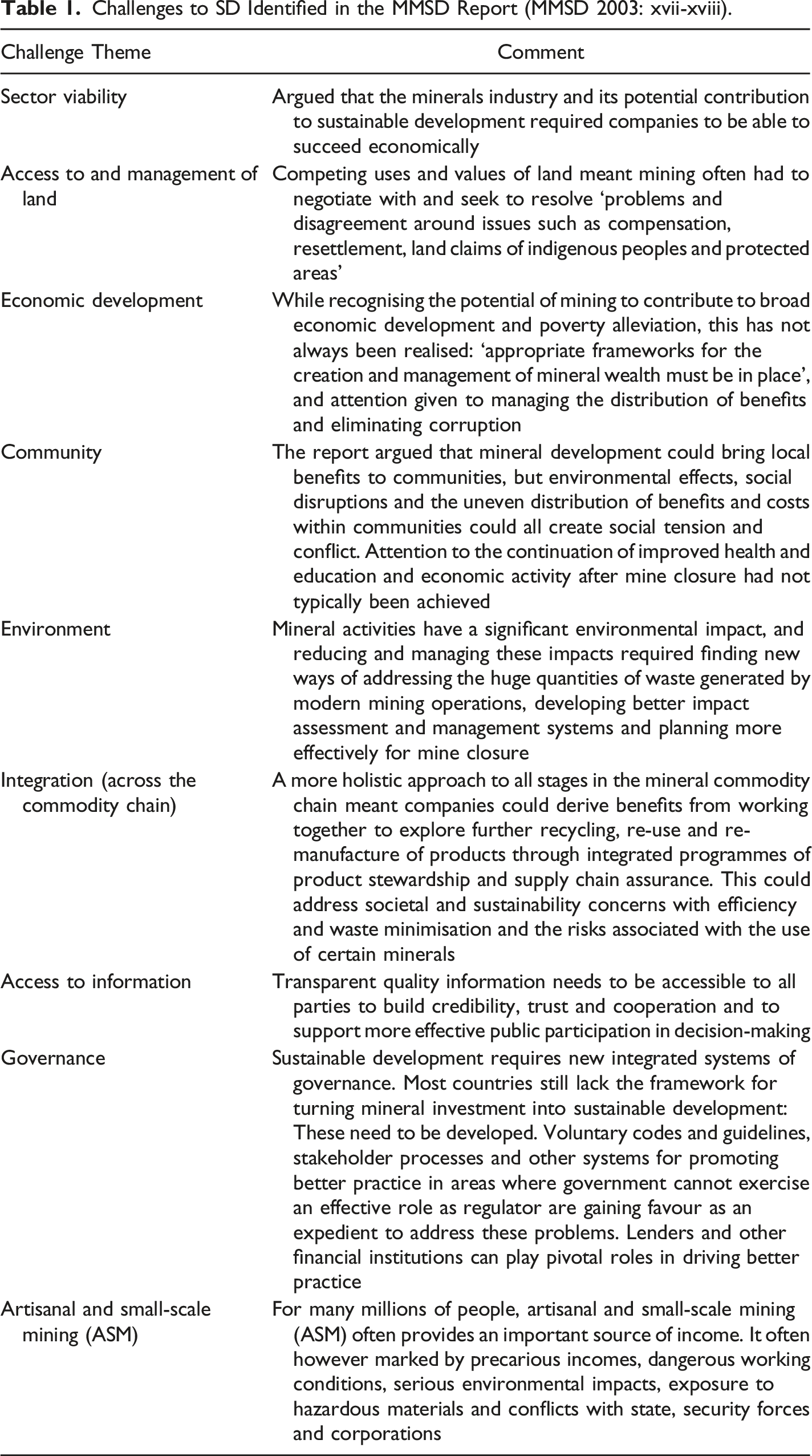
The MMSD process and report is largely a proactive one (although, it is also reactive in terms of the industry’s response to external pressures) and can be seen as essentially ‘risk focussed’. A key function of the report and process is that it has served to deflect attacks from critics, but it is also important in seeking to shift the public debate regarding the role of minerals in the context of global concerns with sustainable development. The MMSD report and process were also linked to the elaboration of further global governance structures for the sector, most notably the International Council on Mining and Metals, an influential body of 28 of the world’s largest mining companies and 35 industry associations (representing countries, regions and specific minerals). The subsequent growth of an extensive academic and institutional focus on the sector and its contribution to sustainable development more generally have seen, for example, the establishment of academic journals such as Extractive Industries and Society and significant attention from the World Bank and various arms of the United Nations (such as UNDP).
A more recent example of discussion of sustainable development in the mining sector, and the comparator to the MMSD report here, is the process run by the CCSI, the United Nations Development Programme, the United Nations Sustainable Development Solutions Network and the World Economic Forum over 2016–2017. The final report of the project is entitled ‘Mapping Mining to the SDGs: An Atlas’ (CCSI et al., 2016). While the focus is different and, in some senses, more directed than MMSD as it is only concerned with the SDGs, the report ‘presents a broad overview of opportunities and challenges to demonstrate the actual and potential contributions from the mining sector to the achievement of the SDGs’ (p. 3). The Atlas is also generally more celebratory than the MMSD report, with the language of ‘opportunities’ being frequent, and an emphasis on ‘best practice examples’ (although these tend to be small-scale and issues relating to the scaling up of them are largely left unresolved). The Atlas also makes the case for mining companies to engage in areas such as social inclusion (e.g. contributing to peaceful societies by ‘preventing and remedying company-community conflict, respecting human rights and the rights of indigenous peoples…’ (p. 4)) which are areas where corporations have constantly struggled to align their activities with the imperatives of communities. There is a focus on current practices, rather than what needs to be done, with clear cherry picking (some examples are given below) and many of the more blatant and insidious negative effects and impacts of mining not addressed. In a similar vein to the MMSD report, the Atlas advocates that the ‘mining industry must ramp up its engagement, partnership and dialogue’ (p. 4), rather than work to change the way that it operates structurally.
A comparison between MMSD and the Atlas reveals a distinct shift from (mostly) advice aimed at governments to improve management of the sector, to (largely) the identification of ‘opportunities’ for companies to contribute to sustainable development. In this sense there is movement from the industry seeking ways to manage ‘risk’ (through improved state-led governance and regulation to improve certainty for the industry), to a focus more on corporate responsibility (although still regarded as a ‘risk-mitigation’ tool). Despite some references to how political regimes can influence the effects of the industry on sustainable development outcomes, both the MMSD report and the Atlas frame mining and its management in ways that invoke Ferguson’s (1994) discussion of development as an ‘anti-politics machine’. Both reports tend to ignore power relations (e.g. structural inequality) and both heavily focus on technocratic solutions, partnerships and collaboration as ways to ‘leverage resources’ (p. 11) and deliver sustainable development for communities and states.
Between 1992 and 2016, the mining industry has moved to reorient itself through a series of global initiatives which elaborate ways mining can and does contribute to sustainable development, to the extent that more than any other, the sector is at the forefront of global discussions on sustainable development. Hence, Scheyvens et al. (2016) citing Pingeot (2014) found that of the sectors involved in discussions around the post-2015 development agenda, and the development of the SDGs, the mining sector had the largest presence, a stark contrast to its absence at Rio in 1992.
The mining sector – or at least some mining corporations – has been engaged with elements of sustainability that the SDGs highlight for some time. One example illustrative of this, and of a widely adopted pattern, is in Burkina Faso, Semafo’s Mana mine has been working since 2008 with Windiga Energy to build a 20 MW solar plant, the largest in sub-Saharan Africa will significantly extend renewable, rural electrification in the area. This example reflects the above critique of the Atlas in terms of industry practice – innovation and best practice framed within the language of partnerships. While there is nothing inherently wrong with partnership approaches – and indeed there is much to endorse – the result can be a deflection of responsibility and of a drive to align community initiatives with corporate cost-saving initiatives (in this case energy cost savings) (Gardner et al., 2012). Achieving SDGs will require the cooperation of many actors and sectors of society, and collaborations and partnerships between corporations and the state and civil society are an important manifestation of this cooperation. There is concern, however, that in such partnerships the corporate actor can often claim praise for its involvement (and garner many useful PR photos) and yet at the same time abrogate itself of responsibility for poor outcomes or effects.
Other mining corporations (e.g. Teck and Newmont) have taken to reporting the effects of their activities against the SDGs, although again they are selective in what they have focused on, which is in line with the approach most other sectors and governments also do. In line with the recommendations of the Atlas, some (the RMI & CCSI, 2020 report estimates approximately 10%) of the major mining corporations are now ‘Integrating the SDGs into core business’, through incorporating them into policies, standards and management systems, using the SDGs to direct social and environmental baselines and impact assessments, and even giving the SDGs a role in risk and opportunity decision-matrixes and assessments, and more general planning processes. One example of this is in the AngloGold Ashanti Annual Sustainability reports (AngloGold Ashanti, 2021 for the most recent) where the SDGs fed into the redesign of evaluating the corporation’s contribution are embedded in corporate reporting structures, and specific prioritised SDGs are built into the corporation’s operational direction. Most corporations though continue to struggle essentially to retrofit their existing ‘sustainability’ efforts into the SDG framework. Rio Tinto, for example, (see https://www.riotinto.com/sustainability/our-approach) map their ‘three pillars’ of sustainability (‘running a safe, responsible and profitable business’, ‘collaborating to enable long-term economic benefits’ and ‘pioneering materials essential for human progress’) to the SDG framework, and Barrick Gold (2021) has just two pages (out of 102) that directly address the SDGs in their ‘The Gold Standard in Sustainability’ annual sustainability report.
In a sense, then, mining companies and their advocates are talking a big game on sustainable development, arguing for a prominent role for the sector in the transformative changes that the SDGs seek to drive across the global community. It is fair to ask how has this gone before? Sustainable Development Goals and SDG reporting are a voluntary (for companies) international set of goals or standard, and there is a plethora of such voluntary standards that the mining industry has been engaging with for decades: it is a crowded field. These questions frame the discussion that follows.
Mining Companies and Internal Actions to Improve Sustainability Impacts
Mining has a history of using external goals and standards to work towards sustainable development. Many firms assert multiple strategies undertaken at high levels to improve their impacts on sustainable development. Much of this is through adopting and implementing international voluntary standards (Dashwood, 2012). As companies have come under pressure to improve their social and environmental impacts, ways to do this without compromising their core business model are not always clear, given that fundamentally the sector relies on some activities that are environmentally destructive. In lieu of obvious answers, companies in the mining sector have turned to international voluntary standards. While it remains easier to change a company’s image than its behaviour and business model, there is a reason to believe that some companies have improved their sustainable development contributions using international voluntary standards. In the rest of this section, we draw on interviews with mining companies and the wider sector to explore why companies engage in international voluntary standards and then how they incorporate sustainable development concerns into their decision-making, largely through their CSR activities.
In the last two decades, the mining industry has embraced international voluntary initiatives around social and environmental performance with a speed that has surprised many industry insiders. A 2009 World Economic Forum survey listed 35 different initiatives of voluntary principles of relevance to the mines and metal sector (Behrendt et al., 2009). The number has grown since, with a recent high-profile addition being the ICMM’s 2020 Global Industry Standard on Tailings Management. These standards have a range of origins from industry itself (International Council on Mining and Metals, Towards Sustainable Mining, E3 Plus), to NGO coalitions (The Devonshire Initiative), governments (the Canadian Extractive Sector CSR Counsellor) and international bodies such as the UN and OECD (Global Compact, Guidelines for Multinational Enterprises). While not exclusive to the extractive sector, many have had a particularly warm reception within it.
Not all standards are equal. In the last 10 years, a handful of initiatives have come to rule. Amongst these are the International Finance Corporation’s (IFC) Performance Standards, the Voluntary Principles on Security and Human Rights, the OECD Guidelines for Multinationals, the Global Reporting Initiative, the ICMM, the World Gold Council, the ISO 14000 series of standards on environmental management and, most recently, the UN Guiding Principles on Business and Human Rights. These initiatives are part of a wider range of voluntary and non-voluntary initiatives in the sector such as certification processes and investor pressure groups and state-led codes such as the adoption of International Labour Organisation Convention 169 on indigenous and tribal peoples into national law, conflict minerals provisions of the US Dodd-Frank Act and the Extractive Industries Transparency Initiative (EITI). Of the private standards, the IFC Performance Standards were considered by respondents as the ‘benchmark’ – the one ‘most rigorous’, aspired to, referenced and influential (Interviews 88, 16/8/11; 105, 18/6/14; 231, 21/10/14). These cover a range of topics including tailing (mine waste) management, health and safety, resettlement and cultural heritage, moving between vague qualitative requirements around consultation to exact technical requirements for slope gradient on tailing dams (IFC, 2012). Though other multilateral investment funds have similar guidelines, the IFC’s are the most widely disseminated and implemented as they have been adopted by over 128 financial institutions in 38 countries as a core element of the Equator Principles. Between them, the Equator Principles institutions provide standards covering ‘over 70 percent of international Project Finance debt in emerging markets’ (Equator Principles, 2017).
What makes a mining company engage with voluntary standards and choose to change behaviour? Our research has uncovered a range of drivers that can be understood on a spectrum from more voluntary to less voluntary in terms of immediately impinging on a company’s ability to operate. At the more voluntary end of the spectrum can be companies seeking to respond to a simple sense of business ethics, that those working in a company do not wish to see it harming wider society and wish to ensure that they, within the bounds of ‘business logic’, support sustainable development. One respondent described this as saying acting responsibly was ‘very much from the heart’ (interview 240, 7/5/15). As noted above, their lack of contribution to sustainable development has undermined the reputation of the industry and specific companies. Adopting international voluntary standards provides a simple way for companies to show their commitment to sustainable development and get a framework for action, guidance on steps forward and connect to network of like-minded peers. One respondent talked of joining the Voluntary Principles on Human Rights as having two drivers: ‘So, those are the two big drivers on that side, reputation is there, but it was sort of a nice solid base, but the network, and knowing that… you know, we had done the work, and we knew we had to improve in a bunch of areas, and we knew that signing on it would force us to…drive that’ (interview 231, 21/10/2014 also interviews 240, 7/5/15; 314, 15/12/14). A poor reputation has indirect impacts on a range of competitive pressures in the sector, most notably those around access to new resources, talent and capital. Here, a poor reputation amongst investors and regulators can increase business costs, for example, by increasing borrowing costs as investors look elsewhere or demand higher premiums to offset increased risks or increasing regulatory oversight. As one respondent put it ‘we can’t afford that reputational hit to say you, you know, you’ve been kicked out of the code or you’re non-compliant here, That affects everything, our share price, local stakeholders, everything; (interview 236, 5/5/15) thus around CSR ‘that bar is increasingly becoming higher and higher from financiers’ (interview 102, 13/6/14, also interview 231, 21/10/2014; 239, 7/5/15; c.f. Prakash, 2000). Similarly, a poor reputation amongst employees can increase staff attraction and retention costs – in an industry facing staff shortages in key areas (Humphreys, 2015) – as employees choose to work for organisations they see as less damaging to wider society: ‘people don’t really enjoy working for crooks and people who rape the environment’ as one respondent bluntly put it (interview 112, 23/5/14). At the less voluntary end of the spectrum, companies can choose to engage in changed behaviour and voluntary standards to respond to immediate threats to business operations – this can include lending conditions, operational disruption, litigation or seeing other companies operating in a similar way or jurisdiction placed in peril. One respondent described a commitment to improving community relations following previous disastrous experience: ‘the guy who was the project manager on [mine], I was then working for him. He had spent a number of years at Ok Tedi, he had been a manager at Ok Tedi, so he was not just in the company, he was there on the ground when things were, when the shit was hitting the fan at Ok Tedi’ (interview 233, 22/10/14) or simply ‘sometimes you learn that through the school of hard knocks. But I’m sure everybody has their unpleasant surprises in that [community relations] process’ (interview 102, 13/6/14). The IFC Performance Standards and Equator Principles noted above are widely applied to mining projects requiring behavioural change which is monitored through annual third-party audits – one respondent described how improving CSR standards was ‘largely driven by that. Every time there’s some major financing deal we tend to get audited on the Equator Principles. But also our own internal audits had a look at our CSR activities as well including our local business development. But yeah, it’s mainly finance’ (interview 112, 23/5/14, also interview 236, 5/5/15). Companies which do not manage their operations in ways which generate community consent – the fabled ‘social license’ – can see their operations disrupted. Community conflict is potentially very costly for companies, as one respondent put it ‘you lose millions in a couple of days’ (interview 227, 5/9/14), while Franks et al. (2014) found the average cost for large companies of forced closure was more than $1mn a day. Some respondents spoke of changing behaviour after seeing other similar companies get into costly, potentially company-threatening conflicts – ‘A bad quarter won’t stop us but losing social license will break you’ (interview 95, 26/8/2011) – reflecting the 1990s experience of companies such as Placer Dome (now Barrick), Rio Tinto and BHP’s OK Tedi in Papua New Guinea (see Filer et al., 2008).
In corporate decision-making, many of these drivers are understood as forms of ‘risk’. Companies are arguably not set up to pursue SDGs outside of business logics. One respondent said discussion in board was ‘substantially framed around risk’, but there was ‘room to today to talk about … we also have a responsibility’ (interview 240, 7/5/15) while another CSR head introduced themselves as being ‘responsible for non-financial risk management’ (interview 227, 5/9/14). Thus, sustainable development considerations have entered mining company decision-making through ongoing processes of risk management (Franks et al., 2014; Owen & Kemp, 2013). ‘Strategic risk management’ has become central to corporate governance in the mining sector as mining is a traditionally risky business – with fixed, long-term, large capital investments tied to fluctuating international markets and environmentally and socially disruptive operations. As sustainable development moves into corporate decision-making, it becomes subject of new logics and pressures; it becomes both able to be prioritised and acted upon within existing decision-making frameworks by this move, but also limited and reshaped by it, as discussed below. Mining companies filter the drivers discussed above through the lens of seeing them as different kinds of risk, namely, operational, reputational and regulatory (or legal/political) (Frederiksen, 2018). Hence, risks associated with operation disruption such as community conflict over negative environmental impacts are seen as operational risks, those that could lead to negative perceptions of company behaviour are seen as reputational risks and those that could see costs from regulatory pressure, change or litigation are seen as regulatory risks.
At the local level, as sustainable development moves into corporate decision-making through risk management procedures, the resulting support for local sustainable development can be well funded and central to decision making but still not support sustainable development (and thus the SDGs) for those living near operations (c.f. Gilberthorpe & Banks, 2012). This is due to how the risk management framework reshapes sustainable development within mining company decision-making. First, it remains easier to change image than practices (Utting, 2005). Thus, public relations can address many reputational risks. Critiques that see mining company moves around sustainable development as simply ‘window dressing’ therefore have some validity (Slack, 2012 p. 179). Neither are they the whole picture. In our research, respondents discussed how seeing sustainable development challenges as forms of risk could see resources committed to highly visible initiatives, but not necessarily those with the greatest potential to support sustainable development. Companies could commit resources to be seen to be committing resources, giving the initiatives adopted a supply – rather than demand-driven focus (Banks et al., 2016). A risk management approach brings with it a mode of prioritisation which may not align with wider understandings of sustainable development. For example, the priorities acted upon are unlikely to be those with the most potential to benefit from local sustainable development programmes (c.f. McLennan & Banks, 2019). Indeed, the risks measured and acted upon are those to which company boards have the most accountability, and these are not necessarily the risks faced by communities in developing countries living with operations, they are risks to investors. Thus, local spending on sustainable development in many operations contains biases. Targets of spending are those who pose the greatest risk to the operations and those with the greatest ability to reduce this risk. This sees resources frequently targeted at local elites through, for example, contracts to build infrastructure and labour contracts, while groups such as women or children are less likely to benefit (Frederiksen, 2019). With many of the intended audiences of local sustainable development initiatives not at the local level, the resulting programmes often see resources captured by local elites curtailing their ability to support wider sustainable development.
At the international level, the ability of voluntary standards to fundamentally change corporate behaviour is limited by factors beyond a risk management approach. Companies may not mainstream standards adopted, particularly larger companies. The department signing standards may not have wider influence in the company or those managing community relations may not have influence over operations: ‘there’s this inherent, um… irony or problem in the fact that community relations have been given the task of establishing and maintaining social licence to operate, but have zero control, and very little influence, over the issues that actually matter to communities. So, unless you can… change the strategy so that … the problems and benefits are owned by the other departments of the company, then you’re never going to get away from this problem’ (interview 231, 21/10/14, also interview 360, 17/5/18). With many larger companies organised around separate business units, influence across units can be weak. In our research, the hierarchical nature of companies across the industry obstructed operationalising abstract standards. Rather than change behaviours of core business units, or bring in expertise in aspects of sustainable development, some companies engaged in ‘partnerships’ with civil society actors to improve their impacts. This, in practice, frequently meant subcontracting – a common feature of inter-organisational relationships in the mining sector (Bainton and Jackson, 2020). Adopting other modes of ‘partnership’ seems to have been difficult for many companies, and research has pointed to asymmetries of power in these relationships in the past (Gardner et al., 2012; Owen & Kemp, 2017). Further, the nature of the standards may not help their operationalisation. The most discrete, concrete and able to be certified standards (e.g. Cyanide Code, ISO 41000) often demonstrated the most evidence of being widely operationalised. Those that investors demanded also showed evidence of more widespread adoption (e.g. IFC Performance Standards or the Global Reporting Initiative) as these were often tied to specific reporting standards. Conversely, companies which signed up to the more-vague, less-monitored standards showed least progressive practice (e.g. the UN’s Global compact). All of these bode poorly for the SDGs. The next section discusses the implications of this history for the mining industry’s engagement with sustainable development for the SDGs, emerging evidence and alternative conceptions of mining and sustainable development.
Discussion: Mining and SDGs
Mining has successfully positioned itself more centrally to debates on sustainable development despite, as noted above, research on its impacts indicating that it is still largely unsustainable and a major contributor to the problems the SDGs seek to address (CCSI et al., 2016). This is particularly the case in relation to the sector’s role in the supply of materials for new, fossil-fuel alternatives in energy materials and technologies (Lèbre et al., 2020). While the industry press often talks of unsustainability in the past tense, there is no reason to believe that these behaviours have ceased. It is, as we have argued, inherent in the production process of the industry which, understandably, the sector is less keen (or able) to address directly due to associated costs. In this section, we explore some trends and consequences of the mining industry’s approach to sustainable development for its ability to contribute to achieving the SDGs, before reflecting on what a mining industry that thoroughly committed to sustainable development might look like.
Is the mining industry’s engagement driving notably better, more effective sustainable development practices? We remain unconvinced. Mining is a leading industrial sector in terms of its engagement with the sustainable development doctrine. The major documents that have shaped the industry’s engagement with sustainable development (the MMSD project report and the SDG Atlas) and the corporate statements above argue for a profound engagement of the industry with the principles and rhetoric of sustainable development. However, looking at the industry’s previous engagement with a range of voluntary initiatives, the SDGs share many characteristics with those that in our research have led to the least changed behaviour. Standards which have most driven behavioural change are focussed, concrete, tied to lines of accountability (e.g. investors and lenders) and compatible with existing decision-making processes within companies (e.g. easily slot into existing processes for environmental management). The SDGs are big, broad and, even among the targets, abstract and hard to measure and monitor progress. There is also an absence of clear lines of accountability for them – as noted earlier the industry discussions of the SDGs often highlight the collective role of a range of actors and partnerships in delivering the SDGS. While states are clearly the central actors in delivering the SDGs across the globe, here we argue that this focus on partnerships is partly an effort to deflect attention from mining’s core contribution to unsustainable development.
The SDGs do not set out a clear, concrete agenda for action and are thus unlikely to deliver sustainable development. The SDGs are a wish list. They allow for cherry picking, by nations and companies, as we have seen above. This means they easily reproduce historic absences in mining companies’ sustainable development and CSR agendas, such as labour rights and relations, pensions, subcontracting and Free Prior Informed Consent. Importantly, emerging evidence of how companies are tackling the SDGs gathered by a Responsible Mining Initiative analysis of company reporting highlights a striking mismatch between areas of company impacts and areas of action (RMI & CCSI, 2020). Areas where the industry has the worst impacts often see the least action. They argue that ‘looking at the three SDGs for which mining companies pose the highest risk of negative impacts (according to S&P Global), two of these receive some of the weakest levels of action by companies: SDG 6 (Clean Water and Sanitation) and SDG 14 (Life Below Water)’ (RMI & CCSI, 2020: 37). Even within these, action is unbalanced, for example, for SDG6, companies focus more on community projects on sanitation rather than their own impacts on water quality – one of the most widespread and contentious impacts of the mining industry across the globe (RMI & CCSI, 2020). Where the RMI feels the 38 companies surveyed have performed better are SDG 4 (Quality Education), SDG 15 (‘life on land’) – surprising given that extensive destruction of land and environments is marker of larger scale mining – and, perhaps ironic given what we have noted above, SDG 17 (‘Partnerships for the Goals’).
The historical approach taken and framing of sustainable development serve as an obstacle to many ways the industry could support sustainable development. We identify three main ways this occurs. (1) The fundamental processes of production are largely off limits in the discussion. (2) Much like historical efforts on CSR, there is an emphasis on rhetoric over action. This is long identified in the sector and has led to accusations of greenwash (e.g. Brock & Dunlap, 2018). Even most companies that choose to report on the SDGs do so in ‘cosmetic’ ways, eschewing a deeper engagement with what orienting operations towards the SDGs might mean (RMI & CCSI, 2020: 5). Mining is an industry that has a history of misrepresenting its impacts; its efforts around the SDGs appear to do little to change this (e.g. Brock & Dunlap, 2018; Kirsch, 2014). (3) These are interventions that largely ignore politics and the complicated and contradictory processes that shape sustainable development. In them, sustainable development is framed as an apolitical technical process, not one which involves trade-offs against competing priorities. This criticism has been levelled at the SDGs overall and applies equally to the mining industry’s engagement with them (Hope, 2021; Nilsson et al., 2016). In treating sustainable development as a technical problem to be fixed, deeper conversations are curtailed or avoided. These moves to ‘render technical’ or simplify are not without consequence and can have negative effects (Ferguson, 1994; Frederiksen, 2018; Li, 2007). Often CSR and sustainability initiatives are used to manage a range of strategic pressures on operations (such as stakeholder dissatisfaction), crowding out the aim of contributing to sustainable development (Frederiksen, 2019).
Corporate Behaviours that Would Promote Sustainable Development.
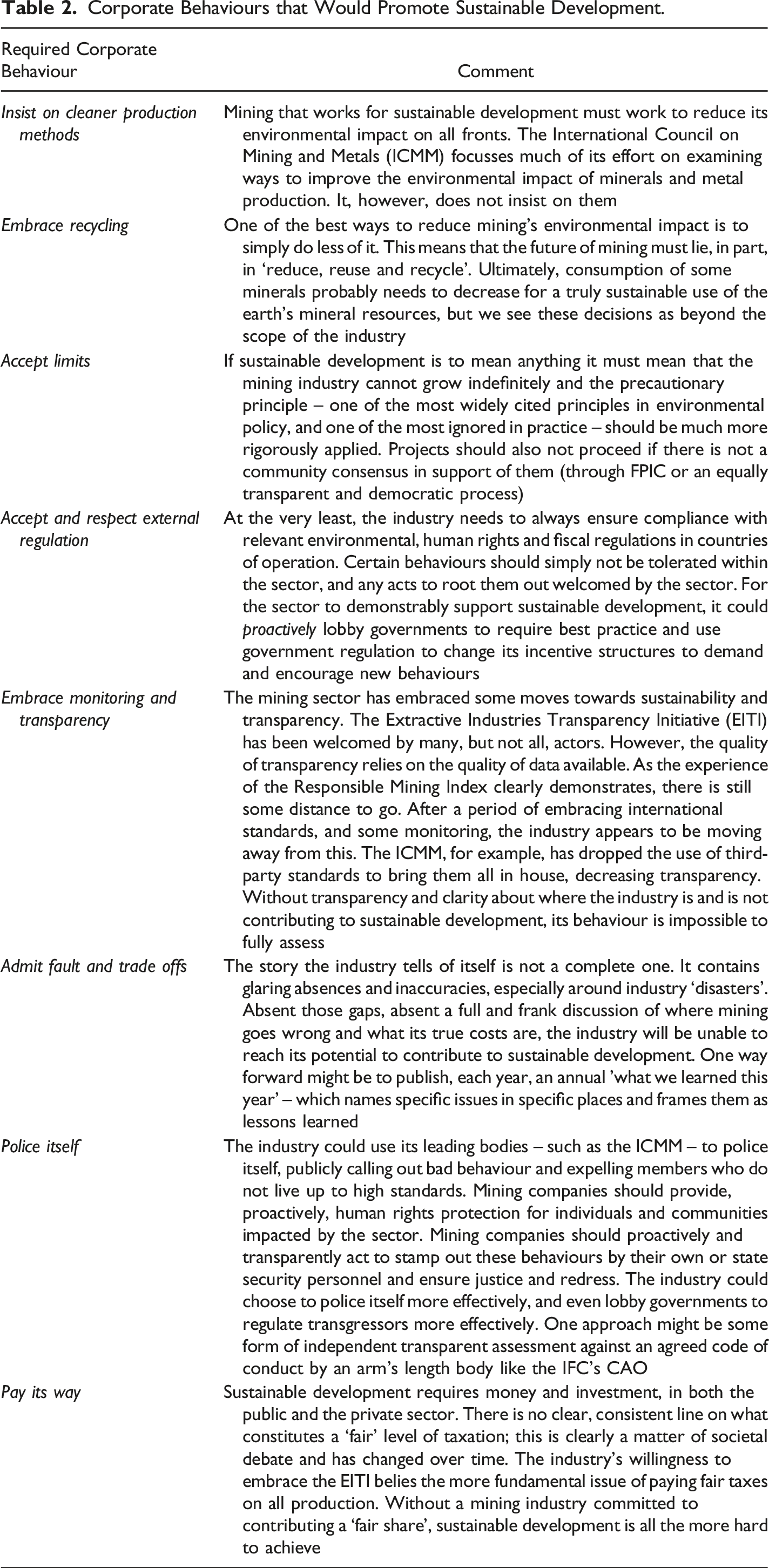
We have taken up this discussion more fully elsewhere (Frederiksen & Banks, 2022), but even this very brief exploration highlights how far the sector is from one that fully embraces its potential to advance sustainable development.
Conclusion: Mining and the SDGs
Mining is a leading industrial sector in responding to shifting currents of sustainable development, and recently the SDGs. In part this responsiveness is due to pressure on the industry – NGO campaigns, the need to address environmental and social ‘legacy’ issues associated with past mining practices and on-going concerns around SLO – but the industry has proactively sought to place itself into the debate on the SDGs. In examining how the industry conceives of sustainable development in landmark reports, we have shown how the industry responses to the sustainable development agenda reveal attempts to shift the discourse and focus away from core aspects of mining (extraction of non-renewable resources) and broad structural issues. Instead, the industry positions mining and sustainable development as compatible, reliant on technologies, partnerships, collaborations and a crucial provider of financial and material resources needed for sustainable development and low-carbon transitions. Our analysis of industry engagement with previous sustainable development standards and initiatives into their operations and behaviours does not auger well for the SDGs. Adoption and application have been uneven and driven and shaped by internal responses to strategic pressures the industry faces. Centrally, the ways in which these pressures feature in company decision-making shape the forms responses take. In the case of much effort around sustainable development, this has been the lens of risk management. The lens of risk management leads to a situation in which most sustainable development aims are crowded out and the most marginalised often benefit the least. Further, many of the features of the SDGs are ill suited to driving change in the industry – they are broad, abstract and not well tied to key pressures shaping behaviour like profitability and shareholder pressure – despite potentially posing regulatory and legal risks in years to come.
The prospects for the mining sector taking up its full potential to deliver the SDGs are slim. Despite decades of engagement with sustainable development, too much about how the industry continues to operate contributes directly to the very problems the SDGs seek to address. Even when the industry does its best to highlight how the industry can and does contribute to sustainable development, glaring absences remain, with some of these efforts having been branded ‘SDG-washing’ (RMI & CCSI, 2020, p. 3). Further, we are pessimistic – or, clear-sighted – about the prospects of the SDGs driving change in the sector. Directly, they are slim. The nature of the SDGs and how they are translated into decision-making within companies militate against this. While some research does point to role of shifting societal expectations in changing industry behaviour, our own research highlights direct pressures and the lens of risk management as being central (Dashwood, 2014; Frederiksen, 2018). If the industry is to deliver on its potential to support the SDGs, more radical change is required. We have briefly elaborated some of the ways this might manifest. It is here, in an industry that embraces new production methods and recycling, accepts limits, polices itself and pays its way, the best chance of delivering the SDGs through the mining sector lies.
Footnotes
Declaration of Conflicting Interests
The author(s) declared no potential conflicts of interest with respect to the research, authorship and/or publication of this article.
Funding
The author(s) disclosed receipt of the following financial support for the research, authorship and/or publication of this article: This research received financial support from the Department for International Development; PO 5113 and British Academy; pf130031.
