




Abstract
Over the last two decades, natural resource governance has become an increasingly important element of South American regionalism as commodities became a central driver for regional development strategies. Yet, due to socio-environmental impacts and dissatisfaction with decision-making processes, it is also frequently contested. This article focuses on one particularly prominent contestation with transboundary and regional repercussions, the case of the pulp mill conflict which escalated between Argentina and Uruguay in the 2000s. Using the concepts of regionness and politics of scale, it examines in which ways the pulp mill conflict affected regional cohesion and seeks to understand why it evolved in this way. This shows that the way national governments address socio-environmental conflicts is an important additional obstacle to regional cohesion which has received little attention in studies of South American regionalism so far.
Keywords
Introduction
Natural resource governance has always been an important element of Latin American regionalism and development strategies. Already in the 19th century as Latin America went through the process of building independent nation states, the sense of a regional identity and shared past was reinforced by shared development patterns based on exports of natural resources to industrialized countries. A century later, during the 1950s and 1960s the desire to reduce the traditional dependency on primary commodity exports played a central role in strategies to foster regional economic development and a fairer insertion in the global economy (Deciancio, 2016, pp. 108–111).
In the 2000s commodities became a central driver for regional development (Vivares, 2016, p. 1) and exports of natural resources provided important revenues for national and regional development (Estay, 2018, pp. 59–61). This also meant that regional infrastructure developments became a significant part of regional projects. These often involve the region’s river basins, and a major motivation is to facilitate South American natural resource exports. Because of the importance that natural resources gained in regional projects during the 2000s, South American regionalism has also been characterized as “resource-driven” integration (Saguier, 2012). Regional infrastructure projects and resource-driven integration are one of the most contested dimensions of South American regionalism due to the social and environmental impacts and decision-making processes that are often perceived to lack participation mechanisms and transparency. While there have been several studies on how socio-environmental conflicts over natural resource governance affect national and local politics in South America (Bebbington, 2012; Christel & Gutiérrez, 2017; González, 2019; Haarstad, 2012; Seghezzo et al., 2011), their repercussions for South American regionalism deserve more attention.
To examine the intersections between natural resource governance and regionalism in more depth, the article returns to one particularly prominent contestation with transboundary and regional repercussions, the somewhat puzzling case of the pulp mill conflict which escalated between Argentina and Uruguay in the 2000s. When a road block maintained by a Citizen Assembly closed off the main road connection between the two capital cities of Argentina and Uruguay for several years causing a major disruption to trade and transport between two of Mercosur’s founding members, disagreements over the socio-environmental impacts of a large-scale pulp mill to be constructed on the shared Uruguay River escalated to a full-blown international conflict that cooled down relations between the two previously friendly neighboring countries and affected working relationships and trust within regional organizations. The conflict continued for the most part of the decade and was only resolved through a ruling of the International Court of Justice (ICJ) in The Hague without involvement of any of the region’s existing institutions.
It is clear that the pulp mill conflict somehow impacted not only on bilateral relations but also on regional organizations; yet, the precise mechanisms of this have not been examined. It is somewhat surprising that the conflict was not resolved quicker and less acrimoniously, given the existence of several regional institutions and the shared political outlook and declared commitment to regional cooperation of the two countries involved. The analysis of the conflict in this article, therefore, has two aims: first, it examines in which ways the pulp mill conflict affected regional cohesion, and second, it seeks to understand why it evolved in this way. I argue that two elements in particular were important in the conflict’s escalation and had implications for regional cohesion. First, the protests turned from a shared environmental concern to a national cause due to the way that national governments channeled civil society demands and safeguarded economic concerns over sustainability. Second, in an example of “politics of scale,” existing regional organizations were sidelined by both Argentina and Uruguay as well as Brazil. It also demonstrates the limits of local action. Although the protesters in Argentina were able to put pressure on the national government and gain international attention, their objective of stopping the construction and operation of the mill was not achieved, and in fact, sustainability concerns lost in visibility as the conflict evolved.
The case clearly shows how socio-environmental conflicts can impact on regional cohesion. In some ways, natural resource governance as a central pillar of South American regionalism can thus be seen as a barometer for its performance. The way governments address socio-environmental conflicts is an important additional obstacle to regional cohesion which has received little attention in studies of South American regionalism so far. These findings are important for the outlook for regionalism in South America because reports of socio-environmental conflicts linked to natural resource governance continue to rise and some other conflicts also have transboundary dimensions. At the same time, political shifts in the last years have changed the nature of regionalism to less institutionalization and a focus on trade with little attention to other concerns.
The article is structured as follows. The next section introduces the concept of regional cohesion and the notion of politics of scale as key conceptual elements to guide the analysis of the pulp mill conflict. This is followed by an overview of the puzzling case of the pulp mill conflict, and the methods used to show why the pulp mill conflict can be regarded as a critical case for South American regionalism that still has relevance today. The subsequent sections then present a detailed analysis setting out in which ways the conflict affected regional cohesion and tracing why it evolved in this way. The conclusion offers some policy implications and reflections going beyond the specific case of South America.
Constructing Regions Through Natural Resource Governance
Conceptually, this article adopts a constructivist approach that combines the concept of regionness developed by scholars of the New Regionalism Approach to capture differences in regional cohesion with the notion of politics of scale that has been used to analyze water governance and hydropolitics to understand why decisions are taken at certain levels and how power relations between different actors play out. This shows that regions are also defined and shaped through natural resource governance.
The New Regionalism Approach expanded the analytical lens of the study of regionalism to go beyond formal state-led regional organizations and take into account a wider variety of state and non-state actors and different types of regional interactions on a range of topics. Regionalization is, therefore, a dynamic and multidimensional process that happens not just through formal intergovernmental exchanges but through interactions between a much wider range of actors (Hettne, 2005; Hettne & Söderbaum, 2000). In order to facilitate comparisons of regionalism around the world, Hettne and Söderbaum developed the concept of regionness to capture differences in regional cohesion (Hettne & Söderbaum, 2000). These are important because they matter for the quality and legitimacy of regionalism within a region and for a region’s position in the global economy and its ability to shape rather than just react to external events. Hettne and Söderbaum outline five levels of regionness but point out that only the European Union exhibits characteristics of the fifth level, a region state where sovereignty is pooled and authority and decision-making are layered and decentralized. This is still true 20 years after the publication of the article. What is more, although many regions show traits of the third level, a regional society, characterized by increasing interactions between state and non-state actors at the regional level, few regions outside Europe, if any, can be said to have reached the fourth level of a regional community. A key element of a regional community is the mutually reinforcing relationship between the “formal” region which is determined by states, and what Hettne and Söderbaum call the “real” region which encompasses the activities of a transnationalized regional civil society (Hettne & Söderbaum, 2000, p. 466). This also leads to an increase of mutual trust. It is when processes at different levels and in various sectors converge and reinforce each other that a regional society starts turning into a regional community. Regional cohesion thus depends not only on formal state-led regional organizations but on the regional interactions between a wider range of actors.
The New Regionalism Approach is based on the understanding that “there are no ‘natural’ regions, but these are made, remade, and unmade—intentionally or non-intentionally— in the process of global transformation” (Söderbaum, 2016, p. 28). There is thus nothing inherent about the region as a scale for decision-making or for natural resource governance. Rather, as scholars of hydropolitics also note, scales are socially constructed (da Silva & Hussein, 2019, p. 44) and power relations produce scalar structures through different kinds of interactions (da Silva, 2018, p. 142). Different political and ecological scales become prominent according to the national political goals at stake. Hydropolitics in the La Plata basin then is a continuously evolving process involving different actors leading to multi-scalar politics within and beyond South America (da Silva & Hussein, 2019).
It is important to point out that watersheds are not only about managing water, but also closely intertwined with land use (Norman & Cohen, 2016, p. 80). Natural resource governance combining both watersheds and land use in river basins is therefore an important pillar of South American regionalism, but also an outcome of power relations in multi-scalar politics. Non-state actors are important in this and often bring in sub-national or international dimensions (da Silva, 2018, p. 138), but national governments and interests and particularly those of the most powerful states retain a central role (da Silva & Hussein, 2019, p. 51).
Putting Regional Organizations to the Test: The Puzzling Case of the Pulp Mill Conflict
During the 2000s, concerns over a river shared between Argentina and Uruguay, two formerly friendly neighbors, escalated to the extent that diplomatic relations, trust, and working relationships within regional organizations were affected, a road block interrupted traffic between two of Mercosur’s founding member states for several years, and as the conflict went on, civil society mobilizations shifted from incipient regional interactions to firmly national platforms. The origins of the pulp mill conflict between Argentina and Uruguay lay in the decision of Uruguay’s government to authorize two European transnational companies, the Finnish Botnia, taken over by the Finnish UPM in 2009, and the Spanish Ence, to build two large pulp mills. The planned locations were on the Uruguay River which is part of the larger La Plata basin in a section where the river forms the border with Argentina. Initially, this sparked concerns by residents on both sides of the river who were worried not only about the impact of the mills on the natural environment but also tourism, water quality, and health. However, when the second mill was authorized, the protests became much stronger on the Argentinean side with large-scale mobilizations in the city of Gualeguaychú drawing support from all social sectors and the local media. In April 2005, over 40,000 people came together in a large-scale protest at the international bridge over the river. From this, a citizen assembly for the environment (Asamblea Ambiental Ciudadana Gualeguaychú, in short “Citizen Assembly”) developed and became a central actor in leading further protests. A year later, Ence decided to change the location of its mill, but protests continued against the larger Botnia/UPM mill. When the World Bank approved a US$170 million loan to the company in 2006, the Citizen Assembly decided to block the bridge indefinitely (Berardo & Gerlak, 2012, p. 109; Waisbord & Peruzzotti, 2009, p. 693). After the Argentinean government had referred the case to the ICJ in The Hague a second time, the conflict was eventually resolved in 2010. The ICJ ruled that although Uruguay had breached the bilateral treaty on the Uruguay River and should have informed Argentina about its plans, the mill posed no significant environmental risk and could therefore continue, a verdict which was accepted by the Argentinean government (Berardo & Gerlak, 2012, p. 110). Consequently, the Argentinean government withdrew its support for the protests and this effectively meant the end of the road block.
The conflict is related to natural resource governance in several dimensions. Most obviously, it was a disagreement over the use of a shared river. In addition, it raised broader questions regarding large-scale projects for natural resource exports and land use changes as large areas in the region have been turned into plantations for the paper industry. While the pulp mill conflict became a particularly well-known case due to its transboundary implications and international headlines, it is certainly not the only socio-environmental conflict related to resource governance in the region. Rather, the mobilizations against the mill are part of a larger pattern of protests against large-scale regional infrastructure projects by those directly affected and social and environmental groups (Hochstetler, 2011; Humphreys Bebbington et al., 2018, p. 193; Saguier, 2012, 2018, p. 378). In some cases, these also have transboundary dimensions, for example, the protests in relation to the over 300 dams planned in the Amazon basin (Gerlak et al., 2019). Examining the evolution of the pulp mill conflict and its impacts on regional cohesion, therefore, still holds relevance today.
While the pulp mill conflict is not the only socio-environmental conflict, it can be regarded as a critical case for South American regionalism which put existing regional institutions to a test. In many ways, the conditions for regional cooperation during the 2000s were in fact relatively good due to the combination of two elements. First, there were several regional organizations whose remit also covered river basins, natural resources, and environmental governance. Two regional organizations in particular would have been quite obvious contenders for dealing with the conflict: the joint Administrative Commission of the Uruguay River (Comisión Administradora del Río Uruguay or CARU) and Mercosur. Already in 1975, Argentina and Uruguay had signed the Statute of the Uruguay River and established the joint commission CARU with the aim of promoting cooperation on the transboundary aspects of river basin governance. CARU is part of a broader institutional framework covering the whole of the La Plata River basin. The overarching framework for cooperation in the basin which spans across five countries is the La Plata Basin Treaty signed in 1969. Over the years, this has been complemented with a web of further treaties, technical commissions, and a permanent secretariat and funding mechanism (Gilman et al., 2008; Kempkey et al., 2009). CARU has been classified as an international river basin organization in a study of transboundary river basin governance around the world, thus meeting the criteria for a relatively high level of institutionalization and permanence (Schmeier et al., 2016). In addition to the La Plata basin institutions, Argentina and Uruguay are also two of the four founding members of the regional organization Mercosur which has frameworks for cooperation in the area of environment and natural resources (Chidiak, 2012, p. 128; Doctor, 2013, p. 535; Hochstetler, 2003; Siegel, 2017, pp. 66–67).
Second, the pulp mill conflict occurred during a period of relative political and economic stability when governments highlighted their commitment to regional cooperation also beyond trade integration. Although the regional organization Mercosur suffered from the aftermath of the Argentine crisis in 2001 (Carranza, 2003), prospects for regionalism appeared to be strengthened by political developments in the following years when a wave of leftist governments were elected across the region including Argentina and Uruguay. There were many important differences between these governments, but having come to power as a reaction against the neoliberal policies of the previous two decades which had become highly unpopular, they shared some approaches to domestic politics and external relations. This included a renewed commitment to regionalism with a new emphasis sometimes referred to as “post-hegemonic” or “post-neoliberal” (Riggirozzi, 2012b; Riggirozzi & Tussie, 2012). Reflecting developments at the national level, the two regional organizations created in that time, the Brazilian-led UNASUR and the Venezuelan-led ALBA, prioritized domestic needs such as education, health and employment, and regional needs, notably energy and infrastructure, while also seeking to limit US influence in the region (Chodor & McCarthy-Jones, 2013; Luchetti, 2015; Riggirozzi, 2012a).
The 2010s saw the end of South America’s left-wing cycle coupled with the end of the commodity boom and this also changed the nature of regionalism. In 2012, the Pacific Alliance was created by a group of right-wing governments not only to promote trade in the region but also to strengthen trade relations with economic centers in the Asia-Pacific. The Pacific Alliance is characterized by a low level of institutionalization and a focus on trade and national sovereignty (Quiliconi & Espinoza, 2018, p. 294; Thoene et al., 2017). Obstacles to regional cooperation in South America have always persisted, including a lack of political will to create supranational institutions on the part of governments that often prefer to resort to inter-presidentialism (Malamud, 2003, 2015). However, looking back, in comparison, the 2000s in many respects offered a relatively favorable context for South American regionalism and dialog with civil society organizations due to shared political views and a commitment to regional cooperation beyond trade. The fact that a conflict over a shared natural resource could not be resolved quicker, less acrimoniously and within the existing regional institutions, indicates how sensitive the issue of natural resource governance is for the region and how much opinions diverge, not only between states but also between governments and citizens.
The article traces the evolution of the pulp mill conflict drawing on semi-structured interviews with 24 key informants from civil society organizations working on regional and transboundary environmental concerns and river commissions of the La Plata basin in Argentina, Uruguay and neighboring countries, 1 and civil society reports. The interviews were part of a larger study on regional environmental governance in the La Plata basin and the Southern Cone more generally (Siegel, 2017). Interview topics included the development of regionalism, cooperation and conflict in the La Plata basin, and regional civil society initiatives. The interviews were carried out in 2010 and 2011 after the final ruling of the ICJ. This made it possible to look back and discuss how the conflict had evolved over time.
Channeling Civil Society Demands: From a Shared Environmental Concern to a National Cause
Although the pulp mill conflict took on international dimensions, tracing its evolution shows that its source was not a conflict between states but rather a disagreement between governments and citizens regarding the priorities and purposes in the governance of a shared river and decision-making processes in relation to this. State–society interactions are thus a crucial component in the evolution of the conflict. While governments prioritized the economic benefits of the paper industry as well as electoral concerns, civil society demands reflected broader sustainability concerns. Without regional mechanisms able to address the shared environmental concerns and facilitate citizen participation in decision-making, the conflict escalated and came to be framed as a national cause, turning it into an international conflict.
For Uruguay, the installation of the disputed Botnia/UPM plant was the outcome of several decades of government policies promoting the paper industry in the country. The Botnia/UPM pulp mill represents the largest foreign investment in the country’s history and firmly established Uruguay as a key location for the paper industry. Twice the size of a normal size pulp mill in Finland, the scale of the plant is also significant in a global comparison (Pakkasvirta, 2008, p. 422). According to the data provided by UPM, the plant in Fray Bentos in Uruguay has an annual production capacity of 1.3 million tonnes compared to 870,000 tonnes of the largest plant in Finland.
2
Data from the FAO demonstrate that exports of chemical wood pulp in both mass and monetary value increased substantially from 2007 onward, the year the Botnia plant went into operation (see Figure 1).
3
A second mill with a similar capacity was inaugurated in 2014 operated by Montes del Plata, a joint venture of the Chilean Arauco and the Swedish–Finnish Stora Enso. Plans for a third plant, to be operated also by UPM, are ongoing. Chemical wood pulp exports Uruguay 2000–2017. Source: Author’s elaboration based on data provided by FAOSTAT (http://www.fao.org/faostat/en/#data/FO).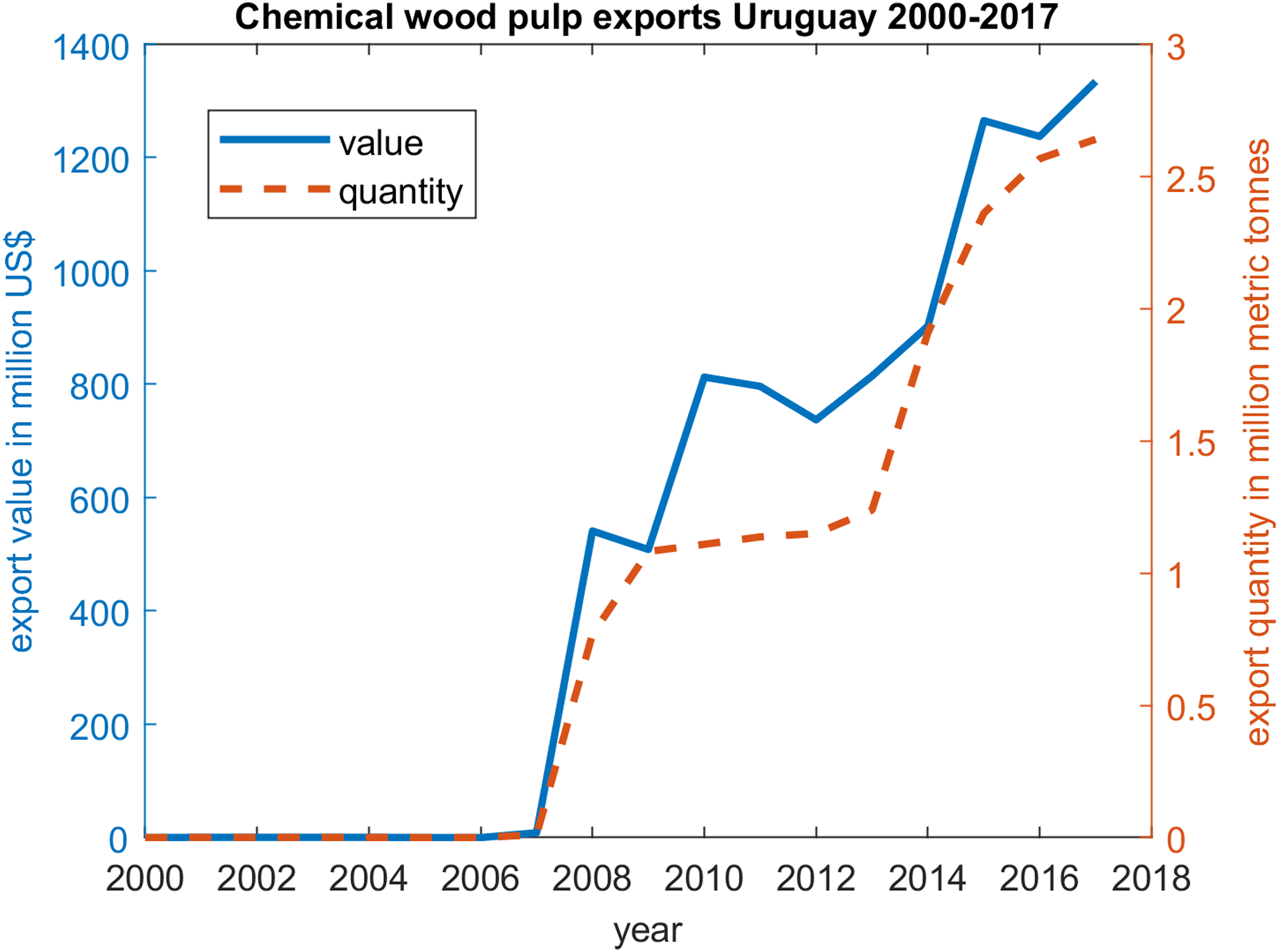
The installation of the mills was the outcome of a longer process as the paper industry has been actively promoted by different Uruguayan governments and international development agencies (Gutiérrez & Panario, 2014). An important milestone was the Forestry Law approved in 1987 under the conservative government of President Sanguinetti declaring the forestry sector a national interest and establishing favorable conditions for foreign investors including state subsidies and tax exemptions. Together with good environmental conditions and an absence of land conflicts, this made Uruguay a promising location for the paper industry. As a result large-scale plantations of non-endemic eucalyptus trees providing the raw materials have expanded exponentially over the last decades (Gutiérrez & Panario, 2014; Pakkasvirta, 2008, pp. 427–428; Switzer, 2014, p. 78). The ties with Finland, a country that is home to a well-established paper industry, were reinforced with the signing of a bilateral investment treaty in 2002 granting Finnish investors very favorable conditions (Chidiak, 2012). Although the left-wing Frente Amplio coalition sided with environmentalists and criticized the construction of the mill on the Uruguay River before it was elected (Berardo & Gerlak, 2012, p. 107; Pakkasvirta, 2010, p. 77), this position changed once in government. The support for the paper industry and the construction of new mills continued also under the Frente Amplio government (Ortiz et al., 2005).
Initially, a broader civil society coalition mobilized against the plant due to wider sustainability concerns including potential water and air pollution but also negative impacts on the landscape and tourism. Significantly, this included Uruguayan environmental groups who sought to work together with Argentinean activists to protest against the mill (Pakkasvirta, 2010, p. 61; Sannazzaro, 2011, p. 216; Waisbord & Peruzzotti, 2009, p. 693). The environmental and social impacts of the paper industry have also been documented by researchers and NGOs based in Uruguay (Céspedes-Payret et al., 2009; Ortiz et al., 2005). The initial stages of the protests also included cooperation with Greenpeace in a high profile campaign. The protests made international headlines when Gualeguaychú’s carnival queen disturbed the official heads of states picture at the 2006 Vienna summit held between the EU and Latin America and the Caribbean, holding up a sign saying “No pulp mill pollution. No a las papeleras contaminantes.”
However, as the conflict evolved, this broader civil society coalition fragmented. The most important driver behind the protests was the Citizen Assembly in the Argentinean town of Gualeguaychú whose main focus was to stop the construction and operation of the large-scale mill on their doorstep. The aim of Greenpeace on the other hand was to develop better regulations of the paper industry in the region in general. As a result of differing priorities, Greenpeace withdrew from the protests later on. 4 Moreover, existing regional institutions did not provide any opportunities for public participation in decision-making. Initially, many members of the Citizen Assembly had hoped that an agreement could be negotiated through the CARU, but then found that the joint river commission was not able to function autonomously from governments and channel public demands or provide formal channels to allow non-governmental stakeholders to participate in decision-making (Berardo & Gerlak, 2012, pp. 113–114).
With no formal participation channels to resort to, the Citizen Assembly looked for other strategies and ways of framing the issue. This included focusing on global environmental justice by pointing out that much of the paper consumption is in the global North, whereas it is the global South that is left with the environmental pollution. Moreover, the members of the protest movement argued that the company is European, but such a big factory would not be acceptable in Europe. In an attempt to gain attention and allies globally, the protestors also targeted European governments, for example, through protests in front of the Finish embassy. 5 However, these strategies had little success as the Finish government and the European Commission firmly supported the plant while Members of the European Parliament from the Greens concluded that it complied with European environmental standards (Pakkasvirta, 2008, 2010, p. 87).
Instead, the Citizen Assembly found that the road block was a particularly effective protest strategy which brought high visibility and media attention and eventually the support of the Argentinean government of Néstor Kirchner. Confronted with regular demonstrations bringing together tens of thousands of people, the road block of an international bridge across the river and several Argentinean politicians supporting the protests (Pakkasvirta, 2010, p. 80) the Argentinean government came under considerable pressure. Fearing escalations of social unrest which had driven several presidents from office during the 2001 crisis only a few years before, it tolerated the blockade and openly sided with the protestors in an effort to avoid confrontation (Waisbord & Peruzzotti, 2009, pp. 694–695). Although the Argentinean government temporarily adopted an environmental discourse, it quickly reduced the dispute to a legal question of whether Uruguay had breached the agreement signed between the two countries in relation to the Uruguay River (Bueno, 2010, pp. 171–187). The Argentinean government also encouraged a nationalistic discourse which helped to direct the anger of the citizens away from domestic politics and toward the Uruguayan government instead. This was successful in that President Kirchner did not become the target of the protest, but at the cost of turning the civil society protests into an international conflict (Chidiak, 2012, p. 127; Waisbord & Peruzzotti, 2009).
The focus on legal aspects also helped the Argentinean government to avoid a debate on domestic environmental concerns. This sidelining of environmental concerns was also reflected in the reporting by the Argentinean national media that presented the conflict mainly as a political problem with little coverage of technical aspects or the details of the environmental dimensions (Waisbord & Peruzzotti, 2009). This is important as it implicitly ensured the support for the paper industry across the region. Argentina, Brazil and Chile all have significant areas dedicated to tree plantations and are home to a number of paper and pulp mills (Chidiak, 2012, pp. 129–131; Pakkasvirta, 2008, p. 427). Significantly, in Argentina, there are several pulp mills which are smaller than the disputed Botnia/UPM plant in Uruguay but use older and more polluting technology. 6 Despite President Kirchner’s temporary environmental discourse, there were no substantive changes on river basin governance within Argentina (Bueno, 2010, pp. 171–187; Malamud, 2011, p. 93).
At the same time, the economic costs of the blockade were borne mostly by Uruguay as the other side of the river was cut off from traffic, trade, and tourism from Argentina. While generating a lot of attention and forcing the issue onto political agendas, the bridge blockade thus alienated Uruguayans who felt that this was an unjust and illegal form of protest (Chidiak, 2012, pp. 133–134; Waisbord & Peruzzotti, 2009, p. 693). Given this evolution of the issue, it is perhaps not surprising that in Uruguay public opinion over time shifted towards supporting the mill as it turned into a symbol of national sovereignty vis-à-vis large and powerful neighboring Argentina (Pakkasvirta, 2010, p. 89). From an environmental concern over the use of a shared river, the conflict thus evolved into a national cause.
The Objectives, Priorities, and Purposes of Regionalism
The analysis of state–society interactions in the pulp mill conflict highlights the lack of consensus and the disagreements over the objectives, priorities, and purposes of natural resource governance at the regional level and raises questions as to how and by whom decisions should be taken. As Saguier (2018) has pointed out in relation to transboundary water governance in South America, there is a division between bottom-up approaches to the basin as a socio-ecological system where sustainable development practices can be realized which contrasts with the hegemonic view of the basin as a place where energy and transportation potentials can be optimized with infrastructure investments. In this contestation, it is clear that resource-driven regional infrastructure integration has taken priority over cooperation on environmental protection and sustainable development as agendas of regional integration. Resource-driven integration has, therefore, also constraint the possibilities to build regional governance frameworks for natural resources taking into account a wider range of economic, social, and environmental aspects and regional institutional channels to address socio-environmental concerns of citizens are lacking (Siegel, 2016, p. 506). The absence of a common regional vision on natural resource governance for comprehensive sustainable development has also been noted in relation to other natural resource sectors, such as energy and mining. It also limits the region’s ability to manage and shape its insertion in the global economy (Saguier, 2014, p. 42; Saguier & Brent, 2015, p. 144).
The contestations around regional resource governance coupled with an absence of channels to discuss and resolve them are also important because this constitutes a limitation to regional cohesion. The mutually reinforcing relationship between regionalization processes involving formal state-led regional cooperation and civil society initiatives, which is a key element of regional cohesion, requires some degree of shared purposes and priorities. However, as the many civil society protests show, this is often not the case for natural resource governance in South America. The protests also undermine the legitimacy of regional infrastructure projects promoted by governments. The lack of consensus makes it difficult to build synergies between the priorities of governments and those of civil society and therefore undermines a mutually reinforcing relationship between different actors and policy areas which is a central element of stronger regional cohesion. It also means that policy areas which are closely interrelated such as energy and climate change are not addressed in a comprehensive way.
Politics of Scale at Play: The Sidelining of Regional Organizations and the Limits of Local Action
One of the most striking aspects of the evolution of the pulp mill conflict is the lack of involvement of regional organizations (Chidiak, 2012) despite the existence of regional institutions for both transboundary river basin governance and regional cooperation more generally. Although the governments of Argentina and Uruguay as well as regional power Brazil came from different angles, they all converged in not giving CARU or Mercosur the mandate to address the issue, so that existing regional institutions were hardly involved, yet still suffered negative consequences.
At the start of the conflict, the Uruguayan government bypassed the joint river commission CARU and unilaterally authorized the mills. From then on the role of the joint commission continuously weakened and its ineffectiveness in diffusing the conflict contributed to the escalation (Berardo & Gerlak, 2012, pp. 107–111). Sidelining CARU in the conflict can, therefore, also be seen as weakening the river basin organization. A crucial component of the success of a river basin organization is its ability to ensure joint decisions on the shared resource. If this joint decision-making fails, for example if the river basin organization is not given the mandate to address disagreements, the organization risks turning into a paper tiger and losing its legitimacy (Schmeier & Vogel, 2018, p. 354).
In addition, Brazil refused to address the conflict through Mercosur insisting that this was a bilateral and not a regional issue, thus taking the same position as the Argentinean government (Moreno, 2011, p. 71; Torres & Diaz, 2011, pp. 209–210). Moreover, to Uruguay’s bitter disappointment Brazil also refused to mediate in the pulp mill conflict (Malamud, 2012, p. 174; Sotero, 2010, p. 76). Eventually, the conflict was resolved through a ruling of the ICJ in The Hague, far away from the region and without involvement of any of the region’s existing institutions.
Several interviewees pointed out that regional institutions and joint projects on other issues of transboundary water governance continued to function despite the conflict. 7 Other reports, however, noted that even though the conflict was not formally on the Mercosur agenda, it affected the work of Mercosur more generally, stalling some processes and reducing trust (Chidiak, 2012, p. 127; Moreno, 2011, p. 71; Torres & Diaz, 2011, p. 210). At the height of the conflict in 2006 some analysts even feared that the future of Mercosur as a whole was at stake (Malamud, 2006, p. 8). Moreover, Uruguay vetoed the candidacy of Argentina’s former president, Néstor Kirchner, as the first permanent secretary-general of Unasur in 2008 (Malamud, 2011, pp. 93–94). Clearly, the pulp mill conflict had implications for the functioning and role of formal regional organizations.
Examining the role of regional organizations as the conflict evolved provides a clear example of politics of scale. National governments were central in shifting the conflict from the regional level to an international court at the global level. This safeguarded national sovereignty in natural resource governance and sets a precedent that existing regional organizations did not have a mandate in addressing disagreements over transboundary natural resources or offering civil society organizations possibilities to have a say in regional environmental governance.
Lacking Mechanisms for Public Participation: The Challenges of Accessing the Regional Level
Politics of scale can also be observed in relation to transboundary cooperation at the subnational level. On the one hand, there are many examples of transboundary cooperation with different levels of institutionalization and formality between local governments and other actors in South American border regions. This also includes natural resources and environmental governance, for example, in the case of the Iguazú National Park on the border between Argentina and Brazil (Jimenez Aguilar & Thoene, 2020) or the Guarani Aquifer which is shared between Argentina, Brazil, Paraguay and Uruguay (Hussein, 2018, pp. 58–59). There is also evidence of significant developments in regional civil society networks in South America as local communities engage in transnational mobilizations in order to raise their concerns and defend their rights, for example, in relation to water resources. Local communities thus often engage at several scales; they not only form regional civil society networks with organizations in neighboring countries but they also use global frameworks and networks in order to defend their rights (Dupuits et al., 2020).
The pulp mill conflict illustrates that civil society organizations can exert significant pressure on governments with implications for regional relations. This is a highly dynamic area as local communities and civil society organizations use different ways of framing their concerns and seek out various allies in order to achieve their aims. Studies focusing on participation in natural resource governance at the national level in Argentina have also shown that citizens often combine different strategies, using both institutional channels and protests (Christel & Gutiérrez, 2017).
However, analyzing the evolution of the pulp mill conflict has also demonstrated that governments remain central in channeling civil society demands and deciding the agendas and access to regional organizations. If governments do not open up channels for civil society participation in decision-making at the regional level, even relatively well-resourced civil society organizations, like Gualeguaychú’s Citizen Assembly, struggle to access the regional level. This echoes findings from earlier studies which have identified persistent institutional barriers to civil society participation in Latin American regional governance in general, and particularly in relation to sensitive questions of natural resource governance (Grugel, 2006; Siegel, 2017, pp. 71–72). A study on the Andean Community found that internationalizing water management in border regions can weaken public participation as regional organizations do not seek to include local actors, and public knowledge of regional organizations and their environmental agendas is limited (Maganda, 2008). In these circumstances, it may not be strategic for civil society organizations to invest their limited resources into processes at the regional level with very uncertain outcomes.
Although the lack of mechanisms for public participation in the governance of transboundary river basins, including the La Plata basin, has already been noted some time ago (Milich & Varady, 1999), the implications of this for regional cohesion and regionalism have not received much attention. The findings from the pulp mill conflict suggest that serious efforts to strengthen regional cohesion in South America by promoting the convergence of state-led regionalization processes and civil society concerns would need to include some form of civil society participation in the governance of transboundary and shared natural resources. In the absence of such channels, however, shared environmental concerns can also turn into national causes as the most promising strategy for protestors is to put pressure on national governments. Contestations around natural resource governance can, therefore, become an obstacle to regional cohesion. While other scholars have noted that addressing the region’s pressing socio-environmental concerns at the regional level involving both governments and civil society would strengthen regionalism (Doctor, 2013, p. 535), this is very difficult to achieve without regional mechanisms for civil society participation.
Conclusion
This article has examined the relationship between natural resource governance and regionalism based on the somewhat puzzling case of the pulp mill conflict between Argentina and Uruguay. Natural resource governance is an important element of South American regionalism where significant interactions between different state and non-state actors take place. It is also often contested and the analysis of the pulp mill conflict shows how such contestations can affect regional cohesion. In particular, the way national governments address socio-environmental conflicts is an important additional obstacle to regional cohesion which has received little attention in studies of South American regionalism so far.
Three broader findings can also be drawn from this analysis. First, it demonstrates the value of an interdisciplinary approach that combines concepts from different fields, notably regionalism and hydropolitics, while also including findings from the social movements and environmental justice literatures. While there is a long history of studying regionalism in South America, this has not engaged in much detail with natural resource governance, and at the same time, a literature on hydropolitics and transboundary water governance has emerged almost in parallel. Combining concepts from both literatures offers a helpful framework to examine the relationship between socio-environmental conflicts and regional cohesion. Second, the case also offers some important policy implications for South America. In recent years, the UN Economic Commission for Latin America and the Caribbean, for example, has increasingly paid attention to socio-environmental conflicts and sustainability concerns in their publications (Gligo et al., 2020; Sánchez, 2019), but the implications for regional cohesion have not received much attention. At the same time, there have also been some interesting policy developments at the regional level, notably the signing of the Escazú Agreement on access to information, public participation, and justice in environmental matters in Latin America and the Caribbean which enters into force in April 2021. 8 It will be important to follow the implementation of this agreement as it could potentially also foster a regional dialog and open up channels for civil society participation and thereby strengthen regional cohesion. Finally, the Environmental Justice Atlas (Temper et al., 2015) provides evidence that natural resource governance is also contested in many other regions of the world. The regional haze crisis related to palm oil plantations in Southeast Asia, for example, offers another clear example of how transboundary effects of natural resource exploitation and civil society demands impact on regional relations. In this case, the regional organization ASEAN has played a role in attempts to address the crisis, yet this has remained relatively ineffective (Varkkey, 2016). Examining and comparing the relationship between natural resource governance and regional cohesion in different regions is, therefore, an important avenue for further research.
Footnotes
Acknowledgments
I would like to thank all interviewees for their time and contributions to this study. I would also like to thank the four anonymous reviewers as well as Maurizio Carbone, Andrew Judge, and Ty Solomon for comments on an earlier draft of this manuscript.
Declaration of Conflicting Interests
The author(s) declared no potential conflicts of interest with respect to the research, authorship, and/or publication of this article.
Funding
The author(s) disclosed receipt of the following financial support for the research, authorship, and/or publication of this article: Furthermore, I gratefully acknowledge funding from the German Federal Ministry of Food and Agriculture (BMEL) (grant number 2219NR291) and support from Glasgow University and the Society for Latin American Studies (SLAS) for the fieldwork that underpinned this article.
