



Abstract
This article focuses on development organizations’ construction of representative roles in their work at the environment–development interface and on implications of these constructions for inclusiveness. While much of the past literature on representation has dealt with electoral representation, this article highlights the importance of nonelectoral representation. It follows a constructivist approach and is based on 36 in-depth interviews with the staff of different types of India-based development organizations working on disaster risk management. The article shows how development organizations in India contribute to inclusive development by representing groups that are vulnerable to disaster risk in diverse ways. Showing this diversity and how it is mediated by organizations, the article makes clear that representation is much more complex than literature commonly suggests. This complexity enables organizations to engage with specific dimensions of inclusive development. The article also illustrates how representation by development organizations happens through opportunities found and created through the intertwining of capacity development, service delivery, and advocacy. At the same time, the mediated nature of representation, and its embeddedness in a wide set of relations, makes representation by development organizations indirect and questionable in ways beyond the commonly understood dominance of powerful nongovernmental organizations.
Keywords
Representation is a crucial element of inclusiveness (Nunan, 2018), which is a key principle of good governance. Representation, defined here as acting on behalf of others (Näsström, 2015), materializes through electoral and nonelectoral processes. Although past representation research focused on electoral representation, nonelectoral representation has attracted increasing attention in recent years. Urbinati and Warren (2008) traced the growing importance of informal representation, and Saward (2005) described governance embracing a widening array of actors, creating new spaces for and new forms of representation.
Many development organizations engage in representation by acting for others, articulating their needs and rights, advancing problem definitions important to particular groups, and advocating solutions for specific groups’ problems. However, their representative role has received little attention, possibly because international nongovernmental organizations (INGOs) generally avoid claiming to represent others (Jordan & Van Tuijl, 2012, p. 2053), making the idea of representation problematic.They instead present themselves as partners to groups and organizations they seek to support, empower, and collaborate with (see, e.g., Rubenstein, 2014). Nevertheless, some authors have considered the representative role of development organizations—formalized civil society organizations (CSOs) working toward development objectives—with some research constructing this representation as a legitimate and important part of civil society’s role in democracy (Kamstra & Knippenberg, 2014). Most research on the topic has focused on legitimacy. Holmén and Jirström (2009) showed that development organizations often act as representatives despite having limited interaction with those they represent, leading to biased and misinformed representation. Holzscheiter (2016) described how such representations are rooted in power relations, with powerful organizations positioning themselves as representational authorities in global governance, which is contested by constituencies. Others, treating representation implicitly, have criticized how INGOs’ advocacy imposes discourses and agendas on people and CSOs in the Global South (e.g., Benessaieh, 2011; Bownas, 2017; Seay, 2015).CSOs’ relative independence from constituency funding and the absence of highly developed accountability mechanisms may enable organizations to engage in representation without facing many constituents’ questions. Close relations with funders, donors, and governments may even discourage interaction with constituencies (Banks et al., 2015; Lang, 2012; Van Wessel et al., 2019), raising questions regarding whether and how legitimacy and accountability can be advanced for nonelectoral representation in development.
However, nonelectoral representation matters for development and warrants broader attention for several reasons beyond these questions. First, in contexts with institutions of representative democracy, nonelectoral representation can challenge exclusions reinforced by electoral representation, advancing inclusive development. Theorists have highlighted how electoral representation’s structural limitations restrict the range of representative resources, perspectives, and voices, resulting in exclusions (Mansbridge, 2003; Phillips, 1995; Saward, 2010; Young, 2002).Nonelectoral representation, shaped by constituencies’ and audiences’ interests and actions, can advance the inclusion of silenced or marginalized groups and their interests.
Second, development organizations may not have embraced the idea that their role is representative, but nonelectoral representation is an arguably a growing reality in development as elsewhere. Development organizations often engage in advocacy involving acting on behalf of specific groups, and this appears to be increasing, especially for INGOs (Yanacopulos, 2015).The consequences of this shift for Southern CSOs are unclear but will affect those working with INGO funding.
Third, several gaps in existing knowledge hinder a meaningful understanding of representation in development. First, scholars have often focused on the role and legitimacy of INGOs instead of representation by national/subnational CSOs. Second, there is little understanding regarding the nature of representation or what “doing representation” entails. The constructivist approach, considered important for understanding representation in political science and related fields, has rarely been applied to this topic in development. Third, the focus on INGOs and international policy processes has led to the neglect of diversity among CSOs active in development at national/subnational levels and of this diversity’s potential implications for representation. Fourth, no attention has been paid to the role of representation in specific thematic development domains.
Because structural inequalities shape development differently in different domains, this study focused on disaster risk management (DRM), a thematic domain at the environment–development interface where structural inequalities are prominent. Disaster risk lies at the intersection of natural hazards, exposure, and vulnerability (Peduzzi, 2019; Shi et al., 2010). The Yokohama Strategy and Plan of Action for a Safer World (United Nations Office for Disaster Risk Reduction [UNDRR], 1994) established interlinkages between sustainable development and disaster risk reduction (DRR). These interlinkages have been continuously strengthened in key global agreements such as the Sendai Framework for DRR (UNDRR, 2015) and the Sustainable Development Goals (Intergovernmental Panel on Climate Change, 2014; Kelman et al., 2015). Disasters can delay development and restrict progress toward sustainability (Shi et al., 2010; Uitto & Shaw, 2016). Disasters at the environment–development interface have been conceptualized by integrating social, economic, and environmental aspects of the disaster cycle (i.e., before, during, and after disasters; Izumi & Shaw, 2014). Our study site was India, a country with high disaster risk and structural inequalities that cause variation in how risk is experienced by different groups, affecting development outcomes.
To address the gaps in the understanding of nonelectoral representation (hereafter representation) by development organizations, we posed three research questions: How do development organizations working on DRM in India construct the “others” on whose behalf they act? How do these development organizations construct their representative roles? What implications do these forms of representation have for the inclusiveness of the development activities these organizations engage in through their representation?
We seek to draw the attention of donors, development organizations, and development studies scholars to nonelectoral representation in development, show how this representation must be understood as context- and organization-specific, and demonstrate the divergent implications of diverse forms of representation for inclusive development.
The next section presents our theoretical approach regarding the key concepts of the representation process, representation in DRM, and inclusiveness. We then describe the research methods, before presenting and discussing our findings. Finally, we present conclusions and avenues for future research.
Theoretical Framework
In this section, we present our approach to representation, DRM, vulnerability, and CSOs’ potential relevance for advancing inclusiveness in DRM.
Representation
Most previous work has conceptualized nonelectoral representation in terms of discourse that gains traction through interaction. In their concept of discursive representation, Dryzek and Niemeyer (2008) emphasized the advancement of inclusiveness through bringing all relevant discourses into governance. In Saward’s (2010) influential theory on representative claims-making, representatives, the represented, and representation are constituted through a claims-making process by actors seeking to represent others; the represented then acknowledge or reject these claims.
Scholars have also explored who or what is represented by nonelectoral representation. Dryzek and Niemeyer (2008) argued that, unlike electoral representation, where primarily “populations” and “constituencies” are represented, nonelectoral representation involves the representation of “perspectives,” “values,” “positions,” and “ideas.” Thus, instead of people, some of their perspectives, for example, are represented (Dryzek & Niemeyer, 2008, p. 483). Often, there may be no reference to any direct constituency, as seen in the representation of values or issues considered for the public good (e.g., climate change mitigation) or universal (e.g., ending poverty). In other cases, nonelectoral representation centers on specific recognized groups (e.g., caste, ethnic, or religious groups) that are at least partly formed through the representation itself (Weldon, 2011). Examples include caste or community identities obtaining new political meaning (Hansen, 2004; Michelutti, 2004) and representation by social movements involving claims for the recognition of certain identities (e.g., queer or neurodiverse identities; see, e.g., Jaarsma & Welin, 2012) or shared interests (e.g., youth facing a future with climate change as advocated by Greta Thunberg on behalf of the world’s youth). Through nonelectoral representation, people’s needs and interests are thus represented directly (constituency) or indirectly (common cause or collective discourse). The constructed nature of representation is a common thread: Representation is constituted in language (Dryzek & Niemeyer, 2008), created by interaction (e.g., Saward, 2010), and performed through action (e.g., Hansen, 2004).
Researchers have closely examined the legitimacy of nonelectoral representation, which lacks formal authorization. Dryzek and Niemeyer (2008) presented multiple justifications for discursive representation, arguing that, because discourses may represent aspects of subjects rather than the overall views of subjects, the overall representation of individuals is problematic, and the present era is one of an unbounded demos. Including all relevant discourses could therefore advance democratic governance more effectively, compared with representation through a fixed set of authorized representatives. Saward (2010), Maia (2012), and MacDonald (2008) emphasized interactions between representatives and the represented. Saward stressed the interactive constitution of representation, whereas Maia and MacDonald explored how interaction creates accountability.
Maia (2012, p. 430) also provided a model articulating the representative role of nonelectoral representatives—“leaders of social movements, spokespersons of NGOs or other advocates, who speak on behalf of the groups they claim to represent.” This model offers a way to understand how CSOs shape their representative roles in practice. Maia distinguished three elements of nonelectoral representation. First, representatives act as “translators, capturing feelings of injustice, discourses of self-understanding or interpretations of needs” in the daily lives of vulnerable individuals, expressing them so that they can “be understood by others” (p. 430). Second, for Maia, nonelectoral representation is a vehicle for association, constructing constituencies and thus shaping a collective through which common experiences can be projected to society. Third, nonelectoral representatives create “resources and a structure of opportunities that raise public awareness and exert social influence within or against the state,” with diverse associations pursuing “multiple pathways to political representation” (p. 431). Using Maia’s model, we explored how development organizations construct roles for themselves that can be understood as representative and identified the implications for understanding CSOs’ role in inclusive development. We aimed to investigate whether and how CSOs’ efforts to influence DRM in India can be understood as representation, considering their relations with constituencies; the construction of views, needs, and interests to represent; and the forms of inclusion in influencing or implementing policies.
DRM, Vulnerability, and Civil Society’s Role
A comprehensive approach to disaster, including DRR, is essential for sustainable development. The Yokohama Strategy and Plan of Action for a Safer World (UNDRR, 1994) was the first major international framework recognizing the interlinkages between sustainable development and DRR, which have been continuously strengthened in key global agreements such as the Sendai Framework for DRR (UNDRR, 2015) and the Sustainable Development Goals (Intergovernmental Panel on Climate Change, 2014; Kelman et al., 2015). Interactions among the social, economic, and environmental dimensions of sustainable development before, during, and after disasters may affect disaster risk vulnerability (Izumi & Shaw, 2014). Vulnerability to disaster—“the state of susceptibility to harm from exposure to stresses associated with environmental and social change, and from the absence of capacity to adapt” (Adger, 2006, p. 268)—is largely determined by how systems respond to continuous, unpredictable, and abrupt changes.
The positioning of different groups in relation to each other and to their environment is extremely important in understanding representation in the context of disaster and disaster risk (Weisner et al., 2004). Particularly when socioeconomic inequality is high, certain vulnerable groups face exclusion (Mosse, 2018), resulting in insufficient motivation, resources, and capacities to represent their own needs and interests (Sen, 1999).
Vulnerability to risk is politically constructed in two ways. First, political processes shaping development contribute to the material production and distribution of vulnerability, increasing some groups’ risk by reducing access to essential resources (Cannon & Müller-Mahn, 2010; O’Brien et al., 2006). Second, classifying certain groups as vulnerable is itself a political act (Bankoff et al., 2004; Sen, 1999). McLaughlin (2011) identified inequality, poverty, and marginalization as drivers of vulnerability, as these factors reduce individuals’ and communities’ capacity to recover from changes. The politics of framing risk opens possibilities for pursuing more integrative and equitable risk-reduction strategies, engaging with challenges, and shaping a role for CSOs that may affect agenda setting, the understanding of risks and solutions, and the equitability of implementation. Understanding the role of representation by development organizations in DRM, especially considering the risk vulnerability of those being represented, is clearly important from the perspective of inclusiveness. We adopt Gupta and Vegelin’s (2016) approach, distinguishing social, ecological/environmental, and relational inclusiveness. Social inclusiveness addresses marginalization and inequality through sharing of opportunities, meaningful participation, and by expanding skills and capacities, among other things. Ecological and environmental inclusiveness, which concern linkages between environmental resources and issues and marginalized people (e.g., through livelihoods), refers to protecting access to and ownership of resources, protection of ecosystems, and equitable ways of handling environmental challenges like climate change, among other things. Relational inclusiveness involves the addressing of societal power relations wherein actions taken by some can lead to exclusion and inequality—and hence the vulnerability of others.
Research Methods
Study Sites
India is prone to multiple types of disasters, including floods, earthquakes, cyclones, droughts, landslides, and tsunamis, which commonly have the largest effect on vulnerable populations (see, e.g., Ray-Bennett, 2009). The government’s DRM policy documents profess an integrative approach, where prevention, preparedness, risk reduction, resilience, and recovery are central, moving away from a conventional reactive approach. Corresponding steps have been taken toward policy making, but a government audit revealed that DRM policy suffers from numerous national- and state-level implementation problems (Union Government Ministry of Home Affairs, 2013). Nevertheless, policy changes have reduced risk significantly in some instances (Jha et al., 2016).
Social, economic, and cultural inequalities continue to significantly impact human development (Drèze & Sen, 2013) and disaster risk in India. Vulnerability is influenced by intersections of identities including caste, class, and gender (Ray-Bennett, 2009). Disasters may affect people differently because of exposure and identity-related access to institutions and resources. Although national disaster policies address differentiated vulnerability and identify particular groups, this is framed generically. In policy documents, civil society is frequently mentioned as a partner in DRM, but its assigned roles involve supporting capacity development, awareness raising, mobilization, relief, reconstruction, and rehabilitation (i.e., complementing the state’s capacity) rather than representation or influencing policy development more broadly (Bahadur et al., 2016; National Disaster Management Authority, 2016; Pal & Shaw, 2018). Research on civil society in DRM in India has generally focused on these assigned roles (e.g., Chatterjee et al., 2010; Vahanvati & Mulligan, 2017). Nevertheless, there are some indications of development organizations’ advocacy in this context (e.g., Jones et al., 2016; Pal & Shaw, 2018), including in policy documents (e.g., Government of Bihar, 2016).
We selected the state as the scale of study because “primary responsibility of disaster management rests with the States” in India, with the “Central Government support[ing] the efforts of State Governments by providing logistical and financial support” (Government of India, 2017). Exploring representation at the state and substate levels can provide insight into the nature of development organizations’ engagement with constituencies, moving beyond the existing understandings of representation as problematic constructions by powerful and distant actors (Holmén & Jirström, 2009). Bihar and Gujarat, two states facing extreme risk from multiple hazards (Amarnath et al., 2017), were selected as the study sites. Gujarat is prone to floods, cyclones, earthquakes, and droughts. Bihar experiences floods, droughts, earthquakes, wildfires, cyclones, and heatwaves.
Bihar and Gujarat have established DRM institutions and, to varying degrees, have been developing DRM policy. In line with national policy (National Disaster Management Authority, 2009, 2016), both states approach DRM as a multiple-stakeholder effort, giving scope to development organizations’ roles. Although the states’ suggestions of “partner” roles for these organizations are generically defined in terms of supporting various efforts (Government of Bihar, 2016; Gujarat State Disaster Management Authority, 2016; Syal et al., 2020), CSOs’ specific capacities (e.g., expertise, local knowledge, and relations with local communities, including vulnerable groups) are recognized (see, e.g., Bihar State Disaster Management Authority, 2014). In both states, civil society has been found to play a role in DRM (Chatterjee et al., 2010; Vahanvati & Mulligan, 2017).
Data Collection and Analysis
We selected development organizations for our study using snowball sampling, with three key inclusion criteria: (a) embeddedness in the local context and relations with social groups commonly considered vulnerable to disaster risk, (b) engagement in at least one DRM issue, and (c) contribution to inclusion of a spectrum of capacities through which development organizations in India contribute to DRM.
First, the selected organizations had to be embedded in the local context and have multiple relations with groups commonly deemed vulnerable in that context (e.g., members of low castes, tribes, children, older people, women, or people with disabilities), and they had to define their work as addressing these groups’ vulnerability. Second, we selected organizations working in water, sanitation, and hygiene; food and nutrition; housing; health care; education; natural resource-dependent livelihoods; social transformation; or equality. This range of issues reflects the interlinkages between environmental and developmental aspects in the work of development organizations in DRM. Third, we selected development organizations involved in search and rescue, relief distribution, or social change through using technical skills for infrastructural recovery and reconstruction; analyzing policies at multiple governance levels; documenting communitie’s knowledge, resources, and mobilization; working on constituents’ priorities and improving services intended for them; generating awareness; and building capacities. All selected organizations were development organizations engaging in multiple activities for inclusive development. They identified with development objectives rather than with DRM specifically.
We selected a sample of 18 organizations. An interview checklist was designed following Maia’s framework of nonelectoral representation, working from a constructivist approach. From August to December 2018, we conducted 36 semistructured interviews with organization staff members (directors, project managers, and community mobilizers). Most interviews were one-on-one and conducted in the organizations’ office. Some interviews were conducted by phone because some organizations were remotely located to be near the vulnerable social groups they represented. A few group interviews were conducted with staff members from two or three organizations, allowing us to witness the formation of discourses. The interviews were intensive, with each session lasting 1 to 2 hours. We conducted one to three sessions per organization. Before beginning the interviews, we obtained the respondents’ informed consent to participate and ensured them that their confidentiality would be maintained. The interviews focused on interviewees’ understandings, motivations, and considerations regarding the representation of vulnerable people through their DRM work. We chose this constructivist approach to enable understanding of meanings that are socially constructed by the actors involved (Neimeyer & Levitt, 2001).
The interviews were recorded, transcribed, and subsequently analyzed using narrative and discourse analysis, in line with our constructivist approach (Neimeyer & Levitt, 2001). Narrative analysis has a culture-specific orientation and draws out distinctive lived histories through language and contextual references (Clandinin & Connelly, 2000). Discourse analysis unpacks hidden assumptions in respondents’ views, revealing the construction of individual and collective meanings (Neimeyer & Levitt, 2001). We analyzed the interview transcripts using Atlas.ti, including codes for the three elements of Maia’s framework (translator, vehicle for association, and creator of resources and structures of opportunities) and for embeddedness in multiple relations within these elements. We carried out both deductive and inductive content analysis, with the former based on Maia’s three elements and the latter using inductive subcodes that emerged from the analysis. The analytical focus was thus not on observable behavior but rather on staff members’ understandings of their organizations’ roles gathered from their stories and explanations of their work. The interview data were supplemented with at least three documents for each organization (e.g., project reports, manuals, articles, book chapters, and strategy documents).
Two validation workshops were conducted in the postanalysis phase of the study—one with academic experts on civil society in India and DRM, and one with development organizations, including those in our sample and others engaged in DRM in India.
Findings
Vehicles for Association
The idea of representation as a vehicle for association involves establishing a collective through which common experiences, views, needs, and interests can be projected to society (Maia, 2012). Because development organizations are organizations in their own right, Maia’s assumption about establishing a collective beyond the representing entity is not self-evident. The question becomes how development organizations relate to constituencies, as people playing a part in the representation. Although the interviewees did not describe their roles as representative, they could relate to our conceptualization of representation.
First, we found that the development organizations often acted as intermediaries between communities and the state, carrying out substantive representation (Severs, 2012)—seeking to advance certain groups’ interests. They shaped this representation through their perspectives on how to relate to constituencies and their organization-specific forms of expertise, but this worked differently for different types of organizations, as we show later. We also identified direct representation (or self-representation), as well as instances where development organizations supported groups’ self-representation.
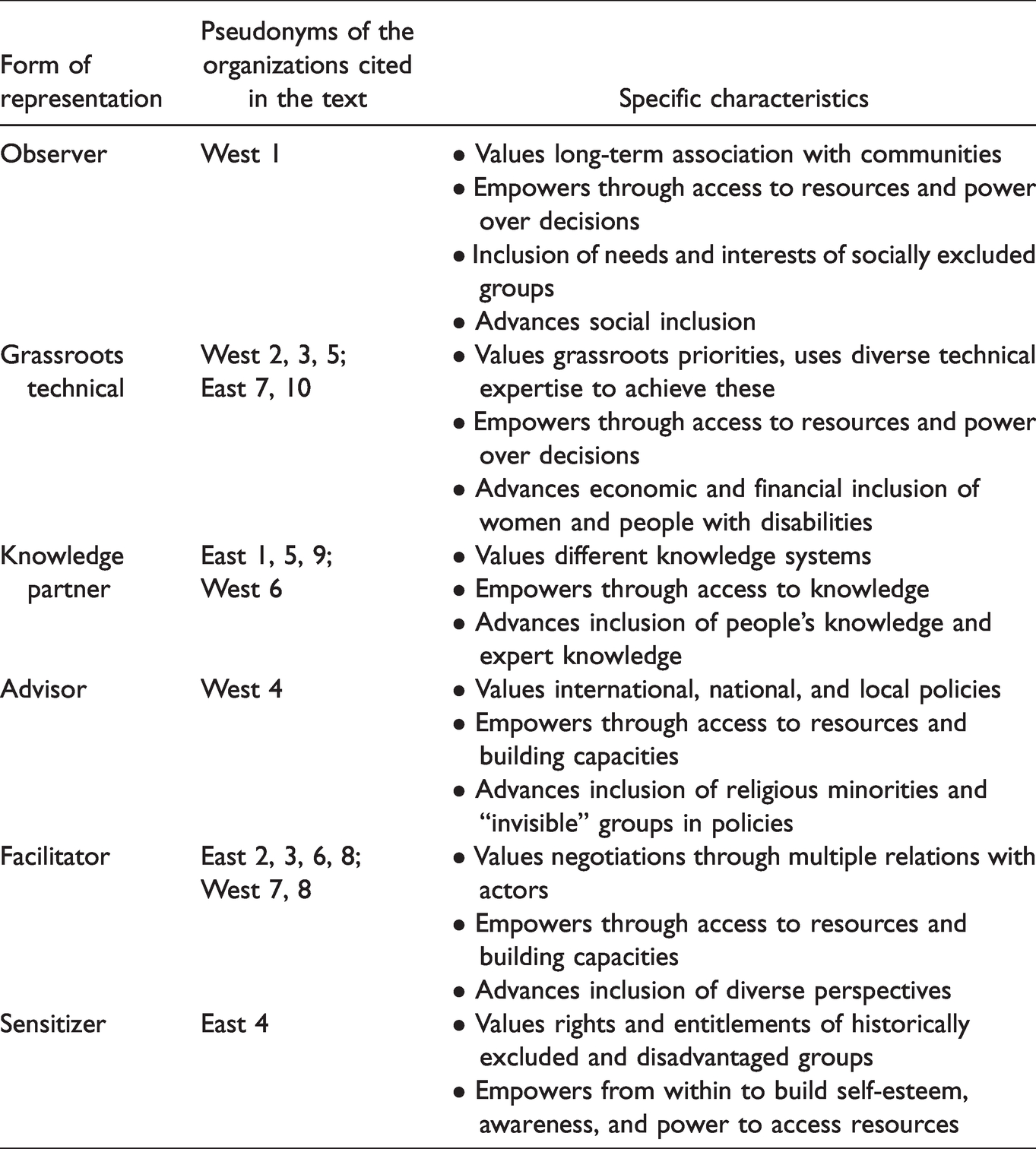
Second, we found diversity in how organizations related to the groups they sought to represent. Table 1 shows the organizations’ descriptions of themselves—as observers, grassroots technical organizations, knowledge brokers/partners, sensitizers, advisors, and facilitators, with most organizations reporting multiple roles. These diverse descriptions were shaped by organization-specific understandings of their roles, which, in turn, were influenced by their own capacities, perspectives, and corresponding ways of relating to constituents. Our findings, with the central role of organizations in shaping representation, suggest that Maia’s claim that representation involves creating collectives through representation mostly does not hold in the direct way her model suggests for development organizations in India working on DRM.
Organizations and Their Forms of Representation.
A third finding is that forms of representation often take shape through projects focusing on other developmental work (e.g., capacity development, participatory processes, or technical/organizational reconstruction support) and are thus entwined with other development activities.
One organization in our sample took on an observer role. This organization’s members saw themselves as social transformation experts and considered their close and long-term association with communities the starting point for representation: “We went, observed, and we met them and understood it” (program manager, West 1). For this organization, the ability to engage with communities emanated from their field presence and from having the resources and expertise to analyze social relations and developments. The observer used “substantial information and evidence from action research” (program manager, West 1) to translate vulnerable groups’ problems to inform policy. Their understanding of these problems influenced how the organization conducted “hazard risk vulnerability and capacity assessments for informing DRM plans on social inclusion, [ . . . ] gender-based vulnerabilities, Scheduled Castes, Scheduled Tribes” (program manager, West 1). This organization believed they could act on behalf of specific vulnerable groups because, being in the local context, they had built the necessary knowledge on the relevant issues. This constitutes a form of representation as an intermediary.
The five development organizations identifying as grassroots technical organizations were headed by technical specialists (i.e., architects, engineers, or livelihood skills experts). The West 2 director claimed that “grassroots technical” was the most appropriate phrase to describe their work—“not technical or technical grassroots”—because the “priorities of the grassroots shape our technical interventions and take precedence over technical, directing our use [of] technical expertise.” For instance, West 3 architectural experts described codesigning earthquake-proof housing with women from affected communities in Gujarat, considering “their socio-cultural preferences and cleaning practices.” Grassroots technical organizations felt that they could act on behalf of specific vulnerable groups because they consciously began the design process from people’s socioculturally embedded priorities. This is a second form of representation as an intermediary.
The four development organizations identifying as knowledge brokers/partners related to the groups they sought to represent through cocreating knowledge in consultation with Indigenous groups and natural/social scientists, bringing together local and global knowledge. Previous work (e.g., Cummings et al., 2019) has classified such organizations as “knowledge brokers,” but an East 1 interviewee described their organization as a “knowledge partner,” “partnering with the vulnerable groups and the scientific experts.” These organizations valued long-term informal community relations for building trust and cocreating knowledge. For example, knowledge brokers/partners sought to act as a bridge, integrating communities’ traditional knowledge with scientific early warning systems expertise. Although knowledge brokering is partly about integrating knowledges, knowledge brokers/partners also saw their role as facilitating the inclusion of bottom-up knowledge from vulnerable groups that might otherwise be unrecognized—a third form of representation as an intermediary.
One organization (West 4) saw itself as an advisor and sought to inform local-, state-, and national-level DRM policies using research, analysis, and experience. The advisor provided actionable evidence to state and nonstate actors through training, reports, and consultation, advancing the inclusion of marginalized groups, especially scheduled castes and tribes—disadvantaged castes and tribes eligible for policies to advance their position in society. India’s historical system of occupation-based stratification has led to persistent and severe deprivation and exclusion of the scheduled castes (Mosse, 2018). In many contexts, scheduled castes have relatively high exposure to environmental risks (e.g., living in areas with high flood risk). Scheduled tribes are ethnic minorities that are severely marginalized in Indian society. These groups are highly dependent on environmental resources and face particular challenges and inadequate representation in DRM planning and programs in India (Bahadur et al., 2016). The advisor sought to address these problems, for example, by seeking to insert these groups’ needs, as they interpreted them, in their project work with state actors: How do we do inclusion? We look for scheduled caste/scheduled tribe schemes to be mainstreamed in district disaster management plans. There are some central government schemes where 25% of the scheme is flexible [ . . . ] so we plan how this can be used [ . . . ] They are made at high government level but are implemented at a decentralized level like at the district level. The government officials at this level are sometimes not sensitized about how these funds can be used. (DRR specialist, West 4) We see where it is possible to combine different government schemes like the Mahatma Gandhi National Rural Employment Guarantee Act, rural development, and forest schemes. [ . . . ] The community we were talking to identified soil erosion as a problem [ . . . ] so we suggested planting certain beneficial grass species using these schemes. (DRR specialist, West 4)
The six organizations that saw themselves as facilitators sought to link different state and nonstate organizations in a network to advance the integration of diverse perspectives and knowledges, facilitating inclusive DRM. Facilitators drew on and coordinated network members’ “concentrated and fragmented capabilities [ . . . ] to facilitate the sharing of their knowledge, skills, and experiences” (director, East 2). Because they sought inclusiveness, facilitators can be understood as working to advance discursive representation (i.e., inclusion of neglected perspectives and interests in a change process; Dryzek & Niemeyer, 2008). For instance, the East 3 director, who convened a DRM civil society network in Bihar, said the following about the network: We took up this issue of girls’ need of sanitary pads for menstrual hygiene in flood-affected areas, which was raised by young girls. We then tried to influence our network members to adopt it, and then, as a network, we advocated for including it in relief packages to the state disaster management agency.
One organization described itself as a sensitizer. This organization’s staff members were largely members of the represented group, and they drew upon shared experiences to sensitize others about their rights. The sensitizer organization represented Dalits’ issues, specifically concerning the highly marginalized Mahadalits. The organization’s leader was from a Mahadalit caste and hence “stood for” the Dalits and Mahadalits, carrying out symbolic, descriptive, and substantive representation and seeking to advance Dalits’ dignity and rights in interactions with the state: Sensitizing the youth and adults from Dalit and Mahadalit groups from 28 districts in Bihar about their rights and entitlements, [ . . . ] encouraging them to think of a life of dignity ensured to them by the Constitution of India, [ . . . ] a life with equality to other social groups [ . . . ]. We sensitize them based on our examples—how we changed our situation based on our awareness of our rights and entitlement [and how we] prevent discrimination during disasters in accessing relief because some of the social groups still consider them as not equal. (director, East 4)
Translators
Following Maia’s (2012, p. 430) framework, development organizations act as “translators, capturing feelings of injustice, discourses of self-understanding or interpretations of needs” in vulnerable individuals’ daily lives, expressing them so that they are “able to be understood by others.” Indeed, we found evidence of development organizations acting as translators, but they did this by drawing on their own organizational perspectives and capacities in addition to their interactions with vulnerable groups through their development work. Translation is thus mediated by organizational capacities and perspectives. We also found that development organizations’ translation was embedded in and shaped by their interpretations of vulnerability in state, national, and international policies, standards and frameworks, as well as their differentiated ways of relating to communities, other development organizations, and the state.
The development organizations considered social inequalities in the states where they worked important factors driving vulnerability. They translated issues emerging from inequalities related to identities such as caste, age, gender, religion, physical ability, and ethnicity, as well as issues at the intersection of multiple identities. The groups they sought to represent faced identity-based exclusion: “Indigenous tribes, castes that are discriminated against, religious minorities, and women-headed households [ . . . ] vulnerability is higher in these groups facing exclusion” (program coordinator, West 4; advisor).
The organizations sought to make visible specific “invisible” vulnerable groups, constructing vulnerability as rooted in inequalities affecting certain groups, going beyond global classifications of vulnerability such as that advanced in the Sendai Framework (2015, p. 10), which defines vulnerability as “the conditions determined by physical, social, economic and environmental factors or processes, which increase the susceptibility of a community to the impact of hazards.” Indeed, Indian governmental documents also commonly acknowledge group vulnerabilities. For example, the Gujarat State Disaster Management Plan states the importance of addressing “the needs of vulnerable groups” such as “women, adolescent girls, old age persons, differently able persons, children, destitute, below poverty line population, scheduled castes, scheduled tribes, [and] particularly vulnerable tribal groups” (Gujarat State Disaster Management Authority, 2016, p. 75), encouraging development organizations to do this work.
These organizations engage with groups and their needs in multiple ways; for example, development organizations articulate how sociocultural norms produce identity-based inequalities in access to and ownership of life-saving resources and in influence over DRM decisions. The East 3 (facilitator) director explained that “boats do not reach Dalits” when there is flooding and that Dalits end up with “one [ . . . ] chullah [traditional cooking stove] for 500 people [ . . . ] [and] no tents.” A West 5 (grassroots technical organization) program coordinator noted that women across social groups lack access to financial resources. However, different types of organizations stressed different vulnerability issues: Considering landless laborers, the sensitizer organization focused on Dalits’ “distress migration” (group interview, East 4). The advisor organization saw landless laborers as “vulnerable to other disaster risks where they migrate and lack access to any social safety net schemes as migrants” (group interview, West 4). A knowledge partner organization focused how laborers in a sharecropping arrangement could not receive compensation when floods damaged their crops because “the compensation is received by the landowner from whom land is rented [ . . . ], putting the poor landless laborer in a trap” (director, East 5). A facilitator organization (East 2) director emphasized how (largely male) landless laborers’ distress migration increased the vulnerability of women, who “are forced to become small and marginal farmers, devoid of recognition as ‘farmers’ because of the gendered construction of the local economy.”
The organizations often described interactions with vulnerable groups to identify their concerns, needs, and perspectives as contributing to issue formulation and agenda setting: Gradually, we came to understand that just working on water and sanitation is not reducing the vulnerability of the community. In all the focus group discussions with the community, two things were coming out very strongly. First, livelihood that gives them food for at least 365 days. Second, [ . . . ] women’s issues related to floods and other disasters were not being taken up very strongly by NGOs, donor agencies, or the government. (director, East 3; facilitator) Our approach is to focus on all people who might be ignored or excluded, any marginalized group. Once you go to the field, you will get a sense of what the structure is very quickly. [ . . . ] Vulnerability exposes itself after an earthquake. When people have resources, they will get proper medical services, and they will have their houses up first. But those who don’t have any resources will take a longer time to rebuild their lives. Disaster affects everybody, but the capacity to recover is when vulnerability comes in play. (staff member, West 1; observer)
Translation also involved the organizations’ capacity to develop public discourse vocalizing groups’ interests in a language that others understood. The West 3 (grassroots technical organization) head described earthquake-proof housing as “good housing” built with consideration of “people’s own lifestyle and culture that gives them the freedom to shape their own environment, is suitable to climatic conditions, and is affordable.” Importantly, this organization’s interpretation and articulation of “good housing” at the grassroots level were not individual but rather were embedded in complex interactions among different community groups: “Social networks are a buffer in times of distress such as disasters [ . . . ] Issues, decisions, and actions are collective, and individuals are answerable to their social connections” (director, West 3). This relational dimension also comes in when engaging with the state. For instance, issues of unequal access to water were translated into a discourse deemed acceptable for the state to make these issues visible while building bridges through representation. As an East 1 (knowledge partner) managing trustee explained, “‘Safe water for all’ as a public discourse talks about the safety of water, simplifying complex scientific water quality parameters for everyone to understand, and about inclusion, promoting access to safe water by all social groups without discrimination.”
Creators of Resources and Structures of Opportunities
For Maia (2012), nonelectoral representatives create resources and a structure of opportunities that raise public awareness and exert social influence in line with or against the state. We explored the types of resources and opportunities for influencing through representation that the development organizations sought to create in their work, asking who was involved, how, and to what end. We found that the development organizations (a) contributed to different forms of empowerment of vulnerable groups, building different types of power as a resource; (b) acted as representatives but also sometimes supported self-representation; and (c) engaged in representation that developed in different spaces involving different actor constellations—with or without direct interaction with the state. Representation thus “happens” through a wide range of practices, bringing about diverse resources and opportunities.
Viewing social inequality as key driver of vulnerability, the development organizations sought to address asymmetric power relations between different actors. To balance these asymmetries, the organizations used diverse empowerment methods. Empowerment can be individualistic, focusing on the expansion of an individual’s capabilities to achieve empowerment on their own terms. Empowerment can also be a multidimensional, relational, and multilevel process involving interactions and relations among individuals, groups of people, and institutions (Galiè & Farnworth, 2019).
To understand this diversity in empowerment, we used Rowland’s (1995) ideas of “power to,” “power with,” “power within,” and “power over.” Most development organizations sought to enhance specific vulnerable groups’ power to access resources—“provisions for them from different government schemes” (community mobilizer, West 1; observer)—for example, through Indira Awas Yojana, a housing scheme aiming to build resilience to earthquakes or floods. The observer and grassroots technical organizations empowered vulnerable groups to gain power over decisions affecting them by influencing power relations in the community: In the community meetings on issues of disaster risk, only the upper caste men would come. Now some of the lower caste men come but do not speak; they usually stand in the corner. They do not feel a sense of security if they speak. Gradually, we are making efforts for them to speak, little by little, on common decisions. (community mobilizer, West 1)
Representation practices involved diverse actor constellations. Some organizations engaged with the state, sometimes through consultations that might provide opportunities to advance certain groups’ rights, as the sensitizer organization reported regarding Dalits in Bihar. DRM projects create novel spaces for representation, where service delivery, capacity building, research, and advocacy may be intertwined with representation opportunities. For example, the technical expertise and capacity building that are formally central in projects may help create opportunities for representation. In fact, representation may occur because these domains often go together. A West 1 staff member’s explanation illustrates this: A district authority will never say that all the community members come together and sit down to make a disaster management plan. They contracted us to make a plan. So our approach is that, when we have the opportunity to make the plan, the social group that was hidden, invisible, was not a priority—we bring them forward.
Conclusion
The studied development organizations commonly acted on behalf of specific groups. Although none explicitly conceived of their practices as representation, they could all relate to the idea of representation as part of their efforts. We found that representation is much more complex and diverse than suggested by the (often normative or ideal-typical) discussions found in the political science and development studies literature discussed in the introduction, including Maia’s (2012) framework.
These observations led to three main lessons. First, Maia’s (2012) ideal-typical elements of nonelectoral representation cannot capture the representation we observed at the environment–development interface. Although representatives forming vehicles for association, acting as translators, and creating resources and structures of opportunities make intuitive sense, these ideas construct representation without considering the mediating roles of those doing the representing, defining who was represented how. Organizations’ differentiated capacities and perspectives enable them to engage with specific dimensions of inclusiveness at the environment–development interface. Development organizations’ representation of vulnerable people connects environmental issues and vulnerabilities, for example, by focusing on how flooding or soil erosion affects specific groups’ livelihoods. These organizations thereby contribute to ecological and environmental inclusiveness. Acknowledging sociocultural contexts and social inequalities such as caste as drivers of vulnerability requiring representation advances social inclusiveness. Influencing asymmetric power relations between vulnerable groups and other actors, for example, by facilitating participation in DRM processes, advances relational inclusiveness.
Second, development organizations’ representation is embedded in multiple types of relations among actors. This calls for a contextualized approach to understanding representation by development organizations, engaging with the multiple priorities, discourses, and forms of relating that can come together in different ways in organizations’ form of representation. They have different types of relations with vulnerable groups, depending on the organization’s perspective on their roles and the way they enact these. Relations with state and nonstate actors and discourses developed and disseminated through networks also shape representation.
Third, development organizations’ representation takes shape in interplay with (and often in the context of) other developmental activities. Interacting with groups in their local contexts through development projects helps organizations build their representative roles. Development work also builds organizations’ credibility, including in the eyes of the state, and creates concrete spaces for representation. This representation may not be in direct and open engagement with the government but rather in implementation of government policy, through more covert influencing, or in interactions with other actors.
These findings lead us to provide the following recommendations. Rather than disavow representation and speak simply of “partnership” and “empowerment,” which denies their potentially defining, intermediary role, development organizations (and their donors) should acknowledge that the intermediary work they carry out or support can involve forms of representation. They should seek to identify these forms, as they emerge in different contexts, fora and domains, and their implications for inclusiveness. What forms of representation are we involved in? How do different activities we do or support create spaces for representation? How is our representation mediated by our own understandings and capacities and by the different relations we are embedded in? On the basis of such a closer look, questions on legitimacy, interaction, and accountability can be addressed—rather than avoided, as often appears to be the case now.
To help make this possible, an important avenue for future research concerns potential diversity in representation in different domains. We explored representation in the context of DRM in India. Organizations active in this domain appear to be relatively closely aligned with the state concerning addressing vulnerability. Studying organizations openly challenging a state’s natural resource management because of its impact on certain groups, for example, would have led to different results, as the forms of relating to constituencies, defining issues, and creating opportunities for influencing would have differed. Attention to development organizations’ representation around other issues at the environment–development interface and beyond, such as climate change, conservation, water management, and food security, would deepen and broaden understandings of representation and its implications for inclusiveness. We do believe that our general findings—that organizations’ capacities and perspectives, embeddedness in a wide network, and other development work create multiple forms of representation, which may contribute to inclusive development—have the potential to form a starting point for this further research.
Given our findings of the importance of representation by development organizations, future research should also explore the quality of the different forms of representation identified here, engaging with the debates on representation regarding legitimacy, interaction, and accountability. For example, participants described interaction with constituencies as a fundamental basis of their representation; we were unable to further investigate this claim, but this interaction was varied and had various purposes. Notably, organizational perspectives, capacities, and relations with other actors are important in determining how representation takes shape, and organizations may have vested interest in these. Instead of purely facilitating representation, the intermediary role many organizations see for themselves may also shape representation in ways that conflict with vulnerable people’s perspectives and priorities. These people’s voices may find limited articulation, remaining both unheard and underdeveloped, as organizations do not seem to take up Maia’s vehicle for association role. Embeddedness in multiple relations and development work also play its part. For example, representation through state-funded development projects may limit challenges to root causes of inequality that would contradict state perspectives. Important questions can therefore be raised here regarding which groups, priorities, and understandings are included or excluded through development organizations’ intermediary roles, and with what consequences.
Footnotes
Declaration of Conflicting Interests
The authors declared no potential conflicts of interest with respect to the research, authorship, and/or publication of this article.
Funding
The authors received no financial support for the research, authorship, and/or publication of this article.
