




Abstract
Lullabies are commonly described as a universal musical genre among humans and a likely source of insights into the origins of music. This study explores the validity of these claims through a critical analysis of the ethnographic literature, starting with a literature review based on the Standard Cross-Cultural Sample. Lullabies emerged as a “near universal” when defined broadly as any type of singing used to soothe children, but neither as a “near universal” nor a “statistical universal” when defined strictly as a specific category of infant-directed songs. As Indigenous Peoples from America presented more societies with few or no lullabies than other regions did, a second review focused on this area was conducted, highlighting three cases: (1) the absence of lullabies among certain Native American communities, (2) the historical diffusion of repertoires in the Circumpolar North, and (3) cross-cultural convergences and entanglements between musical genres on the Pacific Northwest Coast (complemented with corresponding examples from Polynesia). In conclusion, while the act of singing to soothe children is a near universal, it also presents significant cross-cultural variability. Perspectives for future research are discussed.
Keywords
Introduction
In the seventeenth century, the Spanish poet Rodrigo Caro (1884 [1626], p. 327) described lullabies as “the mothers of all songs and the songs of all mothers.” Their use seemed to him “so natural that, when there’s nothing to sing or when we don’t know what to sing, they come to our lips by themselves and flow from them without care or artifice.” Nearly 400 years later, the genre still holds a particular status in the musicological literature. Due to its antiquity – possibly reaching back nearly 4000 years ago in written sources (Farber, 1990; Kramer, 1956; Ronzitti, 2019) – and its wide cross-cultural distribution, it has maintained the reputation of a “universal” phenomenon: a rare case of musicality “inherent to man” (Doja, 1997) – or, we could say, rather to “women,” their main performers in most cultures.
While such ideas about the “naturalness” of lullabies seem age-old, with early observations made by Adelard of Bath (1998 [twelfth century], p. 51) and Salimbene di Adam (1905-1913 [thirteenth century], p. 350), the systematic study of their cross-cultural similarities has received increasing attention over the past decades. This evolution must be related to a renewed interest in comparative approaches in cognitive and evolutionary musicology, in contrast to the qualitative approaches and long-term fieldwork privileged by most ethnomusicologists since the middle of the twentieth century (Savage & Brown, 2013). Systematic approaches to infant-directed singing have notably been adopted by Sandra Trehub and colleagues from the 1990s, suggesting the presence of biological predispositions in the musical cognition of infants (e.g., Trehub, 2000; Trehub & Unyk, 1991), and more recently by Samuel Mehr and colleagues, who hypothesized that human infant-directed singing may have emerged partly in response to “pressures of helpless infants requiring substantial parental investment” (Mehr et al., 2021, p. 29), and that it may represent one prototype that led to the development of other, non-infant-directed types of music (Mehr & Krasnow, 2017, p. 681).
In the meantime, lullabies have also received increasing attention in the fields of ethnography, musicology, philology, history, and folklore, offering textual and musical analyses of songs, or thick descriptions of practices from various regions and historical times. Unlike the cognitive and evolutionary studies mentioned above, these works are not strongly articulated into a coherent research field and, despite the growing number of doctoral theses devoted to lullabies in specific cultures (e.g., Bonnár, 2014; Duhl, 1999; Machado, 2012; Pettit, 2014; Thompson, 2020; Uno, 2003; Watt, 2012; Weisner, 2000), much of the information available comes from isolated research articles or punctual mentions in larger publications. This literature thus remains largely heterogeneous, featuring a wide range of research questions and few instances of authors referring to one another, as they tend to prioritize focused inquiries on their respective repertoires over comparative gestures.
Yet, even in this rather pluralistic literature, it remains a firmly established convention to stress the universality and primordiality of lullabies – e.g., “It is clear that lullabies are universal: we all have to sleep” (Gintsburg & Kogan, 2021, p. 391); “The soothing singing of a mother before her child falls asleep is likely […] a part of musical culture since humanity learned to speak and sing” (Steinheuer, 1997, p. 49); “Mother singing to their babies is found in every tradition” (Tami & Yulianeta, 2020, p. 640); “Songs that encourage children to sleep are sung by mothers and other caregivers the world over” (Turpin & Green, 2018, p. 52); “It is probably fair to say that mothers have crooned or hummed melodies to soothe fractious babies since human life began” (Watt, 2012, p. 77); “The oration of lullabies seems to be an international language of all humankind, irrespective of age, culture, or time” (Weisner, 2000, p. 8); “All nations and communities know the practice of singing over a child who is falling asleep. Lullabies are created and performed in an instinctive and intuitive way. They are primeval” (Żebrowska-Mazur, 2013, p. 177).
The assertiveness of these statements contrasts with more nuanced approaches to “universality” privileged by cognitive and evolutionary musicologists, who readily acknowledge that “any concept of universality that requires inviolable applicability to every moment of every instance of music from every culture is doomed to failure from the start” (Brown & Jordania, 2011, p. 5). Donald E. Brown (2004, p. 48) thus distinguished “absolute universals,” found “among all peoples known to ethnography and history” (such as the use or production of tools), as one type of human universals among others, including “near universals,” found in a majority of cultures with only a few exceptions (such as fire making), and “statistical universals,” which “may be far from absolutely universal” but nonetheless “occur in unrelated societies at a rate that seems well above chance” (such as naming the pupil of the eye with a term referring to a little person).
In a study focused on musical diversity (Savage et al., 2015), an analysis of 304 music recordings from all continents allowed the authors to identify 18 “statistical universals,” such as the use of group performance and isochronous beat, observed in 77.3% of the recordings. Although the authors do not use this expression, some of the traits they review also qualify as “near universals,” as they are observed in nearly all recordings. These include the use of 2- or 3-beat subdivisions and non-equidistant scales.
Several lines of research indicate that lullabies may also qualify either as an absolute, near, or statistical universal. One of them comes from the discovery of ancient texts – from Sumerian, Babylonian, Assyrian, and Indo-Iranian materials – apparently containing lullaby texts (Farber, 1990; Kramer, 1956; Ronzitti, 2019). Structural similarities between contemporary children’s songs and the music of “pre-literate” societies have also been suggested as an indication of the former’s antiquity (Nettl, 2001, p. 469; Trehub & Trainor, 1998, p. 50). Thus, while early comparative musicologists typically turned to the music of so-called “primitive” peoples to inquire the “origins of music” (e.g., Wallace, 2009 [1889]; Wallaschek, 1893), lullabies and other forms of mother-infant vocal exchanges now appear as a privileged source of insights about the primitive substrate from which music may have evolved (Dissayanake, 2000; Falk, 2004; Mehr et al., 2021; Mehr & Krasnow, 2017; Mithen, 2005; Trehub, 2000).
Other indications of universality come from the field of psychology, including developmental and experimental studies on music perception. Based on experimental studies, infants appear to prefer “infant-directed singing” over other types of singing (Bainbridge et al., 2020; Trainor, 1996) and to display a general sensitivity to musical stimuli which only later becomes culture-specific (Hannon & Trehub, 2005), while mothers spontaneously tend to adapt their vocal quality when singing face-to-face with their children (Bergeson & Trehub, 1999; Trainor et al., 1997; Trehub et al., 2016). Adults reach high levels of accuracy when asked to discriminate lullabies from play songs (Rock et al., 1999) or to identify lullabies among different songs stemming from foreign cultures (Mehr et al., 2018; Trehub et al., 1993).
Enlightening as they may be, these observations are not entirely sufficient to confirm the lullaby’s universality and primordiality. Although ancient written sources reveal a certain degree of historical stability, they do not reach further back than 4000 years ago and only concern limited geographical areas. In psychology, most experiments are conducted with WEIRD – Western, Educated, Industrialized, Rich, Democratic (Heinrich et al., 2010) – participants and use selected recordings that may not reflect the diversity of songs performed (or not performed) to children worldwide. While it is reasonable to state that infants “do not begin life with a blank musical slate” and that they show certain predispositions (Trehub, 2003, p. 13), these appear difficult to isolate from enculturation processes starting before birth (Custodero & Johnson-Green, 2003, pp. 102–103). Regarding recurring structural features of melodies, such as “simplicity,” numerous diverging cases have been documented, including the use of fast or complex rhythms in some African repertoires (Ebeogu, 1991, p. 191; Hawes, 1974, p. 142; Jones, 1959, pp. 22–23; Kirby, 1936, pp. 398–399; Simako, 2009, p. 91). Lastly, following an argument that goes back to Plato (Laws, 780d, 791e-792a), lullabies and other childcare practices appear to result from actual engagements between adults and infants, guided by empirical observations of the latter’s reactions to the former’s voice as part of mutually stimulating dialogues (Bjørkvold, 1992, pp. 12–13). Thus, one should remain cautious not to confuse universality for pure innateness, nor to reduce the issue to a strict dichotomy between human biology and culture (Bateson & Mameli, 2007; Ingold, 2012; Lewkowicz, 2011).
While the ethnographic literature may appear as the most promising area to test the universality of lullabies, surprisingly little attention has been devoted to it in earlier discussions, probably due to an untested consensus that “there is no evidence of a culture in which caregivers do not sing to infants” (Corbeil et al., 2016, p. 385). Folklorist Imre Katona (1980, p. 55) once nuanced this claim by stating that lullabies were present all over the world, “except in Oceania and Australia” – as shown in the data presented further below, this statement is exaggerated and at least some societies from these regions do sing lullabies. More recently, Samuel A. Mehr and Max M. Krasnow (2017, p. 679–680) stressed that “the universality of infant-directed song […] has not yet been systematically described,” but nonetheless defined lullabies as a “regularly occurring” song type (Mehr et al., 2019, p. 3) and suggested, based on results from a sample of 86 societies, that “soothing songs, such as lullabies” are likely found in all societies (p. 5).
The need for a more comprehensive ethnographic review emerged as the author was delving into the literature on lullabies for an ongoing research project in anthropology and encountered mentions of societies lacking lullabies across every continent (e.g., Andrš, 2014, p. 35; Burrows & Spiro, 1953, p. 253; Mâche, 2000, p. 478; Razy, 2007, p. 284; Seeger, 1987, p. 8; Takada, 2020, p. 145; Waterman, 1971 [1955], p. 168). To further investigate the issue, this paper undertakes a systematic review of the ethnographic literature based on the Standard Cross-Cultural Sample (SCCS), an ensemble of 186 societies designed to offer “a representative sample of the world’s known and well described cultures” (Murdock & White, 1969, p. 329) and thus “eliminate as far as possible the number of cases where similarities are presumably due to the historical influences of diffusion or common derivation” (Murdock & White, 1969, p. 331). The sample was designed by analyzing 1250 societies (see Murdock, 1967), by grouping them into cultural clusters and sampling provinces, and by choosing one well-documented society from each province (Murdock & White, 1969, pp. 331–332). The large majority of societies included in the sample are nonindustrial.
While the results of this first review (presented below) confirm the wide distribution of lulling practices, they also raise the central question of how strictly we define a “lullaby.” Additionally, they reveal the apparent singularity of Indigenous Peoples on the American continent, among whom lullabies have repeatedly been reported as rare or absent (Daiken, 1959, p. 36; Seeger, 2000, p. 81; Whiffen, 1915, p. 208). Focusing on those communities, a second review was conducted, leading to qualitative considerations about three singular cases: (1) societies without lullabies, (2) societies with shared practices likely stemming from historical diffusion, and (3) punctual instances of cultural convergence between distant societies.
Thus, although primarily articulated on the global universality of lullabies, this paper also seeks to encourage nuanced comparative research on this topic, acknowledging the importance of various types of musical universals while also taking the time to investigate cross-cultural variations (Candea, 2019).
Global Review (Standard Cross-Cultural Sample)
It is notably tricky to prove the absence of anything. In the case of lullabies, four additional challenges must be considered. Firstly, the domain of infancy has received limited attention from social anthropologists and ethnographers (Gottlieb, 2000; Hirschfeld, 2002). Lullabies themselves appear rather neglected compared to other musical practices, possibly due to a lack of attention to female practices among male investigators, as well as perceptions of the genre as trivial (Juvančič, 2010, p. 121; Pettit, 2014, p. 8; Thompson, 2020, pp. 1–2). Consequently, the absence of lullabies is likely to elude the attention of ethnographers.
Secondly, even those who deliberately attended to lullabies frequently reported the difficulty of observing performances in their normal context (Ebeogu, 1991, p. 100; Gintsburg & Kogan, 2021, p. 391; Pettit, 2014, p. 7; Sprott, 1999, p. 152). Thus, although composer and pioneer ethnomusicologist Béla Bartók reported the near absence of lullabies among Romanians (Bartók, 1967, p. xliii), later writers suggested that they existed and Bartók simply missed them (Bartók, 1967, p. xxxiii).
Thirdly, the fact that lullabies exist in a culture does not imply that all members of that culture (including men) sing them. In the United States, a survey conducted with 2250 participants (73% of whom were women) indicated that less than half of them sang lullabies (Custodero & Johnson-Green, 2003, pp. 105–107). Even the assumption that the possession of lullabies can be assigned to discrete cultural entities should not be taken for granted; hence, the ethnonyms used in this paper should be considered merely as convenient categories serving the purpose of a global investigation.
Lastly, and perhaps most importantly, the very definition of “lullaby” is problematic. Defining the genre as “a type of song sung by mothers and nurses the world over to coax their babies to sleep” (Brakeley, 1950, p. 653) would exclude cases of performance by men and the use of songs for soothing children without inducing sleep. Conversely, defining it as “a tune or song, sung or hummed gently, in order to lull, comfort, or bring relief from anxiety, to the writer, the singer or the listener” (Watt, 2012, p. 381) would imply including a wide range of songs beyond the context of childcare. The issue is even more convoluted when considering instances of “lullabies” for domestic animals (e.g., Hutchins, 2019), sleep-inducing songs for monarchs (e.g., Kahunde, 2012, p. 208), or musical technologies for bedtime (e.g., Young, 2008, p. 38). Also central to this paper is the observation that many people soothe children with songs that are not originally intended as lullabies, or with improvised performances that may be reduced to a monotonous hushing sound – several examples are presented below.
Bearing these issues in mind, the distribution of lullabies was explored by reviewing scholarly sources covering the Standard Cross-Cultural Sample (SCCS) (Murdock & White, 1969). Two definitions of “lullaby” were considered. Following a broad definition, a lullaby is any type of song or rhythmic vocalization used to soothe a child. Following a strict definition, a lullaby is a type of song specifically designed to soothe a child. The broad definition thus includes cases of singers using alternative song repertoires or improvisations, whereas the strict definition only includes cases where singers use a specific, infant-directed repertoire.
Sources were first sought using the eHRAF World Cultures database, which provides ethnographic texts for each society in the SCCS. Five searches were performed, using the following keywords respectively: lull*; cradle song*; sing* AND sleep; song* AND sleep; sooth* AND sleep. Mentions of lullabies (present or absent, broadly or strictly defined) were found for 74 societies within the SCCS. When more than one source emerged about the same society, only the earliest was considered. For each society, the search through alternative keywords stopped as soon as one relevant source was found (mentions of the precise term “lullaby” are therefore favored over vaguer expressions such as “soothing to sleep,” following the keyword order presented above). For the remaining 112 societies, additional sources were sought beyond the focal documents proposed in the eHRAF World Cultures database. Searches on Google Scholar were performed using the same keywords (as well as equivalent words in four major colonial languages: Spanish, French, Portuguese, and Russian) and ethnonyms. For each society, the search stopped as soon as one relevant source was found. In total, information was found for 124 societies (i.e., 66.7% of the SCCS). Since the absence of lullabies cannot be easily inferred from a lack of information in ethnographic accounts (even in cases where childcare practices or musical genres are discussed in detail), the remaining 61 societies are not discussed below.
Following a strict definition, lullabies appear present in 97 of the 124 societies considered (78.2% of the sample). In some cases, a well-established repertoire is mentioned, whereas in others, no details are provided. Following a broad definition, lullabies appear present in 120 societies (96.8%). The difference consists of 23 societies who are reported to soothe children through singing or rhythmic vocalizations, but to lack a specific repertoire of songs designed for that purpose. These can be further divided into two categories, namely 14 societies (11,3%) described as having only rare, minimalist, or improvised performances, and 9 societies (7.3%) described as using alternative repertoires to soothe children, such as religious songs, dance songs, or imported songs. Lastly, 4 societies (3.2%) are reported to lack lullabies entirely.
Presence of Lullabies Among Cultures From the Standard Cross-Cultural Sample (SCCS).
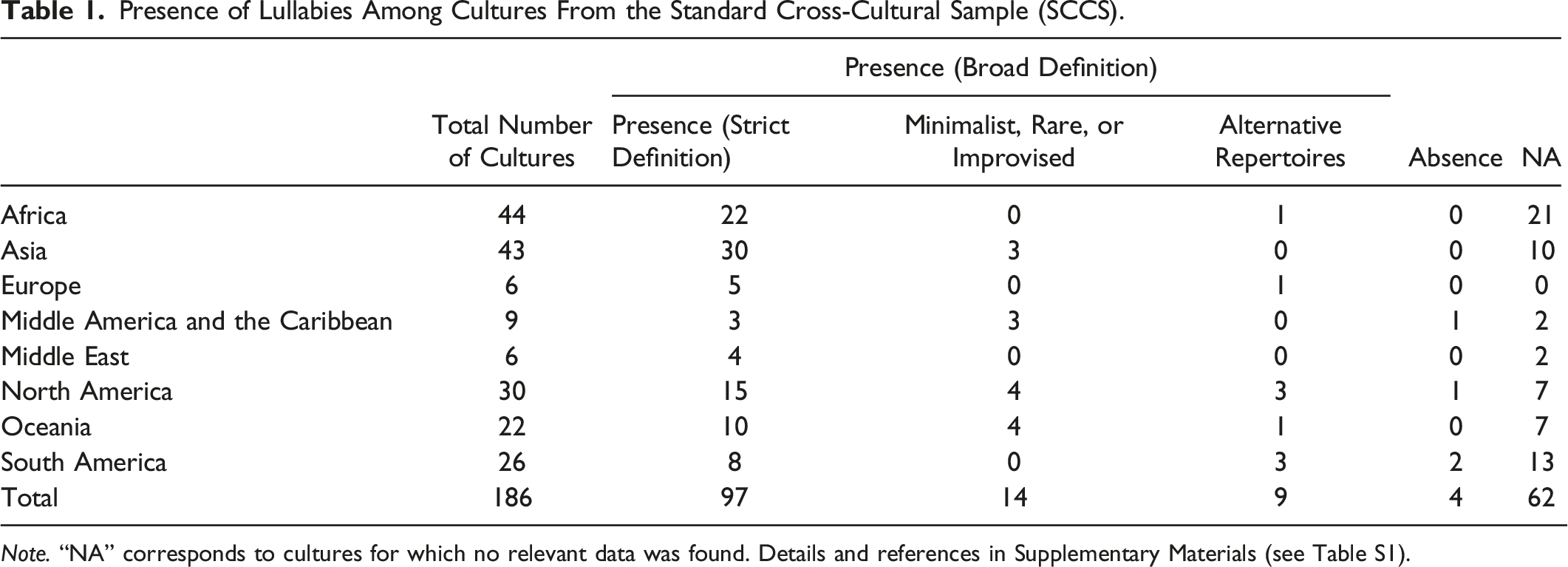
Note. “NA” corresponds to cultures for which no relevant data was found. Details and references in Supplementary Materials (see Table S1).
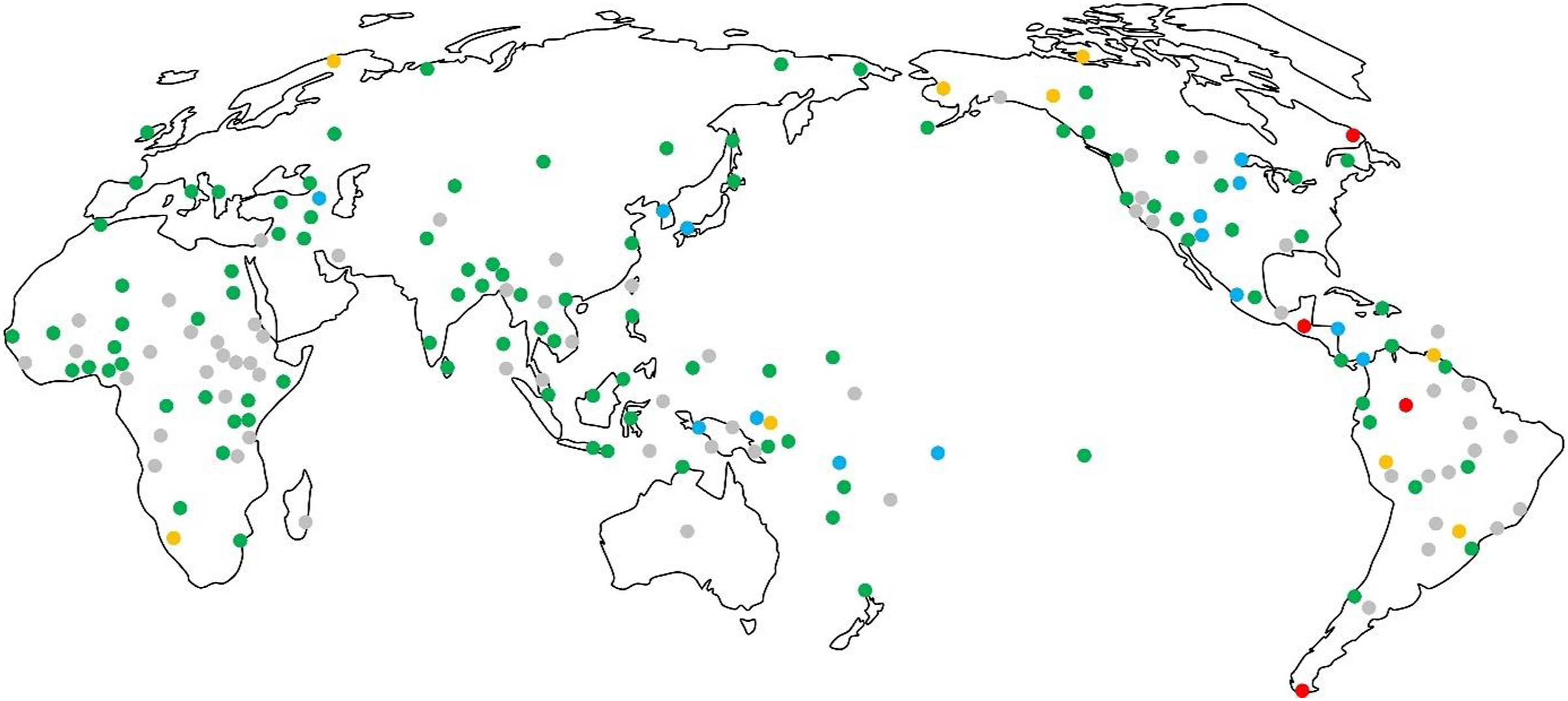
Presence of lullabies among cultures from the Standard Cross-Cultural Sample. Note. Green: presence; Blue: rare, minimalist, or improvised songs; Yellow: alternative repertoires; Red: absence; Gray: no data. The geographical localizations of cultures are approximate.
Following a broad definition, lullabies appear present in a vast majority of societies and can safely be defined as a near universal. However, following a strict definition, their presence is more limited. Based on the data available, the possession of a specific infant-directed repertoire of soothing songs does not qualify as a near universal. It is nonetheless reported in a majority of societies and we may reasonably wonder whether it may qualify as a statistical universal. To be defined as such, (strictly defined) lullabies should be found across unrelated cultures above chance levels. Using a one-tailed binomial test on the global results (N = 124, X = 97), with a chance level of 0.5, they do appear significantly above chance level (p < .0001). However, geographical disparities should also be taken into account. In particular, Oceania and the American continent (including mostly Native American Peoples) account together for 22 societies lacking a specific repertoire of infant-direct soothing songs, out of 27 worldwide. Moreover, all 4 cases of societies without any type of lullaby come from Native American peoples. Using a one-tailed binomial test and a strict definition of lullabies, and focusing on regional results, both Oceania (N = 15, X = 10, p = .15) and the American continent (N = 43, X = 26, p = .11) stand out in that lullabies appear above chance level, but not significantly so.
These cases recall certain musical traits explored by Patrick Savage and colleagues (2015) in their global review of musical universals, namely “sex segregation”, “phrase repetition,” and percussion use.” Although predominant on a global scale, these were not present above chance level in each of the nine regions investigated by the authors and therefore were not retained as genuine universals. Under these criteria, and based on the data available, lullabies should also be ruled out if a strict definition of the genre is adopted.
To go further, statistical analyses were performed to explore the influence of geographic regions (as categorized in the eHRAF World Cultures database) on the presence of (strictly defined) lullabies across societies. Additionally, the following explanatory variables were considered: subsistence type (as categorized in the eHRAF World Cultures database), degree of political complexity (based on data from the online D-PLACE database (Kirby et al., 2016) and George Peter Murdock’s Ethnographic Atlas (1967, p. 52)), and degree of phylogenetic affinity between societies (based on four clusters derived from an existing phylogenetic tree of the SCCS (Minocher et al., 2019)) (see Table S2 in Supplementary Materials for a full presentation of the data and phylogenetic clusters used). Generalized linear models (GLMs) with binomial distribution and logit link function were used, using version 4.3.1. of R (function glm from package stats). The model fit was assessed using the Akaike Information Criterion (AIC), while the significance of associations was determined through Chi-square tests.
Geographic region emerged as the most informative predictor of lullaby presence and showed significant association (AIC = 125.44, χ2 (7, N = 124) = 20.522, p = .0045). Political complexity also offered an explanatory contribution (AIC = 127.84, χ2 (1, N = 124) = 6.1184, p = .013), with highly “complex” societies being more likely to have lullabies, followed by phylogenetic clusters (AIC = 128.95, χ2 (3, N = 124) = 9.0121, p = .029), with cluster 4 (mostly present in Sub-Saharan Africa) being the most likely to have lullabies, and cluster 1 (mostly present in America, Asia, and Oceania) the least likely. In contrast, subsistence type did not appear as a significant predictor (AIC = 134, χ2 (6, N = 124) = 9.9603, p = .126).
Based on these results, lullabies do not seem to qualify as a statistical universal if they are defined strictly as a specific repertoire of songs designed to soothe children. They rather appear as a widespread practice, present in most regions of the world, but unequally so, and partly related to political complexity and phylogenetic affinity.
This observation indicates the need to explore further the distribution and historical development of various forms of lullabies. To do this, attending to the apparent singularity of Indigenous Peoples from America appears as a promising direction, especially since the review’s results are consistent with earlier observations. Anthony Seeger (2000, p. 81) reported that some societies, “particularly Amerindian communities,” have “no lullabies and no special children’s songs: the children fall asleep or stay awake to the sounds of adult music.” Nearly a century earlier, Thomas Whiffen (1915, p. 208) already observed that “among the Indians,” a mother “never croons to her baby; she does not understand a lullaby.” Leslie Daiken (1959, p. 36) suggested with more nuance that both North and South “American Indian tribes” lack lullabies but may nonetheless use “noises” or “crooning” to put their babies to sleep. These three observations, combined with the results of the SCCS review, call for an additional review focused on the American continent.
Indigenous American Review
The literature about lullabies among Indigenous Peoples of the American continent, both within and outside the SCCS, was systematically reviewed. Data was gathered in an opportunistic way, drawing from the eHRAF World Cultures database, as well as other databases (e.g., Google Scholar, AnthroSource, JSTOR), encyclopedias (including Grove Music Online), relevant journals and publications, and mutual quotations by authors. The aim here is to provide a more comprehensive, although less representative (due to the inclusion of related societies and multiple sources for certain societies), picture of lullabies on the continent. While this approach does not afford reliable quantitative analyses, it does afford certain qualitative considerations on the development of lullaby traditions. Three cases are here reviewed: the absence of lullabies in certain Native American communities, the historical diffusion of children’s songs in Circumpolar regions, and the singular case of the Pacific Northwest Coast, which converges with certain lullaby traditions from other regions, notably Polynesia.
Absence: Native American Communities
Presence of Lullabies Among Native American Communities.
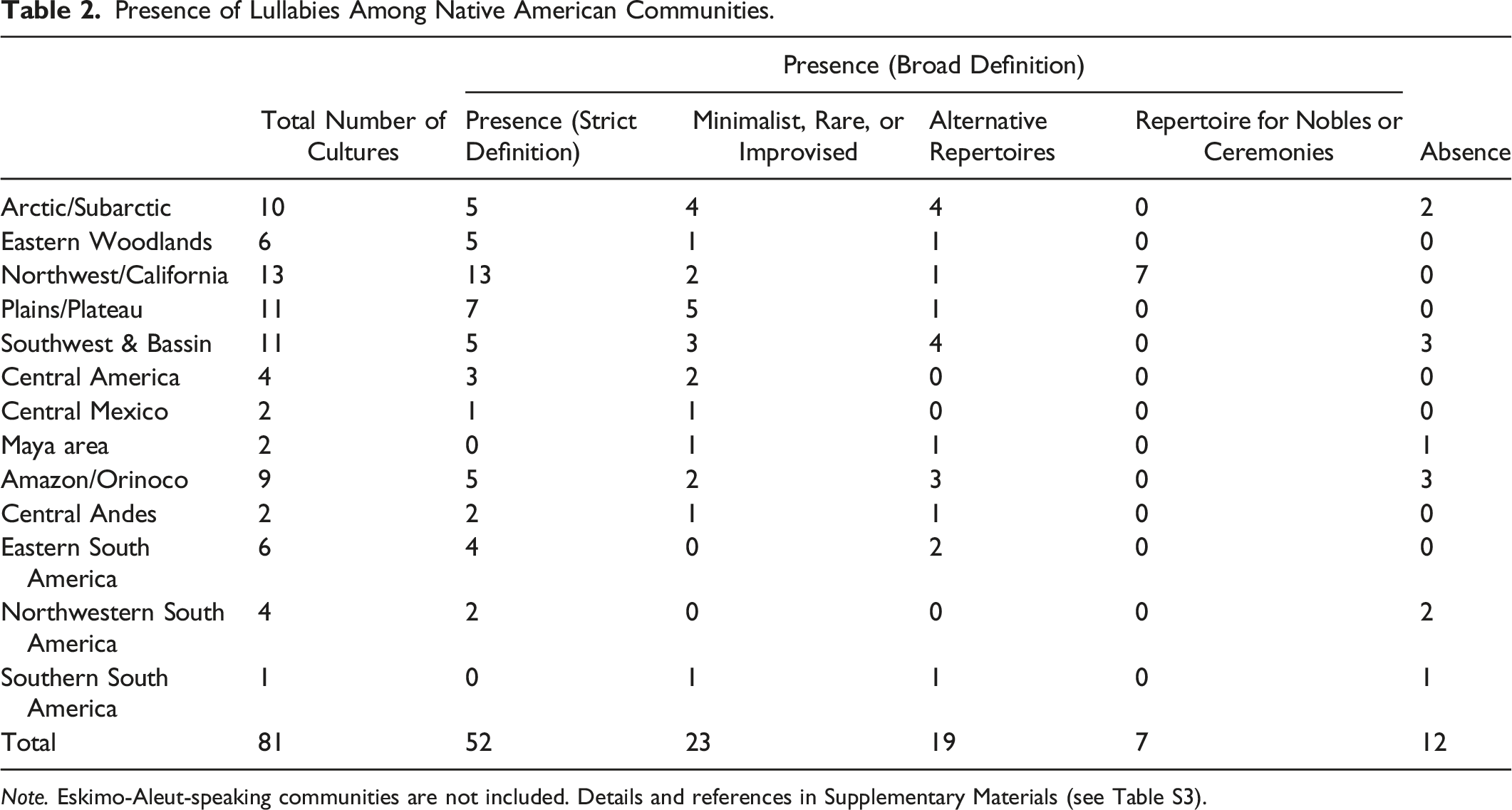
Note. Eskimo-Aleut-speaking communities are not included. Details and references in Supplementary Materials (see Table S3).
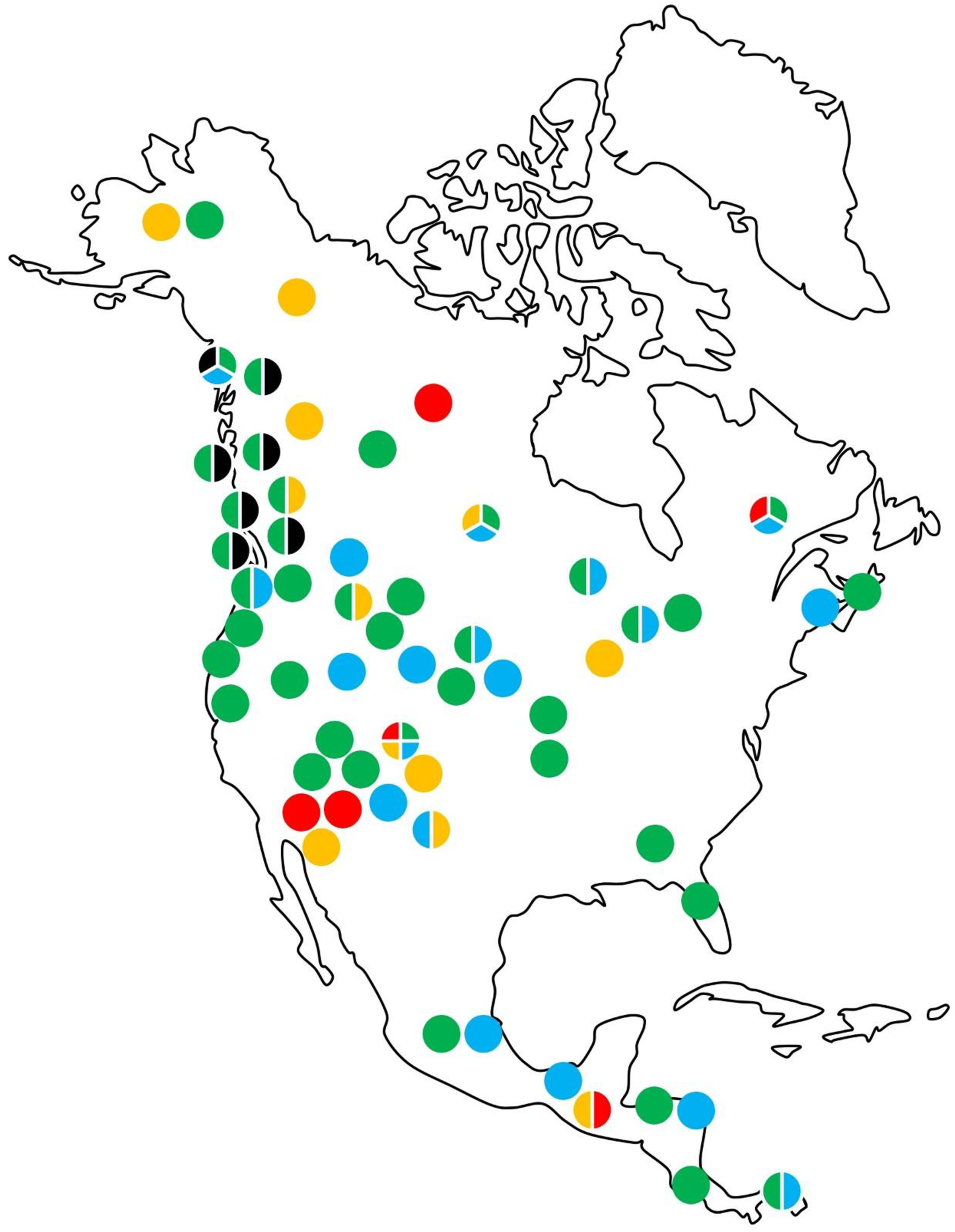
Presence of lullabies among Native American communities in North America. Note. Green: presence; Blue: rare, minimalist, or improvised songs; Yellow: alternative repertoires; Red: absence; Black: lullabies for ceremonies and nobles. Each circle corresponds to one culture. Representation of certain cultures with more than one color reflects contrasting statements found in the literature (see Table S3 in Supplementary Materials). The respective sizes of colored sectors are not significant. The geographical localizations of cultures are approximate. Eskimo-Aleut-speaking communities are not included.
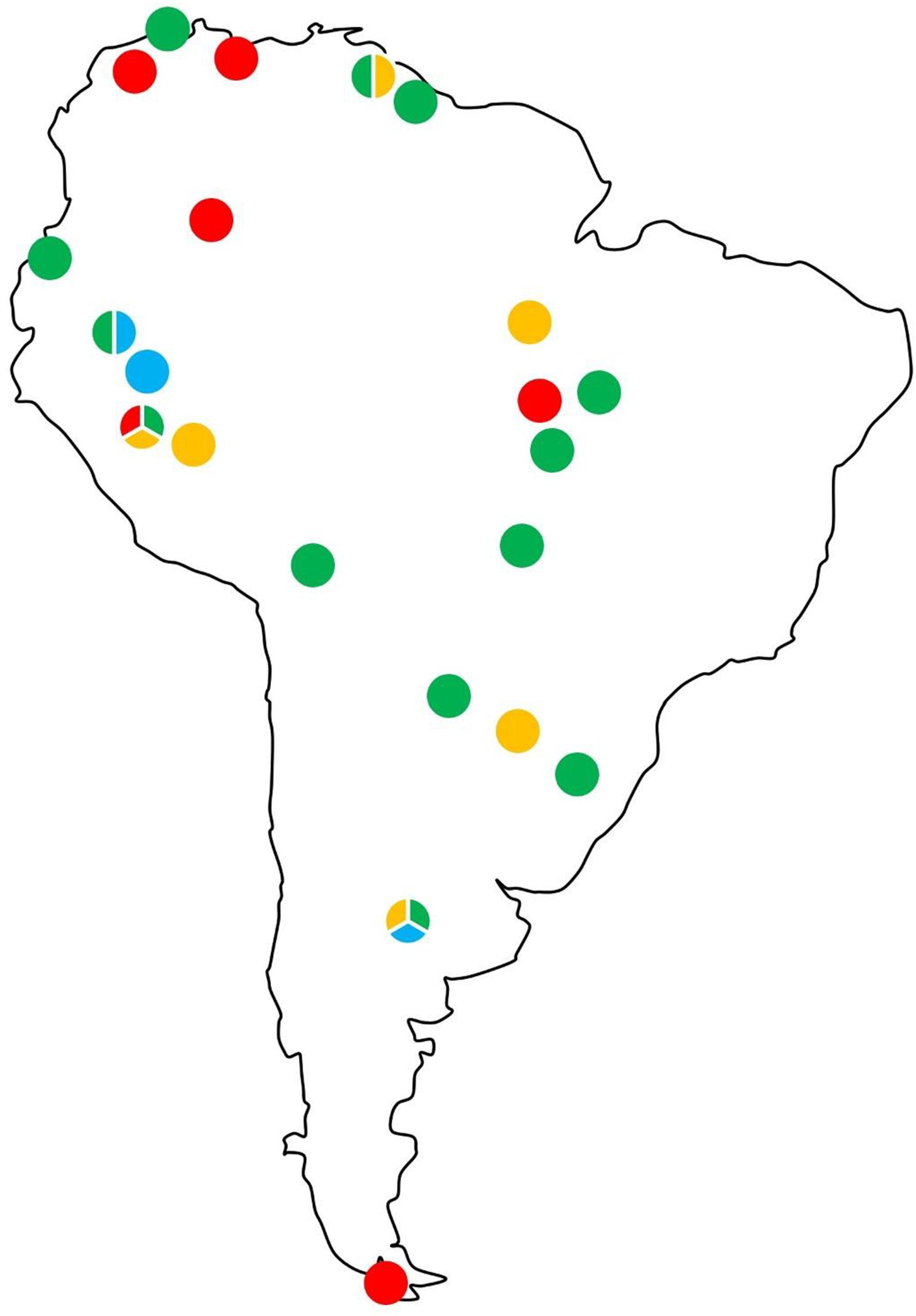
Presence of lullabies among Native American communities in South America. Note. Green: presence; Blue: rare, minimalist, or improvised songs; Yellow: alternative repertoires; Red: absence. Each circle corresponds to one culture. Representation of certain cultures with more than one color reflects contrasting statements found in the literature (see Table S3 in Supplementary Materials). The respective sizes of colored sectors are not significant. The geographical localizations of cultures are approximate.
As in the SCCS review, most societies (although only 64.2% here) are reported to have lullabies in least one source. The Innu described by Connie Heimbecker (1984, pp. 71–72) are an interesting case (even though older sources emphasize their lack of lullabies), as each family has a set of lullabies that are personal to each adult but bear melodic similarities differentiating them from those of other families. The San Blas Kuna have not just a repertoire of lullabies, but also a myth about its origins, received from “star girls” along with funeral laments (Howe & Hirschfeld, 1981, pp. 294–297). In contrast, about the Slavey, no information is given other than the fact that “lullabies are often sung” (Asch, 1981, p. 344). Likewise, the Seminole are simply said to “have lullabies,” even though they reportedly make “little use of music” (MacCauley, 1887, p. 519).
Societies said to have only rare, minimalist, or improvised performances, are counted separately and represent 28.4% of the sample. Examples include communities from the plains and plateau regions, such as the Shoshone: “While tiny lullaby-ostinato patterns exist, for the most part there are no lullabies” (Vander, 1996, p. xvi); the Sioux, who are said to have only one lullaby (Densmore, 1918, p. 493); the Flathead, whose lullabies are so rare that they are a “doubtful entity” (Merriam, 1967, p. 164); and the Omaha, among whom “no true lullaby songs” are heard, although men and women induce sleep by making a “low murmuring” resembling the sound of the wind in the pines (Fletcher & La Flesche, 1911, p. 328). The Yahgan represent an extreme case, as mothers are said to rock their children back and forth with only a rhythmic repetition of the sounds “hūš hūš” (Gusinde, 1937, p. 412) – Since no use of melody is mentioned, we may debate whether this last case truly belongs to the category of “minimalist” lullabies or instead reveals the “absence” of lulling songs.
The use of alternative or imported repertoires for lulling children to sleep is mentioned in 23.5% of the societies sampled. A study of Gwich’in songs mentions only one lullaby derived from a love song, which itself is derived from a caribou song, originally meant to bless the hunted animal (Ranspot, 2019, pp. 147–148). Among the Nuxalk, one author appears confused about the categorization of a song either as a true lullaby or as a song about the cormorant (McIlwraith, 1948, p. 335). The Guaraní are said to use individual prayers sent by divinities instead of actual lullabies (Schaden & Lewinsohn, 1962, p. 81). Another typical case is the use of imported music, as among the Cree, where younger generations tend to hum country songs and hymns (Whidden, 2007, p. 62). Among the Shipibo, a widespread lullaby seems derived from a Spanish Christmas carol (Brabec de Mori, 2015, p. 248); mentions of lullabies in the area otherwise seem absent from historical records (Brabec de Mori, 2011, p. 570). The same origin was recently proposed for lullabies shared by several cultures in the Ucayali-Amazonas region, suggesting a historical diffusion through Franciscan missionary work and forced migrations (Prieto Mendoza, 2023, p. 47). Two additional sources about the Amazon region (not included in the quantitative results due to the vagueness of the cultural group they evoke) mention the use of a Latin plainchant melody (Andrade, 1980, p. 184) and the fact that “Indian mothers” adopted European medieval chants to lull their children to sleep (Rámon y Rivera, 1982, p. 24).
Lastly, societies reported to lack lulling songs represent 14.8% of the sample. In the latter category, the most striking case is that of the Quiché Maya, who were reported to have neither lullabies nor children’s tales (Bunzel, 1959, p. 101) and to laugh at the very idea of singing a child to sleep (Morelli et al., 1992, p. 608). These laughs may be interpreted as the most conclusive proof of the total absence of a shared lulling tradition, although a few Quiché Maya mothers admitted with embarrassment that they have sung church songs at bedtime (Morelli et al., 1992, p. 608). About the Navajo, one author mentions that none of his informants knew anyone who sang lullabies to their children, but otherwise simply states that they are “very rare” (McAllester, 1954, p. 65, p. 88). Likewise, among the Slavey, one author states that his informants never lulled their children to sleep, although he managed to find and record one local lullaby (Keillor, 1986, p. 61). In these two cases as in several others, the authors do not specify whether adults may nonetheless use some type of crooning or humming. Thus, although societies “without lullabies” appear as a significant minority on the American continent, the data does not provide conclusive evidence of societies where soothing songs or rhythmic vocalizations never occur in childcare.
Main Lullaby Themes Among Native American Communities.
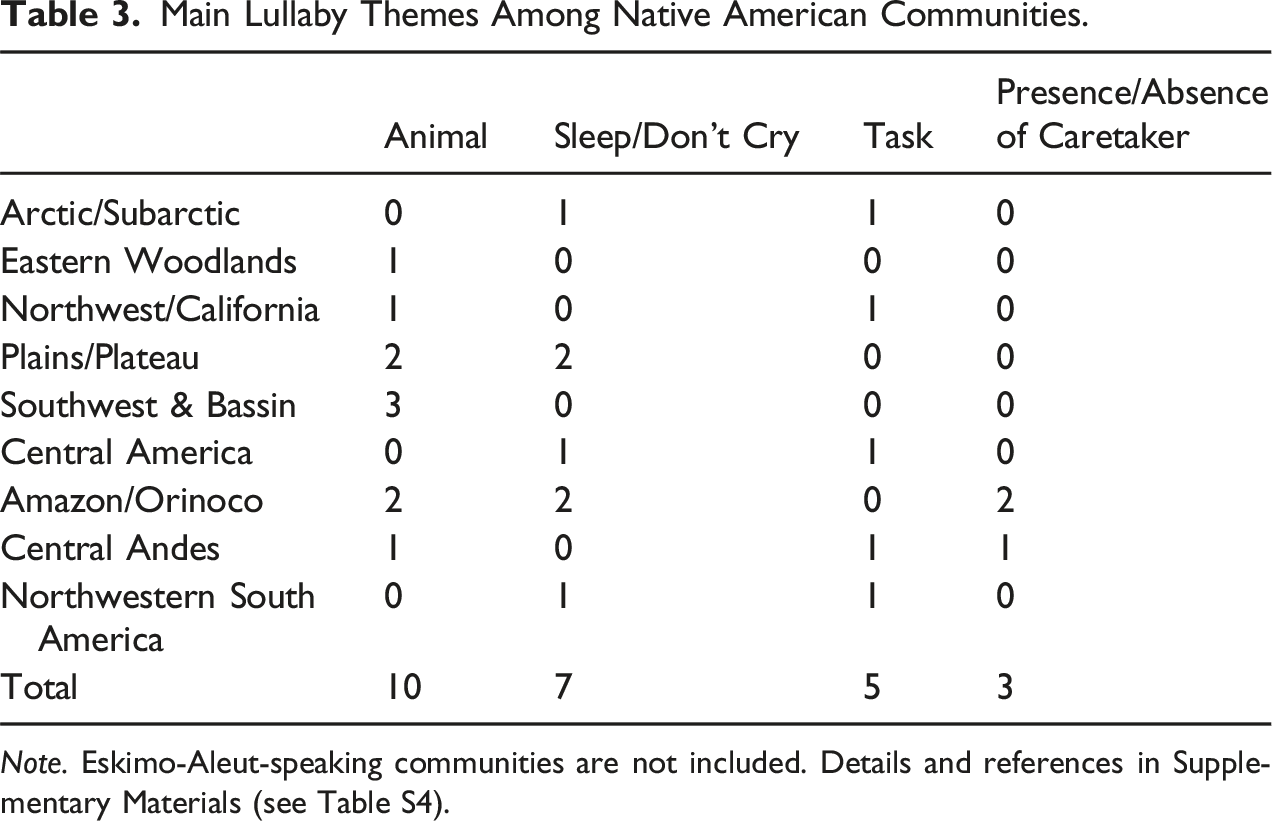
Note. Eskimo-Aleut-speaking communities are not included. Details and references in Supplementary Materials (see Table S4).
All these themes are rather obvious choices and are sporadically mentioned in various parts of the continent, as if they appeared or were improvised independently from one place to another. Compared with the poetic creativity displayed in lullaby repertoires from other parts of the world, they suggest a low investment in lullabies throughout most of the continent. Another possible indication of this low investment lies in the apparent absence of names for “lullaby:” none of the sources mentions any such term, except for the Northwest Coast.
Finally, in 5 societies, it is specified that men participate in lulling children to sleep. A global search on the eHRAF World Cultures database only revealed five other cases outside the American continent: four in Sub-Saharan Africa (Gulliver, 1951, p. 188; Heusch, 1980, p. 42; Marlowe, 2010, p. 206; Parin et al., 1963, p. 264) and one in Melanesia (Powdermaker, 1933, p. 79). While this does not mean that men do not lull children to sleep elsewhere, it suggests that such cases are likely the exception rather than the rule. This apparent singularity of Native Americans has already been noted (Heth et al., 2005, p. 152) and is consistent with a relative lack of formal rules and established conventions surrounding lullaby practices, compared to other regions of the world.
In sum, only a minority of Native American societies are reported to have no lullabies at all, and, in several cases, ethnographers have nuanced this observation. Yet, such reports are found throughout the continent, from its northernmost (the Innu and the Tlicho) to its southernmost (the Yahgan) communities. As these reports reflect rare instances where authors noticed the absence and found it worth mentioning, they may be the tip of the iceberg. However, the absence of lullabies may just as well be overestimated, for example due to perceptions of the act of lulling a child to sleep as something “embarrassing,” as reported among the Quiché Maya (Morelli et al., 1992, p. 608), making direct observations by ethnographers challenging.
Beyond cases of strict absence, Native American cultures present a heterogeneous picture apparently without any shared and strongly conventionalized lulling traditions, either at regional or continental levels (except for the Northwest Coast). While animals are the most prominent theme, they appear in various narrative forms and are only sporadically reported among geographically dispersed societies.
Moving to a more speculatory register, we may wonder whether the communities who originally settled the continent had any formal lullaby repertoire. At least some of the societies discussed here may have started to sing lullabies after European contact. The opposite scenario, namely that some lullaby traditions disappeared after European contact (Machado, 2012, pp. 122–123), is another possibility. Yet, if specific lullaby practices and repertoires were established at some point in the pre-colonial past, we might expect to find more traces of it in ethnographic sources. There are indeed other cases of pre-colonial song genres that remain well documented in large parts of the American continent despite colonisation, such as “personal songs” for children in Arctic regions (discussed in the next section) or “animal songs” in North America, where they are believed (both by settler ethnomusicologists and some Indigenous singers) to be particularly old (Keeling, 2012, p. 259). Richard Keeling (Keeling, 2012, p. 235) thus reported that animal songs originally performed in medical or shamanic contexts have been misinterpreted by ethnographers as children’s songs; this may concern some of the sources reviewed here.
Given the uncertainty surrounding historical lulling practices on the American continent, any speculation about lullabies constituting a specific category of songs related to the origins of music and reaching back to distant human prehistory should be considered with caution. Following Frances Densmore (1932, p. 212), even in cases where adults lull their children to sleep, the development of “a distinct, repeated melody for soothing a child” appears “gradual” and sometimes limited to a “formless” type of “crooning.” Thus, it cannot be excluded that lullabies have remained absent, developed, or even disappeared independently at different times and in different places, leading to multiple situations on an asymmetric continuum between two poles: the total absence of infant-directed vocalizations (found, at best, in a minority of present-day cultures) and the existence of a specific infant-directed repertoire shared by the community.
Diffusion: The Circumpolar North
The SCCS only includes two Eskimo-Aleut-speaking communities from North America, namely the Aleut and the Copper Inuit. An early source mentions that, according to the “old Aleuts,” sea otters tend to their children like human women do and that it is possible to hear them sing lullabies (Veniaminov, 1840, pp. 339–340) – from there, it can be inferred that people sang lullabies too. As for the Copper Inuit, two sources mention the use of personal dance-songs (pisik) in the absence of actual lullabies (Jenness, 1959, p. 196; Roberts & Jenness, 1925, p. 20, pp. 404–5).
At first sight, this picture may recall observations made among Native American communities, where the use of alternative repertoires (including animal songs) is frequent. However, the connection with the genre of “personal songs” appears to be specific to the Circumpolar North and deserves some comments. A review of this issue was published elsewhere (Aubinet, 2023) and is summarized in this section. It points to the practice of attributing individual songs to children (encountered across various Uralic-, Paleo-Siberian-, and Eskimo-Aleut-speaking cultures of Eurasia, North America, and Greenland) and illustrates how shared lulling traditions may emerge from historical processes, such as population migrations and cultural exchanges, rather than merely from universal features of human cognition.
In North America, the Yup’ik case appears exemplary. Although they are said to have “no formal lullaby category,” they have personal “cooing songs” for children called inqum (Johnston, 1989), unique to each child, understood only within the family, and often chronicling the child’s traits and milestones. Strictly speaking, an inqum is not a lullaby, as its primary function is to describe the child’s life and express the parents’ love and affection. Yet, it is common to lull children to sleep with their respective inqum.
Personalized Children’s Songs in the Circumpolar North.
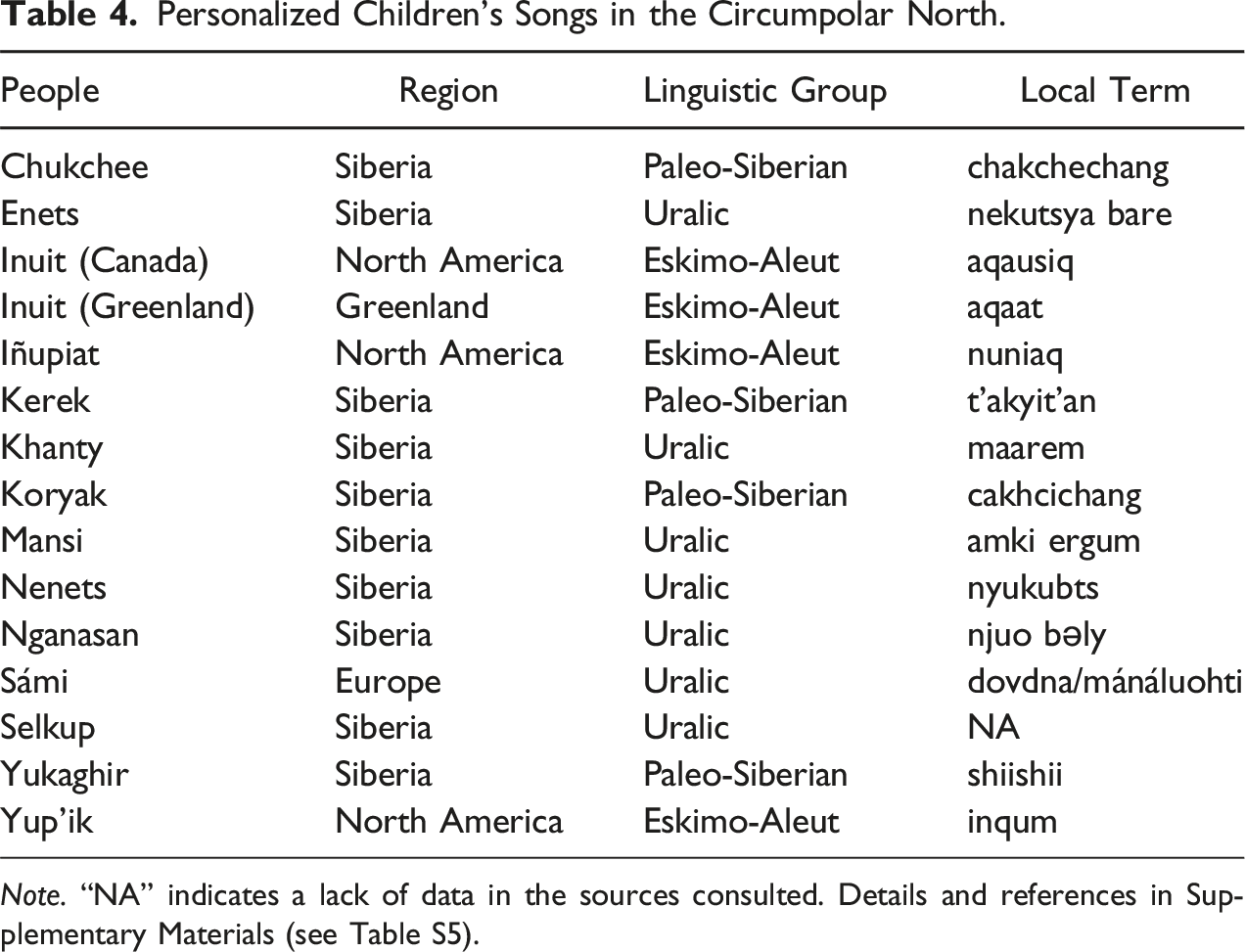
Note. “NA” indicates a lack of data in the sources consulted. Details and references in Supplementary Materials (see Table S5).
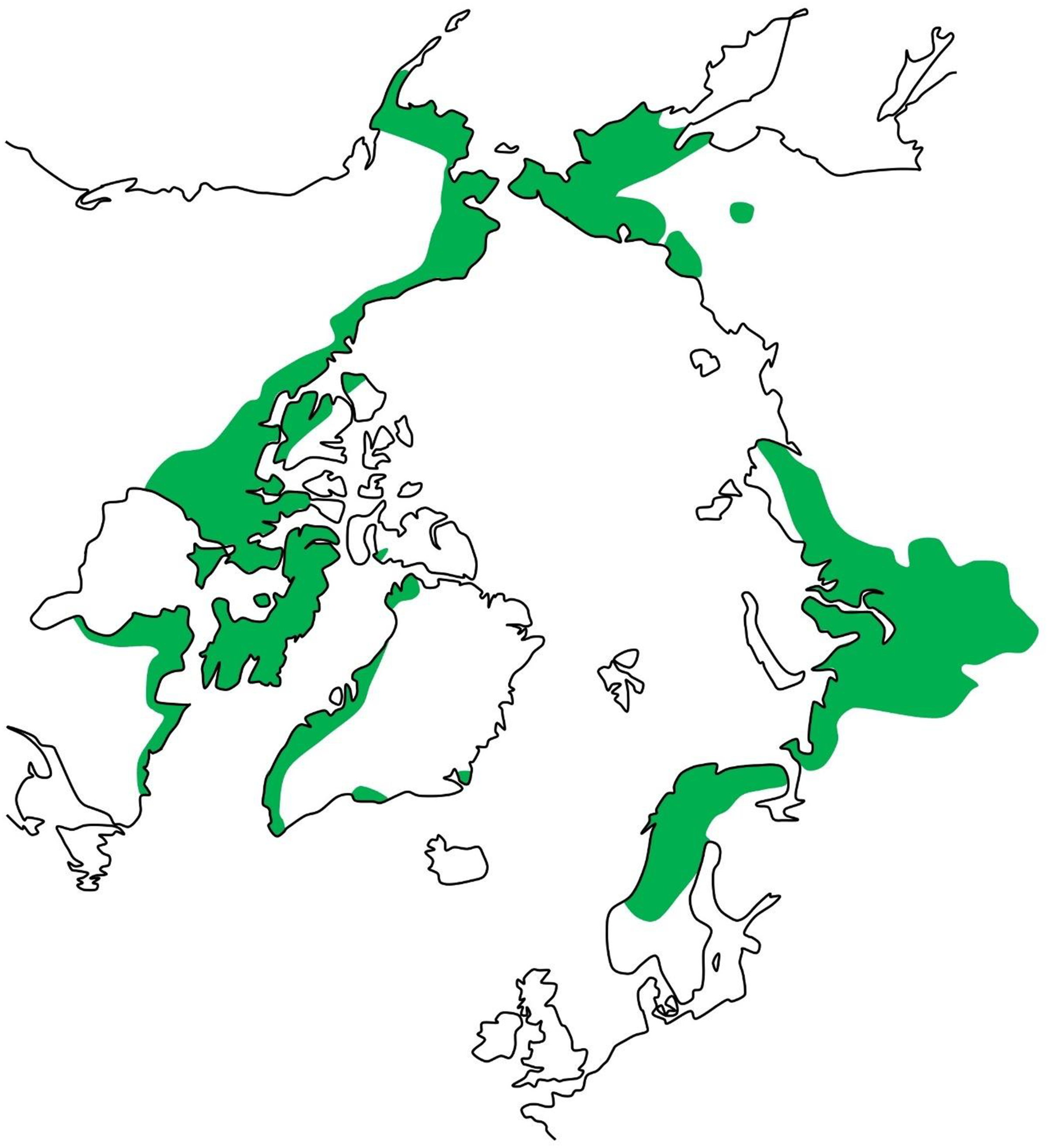
Distribution of Circumpolar cultures with a documented tradition of personal songs for children. Note. The geographical localizations of cultures are approximate. List of cultures and sources consulted in Supplementary Materials (see Table S5).
The ubiquity and uniqueness of these songs, which seem absent in neighboring Native American and Eurasian cultures, suggest a historical connection. One hypothesis is that their diffusion accompanied the migrations of pre-Inuit peoples reaching the American Arctic across the Bering Strait, as well as Eurasian contacts influencing Sámi populations, both of which may largely predate the written lullabies of ancient Sumerians and Babylonians. Personalized children’s songs could also have spread “horizontally,” namely through continuous or punctual cultural exchanges occurring between Arctic populations. In both scenarios, their present-day diffusion exemplifies how specific lulling practices may travel over vast territories and maintain a high degree of stability despite colonial experiences.
Importantly, historical diffusion does not exclude universality. On the contrary, the diffusion of “ancient, and generally useful, cultural traits” is commonly seen as a major causal process leading to the emergence of universals (Brown, 2004, p. 50). However, the fact that personalized songs for children present a wide but circumscribed distribution indicates that lullabies may take different forms across regions. Out of the many possibilities offered to adults for singing or not singing to children, the development of a formal lullaby repertoire indistinctly addressed to any child (as is common in Western countries and beyond) should therefore be seen as one historically contingent choice among others.
Thus, the study of cross-cultural variability in lulling practices should not be entirely reduced to the question of universality, nor to how strictly we define those practices. Future research going beyond the presence/absence criterion could contribute to identifying a set of recurring forms that infant-directed songs may take across cultures. Beside the Circumpolar North, one such form is found along the Pacific Northwest Coast.
Convergence: The Pacific Northwest Coast
Among Native American communities, those living along the Pacific Northwest Coast stand out in at least two regards. Firstly, among the societies considered, all of them have a lullaby repertoire. Secondly, at least 7 of them are reported to have a special repertoire of lullabies absent from the rest of the continent, typically sung for noble individuals and ceremonial purposes.
Examples include the Haida Gid ₭agaan, a type of lullaby designed to honor yahǥid (“noble”) children (Boelscher, 1988, p. 83). Besides their function of lulling to sleep (Enrico & Stuart, 1996, p. 22), these songs may be performed as part of “potlatch” feasts, during which each child is summoned in age order by a lullaby made in their honor (Murdock, 1970, p. 10), or during house-building ceremonies. The lyrics involve a “high language” and lead to the socialization of children to their status, developing their knowledge of kinship systems, heritage, and how to properly address others or refer to oneself, with textual repetition serving to emphasize this content (Enrico & Stuart, 1996, p. 21; White, 2011, pp. 293–296). A corresponding example is found among the Kwakiutl, with a lullaby for a noble daughter singing her pride in her lineage and wealth, as well as her destiny to make her husband a great chief (Day, 1951, p. 58).
Tlingit songs performed during potlatch ceremonies also include a type of “love song” addressing each child of the singer’s clan and referring to Tlingit people as “children” as a way of pleasing and flattering them. As the Tlingit are traditionally divided into two matrilineal exogamous moieties, the songs are meant to designate potential spouses and thus convey knowledge about the kinship system (Kan, 1986, p. 205). In the Nuu-chah-nulth case, similar songs called ʔastimxýak are performed during potlatch ceremonies and explicitly described as “lullabies,” although they lack repetition and display structural complexity (Roberts & Swadesh, 1955, p. 228, p. 325).
As is the case among the Haida and the Tlingit, Nuu-chah-nulth lullabies require property rights to be performed; they are “like the coat of arms or totems” in that they “refer to family history and privileges” (Barbeau, 1933, pp. 103–104). Typically, boys inherit their fathers’ songs (Barbeau, 1933, 203). Likewise, among the Tsimshian, each clan has its own songs, including a set of lullabies (Miller, 1997, p. 61, p. 126; Roth, 2002, p. 129). Feasts are here characterized by an open circulation of material goods, contrasted by the controlled circulation of immaterial treasures, including lullabies, normally transferred to the next generation at the time of death (Anderson & Halpin, 2000, p. 21; Roth, 2011, p. 122). A lullaby learned by a Nlaka’pamux chief from a female grizzly during a dream was likewise considered as “his own song,” although in this case, the women of his band liked it and eventually adopted it as a common lullaby (Wickwire, 2001, p. 441).
Looking for corresponding practices, we may turn to Polynesia. Although this barely appears in the SCCS review, several authors have stated that lullabies “seem not to have been in general use” in this region, that they are “recent imports” (Burrows, 1940, p. 340), that there are “no true lullabies” in the area (Kaeppler, 1980, p. 142), or that they are “surprisingly few” (McLean, 1999, p. 369). As is the case among Native Americans, some reports are ambiguous, as in the Cook Islands, where “babies are not sung to” but are nonetheless “bounced rhythmically to articulated syllables” (Sullivan, 2021, pp. 35–6). In Samoa, although apparently “no lullabies” are found, adults can make up their own short songs to put children to sleep (Solomona, 2009, p. 27). This may explain why Samoans are elsewhere reported to have no word for “lullaby,” other than a descriptive expression: ‘o le pepe e fa’amoemoe ai le pepe, “a song to put the child to sleep” (Moyle, 1972), in line with observations made on Rapa Nui (Easter Island) and the Southern Marquesas Islands (Fischer, 1997, p. 148; Moulin, 1994, p. 48).
There are, in fact, established traditions of lullabies in Polynesia, with specific names for the repertoires. Yet, as is the case on the Northwest Coast, such instances are typically related to other musical forms that could be categorized as “court music,” or “praise songs” for chiefs. For example, although commonly translated as “lullaby,” the Tongan term ūpē originally referred to nose flute performances aimed at awakening chiefs (Kaeppler, 1974, p. 112), but also to an “obsolete form of lullaby” that used to be “performed for children of chiefs” (Moyle, 1987, p. 204). Similar cases are found in Mangareva, where the term keko refers both to laudatory chants for chiefs (Buck, 1971 [1938], p. 391) and, more typically today, to lullabies (Mawyer, 2023, personal communication), and in Hawaii, where the genre of mele inoa, i.e. personal songs honoring individuals, is often attributed to newborns (Silva, 2014, p. 105).
Another, better documented case is the Maori oriori, defined as a lullaby “for children of high birth” (McLean, 1999, p. 360). While an oriori may be specific to a child, it primarily contains information about a lineage and legacy as a way of defining the child’s future leading role (Brady, 2005, p. 202). Thus, although an oriori may be used for lulling children to sleep, its functions also encompass a general education in history and traditions (Greenway, 1964, p. 57). The texts may contain complex references to mythological themes inaccessible to the understanding of small children, who may start asking questions about them when they grow older (Greenway, 1964, p. 45; Luomala, 1971 [1949], p. 90). Oriori may be sung to male or female children, with equally high complexity in the lyrics, while the melodies tend to be simple (although sung on fast tempos) (McLean, 2013; McLean et al., 2001). These songs may still be sung today, although not specifically in the context of bedtime, but rather as part of collective performances, such as poi dances (McLean, 1999, p. 380; Paringatai, 2005, p. 5).
It is a recurring gesture to track similarities between the Maori and cultures from the Northwest Coast (e.g., Rubel & Rosman, 1971). Among other corresponding features, both areas tend to display stratified tribes with a tripartite distribution between slaves, commoners, and aristocrats, the latter being themselves hierarchically organized according to their lineage; even their houses show structural and functional similarities, notably in their role of displaying their owners’ wealth and the presence of ancestors (Descola, 2021, p. 650). One important aspect of these commonalities is that they likely emerged independently on both sides of the Pacific Ocean. Indeed, while evidence of pre-Columbian human trans-Pacific voyaging contacts has been found, it primarily concerns East Polynesian and South American areas (Ioannidis et al., 2020; Willerslev & Meltzer, 2021, p. 361) and such contacts are unlikely to have affected Native American cultures to any significant degree. Thus, despite their independent histories, Polynesia and North America present a common pattern, as two vast geographical areas characterized by the rarity of lullabies, which nonetheless developed formal repertoires in cases where these were inserted into hierarchical social structures and ceremonial life.
The association between lullabies and “court music” is in fact a recurring phenomenon that would deserve a study of its own. An additional case to include in such a study would be Irish and Scottish communities under the ancient clan systems, where songs originally praising noble children were appropriated and made part of popular lullaby repertoires (Nic Lochlainn, 2013; Watt, 2012, pp. 329–331). A specific review of sources based on the eHRAF World Cutltures database and the SCCS revealed three additional cases of societies with specific lullabies for kings, namely the Ganda (Richards, 1964, p. 285), the Cambodians (Brodrick, 1948, pp. 79–80), and the Malays (Wilkinson, 1920, p. 6, p. 68). Yet, this association with “court music” is far from being universal: the ancient Gaelic societies appear as isolated instances in Europe, as does the Pacific Northwest Coast in North America.
Such observations, which can neither be interpreted as mere coincidences stemming from cultural arbitrariness, nor as the mechanical outcomes of human biological predispositions or in-the-brain processes, nor even as strict “conditional universals” (implying an “if-then” relationship between two cultural traits) (Brown, 2004, p. 48), have received surprisingly little attention from scholars working on lullabies. In addition to “universality,” a central concept for studying the cross-cultural variability of lullabies should therefore be “convergence,” namely the independent development of similar forms due to similar environmental constraints and affordances (Tomlinson, 2018, pp. 110–111).
One example in lullaby lyrics is the recurring motif of a dog asked not to bark and awaken the child. An early case is found in a lullaby included in the Rigveda, dating back to the second millennium BC (Ronzitti, 2019, p. 10). Since then, it has been reported in various other regions, including Russia (Golovin, 2000, p. 245) and Korea (Smith, 1897, p. 182). In all likelihood, the dog theme emerged neither through historical diffusion nor from innate cognitive processes in humans, but rather from the experience of living in environments where dogs are present and may interfere with children’s sleep. It is here a certain similarity between environments (the presence of barking dogs) that triggered convergence (Tomlinson, 2018, p. 98, p. 110).
Evidently, this type of convergence does not exclude universality any more than historical diffusion does. However, attending to punctual cases of convergence such as these reminds us of the need to complement “universal” narratives about lullabies, to avoid definitions of the genre as a monolithic entity, and to turn our attention to the multiplicity of environments within which they develop.
In the Northwest Coast and Polynesia, the prominence of a highly hierarchical society and collective ceremonies likely provided favorable conditions for the development of lullabies towards corresponding forms. Lullabies here appear as a genre whose development is inscribed in specific social environments and enmeshed with a diversity of other (musical and non-musical) practices that impact their structures and performances in ways that are neither universal nor entirely arbitrary. Given the rarity of lullabies unrelated to animal songs, nobility, or ceremonial events among Indigenous cultures of Polynesia and America, we may in fact wonder to what extent lullabies are likely to emerge as formal repertoires on their own, without being from the outset connected to other forms of musicality.
Conclusion
On a global level, the practice of soothing children with songs or rhythmic vocalizations (a broad definition of “lullaby”) is found in a vast majority of societies (97.8%) and can safely be defined as a near universal. On the other hand, the possession of a specific repertoire of songs designed to soothe children (a strict definition of “lullaby”) emerged neither as a near universal nor as a genuine statistical universal. Although reported in a majority of societies (78.2%), it appears to vary significantly across geographical regions, with a more limited presence among Oceanian and Native American cultures. Societies with high degrees of political complexity or belonging to certain phylogenetic clusters also appear more likely to possess a specific repertoire of lullabies.
Rather than an “either/or” alternative, the results suggest an asymmetric continuum ranging from the presence of a specific and well-established repertoire of soothing infant-directed songs to the total absence of infant-directed singing, the latter being represented at best by a minority of present-day cultures. Thus, while we may safely speculate that there is a “common impulse, irrespective of race, creed, climate, or the size of a family” leading to the emergence of “music for babes” (Daiken, 1959, p. 10), it seems that this “impulse” does not fully determine whether, how, and with what level of investment it will be answered. Some Native American Peoples, like the Quiché Maya, exemplify low investment in lullabies, while others, especially on the Pacific Northwest Coast, exemplify a high degree of creative investment.
Although these results do not disqualify theories about the evolutionary origins of human music in parent-child vocal exchanges (Dissayanake, 2000; Falk, 2004; Mehr et al., 2021; Mehr & Krasnow, 2017; Mithen, 2005; Trehub, 2000), they call for caution regarding the significance of lullabies in human prehistory. While the act of singing to infants is likely ancient, the use of songs specifically intended for them could be a recent development. Such songs may also have been absent in specific places and at specific times in the past. Whether they were present during the original settling of America and Polynesia, for example, should not be taken for granted. In both regions, infant-directed songs often appear derived from, or strongly entangled with other (sometimes more formalized) musical genres, such as court music, or personal and animal songs.
The Circumpolar North further illustrates how lulling practices may be historically contingent, diffuse over vast geographical areas, and maintain themselves over long periods, thus making it hazardous to automatically assign cross-cultural similarities in contemporary infant-directed songs to atemporal, biological predispositions. The personalized and individualistic nature of repertoires also exemplifies how lullabies may take different forms across cultures, even when they are strongly conventionalized as a specifically infant-directed genre.
Lastly, cases of convergence, such as lullabies for nobility and ceremonies, remind us of the need to address certain types of regularities in human music beyond the dichotomy of particularism versus universalism. In the past decades, ethnomusicologists have strongly emphasized cultural particularism, while scholars from cognitive or evolutionary musicology have tended to emphasize universality (Savage & Brown, 2013). Together, they reproduce a typical tendency of Western ontologies and epistemologies, namely to split reality into the realms of culture and nature (Descola, 2013; Jullien, 2014; Viveiros de Castro, 2014) and to focus on one at the exclusion of the other. Yet in-between these approaches lies perhaps a “fertile middleground” for comparative research on lullabies and music at large (Clarke, 2014, p. 3), accounting for variation in human practices and their insertion within specific social environments, while also taking instances of cross-cultural convergence seriously.
In conclusion, this study confirms the universality of lullabies, although only insofar as a broad definition of the genre is adopted, and highlights several directions for further research into their cross-cultural variability. These include (1) investigating other cultural areas where the absence of lullabies has been reported and inquiring why certain cultures choose to invest more than others in the genre, (2) documenting other instances where the historical trajectories of infant-directed singing practices can be traced, and (3) exploring the plurality of typical forms that lullaby practices are likely to take across cultures, notably through convergence.
Footnotes
Acknowledgments
I am grateful to the editor (Carol Ember) and reviewers (Patrick E. Savage and anonymous) for their interest, patience, and insightful feedback on previous versions of the manuscript. The statistical analyses presented in the paper were carried out with the collaboration of Thomas Solvin and Knut Waagan, from the Data Management Section of the IT Department, University of Oslo.
Declaration of Conflicting Interests
The author(s) declared no potential conflicts of interest with respect to the research, authorship, and/or publication of this article.
Funding
The author(s) disclosed receipt of the following financial support for the research, authorship, and/or publication of this article: This work was supported by the Norges Forskningsråd (314818).
Author Biography
References
Supplementary Material
Please find the following supplemental material available below.
For Open Access articles published under a Creative Commons License, all supplemental material carries the same license as the article it is associated with.
For non-Open Access articles published, all supplemental material carries a non-exclusive license, and permission requests for re-use of supplemental material or any part of supplemental material shall be sent directly to the copyright owner as specified in the copyright notice associated with the article.
