




Abstract
Populist studies are increasingly interested in the effects that populism has on the politics of contemporary democratic systems. This article analyzes the relationship between populist parties and politicians and the intensity of political protest. Arguing that populists generate feelings of anger and outrage at establishment politicians, develop close relationships with social movements, and instigate further polarization and resistance from the opposition, the existence of populist actors in a political system is believed to generate more political protests. Using a unique dataset of populist parties in European, Latin American, and North American countries, cross-national testing demonstrates strong positive correlations between the presence of populists in power and anti-government demonstrations, testifying to the effect that populists have on protest activity. Tests for the existence of populist parties in the opposition, however, reveal no empirical support for increased levels of political protest, implying that the strongest effect only comes once populists come to power. These results provide necessary nuance to our understanding of the destabilizing effects of populism and its consequences for contemporary liberal democracies.
Keywords
Introduction
On April 13th, 2001 a rather fascinating event occurred. Four days prior, a general strike organized by Venezuela’s National Federation of Trade Unions led nearly one million Venezuelans to protest President Hugo Chavez’s reforms in the streets (Hawkins, 2010). After violent clashes between supporters and opponents of Chavez occurred near the presidential palace, the military stepped in to request Chavez’s resignation. By the 13th, however, word had reached his supporters that he had refused to resign from the office of the presidency. Supporters surrounded the presidential palace and seized television stations demanding his return and in a surprising turn of events, pro-Chavez members of the presidential guard removed the interim president and reinstalled Chavez as president. As with Juan Perón before him, Chavez’s polarizing political strategy had created a strong opposition force ready to protest his political reforms in the streets, though, at the same time, his strong connection to a segment of the Venezuelan citizenry had ultimately saved him from being ousted from power.
While the case of Chavez is a more extreme case of mass mobilization, similar phenomena can be seen in many other cases of populists’ ascendancy to power. Populism’s close connection to the people, manifested by their exaggerated support for full popular sovereignty, the redirection of the anger of the populace towards establishment figures, and populists’ close connection to social movements is likely to engender political protest on behalf of the masses whose grievances or issues have not been addressed by the political mainstream. Previous tests have demonstrated that populist attitudes are positively correlated with non-institutionalized forms of political participation, such as protest, and less with institutionalized forms (Anduiza et al., 2019). Moreover, populists in power are commonly very polarizing figures that can lead to further protests by the opposition, such as was the case with Hugo Chavez. This study intends to build upon this literature by testing this relationship with the use of cross-national panel data. If it is the case that populist attitudes push citizens to protest in the streets, then one should expect to see this connection empirically when populists are present in the political arena. While this article makes no claim to ultimate causality, it instead investigates the observable implications of prior theories about the mobilizational potential of populism at a higher level of analysis.
This study is organized in the following way. It begins with a review of the literature on populism and political protest, followed by the theoretical argument to be empirically investigated. In brief, I argue that populist parties and politicians can lead to more political protests on behalf of the citizenry. For one, they can effectively mobilize those citizens who are angry with the political establishment for not hearing out their grievances, and secondly, populists often lead to a polarization of society that brings about further mobilization by the opposition. From there, the methods and materials are presented with a detailed description of the creation of the ‘populist’ variables as well as the dependent variables for ‘political protest.’ The study then moves towards empirical testing, which is performed by way of regression analysis. Upon demonstrating that both the share of the vote for populist parties and populists in power demonstrate strong positive relationships with anti-government demonstrations when controlled for, I provide several concluding remarks, limitations, and promising directions for future research.
Populism and Political Protest
Populism is closely linked with the democratic notion of popular sovereignty brought about by the great liberal revolutions of the 18th and 19th centuries. The fundamental belief at the core of democracy is that government should be, to quote Abraham Lincoln, “of the people, by the people, and for the people.” The implication is that the “sovereign people” are the ultimate legitimate power in a democracy and that they are right to rebel against their government if they feel that they are not being properly represented by their politicians. Conceptually speaking, “populism,” can best be described as a “thin-centered ideology which considers society to be divided into two homogenous and antagonistic groups, the “pure people” and the “corrupt elite,” and believes that politics should be the expression of the volonté générale” (Mudde, 2004). It is important to note that while many democratic ideologies invoke the concept of popular sovereignty, populists are unique in that they view popular sovereignty as being the supreme value in modern democracies, which often leads to a crude belief in simple majority rule. While it can attach itself to other “host-ideologies” which provide for the larger worldview (Mudde, 2004), it is this core belief in popular sovereignty and the moralistic dimension to populism that are expected to act, albeit for different reasons, as significant motivators for political protest.
As populists believe fundamentally in the notion of popular sovereignty, that the people as a whole should determine the politics of their country, perceived violations of this notion can lead citizens to develop grievances. Judges, bureaucrats, political parties and other intermediary institutions associated with liberal democracy, as well as other political “influencers” such as the media, interest groups, multinational corporations, and supranational governmental structures, are often the target of populist critiques. While populism often holds a rather antagonistic position to liberal democracy (Mudde, 2012; Mudde & Rovira Kaltwasser, 2017; Ruth-Lovell et al., 2019), this is not to say that populists are fundamentally anti-democratic per se. In their study on populist attitudes, Kaltwasser Rovira and van Hauwaert (2020) conduct a cross-national survey involving countries in both Europe and Latin America and demonstrate that while populist citizens, on the whole, tend to be dissatisfied with the state of democracy in their country, fundamentally, they show strong support for democracy and democratic values. This implies that populists are not closet authoritarians by nature, but simply dissatisfied democrats (see also Oesch, 2008; Ramiro, 2016; Van Hauwaert & Van Kessel, 2018; Zaslove, et al., 2020).
Given their core belief in popular sovereignty, populists consider violations of the principle of ‘majority rule’ to go against this core notion of democracy. Using emotional appeals to feelings of injustice amongst a population, populism is capable of mobilizing citizens who have objective, relative, or constructed grievances concerning the governance of the establishment parties (Laclau, 1977; Laraña et al., 1994). Most often, these groups include those who have the impression of being ignored or excluded by the political establishment (Mudde & Rovira Kaltwasser, 2017). In this respect, populist parties and movements can play a positive role for democracy insofar as they help to articulate the demands of these individuals who feel abandoned.
The moralistic dimension to populism which leads the populist to view the struggle between the two polar forces imagined by the populist, the people and the elite, to be viewed in Manichean terms (Mudde, 2004) generates feelings of anger and moral outrage (Rico et al., 2020). 1 While general distrust (Hooghe & Marien, 2012) and dissatisfaction (Miller, 1980; Torcal & Montero, 2006) are also negative attitudes that can be held about political phenomena, the anger arising from anti-elite sentiments is different insofar as it is of a moral character. While the former two can lead to political apathy, moral outrage is expected to lead to increased political participation. Moralized attitudes are associated with higher motivations to participate in politics (Skitka & Bauman, 2008; Skitka et al., 2017) and fewer inhibitions against acting (Effron & Miller, 2012; Ryan, 2017). In times when the political mainstream has become disenfranchised to the point of being hated by a large portion of the citizenry (Hay, 2007), the narratives constructed by populists can produce a justification for becoming more politically engaged. Feelings of injustice and moral outrage have been demonstrated to be strongly correlated to political engagement and political protest (Goodwin et al., 2009; Van Stekelenburg & Klandermans, 2010; Van Zomeren et al., 2008). While other negative emotions have at times been associated with populist attitudes (Demertzis, 2006), the most common emotional association is anger (Rico et al., 2020). This was the case with Euroscepticism in Britain (Vasilopoulou & Wagner, 2017), votes for Donald Trump (Abramowitz, 2018), votes for the populist radical right in France (Vasilopoulos, et al., 2018), and populist attitudes in Spain (Rico et al., 2017). Anger is an emotion that arises from contexts where the individual understands personal harm or the threat of harm to be the result of negligent behavior of political actors. Previous studies have emphasized the extent that anger enhances political participation more than other emotions (Thompson, 2006; Valentino, et al., 2011; Weber, 2012).
Considering that populist beliefs are ultimately related to feelings of anger, one should expect them to lead one to becoming more engaged in political protests than to become apathetic. Indeed, when tests were run using survey data from nine European countries, Anduiza et al. (2019) demonstrated that those with populist attitudes were correlated with participation in non-institutional forms of political participation such as signing petitions, participating online, and in some cases participating in political demonstrations. Meanwhile, studies testing participation in institutional forms of political participation, however, have shown the showed the opposite relationship (Anduiza et al., 2019; Immerzeel & Pickup, 2015). In another study by Lüders, et al. (2021), populist attitudes were a highly significant mediating variable between indicators measuring levels of group relative deprivation and joining in the Yellow Vests protests in France. However, different studies investigating the mobilizational potential of those with high populist attitudes also show a null or even inverse effect; using a sample from the Netherlands, Zaslove et al.’s tests revealed a statistically negative relationship. While Anduiza et al.’s (2019) study shows positive relationships in the case of France, Greece, and Spain, in others, this relationship is insignificant for others, and in the case of Switzerland, it is statistically negative. This study shall build upon the results of the tests conducted by this handful of studies by testing this relationship with cross-national data.
Given the populist’s close connection to “the people,” and the un-mediated relationship they attempt to construct in order to bypass the mainstream institutions of society, populist politicians often have a close relationship with populist social movements, whether they be grassroots organizations or party affiliated (Aslanidis, 2017; Caiani & Císař, 2019; Hutter & Kriesi, 2013; Sawyer, 2021; Skocpol & Williamson, 2016). Many populist leaders, such as Evo Morales (Lehoucq, 2011, p. 352), have come to power on a wave of populist political protest against the incumbent or mainstream parties, while others, such as Hugo Chavez (Myers, 2011) and Juan Péron (Chen, 2011, p. 113, 117), have even been returned to power by popular demonstrations after having been ousted by the opposition. From their beginnings in the late 1990 s, Morales’ Movement for Socialism (MAS) built bridges between existing social movements that were increasingly resistant to the neoliberal politics of the era in order to form a broad opposition coalition (Lehoucq, 2011, p. 352; Madrid, 2011). Whether organized with a strong leader with centralized power, or direct democratic decision-making, many radical anti-establishment parties today engage with social movements seeking to push politics in a certain direction, forming what has been referred to as the movement-party (Caiani & Císař, 2019). Aslanidis (2017) outlines three typologies of populist movements in terms of their connection to electoral politics. The first of these are movements that eventually become institutionalized in the form of political parties, such as PODEMOS in Spain and Italy’s Five-Star Movement. Next are those movements that associate themselves with a certain party in an effort to have certain political candidates win political office. The Tea Party in the United States is a prime example as they provided support for right-leaning, small government Republican candidates such as Ted Cruz, Sarah Palin, and Michelle Bachmann (Skocpol & Williamson, 2016). Finally, the third form are those movements that become “co-opted” by political parties. Considering that the discursive construction of such concepts as “the people” or the “99%,” are what Laclau (2005) termed “floating signifiers,” this renders them able to be co-opted and by political actors who can use them for their own opportunistic ends. One of the most infamous instances of this occurring happened in Ecuador when Rafael Correa appropriated the collective identities and discursive constructions of popular grassroots movements prior to initiating his first presidential campaign. In this respect, it is expected that if there is a prominent populist party representing the voices of angry citizens in the political system, it would go to reason that social and protest movements would coalesce around them as the raison d’être of both are essentially to protest a fundamentally unjust status quo.
Populism and Polarization
Once populist parties become present in the political system, however, or gain representation in government, this can spur the opposition to counter-protest. It was, for example, the controversial decision by Poland’s Law and Justice party (PiS) to restrict the abortion law that sparked the mass mobilization of newly politicized Polish citizens who opposed the decision (Hall, 2019). In the United States, Donald Trump’s campaign rhetoric and support for controversial policies such as the Muslim ban and the family separation policy, instigated large protests in opposition (Berry & Chenowith, 2018; Zepeda-Millan & Wallace, 2018). The inauguration protests alone are estimated to have attracted around two million protesters and acted as a catalyst for the formation of a unified ‘resistance’ movement (Booth & Topping, 2017, Jan 22; Meyer & Tarrow, 2018). A number of populist heads of government have been removed from power after large scale anti-government protests as was the case for Abdalá Bucaram in Ecuador (Conaghan, 2011, pp. 372–3), Hugo Chavez in Venezuela (Myers, 2011, pp. 270, 281), and Fujimori in Peru (Palmer, 2011, p. 249).
When in power, populism can also spur negative emotions related to anger and outrage to the ‘establishment’ opposition, and polarization is a common side effect of having populists in power (Roberts, 2022). Due to their often divisive rhetoric, Manichean perspective on politics, their support for controversial issues and policies backed by their ‘people,’ their propensity to bring “bad manners” into the “respectable” profession of politics, and the rather complicated relationship they have towards the institutions of liberal democracy (Arbatli and Rosenberg, 2021; Enyedi, 2016; Handlin, 2018; Kaltwasser, 2017). In political systems where “populist polarization” exists, party rivalries are ultimately not confined to elite-conflicts as the dominant electoral strategy is one where elites appeal to the “opposition between the righteous people and the corrupt elites, and to the public’s distrust of the institutions of compromise” (Enyedi, 2016). Mudde and Rovira Kaltwasser (2017) note that populism can lead to a “moralization of politics” which makes reaching agreements with other parties and the formation of stable political coalitions more difficult. Instead of creating a simple electoral constituency, or voting-bloc of citizens prepared to support them in elections, populism creates a broader political movement based on a common identity. Bornschier et al. (2021) has shown, for example, that in Switzerland, the populist radical right had created a political movement based on a fixed cultural identity that sees itself as embodying the Swiss “people” and rural voters, who are opposed to the urban educated class. In lieu of elite-conflicts, populist polarization is based in genuine cultural and ideological differences and political cleavages within the electorate, and a change in government instead does not simply bring to power an opposition party, but also a party that is anti-systemic in nature (Enyedi, 2016).
Elections, thus, are transformed into a contest between competing political regime types along a populist and “anti-populist” cleavage. “Anti-populism,” or a political response to the populist movement rooted in concern and denunciation of perceived political extremism, belief that political processes are, by nature, more complex than the populists portray it as, and a belief in the legitimacy of elected representatives over direct forms of popular sovereignty often manifest themselves to form a movement or coalition of actors that oppose the populist movement (Hamdaoui, 2022a). On the one hand, studies have shown that one such strategy by mainstream actors is sometimes to promote a conciliatory approach or adopt the very issues and policy prescriptions offered by the populist movement in an attempt to sap their base of support (Mondon, 2016; Carvalho, 2019). This can be seen in the case of France’s Union pour un Movement Populaire (UMP) that attempted to co-opt the topics of immigration and integration previously monopolized by the Front National (Carvalho, 2019), as well as Emmanuel Macron’s attempts to defuse the Yellow Vest protests by presenting himself as less adversarial as he did with his Front National opponents (Hamdaoui, 2022b). By itself, this strategy may not necessarily promote political protest by the anti-populists due to the non-adversarial way in which it interacts with the newcomers.
On the other hand, a more common adversarial response by many establishment forces such as the media (Demata et al., 2020; Kitzberger, 2023), establishment political parties (Hamdaoui, 2022b), and rival social movements (Hamdaoui, 2022a), is to “fight fire with fire” against a rising populist movement. This strategy attempts to demonize the populist movement by employ the opposite moral categories used by the populists, and has the effect of feeding this conflict which can lead to more polarization and a more permanent populist versus anti-populist political cleavage (Kaltwasser, 2017). While the anti-populist response may also be detrimental to preserving democratic norms of “mutual toleration” and “institutional forbearance,” (Levitsky and Ziblatt, 97–117) as they attempt to mitigate the populist ‘threat’ by any means necessary, they too energize and engage their constituents in the political process. The resulting backlash from the ‘establishment’, therefore, should expect to produce intensified protests against the populists once they enter into government. As with populist mobilization, this can also be linked to the anger and outrage of the “anti-populists” at the populists’ daring to challenge what is believed to be a more–or-less “just” political system, and the presence or absence of certain issues in the political domain which, in turn, would spark counter-protest. Anecdotally, this relationship would seem to hold in a number of modern democracies.
In this respect, one should expect to observe more political protests, especially those that target governing elites, to occur when populists are present in the political system. Consequently, I expect to find evidence for the following hypotheses:
The presence of populist parties in the political system is associated with a higher tendency for anti-government demonstrations.
In the following section, I present the empirical strategy and the variables to be used for testing.
Materials and Methods
Empirical Strategy
In order to test the main hypothesis on the relationship between populism and the number of anti-government demonstrations, I take panel data from 1989 to 2018. The method used to analyze this relationship involves the use of a zero-inflated negative binomial regression, which allows one to avoid the biases associated with a non-normalized Poisson distribution of a dependent variable containing a large number of zeroes, which is the case for the dependent variable utilized in this study. This being the case, a standard parametric OLS-regression is not applicable for the purposes of this study, as it cannot account for a poisson-distributed dependent variable (see Hilbe, 2011). Moreover, considering that the data involves observations for both country and year, organized as panel data, a negative binomial regression is appropriate where a regular poisson regression is not. I estimate fixed-effects models with country and time-fixed effects in order to gauge the yearly impact of populism on the intensity of protest in a given country. Whereas country-fixed effects permit one to account for unobserved heterogeneity between different countries in the sample, I also include time-fixed effects to account for unobserved shocks that hit all countries at the same time during our period of observation (see Allison, 2009).
This study is divided into two sets of tests. The first involves tests using a large dataset including countries in Europe, North and South America, and Asia (India) for the effect that the presence of a populist politician in the position of the chief executive has on the number of anti-government demonstrations in a given country. The second set of tests focuses on the European data and includes additional variables measuring the relative size of the populist party in the national legislature. From this, it will be possible to gauge the effect of simply having a prominent populist party as the opposition as well as the effect of a populist coming to power.
Dependent Variables
In order to test for a relationship between populism and political protests, I make use of the data from the Cross-National Time-Series Database (Banks & Wilson, 2019), which contains variables for “anti-government demonstrations” which will be used as the main dependent variable. The definition that Banks and Wilson provide “for anti-government demonstrations” is “any peaceful public gathering of at least 100 people for the primary purpose of displaying or voicing their opposition to government policies or authority, excluding demonstrations of a distinctly anti-foreign nature” (Banks & Wilson, 2019, p. 13). This variable was chosen due to its operationalization of protests of an explicitly anti-governmental nature, which avoids fallaciously linking protests of all kinds to the phenomenon of populism, and focuses on the main theoretical dichotomies of populism and anti-populism of interest in this study; those in power and those who are not. Anti-government demonstrations fit within the theoretical framework as they link specific demands made out of anger and outrage at elected officials to acts of collective action. This operationalization strategy is also useful for understanding the directionality of the protests that may be aimed at the populist party or not, depending on whether they are in power in a given year.
Operationalization of “Populism”
The concept of “populism” is notoriously difficult to conceptualize, and the underlying theory behind the term necessarily affects which parties, politicians, and movements are included into the category. Considering that the argument made in the theoretical section is based on the ideas that populists have of politics, data points for the populist variables will be based on the ideational approach (Mudde & Rovira Kaltwasser, 2017). Cross-national data of populist politicians and parties is rather scarce today despite the explosion of interest in the subject. That being said, a number of regional datasets which take the ideational approach as their framework are available for use which identify populist actors based on qualitative literature review, expert validation, and analysis of politicians' speeches and manifestos.
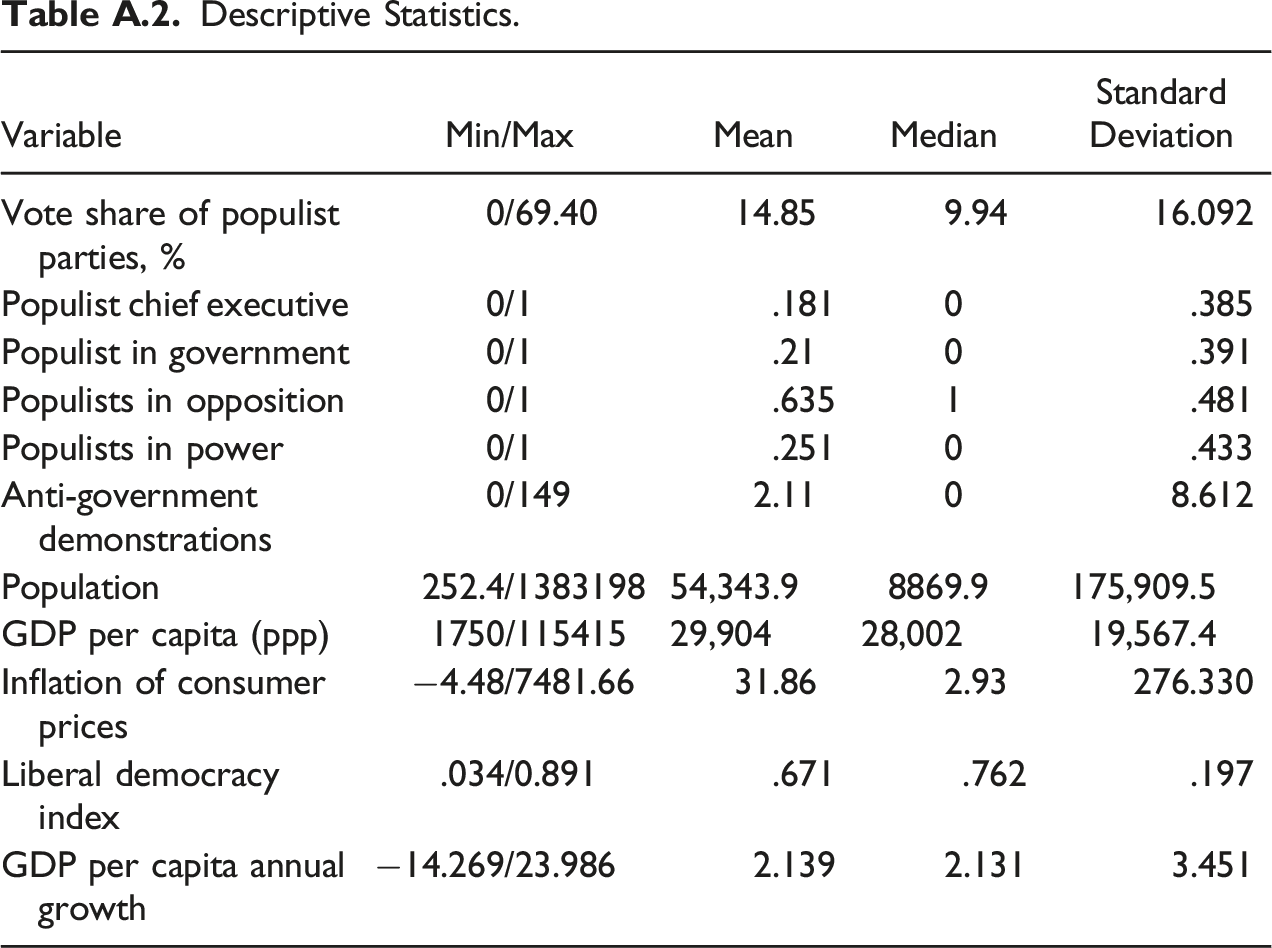
The first variable used in this study, POPULIST VOTE SHARE, denotes the percentage of the vote for all European populist parties in a given country and year from 1989 to 2018. So as to identify parties that fill the criteria of being populist according to the ideational approach, I utilize Rooduijn et al.'s (2023) Popu-List which lists all populist parties in 31 countries in Europe since 1989. To ensure the accuracy of such classifications, the list is compiled and reviewed by a team of 80 academics. From here, the vote share for these parties is taken from the ParlGov database (Döring and Philip, 2019). To create the figures for the panel data, each country-year observation is given the total percentage of the vote for all populist parties. An overview of these figures can be observed in Table A2 in the Appendix.
In order to move beyond the limited scope of European countries, where clear ‘populist’ parties can actually be identified, a variable designating a populist head of government (POPULIST CHIEF EXECUTIVE) is used for the second set of tests. The benefit of using such a variable is two-fold; (1) It permits an analysis of populism in political systems where populist politicians can arise out of non-populist parties; (2) It permits one to examine the effect of populists controlling the executive branch of a given country. This variable is dichotomous in nature and is based on the data used by Ruth-Lovell et al. (2019) whose dataset spans both Europe and South America. For European heads of government, the populists identified in Rooduijn et al.'s (2023) Popu-List are combined with the ParlGov database (Döring and Philip, 2019) in order to identify when a populist politician held either the Presidency or Prime Ministry. To account for populists in Latin America, I take from Ruth’s (2018) list of populist presidents which is based on expert examination. Finally, so as to incorporate more recent populist chief executives, as well as those residing in countries in Central and North America, I code for those individuals who were deemed to be populists in the Global Populism Database (Hawkins, et al., 2019). This database measures the level of populist discourse in the speeches of 215 chief executives from 66 countries around the world. Based on their criteria, individuals were awarded with a score from “somewhat populist” to “very populist.” For the purposes of this study, though, those who were given a score of .5 or higher (denoting ‘somewhat populist’) were included in the dataset for this study. To test various aspects of the hypotheses and provide robustness checks, I transform this variable into one where populists are present in a coalition government, both as a dummy variable (POPULISTS IN POWER) and another reflecting the greater decision-making power afforded the chief executive (POPULIST GOVERNMENT). 2 Finally, in order to fully operationalize populist parties in the opposition, that are present in the legislature, yet outside of the executive, I create a dummy variable that gives a “1” to country-year observations where POPULIST VOTE SHARE is greater than 1, but populists are not in a governing coalition.
All together, the dataset I make use of consists of 45 countries, with 1440 country-year observations from 1989 to 2020.
Control Variables
In the following section, I introduce variables that are prominent indicators of political protest intensity and will be included in the regression models as control variables.
Democratization is recognized to be an important prerequisite for protests and the operations of social movements. Democratic regimes allow, and even facilitate, political protest, by promoting “citizen” relationships, formalizing rights that legally protect citizens, including the participation of political minorities, incentivizing politicians to listen to the demands of social movements, and creating “complementary institutions,” such as labor unions, electoral campaigns, political parties, and other societal organizations that social movements can use as ‘allies’ (Tilly & Wood, 2009, pp. 137–9). As a result, they are much less likely to use the repressive apparatus of the state to prevent citizens from expressing demands of their government. In order to account for the presence or absence of these institutional procedures, the Liberal Component Index from the Varieties of Democracy dataset will be included as a control (Coppedge, et al., 2020). This variable is described as follows: “The V-Dem Liberal Component Index (LCI) captures the central liberal aspect of democracy that ensures citizens’ and minority groups’ protection from the tyranny of the state and of the majority, an important element of a democratic state. It includes the equality before the law and individual liberty as well as judicial and legislative constraints on the executive” (Coppedge, et al., 2020). These figures are operationalized as a decimal figure between “0” and “1” with “1” denoting a theoretically ideal liberal democracy.
Given the rather intuitive fact that countries with larger populations naturally have higher incidences of political protest, a control variable is included which for population size in order to account for this from the United Nations, from the CNTS dataset (Banks & Wilson, 2019). These figures have been logged to ensure a less skewed distribution. From the perspective of the Rational Choice Theory, larger populations allow political entrepreneurs opportunities for communication and organization that are conducive to the outbreak of political protests by offering a solution to what Lichbach (1998) called the “Rebel’s Dilemma” (Nam, 2007). Powell (1982) has also noted that political protest is also a function of population due to the fact that state authorities find it more difficult to curb the outbreak of collective action when the population is larger. Wilson and Dyson (2017) posit that reducing mortality rate, fertility rate, and the age structure can influence democratization in underlying ways, which consequently allows for more protests.
The level of economic development is a relevant indicator to the intensity of political protests and has shown to be consistently correlated with political protest events. A large number of studies have pointed to the fact that levels of GDP per capita tend to promote anti-government protests (Ang et al., 2014; Brancati, 2014; Dalton & van Sickle, 2005; Korotayev et al., 2021; Nam, 2007; Su, 2015). This strong correlation can be explained in several ways; (1) economic development is strongly correlated with more democratic regimes (Lipset, 1959; Boix, 2011; Brunk et al., 1987; Burkhart & Lewis-Beck, 1994; Cutright, 1963; Dahl, 1971; Epstein et al., 2006; Londregan & Poole, 1996; Moore, 1966; Rueschemayer et al., 1992). This is either due to the fact that more economically well-off citizens become less tolerant of repressive regimes and decide to join pro-democracy protests (Lipset, 1959) or that more economically developed countries are less likely to backslide into autocratic regimes (Przeworski & Limongi, 1997); (2) economic development is closely linked to the level of formal education in a given country (Barro, 1991; Barro & Sala-i-Martin, 1995; Benos & Zotou, 2014; Korotayev et al., 2006, 2007; Korotayev, 2009; Korotayev & Khaltourina, 2010; Sadovnichij et al., 2016; Sala-i-Martin, 1997). As those with higher educational attainment (Brody, 1978; McVeigh & Smith, 1999), or those with both higher education levels and higher incomes (Lipset, 1981; Powell, 1982; Verba et al., 1978) are more likely to participate in political protests, the proliferation of formal education throughout the modernization process has been identified as an important factor promoting protests; (3) economic development is, as Inglehart and Welzel (2005) have shown, accompanied by a transition from material survival values to post-materialist values of self-expression. Through their World Values Survey (Inglehart et al., 2014) they have demonstrated that those respondents adhere to values of self-expression are more likely to report having participated in protest activity or express interest in doing so (Inglehart & Welzel, 2005). The figures for GDP per capita (ppp) chosen as a control come from the World Bank from the CNTS dataset (Banks & Wilson, 2019). So as to ensure that the distribution used resembles more of a normalized distribution, I make use of logged figures of GDP per capita.
Despite the paradigmatic shift in social movement theory, a large collection of literature continues to thrive in which it is argued that the macroeconomic backdrop to anti-government demonstrations remain relevant, that “misery matters.” Hardship from economic crisis is generally understood to be a catalyst to large-scale protest mobilization (Foran, 2005; McVeigh, 2009; Snow, et al., 1998; Snow, Soule & Cress, 2005). As per the quotidian disruption theory, mobilization can occur in the event that socioeconomic “shocks” interfere with the daily life of an individual, making life untenable, or when growth in demand for resources is larger than available resources (Snow et al., 1998). In a cross-national study of 145 countries from 1960–2006, Caren et al. (2017) detected a negative correlation between the number of contentious events and economic growth, with the strongest effects felt in countries experiencing extreme economic decline and in non-democratic regimes. Considering that more protests also tend to occur in times of economic depressions, when citizens have more pressing economic grievances (Ang et al., 2014; Brancati, 2014), a further control for GDP per capita annual growth was also added to our models, originating from the V-Dem dataset (Coppedge, et al., 2020). Furthermore, to control for the effect of inflation, which also has a tendency of being an underlying factor which contributes to the intensity of political protests (Korotayev, 2007) an indicator for in inflation rate of the consumer price index will be added as a control from the World Bank (World Bank, 2020).
Results
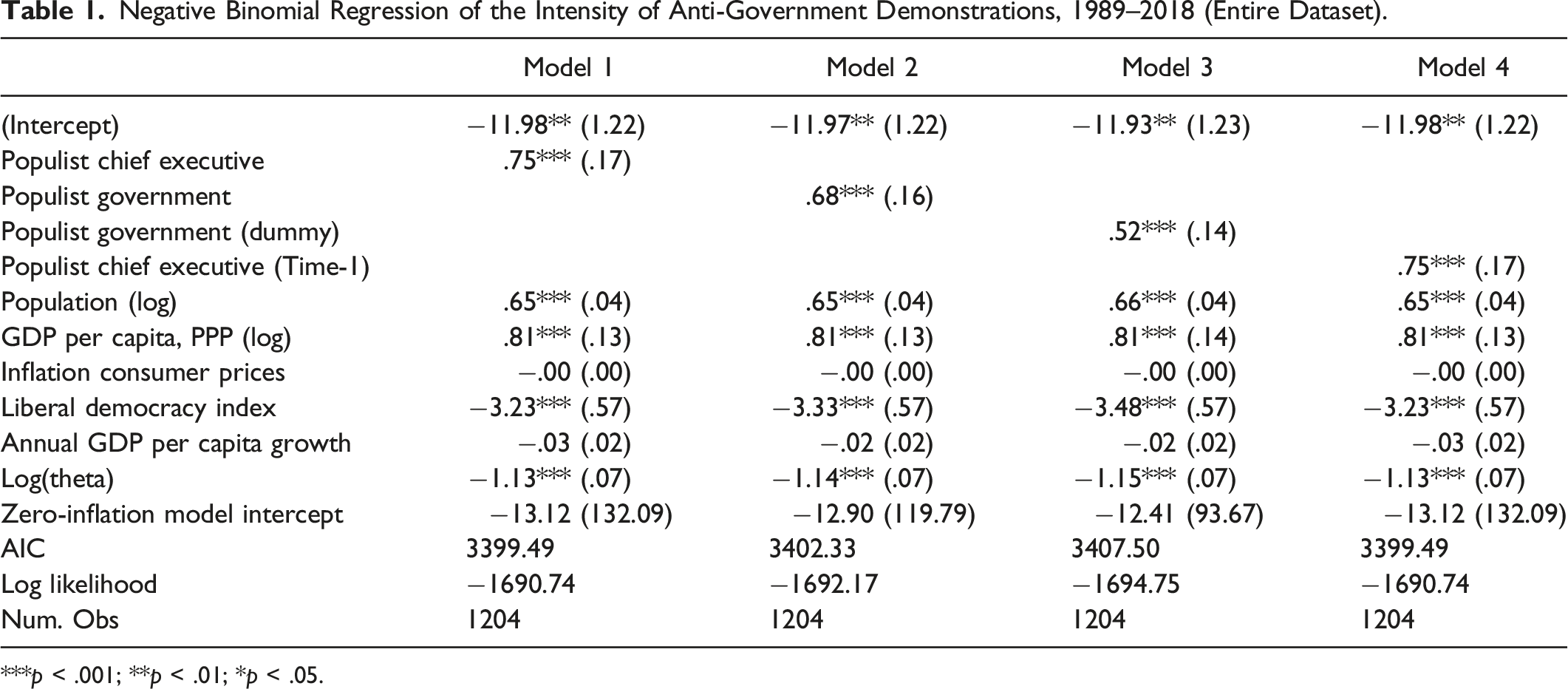
Negative Binomial Regression of the Intensity of Anti-Government Demonstrations, 1989–2018 (Entire Dataset).
***p < .001; **p < .01; *p < .05.
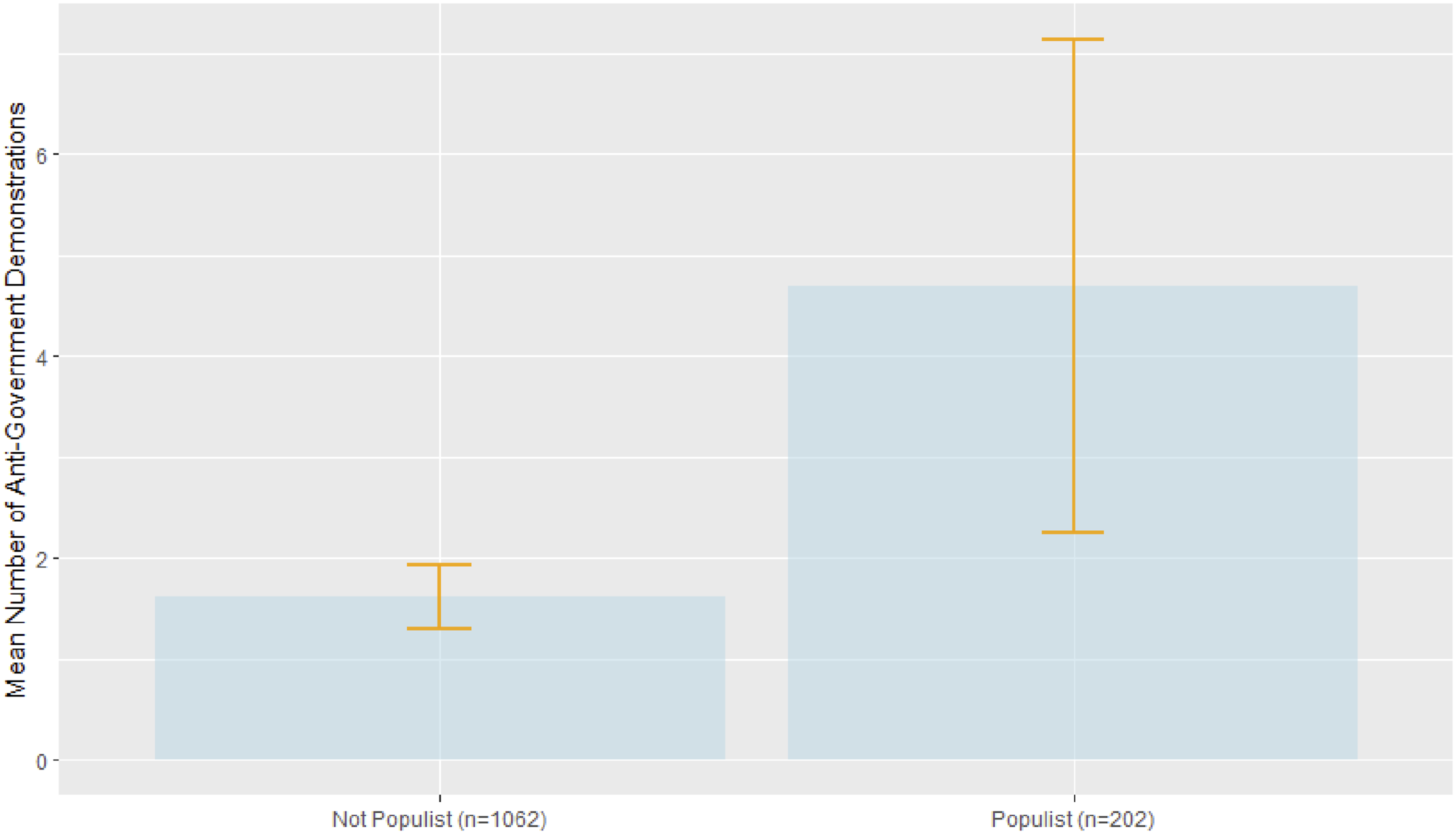
Populists in power and protest intensity (1989–2020). Visualization of (Table 1, Model 1). Data sources: Author; Banks & Wilson, (2019).
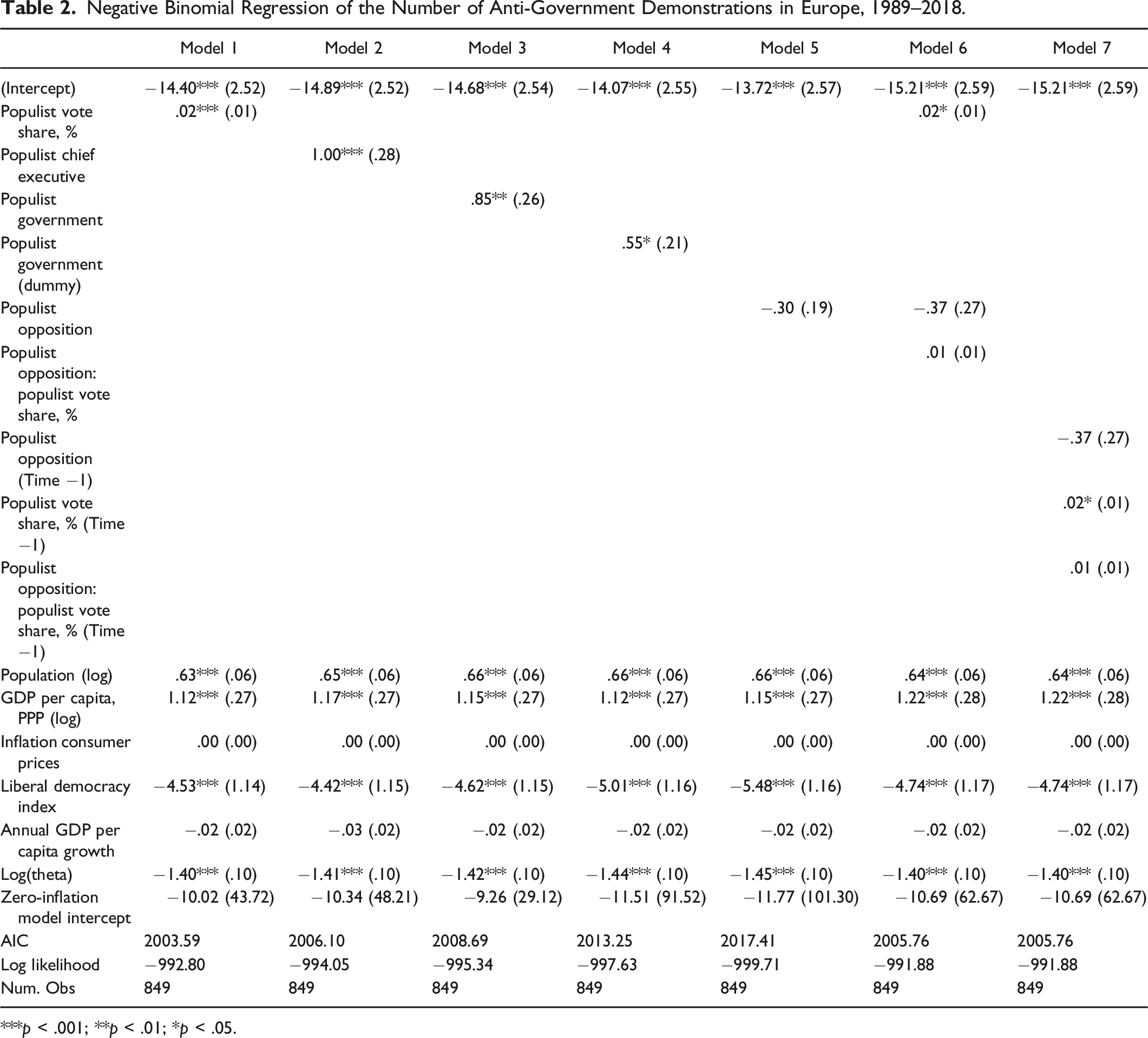
Negative Binomial Regression of the Number of Anti-Government Demonstrations in Europe, 1989–2018.
***p < .001; **p < .01; *p < .05.
Discussion
From the tests performed in the previous section, the results suggest that the existence of a populist party in a political system, or their ascendancy to the head of government, ceteris paribus, is strongly associated with the amount of anti-government demonstrations. These results would seem to testify to populist political actors, operationalized by using both presence in the executive branch of their given country, and their influence in the national legislature, being a rather strong predictor of peaceful anti-government demonstrations. These results hold when controlled for other factors contributing to protest intensity such as GDP per capita, inflation, and population size as well as those that tend to be inhibiting factors such as GDP per capita growth and liberal democratic institutions. With this in mind, the principal conclusion derived from this study can be found in this result, and empirical evidence supports the primary hypothesis (H1).
The results from this study, however, also come with a certain amount of nuance. Instead of a general association with political protests, the largest effects can be found when populists inhabit the office of the executive branch, while populist parties in the opposition do not seem to spark a statistically significant amount of anti-government demonstrations. When in power, populist chief executives demonstrate strong positive correlations with anti-government demonstrations, a relationship that holds also for populists that enter into governing coalitions as junior partners. On the other hand, populists in the opposition do not demonstrate such relationships with anti-government demonstrations according to these tests. While these tests do not necessarily conflict with studies that point to anger and populist attitudes being a prominent indicator of one’s intention to join protests on the level of the individual (see Anduiza et al., 2019), they instead show that such protests are more prominent once a populist politician occupies the highest office of the land, an essentially destabilizing act for the political system that engenders resistance.
Conclusion
In this study, the influence of populist political actors in the political system is tested for the effect they have on the intensity of political protest in a given country. Based on an examination of the literature on populism and populist attitudes and their influence on the propensity to protest, it was theorized that populism’s close connection to an angry and disenfranchised segment of the population that is dissatisfied with the state of democracy in their country and alienated from the politics of the political establishment, should be associated with political protests due to the populist’s ability to redirect this anger towards mainstream ‘establishment’ political figures. The moralistic dimension to populist attitudes, and the feelings of anger and outrage associated with them, lead one to be more likely to resort to non-institutional forms of political participation (Anduiza et al., 2019). Moreover, given populists’ Manichean views on politics, their support for controversial policies, and their hostile attitude to the institutions of liberal democracy (Enyedi, 2016; Handlin, 2018; Kaltwasser, 2017), the polarizing effect of populism in power is also believed to promote political protests on behalf of the non-populist opposition.
Cross-national testing performed in this study demonstrates support for this hypothesis, as strong positive relationships were revealed between the number of anti-government demonstrations in a given country and (1) the share of the vote for populist parties; (2) the existence of populist politicians in the highest office of their political system (President or Prime Minister); (3) the existence of populist politicians in the executive branch (as a part of a coalition). When controlled for with variables for GDP per capita, GDP per capita annual growth, inflation, the level of liberal democracy, and population size, the results demonstrated strong positive relationships between the two independent variables and the number of anti-government demonstrations. The results shown by the first series of tests, with populists occupying the chief executive as the independent variable, contributes to the ever-growing literature on the consequences of populism in power. From these tests, it would seem that the ascension of a populist politician to the office of the President or Prime Minister of their respective country unleashes further protests, most likely due to the feelings of anger and polarization that comes along with their rise. However, from these tests, no evidence is demonstrated pointing to any significant protest activity when populist parties are in the opposition. This does not necessarily mean that individuals with higher levels of ‘populist attitudes’ or anger at the state of politics do not protest more on average, as shown by Anduiza et al. (2019), however, the tests from this study would imply that the destabilizing effect of populists entering the office of the president or prime minister is more impactful. It is likely that populist parties that occupy a very small position in their national legislatures or are insignificant in the overall governance or national discourse only promote these emotions amongst their small groups of followers, whereas those that reach national prominence, as with the cases of Donald Trump, Narendra Modi, and Alexis Tsipras are able to bring in a much larger cohort of supporters into politics and provoke the animosity of their opponents. In a way, this process also points to one of the multifaceted ways in which populism affects the state of democracy. While the delegitimization of political elites and institutions of society are unhealthy to a functioning democracy, the collective response, which serves to engage more of the citizenry in politics, may be a positive consequence (see Mudde & Rovira Kaltwasser, 2017, p. 115). Due to the large number of observations from countries outside of the European context, the conclusions which can be extrapolated from this study are helpful in moving away from the “Atlanticist bias” in populist studies (Moffit, 2015) and towards a more universal understanding of the consequences of populism.
It should be noted that the theoretical basis for why populist supporters would be more prone to protest rests on factors related to emotional factors, such as anger and outrage, and effective polarization. These factors have been shown to be prevalent in many previous studies, however, in the current one, I do not test for these directly. Instead, I sought only to test the logical empirical implications of these theories; if it is the case that anger and polarization push citizens to join political protests, one should expect to observe this in actual protest data. While emotions and polarization are theoretically-speaking, the most likely factors which may promote political protest intensity, the author does not disregard other important possible factors that researchers of social movements have identified in their work.
Footnotes
Declaration of Conflicting Interests
The author(s) declared no potential conflicts of interest with respect to the research, authorship, and/or publication of this article.
Funding
The author(s) received no financial support for the research, authorship, and/or publication of this article.

Notes
Appendix
Correlation Matrix. Note. Correlations indicated with an “X” are not significant at the .05 level.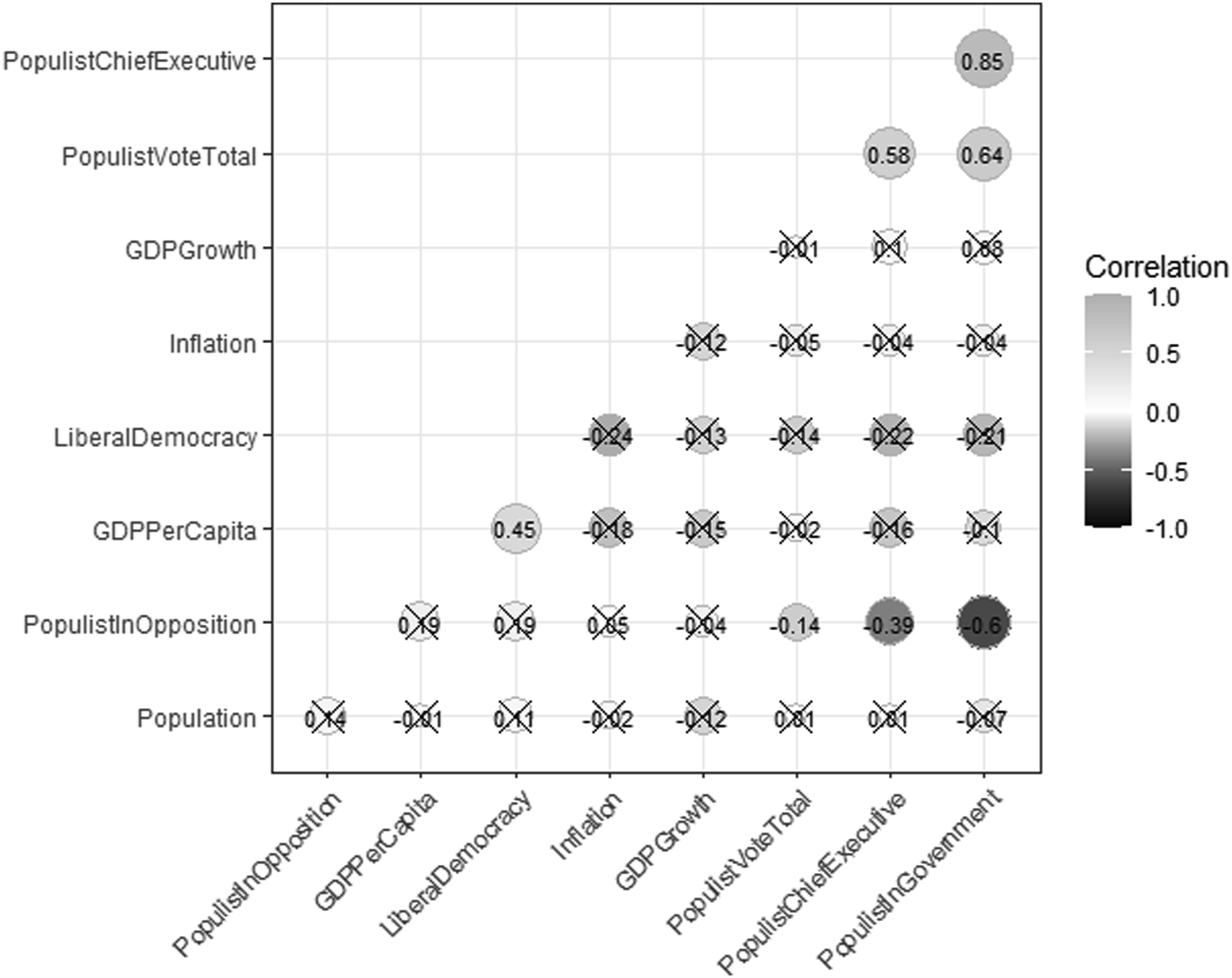
List of Populist Chief Executives. Descriptive Statistics.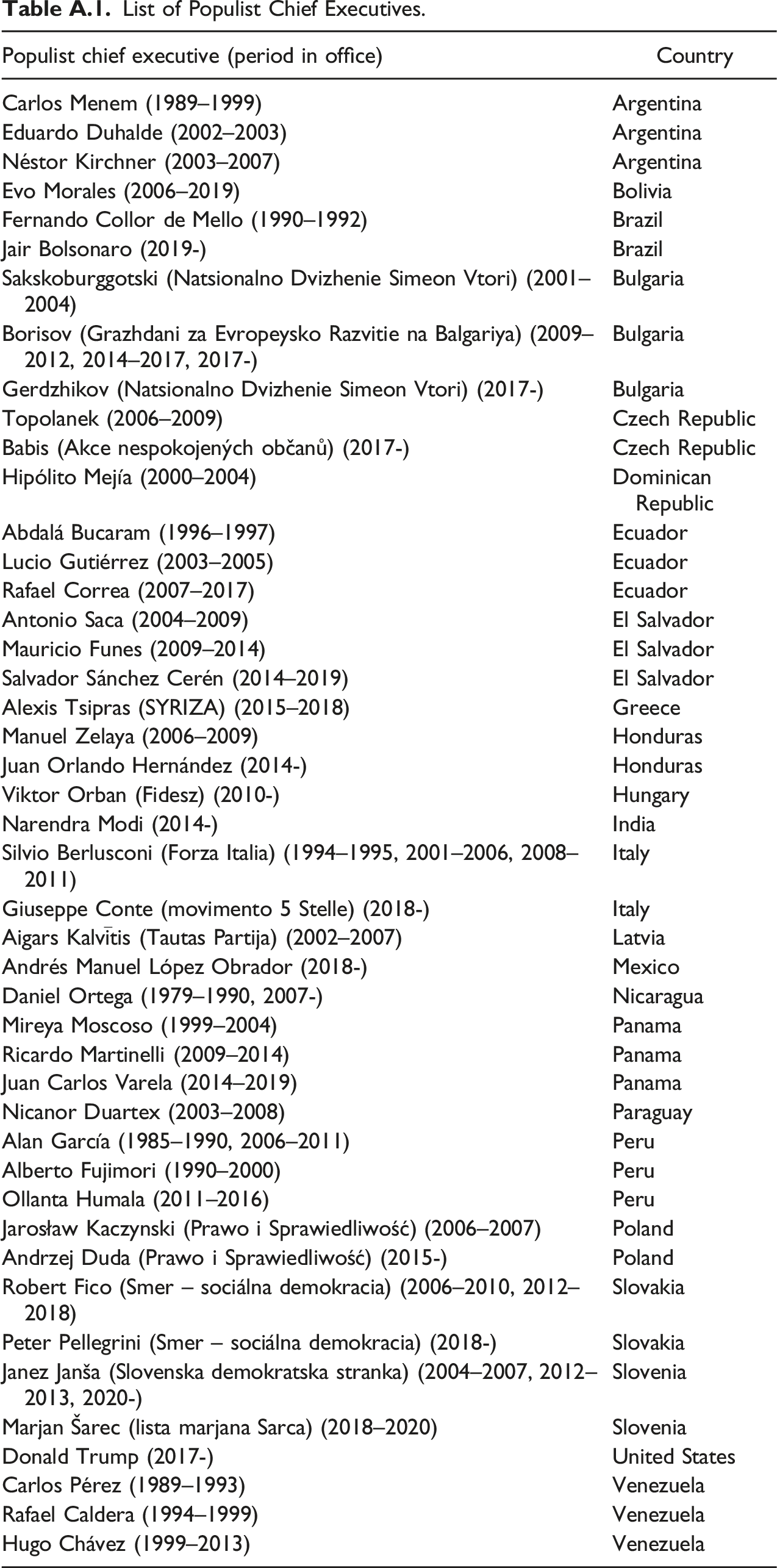
Populist chief executive (period in office)
Country
Carlos Menem (1989–1999)
Argentina
Eduardo Duhalde (2002–2003)
Argentina
Néstor Kirchner (2003–2007)
Argentina
Evo Morales (2006–2019)
Bolivia
Fernando Collor de Mello (1990–1992)
Brazil
Jair Bolsonaro (2019-)
Brazil
Sakskoburggotski (Natsionalno Dvizhenie Simeon Vtori) (2001–2004)
Bulgaria
Borisov (Grazhdani za Evropeysko Razvitie na Balgariya) (2009–2012, 2014–2017, 2017-)
Bulgaria
Gerdzhikov (Natsionalno Dvizhenie Simeon Vtori) (2017-)
Bulgaria
Topolanek (2006–2009)
Czech Republic
Babis (Akce nespokojených občanů) (2017-)
Czech Republic
Hipólito Mejía (2000–2004)
Dominican Republic
Abdalá Bucaram (1996–1997)
Ecuador
Lucio Gutiérrez (2003–2005)
Ecuador
Rafael Correa (2007–2017)
Ecuador
Antonio Saca (2004–2009)
El Salvador
Mauricio Funes (2009–2014)
El Salvador
Salvador Sánchez Cerén (2014–2019)
El Salvador
Alexis Tsipras (SYRIZA) (2015–2018)
Greece
Manuel Zelaya (2006–2009)
Honduras
Juan Orlando Hernández (2014-)
Honduras
Viktor Orban (Fidesz) (2010-)
Hungary
Narendra Modi (2014-)
India
Silvio Berlusconi (Forza Italia) (1994–1995, 2001–2006, 2008–2011)
Italy
Giuseppe Conte (movimento 5 Stelle) (2018-)
Italy
Aigars Kalvītis (Tautas Partija) (2002–2007)
Latvia
Andrés Manuel López Obrador (2018-)
Mexico
Daniel Ortega (1979–1990, 2007-)
Nicaragua
Mireya Moscoso (1999–2004)
Panama
Ricardo Martinelli (2009–2014)
Panama
Juan Carlos Varela (2014–2019)
Panama
Nicanor Duartex (2003–2008)
Paraguay
Alan García (1985–1990, 2006–2011)
Peru
Alberto Fujimori (1990–2000)
Peru
Ollanta Humala (2011–2016)
Peru
Jarosław Kaczynski (Prawo i Sprawiedliwość) (2006–2007)
Poland
Andrzej Duda (Prawo i Sprawiedliwość) (2015-)
Poland
Robert Fico (Smer – sociálna demokracia) (2006–2010, 2012–2018)
Slovakia
Peter Pellegrini (Smer – sociálna demokracia) (2018-)
Slovakia
Janez Janša (Slovenska demokratska stranka) (2004–2007, 2012–2013, 2020-)
Slovenia
Marjan Šarec (lista marjana Sarca) (2018–2020)
Slovenia
Donald Trump (2017-)
United States
Carlos Pérez (1989–1993)
Venezuela
Rafael Caldera (1994–1999)
Venezuela
Hugo Chávez (1999–2013)
Venezuela
Variable
Min/Max
Mean
Median
Standard Deviation
Vote share of populist parties, %
0/69.40
14.85
9.94
16.092
Populist chief executive
0/1
.181
0
.385
Populist in government
0/1
.21
0
.391
Populists in opposition
0/1
.635
1
.481
Populists in power
0/1
.251
0
.433
Anti-government demonstrations
0/149
2.11
0
8.612
Population
252.4/1383198
54,343.9
8869.9
175,909.5
GDP per capita (ppp)
1750/115415
29,904
28,002
19,567.4
Inflation of consumer prices
−4.48/7481.66
31.86
2.93
276.330
Liberal democracy index
.034/0.891
.671
.762
.197
GDP per capita annual growth
−14.269/23.986
2.139
2.131
3.451