




Abstract
Almost two billion people use Facebook every day, but relatively few studies have examined the ways that culture shapes its use, and in turn, its associations with well-being. Our 1-week daily diary study sought to extend this literature by comparing prosocial uses of Facebook in a collectivist culture, Thailand (N = 169), and in an individualist culture, Canada (N = 131). We found that, relative to Thais, Canadians more frequently engaged in knowledge-sharing prosocial Facebook behaviour (i.e., providing useful information to Facebook friends), which was mediated by their more independent self-construal, stronger motivation to use Facebook for spreading information, and weaker motivation to use it for belongingness. Only Canadians reported higher life satisfaction on days they engaged in more prosocial knowledge-sharing. However, Thais and Canadians were equally likely to engage in emotionally-supportive prosocial Facebook behavior, which was associated with higher positive affect and life satisfaction in both groups.
Introduction
Imagine two social media users: one who frequently provides emotional support to online friends, and another who shares useful information with the members of their network. Are there cultural differences in these prosocial uses of social media, and in turn, are they differentially associated with subjective well-being? There are almost two billion daily active Facebook users around the world, with 16 of the top 20 countries with the greatest number of users from the Global South (Statista, 2022), yet much of the research on social media use has been conducted in individualistic countries from the Global North (Ghai et al., 2022; Hsu et al., 2021; Zhang & Leung, 2015). Not only do these findings have limited generalizability to collectivistic populations in the Global South, but they also highlight how much remains to be known about the cultural shaping of social media use around the globe.
The current study sought to expand this literature in several ways. First, we examined social and informational motives for using Facebook and their expression in online prosocial behaviour in Canada and in Thailand. We selected these countries because of their high individualism and collectivism (Hofstede, 2001), respectively, and because Facebook is the most dominant social media platform in both (NapoleonCat, April 2020; StatCounter Global Stats, 2021). Second, this research contributes to our understanding of online prosocial behaviour, which has been far less studied than online antisocial behaviour (Erreygers et al., 2019) and rarely across cultures. We sought to advance theory by differentiating between emotionally-supportive and knowledge-sharing forms of online prosocial behavior. Third, we aimed to contribute a cultural perspective to the growing body of work examining the associations of social media activity with subjective well-being (e.g., Johannes et al., 2021; Orben & Przybylski, 2019). Fourth, we sought to establish more precise estimates of these associations and their day-to-day fluctuations through daily diary methods. We drew on the theoretical framework of independent and interdependent self-construal to explain potential differences in Facebook use and downstream influences on well-being in Canada and Thailand.
Independent and Interdependent Self-Construal
In Western cultures such as North America, Western Europe, and Australia/NZ, a primary cultural goal is to achieve independence from others (Schulz et al., 2019). An independent self-construal consists of perceiving the self as separate, bounded, unique, and comprised of trans-situational internal attributes that drive thought, emotion, and behaviour (Markus & Kitayama, 1991). Personal goals are privileged over group goals, and the individual strives to enhance and express their inner attributes (Takemura & Suzuki, 2015). In contrast, a primary cultural goal in non-Western cultures – e.g., East and Southeast Asia, Africa, Latin America – is to achieve interdependence and connection with others (Talhelm, 2020). Accordingly, construing the self as interdependent means defining the self in relation to important others, expected social roles and group memberships, and privileging group goals over personal goals (Markus & Kitayama, 1991). Situational influences are perceived as a stronger driver of thought, emotion, and behaviour than are internal attributes (Tripathi et al., 2018), and as such, self-expression of internal attributes is less of a cultural imperative than it is for the independent self. In the present study, we compared Facebook users from Thailand, where people tend to have a more interdependent self-construal, with users from Canada, where people tend to have a more independent self-construal (Smith et al., 2020). We examined the extent to which cultural differences in independence and interdependence were reflected in Facebook activity and, in turn, well-being.
Cultural Differences in Facebook Use
Many young adults in Western cultures use Facebook – e.g., 89% of Canadians ages 18–34 and 70% of Americans ages 18–29 (McKinnon, 2019; Pew Research Centre, 2021). Nonetheless, they are increasingly using Instagram, Snapchat, and TikTok (Statista, 2022). Facebook remains highly popular in Thailand, one of the biggest markets in the world (Statista, 2022), where it is used by 76% of Thais (NapoleonCat, April 2020). Young Thai adults are particularly heavy users: 68% use it for more than 30 minutes a day (Sereetrakul, 2013) and have, on average, over 1000 Facebook friends (Pornsakulvanich, 2018). Despite this usage, Thais are underrepresented in the media effects literature.
The first purpose of our study was to examine whether Canadians and Thais differed in their motives for using Facebook and its expression in everyday behaviour. Uses and gratifications theory (Katz et al., 1973) has often been deployed to identify how and why people use social media (Papacharissi & Mendelson, 2011). For example, cognitive needs may be gratified through seeking and sharing information on social media (Hughes et al., 2012; Xiao et al., 2021), whereas social and affective needs may be gratified through seeking and providing emotional support (Kim et al., 2011; Lin & Chu, 2021; Zhang et al., 2011). Researchers have identified a plethora of other needs that may be gratified through social media, including self-presentation, self-expression, social validation, belongingness, communication, entertainment, relationship maintenance, and social comparison (Marshall et al., 2015; Nadkarni & Hofmann, 2012; Park & Lee, 2014; Wilson et al., 2012). Several Facebook features afford the gratification of these needs; for example, status updates and photos/videos enable expressive needs through content generation, whereas the like, reaction, and comment features allow users to be responsive to and supportive of others. In the present study, we focused on social and informational uses of Facebook because we thought they would be particularly influenced by interdependent and independent self-construal, respectively.
Social Motives for Using Social Media
No published research to our knowledge has directly compared the uses and gratifications of Facebook in Thailand and Canada, so we drew on other cross-cultural studies of Facebook use or that examined self-construal to inform our hypotheses. These studies have largely found that people who are from more collectivistic cultures or who are more interdependent tend to have stronger social motives for using Facebook than people who are from more individualistic cultures or who are more independent. For example, collectivists are more strongly motivated to use Facebook to communicate with family and friends (Kim et al., 2010), to maintain existing relationships and to expand their social ties (Abbas & Mesch, 2015), to seek social support (Kim et al., 2011), to support others through providing “likes” (Hong & Na, 2018) and other forms of online prosocial behaviour such as comforting or consoling someone (Raza et al., 2022), and to update more often about close others (Günsoy et al., 2020). More generally, collectivists tend to have tighter-knit online social networks that are more likely to consist of strong ties like family and close friends compared to individualists (Choi et al., 2011; Kim et al., 2010).
In contrast, people from individualist cultures tend to have larger online social networks that are more likely to consist of weak ties, like acquaintances, and they are more strongly motivated to use social media for entertainment (Kim et al., 2011). Individualists are also more likely to engage in self-enhancing social comparisons on Facebook (Song et al., 2019) and self-expression through status updates (Hong & Na, 2018). Consistent with the independent self’s positivity bias, self-enhancement, and uniqueness motivations, individualists tend to generate more affectively positive content on social media (Hsu et al., 2021) and post more updates about personal achievements than collectivists (Günsoy et al., 2020). In sum, the weight of evidence suggests that collectivists have stronger social motives for using Facebook than individualists. We focused on a particular type of social motive – the need for belonging – in the present study because of its centrality for interdependent selves (Markus & Kitayama, 1991; Uskul & Over, 2017).
Informational Motives for Using Social Media
The evidence is less equivocal here. Non-comparative studies have found that informational motives for using social media are salient in both individualist cultures (Hughes et al., 2012; Marshall et al., 2015) and in collectivist cultures (Guo et al., 2014). Comparative studies have found that collectivists are more strongly motivated to use social media for informational purposes than are individualists (Kim et al., 2011), yet informational motives more strongly predict intentions to continue using social media in individualistic cultures while social motives more strongly predict continuance in collectivist cultures (Hsu, et al., 2015). Because so few studies have directly compared informational motives across cultures, we considered other evidence that seeking and sharing information on social media gratifies needs for cognition, personal agency, self-enhancement, self-expression, or belongingness.
On the one hand, informational uses may better gratify cognitive needs than belongingness needs when there is a relatively impersonal exchange of information about current events, politics, research, the arts, careers, etc. (Marshall et al., 2020). People may not only deepen their cognitive involvement in a news story through sharing it on Facebook, but they may also enjoy a heightened sense of agency through taking on the role of information gatekeeper or opinion leader (Oeldorf-Hirsch & Sundar, 2015). People may also share news and information on Facebook if it enhances their own status and reputation, not necessarily because they wish to strengthen their connection with others (Pi et al., 2013; Thompson et al., 2020). Individualists’ use of social media in more independent ways (Hong & Na, 2018) is not only reflected in their agentic and self-enhancing exchange of information, but also in their self-expression and free discussion of topics – including news and information – that have the potential to disrupt social harmony (Kim & Sherman, 2007). On the other hand, sharing information online may resonate more with collectivists insofar as it can gratify users’ needs for belonging (Chai & Kim, 2012), especially if they think the information will benefit others with whom they positively identify (Pi et al., 2013). For example, people in Wuhan, China, used social media both to seek and share information with friends about how to manage the coronavirus pandemic and to alleviate loneliness after the city went into lockdown in February 2020 (Zhong et al., 2021). Moreover, informational uses of Facebook are positively associated with bridging social capital (i.e., cultivation of weak ties) (Guo et al., 2014) and with bonding social capital (i.e., cultivation of strong ties): collectivists are more likely to turn to their close-knit network when they need information (Kim et al., 2011). Considering this mixed evidence, a purpose of our study was to clarify potential cultural influences on motives to share information. Thus, we examined the association of culture and self-construal with informational motives on an exploratory basis only.
Online Prosocial Behaviour and Well-Being
Online prosocial behavior, defined as voluntary online behaviour intended to benefit others, includes the provision of emotional support and/or knowledge-sharing with members of one’s social network (Erreygers et al., 2018). Prosocial behaviour is self-rewarding because it increases positive affect and decreases negative affect at least in part through maintaining or enhancing social connections between the giver and the recipient (Aknin et al., 2013). Indeed, offline prosocial behaviour is associated with greater social capital and well-being in both Western, individualist cultures and in collectivist cultures (Guo et al., 2017; Helliwell et al., 2017; Yang et al., 2019). Online prosocial behaviours are also associated with greater social capital and more positive emotions (Erreygers et al., 2019). For example, online prosocial behaviours like responding supportively to others’ posts through Facebook’s like/reaction and comment functions is an active use of social media that can build social capital and, in turn, enhance psychological well-being (Ellison et al., 2007; Erreygers et al., 2019; Guo et al., 2014; Verduyn et al., 2017). These behaviors benefit both the people who share emotions on social media – e.g., receiving likes/reactions/comments to one’s post can increase feelings of belonging, self-esteem, and meaningful existence (Tobin et al., 2015) – and the people who give the emotional support (Hong & Na, 2018). Indeed, online prosocial behaviour can gratify belongingness needs (Moreno & Uhls, 2019) and informational needs (AlQarni et al., 2016). Conversely, passive use of social media – i.e., browsing others’ content without direct engagement (Verduyn et al., 2017) – may mean that users miss out on opportunities to enhance their well-being through these prosocial exchanges.
The following theoretical model is illustrated in the Figure 1. Insofar as people who are more interdependent have stronger belongingness motives to use Facebook, they may be more likely to show emotionally-supportive online prosocial behaviors. Indeed, people with a more relational self-construal are more likely to engage in supportive online prosocial behaviour (Ferenczi et al., 2017). Because responding to others’ posts with likes/reactions/comments can further cement belongingness (Tobin et al., 2015), these may be tools more often used by interdependent selves given their heightened concern with in-group belongingness (Uskul & Over, 2017). Meanwhile, informational motives for using Facebook may translate into knowledge-sharing online prosocial behaviour, but the impetus is unclear: sharing useful resources, tips, ideas, opinions, and news may satisfy the independent self’s need for agency and self-enhancement through positioning oneself as an informational gatekeeper or opinion leader, but it may also satisfy the interdependent self’s need for in-group belongingness. Thus, we predicted that Facebook use may be more likely to gratify belongingness needs in collectivist cultures through emotionally-supportive online prosocial behaviour, and therefore have a stronger association with well-being for Thais than Canadians. However, we remained agnostic on the cultural and motivational underpinnings of knowledge-sharing online prosocial behaviour and whether it would be more strongly associated with well-being for Thais or for Canadians. Hypothesized associations of culture with subjective well-being through self-construal, Facebook motives, and prosocial Facebook use.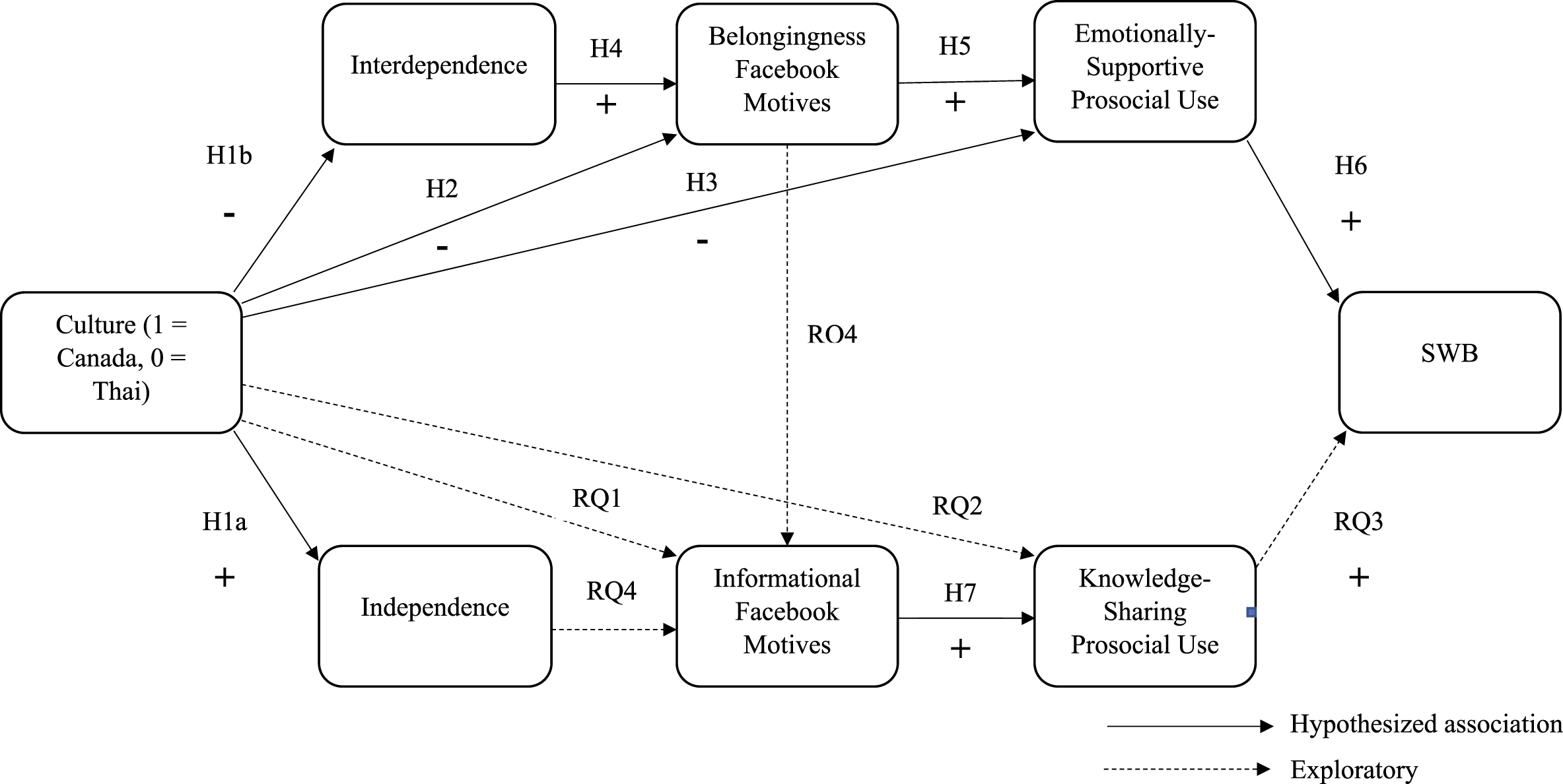
The Present Study
The purpose of the present study was to test the predictors of prosocial online behavior across cultures and its association with subjective well-being. Toward that end, we introduced two methodological improvements on past studies. First, few studies examining cultural influences in social media use have directly measured cultural values (e.g., individualism, collectivism) or self-construal, relying instead on speculation or stereotypes when interpreting cultural differences. As such, we included a self-construal scale in the present study to directly assess whether differences in how and why Thais and Canadians use Facebook might be explained by cultural differences in independent and interdependent self-construal. Second, the daily diary design of the present study – i.e., one in which participants complete a short survey every day over a period of time – has several advantages over the cross-sectional designs of past studies in this area, including the naturalistic recording of thoughts, emotion, and behaviour as they occur, minimizing of memory bias, and greater statistical power (Bolger & Laurenceau, 2013). Our daily diary research design may also furnish more precise estimates of the association of daily Facebook activity with fluctuations in well-being. We have summed up our hypotheses and research questions below and in the Figure 1.
Thais will be greater in interdependence than Canadians.
Canadians will be greater in independence than Thais.
Thais will have stronger belongingness motives for using Facebook than Canadians.
Thais will report greater emotionally-supportive prosocial behavior than Canadians.
Interdependence will be positively associated with belongingness motives for using Facebook.
Belongingness motives for using Facebook will be positively associated with emotionally-supportive prosocial Facebook behavior.
Emotionally-supportive prosocial Facebook behavior will be more strongly associated with subjective well-being for Thais than Canadians.
Informational motives for using Facebook will be positively associated with knowledge-sharing prosocial Facebook use.
Will Thais or Canadians have stronger informational motives for using Facebook?
Will Thais or Canadians report greater knowledge-sharing prosocial Facebook behavior?
Will independence and/or belongingness motives for using Facebook predict informational motives for using Facebook?
Will knowledge-sharing prosocial Facebook behavior be more strongly associated with subjective well-being for Thais or Canadians?
Method
Participants
341 participants (146 Canadian, 195 Thai) completed the intake survey on Day 1. Two participants were removed because they failed more than one attention check, and three were removed because they were not active Facebook users (i.e., they indicated at intake that they checked Facebook once every few weeks or less and they did not check Facebook once during the daily diary period). 36 did not complete at least one daily diary, so the following results are based on N = 300 (131 Canadian, 169 Thai). A sensitivity analysis indicated that our sample size was large enough to detect a minimal effect size of d = .38 (α = .05, two-tailed) at 95% power and d = .29 (α = .05, two-tailed) at 80% power. This sample size also exceeded the recommendation of Maas and Hox (2005) to sample at least 50 upper-level units to avoid bias in estimates of standard errors in multilevel models.
Participants were undergraduate students recruited at a large urban university in Canada or in Thailand. The recruitment ad stated that participants must be active Facebook users. All Canadian participants, and 33% of Thais, received course credit for participating; the remaining 67% of Thais received a payment of 250 baht (approximately $10 CAD). Canadians (M = 18.51, SD = 1.59) were significantly younger than Thais (M = 20.05, SD = 1.21), t (295) = 9.49, p < .001, most likely because 89% of Canadians were in their first year of undergraduate studies compared to 29% of Thai students. 78% of participants were female-identified, 18% were male-identified, and 4% did not wish to say or identified with a gender not listed. There was a larger proportion of Thais who did not wish to say or identified with a gender not listed (7%) compared to Canadians (1%), χ2 (2) = 7.34, p = .025. All Thais were born in Thailand; 74% identified their ethnicity as Thai, 17% as Southeast Asian, 4% as East Asian, 4% as multi-ethnic, 1% as South Asian, and 1% as various other ethnicities. Meanwhile, 79% of the Canadians were born in Canada, 18% were born elsewhere (mean number of months lived in Canada = 99.84, SD = 75.14), and 3% did not wish to answer. 1 40% of Canadians identified their ethnicity as European, 20% as East Asian, 18% as South Asian, 7% as Southeast Asian, 7% as Middle Eastern, 4% as multi-ethnic, 2% did not wish to answer, and 4% were of various other ethnicities. 2
Procedure and Measures
After giving consent, participants completed the online intake survey on Day 1. Starting the following day, they were emailed the same online diary every day for 1 week (Days 2–8). They were asked to complete the diary at the end of the day, before they went to bed. Data collection occurred from November 2019 to July 2020.
Intake Measures – Day 1
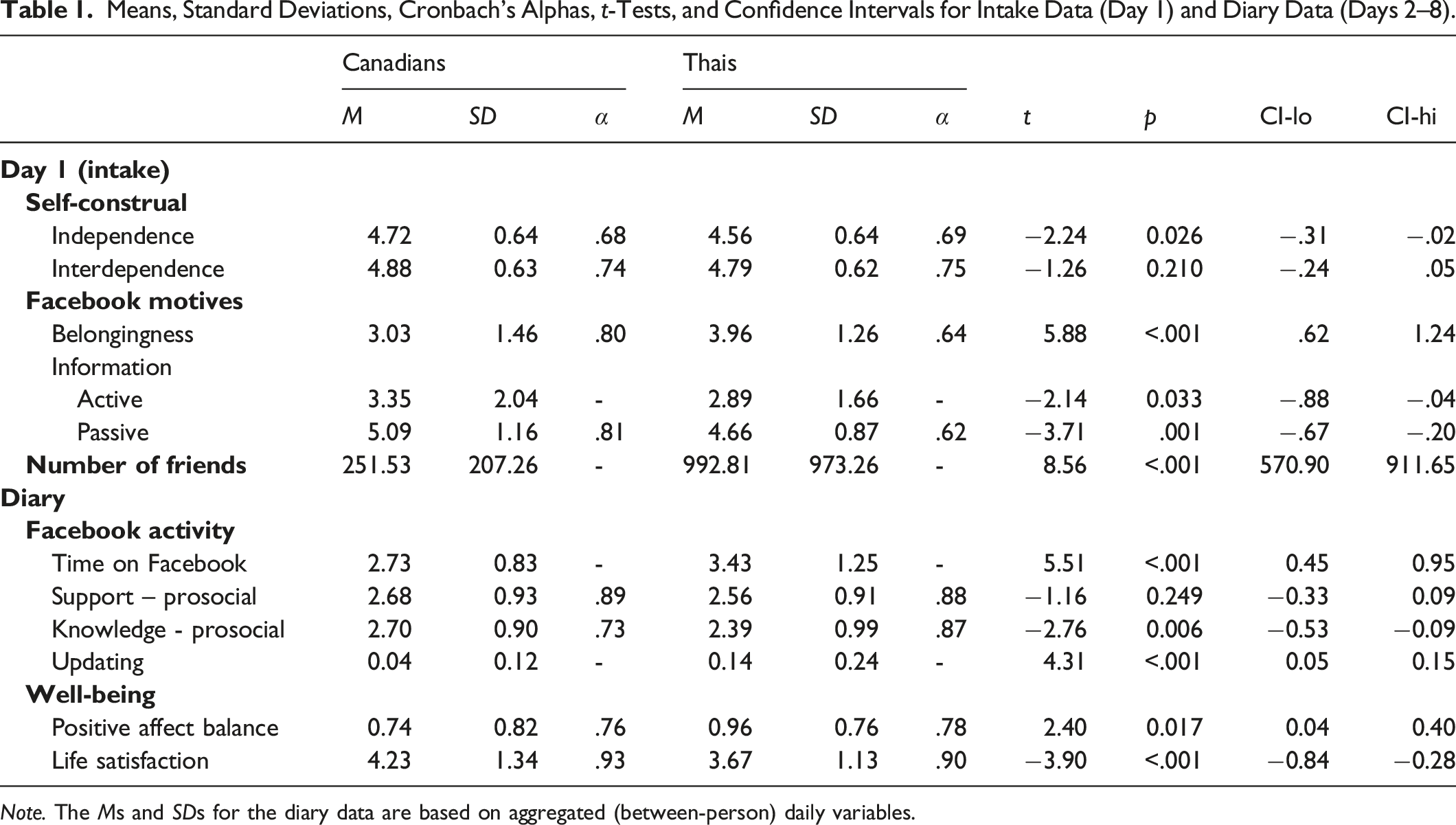
Means, Standard Deviations, Cronbach’s Alphas, t-Tests, and Confidence Intervals for Intake Data (Day 1) and Diary Data (Days 2–8).
Note. The Ms and SDs for the diary data are based on aggregated (between-person) daily variables.
Independence and Interdependence
We used 14 items from the Self-Construal Scale (Singelis, 1994) to measure independence (e.g., “I do my own thing, regardless of what others think”) and 15 to measure interdependence (e.g., “My happiness depends on the happiness of those around me”). Items were rated using a 7-point Likert scale anchored with Strongly disagree (1) and Strongly agree (7).
Facebook Motives
We assessed the role of two motives for using Facebook, belongingness and information exchange, using Marshall et al.’s (2015) scales. Each item was preceded by the stem, “I use Facebook…” and was rated on a 7-point Likert scale (1 = Strongly disagree, 7 = Strongly agree). Three items measured belongingness motives (e.g., “I use Facebook because it makes me feel like I fit in”). The informational items reflected both active use (“I use Facebook to spread information”) and the passive consumption of information (e.g., “I use Facebook to keep abreast of current events”, “I use Facebook to find information relevant for my professional/academic life”; six items). We differentiated between active and passive informational motives in our analyses given that only active sharing of information should theoretically predict knowledge-sharing prosocial Facebook behaviour.
Daily Diary Measures
Daily Facebook Activity
Participants indicated how much time in total they spent on Facebook that day (not including time they were logged into Facebook but were not actually looking at it) using a 6-point scale (1 = No time - I did not look at Facebook today, 2 = Less than 10 minutes, 3 = 10–20 minutes, 4 = 21–40 minutes, 5 = 41–60 minutes, 6 = More than 60 minutes). To assess how actively they used Facebook, we also included an item to measure updating frequency: “Did you post a status update on Facebook today?” [Yes = 1, No = 0].
Online Prosocial Behavior
Four items assessed emotionally-supportive prosocial Facebook behavior: “Today, I used Facebook’s “like/reaction” and “comment” functions to show emotional support for Facebook [friends I am close to/acquaintances] and “Today, I used Facebook to show Facebook [friends I am close to/acquaintances] that I care about them.” 3 Two items assessed knowledge-sharing prosocial Facebook behavior: “Today, I used Facebook to share useful information with [Facebook friends I am close to/acquaintances].”
Affect
The 10-item short-form of the Positive and Negative Affect Scale (International PANAS Short-Form; Thompson, 2007) was adapted to measure “how you feel today”. Five items measure positive affect (e.g., inspired) and five measure negative affect (e.g., upset) using a 5-point Likert scale (1 = Not at all, 5 = A great deal). To calculate positive affect balance, negative affect scores were subtracted from positive affect scores.
Life Satisfaction
The 5-item Satisfaction with Life Scale (Diener et al., 1985) was adapted to ask participants “how you felt about your life today.” Participants responded to items such as “Today, I felt that in most ways my life is close to my ideal” using a 7-point Likert scale (1 = Strongly disagree, 7 = Strongly agree).
Results
Correlations for Canadians (Below Diagonal) and Thais (Above Diagonal).
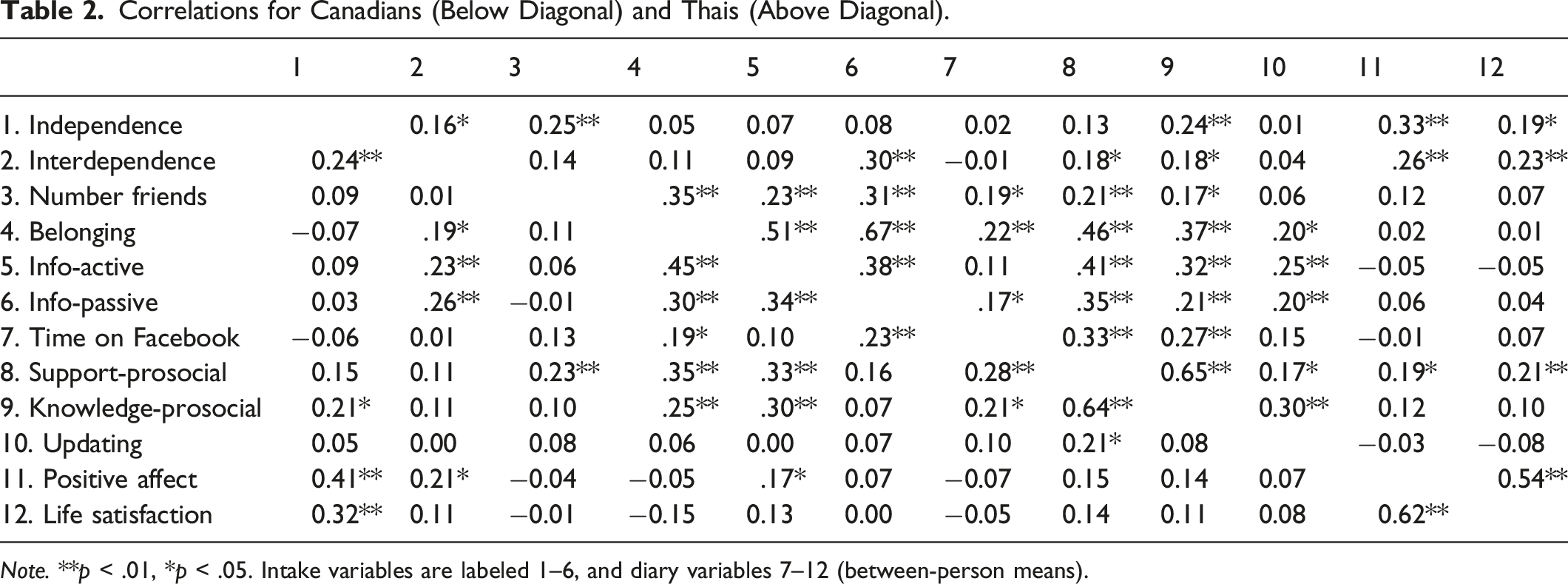
Note. **p < .01, *p < .05. Intake variables are labeled 1–6, and diary variables 7–12 (between-person means).
Between-Person Results
As seen in Table 1, Canadians were significantly higher than Thais in independence (supporting H1b), motives to actively share and passively consume information on Facebook (answering RQ1), knowledge-sharing prosocial Facebook behavior (answering RQ2), and life satisfaction, but they were significantly lower in belongingness motives for using Facebook (supporting H2), number of Facebook friends, the mean number of times they updated their status during the diary period, and positive affect balance. Against H1a and H3, Thais were not significantly greater in interdependence and emotionally-supportive prosocial Facebook behavior than were Canadians.
Next, we tested the upper and lower pathways depicted in the Figure 1 with the PROCESS macro for SPSS (Hayes, 2013) with 5000 bootstrap samples and 95% confidence intervals. 4 Even though culture was not directly associated with emotionally-supportive prosocial Facebook behavior, that does not preclude the possibility of indirect effects. As such, we tested the upper pathway depicted in the Figure 1 through serial mediation, with culture (1 = Canada, 0 = Thai) as the independent variable, interdependence and belonging as the mediators, emotionally-supportive prosocial Facebook behavior (aggregated across the diary period) as the dependent variable, and mean time spent on Facebook over the diary period as the covariate. The full pathway was not significant, but H4 and H5 were supported: interdependence was positively associated with belongingness (b = .32, SE = .12, p = .001), and belongingness was positively associated with emotionally-supportive prosocial Facebook behavior (b = .24, SE = .04, p < .0001). Moreover, there was a significant indirect effect of culture on emotionally-supportive prosocial behavior through belongingness [b = −.18, SE = .05 (95% CI: −.285, −.099].
We then explored the serial mediation of Canadians’ greater knowledge-sharing prosocial Facebook behavior (aggregated across the diary period) using PROCESS. Culture was entered as the independent variable, independence, active, and passive informational motives were entered as mediators, mean time spent on Facebook over the diary period was entered as a covariate, and mean knowledge-sharing prosocial Facebook behavior over the diary period was entered as the dependent variable. This test revealed support for H7: active informational motives were positively associated with knowledge-sharing prosocial Facebook use (b = .14, SE = .03, p < .0001). Second, there were two significant pathways: culture was indirectly associated with knowledge-sharing prosocial Facebook behavior through independence [b = .05, SE = .03 (95% CI: .003, .11)] and through active informational motives [b = .08, SE = .03 (95% CI: .015, .15)]. The serial mediation that tested the full pathway – i.e., the indirect effect of culture on knowledge-sharing prosocial Facebook behaviour through independence, and in turn, active information-sharing – was not significant. Next, we tested the indirect effect of culture on knowledge-sharing prosocial Facebook behaviour through belonging, and in turn, active information-sharing (with mean time spent on Facebook over the diary period, independence, and interdependence as covariates). This serial mediation was significant [b = −.05, SE = .02 (95% CI: −.092, −.013]. Together, these results provided answers to RQ3: both independence and belongingness motives predicted informational motives for using Facebook. 5
Associations with Well-Being
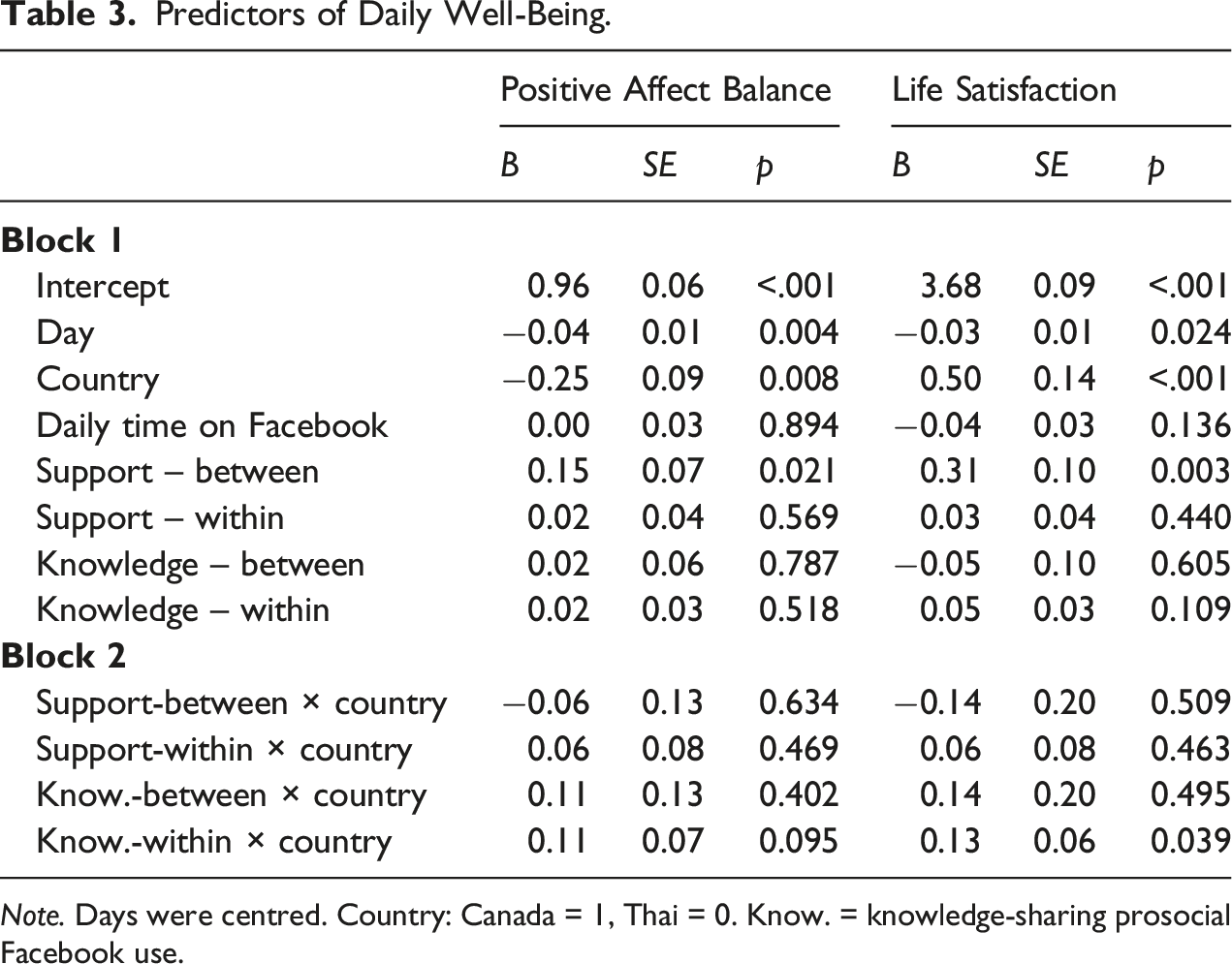
Predictors of Daily Well-Being.
Note. Days were centred. Country: Canada = 1, Thai = 0. Know. = knowledge-sharing prosocial Facebook use.
Results revealed that the between-person component for emotionally-supportive prosocial Facebook behavior was significantly associated with higher positive affect balance and life satisfaction. Against H6, however, it did not significantly interact with country, indicating that emotionally-supportive prosocial Facebook behavior was associated with greater subjective well-being for Thais and Canadians alike.
Next, we tested RQ4 – whether knowledge-sharing prosocial Facebook behavior would be more strongly associated with subjective well-being for Canadians or Thais. As seen in Table 3, there was no main effect of the between- or within-person component of knowledge-sharing prosocial Facebook behavior on either of the well-being variables. However, the within-person component for knowledge-sharing prosocial behavior significantly interacted with country when predicting life satisfaction. The simple slope for knowledge-sharing prosocial behavior was significant for Canadians (b = .14, SE = .05, p = .008) but not for Thais (b = −.01, SE = .04, p = .763), indicating that on days Canadians engaged in more prosocial knowledge-sharing on Facebook than usual, they reported greater life satisfaction.
Discussion
Our findings illuminate cultural differences and similarities in the ways that people use social media. Thais were more likely to use Facebook for belonging and Canadians for information and prosocial knowledge-sharing, but Thais and Canadians were equally likely to engage in emotionally-supportive prosocial Facebook behaviour and to reap the well-being benefits of this behaviour. We discuss these findings in more detail below.
First, we improved on past studies examining cultural influences in social media use by directly measuring self-construal. Our results revealed that Canadians were greater in independence than were Thais, consistent with our hypothesis and with other findings (Smith et al., 2020). Contrary to expectations, Thais were not greater in interdependence than were Canadians. This could not be attributed to the ethnic heterogeneity of the Canadian sample; rather, it may be that Westerners are more interdependent in some respects than originally conceived by self-construal theory (Santamaria et al., 2010). For example, Westerners tend to report greater commitment to others than self-interest (Vignoles et al., 2016). Even still, that we did not find the expected cultural difference in interdependence underscored the value of directly measuring self-construal instead of relying on cultural stereotypes in the media effects literature.
Second, Thais were more strongly motivated than Canadians to use Facebook for belongingness, consistent with our hypothesis and with other findings that collectivists are more likely to use Facebook for social reasons than are individualists (e.g., Kim et al., 2011). Moreover, the indirect effects suggested that Thais’ greater belongingness contributed to their emotionally-supportive prosocial Facebook behaviour over the diary period. Against our hypothesis, however, emotionally-supportive prosocial Facebook behavior was associated with greater subjective well-being for Thais and Canadians alike. This similarity suggests that the cultural norms of “niceness” and showing caring and consideration may be equivalent bases of well-being in these cultures (Karim, 2008; Komin, 1990). These results may also speak to the cross-cultural generality of the link between online prosocial behaviour and well-being, given that we not only replicated previous findings (Erreygers et al., 2019) in an individualistic culture but also in a collectivistic one. Thais’ greater belongingness may also translate into Facebook activities other than emotionally-supportive prosocial behaviour; for example, belongingness motives were significantly correlated with posting more frequent status updates over the diary period for Thais, but not for Canadians. Thus, in contrast to Facebook’s waning popularity as the primary venue for online content generation and social connection among young Westerners (Statista, 2022), it still appears to be going strong in Thailand, perhaps because they are more motivated to use it to confer a sense of belongingness. Facebook may also remain relevant for others in the Global South – for example, India has the largest number of Facebook users in the world (Statista, 2022). Our findings highlight the importance of studying social media use across cultures and in recognizing that findings based on Western social media users may not generalize beyond the Global North.
In contrast to Thais, Canadians appeared to be relatively lacklustre in their Facebook activity: they had fewer friends, spent less time using Facebook, and posted fewer updates. Nonetheless, Canadians were more strongly motivated than Thais to use Facebook to actively share and passively consume information and they engaged in more prosocial information-sharing over the diary period than did Thais, therefore providing answers to Research Questions 1 and 2, respectively. This may reflect a shift in young Westerners’ Facebook use over the years from socializing (Pempek et al., 2009) to information-seeking as other social media sites have grown in popularity such as Instagram, Snapchat, and TikTok (Statista, 2022). Nonetheless, we found that Canadian participants still used Facebook on 86% of the days that they completed a diary (compared to 91% of Thais), suggesting that many young Canadians still use Facebook, especially to respond to others’ content in a prosocial manner, but they may simply be less likely to generate content (as reflected in the infrequency with which they posted status updates). Even if Facebook is no longer the primary venue for young Canadians to generate content, with Instagram, Snapchat, or TikTok taking precedence, our results suggested that using it to be responsive and prosocial with others was still associated with their higher life satisfaction and positive affect.
Canadians’ greater independence and motivation to spread information on Facebook was associated with greater knowledge-sharing prosocial Facebook behavior over the diary period, but their weaker motivation to use Facebook for belongingness was associated with lower motivation to actively spread information and, in turn, knowledge-sharing. These results help to clarify the mixed literature on cultural differences in information-sharing on social media: it may be influenced by belongingness motives across cultures, as sharing information may enhance social capital (Guo et al., 2014) and benefit the members of one’s in-group (Pi et al., 2013), but people from cultures that privilege the independence of the self, and the active spreading of information as gatekeepers/opinion leaders (Oeldorf-Hirsch & Sundar, 2015) or status-seekers (Thompson et al., 2020), may be particularly likely to engage in prosocial knowledge-sharing on social media. Thus, people may require both the agency and assertiveness of independence alongside the desire for inclusion and belongingness to actively share helpful information on social media. Accordingly, only Canadians reported greater life satisfaction on days they engaged in more knowledge-sharing prosocial Facebook behavior than usual. Looking at these results from a different angle, Thais’ stronger motivation to use Facebook for belongingness may not have translated into more prosocial knowledge-sharing and, in turn, greater life satisfaction because it was neutralized by their lower independence and reluctance to spread information on Facebook. Perhaps they were more attuned to the potential social consequences of spreading information online that may be false, controversial, or disruptive, especially during the Covid-19 pandemic (when this data was collected).
Our findings also run counter to claims that social media use is associated with lower subjective well-being (e.g., Twenge & Farley, 2021). Our indices of Facebook use were either not significantly associated with well-being (the amount of time spent on Facebook per day, frequency of updating) or positively associated with well-being (emotionally-supportive prosocial Facebook behavior in both cultures, knowledge-sharing prosocial Facebook behavior for Canadians). If anything, our results support Verduyn et al.’s (2017) proposition that active use of social media can enhance well-being, particularly through providing opportunities to build social capital.
Limitations and Future Directions
Our study had several limitations that warrant mention. First, we only compared two countries; our results may not generalize to other cultures that vary in individualism and collectivism. Second, participants’ ratings of the amount of time they spent on Facebook per day and the extent to which they engaged with the platform were self-reported and therefore may not have been as accurate as examining participants’ actual Facebook engagement, such as through objective logs (e.g., the Screen Time app on Apple iPhones) (Parry et al., 2020). However, estimates from subjective self-reports tend to be very close to objective logs, and neither measure of time spent on social media tends to be associated with daily well-being (Johannes et al., 2021), as we found in this study.
Another limitation is that we did not measure what type of information users might be sharing with others. Our diary measure simply asked if participants had shared “useful information” that day; we reasoned that it would require too many diary items to measure the different types of information that might be shared, increasing participants’ time burden and, in turn, the chances of non-completion (see the Supplementary File for further speculation). Nonetheless, we acknowledge that young people exchange a wide range of information online, such as information related to schoolwork (Aaen & Dalsgaard, 2016), products and services (Cho et al., 2015), health (AlQarni et al., 2016), and social justice movements like Black Lives Matter, gun control, and climate advocacy (Armstrong-Carter & Telzer, 2021). Future research might examine whether sharing certain types of information is particularly associated with higher well-being, and whether this generalizes beyond people who have a more independent self-construal. Moreover, researchers might further deconstruct the various reasons why people might actively share information on social media, and whether they are differentially associated with the types of information shared. For example, people who have prosocial motivations to actively share information might share different information than people who have self-aggrandizing or information-gatekeeping motivations.
A further limitation was our use of Singelis’s (1994) Self-Construal Scale. Despite its popularity, the scale does not include any reversed items to guard against acquiescent responding (Kam et al., 2012). Thus, it is possible that acquiescent responding might at least partially account for the correlations of independence and interdependence with prosocial information-sharing and subjective well-being that we found in both cultures. Future research should aim to replicate the present findings with a measure of self-construal that controls for acquiescent responding, such as the scale developed by Vignoles et al. (2016).
Finally, because our design was correlational, causal inference remains limited. For example, we cannot necessarily conclude that emotionally-supportive prosocial Facebook behavior caused higher subjective well-being; it is just as likely that people who were higher in well-being were more likely to engage in emotionally-supportive prosocial Facebook behavior. Experimental designs that compare control participants with those who are asked to engage in greater provision of emotional support or knowledge-sharing than usual may shed more light on causal direction.
Concluding Remarks
Our findings suggest that, to an extent, the ways that we use social media reflects our cultural selves – our values, beliefs, goals, and desires. Nonetheless, culture did not moderate the links between emotionally-supportive prosocial use and well-being: whether people were from Thailand or Canada, the impulse to provide emotional support via Facebook was associated with greater well-being. Conversely, cultures that emphasize independence, like Canada, may be more likely to value a friendly but impersonal sharing of information on Facebook and, in turn, reap the well-being benefits of this prosocial behavior. In sum, our results suggest that, in collectivist and individualist cultures alike, online prosocial Facebook behavior may not only help others, but also oneself.
Supplemental Material
Supplemental Material - Online Prosocial Behaviour Predicts Well-Being in Different Cultures: A Daily Diary Study of Facebook Users
Supplemental Material for Online Prosocial Behaviour Predicts Well-Being in Different Cultures: A Daily Diary Study of Facebook Users by Tara C. Marshall, Jennifer Chavanovanich, Lu Huang and Jie Deng in Cross-Cultural Research
Footnotes
Correction (July 2023):
Article has been updated to list the missing funding statement.
Declaration of Conflicting Interests
The author(s) declared no potential conflicts of interest with respect to the research, authorship, and/or publication of this article.
Funding
The author(s) disclosed receipt of the following financial support for the research, authorship, and/or publication of this article: The research was supported through a grant awarded to Jennifer Chavanovanich to support the development of new faculty - Ratchadaphiseksomphot Fund, Chulalongkorn University.
Supplemental Material
Supplemental material for this article is available online.
Notes
Author Biographies
References
Supplementary Material
Please find the following supplemental material available below.
For Open Access articles published under a Creative Commons License, all supplemental material carries the same license as the article it is associated with.
For non-Open Access articles published, all supplemental material carries a non-exclusive license, and permission requests for re-use of supplemental material or any part of supplemental material shall be sent directly to the copyright owner as specified in the copyright notice associated with the article.
