




Abstract
The COVID-19 pandemic created stressors and uncertainty, particularly for women. This international study explored whether the impact of the COVID-19 pandemic on women’s stressful experiences and future expectations is associated with Hofstede’s cultural dimension of femininity/masculinity, which refers to the cultural constructions of gender role differences. In total, 1218 women from 15 countries varying in cultural femininity/masculinity provided narrative data by answering open-ended questions via an online survey. Data were analysed using mixed methods, starting with thematic content analysis followed by logistic regression analyses. The findings from the regression analysis indicate that many stresses and expectations that were mentioned in the narratives were unrelated to the cultural femininity/masculinity. However, women from masculine cultures more often expressed disorientation, while women from feminine cultures more often wrote about negative emotions. Additionally, women from masculine cultures had more future expectations regarding daily activities, while women from feminine cultures had more expectations regarding social activities, work and economic revival, and universal social issues. The pandemic seems to confront women in both types of culture with similar challenges. The differences between women from feminine versus masculine cultures indicate that increased societal participation and responsibilities of women in feminine cultures was associated with negative affect during the pandemic, but they also propelled plentiful expectations for the future “after COVID-19”.
Introduction
The COVID-19 Pandemic as a Major Stressor for Women
The COVID-19 pandemic created a global situation characterised by new, multiple sources of stress and trauma, having to do with threats to one’s own health and that of loved ones, loss of employment, separations and loneliness, and uncertainty about the future (Gloster et al., 2020). There have been many indications that this pandemic has had significant social and psychological detrimental effects for women (The Sex Gender and COVID-19 Project, 2021). De Paz and colleagues summarized the overall negative impacts of the pandemic especially for women and girls, such as disadvantages in health care access, increases in burden due to multiple care responsibilities, less economic safety, and higher danger of gender-based violence (De Paz et al., 2020).
The COVID-19 pandemic and the measures taken to mitigate it, such as quarantines and stay-in-place in the first phase of the pandemic, led to separation among families and friends, and social isolation for many (Evans et al., 2020) and were experienced particularly intensely by women (Todorova et al., 2021). An additional highly concerning development during the pandemic has been the increased incidence of domestic violence against women, which has been reported in many countries around the globe (Sánchez et al., 2020). While violence against women has long been a public health crisis and has increased during previous pandemics (Roesch et al., 2020), the COVID-19 lockdown measures which were especially strict during the initial months of the pandemic exacerbated the incidences.
Women are predominantly those who have been on the frontlines of healthcare and other essential areas of the economy, in addition to the care of children and the elderly at home (Guerrina et al., 2021). The pandemic caused a return to traditional gender roles regarding the balance of work and care with responsibilities disproportionally falling on women, though there is also evidence that creative alternatives have been found by couples in dual-career families (Shockley et al., 2021). Employment has become more uncertain for women, and some studies have suggested that they have been more hesitant to make plans for the future (Guetto et al., 2020).
The multiple inequities and risks posed by the pandemic and their unequal impact on women can also have significant health consequences. Research during the first months of the pandemic has illustrated its greater consequences for the mental health of women working in healthcare, who experienced more depression, anxiety, distress, and other symptoms (Thibaut & van Wijngaarden-Cremers, 2020). Also, during the lockdown measures, most schools moved to online education; the responsibilities which women had to take on in the homes, as well as in caring and educating children increased dramatically (Ghislieri et al., 2021; Harth & Mitte, 2020; Power, 2020). This has implications for higher risk of burnout among women. It has also shown that access to regular health care has been limited during these months for many women, affecting reproductive health and perinatal care (Connor et al., 2020).
Gender and Health Contextualized Within Culture
The meanings of gender, health, and illness are culturally constructed (Kleinman, 1989; Napier et al., 2014), i.e., they are experienced within shared beliefs, values, and norms of a given group. Similarly, stress occurs and is experienced within the context of culture (Aldwin, 2004; Chun et al., 2006). Aldwin (2004) proposed that culture may affect the experience of stress and how people deal with stress: culture influences the type of stressor a person may experience (e.g., puberty rituals, retirement) and affects the appraisal of what is stressful or threatening. Moreover, culture influences how individuals deal with a stressor, through beliefs, values, commitments, and resources people have at their disposal. There is some literature on the cultural determinants that affect the way people experience stress (Akhtar & Kroener-Herwig, 2017; McVeigh & MacLachlan, 2021; Szabo et al., 2017; Taylor et al., 2007), underlining the importance of culture in the context of stress.
According to Triandis (1995), culture can be regarded as a meaning system that is learned within a society and passed over and changed from one generation to the next (Triandis, 1995). There are many ways that cultural characteristics and differences have been studied. For example, Hofstede proposed a taxonomy for classifying cultures and nations (rather than individuals) that includes six main dimensions (Hofstede, 2011): individualism versus collectivism, power distance versus closeness, uncertainty avoidance versus acceptance, masculinity versus femininity, long-term versus short-term orientation, and indulgence versus restraint.
The Cultural Dimension of Femininity/Masculinity
In this paper, we focus on the dimension of femininity/masculinity, which refers to the perceived distribution of values, duties, and gender role differences between men and women within a culture (Hofstede, 1998). In more feminine cultures, only marginal emotional and social role differentiation between the genders are assumed, while more masculine cultures are characterized by beliefs about pronounced differences between women and men, based on traditional gender roles, for instance regarding women’s participation in the work market, distribution of domestic duties, or the proportion of women in political positions (Hofstede, 2011). According to Hofstede and colleagues, “a society is called masculine when emotional gender roles are clearly distinct: men are supposed to be assertive, tough, and focused on material success, whereas women are supposed to be more modest, tender, and concerned with the quality of life“ (p. 140), while “a society is called feminine when emotional gender roles overlap: both men and women are supposed to be modest, tender, and concerned with the quality of life“ (p. 140) (Hofstede et al., 2010). Thus, according to this dimension, in feminine cultures genders are considered similar in values, duties, and societal participation. As a matter of fact, Emrich and colleagues developed an explicit dimension of “gender egalitarianism” based on the Hofstede femininity/masculinity dimension when designing the GLOBE study, presenting data on cross-cultural differences in gender egalitarianism - the degree to which a collective minimizes gender inequality (Emrich et al., 2004).
There is scant research on the links between gender roles, the femininity/masculinity dimension, and the perception of stress. There are indications that broad beliefs and values of gender equality are associated with different indicators of well-being (Arrindell et al., 2003, 2004; Eek & Axmon, 2015; Soltanpanah et al., 2017; Tesch-Römer et al., 2007; van de Vijver, 2007). Some studies specifically address the relevance of the Hofstede dimension of femininity/masculinity to indicators of well-being. For example, in a study with participants from 13 nations, Arrindell and colleagues found that in cultures with pronounced masculine characteristics, higher masculine gender role stress was reported (Arrindell et al., 2013). Additionally, higher national masculinity index has been shown to be associated with higher national depression levels (Arrindell et al., 2003) as well as with certain fears, such as agoraphobic and bodily injury, illness, and death fears (Arrindell et al., 2004), which could be of particular relevance in the pandemic situation.
The above lends support to the notion that cultural characteristics and gender-specific stress levels could be related, but the direction of these relations could be complex. While participation in all areas of a society in a more feminine culture might be associated with more stressors for women in specific domains (such as work and political participation), the overall stress level that is caused by dependency and lack of power would be expected to be higher in more masculine cultures (Halford & Leonard, 2001; Maddock & Parkin, 1993; Pfau-Effinger & Hennig, 2012). Additionally, feminine cultures might offer greater opportunities for the fulfilment of needs and goals (for men and women), which has been associated with happiness and well-being (Diener, 2009).
Culture and COVID-19
Several studies have explored the relevance of the cultural dimensions, as developed by Hofstede (2011), to the pandemic’s levels, governmental response to the pandemic, and the public’s health-related behaviours, arguing that awareness of cultural differences can more adequately inform government policies. The most frequently addressed cultural dimension is that of individualism/collectivism, indicating that countries categorized as collectivistic had fewer cases of coronavirus infections and lower death rates compared to those high in the individualism dimension (Rajkumar, 2021). Maaravi et al. (2021) conducted several studies which aimed to understand the mechanisms behind this observation and concluded that in collectivistic countries people were more mindful of protecting the health of others in the community, and thus adhered to the public health measures (Maaravi et al., 2021). This observation regarding the individualism/collectivism dimension has been confirmed by several other studies (Arslan & Allen, 2021; Dheer et al., 2021; Guss & Tuason, 2021).
Few studies, however, have examined the role of the femininity/masculinity dimension during the COVID-19 pandemic, with inconsistent findings. Gokmen and colleagues analysed several cultural dimensions and found no association between the cultural femininity/masculinity and infection rates at a country level (Gokmen et al., 2021). On the other hand, Dheer and colleagues found that masculinity was associated with lower COVID-19 cases (though they had hypothesized that countries with feminine values would have lower cases), interpreting this as an indication that countries focused on achievement (as are masculinity oriented ones) would aim to be successful in limiting the pandemic effects (Dheer et al., 2021). They concluded that a balance between achievement of goals with the care for others would be the most successful approach to mitigating pandemic consequences.
While there is some understanding of the association between the femininity/masculinity cultural dimension and the epidemiological progression of the pandemic at a country level, we are not aware of studies which have explored the role of the femininity/masculinity dimension of culture for understanding the experiences of people during the pandemic, e.g., stressors experienced and the multifaceted responses to the pandemic situation. More specifically, there is a gap in the literature on women’s socio-emotional experiences in the pandemic whilst taking the femininity/masculinity cultural context they are living in into account. The present paper addresses this gap.
The Present Study
The present study is a component of a large international study conducted in the early months of the pandemic. The overall aim of the large study was to understand the role of culture and cross-cultural differences in meaning making during the initial crisis of the pandemic. In this paper we focus specifically on gender as a social determinant of health, and consider that gender roles, structural barriers based on gender, and power hierarchies vary across countries. Our rationale for doing so is based on the literature which illustrates that during the COVID-19 pandemic, gender role distinctions have become heightened, reverting to more traditional definitions, and thus gender inequalities have expanded. The situation also exacerbated other pre-existing inequalities for women at the intersection of race, ethnicity, and socioeconomic status (The Sex Gender and COVID-19 Project, 2021).
The analyses we present in this article aim to explore whether the perceived impacts of the pandemic for women in diverse countries and women’s expectations for the future varied according to the cultural dimension of femininity/masculinity. We have chosen to apply the cultural dimension of femininity/masculinity as proposed by Hofstede (1998) for several reasons. This dimension refers to cultural meanings and beliefs regarding the culturally appropriate distinctions based on gender, which is in resonance with our overall study focus on meaning making. Additionally, the femininity/masculinity index is available for all the countries in our sample, including separately for Puerto Rico. 1
Hence, our study addresses the following two research questions. 1) What kind of stressors and difficulties did women in feminine and masculine cultures experience during the COVID-19 pandemic? 2) What expectations did women in feminine and masculine cultures express for the time after “the end of the pandemic”?
Method
Procedure
The study was international, with 15 countries participating. There were in Asia: Bangladesh (BD), China (CN), India (IN), Israel (IL), and Malaysia (MY); in Europe: Bulgaria (BG), Germany (DE), Italy (IT), The Netherlands (NL), Romania (RO), Switzerland (CH), and The United Kingdom (GB); in North and South America: Brazil (BR), Puerto Rico (PR) 1 , and The United States mainland (US). Data collection continued from May 1st to September 22nd, 2020, with different countries collecting data at different weeks during this period. At the time of data collection, restrictions to mitigate the spread of COVID-19 were in place in each country. For most countries, it was at the end of the first wave of the pandemic (China), and for some countries restrictions had started to be eased (Bulgaria, Italy, Israel, Germany, Netherlands, Malaysia, Romania, Switzerland, United Kingdom, United States). Several countries were still within the first wave of the pandemic while restrictions were being implemented (Bangladesh, Brazil, India).
We initially constructed a questionnaire and a consent form in the English language. The questionnaire included 20 demographic and background questions (age, gender, country and state/county of residence, ethnicity, education, employment status, marital status, living situation, self-rated health) as well as three open-ended questions. Being aware both of the challenges when designing assessment tools for cross-cultural studies (Kristjansson et al., 2003; Lee et al., 1999; Sperber et al., 1994) and of the fact that there is no “gold standard” for the cross-cultural adaptation of questionnaires (Epstein et al., 2015), it was decided that each country team would conduct the translation into the local language with at least two researchers from each country engaged in the decisions. We then coordinated the final wording of the questions through discussions with all country teams, exploring the intended meanings in English and their synchronization with the local languages.
Data were collected through an anonymous online survey, where the consent form was visible at the beginning of the questionnaire and informed participants about the purpose of the study, that participation is voluntary, and that the responses are anonymous. For further details of the procedure and international sample recruitment, see Todorova et al. (2021). The study was approved by the Internal Review Board of Northeastern University, Boston US, IRB Protocol: #20-04-28.
Participants
Each local research team conducted recruitment of participants in their country with a link to the central study website, where participants could complete the survey in the language of their choice. The full study recruited 1685 participants; there were more women (n = 1127) who completed the questionnaire compared to men (n = 440), there were few people who self-identified as non-binary (n = 17), and one participant who refused to indicate gender (n = 1). A first analysis focused on describing the themes for each country for the full sample and demographic differences in the prevalence of themes (it did not analyse cross-cultural differences) (Todorova et al., 2021). For the current analysis, we have selected only the women (n = 1227) from the large sample. Women with missing values on one of the (control) variables were excluded (n = 9), resulting in a sample of 1218 women.
Measures
Each background variable was assessed by a single item. Age was measured in years. Participants indicated whether they have children under 18 years old (0 ‘no’, 1 ‘yes’) and what their highest attained education is (1 ‘less than college’, 2 ‘graduated from college (BA)’, 3 ‘graduate school’). They also reported their employment status (1 ‘employed’, 2 ‘student’, 3 ‘not employed’) and their living situation (1 ‘living alone or with friends’, 2 ‘living with relatives’). The maximum stringency index (i.e., the strictness of government policies) during the pandemic for each country was retrieved from “Our World in Data” (Our World in Data, 2020). This source calculates the stringency index on a given day, as well as the maximum value during the period of the data collection.
To determine the degree of femininity/masculinity of the culture of the 15 countries, the masculinity index scores from Hofstede’s studies were used (Hofstede, 2021). Scores ranged from 14 (The Netherlands) to 70 (Italy), with lower scores indicating a more feminine culture and higher scores indicating a more masculine culture. Each participant from a certain country received the same index score.
The narrative data were collected through three open-ended questions which prompted the participants to write stories/reflections on their experiences during the initial months of the pandemic. For the purposes of this manuscript, we used two of the questions; 1) What are the main difficulties you are facing, and how are you dealing with them? and 2) What are you most looking forward to after the pandemic is over and why? Though translations could vary in shades of meaning, this question was interpreted as relating to expectations for the future “after COVID-19”.
Data Analysis
In a first step, the narratives collected through the two open-ended questions were analysed through thematic content analysis (TCA) (Joffe & Yardley, 2004; Vaismoradi et al., 2013) which proceeded in several steps: First, we conducted inductive coding, through which a final codebook was created from the input of all partners. It included the codes, sub-themes, and themes. Second, the subthemes were given a code of one or zero, according to the presence or absence of each one, and were then merged into themes. Full coding proceeded by two or more researchers coding the data in their language, after extensive training of the international team. This led to a quantitative representation of the presence or absence of themes per participant. For more details about the TCA, inter-rater reliability calculations, and word count per question, see Todorova et al. (2021).
Sample Characteristics.
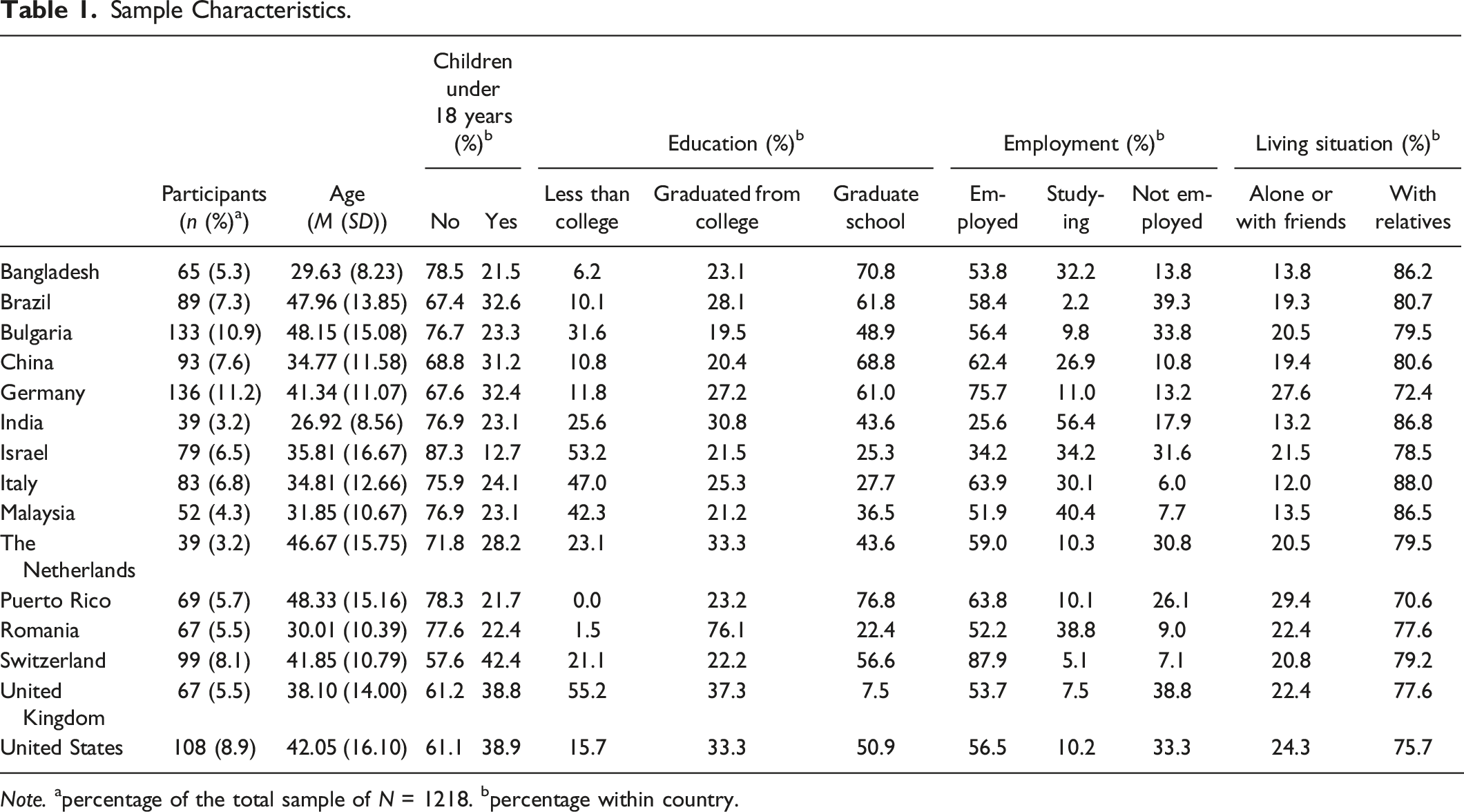
Note. apercentage of the total sample of N = 1218. bpercentage within country.
Results
Description of Participants
The 1218 women in our sample had a mean age of 39.64 years (SD = 14.60). The majority of the women had no children under 18 years old (71.3%), had attained tertiary education (77.1%), and lived with relatives (78.6%). Also, most women were employed (59.6%), while the rest were studying (18.8%) or unemployed (21.6%). More detailed sample characteristics can be found in Table 1.
Description of Stressful Experiences (Presence of Themes)
The TCA identified the presence or absence of multiple themes in the following categories: relationships, daily life, personal challenges and change, and societal challenges and change. For the full description of the themes and their prevalence within the narratives from different countries, see Todorova et al. (2021). A short summary of the descriptions of the themes and their prevalence can be found in the Supplementary Materials (see Supplementary Tables S1 and S2). Most prevalent themes were related to the stresses of disruptions in relationships (31.4%), missing friends and physical presence (35.0%), health concerns (31.9%), missing regular daily activities (42.6%), looking forward to life without pandemic restrictions (39.5%), and the emotions of anger and fear (25.6%).
Cultural Differences in Stressful Experiences (Presence of Themes)
Stressors of the Pandemic Experienced
Summary of the Results of the Logistic Regression Analyses on Experienced Stressors and Things to Look Forward to.
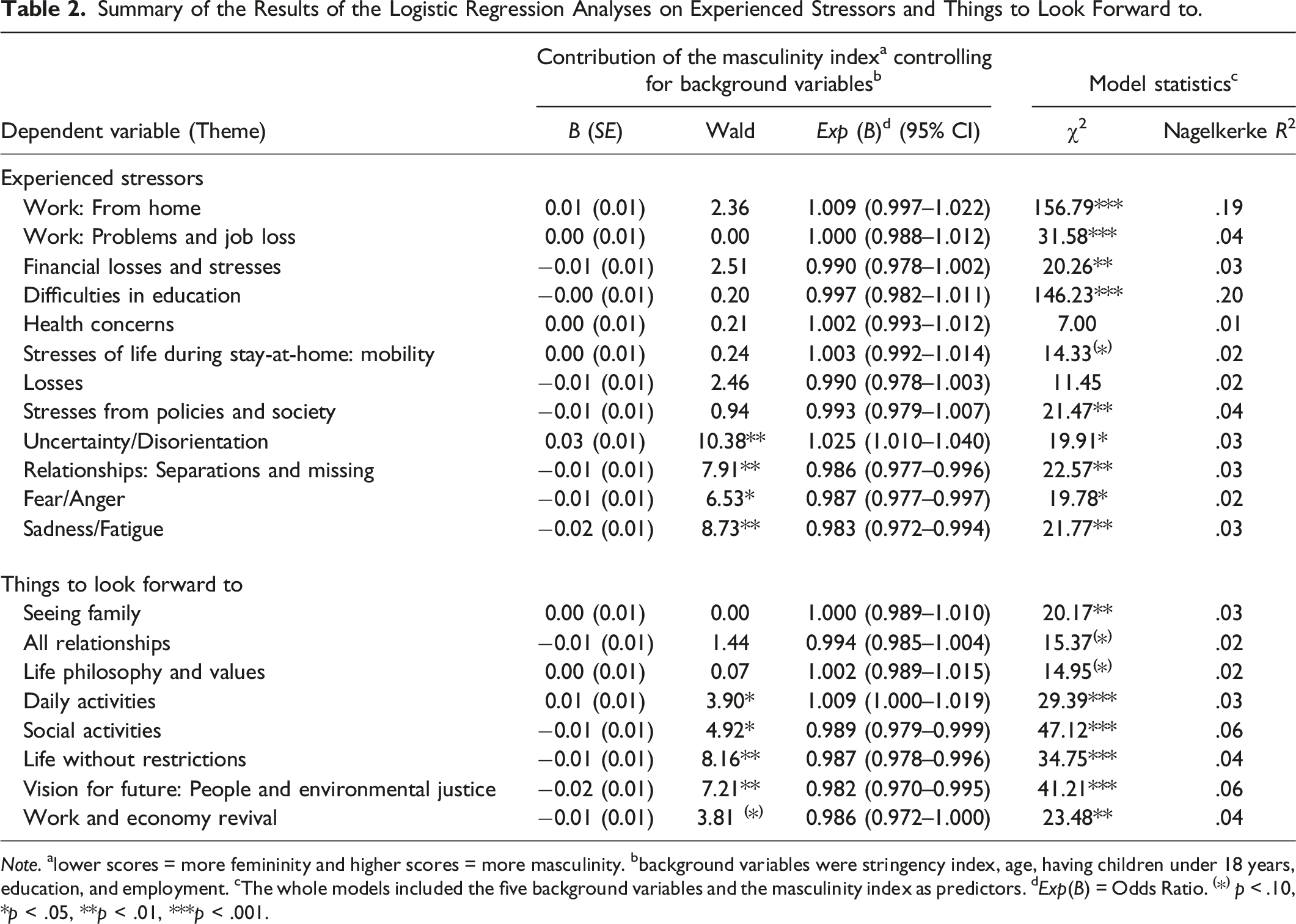
Note. alower scores = more femininity and higher scores = more masculinity. bbackground variables were stringency index, age, having children under 18 years, education, and employment. cThe whole models included the five background variables and the masculinity index as predictors. dExp(B) = Odds Ratio. (*) p < .10, *p < .05, **p < .01, ***p < .001.
The logistic regression analyses revealed that the five background variables and the masculinity index together explained between 1% and 20% of the variance in the presence of the 12 themes regarding the experienced stressors (see Table 2, last column).
The presence of stressors and difficulties arising from working at home, restricted mobility, and changes in education were not associated with the femininity/masculinity of the culture. Also, no associations between the presence of work problems, financial problems, health concerns, and different kinds of losses, such as loss of plans, opportunities, independence, and freedom, and the cultural femininity/masculinity were found. Furthermore, the dimension femininity/masculinity was unrelated to the frequency in which women wrote about disappointment with government and concerns about societal changes.
The femininity/masculinity of the culture was significantly positively associated with the expression of disorientation or confusion, indicating that with increasing cultural masculinity, women were more likely to report a sense of disorientation or confusion (OR = 1.025; 2.5% increase in odds per 1-unit increase in masculinity index).
Additionally, the cultural dimension femininity/masculinity was significantly negatively associated with mentioning separation and missing people as well as the emotions fear/anger and sadness/fatigue. These findings indicate that with decreasing masculinity (i.e., increasing femininity), women were more likely to write about missing people and physical aspects of relationships, such as hugging (OR = 0.986; 1.4% decrease in odds per 1-unit increase in masculinity index), to express fear and anger (OR = 0.987; 1.3% decrease in odds per 1-unit increase in masculinity index), and to report sadness and fatigue (OR = 0.983; 1.7% decrease in odds per 1-unit increase in masculinity index).
What to Look Forward to After the Pandemic
The full results of the second series of multivariate logistic regression analyses explaining what women were looking forward to after the pandemic dependent on the cultural femininity/masculinity while controlling for several background variables are presented in the Supplemental Materials (see Supplementary Table S4). A summary of the findings regarding the cultural dimension femininity/masculinity can be found in the lower part of Table 2.
The logistic regression analyses revealed that the five background variables and the masculinity index together explained between 2% and 6% of the variance in the presence of the eight themes regarding things to look forward to (see Table 2, last column).
No associations were found between the cultural femininity/masculinity and the presence of looking forward to returning to all aspects of relationships, including seeing family, friends, and co-workers, having physical contact, and going on dates, as well as of looking forward to a life of new or reaffirmed personal values and attitudes.
The femininity/masculinity of the culture was significantly positively associated with writing about daily activities, indicating that with increasing masculinity, women were more likely to look forward to daily activities, such as going shopping, having dinner in a restaurant, attending cultural events, and exercising hobbies (OR = 1.009; 0.9% increase in odds per 1-unit increase in masculinity index).
Additionally, the cultural dimension femininity/masculinity was (marginally) significantly negatively associated with mentioning social activities, a life without restrictions, visions for the future, and a revival of work and economy. The findings indicate that with decreasing masculinity (i.e., increasing femininity), women were more likely to look forward to social activities, such as social gatherings, celebrations, and going on vacation (OR = 0.989; 1.1% decrease in odds per 1-unit increase in masculinity index), to living without restrictions (OR = 0.987; 1.3% decrease in odds per 1-unit increase in masculinity index), to a better world with more equality, social justice, and solidarity (OR = 0.982; 1.8% decrease in odds per 1-unit increase in masculinity index), and to getting back to work and financial stability (OR = 0.986; 1.4% decrease in odds per 1-unit increase in masculinity index).
Discussion
The present study investigated the association of the femininity/masculinity of the culture with the stresses of COVID-19 experienced by women as well as with their expectations of life “after COVID”. The stories were generated by the women themselves, living in diverse societies across the globe, and were analysed in two phases: the first phase consisted of inductively identifying themes and quantifying their prevalence and the second quantitative phase associated the prevalence of themes with the femininity/masculinity of the culture women were living in.
The main sources of stress which women wrote about in our study emanated from the pandemic itself (such as health concerns) or from the responses of governments aimed at mitigating the pandemic (such as disruptions in relationships, separations from friends and physical presence, changes in regular daily activities). At this early stage of the pandemic few people had actually contracted the disease, but all were experiencing the widespread disruption of “normal” existence. These themes were reported in other studies as well (Evans et al., 2020; Gamonal-Limcaoco et al., 2021; Hill et al., 2020).
For many domains of stress there was no association between their prevalence and the extent to with the culture had more feminine or masculine values. This may indicate that the pandemic was a “strong situation” (Mischel, 1977), namely, a situation that constrains options and provides clear signals about what is expected, thus restricting the degrees of behavioural variability across individuals (Cooper & Withey, 2009). This “strong situation” meant that globally most women lived through the restrictions, thus experiencing similar levels of changes in education and work, concerns about their own health and the health of others, financial problems, and enduring losses of plans, opportunities, and independence. This finding can be compared to only two other studies which examined cultural femininity/masculinity in the COVID-19 context, though both studies examined it with association to an epidemiological indicator of COVID-19 cases. The lack of association resonates Gokmen’s inquiry which found no association between femininity/masculinity and the indicator of COVID-19 cases (Gokmen et al., 2021) and is contrary to Dheer et al. (2021) findings.
Women living in masculine cultures were more likely to express a sense of disorientation and confusion during the first months of the pandemic. On the other hand, women living in feminine cultures were more likely to write about missing people and the physical contact in relationships and to express feelings of sadness, fatigue, fear, and anger. These findings could be interpreted as reflecting the consequences of shared responsibilities in feminine cultures: for women more involved in the different layers and streams of society, as women in feminine cultures are, the events may be less disorienting and confusing (Hofstede, 2011). However, this enhanced understanding of the situation was concomitant with more negative emotions. This higher frequency of negative emotions may be interpreted as reflecting more acceptance and legitimacy to express negative emotions in more feminine societies or a reflection of the price the increased responsibility entails. This finding contradicts earlier findings which showed that negative emotions (i.e., depression and fear) are less prevalent in feminine cultures (Arrindell et al., 2003, 2004). However, it is in line with subjective well-being theories that propose that well-being is related to the fulfilment of needs, desires, and goals (Diener, 2009). As women from feminine countries had to give up or put on hold more activities which they were involved with before the pandemic, it is likely that their subjective well-being was relatively more negatively impacted than that of women in more masculine countries.
As regards the future expectations, it should be noted that the data were collected in the period of the first COVID-19 wave, when many people expected that things would return to “normal” soon after the lockdowns. In our analysis, independent of the femininity/masculinity of the culture, women were looking forward to family and relationships and to a life with new or reaffirmed personal values and attitudes.
However, women living in cultures with more masculine values were more likely to write about expectations to return to daily activities. On the other hand, women from more feminine cultures were more likely to write about expectations in all domains, from the micro to the macro level: they were more often looking forward to life without restrictions, they were more often looking forward to social activities, getting back to work and financial stability, and they more often expected social changes, so that the world could be “better” in terms of social justice, equality, and solidarity. These differences could be interpreted as reflecting what a “tough” or masculine culture offers to women. Several theorists (Arsenian & Arsenian, 1948; Halford & Leonard, 2001; Hofstede, 2011) suggested that a tough culture - masculine in this case - provides few valued goals and severely restricts access to the pathways through which that goal may be achieved. This type of culture might offer fewer scenarios for the future, or in the words of Törrönen, fewer “pending narratives” (Törrönen, 2021), or strivings, which were found to be associated with life satisfaction (Emmons, 1986). This may be one of the reasons for fewer expectations shared by women in masculine cultures; indeed, the only future expectation associated with masculine societies was for a return to daily activities which were restricted during the pandemic. Conversely, women living in feminine cultures expected to become involved in many of the areas of life which they previously had access to (social engagement, participation in the economy), yet were restricted from them during the pandemic. Indeed, women living in masculine cultures are expected to have less “ego goals” (Hofstede, 1998), those associated with achievement, success, and assertiveness, and more goals associated with family and caring, goals which were not hampered during the restriction but rather amplified.
Strengths, Limitations and Future Directions
The study harbours several strengths as well as limitations. Its chief strength is that participants are from many countries with different geographical locations and local contexts. The wide diversity of societies represented in the study afforded a perspective on the multiple ways in which the pandemic was experienced and interpreted around the globe. Second, the data were generated by the participants themselves, guided only by two general questions aimed to prompt stories - what concerns people have during the pandemic and what they look forward to. Third, the analysis took account of the circumstances in which the women live, i.e., COVID-specific (e.g., the epidemiological situation and authorities’ response to the pandemic) and demographic variables (age, number of children under 18 years old, education, employment status) by controlling for these variables.
The study also has limitations. Some of these are tied to the limitations of the model of cultural dimensions itself, and particularly the dimension of femininity/masculinity (Jeknić, 2014). We noted that a country or a nation is not the same as culture and its values (Sawang et al., 2016). Indeed, we are cognizant of the fact that characterizing a whole country with a given cultural dimension ignores the significant within-cultural differences. The above is a frequent criticism of the Hofstede model which we consider. However, the model is still a widely used approach in cross-cultural studies, partly due to its frequent validation in empirical studies (Zainuddin et al., 2018), and has to some extent moved away from gender stereotypes to emphasize the similarity of values among men and women in feminine cultures (Hofstede, 2011). In our study, we used the interpretation of the femininity/masculinity dimension as indicative of values related to gender role similarity in a wide range of countries, rather than as an indication of fixed gender roles and characteristics. Another limitation is that our sample was highly educated, resulting from recruitment through professional networks and social media. Indeed, the online questionnaire might not have been accessible to all groups, depending on device (computer, phone) and Internet access. Thus, the differences between women in feminine versus masculine cultures is skewed towards educated women in such cultures, many of whom were working at home during the pandemic. A third limitation is that most participants wrote sparingly, reflecting difficulties in time commitment for an online narrative study, and themes were only coded when explicitly stated. Lastly, we could not use multilevel logistic modelling which nests women within a country and then within a culture, as the number of countries was too small (Sommet & Morselli, 2017).
The results of the present study underline the importance of the femininity/masculinity dimension for future studies, both international, comparing nations or cultures as well as local. International studies comprising many societies or cultures can use the masculinity index scores from Hofstede’s studies (2021) without adding additional measures. International datasets, such as the Survey of Health, Ageing and Retirement in Europe (Börsch-Supan et al., 2013) which includes also non-European countries, affords such an analysis on many variables of interest, from social support to attitudes towards aging. Including the femininity/masculinity dimension in studies conducted in only one country may require more nuanced models of cultural orientation, such as the vertical and horizontal orientations developed within the individualism/collectivism dimension (Singelis et al., 1995; Triandis & Gelfand, 1998). Such development of the femininity/masculinity dimension will require a first step of theoretical conceptualization.
Conclusions
This exploratory analysis sheds light on how a major stressor as COVID-19 is contextualized within a type of culture. Several studies have already linked culture to the variation in the prevalence of the pandemic, in governmental response to it, and in the health behaviours of the public-at-large, focusing primarily on the dimension of individualism/collectivism. Our study enriched the understanding of how health and stress are embedded in culture by focusing on the femininity/masculinity dimension, uncovering how women living in different cultures experienced the pandemic differently and looked forward to different things in the future.
COVID-19, as a “strong situation” at the initial phase of the pandemic, created many similar stresses, yet women in feminine cultures were less disoriented and confused while expressing more negative emotions. Noteworthy is the finding that women living in feminine cultures reported more hopes for the future, possibly reflecting their enhanced access to paths realizing their goals. Our interpretation of the findings is that the increased opportunities for women in cultures higher in the feminine dimension materialized into a better understanding of the pandemic and more hopes for themselves and society in many realms. Concomitantly, this higher involvement in all spheres of life in feminine cultures, compared to masculine cultures, came with increased negative affect during the pandemic, which is either more legitimately expressed, a reflection of the better understanding of the situation, or due to the disruption of goals in a broader range of life domains. Thus, the gains and elevated responsibilities which feminine cultures avail women make the situation less confusing yet also the losses of COVID-19 loom larger. This same mix of opportunities and responsibilities also propels their plentiful expectations for the future.
Supplemental Material
Supplemental Material - Stresses of COVID-19 and Expectations for the Future Among Women: A Cross Cultural Analysis According to the Femininity/Masculinity Dimension
Supplemental Material for Stresses of COVID-19 and Expectations for the Future Among Women: A Cross Cultural Analysis According to the Femininity/Masculinity Dimension by Manja Vollman, Irina Todorova, Christel Salewski and Efrat Neter in Cross-Cultural Research
Footnotes
Declaration of Conflicting Interests
The authors declared no potential conflicts of interest with respect to the research, authorship, and/or publication of this article.
Funding
The authors received no financial support for the research, authorship, and/or publication of this article.
Supplemental Material
Supplemental material for this article is available online.
Note
Author Biographies
References
Supplementary Material
Please find the following supplemental material available below.
For Open Access articles published under a Creative Commons License, all supplemental material carries the same license as the article it is associated with.
For non-Open Access articles published, all supplemental material carries a non-exclusive license, and permission requests for re-use of supplemental material or any part of supplemental material shall be sent directly to the copyright owner as specified in the copyright notice associated with the article.
