




Abstract
Most research on friendship has been grounded in Western cultural worlds, a bias that needs to be addressed. To that end, we propose a methodological roadmap to translate linguistic/anthropological work into quantitative psychological cross-cultural investigations of friendship, and showcase its implementation in Russia and Canada. Adopting an intersubjective perspective on culture, we assessed cultural models of friendship in three inter-related ways: by (1) deriving people’s mental maps of close interpersonal relationships; (2) examining the factor structure of friendship; and (3) predicting cultural group membership from a given person’s friendship model. Two studies of Russians (Study 1, n = 89; Study 2a, n = 195; Study 2b, n = 232) and Canadians (Study 1, n = 89; Study 2a, n = 164; Study 2b, n = 199) implemented this approach. The notions of trust and help in adversity emerged as defining features of friendship in Russia but were less clearly present in Canada. Different friendship models seem to be prevalent in these two cultural worlds. The roadmap described in the current research documents these varying intersubjective representations, showcasing an approach that is portable across contexts (rather than limited to a specific cross-cultural contrast) and relies on well-established methods (i.e., easily accessible in many research contexts).
We like each other quite well, though I’m not sure what is between us is “friendship” - a word which in Polish has connotations of strong loyalty and attachment bordering on love. At first, I try to preserve the distinction between “friends” and “acquaintances” scrupulously, because it feels like a small lie to say “friend” when you don’t really mean it, but after a while I give it up. “Friend,” in English, is such a good-natured, easygoing sort of term, covering all kinds of territory, and “acquaintance” is something an uptight, snobbish person might say. . . . As the word is used here, Penny is certainly a friend. (Hoffman, 1990, p. 148)
This quotation from the memoir of Eva Hoffamn, a Polish immigrant to North America illustrates the notion that friendship, although ubiquitous, does not mean the same thing everywhere. What’s in a friend depends on the social or cultural context (Adams & Plaut, 2003; Allan, 1998). Yet, like much psychological research, work on friendship has mostly been grounded in WEIRD (Western, Educated, Industrialized, Rich, Democratic; Henrich et al., 2010) cultural worlds—North American ones in particular. This bias hinders a better understanding of the culturally patterned ways in which people relate to each other and form fulfilling relationships (see Morris et al., 2000 for work in a similar vein). It can also obscure the real difficulties immigrants encounter when attempting to recreate a social network in their new country—a recurring theme in Hoffman’s memoir.
To counter this bias, we need tools allowing researchers to systematically document cross-cultural differences in friendship. As a step in this direction, we outline an approach that translates linguistic/anthropological work into quantitative psychological investigations of friendship in different cultural settings. We showcase the implementation of this approach by investigating people’s understanding of friendship in Russia and in Canada.
The Cultural Grounding of Friendship
Friendship plays a very positive role in our life, promoting happiness and life satisfaction (Gillespie et al., 2015), helping us go through major life transitions (de Vries et al., 2014; Waldrip et al., 2008) and protecting us against physical and mental health difficulties (Goosby et al., 2013; Lincoln et al., 2010). Conducted mostly in Western contexts, research on friendship describes an informal and voluntary relationship, not bounded by institutional ties, formal rules, or tasks (Adams & Blieszner, 1994; Hojjat & Moyer, 2016). Defining features of that relationship include fun and enjoyment, symmetrical reciprocity, intimacy and self-disclosure, practical help, sharing common characteristics, and personal growth that friends promote among each other (Hall, 2012). Researchers often distinguish between “close” versus “casual” friendships, indicating that the term friend can encompass a range of relationships varying in intimacy or frequency of interaction (Bryant & Marmo, 2012). Closeness distinctions aside, Western friendship is described overall as a uniquely voluntary relationship, where “in its purest form, its sole goal is its own preservation and enjoyment” (Wiseman, 1986, p. 192).
Yet, rather than reflecting exclusively personal choices and feelings, the structure and meaning of friendship are strongly shaped by the sociocultural context within which this relationship emerges (Allan, 1998; Ueno & Adams, 2006). Different cultural worlds emphasize different ways of being, acting, and feeling as good and desirable. People’s ways of relating to each other—and therefore the types of friendship they form—reflect these cultural mandates and affordances (Morris et al., 2000). For example, reflecting a prevalent cultural concern of relational interdependence, Ghanaian participants advocated caution toward friends and emphasized practical assistance as a defining characteristic of friendship (Adams & Plaut, 2003). They also saw having many friends as foolish, because of the heavy obligations that come with friendship. This contrasts with the experience of American participants, who reported larger number of friends and expressed pity toward a person without any friends; in contrast to the accusations leveled at the friendless in the Ghanaian sample. This American experience is consistent with a view of friendship as voluntary association and reflects a broader cultural concern with independence.
Adams and Plaut’s (2003) research targeted specific cross-cultural comparisons (e.g., regarding a friendless person with accusation or pity), based on specific hypotheses regarding underlying cultural mechanisms. However, before carrying out such nuanced investigations, it is essential to first document the existence of cross-cultural differences. Cultural/cross-cultural psychologists often do so by conducting qualitative studies or by borrowing from neighboring disciplines such as anthropology or linguistics. An important next step is to confirm these initial cross-cultural differences quantitatively, because it allows us to triangulate these differences from a complementary perspective and to increase their generalizability. This next step, which is our focus here, also provides a quantitative basis for subsequent (typically quantitative) investigations of underlying cultural mechanisms, namely, studies aimed at “unpackaging” culture (Singelis et al., 1999). We showcase the implementation of a three-pronged methodological approach targeting this intermediate step.
An Intersubjective Perspective on Culture
Several disciplines concerned with the interrelation of culture and mind have terms to describe cognitive schemas or scripts that are represented in the minds of individual people while also playing out in the relationships between people in the social world. We use the term “cultural model” for this purpose. A “cultural model of friendship” is a normative model in this framework, meaning that it describes assumptions and their associated behaviors that are intersubjectively understood as normal (Chentsova-Dutton & Ryder, 2020). In other words, a cultural model of friendship is a set of mental representations about what people in a given cultural context believe a typical friendship (a) ought to be like, (b) typically is like, and (c) sometimes can be like and still be called a friendship of some kind. As such, this concept overlaps with notions of friendship rules, standards, or expectations (Argyle & Henderson, 1984; Hall, 2012).
Shared and consensual (up to a point) within a cultural world, this knowledge coordinates how people relate to each other within that world and informs how people experience their own friendships—which may or may not align with the prevalent friendship model (Chiu et al., 2010b). This intersubjective perspective on culture contrasts with the traditional subjectivist approach that characterizes culture by aggregating measures of individual-level characteristics (Chiu et al., 2010a). Methodologically, measuring cultural models of friendship from an intersubjective perspective entails asking questions about what friendship typically means for people in one’s cultural context rather than questions about one’s own idiosyncratic friendships.
Our approach to document cross-cultural differences in models of friendship (described in the next section) rests on the assumption that such cultural models exist. That is, we assume that a given local social world has developed a consensual and shared cultural solution regarding what friendship means and how one should act with friends within this world. To test and integrate that assumption, we use cultural consensus methods that allow us determine the consensual pattern of responses within a context and take into account individual variation in cultural competence, that is, individual differences in the knowledge of that intersubjective reality (Chiu et al., 2010a). The cultural consensus framework, developed in anthropology, posits that estimates of people’s knowledge of intersubjective representations can be estimated from agreement levels among them (using factor analytic methods). After establishing that there is one core consensual representation, this approach assesses how much each person knows about this representation and takes into account these individual differences in knowledge to more precisely characterize the group consensus (Romney et al., 1986). Here, we apply cultural consensus methods to assess friendship models in three ways.
Methodological Roadmap: A Three-Pronged Approach to Documenting Cross-Cultural Differences in Friendship Models
Mental Maps of Close Interpersonal Relationships
In all spheres of life, we tend to make judgments about how similar or different the many stimuli we encounter are from one another (Green & Carmone, 1970). As such, one way to understanding friendship models is to consider where friendship stands in relation to other non-kin and non-work relationships. By drawing a map of the terms used to denote relationships in that interpersonal space (e.g., friend, pal, acquaintance), we can shed some light on the “hidden structure,” or mental framework organizing that space (Pinkley et al., 2005).
Practically, and to capture these mental maps, participants judge the similarity among relationship terms (e.g., how similar friend is to pal), and we then conduct a multidimensional scaling analysis of these judgments. We would expect the resulting spatial map of relationship terms to be different across cultural contexts, reflecting different cultural models of friendship (H1). Given that participants use their own mental model of the stimuli to guide their judgments, the researcher’s hypotheses or preconceptions are unlikely to affect the results (Pinkley et al., 2005).
Friendship Factor Structure
Measurement invariance refers to the psychometric equivalence of a construct across groups (or timepoints) and indicates that the same underlying construct is being measured in equivalent ways in those groups. The first step of establishing measurement invariance consists in demonstrating that the construct’s factor structure (number of factors and pattern of factor-indicator relationships) is identical across groups. A prerequisite to this first step, however, is that the set of scales or measures evokes the same conceptual framework in each group (Vandenberg & Lance, 2000). Taking this prerequisite as a starting point, a second way to investigate cultural models of friendship is to examine the factor structure of friendship in different cultural settings, and show that people may perceive friendship differently across these settings.
Practically, participants answer questions about properties of a typical friendship in their context by completing standard friendship questionnaires. We then conduct an exploratory factor analysis of the responses, separately in each cultural setting. This analytic approach is particularly useful when the underlying dimensions of a construct are unknown or unclear (He & van de Vijver, 2012). We would expect the optimal factorial solution to differ across settings, with different numbers of factors and/or pattern of item loadings on the factors (H2).
Predicting Group Membership Based on Cultural Models
By showing that some psychological constructs (e.g., values) vary more within a country than between countries (using multi-level approaches), recent cross-cultural work has questioned the usefulness of societal culture as an explanatory variable (Schwartz, 2014). In line with this issue, the third aspect of our methodological roadmap concerns the ability of friendship cultural models to discriminate between members of cultural groups. In other words, can we infer people’s cultural background based on their intersubjective understanding of friendship? If so, what facets of this intersubjective understanding have the strongest ability to discriminate between groups? Thus, this third aspect addresses whether cross-cultural differences are substantial enough to make meaningful group predictions.
In this approach, participants answer questions about the properties of a typical friendship in their context (created based on initial qualitative inquiries of cross-cultural differences in friendship described below). We then conduct a logistic regression analysis of the responses, with cultural group as the dependent variable. We would expect people’s ratings of friendship characteristics to predict the probability of belonging to one cultural group versus the other (H3).
The three-pronged approach just described should allow researchers to document cross-cultural differences in friendship models in many different cultural contexts - a strength of the proposed approach. In addition, the methods used in this approach are already well-established. As such, computational tools used to implement these methods should be readily available to a majority researchers in many contexts. Here, we showcase the implementation of this approach in Canadian versus Russian contexts.
Friendship in Russia Versus North America
Contrasting friendship models in these two cultural worlds is an interesting case study because doing so departs from the typical East-Asia/North-America comparison and because preliminary evidence suggests we can expect to find significant differences (for a review that includes studies of Russian collectivism and trust, see: Jurcik et al., 2013). A few studies showed that, compared to American participants, Russian participants were more likely to allow friends to enter their personal sphere (Searle-White, 1996), had fewer friends and engaged in less self-disclosure (Sheets & Lugar, 2005a), and tolerated fewer violations in their friendships, ending a relationship in reaction to a broader range of issues (Sheets & Lugar, 2005b). In that respect, betrayal was particularly problematic for Russians, whereas Americans were more sensitive to keeping secrets from a friend. In a qualitative study of Russian immigrants to Canada, we also found that participants described friendship in Russia as a stronger and deeper, but also more demanding relationship than in Canada (Doucerain et al., 2018).
These findings resonate with linguistic work on semantic differences between the translation equivalents friend and друг (droog). Based on the argument that key terms in a language encapsulate the beliefs, values, and concerns prevalent in its ethnolinguistic speech community, Wierzbicka (1997) showed that friend and droog conjure up different cultural models of friendships among English and Russian speakers. Her semantic analyses showed that friend implies enjoyment of spending time together (“fun”), sharing common interests and activities as well as validation of each other’s needs. Droog, on the other hand, evokes complete trust, almost boundless support and readiness to help in adversity, positive regard and feelings for one’s friend, and considerable self-disclosure. We used these linguistic analyses as a springboard to select friendship questionnaire items (friendship factor structure) and to construct statements about friendship properties (predicting group membership based on cultural models).
The Present Studies
Informed by an intersubjective approach to culture, we implement a three-pronged methodological approach to quantitatively document cross-cultural differences between Russian and Canadian friendship models. Several aspects of our approach are noteworthy. First, we examine friendship models overall, rather than focusing on singular friendship aspects (e.g., Sheets & Lugar’s, 2005b study on self-disclosure). Second, we propose a research approach that is portable across contexts, rather than limited to a specific cross-cultural contrast. Third, we pay attention to issues of cultural consensus and measurement equivalence, and we control for potential cross-cultural response biases. Study 1 allows us to test our first hypothesis. Studies 2a and 2b draw from the same initial pool of participants, but use slightly different subsets of that pool, and test H2 and H3, respectively. Our overarching goal is primarily methodological, but as a theoretical contribution, we also build on initial qualitative work by quantitatively characterizing differences in intersubjective understandings of friendship in Russian versus Canadian contexts.
Study 1
Methods
Procedure and participants
We recruited participants in Canada (initial N = 89) and in Russia (initial N = 89) through websites for classified ads and through snowball sampling. Information about the study was also disseminated through the personal network of the first author in Russia. Eligibility criteria were to have both parents born in Canada/the former Soviet Union; and to have English/Russian as one’s native language. The study took place online. Participants provided informed consent at the beginning of the study and were entered in a draw for 100 dollars in Canada and 2,000 rubles in Russia (reflecting locally appropriate amounts as compensation for such a study). We only retained participants who provided data for at least 50% of the study variables. Further, given that content non-responsivity is a concern in online studies (Johnson, 2005; Meade & Craig, 2012), we screened for careless responses by looking for participants who “straightlined” (i.e., picked the same answer for all questions) at least 50% of the questionnaire items (Barge & Gehlbach, 2012). None were identified. The final Canadian sample comprised 70 participants (47 females) with an average age of 32.28 years (SDage = 11.66); the final Russian sample comprised 71 participants (59 females) with an average age of 28.69 years SD = 8.40).
Materials
We first compiled a list of words covering the space of interpersonal relationships around friendship in English and Russian. To do so, we searched for synonyms of the word friend in synonym dictionaries, as well as for synonyms of these synonyms, excluding those that referred exclusively to work relationships. We kept 16 terms based on the evaluation of these terms by a small focus group of native English speakers for exhaustiveness of interpersonal relationships and use in natural settings (i.e., removing terms that were overly literary or antiquated). The same procedure was followed for Russian, with droog (друг) as a starting point. In English, friend is often used in noun phrases that are almost treated as compounds, such as best friend, close friend, or friend of mine. To reflect this feature of English while still focusing on single words, we included the commonly used collocation best friend (and its Russian equivalent luchshiy droog) as 1 of the 16 terms. The final sets of terms, with translations, are shown in Supplemental Material.
The study was first launched in Canada and participants evaluated the similarity/differences between terms in all pairwise combinations of the 16 terms (a total of 120 comparisons, in random order) on a Likert-type scale ranging from 1 Very similar to 9 Very different, in random order. However, participants complained about the length and tediousness of the task. Therefore, we randomly split the 120 pairs into two equal sets, and randomly assigned participants to rate one of the two 60-pair sets. We aggregated the semantic differentials from full-length and half-length sets prior to conducting multidimensional scaling.
Analysis
The analysis proceeded in three steps: first, a cultural consensus analysis of semantic differentials, followed by a multidimensional scaling analysis of semantic differentials, and finally a hierarchical cluster analysis of the multidimensional scaling configuration.
Cultural consensus on semantic differentials
Following Segalowitz et al. (2016), we conducted a cultural consensus analysis (Weller, 2007) on the semantic differentials before aggregating participants’ scores for multidimensional scaling. We conducted minimum residuals factor analysis on randomly selected subsets of 10 participants (5,000 resamples), using the psych package (Revelle, 2017) in R. We computed a weighted average dissimilarity matrix of the 16 terms using participants’ factor loadings (cultural competence scores) as weights, so that participants with greater knowledge of the culturally consensual representation of relationships contributed more to the group average that those with lesser knowledge. The reader is directed to Segalowitz et al. (2016) for a detailed description of this analytic approach.
Multidimensional scaling (MDS)
We conducted an ordinal multidimensional scaling analysis of the weighted average dissimilarity matrix using the smacof package in R (de Leeuw & Mair, 2009). Note that in the Canadian sample, the pair “associate-friend” was mistakenly replaced by the pair “best friend-peer.” The grand mean of the matrix was imputed for the missing “associate-friend” pair.
Hierarchical clustering of the MDS solution
Interpreting an MDS configuration relies on a qualitative and partially subjective approach (Borg et al., 2012, p. 2; Meyers et al., 2016, p. 201), so it is fairly common to conduct a cluster analysis of the MDS configuration to aid interpretation (Leonard & Ashley, 2012; McLaughlin et al., 1991). Here, the MDS coordinates for each term were submitted to hierarchical cluster analysis with Euclidian distances and the complete linkage method using R (R Core Team, 2017).
Results
Cultural consensus analysis
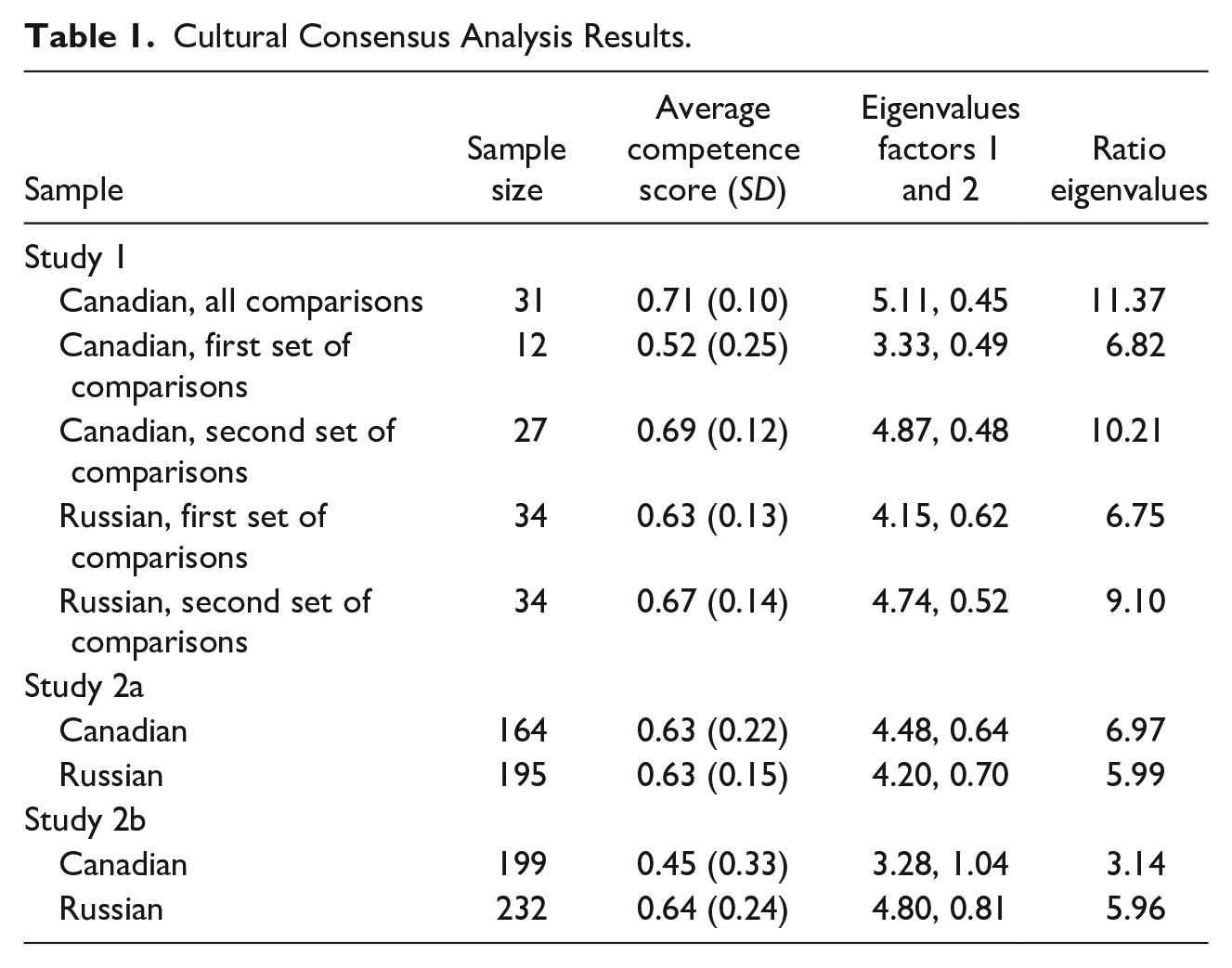
Table 1 shows the results of the cultural consensus analysis in both countries. A ratio of first-to-second factor eigenvalues >3.0 and average competence scores (factor loadings on the one-factor solution) >0.50 indicate the existence of a group consensus (Weller, 2007). Results supported the existence of such a consensus in both countries, indicating that there was a single consensual mental representation of the target relationship terms.
Cultural Consensus Analysis Results.
Multidimensional scaling
The statistical acceptability of an MDS solution is evaluated using Stress-1, a typical “badness of fit” statistic and RSQ values, the proportion of variance in the scaled dissimilarity ratings explained by the corresponding distances in the MDS solution. Stress-1 values below 0.05 are considered excellent, between 0.05 and 0.10 are good, between 0.10 and 0.20 are fair, and above 0.20 are poor (Kruskal & Wish, 1978). For RSQ, the minimum acceptable value is 0.60. In both samples, Stress-1 values went from fair for the two-dimensional solution (0.11 in Canada and 0.16 in Russia) to good for the three-dimensional solution (0.08 in Canada and 0.10 in Russia). RSQ values also improved in the three-dimensional solution, compared to the two-dimensional solution (0.94 to 0.96 in the Canadian contexts and 0.88 to 0.93 in the Russian context). These fit indices indicate that a three-dimensional solution should be retained. The left panels of Figure 1 show this three-dimensional solution.
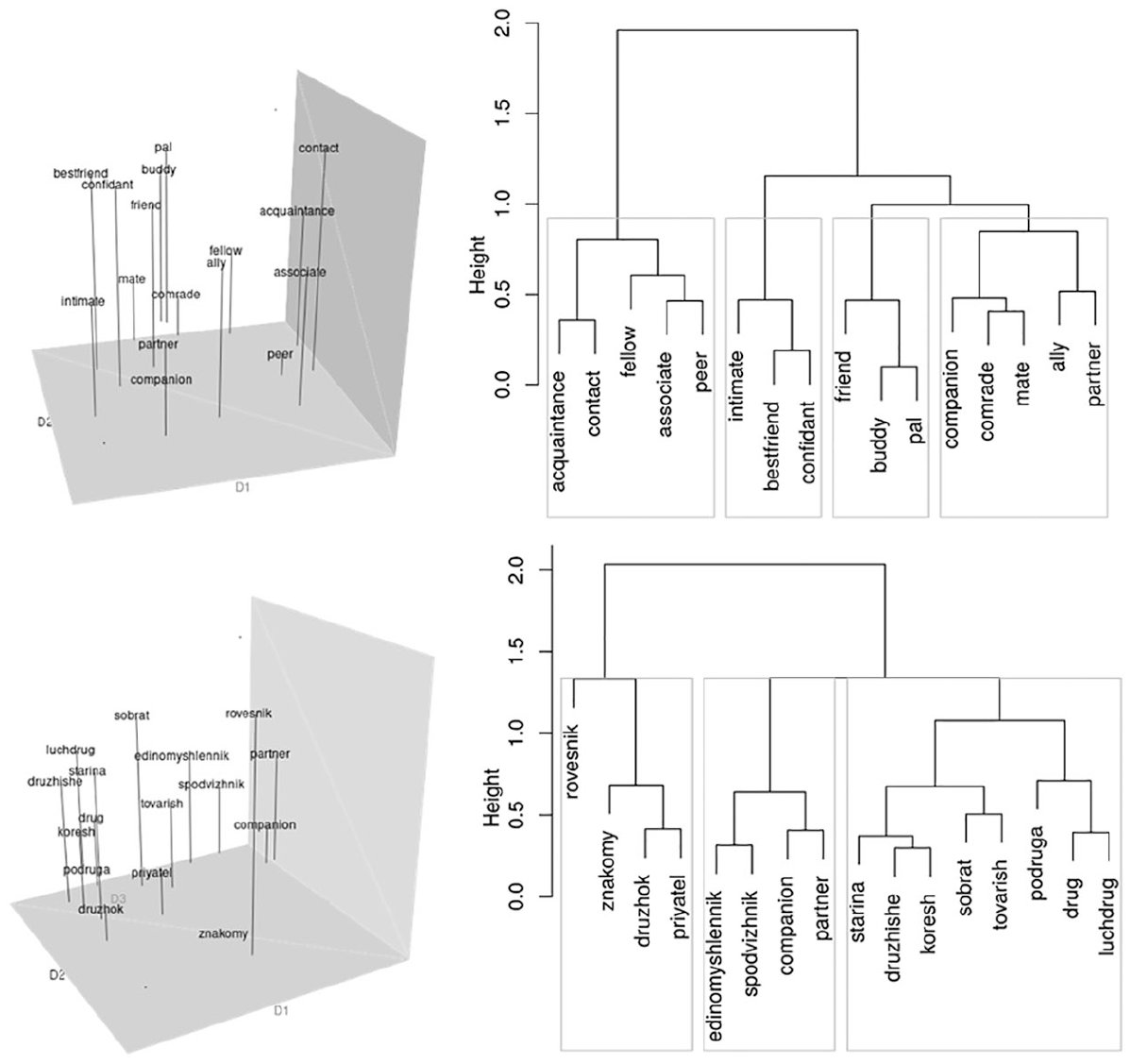
Study 1—Results of the MDS and hierarchical cluster analyses. The 3D MDS solutions are shown on the left and the hierarchical cluster analysis dendrograms are shown on the right. The upper two panels show results for the Canadian sample and the lower two panels for the Russian sample.
Hierarchical clustering of the MDS solution
There is a lack of consensus regarding how to determine the optimal number of clusters and this determination is mainly subjective. Here, scree plots of the cluster dendrograms heights were consistent with four clusters in the Canadian context and three clusters in the Russian context; the right panel of Figure 1 highlights these groupings.
The position of friend and its translation equivalent droog are of particular interest here. In the Canadian sample, friend is right next to buddy and pal, terms that are associated with notions such as spending good times together, or “hanging out.” The term best-friend is located in a different cluster, along with intimate and confidant, both of which denote a very close and intimate bond. This distinction suggests that for Canadians, friend and best-friend represent different types of relationships. By contrast, in the Russian sample, droog is located very close to luchshiy droog, and in the same cluster, thus suggesting that these two terms are perceived quite similarly. Druzhishe and koresh, which can be loosely translated as pal, are also located next to droog, in a way that is superficially similar to Canadians. However, the presence of tovarishch and sobrat in the same cluster, both of which have a connotation of bonding and closeness in adversity, also support the idea that friend and droog are mentally represented very differently, despite being translation equivalents. Based on its location, droog seems to include elements of intimacy and “brother in arms” as well as “hanging out,” whereas friend seems to reflect this latter element more exclusively, and reserve intimacy for different relationships.
In short, the mental maps of terms covering the interpersonal space around friendship differ between Canadians and Russians participants, suggesting that how people in these two groups use different criteria to friend versus droog from other relationships. In the next study, we aim to confirm these differences by examining the factor structure of friendship in both cultural contexts.
Study 2a
Methods
Participants and procedure
Recruitment and study administration followed the same procedures as in Study 1, yielding an initial pool of 227 Canadians and 259 Russians. We removed participants who provided data for less than 50% of the study variables and/or who “straightlined” at least 50% of the questionnaire items. The Canadian sample comprised 164 participants (120 females) with an average age of 30.65 years (SDage = 12.74); the Russian sample comprised 195 participants (156 females) with an average age of 28.68 years SDage = 10.37).
Materials
Participants completed questionnaires assessing some of the friendship dimensions that are presumed to differentiate between droog and friend, based on Wierzbicka’s (1997) linguistic analyses. They read the following scenario: “Imagine two strangers Mel and Pat. You don’t know anything about them other than they’re friends. Given that’s all you know, what can you assume about their relationship?” Next, they rated this hypothetical friendship on a Likert-type scale ranging from (0) Definitely not true to (6) Definitely true, using the sets of items described below. We used unisex names (Женю/Zhenya and Сашу/Sasha in the Russian version) in order to keep the imagined friendship as generic as possible.
We used three subscales of the McGill Friendship Questionnaire—Friend’s functions (Mendelson & Aboud, 1999). The Help subscale (eight items) assessed help/support in friendship. A sample item is “Mel helps Pat do things.” The Stimulating Companionship subscale (eight items) was used to measure enjoyment/pleasure in a friendship, with “Pat makes Mel laugh” as a sample item. The Self-Validation subscale (eight items) assessed the extent to which the friendship fosters the perception of oneself as a competent and worthwhile person. A sample item is “Mel makes Pat feel important.” The Positive Feelings items of the McGill Friendship Questionnaire—Respondent attachment (eight items; Mendelson & Aboud, 1999), such as “Mel likes Pat a lot,” measured intense positive emotions in a friendship.
We also included three subscales of the Acquaintance Description Form (Wright, 1985). Obligation in adversity was measured using the Utility Value subscale (three items), with “If Pat were sick or hurt, Pat could count on Mel to do things that make it easier to take” as a sample item. The Security Value subscale (five items) characterized trust in friendship. A sample item is “Mel feels free to reveal private or personal information about her/himself to Pat because Pat is not the kind of person who would use such information to Mel’s disadvantage.” The General Favorability subscale (five items) was used to measure high regard in a friendship, with the following sample item: “Mel thinks that Pat is a genuinely likeable person.” The full list of items is available in the Supplemental Material.
Analysis
Following the same procedure as in Study 1, we first conducted a cultural consensus analysis on the friendship questionnaire items in each country separately. Second, we conducted an exploratory factor analysis of these items with a minimum residuals factoring method and promax rotation, also separately in each country. Cultural competence scores were entered as weights, in order to take into account the extent to which participants’ views reflected the consensual cultural representation of friendship. Following Courtney (2013), we looked at converging recommendations from optical coordinates, acceleration factor, parallel analysis, and Velicer’s MAP criterion to determine how many factors to retain. Five multivariate outliers were detected (based on their Mahalanobis distance evaluated at the stringent level of p < .001) in each country, and were removed from analyses.
Measurement invariance across groups is typically tested using multigroup confirmatory factor analysis (CFA). However, the baseline model used in such procedures is already very restrictive because of its assumption of equivalent factor number and loading pattern (Roover & Vermunt, 2019). Given our goal to investigate this prerequisite to measure invariance, using exploratory factor analysis is warranted (Roover & Vermunt, 2019) and not an uncommon step (see, e.g., Chen et al., 2015 for a similar first step).
Results
Cultural consensus
Table 1 shows the results of the cultural consensus analysis of friendship questionnaire items. As in Study 1, the ratio of first-to-second eigenvalues was >3.0 and the average cultural competence score >0.50 in both samples. These results are consistent with the existence of a consensual representation of a typical friendship within each cultural group.
Exploratory factor analysis
The Kaiser-Meyer-Olkin (KMO) measure of sampling adequacy was excellent overall in both samples, as indicated by values >0.90 (0.94 in Canada, and 0.92 in Russia). However, KMO values were problematic for two items in Canada (0.52 for “Pat is the kind of person that likes to “put Mel down” or embarrass Mel with seemingly harmless little jokes or comments” and 0.51 for “Pat is quick to point out anything that s/he sees as a flaw in Mel’s character”), and appreciably lower than the rest of the items in Russia (0.71 and 0.75 respectively, whereas all other values were >0.85). Therefore, we removed these two items from the analyses. Correlation matrices (available upon request) were scanned for extreme correlations, separately in each sample. Seven correlations were >0.80 among Canadians, as were three among Russians. However, given that they concerned different variables in the two samples, no further measure was taken at this point. Box’s M-test showed that covariance matrices differed significantly across samples; χ2(1,035) = 1,614.00, p < .00001—a first indicator that the current friendship measures function differently in these two cultural contexts.
Optimal coordinates and parallel analysis suggested retaining three factors in the Canadian sample and four factors in the Russian sample (acceleration factor suggested one factor and MAP suggested six factors in both samples). We therefore report these three- and four-factor solutions. A first round of extraction was conducted to identify items that did not load on any factor (maximum loading <0.40) or that cross-loaded on several factors (difference between highest and second highest loadings <0.30). A second round of extraction was conducted, not including these problematic items. Model fit was good for all these final models. They all accounted for more than 50% of shared variance (63% among Canadians; 54% among Russians). Fit based off-diagonal values were >0.95 and root mean squared residual (RMSR) values were <0.05 in both cases. In addition, the proportion of absolute residuals >0.05 was less than 50% for both models.
Table 2 shows factor loadings of this second round of models in both samples. Factor structures in these two countries show evidence of both similarities and differences. Regarding similarities, Stimulating Companionship items formed one factor in both samples, and so did Self-Validation items. Help and Utility Value items loaded on a single factor in both cultural groups.
Study 2a—Exploratory Factor Analysis of Friendship Questionnaires Items.
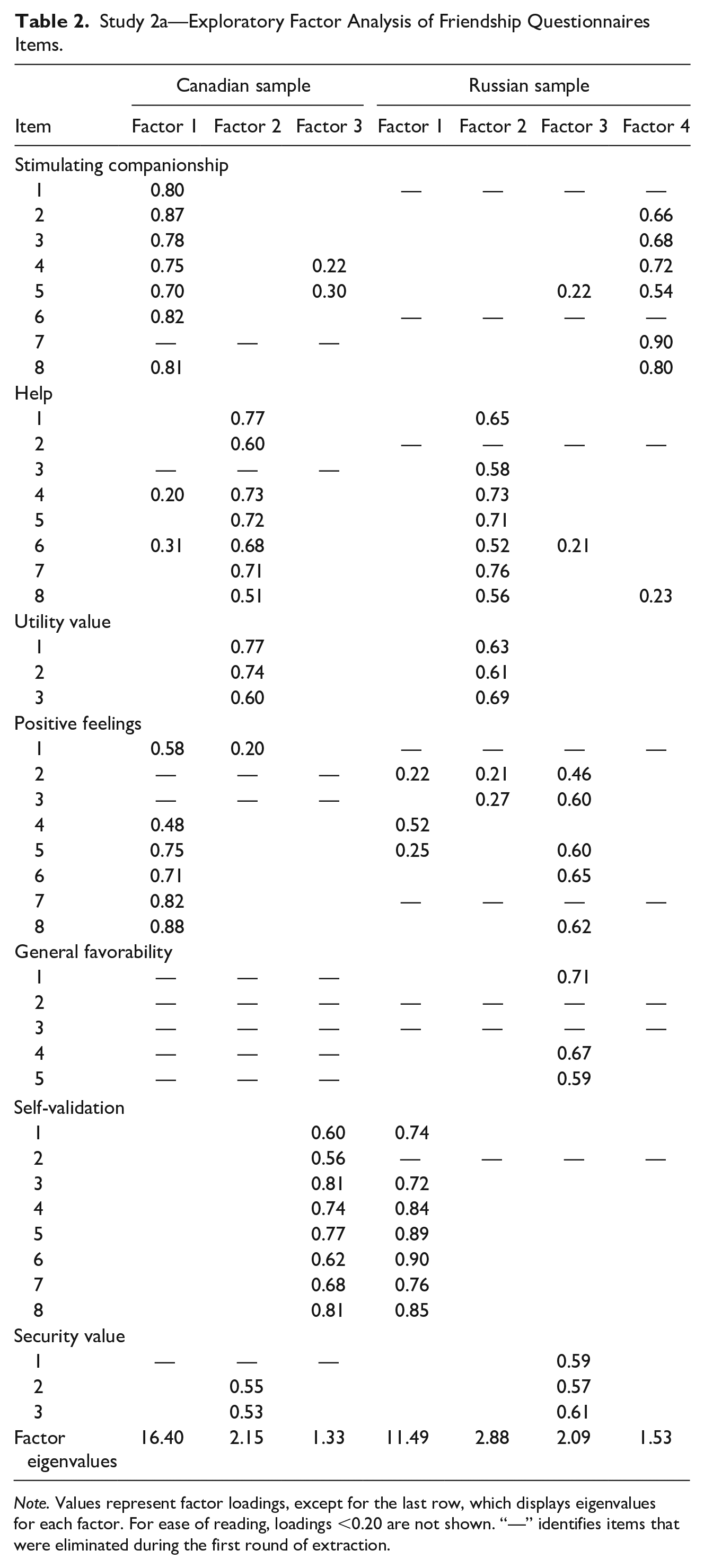
Note. Values represent factor loadings, except for the last row, which displays eigenvalues for each factor. For ease of reading, loadings <0.20 are not shown. “—” identifies items that were eliminated during the first round of extraction.
General Favorability items and Positive Feelings items were lumped into a single factor in the Russian sample, whereas only Positive Feelings item formed a factor in the Canadian sample. General Favorability items did not have a clear loading pattern in the Canadian sample. These results suggest that Russian participants see high regard and strong positive emotions toward friends as a single facet, whereas Canadian participants focused only on positive emotions. Another key difference between the two samples concerns Security Value items. In the Canadian sample, the two remaining Security Value items loaded on the Help-Utility Value factor. In contrast, Security Value items loaded on the General Favorability-Positive Feelings factor among Russians. These results indicate that Canadians see trust (Security Value items) as something pertaining to support and obligation to help in adversity. Russians, on the other hand, see trust as part and parcel of esteem and positive feelings toward one’s friend.
In short, in line with Study 1a’s results, we find here that friendship has a different factor structure in Russian versus Canadian contexts. In other words, people in these cultural contexts use different underlying components to characterize this relationship. We now consider whether these different mental models of friendship can help us discriminate between groups.
Study 2b
Methods
Participants and procedures
The initial pool of participants was the same one as in Study 2a. We removed participants who provided data for less than 50% of the variables for this study component and/or who “straightlined” at least 50% of the questionnaire items for this study component. Some of the participants who thus failed Study 2b inclusion criteria were not the same as those who failed Study 2a inclusion criteria. Applying these criteria resulted in a slightly different final sample than in Study 2a. More precisely, 161 Canadian and 191 Russian participants were included in both Study 2a and Study 2b; three Canadian and three Russian participants were included only in Study 2a; 38 Canadian and 40 Russian participants were included only in Study 2b. The final Canadian sample comprised 199 participants (147 females, 46 males, 6 participants did not provide their sex) with an average age of 31.24 years (SDage = 12.66); the Russian sample comprised 232 participants (188 females, 41 males, 3 participants did not provide their sex), with an average age of 28.10 years (SDage = 10.27).
Materials
We constructed 20 bipolar items characterizing friendship, directly based on Wierzbicka’s (1997) linguistic analysis of differences in the meaning of friendship in English and Russian. For example, the item assessing whether friendship reflects one’s social skills had the following two poles: “Mel’s relationship with Pat is no reflection of her/his social skills.” versus “Mel’s relationship with Pat reflects her/his social skills.” Brief descriptors are shown in the results section, and the full list of bipolar items is provided as Supplemental Material. Participants were given the same scenario (with the same unisex names) as in Study 1a.
Analysis
Following the same procedure as in Study 1, we first conducted a cultural consensus analysis on the bipolar items in each country separately. Participants’ factor loadings (cultural competence scores) were transformed to Z-scores in each country, in order to be on the same scale. Second, we conducted logistic regressions with country as the dependent variable, bipolar items as predictors, and standardized cultural competence scores as covariates. Also, in order to account for potential cross-cultural response biases between Canadian and Russian participants, we used a covariate adjustment procedure (Fischer, 2004). Specifically, we entered participants’ mean and standard deviation across all friendship questionnaire items from Study 2a as covariates (given that all bipolar items were included as predictors, participants’ mean across these items was redundant information and therefore could not be entered in the regression). This approach controls for cultural differences in tendencies to preferably use lower/higher scores (mean covariate) and to typically use wide/narrow range of response options (standard deviation covariate). Twenty-seven multivariate outliers were detected (evaluated at a stringent level of p < .001), but given that their Mahalanobis values were not visually separate from the rest of the sample and that their removal did not affect the results, we did not remove them from analyses.
Results
Table 2 shows the results of the cultural consensus analysis of bipolar items. As in Study 1 and Study 2a, the ratio of first-to-second eigenvalues was >3.0 in both samples. The average cultural competence score was >0.50 among Russian participants. In the Canadian sample, the average competence score was slightly under 0.50, but the median competence score was 0.53, suggesting a minority of individuals with very low competence scores influenced the mean. Overall, these results support the existence of a consensus within each cultural group regarding people’s mental representation of a typical friendship with, however, more variability among Canadian participants.
Scanning correlations among bipolar items (the full correlation matrix is provided in the Supplemental Material), we identified several correlations >0.60 and a few >0.70, suggesting that multicollinearity might be an issue. Indeed, when entering all bipolar items as predictors of participants’ country, the variance inflation factor (VIF) was >2.50 for several items (Know well, Regard, Support, Know thoughts, Know feelings, Feel good, Fun together, and Stay friends), indicating problematic levels of multicollinearity (Allison, 1998). These items were therefore not included in the final logistic regression model. The VIF was also >2.50 for cultural competence scores (VIF = 4.88), but it could safely be ignored given that this variable was included as a covariate (Allison, 2012).
Table 3 shows the results of the logistic regression predicting participants’ country. Compared to Canadian participants, Russian participants were statistically significantly more likely to endorse that friends are certain that nothing bad will result from what they say to one another (Bad consequences), trust one another completely (Trust), are likely to be of the same gender (Same gender), and want to interact with one another very frequently (Frequency of interaction). In contrast, they were statistically significantly less likely than Canadian participants to endorse that friends share very similar life circumstances (Life circumstances) and that having friends reflects one’s social skills (Social skills). Nagelkerke’s pseudo-R2 was 0.57 for the overall model, and 81% of observations were classified correctly, indicating that collectively the bipolar items accounted for a substantial proportion of variance in the participants’ country.
Study 2b—Logistic Regression of Country (Russia = 1, Canada = 0) On Bipolar Items.
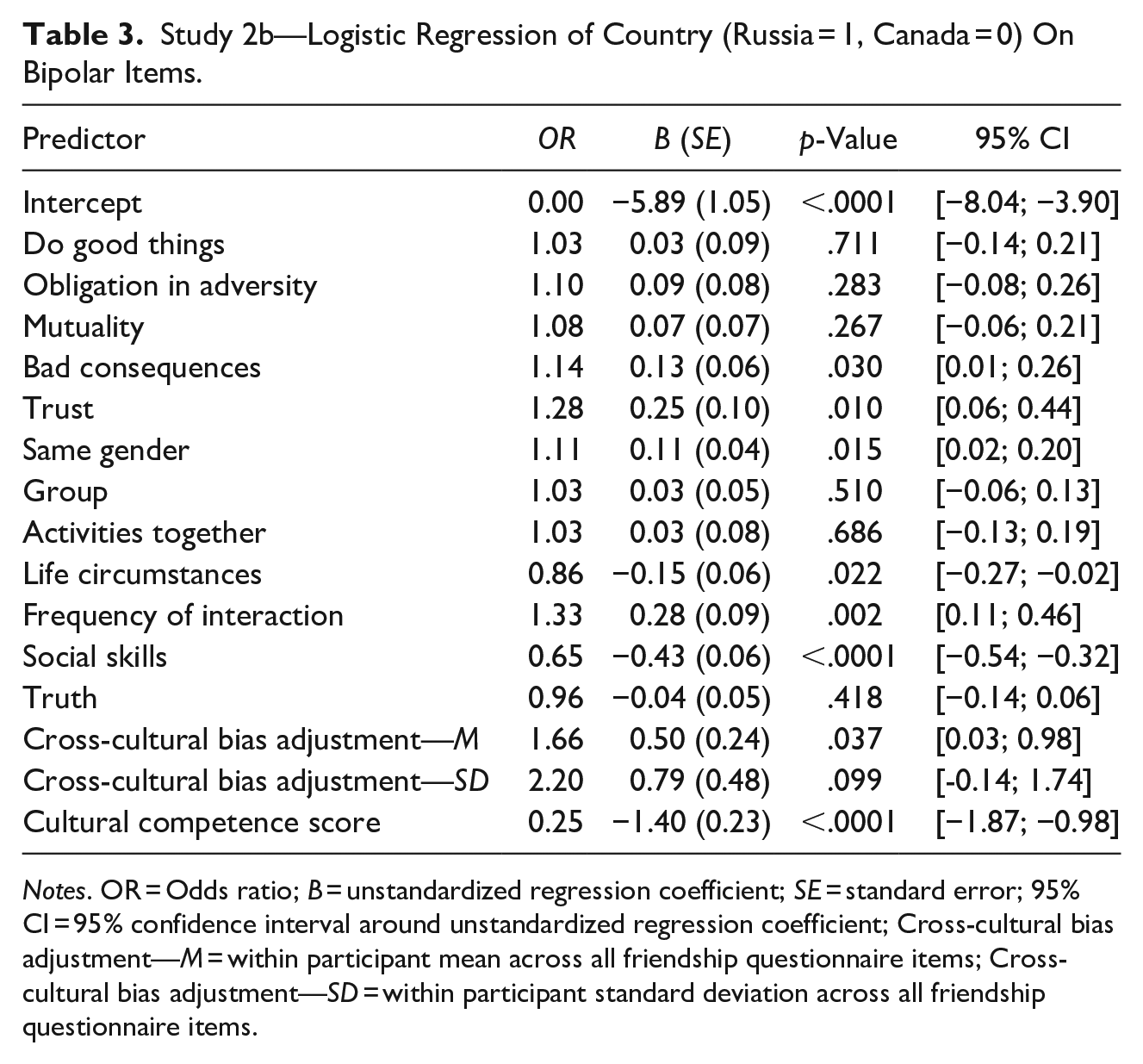
Notes. OR = Odds ratio; B = unstandardized regression coefficient; SE = standard error; 95% CI = 95% confidence interval around unstandardized regression coefficient; Cross-cultural bias adjustment—M = within participant mean across all friendship questionnaire items; Cross-cultural bias adjustment—SD = within participant standard deviation across all friendship questionnaire items.
Discussion
The present studies showcased a three-pronged approach to quantitatively document cross-cultural differences in models of friendship in Canadian versus Russian cultural contexts. Our hypotheses were largely supported. Participants’ mental map of the interpersonal space around friend was different from that around droog (H1), the factorial structure of friendship characteristics differed across cultural settings (H2), and we could predict group membership from participants’ ratings of friendship characteristics (H3). We also found evidence of cultural consensus in people’s responses across studies and across cultural contexts. Further, the three aspects of our methodological approach relied on very different analytic strategies, yet yielded convergent results.
Our results documented some similarities between the two cultural contexts. Both friend and droog were located close to relationship terms with connotations of fun and good times (Study 1), and items referring to stimulating companionship clearly loaded on a single factor in both countries (Study 2a). This is consistent with existing research on the classical Aristotelian model of friendship, where enjoyment is an important feature of friendship (Bukowski et al., 1987; Hall, 2012). However, across studies, the notions of trust and help in adversity emerged as defining features of friendship in the Russian context, whereas they were less clearly present in the Canadian context. Relationship terms with connotations of “brother-in-arms” were located very close to droog (Study 1), and higher ratings of trust and not fearing negative consequences from a friend’s actions were related to a greater likelihood of being Russian (Study 2b). Trust is also seen as a friendship characteristic in the Western literature (Hall, 2012; Hartup & Stevens, 1997; Wright, 2006), but in addition to being particularly salient for Russian participants, trust may also be represented differently in the Russian context. Indeed, trust and esteem for one’s friend formed a single factor among Russians, whereas trust items were associated with instrumental help (or tended to not load very highly on their respective factor) among Canadians (Study 2a). This is consistent with Russia’s 20th century historical events. In a totalitarian regime where self-disclosure could have life threatening consequences, trust, and help in adversity may well have emerged as paramount features of friendship.
The results also indicated that friendship is seen as a closer and more intimate relationship in the Russian group than in the Canadian group. Droog and luchshiy-droog were located very close together, whereas friend and best-friend were in different clusters (Study 1), and seeing friendship as entailing very frequent interactions was related to a greater likelihood of being Russian (Study 2b). As mentioned earlier, Western research on friendship regularly distinguishes between “casual” and “close” friendships. In Western/North-American cultural worlds, a generic friendship may be mentally represented as a not a very deep relationship, and qualifiers such as “close” are necessary to account for a broader range of social ties. It was also noteworthy that endorsing more strongly the idea that having friends is a reflection of one’s social skills (Study 2b) was related to a greater likelihood of being Canadian. This is consistent with the Western interpersonal literature, whereby friendships index one’s interpersonal abilities (Jerrome, 1984) and personal characteristics (Walther et al., 2008). This notion is also encoded in the English language, where “‘making friends’ appears to be seen as an art and a skill” (Wierzbicka, 1997, p. 45).
Overall, our results echo Wierzbicka’s (1997) linguistic analyses and the qualitative findings that friendship is a very involved and demanding relationship in the Russian cultural context (Doucerain et al., 2018). Collectively, these results also support the notion that different intersubjective representations of friendship, or friendship models, are prevalent in these two cultural worlds. Although these results encourage confidence in our methodological approach, several limitations should be noted. First, we used gender-neutral names to elicit representations of as generic a friendship as possible, but this decision may have introduced noise into the results. Gender differences in friendship patterns are well documented (Aukett et al., 1988), and whether participants had a male or female generic friendship in mind when completing the study might have influenced their answers. Second, both Russian and Canadian samples were fairly young (in their thirties on average), and it is possible that older participants would have characterized friendship differently. This is particularly problematic for the Russian sample, given the profound social changes that Russia experienced over the last decades. In a related vein, North American products are increasingly prevalent in Russia, like in many other parts of the world. These globalization forces (Cowen, 2009) may influence people’s friendship representations—particularly among younger people, just like they contribute to reshaping a number of psychological constructs and processes (Kirmayer, 2006; Watters, 2011). Finally, so far, we have tacitly assumed a complete overlap between nation-state and cultural group, which is problematic. Cultural/cross-cultural psychologists routinely rely on such correspondences, but they are over-simplifications that can unfortunately reify and essentialize cultural differences (Morris et al., 2015). Our goal here was to propose and document an approach to characterize cultural models of friendship—and our results suggest that our approach was adequate—but future research should take these limitations into consideration.
We showcased our three-pronged methodological approach by contrasting Russian versus Canadian friendship models, but future research could employ a similar approach in other cultural contexts. For example, some preliminary qualitative work suggests that Japanese friendship models may also differ from North American ones (Cargile, 1998). It would be interesting to examine where friend’s translation equivalent tomodachi (友達) stands in relation to other relationship terms such as mikata, nakama, shinyuu, or tsukiai, and how the factor structure of a generic tomodachi’s characteristics compares to the factor structures derived here.
However, rather than being an end in itself, documenting cross-cultural differences in friendship models should serve as a base for subsequent “unpackaging” studies: namely, studies clarifying what mechanisms account for the observed cultural differences (Dere et al., 2012; Matsumoto et al., 2008). In other words, what sociocultural characteristics, historical circumstances, prevalent practices or core concerns of Russian versus Canadian worlds can explain the differences in friendship models we observed here? For example, the high premium placed on trust in the Russian model may stem from decades of Soviet rule where self-disclosure entailed significant risk to one’s safety, and future research should test such a hypothesis.
More broadly, focusing on the mechanisms underlying cross-cultural differences in friendship patterns may stimulate work on how culture shapes ways of relating to each other. Cultural/Cross-cultural psychologists have usually focused on individual-level constructs, such as values (Schwartz, 2012), self-construal (Markus & Kitayama, 1991), or emotional experience (Matsumoto et al., 2008), but much less on relational constructs (Morris et al., 2000). The present work took a step toward addressing this paucity of research by proposing a methodological road map for studying cross-cultural differences in friendship models and by documenting these differences across Canadian and Russian cultural contexts. Many quantitative investigations of cross-cultural differences build on initial qualitative, anthropological, or linguistic evidence. We hope to have demonstrated here one approach to negotiating this transition step in a systematic way.
Supplemental Material
sj-pdf-1-ccr-10.1177_10693971211024599 – Supplemental material for What Are Friends for in Russia Versus Canada?: An Approach for Documenting Cross-Cultural Differences
Supplemental material, sj-pdf-1-ccr-10.1177_10693971211024599 for What Are Friends for in Russia Versus Canada?: An Approach for Documenting Cross-Cultural Differences by Marina M. Doucerain, Andrew G. Ryder and Catherine E. Amiot in Cross-Cultural Research
Footnotes
Declaration of Conflicting Interests
The author(s) declared no potential conflicts of interest with respect to the research, authorship, and/or publication of this article.
Funding
The author(s) disclosed receipt of the following financial support for the research, authorship, and/or publication of this article: This research was supported in part by a postdoctoral fellowship and a grant from the Fonds de Recherche du Québec – Société et Culture (#193335 and #211460) to the first author.
Supplemental Material
Supplemental material for this article is available online.
Author Biographies
References
Supplementary Material
Please find the following supplemental material available below.
For Open Access articles published under a Creative Commons License, all supplemental material carries the same license as the article it is associated with.
For non-Open Access articles published, all supplemental material carries a non-exclusive license, and permission requests for re-use of supplemental material or any part of supplemental material shall be sent directly to the copyright owner as specified in the copyright notice associated with the article.
