




Abstract
Recently Kaasa (2021) has developed a Cultural Models Synthesis Scheme (CMSS) merging together the cultural models of Hofstede, Schwartz and Inglehart. However, this theoretical framework still needs to be complemented by an empirical analysis. This exploratory study focuses on the Schwartz’s model using the ten-item battery in the World Values Survey (WVS) inspired by his questionnaire. We empirically position Schwartz’s items into the theoretical CMSS by the means of the empirical framework of Kaasa and Minkov (2022) that already includes Inglehart’s dimensions and Minkov’s (2018) revision of Hofstede’s model. The results support the placements of Schwartz’s dimensions in the CMSS. However, the results also show serious inconsistencies and contradictions regarding the keywords associated to some Schwartz’s dimensions. We highlight the need to be careful about which keywords and question wordings capture the core of those dimensions and to consider the accuracy of the names of dimension. We show that some keywords previously associated with a particular pole of the mastery versus harmony and hierarchy versus egalitarianism, might, in fact, tap aspects of the opposite pole. We also propose using the term ‘conformity’ instead of ‘harmony’. We conclude from these insights that cross-mapping different cultural models is an exercise with significant intellectual payoff.
In the last half century, culture – a societal-level pattern of values, attitudes, norms and beliefs – has gained increasing attention in the social sciences. The ever-increasing amount of different models of culture has led to a situation, where the call for some systemisation has become increasingly prominent. Earlier attempts at systematising cultural dimensions notwithstanding (Maleki & de Jong, 2014; Nardon & Steers, 2009), Kaasa (2021) presents to date the most comprehensive Cultural Models Synthesis Scheme (CMSS). Her CMSS integrates in conceptual terms the three most widely used models to pinpoint cross-cultural variation in human values: namely, those by Hofstede (1980), Schwartz (1994, 2004), and Inglehart (1997). However, this CMSS needs to be complemented by a systematic empirical analysis. Importantly, against this backdrop, a recent study by Kaasa and Minkov (2022) demonstrates empirically that Inglehart’s two dimensions (Inglehart & Welzel, 2021), the two dimensions of the revised Hofstede’s model by Minkov et al. (2017, 2018a, 2018b), as well as the first two dimensions extracted by Beugelsdijk and Welzel’s (2018) synthesis of Inglehart’s and Hofstede’s models, are rotations of each other. This is in accordance with the results of Fog (2021), who factor-analysed the cultural dimensions of all major studies and showed that his meta-level factors, resembling Minkov’s two dimensions, can be aligned with Inglehart’s dimensions with the help of rotation. Thus, we already have some understanding about how Hofstede’s and Inglehart’s models (two of three in the CMSS) are empirically related. However, we do not have much empirical evidence about the placement of Schwartz’s cultural model with respect to other cultural models. This forms the motivation of this article.
In this exploratory study, we turn to those items inspired by Schwartz’s questionnaire that were fielded in the World Values Survey (WVS). We follow the spirit of Schwartz’s study (2006), where he analysed the 21 Schwartz items fielded in the European Social Survey (ESS). In the WVS, even less items (altogether 11 items in two waves) were fielded. Moreover, the choice of Schwartz items both into the ESS and the WVS apparently has been made keeping his individual-level model in mind and thus does not cover the dimensions of his cultural level model to the same extent. We believe that although the 10 Schwartz items do not provide full coverage of Schwartz’s cultural-level circumplex, they do outline its structure in a concise form and analysing those scarce items will give us valuable information. In the similar spirit, although from different field, it has been shown (Gosling et al., 2003) that very brief, 5 and 10-item measures of the Big-Five dimensions, although somewhat inferior to standard multi-item instruments, reached adequate levels of convergence with widely used Big-Five measures. Previously, Dobewall and Rudnev (2014) have analysed the 10 Schwartz items from the fifth wave of the WVS in comparison to the 10 variables that have been used for calculating the scores for Inglehart’s two dimensions (Inglehart & Baker, 2000; Inglehart & Welzel, 2021). We will go a step forward in two aspects: first, we will use data from both WVS waves in which the Schwartz items were fielded; and second, we will use a balanced set of 25 items unambiguously measuring culture used by Kaasa and Minkov (2022) as our background framework. This will enable us to relate those Schwartz items to the Inglehart’s and revised Hofstede’s models.
Our main research question is: how would the WVS items inspired by Schwartz’s questionnaire be positioned in Kaasa and Minkov’s (2022) empirical framework and the theoretical framework offered by Kaasa’s (2021) CMSS? Answering this question is an important step towards an empirical solidification of our understanding, how different cultural models relate to each other. This is important, for example, when studying the impact of culture on some other phenomena and wanting to compare the results of previous studies that have used different cultural models for describing culture.
Our comparison of the positions of Schwartz’s items in the WVS with the positions of the dimensions of the Inglehart’s and revised Hofstede’s models reveals some important details concerning Schwartz’s model. We have no reason to doubt the general idea behind Schwartz’s model: what are the main dimensions and what is the core of each dimension, e.g. the basic problems societies face and have to respond to. However, the positions of the Schwartz items fielded in the WVS with respect to established dimensions of culture from alternative models can contribute to a better understanding of Schwartz’s model. We will show that it might be useful to rethink some dimensions of Schwartz’s model: what are the keywords and questions that help us to capture the core of those dimensions and whether the names of the poles of those dimensions describe the idea behind these dimensions in the best possible way.
Correlations Between Schwartz’s and Hofstedes Scores and Cultural Dimensions Analysed in Kaasa and Minkov (2022).
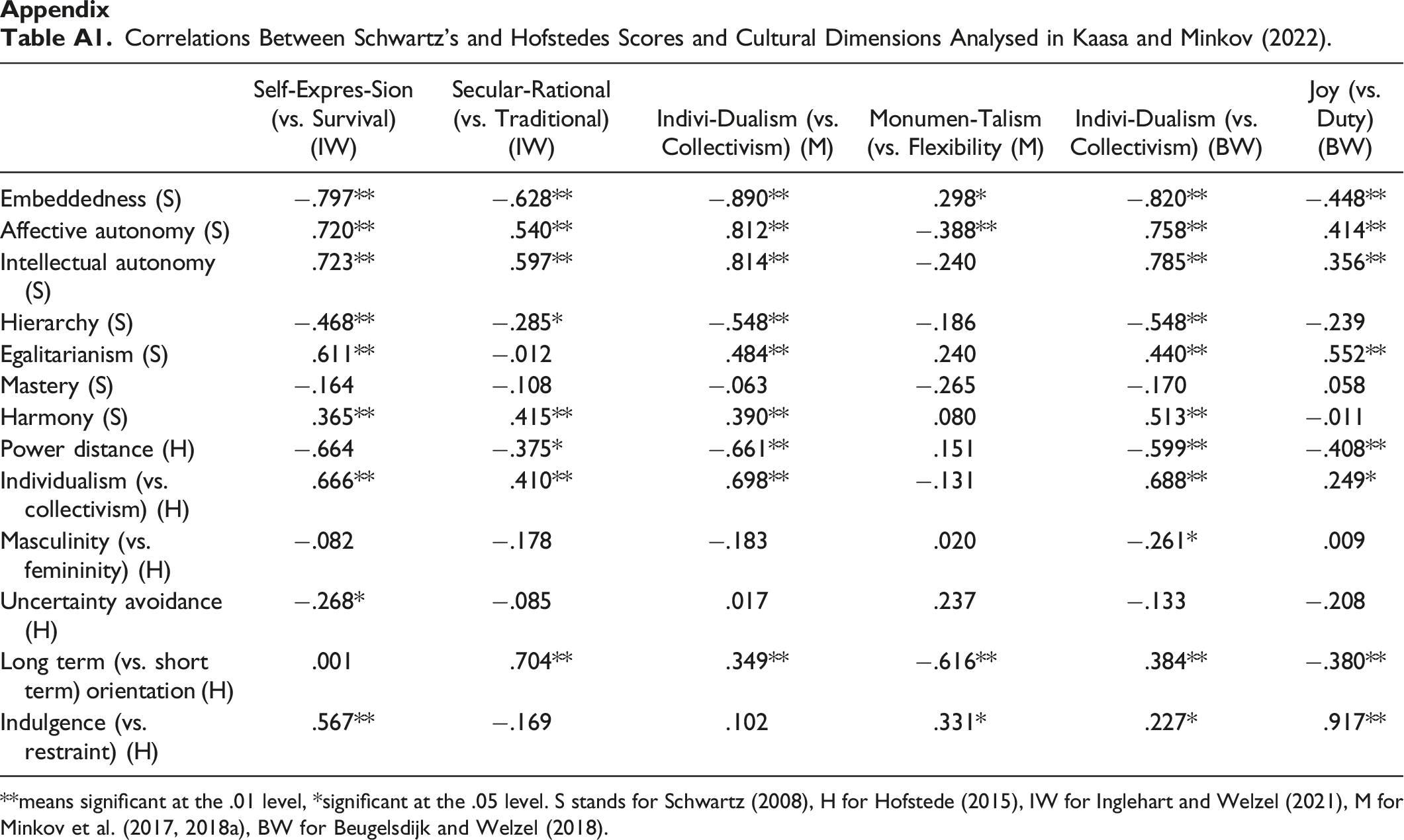
**means significant at the .01 level, *significant at the .05 level. S stands for Schwartz (2008), H for Hofstede (2015), IW for Inglehart and Welzel (2021), M for Minkov et al. (2017, 2018a), BW for Beugelsdijk and Welzel (2018).
Goal and Concept of This Study
The main goal of our study is to investigate how the Schwartz items in the WVS would be positioned in the system, which merges Hofstede’s, Schwartz’s, and Inglehart’s model (Kaasa, 2021). We will start by mapping what we can conclude from previous studies about how the Schwartz’s model relates to the other well-known cultural models.
For our empirical analysis, we use data from the WVS. There are two large cross-cultural surveys – WVS and the ESS (European Social Survey) – fielding items inspired by the Schwartz’s questionnaire of the Schwartz Value Survey (SVS, Schwartz, 1992). There are 21 questions included in all rounds of the ESS and 10 or 11 questions (not all asked in all countries) were included into the fifth and sixth wave of the WVS. As we wanted to cover countries from as many regions of the world as possible, we could not use the ESS. As our main method, we decided to use multidimensional scaling (MDS) – the same method that was used both by Schwartz (2004, 2006) in the development of his cultural level theory and his famous – using his terms – circumplex. The same method was used by Dobewall and Rudnev (2014) to compare the 10 Schwartz items in the WVS items with the 10 items used to calculate Inglehart’s dimensions (Inglehart & Baker, 2000; Inglehart & Welzel, 2021). As an alternative, to further validate our results, we also applied factor analysis. Both methods enable us to find out the relative positions of the Schwartz items with respect to each other and with respect to other items in the WVS.
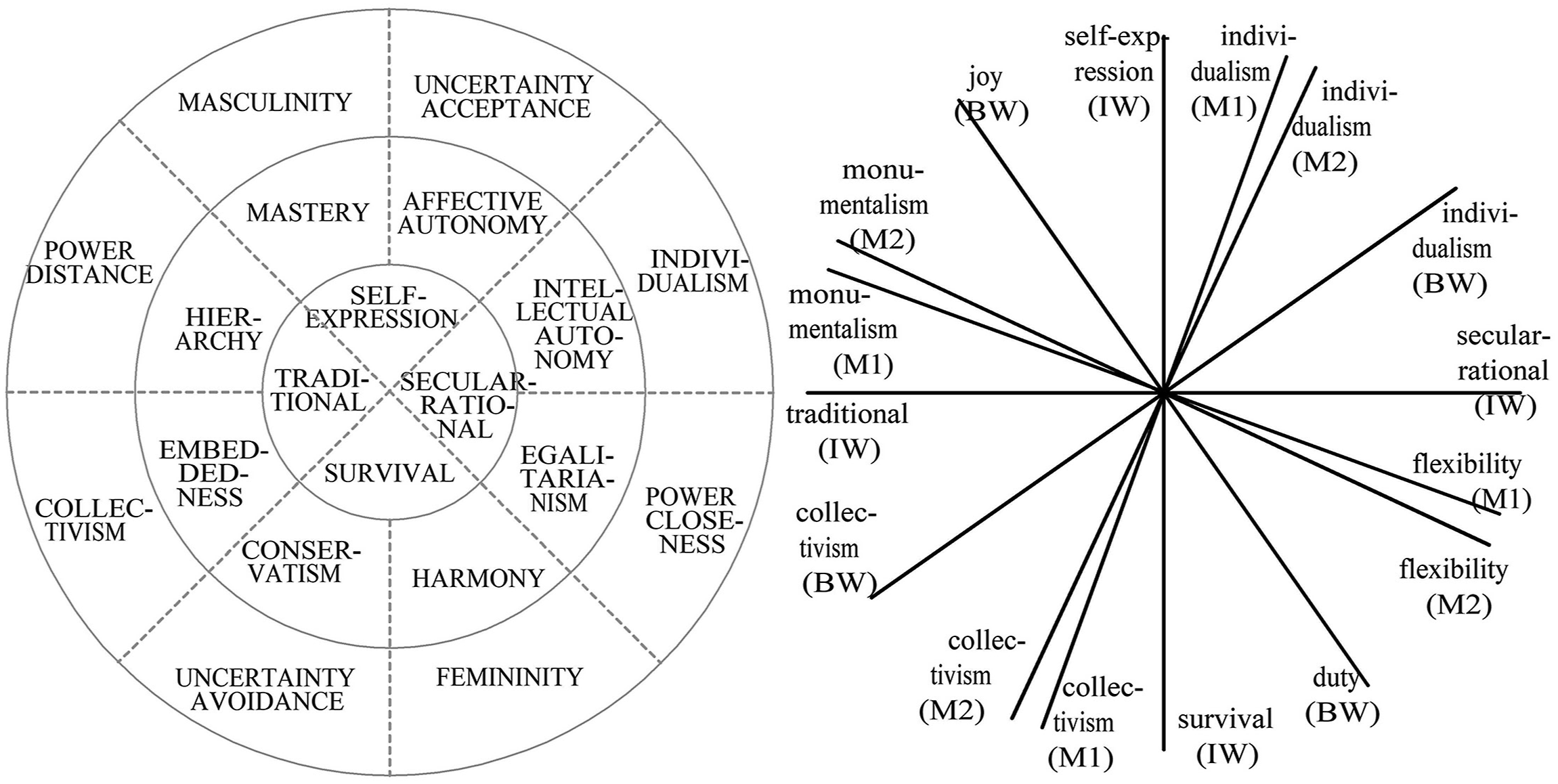
Regarding those other items, we start with 25 items available in the WVS that unambiguously measure culture as it is currently understood in the mainstream cross-cultural literature. The same 25 WVS items are also used by Kaasa and Minkov (2022) as a background framework. This choice has two advantages. First, those 25 culture-related items form a balanced set avoiding overrepresentation of some cultural aspects at the expense of others. Second, Kaasa and Minkov (2022) provide placements of dimensions from various models, including Inglehart’s and revised Hofstede’s model on the background of those 25 items (see Figure A1 in the Appendix). Using the same items will also allow us to rely on those placements and relate the Schwartz items in the WVS to the Inglehart’s and revised Hofstede’s model. As Kaasa and Minkov (2022) have also aligned their empirical model with the theoretical CMSS (Kaasa, 2021) as shown on Figure 1, we will be able to relate all WVS items that we will now analyse on the background of the mentioned 25 items to the theoretical CMSS merging Hofstede’s, Schwartz’s, and Inglehart’s models. This enables us to compare the theoretical placement of various cultural elements (the term used by Kaasa (2021) for values, norms, beliefs, attitudes, and more) with the placement of their empirical equivalents. After mapping the Schwartz items on the background of those 25 items, in order to provide a wider basis for our conclusions and to explore possible explanations for our observations, we include additional items that are available in either the fifth or the sixth WVS wave. Placement of various sets of cultural dimensions on the background of 25 culture-related items (IW stands for Inglehart and Welzel (2021), M1 for a set from Minkov et al. (2017; 2018a), M2 for Minkov et al. (2018b), BW for Beugelsdijk and Welzel (2018)). Source: Kaasa and Minkov (2022). Comparison of the theoretical CMSS proposed by Kaasa (2021) (rotated by 180°) and the placement of various empirical sets of cultural dimensions by Kaasa and Minkov (2022) with Inglehart’s dimensions aligned with vertical and horizontal axes (IW stands for Inglehart and Welzel (2021), M1 for a set from Minkov et al. (2017; 2018a), M2 for Minkov et al. (2018b), BW for Beugelsdijk and Welzel (2018)). Source: Kaasa and Minkov (2022).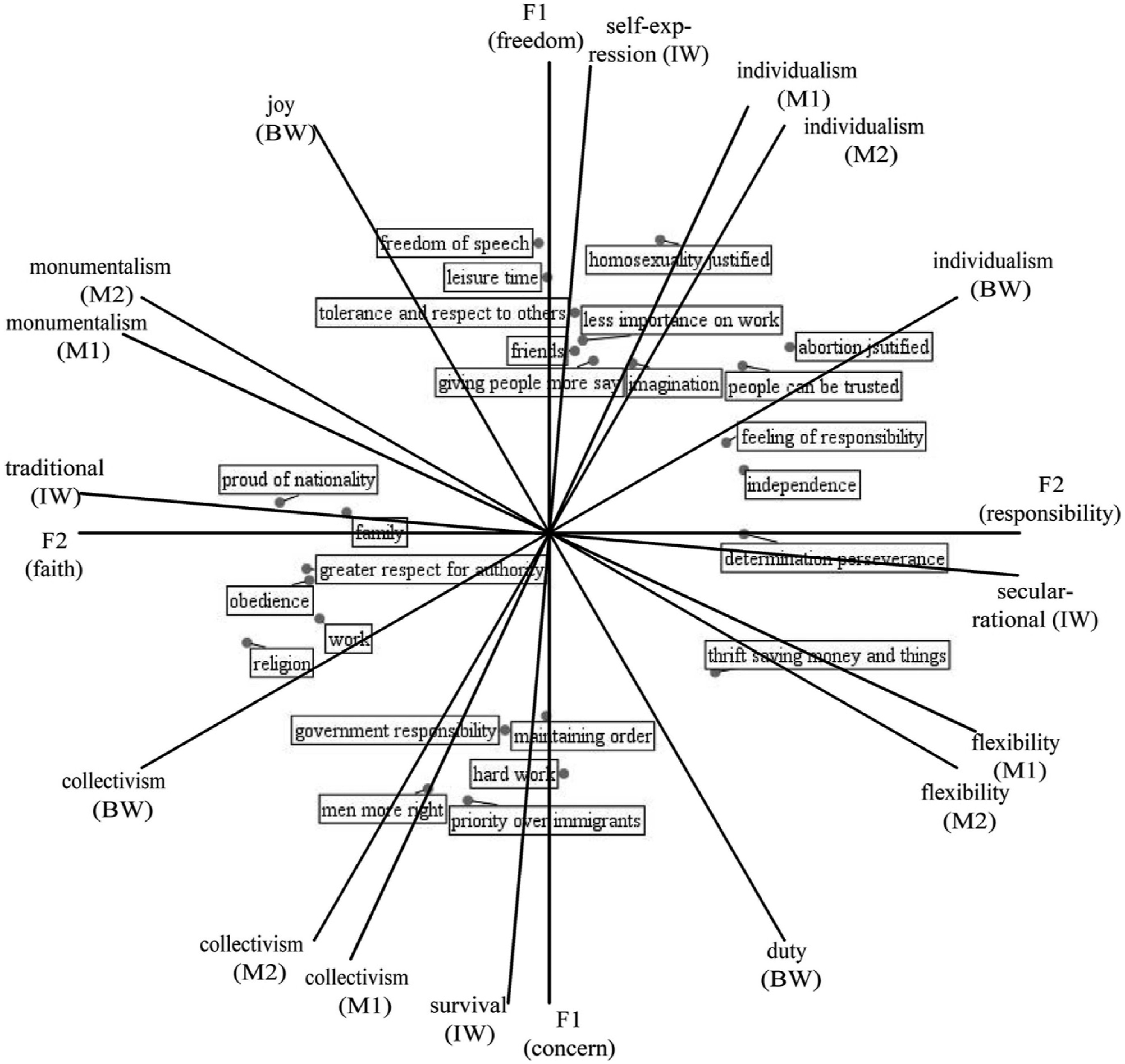
Schwartz’s Model Compared to Other Cultural Models
Schwartz’s cultural level model includes seven value types that have been often generalised into three dimensions. However, according to Kaasa (2021), after splitting the area on the opposite of autonomy (which is already consisting of two value types: intellectual and affective autonomy) into an embeddedness part related to relationships and a conservatism part related to formal aspects, Schwartz’s model can be represented by four dimensions, each conceptually similar with one of Hofstede’s (1980) original dimensions (see Figure 1, left). Intellectual autonomy versus embeddedness is similar to Hofstede’s individualism versus collectivism, affective autonomy versus conservatism has common elements with Hofstede’s conceptualisation of uncertainty acceptance versus avoidance; whereas the concepts of hierarchy versus egalitarianism and mastery versus harmony are similar to Hofstede’s conceptualisation of power distance versus closeness and some parts of Hofstede’s conceptualisation of masculinity versus femininity, respectively (Kaasa, 2021; Maleki & de Jong, 2014; Nardon & Steers, 2009).
When developing his cultural level model, Schwartz (1994) hypothesised two broader dimensions: autonomy versus conservatism/embeddedness and hierarchy plus mastery versus egalitarianism plus harmony. The same approach has been used later (Dobewall & Strack, 2014) as well. These broader dimensions are placed at a 45-degree angle with respect to Inglehart’s dimensions in the theoretical CMSS framework (see Figure 1, left). The autonomy pole is placed between the self-expression and secular-rational poles of Inglehart’s model, whereas the conservatism/embeddedness pole is situated between the respective opposites. Hierarchy plus mastery is placed between the self-expression and traditional poles of Inglehart’s dimensions and egalitarianism plus harmony is again between the opposites.
While Hofstede’s (1980), Schwartz’s (1994) and Inglehart’s (1997) models have been known for decades and have gained huge popularity, Minkov (Minkov, 2018; Minkov et al., 2017, 2018a, 2018b) has recently published a revision of Hofstede’s model, containing only two dimensions: individualism versus collectivism and flexibility versus monumentalism. The latter dimension is a successor of the long versus short term orientation dimension in Hofstede’s extended model (Hofstede, 2001). Similar aspects are captured by the first two dimensions that emerged from the analysis of Beugelsdijk and Welzel (2018): individualism versus collectivism and duty versus joy, whereas their third factor was based on items that did not reflect culture in the same sense as the dimensions of Hofstede, Inglehart, or Schwartz (Kaasa & Minkov, 2022).
In Kaasa and Minkov’s (2022) empirical analysis (see Figure 1, right), the dimensions named individualism-collectivism by Minkov as well as Beugelsdijk and Welzel were placed between the Inglehart’s two dimensions, individualism between the self-expression and secular-rational poles and collectivism between the survival and traditional poles, confirming the placements in the CMSS (Figure 1, left). This also provides indirect support for the similar placement of the Schwartz’s opposition of autonomy versus embeddedness/conservatism in the CMSS, as that dimension has been shown to be empirically close to individualism-collectivism (Fog, 2021; Maleki & de Jong, 2014). However, Schwartz’s dimensions have a more ambiguous relationship with the second dimension in Minkov’s model (monumentalism vs. flexibility), and in Beugelsdijk and Welzel’s model (joy vs. duty), which were placed close to the other diagonal in Kaasa and Minkov’s (2022) visualisation. Both monumentalism-flexibility and joy-duty tap the opposition between self-enhancement and self-transcendence, which Schwartz (1994) theorised to be covered by the broad dimension of hierarchy plus mastery versus egalitarianism plus harmony. However, Schwartz’s (2008) scores pertaining to these dimensions appear not to be significantly correlated with monumentalism-flexibility and joy-duty (see Table A1 in the Appendix), except for egalitarianism that is positively related to joy (vs. duty), contradicting the expectations based on the placements shown on Figure 1.
Data and Methods
Items Based on Schwartz’s Questionnaire in the WVS.
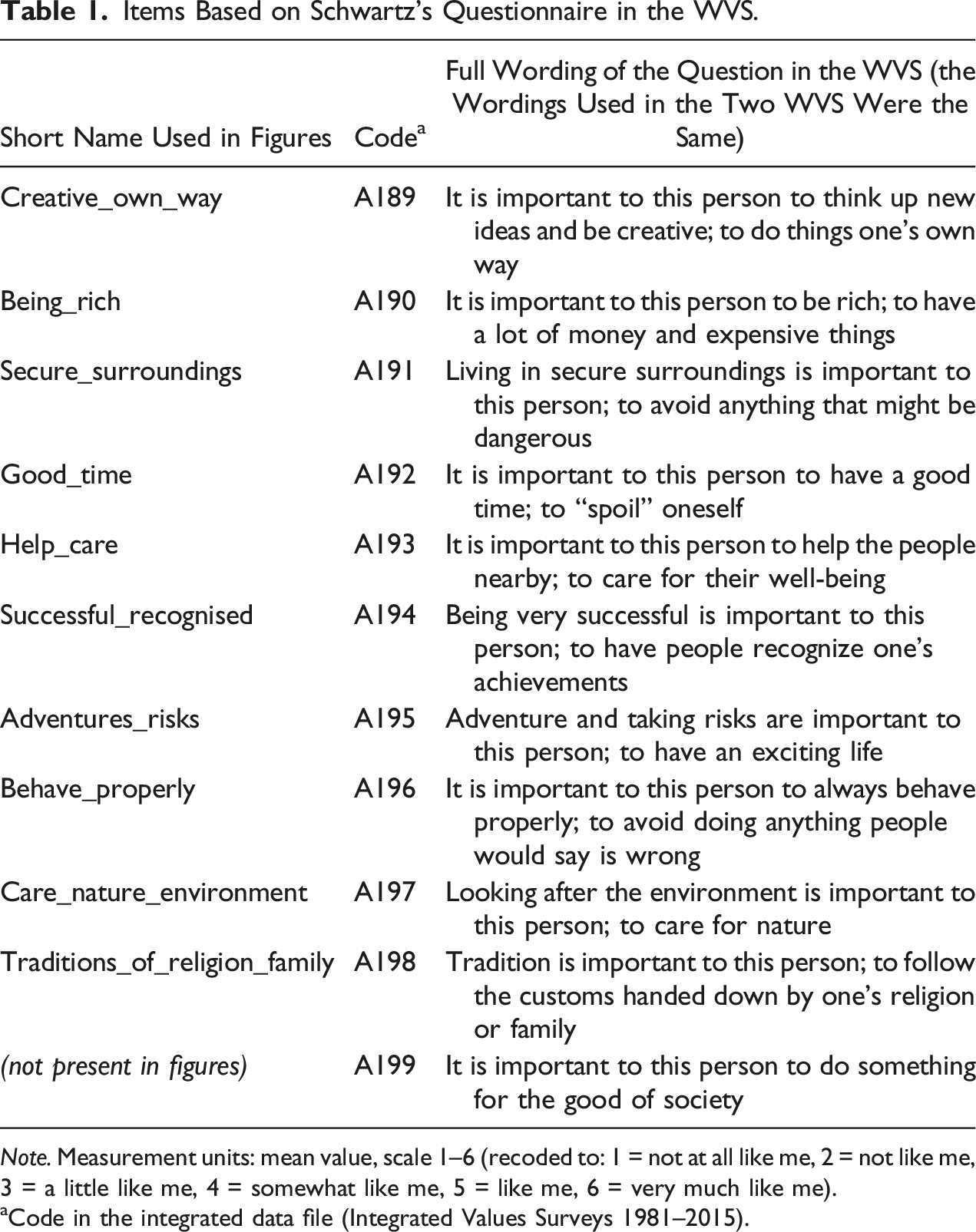
Note. Measurement units: mean value, scale 1–6 (recoded to: 1 = not at all like me, 2 = not like me, 3 = a little like me, 4 = somewhat like me, 5 = like me, 6 = very much like me).
aCode in the integrated data file (Integrated Values Surveys 1981–2015).
Similarly to Schwartz (1994; 2004; 2006; 2008) and Dobewall and Strack (2014), ipsatised scores were used: each individual respondent’s ratings of items were centered on his or her mean rating of all of the items. This allows to account for relative importance for a particular respondent of the values covered by those questions.
Here and hereafter, the individual-level variables from the WVS were aggregated by calculating the country means for each wave, using the weights provided by the WVS to ensure that data would be representative according to the demographic structure of countries. The number of respondents per country was 1470.7 on average and ranged from 841 to 4078. If a country was present in both waves, we then calculated the average score for each item across the fifth and sixth waves. This enables us to reduce the effect of score fluctuation due to random measurement error. For countries that were studied only in either the fifth or sixth wave, we used scores from a single wave.
Description of 25 Background Items Used in this Study.
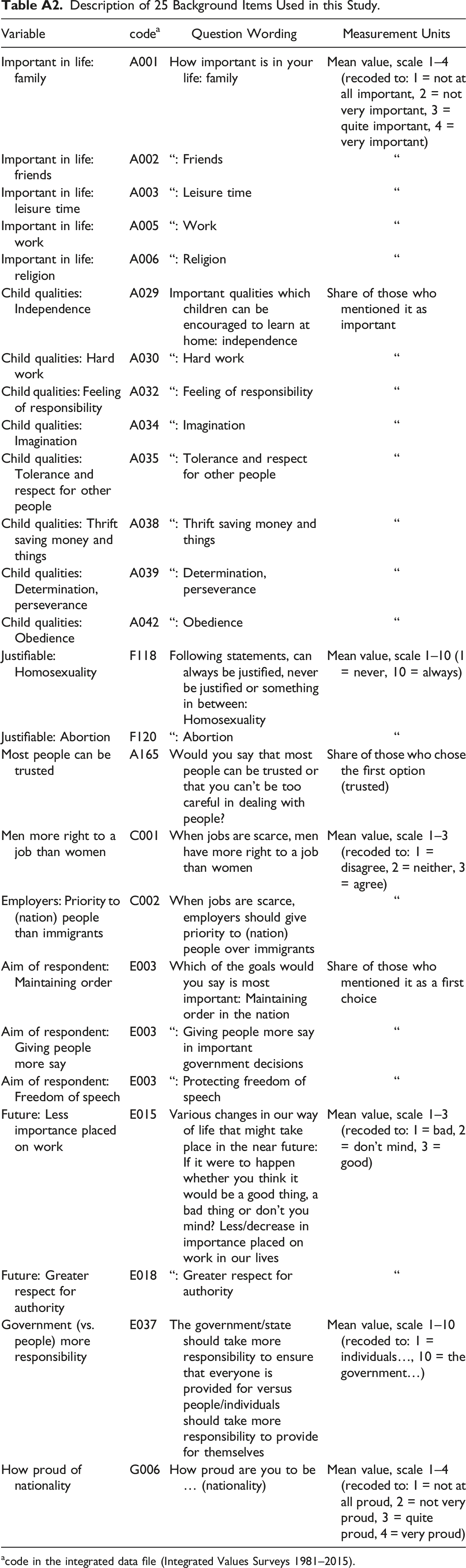
acode in the integrated data file (Integrated Values Surveys 1981–2015).
Additional Items Used in this Study.
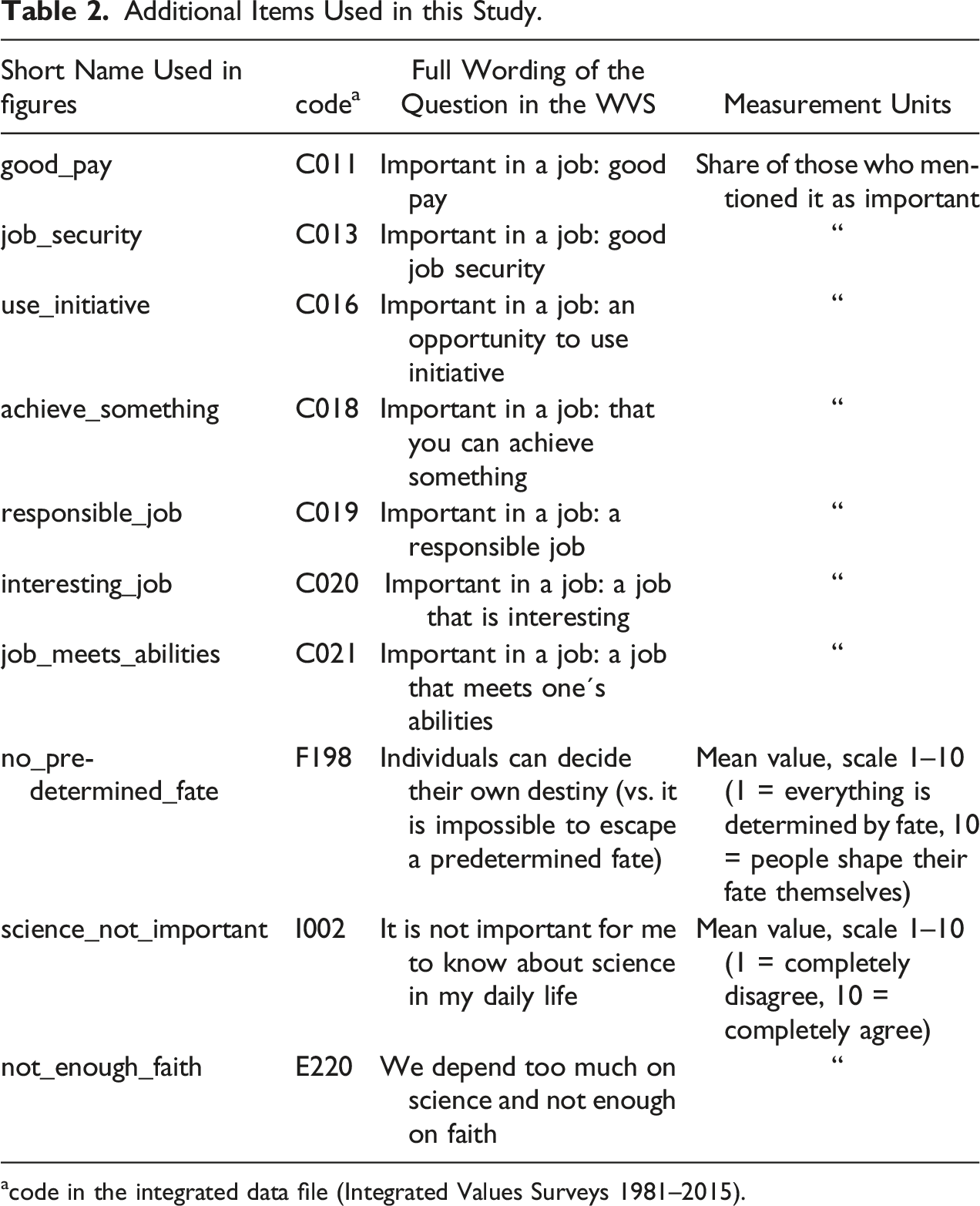
acode in the integrated data file (Integrated Values Surveys 1981–2015).
To map the association/dissociation pattern between all of these variables, we employed multidimensional scaling analysis as our main method, because this is the same method as Schwartz (2004, 2006, 2008) used when creating his cultural model as a circumplex. The idea of circumplex (going back to Guttman, 1954) is a circular ordering of various elements (items) so that those close to each other conceptually are also close to each other on figure. The most widely used methods for testing circumplex models are multidimensional scaling (MDS) and factor analysis (principal component method) (Hinz et al., 2005). Schwartz (1994) used the MDS and concluded that “culture level values are organized into the same two basic dimensions that organize individual-level values”, but for interpretational reasons divided his circumplex into more than two dimensions. Hofstede (1980) and Inglehart (1997) used factor analysis. However, as Inglehart (1997, p. 82) has demonstrated, in case of only two factors, it is possible to create figures similar to circumplex so that axes represent two factors and the item’s placement is determined by the loadings of the items onto the two dimensions. Hence, we also used factor analysis in order to further validate our results.
We used IBM SPSS Statistics 27.0 for our analyses. For MDS, we applied ALSCAL procedure with Euclidean distances on our country level data. We standardised all variables before the analysis to take them into account on equal basis as suggested (IBM, 2021) in order to avoid differences in scaling affecting our solution.
Stress values and dispersion accounted for (DAF) for MDS analyses of different setups depending on the number of dimensions asked.
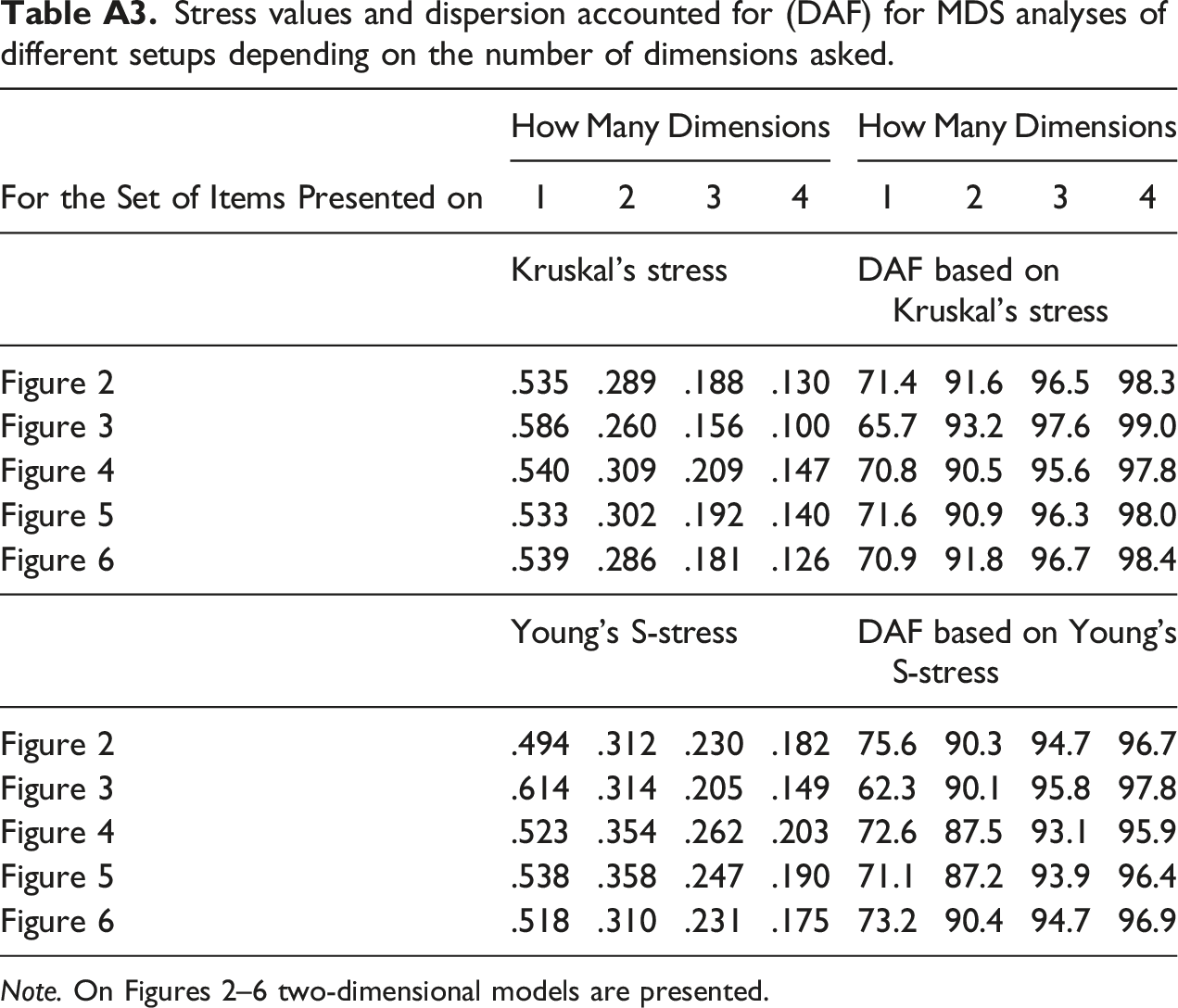
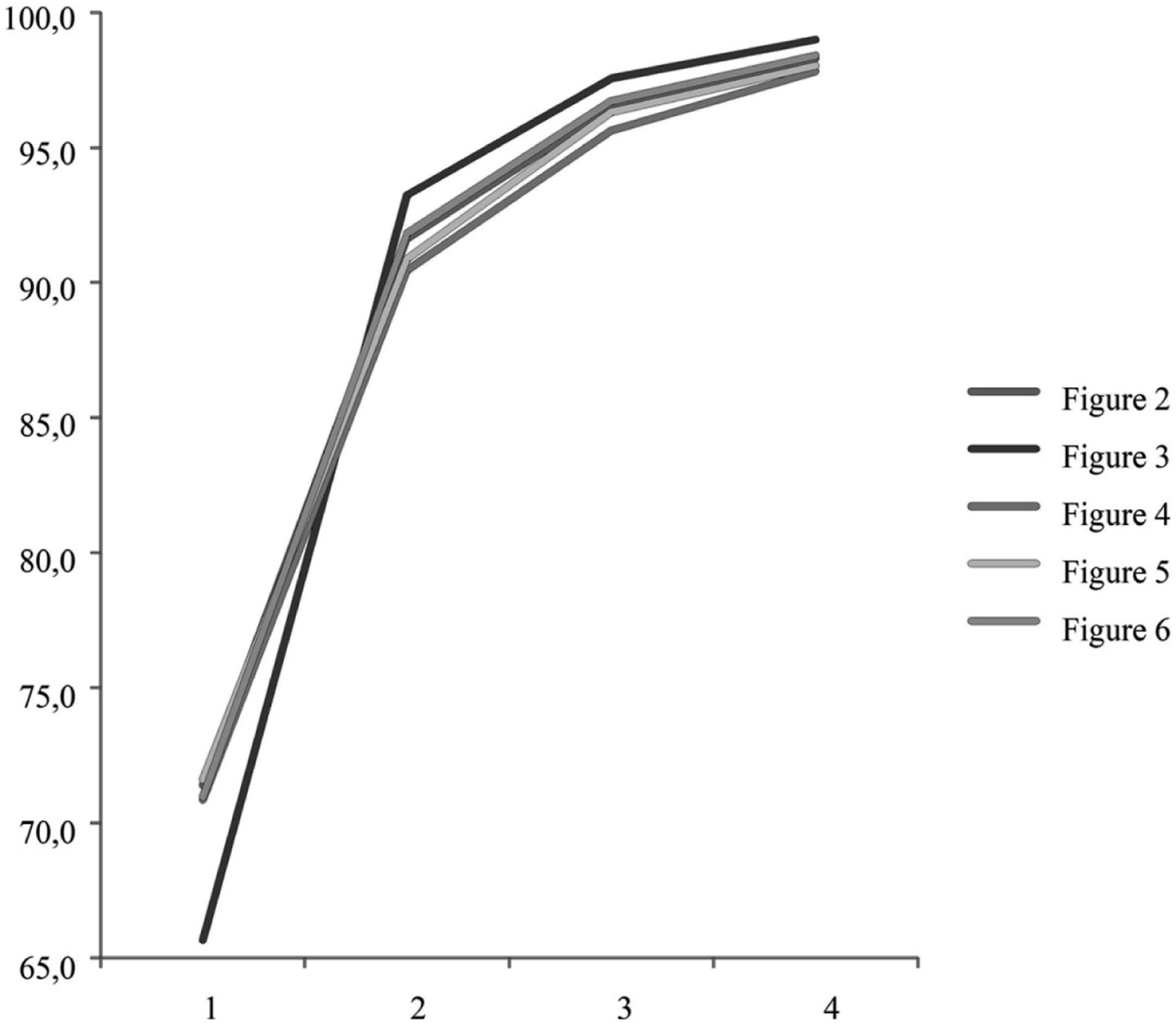
For better comparability, the results of the MDS are rotated to align them with the background framework presented on Figure 1 (except for the initial analysis of Schwartz’s items without any other items). This is done based on the relative placements of 25 background items with respect to cultural dimensions on Figure A1 in the Appendix. As an alternative method, to further validate our results, we also applied factor analysis (principal component method, varimax rotation). We present the results of our factor analyses in the same way as for example Inglehart (1997, p. 82) and Fog (2022, p. 37): as figures mapping the analysed items in the set of axes presenting two factors and factor loadings determining the placement of items. Again, for better comparability, the results are rotated to align them with the background framework presented on Figure 1.
Results
Initial Analysis of 25 Culture-Related Background Items
We start with the 25 culture related background items. In a first step, we analyse only those 25 items and we present the relative positions of those items on Figure 2. The relative positions according to our MDS analysis of 25 culture-related background items using data from the fifth and sixth wave of the WVS (presented on Figure 2) are very similar to the results obtained by Kaasa and Minkov (2022) when factor-analysing data from the waves 2–7 of the WVS (shown on Figure A1 in the Appendix). Thus, we can rely on Figure A1 in relating the positions of analysed items relative to various cultural dimensions. So, here and hereafter, for background information we also draw the axes pertaining to the Inglehart’s dimensions on figures in order to relate our results to the placements of various dimensions on Figure 1. We also mark the domains of Hofstede’s and Schwartz’s dimensions based on how the CMSS places them with respect to Inglehart’s dimensions. Relative positions of 25 culture-related background items (MDS results based on 67 countries) on the background of the CMSS merging Inglehart’s, Hofstede’s and Schwartz’s model.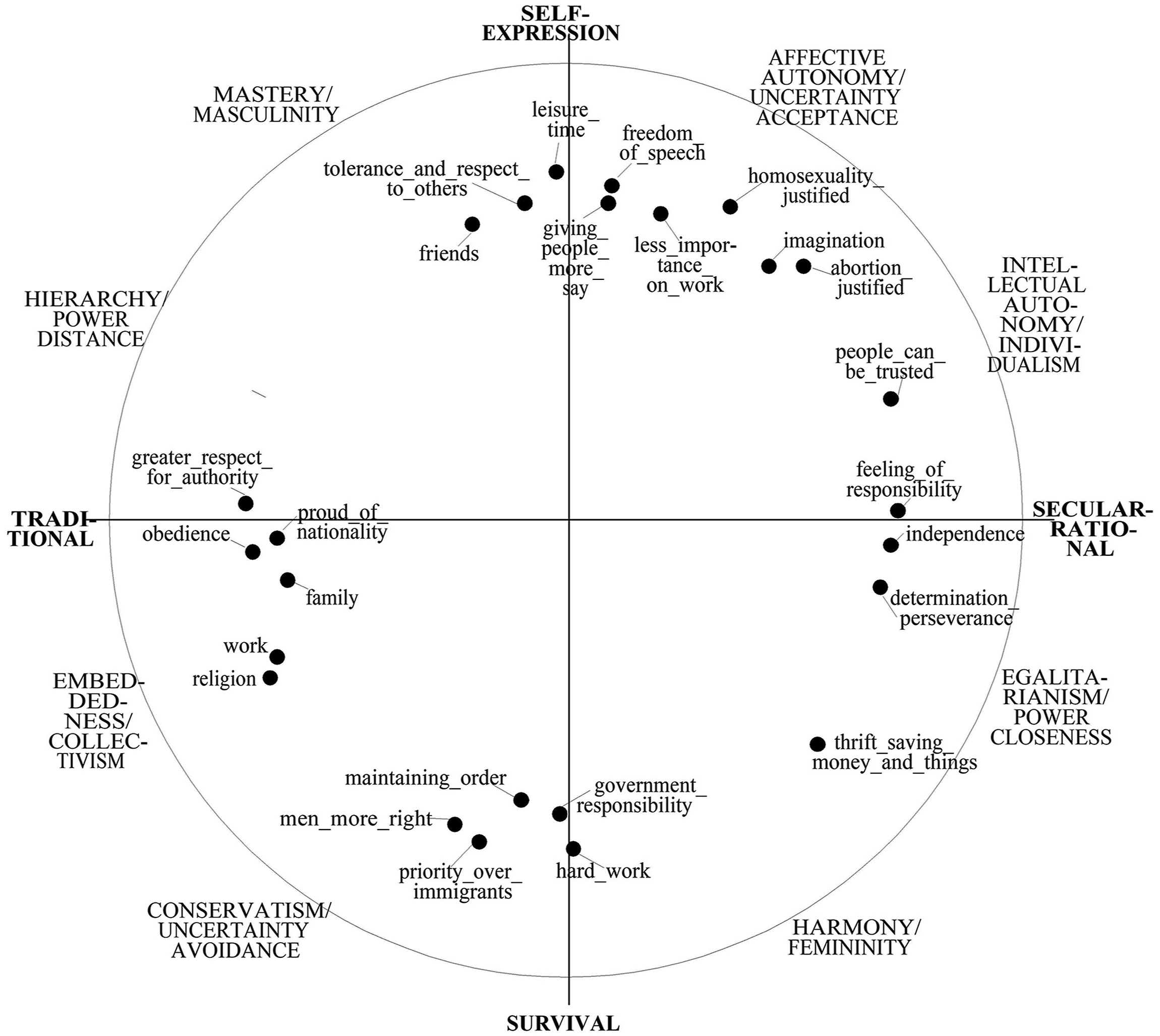
Initial Analysis of Schwartz’s Items
Next, Figure 3 shows the positions of the Schwartz’s items, when only these are entered into the MDS. In this stage of our analysis, we have no information that would help us to align the results with the CMSS, hence we have added no axes to the figure: the positions of items are presented in the way they have emerged from the MDS analysis. However, we can see that a clear two-dimensional pattern emerges. On the slightly tilted horizontal axis, we see the opposition between conservatism/embeddedness on the left-hand side and affective/intellectual autonomy on the right-hand side. By contrast, the slightly tilted vertical axis seems to display the opposition between egalitarianism and harmony on the upper end, versus mastery and hierarchy on the lower end. This suggests that even if the choice of Schwartz items into the WVS was made keeping his individual-level model in mind, they seem to replicate the cultural model to a reasonable degree. Relative positions of Schwartz’s items (MDS results based on 65 countries). In this stage of our analysis, we have no information that would help us to align the results with the CMSS, hence we have added no axes to the figure.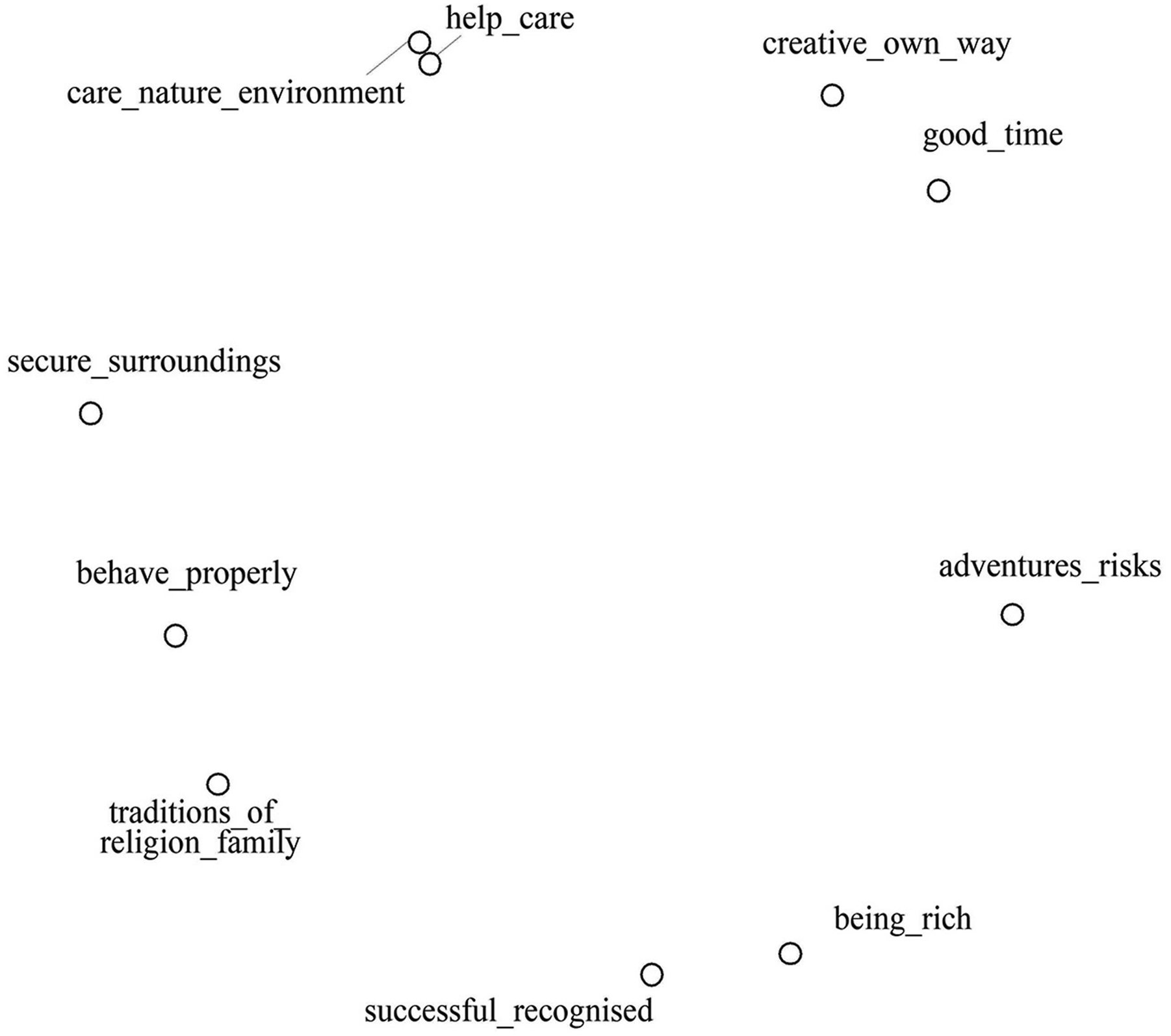
Placements of Schwartz’s Items With Respect to 25 Background Items
Correlations between the Schwartz’s items in the WVS and 25 culture-related background items.
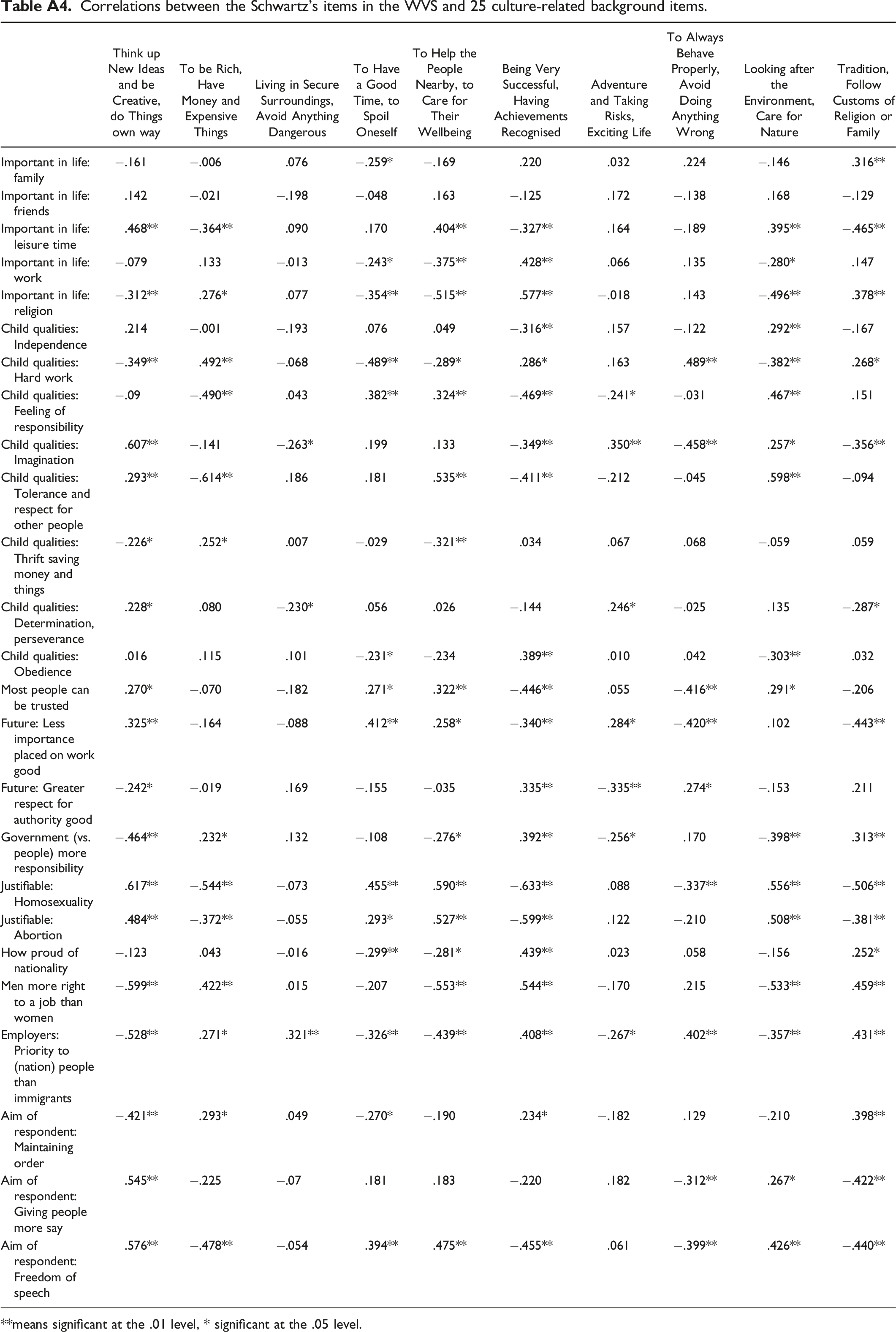
**means significant at the .01 level, * significant at the .05 level.
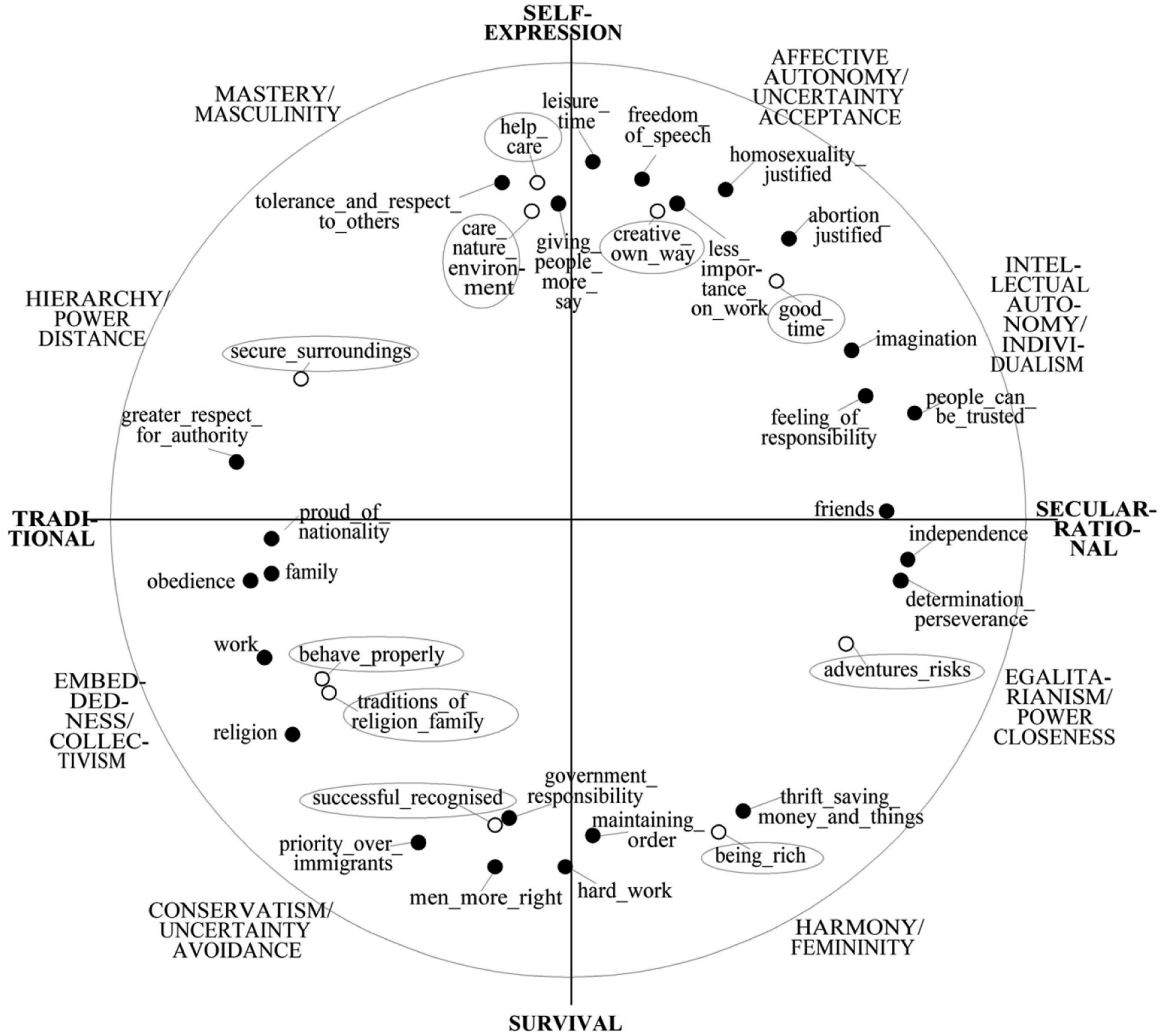
Relative positions of Schwartz’s items (circled) and 25 background items (MDS results based on 53 countries) on the background of the CMSS merging Inglehart’s, Hofstede’s and Schwartz’s model. 25 background items are denoted with black, Schwartz’s items with white fill.
The placement of the Schwartz items with respect to each other in Figure 4 is very similar to that already shown in Figure 3 as well as to the pattern revealed by Dobewall and Rudnev (2014, F. 1a). They positioned the 10 Schwartz items relative to the 10 items that were used for calculating the scores for Inglehart’s dimensions by Inglehart and Baker (2000) as well as Inglehart and Welzel (2021) and demonstrated that positioning of the items pertaining to those two models with respect to each other is very similar to the positioning presented in Figure 4.
Figure 4 locates tradition (‘Tradition is important to this person; to follow the customs handed down by one’s religion or family’) and behaving right (‘It is important to this person to always behave properly; to avoid doing anything people would say is wrong’) close to the traditional pole in Inglehart’s terms. In accordance with Schwarz’s model, those two items appear to be placed in the wider embeddedness/conservatism sector together with success and recognition (‘Being very successful is important to this person; to have people recognize one’s achievements’). Although tradition and behaving right are related to conservatism and maintaining the status quo, the wordings of the questions also have elements related to relationships, such as ‘anything people would say is wrong’ or ‘family’, thus indicating that approval and harmonious relationships are important. Similarly, it is likely that the relationships-related part of the success and recognition item – ‘have people recognize one’s achievements’ – is what is behind its placement within the conservatism-embeddedness sector.
On the opposite side, we see items that all are related to autonomy (both intellectual and affective). Creativity and doing things one’s own way (‘It is important to this person to think up new ideas and be creative; to do things one’s own way’) is placed close to the self-expression pole in Inglehart’s terms, aligned with affective autonomy. Similarly, having good time (‘It is important to this person to have a good time; to “spoil” oneself’) is also associated with autonomy.
The placement of adventure and taking risks (‘Adventure and taking risks are important to this person; to have an exciting life’) close to egalitarianism and security (‘Living in secure surroundings is important to this person; to avoid anything that might be dangerous’) close to hierarchy might seem questionable at first sight, as one might expect those to be placed on the affective autonomy versus conservatism axis. The correlations of these two items with the 25 background items are relatively weak, so we cannot draw very strong conclusions here, but one potential explanation is that those two items can be related to one facet of hierarchy-egalitarianism. According to Schwartz (2004), hierarchy can be understood as a hierarchical system of ascribed roles, where authority is highly regarded, while both egalitarianism and intellectual autonomy “share the assumption that people can and should take individual responsibility for their actions and make decisions based on their own personal understanding of situations.” Thus, this dimension encompasses accepting ascribed roles and expecting authorities to make decisions and take actions, versus everyone taking responsibility for their own decisions and actions. In this context, the placement of an item containing ‘taking risks’ together with the items of independence, determination and feeling of responsibility, close to the secular-rational pole seems comprehensible.
The last Schwartz’s dimension to discuss is mastery-harmony. Apparently, being rich (‘It is important to this person to be rich; to have a lot of money and expensive things’) and successful (‘Being very successful is important to this person; to have people recognize one’s achievements’) align with survival values in Inglehart’s terms: if one has to cope with insecure and dire material conditions, wealth and success are highly desired. Further, only when some level of well-being is reached, can people start to think about helping others or caring for nature: if one worries about one’s own survival, caring for nature or others is not a priority. This is in accordance with the Maslow’s (1943) logic that some human needs become relevant only when the others are satisfied, with the physiological and safety needs at the bottom of the pyramid and self-actualisation and –transcendence at the top. The placement of caring for nature (‘Looking after the environment is important to this person; to care for nature’) and helping (‘It is important to this person to help the people nearby; to care for their well-being) close to mastery (and self-expression) is also in accordance with the logic that mastery is about courage, willingness to stand out, and life control or, in more academic terms, ‘agency’(Chang et al., 2017): the capability and ambition to dedicate one’s actions to purposes of one’s own choice. Only agentic individuals in this sense can develop a sense of responsibility for their actions, including the responsibility for others and nature. The relationship between agency and generosity has been shown for example by Whillans and Dunn (2018). Thus, in our modern societies, caring for nature, helping others, charity etc. might be associated with a generous person who can afford it, both in social sense (daring to oppose the dominant views) and in economic sense (noblesse oblige).
According to Schwartz (2004), mastery “encourages active self-assertion”, while harmony “emphasises fitting into the world as it is”. Hence, the placement of the harmony dimension close to the survival pole together with conservatism and the placement of mastery close to self-expression pole together with affective autonomy as in the CMSS seems comprehensible. As Schwartz (1994) noted, mastery and affective autonomy “share an emphasis on stimulating activity”. Mastery can be understood as courage, self-realisation and willingness to stand out, so the placement of the item containing doing ‘things one’s own way’ close to mastery is a logical reflection of human agency. While harmony is about conforming to the environment or situation, mastery is about changing it.
Placements of Job-Related Items With Respect to 25 Background Items
Correlations between the additional items and 25 background items.
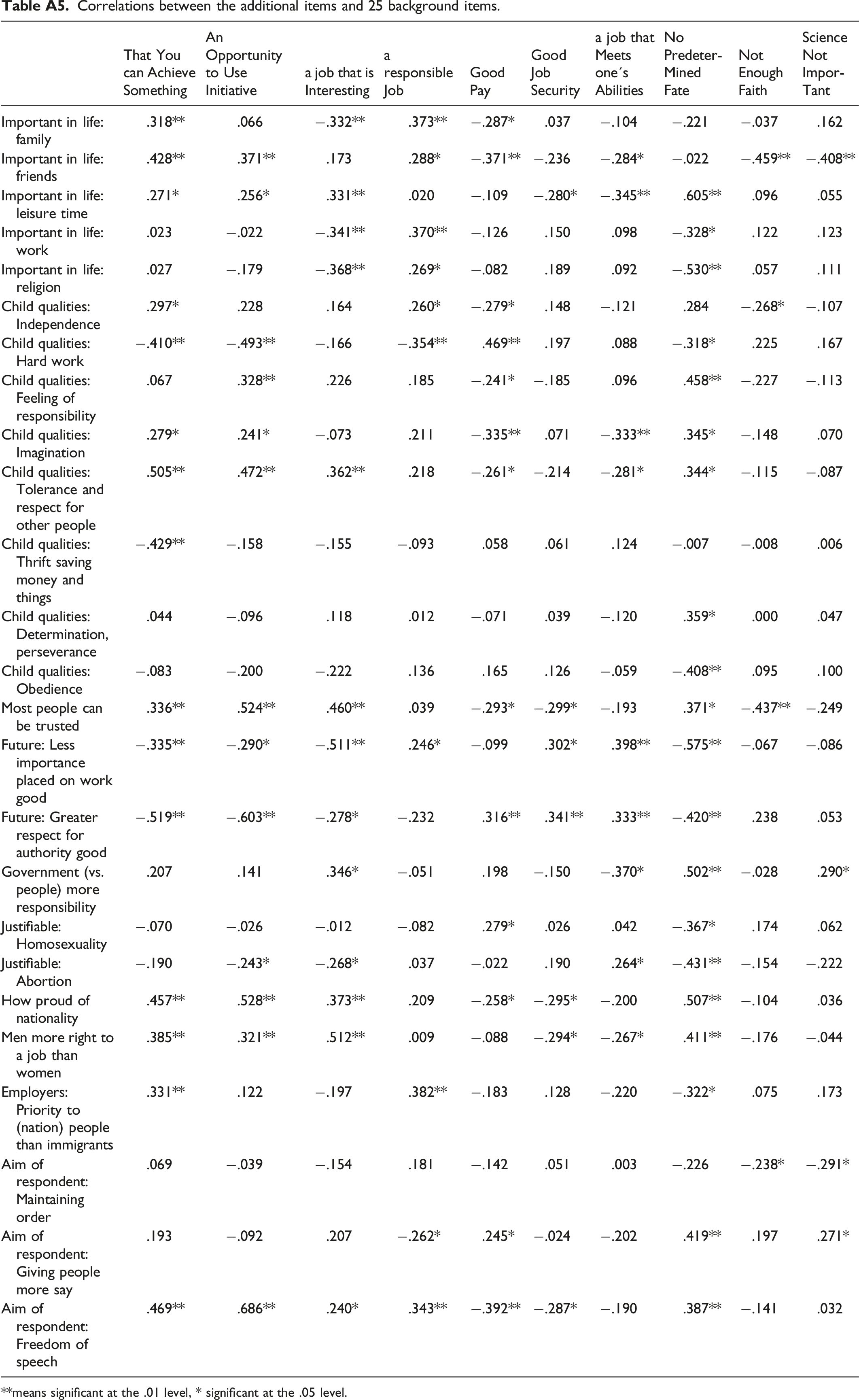
**means significant at the .01 level, * significant at the .05 level.
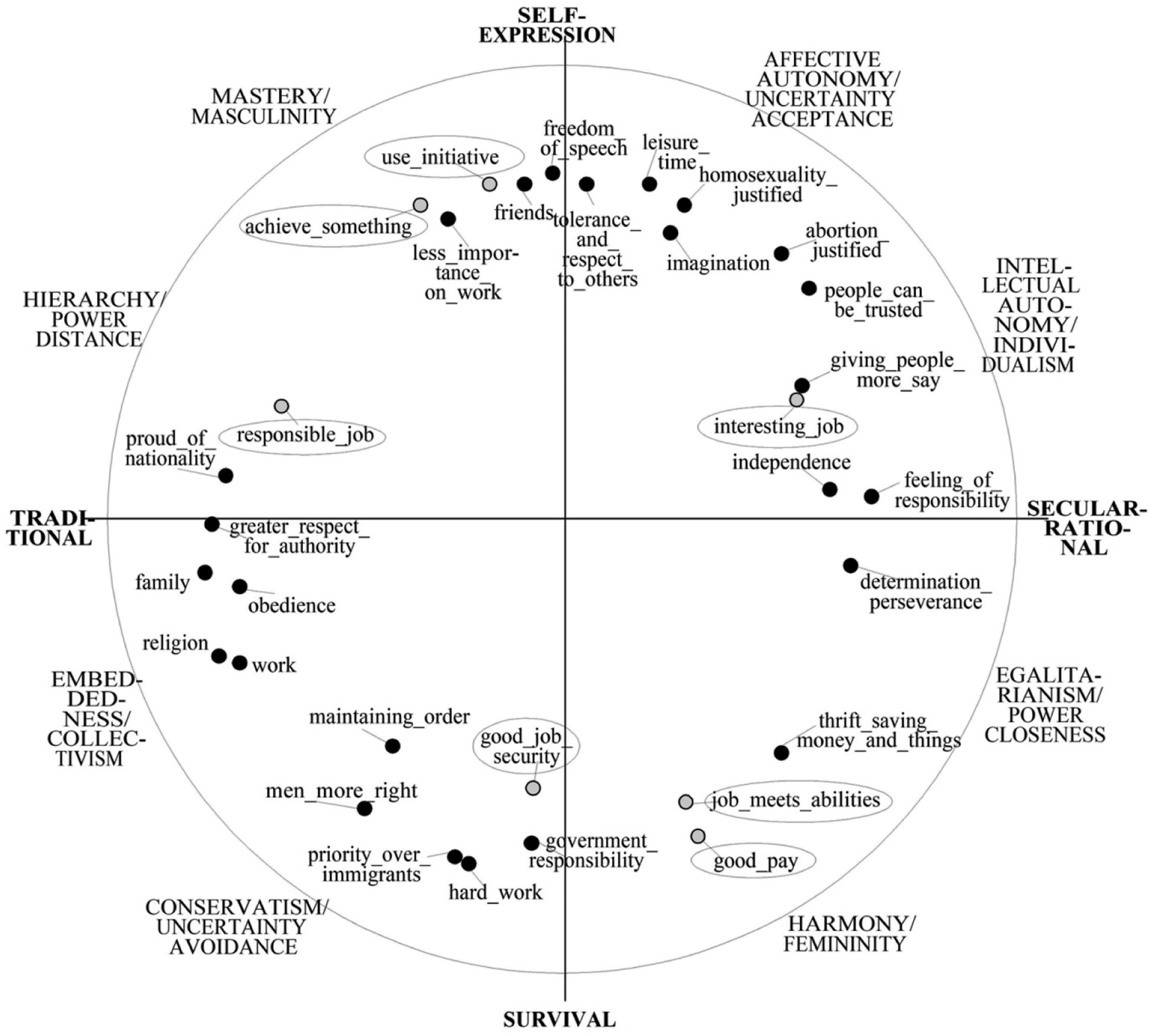
Relative positions of job-related items (circled) and 25 background items (MDS results based on 41 countries) on the background of the CMSS merging Inglehart’s, Hofstede’s and Schwartz’s model25 background items are denoted with black, additional items with grey fill.
We see that ‘an opportunity to use initiative’ and ‘that you can achieve something’ are placed in the mastery sector in Schwartz’s terms (masculinity sector in Hofstede’s terms), while ‘a job that is interesting’ is located in the intellectual autonomy (individualism) sector. However, ‘good pay’ and ‘a job that meets one´s abilities’, are placed into the harmony (femininity) sector. ‘Good job security’ is close to those, but is even closer to conservatism (uncertainty avoidance). ‘A responsible job’ is placed in the hierarchy (power distance) sector. Of course it is also close to the achievement and initiative items, but one explanation for its alignment with the hierarchy sector is that ‘a responsible job’ is understood as a prestigious position rather than feeling and taking responsibility.
Thus, good pay, being rich, successful, and recognised seem, indeed, to tap the harmony pole together with job security, while helping others and caring for nature seem to be on the mastery pole together with achievement and initiative. This is not in accordance with the operationalisation of masculinity-femininity by Hofstede, who placed earnings and recognition at the opposite pole of the employment security. This misplacement explains the non-replicability of Hofstede’s masculinity-femininity dimension shown for example by Minkov (2018) or Minkov and Kaasa (2021). This also means that even when excluding the aspect of gender equality from the masculinity-femininity dimension, there are still problems with Hofstede’s operationalisation of masculinity-femininity dimension.
Placements of Additional Items With Respect to the 25 Background Items
In investigating the idea that taking responsibility versus fatalistic views and a belief that authorities can sort everything out might be an aspect of egalitarianism versus hierarchy, we use three additional questions (last three items in Table 2). Table A4 in the Appendix documents the correlations of these items with the 25 background items. We entered those items into the MDS analysis together with the 25 background items. Figure 6 shows the results. Relative positions of additional items (circled) and 25 background items (MDS results based on 27 countries) on the background of the CMSS merging Inglehart’s, Hofstede’s and Schwartz’s model25 background items are denoted with black, additional items with grey fill.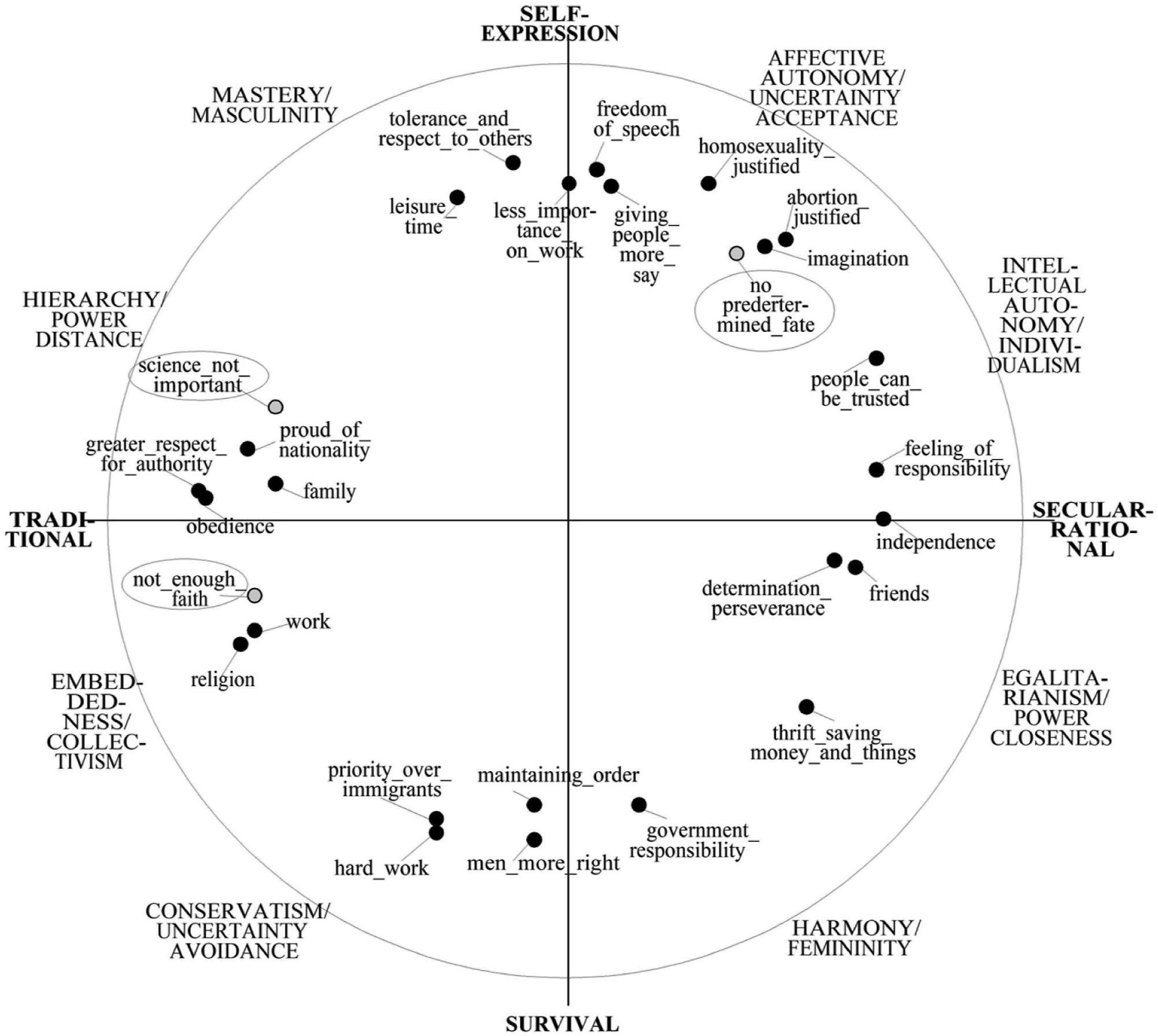
Indeed, the call for more faith (‘We depend too much on science and not enough on faith’) and science viewed as unimportant (‘It is not important for me to know about science in my daily life’) are placed in or close to the hierarchy sector. Together they might reflect passive fatalistic views and a lack of agency and lack of interest in decision-making, in which case knowledge on which to base decisions appears to be unnecessary. The belief that fate is not predetermined, ‘Individuals can decide their own destiny’ (vs. ‘impossible to escape a predetermined fate)’ is placed in the autonomy section next to egalitarianism. This finding confirms that agency and informed responsibility is a facet linking egalitarianism and intellectual autonomy, while fatalism at the opposite end bridges hierarchy and embeddedness. In that light the positioning of ‘taking risks’ close to independence, determination and a feeling of responsibility as well as the positioning of ‘secure surroundings’ close to valuing authorities seems comprehensible. This pattern is also in accordance with the conceptualisation of power distance by Hofstede (1980), including participation versus autocratic decision-making among others.
Putting it all Together
As the placements of the background 25 items presented in Figures 2 and 4–6 are very similar, we can combine them and all other analysed items onto one figure (Figure 7). The exact placements of the 25 background items are based on Figure 2 in this article. Relative positions of all items on the background of the CMSS merging Inglehart’s, Hofstede’s and Schwartz’s model; 25 background items are denoted with black, Schwartz’s items with white and additional items with grey fill.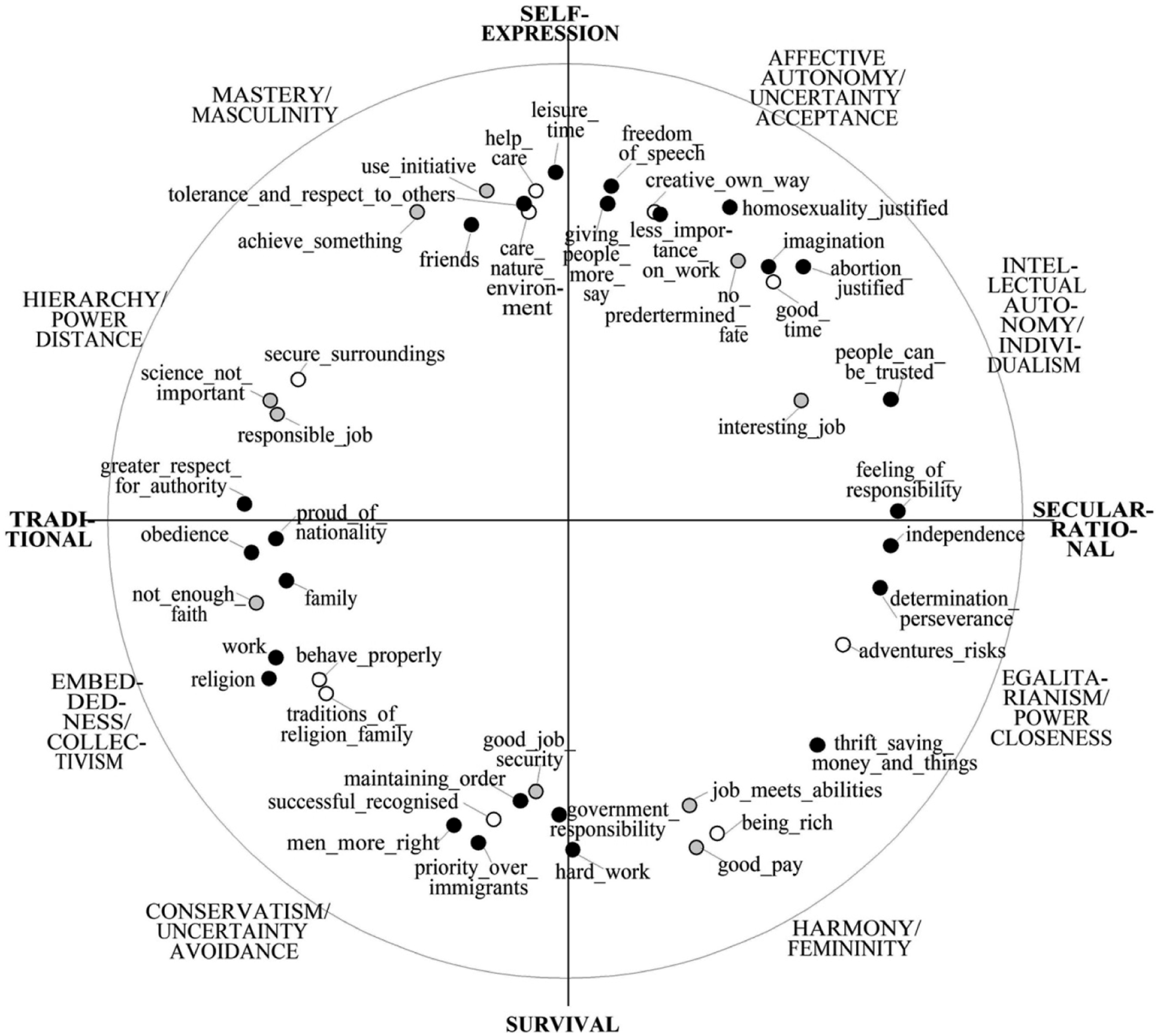
As Figure 7 illustrates, the ‘good pay’ and ‘being rich’, items from two different sets, are placed together and on the opposite end of ‘using initiative’ and ‘achieving something’. ‘Being successful and recognised’ is placed in the conservatism sector with ‘good job security’. Also, ‘help and care’ and ‘caring for nature’ are placed in the mastery sector together with ‘using initiative’ and ‘achieving something’ and also close to ‘being creative and doing things one’s own way’. In the area close to hierarchy, there are items expressing fatalistic, faith- and authority-oriented views, like ‘science is not important’ or ‘not enough faith’, but also valuing ‘secure surroundings’, possibly provided by authorities, as well as obedience-related ‘following traditions’ and ‘behaving properly’. On the opposite end, there are ‘adventures and risks’ close to valuing an ‘interesting job’ and ‘responsibility’, ‘determination’, and ‘independence’ as well as ‘no predetermined fate’. The placement of these items on both sides of the secular-rational versus traditional axis implies that viewing Hofstede’s individualism-collectivism and power closeness-distance as one-and-the-same dimension might be justified. This broader dimension maps tightly on Inglehart’s secular-rational versus traditional dimension. By contrast, the other aspects that are also often viewed as reflecting individualism-collectivism in a broader sense, namely uncertainty acceptance-avoidance or affective autonomy versus conservatism are covered by Inglehart’s other dimension – self-expression versus survival – together with the elements pertaining to the concepts of masculinity-femininity or mastery-harmony.
Comparison With the Empirical Framework of Two-Dimensional Sets
Figure 8 places the same items as those in Figure 7 into the empirical framework shown on Figure 1 (right) and Figure A1 in Appendix. This enables us to analyse the placements of Schwartz’s items also in comparison with the dimensions in the revised Hofstede’s model by Minkov and the first two dimensions of Beugelsdijk and Welzel’ (2018) synthesis of Inglehart’s and Hofstede’s models. Relative positions of all items on the background of the empirical framework by Kaasa and Minkov (2022); 25 background items are denoted with black, Schwartz’s items with white and additional items with grey fill; IW stands for Inglehart and Welzel (2021), M1 for a set from Minkov et al. (2017; 2018a), M2 for Minkov et al. (2018b), BW for Beugelsdijk and Welzel (2018).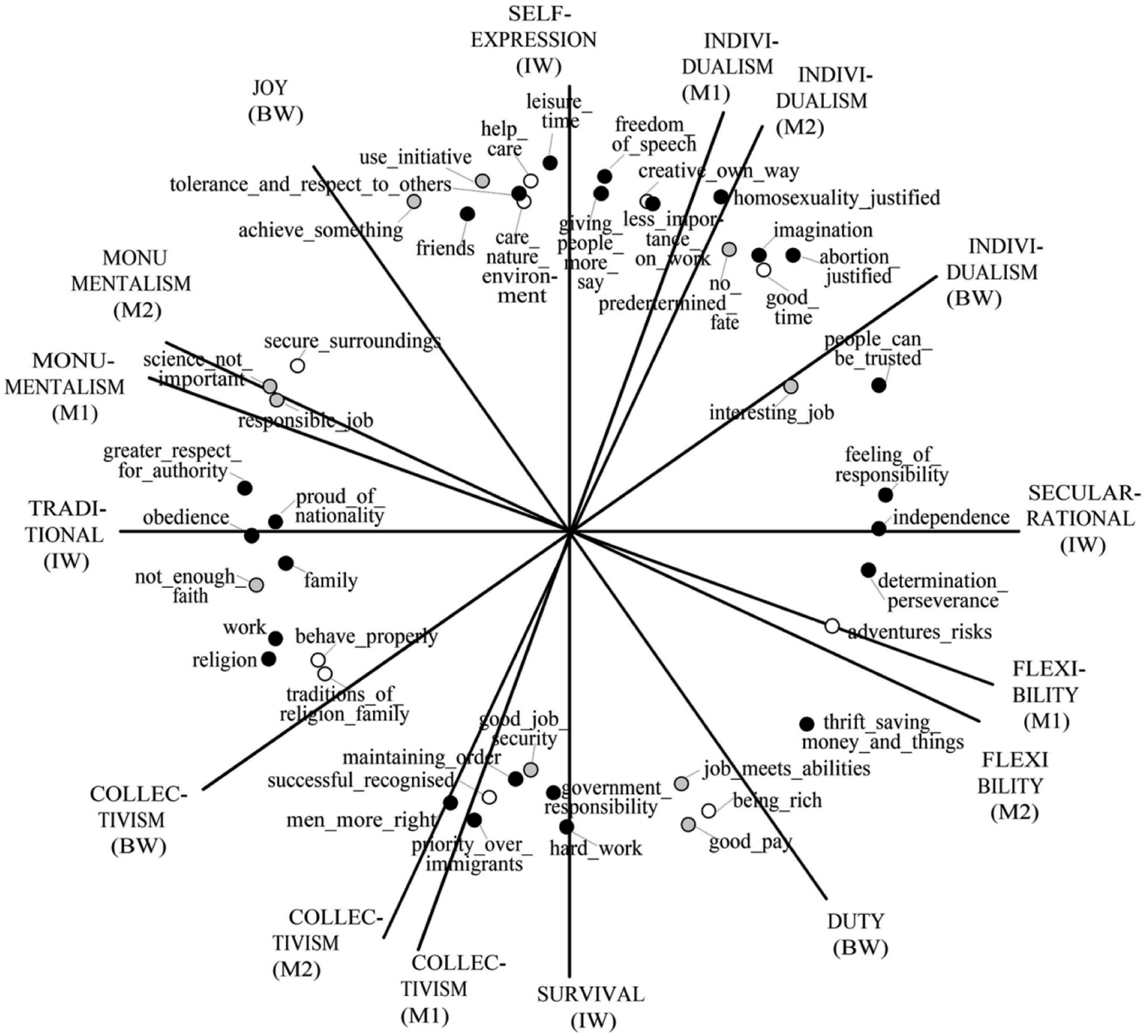
The placement of items relating to autonomy versus conservatism/embeddedness are expectedly in accordance with the individualism-collectivism dimensions of Minkov (2017, 2018a, 2018b) and Beugelsdijk and Welzel (2018). The items related to the opposition of mastery plus hierarchy versus harmony plus egalitarianism are covered by the monumentalism-flexibility and joy-duty dimensions. At that, monumentalism-flexibility is slightly more aligned with hierarchy-egalitarianism and joy-duty slightly more with mastery-harmony, but there are overlapping elements as well. According to Minkov and Kaasa (2021), flexibility is about personal adaptability, that is, being flexible and willing to adapt, as well as self-reliance, that is, “being concerned primarily with one’s own issues and attempting to solve them on one’s own”. Monumentalism, in turn, means dependence on others and generosity, “being always ready to help others in order to earn their admiration”. This is in compliance with the logic that puts help and caring for nature on the mastery and hierarchy pole. Monumentalism includes also self-stability, which might be related to keeping the ascribed roles. Harmony as fitting into the environment is in accordance with flexibility and willingness to adapt. The core of the joy versus duty dimension covers the opposition between post-materialist and materialist values, respectively. Thus, the placement of ‘being rich’ close to the duty pole is comprehensible, again. Beugelsdijk and Welzel (2018) also note that in societies at the joy pole people do not find good income important in a job. ‘Being successful and recognised’ is placed between the duty and collectivism axes of Beugelsdijk and Welzel (2018), as it covers both materialist and relationship-oriented elements – again, inherently intelligible.
Discussion
When comparing our results with Schwartz’s original interpretations of his MDS results (1994; 2004; 2006), it turns out that the items that are supposed, based on Schwartz’s interpretations, to be related with autonomy (‘being creative and doing things one’s own way’, ‘having good time’) surface in this study in the sector between the self-expression and secular-rational poles, where the autonomy is placed in Kaasa’s (2021) CMSS framework as well. Correspondingly, the items supposed to represent Schwartz’s conservatism/embeddedness (‘behaving properly’, ‘traditions’) occur on the opposite end, between the survival and traditional poles in the CMSS.
However, the placements of other items provide some interesting insights related to (1) operationalisation of cultural dimensions and (2) accuracy of their names. First, there are incompatibilities that seem to indicate an interesting mis-conceptualization in Schwartz’s original value circumplex in the sense of the choice of the
In addition, our results refer to the possibility that the items ‘adventures and taking risks’ and ‘secure surroundings’ reflect rather the opposition of taking responsibility versus expecting authorities to provide solutions that also relates to the logic of power closeness versus distance. Schwartz’s interpretation places ‘exciting life/risk, excitement’ under affective autonomy or mastery and ‘national security/secure surroundings’ under embeddedness. However, our results place ‘adventures and taking risks’ and ‘secure surroundings’ in the sectors that belong to egalitarianism and hierarchy, respectively.
Schwartz (2004, 2008) defines the idea of mastery as encouraging active self-assertion and of harmony as fitting into the world as it is. When looking at the keywords in the original MDS circumplex (available for example in Schwartz, 2006, F. 2), we can see that ‘daring’, ‘capable’, ‘ambitious’, ‘independent’, ‘choosing own goals’ that are related to the general idea of mastery (as well as achievement orientation and self-realisation) are placed together with ‘
There are only a few keywords in the harmony section of Schwartz’s circumplex and in order to understand them better, it is useful to check the exact wording in the questionnaire (Schwartz, 1994). The full wording of two of the questions in the harmony section was ‘unity with nature (fitting into nature)’ and ‘a world at peace (free of war and conflict)’, which is in accordance with the concept of conforming to one’s environment, but ‘protecting the
Next, Schwartz (2004, 2008) explains the idea of hierarchy dimension as relying on hierarchical systems of ascribed roles and of egalitarianism as people recognising one another as moral equals. In the hierarchy section of Schwartz’s original MDS circumplex we see ‘humble’ as well as ‘
Among the keywords placed in the egalitarianism section in Schwartz’s circumplex we find both ‘responsible’ and ‘
Second, regarding the accuracy of the dimension
Regarding the analogue in Hofstede’s (1980) model, he associated his masculinity-
Our exercise of comparing one cultural model to others and placing them all in a common universe – the CMSS by Kaasa (2021) has brought out two important implications. First, it might be that the
It becomes clear that
Those seeming incompatibilities do not mean that the general idea of a model and its dimensions cannot still hold. Our study shows that including other items not based on Schwartz’s questionnaire still confirms the general logic of Schwartz’s model and its relationships with other models, including those modern two-dimensional models that are shown on Figure 8. However, it is possible that although the dimensions of well-known cultural models have proven to be still viable and relevant, at least in the conceptual sense (as opposed to particular operationalisation), it might be reasonable to rethink the possibly misleading
We acknowledge that this study is just one step further in understanding the cultural differences and how different models capture them. However, some suggestions can be made based on this study. With respect to future attempts to replicate Schwartz’s dimensions using some large cross-cultural surveys (such as for example the WVS), it is important to stress that in order to achieve an adequate operationalisation, a sufficient amount of items is necessary. When using only one or two items, there is a high likelihood that because of the unfortunate wording of those items they tap rather something different from what was intended. For example, when intending to measure mastery versus conformity (harmony), a wider set of items describing achievement orientation versus fitting into the environment is needed, including more than just one or two items per dimension pole. Otherwise, as we have shown in this article, misinterpretations can occur easily. For example the placement of the mastery-plus-hierarchy versus the conformity-plus-egalitarianism axis that can be derived when looking only at the 10 Schwartz items (Figure 3) changes to the opposite when we include many additional items outside the ten-item battery (like for example in Figure 7). This insight allows to conclude that concerning the WVS-based analyses of the Schwartz dimensions: (1) either the WVS will expand considerably the number of items used to cover the Schwartz dimensions, or (2) researchers will analyse the WVS-Schwartz items always in connection with a considerable number of additional cultural items to widen the interpretive context, as done in this study against the backdrop of the Kaasa’s CMSS. Whether the same applies for the 21 items that are included into the ESS deserves attention in further research.
Supplemental Material
Supplemental Material - Elements of Schwartz’s Model in the WVS: How Do They Relate to Other Cultural Models?
Supplemental Material for Elements of Schwartz’s Model in the WVS: How Do They Relate to Other Cultural Models? by Anneli Kaasa, and Chris Welzel in Cross-Cultural Research.
Footnotes
Declaration of Conflicting Interests
The author(s) declared no potential conflicts of interest with respect to the research, authorship, and/or publication of this article.
Funding
The author(s) disclosed receipt of the following financial support for the research, authorship, and/or publication of this article: This work was supported by the Eesti Teadusagentuur (PRG380).

Supplemental Material
Supplemental material for this article is available online.
Appendix
Author Biographies
References
Supplementary Material
Please find the following supplemental material available below.
For Open Access articles published under a Creative Commons License, all supplemental material carries the same license as the article it is associated with.
For non-Open Access articles published, all supplemental material carries a non-exclusive license, and permission requests for re-use of supplemental material or any part of supplemental material shall be sent directly to the copyright owner as specified in the copyright notice associated with the article.
