



Abstract
We study whether having several siblings decreases the level of educational performance of adolescents and whether this phenomenon can be compensated by other factors such as the economic or cultural resources of the parents. Based on this compensation model, parental resources should be associated with children’s educational attainments more strongly in families with a higher rather than a lower number of children. We analyzed the Program for International Student Assessment (PISA) data from 20 Western countries and found that better family wealth, an increased level of parental education, and a higher parental occupational status were associated with increased educational attainments more strongly among 15-year-old children who have siblings than among children without siblings. The same effect was not found in the case of family cultural possessions. Although parental resources may matter more in larger families than in smaller families, some types of resources are more important than others regarding compensation.
Introduction
In recent decades, the influence of family-related factors on students’ academic achievements has become a standard part of research in social stratification and mobility. Currently, a large number of studies from the United States (e.g., Blake, 1989; Jaeger, 2008), Europe (e.g., Lawson, Makoli, & Goodman, 2013; Sieben, Huinink, & de Graaf, 2001), Asia (e.g., Li, Zhang, & Zhu, 2007; Post & Pong, 1998), and Australia (e.g., Evans, Kelley, & Wanner, 2001) show that when the number of siblings increases, educational performance tends to decrease. In addition, research has shown that when parental resources increase, educational attainment also tends to increase (e.g., Davis-Kean, 2005; Hampden-Thompson, 2009). However, there is a lack of cross-national studies that analyze whether parental resources have a distinct effect on families of different sizes. Here, we study whether different types of family resources compensate for the sibship size, that is, are parental resources more strongly associated with 15-year-old children’s educational scores in larger families than in smaller families.
The article produces novel information concerning the accumulation of advantage that focuses on sibship size, educational performance, and the resource compensation model. Thus, the article gives new insights to mechanisms regarding why large families do not automatically designate the poor educational outcomes of children. To our knowledge, there are no cross-cultural studies investigating whether parental resources more strongly correlate with children’s educational achievements in larger families than in smaller families. Here the cross-national data are used because we try to find a general mechanism that is not associated only with some country-specific feature (see Henrich, Heine, & Norenzayan, 2010, for discussion).
The structure of the article is as follows. First, the previous studies concerning the negative effects of large sibship size and low parental resources are presented. Moreover, we present the main theoretical premise of the current study, that is, the compensation model. Then, after a formulation of hypotheses and a description of the data and methods that are used, the results of our empirical analyses are reported. In the final chapter, the results are discussed with the reference to our theoretical considerations and previous empirical findings.
Sibship Size and the Parental Resource Compensation Model
The negative effect of a large sibship size on children’s educational performance is often explained by three different but partly overlapping theories: the resource dilution model, the sibling competition hypothesis, and the confluence model. The parental resource dilution model (e.g., Coleman, 1988; Downey, 2001; Jaeger, 2009) predicts that parental resources should influence children’s academic outcomes, and because parental resources are finite, all new children in the household decrease the parents’ possibilities to invest resources in any particular child. Thus, the resource dilution model assumes that increasing the number of siblings is associated with a decreasing level of school performance.
A classic question in resource dilution literature is whether patterns of postsecondary education can be attributed to sibship size because families with many children are only able to support the university attendance of one or two children (Downey, 2001). Although one may assume that the resource dilution effect should be stronger in countries with lower levels of public spending on education, previous studies have shown that the resource dilution effect occurs also in countries with higher rates of public spending on families and education (e.g., Park, 2008). Moreover, preliminary findings from Finland show that also in a Scandinavian country characterized by free education from compulsory school to University level, parental involvement may still divide unequally between children and influence children’s educational careers (Danielsbacka & Tanskanen, 2015). In addition to analyzing the actualized entry to college, studies have also considered how anticipation of such future trajectories might affect short-run performance in secondary school (e.g., Downey, 1995; Kreidl & Hubatkova, 2014). The anticipatory effects are often observed by educational test scores as we do also in the present study. Educational test scores are good measures of child outcomes as several studies have shown that educational achievements in childhood and adolescence strongly correlate with, for instance, higher educational level and better salary in later life (e.g., Card, 1999; Heckman, 2006).
In addition to the resource dilution model, the sibling competition hypothesis predicts that increased sibship size correlates with decreased intellectual achievements in children. The hypothesis notes that siblings compete with one another over parental resources, including time, energy, money, and other resources (Trivers, 1974). Although sibling competition over parental resources may also exist in adult siblings (Danielsbacka & Tanskanen, 2015; Tanskanen, Danielsbacka, Jokela, David-Barrett, & Rotkirch, 2016), it tends to be most severe in childhood and adolescence when parental resources matter the most (Salmon & Hehman, 2014; Tanskanen, Danielsbacka, & Rotkirch, 2015). The sibling competition hypothesis argues that from the children’s perspective, it is beneficial to obtain as many resources from their parents as possible, whereas from the parental perspective, it is more important to guarantee their children’s well-being by investing resources in all children, not only one child (Tanskanen & Danielsbacka, 2016). These different perspectives between family members may create a conflict between parents and children and among siblings (Tanskanen, Danielsbacka, Jokela, & Rotkirch, 2016).
The confluence model is also used to explain the relation between sibship size and the educational outcomes of children. The confluence model, which was originally applied in psychology, predicts that the primary channel through which sibship size has a negative effect on the educational success of children is through the creation of an inferior intellectual environment in families with many children (Jaeger, 2009). The confluence model predicts that having many children produces an intellectually weaker climate that is harmful to schooling outcomes (Jaeger, 2008; Zajonc & Markus, 1975). The confluence model is not directly related to parental resources as is the case with the sibling competition hypothesis and the resource dilution model. Instead, the confluence model predicts that family environment changes when the number of children increases. However, a family’s intellectual climate can be seen as partly produced by parental (e.g., cultural, human, and social) resources.
Consistent with the resource dilution model, the sibling competition hypothesis, and the confluence model, several studies from different societies have found that when the number of siblings increases, the educational attainments tend to decrease, as discussed above. However, there could be differences on the effects of parental resources from the number of siblings. When parental resources are high, the effect of having siblings may not be as crucial as the situation when parental resources are scarce. For instance, if a child has no siblings at all, the child is not forced to distribute parental resources with other children. In this case, a lower level of parental resources may be sufficient. In contrast, when a child has several siblings, low parental resources may significantly weaken and high resources may significantly strengthen the child’s educational achievements.
The compensation model in general means that missing parental resources can be replaced with other available resources; therefore, the outcomes of children should be better than missing resources give us reason to predict (e.g., Bernardi, 2014; Bernardi & Grätz, 2015; Conley & Glauber, 2006). One factor (i.e., having several siblings) that may decrease the level of educational performance may be compensated by some other factor (i.e., high parental resources). Thus, according to the compensation model, parental resources should matter more in larger families than in smaller families. The compensation may take place in several ways. For instance, a problem for parents with multiple children may be that they cannot spend enough time to helping their children. While richer parents cannot increase the number of hours in a day, what they can do is buy services (like tutoring) that compensate the lack of parental involvement. This is one reason why the effect of parental resources should be increased with the increasing number of children.
In this article, we assume that the compensation model is a theoretically useful tool to understand the educational outcomes of adolescents in large families. To our knowledge, this question has not been previously studied with cross-country data using family-level measures of parental resources. Perhaps the most comprehensive previous study on the topic is the work by Downey (1995), who investigated the school grades of U.S. students with mixed results. Downey analyzed the interactions between parental resources and sibship size and found negative correlations in five of nine models, which indicates that increased parental resources have more impact on school grades in larger families than in smaller families. Although Downey found that some parental resources (e.g., having educational objects in the home) have a more positive influence on test grades in larger families than in smaller families, other resources (e.g., having a computer in the home) do not. One of the main limitations of Downey’s study was that he used data from only one country (i.e., the United States). Thus, it is not known whether the findings are as the results of specific features of, for instance, the U.S. educational system or other country-specific features. In previous studies, Americans are found to be unique among other Westerners in several ways, including educational and childbearing practices that emphasize high level of individualism, autonomy, and independence (see Henrich et al., 2010, for discussion). This means that the results discovered from the United States may not be generalizable to other Western countries.
Later, Park (2008) used cross-national data and investigated how financial resources were associated with children’s school achievements by the number of siblings. In his country-level investigation, Park found that the negative influence of the number of siblings was smaller in countries with a higher level of public spending on families and education. In addition, the negative influence was higher in countries with lower rates of investment in families and education. Park, however, measured wealth by a national level rather than a family level and therefore focused the compensation model more on national policy than on a family resource perspective. Here, we use data from 20 countries and analyze several family and parental resource variables while investigating adolescents’ educational achievements.
Parental Resources
Parental resources can be measured by several factors, including parental education, occupation, family wealth, and cultural capital. These factors often overlap with one another. For instance, individuals with a higher educational status are more likely to have high-skilled occupations, more financial resources, and cultural capital than individuals with a lower educational status. Although different resources tend to correlate with one another, they do not measure exactly the same, and the magnitude of the effect to children’s academic success may vary among different resource types (e.g., Jaeger & Hom, 2007; Kallio, Kauppinen, & Erola, 2016). By concentrating on a single measure of parental resources, it is possible to oversimplify their impact regarding the outcomes of children (Bukodi & Goldthorpe, 2013; Erola, Jalonen, & Lehti, 2016).
In modern nations, parental education may be the most important family resource factor that explains children’s academic success. This importance is because in contemporary Western societies, education plays an important role as a “gatekeeper” or “pathway” to higher occupational status and pay (Bäckman & Nilsson, 2011). High parental education can be transmitted from parents to children via socialization and involvement (Jeynes, 2007). Moreover, higher educated parents tend to have more knowledge about the school system that may benefit their children compared with their lower educated counterparts (Bourdieu, 1984, 1986). In addition, higher educated parents may provide significantly more help to their children than do their less educated counterparts, regardless of their occupational status or financial resources (Useem, 1992).
Parental occupational position indicates parental social status. However, it may also measure both parental educational level that has led to any particular occupation and earnings that are linked to this occupation (Erola et al., 2016). Thus, parental occupation tends to reflect parental financial resources, which, in turn, have shown to be an important factor that influences children’s school attainments for several reasons. First, parents with lower financial resources are less able to purchase educational materials for their children than parents with higher financial resources (Entwisle & Alexander, 1995; McNeal, 1999). Educational materials include, for instance, computers, books, and newspapers. In addition, when parental financial resources are scarce, the housing condition may be poorer and, for instance, there may be a decreased likelihood that children have a silent place to study (Blake, 1989). Finally, higher income parents may be more able to offer their children activities such as summer camps, travels abroad, music lessons, or other hobbies that may improve child development (e.g., Blake, 1989). Having access to these resources and activities may positively affect children’s educational achievements.
Finally, access to cultural possessions has been shown in previous studies to correlate with academic achievements (e.g., Andersen & Jaeger, 2015; DiMaggio, 1982; Dumais, 2002; Xu & Hampden-Thompson, 2012). In his classical works, Bourdieu (1977, 1984, 1986) has argued that cultural resources measure immaterial types of capital that should be noticed similarly than socioeconomic types of capital. In practice, cultural capital can be measured by objectified cultural possessions, including artworks, classical literature, and books (Evans, Kelley, Sikora, & Treiman, 2010). According to Bourdieu (1977, 1984, 1986), children from high cultural resource backgrounds are socialized to increase knowledge, for instance, by reading books and participating in highbrow cultural activities, including classical music concerts and operas. In turn, this kind of cultural capital benefit them in the academic environment and thus help children from high cultural resource families to achieve better educational success.
According to the resource compensation model, there are differences among parental resources on how easily they can be shared and whether this sharing decreases the total amount of family resources. Parents’ material and economic resources that are difficult to share among siblings dilute rapidly when the number of children in the family grows (Downey, 2001). In contrast, cultural resources do not dilute as rapidly (Jaeger, 2009). Considering the resource compensation model, parental education, occupation, and family wealth should compensate for the negative effect of sibship size. The effect of cultural possessions, however, should not depend on the number of siblings. This is because several children may benefit from the same cultural possessions like artworks and books. In contrast, socioeconomic resources are more difficult to re-use. For instance, the beneficial effects of parental educational resources are strongly related to parental investment of time in their children (Jeynes, 2007) and time of any individual is always limited. Thus, when the number of children in the household increases, the amount of time parents are able to invest in any particular child decreases. Moreover, if parents invest a certain amount of money in one child, the same money cannot be invested again in another child. Therefore, based on the compensation model, compared with cultural possessions, socioeconomic resources should more strongly relate to the school performance of children in larger families than in smaller families.
Hypotheses
The objective of the present study is to investigate how the number of siblings and parental resources influence the academic achievements of children. Based on the resource compensation model, we predict that the following:
Data and Method
In this study, we used first-round data from the Program for International Student Assessment (PISA) that was collected in 2000, which has been recently used in several social mobility and stratification studies (e.g., Andersen & Jaeger, 2015; Kreidl & Hubatkova, 2014; Park, 2008). The goal of the PISA was to collect cross-national data on 15-year-old adolescents’ school attainments. In addition, in an adolescents’ survey, students were asked information concerning their family structure and parental socioeconomic factors. In this study, the first round of the PISA data was used because it contains more information on the adolescents’ household composition (i.e., number of siblings) than do the more recent rounds.
In 2000, the PISA data were gathered from 32 countries (28 Organisation for Economic Co-Operation and Development [OECD] countries and four non-OECD countries). In this study, however, analyses included 20 Western countries, namely, Greece, Luxembourg, Italy, Spain, Germany, Belgium, Ireland, Australia, the United Kingdom, the United States, Portugal, Switzerland, Austria, France, Canada, New Zealand, Finland, Norway, Sweden, and Denmark. The Netherlands did not reach the sampling standards of PISA, and thus, it is recommended to exclude it from cross-country studies (Adams & Wu, 2002). We restricted our analyses to industrialized Western countries for three reasons. First, we wanted to include countries with more similar rates of social, political, and economic development to accurately measure the possible effect of family resources and sibship size on educational attainment. Second, by including only industrialized Western countries, we attempted to control for the biases that are based on cultural differences. Third, the PISA data included only the children who were in school at age 15, and in developing countries, half of the population or less tended to attend secondary schools. Therefore, by selecting only more developed industrial countries in the analyses, we attempted to avoid the biases that are based on school dropouts. These selections left us with a sample of more than 107,000 adolescents.
Child Outcome
In the present study, reading literature was selected to measure child outcome. In the PISA, adolescents’ school attainments were measured through three indicators, that is, reading literature, mathematical literacy, and scientific literacy. In every PISA round, one of these themes was selected as the main theme; in the PISA 2000, the main theme was the adolescents’ reading literature skills. In the PISA 2000, the adolescents’ mathematical and scientific literacy were tested, although not all of the adolescents participated in these tests. In the PISA, reading literature measures adolescents’ capability to use, understand, and reflect written text (OECD, 2001). This measure of children’s educational attainments has been widely used in previous studies (e.g., Andersen & Jaeger, 2015; Kreidl & Hubatkova, 2014).
The PISA sample contains five plausible values for reading literature for each respondent with a mean score of 500 and a standard deviation of 100. These plausible values were constructed by using item response theory, and they represented a selection of probable attainment for the adolescents (see Adams & Wu, 2002, for more detailed information). In the sample, the mean score of reading literature was 509.
Number of Siblings
In the survey, the respondents were asked to report how many sisters and brothers they have. In the questionnaire, biological, step, and adopted siblings were not separated from one another. For the analysis, we constructed a dummy variable that has five mutually exclusive classes, namely, zero, one, two, three, and four or more siblings.
Parental Resources
We used four variables that measured parental resources indirectly rather than directly. The family wealth variable was calculated by adding children’s reports on the availability in the household of a dishwasher, one’s own room, educational software, and access to the Internet, as well as the number of televisions, computers, cellular phones, cars, and bathrooms in the household. Cultural possessions were measured by asking whether children have artwork, classical literature, and books of poetry in their home. The family wealth and cultural possessions indexes were standardized using Warm’s (1985) estimates by the PISA project team. In these indexes, negative values indicate a lower level of resources, and positive values indicate a higher level of resources. The variable constructions are described in more detail elsewhere (Adams & Wu, 2002).
In the questionnaires, the children were asked to report their mothers’ and fathers’ occupations. The parental occupation index ranges from 16 to 90 where lower scores indicate lower occupational status, and higher scores indicate the opposite (see Ganzeboom, de Graaf, & Treiman, 1992, for more detailed information). In addition, the children were asked to classify their mothers’ and fathers’ highest educational level. Later, the PISA project team classified these responses in six internationally comparable classes of parental educational attainment by using the International Standard Classification of Education (ISCED) 1997 classification (see OECD, 1999). We derived two new variables measuring average parental occupational status and educational level, respectively. The average value (instead of choosing the highest one or separate estimates for mothers and fathers) was chosen to reduce measurement error of parental status as well as to achieve more precise estimates (Korupp, Ganzeboom, & Van Der Lippe, 2002).
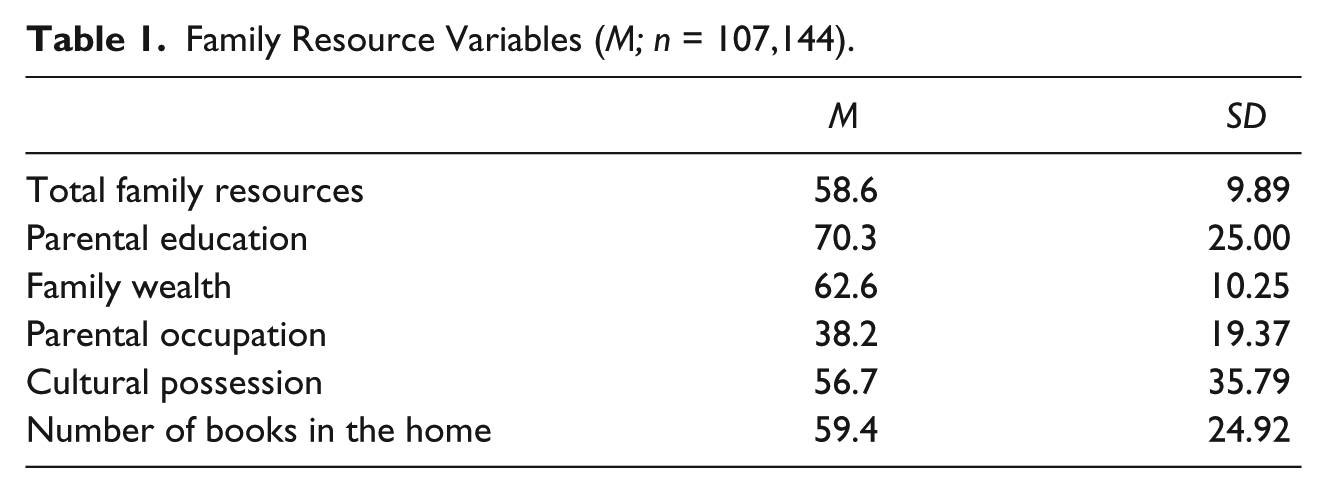
Finally, we measured total family resources by the PISA index of economic, social, and cultural status (ESCS). The index was constructed by using three indicators, namely, parental education, parental occupation, and home economic and cultural possessions. These indicators were standardized and the ESCS index was derived using principal components analysis (see OECD, 2001, for full description). To ease readers to interpret the results, all parental resource variables described above were transformed between 0 and 100. The distributions of parental resource variables are presented in Table 1.
Family Resource Variables (M; n = 107,144).
Control Variables
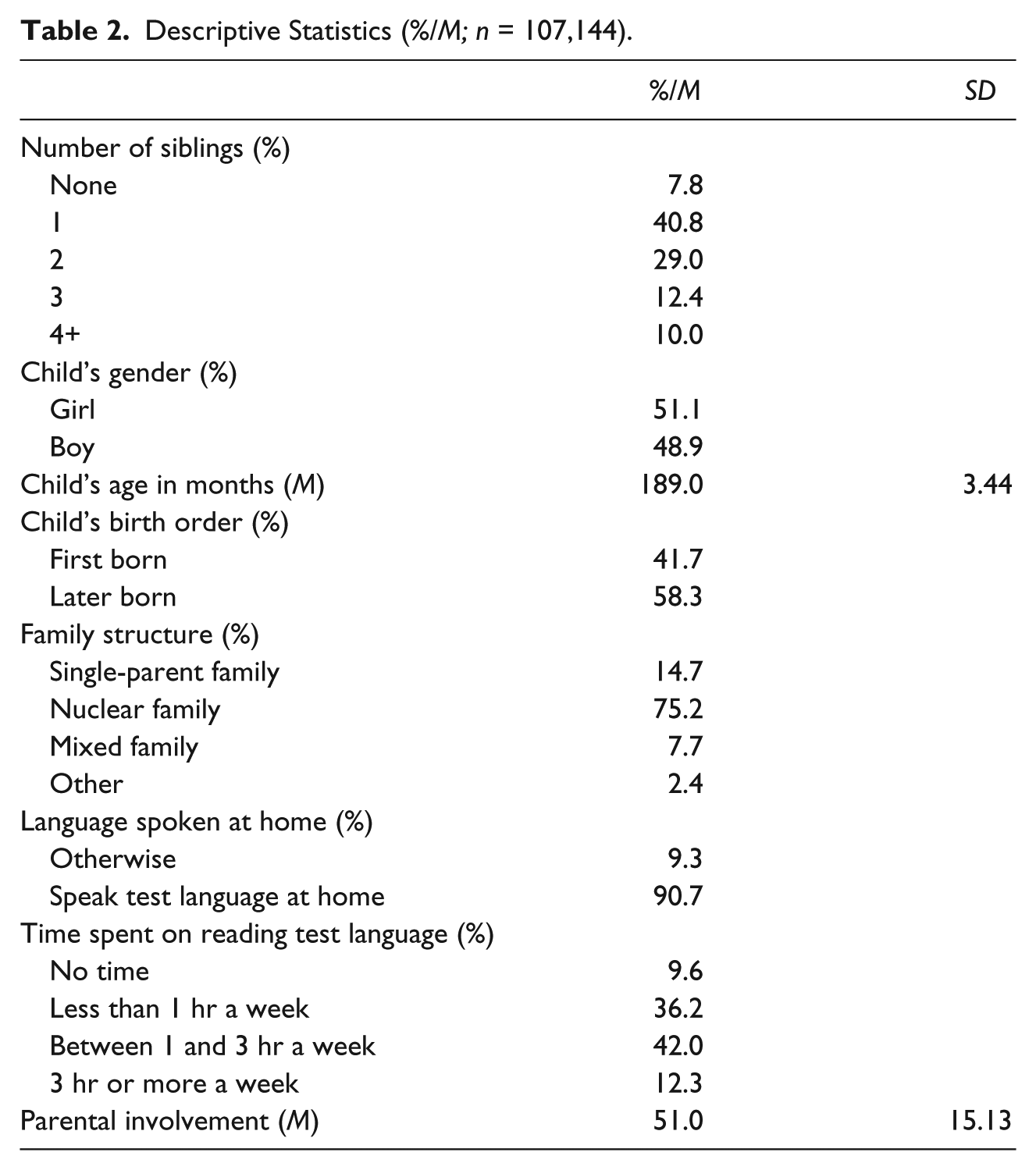
In the analyses, we controlled for several potential confounding variables, which have been shown to correlate with educational attainment in previous studies (e.g., Jaeger, 2008; Xu & Hampden-Thompson, 2012). These variables included the children’s gender, age (in months), birth order, family structure, the language spoken at home (i.e., whether the children were speaking the test language at home or otherwise), time spent on homework in test language, and parental involvement. The parental involvement variable was constructed by summing up the answers to six questions (Cronbach’s α = .66). These questions measured two dimensions of parental involvement, namely, cultural communication and social communication. Index for cultural communication included children’s answers to three questions: How often have they discussed social or political issues with parents? How often have they discussed about books, films, or television programs with parents? How often have they listened to classical music with parents? Social communication index also included responses to three questions: How often have they discussed with parents how well children are doing at the school? How often children and parents eat the main meal together around the table? How often parents spend time to just talk with the child? These index scale scores were standardized by Warm estimates (see Adams & Wu, 2002, for full description). These scores range from −7.13 to 6.85 and higher scores indicate higher parental involvement and lower scores the opposite. To ease readers to interpret the results, the parental involvement variable scale was transformed between 0 and 100. The sample descriptive statistics are presented in Table 2.
Descriptive Statistics (%/M; n = 107,144).
Analytical Strategy
The objective of the present study was to investigate whether family resources were more strongly associated with adolescents’ educational attainments in families with more children than in families with fewer children. Furthermore, the purpose of the study was to analyze whether there are differences among distinct parental resources regarding compensation and sibship size. Linear regression models with fixed effects that control for between-country variation (ordinary least squares [OLS] with country dummies) were employed. Because the PISA data were clustered by schools, we used Stata’s statistical software cluster option to compute the standard errors. This method took into account the non-independence of responses reported by children from the same schools. We used the statistical software Stata’s pv package to analyze five plausible values of reading literature (“pv” command in Stata; see Macdonald, 2014). The analyses of these reading literature scores were conducted 5 times, that is, once with each variable. The results indicated that the average score of the five plausible values and the variation among them was adjusted when calculating statistical significance. In the analyses, several of the potential confounding variables that were described above were controlled for.
Results
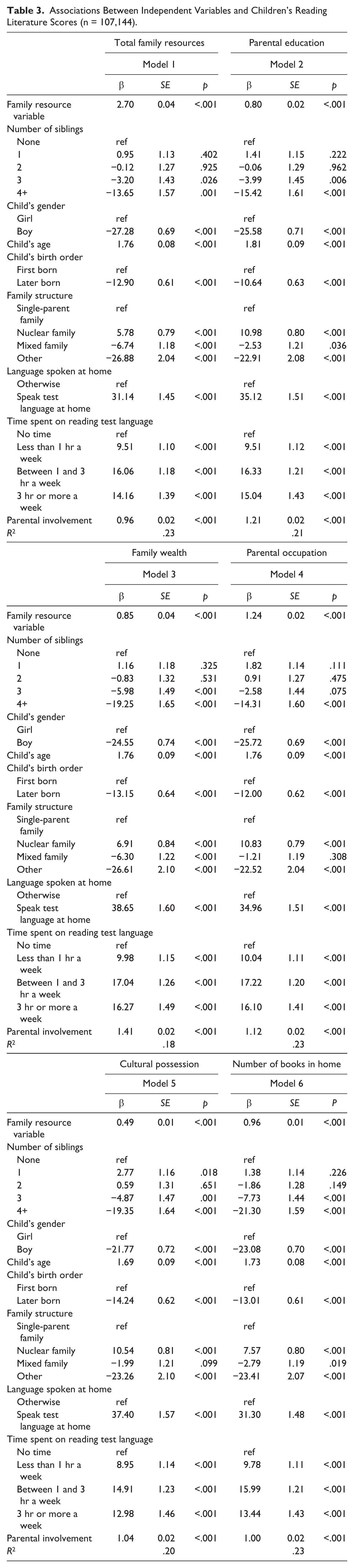
We present our empirical results in Tables 3 and 4. First we found that when parental resources increase, adolescents’ test scores also increase (Table 3). This result is it in the case with all parental resource variables studied (β-coefficients between 0.49 and 2.70; in all models p < .001). Thus, we can conclude that total family resources, parental education, occupation, family wealth, cultural possessions, and number of books in the home all correlate with improved educational achievements in children. Next our empirical analyses presented in Table 3 (Models 1-6) showed that when the number of siblings increases, the educational test scores decrease. The β-coefficients were between −13.65 and −21.30 among those with four siblings or more compared with reference group “no siblings” (in all models p < .001).
Associations Between Independent Variables and Children’s Reading Literature Scores (n = 107,144).
Associations Between Family Resource Variables and Children’s Reading Literature Scores by Sibship Size (n = 107,144).
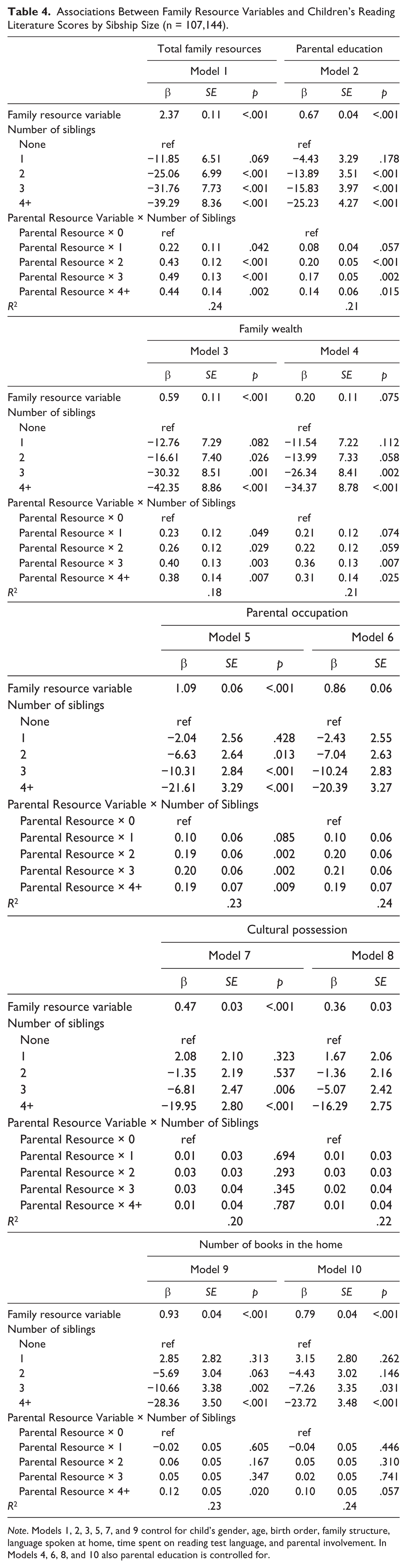
Note. Models 1, 2, 3, 5, 7, and 9 control for child’s gender, age, birth order, family structure, language spoken at home, time spent on reading test language, and parental involvement. In Models 4, 6, 8, and 10 also parental education is controlled for.
Moreover, Table 3 shows that in addition to family resources and number of siblings, several other factors correlate with the adolescents’ educational performance. Girls receive higher scores than boys, and as the children’s age increases, educational attainment increases. Later born children received lower scores than first-born children. The children who speak the test language at home received better test results than the children who do not speak the test language at home. The children from intact families received better scores and the children from the groups “mixed” (i.e., mother and male guardian, father and female guardian, or two guardians) and “other” received worse scores compared with the children from single-parent families. More time spent in reading test language was associated with higher scores. Finally, when parental involvement increased so did educational test scores among children.
According to first hypothesis, parental socioeconomic resources should be associated with educational test scores more strongly in families with a higher number of children than in families with a lower number of children. The results are presented in Table 4 (Models 2-6). We included interaction term between parental education and sibship size, between family wealth and sibship size, and between parental occupation and sibship size. These investigations show that a higher parental occupational and educational status are associated with increased achievements more strongly in children with one or more siblings than in children with no siblings (β coefficients between 0.08 and 0.40). In the case of family wealth and parental occupation, the results were mainly similar whether the parental education was controlled for or not. Thus, the findings support the first hypothesis.
Our second hypothesis predicts that parental cultural resources should not compensate for the negative impact of large sibship size. Thus, next we analyzed the interaction between cultural possessions and sibship size as well as number of books in the home and sibship size (Table 4). In the case of cultural possessions, results presented in Models 7 and 8 show that there are no significant interactions. In Model 9, we included interaction term between number of books in the home and sibship size and found that a higher number of books is associated with increased achievements more strongly in children with four or more siblings than in children with no siblings (β = 0.12; p = .020). However, after we controlled for parental education (in addition to other factors) in Model 10, there was no statistically significant difference (β = 0.10; p = .057). Thus, these findings provide support for the second hypothesis.
Conclusion
In this study, we have investigated the associations among sibship size, parental resources, and academic achievements in 15-year-old adolescents in 20 Western countries. First, we found that increased family resources are associated with increased test scores among children. Second, the increased number of siblings correlates with decreased educational achievements among children. These results are consistent with the prediction that is based on the dilution model, the sibling competition hypothesis, the confluence model, and several previous empirical analyses (e.g., Andersen & Jaeger, 2015; Downey, 1995).
The main objective of the present study was to analyze whether parental resources are associated with adolescents’ educational achievements more strongly in larger families than in smaller families. Furthermore, we were interested whether there are differences among distinct parental resources considering the compensation of the negative effect of large sibship size. We found that better family wealth, an increased level of parental education, and higher parental occupational status were associated with increased educational attainments more strongly in children who have siblings than in children without siblings. These results provide support for the predictions derived from the compensation model. In addition, we found support for the prediction that the parental cultural resources do not compensate for the negative impact of large sibship size.
Similarly, using data from the United States, Downey (1995) found that some parental resource types increased children’s school grades more in larger families than in smaller families, whereas other resources did not. In addition, consistent with our results, Downey found that cultural classes and activities were not associated with school grades more strongly in larger families than in smaller families. It seems that the amount of cultural resources may matter less for the compensation of sibship size than parental socioeconomic resources. We argue that this decreased importance may be because of the scalability of cultural resources. Several children may benefit from parental cultural possessions, for example, children can read the same books, whereas socioeconomic resources are more difficult to “re-use” (see also Jaeger, 2009, for discussion). If parents use 5,000 euro for the educational costs of one child, the same money cannot be used again for the educational costs of another child. Moreover, the positive influences of high parental education tend to be strongly related to parental involvement, that is, parental opportunities to give time to children. As time is always finite, when the number of children increases the likelihood to give time to any particular child decreases. Moreover, parental education can be a proxy for parental income and also in this case it should play a role regarding compensation. Overall, we believe that the inability to re-use resources is the main reason why resource compensation exists in the case of parental socioeconomic resources but not in the case of cultural possessions.
It is not totally clear why we found support for the compensation effect also in the case of parental occupation. If one predicts that occupational level indicates parents’ social status, there should be no compensation effect as social status does not dilute rapidly and thus high parental occupational status should benefit several children (as was the case with cultural resources). In contrast, if parental occupational status is a proxy for parental income, it should play a role regarding compensation. Thus, based on the present results, it seems that parental occupation indicates rather parental income than social status. Unfortunately, PISA data do not include direct information on parental income and thus we call for future studies to respond to this question.
The results fit well with the findings of previous studies on the compensation model (Bernardi & Cebolla-Boado, 2014; Bernardi & Grätz, 2015; Grätz, 2015). These studies have shown the importance of compensation for the better-off parents to overcome the potential disadvantages of their children in attainment. This importance also appears to be the case here because having more siblings is a relative disadvantage, and parents may also be at least partially aware of this. The finding also explains why and how advantages accumulate and multiply even more in well-off families (cf. DiPrete & Eirich, 2006). Having sufficient family resources gives both parents and children more possibilities to use them; it may be sufficient to address the problem of dilution just by exhausting these resources more efficiently than is necessary in the well-off families with fewer children. The intergenerational effects that are observed as multiplication (rather than just accumulation) at the top end of stratification may thus occur just because of the variation in the efficiency of utilizing family resources, not because these resources would have stronger multiplicative qualities.
Compared with previous research, our study has several strengths. Because we have used cross-national data, our results tend to be more generalizable than the results of studies that use data from single countries only (see Henrich et al., 2010, for discussion). In addition, we were able to study several parental resource variables and control for several potential confounding variables that have been shown to influence academic achievements in previous studies. Our study also has some limitations. First, here, we have used a snapshot rather than longitudinal data. We call for further research that analyzes whether parental resources matter more in larger families than in smaller families by using longitudinal data from several countries. Second, given the cross-sectional nature of the data, we cannot claim causality (see Angrist, Lavy, & Schlosser, 2010; Black, Devreux, & Salvanes, 2005; Conley & Glauber, 2006; Guo & VanWey, 1999, for discussion). Thus, the present results could be not related to resource compensation but rather some other mechanism. For instance, number of siblings is not exogenous to family background. If parents with higher level of socioeconomic resources tend to have on average less children, those with high level of socioeconomic resources who do have many children could be a selected group. If this kind of selection occurs, then the patterns observed here might be different from compensation effect. We call further studies to investigate this question. Third, we have measured child outcomes by the reading literature index, but in the future, other educational outcome variables should be explored. For example, there is room for studies that investigate whether children with more rather than fewer siblings benefit more from parental resources concerning access to a university-level education. Finally, here, we have analyzed adolescents’ educational scores, but it is important to study whether some parental resources matter more for younger children than for older children.
To conclude, the present study lends support to the previous results that show that when the number of siblings increases, the educational achievements tend to decrease. Moreover, in accordance with several previous studies, we have shown that parental resources are associated with improved educational achievements in children. Most importantly, however, the present study showed that consistent with the prediction based on the compensation model, the effect of parental socioeconomic resources tend to vary by the number of siblings. Thus, we hope that the present findings stimulate studies to explore social mobility by considering the compensation perspective.
Footnotes
Declaration of Conflicting Interests
The author(s) declared no potential conflicts of interest with respect to the research, authorship, and/or publication of this article.
Funding
The author(s) disclosed receipt of the following financial support for the research, authorship, and/or publication of this article: This research was supported by the European Research Council, decision number ERC-2013-CoG-617965; and the Strategic Research Council of the Academy of Finland, decision number 293103.