




Abstract
In this qualitative longitudinal study, we investigate how discrepancies between career goals set before graduation (T1) and actual achievements one year later (T2) shape the sustainability of emerging adults’ careers. Although prior research has shown that career goal discrepancies can challenge early career development, little is known about how such discrepancies emerge and are navigated during the school-to-work transition. Based on a one-year interview study of 36 participants, we identify three qualitatively distinct patterns: responsive alignment, recalibration and erosion, and reorientation after disruption. We also analyzed how the discrepancies shape participants’ happiness, health, and productivity. Beyond uncovering these patterns, we explore behaviors (e.g., reflection, planning, adaptability) and contextual factors (e.g., family support) that explain why discrepancies emerge and how they are navigated. Adding to the consensus that goal alignment is needed to support career sustainability, we demonstrate that even misalignment can catalyze growth when approached with adaptive reflection. We advance sustainable career theory by reframing discrepancies not as static shortfalls, but as dynamic interpretive experiences that can either disrupt or enhance career sustainability depending on how individuals and their contexts respond. In doing so, we contribute to broader debates on how young people build sustainable careers in uncertain labor markets.
Keywords
Introduction
In today’s volatile and rapidly changing labor markets, career goals, such as achieving promotions, salary increases, or acquiring new skills, not only shape individuals’ choices but also serve as benchmarks for evaluating success (Creed & Hood, 2015; Greco & Kraimer, 2020). The school-to-work transition (STWT) is defined as “a process during which individuals navigate a physical and psychological movement when leaving education and starting to integrate into the labor market,” (Blokker et al., 2023, p. 251) and is characterized by instability, ambiguity, and shifting expectations. During this initial transition into the labor market, career goals offer structure and direction (Praskova et al., 2015; Ranta et al., 2014). We define career goals as desired career outcomes that individuals wish to attain (e.g., promotions, salary increases, and skills acquisition; Greco & Kraimer, 2020; Greenhaus, 1987). Without clear career goals, emerging adults 1 risk feeling adrift, experiencing career distress, and delaying key developmental milestones (Akmal et al., 2021) that are fundamental for long-term career sustainability. Career sustainability can be defined as the ability to maintain and develop happiness (i.e., job satisfaction and personal fulfillment), health (i.e., physical and mental well-being), and productivity (i.e., performing effectively now and developing capabilities for future roles) across life stages and shifting career contexts (De Vos et al., 2020; Van der Heijden, 2005; Van der Heijden & De Vos, 2015). For the STWT, career sustainability means maintaining a happiness, health, and productivity balance from career entry, laying a foundation for later sustainability, while developing them as roles stabilize (see also Blokker et al., 2023).
Despite decades of research on goal setting across countries (predominantly U.S-based with some in Europe and Southeast Asia; Locke & Latham, 2019), less is known about what happens when individuals’ career paths deviate from their original goals. A key concept for understanding this phenomenon is career goal discrepancy, defined as “the perceived gaps between an individual’s desired career goals (future self or situation) and their career goal progress (current self or situation)” (Creed & Hood, 2015, p. 309). These discrepancies are not neutral. Negative discrepancies, indicating unmet expectations and inadequate advancement (Carver & Scheier, 1998), are associated with emotional distress, reduced motivation, and lowered self-efficacy (Widyowati et al., 2024a). Currently, the literature primarily focuses on the negative characterization of discrepancies and assumes that discrepancies are inherently detrimental. However, positive discrepancies have also been identified (Akmal et al., 2024). Positive discrepancies, when progress exceeds initial goals (Carver & Scheier, 1998), may foster satisfaction, confidence, and upward goal revision (Akmal et al., 2024). Although Akmal et al. (2024) reported empirical evidence supporting the idea that positive and negative discrepancies are largely independent constructs, viewing goal achievement in a bipolar manner still limits theoretical nuance, let alone empirical progress. Moreover, existing research typically assessed discrepancies prospectively using cross-sectional, quantitative scales (e.g., Akmal et al., 2024; Creed & Hood, 2015), treating them as static perceptions at a single point in time. Yet in practice, discrepancies can only be fully recognized over time, when set career goals are compared with later realities, and are likely to evolve. This highlights the need for longitudinal, qualitative approaches to capture how discrepancies emerge and change over time, and in this study, during the STWT.
Understanding how these discrepancies unfold during the volatile nature of the STWT is particularly urgent, as this transition comprises the phase wherein career identities, expectations, and professional behaviors start to crystallize (Blokker et al., 2023). Career goal discrepancies, whether driven by external setbacks or unexpected success, require individuals to adapt their goals and actions, often under pressure and with limited support (Widyowati et al., 2024b). When left unaddressed, discrepancies, whether due to unrealistic goals or limited progress, can undermine emerging adults’ early career confidence, lead to disengagement or premature compromise, and/or result in stalled or unstable career trajectories (Creed & Hood, 2015; Widyowati et al., 2024). In their review of the STWT, Blokker et al. (2023) demonstrated how the sustainable career framework is a valuable lens to research this transition process as it offers a holistic perspective by recognizing the interplay between the person (e.g., agency, adaptability), context (e.g., support, constraints), and time (e.g., development and change across life stages; De Vos et al., 2020). Adopting such a holistic lens is especially helpful for understanding the nuanced ways in which career goal discrepancies arise, evolve, and are responded to, because it captures the interplay between personal reflection, contextual influences, and shifting values over time—elements often missed in outcome-focused approaches.
Building on the need for a broader and integrative understanding of career goal discrepancies during the STWT, we ask three questions: (1) What patterns of career goal discrepancies emerge among emerging adults during their STWT? (2) How do these discrepancies affect their happiness, health, and productivity? (3) What roles do personal and contextual factors play in shaping and responding to these discrepancies? Using a longitudinal, qualitative design, we explore how emerging adults formulate, reflect on, and adapt career goals and their alignment across time.
Our study makes three contributions to the literature on career goal discrepancies and sustainable career development in the context of the STWT. First, we challenge the assumption that discrepancies are primarily binary. While much of the literature has emphasized distress and dysfunction in light of negative discrepancies (Akmal et al., 2021; Widyowati et al., 2024a), we investigate a wider range of experiences, such as moderate, shifting, or ambiguous discrepancies, that do not neatly align with this binary (i.e., positive vs. negative) framework. Our qualitative longitudinal approach reframes discrepancies as plural and complex, rather than polarized.
Second, by integrating the sustainable careers framework (De Vos et al., 2020) into our study, we contribute to the STWT by demonstrating how career goal discrepancies can act as catalysts for reflection, adaptability, and personal growth rather than merely indicating failure or success. Specifically, building on research in goal regulation and career adaptability (De Vos et al., 2020; Locke & Latham, 2002), we explore how evolving goals continuously reshape perceptions of discrepancies, shifting them from static gaps toward opportunities for meaningful career development. This reconceptualizes discrepancies not just as evaluative judgments, but as dynamic touchpoints in one’s career development.
Third, we address the limitations of cross-sectional research on career goal discrepancies by focusing on how emerging adults experience and reflect on discrepancies over time, and make adaptations. Current research tends to focus on anticipated discrepancies (i.e., asking participants to predict future challenges), rather than exploring how individuals experience and reflect on those discrepancies after the fact (Akmal et al., 2021; Creed & Hood, 2015). As a result, we know relatively little about the lived, evolving nature of career goal discrepancies and how individuals actively navigate them. By integrating both prospective and retrospective perspectives, our longitudinal design enables us to go beyond purely prospective, cross-sectional methodologies (e.g., Creed & Hood, 2015) and reveal how discrepancies emerge, persist, or resolve, offering insight into the lived, evolving nature of career development during the STWT.
Theoretical Framework
Goal Setting During the STWT
The STWT has long been viewed as a straightforward sequence. However, contemporary studies reveal its intricate and dynamic nature (Akkermans et al., 2021a). The STWT is now perceived as a process encompassing a variety of experiences, including internships, part-time work, and continued education, that collectively shape early career trajectories (Ng & Feldman, 2007). Moreover, the dynamic nature of modern labor markets demands that individuals combine structured planning with the openness to adjust when circumstances change (Savickas, 2005).
The STWT lays a foundation for career behaviors and identities. Emerging adults face the dual challenge of adapting to new roles and environments while managing the psychological demands of redefining themselves within professional contexts. In this period of uncertainty and pressure, they must navigate employer expectations, balance financial responsibilities, and make critical decisions about their career paths (Blokker et al., 2023). Against this backdrop, career goals, defined as any desired career outcome an individual wishes to attain (Greco & Kraimer, 2020; Greenhaus, 1987), emerge as a vital instrument to guide decision-making during turbulent times (Clements & Kamau, 2018). During the STWT, these goals serve as benchmarks that enable emerging adults to manage competing demands effectively (Ng & Feldman, 2007). Additionally, the pursuit and achievement of these goals are influenced by contextual factors such as family support, social networks, and organizational environments, which provide varying levels of resources and encouragement (De Vos et al., 2020; Greenhaus & Kossek, 2014).
Nevertheless, even with clearly defined goals, alignment between intentions and outcomes is not always achieved, especially within the unpredictable terrain of contemporary labor markets. During the STWT, emerging adults face ongoing tensions between what they aim for and what their context allows, prompting an ongoing reassessment of progress, values, and priorities (Akkermans et al., 2021a). Within this dynamic environment, misalignments between desired and actual career paths may arise. These perceived gaps are commonly referred to as career goal discrepancies, defined as the distance between one’s aspired career goals and current progress toward those goals (Creed & Hood, 2015). Despite its relevance, career goal discrepancy remains an underexplored concept, particularly during formative transitions such as the STWT (e.g., Akmal et al., 2021, Akmal et al., 2024; Creed & Hood, 2015; Widyowati et al., 2024b).
While prior work has focused predominantly on negative discrepancies, fewer studies have explored positive discrepancies, where progress exceeds initial goals, and which is linked to satisfaction, enhanced confidence, and upward goal revision (Akmal et al., 2021, 2024). However, emerging adults’ experiences might also be more ambiguous, where outcomes do not clearly exceed or fall short of their original intentions. Such complexity challenges binary frameworks and underscores the need to investigate the lived, evolving nature of discrepancies. Existing models often rely on static or hypothetical constructs, assuming stable goals and linear feedback loops, as seen in foundational theories like control theory (Carver & Scheier, 1990) and social cognitive theory (Bandura, 1991). These assumptions may falter during periods of rapid change, when goals themselves are in flux and responses are shaped by iterative reflection rather than fixed evaluations.
Sustainable Careers
Sustainable careers offer a dynamic perspective on how individuals maintain meaning, well-being, and performance across changing personal and professional contexts. Rather than emphasizing linear advancement or singular definitions of success, the sustainable career framework highlights how individuals preserve and build personal resources over time in ways that foster meaningful and viable careers (De Vos et al., 2020; Van der Heijden & De Vos, 2015). This framework is based on two core components: three indicators of career sustainability—happiness, health, and productivity (Van der Heijden, 2005)—and three guiding dimensions that shape these outcomes over time—person, context, and time.
Happiness refers to subjective experiences of job satisfaction and personal fulfillment; health encompasses physical and mental well-being; and productivity reflects individuals’ capacity to contribute effectively to their professional roles (Akkermans et al., 2021a; Blokker et al., 2023; De Vos et al., 2020). These indicators are not evaluated in isolation, but are interdependent and may shift in relative importance across life stages and circumstances.
The person dimension focuses on individual agency, including self-reflection, adaptability, and goal-setting behaviors that enable individuals to navigate transitions and align their careers with personal values (De Vos et al., 2020; Savickas, 2005). The context dimension highlights external factors such as organizational support, family dynamics, and labor market conditions that influence the resources and opportunities available to sustain careers (Blokker et al., 2023; De Vos et al., 2020; Greenhaus & Kossek, 2014). Finally, the time dimension emphasizes the evolving nature of careers, acknowledging that sustainability is not achieved at a single point in time but requires ongoing adjustments across life stages (De Vos et al., 2020; Van der Heijden & De Vos, 2015). This temporal lens is particularly critical during transitional periods, such as the STWT, when goals, identities, and external circumstances are all in flux (Blokker et al., 2023).
Recent studies have expanded the conceptual and empirical support for the sustainable careers framework (De Vos et al., 2020), for example, by examining how proactive behaviors shape the sustainability of early careers during the STWT (e.g., Gerritsen et al., 2024) and by using it as an analytical lens in reviews to synthesize evidence across complex and uncertain contexts (e.g., Blokker et al., 2023). This framework is especially relevant for emerging adults, as the STWT represents the first major career transition and therefore lays a critical foundation for one’s long-term career sustainability (Blokker et al., 2023; Steiner et al., 2022). The above-mentioned studies illustrate how the dimensions of person, context, and time, and their focus on happiness, health, and productivity, can be applied empirically. In the context of this study, we build on the previous scholarly work in this field by applying the sustainable careers framework to examine how individuals navigate misalignment between goals and outcomes during the STWT. This approach allows us to connect the lived experiences of misalignment to the broader sustainable career indicators.
Method
Research Design
This study employed a qualitative quasi-foundationalist approach, aligning with Amis and Silk (2008). Such an approach asserts the existence of a reality independent of our understanding but acknowledges that there is no theory-free knowledge (Denzin & Lincoln, 2005). In doing so, we aimed to generate generic findings that are both grounded and scientifically credible while recognizing the interpretive paradigm, wherein the lived experiences of the researched individuals are constructed in the written text by the researcher (House, 2005). The selection of this approach is driven by the idea that a research strategy should be practical while allowing for internal reflexivity among the researchers (Denzin & Lincoln, 2005). To engage with the socially constructed and relational nature of participants’ perceptions and experiences, an interpretivist ontology lens (Sandberg, 2005) was employed. An interpretivist ontology lens holds that reality is socially constructed and understood through the subjective interpretations and interactions of individuals (Guba & Lincoln, 1994).
To enhance our understanding of emerging adults’ career goals during the STWT from a career sustainability perspective (De Vos et al., 2020), we conducted semi-structured interviews that allowed us to explore participants’ perceptions, opinions, motives, and attitudes (Kallio et al., 2016). This approach provided an in-depth insight into the “why” behind the career goal discrepancies, their associated behaviors, and their relationship with the indicators of career sustainability. We adopted a qualitative longitudinal design over 12 months. In the Netherlands, almost every graduating student at Universities of Applied Sciences begins their final bachelor project half a year prior to graduation (Government of the Netherlands, 2023). Therefore, we conducted interviews at the commencement of the students’ graduation projects in February, which is approximately six months before their graduation, under the premise that this marks the initiation of the STWT for this cohort. Subsequently, interviews were repeated 12 months after the initial round (i.e., around six months after their graduation, in February of that year) to capture the transition of emerging adults into the workforce. This deliberate timing aligns with the view that the STWT is best understood as a process rather than a single event (Blokker et al., 2023), allowing us to trace both anticipatory goal setting before graduation and the lived realities of early work experiences afterward. Between T1 and T2, we did not engage in participant contact, beyond scheduling the second round of interviews.
Participants and Sampling
Purposive sampling was employed for the student interviews conducted at one of the largest Applied Sciences Universities in the Netherlands to ensure a representative selection (Black, 2010). Specifically, we focused on bachelor students in the field of Economics, chosen for their comprehensive education that enables employment across various industries (Times Higher Education, 2022). Considering the potential impact of factors such as gender (Patton et al., 2002), migration (Clair et al., 2017), and educational background (Wolniak & Engberg, 2010) on career outcomes, we incorporated these elements into our sampling strategy to enhance the validity of our study (see ‘Procedure’ for the workflow). To optimize representativeness, efforts were made to maintain a balanced sample across these factors.
Procedure
Participants were recruited by directly contacting the students for the initial round of interviews. Recruitment was conducted by the first author, who contacted students individually via Microsoft Teams. All final-year students in the program were eligible to participate; no formal exclusion criteria were applied. To ensure a sound degree of randomization in our recruitment process, we began by stratifying the eligible pool by gender, migration background, and educational background. Subsequently, we randomized the contact order within each stratum. Students were approached in a top-to-bottom sequence on the randomized lists until target numbers per stratum were reached. Participation was voluntary, and no incentives were provided.
Participant Overview of Students
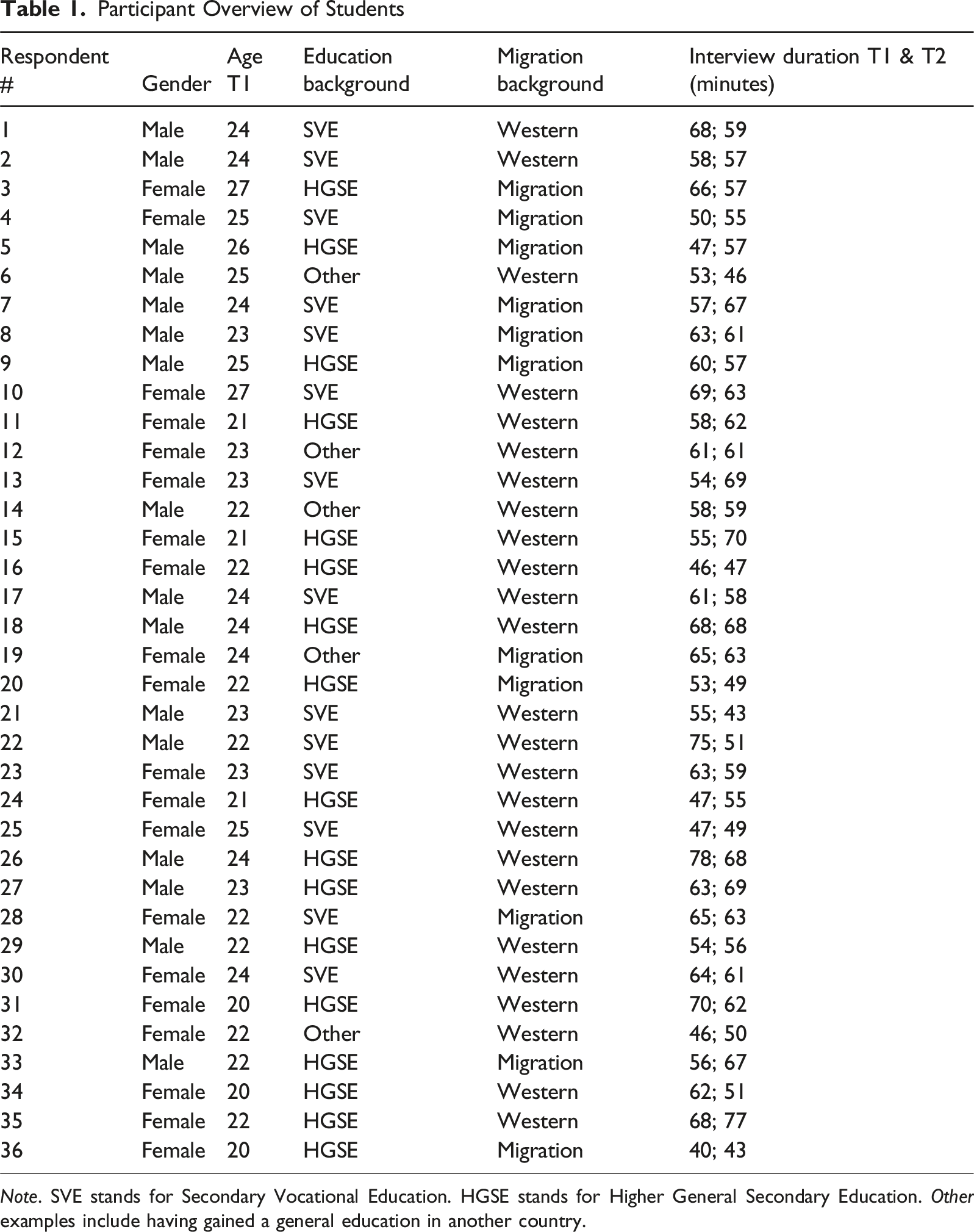
Note. SVE stands for Secondary Vocational Education. HGSE stands for Higher General Secondary Education. Other examples include having gained a general education in another country.
We took several measures to ensure the quality of the preliminary interview guide for the first round of interviews. First, we grounded the guide empirically by incorporating happiness, health, and productivity (Van der Heijden, 2005) as the three indicators of career sustainability (De Vos et al., 2020; Van der Heijden & De Vos, 2015). Second, the research team critically evaluated two preliminary interview guides, varying in their level of structure (i.e., a more open questionnaire versus a more structured questionnaire). Third, field testing was done by four potential participants to confirm relevance and to investigate whether diverse responses came up, which led to further clarifying wording, adjusting sequencing, and adding probes to elicit more detailed responses (Chenail, 2011). Notably, participants from the pilot study were excluded from the final study. Finally, the research team finalized the interview guide, considering criteria for varied and in-depth responses, and made the necessary adjustments based on field testing. In the first round of interviews, we explicitly introduced the sustainable career indicators—happiness, health, and productivity—using the definitions from the sustainable careers literature (De Vos et al., 2020). We then prompted the participants for concrete examples to ensure that participants’ stories aligned with our theoretical definitions before moving into the open questions. To strive for quality and consistency, for the second round of interviews, we used questions similar to those in the first interview guideline (see Appendixes A and B in Supplemental Materials for the final interview guides in English).
Additionally, in the second round of interviews, we initiated the session by asking participants to graphically depict the development of their happiness, health, and productivity over the past 12 months in a drawing (i.e., the development since the last interview). This approach aligns with visual methodologies used within qualitative research (Barbour, 2019; Guillemin, 2004). Participants were asked to interpret low to high values for the sustainable career indicators on the vertical axis (see Figure 1). Before the drawing, we did not pre-define happiness, health, and productivity to avoid steering the depiction. After the drawing, however, we used brief clarification probes to ensure a shared understanding of what each line in the drawing meant (e.g., clarifying that ‘productivity’ referred to performance/success in one’s current role and anticipated future roles). When participants used different meanings, we noted these explicitly and then proceeded with consistent terminology for the interview. In these interviews, the participants were asked to consider all events from the past year and the impact on their happiness, health, and productivity. The resulting drawing was then used as a basis for the interview, focusing on the dynamics sketched within the drawing (e.g., peaks or lows). This exercise was facilitated by the flexible nature of the interview guide, which could zoom in on both peaks and lows as well as stable drawings. This allowed for an open and expressive interview style as we delved into discussions based on the drawn representations. Happiness-Health-Productivity 12-Month Drawing of R23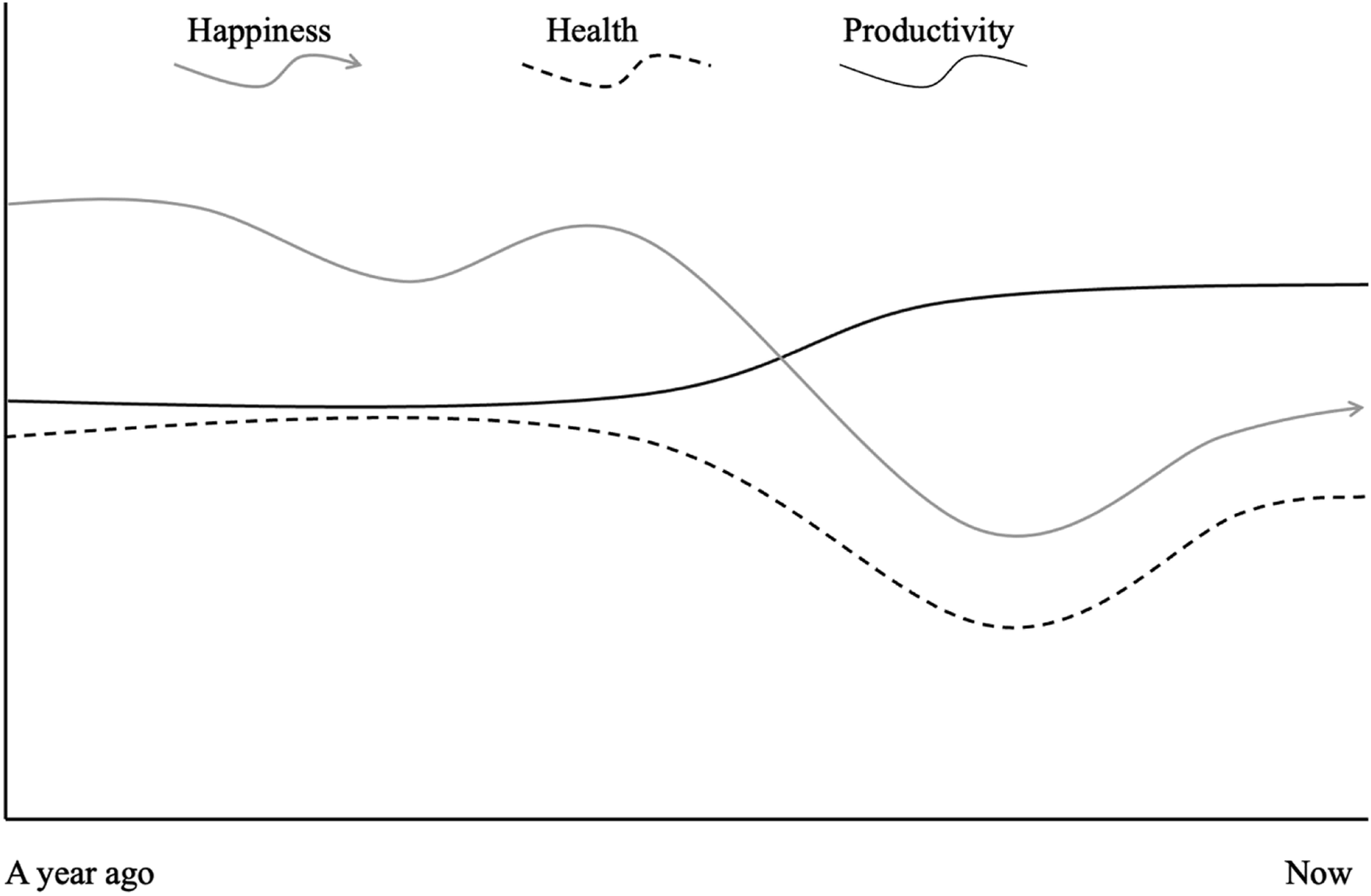
We adhered to the ethical guidelines of the university of the first author when conducting this study. Given the absence of an ethical commission at the participating Applied Sciences University, approval was obtained from the institution’s director and the educational manager of the relevant bachelor’s program. Finally, informed consent was obtained from all participants. To facilitate a thorough analysis, all interviews were recorded and transcribed verbatim. Participant anonymity was maintained by labeling individuals with a capitalized ‘R' followed by a number (R1, R2, etc.). Both rounds of interviews were done virtually using Microsoft Teams. The interviews lasted 60 minutes on average, ranging from 40 to 77 minutes. The interviews were conducted in Dutch, the first language of both the participants and researchers. This choice facilitated the most comfortable and thorough discussions. The first author of this article conducted all interviews.
Data Analysis
We employed template analysis (King, 2004), which is a structured form of thematic analysis (Nowell et al., 2017). Unlike approaches that rely solely on inductive, data-driven coding (see Braun & Clarke, 2021), template analysis begins with an initial coding framework (a ‘template of codes’) derived from theory, which is then iteratively refined based on the data (Flach & Kakas, 2000). In line with contemporary views on longitudinal qualitative research (Masdonati et al., 2024; Neale, 2021; Vogl et al., 2018), this approach combines a deductive foundation (using literature-derived preliminary codes) with inductive flexibility to add or modify codes as new themes emerge. Braun and Clarke (2021) situated template analysis within the ‘codebook’ family of thematic analysis approaches, which combine some a priori structure with researcher reflexivity. Appendix C in Supplemental Materials provides an overview of the final codes. Participants’ drawings were initially used to structure the interviews, and were subsequently examined through thematic analysis (Nowell et al., 2017) following established practices in visual methodologies (Guillemin, 2004). Additionally, they were coded for changes in happiness, health, and productivity to complement and triangulate the interview data.
All authors jointly coded ten percent of the first-round interviews to develop a shared coding scheme, refining codes when discrepancies arose. The first author then coded the remaining interviews from both rounds, consulting the second and third authors when uncertainties arose. Analysis of the first and second rounds was done separately, after which we compared each participant’s interviews side-by-side to trace individual change over time. Consistent with longitudinal qualitative research practices (e.g., Neale, 2021; Vogl et al., 2018), we first sought to understand the individual narratives and processes of change before looking at the cross-case analysis to map broader patterns and typologies of change.
We coded career goal discrepancies as follows. At the first round of interviews, participants were explicitly asked to state their main career goals for the first six months after graduation. At the second round of interviews, participants were not directly asked whether they had achieved these goals. Instead, they were invited to depict and narrate their trajectories through drawings of their happiness, health, and productivity, as well as interview accounts. We systematically compared the goals articulated at the first round of interviews with participants’ actual post-graduation situation as described in the second round of interviews (e.g., employment/role/contract, further education, entrepreneurship). Based on the drawings and interviews, we triangulated the data to judge whether each case reflected (1) responsive alignment, (2) recalibration and erosion, or (3) reorientation after disruption. We did not ask participants to ‘classify’ their discrepancy because member-checking of interpretive categories is contested (Birt et al., 2016). Instead, we used researcher-coded cross-wave classifications to minimize hindsight bias (Roese & Vohs, 2012). To illustrate this coding process, six example cases (two from each group) of T1 goals, their corresponding T2 outcomes, and assigned typologies are provided in Appendix D in the Supplemental Materials. Importantly, the majority of goals articulated at T1 were short-term and concrete (e.g., obtaining a diploma, securing entry-level employment, or beginning a master’s program), and thus appeared to be generally attainable within the one-year time frame we examined.
To enhance transparency and provide richer insight into participants’ lived experiences, we compiled extended illustrative quotes for each of the three discrepancy typologies identified in the Findings section. These quotes can be found in Appendix E in the Supplemental Materials.
Researcher Positionality and Perspectives
This study involved a research team comprising various members from several Dutch Universities (of Applied Sciences). All team members are trained in qualitative research methods and have extensive qualitative research experience. The team’s collective expertise spans educational sciences, career research, strategic human resource management, and work and organizational psychology. The authors represent different career phases, ranging from six to 36 years of research experience. All team members are familiar with the higher education sector through their roles in Dutch Universities (of Applied Sciences), and their research expertise extends to the Dutch labor market. Aligned with the belief that everyone is entitled to a sustainable career, the research team is part of a larger research project dedicated to stimulating and facilitating proactive behaviors for career sustainability among emerging adults during their STWT. In line with calls for reflexivity in qualitative research (Finlay, 2002; Tracy, 2010), we also engaged in internal reflexivity as part of routine analysis meetings. Rather than a formal positionality protocol, we integrated reflexive checks into our analytic meetings: when background assumptions surfaced, we named them, noted possible implications for coding, and searched for discrepant cases to keep themes anchored in participants’ experiences rather than researchers’ expectations.
Findings
Our longitudinal study of 36 emerging adults revealed three qualitatively distinct patterns of career goal discrepancy. We categorized participants into three groups based on the alignment between the career goals they articulated six months before graduation (T1) and their actual status one year later (T2): (1) responsive alignment, (2) recalibration and erosion, and (3) reorientation after disruption. Labels were derived by clustering first-order codes across the dimensions of person (mechanism), context (supports/constraints), time (development), and happiness, health, and productivity outcomes into second-order themes; a cross-case comparison then yielded three typologies (see Appendix C in Supplemental Materials). Those in the first group largely realized the plans they had set, though often under considerable self-imposed pressure. Those in the second group stayed broadly on track but allowed side goals or ambitions to fade, leaving a gradual goal erosion. Those in the third group encountered sharp breaks between what they had envisioned and what actually unfolded, which forced them to rethink and redirect their careers. Notably, none of our participants exceeded their initial goals. In other words, we found no cases of a “positive” discrepancy where outcomes surpassed expectations (we reflect on this further in the discussion section). Below, we detail each group’s characteristics, their relationships to the three sustainable career indicators (i.e., happiness, health, productivity), the individual behaviors that shaped their trajectories, and the key contextual influences that affected their career sustainability. We also highlight the mechanisms by which these discrepancies impacted early career well-being and development. We present three qualitatively distinct typologies shaped by the dimensions of person, context, and time. We interweave quotes here and provide extended excerpts per typology in Appendix E (see Supplemental Materials).
Group 1: Responsive Alignment
Group Characteristics
The participants in Group 1 experienced no apparent gap between their post-graduation outcomes and their initial career goals. In other words, they accomplished what they set out to do at graduation. For example, one participant planned to pursue a master’s degree while working part-time, and indeed achieved this. As R4T2 remarked, “For me it was clear: I wanted to follow this path, and I never deviated,” which culminated in a T2 outcome that matched the original goal. Such narratives show how clearly articulated, vision-driven goals enabled these graduates to follow through on their intentions. Among this category of participants, graduation was not an endpoint but rather a springboard to further goals, and their actions remained consistent with that outlook.
Sustainable Career Indicators
Overall, participants in Group 1 reported positive indicators of career sustainability. With their goals on track, they felt a strong sense of purpose and direction that boosted their happiness and productivity during the transition. However, pursuing ambitious goals also carried psychological and health costs even when those goals were achieved. Some noted that maintaining perfect alignment put them under intense pressure. For example, one participant (R17T2) suffered panic attacks, and another one (R11T2) developed partial facial paralysis during the year. As R11T2 clarified: “I set the bar high for myself, sometimes too high, because I don’t want to fall behind.” These incidents underscore that even “successful” goal attainment can strain well-being. Achieving one’s planned milestones brought a sense of happiness and accomplishment, yet high self-imposed standards sometimes detracted from health.
Individual Behaviors
Members of Group 1 displayed proactive, long-term orientations toward their careers. Many treated their early career steps as part of a bigger picture, approaching the STWT as an ongoing learning cycle rather than a one-off event, regularly reflecting on progress and adjusting tactics while keeping their long-term objectives in sight. As R7T2 explained, “I just want to acquire knowledge… I always want to keep learning, so even when I’m 40, I still want to learn new things.” This forward-looking mindset went hand in hand with careful planning and self-monitoring. One graduate said at T1, “If I want to achieve something, I make sure I achieve it” (R11T1), reflecting a proactive commitment to goal attainment.
Importantly, this proactive commitment also meant that alignment was not treated as fixed. Even when their early goals were achieved, some graduates re-evaluated whether these remained fulfilling. For instance, R30T2 initially followed her plan into further education, but later realized: “I’ve always felt that if you start something, you have to keep going. But at some point, I told myself, well, this isn’t making me happy, so I’ll stop with it.” She switched to a different career direction to better match her personal values and well-being. This example shows how ongoing self-reflection and flexibility, even after a goal is achieved, can prevent a potential misalignment from growing. In sum, participants in Group 1’s habits of long-term planning, continuous reflection, and readiness to adjust were key mechanisms that helped them to achieve their early goals while maintaining their happiness and health, keeping their post-graduation careers sustainable.
Contextual Factors
The experiences of participants in Group 1 were often bolstered by supportive contexts. In particular, family support reinforced a broad, value-driven perspective rather than narrow, short-term pressure. Several participants described parents or significant others who encouraged them to think deeply about their choices. For example, R31T2 explained that after job interviews, her parents would ask, “Is this what you want?”—prompting her to consider her true desires beyond simply securing any job. Such dialogue provided emotional support and permission to choose authentic paths, fostering long-term satisfaction. Ultimately, Group 1 participants were well prepared for the shift from student life to work life. Their thorough planning and clarity of purpose made entering “the real world” less disorienting. Yet, they were not exempt from stress. For example, R30’s experience above shows that realizations of misfit can arise even when one is following an initial plan. However, with a clear vision and support system, they navigated the transition more smoothly, treating surprises as signals to reflect and adapt rather than as crises. While the context was supportive, it took on a more auxiliary role; for these participants, personal agency and long-term orientation were the primary drivers of alignment. Essentially, a nurturing context (family support emphasizing personal happiness and fit), combined with personal preparedness, enabled Group 1 to align their goals with high well-being.
The journeys of Group 1 participants illustrate that having no initial discrepancy is not a static state of “everything going right,” but an active process of reflection, adaptation, and support. Ongoing planning and adjustment, backed by an encouraging environment, were crucial to this group’s continued happiness, health, and productivity.
Group 2: Recalibration and Erosion
Group Characteristics
Participants in Group 2 encountered a partial misalignment between their goals and outcomes. This gap was partial rather than complete: their post-graduation situation showed some alignment with what they had planned, alongside notable divergence. Often, they achieved certain aspects of their goal while letting go of others. For example, one student planned to work part-time and build a personal business one day a week, but by T2, was working full-time and not pursuing the side venture at all. The student stayed on a conventional career track (employment, as intended) yet dropped the entrepreneurial component of the goal. Similarly, others in this group stayed on a general trajectory (e.g., remaining in the same study program or industry) but did not fulfill specific goals such as internships abroad, creative projects, or further study that they had hoped to undertake. In many cases, the status quo was maintained—finishing their degree or holding a stable job—yielding outward success “on paper”, while other personal or specific goals were quietly set aside. This gradual reprioritization led to letting go of several initial goals. R17T2 reflected: “I did my work, but increasingly wondered whether it still fit with my goals,” a recognition that preceded dropping specific ambitions. Thus, their journeys were characterized by a quiet tension between expectations and reality: a gap that did not result in open failure or a dramatic change of course, but gradually shaped their sense of direction and satisfaction over time. This reflects not just a lesser degree of misalignment but a qualitatively distinct form: Broad goals were met, but finer-grained ambitions were deprioritized, deferred, or dropped.
Sustainable Career Indicators
Because their discrepancies were not extreme, Group 2 participants often continued to perform well. Many said they were ‘doing fine’ in their studies or jobs and indeed showed high productivity and achievement in academics or entry-level roles. Their health and happiness were not severely threatened in the short run; few reported acute stress, and they did not experience the upheaval of unmet graduation requirements or unemployment. However, the subtle misalignment in their situation often manifested as a growing sense of dissatisfaction or questioning. While they met their immediate obligations and stayed “on track” outwardly, these individuals often felt that something was missing in terms of personal fulfillment or long-term direction. One participant realized he was “just going through the motions… not really thinking: is this still what I want?” (R10T2). Or R28T2, “A friend said: you don’t sound enthusiastic anymore, and then I thought: he’s right.” These sentiments capture the discrepancy experience: their happiness and engagement were decent but not as high as they could be because the work or path they were on started to feel out of sync with their deeper interests or evolving goals. In the absence of obvious problems, these accounts suggest a quieter challenge to career sustainability—not through crisis, but through gradual erosion of meaning or motivation. Moderate discrepancies did not dramatically derail early progress, but they planted seeds of lower career happiness and purpose that might eventually undermine success if left unaddressed. Even a modest misalignment had implications for sustainability, highlighting the importance of recognizing and resolving these issues early.
Individual Behaviors
A defining feature of the behavior of participants in Group 2 was a lack of proactive behavior during the transition. Unlike participants in Group 1, they were less inclined to anticipate and pre-empt misalignment through early reflection, planning, or small course corrections. Instead, they often drifted along the most straightforward or expected path until the discrepancy became too obvious to ignore. Their goal pursuit was more reactive than proactive. For instance, some participants noted that they did not consciously decide to abandon their side goals. Rather, competing demands slowly took over. Several participants described how side goals disappeared gradually: as R14T2 explained, “There wasn’t one big change, but slowly I noticed—I was working more, and my side project just… faded.” Similarly, R12T2 admitted, “I didn’t decide not to do it. I just kept saying ‘not now’—and eventually, it just wasn’t a thing anymore.”
It often took an external prompt to spur reflection. As R23T2 recalled: “When my manager asked where I saw myself in five years, I realized I had no answer.” Yet, another participant described how a confrontation at work became a nudge, as R26T2 recalled, “When my manager lashed out at me, she really woke me up, like, yeah, it’s nice that you’re getting high grades, great, but this is the real world, welcome!” This harsh feedback suddenly highlighted the gap between academic comfort and professional expectations, prompting him to re-examine his complacency. In Group 2, such prompts triggered belated reflection, but did not precipitate a major shift in direction. After coasting for a time, these individuals began engaging in self-questioning. As their awareness grew, some Group 2 participants initiated a tentative recalibration of their goals. One student shared that even while everything looked successful externally, a “little voice” in the back of his mind kept asking, “Is this it?” (R17T2). That inner voice marked the beginning of a critical re-evaluation of his path. Ultimately, insufficient reflection and a short-term focus had allowed minor misalignments to persist; only after some time (and often an external prompt) did these individuals adjust their course.
Contextual Factors
The context of the STWT both concealed and eventually exposed the quiet drift for Group 2. On the one hand, the structured environment of leaving university and beginning full-time work or advanced study provided immediate objectives (e.g., finishing assignments and pleasing a new boss) that kept these graduates busy and outwardly on track. Early in their careers, simply keeping one’s head down and meeting expectations often passes as success, and participants in Group 2 excelled at that. However, this same context introduced new pressures and learning experiences that ultimately forced them to confront the gap between their expectations and reality. As the relatively unstructured freedom of student life transformed into the fixed schedules and responsibilities of working life, many were confronted with questions about where they were headed. R28T2, for instance, recalled how “I really had to adjust to the 9-to-5”, an adjustment they had not anticipated. These “real-world” realities served as natural inflection points when questions about fit and satisfaction could no longer be ignored.
Another key contextual factor was the absence of support outside of work. Unlike some participants in Group 1, many in Group 2 did not have strong mentoring or family guidance during this period; they often lacked clear support structures. As R30T2 noted: “At home they asked how it was going, but never critically, so I just muddled along.” Without mentors or family members prompting them to examine their deeper goals, it was easy for these individuals to continue in autopilot mode. When support did appear, it was often in the form of (tough) feedback from work (e.g., a manager’s blunt rebuke; R25T2) rather than gentle, proactive guidance. Thus, external influences played a dual role: initially, the structured work environment masked personal misalignment, and later, critical incidents and transition stress exposed the need for change. Notably, the discrepancies among participants in Group 2 never escalated into full crises, partly because contextual prompts eventually prompted them to adjust (or at least acknowledge the problem). The moderate discrepancy experience underscores how transitional contexts can both shape emerging adults’ paths and reveal misalignments, especially in the absence of early self-reflection.
Group 3: Reorientation after Disruption
Group Characteristics
These participants experienced major ruptures between their initial career goals and the situation one year after graduation. In plain terms, what they ultimately did was very different from what they had planned. In some cases, intended goals did not materialize. For example, R2T2 described: “When I was rejected for the job I had set everything on, I had to rethink what I actually wanted.” Another graduate who aimed to start a master’s program immediately after college instead entered full-time employment, and another who envisioned launching a start-up found themselves joining an established company. While none of these outcomes are objectively ‘bad’, both cases involved a shortfall from the participant’s original goals, thereby constituting a negative discrepancy in terms of unmet expectations, even if not experienced as acute failure.
In other cases, the goal at T1 was so short-term that achieving it left a void. Notably, several participants in this group framed graduation itself as the primary objective, treating the act of finishing school as a goal in its own right rather than a step toward a longer career plan. For instance, one graduate declared, “My biggest goal is to get my diploma.” This emphasis on immediately completing the degree reflects a mindset where the planning horizon did not extend beyond the graduation ceremony. While earning the diploma was important, an exclusive focus on that milestone often hindered deeper reflection on what would come next. As a result, once these participants graduated (and many did finish on time, thus initially “succeeding”), they had no clear roadmap and often found themselves in jobs or situations that did not match any broader ambitions, or simply felt unsure of what to pursue next.
The defining feature of participants in Group 3 was the significant disconnect between their initial goals and the subsequent reality experienced post-graduation, which required them to re-orient their plans. For some individuals, this disconnect resulted from setting overly ambitious objectives, such as starting a business or aiming for a selective opportunity, that ultimately did not materialize as planned. Others faced challenges due to setting overly narrow, short-term goals like ‘simply obtaining the diploma,’ which left them without a comprehensive vision for their future. In both scenarios, while graduation represented a notable achievement, it was often followed by feelings of uncertainty, aimlessness, or disappointment as their original intentions fell short of actual outcomes.
Sustainable Career Indicators
Experiences of participants in Group 3 had the most complex, and initially the most turbulent, implications for career sustainability. In the short term, reaching a goal like graduating provided a brief boost of happiness. For example, R2T1 described feeling happy in the final phase of school: “This final time gives me happiness that I’m almost done… once it’s done, it’ll be a chapter that I can check off.” Completing the immediate objective yielded short-lived satisfaction. However, because a major discrepancy loomed—their longer-term career situation was unresolved or off-track—this initial high was often followed by confusion, disappointment, or anxiety. Many participants in Group 3 experienced a decline in happiness in the months following graduation, as the reality of their misalignment became apparent. As R35T2 put it: “I had a burnout, then I had no choice but to look at everything differently.” Or, being existentially halted in another way, R30T2 admitted that after finishing school with no clear plan, “I was really a bit stuck, and I thought, I don’t know which way I want to go.” R30’s reflection captures a broader pattern: this feeling of being stuck captures the drop in momentum and emotional well-being that occurred when one goal is finished, and no next goal is in place. In terms of productivity, some of these graduates floundered initially. Those who failed to get into a master’s program or whose start-up plans fell apart had to scramble for alternatives, often ending up in stopgap jobs that did not fully use their skills or interests. Significant stress was also common, though it took different forms. Some mentioned burnout or intense pressure from trying to catch up, while others suffered a blow to self-esteem and the stress of prolonging their studies with extra costs.
Yet the longer-term outlook for this group was not uniformly bleak. Crucially, some participants managed to transform their significant discrepancies into opportunities for growth, thereby improving their sustainable career prospects after the initial setback. Being knocked off track forced some to engage more deeply with what they truly wanted and valued, leading to positive changes. For example, two participants who failed their final projects (and did not graduate on time) eventually reframed that failure as a chance to reassess their life priorities. R5T2 recounted that during the extra year resulting from this setback, “I was able to focus on what I found important in life… I could focus on my relationship with God, you know. That’s important to me.” With more time for personal and spiritual development, they said, “I spent more time on that and started praying more. I really tried to change… and I truly felt happy.” What initially seemed like a purely negative outcome (a delay in graduation) turned into a period of significant personal growth, yielding greater happiness and a clearer sense of purpose, key components of a sustainable career. Similarly, R29 described how an unplanned deviation from their original path (studying abroad for six months, which was not in their initial plan) ended up broadening their horizons. They took a course in a new field and discovered a passion, leading them to pursue further education in that area. In these cases, the discrepancy acted as a catalyst for reflection and redirection, ultimately improving the individuals’ alignment with their work and long-term goals. The severity of the misalignment appeared to generate a stronger impulse for change than the more subtle drift experienced by participants in Group 2, where the absence of acute tension sometimes delayed meaningful adjustment.
Individual Behaviors
In terms of individual behavior, many Group 3 participants initially had a short-term, outcome-driven mindset that left them without a clear plan once their immediate goal was met or thwarted. Few had engaged in forward-looking reflection during school, so when they finished (or failed to finish), they had little sense of alternative direction. Over time, some of these graduates made a crucial shift toward a more reflective and flexible approach: they started asking more profound questions about what they truly wanted and opened themselves to new paths. Within this pattern, those who pivoted—by changing plans or seeking new guidance—eventually found better alignment and well-being. By contrast, those who clung rigidly to their original plan or felt paralyzed by the setback struggled to find a sustainable way forward. The turning point for many was moving from a passive, fixated stance to an active, adaptive one. This ability to pivot and learn ultimately separated those who rebounded in their careers from those who remained stuck.
Contextual Factors
On many occasions, the surrounding context of participants with significant discrepancies either compounded their difficulties or provided turning points for improvement. A key external influence was family and societal expectations. Many Group 3 participants came from environments that placed heavy emphasis on immediate achievements, such as finishing the degree or quickly getting a “good” job. Family support in these cases was well-meaning but narrowly focused. For example, R5T2 recalled their parents pressuring them, saying, “Your main focus should be to get your diploma.” This kind of encouragement, centered squarely on hitting the short-term target, likely reinforced their own short-term focus and discouraged thinking about alternative paths or backup plans. Once the diploma was attained (or not attained), that support often waned or turned to concern, but by then, the student was left without guidance on next steps. This illustrates how a context fixated on immediate success can inadvertently set the stage for a later discrepancy.
In contrast, some participants eventually encountered supportive figures or environments that helped them broaden their perspective. A few found mentors or had chance encounters that provided reflective support after their initial plans fell through. This kind of input helped open their eyes to new possibilities beyond their original plan. Besides interpersonal support, the nature and timing of the transition itself were influential. Leaving university and entering the workforce was often more disorienting for Group 3 participants than for others, highlighting their lack of direction. However, within this challenging period, there could also be formative experiences. An unplanned study-abroad detour became one such turning point for one participant; others mentioned that taking a temporary job or some gap time, while stressful, gave them exposure to new ideas or time to reflect.
When the surrounding context values only immediate outcomes, it hinders future preparation and exacerbates discrepancies. But when the context offers some breathing room or novel input (a “trial period” after graduation or support for exploration), it can catalyze a return to a sustainable direction. Such contextual factors could mitigate the negative impact of the discrepancy or help the individual bounce back, whereas lacking these supports made it much harder.
Beyond the Three Groups: Emerging Mechanisms and Evolving Reflections
To understand how career goal discrepancies affect sustainability, we identified mechanisms that cut across group lines. First, reflection emerged as a longitudinal and evolving process—one that evolved over time and shaped participants’ ability to adjust. Around graduation, many participants focused on concrete, short-term goals such as submitting a thesis, securing a job, or simply “getting it done.” These immediate aims helped manage the uncertainty of transition, but often lacked a broader sense of purpose. As participants entered the workplace and gained distance from school, their reflections began to shift. Some started asking more fundamental questions—not just whether they were reaching their goals, but also whether those goals still made sense. R25, for example, noted, “Now that I’ve graduated, it feels like I have to figure out who I want to be, not just what job I want.” Others, like R16, moved from “I just wanted to find something that paid well” to a more holistic outlook: “how it fits into the rest of my life.” When this kind of deeper reflection happened earlier, participants were generally better prepared to adapt and avoid painful discrepancies. When it came later, they were more likely to cling to outdated plans, only adjusting after experiencing significant misalignment.
Second, the interaction between personal agency and contextual support played a central role. Some participants showed strong agency through planning, reflecting, and adapting. But this was not enough on its own. Those embedded in rigid or unsupportive environments struggled to respond constructively to setbacks, even when motivated. Conversely, those with more flexible and encouraging support systems (such as mentors or families who offered feedback or validation) were better equipped to adjust. For instance, many Group 1 participants benefited from ongoing conversations that helped them reassess and refine their paths. In contrast, several Group 3 participants lacked such input and often faced the challenges alone, which intensified the impact of misalignment.
Third, discrepancies themselves were not inherently negative or positive—it was the response that shaped their effect on career sustainability. A slow erosion, if ignored, could slowly drain energy and focus. A major disruption, while destabilizing, sometimes sparked meaningful reassessment and growth. Across all groups, what mattered most was how individuals interpreted the gap between their goals and current reality, and how they responded to it over time.
Comparative Overview of Discrepancy Groups a
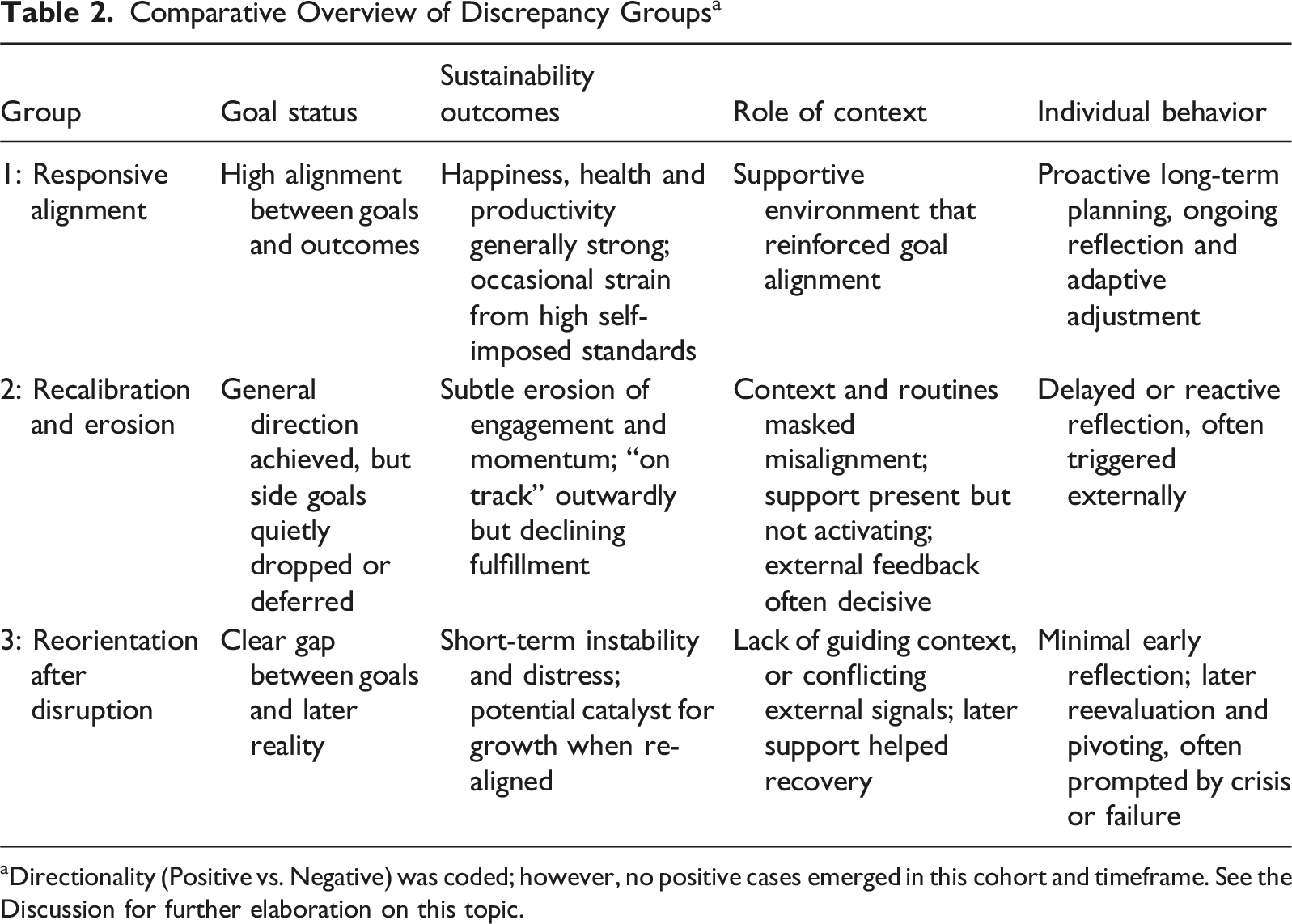
aDirectionality (Positive vs. Negative) was coded; however, no positive cases emerged in this cohort and timeframe. See the Discussion for further elaboration on this topic.
Discussion
This study examined how career goal discrepancies unfold during the STWT and how they relate to early career sustainability. In response to our first research question—what patterns of career goal discrepancies appear—we identified three qualitatively distinct typologies: (1) responsive alignment, (2) recalibration and erosion, and (3) reorientation after disruption. Their experiences reflected a range of alignments and misalignments shaped by both goal clarity and external factors. By distinguishing these groups, we emphasize that discrepancies should not be seen as points on a single continuum of success or failure, but as different ways of experiencing and negotiating alignment in early careers.
In addressing our second question—how do discrepancies influence happiness, health, and productivity—we found that alignment generally supported short-term satisfaction and performance, though it sometimes came at the expense of health due to high expectations and pressure. Across groups, the links between discrepancies and happiness, health, and productivity were not linear; we observed trade-offs and sequencing (e.g., high happiness/productivity paired with depleted health). For example, Group 2 often sustained outward success yet slowly eroded happiness. Group 3’s disruptions were destabilizing at first, but in some cases sparked deeper reflection that eventually restored balance. Overall, it was not the discrepancy itself, but the emerging adult’s interpretation and response that determined its impact on career sustainability.
Finally, regarding our third question—what role do personal and contextual factors play—we observed that proactive reflection, value-driven planning, and adaptable behavior were key to navigating discrepancies constructively. Supportive environments, particularly those encouraging open dialogue and long-term thinking, helped individuals maintain or restore alignment. In contrast, lacking, rigid or narrowly focused support often contributed to short-term thinking and deeper misalignment.
Taken together, these findings underscore qualitative differences in how discrepancies play out. Their effects depend on personal behavior, context, and timing, and cannot be reduced to simple binary logic.
Theoretical Contributions
This study contributes to research on career goal discrepancies and sustainable careers within the STWT context, in four key ways. First, we challenge the assumption that career goal discrepancies are best understood in binary terms, either positive (goals exceeded) or negative (goals unmet). Our findings reveal a broader spectrum that also includes partial discrepancies, where some aspects of a career goal are achieved while others are deferred or dropped. This typological expansion shows that discrepancies are not static or clearly polarized outcomes, but complex and evolving experiences. Particularly, the “recalibration and erosion” group illustrates a qualitatively distinct pattern: broad alignment with overarching goals (e.g., “having a stable job”) coexists with the gradual loss or postponement of more specific aspirations (e.g., creative ambitions or entrepreneurial plans). These subtle drifts, such as gradually letting go of goals without conscious decision, often remained under the radar, yet had meaningful implications for their happiness. By foregrounding these nuances in career goal discrepancies, we advance a more nuanced conceptualization of discrepancy as plural, layered, and shaped by shifting interpretations over time, building on and extending earlier work that treated discrepancy primarily as dichotomous (Akmal et al., 2021; Widyowati et al., 2024a). This interpretive view also aligns with career construction theory (Savickas, 2013), which highlights how individuals ‘re-author’ their career stories as circumstances evolve. Adopting this lens, discrepancies operate as prompts for narrative reconstruction. That is, career goals are recalibrated, meanings are revised, and next steps are tested. As a result, the same discrepancy can narrow, widen, or be redefined across time, underscoring that such discrepancies are processes, not static states.
Second, by integrating the sustainable careers framework (De Vos et al., 2020; Van der Heijden et al., 2020; Van der Heijden & De Vos, 2015), we reframe career goal discrepancies not merely as indicators of failure or success but as interpretive moments that can spark reflection, adaptation, and renewed direction. Our data show that even significant misalignments, such as not graduating on time or abandoning an initial plan, can become catalysts for growth if individuals engage reflectively and have the contextual support to recalibrate. Participants from Group 1 exemplify how long-term orientation and reflective planning can reduce the disruptive potential of the STWT; for them, graduation was not an endpoint but a moment within a larger, ongoing cycle of career development (De Vos et al., 2019). Their ability to treat their early career phase as an iterative process rather than as a period with one endpoint suggests that alignment is more likely when goals are framed with a long-term, value-based lens rather than short-term performance markers. This process view extends goal-setting theory (Locke & Latham, 2002) by emphasizing adaptive rather than evaluative responses to discrepancy and supports a process-oriented view of sustainable career development (De Vos et al., 2020).
Third, we address the limitations of prior research that relies heavily on prospective, snapshot-based approaches, which treat discrepancies as anticipated gaps between current and future goals (Akmal et al., 2021; Creed & Hood, 2015). Instead, our qualitative, longitudinal design highlights how participants often only recognized the meaning of those gaps in retrospect. For example, several individuals initially described their career path as “on track,” only to later reflect that they had suppressed meaningful aspects of their goals. This time-sensitive, meaning-making process was particularly evident in Group 2, where a delay in reflection contributed to sustained partial misalignment, potentially more detrimental than a dramatic disruption, as the former lacks an apparent trigger for action. By capturing these evolving trajectories, we show that discrepancies are not single data points but dynamic sensemaking processes shaped by context, timing, and reflection. This reframes discrepancies as interpretive developments—best understood through longitudinal, narrative methods—and answers recent calls for process-oriented approaches in career development research (Blokker et al., 2023).
Building on this temporal critique, we further address how discrepancies are conceptualized and measured. Although positive and negative discrepancies make sense conceptually, in our data, no positive discrepancies were found. That is, participants in our study did not report exceeding their initial goals. We argue that negative discrepancies likely trigger strong affective responses (e.g., stress, anxiety, and recalibration). By contrast, positive discrepancies are less pronounced and perceptible, thus making them more difficult to grasp. Participants narrated early achievement (i.e., meeting expectations and settling into first roles), but under our goal-anchored comparison, these accounts did not surpass their initial goal. This suggests that positive discrepancies may be structurally harder to observe in practice, particularly in early careers where aspirations are still forming. This calls into question whether existing measurement tools can adequately capture the phenomenon. Indeed, existing scales, such as the Career Goal Discrepancy Scale (Creed & Hood, 2015) and the Positive Career Goal Discrepancy Scale (Akmal et al., 2021), take a prospective stance by asking respondents to imagine future discrepancies, which may not capture how such experiences are lived and reinterpreted over time. Our findings suggest the need for refined conceptualizations and methods that can not only address whether discrepancies are “positive” or “negative”, but also how they emerge, are noticed, and redefined in the flow of early career development.
Fourth, an unexpected yet salient finding was the role of career shocks—sudden, disruptive events such as failed assessments, rejections, or confrontational feedback, that trigger deliberate career reflections (Akkermans et al., 2018, 2021b)—as critical turning points in how participants navigated discrepancies. While career shocks did not comprise a predefined focus, they surfaced across accounts, especially among those with significant negative discrepancies. In contrast to frameworks that emphasize prospective planning, these shocks often triggered unplanned but profound reassessment. For some, the disruption prompted a shift from passive drift to active goal redefinition. This suggests that shocks can catalyze not just new directions, but new interpretations of one’s career goals and values. We extend prior work (e.g., Akkermans et al., 2018, 2021b) by (1) positioning career shocks as a valuable lens for understanding career-goal discrepancies, and (2) showing that discrepancy experiences, and their interpretation, operate as a mechanism through which shocks shape career outcomes. Ultimately, career shocks are transforming discrepancies from markers of failure into entry points for meaningful, if unexpected, career development. In doing so, we bring a discrepancy-focused lens to the study of career shocks and highlight their interpretive role in early career sustainability.
Practical Implications
Our findings offer concrete strategies for institutions and educators supporting emerging adults during the STWT, particularly in navigating career goal discrepancies. First, institutions can promote adaptive goal setting by embedding structured reflection into the curriculum in a sustained, low-threshold way. Rather than relying solely on standalone counseling sessions or final-year planning tools, reflection activities should be woven into existing touchpoints, such as internships, project-based courses, or mentoring programs. For example, recurring “goal evolution” prompts can help students track how their aspirations shift over time and why. This supports prior calls for iterative, values-based approaches to career development (Savickas, 2005; Van der Heijden et al., 2020), while also resonating with our finding that long-term, reflective planning contributes to greater goal alignment and career satisfaction.
Second, students need help in detecting and interpreting discrepancies early, particularly partial or ambiguous ones that may not feel urgent but still impact engagement. One approach is to build in “discrepancy check-ins” as part of coaching conversations or digital self-assessment tools. These would encourage students to regularly compare their current path with earlier intentions and surface points of drift. While prior research has primarily focused on overt failures (Creed & Hood, 2015; Widyowati et al., 2024a), our study demonstrates that subtle misalignments can be equally disruptive if left unrecognized. Helping students to develop what might be called “discrepancy literacy” could enhance their ability to act before misalignment becomes entrenched.
Third, while support from families or mentors plays a role in helping students reflect, its impact depends heavily on how that support is given. Our findings suggest that exploratory dialogue—asking open-ended questions and validating uncertainty—is more beneficial than pushing for linear success. Institutions can support this by developing conversation guides or short briefing sessions for parents and mentors that promote reflective rather than directive support styles. This builds on prior work showing that stakeholder expectations shape student choices (Greenhaus & Kossek, 2014; Ng & Feldman, 2007), while aligning with the observation that rigid external pressure can constrain adaptive decision-making (Gerritsen et al., 2024).
Limitations and Suggestions for Future Research
Our study has several limitations, some of which highlight areas for future research. First, there are limitations associated with the composition of our student sample. Although we took deliberate steps to ensure a balanced and representative sample by considering factors such as gender (Patton et al., 2002), migration status (Clair et al., 2017), and educational background (Wolniak & Engberg, 2010), our sample consisted solely of Dutch citizens enrolled in a specific higher education program in the Netherlands. As a result, our findings may not be generalizable to other contexts. Further empirical research is needed to determine the broader applicability of our conclusions, particularly in educational systems with different structures. For example, the university college system in the United States, which allows for greater autonomy in curriculum design, may lead to different transitions into the labor market regarding career sustainability indicators (Henri et al., 2018). This increased autonomy may influence career goal setting by encouraging students to develop a stronger sense of ownership over their career trajectories earlier in their academic journeys. Consequently, students may prioritize long-term aspirations over immediate academic milestones, potentially reducing the perceived significance of the final graduation project.
Second, while our study did not specifically aim to explore the impact of socio-economic backgrounds or family dynamics, these factors emerged as influential in the experiences of some students. Although we employed purposive sampling to ensure representation across various demographics (including gender, migration status, and educational background), migration background appeared to play a key influential role. Students from migration backgrounds occasionally emphasized the importance of family support in navigating the STWT, describing emotional or practical assistance that helped them remain resilient during challenging periods. This aligns with prior research showing that students from minority or migrant backgrounds often rely heavily on family networks to compensate for systemic disadvantages in the labor market (Leschke & Weiss, 2020). While our purposive sampling ensured demographic diversity, it may not have fully captured the variation in how migration background intersects with family support. Furthermore, more network-based recruitment strategies (e.g., snowballing) could have yielded additional nuance in the Group 2 (i.e., recalibration and erosion) by mobilizing participants’ social ties or reach underrepresented cases.
However, as we did not systematically examine the interplay between migration background and family dynamics, more research is needed to examine the impact of a migration background. Future research could explore intersectionality more deeply to better understand how migration background influences family support and career outcomes, particularly for students facing additional cultural or structural barriers (Blokker et al., 2023). By identifying how migration status affects the availability and type of family support, researchers can pinpoint gaps where students may need additional institutional or policy-level interventions. This understanding is critical for designing inclusive career interventions that address the unique challenges of students with migration backgrounds, ensuring equitable support for their career development.
Third, consistent with De Vos et al. (2020), career experiences can exert immediate and delayed effects on career sustainability, some of which only surface clearly over longer periods. Our 12-month timeframe provides valuable insights into career sustainability during the STWT, yet a longitudinal perspective extending beyond initial workforce entry is needed to fully capture evolving sustainability dynamics. Future research should thus adopt extended timeframes, such as five years, to elucidate how initial career challenges, including temporary heightened stress and health strains experienced during graduation, are navigated throughout longer-term career trajectories (Akkermans et al., 2021a). Additionally, further investigation into career goal discrepancies is warranted. Existing studies predominantly employ static, binary classifications (positive versus negative discrepancies; Akmal et al., 2021; Widyowati et al., 2024a, 2024b), yet our findings reveal nuanced, multi-dimensional experiences that shift meaningfully over time in response to personal values, external disruptions, and social comparisons. Systematic exploration of partial versus significant discrepancies and their differing implications for engagement, reflection, and sustainability is particularly promising. Longitudinal and qualitative designs, complemented by the development of dynamic, process-oriented measurement tools, will not only deepen theoretical understanding of discrepancies but also inform practical interventions aimed at fostering value-aligned, adaptive, and sustainable careers (Van der Heijden et al., 2020; Van der Heijden & De Vos, 2015).
Finally, we note the absence of positive discrepancies in our data. Whereas above in the section on theoretical contributions, we raised broader conceptual issues around the elusiveness of positive discrepancies, here we reflect on the potential methodological and contextual reasons why they did not appear in our study. While prior research distinguished between positive and negative discrepancies (Akmal et al., 2021; Creed & Hood, 2015), none of our participants described surpassing their initial goals (e.g., graduating cum laude when the goal was to simply graduate or obtaining a more prestigious/higher-level role than targeted). Because our discrepancy categories compare T1 goals with T2 outcomes, this pattern is unlikely due to retrospective rationalization. The prospective goals were, however, rather broadly formulated (e.g., good fit), which might have reduced the potential for labeling an outcome as ‘beyond’ or ‘below’ the target. In practice, not reaching one’s goal showed clear markers of distress. Consequently, this points to a methodological challenge; positive discrepancies may be inherently harder to solely capture in retrospective, narrative designs. Future studies could examine whether positive discrepancies are more visible at later career stages, or through methods that combine prospective measurement tools (e.g., Akmal et al., 2021) with longitudinal, qualitative approaches to capture how goals evolve and are reinterpreted over time. For example, future work could sample later career milestones, pre-define ‘beyond target’ criteria at T1 (base vs. stretch goals), track exceedances with monthly diaries, and triangulate with supervisor ratings or other objective changes.
Conclusion
This study advances our understanding of career goal discrepancies by showing how they evolve and are reinterpreted during the emerging adults’ first major career transition. Our typology illustrates that discrepancies are not static states but interpretive processes with distinct implications for graduates’ happiness, health, and productivity. These insights expand the sustainable careers framework and offer practical guidance for embedding reflection and adaptive support into educational contexts. Yet they also raise new questions about how discrepancies are conceptualized, measured, and navigated across longer time frames and diverse contexts. By continuing to trace how emerging adults respond to both career goal alignment and misalignment, future research can further illuminate how discrepancies, far from being binary markers of success or failure, become central mechanisms in building sustainable careers.
Supplemental Material
Supplemental Material - From Books to Business: The Impact of Career Goal Achievement on Career Sustainability During the School-to-Work Transition
Supplemental Material for From Books to Business: The Impact of Career Goal Achievement on Career Sustainability During the School-to-Work Transition by Sjoerd Gerritsen, M. Darouei, K. Pak, J. Akkermans, B. I. J. M. Van der Heijden in Journal of Career Assessment
Footnotes

CRediT Authorship Contribution Statement
Funding
The authors received no financial support for the research, authorship, and/or publication of this article.
Declaration of Conflicting Interests
The authors declared no potential conflicts of interest with respect to the research, authorship, and/or publication of this article.
Supplemental Material
Supplemental material for this article is available online.
Note
References
Supplementary Material
Please find the following supplemental material available below.
For Open Access articles published under a Creative Commons License, all supplemental material carries the same license as the article it is associated with.
For non-Open Access articles published, all supplemental material carries a non-exclusive license, and permission requests for re-use of supplemental material or any part of supplemental material shall be sent directly to the copyright owner as specified in the copyright notice associated with the article.
