




Abstract
Internal dissonance and disagreement with significant others over career goals can disrupt career progress. Based on goal setting and self-regulation theories, this study tested the relationships between self and parent career goal discrepancy (gap between what is desired and what is achieved) and career goal adjustment (career compromise and goal revision intentions) directly and indirectly via negative emotions (self- and parent-referenced career distress and regret). We surveyed 315 young adult students (76.5% women; MAge 19.52 years) recruited from a single multi-campus Australian university. Using structural equation modelling (maximum likelihood estimation), we found that higher self and parent career goal discrepancies were associated with higher compromise and intention to downgrade career goals. Further, self- and parent-referenced emotional responses partially explained the discrepancy to goal adjustment relationships. The findings have implications for how career theories incorporate self- and other-set career goal disruptions and should help counsellors assist young people, particularly in a strongly individualist, but multicultural, country such as Australia, to understand and manage their tendencies to compromise or downgrade their career goals.
Keywords
Emotions underlie almost all significant decisions and actions in human life, including those related to career development (Oliveira et al., 2015). They fuel motivational and behavioural patterns of approach and avoidance to career development, influencing, for example, career exploration (Vignoli, 2015), career choice and decision-making (Kidd, 1998), and career goal striving (Hartung, 2011). Positive emotions (e.g. joy and enthusiasm) are linked to greater agency, resource building, adaptability, and personal growth; whereas negative emotions (e.g. anger and sadness) are related to impulsive responses, avoidance, and escape tendencies (Fredrickson, 2004). In the career field, negative emotions have been associated with decision-making difficulties (Farnia et al., 2018) and concerns about one’s vocational future (Mahmud et al., 2021).
Emotions also link individual experiences to goals and actions, including goal setting, goal pursuit, and evaluation of goal progress (Mejia & Hooker, 2017). Career goal progress can be thwarted when young people experience career goal conflicts or discrepancies, such as failing to live up to their own ideals (e.g. perceive that they have insufficient ability, persistence, and/or resources to meet their goals) or experience conflict with goals that important others, such as parents, have for them (Creed & Hood, 2015; Sawitri et al., 2021). When young people appraise a career goal discrepancy, they experience a range of behavioural outcomes. These include lowered expectations, downward goal adjustment, and goal disengagement when discrepancies are negative (Creed et al., 2015, 2017; Hu et al., 2017), and upward goal revision when discrepancies are positive (Akmal et al., 2022). Past research found that career distress, which includes negative emotions of depression, anxiety, and despair (Creed et al., 2015), helped explain the relationships between negative career discrepancy and goal assimilation and goal accommodation, although a full explanation for what drives career goal adjustment in response to career-related discrepancy is yet to be clarified (Praskova & McPeake, 2021). We took a self-regulatory theoretical perspective to extend on this limited existing work, first, by testing the relationships between both self-referenced and parent–child negative discrepancies and career goal adjustment (i.e. career compromise and revision intentions) and, second, by examining whether negative career-related emotions (i.e. distress and regret) accounted for these associations (Figure 1). Hypothesised relationships between career goal discrepancy and career goal adjustment via negative emotions.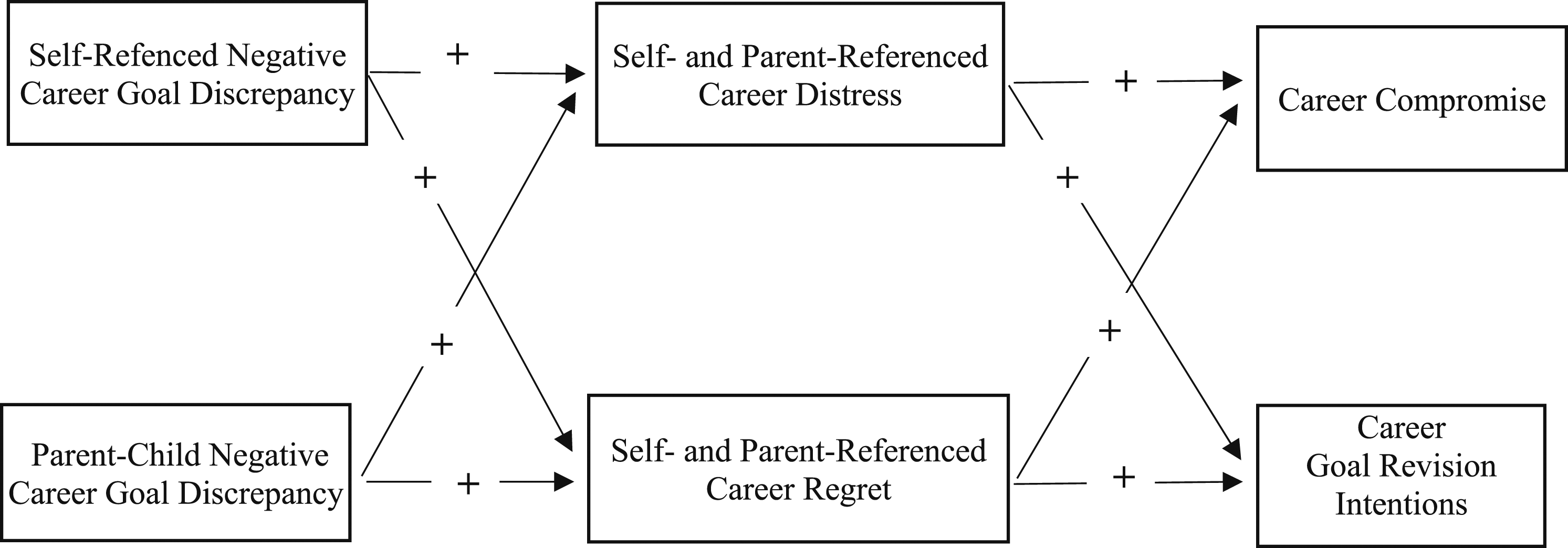
Self-Regulatory Theory
According to self-regulatory theories (Bandura, 1991; Latham & Locke, 1991), once an individual sets a goal and plans how to achieve it, they monitor their performance to assess any gap or discrepancy between their progress and what is required. A negative goal-progress discrepancy occurs when performance is appraised as being insufficient to meet the goal. This, in turn, generates dissatisfaction and triggers actions to reduce the disparity and, thus, ease the negative feelings (Bandura, 1991). Goal-performance discrepancies can be generated both internally (e.g. self-monitoring and appraisal) and/or externally (e.g. via feedback from others; Bandura, 1991). As individuals set their goals and take goal-directed action, they monitor feedback from both internal and external sources to evaluate how well they are progressing towards their goal standards.
Self-regulation theories (Bandura, 1991; Latham & Locke, 1991) argue that goal discrepancy motivates individuals to make adjustments to achieve their goals and reduce the dissonance between the goal standard and performance or progress. When facing a negative goal discrepancy, individuals might strive harder to attain the goal (Latham & Locke, 1991), abandon their goal (Bandura, 1991), re-engage in the pursuit of new goals (Wrosch et al., 2003), or lower the standard (Donovan & Williams, 2003; Theobald et al., 2021). Negative goal discrepancy has been studied in various areas such as sport (Williams et al., 2000), health (Wrosch et al., 2003), motivation (Ilies & Judge, 2005), and career development (Creed & Hood, 2015; Praskova & McPeake, 2021). The current study extended the limited existing research in the context of career development.
Career Goal Discrepancy
Career goals are essential for young adults. They stimulate planning, implementation of career actions, and career optimism, which enables career goal progress and achievement. For example, career planning and exploration are related to greater career development, satisfaction, and success over time (Rogers & Creed, 2011; Schoon & Polek, 2011). However, when the rate of career goal progress is thwarted, not up to expectations, or there is a gap between the individual’s skills and their goals – that is, a career goal discrepancy is perceived – discomforting emotions, such as distress and anxiety, arise (Höpfner & Keith, 2021; Jawahar & Shabeer, 2021).
Creed and Hood (2015) defined self-perceived career goal-progress discrepancy as the perceived gap between the individuals’ targeted career goal and their perceived current progress towards that goal. Discrepancies arise from perceived gaps in their achievement, ability, effort, and self-set standards. This reflects the notion from self-discrepancy theory of an incompatibility between the person’s actual and ideal states (Higgins, 1987). Thus, a career goal-progress discrepancy generates feedback regarding actual progress towards a career goal (e.g. achievements to date) compared to where the person appraises they should be or are expected to be. When individuals perceive unfulfilled hopes and desires, they are vulnerable to poor emotional wellbeing and low self-esteem (Kelly et al., 2015). Previous research has confirmed that negative career goal-progress discrepancy is related to negative emotions (higher career distress; Creed et al., 2015; Sheppard et al., 2020), which, in turn, increases the tendency to downgrade a goal or reduce effort (Praskova & McPeake, 2021).
In addition to self-referenced gaps, discrepancies can be based on feedback from others. When significant others, such as parents, teachers, and employers, express disappointment or convey directly that the goal or the progress being made towards it is unsuitable or unsatisfactory, the sense of not meeting obligations or one’s duty to them creates a discrepancy (Higgins, 1987). Feedback from parents is a powerful force for young people’s goal selection and pursuit (Farkas & Grolnick, 2010), and discrepancy with parental expectations can lead to distress and dissatisfaction. Young people compare whether their career direction, performance, and achievements are congruent with the aspirations that their parents have for them (Sawitri et al., 2021), and parent–child career discrepancies are associated with lower parental support, fewer opportunities to develop occupational skills, reduced self-efficacy (Sawitri et al., 2021), and reduced capacity and willingness for the young person to translate career interests into goals and goals into action (Lent & Brown, 2013). Parent–child career goal discrepancies can also affect educational choices adversely (Lee & Liu, 2001; Ma et al., 2014) and result in poorer career engagement and decision-making (Sawitri et al., 2021).
While both self- and other-referenced discrepancies are important in young ‘adults’ career development, past studies have examined self- (Akmal et al., 2022; Creed et al., 2015; Praskova & McPeake, 2021) and other-referenced discrepancies (e.g. with parents and peers; Budjanovcanin et al., 2019; Li et al., 2015) separately. As young adults can experience both discrepancies simultaneously, we advanced this past work by examining the relationships of both self-referenced and parent–child career goal discrepancies to career-related self-regulatory responses.
Career Goal Adjustments in Response to Discrepancy
Young learners use career-relevant resources to achieve their goals, but, faced with internal or external barriers, either anticipated or actual, can consider less-preferred alternatives and might compromise on their favoured direction (Gottfredson, 2002). A career goal-performance discrepancy constitutes a barrier (Bandura, 1991) and, faced with this, one option for young people is to realign their direction to avoid wasting effort and resources in pursuit of a goal that is perceived to be unachievable (Gottfredson, 2002). Parent–child career goal discrepancies also potentially reduce available resources, such as financial and social support, and opportunities (Sawitri et al., 2021), which hinders efforts to achieve desired career goal outcomes. When faced with these discrepancies, individuals can adjust their goals and aim for more acceptable or attainable, although less preferred, ones (Gati, 1993; Wee, 2014).
Career compromise refers to the changes individuals make to desired goals to accommodate uncontrollable circumstances (Gottfredson, 2002). Career goal-performance discrepancy is related to a greater willingness to compromise (Creed et al., 2020; Wee, 2014). Similarly, parental disapproval over career choice is associated with young people moving their goals closer to parental expectations (Ma et al., 2014), which potentially reflects compromising on their own goals. Career compromise also has been related to more negative affect (e.g. career distress and dissatisfaction) and less career commitment and perceived employability (Creed & Blume, 2013; Ryu & Jeong, 2021). However, we currently do not know the relative strengths of the relationships between self- and parent-referenced career goal discrepancy and career compromise.
While career compromise refers to current goal adjustment state (e.g. ‘My current career direction is a compromise on what I really want to do’; Creed & Gagliardi, 2015), career goal-progress discrepancy can also affect expectations or intentions to revise one’s goals in the future (e.g. ‘I plan to lower my career goal as I am aiming too high’; Hu et al., 2017). When there is a negative discrepancy, downward goal revision intentions can result (Donovan & Williams, 2003; Williams et al., 2000). Downward goal revision intentions refer to intentions to revise their existing goal by setting a similar but lower or more attainable goal (e.g. choosing a nursing career over that of a medical doctor; Hu et al., 2019). Previous research has shown that negative goal-performance discrepancy is associated with downward goal revision intentions in college-level athletes competing in varsity level indoor track and field events (e.g. revision down desired sprint time goals; Donovan & Hafsteinsson, 2006; Donovan & Williams, 2003) and in the career domain (i.e. intentions to downgrade to a more obtainable career; Hu et al., 2017; Praskova & McPeake, 2021). Similarly, incompatibility between self and parents’ goals and expectations could trigger intentions to revise career goals away from one’s own desired direction to a lower goal, after considering what is acceptable to the parent/s and what is realistic (e.g. vis-à-vis the feedback given and support available from the parents; Bandura, 1991).
From the above, our first hypotheses were as follows:
Self-referenced negative career goal discrepancy is associated positively with career compromise (H1a) and downward career goal revision intentions (H1b), and
Parent–child negative career goal discrepancy is associated positively with career compromise (H2a) and downward career goal revision intentions (H2b).
Explanatory Mechanism of Negative Emotions
Consistent with Higgins’ (1987) self-discrepancy framework, self-referenced negative career goal-progress discrepancy represents a gap between current progress and where they need to be. This represents a perceived inability to fulfil one’s hopes and desires, leaving the individual at risk for negative emotions (Carver, 2015; Higgins, 1987). Similarly, parent and child disagreement over career goals is a significant stressor (Lee & Kang, 2018). Parent–child career goal discrepancy indicates the discrepancy between want-to and have-to goals (Higgins, 1987). The individual’s goals are the want-to goals, whereas the have-to goals are their felt obligations to their parents. Violating prescribed duties and obligations is associated with sanctions and punishments, including criticism, threats, a sense of shame, and fear of losing their parent’s love and support (Higgins, 1987). This makes the individuals vulnerable to agitation-related emotions such as fear, threat, and restlessness (Higgins, 1987).
Both self-referenced and parent–child negative career goal progress discrepancy have been related to career distress (Hu et al., 2018a; Praskova & McPeake, 2021; Sawitri et al., 2013, 2021). Parent–child discrepancy has been related also to other negative emotions, including depressive symptoms, loneliness (Lee & Kang, 2018), and anxiety (Zhou et al., 2016). Career distress is elicited when individuals confront negative experiences in setting or pursuing their career goals (Creed et al., 2016). It is common in young adults and has become an important reason for them to attend career counselling (Şensoy & Siyez, 2019). High career distress has been associated, in turn, with lower occupational engagement and future career expectations (Kim & Lee, 2019) and poorer psychological and subjective wellbeing (Arslan et al., 2020). In this study, we distinguished between career distress related to uncertainty about one’s career future (i.e. self-referenced distress) and career distress related to concerns that one’s career future would not meet parental expectations (i.e. parent-referenced distress).
We also examined the career-related regret as a potential underlying mechanism between discrepancy and goal adjustment. Occupational or career regret is defined as an enduring state of wishing that one had never entered one’s current occupation (Wrzesniewski et al., 2006, p.3). Regret is an ‘enduring state’ as career decisions are linked strongly to individual identities, which can be difficult to change (Budjanovcanin et al., 2019). According to Zeelenberg and Pieters (2007), regret reflects self-censure and blame and a strong wish to correct the current situation. We defined self-referenced regret as self-censure and blame in relation to perceptions that their career decisions or actions were misguided or unfavourable, accompanied by a strong wish to correct their present career circumstances. Parent-referenced regret was defined as regret arising from parental censure and blame over their career decisions or actions, which was also accompanied by a strong wish to change and repair their relationship with their parents. While both distress and regret are unpleasant negative emotions, distress saps one’s control and capacity to act, whereas regret is more aligned with personal agency and a drive to remedy a poor situation or decision (Epstude & Roese, 2008; Zeelenberg et al., 2000). Regret, thus, is an important regulatory mechanism that activates behavioural responses. When individuals perceive that they could or should have done better or set different goals, regret ensues and this triggers regulatory actions such as trying harder or adjusting goals to ensure achievement and a reduction in their negative emotional state. For example, Sullivan et al. (2007) showed that laid-off workers blamed themselves for not engaging appropriately at work, regretted their actions, and resolved to prevent this in the future.
Thus, we hypothesised that:
Self-referenced negative career goal discrepancy is related to more self- (H3a) and parent-referenced (H3b) distress, and more self- (H4a) and parent-referenced (H4b) regret, and
Parent–child negative career goal discrepancy is related to more self- (H5a) and parent-referenced (H5b) distress, and more self- (H6a) and parent-referenced (H6b) regret. Emotions are important in goal pursuit as they link experiences to goals and actions: positive emotions reinforce and encourage goal progress, while negative ones operate to impede progress (Mejia & Hooker, 2017). Negative emotions provide essential feedback that helps individuals self-regulate their actions (e.g. adjust behaviour, revise, or abandon a goal) to reduce the discrepancy and associated uncomfortable feelings (Carver & Scheier, 1990). Career distress has been related to career goal disengagement (Creed & Hood, 2014), downward revision (Hu et al., 2017), and adjustment (Praskova & McPeake, 2021). Similarly, when faced with undesirable or unexpected outcomes, lowering one’s goal, reversing or switching to alternative goals, and seeking options that can be undone are effective strategies to cope with current, and prevent future, regret (Kamiya et al., 2021; Pieters & Zeelenberg, 2007). However, no research, to our knowledge, has examined the association between regret and goal adjustment in the career context. Based on the theoretical and empirical literature, we expected that:
Self- and parent-referenced career distress and regret are associated with more career compromise (H7a, H7b, H7c, and H7d) and downward goal revision intentions (H8a, H8b, H8c, and H8d). Thus far, we have argued that self- and parent-career goal discrepancies are related to more self- and parent-referenced career distress and regret, and these negative emotions are associated with more compromise and downward goal revision intentions. However, as emotional responses stimulate self-regulatory responses to reduce the discrepancy, they provide an underlying mechanism through which discrepancy is related to goal adjustment (Epstude & Roese, 2008; Fishbach et al., 2010). Consistent with this, Ilies and Judge (2005) found that emotion mediated the relationship between positive and negative goal discrepancy and goal adjustment. Further, Praskova and McPeake (2021) found that career goal discrepancy was associated with reduced goal effort and motivation and a greater intention to downgrade or change the goal indirectly via higher career distress. Thus, our hypotheses here were:
Self-referenced negative career goal discrepancy is related indirectly to career compromise (H9a) and goal revision intentions (H9b) via self- and parent-referenced career distress and career regret; and
Parent–child negative career goal discrepancy is related indirectly to career compromise (H10a) and goal revision intentions (H10b) via self- and parent-referenced career distress and career regret.
Summary
According to self-regulatory theories (Bandura, 1991; Latham & Locke, 1991), negative career goal discrepancies trigger negative emotional reactions, which then stimulate self-regulatory responses, such as goal adjustment, to reduce the discrepancy (Epstude & Roese, 2008; Fishbach et al., 2010). However, to date, research on the role of negative emotions in explaining the relationships between goal discrepancy and self-regulatory responses in the career context is limited. Therefore, the purpose of the current study was to test a model in which career-related negative emotional reactions (i.e. distress and regret) explained the relationships between career goal discrepancy and career goal adjustment. Further, we examined both discrepancies and negative emotions from the perspective of the self (i.e. based on own judgements and responses to that) and their parent/s (i.e. based on feedback and reactions from their parents and their emotional responses to that).
The study was conducted in Australia, which is a multicultural society. For example, in 2019, 25% of young people (aged 15–24 years) were born overseas, with the most common origins being China (4.5%), India (2.7%), New Zealand (1.9%), and England (1.7%; Australian Institute of Health & Welfare, 2021), and almost half of all Australians (46%) have one overseas-born parent. However, despite its multicultural nature, Australia is a strongly individualistic culture (score of 90/100 on ‘Hofstede’s’ individualism measure; Hofstede Insight, 2020). As such, the interests of the self and one’s direct family are prioritised, compared to more collectivist cultural contexts where the broader community’s interests are more important. Therefore, examining the key variables from both self- and parent-reference points is particularly relevant to this population.
Method
Participants
Participants were 315 young adult students (76.5% women; MAge 19.52 years, SD = 1.78, range 17–25) drawn from one multi-campus Australian university. Most were domestic Australian students (96.2%), with the remainder being international students studying in Australia (from China, Vietnam, India, South Africa, and Fiji). Mean subjective socio-economic status (100-point scale regarding status of family of origin, where 1 = worst off and 100 = best off; Adler et al., 2000) was 59.00 (SD = 24.68). Participants self-reported academic achievement in the last year of high school was 13.3% indicating very high achievement, 47.6% high, 36.5% satisfactory, and 2.5% low achievement. Most (84.8%) were working part-time as well as studying, which is typical for Australian tertiary students.
Measures
Unless otherwise indicated, scale responses were made using a 6-point format (1 = strongly disagree to 6 = strongly agree). Scale items were summed to give scale totals, where higher scores indicated higher levels of a construct.
Self-Referenced Negative Career Goal Discrepancies
We used the 6 highest loading items from the 12-item Career Goal Discrepancy Scale (Creed & Hood, 2015), which assesses 4 domains of achievement, effort, standard, and ability discrepancy (e.g. ‘I thought I had the ability to get the career I want, but now I am not so sure’; items available from authors). In a good fitting confirmatory factor analysis (CFA), the 6 items loaded onto a single factor, with factor loadings ranging from .87 to .92. Creed and Hood (2015) reported an α of .96 for the full scale and supported validity by negative associations with goal commitment and positive associations with career distress. The current alpha was .96.
Parent–Child Negative Career Goal Discrepancies
We used six high loading items from the Parent-Child Career Goal Discrepancy Scale (Sawitri et al., 2021), which taps domains of ability, choice, and enthusiasm discrepancy (e.g. ‘I don’t think I can meet the requirements for the career my parents want for me’; items available from authors). In a CFA, the 6 items loaded onto a single factor, with factor loadings from .85 to .94. Sawitri et al., (2021) reported an α of .92 for the full scale and validity by a positive association with career distress. In the current study, the alpha was .92.
Career Distress
For self-referenced career distress, we used the 5-item Career Ambiguity Subscale from the Korean College Stress Inventory (Choi et al., 2011), which assesses stress associated with an uncertain career future (e.g. ‘I feel frustrated because I doubt what I am planning for my future is what I really want’). For parent-referenced career distress, we modified the scale items to focus on stress related to their future career not matching parent expectations (e.g. ‘I feel frustrated because I doubt what I am planning for my future is what my parents really want for me’; items available from authors). Items in this adapted scale loaded onto a single CFA factor. Choi et al. (2011) reported an alpha of .89 for the original scale and validity by negative associations with career goal selection and identity. Current alphas were .90 (self) and .94 (parent).
Career Regret
We adapted Passyn and Sujan (2006)’s 2-item health-related regret measure (e.g. ‘I felt blameable that because of my own doing, I might be at risk for developing skin cancer’). Example adapted items were ‘I felt regret that because of my own doing, I might not be able to achieve my ideal career goal’ (self-referenced career regret) and ‘Because of my parent/s' intervention, I am at risk of failing to attain the career goals I would like for myself’ (parent-referenced career regret). Passyn and Sujan reported inter-item correlations > .65 and supported validity by showing that those reporting higher health-related regret were more likely to develop health-related behavioural intentions. In the current study, inter-item correlations were .91 (self) and .96 (parent).
Career Compromise
Creed and Gagliardi’s (2015) 6-item Career Compromise Scale assesses the extent to which individuals perceive their current career goals to reflect a compromise on their desired career status, interests, meaningfulness, level of responsibility, contribution to others, and what they really want to do (e.g. ‘To what extent do you feel that your current career direction will result in a less meaningful occupation than you really wanted?’; 1 = not at all to 6 = completely). Creed and Gagliardi reported an alpha of .88 and validity by expected negative associations with perceived employability and positive associations with career distress. Our alpha was .94.
Downward Career Goal Revision Intentions
Hu et al.'s (2017) 6-item Downward Career Goal Revision Scale measures intentions to lower career goals (e.g. ‘I plan to aim for a career that is less demanding than my current choice’). The authors reported alphas of .88–.91 and validity by negative associations with career distress. Our alpha was .91.
Procedure
The study was approved by the authors’ university ethics committee (Ref No: 2020/676). Student volunteers, who completed anonymous online questionnaires, were recruited by advertising on their course website. For participating, they were able to claim course credit and enter a draw to win a $50 shopping voucher.
Analytic approach
Latent variable analysis (AMOS V28) was used to test all hypotheses. Multi-item parcels were created to represent the latent variables (Landis et al., 2000) for multi-item scales. Individual observed items were used to represent the self- and parent-referenced career regret latent variables as there were only two indicators of each. Parcelling generates fewer and more stable parameters, improves measurement reliability, reduces the risk of violating assumptions of normality when sample sizes are small, and generates more parsimonious models (Hau & Marsh, 2004). To create parcels, we subjected each multi-item scale to an exploratory factor analysis, rank-ordered the items by factor loadings, and then distributed them across parcels (2 per parcel; Kline, 2016) using a balanced approach (Hau & Marsh, 2004). For fit, we followed the recommendations by Hair et al. (2010). For a sample of N > 250 with > 12 observed variables, good fit is indicated by χ2 (significant p-value expected), normed chi-square (χ2/df < 3), Goodness of Fit Index (GFI > .90), Comparative Fit Index (CFI > .92), and Root Mean Square Error of Approximation (RMSEA < .07).
Results
Summary Data and Bivariate and Latent Variable Correlations (N = 315).
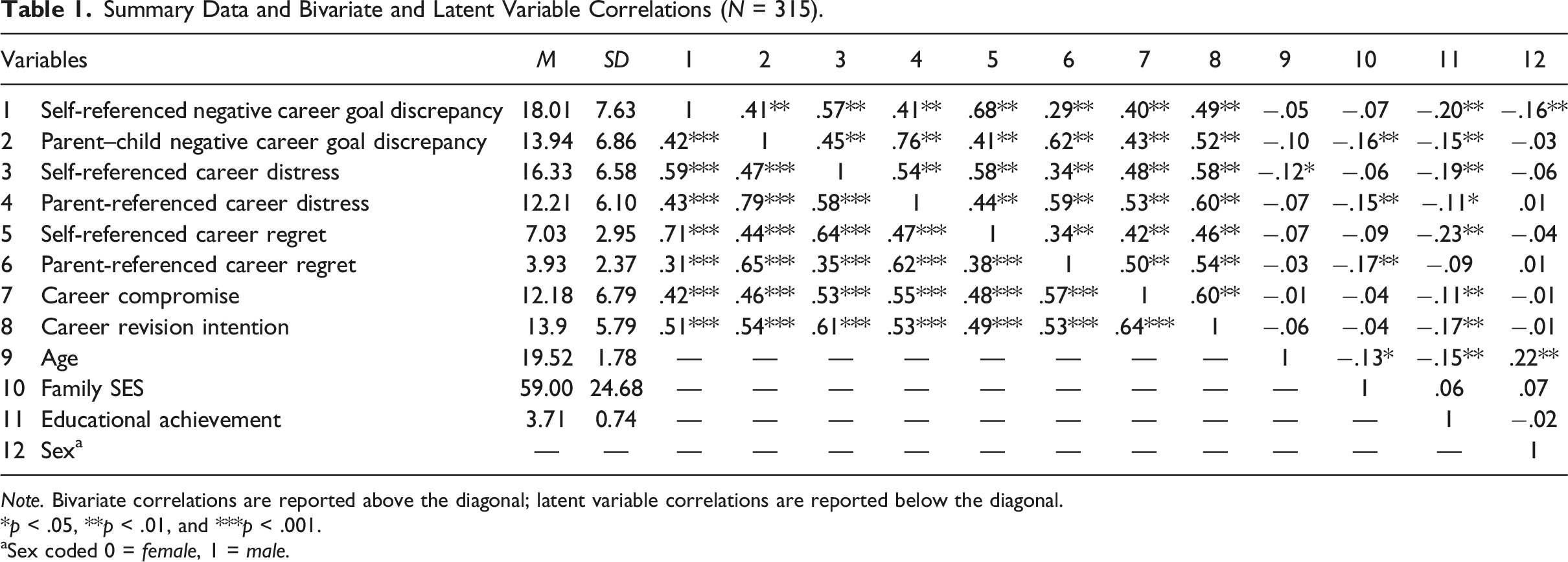
Note. Bivariate correlations are reported above the diagonal; latent variable correlations are reported below the diagonal.
*p < .05, **p < .01, and ***p < .001.
aSex coded 0 = female, 1 = male.
Model Testing
First, we assessed an 8-factor measurement model (i.e. self- and parent-career goal discrepancy, self- and parent-referenced career distress and regret, career goal compromise, and revision intentions) to confirm that all latent variables could be represented by their parcels and were distinct from one another. This produced a good fit, χ2(76) = 126.26, p < .001; χ2/df = 1.66; CFI = .99; GFI = .95; RMSEA = .05, with high factor loadings (.89–.98; p < .001). Further, latent variable intercorrelations reflected those between the observed variables (see Table 1). We also tested a 7-factor model, in which career compromise and revision intention parcels were allowed to load onto a single ‘goal adjustment’ factor to check whether we could separate out these two outcomes. This yielded a poorer fit than the 8-factor model, χ2(83) = 472.07, p < .001; χ2/df = 5.69; CFI = .93; GFI = .87; RMSEA = .12, χ2Diff (7) = 345.51, p < .001; therefore, we proceeded with the separate compromise and revision factors.
Testing the Hypothesised (Structural) Model
Next, we tested the structural model indicated in Figure 1 and followed this by testing a series of direct and indirect path models to confirm the hypothesised indirect effects. The structural model had a good fit, χ2(84) = 154.22, p < .001; χ2/df = 1.83; CFI = .99; GFI = .94; RMSEA = .05. The paths from self-discrepancy to self- (β = .49, p < .001) and parent- referenced distress (β = .12, p < .01) and self-referenced regret (β = .64, p < .001) were significant (supporting H3a, H3b, and H4b). The path from self-discrepancy to parent-referenced regret (β = .05, p = .29) was not (H4a not supported). The paths from parent-discrepancy to self-referenced distress (β = .27, p < .001) and regret (β = .18, p < .001) and parent-referenced distress (β = .75, p < .001) and regret (β = .64, p < .001) were significant (supporting H5a, H5b, H6a, and H6b). In addition, the paths from self-referenced distress to compromise (β = .25, p < .001; H7a) and goal revision intentions (β = .34, p < .001; H8a) and from parent-referenced distress to compromise (β = .17, p < .01; H7b) and goal revision intentions (β = .24, p < .001; H8b) were all significant. The path from self-referenced regret to compromise (β = .14, p < .05; H7c) was significant, but the path to goal revision was not (β = .08, p = .18; H8c). The paths from parent-referenced regret to compromise (β = .29, p < .001; H7d) and goal revision intentions (β = .28, p < .001; H8d) were significant (see Figure 2). This model explained 42.4% of the variance in self-referenced distress, 52.4% in self-referenced regret, 64.7% in parent-referenced distress, 43.5% in parent-referenced regret, 42.9% in compromise, and 53.8% in goal revision intentions. Standardised beta weights from structural (solid lines) and direct/indirect effects models (dashed lines); N = 315. Note: On dashed lines, non-italicised beta weights are direct effects without indirect effects included; italicised weights are direct effects after indirect effects included; *p < .05, **p < .01, and ***p < .001.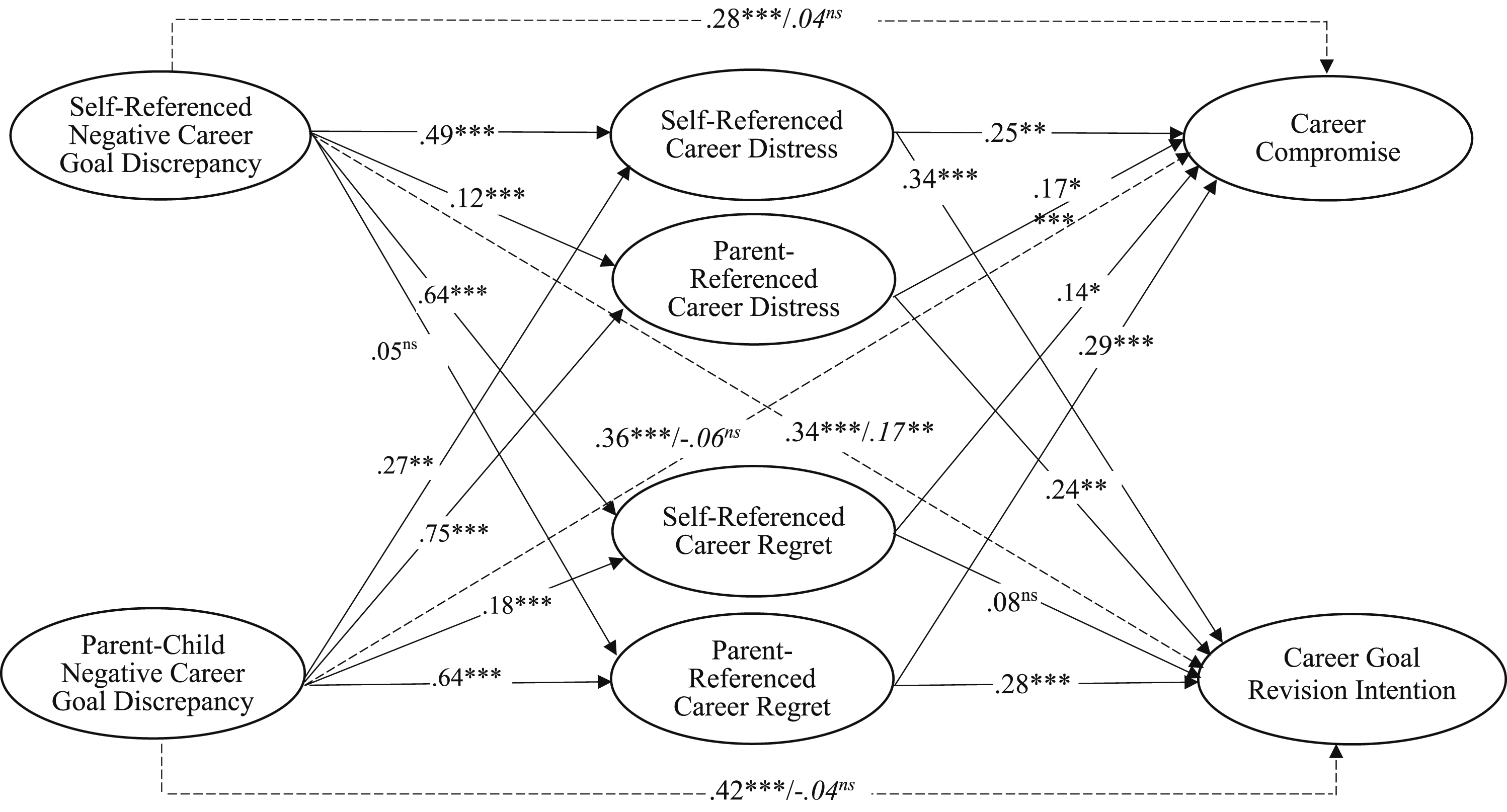
Testing for Indirect Effects
First, we assessed a direct effects model, which fitted well, χ2(82) = 152.94, p = .001; χ2/df = 1.87; CFI = .99; GFI = .95; RMSEA = .05. Self-discrepancy was related to compromise (β = .28, p < .001; H1a) and goal revision intentions (β = .34, p < .001; H1b), as was parent-discrepancy (compromise β = .35; revision β = .42; both p < .001; H2a and H2b). These direct paths were added to Figure 2.
For the indirect effects model, we used AMOS bootstrapping (5000 samples) to obtain bias-corrected 95th percentile CIs. An indirect effect exists when the CIs do not contain zero. There was a good fit for this model, χ2(80) = 145.45, p < .001; χ2/df = 1.81; CFI = .99; GFI = .95; RMSEA = .05. There were significant indirect relationships, via self- and parent-referenced distress and regret, between self-discrepancy and compromise (CIs: .10 to .35; H9a) and goal revision (CIs: .05 to .21; H9b), and between parent-discrepancy and compromise (CIs: .31 to .68; H10a) and goal revision (CIs: .26 to .55; H10b).
The direct path from self-discrepancy to compromise was no longer significant when the indirect paths were included (β = .04, p = .21), indicating a fully indirect effect (total = .28, direct = .04, and indirect = .24). The direct path from self-discrepancy to goal revision remained significant (β = .17, p < .01), indicating a partial indirect effect (total effect = .34, direct effect = .17, and indirect effect = .17). Similarly, the direct paths from parent-discrepancy to compromise (β = −.06, p = .21) and goal revision (β = −.04, p = .52) were no longer significant with the indirect effects included (total effects = .36 and. 41, direct effects = −.06 and −.04, and indirect effects = .48 and .46, respectively).
We also examined the specific indirect effects (calculated by finding the product of the relevant path coefficients). Indirect paths from self-discrepancy to compromise via self- (unstandardised effect, B = .10; CIs: .04 to .19) and parent-referenced distress (B = .03; CIs: .00 to .08) and to goal revision via self- (B = .11; CIs: .06 to .17) and parent-referenced distress (B = .02; CIs: .01 to .05) were significant. Thus, these effects operated via self- and parent-referenced distress and not via self- and parent-referenced regret (these latter specific indirect effects were nonsignificant).
There were three significant indirect pathways from parent-discrepancy to compromise: via self- (B = .07; CIs: .02 to .13) and parent-referenced distress (B = .19; CIs: .01 to .39) and parent-referenced regret (B = .21; CIs: .11 to .32). We also found three indirect pathways from parent-discrepancy to goal revision: via self (B = .07; CIs: .04 to .12) and parent-referenced distress (B = .17; CIs: .07 to .29) and parent-referenced regret (B = .16; CIs: .08 to .28), indicating that these effects operated via self- and parent-referenced distress and parent-referenced regret but not via self-referenced regret.
In summary, most hypotheses were fully supported, although there was only partial support for a couple. As expected, more self- and parent-referenced discrepancies were related directly to higher goal adjustment, operationalised as both current compromise and intentions to downwardly revise career goals (full support for Hypotheses 1 and 2). Self-referenced discrepancy was related as hypothesised to self- and parent-referenced distress and self-referenced regret but was not related to parent-referenced regret. Thus, Hypothesis 3 was fully supported but there was only partial support for Hypothesis 4. Hypotheses 5 and 6 were fully supported as parent–child discrepancy was related to all of the forms of negative emotion. All forms of negative emotion were related positively to the goal adjustment outcomes, fully supporting Hypotheses 7 and 8.
Self-discrepancy was related indirectly via both forms of distress to goal revision and compromise. However, the indirect paths via either form of regret were not significant. Thus, Hypothesis 9 was only partially supported. Parent-discrepancy was related indirectly to both goal adjustment outcomes via self- and parent-referenced distress but only parent-referenced regret. Thus, Hypothesis 10 was only partially supported.
Discussion
We tested a model in which both self- and parent-sources of career goal discrepancies were associated with career goal adjustment via self- and parent-related negative emotions. We found that greater discrepancy between the young person’s career goals and their perceived progress, as well as the discrepancy with their perceived parents’ career goals for them, were related to more current career goal compromise and greater intentions to downwardly revise their career goals. These relationships were explained, in part, by higher levels of self- and parent-related career distress and regret.
Our results were consistent with self-regulatory theories (e.g. Bandura, 1991; Carver & Scheier, 1990) and the career compromise literature (Gati, 1993; Gottfredson, 2002), which indicate that individuals will perceive internal and external goal progress discrepancies as barriers that prevent them from reaching their ideal goals. When faced with these barriers, one option is to compromise on their goal direction, which they do to alleviate the negative feelings resulting from the appraised discrepancies. The results are also consistent with existing findings that when young people think their current goal achievement falls short of their expectations, they look to revise their goals to less challenging ones (e.g. Hu et al., 2017; Praskova & McPeake, 2021), or when they perceive that their goals are unattainable because they conflict with their parents’ goals for them, they will abandon or change them to reduce tensions (Sawitri et al., 2013, 2021). We extended on the existing research by assessing self- and parent-discrepancies simultaneously, demonstrating that both contribute independently to understanding goal adjustment.
Appraised feedback from the self and from parents is an important motivator for young people in their career goal pursuit as they test, evaluate, and adjust their career direction over time (cf. Bandura, 1991; Carver & Scheier, 1990). Our research contributes further by considering both distress (which hinders agency) and regret (which stimulates regulatory mechanisms) as explanatory mechanisms in the discrepancy-goal progress relationships. We showed that young people experience different negative emotions in response to different goal-performance discrepancies. Both self- and parent-discrepancies related to self- and parent-referenced distress and regret. An important finding was that self-discrepancy was related primarily to parent and self-referenced distress and self-referenced regret, but parent-discrepancy was related to parent-referenced distress and regret only. These results suggest that young people’s reflections on parental discrepancy stimulate greater distress and regret related to violating their parents’ rather than their own expectations, whereas when contemplating their own performance-goal discrepancies, this primarily stimulates self-related negative emotions. Thus, when young people perceive that they are making insufficient progress, they recognise their own responsibilities, leading to distress and regret about letting themselves down. However, when they perceive that parents also might be responsible, this is related to both self- and parent-referenced distress and regret, which aligns with Newton et al. (2012) and Sullivan et al. (2007), who found that those who do not pursue their personal career goals and consider alternative careers due to family obligations experience greater career regret.
Previous research (Creed et al., 2020; Hu et al., 2017; Praskova & McPeake, 2021) has demonstrated that when individuals experience greater negative emotions triggered by career goal discrepancies, they are likely to compromise or revise their occupational choice to a less-preferred one. We found that this held for the negative emotion of distress and parent-referenced regret, but that self-referenced career regret was not related to intentions to revise career goals. Regret has an avoidance function that is beneficial to forestall negative outcomes by maintaining the status quo (Saffrey et al., 2008). Thus, for young adults who perceive they are not making adequate progress in achieving their goals, regret might contribute to maintenance of the status quo and a lack of intentions to revise their career goals. Instead, they might increase their effort towards the current goal or look for strategies (e.g. support-seeking) to ameliorate the unpleasant emotions. As we did not measure effort or other strategies, future research will need to test these possibilities.
Self- and parent-goal discrepancies were associated with both sources of career distress, and these, in turn, were associated with more career compromise (full indirect effect) and goal revision intentions (partial indirect). Self-regulatory theories (Bandura, 1991; Carver & Scheier, 1990) suggest that distress as a result of perceived discrepancies would trigger self-regulatory responses (e.g. compromise on or revise career goals that are unrealistic, unachievable, or unacceptable), to reduce the discrepancy and distress.
Higher parent-discrepancy was associated indirectly via parent-referenced, but not self-referenced, career regret with more compromise (full indirect) and goal revision (full indirect). Regret is a motivational emotion (Zeelenberg & Pieters, 2007), and our findings suggest that it is more important in motivating goal adjustment when it stems more from feeling they will fail their parents than themselves. Consistent with this, Saffrey et al. (2008) found that regret facilitated social harmony, for example, through the young person changing their career goals to ones more acceptable to their parents. Self-referenced regret, on the other hand, might motivate increased effort to preserve the current goal (cf. Carver, 2015). Further research to confirm the explanations for these differences between the two negative emotions is needed.
Practical Implications
As the distress and regret arising from perceptions of discrepancy were associated with goal adjustment, practitioners can help young people cope with these negative emotions in ways that might enable goals to be examined and, potentially, preserved. They could help young people develop strategies to understand and regulate their emotions and to more effectively cope with the discrepancy. Practitioners might assist in the prevention or reduction of career goal discrepancies in the first place by working with young people to help them clarify their career goals and identify barriers to their achievement. They can assist young people to establish realistic goals and develop strategies to cope with potential obstacles, including negative feedback from others. They might help young people whose negative emotions arise from negative discrepancies with their parents by increasing their self-affirmation and own career goal clarity and giving them strategies to determine what their parents expect, and increasing their confidence in communicating their career aspirations to their parents. Parents could be assisted to understand their children’s goals, gain a broader awareness of current career issues, and build open and effective communication with their child. This is particularly important in a strongly individualistic culture such as Australia where young people strive to please both the self and their immediate family (Akosah-Twumasi et al., 2018; Widyowati et al., 2023). However, in university settings in Australia, career practitioners typically focus on the career aspirations of the young adult without regard to the important role that the expectations of their parents still play in their career-related emotions and outcomes.
Limitations and Future Research
Our results are based on a single sample of students from one Australian university. Despite being multicultural, Australia is strongly individualistic and, thus, these results might not generalise beyond individualistic Western cultures. Future studies should broaden this research to young adult students from different cultures to strengthen generalisability. Cultural background affects how individuals set, strive for, and regulate their goals (Oishi & Diener, 2001). The strength of parent-referenced goal discrepancy and negative emotions might be stronger in collectivist cultures, where parents play a larger role in the lives of young adults than individualist cultures, which emphasise personal interest and independence in deciding career goals (Akosah-Twumasi et al., 2018).
We also had more female than male participants. There was no association between gender and the focal variables; however, future studies should aim for a more balanced gender representation. This study was cross-sectional and, although the directions of the relationships tested were consistent with theory and previous research, we could not draw strong temporal conclusions. It remains possible that goal adjustment triggers negative emotions, which, in turn, result in perceptions of discrepancy; similarly, distress and regret could be a consequence of, rather than an antecedent to, career goal compromise or revision intentions. Future studies need to confirm the direction of the associations using longitudinal cross-lagged methodology that enables testing of alternate models, such as reciprocal causation. Future research could also focus on investigating conditions that might buffer the relationships between discrepancy, negative emotions, and career goal adjustments. This might inform about factors that can be used to assist positive career goal pursuit in young people.
Finally, we only used two items to measure career regret, which were adapted from a different discipline area (consumer psychology related to health behaviours). Thus, it is possible that we have failed to adequately assess the full domain of the career or occupational regret construct. Previous studies of occupational or career regret in adult workers (Budjanovcanin et al., 2019; Sullivan et al., 2007) used multi-item scales, and future research examining career regret in young adult students should also use a multi-item measure. One difficulty with these existing scales is that they reflected backward-looking regrets (i.e. I wish I had done things differently throughout my career/work to date), whereas measuring this in young adults who are still working towards achieving their career goals requires measures that focus on regret that what they are deciding or doing now will lead to them not achieving their goals. The advantage of the items that we used in this study was that they had that forward-looking perspective on regret.
Conclusion
We demonstrated that internal and external sources of career goal discrepancy (self and parents, respectively) are associated with different types and sources of negative emotions (self- and parent-related distress and regret), and that these emotions help explain why young people respond to discrepancy by both compromising and intending to revise their goals. These findings advance the existing literature by confirming the role of career-related regret in helping explain why young people adjust their career goals in response to discrepancies. They also provide insights into how practitioners might better help young people who are confronted by career goal discrepancies by preventing them in the first place and/or managing the negative emotions that result when discrepancies occur.
Footnotes
Declaration of Conflicting Interests
The author(s) declared no potential conflicts of interest with respect to the research, authorship, and/or publication of this article.
Funding
The author(s) received no financial support for the research, authorship, and/or publication of this article.

Author Biographies
Contact information:
Faculty of Psychology, Ahmad Dahlan University, Yogyakarta, Indonesia.
Contact information:
Office of the Pro Vice Chancellor (Health), Griffith University Gold Coast campus, Parklands Drive, Southport, QLD, 4215, Australia.
Contact information:
School of Applied Psychology, Gold Coast campus Griffith University, QLD, 4222, Australia.
Contact information:
School of Applied Psychology, Griffith University, Gold Coast, Australia.