




Abstract
Higher education can offer refugee youth a route to economic advancement and improved quality of life. However, the decision to pursue college poses a unique set of challenges and considerations. Drawing on Perna’s conceptual model of student college choice, this study employs a phenomenological approach to examine refugee students’ motivations and perceptions of college as well as their career aspirations. Semi-structured interviews with 15 refugee students revealed a strong desire to go to college and pursue a STEM career; an unfamiliarity with the college process; and a preference for community colleges. Modifications to using Perna’s model to better capture refugee youth’s college choice experiences are discussed. Findings from this study yields important insights regarding how high schools can offer guidance to refugee youth on the college choice process.
Introduction
The displacement of refugees is one of the most significant humanitarian issues of the 21st century. A refugee is someone who has been forced to flee their country because of persecution, war, or violence. The United Nations High Commissioner for Refugees (United Nations High Commissioner for Refugees, 2019) notes that refugees have a well-founded fear of being persecuted for reasons of race, religion, nationality, political opinion, or membership in a particular social group. Since 1975, the U.S. has resettled more than 3 million refugees from around the world due to ongoing conflicts and political unrest in countries like Afghanistan, Myanmar, Syria, and Ukraine (Monin et al., 2021). Between FY 2010 and FY 2020, 64% of all refugees admitted to the U.S. were women and children under age 14 (Monin et al., 2021). Moreover, according to the Department of Homeland Security, out of the 29,916 refugees who arrived in 2019, about 17,393 (59%) were children and youth under the age of 24 (Baugh, 2020). These numbers demonstrate the disproportionate number of youth among refugees and underscore the importance of researching the experiences of this demographic.
Refugee youth experience an array of migration-related stresses that influence adaptation to their new school contexts (Suárez-Orozco & Suárez-Orozco, 2001). Refugee youth often have experienced increased levels of trauma and violence prior to fleeing their countries of origin and\ compared to adults, are at heightened risk for symptoms of anxiety, depression, grief, posttraumatic stress disorder (PTSD), social withdrawal, and behavioral and academic difficulties (Sullivan & Simonson, 2016). Upon their arrival to the U.S., refugee youth encounter a variety of academic, economic, and psychosocial challenges, including separation from family, cultural dissonance, acculturation stress, host country language deficiency, gaps in schooling, distrust or fear of school personnel, conflicting expectations between families and school faculty, and limited financial resources (Bal & Arzubiaga, 2014). Schools are one of the earliest encountered and most influential institutions for newly arrived refugee youth. They function as a primary driver of integration into the receiving country’s culture, and a link to resources and assets promoting healthy development and a sense of belonging among peers and adults. Schools can function as a supportive environment for positive social interactions and provide a space to develop the knowledge and skills refugee children will need for their future lives and work in the U.S. (Tuliao et al., 2017).
The Benefits of Higher Education for Refugees
Following the completion of K-12 schooling, many refugees see higher education as a gateway to improving their own and their family’s circumstances. For many refugees, access to higher education is an integral part of the adjustment process. Refugees often perceive higher education to develop the necessary skills, knowledge, and relationships that enable them to enter the workforce and generate income (Felix, 2016). Indeed, there are numerous known benefits of higher education. To contextualize the benefits of higher education for refugees in the U.S., it is helpful to understand the well-documented benefits of higher education for those born in the U.S. For example, people who obtain bachelor’s degrees or above have greater potential for higher incomes and employment rates, earning more than the $900/week median for all workers (including those with high school diplomas and lower degrees of education), and their unemployment rate is only 3.6% (Zumbrun, 2016).
Moreover, college graduates report higher levels of civic participation, and more confidence pursuing leadership roles in science, medicine, major business, the press, and the Supreme Court (Nietzel, 2019). Adults with higher educational attainment live happier, healthier, and longer lives compared with their less educated peers (Nietzel, 2019). Scholars attribute this finding to four possible factors: greater economic resources and access to healthcare (Zajacova & Lawrence, 2018); lower levels of engagement in violent crime (Trostel, 2010); and stronger feelings of empowerment (Carnevale et al., 2021), contributing to increased levels of overall happiness. Refugee access to higher education has also been reported to stimulate a deeper awareness of societal and cultural norms (Felix, 2016) and to further integration into host societies as refugees develop skill sets that can be applied to entry into labor markets (Ferede, 2018). Higher education has been found to protect refugees from abuse and marginalization (Kirk & Sherab, 2016), offer a level of hope for a better life in the resettlement country, and For facilitate resistance to harmful rhetoric shared by extremist groups (Barakat & Milton, 2015).
Critical Strategies to Get Into College
To see some of the many benefits higher education offers, students must first get into college. As detailed above, refugee youth face a unique set of difficulties in their resettlement and consequently their journey to higher education. While many refugee families emphasize the importance of education and encourage their children to pursue college, parents of refugee youth often have little to no formal experience with the college system. Thus, refugee youth must rely heavily on support from schools (e.g., teachers and counselors). In the broader literature on high school student success, researchers have identified multiple strategies to ensure that students are competitive for college admissions (Radcliffe & Bos, 2013; Roderick et al., 2009; Schneider, Kirst, & Hess; 2003).
One such strategy encourages young people to start thinking about college applications as early as middle school. Radcliffe and Bos (2013) specifically recommend schools take students on university campus tours as they enter 7th grade to help prepare for college. In preparing high schoolers for college applications, admissions officers emphasize the importance of maintaining a high overall GPA, enrolling in Advanced Placement and other college-prep classes, performing well on standardized tests (e.g., ACT or SAT), and engaging in extracurricular activities that teach valuable lessons and habits. For the applications themselves and later college selection, admissions officers recommend crafting a well-written and thought-provoking personal statement and developing an organized approach to completing multiple applications (Butler & Claybourn, 2022). Although some of these supports may be a given for students coming from wealthy and highly educated backgrounds, such access to academic guidance and resources are much less common for students whose families have limited economic and social resources—a situation characteristic of many refugee youth (Schneider, Kirst, & Hess; 2003).
College Choice Process Framework
To frame this study, we draw on Perna’s (2006) conceptual model of student college choice. This model describes the college choice process through “four nested contextual layers” (Perna & Kurban, 2013, p. 12), integrating economic and sociological approaches frequently used to examine college access and choice. The model consists of the following layers: 1. the individual’s habitus (or student and family context) 2. the school and community context 3. the higher education context 4. the broader social, economic, and policy context.
Perna argues that the conceptual model assumes that there is not one course leading to college enrollment, but multiple courses. Therefore, she asserts that each of the layers play an integral role in the college choice process for students, highlighting how networks, structures, or resources may facilitate or impede college enrollment and how context may restrict access for under-represented groups.
In constructing the model, Perna draws heavily from human capital theory, positing that a student’s decision on whether to enroll in college is determined by an analysis of the expected benefits and costs. Perna and Kurban (2013) explain that the expected benefits comprise both monetary and nonmonetary benefits, while the expected costs include the cost of attending college and the potential income that may have been earned otherwise. Rather than expecting equal benefits and costs across students, the model considers that such calculations are influenced by academic preparation for college as well as access to financial resources. The layers of the model accordingly operate with the understanding that differences in resources will consequently result in differences in college enrollment and choice among students (McDonough, 1997).
The first layer, the individual’s habitus, comprises one’s social and cultural capital and can be understood as the beliefs and ways of thinking that come from one’s immediate surroundings (Perna, 2006; Perna & Kurban, 2013). Bourdieu (1986, 1977) describes social capital as one’s social networks and the ways in which these networks and connections are maintained, while cultural capital focuses on the system of attributes such as language skills, cultural values, and mannerisms that are largely derived from one’s parents (Morrow, 1999). Together, this combination of social and cultural capital in the first layer reflects the individual’s expectations, college-going aptitude, and knowledge. The habitus determines the range of postsecondary options that an individual considers, how these options are valued, and the final decision. Perceived postsecondary options are impacted by the individual’s social, organizational, and cultural context such as access to financial and familial resources and support.
The second layer, the individual’s school and community context, considers the role of social structures in either reinforcing or interrupting social inequalities (Perna, 2006). Schools, for example, have different levels of resources (e.g., teachers and counselors with the capacity and expertise to guide students in the college application and admissions process; McDonough, 2005; Perna, 2006). McDonough’s (1997) qualitative work on the college-related decisions of 12 students across four different high schools, confirms these differences in schools. Her analyses particularly underscored disparities in the schools regarding the time and resources counselors have available for college counseling, the types of colleges emphasized by counselors to students, and the role of counselors in the college-choice process. Notably, Perna and Titus (2005) reinforced the idea that one of the most important factors in whether students enroll in college is the number of school resources they can access. Given the common dependency of working-class minority students on nonfamilial resources for important college-information, school and community contexts hold great power in maintaining or disrupting college-going inequalities (Stanton-Salazar, 1997).
The third layer, higher education context, focuses on the colleges themselves and the role 45 they play in college enrollment and choice. As institutions, colleges can actively recruit and inform students through in-person visits and digital marketing campaigns, or simply through proximity and reputation. Additionally, students typically prefer to attend colleges they feel align with their personal and social identities.
The final layer, the social, economic, and policy context more broadly considers the direct or indirect influence of societal changes such as shifts in state or countrywide demographics, the economy, and public policies. Indeed, several researchers have identified connections between public policy and college choice outcomes (e.g., Kirst & Bracco, 2004; Perna & Titus, 2004; St. John, 2004). In their work exploring state public policies, Perna and Titus (2004) found that even after controlling for student-level characteristics, the following play a role in differences across states in both student college attendance and in the type of institutions students select: public policies related to appropriations, tuition, financial aid, and K-12 academic preparation.
While each of these layers is critical in understanding college choice, in this study we focus on the first two layers—the individual’s habitus and the school and community context. Our decision to focus on these layers stems from our interest in engaging refugee youth directly and drawing from their personal experiences. Different from the third and fourth layers, which center broader institutional and policy impacts, the student is unequivocally the expert of their own experience in the first two layers. Students may not fully understand college recruitment or current societal shifts, but surely insight on their family dynamics and on school and community context is invaluable. Although Perna’s college choice model has been applied to Latinx and African immigrant groups (Nienhusser, 2013; Griffin et al., 2012), limited research focuses on the refugee student’s distinct motivations for pursuing college, and their perceptions of the process. The current study seeks to understand how family context differentially impacts the refugee student’s college choice process. As a collective, these layers create a model by which to interpret programs and policies in the name of college choice.
Research Objectives
We employ a phenomenological approach to examine refugee students’ motivations and perceptions of college and their career aspirations, addressing two research questions: 1. What are refugee youths’ general motivations and perceptions of college? 2. How are refugee youths and their families preparing for college?
Research Methods
Since little is known about refugee students’ perceptions and motivations around attending college, a qualitative research method grounded in a phenomenological approach was used (Moustakas, 1994). This approach seeks to understand how people make sense of their experiences in relation to “the situations and conditions surrounding those experiences” (Padgett, 2016, p. 41). The use of the phenomenological approach allowed us to thoroughly explore refugee youths’ unique perceptions surrounding college choice in the U.S. Our study was approved by the University of Chicago’s Institutional Review Board.
Sampling and Recruitment of Participants
Before delving into the data collection and analysis process, we engaged in bracketing, which is a useful tool to demonstrate validity in phenomenology research. We did so because it is the lived experiences of the participants that the researcher is trying to understand (Giorgi, 1997). One way we engaged in bracketing was through the practice of reflexivity, which encourages researchers to engage in an honest examination of the values and interests that may impinge upon research work (Primeau, 2003). Therefore, we used a reflexive diary to write down our thoughts, feelings, and perceptions, allowing us as researchers to re-examine our positions when issues were raised that might affect the research process (Wall et al., 2004).
The sample consisted of 15 refugee students (5 male, 10 female) from four countries: Syria (5), Iraq (4), South Sudan (3), and Myanmar/Burma (3). Initial meetings with refugee youth were conducted at the Universal Refugee Center (URC), a community organization located on the north side of Chicago that works closely with refugee families to connect them with employment, mental health, English language programs, and educational support for youth. Participants in this study represent the dominant refugee groups that are supported by URC. We used purposive sampling in the recruitment process to gather stories from a diverse sample, including refugee students of varying grade levels countries of origin, genders, years living within the United States, and career choices. In addition to posting study recruitment fliers around the organization, which were translated into multiple languages, the URC staff assisted in selecting a sample representing the diverse categories mentioned above. The URC staff recommended youth who were engaged in the educational and after-school programs offered at the organization. For example, the organization offers a range of programs, such as an education program to provide a space for the participants to improve their English skills. Tutoring is also available to students who wish to receive additional homework support by volunteers. Finally, youth can participate in a mentoring program with someone from the local community for at least two hours weekly to discuss topics related to school, relationships, and future academic and career goals. To be included in the study, a student had to identify as a refugee, attend high school, be between the ages of 14 and 17, attend a Chicago-based public school for at least one year, and speak English. We incorporated pseudonyms for participants and the community organization to maintain anonymity and confidentiality.
The URC staff invited refugee parents and students to the organization to describe the study in multiple languages (e.g., Arabic, Burmese, and English), and to obtain signed consent and assent forms, which were available in the languages. At the initial meeting, we shared relevant information about our personal and professional backgrounds and addressed specific questions about the study. Most participants had lived in the U.S. between two and three years. Table 1 (see Appendix 1) provides demographic information on the students.
Data Collection
In phenomenological research, the research questions are not predetermined; instead, as researchers, we follow the cues of the participants (Ray, 1994). Therefore, prior to data collection, we developed a semi-structured interview protocol, which centered the student perception of college and motivations to attend. The interview protocol was reviewed by URC staff members and several experts from the University of Chicago who teach courses on qualitative research methodology. We piloted the interview guide with three refugee students who participated in educational programs at URC and comparable organizations before engaging participants. Based on their feedback, we incorporated probes and follow-up questions in response to developing themes as the interview process progressed. We added more questions to the interview protocol on the role of family in informing refugee students’ college and career decisions. Initially the interviews focused only on perceptions of students instead of considering the influence parents have on these important decisions. We also offered more clarity around the differences between four-year universities and community colleges. Finally, we offered a list of potential careers when students asked for suggestions related to their potential college majors and career aspirations. We only referred to the list of potential careers if refugee students were unable to identify careers on their own. For example, we shared non-STEM majors and careers when students asked for suggestions or struggled to identify careers. Sample interview questions included the following: 1. Describe your process for choosing a college. 2. Describe the type(s) of career(s) you would like to pursue when you grow up. 3. Describe how you learned about career opportunities. 4. When you have questions pertaining to college or a future career, who do you talk to? 5. Describe the type(s) of majors you would like to pursue in college. 6. What is your family’s perception of college? 7. How does your family inform your decisions around college? 8. Describe the type(s) of school-based resources and support offered at your school to prepare you for college.
Data was collected from January through November 2018. Interviews were conducted on a one- on-one basis before school, after-school, or during the weekends and lasted between 45 and 60 minutes. On average, the interviews lasted about 50 minutes. Moreover, most interviews were conducted at the URC in a private location as requested by participants. Other participants preferred to meet at a local library or in their homes. Refugee students received $10 Target gift cards for their participation. Even though all the interviews were conducted in English, three interpreters were available upon request for students requiring additional language support to convey their narratives.
Data Analysis: Finding Themes and Patterns
We used the phenomenological hermeneutic (interpretive) approach (IPA), which allowed us to focus on how a given person makes sense of the phenomenon in each context (Smith et al., 2009). IPA is a useful method for one-on-one interviews as it enables researchers to unpack the rich descriptions of human experience (Fade, 2004) and emphasizes the importance of individual accounts (Pringle et al., 2011). We sought to interpret participants’ experiences, and interpretations, as they described their educational experiences. The interviews were audio- recorded and transcribed verbatim to ensure accuracy by the first author since all the interviews were conducted in English. We coded interviews using NVivo, a software program designed to support computer-assisted qualitative methods. Drawing on IPA, data analysis included several stages. First, we read each transcript in its entirety to gain insight into the narratives. Second, each interview was read by each author to better understand what participants experienced in the college preparation process. Third, themes that emerged from data were documented. These themes were derived from pertinent information described by participants across interviews. This step in the analysis process is critical since it follows the phenomenological approach of allowing participants’ voices to emerge from the data. Commonalities across participants’ stories guided the development of analytical and conceptual categories that reflected the overall experiences of participants. Consistent with the phenomenological approach, meaningful participant statements informed the development of themes and textual descriptions of each theme. Upon reviewing the themes in the findings, we began to analyze and develop preliminary study findings. The importance of attending a four- year university or a community college and pursuing careers in the STEM fields were constant major themes within the data as each participant reflected upon specific academic and professional goals.
As another way to promote trustworthiness, we devoted time to reflecting on, fleshing out, and interrogating our research orientations in reflective and analytical memos, which evolved throughout the study. We conducted stakeholder checks and two debriefings at URC to enable refugee youth participants, their parents, URC staff members and other community stakeholders to comment on whether the data gathered were accurately interpreted. For the debriefing, we shared the findings through oral presentations. Attendees offered favorable feedback on the findings, suggesting potential reasons why refugee students and their families prioritize STEM fields over other fields. We also discussed additional programming offered to refugee youth and their families on possible fields or careers students could pursue, as well as the process to attend a four-year university. Finally, we engaged in stakeholder meetings to share final research findings and discuss possible programs and future research studies.
Positionality shapes research and influences interpretation, understanding, and belief in the truthfulness and validity of the research (Padgett, 2016). Positionality refers to the position a researcher has chosen to adopt within a particular research study. This requires the researcher to consciously examine their own identity to allow the reader to process the effect of their perspectives and personal characteristics in relation to the study population, the topic itself and the research process (Wilson et al., 2022). The first author identifies as a Black woman who was born in the U.S., with over 15 years of practice and research experience working with refugee and migrant youth within school and after-school settings in international contexts (e.g., Turkey, Jordan, Lebanon, Zambia, and South Africa) and domestic urban settings (e.g., Chicago). The second author’s positionality draws on personal and professional experiences. As a second- generation Mexican and Filipino American whose maternal and paternal grandparents immigrated from Mexico and the Philippines respectively, he has valuable experience helping family navigate the legal and medical systems. He also has worked with U.S. born youth of color in K-12 and higher educational settings.
Findings
Findings from this study describe refugee students’ motivations, perceptions, and preparations for college. First, although refugee students possessed a strong desire to attend a four-year university, they described a level of unfamiliarity with the college application process. Second, refugee students shared their preference to attend community colleges with the goal of receiving additional academic support, offering financial and caregiving support for their families, and saving money to cover the future costs of a four-year degree. Finally, refugee students were adamant about pursuing a career in STEM fields due to family pressures and the perceptions of these fields as more lucrative, secure, and prestigious.
Unfamiliarity With the College Choice Process
While every was encouraged to attend college by their families and school staff, most of them were unfamiliar with how to prepare for college. For example, Leila, an Iraqi refugee girl, shared the following statement: “I mean, like, of course I want to attend college. My family talks about it...I know I need to have good grades and stuff. Like, good grades matter.” However, when we probed her about other requirements associated with college readiness and post-secondary applications, she was less confident: I don’t really know. Maybe being in, like, a sport or a leadership role is good. Oh yeah, I know you have to take a test or something. I think I have to take the test soon. I think that’s important.
Similarly, Aamira, a refugee girl from South Sudan, struggled to describe the various strategies she would need to use to be competitive for college admissions: “I have to get good grades. I think it’s good to do some after-school stuff. I sometimes meet with my counselor to talk about college, but it’s a little confusing to me.” Muhammed, a boy, also stated that he was unfamiliar with how to prepare for college. “I haven’t been here [in the U.S.] for too long. I’ve been trying to learn English and to get good grades. I want to go to college. I’m not sure about all the stuff I need to do.”
We also asked refugee students to describe their parents’ familiarity with the college application process. Most that while their parents were adamant about them attending college, they were unfamiliar with for getting in. Munir, a refugee student from South Sudan, stated the following: My parents tell me to attend college. Like, that’s all they talk about. ‘Get good grades. Go to school every day. Learn English. Stay focused.’ I don’t know if they [my parents] are aware of what I need to do to get into college.
Similarly, Htay, a refugee girl from Burma, shared how her parents were unable to offer any guidance on college preparation. She stated the following: My parents don’t know that much English, so it’s hard for them to understand school stuff. They tell me to talk to my counselor or teachers about college. They tell me to get As and Bs to get a scholarship. But they don’t know what else I need to do to get into college. That’s a bit harder.
Refugee participants shared how their parents insisted on attending college, but lacked knowledge on preparation (e.g., applications, covering college expenses). Most conversations at home centered around performing well in coursework, but there were limited or no conversations around other themes associated with college choice as conceptualized by Perna. For example, according to Perna’s second layer, organizational habitus, schools that offer a wide range of resources and support are instrumental in preparing students for college (Perna, 2005, 2006). While refugee parents offered a consistent message on the importance of attending college, they were not always aware of the resources available to them. For example, when we asked refugee students if they were aware of school related resources to guide them with college planning, most refugee students shared how they, along with their parents, were unfamiliar with school-level support. For example, Leila stated, “I didn’t know there was support at the school. I know I have a school counselor, but I’m not quite sure what we discuss with them. I would like to discuss my college goals with someone...my parents too.” Similarly, Munir stated, “I’m not aware of resources offered at the school. Like, even if there were workshops and stuff, my parents wouldn’t understand it. They’re still learning English. And applying for college seems very hard here [in the States]. It would be cool if the school offered workshops and stuff for my family.”
Acknowledging the limitations of their college knowledge, refugee parents typically encouraged students to seek out additional support from teachers and school staff.
Attending Community Colleges
To obtain additional knowledge of college preparation, six refugee students shared feeling compelled to attend community college, often near their resettled city. Refugee students noted a few reasons for pursuing community college, such as the need to receive additional academic support before transitioning into a four-year university; to offer financial and caregiving support to their families; and to save money to cover the expensive costs of college.
Additional Academic Support
Two students shared their plan to attend a community college closer to home to receive more academic support before attending a four-year university. Munir moved to the U.S. when he was a rising sophomore. As someone with limited English whose education had been disrupted, he felt the need to attend a community college to take remedial courses and to receive additional English training. He stated, I’m planning to go to the local college for a couple of years. I don’t think I’m ready to attend college [four-year university]. But I will be, I hope. I just want to learn more English. I don’t know if I could handle the work right now.
Likewise, Abia, a girl, described plans to attend the local community college stating, I’ve talked to my parents and school counselor about it. School is very hard. A two-year college would be good, I think. I really want to attend [a local university]. My grades are almost good enough to get in. I think attending college will help bring my grades up.
Financial and Caregiving Support
Two students shared their motivations to attend a local community college so they could still offer financial and caregiving support to their families. Muhammed stated, My family depends on my money to help out with bills. I work at the grocery store after school. I’m going to Obama College...I will attend classes in the morning and work at the grocery store at night... The extra money helps.
Leila shared a similar narrative, stating, “I’m going to work for a few months before going to Obama College. I’ll work two jobs. I gotta do it to help my family. Stuff is so expensive. And then I’ll apply to DePaul.”
Community College Cost Savings
Three refugee students opted to attend a with the goal of saving money to cover the cost of attending a four-year university. These three students shared how they were encouraged to attend a community college to save a of money on tuition and the cost of room and board. While many U.S. based students managed to cover most of the refugee students stated they were unable to cover the hefty costs, deterring them from enrolling into a four-year public or private university. For example, Leila stated the following: I didn’t know college was so expensive. We [her family] don’t have a lot of money. My dad works a lot. I’m going to attend Obama College for a couple of years while I work. My parents want to help me pay for college, but I gotta help them too.
Additionally, Htay stated, My [school] counselor encouraged me to attend a community college. She says I will save a lot of money on tuition and stuff. College is expensive. She knows we haven’t been in the U.S. that long, so she thought this would be good for me. She told my parents, and they agreed.
Most of the refugee students also shared similar exchanges with school counselors or other mentors who advised them on minimizing the cost of college. They were encouraged to enroll in a local community college for 1–2 years.
A Strong Focus on STEM Majors and Careers
Most were adamant about to pursue a degree in science, technology, engineering, and math (STEM) with future aspirations of working in those fields. They typically shared that they were motivated to pursue these fields even before resettling to the U.S. and have maintained these interests. They also discussed how their parents influenced these pursuits, emphasizing some of the perceived benefits, such as competitive salaries, job security, and the prestige associated with these careers. For example, Hayma, a refugee girl from “It’s important to be good in science and math. I want to be a doctor, so I need to be good in those subjects. When I go to college, I will major in biology.” When we asked her a about her motivation to become a stated, “I think it [a doctor] is a good job. You get to help people who are sick. You get paid a lot of money. My parents really want me to be a doctor.”
Similarly, Abia expressed a desire to become a nurse or doctor. “My parents really want me to become a nurse or doctor. They bring it up often. My father was a doctor back home [in Syria]. He wants me to do something like that.” Amir, a male teen also shared his preference to become an engineer, stating, “I love numbers. I love problem-solving and building stuff. I’m good at it. I think I want to become a mechanical or electrical engineer. I’ll major in one of those [STEM fields] in college.”
When we asked the students about pursuing non-STEM fields, many shared that their parents would be displeased. Moreover, a few expressed concerns about the possible low pay and others were unfamiliar with concrete careers that could be pursued with degrees in the social sciences and humanities. For example, Chit, a boy, stated “My parents want me to become a doctor. They bring it up all the time. So, I have to do well in like math and science. I gotta become a doctor.” When we asked about other career options, Chit I don’t really have other options. My parents really want me to become a doctor. My parents think being a teacher or something like that is good, but they [teachers] don’t make a lot of money.”
Most refugee students expressed unfamiliarity with other majors and careers. Maia, a refugee girl from Iraq, stated, “I don’t know much about other careers. I don’t want to be a teacher or something like that. I want to be an OBGYN. I guess I would need to learn more about other an Iraqi refugee girl, expressed a similar idea: It just seems like you can do so much more with like science and math. Like, I could be a scientist, engineer, or go into medicine. What can you do with, like, English or History majors? Be a teacher? I don’t want to do that. It’s a cool job but not for me.
Upon her request, when we offered a list of other professions she could pursue within the humanities, social sciences, or professional schools, Karida seemed a bit more curious about these fields, but remained adamant about pursuing a STEM-related field.
Two students shared how they felt pressure to pursue a STEM-related career even though they were not particularly good in the subjects. For example, Zahrah, an Iraqi refugee girl, expressed how she did not want to pursue a career in STEM even though her parents encouraged her to do so. She stated: My father wants me to become an engineer. He thinks I will make a lot of money to support the family. He thinks it’s a good job. But I don’t like math. It’s hard. And I don’t want to do it in college. I don’t know what to tell him... like, I don’t want to make him sad.
When we asked Zahrah about her career interests, she stated, I want to be a psychologist or social worker. I work with a social worker at URC, and she is really nice. She helps me a lot. I want to be like her and help people who come to the U.S. feel better. I want young people to have someone to talk to.
Muhammed shared a similar statement, claiming that he did not have a strong desire to pursue a STEM-related field despite his parents’ persistence. Muhammed said, My papa wants me to become a businessman. To own my own company. My father owned several stores in Syria before we came here. He tells me that I’m meant to be one too. I don’t want to, though. Maybe I want to be a lawyer. I like English and social studies.
When we asked Muhammed to share his motivation to become a lawyer, he stated, We [his family] worked with a lawyer when we came here [to the United States]. I also like to watch crime shows and stuff. The lawyers always fight for the good people. And they like to argue, which I am good at. But I know my parents may not like it.
While Zahrah and Muhummed received similar messages around pursuing careers in STEM fields, they were opposed to these paths, opting for careers in psychology or social work and law. However, they were keenly aware that their families might be dissatisfied with their preferred career options.
Discussion
This article highlights perceptions of college, motivations for attending college, preparations for college, overall career goals of refugee students. Every student expressed a strong desire to attend college even if they were unaware of some aspects associated with getting in. Moreover, refugee students shared how much they value the pursuit of higher education and emphasized its importance to their future goals.
A College Choice Model for Refugee Students
Given its emphasis on student and family context as well as school and community context, Perna’s (2006) conceptual model on college choice was fitting to draw on. As indicated in our findings, refugee youths’ decisions about college are heavily influenced by their individual identity, their family, and the school resources available to them. While research on college choices among refugee youth is scarce, other marginalized groups (e.g., students of color, low- income students) studied in the literature share a number of similarities with refugee students in the current study, such as living in poverty and having unequal access to resources or other adults familiar with college preparation within a U.S. context (National Center for Education Statistics, 2004; Perna, 2004; U.S. Government Accountability Office, 1990). These similarities are visible in several factors influencing college choice, one of the most salient being family. Although the benefits of familial support cannot be overstated, the issue of access to college information for low-income, ethnic/racial minority, and refugee youth remains. Research such as Stanton-Salazar’s (1997) exploration of racial minority children and youth and McDonough’s (2005) examination of social class and school structure, indicate these groups rely mostly on counselors and teachers for college information, but the staff often have numerous duties and responsibilities limiting the guidance and mentoring they can provide. Also, high school counselors typically have high caseloads and numerous tasks to complete (Paterson, 2019), so they may not be equipped to offer guidance to the unique needs of refugee students (McBrien, 2005). This reliance on high school counselors was similarly present among the students in our study, with several sharing that they sought out information about college from their teachers and counselors because of their parents’ unfamiliarity with the college entrance process. Although our interview questions were structured with the first and second layer of Perna’s (2006) model in mind, refugee youth in our study only minimally referenced engagement with their school counselors and even those mentions were brief, seemingly indicating limited school support in their college choice. By contrast, the students spoke extensively about the influence of their parents in their academic journeys and decisions.
While the first layer of Perna’s (2006) college choice model offers guidance on analyzing various facets of an individual’s habitus, many scholars examining familial support have limited their focus to the presence or absence of support (Hamrick & Stage, 2004; Hossler et al., 1999; Miller, 1997). Ellis (2018) complicates this notion by explaining that the college-going support that families offer students is reciprocal; students of color particularly harbor familial responsibilities that may impact their educational trajectories. Scholars such as Dotson-Blake et al. (2009), and Tseng (2004) note that competition between family values and the requirements of the academic system can cause additional stress for students as they negotiate time spent fulfilling family obligations, such as caretaking, financial and emotional support, and spending time with family, with school demands (e.g., studying, extracurricular activities) and contribute to dropout rates (Arredondo et al., 2014). Several refugee youths in the current study described their motivations for college and prospective majors as significantly driven by their parents. Considering students’ intended major in their college choice is particularly important for immigrant and refugee students who pursue STEM degrees at high rates. While some aspects of college choice are applicable across majors, there are additional forms of preparation required (e.g., upper-level science and math courses) to enter college as a STEM major, which may affect college choice (Mattern et al., 2015).
Focus on the STEM Fields
About 20% of U.S.-born college students major in STEM subjects. However, those numbers are much higher among immigrants—particularly those who arrive in the U.S. after age 10 and come from countries whose native languages are unrelated to English (Rangel & Shi, 2018). Within that group, 36% major in STEM subjects. According to Rangel and Shi (2018), older immigrant children take more math and science courses in high school and pursue STEM- related majors in college. Research shows that immigrants are more represented in many STEM careers, meaning that immigrants are important for maintaining the nation’s preeminence in advanced industries (Hanson & Slaughter, 2016).
Our study aligns with the current trend in the U.S. Many of the refugee youth expressed a strong desire to pursue a career in the STEM fields. Refugee youth receive strong messaging from their families to pursue STEM-related fields due to the lucrative pay, plentiful jobs, and perceived prestige of STEM careers. Many were also unfamiliar with fields outside of STEM, such as the humanities and social sciences.
These findings reinforce a common trend in higher education: the decline in U.S.-born students, immigrants, and refugees pursuing careers in the humanities and social sciences. In 2020, the number of college students graduating with a humanities major dropped somewhere between 16% and 29%, with fewer than one in 10 college graduates obtaining humanities degrees in 2020—a decrease of 25% since 2012 (Barshay, 2021). These numbers may be attributed to a perception of STEM fields as more lucrative and prestigious. However, while STEM majors have a smoother exit ramp from college to career, earning higher income than their peers in their early 20s, over time, the advantage fades and they have flatter earnings or smaller income increases over the course of their careers than those who studied other subjects (Deming and Noray, 2018). It is important to note that knowledge of these findings was not reflected among students and their families in the current study.
Alongside the often-misperceived income disparity between STEM and non-STEM majors, scholars suggest that students should not simply choose a STEM major or career for money alone, but should consider a profession that they like, as “people who major in subjects like history or political science don’t get first jobs that are as lucrative, but they catch up a lot” (Deming & Noray, 2018). With more awareness of and exposure to non-STEM disciplines and fields, refugee students who do not thrive in STEM courses or who lack a desire to pursue STEM careers will be more informed on other career options. Additionally, exposure to non-STEM fields could debunk any misconceptions refugee youth and their families may have about their contributions to society or salary. While we recognize the need for STEM fields—especially engineering and computing—to increase their representation of women and people of color (Fry et al., 2021), this study highlights the need for high school refugee youth to be exposed to a multitude of career options. Refugee youth should additionally be informed of journeys to college that does not require a four-year degree. Although Perna’s (2006) model is applicable to all post-secondary options, few college choice researchers have specifically delineated the differences between community colleges and four-year universities.
Community Colleges
It is well-documented in educational research that low-income students with comparable qualifications to their financially wealthier peers are less likely to attend college, and among those who do attend, there is a greater likelihood of attending two-year colleges than four-year colleges (Hanson, 1994; Hearn, 1991; Kane, 2010; Pallais & Turner, 2006). While a number of scholars have worked to better understand the social inequalities that drive these disparities (e.g., Roderick et al., 2011; Avery et al., 2006; Koffman & Tienda, 2008), it is paramount to understand the extensive benefits that community colleges offer marginalized students. Community colleges can function as an effective alternative for refugee students who may possess some financial disadvantages and require additional academic support (Warner, 2022).
Community colleges function as a primary vehicle for educating students who recently resettled to the U.S. or who have only been in the country for a short period of time. More specifically, community colleges offer access to the education, skills training, and English language proficiency that is crucial for immigrants and refugees to successfully integrate into and contribute to communities. Community colleges are among the largest providers of adult education English-as-a-Second Language services in many states (Chisman & Crandall, 2007). Moreover, they can offer support to refugee students who face additional barriers in accessing financial resources, navigating a complex higher education system, and processing trauma from past and present experiences. This study underscores some of the reasons why refugee youth opt for the community college route, including financial reasons, caregiving roles, and the need for additional academic support, all of which could make the community college path more viable for other refugee students as well.
Implications
Despite the wide span of exploration that Perna’s (2006) college choice model offers, much work drawing from the model has limited its examination of the habitus to factors such as socioeconomic status and race/ethnicity. Students frequently navigate multiple identities, thus a more thorough investigation of college choice, particularly among refugee students, must demonstrate awareness of reliance on school counselors for college preparation, as well as educational disruptions, parental pressures to major in STEM, and benefits offered by community colleges to prepare for entry into four-year universities. Beyond our recommendation for the use of Perna’s college choice model to better understand refugee student experiences, we urge high school administration and staff to hire counselors who are privy to refugee students’ experiences and who can contact their parents to provide college information in an accessible manner. Training on such skills should also be implemented among current counselors. College advising sessions should be offered to the entire family, not just refugee students, to describe the college application process and concrete strategies to begin preparing for it (Linnehan et al., 2006). These ongoing advising sessions could expose refugee students to a wider range of possibilities beyond the STEM fields to ensure the pursuit of a career that is a good fit.
Unfortunately, responses from the refugee youth interviewed reflect few substantive and ongoing interactions with counselors. It is our hope that with the recommendations, interactions with school counselors will become not only more beneficial, but also more frequent for refugee students. The current study offers insight into the under-studied population of refugee students now transitioning from high school to college. The research does, however, pose its own limitations.
Partnerships between local high schools and colleges/universities would be ideal to offer an additional layer of support and resources around college-readiness to who are interested in pursuing higher education. Since many refugee students shared a lack of knowledge around this process, it would be worthwhile for local colleges and universities to be aware of potential strengths and challenges refugee students may face when transitioning to higher education. Moreover, partnerships between school districts and refugee service providers, including resettlement agency affiliates, community-based organizations (CBOS), and ethnic community-based organizations (ECBOs), would be extremely helpful with preparing refugee students and their families for college/university. Refugee-led organizations, like the URC, can offer college readiness programs and support, such as workshops on applying for financial aid, selecting colleges/universities, learning about potential majors or areas of study, and exploring potential careers. Refugee students and their families would also have a space to pose additional questions and concerns around college and career readiness.
Limitations and Future Research
This study is limited in two ways. First, sample recruitment and data collection, which occurred through URC, consisted only of refugee youth already involved with the organization, i.e., students who were intentionally seeking academic resources and support. Refugee youth who were not connected to URC may have provided a different set of perspectives on their after- school programs, which would be valuable insight. The second limitation of this study was our inability to interview school administrators and staff to learn more about the school-based resources available for helping refugee students thrive in high school in preparation for college. Although we draw from Perna’s college choice model, it is important to note that the second layer of the model places a significant emphasis on the role of school in supporting or deterring college choice among students.
Future research should further unpack the barriers or challenges of attending community colleges and four-year universities. The college experience can be daunting for refugee students who are still learning English, adjusting to a new country, and juggling work and family commitments (Earnest et al., 2010). Most research about refugees in higher education prioritizes experience in four-year university settings instead of community colleges, and focuses on immigrant groups broadly (Morrice, 2013; Xiong & Lam, 2013). Therefore, it would be worthwhile to understand how college and university administrators, faculty, and staff can create a more welcoming environment for refugee students, embracing their diverse identities and strengths while also offering valuable resources and support for their transition. Finally, additional research could focus on the types of support high schools offer refugee students around college and career choice. Even if resources and support are available, it would be worthwhile to examine whether refugee youth are aware of such resources, and whether the supports are tailored to the specific needs of newly resettled refugees.
Footnotes
Acknowledgements
Many thanks to every participant in this study who shared their powerful stories and experiences of navigating academic spaces and career in the U.S. and beyond.
Declaration of Conflicting Interests
The author(s) declared no potential conflicts of interest with respect to the research, authorship, and/or publication of this article.
Funding
The author(s) disclosed receipt of the following financial support for the research, authorship, and/or publication of this article: This work was supported by the Fahs-Beck Fund for Research and Experimentation.

Appendix
Characteristics of Student Participants (N = 15).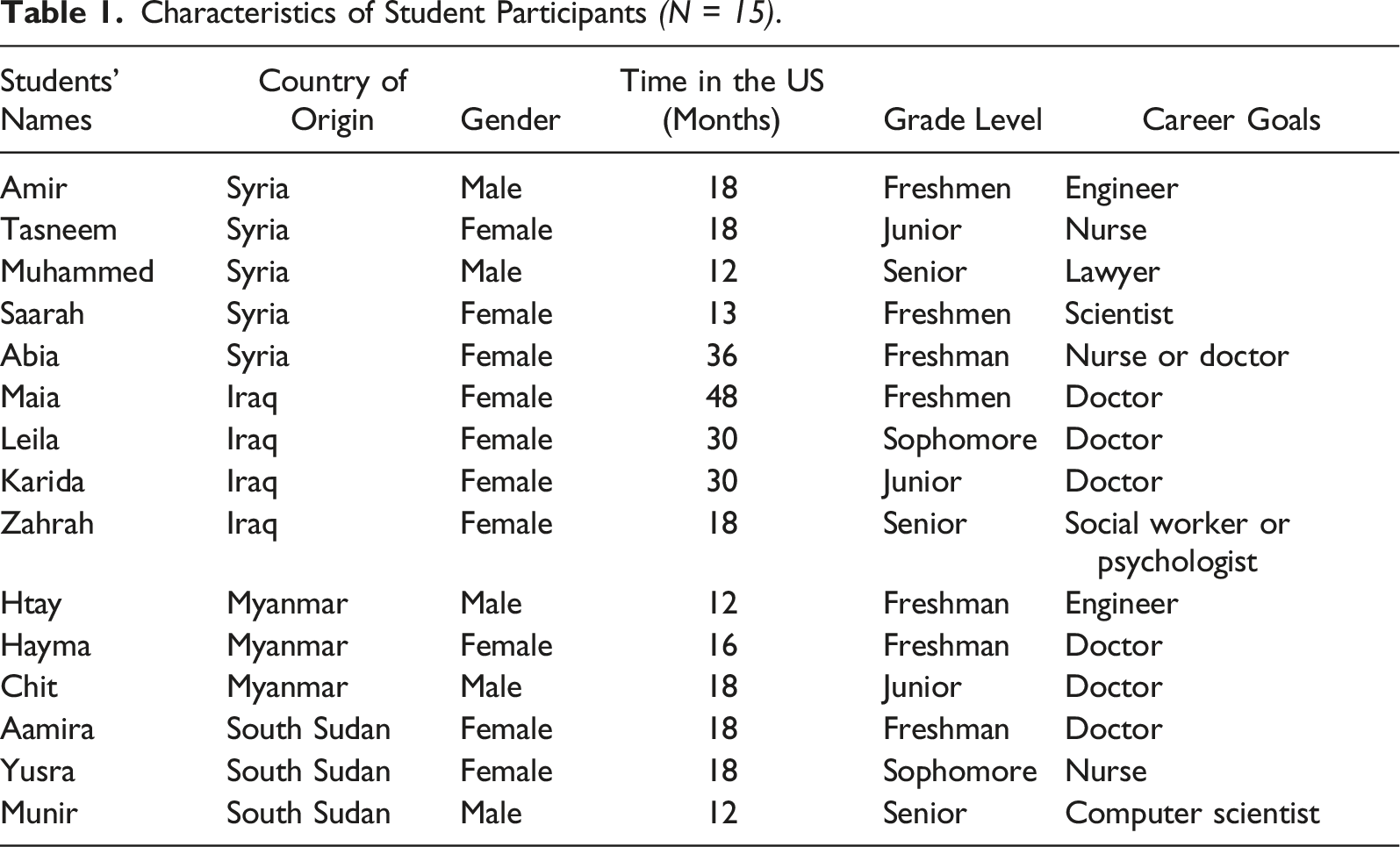
Students' Names
Country of Origin
Gender
Time in the US (Months)
Grade Level
Career Goals
Amir
Syria
Male
18
Freshmen
Engineer
Tasneem
Syria
Female
18
Junior
Nurse
Muhammed
Syria
Male
12
Senior
Lawyer
Saarah
Syria
Female
13
Freshmen
Scientist
Abia
Syria
Female
36
Freshman
Nurse or doctor
Maia
Iraq
Female
48
Freshmen
Doctor
Leila
Iraq
Female
30
Sophomore
Doctor
Karida
Iraq
Female
30
Junior
Doctor
Zahrah
Iraq
Female
18
Senior
Social worker or psychologist
Htay
Myanmar
Male
12
Freshman
Engineer
Hayma
Myanmar
Female
16
Freshman
Doctor
Chit
Myanmar
Male
18
Junior
Doctor
Aamira
South Sudan
Female
18
Freshman
Doctor
Yusra
South Sudan
Female
18
Sophomore
Nurse
Munir
South Sudan
Male
12
Senior
Computer scientist