




Abstract
Although employee strengths use has gained popularity in academia and practice, our understanding of its effective application for maximizing employee performance remains insufficient. This study investigates the interaction between perceived organizational and supervisor support for strengths use and employees’ strengths-based psychological climate and job performance. Using multi-wave data from 241 employee–supervisor dyads, the results of polynomial regression equations with a response surface analysis show that the higher the congruence between perceived organizational and supervisor support for strengths use, the better the strengths-based psychological climate. The congruence between these two forms of support has indirect effects on task performance and organizational citizenship behaviors (OCB) via the strengths-based psychological climate. Furthermore, while meaningful work is found to enhance the indirect effect of congruence on task performance through the strengths-based psychological climate, task interdependence does not strengthen the indirect effect of congruence on OCB. This study highlights the importance of the congruence between perceived organizational and supervisor support for strengths use in promoting employee performance and provides several useful practical implications for both organizations and career counselors.
Keywords
Introduction
Employees often play a crucial role in achieving an organization’s goals and sustaining its competitive advantage (Xiong & King, 2018). For instance, employees in the service industry have direct interactions with customers, and their performance during service encounters can largely influence the quality of service delivery and the customer satisfaction level (Park et al., 2021), which are essential for the organization’s survival and success (Ling et al., 2016). It is therefore vital for the management to provide formal and informal support to promote employee performance such as task performance and organizational citizenship behaviors (OCB). Recently, employee strengths use has received increased attention from scholars and practitioners, because employees who use their strengths at work not only experience various positive emotions such as vitality and joy, but also exhibit optimal functioning and excellent performance (e.g., Bakker & van Woerkom, 2018; Van Woerkom et al., 2022). Employee strengths use has been empirically linked to increased work engagement, enhanced work-related flow, and improved job performance in various occupational sectors (Bakker et al., 2019; Liu et al., 2022). Despite the beneficial effects of employee strengths use, there is surprisingly limited work on how to motivate employee strengths use to maximize job performance.
Along with the development of positive organizational behavior, organizations have begun to recognize the effectiveness of strengths-based approaches for optimizing the functioning of employees (Bakker & van Woerkom, 2018). In fact, organizational and supervisor support for strengths use can be a more effective way to promote excellent performance than the traditional management approach focusing on employee deficit correction (Van Woerkom et al., 2016b). However, most studies have focused on the function of either perceived organizational support for strengths use or perceived supervisor support for strengths use (Matsuo, 2021; Meyers et al., 2020). This line of research may not be irrelevant if both the organization and supervisors have a consistent attitude toward employee strengths use, but support from the organization and supervisors can differ (Marescaux et al., 2019). Organizational support such as training programs and reward systems may benefit employee performance, whereas how supervisors actually direct and support employees tends to influence the effectiveness of these formal work practices (Hai et al., 2020). Accordingly, neglecting the potential interaction between perceived organizational and supervisor support for strengths use and employee outcomes may produce an incomplete understanding of its function.
To extend the theoretical knowledge on the effects of perceived organizational and supervisor support for strengths use as well as provide meaningful recommendations for organizations and career counselors, this study aims to delineate and empirically examine how these factors interact with each other to impact employees’ job performance. Drawing on the job demands-resources (JD-R) model (Bakker & Demerouti, 2007), job resources such as organizational and supervisor support for strengths use may foster personal resources and improve job performance. Task performance and OCB are the most important performance outcomes emphasized in the literature on the JD-R model and strengths use (Bakker et al., 2023; Kong & Ho, 2016). Task performance is defined as employees’ activities directed toward formal job duties and responsibilities (Kluemper et al., 2013), and OCB refers to employees’ behaviors that go beyond formal job descriptions but benefit the organization’s functioning (Lee & Allen, 2002). This study focuses on task performance and OCB as key outcomes not only because they are theoretically relevant in the JD-R model and the strengths use literature (Bakker et al., 2023; Bakker & van Woerkom, 2018), but also because they are crucial for the effectiveness and success of both employees and organizations (Hao et al., 2018; Sørlie et al., 2022).
Another research question is how the congruence between perceived organizational and supervisor support for strengths use influences employee performance. Addressing the mechanisms that link congruence to performance may theoretically allow a better understanding of why this relationship matters and offer practical, effective ways to promote employee performance. When perceived organizational support for strengths use is congruent with perceived supervisor support, employees tend to perceive consistent signals that strengths use at work are supported by both the organization and supervisors, which may help form a strengths-based psychological climate (i.e., employees’ perceptions of the opportunities they can obtain to develop and apply their strengths; Van Woerkom & Meyers, 2015). A strengths-based psychological climate is considered to be an important personal resource that is closely associated with positive emotions and can lead to better job performance (Chang et al., 2022; Van Woerkom & Meyers, 2015). Therefore, we expect that a strengths-based psychological climate acts as a crucial mediator that transmits the effects of the congruence between perceived organizational and supervisor support for strengths use to employees’ task performance and OCB.
Furthermore, the strengths-based psychological climate resulting from the congruence between perceived organizational and supervisor support for strengths use may not always result in better employee performance. For instance, even when employees enjoy a higher strengths-based psychological climate, they may lack motivation to invest their resources and use strengths to improve task performance if they perceive their work as meaningless (Goh & Baum, 2021; Van Wingerden & Van der Stoep, 2018). When employees are required to accomplish independent tasks, they may have lower motivation to build strong connections with others within the organization and engage in less OCB (Thompson et al., 2021). However, little is known about the boundary conditions that may motivate employees to translate their personal resources (e.g., the strengths-based psychological climate generated by job resources) into job performance. Based on the job characteristics model (Hackman & Oldham, 1976; Humphrey et al., 2007), core motivational components of job characteristics such as meaningful work and task interdependence can enhance the possibility of employees becoming intrinsically motivated to achieve favorable psychological, attitudinal, and behavioral outcomes. There is also evidence that meaningful work is a crucial contingent factor in motivating task performance (Allan et al., 2018), while task interdependence is a vital contextual factor in facilitating positive working behaviors such as OCB (Anand et al., 2018). Building from the job characteristics model and previous evidence, we further expand our investigation to include meaningful work and task interdependence as key contextual factors that shape the indirect effects of congruence on task performance and OCB via the strengths-based psychological climate.
Our study seeks to make several noteworthy contributions to the literature. First, the potential interaction between perceived organizational and supervisor support for strengths use and employee outcomes remains unclear. This study complements previous work by investigating the joint effects of perceived organizational and supervisor support for strengths use on employees’ strengths-based psychological climate and subsequent job performance. Second, by examining the mediating role of the strengths-based psychological climate, our study helps expand the understanding of the support for the strengths use–job performance linkage. Third, this study examines contextual factors such as meaningful work and task interdependence that may moderate these relationships. In doing so, we can gain more insights into the function of support for strengths use and offer solutions to organizations that wish to promote employee performance. To examine our proposed theoretical model (see Figure 1), this study conducted a polynomial regression and response surface analysis using multi-wave data from employees and their direct supervisors. The proposed moderated mediation model.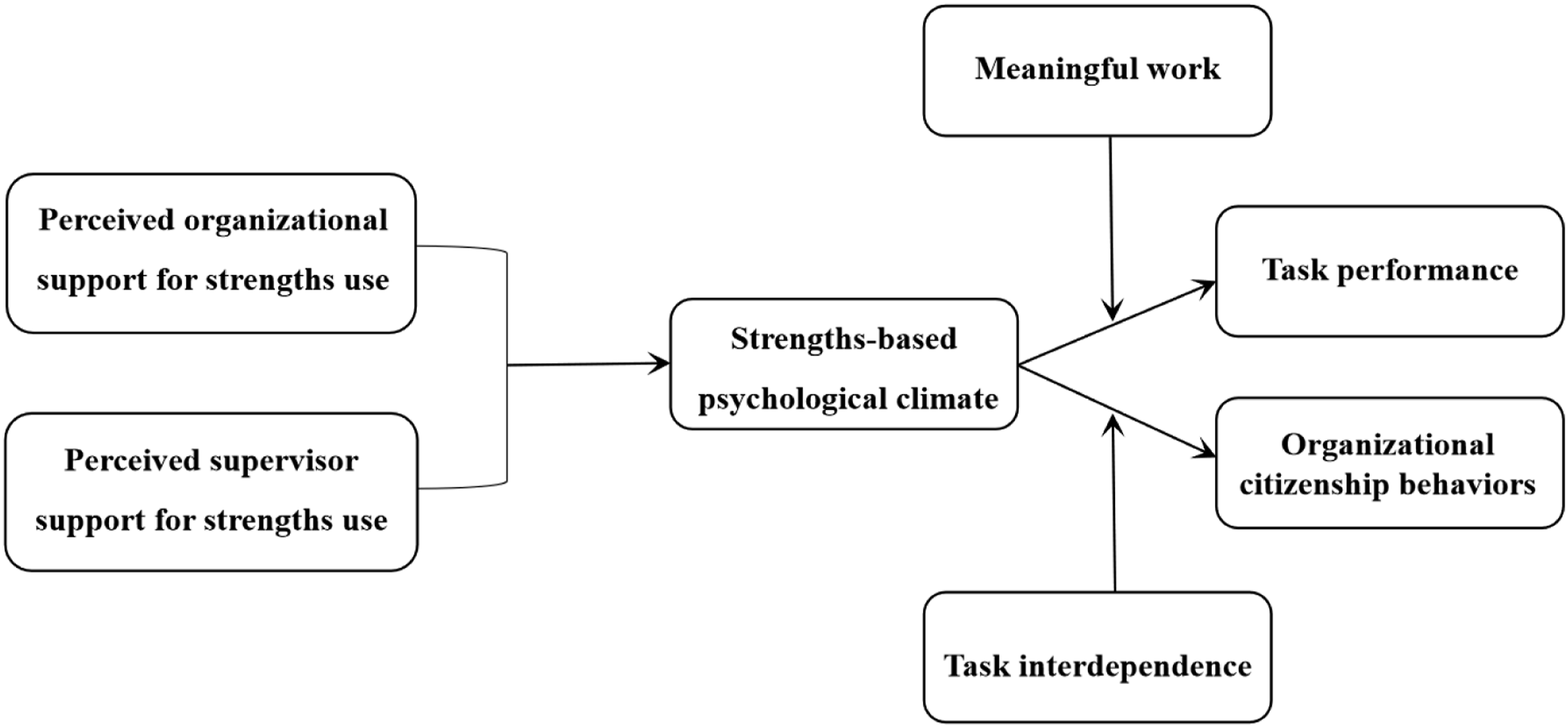
Theoretical Background and Hypotheses
Perceived Support for Strengths Use
Individual employee’s perceptions of strengths use support are influenced by the organization’s practices and rewards and by the supervisors who act as agents of the organization and are responsible for evaluating employee’s job performance (Van Woerkom et al., 2016a). Perceived organizational support for strengths use refers to employees’ beliefs about the extent to which the organization supports them in applying their personal strengths in the workplace (Keenan & Mostert, 2013). The organization may provide this support by focusing on developing employees’ individual strengths or allowing them to engage in activities that align with their strengths. Employees also develop global views of the extent to which their supervisors support the use of their strengths at work, conceptualized as perceived supervisor support for strengths use (Matsuo, 2021). Empirical studies have demonstrated that perceived organizational support for strengths use is positively associated with work engagement and job performance (Meyers et al., 2020; Van Woerkom et al., 2016b); meanwhile, perceived supervisor support for strengths use is positively related to strengths use behavior, career satisfaction, and perceived employability (Matsuo, 2021).
The JD-R model provides a useful framework to understand the influences of perceived organizational and supervisor support for strengths use on employee outcomes. A core proposition of this model is that job resources (i.e., the physical, social, and psychological aspects of a job that assist in achieving work goals and motivating personal growth) can facilitate the accumulation of personal resources and further lead to improved engagement and performance (Bakker et al., 2023). Based on the JD-R model, perceived organizational and supervisor support for strengths use can be considered as new types of job resources that stimulate employees’ growth and development (Matsuo, 2021; Van Woerkom et al., 2016a). Therefore, these two forms of job resources are likely to foster employees’ personal resources (e.g., the strengths-based psychological climate) and promote subsequent job performance. However, perceived organizational and supervisor support for strengths use should be considered as related but conceptually distinct concepts (DeConinck, 2010; Shi & Gordon, 2020). While the former represents formal practices and rewards adopted by the organization, the latter captures the supervisor’s informal leadership behavior and attitude toward followers (Hai et al., 2020; Marescaux et al., 2019). As such, employees are highly likely to experience congruent or incongruent strengths use support from the organization and supervisors.
Effects of the Congruence Between Perceived Organizational and Supervisor Support for Strengths Use
As both perceived organizational and supervisor support for strengths use are crucial in shaping employees’ cognition and behavior in the workplace (Matsuo, 2021; Meyers et al., 2020), they may interact with each other to influence psychological and performance outcomes as well. However, the potential interactive and dynamic relationship between perceived organizational and supervisor support for strengths use has not been theorized or empirically examined. As an exploratory investigation, this study proposes that compared with an incongruent situation, the congruence between perceived organizational and supervisor support for strengths use may be associated with a greater strengths-based psychological climate.
When perceived organizational support for strengths use is incongruent with perceived supervisor support for strengths use, employees may perceive inconsistent signals about whether their strengths use is supported and experience a state of psychological discomfort termed cognitive dissonance (Marescaux et al., 2019). For instance, the organization’s practices may support and reward employee strengths use, but supervisors may seldom provide employees with the opportunity to apply strengths at work or allow them to use their strengths to achieve work goals. Conversely, the supervisor may focus on employees’ strong points and encourage them to fulfill their work commitments in a way that suits their strengths, while the organization may lack formal practices that aim to identity and develop employees’ strengths. Based on cognitive dissonance theory (Stone & Cooper, 2001), both situations send contradictory messages to employees, who, in turn, may experience uncertainty about whether they are free to engage in strengths use at work, leading to cognitive dissonance and impairment in the formation of the strengths-based psychological climate. Previous studies have empirically support that the inconsistency between the organization’s human resource (HR) practices and leadership behavior can undermine the effectiveness of the former and trigger undesirable employee outcomes such as increased psychological discomfort (Marescaux et al., 2019; Salas-Vallina et al., 2021).
In the situation where perceived organizational support for strengths use is congruent with perceived supervisor support for strengths use, employees are likely to perceive consistent and clear signals that their strengths use is supported by both the organization and supervisors and that they can use strengths to successfully achieve work goals and cope with job demands in the workplace (Meyers et al., 2020; Van Woerkom et al., 2016a). The consistent signals sent by the organization and supervisors allow employees to experience cognitive consonance, which is a comfortable psychological state reflecting employees’ reactions toward the situation (Marescaux et al., 2019). Cognitive consonance generated by the internal consistency between perceived organizational and supervisor support for strengths use may not only facilitate employees’ positive interpretation of the employer’s intention to develop and apply their strengths, but also reduce the uncertainty about whether their strengths use is encouraged by their employer (Marescaux et al., 2019). As a result, we expect that the congruence between perceived organizational and supervisor support for strengths use may help form a stronger belief among employees that their strengths are appreciated and valued, thus leading to greater strengths-based psychological climate.
The higher the congruence between perceived organizational and supervisor support for strengths use, the higher the strengths-based psychological climate. Perceived organizational and supervisor support for strengths use can be congruent at either high or low levels. As suggested by Cao and Hamori (2020), employees’ reactions may vary based on the levels of congruence. In this study, we expect that congruence at high levels of both perceived organizational and supervisor support for strengths use is associated with a greater strengths-based psychological climate than congruence at low levels. Based on the JD-R model (Bakker & Demerouti, 2007), abundant job resources provided by the work environment can trigger employees’ motivation and help them cope with job demands. Because perceived organizational and supervisor support for strengths use are considered as new types of job resources (Matsuo, 2021; Van Woerkom et al., 2016a), employees with high support from both ends are likely to develop higher confidence in using their strengths to reach work goals and form a greater strengths-based psychological climate. By contrast, when perceived organizational and supervisor support for strengths use are congruent at low levels, although employees may not receive contradictory messages, the lack of support from both the organization and supervisors reduces the opportunities for employees to develop and apply their strengths at work; this results in a poor strengths-based psychological climate. As such, compared with “low–low” congruence, “high–high” congruence is expected to be associated with a greater strengths-based psychological climate.
The strengths-based psychological climate is higher when perceived organizational and supervisor support for strengths use are both high compared with when they are both low.
Indirect Effects of Congruence on Performance via the Strengths-Based Psychological Climate
The strengths-based psychological climate generated by the congruence between perceived organizational and supervisor support for strengths use may further bring positive outcomes for the organization (Van Woerkom et al., 2022). To better understand how this congruence contributes to organizational functioning, it is important to explore whether the strengths-based psychological climate translates the effects of congruence on crucial employee outcomes. In view of this, we propose that the strengths-based psychological climate resulting from congruence can, in turn, positively relate to task performance and OCB.
First, as it is closely associated with employees’ confidence and vitality (Van Woerkom & Meyers, 2015), we expect that the strengths-based psychological climate generated by congruence is positively associated with task performance. When employees perceive greater opportunities for strengths identification, development, and application in the workplace (i.e., a good strengths-based psychological climate), they are highly likely to leverage their personal strengths consciously or unconsciously at work (Hai & Park, 2022; Van Woerkom et al., 2022); this allows them to effectively achieve their work goals and leads to better task performance (Chang et al., 2022). A high strengths-based psychological climate brings about a sense of self-worth and being valued (Van Woerkom & Meyers, 2015), motivating employees to invest more effort into their work and achieve better task performance. Accordingly, congruence is expected to trigger a higher strengths-based psychological climate, which, in turn, results in superior task performance.
Moreover, as suggested by Chang et al. (2022), the strengths-based psychological climate is an important resource that enables employees to “go the extra mile” to help others within the organization and promote the attainment of organizational goals. A high strengths-based psychological climate means that employees feel recognized and appreciated because of strengths use at work (Van Woerkom et al., 2022), which may facilitate intrinsic motivation toward the job and lead them to engage in extra-role behaviors such as OCB. Employees within a high strengths-based psychological climate are more likely to experience pleasurable states as well as feel energetic and competent (Chang et al., 2022), inducing them to approach others and engage in activities that benefit the organization. Van Woerkom and Meyers (2015) provided empirical evidence that the strengths-based psychological climate is positively associated with OCB by triggering a series of positive feelings. Therefore, the strengths-based psychological climate that results from congruence is expected to be positively associated with OCB.
The congruence between perceived organizational and supervisor support for strengths use has an indirect effect on task performance via the strengths-based psychological climate.
The congruence between perceived organizational and supervisor support for strengths use has an indirect effect on OCB via the strengths-based psychological climate.
Moderated Mediation Effects of Meaningful Work and Task Interdependence
The strengths-based psychological climate generated by the congruence between perceived organizational and supervisor support for strengths use has the potential to promote employee performance; however, job characteristics such as meaningful work and task interdependence can be important for the effectiveness of strengths use support. According to the job characteristics model (Hackman & Oldham, 1976; Oldham & Hackman, 2010), certain job characteristics can increase employees’ motivation to invest their personal resources in their work. Meaningful work and task interdependence are two core components in this model with significant motivational effects (Humphrey et al., 2007). Theoretically, meaningful work is more closely related to employees’ motivation to perform well at work (e.g., completing high quality work and achieving superior task performance), while task interdependence is closely associated with employees’ motivation to cooperate with others to achieve work goals (e.g., helping coworkers and sharing information) (Allan et al., 2018; Anand et al., 2018; Thompson et al., 2021). Building on this theoretical foundation, this study focuses on the role of meaningful work in shaping the indirect effect of the congruence between perceived organizational and supervisor support for strengths use on task performance and the role of task interdependence in moderating the indirect effect of congruence on OCB.
Meaningful work refers to work that is personally worthwhile and valuable (Pratt & Ashforth, 2003), which has been considered a vital motivational component in the job characteristics model (Humphrey et al., 2007; Oldham & Hackman, 2010). When work is perceived to be meaningful, employees are inclined to pay more attention to assigned tasks and conduct tasks with passion (Allan et al., 2019; Vogel et al., 2020); employees are more satisfied, intrinsically motivated, and committed to the organization (Allan et al., 2019; Jung & Yoon, 2016). In this study, we assume that meaningful work enhances the indirect effect of the congruence between perceived organizational and supervisor support for strengths use on task performance via the strengths-based psychological climate.
When work is perceived to be meaningful, employees are likely to be intrinsically motivated to perform work tasks and leverage their personal resources (e.g., the strengths-based psychological climate) to fulfill their work goals (Allan et al., 2019), thereby exhibiting superior task performance. If employees personally feel that their work is meaningful, impactful, and valuable, they are more willing to invest effort and improve persistence and coping strategies (Christensen-Salem et al., 2021; Liu et al., 2022); this may facilitate the positive effect of the strengths-based psychological climate generated by congruence on task performance. Conversely, when work is not perceived as meaningful, although employees may experience a high strengths-based psychological climate resulting from the congruence between perceived organizational and supervisor support for strengths use, they are less likely to translate their personal resources into task performance due to a lack of intrinsic motivation and passion toward their work roles. Therefore, the indirect effect of congruence on task performance via the strengths-based psychological climate varies depending on the level of meaningful work.
Meaningful work moderates the indirect effect of the congruence between perceived organizational and supervisor support for strengths use on task performance via the strengths-based psychological climate, such that the indirect effect is strong when the level of meaningful work is high. Task interdependence is another critical feature of the work environment that may shape the relationship between individual differences and OCB. Task interdependence, which is defined as the extent to which employees perceive that they interact with and depend on others to accomplish their work tasks (Pearce & Gregersen, 1991), promotes communication, cooperation, and knowledge sharing among employees (Ye et al., 2020; Zhang et al., 2022). When task interdependence is perceived to be high, employees are likely to recognize the importance of their coworkers in completing work goals and interact closely with others at work (Drach-Zahavy & Somech, 2013; Yang et al., 2021). Task interdependence is expected to strengthen the indirect effect of congruence on OCB via the strengths-based psychological climate. First, high task interdependence requires employees to communicate and cooperate more to execute work tasks, which may enhance employees’ motivation to build and maintain positive interpersonal relationships with others (Anand et al., 2018; Thompson et al., 2021). As such, when task interdependence is high, employees are more likely to use the resources generated by the congruence between perceived organizational and supervisor support for strengths use to interact positively with and help coworkers to successfully complete work tasks (Zhang et al., 2022). Therefore, task interdependence may facilitate the indirect effect of congruence on OCB by triggering employees’ motivation to apply these resources to maintain stronger connections with coworkers and advance common goals. Second, high task interdependence provides more opportunities for employees to share information and exchange resources to conduct tasks effectively (Christensen-Salem et al., 2021; Ye et al., 2020). This may increase the likelihood of employees leveraging their available resources (e.g., the strengths-based psychological climate) obtained from perceived organizational and supervisor support for strengths use to engage in OCB to benefit others at work; this will enhance the indirect effect of congruence on OCB via the strengths-based psychological climate.
Task interdependence moderates the indirect effect of the congruence between perceived organizational and supervisor support for strengths use on OCB via the strengths-based psychological climate, such that the indirect effect is strong when task interdependence is high.
Methodology
Sample and Procedure
Participants were service employees working in a variety of hotels in China. With the help of these hotels’ HR departments, we randomly invited 340 full-time service employees from different departments (e.g., the front desk, marketing, food and beverage, and housekeeping) to participate in the study. In total, 318 employees of 32 hotels agreed to participate in the survey. Before data collection, we explained the research purpose to the participants, highlighted the significance of providing honest responses, and assured them of data confidentiality and anonymity. To alleviate concerns about common method bias (Podsakoff et al., 2012), we collected the data from employees and their direct supervisors in three waves.
All the data were collected through online surveys. In Wave 1, the participants were required to complete the measures of perceived organizational and supervisor support for strengths use, and report their demographic information such as age, gender, educational level, and tenure. In Wave 2, which was conducted 1 week after Wave 1, the participants completed the measures of the strengths-based psychological climate and meaningful work. In Wave 3, conducted 1 week after Wave 2, we received the task performance and OCB ratings for each participant from their direct supervisors.
A total of 318 employees completed the survey in Wave 1. Of these, 284 employees completed the survey in Wave 2. In Wave 3, the direct supervisors of 241 employees who had completed the surveys in both Waves 1 and 2 were invited to complete the final survey. The final sample consisted of 241 employee–supervisor dyads. Among the 241 employees, 81 were men (33.6%) and 160 were women (66.4%). The mean age of the participants was 39.41 years (SD = 10.70), and their mean organizational tenure was 7.17 years (SD = 6.22). Regarding educational level, 26.6% finished high school and below, 62.6% had a 2-year college, 10.0% had an undergraduate degree, and .8% had a graduate degree.
Measures
All the research constructs were assessed using well-established and validated scales to ensure reliability and validity. We also ensured that these measurements were appropriate for the context of this study.
Perceived Organizational Support for Strengths Use
We assessed perceived organizational support for strengths use using a five-item scale developed by Keenan and Mostert (2013) and adapted by Van Woerkom et al., 2016a. Responses were rated on a seven-point Likert scale ranging from 1 (almost never) to 7 (almost always). A sample item is “This organization allows me to use my talents.” The Cronbach’s alpha for this scale was .94.
Perceived Supervisor Support for Strengths Use
We assessed perceived supervisor support for strengths use using a five-item scale adapted from Keenan and Mostert (2013) and adapted by Matsuo (2021). The participants were required to rate the items on a seven-point Likert scale ranging from 1 (almost never) to 7 (almost always). An example item is “My supervisor gives me the opportunity to do what I am good at.” The Cronbach’s alpha for the scale was .95.
Strengths-Based Psychological Climate
We measured the strengths-based psychological climate using a 12-item scale from Van Woerkom and Meyers (2015). The participants rated the items on a seven-point Likert scale ranging from 1 (strongly disagree) to 7 (strongly agree). A sample item is “In this organization, I gain recognition for activities I do well.” The Cronbach’s alpha for the scale was .95.
Meaningful Work
We assessed meaningful work using four items developed by May et al. (2004) and adapted by Supanti and Butcher (2019). These items were used because they have significant factor loadings, sufficient validity, and reliability (Supanti & Butcher, 2019). The participants rated the items on a seven-point Likert scale ranging from 1 (strongly disagree) to 7 (strongly agree). A sample item is “The work I do on this job at the current organization is meaningful to me.” The Cronbach’s alpha for the scale was .92.
Task Interdependence
We measured task interdependence using a five-item scale from Pearce and Gregersen (1991). The participants rated the items on a seven-point Likert scale ranging from 1 (strongly disagree) to 7 (strongly agree). A sample item is “I work closely with others in doing my work.” The Cronbach’s alpha for the scale was .90.
Task Performance
We measured task performance using the three-item scale developed by Farh et al. (1991). The participants’ direct supervisors responded on a seven-point Likert scale ranging from 1 (very poor performance) to 7 (excellent performance). A sample item is “What do you think of this employees’ work performance? In other words, is this employee able to complete quality work on time?” The Cronbach’s alpha for the scale was .92.
OCB
We assessed OCB using the eight-item scale from Lee and Allen (2002). The participants’ direct supervisors responded on a seven-point Likert scale ranging from 1 (never) to 7 (always). An example item is “This employee gives up time to help others who have work or nonwork problems.” The Cronbach’s alpha for the scale was .89.
Control Variables
As employee demographics may influence work behaviors (Karatepe et al., 2018; Meyers et al., 2020), we included employees’ age, gender, education, and organizational tenure as control variables. Tenure with supervisor was also controlled for because the length of the employee–supervisor relationship may influence employees’ job performance and supervisors’ ratings of employee performance (Malik et al., 2019).
Data Analysis
Polynomial regression and response surface approaches were used to examine the hypotheses
(Edwards & Cable, 2009). The three-dimensional response surface generated by these approaches can provide more information about the combined effect of two predictors on one outcome variable than a traditional two-dimensional analysis (Qiu et al., 2020; Shanock et al., 2010). The polynomial regression equation in this study is as follows:

Where Z represents the outcome variable (i.e., the strengths-based psychological climate), POSSU refers to the effect of perceived organizational support for strengths use, and PSSSU refers to the effect of perceived supervisor support for strengths use. To reduce multicollinearity and enhance the interpretation of the obtained results, POSSU and PSSSU were mean-centered before calculating the second-order polynomial terms (Matta et al., 2015). We examined the hypotheses by regressing the strengths-based psychological climate on the control variables and five polynomial terms: POSSU, PSSSU, POSSU2, POSSU × PSSSU, and PSSSU2.
Then, we used the estimated coefficients to plot the three-dimensional response surface (Shanock et al., 2010), in which POSSU was plotted on the X-axis, PSSSU was indexed on the Y-axis, and the strengths-based psychological climate was plotted on the Z-axis. The slopes and curvatures along the congruence line (POSSU = PSSSU) and the incongruence line (POSSU = −PSSSU) were calculated to test the hypotheses. Based on previous studies (Edwards & Cable, 2009; Shanock et al., 2010), a significantly negative curvature of the surface along the incongruence line (POSSU = −PSSSU) indicates support for Hypothesis 1. The curvature along the incongruence line can be calculated from the coefficients estimated in equation (1) (i.e., b3 − b4 + b5). Hypothesis 2 would be supported if the slope of the surface along the congruence line (POSSU = PSSSU) is positive and significant (calculated as b1 + b2), and the curvature along the congruence line is insignificant (calculated as b3 + b4 + b5).
To examine Hypotheses 3 and 4, we used the block variable approach as suggested by researchers (Carter & Mossholder, 2015; Edwards & Cable, 2009). To create a block variable that represents the joint effect of the five polynomial terms, we combined these polynomial regression terms based on their respective weights. We then examined the mediation effects using the PROCESS model 4 (Hayes, 2017). This approach was adopted because it is considered effective for testing mediation and moderation effects and has been widely used in previous studies (e.g., Qin et al., 2021; Tang et al., 2020). We tested the significance of the mediation effects by conducting bootstrapping with 5000 resamples (Preacher & Hayes, 2008). If the 95% confidence interval (CI) generated by the bias-corrected bootstrapping procedure did not include 0, the mediation effect was considered to be statistically significant. Finally, we used the PROCESS model 14 to test the second-stage moderated mediation effect of meaningful work on task performance (Hypothesis 5) and the second-stage moderated mediation effect of task interdependence on OCB (Hypothesis 6). The significances of the moderated mediation effects were confirmed by conducting bootstrapping with 5000 resamples.
Results
Discriminant Validity and Descriptive Statistics
Before testing our hypotheses, we performed a confirmatory factor analysis with AMOS 20.0 to assess the discriminant validity of the study constructs. The hypothesized seven-factor model showed an acceptable fit to the data (χ 2 = 1047.19, df = 474; CFI = .92, IFI = .92, SRMR = .05, and RMSEA = .07, 90% CI for RMSEA = [.07, .08]). The hypothesized seven-factor model was significantly better than alternative models such as a six-factor model (χ 2 = 1600.32, df = 480; CFI = .84, TLI = .82, SRMR = .06, and RMSEA = .10, 90% CI for RMSEA = [.09, .10]), a five-factor model (χ 2 = 2027.55, df = 485; CFI = .77, TLI = .75, SRMR = .09, and RMSEA = .12, 90% CI for RMSEA = [.11, .12]), a four-factor model (χ 2 = 2581.03, df = 489; CFI = .69, TLI = .67, SRMR = .11, and RMSEA = .13, 90% CI for RMSEA = [.13, .14]), a three-factor model (χ 2 = 3161.15, df = 492; CFI = .61, TLI = .58, SRMR = .12, and RMSEA = .15, 90% CI for RMSEA = [.15, .16]), a two-factor model (χ 2 = 3678.25, df = 494; CFI = .53, TLI = .50, SRMR = .05, and RMSEA = .14, 90% CI for RMSEA = [.16, .17]), and a one-factor model (χ 2 = 4543.59, df = 495; CFI = .41, TLI = .37, SRMR = .17, and RMSEA = .19, 90% CI for RMSEA = [.18, .19]). These results support the discriminant validity of the study constructs.
Descriptive Statistics, Correlations, and Reliabilities.
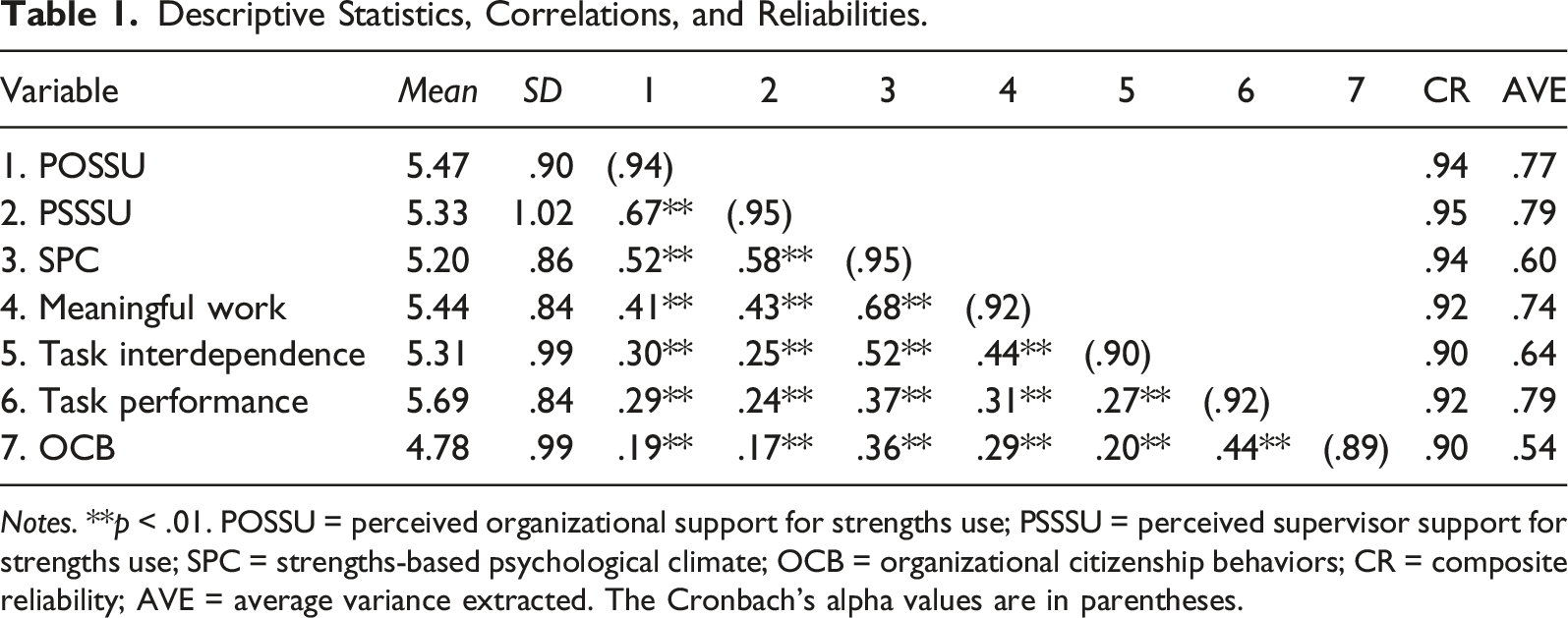
Notes. **p < .01. POSSU = perceived organizational support for strengths use; PSSSU = perceived supervisor support for strengths use; SPC = strengths-based psychological climate; OCB = organizational citizenship behaviors; CR = composite reliability; AVE = average variance extracted. The Cronbach’s alpha values are in parentheses.
Testing the Effects of Perceived Organizational and Supervisor Support for Strengths Use
In Hypothesis 1, we propose that the higher the congruence between perceived organizational and supervisor support for strengths use, the higher the strengths-based psychological climate. The results from Model 2 in Table 2 show that the change in R
2
between Models 1 and 2 was positive (ΔR
2
= .05) and that the five polynomial terms were jointly significant in influencing the strengths-based psychological climate (F = 18.82, p < .001). Moreover, the curvature along the incongruence line was negative and significant (curvature [b3 − b4 + b5] = −.44, p < .001), indicating that the strengths-based psychological climate improved as perceived organizational and supervisor support for strengths use scores became more aligned, but deteriorated as the scores diverged (see Figure 2). Therefore, Hypothesis 1 was supported. Strengths-based psychological climate as predicted by perceived organizational support for strengths use (POSSU) and perceived supervisor support for strengths use (PSSSU). Polynomial Regression Results for Perceived Organizational and Supervisor Support for Strengths Use Predicting the Strengths-Based Psychological Climate. Notes. †p < .10; *p < .05; ***p < .001. POSSU = perceived organizational support for strengths use; PSSSU = perceived supervisor support for strengths use. Unstandardized regression coefficients are reported (standard errors in parentheses).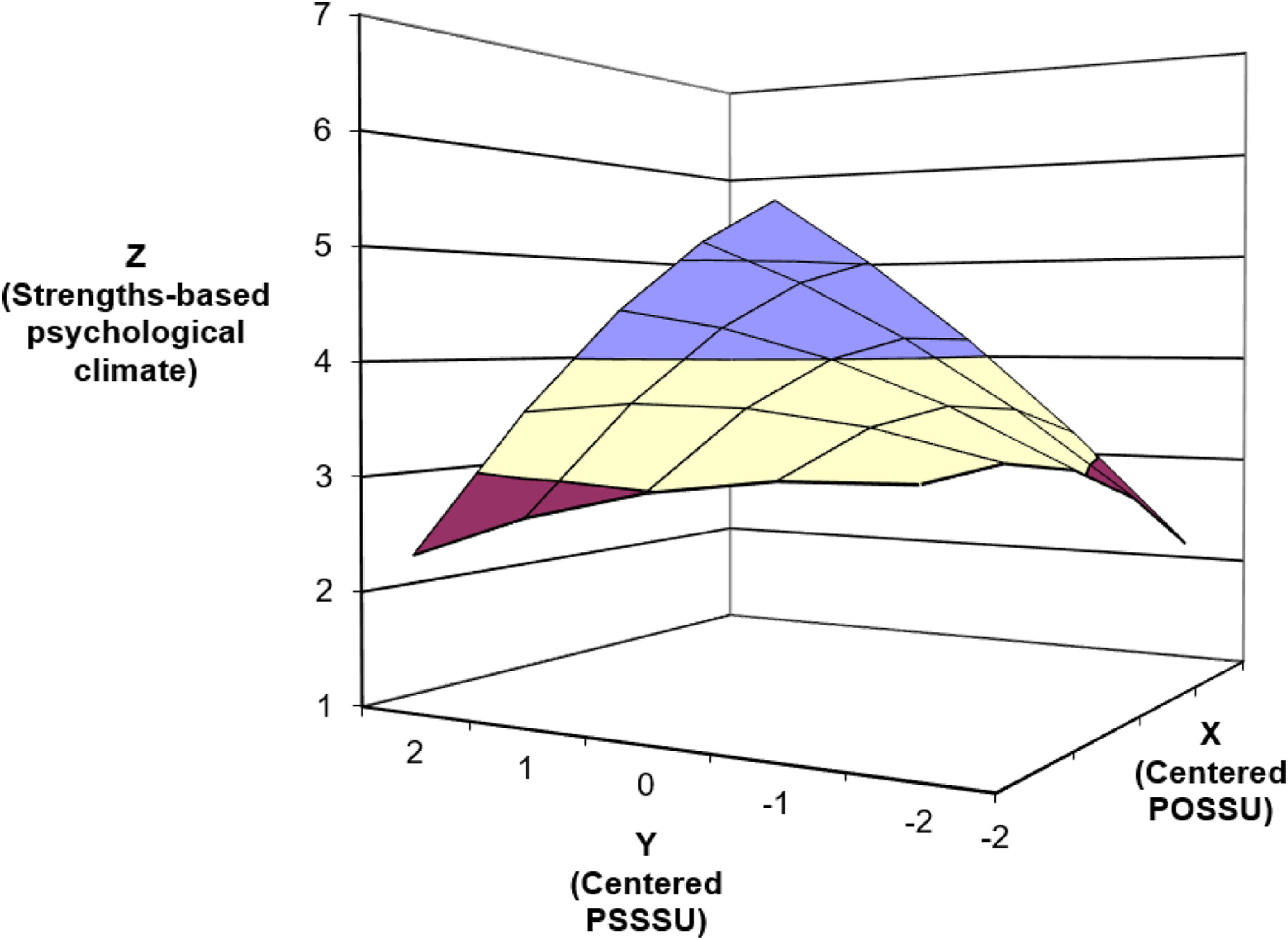
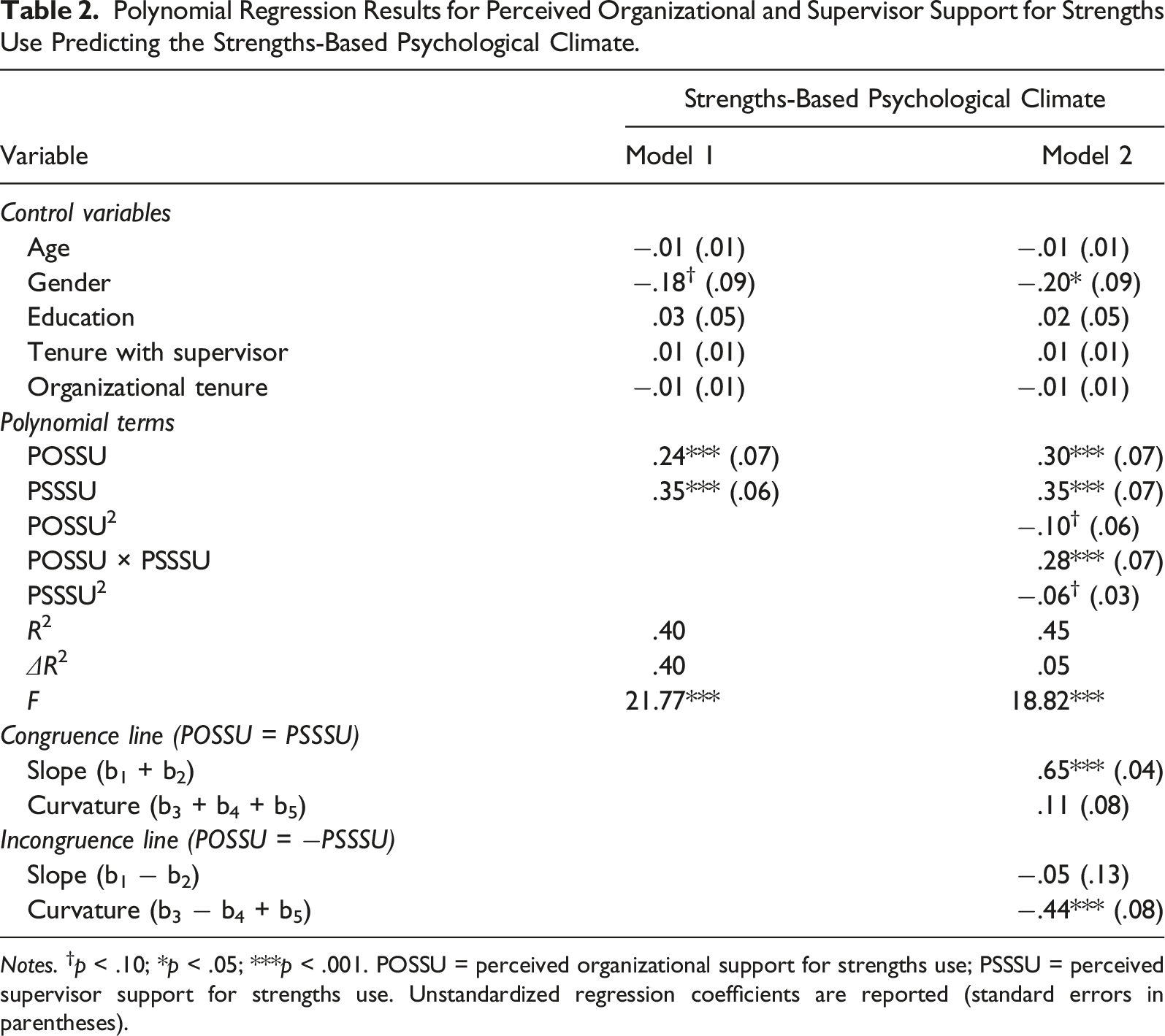
Hypothesis 2 proposes that the strengths-based psychological climate is higher when perceived organizational and supervisor support for strengths use are both high as opposed to when they are both low. As displayed in Table 2, the slope along the congruence line was positive and significant (slope [b1 + b2] = .65, p < .001) and the curvature was nonsignificant (curvature [b3 + b4 + b5] = .11, p > .05). The results indicate that the congruence between perceived organizational and supervisor support for strengths use had a positive linear effect on the strengths-based psychological climate. Figure 2 shows that the strengths-based psychological climate improved along with the congruence line from the front corner to the rear corner on the surface plot, thus supporting Hypothesis 2.
Testing the Mediation Effects of the Strengths-Based Psychological Climate
Results for the Indirect Effects of the Strengths-Based Psychological Climate on Employees’ Task Performance and OCB.
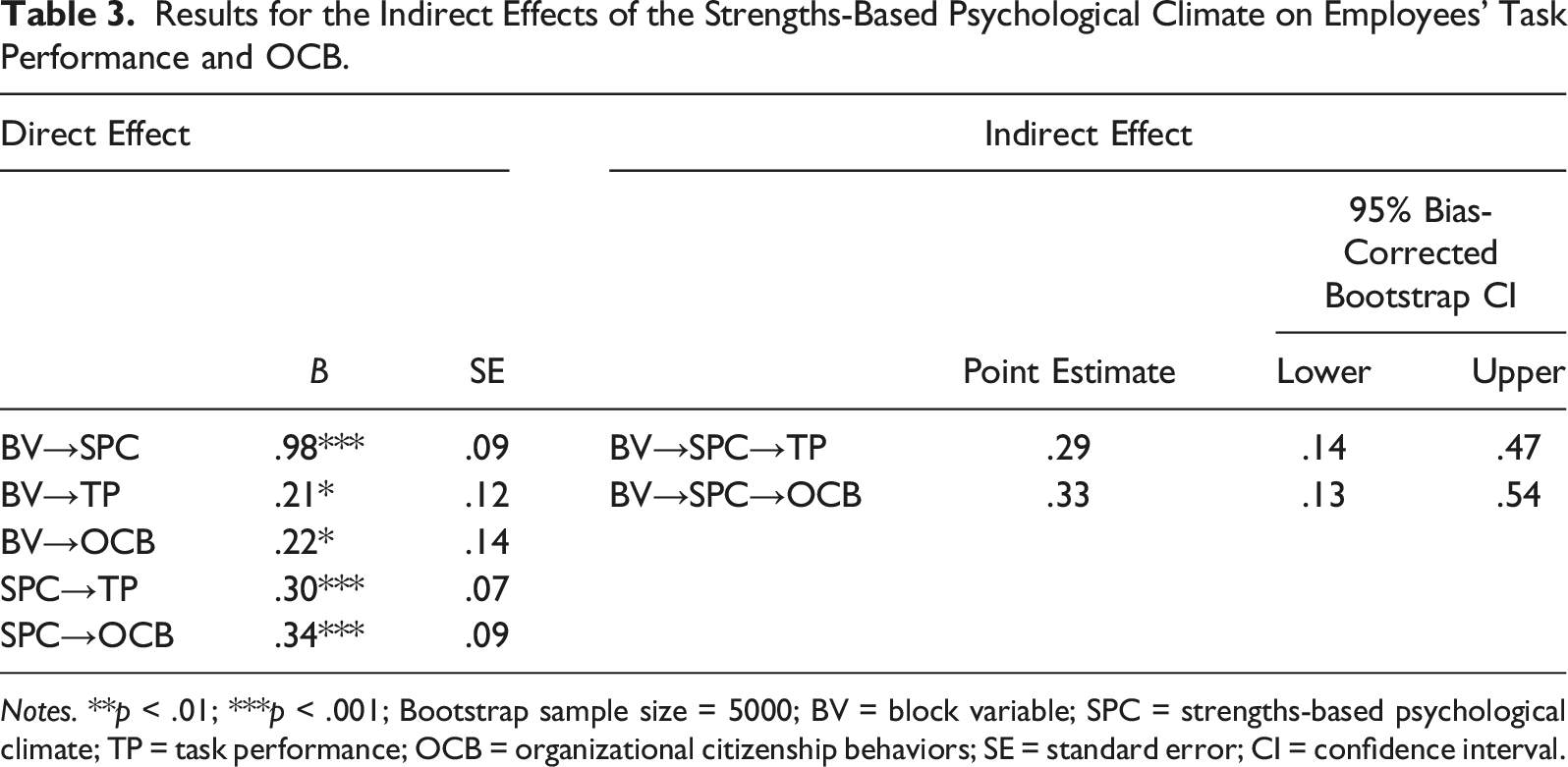
Notes. **p < .01; ***p < .001; Bootstrap sample size = 5000; BV = block variable; SPC = strengths-based psychological climate; TP = task performance; OCB = organizational citizenship behaviors; SE = standard error; CI = confidence interval.
Testing the Moderating Mediation Effects of Meaningful Work and Task Interdependence
Conditional Indirect Effects of the Congruence Between Perceived Organizational and Supervisor Support for Strengths Use on Task Performance and OCB via the Strengths-Based Psychological Climate.
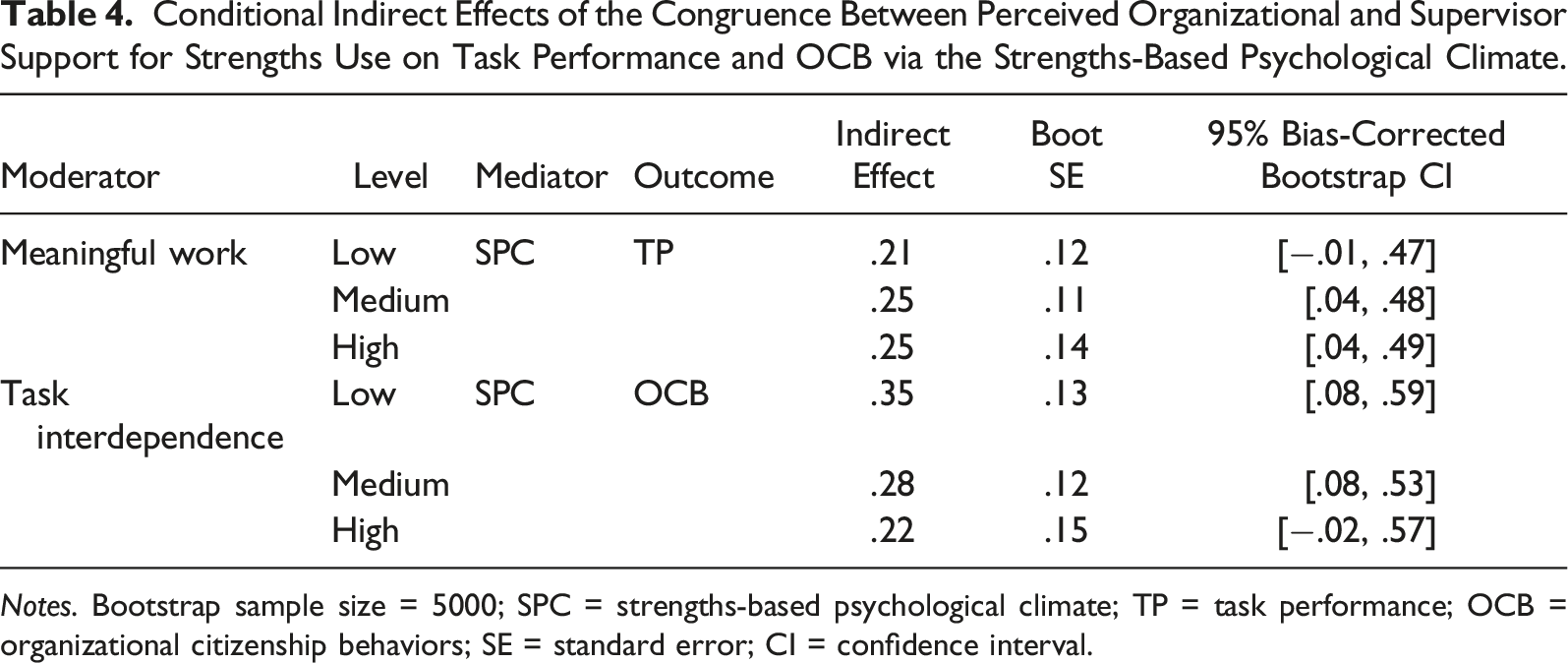
Notes. Bootstrap sample size = 5000; SPC = strengths-based psychological climate; TP = task performance; OCB = organizational citizenship behaviors; SE = standard error; CI = confidence interval.
Hypothesis 6 posits that task interdependence enhances the indirect effect of congruence on OCB via the strengths-based psychological climate. The interaction between the strengths-based psychological climate and task interdependence was not significantly related to OCB (β = −.05, p > .05). Further, the conditional indirect effect of congruence on OCB through the strengths-based psychological climate was significant when task interdependence was low (estimate = .35, boot SE = .13, CI [.08, .59]), but nonsignificant when task interdependence was high (estimate = .22, boot SE = .15, CI [−.02, .57]) (see Table 4). Therefore, Hypothesis 6 was not supported.
Post-Hoc Analysis
First, we ran our analyses without the control variables to demonstrate the robustness of the results. No significant differences were found in our results with or without the control variables. Therefore, the inclusion of the control variables did not influence our findings. Next, we examined the effects of the incongruence between perceived organizational and supervisor support for strengths use (i.e., high perceived organizational support for strengths use and low perceived supervisor support for strengths use vs. low perceived organizational support for strengths use and high perceived supervisor support for strengths use) on the strengths-based psychological climate. Table 2 shows that the slope along the incongruence line was nonsignificant (slope [b1 - b2] = −.05, p > .05), suggesting that the effect of high–low incongruence on the strengths-based psychological climate did not significantly differ from the effect of low–high incongruence. Third, we investigated whether meaningful work moderated the indirect effect of congruence on OCB and whether task interdependence moderated the indirect effect of congruence on task performance. The results of the moderated mediation analyses show that the conditional indirect effect of congruence on OCB through the strengths-based psychological climate was nonsignificant when the level of meaningful work was high (estimate = .25, CI = [−.04, .55]) and when it was low (estimate = .20, CI = [−.12, .50]). The conditional indirect effect of congruence on task performance through the strengths-based psychological climate was significant when task interdependence was high (estimate = .20, CI = [.02, .46]) and when it was low (estimate = .27, CI = [.08, .47]). These results indicate that meaningful work and task interdependence did not moderate the indirect effect of congruence on either of the dependent variables.
Discussion
Expanding the emerging literature on strengths use support (e.g., Liu et al., 2022; Matsuo, 2021; Meyers et al., 2020), the present study investigated the joint effects of perceived organizational and supervisor support for strengths use on employees’ psychological and performance outcomes. Using data collected from multiple measurement points and sources, our polynomial regression and response surface analysis shows that the higher the congruence between perceived organizational and supervisor support for strengths use, the better employees’ strengths-based psychological climate. Employees’ strengths-based psychological climate was higher when congruence occurred at higher rather than low levels of strengths use support. Our analysis further reveals that congruence had indirect effects on task performance and OCB via the strengths-based psychological climate.
Moreover, meaningful work enhanced the indirect effect of congruence on task performance through the strengths-based psychological climate. Contrary to our hypothesis, we find that task interdependence mitigated the indirect effect of congruence on OCB via the strengths-based psychological climate. One possible explanation for this finding may be that although task interdependence provides more opportunities for employees to interact with coworkers during work (Anand et al., 2018; Thompson et al., 2021), such increased interactions can also induce a conflict that interferes with the indirect effect of congruence on OCB. Previous studies have indicated that in a highly interdependent task environment, employees are likely to experience more conflicts when performing assigned tasks due to differences in opinions or disagreements about the distribution of resources and procedures (Yang et al., 2021). Employees who experience conflict may withdraw from work and be unwilling to engage in OCB (Lu et al., 2011), thereby reducing the indirect effect of congruence on OCB via the strengths-based psychological climate. We encourage future studies to provide evidence for this assumption.
Theoretical Implications
This study has several theoretical implications for enriching the literature on strengths use support and job performance. First, research has identified perceived organizational and supervisor support as important job resources that motivate employees to display better performance and reduce the negative impacts of job demands (Karatepe et al., 2018; Shi & Gordon, 2020). However, little is known about the interaction between perceived organizational and supervisor support for strengths use and employee outcomes despite the established importance of strengths use support in enhancing employee productivity and promoting excellent performance (Meyers et al., 2020; Van Woerkom et al., 2016b). Drawing on the JD-R model (Bakker & Demerouti, 2007), this study expands the current knowledge on organizational and supervisor support by investigating the implications of the congruence between perceived organizational and supervisor support for strengths use for employee job performance.
Our findings indicate that employees’ strengths-based psychological climate is greater when the level of perceived organizational support for strengths use is congruent with perceived supervisor support compared with incongruent conditions. This suggests that clear and consistent messages about whether strengths use is supported in the workplace are essential for employees to develop a strengths-based psychological climate. If organizational support for strengths use is higher or lower than perceived supervisor support, employees may receive contradictory signals, which can lead to cognitive dissonance (Marescaux et al., 2019) and undermine the development of a strengths-based psychological climate. This study not only provides a more nuanced understanding of the implications of strengths use support for employees, but also highlights the importance of addressing the inconsistency between the organization’s HR practices and leadership behavior in achieving organizational goals.
Moreover, the study results demonstrate that employees’ strengths-based psychological climate is highest when perceived organizational support for strengths use is congruent with perceived supervisor support at higher levels rather than at lower levels. According to the JD-R model (Bakker & Demerouti, 2007), high perceived organizational and supervisor support for strengths use can act as important job resources for employees to develop a greater strengths-based psychological climate and exhibit better job performance. This suggests a way for organizations to maximize the effectiveness of support for strengths use and promote employee performance.
Next, the literature addressing how perceived organizational and supervisor support for strengths use impact employee performance is surprisingly lacking. This study contributes to the literature on support for strengths use and job performance by revealing that the strengths-based psychological climate mediates the effects of the congruence between perceived organizational and supervisor support for strengths use on employees’ task performance and OCB. Specifically, congruence is associated with a higher strengths-based psychological climate, which, in turn, leads employees to display better task performance and engage in more OCB. By investigating the mediating effects of the strengths-based psychological climate, our study helps unfold the psychological process underlying the linkage between support for strengths use and employee performance, thereby advancing the nascent literature on the function of support for strengths use.
Finally, our study provides a more comprehensive understanding of the impacts of support for strengths use on employee outcomes by exploring the moderating effect of job characteristics (i.e., meaningful work and task interdependence) on the relationship between congruence and job performance through the strengths-based psychological climate. Although the congruence between perceived organizational and supervisor support for strengths use can promote employees’ strengths-based psychological climate and subsequent performance, this relationship may depend on contextual factors such as job characteristics. Drawing on the job characteristics model (Hackman & Oldham, 1976; Oldham & Hackman, 2010), our study shows that when work is perceived to be meaningful, congruence has a stronger indirect effect on task performance via the strengths-based psychological climate. This is because meaningful work motivates employees to invest more effort and resources into fulfilling work tasks (Vogel et al., 2020), enhancing the mediation effect of the strengths-based psychological climate on the relation between congruence and task performance. Our findings are important in that we provide some of the first insights into how the motivational components of job characteristics shape the impact of support for strengths use on employee outcomes.
Practical Implications
This study offers meaningful implications for practitioners. First, our findings indicate that the congruence between perceived organizational and supervisor support for strengths use positively relates to employees’ strengths-based psychological climate and subsequent job performance. Therefore, organizations that wish to promote employee performance should be aware of the important role played by both the formal organizational system and supervisors when implementing HR practices. It is crucial for organizations to send a clear and consistent message that employee strengths use is supported by the organization and supervisors.
To enhance perceived organizational support for strengths use, organizations can introduce training interventions that focus on identifying, developing, and using employees’ personal strengths (Meyers & van Woerkom, 2017). Performance appraisals and rewards should be adapted to encourage employee strengths use rather than addressing their deficits (Meyers et al., 2020). Instruments such as strengths-based performance appraisals (Van Woerkom & de Bruijn, 2016) can be introduced in the context of these HR practices. These practices may be especially beneficial for employees who consistently experience high levels of job stress and turnover intention due to unfavorable working conditions (Karatepe et al., 2018). This is because perceived organizational support for strengths use not only helps develop a strengths-based psychological climate, but also triggers positive emotions and alleviates the negative influences of job demands on employees (Van Woerkom et al., 2016a).
Organizations should ensure that their supervisors understand the importance of strengths-based practices and train them to guide employees to follow strengths-based approaches. To promote perceived supervisor support for strengths use, organizations can improve supervisors’ abilities to identify, develop, and leverage employees’ strengths through leadership training programs. For example, strengths-based micro-coaching is suggested as a useful tool to foster the ability to focus on personal strengths (Peláez et al., 2020). Additionally, supervisors can attempt to provide employees with positive feedback on their strengths, offer more opportunities for employees to perform work tasks that they are good at, and allow them to conduct tasks in a way that suits their strengths. As supervisors interact frequently with subordinates, they may know their subordinates’ personal strengths well enough to be able to provide more customized support and grant sufficient autonomy to use strengths through task allocation (Ding & Yu, 2020; Matsuo, 2021).
Furthermore, meaningful work serves as an important contextual factor that enhances the indirect effect of congruence on task performance via the strengths-based psychological climate. Therefore, to maximize employees’ task performance, organizations should not only provide support for strengths use, but also seek ways to facilitate work meaningfulness as perceived by their employees. First, organizations can attempt to provide employees with meaningful work. For example, a job design that offers higher autonomy, more learning and development programs, and promotional opportunities can effectively facilitate work meaningfulness (Vogel et al., 2020). Second, to enhance employees’ experiences of meaningful work, supervisors can clearly communicate with employees about the values of work that may apply to their personal life, the organization, and society at large. This may help employees connect their work tasks and behaviors with the ultimate aspiration of the organization and increase the likelihood of employees perceiving their work as meaningful.
This study also provides implications for career counselors and employees. Based on the theory of work adjustment (Dawis, 2005), the degree of fit between employees’ abilities/skills (e.g., personal strengths) and the work environment’s performance requirements is closely associated with satisfaction and career development. Accordingly, career counselors can help employees proactively enhance their fit with the work environment to attain greater achievements in their careers. For instance, counselors could use instruments such the Values in Action Inventory of Strengths (Peterson & Seligman, 2004) and the Strengths Finder (Rath, 2007) to assist employees in identifying their unique strengths that enable them to perform their job role effectively and fulfill the work environment’s requirements successfully. Moreover, counselors can help employees assess whether their qualifications match the job requirements, their psychological needs are satisfied by the task, and they feel valued for their contributions. Through these efforts, employees can find more meaning in their work and exhibit better performance (Lysova et al., 2019).
Limitations and Future Directions
There are some potential limitations to this study. First, this study collected data with a sample of service employees, which may limit the generalizability of the study findings. Compared with employees in other industries (e.g., information technology, education, and manufacturing), service workers have intensive interactions with customers and are frequently exposed to stressful work environments such as excessive emotional demands, laborious working hours, and family-unfriendly work shifts (Karatepe et al., 2018; Park et al., 2021). This work context may influence employees’ psychological and behavioral responses to organizational and supervisor support for strengths use. To help generalize our findings to other contexts, future studies could examine the current theoretical model in various work settings and provide strong evidence to support the research findings. Second, this study shows that the congruence between perceived organizational and supervisor support for strengths use has positive impacts on employee outcomes at the individual level. However, organizational support for strengths use, supervisor support for strengths use, and the strengths-based climate in organizations can also be studied as a team- or group-level phenomena that has important implications for organizational performance (Van Woerkom et al., 2022). Third, given the high correlation between the strengths-based psychological climate and meaningful work found in this study and previous evidence that meaningful work may be influenced by organizational practices and climate (Lysova et al., 2019; Supanti & Butcher, 2019), the strengths-based psychological climate has the potential to facilitate meaningful work and further improve employee performance. Therefore, future studies are encouraged to extend the current study by conducting an in-depth investigation on the relationships among the strengths-based psychological climate, meaningful work, and employee performance. Fourth, this study focused on the moderating effects of job characteristics such as meaningful work and task interdependence. However, employees’ personal traits (e.g., proactive personality) should also be considered, because different employees may respond differently to certain organizational practices and leadership behavior (Ding & Yu, 2020). To deepen our understanding of the implications of support for strengths use, future studies should explore other boundary conditions for the impacts of the congruence between perceived organizational and supervisor support for strengths use.
Conclusion
The present study improves our understanding of support for strengths use by uncovering the interaction between perceived organizational and supervisor support for strengths use and the strengths-based psychological climate and employee performance. The findings show that the congruence between perceived organizational and supervisor support for strengths use is crucial for developing a strengths-based psychological climate. Moreover, the congruence between the two forms of support can promote employees’ task performance and OCB through the increased strengths-based psychological climate. Meaningful work enhances the beneficial effects of the congruence between the two forms of support. We believe that these new findings not only enrich the literature on support for strengths use and job performance, but also highlight the important role played by both the formal organizational system and supervisors when implementing HR practices.
Footnotes
Declaration of Conflicting Interests
The author(s) declared no potential conflicts of interest with respect to the research, authorship, and/or publication of this article.
Funding
The author(s) received no financial support for the research, authorship, and/or publication of this article.
