




Abstract
The present study explored the relationship between invisibility experiences, a component of microaggressions, and negative career outcome expectations among a sample of Black, Indigenous, and People of Color (BIPOC) students attending a predominantly White institution of higher education (PWI). Additionally, given that invisibility is experienced differently across gender (i.e., intersecting invisibility), we explored whether the relationship between invisibility experiences and negative career outcome expectations differed across women and men. With a sample of 103 BIPOC college students, the findings supported the hypothesis of a significant positive relationship between invisibility experiences and a negative outlook on career advancement. Using Hayes’ SPSS PROCESS, the results also supported the moderation role of binary gender on the relationship between invisibility experiences and negative career outcome expectations in which the relationship was observed only for self-identified men BIPOC students. Implications include providing more attention to the invisibility experiences of BIPOC students, particularly at PWIs, and placing greater effort in assisting with the career development of BIPOC men college students. Specifically, given the significant moderation by gender relationship, customized interventions based on intersecting invisibility experiences are warranted. Additional discussion of the study’s implications and limitations are further described.
Keywords
Introduction
The U.S. population has rapidly diversified in recent years, with a large increase in the number of individuals who identify as members of diverse racial and ethnic groups (Jensen et al., 2021). Accordingly, the number of Black, Indigenous, and People of Color (BIPOC) students in higher education has grown over the last decade. Specifically, the college enrollment of BIPOC students increased from 29.2% of the Fall enrollment in degree-granting higher education institutions in 2000 to 45.7% in 2019 (National Center for Education Statistics, 2020).
However, the needs of BIPOC students, particularly those needs related to career development and advancement, have been sorely understudied (Lee et al., 2017). Such inattention in the scholarly literature hinders the academic and career success of BIPOC students, resulting in a low representation of BIPOC individuals across academic pathways (Cook & Glass, 2013) and various occupational fields. While the overall enrollment of BIPOC students in college may have increased, findings have shown that BIPOC students are less likely to complete higher education than White students (Astin & Oseguera, 2005; Shapiro et al., 2017) and it is of significant concern for the career advancement of BIPOC students. Graduating with a college degree offers people the opportunity to secure a position and advance in their careers of interest (Abel & Deitz, 2014), and for BIPOC individuals who do not attain a higher education degree, their ability to obtain and advance in positions across various occupational sectors and fields are significantly diminished (Cook & Glass, 2013). Given that college students’ academic persistence and success are strongly related to the institutional environment (e.g., the degree to which the institution is welcoming and inclusive; Hurtado et al., 1998), an exploration of BIPOC students’ experiences in college and how their experiences relate to their perception of career success is warranted.
The present study focused on the experiences of BIPOC students attending a predominantly White institution (PWI). A body of literature has documented BIPOC students’ marginalization experiences at PWIs (e.g., Harper et al., 2011; Linley, 2018). For example, BIPOC students in leadership at PWIs—a prestigious status on campus—were found to experience a significantly higher level of neglect and discrimination in comparison to their White counterparts at the same institution (Arminio et al., 2000; Harper et al., 2011). The findings on oppressive campus climate against BIPOC leadership indicate that the marginalization that BIPOC students experience at PWIs are due to the negative experiences they encounter rather than simply the BIPOC students comprising a low representation in the PWIs. One such possible negative experience that BIPOC students experience is microaggressions, and specifically in the form of invisibility. Therefore, the goal of the present study was to explore the experiences of invisibility among a sample of BIPOC students attending a PWI and its relationship to their perceptions of career outcomes and success. In addition, we examined the possible moderating role of binary gender on the relationship between invisibility and career expectations.
Invisibility as a Component of Microaggressions
Racial microaggressions have been defined as “brief, everyday exchanges that send denigrating messages to people of color because they belong to a racial minority group” (p. 273, Sue et al., 2007). Although some effort has been made to dismantle systemic racism, college campuses are not free from layers of discrimination including microaggression (Cokley et al., 2017). The acknowledgement of the presence of microaggressions has led to discussions around how racism is experienced today. The prefix ‘micro’ may misleadingly imply a benign nature of this type of racism when, in reality, microaggressions are as harmful as, if not more damaging than, overt racial discrimination (Jones et al., 2016). Specifically, the attributional ambiguity of the incident (Crocker & Major, 2003) exacerbates the challenges of dealing with covert forms of discrimination such as microaggressions. It is difficult for BIPOC individuals to pinpoint the cause of distress due to the subtle nature of microaggressions, resulting in considerable amounts of time and energy spent attempting to understand the interaction. Moreover, microaggressions are a daily and frequent experience for BIPOC individuals that are perpetuated both intentionally and unintentionally (Sue et al., 2007). The cumulative exposure to these degrading instances can cause harm across many aspects of life (Sue, Sue, Neville, & Smith, 2019). For instance, several research studies have reported the significant and damaging impact of microaggressions on individuals’ mental health (e.g., Blume et al., 2012; Hernandez & Vidollas, 2020; Nadal et al., 2014; Sue et al., 2007; Wong-Padoongpatt et al., 2017).
For BIPOC college students attending a PWI, the experiences with microaggressions may be even greater and more severe than BIPOC persons at non-PWIs (e.g., Graham et al., 2022; Velez & Jessup-Anger, 2022). By definition, a PWI is comprised predominantly of White individuals and this likely leads to a significantly higher frequency of microaggression transgressions toward BIPOC individuals. In fact, discriminatory treatment against BIPOC students is practiced by the institution, such as the underrepresentation of BIPOC students, faculty, and administrators at these institutions and portraying certain neighborhoods near the college campus where BIPOC individuals are heavily populated as dangerous, ultimately perpetuating and instigating racial aggression towards BIPOC (Velez & Jessup-Anger, 2022). When BIPOC persons experience microaggressions, there are relatively few sources of support at PWIs with predominantly White students, faculty, and staff, and thereby worsening the initial impact of the microaggressions. Such a systemic failure in effectively supporting and retaining BIPOC individuals is mirrored across different disciplines particularly at PWIs (e.g., Graham et al., 2022; Schusler et al., 2021, indicating some of the shared challenges that BIPOC students experience in predominantly White spaces. Given the context of a PWI, research suggests that when BIPOC individuals come together based on their shared identity as a minoritized and marginalized persons, it can be of great help for their career advancement (Graham et al., 2022). In sum, the shared experiences of microaggressions and subsequent needs to belong to a group are believed to further solidify the BIPOC identity among college students, particularly at PWIs.
For BIPOC students at PWIs, microaggressions can significantly harm their potential to garner success in the career realm due to the negative impact on their internal beliefs, such as career decision self-efficacy and beliefs around success in one’s career pursuits, that are associated with career decisions (Bonifacio et al., 2018). The impact of microaggressions can also lead to questioning one’s credibility and belongingness in a profession (Wilkins-Yel et al., 2019). However, studies investigating if and how microaggressions relate to career development are sorely lacking, and far less is known about the impact of microaggressions on BIPOC students at PWIs and their career development process.
Invisibility and Influence on Career Issues
Scholars have expounded upon the microaggression model by distilling microaggression into six critical categories: invisibility, criminality, low-achieving/undesirable culture, sexualization, foreigner/not belonging, and environmental invalidation (Torres-Harding et al., 2012). Among the aforementioned categories, particularly within the career context, a couple of studies have investigated the concept of invisibility and its salient influence on the career trajectory of individuals holding marginalized identities (Smith et al., 2019; Wilkins-Yel et al., 2019). Among samples of high-achieving women, these studies reported that their experiences with invisibility played a significant role in the workplace, such as experiences of being continuously questioned about one’s credentials and being excluded from promotions.
Invisibility refers to the experience of being treated as if one is not visible and being dismissed, devalued, and ignored because of one’s race (Franklin & Boyd-Franklin, 2000). As a component of the microaggression model, invisibility experiences is a contextual variable that influences and limit the amount of visible attention received by a person by others around that person. As such, someone with a high level of invisibility experiences would report high frequency of being dismissed, devalued, and ignored in a particular context. Within the vocational context, invisibility includes experiences of being overlooked or dismissed by the members of the dominant group in terms of professional potential, recognition, and authority (Torres-Harding et al., 2020). As implied by the term, invisibility experiences are not as overtly apparent as the other five categories of microaggressions (e.g., criminality is more noticeable), making it the most insidious type of microaggression that can be perpetuated without anyone noticing it. It may arguably be the easiest type of microaggression to be dismissed and not attended to due to its subtlety, and targets of this form of microaggressions are often blamed for being too sensitive. Thus, invisibility experiences and its harm warrant further investigation.
The experiences of invisibility are most salient among those holding various types of marginalized identities (Torres-Harding et al., 2020). In fact, BIPOC individuals’ achievements and existence are often neglected in academic and workplace settings (Wilkins-Yel et al., 2019), and messages are communicated to BIPOC individuals that those who do not belong to the dominant group are insignificant and unnoticeable (Sue et al., 2019). Also, due to the subtlety and seemingly innocuous nature of the invisibility experiences, BIPOC individuals are set up for failure when they try to point out to others the underlying racism of being treated as invisible. Others often dismiss the concern as the victim being overly sensitive and attribute BIPOC individuals’ perception of being invisible as the individuals actually lacking ability and competence and thereby not deserving of recognition (Bonifacio et al., 2018). Additionally, BIPOC individuals experience an extreme underappreciation that can result in painful and repetitive questioning of their position in the field (Wilkins-Yel et al., 2019). Based on this background, our first hypothesis is that the experiences of invisibility will be related to negative career outcome expectations (i.e., negative views about one’s prospective future in the field). Next, we discuss the theoretical underpinnings of this hypothesis.
Social Cognitive Career Theory
We use social cognitive career theory (SCCT; Lent et al., 1994; 2000) as the theoretical basis for this study. SCCT provides multiple pathways through which individuals develop academic or career-related interests, goals, and performance. Social cognitions (Bandura, 1986), based on social cognitive theory, are at the heart of the SCCT model. Specifically, the social cognitions of self-efficacy and outcome expectations, are key mechanisms that direct future actions and through which career interests and goals are formed. In this study, we focus on career outcome expectations, or the anticipation of particular outcomes after executing a certain action, According to Bandura (1986), both positive and negative valences of outcome expectations are posited to predict future behaviors. However, prior studies and measures have largely been limited to the positive nature of outcome expectations on career success. Accordingly, negative outcome expectations—a low expectation for a reward following one’s performance in a given domain—is believed to hinder individuals from engaging in actions needed for their career pursuits. Thus, more studies are needed to examine how negative outcome expectations function in the career development process (Lee et al., 2018). Given that outcome expectations are an antecedent of future career goals and actions (Lent et al., 2018), and may be particularly important for individuals holding marginalized identities (Fouad & Byars-Winston, 2005), we examine this central SCCT construct with BIPOC students.
According to SCCT, outcome expectations are believed to develop from two sources. One source is prior learning experiences, which include performance accomplishments, vicarious reinforcement, and social persuasion or encouragement (Bandura, 1986). Contextual variables are the second source, which are also believed to play an important role in shaping outcome expectations. In fact, a recent meta-analysis study reported that the proximal contextual variables had significant direct effects on outcome expectations (Lent et al., 2018). Aligning with SCCT, particularly how contextual variables, such as barriers and supports, are postulated within the model, invisibility microaggressions was conceptualized as a contextual variable. Specifically, we hypothesized that high levels of invisibility experiences will be associated with the formation of negative outcome expectations in one’s career field.
Researchers have highlighted the significance of negative outcome expectations among individuals from marginalized groups (Fouad & Byars-Winston, 2005; Lent et al., 2000). Unlike students from dominant groups, the expected reward for students from marginalized groups is less contingent upon the quality of their performance but more determined by external and systemic factors (Lent et al., 2000). Thus, for students with marginalized identities, their engagement in future career behaviors may be dependent on their anticipated outlook in the field and less on their evaluation of their competencies (Morrow et al., 1996; Swanson & Woitke, 1997). For instance, women engineering students may possess a high level of competence or self-efficacy in engineering; however, their decision to persist in the field may hinge upon the belief that their performance will be rightly rewarded in an engineering environment (Swanson & Woitke, 1997). We anticipated that the impact of invisibility experiences will be particularly salient in academic settings where academic and career success is a high priority for college students.
Intersecting Invisibility
Intersectionality refers to the unique experiences that depend on overlapping marginalized identities (Crenshaw, 1991). It calls attention to the complexities resulting from intersecting marginalized identities that are critical for a more nuanced understanding of an individual’s experiences. A recent study’s results clearly illustrated how invisibility experiences are situated at the intersection of sexism and racism. In the study, findings indicated thatwomen of color in STEM fields are devalued and their competence and belongingness are questioned by the members of the majority group (Wilkins-Yel et al., 2019). Thus, we expected that the relationship between invisibility experiences and negative outcome expectations will differ across gender groups.
In many ways, BIPOC women are at the margins in numerous domains of society. The compounded marginalization of BIPOC women, attributable to the intersecting identity they hold as BIPOC individuals and as women, is less likely to be explained solely by invisibility experiences (Berdahl & Moore, 2006). In other words, invisibility experiences independently may have a less direct influence on the anticipated career outlook of BIPOC women. Findings from prior studies reveal the complexity of invisibility for women workers and support this notion; some women choose to be invisible in leadership positions to match societal gender expectations (e.g., adopting behaviors to appear more passive than their usual self in the male-dominant field to avoid backlash), which contributes to ascension in their career (Ballakrishnen et al., 2019).
On the other hand, BIPOC men appear to receive more recognition for their presence, as well as their achievement in diverse contexts, which stems from the socially ingrained male privilege (Sacks, 1988). Male privilege imposes an overwhelming and unfair level of burden on men; however, the benefits that men gain in their career pursuits are undeniable. Kolb (2007) demonstrated that male privilege was fostered and reproduced even within Black student political organizations where men’s career success outpaced those of their women counterparts. Thus, in higher education settings where achievements are highly prioritized, BIPOC men may be less equipped to cope with invisibility experiences than BIPOC women. BIPOC men may be fraught with a significant level of deterioration in their career aspirations, which can be reflected in more pronounced negative outcome expectations. Therefore, we hypothesized that the experiences of invisibility may have a more substantial negative impact on BIPOC men than on BIPOC women. To our knowledge, no prior studies have explored the relationship between gendered invisibility experiences and perceived career outlook. If the relation between invisibility experiences and career outcome expectations among BIPOC students are found to vary by gender, tailored interventions are warranted to appropriately and effectively address the issue.
Current Study
The present study aimed to understand the relationship of invisibility experiences and negative outcome expectations among BIPOC college student sample attending a PWI. We hypothesized that there would be a significant positive relationship between invisibility experiences and negative outcome expectations. Additionally, the potential moderation of binary gender on the relationship between invisibility experiences and negative outcome experiences was explored. We hypothesized that BIPOC men students’ experiences of invisibility would be more strongly and positively related to negative outcome expectations than that of BIPOC women students.
Method
Participants
A total of 140 students attending a predominantly White university in the southern region of the U.S. participated in the study. After a close monitoring of participants’ self-reported racial/ethnic information, 22 cases were screened out for not meeting the inclusion criteria (i.e., self-identified as White). Additionally, 15 cases were deleted for 100% missing data, leaving a total of 103 cases that were used for the analyses. Power analysis results from G*Power indicated that the study’s sample size was sufficient to achieve a power of .80 that allowed us to detect a medium effect size (f 2 = .15) at α = .05. Among the 103 participants, 55 individuals identified as women (53.4%) and 46 self-identified as men (44.7%). The mean age of the sample was 21.3 years (SD = 3.3 years) and ranged from 19 to 50 years. A majority of the sample were seniors (n = 35, 34.0%) and juniors (n = 33, 32.0%), followed by sophomores (n = 25, 24.3%), first-year (n = 7, 6.8%), and a graduate student (n = 1, 1.0%). Participants reported their racial identity as follows: African/Black (n = 43, 42.0%), Asian (n = 32, 31.3%), Latinx (n = 12, 11.7%), Biracial (n = 7, 7.0%), Native American (n = 5, 4.9%), and Arab/Middle Eastern (n = 3, 3.0%). Regarding generational status, majority of the sample identified as third generation or higher (i.e., parents were born in the U.S.; n = 53, 51.5%), followed by first generation (i.e., participant was born in other country; n = 28, 27.2%) and second generation (i.e., either parent was born in the U.S.; n = 20, 19.4%). Participants were also asked to report their perceived social class, with the majority identifying as middle class (n = 70, 68.0%), followed by working class (n = 19, 18.4%), upper class (n = 10, 9.7%), and lower class (n = 2, 1.9%).
Measures
Invisibility Experiences
Invisibility experiences was measured using the Invisibility subscale of the Racial Microaggression Scale (Torres-Harding et al., 2012). The 8-item Invisibility subscale assesses one’s experiences of being treated as if one is invisible, being dismissed, devalued, ignored, and delegitimized by others because of one’s race. Respondents were asked to report how often they encountered experiences of invisibility on a 4-point Likert scale (0 = never to 3 = often/frequently). Sample items included “My contributions are dismissed or devalued because of my racial background” and “I feel invisible because of my race.” Invisibility subscale score positively and significantly related to the occurrence of racial microaggressions, indicating evidence of convergent validity (Torres-Harding et al., 2012). Additional evidence of validity includes the significant and positive correlation between the invisibility score and experiences of distress among a group of Asian individuals (Sohi & Singh, 2016). The internal consistency of Invisibility score was reported as .89 with a sample of people of color (Torres-Harding et al., 2012). Consistent with the prior findings, Cronbach’s alpha coefficient was .89 in this study.
Negative Outcome Expectations
Negative outcome expectations was measured using the 21-item Negative Outcome Expectations Scale in Engineering (NOES-E; Lee et al., 2018), which was developed to assess anticipated negative outcomes related to pursuing a career in engineering. The NOES-E was the only measure of negative outcome expectations based on SCCT that we could find in the literature. Given that the instrument was developed for students in the field of engineering, we adapted the items to represent one’s anticipated expectations in general career areas by replacing “engineering” with “career.” To ensure the applicability of this adapted version of the NOES-E for use with a wider range of majors beyond engineering, we performed a confirmatory factor analysis with the data from the current study sample. (A detailed description of the process and results are presented below in the results section.). In using the adapted NOES-E, respondents were asked to rate the likelihood of the following events occurring in their future careers on a 10-point Likert scale (0 = Strongly Disagree to 9 = Strongly Agree). Sample items are “Having a job that is uninspiring,” “Doing boring work,” and “Receiving a lower salary than my peers for equal work and qualifications.” The NOES-E was significantly and positively related to perceptions of environmental barriers while negatively related to positive outcome expectations, intentions to persist in the field of study, and satisfaction in the academic pursuit (Lee et al., 2018). Similarly, the scale was found to have a significant and negative association with positive outcome expectations, academic satisfaction, and intended persistence in the major in a two-time point study (Flores et al., 2021). The internal consistency of the scale’s score was .94 for the samples from both the original and current study, demonstrating good reliability.
Procedure
Participants were recruited via SONA, a platform in which students enrolled in psychology courses can choose to take surveys to receive one course credit. The questionnaire took an average of 14 minutes to complete and was administered through an online survey system. An informed consent form, including the detailed study information and participant requirements (e.g., self-identified as BIPOC), was provided before the survey. Approval was secured by the institutional review board, and the study was conducted in compliance with the approved protocol.
Results
Preliminary Analysis
Bivariate Correlations and Descriptive Analyses for the Study’s Variables.
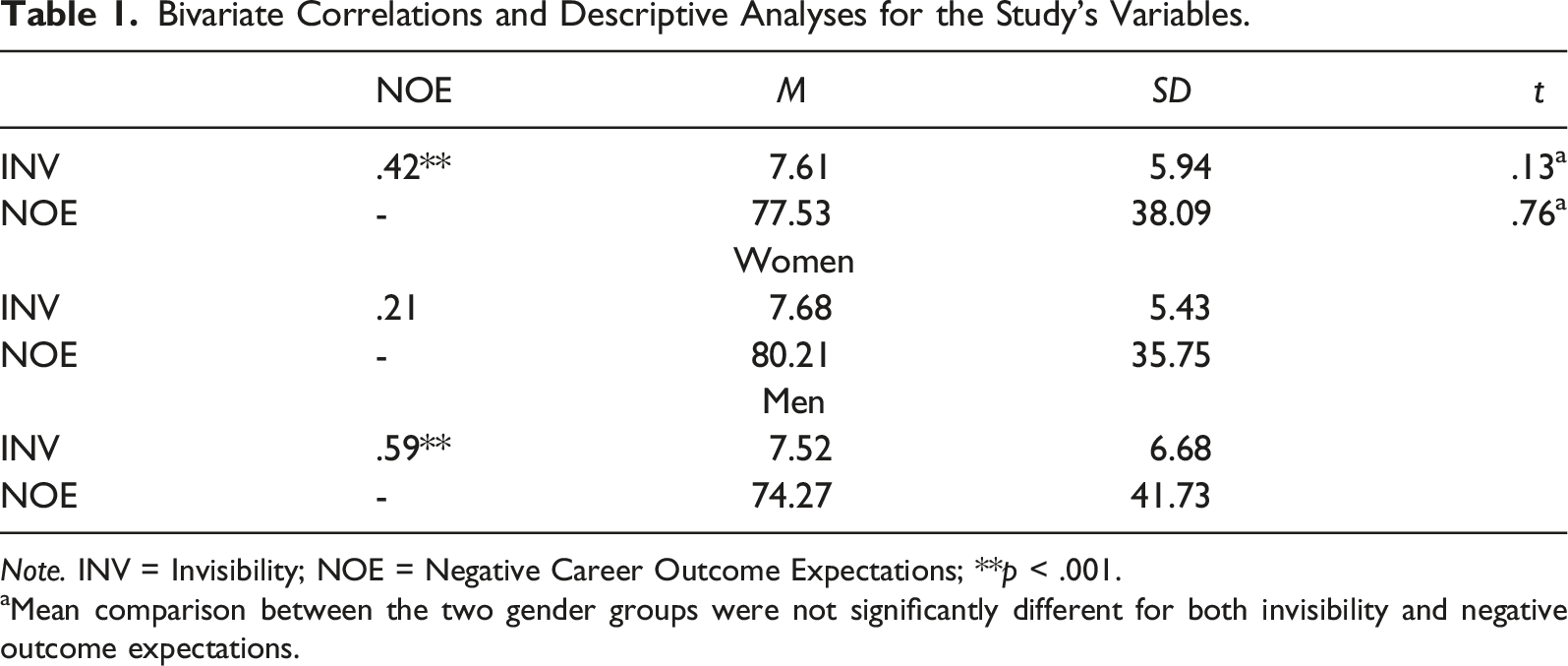
Note. INV = Invisibility; NOE = Negative Career Outcome Expectations; **p < .001.
aMean comparison between the two gender groups were not significantly different for both invisibility and negative outcome expectations.
Confirmatory Factor Analysis of Negative Outcome Expectations Scale in Engineering
The NOES-E was initially developed for engineering students. Thus, a confirmatory factor analysis (CFA) was performed to obtain evidence for construct validity by testing if the model fits the data with a sample of students in non-engineering majors. Items on the NOES-E were treated as ordered categorical variables. The CFA indicated that the model has a good fit to the data:
Given the relatively small sample size in the study, a Monte Carlo simulation was conducted to determine the statistical power to estimate the posited CFA model. The parameters in the simulation were stipulated by the CFA results. Based on the simulation, the model had a close fit to the approximated theoretical value:
Primary Analysis
Correlation results indicated that invisibility was significantly and positively related to negative outcome expectations for the overall sample (r = .42, p < .001), providing support for the first hypothesis. Interestingly, the significant relationship between invisibility and negative outcome expectations was only found among BIPOC men (r = .59, p < .001) and was not replicated with BIPOC women (r = .21, p = .12). The significant interaction result implied potential moderation by gender regarding the relationship between invisibility and negative outcome expectations.
Moderation by Gender on the Relationship between Invisibility and Negative Career Outcome Expectations.
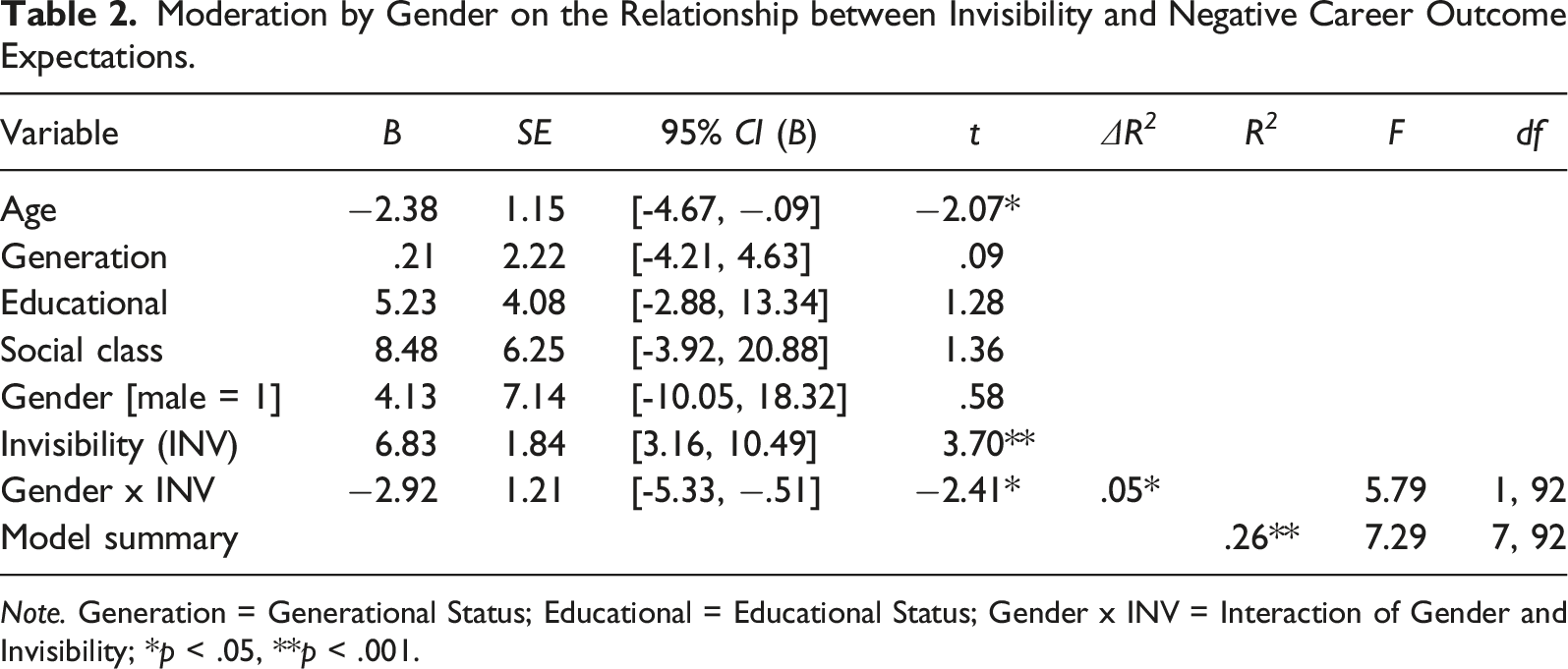
Note. Generation = Generational Status; Educational = Educational Status; Gender x INV = Interaction of Gender and Invisibility; *p < .05, **p < .001.
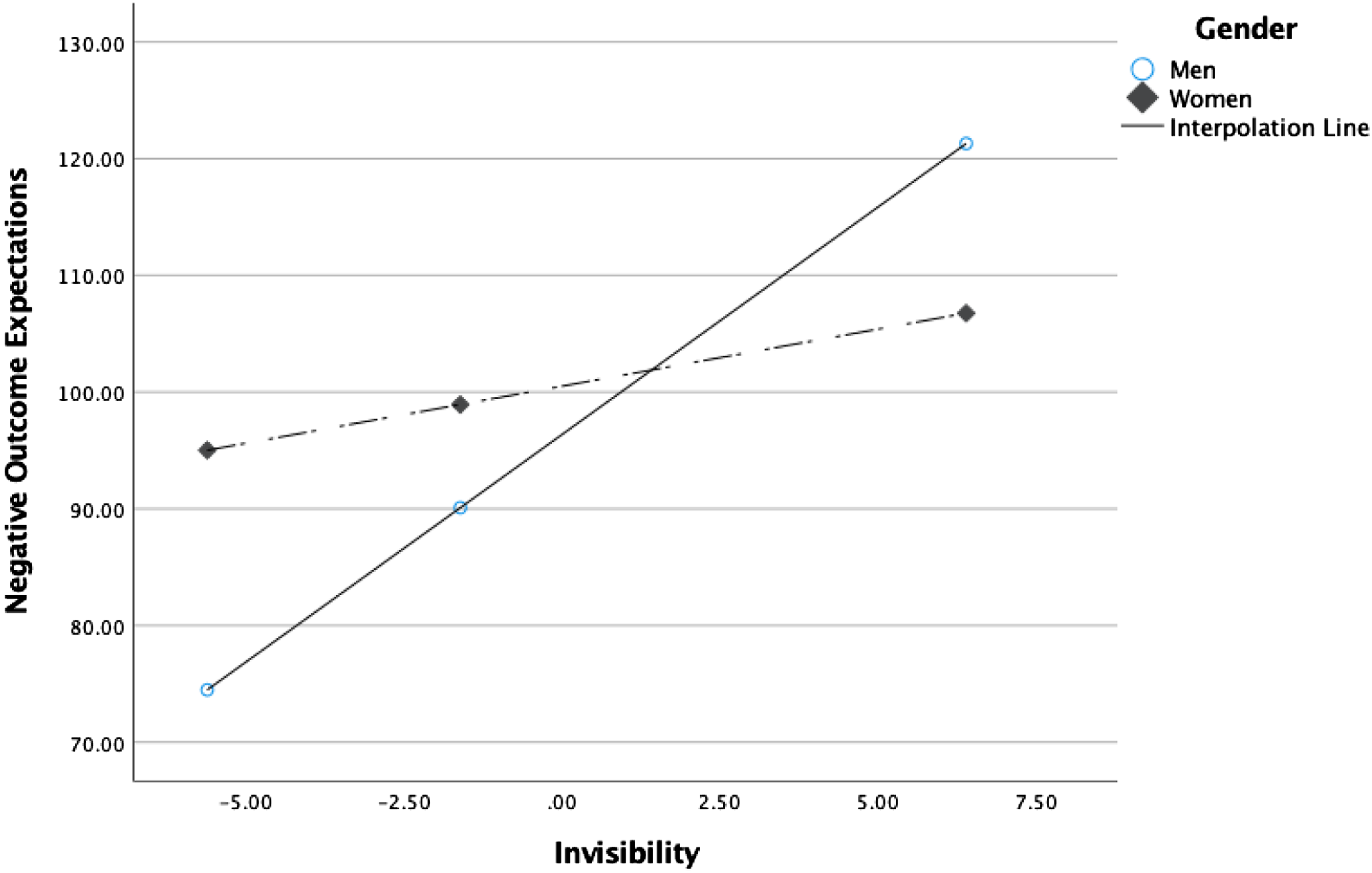
Moderation by gender on the relationship between invisibility and negative career outcome expectations.
Discussion
The concept of invisibility within the framework of microaggressions has recently captured attention in studies, especially within the vocational context (e.g., Wilkins-Yel et al., 2019). Based on social cognitive career theory, we explored the relation between invisibility and negative career outcome expectations in the current study. Additionally, the investigation situated the relationship between invisibility and negative career outcome expectations on the intersecting invisibility lens with gender, which is a unique contribution of this study.
The findings indicated that invisibility has a different relationship with negative career outcome expectations depending on BIPOC students’ gender. BIPOC men college students’ negative career outcome expectations significantly increased as their experiences of invisibility increased. The findings appear to relate to the socially ingrained male privilege (Kolb, 2007), in which in comparison to BIPOC women, BIPOC men receive relatively more recognition in social contexts. Thus, invisibility experiences may come as a surprise to BIPOC men in college environments, and they may be less prepared to cope with the unexpected invisibility. Given that the sample was recruited from a predominantly White institution, the invisibility experiences might have been more pronounced and led to a higher degree of surprise, especially for those first introduced to such an environment. So, the impact of invisibility may have been noticeable to BIPOC men who are unfamiliar, or less familiar, with such treatment. Additionally, considering that the college environment is highly oriented to achievement, BIPOC men who may not cope successfully with invisibility experiences, particularly when it interferes with their need for achievement recognitions, may experience a high level of mental distress. Furthermore, given the stigma around men seeking external help, BIPOC men may deal with invisibility experiences alone at the cost of their career aspirations (i.e., higher negative career outcome expectations). Lack of help-seeking behavior among BIPOC men is akin to Latino men immigrants having a relatively more difficult time than Latina immigrants during the acculturation process, in which men are expected to be self-sufficient, especially when experiencing mental difficulties (Castillo et al., 2015).
Findings from the current study showed no relationship between invisibility and negative career outcome expectations for BIPOC women. As shown in Figure 1, the levels of negative career outcome expectations did not look vastly different between those who reported extremely high levels of invisibility and those who reported low levels of invisibility. Together with BIPOC women’s high mean score and low standard deviation on negative outcome expectations, it appears that BIPOC women generally have high levels of negative career expectations, a finding that corresponds to prior studies (Lee et al., 2018). For example, Lee et al. (2018) found that women engineering students reported generally higher levels of negative outcome expectations than their men counterparts. The result is also shown in Figure 1 and suggests that individual factors such as invisibility experiences may not effectively and sufficiently explain BIPOC women’s anticipated negative outlook in one’s career. Such a finding may be rooted in systemic issues in which BIPOC women experience chronic gender inequities and thus anticipate a negative future in career advancement (Bates et al., 2016). Also, the results may stem from the normalization of invisibility experiences among BIPOC women due to being consistently exposed to invisibility in numerous settings and situations. The long-term experience with invisibility may potentially prompt BIPOC women to learn to cope with invisibility experiences across multiple contexts (Ballakrishnen et al., 2019). Thus, the experiences of being overlooked or dismissed in terms of professional authority, potential, and recognition in college solely may not effectively explain BIPOC women college students’ career outcome expectations compared to their male counterparts.
Limitations
Despite several strengths of this study, there are also some limitations. The sample was collected from a predominantly White university in the southern region so generalizing the results should be done with caution. Relatedly, depending on participants’ race, their invisibility experiences and negative outcome expectations may look different (Franklin et al., 2006). Due to the small size of the sample across racial groups, race was not included as another moderator. Given the intersectionality of invisibility experiences and gender, future studies may benefit from incorporating variables such as race, sexual orientation, and religion in the analysis to further contextualize the findings. For example, individuals who do not conform to heteronormativity also often experience invisibility. It is important to study how gender identity might intersect with other identity variables such as race and sexual orientation to influence their negative outcome expectations about their future careers. Finally, the present study used cross-sectional data, so directional implications cannot be derived from the findings. In other words, invisibility experiences may foster negative career outcome expectations; however, the opposite is also possible, in which students with negative career outlooks may attend to experiences that confirm their belief in negative outcomes in one’s career. Furthermore, nearly 80% of the sample was comprised of middle- and upper-income individuals and hence the findings may not generalize to BIPOC college students from other social class categories.
Implications
There are a few research implications worth mentioning. This is the first study to uncover the relationship between invisibility and negative career outcome expectations among a sample of BIPOC college students. The findings have the potential to deepen understanding of the relationship by situating the finding on the intersection of gender and potentially race. It would be of interest to researchers to collect a larger sample from diverse regions and racial groups to test the potential moderator of race in this research model. In addition, utilizing an experimental design would enable researchers to understand the causal relationship between the study variables. Additionally, a study with an expanded research model that includes other SCCT variables that explores how the study variables impact on career trajectory or success is warranted. Finally, invisibility experiences may look different according to intersecting identities (Wilkins-Yel et al., 2019); a qualitative study to illuminate the unique experiences would enable a better understanding of the relationship between intersectional invisibility and its relationship to career issues.
The results from the study indicate the need for tailored interventions for BIPOC college students based on participants’ gender identity. For BIPOC men college students, invisibility experiences were significantly related to higher levels of negative career outcome expectations. Thus, exploration of both invisibility experiences and perceptions of their career advancement appears crucial. In addition, it would be critical to help students to externalize invisibility experiences to lessen its impact on their career outlook. Career counselors can also design systemic interventions to increase awareness about how microaggressions, especially invisibility experiences, are manifested in educational settings and workplaces. Moreover, career counselors in college and university settings can work within those systems to create experiences that counteract invisibility experiences and generate feelings of inclusion and recognition among BIPOC students.
As for BIPOC women college students, results indicated that they generally have high levels of negative career outcome expectations. Given that research has demonstrated that negative outcome expectations have a significant impact on career development outcomes, including for those holding marginalized identities (Fouad & Byars-Winston, 2005; Lent et al., 2018), interventions to mitigate negative outlooks are critical. In addition, it appears that invisibility alone does not explain BIPOC women students’ negative outcome expectations. Thus, explicating how the multiple discrimination experiences lead to negative outcome expectations seems critical. Then, a holistic intervention that addresses the multi-layered discrimination experienced by BIPOC women students and that fosters their positive career outlooks is warranted. For instance, externalizing systemic oppression, particularly gender discrimination, that shaped negative career outcome expectations among BIPOC women college students is suggested. Additionally, clinicians should consider encouraging BIPOC women college students to seek out support from mentors as those experiences could help mitigate negative career outcome expectations. System-level support is equally critical, such as recruiting mentors and authority figures of the same background (e.g., gender) would enable the vicarious learning experiences among BIPOC women college students. Finally, vocational psychologists can work with leaders in academic and occupational settings to educate the respective communities about the systemic barriers that may fuel these negative outcome expectancies among BIPOC students and workers to mitigate these systemic barriers.
To summarize, our findings indicated that invisibility was positively related to negative career outcome expectancies among BIPOC men in college, and that BIPOC women students reported high levels of negative outcome expectancies. Raising awareness on subtle forms of microaggression as well as its impact on BIPOC individuals’ career expectations is warranted. Psychoeducation on invisibility and the underlying systemic oppression among BIPOC communities is critical so that BIPOC individuals can recognize when the invisibility occurs and externalize the mistreatments. Instructors and clinicians can help BIPOC students to understand the insidiousness of invisibility as the students may not be aware of the invisibility experiences or how the experiences could impact their career trajectory. In addition, seeking help for mental health difficulties may be highly stigmatized among men, which can negatively impact their career development process. Thus, finding ways to encourage BIPOC college men’s engagement in the discussion involving mental health needs is crucial. As for BIPOC women college students, negative future career outlook appears to be prevalent, pointing to systemic issues that need to be rectified. Measures to foster gender equity, such as increasing BIPOC women’s access to professional networks, are critical (Bates et al., 2016).
Footnotes
Declaration of Conflicting Interests
The author(s) declared no potential conflicts of interest with respect to the research, authorship, and/or publication of this article.
Funding
The author(s) received no financial support for the research, authorship, and/or publication of this article.
Public Significance Statement
We found that invisibility experiences among self-identified men BIPOC students attending a PWI are significantly related to their negative outlook on career advancement. The same relationship was not found for self-identified women BIPOC students at a PWI. But for the BIPOC women students, negative career outcome expectations were invariably high regardless of the invisibility experiences, potentially due to chronic gender inequities in the vocational realm. Findings point to the need for tailored interventions, both for BIPOC men and women students, based on their intersecting invisibility (e.g., gendered invisibility experiences), to address the invisibility experiences and their influence on negative career outcome expectations.
