




Abstract
This study examined how the culture in school counseling programs or departments shapes the college-related outcomes of high school students including students of color. With data from the High School Longitudinal Study 2009, we investigated two major steps in the college-going process: (a) whether students see the counselor for financial aid counseling and (b) whether they seek college admissions counseling in 12th grade. We discuss the literature on the role of school counselors in college access, especially support for students of color, and how school counseling contextual variables and school counselor mindsets, which we term school counseling college-going culture (SCCGC), affect students’ college-going decisions. We conducted logistic regression analyses by racial/ethnic groups among 9170 high school students from the High School Longitudinal Study 2009–2016 dataset. The results indicated that counselor expectations, priorities, student–counselor contact prior to 12th grade, college and career readiness activities, and constraints affect students’ college outcomes differently across racial and ethnic backgrounds. This study has implications regarding what interventions, mindsets, and practices school counselors need in order to improve college-going outcomes (e.g., student–counselor contact for college admissions and financial aid counseling) for students from diverse racial and ethnic backgrounds.
Keywords
Introduction
According to the American School Counselor Association (ASCA, 2017), “School counselors provide and advocate for postsecondary awareness, exploration and planning for each student, thereby supporting students’ rights to choose from a wide array of options when they leave secondary education” (p. 1). Indeed, one of the crucial goals of the ASCA National Model (ASCA, 2019) is to provide school counselors with effective tools for promoting postsecondary readiness and success for all students. Ample research demonstrates the vital role that school counselors play in the college admission process for high school students (Bryan et al., 2011; Cholewa et al., 2015; Engberg & Gilbert, 2014; McDonough, 2005; McKillip et al., 2012; Perna et al., 2008). More specifically, research indicates that students’ participation in college admissions and financial aid counseling in 12th grade are important steps on the pathway to college and precursors to whether students apply to and enroll in college (Fitzpatrick, 2019; Robinson & Roksa, 2016). Through college admissions and financial aid counseling, school counselors provide students with critical college-related information, such as knowledge about and assistance with the college application and enrollment process and financial aid assistance and advice (Bryan, Kim et al., 2022). Students of color and those from low-income backgrounds especially appear to benefit from college admissions and financial aid counseling (Bryan et al., 2011). Navigating concerns over the cost of college, completing financial aid forms, completing college application forms, and accepting a college offer can prove to be intimidating for students without access to college information in their homes and schools and who face barriers to college application and enrollment, which is more likely for students from diverse racial/ethnic backgrounds (Cabrera & La Nasa, 2001). When students receive college information and counseling from school counselors, their college application numbers and college enrollment rates increase (Belasco, 2013; Bryan, Kim et al., 2022; Bryan et al., 2011; Robinson & Roksa, 2016).
Despite the numerous studies (e.g., Bryan et al., 2011; Cholewa et al., 2015; Perna et al., 2008; Poynton & Lapan, 2017) that support the valuable role of school counselors in creating college readiness and access, especially for marginalized students, research indicating what works for school counselors in improving students’ college-going outcomes is scant (Castleman & Goodman, 2014; McMahon et al., 2017). The Evidence-Based School Counseling model has amplified the importance of identifying evidence about what works that can be used for creating effective school counseling programs and interventions (Dimmitt & Zyromski, 2020; Zyromski & Dimmitt, 2022). The dearth of school counseling intervention research on college going and college access (McMahon et al., 2017) may be attributed to a lack of information on malleable factors and theories of change to inform college access interventions in school counseling.
School Counseling College-Going Culture: Defining Culture in School Counseling Programs and Departments
This study is based on the recognition that, beyond student variables, multiple contexts and ecological systems affect students’ college-going outcomes and these systems and power structures affect students differentially (Bryan, Henry et al., 2022; Bryan, Kim et al., 2022; Zyromski & Dimmitt, 2022). Indeed, research on college-going culture in schools has highlighted the importance of whole-school comprehensive efforts in enhancing college going and has emphasized the centrality of school counseling programs in this school-wide college-going culture (Engberg & Gilbert, 2014; McDonough, 2005). However, the existing research does not identify contextual variables specific to school counselors or how such contextual factors affect students with diverse identities. Culture is defined as norms, expectations, customs, practices, and behaviors that hold a unit, department, or program together and give it a distinct identity (Bellou, 2008; Bunce & Willower, 2001). Recently, research evidence has begun to suggest that the culture (or subculture) within school counseling departments is critical to students’ college-going decisions, including decisions regarding whether students have contact with their counselors for college admissions and financial aid counseling, or apply to and enroll in college (Belasco, 2013; Bryan, Kim et al., 2022; Bryan et al., 2011; Engberg & Gilbert, 2014; Fitzpatrick, 2019; Goodwin et al., 2016).
In several extant studies using national longitudinal datasets, scholars have examined the associations and effects of school counseling contextual variables on students’ college-going decisions, including receiving counseling for college admissions and for financial aid, career aspirations, applying to college, and college enrollment. The variables emerging from this extant research include school counselor expectations (Bryan et al., 2009; Bryan, Farmer-Hinton et al., 2017); priority goals, use of time, hours spent on college readiness counseling (Engberg & Gilbert, 2014; Rangel & Ballysingh, 2020; Shi & Brown, 2020; Velez, 2020); student–counselor contact, visits, or talk (Belasco, 2013; Bryan, Farmer-Hinton et al., 2017; Bryan et al., 2011; Velez, 2020); college and career readiness activities (Edwin et al., 2019; Engberg & Gilbert 2014; Fitzpatrick, 2019; Fitzpatrick & Schneider, 2016; Rangel & Ballysingh, 2020); counselor caseloads (Goodman-Scott et al., 2018; Shi & Brown, 2020; Woods & Domina, 2014); and number of counselors (Bryan et al., 2011; Robinson & Roksa, 2016).
Synthesizing this extant research, Bryan, Kim et al. (2022) proposed and tested a school counseling centered conceptual model of school counseling college-going culture (SCCGC), presented in Figure 1. The variables in the SCCGC model were counselors’ expectations and goals or priorities (i.e., norms); their contact and interactions with students, specifically around college and career counseling; the practices and activities they engage in to support college and career readiness; and the constraints and resources (or lack thereof) within a school counseling department. These variables, described below, together capture the culture in school counseling programs related to college going (termed “school counseling college-going culture” or SCCGC). Conceptual model of school counseling college-going culture affecting students’ college-going decisions.
Counselor Expectations and Priorities
Counselors’ expectations refer to their perceptions of or beliefs about their students and their roles in serving students. Educator expectations matter and these expectations are transmitted to students through their conversations and reflected in their program priorities (Bryan et al., 2009; Bryan, Farmer-Hinton et al., 2017; Papageorge et al., 2020; Vela et al., 2013; Vela-Gude et al., 2009). Counselors’ priorities describe what program goals they prioritize in their daily work and what percentage of time they spend on those goals. School counselors must prioritize and divide their time among goals such as academic counseling and development, providing help with job seeking, social/emotional counseling and development, and college/postsecondary admissions counseling. Although often unspoken, school counselors’ expectations and priorities shape the norms or daily pattern of behaviors in their program and school.
Student–Counselor Contact for College and Career Counseling
Student–counselor contact for college counseling comprises students’ direct contact with counselors for college- or career-related information, in the form of college admissions counseling, financial aid information and assistance, and academic and career advising. Student contacts with a counselor in earlier grades (e.g., ninth grade) and at multiple points (i.e., more than one time) for college readiness counseling are important. These contacts for college and career issues serve as a source of social capital leading to numerous college-related outcomes, such as financial aid or Free Application for Federal Student Aid (FAFSA) submission, submission of college applications, and, ultimately, college enrollment (Belasco, 2013; Bryan et al., 2011; Fitzpatrick, 2019; Missaghian, 2021; Velez, 2020).
College and Career Readiness Activities
College and career readiness activities are essential tasks, practices, and programs that school counselors typically coordinate to promote students’ college and career readiness, such as college visits, college and career fairs, career awareness activities and career assessments, and financial aid workshops and meetings (Bryan et al., 2016, 2019; Conley & McGaughy, 2012; Goodwin et al., 2016; McDonough, 2005). Engberg and Gilbert (2014) defined college and career readiness activities, such as college course offerings, college fairs, information sessions, and financial aid assistance, as important resources in the counseling opportunity structure and important predictors of high school college-going rates. These resources or activities are especially beneficial for students underrepresented in college going such as low-income and African American students (Bryan et al., 2016, 2019; Fitzpatrick & Schneider, 2016; Muhammad, 2008; Kimura-Walsh et al., 2009).
Constraints
Specific to college going, common constraints include school counselors’ student caseloads and college counseling availability; that is, college-specific guidance and counseling provided by college counselors, advisors, mentors, or coaches (Bryan et al., 2009; Poynton & Lapan, 2017; Shi & Brown, 2020). These resource challenges constrain school counselors’ roles and the services they provide in high school counseling departments, especially regarding preparation for postsecondary decisions and transitions (Bryan, Farmer-Hinton et al., 2017; Bryan et al., 2016, 2019; Perna et al., 2008).
In Bryan, Kim et al. (2022) initial study that hypothesized and tested the conceptual model of SCCGC, findings suggested that the characteristics of school counseling environments and school counselor practices and mindsets work together to create a specific SCCGC that impacts students’ college decisions or outcomes. Findings indicated that school counselors’ expectations and priorities, especially percentage of time devoted to college readiness, student–counselor contact for college counseling in earlier grades, and school counseling caseload, were the most salient predictors of students’ college-going outcomes. Earlier student–counselor contact for college counseling affected the more proximal decisions, such as whether students received college admissions and financial aid counseling in 12th grade and the numbers of college applications they submitted, while school counselors’ use of time and caseload affected both the more distal decisions (i.e., students’ postsecondary enrollment) and the more proximal decisions. The two most salient college and career readiness activities were application and financial aid assistance and college information and FAFSA meetings, which predicted whether high school seniors received financial aid counseling and enrolled in college (see Bryan, Kim et al., 2022, p. 12). The conceptual framework emerging from this synthesis, shown in Figure 1, allows for further exploration of the effects of SCCGC and how it may vary across student differences such as race and ethnicity (Bryan, Kim et al., 2022). Various aspects of SCCGC may behave differently across students’ racial and ethnic backgrounds. In this article, we use the terms students of color, minoritized students, and racially and ethnically diverse students interchangeably to refer to Asian, Black, and Hispanic students.
Purpose and Significance of the Study
In the current study, we were interested in whether the association between aspects of SCCGC and students’ utilization of the school counselor for financial aid and college admissions counseling in 12th grade varied based on students’ race/ethnicity. Using a national longitudinal dataset, the High School Longitudinal Study 2009 (HSLS:09) from the National Center of Education Statistics (NCES; Ingels et al., 2015), we examined the following research question: How do the effects of school counseling college-going culture (i.e., counselors’ expectations and goals or priorities; their contact and interactions with students around college and career counseling; their practices and activities that support college and career readiness; and constraints and resources within a school counseling department) on students’ college going decisions (i.e., student–counselor contact for financial aid counseling and college admissions counseling in 12th grade) vary across racially/ethnically different student groups?
Investigating the conceptual model of SCCGC (see Figure 1) to determine how it varies across racially/ethnically different student groups could help identify malleable factors that counselors could use to develop research-informed college and career readiness interventions or practices. The results may provide insights into how school counseling programs differentially affect students and factors school counselors can manipulate to create a college-going culture in their programs or departments that meets the specific needs of students of various racial and ethnic backgrounds and reduces inequities in college-going decisions.
Researchers’ Positionality
As a research team, we recognize the importance of disaggregating data by race to explore how schools and programs may affect students differentially and to better identify the specific needs of students and how school counselors may better meet those needs. As racially and ethnically diverse researchers (one Black, one Korean, and one Chinese), all with international origins, we are aware that we may have racial blind spots that make us susceptible to anti-Black racism and deficit perspectives that could show up in our narratives and interpretations regarding students of color. Indeed, we are aware of how studies examining racial group differences using inferential methods often perpetuate racism and stereotypes, including anti-Black racism and the model minority myth stereotype (Garcia & Mayorga, 2018; Gillborn et al., 2018; Kim et al., 2022). Researchers often use regression models to draw conclusions about students of color that do not take into consideration the effects of structural racism and differences in social experiences and that promote deficit views of students of color (Ross et al., 2020; Van Dusen & Nissen, 2022). The broad categorization of racial and ethnic groups such as we are using in this study (i.e., White, Black, Asian, Hispanic), often masks subgroup differences within each racial group (Ross et al., 2020). Racially and ethnically diverse groups are often compared to White students as the reference group, who are often held up as the norm (Ross et al., 2020). In this study, we have made a conscious effort to avoid comparisons of each racial group to White students. Further, we avoided comparisons across groups and focused instead on the utility of the SCCGC model for each racial group. We also continually questioned whether we promoted racial bias and deficit views of minoritized students in our theoretical framework, research question, data analyses, and interpretations.
Method
Dataset
In the current study, we used data from the High School Longitudinal Study 2009 (HSLS:09), a nationally representative dataset of 944 schools and more than 23,000 students. HSLS:09 comprises educational data on ninth graders in 2009 with follow-up data collection in 2012, when the students were in 11th grade; in 2013, at the end of their expected 12th grade year; and in 2016, 3 years after high school completion. In addition to the surveys for student, administrator, teacher, and parent surveys, HSLS:09 includes the first NCES survey of school counselors. The school’s lead or most senior school counselor responded to the survey which asked questions about counselors’ expectations and emphasized goals, college and career readiness activities such as college visits and career fairs, the counselor’s contact with students for various reasons, and information about caseload and other indicators relevant to this proposed study. The analytic sample for the current study comprised ninth-grade students who were in the base year (2009), the first follow-up (2012), and the 2013 survey when students were in 12th grade. We used restricted data for the analyses; we have a license for the HSLS:09 restricted dataset and have experience in using the data for previous work (Bryan et al., 2010; Bryan, Kim et al., 2017, 2022). Given the persistence of educational patterns in schools, these data, although collected from 2009–2016, are informative because they are nationally representative of high schools (Bryan et al., 2010; Bryan, Kim et al., 2017).
Participants
The analytic sample for the current study comprised 9170 high school students (weighted sample = 2,309,409). In our analysis, we only selected students from four racial/ethnic groups: White, Black, Asian, and Hispanic, because these subsamples were large enough to permit multivariate analyses. Of the analytic sample, 65.58% were White, 9.38% were Black, 9.51% were Asian, and 15.53% were Hispanic; 49.47% were female and 50.53% were male. In terms of socioeconomic status (SES), 32.60% of the analytic sample were in the highest SES group (fifth quintile), 21.36% were in the higher middle (fourth quintile), 18.42% were in the middle SES (third quintile), 14.83% were in the lower middle SES (second quintile), and 12.79% were in the lowest SES group (first quintile).
Dependent Variables
Student–Counselor Contact for College Admissions Counseling in 12th Grade
This variable was measured by a categorical item asking whether 12th-graders had met with their high school counselor about college admissions in their senior year. This variable was coded into two categories: (a) Yes (74.24%) and (b) No and Don’t know (25.76%), which were collapsed.
Student–Counselor Contact for Financial Aid Counseling in 12th Grade
This variable was measured by a categorical item about whether 12th-graders had met with their counselor about financial aid in their senior year. This variable was also coded into two categories: (a) Yes (48.89%) and (b) No and Don’t know (51.11%), which were collapsed.
Independent Variables
The following variables measured SCCGC.
Counselor Expectations and Priorities
School counselors’ expectations and priorities was measured by three variables: (a) an NCES-derived composite of six items that measured the school counselor’s expectations (M = 0.07, SD = 1.05); (b) one categorical item that measured the most emphasized goal in the school counseling program, with four categories: helping students plan and prepare for their work roles after high school (2.65%), helping students with personal growth and development (13.78%), helping students plan and prepare for postsecondary schooling (53.36%), and helping students improve their achievement in high school (30.21%); and (c) a categorical variable that measured the percentage of their time that school counselors spent on college readiness/selection/application, with four categories: 10% or less (16.49%); 11%–20% (34.13%); 21%–50% (38.90%), and more than 50% (10.48%).
Student–Counselor Contact for College/Career Counseling and Advising
This segment of student–counselor contact comprised two variables. The first variable measured whether a student had talked to school counselors in ninth grade about going to college (Yes = 17.12%, No = 82.88%). The other variable measured whether a student had talked to a high school counselor about options after high school (Yes = 63.20%, No = 36.80%).
College and Career Readiness Activities
College and career readiness activities were measured by 10 dichotomous items (Yes/No) that assessed college and career readiness programs that school counselors are typically responsible for. These variables covered activities and meetings such as college fairs, college visits, helping students with college applications, and providing access to information on college and the FAFSA. Previous studies have used these activities and meetings to examine school counselors and college-going outcomes (Belasco, 2013; Bryan, Kim et al., 2022; Bryan et al., 2011; Engberg & Gilbert, 2014; Fitzpatrick & Schneider, 2016; Poynton & Lapan, 2017). We conducted a categorical principal components analysis (CATPCA) of the 10 dichotomous variables to derive components of college and career readiness activities. CATPCA, compared to traditional principal component analysis where variables are continuous, is more suitable for analyzing relationships among categorical variables. We determined the components based on theoretical interpretability, scree plot, and eigenvalues (conventionally greater than 1). We selected a four-component model that was conceptually meaningful. Factor loadings ranged from 0.48 to 0.74 (total Cronbach’s alpha = 0.89). The four components were as follows: (a) assists with application and financial aid process (in the tables, named Application and financial aid help); (b) holds/participates in college fairs in 9th and 11th grade (named College fairs); (c) provides college information and helps to select colleges in 11th grade (named College info and selection help); (d) holds meetings and sessions to provide college information in 11th grade (named College info and FAFSA meetings).
Constraints
Constraints were measured by three variables: (a) an average caseload for school counselors with three categories: 0–249 (18.04%), 250–449 (61.80%), and 450 or more (20.16%); (b) number of full-time high school counselors in the school (M = 3.79, SD = 2.31); and (c) a dichotomous variable that indicates whether the school has a counselor designated for college readiness/selection/application (Yes = 62.91%, No = 37.09%).
Group and Control Variables
Race, the grouping variable in this study, comprised four categories: White, Asian, Hispanic, and Black. We included three covariates to control the relationship between the dependent variables and the important alternative factors to the independent variables. Previous research (Cabrera & La Nasa, 2000; 2001; Hossler et al., 1999; McDonough, 1997) has identified these factors as significant predictors of students’ college going. These covariates are gender, students’ academic performance (math achievement), and socioeconomic status. In the current analysis, gender was measured by a dichotomous variable, where 0 = female (reference group, 49.47%) and 1 = male (50.53%). Math score was measured by an NCES-created norm-referenced measurement of math achievement of ninth-graders in 2009, which was transformed and rescaled from the Item Response Theory (IRT) theta (ability) estimate. The variable of math score had a mean of 53.24 with a standard deviation of 9.85. Socioeconomic status (SES) was measured by a NCES-generated composite score. This continuous composite score was calculated using parents’/guardians’ education, occupation, and family income (Ingels et al., 2015). The mean SES score for the analytic sample was 0.19 with a standard deviation of 0.81.
Data Analysis
Given the complex survey design of HSLS:09, the appropriate sample weights are important to produce estimates that are representative of the target population (Bryan, Kim et al., 2017). We used a linearization variance estimation through a Taylor series approximation by using variables that represent school sampling strata and primary sampling units (Ingels et al., 2015). In the current study, we performed complete case analysis for each dependent variable by listwise deleting cases with missing values; therefore, the sample size for each analysis varies.
To answer the research question about whether and how the SCCGC affects students’ college-going decisions, we performed regression analysis by racial/ethnic groups. In this study, we mainly focused on four racial/ethnic student groups, (i.e., White, Black, Asian, Hispanic). For statistical modeling of the data, we employed logistic regression modeling for the dichotomous dependent variables. We entered variables by blocks in the regression modeling process. In the first block, we entered SCCGC variables into the models; then, in the second block, we entered the control variables.
For each dependent variable, we ran a logistic regression analysis by racial/ethnic group. We evaluated the model estimates (i.e., coefficients, standard errors, odds ratios, and t values) to determine the statistical significance and effect size. We used regression analysis and reported p values at both 0.05 and 0.10 levels because we are exploring a new model (see Tables 2 and 3).
Results
Means and Percentages for Each Variable in the Regression Analyses by Race.
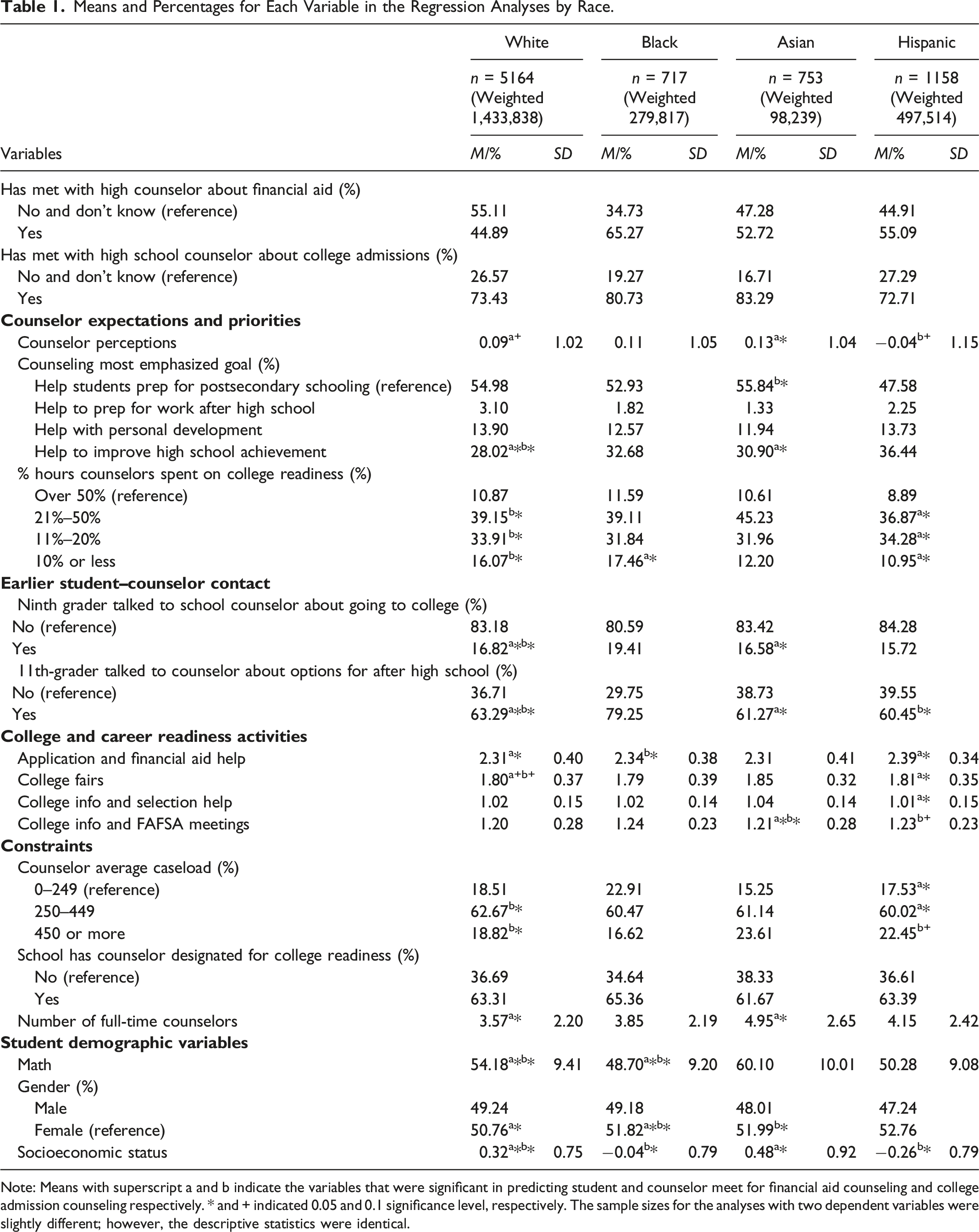
Note: Means with superscript a and b indicate the variables that were significant in predicting student and counselor meet for financial aid counseling and college admission counseling respectively. * and + indicated 0.05 and 0.1 significance level, respectively. The sample sizes for the analyses with two dependent variables were slightly different; however, the descriptive statistics were identical.
Logistic Regressions Predicting Student–Counselor Contact for Financial Aid Counseling in 2012–2013 Year (by Race, Weighted).
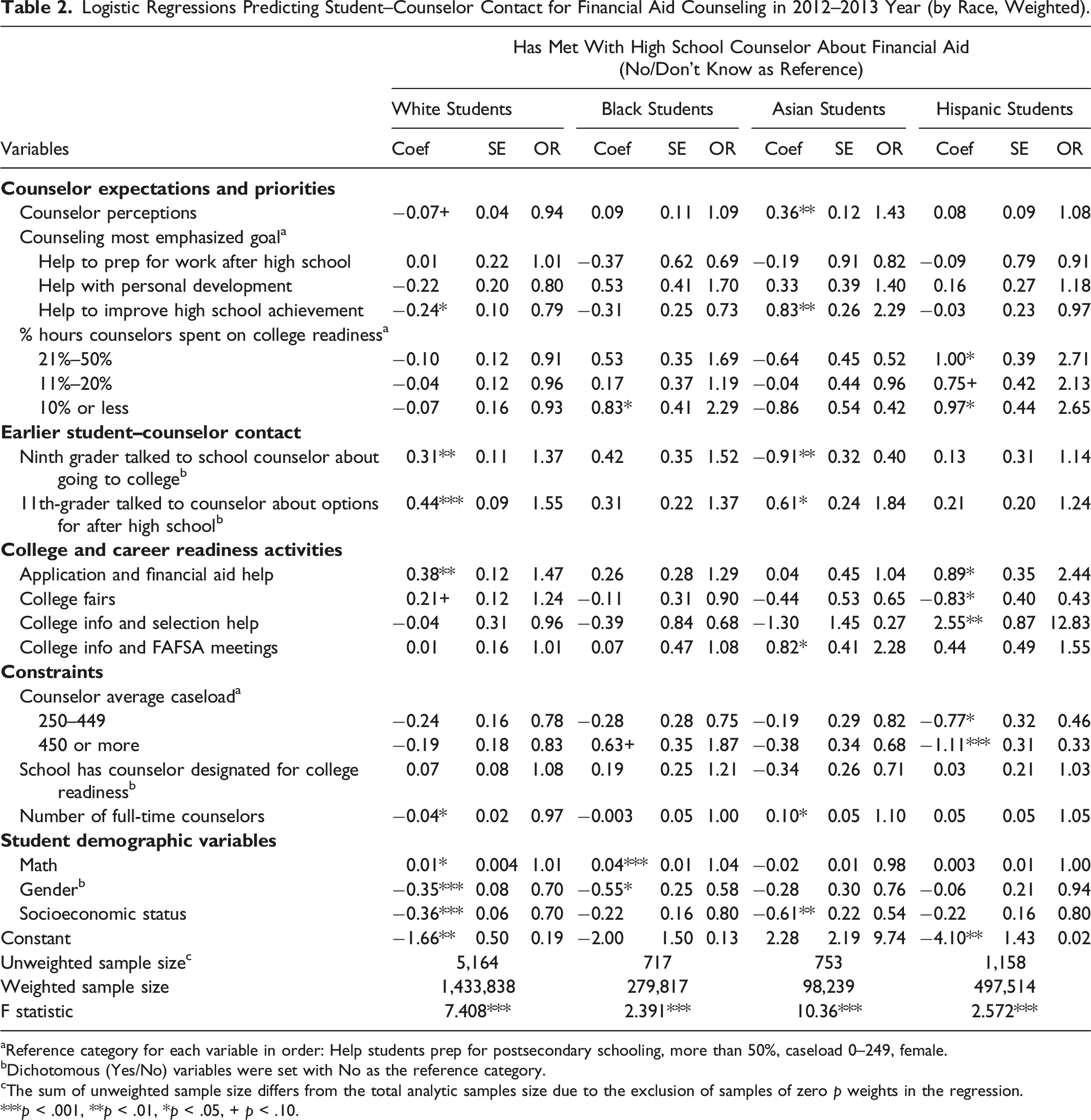
aReference category for each variable in order: Help students prep for postsecondary schooling, more than 50%, caseload 0–249, female.
bDichotomous (Yes/No) variables were set with No as the reference category.
cThe sum of unweighted sample size differs from the total analytic samples size due to the exclusion of samples of zero p weights in the regression.
***p < .001, **p < .01, *p < .05, + p < .10.
Logistic Regressions Predicting Student–Counselor Contact for College Admission Counseling in 2012–2013 Year (by Race, Weighted).

aReference category for each variable in order: Help students prep for postsecondary schooling, more than 50%, caseload 0–249, female.
bDichotomous (Yes/No) variables were set with No as the reference category.
cThe sum of unweighted sample size differs from the total analytic sample size due to the exclusion of samples of zero p weights in the regression.
***p < .001, **p < .01, *p < .05, + p < .10.
SCCGC and White Students
The regression models confirmed most of the hypothetical links between our chosen indictors and the outcomes for White students. When school counselors prioritized helping students to improve their academic achievement as opposed to helping them prepare for postsecondary schooling, White students had lower odds of seeking the counselor in 12th grade for both financial aid (OR = 0.79, CI [0.65, 0.95]) and college admissions counseling (OR = 0.73, CI [0.58, 0.90]). When school counseling departments reported spending less than 50% of their time on college and career readiness, White students were less likely to see the counselor for college admissions counseling in 12th grade (ORs = 0.70, 0.60, 0.60 for each category less than 50% of the time spent). When White students reported earlier counselor contact in 9th and 11th grades, they had higher odds of seeing the counselors in 12th grade for both financial aid (OR for ninth grade = 1.37, CI [1,11, 1.68]; OR for 11th grade = 1.55, CI [1.31, 1.84]) and college admissions counseling (OR for ninth grade = 1.41, CI [1.09, 1.82]; OR for 11th grade = 1.95, CI = [1.65, 2.29]). Application and financial aid help was most beneficial for White students, increasing their odds of seeking financial aid counseling in 12th grade (OR = 1.47, CI [1.15, 1.88]). College fairs may also be beneficial (significant at 0.01 alpha level) for White students by increasing their utilization in 12th grade of both financial aid (OR = 1.24, CI [0.98, 1.55]) and college admissions counseling (OR = 1.34, CI [0.99, 1.81]). School counseling caseloads of 250 or greater had a negative effect on whether White students sought counselors for college admissions counseling in 12th grade (OR = 0.60, CI [0.38, 0.92] for caseload of 250–449; OR = 0.48, CI [0.31, 0.76] for caseload of 450 or more). Further, as the number of full-time counselors decreased, so did the likelihood of White students seeking the counselor for financial aid counseling in 12th grade (OR = 0.97, CI [0.94, 0.99]). White male students (OR = 0.70, CI [0.59, 0.82]) and students of higher socioeconomic status (OR = 0.70, CI [0.62, 0.79]) were less likely to utilize the school counselor for financial aid counseling in 12th grade, while students with higher math achievement scores (OR = 1.02, CI [1,01, 1.03]) and from higher SES backgrounds (OR = 1.36, CI [1.21, 1.53]) were more likely to utilize the school counselor for college admissions counseling in 12th grade.
SCCGC and Asian Students
The regression models indicated significant associations between some our chosen predictors and the outcomes for Asian students. School counselor perceptions positively affected whether Asian students used financial aid counseling in 12th grade. Higher score of counselor perceptions predicted higher likelihood of Asian students seeking financial aid counseling (OR = 1.43, CI [1.134, 1.81]). When school counselors prioritized helping students improve their academic achievement as opposed to helping them prepare for postsecondary schooling, Asian students had higher odds of seeking the counselor for financial aid counseling in 12th grade (OR = 2.29, CI [1.37, 3.81]). When Asian students had earlier counselor contact in ninth grade, they had lower odds of seeing the counselor for financial aid counseling in 12th grade (OR = 0.40, CI [0.21, 0.76]), but higher odds when they saw the counselor in 11th grade (OR = 1.84, CI [1.14, 2.95]). College info and FAFSA meetings appeared to be most helpful for Asian students, increasing their odds of utilizing the school counselor in 12th grade for both financial aid (OR = 2.28, CI [1.01, 5.15]) and college admissions counseling (OR = 7.37, CI [2.67, 20.39]). Asian students from higher income backgrounds were less likely to utilize financial aid counseling in 12th grade (OR = 0.54, CI [0.35, 0.84]). Asian male students were less likely to seek/receive college admissions counseling in 12th grade (OR = 0.54 CI [0.31, 0.94]).
SCCGC and Hispanic Students
The regression models confirmed some of the hypothetical links between our indictors and outcomes for Hispanic students. School counselor perceptions affected whether Hispanic students sought college admissions counseling in 12th grade (significant at 0.1 alpha level, OR = 1.18, CI [0.99, 1.42]). In schools where counselors spent 50% or less time on postsecondary schooling, Hispanic students were twice as likely (or more) to see the school counselor for financial aid counseling, ORs = 2.71 (21%–50%), 2.13 (11%–20%), 2.65 (10% or less). When they saw the counselor in 11th grade, Hispanic students were more likely to see the school counselor for college admissions counseling in 12th grade (OR = 1.54, CI [1.05, 2.24]). College information and selection help was beneficial for Hispanic students in facilitating their use of financial aid counseling in 12th grade (OR = 12.83, CI [2.33, 70.59]), and college fairs were less beneficial (OR = 0.43, CI [0.19, 0.96]). College application and financial aid help from school counselors was also beneficial to Hispanic student in seeking financial aid counseling (OR = 2.44, CI [1.23, 4.83]). College info and FAFSA meetings may be beneficial for Hispanic students in promoting their use of college admissions counseling (OR = 2.45, CI [0.88, 6.86], significant at 0.10 alpha level). Caseloads of 250 or greater had a negative effect on whether Hispanic students sought counselors for financial aid counseling in 12th grade (OR = 0.46, CI [0.25, 0.87] for a caseload of 250–449; OR = 0.33, CI [0.18, 0.61] for a caseload of 450 or more). Caseloads of 450 or more may negatively affect whether Hispanic students seek counselors for college admissions counseling in 12th grade (OR = 0.37, CI [0.13, 1.02], significant at 0.1 alpha level). Hispanic students from higher income backgrounds were more likely to utilize college admissions counseling in 12th grade (OR = 1.54, CI [1.17, 2.03]).
SCCGC and Black Students
The regression models appeared to confirm some of the hypothetical links between our indicators and outcomes for Black students. In schools where the counseling department devoted 10% or less of their time to college and career readiness (as opposed to more than 50%), Black students had higher odds of seeing the counselors for financial aid counseling (OR = 2.29, CI [1.01, 5.17]). Application and financial aid help was most helpful for Black students in facilitating their use of college admissions counseling in 12th grade (OR = 2.18, CI [1.16, 4.10]). Black male students were less likely to utilize financial aid counseling (OR = 0.58, CI [0.35, 0.93]) and college admissions counseling (OR = 0.56, CI [0.33, 0.95]) in 12th grade. Black students with higher math achievement scores were more likely to utilize financial aid counseling (OR = 1.04, CI [1.02, 1.07]) and college admissions counseling (OR = 1.03, CI. [0.99, 1.07], significant at 0.1 alpha level) in 12th grade. Black students from higher income backgrounds were also more likely to utilize college admissions counseling in 12th grade (OR = 1.65, CI [1.05, 2.58]).
Discussion and Implications
Limitations
A number of limitations are inherent in studying racial group differences using quantitative data and broad racial categorizations. This study did not allow for the examination of subgroup differences, and this may inadvertently perpetuate the homogenization of racial groups and mask the rich heterogeneity among Black, Hispanic, Asian, and White students. Lack of consideration of the intersectionality of students’ identities obscures valuable information about sociocultural factors and social experiences that affect student outcomes (Ross et al., 2020). Due to the nature of secondary datasets, we were unable to utilize a balanced sample for each of the racial/ethnic groups; the model performance was unstable across groups. Although the current analysis used a national representative dataset, we conducted a complete case analysis and any hidden missing pattern in data values may limit the generalizability of our findings statistically. Further, these data and analyses limit the ability to get at underlying structures, policies, and practices in schools that contribute to inequities among minoritized students (Bryan, Henry et al., 2022). Nevertheless, this study of SCCGC provides insights into and implications for how school counseling programs differentially affect students and potentially how school counselors can work to reduce disparities in college going. Indeed, this study could help school counselors to intentionally re-shape school counseling programs to focus on activities and resources that may be more effective in meeting the specific college and career readiness needs of both White and minoritized students, thus creating greater postsecondary access, especially for students who are underrepresented or under-resourced in the college-going process.
Discussion of Results
This study examined whether the relationship between SCCGC and students’ utilization of the school counselor for financial aid and college admissions counseling varied by race/ethnicity. Findings indicated that more of the SCCGC variables predicted outcomes for White and Asian students than for Black and Hispanic students. We found significant associations between most aspects of SCCGC and students’ use of financial aid and college admissions counseling, especially for White and Asian students. Indeed, the results for White students closely mirror the findings in Bryan, Kim et al. (2022) initial study of SCCGC. More specifically, for White students, counselors’ priorities, students’ contact in earlier grades, and caseload predicted their utilization of financial aid and college admissions counseling in 12th grade. For these students, when school counselors prioritized and committed 50% or more of their time to college/postsecondary preparation and when the students had contact with school counseling in earlier grades (9th and 11th grade), then they were more likely to receive counseling for both financial aid and college admissions counseling in 12th grade. Caseloads of less than 250 also impacted White students’ utilization of college admissions counseling later in 12th grade. When school counselors provided application and financial aid help, this college and career readiness activity encouraged students to seek/use financial aid counseling in 12th grade.
These results are consistent with evidence that the structure of U.S. schools benefits White students and that the culture in school counseling departments and programs may benefit White students more than minoritized students (Vela et al., 2016). Embedded within U.S. institutions—including schools—are policies and practices that perpetuate structural and institutional racism. These have both historical and interpersonal components that often produce cumulative positive outcomes for Whites and adverse outcomes for people of color (Nelson et al., 2020). If school counseling programs and departments are to benefit minoritized students, attention must be paid to the underlying power structures and environments and to the specific needs of those students. For instance, school counselors might need to assess whether disempowering messages, microaggressions, and deficit communications are prevalent in their department and the wider school culture among school staff and even among other students, because these likely affect students’ perceptions about seeing school counselors and engaging in college and career readiness activities.
A surprising result for Hispanic and Black students was that they were more likely to see the school counselor for financial aid counseling when counselors spent 50% or less of their time or 10% or less of their time, respectively, on college and career readiness. Previous research (Vela-Gude et al., 2009) indicated that in schools with many Hispanic and Black students, schools or school counseling departments/programs devoted less time to college and career readiness. These schools often have fewer counselors and higher caseloads (Martinez et al., 2020; Nikischer et al., 2016; Vela et al., 2013). Indeed, research indicates that Hispanic and Black students rely more on school counselors for college-going information/counseling because they have less access or exposure to college information resources (Bryan et al., 2011; Vela et al., 2013, 2016).
When Asian and Hispanic students saw school counselors in earlier grades, specifically 11th grade, they were more likely to see school counselors in 12th grade for financial aid counseling or college admissions counseling. On the other hand, Asian students who saw the school counselor in ninth grade were less likely to see counselors in 12th grade for financial aid counseling. Previous research indicated that students benefit from seeing the school counselor as early as 10th grade; however, this may not always be the case for students of color (Bryan et al., 2011). In the current study, counselor perceptions also affected whether Asian students sought the counselor for financial aid counseling in 12th grade. A possibility is that Asian students, when seeing the counselor in an earlier grade, may be affected by school counselor perceptions or their experience in the interaction. Asian students are often invisible in schools (Kim et al., 2018, 2022). As school counselors build a school counseling program that addresses the needs of all of their students, ideally, they should consider the specific needs of minoritized student groups including the activities that work for these students in the college-going process.
A variety of college and career readiness activities worked for different groups of students: college info and FAFSA meetings for Asian (and perhaps Hispanic) students, application and financial aid help for Black and White students, and college information and selection help for Hispanic students. This result highlights the need for school counseling programs/departments to provide a range of college and career readiness activities for students rather than assuming one size fits all. School counseling programs should provide meetings, workshops, and information sessions for students and family members on college admissions information and financial aid, college applications, and selecting colleges. Surprisingly, college fairs was one activity that did not appear beneficial to any student group. Further exploration of college fairs and how they specifically affect students of color and White students may be warranted.
As school counselors create college access interventions, examining and considering the intersections of income and gender along with race and ethnicity are essential to understanding the experiences of students of color around college-going decisions. For example, in this study, Black, Asian, and White male students were less likely to contact the school counselor for financial aid or college admissions counseling in 12th grade. This is consistent with previous research that male students are less likely to utilize school counseling services for college information (Nikischer et al., 2016; Schneider & Saw, 2016). Further, patterns of use of counselor services varied across racial groups based on income. While Asian students from higher income backgrounds were less likely to see the counselor for financial aid counseling in 12th grade, Black, Hispanic, and White students from higher income backgrounds were more likely to see the counselor for college admissions counseling in 12th grade. In contrast, lower income Asian students were more likely to see the school counselor for financial aid counseling while lower income Black, Hispanic and White students were less likely to see the school counselor for college admissions counseling in 12th grade. These findings are consistent with previous research indicating that some Black and Hispanic students from lower income backgrounds may be finding information for college outside of school counselors (Bryan et al., 2011). For example, Latino students complained of lack of access to school counselors, differential treatment, low expectations, and inadequate advisement from school counselors in the college-going process (Vela-Gude et al., 2009). Some of these students may not have access to school counselors and when they do, may not feel as if they can approach them for support. Notably, results in the present study suggested that when school counselors do have positive perceptions of Hispanic students, the students may seek them out for college admissions counseling in 12th grade.
Implications
Various aspects of school counseling college-going culture clearly affect students differently across racial and ethnic backgrounds, with the SCCGC model appearing to be more salient for White students. We proposed the SCCGC model using prior extant research on college going, which may not reveal the most informative predictor variables for students of color. Variables that capture the interpersonal dynamics between school counselors and students of color and their experiences with racism, biases, and stereotype threat in the school may not be adequately captured in preexisting quantitative research especially with large national datasets (Garcia & Mayorga, 2018; Gillborn et al., 2018). This study underscores the importance of using a critical perspective (e.g., QuantCrit, critical race theory) in future research to identify variables that may better capture the sociocultural experiences of students of color in schools and their effects on student outcomes. For example, variables such as perceived discrimination from teachers/counselors and students, sense of belonging, and racial climate likely affect these students’ experiences with school counselors, the culture in school counseling departments, and subsequent student outcomes (Bryan, Henry et al., 2022).
Nevertheless, this study highlights the complexity of student needs across race and the need for school counselors to intentionally design their college and career readiness and college access interventions to meet the needs of a diversity of student groups, rather than taking a one-size-fits-all approach. All too often, school counseling programs—like most schools—work best for “mainstream” White students (i.e., White middle class or affluent, able-bodied). Thus, these findings draw attention to the importance of creating the conditions in which SCCGC works well for all students, especially for those of students of color from disadvantaged backgrounds. Specifically, school counselors must consider what contextual and behavioral factors they might change to enhance college-going outcomes for students of color. Those factors may include enhancing interpersonal dynamics between counselors and students, improving students’ perceptions of and relationships with counselors, and making counseling opportunities and resources available that are designed specifically for ethnic minoritized students. The SCCGC may be more effective for students when accompanied by efforts to address the sociocultural and contextual issues known to affect these students in schools (Bryan, Henry et al., 2022). For instance, school counselors might need to begin to examine, explore, and analyze system dynamics or school culture and how these influence or counteract school counseling college-going culture in promoting college access and producing positive college-going outcomes for students of color.
Our findings suggest that school counselors’ expectations matter for Asian and Hispanic students in determining student–counselor contact for either financial aid or college admissions. Previous qualitative research has documented the important role counselors’ high expectations play in increasing Mexican students’ college-going beliefs and aspirations (Vela et al., 2016; Vela-Gude et al., 2009). Counselors’ high expectations may be communicated and translated into emotional support for minoritized students throughout high school that then promote students’ decisions to see counselors again in 12th grade. Thus, school counselors may need to be aware of their expectations toward minoritized students and develop a variety of ways of communicating high expectations to those students (Vela et al., 2013).
Although counseling priorities (e.g., % of hours spent on college counseling) play significant roles in determining White students’ contact for college admission support in 12th grade, when counselors spent less time on college counseling, Black students were more likely to see them for financial aid counseling in 12th grade. This result raises questions concerning what may make Black students more likely to utilize counselors in this context. These findings further point to the importance of attending to sociocultural and contextual factors such as students’ experiences of social/emotional support and microaggressions and discrimination in their relationships with counselors and teachers (Bryan, Henry et al., 2022). Counseling caseloads were not significant in predicting seeing school counselors except among White students. This may reflect the fact that many schools with large numbers of minoritized students often have few or no school counselors. If students of color appear to be unaffected by counseling caseloads, school counselors might need to examine existing counseling practice or underlying contextual or sociocultural factors as discussed in the previous section. Students of color may not access counselors because they might perceive that counselors are not there for them. Thus, school counselors may need to think about how minoritized students might perceive counselor availability in schools. One approach for school counselors is developing strategies for building quality relationships with minoritized students. Quality student–counselor relationships begin with counselors being intentional and making special efforts, taking time to get to know students of color, and listening to their challenges in a culturally responsive way whenever interactions occur. Furthermore, schools might need to recruit ethnically and racially diverse counselors and help counselors increase cultural competency to be more accessible for students from diverse backgrounds.
The findings of this study draw attention to the importance of college and career readiness activities that facilitate minoritized students in seeing school counselors for financial aid support or college admission counseling in 12th grade. These activities need to be specifically targeted and framed around the needs and concerns of families and students of color. As the findings demonstrated, college and career readiness activities might need to be focused more on the application process and financial aid help for White, Black, and Hispanic students; on college selection help for Hispanic students; and on and FAFSA meetings for Asian and Hispanic students. College and career readiness interventions or activities centered on providing substantial or concrete information on college application process, college costs, and financial aid may be more beneficial for minoritized students. To create effective college application and financial aid interventions, school counselors may need to develop their knowledge and accurate information on college entrance requirements, college costs, and financial aid (McDonough & Calderone, 2006; Robinson & Roksa, 2016). One strategy is to partner with financial aid officers and college admission offices in local or state universities (Bryan et al., 2016).
Early, direct student–counselor contact appeared most beneficial for White students, although we found some effects for Hispanic and Asian students. An encouraging result was that Asian and Hispanic students’ contact with counselors in 11th grade was predictive of counselor contact in 12th grade. School counselors’ efforts in creating a college-going culture centered on direct student contact for Asian and Hispanic students would send positive messages for them to come back to school counselors for college information in 12th grade. Early student–counselor contact may not play significant roles among Black students in determining their contact for financial aid and college admission support in 12th grade. This result may be associated with unmeasured school factors such as school size, school location (e.g., urban, suburban, rural) or type of school (e.g., public, private, or parochial); for example, Black students are more likely to be concentrated into under-resourced or underserved schools. Black students who attend under-resourced schools may already face a low level of counselor availability (due to high counselor caseloads, poor student–counselor relationships, negative racial school climate) that may hinder minoritized students’ decision to seek counselors’ help (Bryan, Henry et al., 2022; Vela-Gude et al., 2009). Black students might not consider seeking out counselors in ninth or 11th grade due to racism, microaggressions, or deficit perspectives that might be prevalent throughout the school culture or counseling department culture. School counselor advocacy for improving the racial and cultural dynamics and climate in schools might be necessary to promote equity in college access for minoritized students. School counselors need to check their own biases and deficit perspectives regularly and develop a culturally responsive strategy to building positive relationships with students of color.
Footnotes
Declaration of Conflicting Interests
The author(s) declared no potential conflicts of interest with respect to the research, authorship, and/or publication of this article.
Funding
The author(s) received no financial support for the research, authorship, and/or publication of this article.
