




Abstract
This three-wave study explored whether living a calling (at work) mediated the relation between unnecessary tasks (time wasting work tasks) and socio-contextual performance at work (cynicism, organizational citizenship behavior). Participants were 518 Finnish white- and blue-collar employees, who were followed up in 2018, 2019, and 2020. The results of structural equation modeling showed that unnecessary tasks at Time 1 related negatively to living a calling at Time 2, which, in turn, related to cynicism and organizational citizenship behavior at T3. Thus, living a calling mediated the relation between unnecessary tasks and the outcomes. We found no evidence for the moderator role of living a calling between unnecessary tasks and the outcomes. Unnecessary tasks should be minimized in organizations to promote living a calling and subsequent positive outcomes predicted by calling.
Background and Aim
Employees may be expected to carry out work tasks which they perceive to be useless, irrelevant, inappropriate to their occupational roles or even identity threatening, that is, unnecessary tasks, which may constitute a source of stress at work (see Kronenwett & Rigotti, 2019; Muntz & Dormann, 2020; Semmer et al., 2015; Sonnentag & Lischetzke, 2018). Moreover, unnecessary tasks may also be a common stressor in contemporary, hectic working life characterized by rapid technological development intertwined with high-performance expectations in globally competitive and insecure labor markets (see Boxall & Macky, 2014; Rosa, 2003, 2013; Wilson et al., 2020). These global phenomena of today’s working life may create a fertile ground for unnecessary tasks, meaning that employees may also be willing to or compelled to carry out work tasks, which they consider pointless or incompatible with their (core) occupational roles.
Unnecessary tasks have already been shown to be harmful job stressors resulting in negative well-being and motivational outcomes (see e.g., Eatough et al., 2016; Kronenwett & Rigotti, 2019; Muntz & Dormann, 2020; Semmer et al., 2015; Sonnentag & Lischetzke, 2018). Despite this mounting empirical evidence, certain outcomes (e.g., performance-related) and pathways (e.g., mediators) between different outcomes linked to unnecessary tasks are not yet well established. The present study addresses this limitation; we namely focus on socio-contextual performance at work as the outcome of unnecessary tasks by also testing a potential mediator pathway in this relation. Specifically, we explore (1) whether unnecessary tasks relate negatively to employees’ socio-contextual performance at work, and (2) whether living a calling (at work) mediates this relation. Our study is based on three-wave data (N = 518) collected among Finnish employees in 2018 (Time 1; T1), 2019 (Time 2; T2), and 2020 (Time 3; T3). This is the first follow-up study to focus on the relations between unnecessary tasks, living a calling, and socio-contextual performance at work.
We conceptualize and assess socio-contextual performance via cynicism and organizational citizenship behavior (OCB). Cynicism (or depersonalization) refers to an employee’s negative or inappropriate, often cynical, attitudes toward people (s)he is interacting with at work, e.g. during caring, serving, teaching (Maslach et al., 2001). Typically, cynical employees have lost their emotional involvement in work and also display withdrawn attitudes or irritation while interacting with customers, patients, and students. OCB describes employees’ extra-role performance at work, implying that employees experiencing (high) OCB are willing to do more at work than what is specifically required in formal job descriptions, and that doing more is also voluntary (Lee & Allen, 2002; Organ, 1988). As these definitions of cynicism and OCB indicate, they both describe employees’ performance at work from social and contextual angles, thus forming relevant performance-related indicators particularly in human-oriented fields, e.g. teaching, caring, service occupations. Moreover, as stated before, there is little research on how and via what pathways, unnecessary tasks are related to performance, and thus the process via which unnecessary tasks link to performance is not yet well explored. Accordingly, we aim to reveal a mediating pathway between unnecessary tasks and socio-contextual performance indicators by exploring living a calling (at work) as a mediator in this relation.
Unnecessary Tasks as a Source of Job Stress and Their Outcomes
Unnecessary tasks refer to extra-role tasks at work, which are considered a waste of time and resources, typically including a feeling that nobody should be doing them (Eatough et al., 2016; Kronenwett & Rigotti, 2019; Ma & Peng, 2019; Muntz & Dormann, 2020; Semmer et al., 2015). Employees perceive unnecessary tasks typically as non-volitional tasks, which hinder goal achievement in core work tasks and consequently giving rise to many negative emotions such as frustration, failure, dissatisfaction, and being unfairly treated (Kronenwett & Rigotti, 2019; Semmer et al., 2015). Examples of unnecessary tasks are numerous and partly also occupation-specific but may include, e.g. useless reporting and documenting, time-wasting meetings, daily ICT hassles, and doing low-skill/under-valued tasks (compared to workers’ competences and job roles).
Unnecessary tasks can be perceived as a job stressor via different theoretical models but here we focus on the stress-as-offense-to-self (SOS) model (see Apostel et al., 2018; Kronenwett & Rigotti, 2019; Semmer et al., 2015). According to the SOS model, unnecessary tasks violate norms as to what can and should be expected of employees considering their job-role(s) and occupational identity, subsequently causing feelings of being treated unfairly and disrespectfully. This also implies that unnecessary tasks may threaten employees’ occupational self-concept/identity and are stressful experiences for this reason. Furthermore, unnecessary tasks may also be unpredicted and sudden (as they are not in-role tasks), and employees are not prepared to face them, rendering coping more difficult, especially if in-role tasks need to be performed alongside. In this respect, unnecessary tasks may also violate employees’ psychological contract (what can be expected of employees in reference to their job content) resulting in a breach of the psychological contract, causing, in turn, many well-documented negative outcomes (Coyle-Shapiro et al., 2019).
There is already empirical evidence showing that unnecessary tasks relate negatively to employees’ well-being, health and role performance, confirming that they are harmful job stressors. Earlier studies on unnecessary tasks have often been conducted in the framework of illegitimate tasks (e.g., Apostel et al., 2018; Eatough et al., 2016; Semmer et al., 2015), including two types of extra-role tasks, that is, unreasonable tasks and unnecessary tasks. Here, we focus on the latter, as recent evidence shows that unnecessary tasks have predicted different outcomes more consistently than have unreasonable tasks (Muntz & Dormann, 2020; Muntz et al., 2019), which, also concerning their negative implications, may actually be more occupation-specific (e.g., more common in occupations where ethical decision-making is relevant). In line with this proposition, it has been shown that employees often make different attributions on unnecessary and unreasonable tasks (Pindek et al., 2019), and thus they may have not only different origins but also different consequences. Next, we present earlier research findings in relation to illegitimate tasks in general (where their two sub-dimensions have not been separately studied) and specifically concerning unnecessary tasks, on which we focus here.
Illegitimate tasks have been shown to relate, for instance, to job burnout and irritability (Semmer et al., 2015), turnover intentions (Apostel et al., 2018), job dissatisfaction (Eatough et al., 2016), lower intrinsic motivation at work (Omansky et al., 2016) and self-esteem (Semmer et al., 2015). As here, some studies have also focused on the mediator relations between illegitimate tasks and employee outcomes. Zhou et al. (2018) found that anger mediated the association between illegitimate tasks and counterproductive work behavior; illegitimate tasks first increased anger, which then predicted more frequent counterproductive work behavior. Moreover, Munir et al. (2017) showed that, besides anger, organizational (in)justice mediated the relation between illegitimate tasks and job burnout. Ma and Peng (2019), in turn, found that job identity mediated the linkages between illegitimate tasks, task performance, and proactive work behaviors. Illegitimate tasks primarily harmed job identity, which then impaired task performance and proactive work behaviors. Two of these aforementioned studies (Ma & Peng, 2019; Zhou et al., 2018) clearly support the idea of mediator linkages between illegitimate tasks and performance-related outcomes, although regarding different mediators than those studied here (living a calling).
Studies focusing on unnecessary tasks—either exclusively or in addition to unreasonable tasks—have revealed that unnecessary tasks hindered the positive effects of challenging job demands on employee outcomes, e.g. prosocial achievement at work (Kronenwett & Rigotti, 2019). Also, Muntz and Dormann (2020) found prospective associations between unnecessary tasks and intrinsic motivation, but in their study intrinsic motivation predicted (more) unnecessary tasks, and not vice versa. Schulte-Braucks et al. (2019) showed that unnecessary tasks were related to both counterproductive work behavior and lowered self-esteem. Sonnentag and Lischetzke (2018) proved earlier that unnecessary tasks associated with more frequently reported negative affect and lower self-esteem. All these findings considered, it is reasonable to assume that unnecessary tasks relate to socio-contextual performance (cynicism, OCB) also in the present study, and that this association may also be indirect, that is, mediated via living a calling, a viewpoint we now turn to.
Calling at Work as a Mediator Between Environmental Demands and Outcomes
There is no widely accepted agreement how to define calling at work (see Duffy, Dik, et al., 2018; Lysova et al., 2019b; Hirschi, 2011), but often the concept has referred to an individual-level phenomenon where work constitutes an integral part of meaning/purpose for individuals and where they actively use their jobs to help others, that is, living a calling (see Duffy et al., 2014; Duffy, Dik, et al., 2018; Duffy & Dik, 2013; Hirschi, 2011). Thus, two core hallmarks of calling are personal, often deep, significance and pro-social nature of one’s work, signifying that work is inherently fulfilling and socially valuable for an individual. Nowadays, living a calling (living out one’s calling) is one of the most widely used conceptualizations of calling and such actualized calling has been shown to have good predictive validity in terms of positive outcomes (see e.g., Brown & Lent, 2016; Duffy et al., 2012, 2014; Duffy, Allan, et al., 2018; Duffy, Dik, et al., 2018; Duffy & Dik, 2013), and this definition and operationalization of calling is also applied in our study. It is significant that we use the term “living a calling” in reference to our study but we use also a more general term “calling” (at work) in reference to other studies (which may have defined and measured calling differently) and in reference to the overall concept of calling.
Calling is one notable personal resource, which has been reported to have various beneficial effects for individuals, e.g. increased job and life satisfaction, work engagement, overall happiness and well-being (see e.g., Brown & Lent, 2016; Duffy et al., 2014; Duffy, Dik, et al., 2018; Duffy & Dik, 2013; Hirschi, 2012; Hirschi et al., 2019). Despite this growing evidence on the positive consequences of calling, there is no specific theory on the associations between job stressors, calling and employee outcomes, an interplay on which we concentrate here. However, there is argumentation and indeed evidence presenting that calling is changeable over the career span and that various environmental and contextual factors can shape calling (e.g., Duffy et al., 2014; Duffy, Allan, et al., 2018; Duffy, Dik, et al., 2018; Hirschi & Hermann, 2013). Here, we propose that unnecessary tasks might well be such (work) environmental demands that potentially harm calling due to their identity—threatening—in line with the SOS model presented above—nature (see also Apostel et al., 2018; Kronenwett & Rigotti, 2019; Ma & Peng, 2019; Semmer et al., 2015). Calling, especially living a calling at work, often means that an individual’s identity/self-concept is inherently strongly connected to work (Duffy, Dik, et al., 2018). Thus, it is reasonable to assume that identity-threatening unnecessary tasks primarily harm one’s living a calling (proximal consequence), which, may then relate to secondary outcomes (distal consequences).
The above-described negative pathway is theoretically explicable via Work as a Calling-Theory (WCT, see Duffy, Dik, et al., 2018). WCT theory is a broad theory and cannot be tested easily in a single study but some of its premises are also relevant for our study. WCT theory namely suggests that person-environment fit (PEF) predicts living a calling, which again predicts subsequent positive outcomes (e.g., performance, well-being). However, in the domain of stress research, person-environment misfit and its harmful implications regarding strain are more commonly known (see Caplan, 1987; Edwards & Shipp, 2007). In the present case, the reasoning is that unnecessary tasks may induce a person-job misfit situation for an employee due to ego-threatening properties and to breach of the psychological contract in line with the theoretical models described above. This person-environment misfit/breach of the psychological contract then relates to impairment of living a calling (at work), which, in turn, has harmful implications for socio-contextual performance (cynicism, OCB). The relation between work-related calling and job performance (using different indicators) has already been found in a few studies (Park et al., 2016, 2018), supporting our reasoning here.
Similarly, the Conservation of Resources model (COR model; Hobfoll, 1989) is a sound framework for explaining the expected mediation relation in our study. In brief, the COR theory proposes that individuals are motivated to gain and protect resources, causing spirals of gains and losses. Here, we focus on the latter. Specifically, we propose that unnecessary tasks, as a job stressor, may initiate a spiral of resource loss(es) for employees by negatively affecting their subsequent personal resources. Consequently, unnecessary tasks would first harm employees’ living a calling, which can be viewed as a notable personal resource (e.g., Duffy et al., 2014; Duffy, Dik, et al., 2018; Duffy & Dik, 2013; Hirschi, 2012; Hirschi et al., 2019). Impairment in this personal resource, i.e. living a calling, thus forms a second step in this resource loss spiral. Moreover, we propose, again in line with the COR-model (Hobfoll, 1989), that impairment in living a calling would next relate to poorer social-contextual performance at work as an endpoint of this resource loss spiral. As pro-social motives are crucial and even inherent experiences in living a calling (see Duffy et al., 2014; Duffy, Dik, et al., 2018; Duffy & Dik, 2013; Hirschi, 2011; Lysova et al., 2019b), we considered it plausible that impairment in living a calling is reflected in socially-originating performance at work, that is, how employees approach and treat their customers/patients/students (cynicism) and how willing they are to help their organization beyond the formal job-scope (OCB).
Thus, on the bases of the above-described theoretical reasoning and empirical evidence, we hypothesize that unnecessary tasks at T1 relate negatively to living a calling at T2 (first hypothesis, H1), which, in turn, is expected to relate to cynicism and OCB (second hypothesis, H2) at T3. Moreover, we expect that the relations between unnecessary tasks at T1 and these two outcomes at T3 are fully mediated via living a calling at T2 (third hypothesis, H3).
Method
Procedure and Participants
This study is part of a larger research project (IJDFIN) which explores mental job demands, well-being and performance in different occupational groups. The study protocol followed the strict ethical requirements of the Academy of Finland including, e.g. that participation in a study was voluntary, informed consent was obtained from each participant, and data was anonymized. The baseline data was collected in 2018 (T1) from currently employed members on the register of the Trade Union of Education, from the Trade Union of Private Services Sector, from the Industrial Union, and from the Trade Union Pro. The first follow-up data was collected 1 year later in 2019 (T2) and the second follow-up data 1 year later in 2020 (T3). Participants were recruited via the trade unions as union membership rates are high in Finland and we wanted to have nationally representative occupational (rather than organizational) samples.
At T1, random sampling included 5,076 individuals and the response rate was 23.9% (N = 4,583). At T2, the response rate was 54.3% (N = 1,020) of those willing to participate in follow up at T1. At T3, the response rate was 83.6% (N = 627). The final sample used here (N = 518) consisted of those respondents who rated the degree of living a calling at T2 (Duffy et al., 2012). In the final sample, the mean age was 47.7 years (SD = 10.6) and ages varied from 22 to 67 years at T3. Of the respondents, 72.0% were female, 84.9% had a permanent employment contract, 11.9% worked in managerial positions. The level of education was high among the respondents: 3.7% had university postgraduate degree (licentiates or doctorates), 47.3% had master’s degrees, and 21.4% had bachelor’s degrees.
Sample Attrition Analysis
The attrition analysis for the longitudinal sample T1–T3 showed that no systematic attrition emerged in relation to gender, age, working hours, managerial position or type of employment contract (permanent/temporary) compared with those who participated in the study only at T1 (n = 3,820, detailed figures available from the authors upon request). However, the participants at T1–T3 had higher education (M = 4.0, SD = 1.3) than those who participated in the study only at T1 (M = 3.3, SD = 1.9, t(842.31) = −11.06, p < .001).
Measures
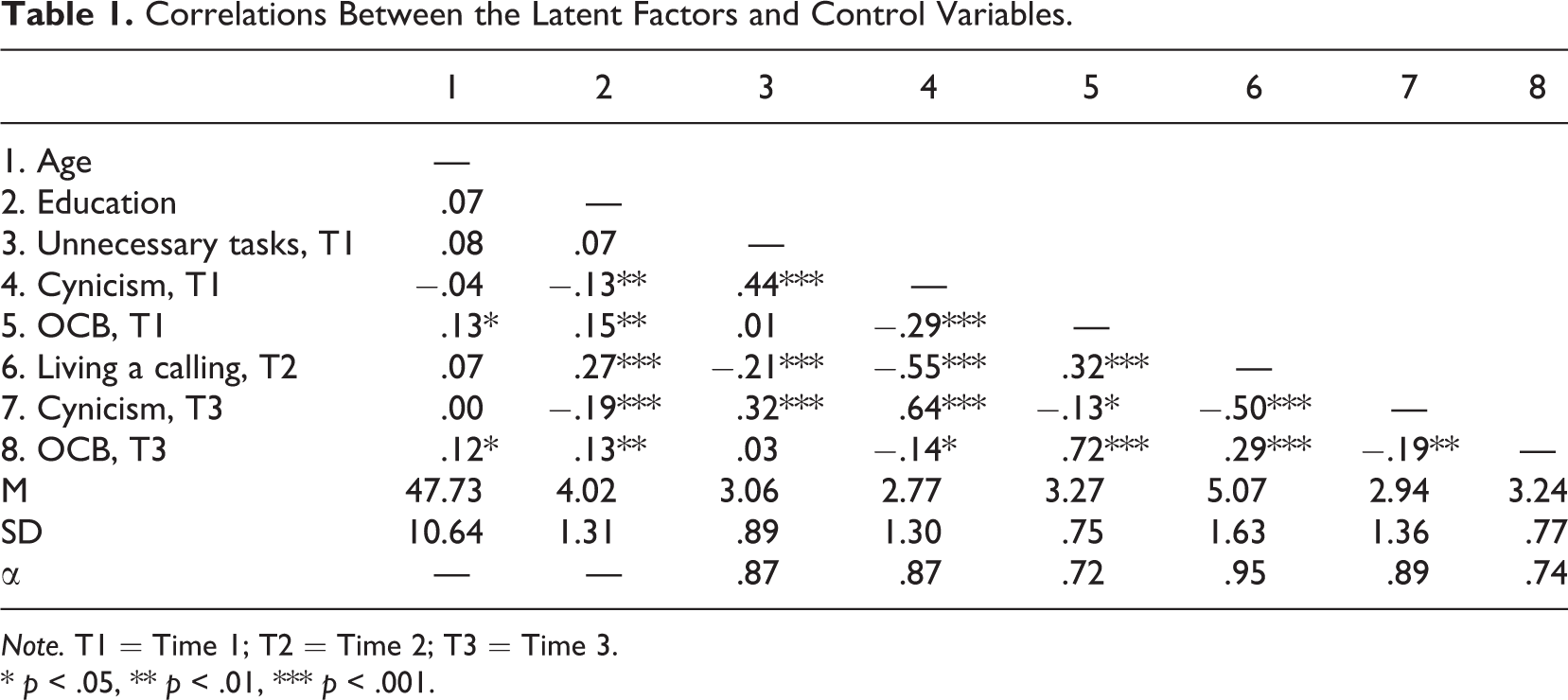
Cronbach’s α coefficients, means, standard deviations, and correlations between the variables are presented in Table 1. As can be seen from Table 1, α coefficients were satisfactory for each sum-scale (for factor structure of latent variables, see results).
Correlations Between the Latent Factors and Control Variables.
Note. T1 = Time 1; T2 = Time 2; T3 = Time 3.
* p < .05, ** p < .01, *** p < .001.
Unnecessary tasks (an independent variable) were measured with four items (e.g., “Do you have work tasks to take care of, which keep you wondering if they have to be done at all?”) from Bern Illegitimate Tasks Scale (BITS scale; Semmer et al., 2010, 2015). The BITS scale has found to be psychometrically reliable in previous studies (e.g., Kilponen et al., 2021; Kronenwett & Rigotti, 2019; Muntz & Dormann, 2020; Semmer et al., 2015). Moreover, criterion/predictive validity of the BITS scale has also been adequate in previous studies, showing that illegitimate tasks have been related to strain-related outcomes in an expected manner (e.g., Eatough et al., 2016; Kilponen et al., 2021; Kronenwett & Rigotti, 2019; Munir et al., 2017; Muntz & Dormann, 2020; Semmer et al., 2015). In this study, the items were rated with a 5-point Likert-scale (1 = never, 5 = often), higher scores reflecting more unnecessary tasks. It is noteworthy that the BITS scale also includes another type of illegitimate tasks, that is, unreasonable tasks. However, this did not have significant prospective effects on the mediator or on the outcomes in our preliminary SEM modeling and was therefore excluded from this study (see also Muntz et al., 2019; Muntz & Dormann, 2020; Sonnentag & Lischetzke, 2018).
Living a calling (a mediator variable) was measured with three items describing living a calling in relation to work (e.g., “I am currently working in a job that closely aligns with my calling,” “I am living out my calling right now in my job”) from the scale for Living a Calling (Duffy et al., 2012). Living a calling has indicated good criterion/predictive validity in earlier studies and was therefore selected as a measure of calling for this study (e.g., Duffy et al., 2012, 2014; Duffy, Allan, et al., 2018; Duffy, Dik, et al., 2018; Duffy & Dik, 2013). The scale was also brief enough for our purposes. The response scale used in this study included a 7-point scale ranging from totally disagree (= 1) to totally agree (= 7).
Cynicism (the first outcome variable) was assessed using three items (e.g., “I feel that I am gradually losing interest in my customers/patients/students/other my employees,” “I feel dispirited at work and I think of leaving my job”) from the Bergen Burnout Indicator-9, the reliability and validity of which have been confirmed in Finnish samples (Feldt et al., 2014; Salmela-Aro et al., 2011). The BBI-scale has been widely used since validation in other Finnish studies and it has shown good criterion/predictive validity by associating with different job stressors in an expected manner (e.g., Huhtala et al., in press; Kilponen et al., 2021; Mauno et al., 2019). In this study, answers were given on a 6-point Likert scale (1 = completely disagree, 6 = completely agree), higher scores reflecting greater cynicism. Cynicism is one sub-dimension of job burnout (Maslach et al., 2001), but cynicism as a single indicator characterizes the elements of lowered (internal) motivation or performance at work, particularly regarding an employee’s attitudes to and relationships with customers/students/patients.
OCB (the second outcome variable) was measured via the scale developed by Lee and Allen (2002) and this particular scale proved to yield a valid and reliable assessment of OCB in this original study. Furthermore, the OCB-scale has found to be psychometrically reliable in other Finnish studies, which have also shown that the scale has sufficient criterion/predictive validity by associating with relevant correlates (e.g., Mauno et al., 2017, 2020). The version used in the present study included OCB toward colleagues and organization which was measured via four items (e.g., “Offers ideas to improve the functioning of the organization,” “Attend functions that are not required but that are help to organizational image). The items were rated using a 5-point Likert scale (1 = completely disagree, 5 = completely agree), higher scores reflecting more OCB.
Of the background factors, only age and education were included in the statistical models as control variables because they correlated significantly with the latent constructs (see Table 1). Thus, the selection of control variables in the statistical analyses was based on their significant correlations with the key constructs (empirical justification) in order to minimize the number of non-significant control variables in structural equation modeling, which may cause unnecessary complexity in modeling.
Statistical Analysis
To explore the study hypotheses (H1, H2, H3), we used structural equation modeling (SEM). However, we first executed measurement models via confirmatory factor analysis (CFA) to test that the hypothesized latent variables (with original items) were separate constructs. CFA was also used to estimate the correlations between the latent constructs and control variables (see Table 1). Fits for the CFA and SEM models were assessed using χ2 values (χ2), comparative fit index (CFI), Tucker-Lewis Index (TLI), root mean square error of approximation (RMSEA) and standardized root mean square residual (SRMR). The cutoff values for fit indices were .95 for CFI and TLI, .06 for RMSEA and .08 for SRMR (Hu & Bentler, 1999; Marsh et al., 2004).
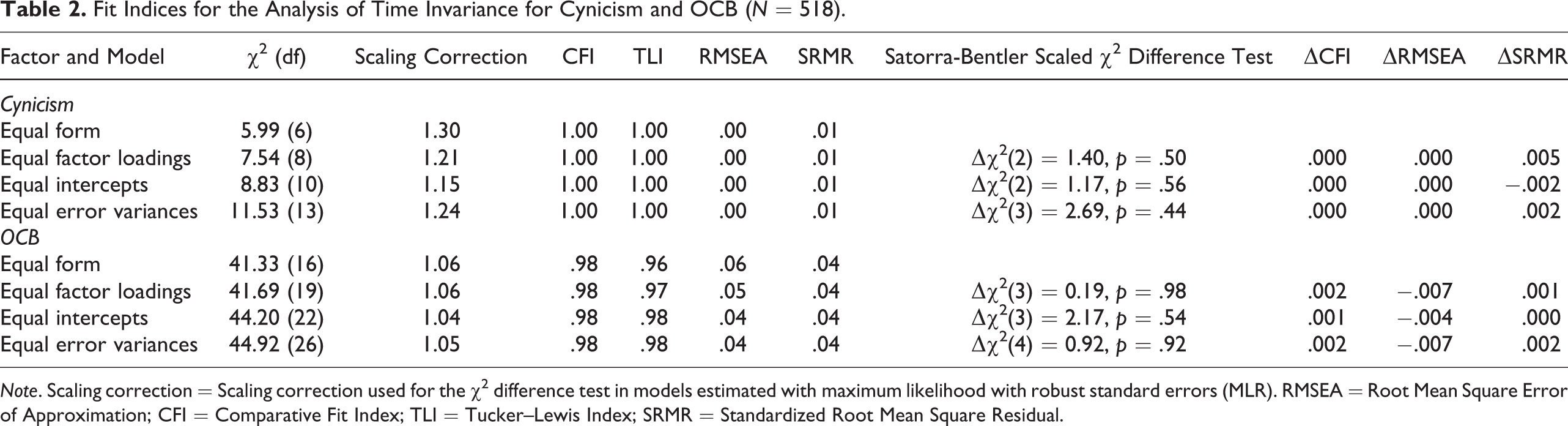
To take into account auto-correlations of the dependent variables (cynicism, OCB at T3), we included latent factors of cynicism at T1 and OCB at T1 in the mediation (SEM) analysis. Before that, we explored time invariance of factor loadings and observed variables’ intercepts and error variances between T1 and T3, as the recommendation requires (see Vandenberg & Lance, 2000). This procedure is needed to ensure that there are no structural changes in those latent factors which are measured repeatedly (here cynicism and OCB). In the model comparisons we utilized the Satorra-Bentler scaled χ2 difference test (Satorra & Bentler, 2001) and difference tests for CFI (ΔCFI), RMSEA (ΔRMSEA), and SRMR (ΔSRMR) according to the next cutoff values (Chen, 2007, p. 501). For metric invariance, a change of <.010 in CFI supplemented by a change of <.015 in RMSEA or a change of <.030 in SRMR was used. For scalar invariance and residual invariance, a change of <.010 in CFI supplemented by a change of <.015 in RMSEA or a change of <.010 in SRMR was used.
All statistical analyses were run using maximum likelihood robust estimation. The mediation model was executed with bootstrapped standard errors and confidence intervals. This is a standard procedure to explore mediation in Mplus framework (see Muthén et al., 2016). The full information maximum likelihood procedure (FIML; see Muthén & Muthén, 1998–2017) was applied in handling missing values by Mplus Statistical Package (version 8.4). The missing data percentages in the study variables varied 0%–6.2%.
Results
Confirmatory Factor Analysis to Test the Discriminant Validity of the Latent Factors
The results for measurement models (CFA) showed that unnecessary tasks at T1, living a calling at T2, cynicism at T3, and OCB at T3, were separate constructs indicating sufficient discriminant validity for these constructs (see more Table 2). CFA with four factors fitted the data significantly better (χ 2 (71) = 138.26, p < .001; CFI = .98; TLI = .97; RMSEA = .04; SRMR = .05) compared to the other models tested (one to three factors), e.g. the model of three factors (cynicism and OCB at T3 as one factor; χ 2 (74) = 518.76, p < .001; CFI = .86; TLI = .83; RMSEA = .11; SRMR = .11) according to differences in χ2 (Satorra-Bentler scaled χ2 difference test p < .001) and other fit indices (more detailed information available from the author due to space constraints). All standardized factor loadings were significant (p < .001), ranging from .50 to .96. Furthermore, time invariance tests showed no structural changes for the latent constructs of cynicism and OCB between T1 and T3 based on the change differences in fit indices (Chen, 2007; see Table 2). This verified to include the latent factors of cynicism at T1 and OCB at T1 in the mediation analysis to control for the auto-correlations of the dependent variables. Altogether, CFA analyses showed that the latent scales had sufficient structural validity.
Fit Indices for the Analysis of Time Invariance for Cynicism and OCB (N = 518).
Note. Scaling correction = Scaling correction used for the χ2 difference test in models estimated with maximum likelihood with robust standard errors (MLR). RMSEA = Root Mean Square Error of Approximation; CFI = Comparative Fit Index; TLI = Tucker–Lewis Index; SRMR = Standardized Root Mean Square Residual.
Structural Equation Model for Testing the Hypotheses
After confirming the structure of the latent factors, we performed SEM in order to test the mediator model and the hypotheses (H1, H2, H3). The model showed a good fit to the data (χ2(230) = 521.71, p < .001; CFI = .96; TLI = .95; RMSEA = .05; SRMR = .11). Associations are presented in Figure 1, which is adjusted for the effects of significant control variables (education, age). As can be seen from the Figure 1, unnecessary tasks at T1 related to lower living a calling at T2 supporting H1 (β = −.24, p < .001). Living a calling at T2, in turn, related to cynicism (β = −.23, p < .001) and OCB (β = .10, p < .05) at T3, supporting H2. A test of indirect effect confirmed that these mediator relations were significant both for cynicism (estimate = .06, SE = .02, p < .01) and OCB (estimate = −.02, SE = .01, p < .05). Furthermore, it can also be seen from Figure 1 that direct relations between unnecessary tasks and cynicism (β = .05, ns), and between unnecessary tasks and OCB (β = .05, ns) were non-significant, supporting the full mediator effects, as proposed in H3.
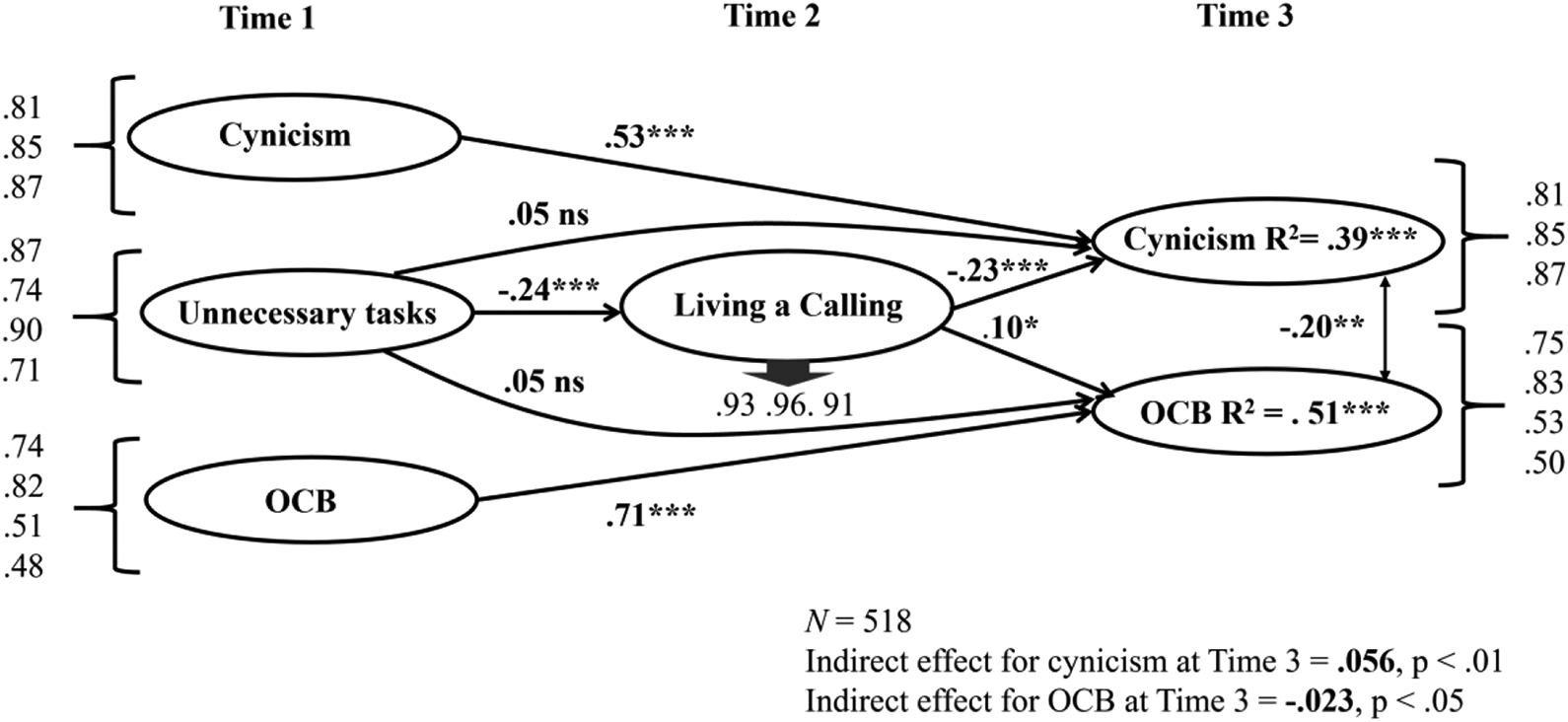
The relations between the latent factors (β-coefficients in bold face). Correlations at T1, error terms and covariates not shown for clarity.
Alternative models: Analysis showed that cynicism at T1 (β = .53, p < .001) and OCB at T1 (β = .71, p < .001) explained a large proportion of variance in cynicism at T3 and OCB at T3, meaning that the auto-correlations of these constructs were high across time (see Figure 1). This, in turn, means that there was less explanatory power for other variables in the SEM analysis, thus, we also ran the mediator model without cynicism and OCB at T1 (i.e., without baseline controls). Overall, these results supported the mediator model reported above, but the relations between independent, mediator, and dependent variables were much stronger (standardized regression coefficients ranged between −.46 and −.22, p < .001; detailed results available upon request) when the baselines of dependent variables were not estimated in SEM. Finally, we also tested another alternative model, that is, whether living a calling moderates the association between unnecessary tasks and the outcomes in order to rule out this alternative explanation concerning the role of living a calling between unnecessary tasks and the outcomes studied. However, an interaction term (unnecessary tasks at T1 × living a calling at T2) was non-significant for both cynicism (β = −.03, p = .40) and OCB (β = −.03, p = .31) at T3. Thus, in our data, living a calling did not moderate the relation between unnecessary tasks and the outcomes studied.
Control variables: Only those control variables which were significantly related to the latent factors were included in the final mediation model. Education had a conditional correlation with living a calling (r = .29, p < .001) (highly educated respondents reported greater living a calling at Time 2) and also age (r = .11, p < .01) had a conditional correlation with OCB at T1 (older employees experienced more OCB at Time 1). It is noteworthy that all the above-reported paths were also significant after estimating the control variables in the SEM analysis.
Discussion
This follow-up study explored whether living a calling (at work) mediated the relation between unnecessary tasks and socio-contextual performance at work (cynicism, OCB) in a three-wave data. We hypothesized that unnecessary tasks (T1) would relate negatively to living a calling at T2 (H1), which, in turn, was expected to relate to cynicism and OCB at T3 (H2). Our findings supported both hypotheses. Moreover, we hypothesized that the prospective relation between unnecessary tasks and the selected outcomes would be fully mediated via living a calling (H3), and this hypothesis gained also support. It is noteworthy that we also tested a moderation possibility, i.e. living a calling as a moderator between unnecessary tasks and the outcomes but this moderation effect was non-significant, lending further support to the mediator model.
Unnecessary Tasks Related to Socio-Contextual Performance via Living a Calling
Our findings are consistent with those of earlier studies, showing that unnecessary tasks are indeed harmful job stressors resulting in various negative outcomes (e.g., Apostel et al., 2018; Ma & Peng, 2019; Muntz & Dormann, 2020; Muntz et al., 2019; Semmer et al., 2015; Sonnentag & Lischetzke, 2018). We found that their stressfulness also concerned living a calling, which was now confirmed for the first time. The finding is theoretically consistent with job stress models (e.g., PEF theory, Caplan, 1987; Edwards & Shipp, 2007) and WCT theory (Duffy, Dik, et al., 2018). Accordingly, unnecessary tasks may imply a threat to an employee’s occupational self-concept/identity, as suggested in the stress-as-offense-to-self model (SOS-model, see Apostel et al., 2018; Kronenwett & Rigotti, 2019; Semmer et al., 2015), thereby harming an employee’s living a calling because occupational self-concept/identity is inherently a crucial aspect in calling (Hirschi, 2012). Moreover, unnecessary tasks may also imply a breach of the psychological contract (see Coyle-Shapiro et al., 2019), which, in turn, may be detrimental to employees’ living a calling (in addition to other negative implications). However, it is equally possible that some other mechanisms/experiences explain why unnecessary tasks are damaging to living a calling. For example, unnecessary tasks may simply cause haste and extra workload for employees thereby reducing their resources to perform core work tasks, which, again, may impair living a calling, creating a resource loss spiral (see Hobfoll, 1989). Indeed, there are many potential explanations for these associations, and future studies should explore in more detail the specific mechanisms between unnecessary tasks and living a calling, as such (extra-role) tasks may well persist in future working life.
There is already ample research evidence showing that calling (at work) relates to many positive outcomes, e.g. life satisfaction, work engagement, positive affect, and calling in life (see e.g., Brown & Lent, 2016; Duffy et al., 2012, 2014; Duffy & Dik, 2013; Hirchi, 2012; Hirschi et al., 2019). However, the significance of calling in explaining performance-related outcomes is less strongly established (cf. Park et al., 2016, 2018), although theoretically sound (Duffy, Dik, et al., 2018). Accordingly, our finding that living a calling functioned as a pathway between socio-contextual performance and job stressors is new and proposes that living a calling may well be a relevant experience also regarding (role) performance (see also Park et al., 2016, 2018). The finding also encourages researchers to investigate the role of other job stressors, besides unnecessary tasks, in interplay between calling and performance. This is important given the shortcoming that job stressors have received only little attention in empirical calling research, which has focused more on the positive correlates of calling (see e.g., Brown & Lent, 2016; Duffy et al., 2014; Duffy, Dik, et al., 2018; Duffy & Dik, 2013; Hirschi, 2012; Hirschi et al., 2019). However, the reasoning above is consistent with a recent theoretical model of calling (see Duffy, Allan, et al., 2018; Duffy, Dik, et al., 2018) proposing that various environmental phenomena, e.g. person-environment (mis)fit as a source of job stress (see Caplan, 1987; Edwards & Shipp, 2007), may shape calling as calling is an evolving and changeable phenomenon throughout the career span (see Dik & Shimizu, 2019; Lysova, Dik, et al., 2019b).
Limitations
There are a few notable limitations in this study. First, we were not able to reliably test different causality models, e.g. whether performance indicators predict unnecessary tasks (via living a calling) rather than vice versa because we did not measure all constructs across the waves. Thus, any conclusions about causal linkages would be premature; they would require more stringent testing using full-panel data and measuring all constructs in each wave (see e.g., Duffy et al., 2014; Duffy, Allan, et al., 2018). However, we analyzed independent, mediator, and dependent variables from separate waves (T1, T2, T3), which should improve the reliability of our findings, at least compared to those of cross-sectional designs. Even though the mediator model tested here was theoretically sound (see WCT theory; Duffy, Allan, et al., 2018; Duffy, Dik, et al., 2018), future longitudinal studies should explore all possible longitudinal associations between these phenomena, also considering stability and change (over time) in these linkages, which we were not able to take into account as fully as possible.
Second, the time-lag we applied may have been either too long or too short but, after all, there is no optimal agreed time-lag concerning the lagged associations between the phenomena studied. Our findings should be replicated in other time-lags to improve their generalizability. It needs to be pointed out, however, that calling develops over the career span and changes therein (caused by environmental factors) may be slower or temporary (Dik & Shimizu, 2019; Lysova et al., 2019b), and in this respect longer follow-ups could be more informative.
Third, we cannot say whether the mediator model found here would concern other types of job stressors or other work-related outcomes, e.g. work engagement, job satisfaction, or job exhaustion, thus these phenomena deserve more attention in future studies. However, our preliminary analyses showed that the second type of illegitimate tasks, i.e. unreasonable tasks (see Semmer et al., 2010, 2015), did not relate directly or via living a calling to OCB or cynicism. Moreover, changes in working life, e.g. technological acceleration, increasing remote work, and job insecurity (see e.g., Boxall & Macky, 2014; Rosa, 2003, 2013; Wilson et al., 2020) may well produce new and unanticipated job stressors also requiring constant alertness among calling researchers.
Fourth, the response rate was relatively low, particularly in the baseline survey although no major sample attrition occurred over time except for education, that is, respondents in the follow-ups were more highly educated than in the baseline. Thus, the findings reported here describe best the experiences of educated employees, which may limit generalizability to less-educated employee groups. In future, we would need more research on calling among occupational groups not commonly perceived as “calling occupations” and these groups should also include less-educated employees.
Practical Conclusions and Suggestions
Our findings have practical implications, and in this respect, we focus on unnecessary tasks and living a calling. On the basis of our findings, we propose that unnecessary tasks should be minimized in organizations as they might be detrimental to employees’ living a calling, again implying an impairment in socio-contextual performance, which is surely harmful for organizations. Managers and employees should discuss on a regular basis what the employees’ core job roles are and what to expect from them in their in-work roles. In organizations, it is also important to realize that employees and managers may perceive unnecessary tasks very differently; useless tasks, from the employees’ perspective, may well be relevant from the organization’s perspective. We recommend that if unnecessary tasks cannot be avoided in organizations, managers should justify them well and also communicate to employees why these seemingly useless tasks are necessary or even beneficial for the organization. Adequate and timely justifications and open communication would render unnecessary tasks easier to tolerate, less ego-threatening and possibly even a part of employees’ psychological contract, and therefore less stressful and demotivating. It is also noteworthy that unnecessary tasks may well be occupation-specific and organizations should also ascertain which tasks are felt to be useless by each occupational group. This would actually be the first and most critical step in screening the nature of unnecessary tasks in occupationally divergent organizations.
Calling, and particularly living a calling, has many positive consequences for employees and organizations (see Brown & Lent, 2016; Duffy et al., 2012, 2014; Duffy, Allan, et al., 2018; Duffy, Dik, et al., 2018; Duffy & Dik, 2013; Hirschi, 2012; Lysova, Allan, et al., 2019a; Lysova, Dik, et al., 2019b; Park et al., 2016, 2018), a finding which we also established here regarding socio-contextual performance at work. Promoting living a calling would therefore have subsequent positive effects on employees and organizations. Consequently, promotors of calling, e.g. job resources, require attention in organizations’ everyday practices and HR-management. Even though job resources were not studied here, there is earlier research showing that they have potential to enhance calling (e.g., Duffy, Allan, et al., 2018; Duffy, Dik, et al., 2018; Lysova, Dik, et al., 2019). For example, job crafting, autonomy, and task significance could be increased in order to enhance calling. Again, it is good to recall that calling is an evolving and changeable phenomenon throughout the career span (see Dik & Shimizu, 2019; Lysova, Dik, et al., 2019b), signifying that calling can also be shaped via appropriate resources and interventions.
Footnotes
Declaration of Conflicting Interests
The author(s) declared no potential conflicts of interest with respect to the research, authorship, and/or publication of this article.
Funding
The author(s) disclosed receipt of the following financial support for the research, authorship, and/or publication of this article: This study was supported by Academy of Finland (grant no: 308334).
