




Abstract
Focusing on the implications of xenocentric behavior for consumer well-being, the authors investigate the link between consumer xenocentrism (C-XEN) and consumers’ self-esteem, using conspicuous consumption orientation and brand addiction as mediating variables. To this end, drawing on system justification, self-concept, and reference group theories, they develop a competitive mediation model and test it on samples of Italian (N = 456) and Peruvian (N = 203) consumers. The results reveal that while the direct effect of C-XEN on self-esteem is negative, C-XEN is also positively related to self-esteem through indirect effects, with conspicuous consumption orientation and brand addiction mediating this relationship. These findings add to our theoretical understanding of the C-XEN construct and its impact on consumer well-being, and have important practical implications for both foreign and domestic producers.
Keywords
Globalization has created new challenges and opportunities for international marketers, resulting in a significant increase in the availability of foreign product options. Hence, consumers’ orientations, attitudes, and behaviors toward products from foreign countries have attracted the attention of international marketing researchers (Bartsch, Riefler, and Diamantopoulos 2016; Donthu et al. 2021; Salomão, Strehlau, and Silva 2022). At the same time, a parallel stream of literature has been focusing on consumer well-being, which “has emerged as a prominent topic in consumer research, driven by several factors such as technological advances empowering consumers, increased concerns regarding health and safety, ethical considerations, and the environmental and economic impact of consumption” (Bhardwaj and Kalro 2024, p. 21). Consumer well-being goes beyond economic criteria (e.g., income or wealth) and captures several aspects of human development, including physical and mental health, pleasure, and life satisfaction (Diener et al. 2010). Indeed, companies are now seen as being responsible for contributing to healthy choices for consumers as well as enhancing their quality of life (Sirgy and Lee 2006). Surprisingly, however, the focus on well-being is still scant in international marketing literature, despite the fact that international marketers regularly make various decisions that can impact consumers’ well-being (Lee and Sirgy 1999).
In response to this gap, the Journal of International Marketing has recently published two special issues “concerning a key concept for many stakeholders in the context of pressing societal issues and an important outcome: well-being” (Grinstein, Hewett, and Riefler 2022, p. 2). However, there is still a pressing need for research specifically aimed at understanding various aspects of well-being in relation to key consumer dispositions, such as consumer ethnocentrism (Shankarmahesh 2006; Shimp and Sharma 1987; Siamagka and Balabanis 2015), consumer cosmopolitanism (Cleveland, Laroche, and Papadopoulos 2009; Makrides et al. 2022; Riefler, Diamantopoulos, and Siguaw 2012), and the like. For example, the award-winning review of positive consumer dispositions toward foreign countries and globalization by Bartsch, Riefler, and Diamantopoulos (2016) 1 makes no reference whatsoever to aspects of well-being either as correlates or outcomes of consumer dispositions. Instead, the focus is squarely on “conventional” consumer response variables “relating to the impact of positive dispositions on (1) evaluations, (2) attitudes, (3) purchase intentions, and (4) consumption/ownership of global and foreign products/brands” (Bartsch, Riefler, and Diamantopoulos 2016, p. 101).
In this article, we follow Grinstein, Riefler, and Hewett’s (2022, p. 2) lead that “research in the international marketing domain has an important role to play in furthering insights into issues of well-being in a global world” by focusing on an important consumer disposition, namely consumer xenocentrism (C-XEN; Balabanis and Diamantopoulos 2016) and its relationship to consumer self-esteem, defined as “self-acceptance, a basic feeling of self-worth” (Ryff 1989, p. 1073; see also Rosenberg 1965). We specifically focus on self-esteem, because of its central importance to consumer well-being (Rosenberg 1979). Indeed, self-esteem is “the most recurrent criterion of well-being … holding positive attitudes toward oneself emerges as a central characteristic of positive psychological functioning” (Ryff 1989, p. 1071), and a fundamental basic task for an individual's mental and social health lies in the construction of positive self-esteem (Macdonald 1994).
Our focus on C-XEN, on the other hand, is due to two reasons. First, unlike other pro-outgroup dispositions such as cosmopolitanism (Cleveland, Laroche, and Papadopoulos 2009) or world mindedness (Nijssen and Douglas 2008), C-XEN is simultaneously both pro-outgroup and anti-ingroup as it reflects “a consumer's internalized belief of the inferiority of domestic products and a corresponding propensity to prefer foreign products for social aggrandizement purposes” (Balabanis and Diamantopoulos 2016, p. 61). It is this dual nature of the construct—capturing both negative self-stereotyping and outgroup favoritism as posited by system justification theory (Jost and Banaji 1994; Jost, Banaji, and Nosek 2004)—that makes C-XEN both unique and theoretically interesting as an explanatory variable of outcomes relating to consumer well-being. More specifically, C-XEN can be expected to have greater implications for consumer well-being than dispositions such as ethnocentrism or cosmopolitanism since xenocentric individuals may face identity struggles and a feeling of alienation from their own culture (Prince and Kwak 2020). Overemphasizing “superior” outgroups and adopting elements from other cultures without a strong connection to one's own culture can create feelings of disorientation or detachment, affecting one's sense of self and well-being (Kent and Burnight 1951; Prince et al. 2016). Indeed, feelings of marginalization or social exclusion and the internalization of negative ingroup stereotypes (Balabanis and Diamantopoulos 2016; Jiang and Christian 2023) have been proposed to lead to frustration and reduced self-esteem among xenocentric consumers (Cleveland and McCutcheon 2022).
Second, empirical evidence shows that C-XEN has strong predictive validity when it comes to consumer behavior outcomes. Specifically, a comparison of the predictive validity of five consumer dispositions based on different theoretical foundations (i.e., ethnocentrism, xenocentrism, cosmopolitanism, global identity, local identity) on brand attitudes and loyalty, revealed that “system justification theory is the most consistent in its predictions in both attitudinal and loyalty biases. … The system justification theory–based construct of consumer xenocentrism consistently explains both types of biases (toward domestic and foreign products)” (Balabanis, Stathopoulou, and Qiao 2019, p. 51). While C-XEN's superior predictive validity highlights the managerial relevance of the construct, little is known as to whether and how C-XEN also impacts consumer outcomes related to well-being, such as self-esteem. This, however, is an important issue for firms targeting xenocentric consumer segments because “companies should take a broader perspective to doing business and acknowledge the relevance of the well-being of their customers” (Van Ittersum 2015, pp. 3–4). Against this background and drawing on the system justification premises of C-XEN, as well as on self-concept and reference group theories, we develop a conceptual model linking C-XEN to self-esteem using the constructs of conspicuous consumption orientation (Chaudhuri, Mazumdar, and Ghoshal 2011) and brand addiction (Mrad and Cui 2017) as mediating variables. A central premise of our model is that, while C-XEN is expected to negatively impact self-esteem, there are countervailing indirect effects through conspicuous consumption orientation and brand addiction. Such indirect effects are expected to (partially or fully) offset the negative direct effect of C-XEN on self-esteem due to the hypothesized competitive mediation structure implied by our model (Zhao, Lynch, and Chen 2010). 2 We test our proposed model in two very different country settings (Italy and Peru) to assess its robustness and enhance generalizability (Lynch et al. 2015; Uncles and Kwok 2013).
We purposely focus on conspicuous consumption orientation and brand addiction as mediating variables because the conceptual nature of C-XEN—as reflected in its perceived inferiority and social aggrandizement dimensions (Balabanis and Diamantopoulos 2016)—can be expected to fuel conspicuous consumption, which, in turn, is likely to positively influence brand addiction. Conspicuous consumption orientation reflects “a deliberate engagement in symbolic and visible purchase, possession and usage of products and services imbued with scarce economic and cultural capital with the motivation to communicate a distinctive self-image to others” (Chaudhuri, Mazumdar, and Ghoshal 2011, p. 217). Note that such a view is very different from older/traditional conceptualizations of the construct whereby conspicuous consumption was seen as wasteful or even sinful and having no value (see, e.g., Mason 1981). Brand addiction, on the other hand, captures the most intense relationship between a consumer and a brand (Fournier 1998), and refers to a “psychological state that involves mental and behavioral preoccupation with a particular brand driven by uncontrollable urges to possess the brand's products and involving positive affectivity and gratification” (Cui, Mrad, and Hogg 2018, p. 124). Recent research shows that brand addiction is not necessarily pathological (i.e., leading to dysfunctional consequences) and offers “evidence of brand addiction's positive impact on consumers’ life happiness, self-esteem and debt avoidance” (Mrad and Cui 2020, p. 406; see also Cui, Mrad, and Hogg 2018; Mrad and Cui 2017).
Our intended contribution is threefold. First, we contribute to the emerging literature on C-XEN by revealing—for the first time—the different pathways through which xenocentric tendencies influence individuals’ self-esteem. We thus enhance our theoretical understanding of the functioning of the C-XEN construct through unraveling its relationship with an important aspect of consumer well-being. These insights should be of value to companies wishing to act responsibly by establishing and maintaining healthy relationships with their customers, thus safeguarding consumer welfare.
Second, also for the first time, we establish a link between C-XEN and conspicuous consumption orientation, and show that the latter is particularly prevalent among xenocentric consumers. This is important from a managerial perspective as it identifies a consumer segment that is likely to be especially receptive to marketing communications emphasizing status-seeking, image-signaling, and the like (Kastanakis and Balabanis 2014).
Third, we contribute to the very limited literature on brand addiction by providing insights on its link to C-XEN in different market contexts. To the best of our knowledge, brand addiction has not yet been investigated in relation to any consumer disposition encompassing tendencies to favor either domestic or foreign products; it is thus a construct completely absent in international marketing literature despite its obvious relevance for consumer-brand relationships (e.g., Cui, Mrad, and Hogg 2018; Mrad and Cui 2020). Our study thus introduces brand addiction as a new consumer response variable deserving investigation in international marketing.
It is important to stress at this point that our study does not advocate the active encouragement of conspicuous consumption and/or brand addiction as a managerial practice. This is because extreme manifestations of such behaviors can also have negative consequences for consumers such as compulsive buying, consumer debt, and the like (Hirschman 1992; Martin et al. 2013). Instead, our study seeks to offer a nuanced examination of how consumer behaviors that are intuitively thought of as being solely dysfunctional may also have positive effects on certain aspects of consumer well-being, thus providing a deeper understanding of their implications for researchers and practitioners alike.
Consumer Xenocentrism: Theoretical Underpinnings
The conceptual roots of the C-XEN construct can be traced back to the sociological concept of xenocentrism, which, broadly speaking, reflects “the belief that what is foreign is best, that your own lifestyle, products or ideas are inferior to others” (Eshleman, Cashion, and Basirico 1993, p. 109). Individuals may exhibit xenocentric behavior when they feel detached from their own cultures or when they consider that their individual values are incompatible with those of their own culture (Kent and Burnight 1951). This form of disconnection—or, in extreme circumstances, marginalization—may prompt the person to pursue belongingness with one or several preferred outgroups (Cleveland and Balakrishnan 2019; Cleveland and McCutcheon 2022).
Applied to a consumption context, individuals exhibiting xenocentric tendencies are invariably negatively biased against the domestic market and favorably inclined toward foreign markets and their products (Mueller and Broderick 2010). More precisely, xenocentric consumers reject domestic products for reasons of perceived inferiority of the home market and seek foreign products from allegedly superior outgroups in order to enhance their social standing (Balabanis and Diamantopoulos 2016). The theoretical underpinning of xenocentric behavior is system justification theory (Jost and Banaji 1994; Jost, Banaji, and Nosek 2004), which posits that people demonstrate outgroup favoritism when differences in social standing are perceived as legitimate. According to this theory, xenocentric consumers are inclined to defend and strengthen the prevailing social system through recognizing and accepting their so-called inferiority (Jost and Banaji 1994). As a result, such consumers develop negative stereotypes of their own group (Zhou and Belk 2004) and “internalize the cultural values and stereotypes of the very social system that oppresses them” (Jost and Burgess 2000, p. 294). Outgroup preference then helps to justify and maintain the system hierarchy that they have adopted (Jost and Banaji 1994).
In short, xenocentric consumers exhibit outgroup favoritism coupled with a bias against the ingroup (i.e., one's home country) (Diamantopoulos, Davydova, and Arslanagic-Kalajdzic 2019). This is reflected in their purchase behavior, which favors foreign products for social aggrandizement purposes and the rejection of domestic offerings due to internalized perceived ingroup inferiority (Balabanis and Diamantopoulos 2016).
Conceptual Model and Hypotheses
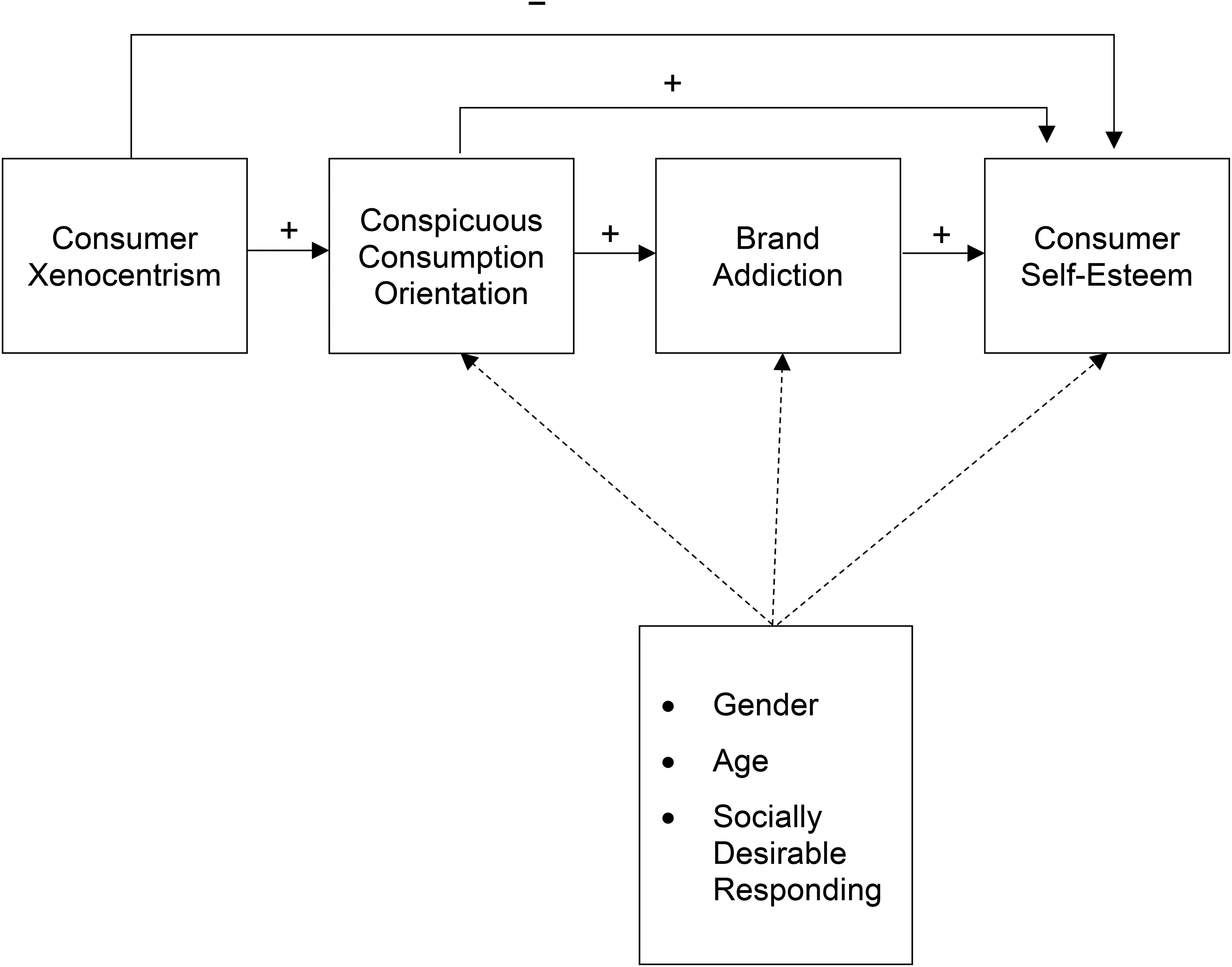
To shed light on the relationship between C-XEN and consumers’ self-esteem, we use the serial mediation model in Figure 1 in which, in addition to (1) the direct link between C-XEN and self-esteem, (2) conspicuous consumption orientation mediates the effect of C-XEN on self-esteem, and (3) conspicuous consumption orientation and brand addiction serially mediate the effect of C-XEN on self-esteem. According to our model, and as elaborated in subsequent sections, the conspicuous consumption orientation of xenocentric consumers is expected to lead to a strong attachment with particular brands originating in foreign countries. As brand addiction drives individuals to experience a sense of connection to these brands and become more involved with them (Cui, Mrad, and Hogg 2018; Mrad and Cui 2017), this consumption behavior is, in turn, likely to lead to more positive feelings of self-esteem (Mrad and Cui 2020).
Conceptual Model.
The first relationship in our model is the direct link between C-XEN and self-esteem. According to Maslow's (1943, 1954) theory of motivation, self-esteem is a fundamental human need and a key aspect of reflecting an individual's judgment of quality of life; people make great efforts to feel better about themselves (Baumeister et al. 2003). From a consumption perspective, the quest for self-esteem is acknowledged as one of the most important motivational drivers of consumption behavior, whereby consumers refer to choices that they believe can enhance and protect their self-esteem (Grubb and Grathwohl 1967; Stuppy, Mead, and Van Osselaer 2016).
Research in social psychology indicates that individuals who are part of a devalued or marginalized group may develop lower self-esteem due to the internalization of negative ingroup stereotypes (Katz, Joiner, and Kwon 2002). Xenocentrism conveys outgroup favoritism as well as internalization of negative stereotypes about oneself (Cleveland and McCutcheon 2022). Research also shows that when consumers are involved in ingroup favoritism, they tend to exhibit higher levels of self-esteem (Iacoviello et al. 2017), and, conversely, individuals who try to enhance their self-image through outgroup favoritism usually have lower self-esteem (Abrams 1992). Furthermore, individuals who are part of a low-status group may experience inclinations toward self-hate or self-depreciation (Tajfel 1981). These tendencies create internal conflicts, which individuals address through an external locus of control, with the latter serving as a crucial foundation to their self-concept (Bearden, Hardesty, and Rose 2001). These findings are consistent with the premises of system justification theory and are further supported by self-concept and reference group theories, as discussed below.
According to system justification theory, individuals may struggle between their inclination to keep and improve a positive self-image, the desire to keep and improve positive images of their own group, and the recognition of the legitimacy of the social system (Jost, Burgess, and Mosso 2001). For such individuals, system justification is usually connected with outgroup favoritism, ingroup incongruity, diminished self-esteem, high level of depression, and neuroticism (Jost and Hunyady 2003). Furthermore, drawing on self-concept theory (Sirgy 1982), which categorizes the self into the actual self (consumers consider who they really are) and the ideal self (consumers consider who they would like to be), it can be argued that xenocentric consumers perceive their ingroup (i.e., the home country) as being the “actual” group, namely the one to which they actually belong, as it is where they live and have their family and professional/business/social relationships. However, for such consumers, the choices associated with or even dictated by their ingroup are not in line with their aspirations, which are instead aligned with a different group. The latter, namely the “ideal” group, is represented by a set of countries considered to be “superior” to the home country and to which they aspire. Xenocentric consumers seek to affirm their ideal group, which is distant from the actual one, thus creating a discrepancy between what they are and what they would like to be. This discrepancy can be expected to have an adverse effect on self-esteem as the ideal group (outgroup) is perceived to be superior to the actual group (ingroup) to which the consumer belongs.
Reference group theory can also help explain the role that outgroups play in shaping individuals’ attitudes and behaviors, including the preference for foreign-made products associated with C-XEN. As individuals usually form an emotional connection with other people from the ingroup (Brown et al. 1992), the preference for other countries by xenocentric consumers may lead to psychological discomfort due to a confusion in their sense of identity and a feeling of not belonging anywhere, which may result in lower self-esteem (Cleveland and McCutcheon 2022; Gailliot and Baumeister 2007).
Bearing the preceding considerations in mind, we thus hypothesize:
The second relationship in our model links C-XEN to conspicuous consumption orientation. The latter construct is an individual difference variable, capturing the tendency to engage in “visible consumption of goods as a mechanism to enhance social standing” (Grace and Griffin 2009, p. 15). The original notion of conspicuous consumption can be traced back to Veblen's Theory of the Leisure Class (1899) and the “invidious comparison” and “pecuniary emulation” that induce individuals to imitate the consumption habits of others who occupy a superior position in the social hierarchy. Individuals (not only the rich but also the middle class and the poorer classes of society) are seen to be involved in a competitive social race for gaining status or prestige by “signaling wealth through conspicuous consumption” (Bagwell and Bernheim 1996, p. 349). However, in addition to the ostentatious signaling of wealth, contemporary research highlights several other motives that underlie conspicuous consumption, including social approval, uniqueness, and self-expression (Chaudhuri and Majumdar 2006; Eastman and Eastman 2015; Memushi 2013).
Conspicuous consumption is conceptually closely related to the notion of status consumption, namely “the motivational process by which individuals strive to improve their social standing through the conspicuous consumption of consumer products that confer and symbolize status both for the individual and surrounding significant others” (Eastman, Goldsmith, and Flynn 1999, p. 41). 3 Research indicates that the purchase and consumption of foreign products and brands is often driven by sociopsychological motives related to improving status and enhancing self-worth (Batra et al. 2000; Dong and Tian 2009; Zhou and Wong 2008). It is also worth noting that conspicuous consumption is not confined to high-income individuals but can be observed regardless of a consumer's income or social class (Belk 1988).
We expect that highly xenocentric consumers are more likely to exhibit a stronger conspicuous consumption orientation due to the social aggrandizement and perceived inferiority dimensions of the C-XEN construct. Social aggrandizement is defined as “the emphasis placed on the symbolic value of foreign products as a way of enhancing perceived social status” (Balabanis and Diamantopoulos 2016, p. 62). It reflects the outgroup favoritism premise of system justification theory on which C-XEN is conceptually based (Jost and Banaji 1994; Jost, Banaji, and Nosek 2004). Xenocentric individuals look for goods that are linked with higher status and are drawn to the status-signaling attributes of brands from (“superior”) foreign countries (Diamantopoulos, Davydova, and Arslanagic-Kalajdzic 2019). Foreign products are generally perceived as being more expensive and scarce than local ones, which makes them more appealing from a reference-group perspective for status-enhancement reasons (Batra et al. 2000). Accordingly, countries other than their home country become “desirable” outgroups, an association with which (e.g., through use of foreign products) improves consumers’ perceived social standing. This view is consistent with recent empirical evidence showing that product conspicuousness amplifies the influence of C-XEN on positive attitudes toward foreign products (Balabanis, Stathopoulou, and Qiao 2019).
The perceived inferiority dimension of C-XEN reflects the negative self-stereotyping facet of system justification theory and is described as “a propensity to degrade, underestimate, and fail to appreciate local goods and brands” (Balabanis and Diamantopoulos 2016, p. 62). Xenocentric consumers internalize the devaluation of their ingroup (i.e., the home country) and favor high-status outgroups (i.e., foreign countries), thus justifying and reinforcing the system hierarchy (Jost and Burgess 2000; Jost, Banaji, and Nosek 2004; Jost, Pelham, and Carvallo 2002). Batra et al. (2000) also pinpoint perceived inferiority as one of the key motivators explaining why consumers purchase foreign goods. Given a feeling of inferiority, consumers purchase specific products with the intention to be better perceived in the greater social hierarchy (Podoshen and Andrzejewski 2012). In this context, research evidence shows that foreign goods and brands, rather than domestic ones, are often considered by consumers as superior indicators for displaying social status (Mueller et al. 2016). We thus hypothesize:
The third relationship in our model links conspicuous consumption orientation to self-esteem. Consumers engage in this form of consumption to enhance their self-esteem, level of social acceptance, or dominance over life circumstances (Shrum et al. 2013). Conspicuous consumption can be viewed as means to empowerment, in that it allows consumers to construct and communicate their own sense of identity, enabling consumers to express themselves (Kumar et al. 2022). Social competition can induce consumers with a high conspicuous consumption orientation to make repetitive status-seeking purchases in the search of social confirmation or uniqueness (Kastanakis and Balabanis 2014); this, in turn, results in the visible consumption of certain goods or brands that mostly signal social status (Melo, Lins, and Poeschl 2021; O’Cass and Frost 2002; Sahin and Nasir 2022). Consumers who possess such products are likely to feel that they are much better than their social surroundings, resulting in a more positive assessment of their well-being (Linssen, Van Kempen, and Kraaykamp 2011). Additionally, conspicuous consumption may give individuals a sense of affiliation with their aspirational groups, making them feel much happier and satisfied in their life (Mandel and Nowlis 2008). In line with this, previous research reports a positive association between conspicuous consumption and consumer well-being (Budiman and O’Cass 2007; Hudders and Pandelaere 2012) and shows that consumers’ engagement in the purchase of expensive and branded products leads to an improved level of self-esteem (Machin et al. 2019).
Thus, it is expected that conspicuous consumption orientation will be positively linked to self-esteem. Given the anticipated positive relationship between C-XEN and conspicuous consumption orientation (see H2), we propose the following mediation hypothesis:
Conspicuous consumption reflects “one's behavioral tendency of displaying one's social status, wealth, taste, or self-image to one's important reference groups through consumption of publicly visible products” (Chen, Yeh, and Wang 2008, p. 686). Individuals who are prone to conspicuous consumption usually seek to enhance their social status through the possession of brands that bring them certain socially admired benefits and standing (O’Cass and Frost 2002). Accordingly, possessions that are used as status markers carry a unique significance and worth (Belk et al. 1991). As some status brands arouse consumers' sense of social recognition and distinction (Kessous and Valette-Florence 2019), consumers’ pursuit for status can lead them to form deep attachment with these brands, often reaching a stage where they become fixated to these brands (Martin et al. 2013). High consumer dependence on brands, in turn, fosters brand addiction (Mrad and Cui 2017; Mrad et al. 2020). We therefore expect that conspicuous consumption orientation will have a positive impact on brand addiction and—in light of H2—act as an intervening variable on the link between C-XEN and brand addiction. We thus hypothesize:
The final link in our conceptual model captures the relationship between brand addiction and self-esteem. Brand addiction is a form of both consumer–brand relationships and addictive behavior (Mrad 2018; Mrad and Cui 2017, 2020). According to consumer–brand relationship theory (Fournier 1998), consumers form different emotional connections with brands, starting from nonintense emotions to moderate emotions, friendly emotions, passionate love, and, finally, reaching the stage of addictive obsession (Fehr and Russell 1991; Sternberg 1986). While Fournier (1998) states that some of these connections involve a “dark side relationship” (p. 361), contemporary addictive behavior theories suggest that addiction should be understood as involving the effort to attain some appetitive effect and gratification through the involvement in some activities, and which could lead to either positive or negative consequences (Sussman and Sussman 2011). In this context, studies on brand addiction demonstrate that brand addiction is quite different from other forms of addictive behavior (e.g., compulsive buying) and generally has positive rather than negative effects on self-esteem (Mrad and Cui 2017, 2020). More specifically, consumers often enhance their self-esteem by putting emphasis on some positive aspects of their lives through connections with specific brands (Zhu et al. 2019). Thus, they tend to become more involved in the repeated purchase of these brands’ products in order to enhance their self-esteem (Mrad and Cui 2017). As individuals are stirred in their cognition and behavior based on previous experiences, reflective experiences of self-connections with some brands may activate a repetitive process of choosing those specific brands and developing strong bonds with them (Mrad and Cui 2020). Since brand addiction is already hypothesized to be driven by C-XEN through its impact on conspicuous consumption orientation (see H4), the following serial mediation hypothesis is proposed:
In summary, our conceptual model in Figure 1 hypothesizes three distinct pathways through which C-XEN is expected to be linked to consumer self-esteem. The first, (direct) pathway posits a negative relationship between the two constructs (see H1), whereas the other two (indirect) pathways propose a positive relationship (see H3 and H5). Thus, in addition to hypothesis testing, our model allows us to estimate the net (i.e., total) effect of C-XEN on consumer self-esteem and thus draw inferences on its likely overall influence on the latter.
Control Variables
Previous studies report significant differences across genders when it comes to conspicuous consumption, with women being more likely to display their social status through consuming conspicuously (e.g., O’Cass and McEwen 2004; Segal and Podoshen 2013). There is also evidence that older consumers are less likely to engage in conspicuous consumption (Kumar et al. 2022).
To date, no research has explored gender differences in the specific context of brand addiction. However, studies on addictive behavior in general have shown that women have a greater tendency to get involved in compulsive consumption than men (e.g., DeSarbo and Edwards 1996; Mueller et al. 2011). Regarding age, it seems that addictive behavior starts at young adulthood to middle adulthood (Mrad and Cui 2017).
Finally, prior research reports higher levels of self-esteem among males and that both males and females display age-connected increases in self-esteem starting from their late adolescence to mid-adulthood (e.g., Bleidorn et al. 2016; Orth, Trzesniewski, and Robins 2010; Trzesniewski, Donnellan, and Robins 2003).
Given the preceding findings, we include respondent gender and age as control variables in our model. Additionally, as all three endogenous variables (i.e., conspicuous consumption orientation, brand addiction, and self-esteem) might be susceptible to social desirability bias (Fisher and Katz 2000; King and Bruner 2000), we explicitly control for socially desirable responding when assessing the model relationships and testing our hypotheses. In doing so, we guard against inflating the relationships of substantive interest due to common method variance (Baumgartner and Weijters 2021; see the “Empirical Studies” section for further details).
Empirical Studies
Prior empirical research on C-XEN has typically used emerging markets or developing countries as research settings (e.g., China [Mueller et al. 2016]; Brazil [Mueller, Damacena, and Torres 2020]; Vietnam [Nguyen and Pham 2021]; Russia [Diamantopoulos, Davydova, and Arslanagic-Kalajdzic 2019]). This reflects, on the one hand, the fact that “the under-evaluation of one's own culture in favor of another foreign culture is common in emerging markets where uneven economic status is predominant between social classes” (Gaur, Bathula, and Diaz 2015, p. 482) and, on the other, the system-justification theoretical foundation of C-XEN whereby “xenocentric consumers are expected to evaluate the images only of “superior” countries more favorably than non-xenocentric consumers” (Diamantopoulos, Davydova, and Arslanagic-Kalajdzic 2019, p. 593, original emphasis).
Following Uncles and Kwok (2013), we designed our empirical investigation with in-built differentiated replication. This approach to study design views replication as “an integral component of the initial study … [and] puts the onus on the original investigators to start the process of replication. … Researchers should not delay the task to an unspecified future time, nor delegate the process to other researchers” (Uncles and Kwok 2013, p. 1399). Based on these recommendations, we first estimated the model in Figure 1 in a highly developed country (Italy) and then did the same in a developing country (Peru) to test its robustness and stability. Thus Study 2 serves as a conceptual replication of Study 1, the aim being to answer the question: “To what extent are the sign, significance, and the effect size of original results robust with respect to changes in the stimuli, settings, participant characteristics, contexts and time of the study?” (Lynch et al. 2015, p. 335). Note that the purpose of a conceptual replication differs from that of a comparative study, where the focus is on testing explicit hypotheses regarding expected cross-country (or cross-cultural) differences. In our case, as elaborated in the next section, Italy enables us to test our conceptual model under highly conservative conditions since it is not an obvious market in which xenocentric tendencies are likely to be strongly manifested. Peru, on the other hand, provides a more conventional empirical setting, since there is consensus in the literature that C-XEN is associated more closely with “emerging markets because of underlying sociopsychological factors that automatically accord statuses of prestige and/or modernity to foreign (i.e., advanced industrialized) countries, and by association, their products” (Mueller et al. 2016, p. 75; see also Ger and Belk 1996).
Study 1: Italy
Italy is an advanced Western country with a highly developed economy. In 2019, Italy was the no. 8 economy in the world in terms of GDP and no. 29 in terms of GDP per capita as well as no. 8 in terms of total exports and no. 10 in terms of total imports (OEC 2019). Italy also ranks 14th on the Country Brand Index (FutureBrand 2019) and 4th on the Anholt-Ipsos Nation Brand Index (Ipsos 2021). Furthermore, it is associated with several strong global brands in a variety of product categories, ranging from food (e.g., Barilla, Ferrero, Lavazza) through fashion (e.g., Armani, Ferragamo, Prada) to motor vehicles (e.g., Alfa Romeo, Ferrari, Maserati). In short, Italy is not a country where xenocentrism is intuitively expected to be a dominant force driving consumer behavior.
Data collection and measures
Five hundred eighteen ordinary consumers (52.5% female, 47.3% male, and .2% did not answer; Mage = 48.2 years, SDage = 16.3) participated in an online survey conducted by a professional marketing research agency. In 2020, 51.5% of the Italian population was male, and the average age was 45.7 years (Statista 2021). Thus, the sample closely mirrors the Italian population in terms of its demographic profile.
Following literature guidelines (e.g., Behling and Law 2000), the survey questionnaire was initially developed in English and then translated into Italian by a bilingual native Italian speaker. It was then back-translated into English by another Italian bilingual native speaker. The questionnaire was subsequently posted on the SoSci Survey online platform and the relevant link forwarded to the marketing research agency that provided the consumer sample. All respondents were Italian nationals.
In line with prior relevant research (e.g., Davvetas and Diamantopoulos 2017; Escalas and Bettman 2005; Le 2020), study participants were first asked to name their favorite brand in a product category they could freely select. 4 We intentionally did not specify any product categories in advance to encourage spontaneous responses by respondents and enhance generalizability. Moreover, given that different consumers may get addicted to different brands in very different product categories, constraining responses to a specified category made little sense from both an internal and external validity point of view. However, respondents were instructed to name a specific brand in a tangible product category rather than a service (e.g., their favorite restaurant) or an entire product category (e.g., shoes). Out of the 518 respondents who completed the questionnaire, 62 (12%) did not have a favorite brand (stated “none” in the open-ended question) or mentioned a product category rather than a brand (despite the instructions given). These respondents were subsequently excluded from the sample, leaving 456 valid cases for analysis.
A total of 195 different brands were mentioned by the 456 respondents spanning a wide variety of product categories, including apparel, technology, cosmetics and personal care, automotive, and food and nutrition. The diversity of product categories comprising the respondents’ favorite brands vindicated our decision not to impose any product category restrictions in the elicitation of favorite brands (see also Davvetas and Diamantopoulos 2017). The most popular brands mentioned were Nike and Samsung (each attracting 7.7% of all responses), followed by Ferrero (6.8%) and Adidas (5.5%). 5
Following the indication of their favorite brand, respondents were exposed to established scales measuring the constructs in Figure 1 drawn from the literature. Specifically, respondents completed Balabanis and Diamantopoulos’s (2016) consumer xenocentrism scale (e.g., “Buying foreign products makes me trendier”; Likert-type format, 1 = “strongly disagree,” and 7 = “strongly agree”; αLC = .860); 6 Chaudhuri, Mazumdar, and Ghoshal’s (2011) conspicuous consumption orientation scale (e.g., “I buy some products because I want to show others that I am wealthy”; Likert-type format, 1 = “strongly disagree,” and 7 = “strongly agree”; α = .908); Mrad and Cui's (2017) brand addiction scale (e.g., “I try very hard to get everything from my favorite brand”; Likert-type format, 1 = “strongly disagree,” and 7 = “strongly agree”; α = .898); and a shortened five-item version of Rosenberg's (1965) general self-esteem scale as also used by Mrad and Cui (2020) (e.g., “I feel that I am a person of worth, at least on an equal plane with others”; Likert-type format, 1 = “strongly disagree,” and 7 = “strongly agree”; α = .870). 7 Web Appendix A lists the measures used to operationalize the model constructs while Web Appendix B shows relevant descriptive statistics and correlation matrices.
To address potential common method variance problems, we applied both procedural and statistical remedies as suggested by Podsakoff et al. (2003). On the procedural side, we promised respondent anonymity, informed respondents that there were no right or wrong answers, and exposed respondents to the dependent variables first to avoid priming effects. On the statistical side, we explicitly included socially desirable responding—using four (yes/no) items from Ray's (1984) social desirability scale—as a control variable in our model. Given that the scales measuring the endogenous constructs in our model contain some items that are potentially “sensitive” in nature, some respondents may be reluctant to respond entirely truthfully and instead provide what they perceive to be socially acceptable answers (e.g., understate the extent of their brand addiction). 8 By explicitly controlling for socially desirable responding, we prevent the confounding of the substantive relations among the constructs of interest with stylistic response effects (Baumgartner and Weijters 2021).
Analysis and results
Of the 456 respondents, 285 (62.5%) indicated a foreign brand as being their favorite, with 171 (37.5%) mentioning an Italian brand. 9 This difference is highly significant (zproportion = 5.339, p = .000) and indicates a clear preference for foreign brands by Italian consumers. As expected, consumers stating a foreign brand as being their favorite score significantly higher on C-XEN than those favoring a domestic brand (Mforeign = 3.12, SD = 1.14; Mdomestic = 2.77, SD = 1.17; t = 3.096, p = .002). These results empirically confirm that xenocentric tendencies may indeed be present even in highly advanced countries such as Italy.
We used Model 6 of the PROCESS routine (Hayes 2022) with 5,000 bootstrap resamples to test our research hypotheses and obtain 95% bias-corrected bootstrap confidence intervals (BCCIs) for the indirect effects. We opted for the PROCESS approach because (1) it makes no distributional assumptions when estimating indirect effects, (2) it enables the formal comparison of different indirect effects linking two variables, and (3) it simultaneously estimates the relevant direct effect, which allows the type of mediation (i.e., indirect-only, complementary, or competitive) to be determined (Zhao, Lynch, and Chen 2010).
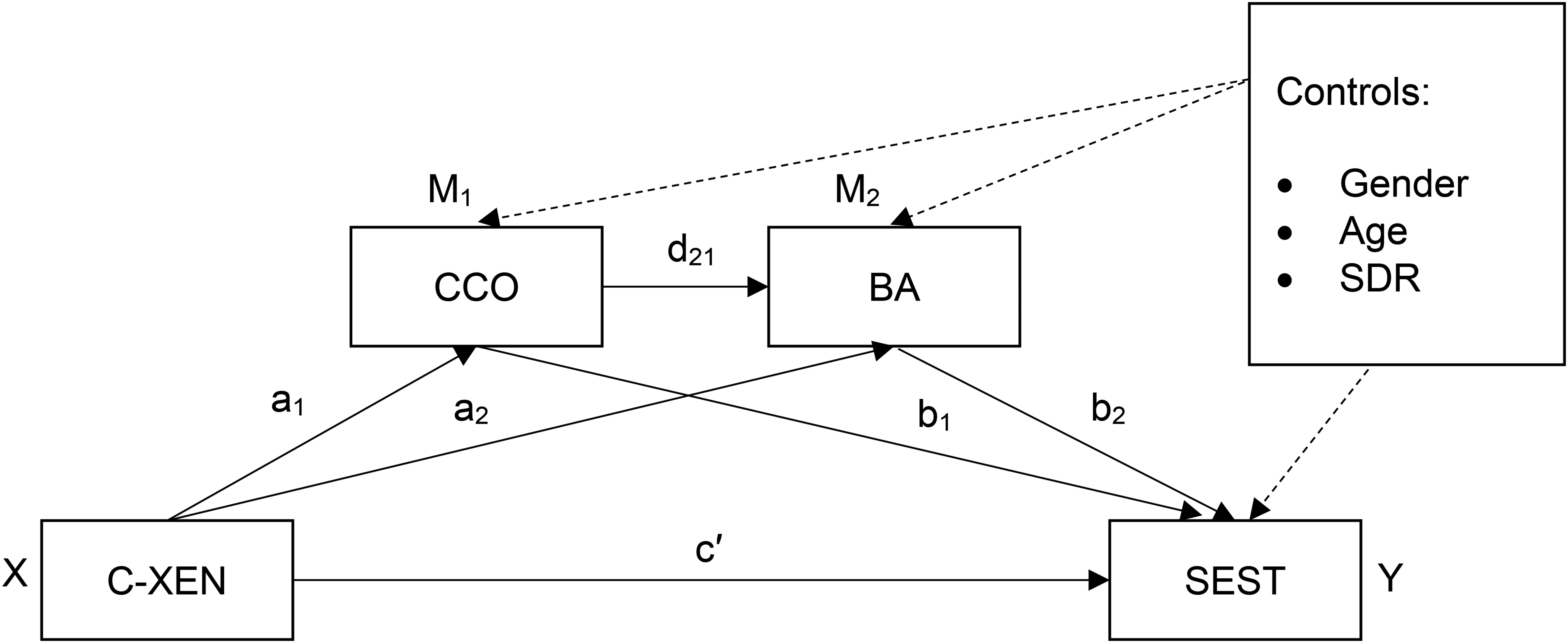
As Figure 2 shows, the estimated serial mediation model includes C-XEN as the independent variable (X); two mediators, M1 and M2 (corresponding to conspicuous consumption orientation [CCO] and brand addiction [BA] respectively); and self-esteem (SEST) as the ultimate outcome variable (Y). Moreover, gender (GENDER), age (AGE), and social desirability (SDR) are included as covariates (control variables) in the model.
Estimated Serial Mediation Model.
We ran the analysis twice, once on the subsample of respondents who mentioned a foreign brand as being their favorite and once on the subsample mentioning a domestic favorite brand. Although xenocentric consumers are—almost by definition—more likely to list a foreign brand as their favorite, it cannot be entirely ruled out that some may have a domestic favorite brand. This is because a xenocentric consumer may routinely purchase foreign brands in most product categories but still have a strong attachment to a specific domestic brand that eventually becomes their favorite (e.g., a highly xenocentric Italian consumer may opt for foreign brands for, say, apparel, cosmetics, and cars but still consider, say, Ferrero as their favorite brand). Thus, exploring whether the hypothesized model relationships also hold when the focal brand is domestic rather than foreign seems to be justified.
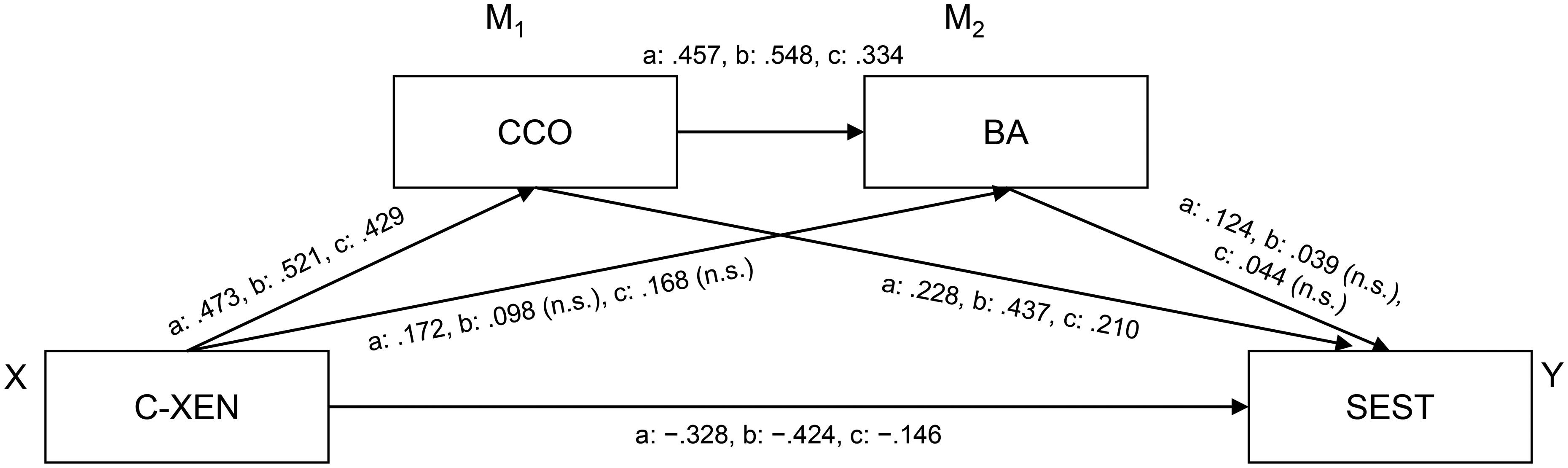
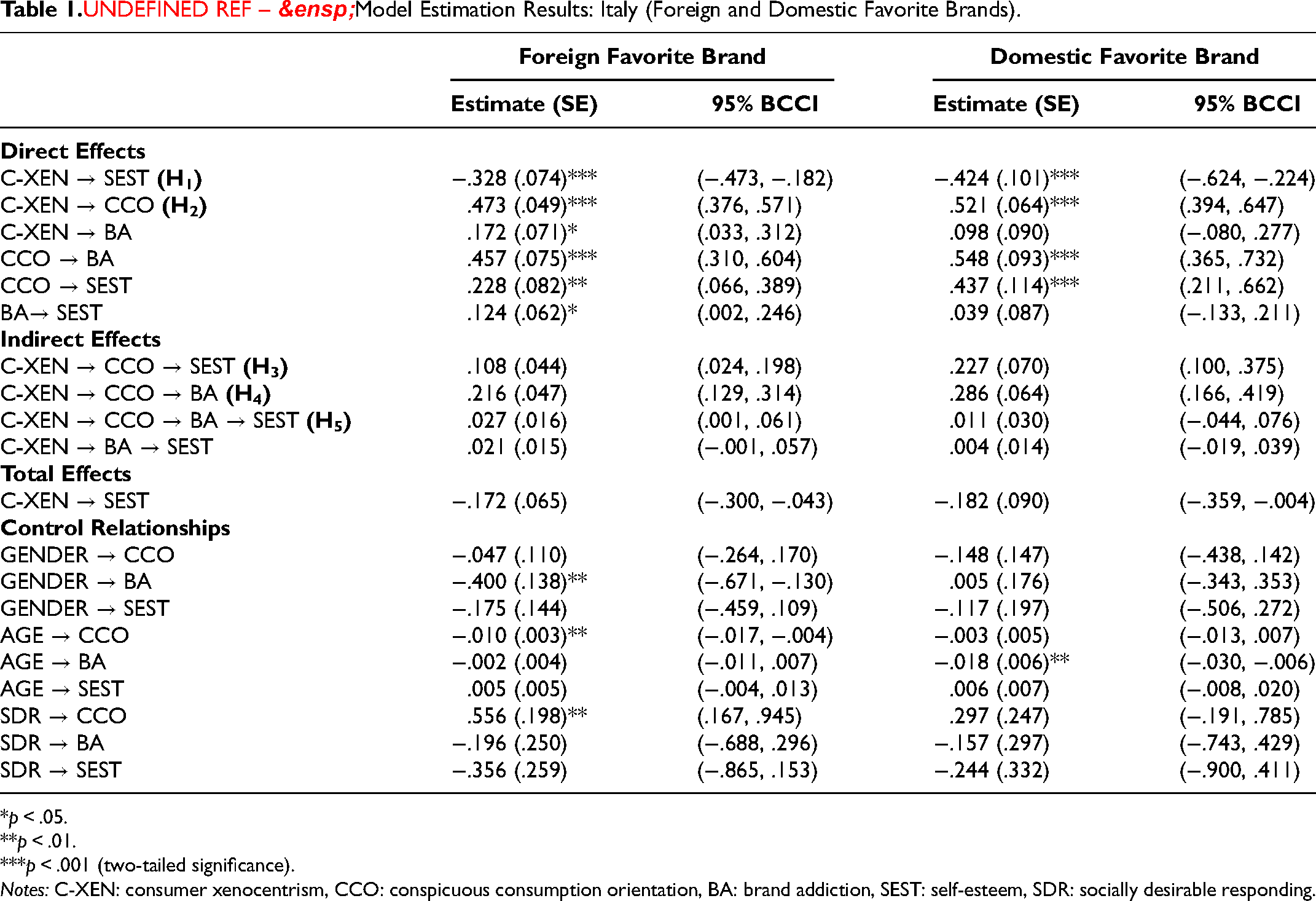
Given the model structure depicted in Figure 2, H1 would be supported if the direct effect C-XEN → SEST (i.e., c′) is negative and significant; support for H2 would be provided if the direct effect C-XEN → CCO (i.e., a1) is positive and significant; H3 would be supported if the indirect effect C-XEN → CCO → SEST (i.e., a1b1) is positive and the corresponding 95% confidence interval does not include zero; H4 would be supported if the indirect effect C-XEN → CCO → BA (i.e., a1d21) is positive and the corresponding 95% confidence interval does not include zero; and H5 (the serial mediation hypothesis) would be supported if the serial indirect effect C-XEN → CCO → BA → SEST (i.e., a1d21b2) is positive and its corresponding 95% confidence interval does not include zero. Table 1 and Figure 3 summarize the results of the PROCESS analysis.
Serial Mediation Model: Path Coefficients.
Model Estimation Results: Italy (Foreign and Domestic Favorite Brands).
*p < .05.
**p < .01.
***p < .001 (two-tailed significance).
Notes: C-XEN: consumer xenocentrism, CCO: conspicuous consumption orientation, BA: brand addiction, SEST: self-esteem, SDR: socially desirable responding.
In support of H1, C-XEN negatively and significantly impacts self-esteem in both the foreign and domestic brand subsamples (βforeign = −.328, p = .000; βdomestic = −.424; p = .000). Also, in both subsamples, C-XEN positively and significantly impacts conspicuous consumption orientation, thus fully supporting H2 (βforeign = .473, p = .000; βdomestic = .521, p = .000). The amount of variance explained in conspicuous consumption orientation is substantial in both subsamples (R2foreign = .343, R2domestic = .333), indicating large effect sizes (Cohen 1988). H3 is also supported in both subsamples as the relevant indirect effect of C-XEN on consumer self-esteem through conspicuous consumption orientation is positive, and the associated 95% confidence interval does not include zero (95% BCCIforeign: [.024, .198]; 95% BCCIdomestic: [.101, .375]). As the direct effect of C-XEN on self-esteem is negative (see H1), this is a case of competitive mediation (Zhao, Lynch, and Chen 2010).
Regarding the expected positive relationship between C-XEN and brand addiction (H4), the indirect effect through conspicuous consumption orientation is positive, and the 95% confidence interval does not include zero in both subsamples (95% BCCIforeign: [.129, .314]; 95% BCCIdomestic: [.166, .419]). This fully supports H4. The relevant direct effect is also positive and significant in the foreign brands subsample (βforeign = .172, p = .016, indicating complementary mediation) but not in the domestic brand subsample (βdomestic = .098, p = .277, indicating indirect-only mediation). The amounts of variance explained in brand addiction are substantial in both subsamples (R2foreign = .256, R2domestic = .338), pointing to large effect sizes.
As far as the serial mediation hypothesis linking C-XEN to self-esteem through conspicuous consumption orientation and brand addiction is concerned (H5), this is supported in the foreign brands subsample (95% BCCIforeign: [.001, .061]) but not in the domestic brands subsample (95% BCCIdomestic: [−.044, .076]). As the direct effect of C-XEN on self-esteem is negative and significant (see previous findings on H1), this indicates competitive mediation for the foreign brands subsample and direct-only nonmediation for the domestic brands subsample (Zhao, Lynch, and Chen 2010). The amounts of variance explained in self-esteem correspond to moderate effect sizes (R2foreign = .104, R2domestic = .151).
An effect decomposition (Iacobucci, Saldanha, and Deng 2007) reveals that the total (i.e., net) effect of C-XEN on self-esteem is negative and significant (95% BCCIforeign: [−.300, −.043]; 95% BCCIdomestic: [−.359, −.004]), implying that, overall, C-XEN has an adverse influence on consumer self-esteem.
In summary, the results of Study 1 (both subsamples) show that while the direct impact of C-XEN on consumers’ self-esteem is negative, the tendency of xenocentric consumers to engage in conspicuous consumption boosts their self-esteem; however, the net (i.e., total) effect of C-XEN remains negative. Furthermore, C-XEN is found to foster brand addiction directly and/or through its effect on conspicuous consumption orientation.
Regarding the control variables, women seem to be more prone to brand addiction (β = .400, p = .004), and younger consumers are likely to be more prone to conspicuous consumption (β = −.101, p = .003); however, these effects were noted only in the foreign favorite brands subsample. Social desirability bias does not appear to materially obscure the relationships of theoretical interest; only a single instance was noted where social desirability had a significant effect (on conspicuous consumption orientation in the foreign favorite brands subsample; β = .556; p = .005).
As a final point, it is worth noting that combining the foreign and domestic brand subsamples and running a single analysis on the total sample (N = 456), produces results that are practically identical with those obtained on the foreign favorite brands subsample (see Table 1). 10
Study 2: Peru
For our second study, we chose Peru—an officially recognized developing country (CIA 2020) with a very different profile than Italy—as our empirical setting. In 2019, Peru was the no. 49 economy in the world in terms of GDP and no. 90 in terms of GDP per capita as well as no. 53 in terms of total exports and no. 57 in terms of total imports (OEC 2019). Peru also ranks 65th on the Country Brand Index (FutureBrand 2020) and 79th on the Human Development Index (Human Development Report Office 2020). Thus, Peru is a country in which substantial xenocentric tendencies can be expected given that there are several more advanced/developed countries that are ranked higher and could therefore be viewed as being “superior” (Balabanis and Diamantopoulos 2016). Importantly, besides its rich mineral resources, Peru has substantial textile, food and beverage, and electrical machinery industries (CIA 2020), which makes it unlikely that foreign products and brands are preferred simply because there are no domestic equivalents. Indeed, Peruvian consumers often exhibit ambiguous purchase behavior as they have a strong interest in purchasing foreign products combined with an intrinsic urge to buy domestic products to support the local economy (Spillan, Kucukemiroglu, and de Mayolo 2008).
Data collection and measures
Two hundred sixteen ordinary consumers (58.8% female, 38.4% male, 2.8% did not answer; Mage = 43.0 years, SDage = 15.63) participated in an online survey using the SoSci Survey platform and forwarding the relevant link to the authors’ personal and professional contacts in Peru using a snowball sampling technique. The survey questionnaire was initially developed in English and subsequently translated into Spanish using the same procedures as in Study 1. Out of the 216 respondents who completed the questionnaire, 13 (6%) did not have a favorite brand or mentioned a product category instead of a brand. These respondents were subsequently excluded, leaving 203 valid cases for analysis.
A total of 116 different favorite brands were mentioned by the 203 respondents spanning a wide variety of product categories, including apparel, technology, cosmetics and personal care, automotive, and food and nutrition. The most popular brands mentioned were Nike (6.5% of all responses), Samsung (4.60%) and Adidas (4.20%).
Following the indication of their favorite brand, respondents subsequently completed the same scales as in Study 1 measuring consumer xenocentrism (αLC = .834); conspicuous consumption orientation (α = .854); brand addiction (α = .838); and self-esteem (α = .819) (see Web Appendices A and B). The same procedures for dealing with common method variance as in Study 1 were also used.
Analysis and results
Of the 203 respondents, no fewer than 156 (76.8%) indicated a foreign brand as being their favorite, with only 47 (23.2%) mentioning a Peruvian brand. 11 This is a highly significant difference (zproportion = 7.637, p = .001) and indicates a clear preference for foreign brands by Peruvian consumers. As expected, consumers listing a foreign brand as their favorite are significantly more xenocentric than those listing a domestic brand (Mforeign = 2.72, SD = 1.08; Mdomestic = 2.40, SD = .93; t = 1.986, p = .050).
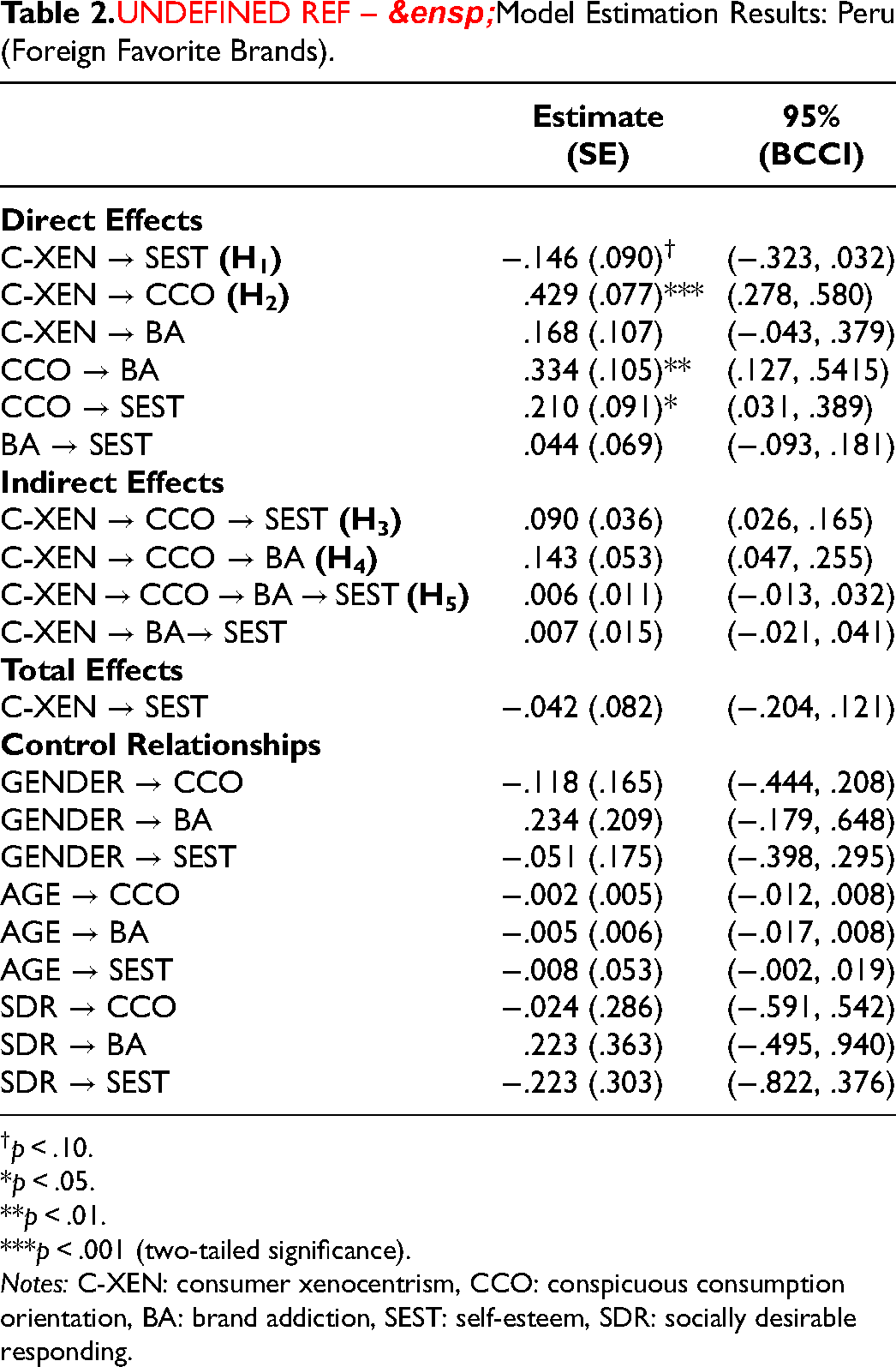
We again used Model 6 of the PROCESS routine (Hayes 2018) with 5,000 bootstrap resamples to test our research hypotheses and obtain 95% BCCIs for the indirect effects. In light of the smaller sample at hand, we ran the analysis only on the subsample of respondents who mentioned a foreign brand as being their favorite; the very small size of the domestic brands subsample (N = 47) precluded the estimation of the model in Figure 2 with any degree of confidence. 12 Table 2 and Figure 3 summarize the PROCESS analysis results.
Model Estimation Results: Peru (Foreign Favorite Brands).
p < .10.
*p < .05.
**p < .01.
***p < .001 (two-tailed significance).
Notes: C-XEN: consumer xenocentrism, CCO: conspicuous consumption orientation, BA: brand addiction, SEST: self-esteem, SDR: socially desirable responding.
In line with Study 1, C-XEN negatively impacts self-esteem (β = −.146, p = .101) thus providing further support for H1. 13 Moreover, as in Study 1, C-XEN positively and significantly impacts conspicuous consumption orientation thus supporting H2 (β = .429, p = .000). The amount of variance explained in conspicuous consumption orientation (R2 = .192) indicates a medium effect size. H3 is also supported as the indirect effect of C-XEN on self-esteem through conspicuous consumption orientation is positive, and the relevant 95% confidence interval does not include zero (95% BCCI: [.026, .165]). As the direct effect of C-XEN on self-esteem is negative (see H1), competitive mediation is also observed in Study 2. The variance explained in self-esteem points to a rather small effect size (R2 = .07).
Regarding the hypothesized positive link between C-XEN and brand addiction (H4), the indirect effect through conspicuous consumption orientation is positive and the 95% BCCI does not include zero (95% BCCI: [.047, .255]). This corroborates Study 1 and provides further support for H4. The relevant direct effect is not significant (β = .168, p = .118), indicating indirect-only mediation. The amount of variance explained in brand addiction (R2 = .158) points to a medium effect size.
Unlike in Study 1, the serial mediation hypothesis linking C-XEN to self-esteem (H5) is not supported since the indirect effect, first through conspicuous consumption and then through brand addiction, is associated with a 95% BCCI that includes zero (95% BCCI: [−.013, .032]). Also unlike in Study 1, an effect decomposition (Iacobucci, Saldanha, and Deng 2007) reveals a zero total (i.e., net) effect of C-XEN on self-esteem (95% BCCI: [−.204, .121]), implying that the (negative) direct and (positive) indirect effects of C-XEN on self-esteem cancel each other out.
In summary, Study 2 broadly corroborates the results of Study 1, showing—in a very different setting—that C-XEN impacts consumers’ self-esteem both directly (negative effect) and indirectly through conspicuous consumption orientation (positive effect). Study 2 also shows that C-XEN can lead to brand addiction through its influence on conspicuous consumption orientation. Thus, in both studies, conspicuous consumption orientation emerges as the key mediating variable transferring the influence of C-XEN on downstream outcomes. However, the relative magnitudes of the direct versus indirect effects of C-XEN on self-esteem differ between the two studies, resulting in different total effects.
Discussion and Conclusions
Despite the fact that well-being has been taking center stage in international marketing literature (Grinstein, Hewett, and Riefler 2022; Grinstein, Riefler, and Hewett 2022), the investigation of the link between prominent consumer dispositions and aspects of consumer well-being has been conspicuously absent in extant research. The present investigation expands our understanding of the C-XEN construct by explicitly examining its relationship with consumers’ self-esteem which, as noted previously, is a central aspect of consumer well-being (Ryff 1989). Our results, based on two studies in very different country settings, show that while being xenocentric is negatively linked to self-esteem, the increased proclivity of xenocentric consumers to engage in conspicuous consumption positively affects their self-esteem (either directly or through fostering brand addiction). We thus offer evidence that constructs that might be intuitively perceived as representing the “dark side” of consumer behavior can have positive effects on certain aspects of consumer well-being. Our findings have several implications for theory and practice as discussed below.
Theoretical Implications
From a theoretical perspective, we contribute to international marketing literature by revealing the pathways through which C-XEN influences self-esteem. Consistent with prior research showing that individuals who try to enhance their self-image through outgroup favoritism usually have lower self-esteem (Abrams 1992), we find a negative direct effect of C-XEN on an individual's self-esteem. This finding is also in line with previous evidence showing a negative relationship between C-XEN and collective self-esteem (Balabanis and Diamantopoulos 2016). Based on self-concept theory (Sirgy 1982), it seems that xenocentric consumers chase an “ideal” self, which, however, is located in outgroups that are distant from the one in which their “real” self is embedded (i.e., the ingroup). This discrepancy creates an inner psychological discomfort that manifests itself in lower self-esteem.
More importantly, our results reveal another further pathway through which C-XEN influences self-esteem. This pathway passes through conspicuous consumption orientation—which is particularly strong among xenocentric consumers—and has a positive impact on self-esteem. In this context, our finding that C-XEN is positively related to conspicuous consumption orientation in both country settings resonates well with Balabanis, Stathopoulou, and Qiao’s (2019, p. 51) assertion that “consumption visibility is indispensable in social aggrandizement yearning of xenocentric consumers.” It is also consistent with prior evidence revealing positive links between C-XEN on the one hand and materialism and vanity on the other (Balabanis and Diamantopoulos 2016; Prince et al. 2016).
In addition to its impact on self-esteem, C-XEN is also positively linked to brand addiction. Again, the linking pin between the two constructs—in both country settings—is conspicuous consumption orientation. Thus C-XEN seems to also have implications for consumer–brand relationships, brand addiction being the most intense form of the latter (Fournier 1998). In this context, although previous research has revealed a positive influence of brand addiction on self-esteem (Mrad and Cui 2020), we find support for this relationship only in one of our studies (Italy) and only when a foreign favorite brand is involved. These diverging patterns of results inevitably call into question the stability of the link between brand addiction and self-esteem. It seems that these two variables are related in some settings but not in others. Clearly, further research is needed to throw more light on this issue.
As the concept of brand addiction is still at an early stage of development (Junaid et al. 2022), the results of our study extend our understanding of consumer brand-relationships and addictive behavior by identifying some antecedents of brand addiction that have not been considered in prior research. Indeed, as a construct, brand addiction has been completely absent in international marketing literature and has not been linked to any consumer dispositions favoring either the home country (e.g., consumer ethnocentrism or economic nationalism) or foreign countries (e.g., cosmopolitanism or global consumption orientation). By revealing a link between C-XEN and brand addiction, we thus encourage the adoption of a consumer–brand relationship perspective in international marketing research.
Finally, regarding the total (i.e., net) effects of C-XEN on self-esteem, our findings suggest that conspicuous consumption and brand addiction can fully neutralize the negative direct effect of C-XEN in some settings (Peru) but not in others (Italy). This serves to highlight the situational nature of the competitive mediation structure in Figure 1; the same model structure involving the same variables may result in diverging total effects depending on the relative magnitudes of the indirect and direct effects. Whether there are also settings characterized by a positive total effect is obviously an empirical question that only future research can answer.
Managerial Implications
From a managerial perspective, perhaps the most basic implication is that C-XEN can impact consumer behavior even in highly developed countries with advanced economies and strong brands. Our finding that the favorite brands of Italian consumers are—more often than not—foreign is consistent with a Nielsen study (Nielsen 2017) showing that, despite the fact that “Made in Italy” is appreciated worldwide, Italian consumers tend to prefer foreign brands in several product categories such as fashion, automotive, and technology. Thus C-XEN is a consumer disposition that companies should take seriously even in markets in which, intuitively, xenocentric tendencies would not appear to be particularly relevant. As Balabanis and Diamantopoulos (2016, p. 71) note, “for foreign companies, xenocentric consumers may be a potentially profitable—and potentially ignored—market niche, the targeting of which may make it easier to get a foothold even in highly ethnocentric markets.” While the size of the xenocentric segment is likely to vary from country to country, it is likely to be substantial even in advanced countries with highly developed economies and strong home brands. Thus, when conducting foreign market assessments in preparation of potential market entry, firms would do well to obtain estimates of the size and purchasing power of the xenocentric consumer segment.
Xenocentric consumers may also constitute a potentially attractive segment for domestic firms willing to employ foreign branding strategies (Aichner, Forza, and Trentin 2017; Leclerc, Schmitt, and Dubé 1994; Thakor and Pacheco 1997). Such strategies seek to make a brand “look” foreign through product design, merchandising, labeling, and advertising, thus generating associations of “foreignness” in the consumer's mind. As Rojas-Méndez and Kolotylo (2022, p. 223) observe, “Domestic companies may want consumers to perceive their brands as foreign, which … would reduce rejection by local consumers. … All efforts made by local companies in positioning their brands as ‘foreign’ would be justified.” In fact, a foreign branding strategy may enable a firm to both attract xenocentric consumers within its domestic market and capitalize on its projected “foreignness” when targeting consumers in other countries. For example, Harmont & Blaine, Off-White, and Golden Goose are all Italian brands that emphasize their Italian heritage in their marketing communications, 14 as “Made in Italy” is a powerful signal in international markets, where Italian craftsmanship and design are often synonymous with luxury and high-quality goods. At the same time, despite embodying a strong Italian identity, these brands choose to use brand names with an Anglo-American sound to tap into the preferences of those consumers (including xenocentric ones) who perceive foreign-sounding names as more modern, trendy, or prestigious.
Firms offering status-related products (e.g., luxuries) can particularly capitalize on the social aggrandizement dimension of C-XEN by highlighting the social and symbolic values of their brands in their communication efforts. By doing so, the conspicuous consumption orientation of xenocentric consumers will be stimulated, bringing benefits to both consumers (due to the positive effect on self-esteem) and to companies (due to the positive impact on brand addiction). However, while the employment of marketing strategies geared toward encouraging conspicuous consumption 15 might be tempting for both foreign and domestic firms, active promotion of conspicuous consumption and/or brand addiction may well be incompatible with other company goals—particularly those relating to corporate social responsibility and ethics. This is because, as mentioned previously, conspicuous consumption and brand addiction can—in their extreme forms—also have dysfunctional consequences (e.g., increased consumer debt; Hirschman 1992; Martin et al. 2013). Thus, companies aiming to “do good” (i.e., enhance consumer self-esteem) by potentially “doing bad” (i.e., encouraging conspicuous consumption and/or brand addiction) may be running the risk that the improvement in one aspect of consumer well-being (self-esteem) may be accompanied by the deterioration in other aspects (e.g., financial well-being). Firms should thus seek to develop positive associations with their brand while conveying ethically correct messages that promote the importance of making responsible choices among consumers. By developing healthy consumer–brand relationships, firms can protect themselves from ethical criticisms that represent nowadays one of the most damaging allegations for companies and brands (Lopes et al. 2020).
Domestic firms can also try to attract xenocentric consumers—particularly for products that are not conspicuously consumed—by persuading them that domestic products and brands are similar to foreign products in terms of quality and may offer better value for money. As Zhou and Hui (2003, p. 41) state, “When consumers are inspired by design and function rather than by foreign appeal or social status, domestic brands are likely perceived as more competitive than their foreign counterparts are because, for most local consumers, they represent good value for their money.” Given that xenocentric consumers are more susceptible to normative influences (Balabanis and Diamantopoulos 2016) and tend to have lower self-esteem (this study), marketing communications should seek to reinforce social norms more toward domestic brands. In this context, using international celebrities and influencers to spread positive messages about domestic brands may be worth considering when seeking to reach a xenocentric audience.
Firms are increasingly being perceived as having a responsibility to promote healthy choices for consumers, improve their quality of life, and contribute to societal well-being (e.g., Horváth and Adıgüzel 2018). Indeed, “consumer goods companies are urged to practice well-being marketing not only because this philosophy translates into a business strategy that leads to higher financial returns in the long run; companies should practice well-being marketing because it is the right thing to do” (Sirgy and Lee 2008, p. 399). The concept of well-being has been developing, going beyond issues relating to physical health to embrace mental, emotional, spiritual, and social health (Breslow 1972). 16 Consumer self-esteem is thus a highly relevant variable for companies seeking to integrate well-being into their products, services, campaigns, and experiences. In this context, a negative relationship between C-XEN and self-esteem is undoubtedly worrying given the latter's importance for consumer well-being. Consequently, firms targeting xenocentric consumers should adopt responsible communication strategies that emphasize satisfaction in life, happiness, and empowerment to make consumers feel better about themselves and help them elevate their self-esteem. For example, Dove launched its “Super U Story” video game as part of its Dove Self-Esteem project, which was “specifically designed to equip young girls with the tools they need to help combat negative self-esteem” (Dove 2022).
Limitations and Future Research
Our investigation is not without limitations, which open several opportunities for future research. In addition to the obvious suggestion of replicating our study in other country settings to provide a robustness check of the identified relationships (Lynch et al. 2015), several other issues deserve research attention.
First, our conceptual model (see Figure 1) focuses on main effects only and does not consider moderating variables that could potentially condition the model relationships (e.g., personality characteristics of the consumer or cultural factors such as power distance). Incorporating such moderating variables in future studies would reveal any relevant boundary conditions and thus provide more fine-grained insights on the link between C-XEN and consumer self-esteem.
Second, in light of the central role of conspicuous consumption orientation as a mediator, decomposing the construct according to different underlying motives (e.g., signaling of wealth vs. “bandwagon” vs. “snob” effects; see Eastman and Eastman 2015; Kastanakis and Balabanis 2014) would reveal exactly how C-XEN encourages conspicuous consumption and how the latter impacts downstream variables.
Third, future studies could focus on other aspects of consumer well-being, given that consumption decisions may have an impact on consumers’ life happiness (Andrews and Withey 2012). According to Ryff (1989), in addition to self-esteem, such aspects include personal growth (continued individual development and self-realization), purpose in life, environmental mastery, autonomy (self-determination and independence), and positive relations with others (sincere and trusting interpersonal relationships). Alternatively, future research could examine clearly dysfunctional or maladaptive aspects of consumer behavior potentially brought about by xenocentric tendencies, such as compulsive consumption (Fournier and Alvarez 2013; Hirschman 1992; Reimann and Jain 2021).
Finally, given the dearth of research on consumer well-being in international marketing literature, the relationship to well-being of other well-established consumer dispositions—such as consumer ethnocentrism, global consumption orientation, or consumer cosmopolitanism—would also seem ripe for investigation.
Supplemental Material
sj-pdf-1-jig-10.1177_1069031X241264992 - Supplemental material for Consumer Xenocentrism and Well-Being: Conspicuous Consumption Orientation, Brand Addiction, and Self-Esteem
Supplemental material, sj-pdf-1-jig-10.1177_1069031X241264992 for Consumer Xenocentrism and Well-Being: Conspicuous Consumption Orientation, Brand Addiction, and Self-Esteem by Adamantios Diamantopoulos, Michela Matarazzo, Mona Mrad, and Mariel Maack in Journal of International Marketing
Footnotes
Editor
Kelly Hewett
Associate Editor
Matthew J. Robson
Declaration of Conflicting Interests
The author(s) declared no potential conflicts of interest with respect to the research, authorship, and/or publication of this article.
Funding
The author(s) received no financial support for the research, authorship, and/or publication of this article.

Notes
References
Supplementary Material
Please find the following supplemental material available below.
For Open Access articles published under a Creative Commons License, all supplemental material carries the same license as the article it is associated with.
For non-Open Access articles published, all supplemental material carries a non-exclusive license, and permission requests for re-use of supplemental material or any part of supplemental material shall be sent directly to the copyright owner as specified in the copyright notice associated with the article.
