




Abstract
Extensive research has investigated how perceived brand globalness (PBG) and perceived brand localness (PBL) affect brand. In this systematic literature review, the authors organize and synthesize the literature on PBG and PBL by analyzing 95 articles published in the past 17 years. They identify similarities, inconsistencies, and omissions in the literature by investigating different conceptualizations of PBG and PBL, boundary conditions of PBG and PBL effects on brand preference, psychological mechanisms through which PBG and PBL affect brand preference, the theoretical foundations underlying PBG and PBL research, and methodological approaches used in the literature. The study outlines avenues for further research based on prior research and current global trends, such as hybridization/glocalization marketing strategies, antiglobalization trends, and digitalization.
Globalization has ceased to be an accepted force for good across the world. Instead, the world is witnessing a revival of national protectionism, sparked by, for example, President Trump’s trade war with China and his promise to bring back industries to the United States that had become “victims” to globalization (Goodman 2020), the United Kingdom’s Brexit, and the growing support for nationalistic parties in European countries such as Hungary (Barber 2020). Some global media groups are also casting doubt on the general benefits of globalization in light of the COVID-19 pandemic. According to The Economist (2019), globalization has been replaced by “slowbalization,” as cross-border investment, global trade, and supply chains shrink rapidly. Consumption trends are being reshaped accordingly. Global brands are losing market share to domestic brands in emerging markets in which these global behemoths used to dominate with an unshakable marketplace position (Gupta and Wright 2019). Against this backdrop, it is important to understand how global and local brands are perceived today and when they are preferred.
The branding literature has devoted a great deal of attention to learning how consumers react to global versus local brands. According to Özsomer and Altaras (2008), global and local brands can consist of either a supply-side perspective (i.e., from the company standpoint) or a demand-side perspective (i.e., from the consumer standpoint). The supply-side perspective views a global (local) brand as one that operates across a range of countries (in a limited geographic region) with a standardized (localized) marketing approach (e.g., Llonch-Andreu, López-Lomelí, and Gómez-Villanueva 2016; Loebnitz and Grunert 2019). However, because consumers may or may not be aware of a brand’s international operations beyond their own market (Fastoso and González-Jiménez 2018; Sichtmann, Davvetas, and Diamantopoulos 2019), research has devoted ample attention to how perceptions of the globalness (localness) of a brand affect brand-related outcomes. Steenkamp, Batra, and Alden (2003) coined the term “perceived brand globalness” (PBG) to reflect consumer perceptions of a brand as global (i.e., as widely available and accepted across the world). They also introduced the term “brand local icon value”—also known as perceived brand localness (PBL)—to reflect how well a brand is connected with the local culture, which they viewed as a promising way for local brands to compete with global brands. Since then, a growing body of research has investigated how perceptions of a brand as global (PBG) versus local (PBL) contribute to brand-related outcomes, such as purchase intention (e.g., Keane and Morschett 2017; Khurana 2018) and brand stereotypes (e.g., Davvetas and Halkias 2019; Lee, Chae, and Lew 2020).
Research on PBG and PBL has developed over the past 17 years since Steenkamp, Batra, and Alden’s (2003) introduction of the PBG concept, thus justifying a review of the literature that takes stock of what is known about PBG/PBL and what is still to be discovered. To our knowledge, the only review of the PBG literature to date is that by Özsomer and Altaras (2008). After 13 years—and a wealth of studies published on the topic—a new review of this literature is timely and necessary. Our review is guided by six research questions: (1) How is PBG conceptualized? (2) How is PBL conceptualized? (3) What are the boundary conditions of PBG’s/PBL’s effects on brand preference? (4) What mechanisms explain the PBG/PBL effects on brand preference? (5) What are the theoretical foundations underlying PBG/PBL research? and (6) What are the methodological approaches used in PBG/PBL literature? We examine how the literature addresses these aspects and propose how future research might best advance each one.
Our study contributes to the field of global/local branding in three ways. First, it represents the first in-depth, comprehensive review of PBG and PBL research, covering more than 17 years of published research on the topic with 95 articles. Second, we draw attention to the consensus in the literature on the topic and discuss important areas for further research that have so far been overlooked: consistent conceptualization of PBG/PBL, boundary conditions of PBG/PBL effects, alternative pathways for PBG/PBL to shape brand preference, theoretical foundations capable of explaining consumers’ affective responses to perceived global/local brands, and additional methodological approaches beyond traditional survey methods. Third, we outline future research directions guided by current global trends such as increased nationalism, antiglobalization movements, hybridization/glocalization of marketing strategies, and digitalization.
Methodology
We adopted a systematic literature review, which refers to a “review of the evidence on a clearly formulated question that uses systematic and explicit methods to identify, select and critically appraise relevant primary research, and to extract and analyze data from the studies that are included in the review” (De Menezes and Kelliher 2011, p. 453). In addition, subjectivity and bias can be mitigated given that a systematic review is methodical, comprehensive, transparent, and replicable (Siddaway, Wood, and Hedges 2019), thereby providing a reliable knowledge base of a topic and enabling future research avenues to be generated and ascertained (Christofi, Leonidou, and Vrontis 2017). Articles were then assessed and synthesized on the basis of the specific research questions (Parris et al. 2016).
We targeted three databases to select relevant studies: Scopus, Web of Science, and Business Source Complete. To address the six research questions, the research team agreed on different variations of suitable keywords to search for in the titles, abstracts, and keywords of published articles. These search strings included the term “brand” combined with any of the following terms: “localness,” “iconness,” “globalness,” “foreignness,” “nonlocalness,” and “globality.” We did not set a publication time frame during the database search. The database search rendered 85 unique articles published in English. We read through each article as well as its lists of references to identify work we might have missed through the systematic search and identified 10 additional articles. Thus, our search delivered a pool of 95 articles focused on PBG/PBL.
The first of the 95 articles was published in 1999 (i.e., Ger 1999) and the last in 2020 (i.e., Mandler, Bartsch, and Han 2020). A median split by year of publication shows that 16 articles were published before 2009 and 79 afterward, thus reflecting a growing interest in the topic. The studies are also published in 40 publication outlets in total. Journal of International Marketing accounts for the highest proportion of publications on the topic (19%, 18 articles), followed by International Marketing Review (10%, 9 articles) and Journal of Business Research (6%, 6 articles).
Findings and Directions for Further Research
We organize this section around our six research questions. For each question, we identify omissions and inconsistencies in the literature and formulate corresponding directions for further research on PBG/PBL. Figure 1 illustrates a thematic map that highlights both the identified omission and inconsistencies in the literature and our concrete suggestions for further research.

Thematic map.
How Is PBG Conceptualized?
Steenkamp, Batra, and Alden (2003, p. 54) conceptualize PBG as “a perception that can be formed only if consumers believe the brand is marketed in multiple countries and is generally recognized as global in these countries.” They measure PBG with “three items indicating the degree to which consumers thought the same brand was marketed in countries beyond their own” (p. 58). As such, perceived wide market reach is unanimously deemed to be a defining feature of PBG in the literature (see Table 1). Note that Steenkamp, Batra, and Alden (2003, p. 55) also suggest that a global symbolism aspect is another component of PBG: “A reason for a global brand preference may be the globalness per se of such brands…. We refer to this as the belongingness pathways…to signal membership in worldwide consumer segments.” Similarly, extant literature suggests that this global symbolism aspect is a component of PBG (e.g., “global myth” [Holt, Quelch, and Taylor 2004], aspirational component [Dimofte, Johansson, and Ronkainen 2008]). For example, consumers “use brands to create an imagined global identity that they share with like-minded people” (Holt, Quelch, and Taylor 2004, p. 71). Mandler (2019, p. 657) also notes this global symbolism aspect of PBG by suggesting that “consumers prefer the cultural imagery and symbolism attached to global brands.” However, he defines this global symbolism as global consumer culture positioning (GCCP) and explicitly proposes and measures GCCP as one of components of PBG. He suggests that GCCP as one of components of PBG refers to “a consumer’s belief that a brand…is associated with a given global consumer culture (i.e., global consumer cultural positioning)” (p. 648). However, GCCP and its corresponding measurement items do not accurately reflect global symbolism. For example, global symbolism differs from GCCP in the sense that the former is a tool for building GCCP. Mandler (2019, p. 657) suggests that “a global positioning might be cultivated through the use of visual brand elements (e.g., brand logo incorporating iconic symbols).” Meanwhile, extant literature suggests that GCCP is an antecedent of PBG (e.g., De Meulenaer, Dens, and De Pelsmacker 2015; Iversen and Hem 2011; Steenkamp 2019a, b). For example, Steenkamp (2019b, p. 531) states that “firms do use [global consumer culture] in their brand positioning strategies, which contributes to perceptions of brand globalness.” Moreover, the corresponding measurement Items 1 and 2 of GCCP (i.e., “To me, the style of this brand’s logo gives an impression of being local [international]” and “I associate this brand with themes and motives that stand for something local [international]”; Mandler 2019, p. 660) are based on local versus international scales. The corresponding Item 3 (i.e., “The people I associate with this brand [e.g., testimonials] are [local country’s name]/[foreign]”; Mandler 2019, p. 660) is based on local versus foreign scales. These three items do not accurately reflect global symbolism. Thus, neither Steenkamp, Batra, and Alden (2003) nor other studies explicitly and accurately measure global symbolism.
Conceptualizations and Measurements of PBG and PBL in the Literature.
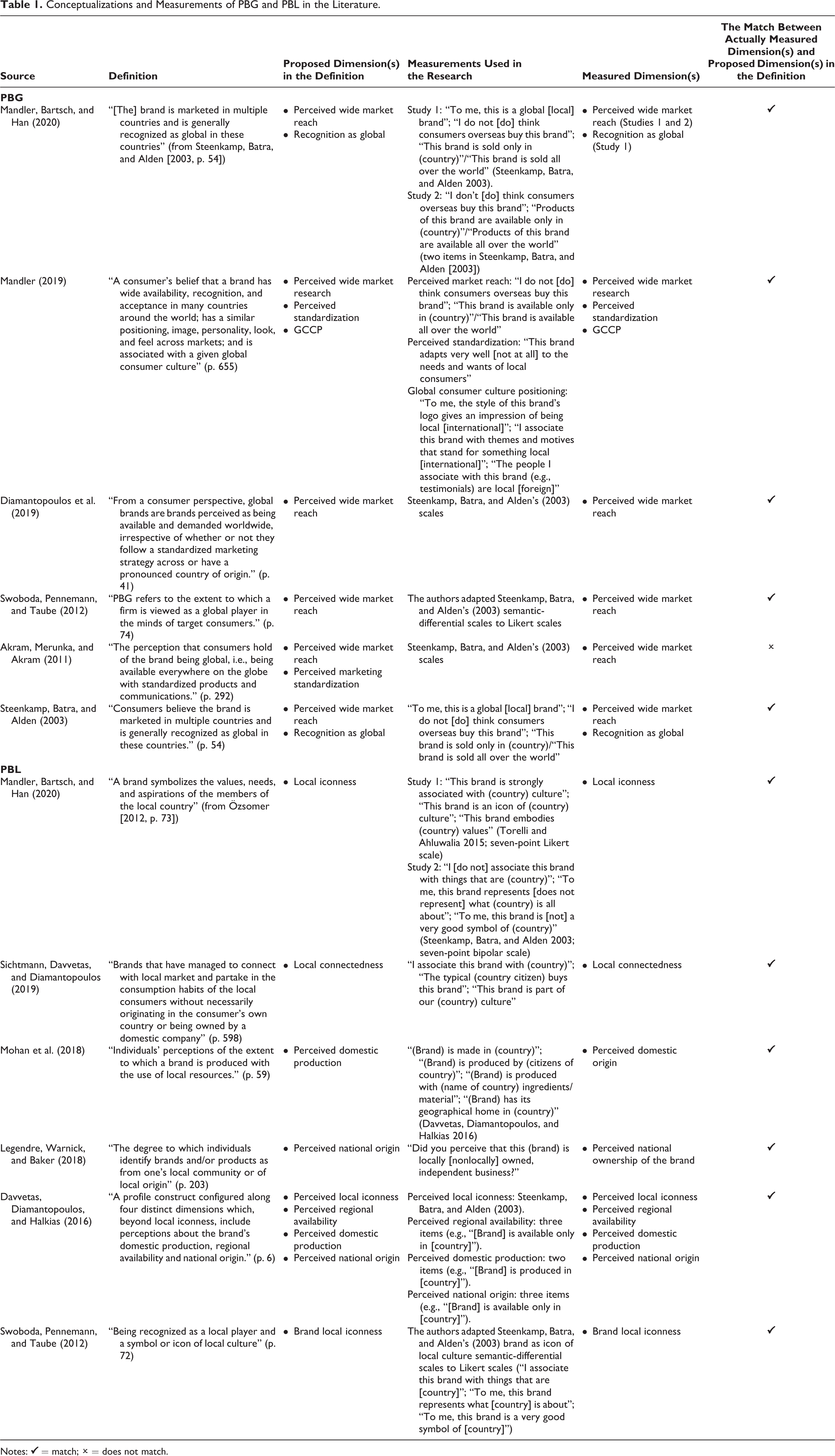
Notes: ✔ = match; ✕ = does not match.
Recently, research (e.g., Akram, Merunka, and Akram 2011; Bauer, Exler, and Bronk 2007; Mandler 2019; Peng 2017) has argued that perceived marketing standardization should be considered an additional component of PBG. For example, Akram, Merunka, and Akram (2011, p. 292) define PBG as “the perception that consumers hold of the brand being global, i.e., being available everywhere on the globe with standardized products and communications.” Likewise, Torelli and Stoner (2015) suggest that consumers perceive brands that adopt a standardization marketing strategy as more global than brands that do not. Mandler (2019) explicitly proposes and measures perceived marketing standardization as one of components of PBG. However, Diamantopoulos et al. (2019, p. 41) question the pertinence of PBG’s marketing standardization, stating that “from a consumer perspective global brands are brands perceived as being available and demanded worldwide, irrespective of whether or not they follow a standardized marketing strategy across culture or have a pronounced country of origin.” The inclusion of perceived marketing standardization is also questionable on the grounds that consumers in a given country may or may not be aware of a brand’s international operations beyond their own market (Sichtmann, Davvetas, and Diamantopoulos 2019). Meanwhile, marketing hybridization/glocalization strategies (i.e., foreign global brands tap into local markets through local cultural adaptability; Guo, Heinberg, and Zou 2019) enabled by brands cast further doubt on whether perceived marketing standardization should be a component of PBG.
As a way forward, we agree with prior arguments and suggest that perceived marketing standardization and GCCP should be treated as antecedents of PBG. Thus, the standardization of marketing activities for a brand and GCCP are likely to increase perceptions of PBG without being part of PBG. Indeed, judgments of the standardization of a brand are contingent on consumers’ subjective perceptions, which require them to be exposed to similar marketing strategies in multiple countries or regions. While some well-traveled consumers (e.g., top-tier luxury consumers) may indeed derive such standardized perceptions from their travels, others, who do not travel, may not have such perceptions. Moreover, GCCP is a brand-positioning alternative (Alden, Steenkamp, and Batra 1999), whereas PBG represents a consumer perception. For example, “in some cases what is positioned as global by the firm [may not be] considered global in the eyes of consumers” (Akaka and Alden 2010, p. 48).
Furthermore, extant PBG literature dominantly measures perceived wide market reach as the only component of PBG. However, “[the symbolic value of global brands] is a crucial attribute that differentiates global brands” (Mandler 2019, p. 657). Indeed, brands often highlight wide market reach in their brand communications, but a question here is whether they represent global symbolism, which PBG entails. Mandler (2019) notes this global symbolism aspect of PBG. However, GCCP and its corresponding measurement items do not accurately reflect global symbolism in his article. Therefore, future studies on PBG should focus on both the perceived wide market reach and global symbolism as components of PBG and should accurately and explicitly measure the global symbolism aspect. To do so, research could adapt Swoboda, Pennemann, and Taube’s (2012) brand local iconness scale, which measures local culture symbolism.
How Is PBL Conceptualized?
Different studies have conceptualized PBL differently (see Table 1). A notable tension in these conceptualizations is worth highlighting. Specifically, Steenkamp, Batra, and Alden (2003) use semantic differential scales to measure PBG. Thus, although they do not use the term PBL per se, their measurement of PBG (e.g., “This brand is sold only in [country]/This brand is sold all over the world”; p. 64) implies that PBL equates to low PBG (i.e., perceived limited geographic reach). Therefore, PBL represents the perceived limited geographic reach initially and thus is opposite to PBG (i.e., perceived wide market reach). Indeed, research suggests that perceived regional/limited geographic reach is a feature of perceived local brands (e.g., Chailan and Ille 2015; Hassan, Husic-Mehmedovic, and Duverger 2015; López-Lomelí, Alarcón-del-Amo, and Llonch-Andreu 2019; Punyatoya, Sadh, and Mishra 2014). Kim, Moon, and Iacobucci (2019) introduce the normalized Herfindahl–Hirschman index scale to measure PBG and treat PBL as the opposite of PBG by focusing on country distribution of the focal brand. By contrast, a stream of research (e.g., Halkias, Davvetas, and Diamantopoulos 2016; He and Wang 2017; Heinberg, Erkan Ozkaya, and Taube 2017; Kolbl, Arslanagic-Kalajdzic, and Diamantopoulos 2019) suggests that PBG and PBL do not represent polar opposites on the same spectrum but rather are independent and separate constructs. Because PBL exhibits a deep connection with the local culture, and PBG and PBL can coexist within a specific brand image (e.g., local brands’ global expansion strategies; Özsomer 2012), we argue that “brand local icon value” (Steenkamp, Batra, and Alden 2003), brand local iconness (Özsomer 2012), and PBL (Swoboda, Pennemann, and Taube 2012) are conceptually identical, as they all connote a deep connection with the local culture (i.e., local symbolism). Furthermore, Sichtmann, Davvetas, and Diamantopoulos (2019, p. 603) broadly define PBL as capturing consumers’ local connectedness, and thus the measurement items “correspond to a broader conceptualization of brand localness which accounts for sources of local brand value beyond mere local iconicity or cultural symbolism.” Therefore, extant literature conceptualizes PBL differently by focusing on a rather different dimension of a brand’s perception: geographic reach versus brand symbolism/connectedness.
We propose that as a way forward, further research on PBL should treat PBL as entailing both perceived limited market reach and local symbolism, because prior research focusing on perceived limited market reach as the only component of PBL does not capture cases in which foreign brands accrue localness perceptions through local cultural adaptability (e.g., Akram, Merunka, and Akram 2011; Davvetas and Diamantopoulos 2018; Punyatoya 2013, 2014). Likewise, research examining local symbolism as the only component of PBL does not capture the case in which local brands are not yet local icons (e.g., Heinberg et al. 2020; Keane and Morschett 2016; Swoboda, Pennemann, and Taube 2012). Moreover, further research should explore different forms of conceptual combinations of PBG and PBL—for example, the combination of perceived wide market reach, high global symbolism, and high local symbolism (e.g., hybrid brands such as foreign global brands achieve localness perceptions through local culture adaptability); the combination of perceived wide market reach, high global symbolism, and low local symbolism (e.g., “true” global brands such as technology brands that do not require local culture adaptations of their products); the combination of perceived limited market reach, low global symbolism, and high local symbolism (e.g., domestic/regional brands with local symbolism: local iconic brands); and the combination of perceived limited market reach, low global symbolism, and low local symbolism (e.g., domestic/regional brands that do not contain local and global symbolism: local brands but not local iconic brands).
Disentangling PBG from Related Constructs
Extant literature uses PBG, perceived brand foreignness (PBF)/nonlocalness, and brand globality interchangeably. Thus, it is necessary to delineate differences and/or similarities between various terms. Research on PBG builds on the classic work of Batra et al. (2000) on PBF/nonlocalness. Batra et al. (2000, p. 86) define PBF/nonlocalness as “the perception that the brand is marketed locally and in foreign countries, instead of only locally.” In other words, they measure PBF/nonlocalness on the basis of perceived wide geographic market reach. Steenkamp, Batra, and Alden (2003) build the three-item measurement scales of PBG by drawing on the PBF/nonlocalness measurement scales of Batra et al. (2000). Thus, perceived wide market reach is a defining feature of PBG, but Steenkamp, Batra, and Alden (2003) do not conceptually differentiate PBG from PBF. Thus, subsequent studies have equated PBG to PBF (e.g., Oh and Zhang 2010). However, Zhou, Yang, and Hui (2010) suggest that PBF is a generic foreignness perception and build PBF measurement scales from Steenkamp, Batra, and Alden’s (2003) symbolism of local icon value to highlight foreign symbolism. Moreover, in defining brand globality, Johansson and Ronkainen (2005, p. 343) argue that the “more countries in which a brand is available, the greater its globality.” Thus, PBF is about perceived wide market reach and foreign symbolism (Batra et al. 2000; Zhou, Yang, and Hui 2010), brand globality highlights perceived wide market reach (Aurifeille et al. 2009; Dimofte, Johansson, and Bagozzi 2010; Johansson and Ronkainen 2005), and PBG represents both perceived wide market reach and global symbolism (i.e., “belonginess pathway”) (Steenkamp, Batra, and Alden 2003).
We propose that as a way forward, further research should include PBF as a distinct construct in the PBG/PBL model to provide a comprehensive understanding of how consumers may differently react to PBG, PBL, and PBF. Furthermore, PBF differs from country of origin in the sense that country of origin represents one specific country and is often reflected in the “made-in” label, whereas PBF represents a generic foreign appeal and perceived wide market of a brand, and thus PBF does not associate with a specific country (Batra et al. 2000; Zhou, Yang, and Hui 2010). Accordingly, not only is PBF/nonlocalness a benefit to brands with a foreign/nondomestic origin, but brands associated with domestic origin can also capitalize on this foreign symbolism. Indeed, foreignness perceptions can arise from foreign-sounding brand names (Zhou, Yang, and Hui 2010). For example, a Chinese consumer may perceive a domestic brand as foreign if it is positioned with non-Chinese language (e.g., English) (Chang 2008). Thus, PBF/nonlocalness and brand origin (domestic/foreign) are distinct constructs. A brand can garner high foreign symbolism perceptions (i.e., PBF/nonlocalness) in three ways: domestic-foreign (i.e., the brand encompasses both PBL and PBF), foreign-global (i.e., the brand encompasses both PBF and PBG), and foreign-nonglobal (i.e., PBF). Drawing on cue utilization theory, Sichtmann, Davvetas, and Diamantopoulos (2019) report that brand origin (domestic/foreign) has a substitutional and complementary role in the evaluation of PBG/PBL. That is, the positive effect of PBG on consumer brand identification is stronger for domestic brands than foreign brands, whereas the positive effect of PBL on consumer brand identification is stronger for foreign brands than domestic brands (Sichtmann, Davvetas, and Diamantopoulos 2019). As an analogy, we propose two cases in which brands entail both PBF and PBL. On the one hand, a domestic-foreign brand (i.e., a domestic brand positioning itself with a foreign-sounding name) may benefit more from foreignness than other domestic brands; on the other hand, a locally connected foreign player may benefit more from localness perceptions than other foreign brands. Likewise, consumers may perceive a foreign brand’s globalness as a differentiating characteristic and value it more than foreign brands having only foreignness as a characteristic.
What Are the Boundary Conditions of PBG’s/PBL’s Effects on Brand Preference?
We identify inconsistent findings of the boundary conditions (i.e., consumer ethnocentrism, country economic development level, and brand origin) of PBG and PBL in the literature and propose future research directions by suggesting potential reasons for these findings. Moreover, we propose new factors (i.e., product ethnicity, Hofstede’s [1980] national cultural dimensions, and product category characteristics) that could enrich the understanding of PBG’s and PBL’s boundary conditions.
Consumer ethnocentrism
Shimp and Sharma (1987, p. 280) define consumer ethnocentrism as “beliefs held by consumers about the appropriateness, indeed morality, of purchasing foreign made products.” Research examining the interaction between consumer ethnocentrism and PBG reports that consumer ethnocentrism does not exhibit a moderation effect on the correlations between PBG and associated outcomes (e.g., Davvetas, Sichtmann, and Diamantopoulos 2015; Diamantopoulos et al. 2019). In particular, Diamantopoulos et al. (2019) assess the different interplays of several consumer dispositions (e.g., consumer ethnocentrism), PBG, and outcomes (i.e., quality perception, prestige perception, trust, brand attitude, purchase intention, and word of mouth) in four models that capture distinct correlation specifications (e.g., moderation and mediation effects of consumer dispositions) based on social identity theory and selective perception theory. Their results raise concerns about the utility of consumer dispositions (e.g., consumer ethnocentrism) for explaining consumer responses to PBG, as they uncover low incidences of the interplays of consumer dispositions and PBG. However, another stream of research suggests that consumer ethnocentrism negatively moderates the relationships between PBG and associated outcomes (e.g., quality and prestige perceptions for consumers in Pakistan [Akram, Merunka, and Akram 2011]; purchase intention for consumers in both the United States and South Korea [Steenkamp, Batra, and Alden 2003]; brand loyalty for consumers in India, Japan, and the United States [Swoboda and Hirschmann 2016]). Thus, we ascertain inconsistent findings in whether consumer ethnocentrism acts as the boundary condition of the relationship between PBG and its associated outcomes (e.g., purchase intention, quality, prestige perceptions).
We propose that the inconsistent findings of the moderating role of consumer ethnocentrism in the relationship between PBG and its effects are due to a brand’s generic foreignness (PBF; Zhou, Yang, and Hui 2010). That is, most studies measure PBG on real brands that are not only global but also foreign in the eyes of study participants (e.g., Pyun, Kwon, and Lee 2011; Steenkamp, Batra, and Alden 2003; Vuong and Giao 2019), and research shows that consumer xenocentrism predisposes consumers to prefer foreign to domestic choices for their social signaling ability (see Balabanis and Diamantopoulos 2016; Mueller et al. 2016). Thus, further research needs to reinvestigate the moderating role of consumer ethnocentrism by controlling for the confounding factor (i.e., PBF). Moreover, globalization headwinds stemming from current political and economic milieus have driven the renunciation of globalization and an appreciation for local cultures across the world (Mandler, Bartsch, and Han 2020; Steenkamp 2019b). The early research of PBG (e.g., Hsieh 2002; Merino and Silvia 2008) shows that consumers exhibit more preference toward perceived global brands than perceived local brands. In particular, Steenkamp, Batra, and Alden (2003) reveal that American and South Korean consumers are more willing to purchase perceived global brands compared with perceived local brands because of premium quality and prestige perceptions of globalness. However, Özsomer (2012) discloses that consumers in globalized markets (i.e., Singapore and Denmark) do not approve the local brands’ globalization strategies, as they exhibit negative attitudes toward globalness perceptions of the brands. Only consumers in the emerging market (i.e., Turkey) approve the local brands’ globalization strategies in their research. Recently, research (e.g., Mandler, Bartsch, and Han 2020; Randrianasolo 2017) reports that consumers in globalized markets show an increasing preference toward perceived local brands over perceived global brands. In particular, Mandler, Bartsch, and Han (2020) report that PBL is a much stronger signal of brand credibility than that of PBG in the globalized market (i.e., Germany), whereas PBG and PBL are of equal significance in the globalizing market (i.e., South Korea). Thus, consumers, especially those from globalized markets, are heavily affected by the increasing antiglobalization trends. Therefore, future research should provide further insights into how antiglobalization trends shape brand preference by investigating the moderating roles of attitude toward globalization (Suh and Smith 2008) and consumer dispositions (e.g., consumer economic nationalism, consumer patriotism; Riefler 2017) in the PBG/PBL research.
Country economic development level
We also identify inconsistent findings in the contextual role of country economic development level (developing vs. developed) in the relationship between PBG and brand evaluation. Extant literature (e.g., Mandler, Bartsch, and Han 2020; Randrianasolo 2017) identifies PBG as a stronger signal in less globalized or developing-country markets. For example, Randrianasolo (2017) investigates correlations between PBG and its outcomes (i.e., quality and prestige) across three markets that vary by country economic development level: a least developed country (Madagascar), an emerging country (India), and a developed country (United States); he finds that the correlation between outcomes (quality and prestige) and PBG is significant in Madagascar, marginally significant in India, and not significant in the United States. However, other studies (e.g., Moslehpour, Pham, and Yumnu 2014; Sichtmann and Diamantopoulos 2013) challenge the dominant finding by suggesting that PBG is not as powerful as previous research suggests in developing markets. For example, Sichtmann and Diamantopoulos (2013) examine the brand extension success of global parent brands in both developed- and developing-country markets and show that globalness perceptions of the parent brands elicit brand extension success (i.e., quality perception) only in the developed market (Austria); they report no correlation between PBG and quality perception in the developing market (Bulgaria).
We propose that as a way forward, PBG/PBL research should reinvestigate the moderating role of country economic development level by separating globalness/localness from the brand origin (e.g., employing experimental studies). This is because prior research (e.g., Kolbl, Arslanagic-Kalajdzic, and Diamantopoulos 2019; Sichtmann and Diamantopoulos 2013) tends to select foreign global brands as product stimuli for investigating globalness perceptions of consumers in emerging countries. However, the foreign origin of a brand may evoke ethnocentric dispositions, which in turn can curb domestic consumers’ favorable attitudes toward foreign global brands. As such, perceived nonlocalness/PBF of the brand could explain why studies find that consumers in emerging countries do not have taken-for-granted quality perceptions of PBG (e.g., Mohan et al. 2018; Sichtmann and Diamantopoulos 2013).
Brand origin (domestic/foreign)
Research on the interplay of brand origin and PBG/PBL is scant, and results remain equivocal, given the inconsistent findings. Samiee, Shimp, and Sharma (2005, p. 382) define brand origin as “the country a brand is associated with or the headquarters of where the brand’s owner is perceived to be located, regardless of where it is manufactured.” On the one hand, research (Han 2016; Swoboda, Pennemann, and Taube 2012) reveals that the correlation between PBG and quality is enhanced when the brand has a foreign origin. For example, Swoboda, Pennemann, and Taube (2012) report that the foreign origin of Asian retailers (i.e., those from China’s neighboring countries such as South Korea or Japan) strengthens the correlation between PBG and its functional value (i.e., quality) for Chinese consumers. On the other hand, studies (Mandler, Bartsch, and Han 2018; Winit et al. 2014) report contradictory results, such that domestic origin enhances the relationship between PBG and consumer quality perceptions. For example, Winit et al. (2014) find that a brand’s domestic origin enhances the correlation between PBG and quality in the airline category in Thailand. Thus, evidence on the moderating effect of domestic/foreign brand origin on PBG effects is mixed. Some studies report that foreign origin strengthens the PBG effect on quality perceptions (Han 2016; Swoboda, Pennemann, and Taube 2012), while others find that it weakens it (e.g., Mandler, Bartsch, and Han 2018; Winit et al. 2014).
We propose that this inconsistent finding of the contextual role of brand origin could be due to other factors (i.e., country globalization extent) that come into play in evaluations of PBG. For example, consumers from globalizing markets such as South Korea (Han 2016) and China (Swoboda, Pennemann, and Taube 2012) have enhanced quality perceptions of PBG for brands with a foreign origin. Similarly, research reports that PBG is a stronger signal of brand credibility than PBL in globalizing countries when the brand originates from a foreign origin (e.g., Mandler, Bartsch, and Han 2020). Thus, further research should take the extent of country globalization into account when considering the contextual role of brand origin (domestic vs. foreign) in the PBG/PBL field.
Product ethnicity
Consumers tend to categorize information in the decision-making process due to various reasons such as lack of time for gathering relevant information, uncertainty about information quality, data availability, and the reliability of information processing (Usunier and Cestre 2007). They often use a categorical approach to obtain associations between products and countries, which forges a form of typicality. This typicality is captured by product ethnicity, or “the stereotypical association of a generic product with a particular [country of origin]” (Usunier and Cestre 2007, p. 36), and indicates a strong match between a product and a country (e.g., vodka and Russia, cars and Germany/Japan). In the PBG/PBL literature, Winit et al. (2014) report a positive, significant relationship between local iconness and perceived quality. However, empirical research suggests that local iconness does not elicit quality perceptions (e.g., Steenkamp, Batra, and Alden 2003) other than in culturally bound categories (e.g., food) (Özsomer 2012). In their study, Winit et al. (2014, p. 112) note that the domestic global brand (Thai Airways) embodies a local icon value for Thai consumers and that “the results for airlines could be regarded as a further validation of the notion that preference for locally owned brands might be strongest in categories where there is a strong match between the product and the origin country.” Their study suggests that a strong match between a country and a product shapes the correlation between PBG/PBL and their associated outcomes (e.g., quality). Thus, we propose that further research should explicitly include product ethnicity to validate whether it shapes the correlation between PBG/PBL and associated effects.
Hofstede’s (1980) national cultural dimensions
Extant literature repeatedly calls for further research to incorporate national cultural variables to examine possible changes in consumer responses to PBG and PBL (e.g., Hussein and Hassan 2018; Sichtmann, Davvetas, and Diamantopoulos 2019). “Another area for further research would be to integrate Hofstede’s (1980) dimensions of national culture into the model by measuring them at the consumer level…to investigate culture’s influence on global (local) brand purchase likelihood” (Özsomer 2012, p. 90). Likewise, Sichtmann, Davvetas, and Diamantopoulos (2019) suggest that research should test the relational outcomes of localness and globalness in different cultural settings. Indeed, given that an antecedent to consumer–brand identification is nostalgia, “consumers of cultures characterized by short-term orientation should be more likely to build relationships with established local brands participating in their nostalgic experiences because of their stronger anchoring in the past compared to consumers of long-term oriented cultures” (Sichtmann, Davvetas, and Diamantopoulos 2019, p. 607). Moreover, it is conceivable that consumers with a high-power-distance orientation may exhibit stronger preferences for things such as the success, prowess, and prestige of PBG because of their deep-seated beliefs about social status than consumers with a low-power-distance orientation. Accordingly, we propose that further research should include Hofstede’s (1980) national cultural dimensions to examine whether and how consumer responses to PBG and PBL may vary by different cultural settings.
Product category characteristics
We also propose that further PBG/PBL research should investigate how product category characteristics contextualize PBG/PBL effects. Davvetas and Diamantopoulos (2016) provide initial evidence that product category may shape preferences for global brands. They coin the term “global brand superiority category” to refer to perceptions that global brands are generally superior to local brands in a specific product category, and they empirically examine and provide four product category characteristics as antecedents to the category. Thus, global brands enjoy superiority perceptions in a specific product category because the category signals a consumer’s social status (i.e., social signaling of product category); satisfies functional, practical, and instrumental consumer needs (i.e., utilitarian category value); is used in public (i.e., category consumption visibility); and is associated with purchasing risk (i.e., product category risk). Drawing on these notions, we propose that further research should investigate product category conspicuousness (luxury vs. nonluxury), product culture grounding (culture bound vs. culture free), product consumption situations (public vs. private), and social signaling of a product category as boundary conditions of PBG/PBL effects. For example, the consumption of luxury products is often associated with status consumption (i.e., a consumer desires to obtain prestige through consumption) (Sreejesh, Sarkar, and Roy 2016; Strebinger and Rusetski 2016) and conspicuous consumption (i.e., a consumer’s inclination to display wealth) (Pino et al. 2019). Meanwhile, PBG signals factors such as prestige, power, and modernism (e.g., Han 2020; Steenkamp 2014; Strebinger et al. 2018). Thus, PBG effects are likely to be stronger in luxury product categories than nonluxury categories. Moreover, PBG and PBL are separate and independent constructs (e.g., Guo, Heinberg, and Zou 2019; Liu, Tsai, and Tao 2020), and recent research (Sichtmann, Davvetas, and Diamantopoulos 2019; Xie, Batra, and Peng 2015) reports that PBG and PBL give brands the ability to signal global and local identity, respectively. Thus, a product category with social-signaling value may also satisfy consumers’ quest for local identity amid the increasing nationalism around the world.
What Mechanisms Explain the PBG/PBL Effects on Brand Preference?
The literature tends to focus heavily on brand quality and prestige as the underlying mechanisms to explain how PBG and PBL drive consumers’ brand preferences. Perceived brand globalness evokes consumers’ quality perceptions of brands because it signals wide availability and acceptance across markets, and such a supply–demand relationship indicates convenience and premium quality (e.g., Bartsch et al. 2016; Riefler 2020; Swoboda et al. 2011). “The more people…buy [a] brand…the better quality it is” perceived to be (Holt, Quelch, and Taylor 2004, p. 71). In addition, PBG signals prestige perceptions because of the higher price and greater scarcity of perceived global brands than perceived local brands (e.g., Debat 2009; Guo and Hong 2018). As such, globalness perceptions drive consumers to engage in “global-equals-better” inferences about perceived global brands (Davvetas, Diamantopoulos, and Liu 2020). Moreover, PBL is valued in markets in which consumers are sensitive to local tastes and demands and support for local economies and resistance to globalization are high (Mohan et al. 2018). Indeed, given that the sources for creating PBL prestige differ from those of PBG, PBL signals prestige to consumers because of perceptions of a deep connection with the local culture and heritage and a deep understanding of local needs and tastes (Ger 1999; Schuiling and Kapferer 2004; Sichtmann, Davvetas, and Diamantopoulos 2014). By contrast, research has found that PBL does not signal quality perceptions except in culturally bound categories, such as food (Özsomer 2012). Moreover, research has considered the following alternative mediators for the PBG/PBL effects: brand (product) local iconness (Guo, Heinberg, and Zou 2019; Özsomer 2012); brand identity expressiveness (Xie, Batra, and Peng 2015); consumer brand identification (Sichtmann, Davvetas, and Diamantopoulos 2019); retail brands’ functional and psychological values (Swoboda and Hirschmann 2016; Swoboda, Pennemann, and Taube 2012); perceived exposure to loss and perceived reduction in information search costs (Mohan et al. 2018); warmth and competence (e.g., Kolbl, Arslanagic-Kalajdzic, and Diamantopoulos 2019); brand affect and brand innovativeness (Huaman-Ramirez, Albert, and Merunka 2019); brand credibility (e.g., Mandler, Bartsch, and Han 2020; Srivastava, Dey, and Balaji 2020); functional, emotional, social, and altruistic values (Baek et al. 2020); and psychological distance (De Vries and Fennis 2020).
Although drawing on quality and prestige as the main mechanisms underlying PBG and PBL yields fruitful results, we question their stability as pathways for explaining consumers’ brand preferences by highlighting that PBG does not evoke quality perceptions of consumers in Austria (Diamantopoulos, Arslanagic-Kalajdzic, and Obradovic 2016), the United States (Dimofte, Johansson, and Ronkainen 2008), or Brazil (Mohan et al. 2018). Likewise, prestige is not associated with PBG among consumers in Denmark (Özsomer 2012), the United States (Randrianasolo 2017), and Taiwan (Moslehpour, Pham, and Yumnu 2014). We posit two reasons for why quality and prestige do not always provide stable results across studies. First, given that consumers in developed countries increasingly display critical attitudes toward globalization, they may not perceive any special attributes as being associated with PBG (e.g., premium quality, prestige). Indeed, research reveals that consumers from developed countries have much stronger credibility perceptions of PBL than PBG (Mandler, Bartsch, and Han 2020), and these consumers may even exhibit negative attitudes toward local-brand globalization efforts (Özsomer 2012). Second, PBG creates quality and/or prestige perceptions from the confounding effects of brand equity granted by real brand names. For example, Dimofte, Johansson, and Ronkainen (2008) do not report a correlation between PBG and quality after the control of brand strength.
We propose that as a way forward, further research should investigate the alternative mechanisms underlying PBG/PBL research, such as brand authenticity (Gilmore and Pine 2007) and brand coolness (Warren et al. 2019), given the likely impact of the resurgence of nationalism and retraction of globalization on consumers’ subjective perceptions of the authenticity or coolness of global/local brands. Moreover, further research needs to recognize that the mechanisms underlying PBG/PBL research may vary by context. Specifically, consumers from developing countries may place more emphasis on functional values (e.g., quality, reliability) and symbolic values (e.g., prestige, social status) of perceived global brands than consumers from developed countries (e.g., Yu and Dong 2017; Swoboda and Pennemann 2014). Indeed, developed-country consumers exhibit increasing critical attitudes toward perceived global brands because of the rise of nationalism and antiglobalization movements (e.g., Mandler, Bartsch, and Han 2020; Özsomer 2012). Moreover, product categories may also shape PBG/PBL effects. For example, symbolic values (e.g., social status and prestige) of products may exceed the products’ functional values (e.g., quality) to be the primary driver of luxury product consumption (Pino et al.2019). In contrast, functional values (e.g., quality, reliability, and performance) of nonluxury products (e.g., a screwdriver) is likely to be the primary concern of consumers. Furthermore, the age group may also shape PBG/PBL effects. Indeed, social values (e.g., status, prestige, success) of brands are likely to be more important for younger urban consumers (e.g., Baek et al. 2017; Steenkamp, Batra, and Alden 2003). In contrast, functional values (e.g., quality) of brands are likely to be more important for older consumers (Özsomer 2012).
What Are the Theoretical Foundations Underlying PBG/PBL Research?
We find that 18% (12) of articles use signaling theory, the most prevalent theory in the field, while 10% (7) use social identity theory, 7% (5) social categorization theory, 6% (4) the accessibility-diagnosticity framework model, and 5% (3) associative network memory theory (see the Web Appendix). Specifically, signaling theory (Erdem and Swait 1998) posits that information is asymmetric and imperfect in the marketplace, and a brand acts as the signal for consumers to mitigate uncertainties or risks associated with the brand by manipulating information sent to consumers in marketing-mix strategies (e.g., high price signals high quality). For example, PBG operates as strong signal of quality, as global availability and acceptance of a brand attest to its premium quality (Steenkamp, Batra, and Alden 2003), whereas PBL signals quality in culturally bound product categories because of deep understanding of local needs and tastes (Özsomer 2012). Moreover, research has recently begun investigating how PBG/PBL develops relational value for consumers (Sichtmann, Davvetas, and Diamantopoulos 2019) and also engaging in stereotypical assessments (e.g., Davvetas and Halkias 2019) based on consumer–brand relationship theory (Fournier 1998). Such studies are an important addition to the theoretical foundations in the literature because extant literature draws on theories (e.g., signaling theory, social identity theory) to examine consumers’ responses to PBG/PBL by testing how they react to brand attributes of PBG/PBL. “Notwithstanding the contribution of extant research, this paradigm myopically treats brand globalness and localness as extrinsic cues signaling some sort of utility or economic information, neglecting that brands are not merely bundles of attributes but, in essence, represents social entities strongly embedded in people’s environment and social interactions” (Davvetas and Halkias 2019, p. 676).
We suggest that further research should consider alternative theories that are capable of explaining consumer affective responses (i.e., what consumers feel), as extant literature tends to rely on cognitive-based theories (i.e., what consumers think). Specifically, signaling theory mainly deals with consumers’ cognitive responses (i.e., whether a brand signal is credible, thus reducing risks associated with the brand), both social identity theory and social categorization theory suggest that consumers categorize brands into different cognitive categories, the accessibility-diagnosticity model requires consumers to expend cognitive efforts to judge the relevance of retrieved information, and associative network memory theory derives from cognitive psychology. Only ten studies examine consumers’ affective responses (see the Web Appendix). Thus, further research exploring alternative theoretical foundations underlying PBG/PBL research, such as the James–Lange theory of emotion (Snarey and Coleman, 2011) and stimulus–organism–response theory (Mehrabian and Russel 1974,) would provide further insights into consumer emotional reactions. Both theories investigate how a stimulus (PBG/PBL in this case) evokes consumer emotions. Moreover, we suggest that further research should include more consumer affective responses, such as brand passion (Albert, Merunka, and Valette-Florence 2013) and brand love (Carroll and Ahuvia 2006), and more negative consumer emotional responses, such as brand hate (Zhang and Laroche 2020), given that consumers may exhibit negative attitudes toward PBG (Mandler 2019; Yu 2003).
What Are the Methodological Approaches Used in PBG/PBL Literature?
Our review of the literature shows that 55% (41) of the studies use questionnaires, 8% (6) use experiments, 5% (4) use qualitative research methods, and 22% (16) use mixed methods. Thus, only a few studies have employed qualitative research and experimental designs. The overreliance on cross-sectional survey designs may be unable to establish the cause of brand preference, and a research focus on real brands may be subject to brand strength effects on brand preference. Notable inconsistencies worth highlighting include that Dimofte, Johansson, and Ronkainen’s (2008) research does not report a correlation between PBG and quality after the control of brand strength. Thus, they suggest that further research needs to avoid the confounding effects of strong brands by controlling for brand strength. However, few studies control for brand strength, and Davvetas, Diamantopoulos, and Liu’s (2020) results suggest that brand strength does not matter in the evaluation of PBG. They use fictitious brands in their research and disclose that the perceived market reach of PBG elicits favorable brand attribute evaluations (e.g., quality). Moreover, only 11% (8) of studies explicitly involve young consumers (i.e., university students) as the research sample; 69% (51) recruit nonstudents and 14% (10) include both students and nonstudents. In terms of research destinations, only 14% (10) of studies use a cross-cultural design (e.g., including both Asia and Europe in the study); instead, 38% (28) take place in Asia, followed by Europe (27%, 20), the United States (5.4%, 4), Mexico (2.7%, 2), and other parts of the world (e.g., Saudi Arabia).
As a way forward, future research should employ qualitative methods, meta-analysis, and experimental approaches to provide further detailed insights into PBG/PBL research. Specifically, extant literature has focused heavily on how PBG/PBL affects brand preference (i.e., outcomes of PBG/PBL), thus overlooking how consumers form perceptions of PBG/PBL (i.e., antecedents of PBG/PBL). Traditional quantitative methods with standard measures cannot provide insights into this. In contrast, qualitative methods are especially useful for exploring and uncovering potential factors that affect a problem at hand (e.g., antecedents of PBG/PBL). For example, in this era of rapid digitalization, consumers spend more time online (Gürhan-Canli, Sarial-Abi, and Hayran 2018), and consumers actively engage in various online brand communities (Liao et al. 2019). Thus, it is important for companies to understand how consumers form PBG/PBL perceptions online, such as through netnography, or “ethnography adapted to the study of online communities and culture” (Kozinets 2010, p. 61). Further research should use netnography to provide emic (i.e., insider) perspectives of how consumers form PBG/PBL perceptions in an online brand community. Moreover, further research should conduct a meta-analysis to systematically study the identified inconsistent findings and explanations highlighted in our research. Indeed, “one of the major advantages of meta-analysis as compared to all other review types is its quantitative orientation and the application of statistical methods” (Eisend 2017, p. 22). Moreover, further research should use experimental approaches to accurately determine the causality of PBG/PBL on brand preference. Studies should also incorporate both experimental methods with fictitious brands and survey methods with real brands to provide insights into whether brand strength plays a role in evaluating perceived global brands. Moreover, research should include young consumers to accurately reflect the benefits of PBG, as they are most likely to embrace and enjoy the benefits of globalization (e.g., perceived global brands). Finally, research should conduct further cross-cultural research to ensure generalizability of the substantial cultural differences between countries.
Conclusions
In this study, we call on further research to explicitly measure global symbolism aspects of PBG and interpret the concept as perceived wide market reach and global symbolism. Research on PBL should focus on perceived limited market reach and local culture symbolism (i.e., brand local iconness). Moreover, research might benefit from investigating other boundary conditions to the PBG/PBL effects. Relevant variables in the context include product ethnicity, national cultural dimensions, product category characteristics, consumer economic nationalism, and attitudes toward globalization amid the retraction of globalization. Moreover, research may need to reexamine consumer ethnocentrism, country economic development level, and brand origin as boundary conditions of the PBG/PBL effects while controlling for the perceived foreignness of the focal brands, particularly with developing-country consumers. In addition, further research should explore alternative mechanisms explaining the PBG/PBL effects on brand preference beyond perceived quality and prestige, as beliefs in the benefits of globalization are abating across the world (Gupta and Wright 2019). Research on PBG/PBL should also explore and integrate alternative affective theories, such as the James–Lange theory of emotion and stimulus–organism–response theory. Finally, with regard to methodological approaches, research might consider incorporating qualitative approaches (e.g., netnography) to explore how consumers react to PBG/PBL/PBF cues in an online setting. Research should use experimental approaches to better determine the causality of PBG/PBL on brand preferences. In addition, studies should include experimental methods with fictitious brands and survey methods with real brands to determine whether brand strength confounds research results.
Supplemental Material
Supplemental Material, sj-pdf-1-jig-10.1177_1069031X20973184 - Perceived Brand Globalness/Localness: A Systematic Review of the Literature and Directions for Further Research
Supplemental Material, sj-pdf-1-jig-10.1177_1069031X20973184 for Perceived Brand Globalness/Localness: A Systematic Review of the Literature and Directions for Further Research by Hao Liu, Klaus Schoefer, Fernando Fastoso and Efstathia Tzemou in Journal of International Marketing
Footnotes
Associate Editor
Peter Magnusson
Declaration of Conflicting Interests
The author(s) declared no potential conflicts of interest with respect to the research, authorship, and/or publication of this article.
Funding
The author(s) received no financial support for the research, authorship, and/or publication of this article.

References
Supplementary Material
Please find the following supplemental material available below.
For Open Access articles published under a Creative Commons License, all supplemental material carries the same license as the article it is associated with.
For non-Open Access articles published, all supplemental material carries a non-exclusive license, and permission requests for re-use of supplemental material or any part of supplemental material shall be sent directly to the copyright owner as specified in the copyright notice associated with the article.
