




Abstract
Family is an important protective factor for Latine immigrants. However, with most of the existing research focusing on overall family relationships, there is a knowledge gap about Latine couples and how their dyadic strengths may also be helpful in the face of immigration-related stressors. Using a Relational Cultural Theory framework, we conducted 16 semistructured interviews to qualitatively examine how eight Latine immigrant couples perceived their relationships positively impacted their immigration experiences. After analyzing over 20 hours of data, five themes emerged: (1) mutual support to overcome challenges and reach goals, (2) open communication based on respect, (3) working together as a team, (4) acceptance and admiration for each other, and (5) loving and being loved as a resource. Findings confirm the presence of significant relational strengths that can be leveraged in the management of immigration-related stressors. Implications for clinical practice and future research are discussed.
There are nearly 20 million Latine 1 immigrants living in the United States (Haner & Hugo Lopéz, 2023), the majority of whom are in a couple relationship. Pew Research Center (Budiman et al., 2020) data estimate that 59% of Mexican, Central American, and South American immigrant adults are married, compared to 48% of U.S.-born adults. However, despite these high marital rates, and Latines representing over 44% of all U.S. immigrants (Budiman et al., 2020), there is limited research on the relationship dynamics of Latine immigrant couples. Moreover, there is a dearth of knowledge about their dyadic strengths, which creates limitations for the application of culturally responsive clinical strategies when working with these couples.
Immigration is a lifelong process that entails cultural, socioeconomic, and psychological changes (Segal et al., 2010) with implications for both mental and relational well-being. Although primarily focused on individual outcomes, an extensive amount of research has documented the presence of impactful immigration stressors. Included among these are grief over the social and family networks left in their countries of origin (Galvan et al., 2022), trauma (Vila & Pomeroy, 2020), acculturative stress (Cheng, 2022) and, for undocumented and mixed-status families, fear of deportation, and family separation (Rayburn et al., 2021). Additionally, resulting from the convergence of racism, nativism, and xenophobia (Chavez-Dueña et al., 2019), Latine immigrants endure daily and policy-level discrimination (Bruzelius and Baum, 2019; Sangalang et al., 2019), which continues to be heightened by inflammatory anti-immigrant political rhetoric (Rojas Perez et al., 2023). The impact of these stressors on Latine immigrants is further exacerbated by disparities in access to essential healthcare and financial resources (Pérez-Escamilla et al., 2010; Whitener et al., 2021).
To a more limited extent, these stressors have also been shown to impact Latine couple relationships. For example, in a sample of 95 Latina immigrants, Negy et al. (2010) found that acculturative stress was positively associated with marital distress. Among Latine immigrants and nonimmigrants, other researchers have found a positive relationship between acculturation levels and experiences of intimate partner violence (IPV; see meta-analysis by Alvarez et al., 2020). Additional challenges have also been documented when exploring the relational impact of immigration using dyadic analyses. Latine male partners’ immigration stressors, for instance, have been linked to increased rates of problem drinking among their female partners (Falconier et al., 2016). Furthermore, Falconier et al. (2013) found that general immigration-related stressors (e.g., missing family, discrimination, occupational demands) are linked to lower relationship satisfaction for Latine women—a relationship that was attenuated by their male partner's common and supportive dyadic coping. Thus, while immigration creates some meaningful challenges for Latine couples, Falconier et al.‘s (2013) findings suggest that healthy relationship qualities may buffer the impact of these stressors.
As it stands, the small body of research dedicated to Latine immigrant couples tends to focus on stressors (e.g., IPV, acculturative stress, and discrimination), with little exploration of the strengths present in these relationships. This creates a critical knowledge gap, particularly because of the important protective role family relationships have been shown to play in Latine well-being. Family support, family cohesion, and family resilience have all been linked to improved mental health outcomes for Latine immigrants (Leong et al., 2013; Mulvaney-Day et al., 2007; Ramos et al., 2022). The role of family in the Latine community, however, has been primarily researched by examining the entire family unit (e.g., Leong et al., 2013; Mulvaney-Day et al., 2007) or parent–child dyads (e.g., Calzada et al., 2020; Taylor et al., 2022), with less emphasis being placed on the couple subsystem as a potential protective factor. Learning more about the relational assets of Latine immigrant couples can support the development of culturally responsive assessment, intervention, and advocacy practices in the fields of counseling and marriage, couple, and family therapy. Knowledge about these strengths and how they may function as coping resources or protective factors can help clinicians identify, promote, and leverage them in treatment. Additionally, this positive lens may help combat damaging stereotypes about Latine immigrants and their intimate partner relationships (e.g., IPV, machismo), thereby challenging clinicians and researchers to examine potential biases impacting their work with Latine couples and families.
Relational Cultural Theory
Relational Cultural Theory (RCT) is a psychological theory of human growth and development that centralizes relationships as the primary tool through which to attain and maintain well-being (Jordan, 2012). RCT theorists argue that the idea of an independent “self”—that is fully autonomous and free from the influence of community—is a pervasive and damaging myth that obscures our inextricable interdependence with others and with society at large (Jordan, 2012). Instead of encouraging separation, RCT theorists promote nurturing growth-fostering relationships. These types of relationships are characterized by relational authenticity, mutual empowerment, and mutual empathy, and result in the five good things (Jordan, 2013). “The five good things” are as follows: (a) a sense of zest (i.e., energy); (b) clarity (i.e., increased understanding of the self, the other, and the relationship); (c) a sense of worth; (d) an improved capacity to act and be productive; and (d) a desire for more connection (Jordan, 2012). From an RCT perspective, healthy relationships are the conduit for meaningful benefits and continued growth, even in the face of significant stressors, such as those related to immigration.
RCT theorists’ focus of interdependence represents a systemic perspective that conflicts with Western hegemonic notions of hyperindividuality, but supports of many Latine cultural values (e.g., personalismo, familismo, respeto, confianza, simpatía). For example, personalismo (i.e., a cultural value that guides Latines to prioritize caring and trusting relationships over other competing priorities; Davis et al., 2019), simpatía (i.e., a preference for social interactions that are warm and positive; Acevedo et al., 2020), and confianza (i.e., a sense a reciprocal trust, commitment, and genuineness; Fitts & McClure, 2015), all promote close interpersonal relationships and align with the RCT concepts of relational authenticity, empathy, and mutual empowerment. It is possible that Latines prioritize interdependence because of its resulting benefits, which due to cultural nuances, may differ, include, or exceed RCT's five good things.
RCT theorists also recognize that relationships happen in the context of larger cultural systems that include power-over strategies that perpetuate marginalization (e.g., racism, xenophobia, nativism; Jordan, 2012). It is perhaps because of this attentiveness to systemic oppression that RCT has been recognized as a helpful theoretical lens to support continued efforts to decolonize the counseling field (Singh et al., 2020). The overlap between RCT central tenets and Latine values, along with its emphasis on relational processes and its attentiveness to the larger systemic context in which relationships exist, makes this theory particularly apt for investigating the experiences of Latine immigrant couples.
About this Study
Grounded on an RCT framework, the aim of this study was to explore the following research question: What are Latine couples’ perceptions of how their relationship positively influenced their immigration experience after arriving in the United States? Given the prevalence of research exploring stressors, we deliberately chose to focus on the relational strengths possessed by these couples and how these strengths may have been helpful in the context of immigration. To do this, we relied on an Interpretative Phenomenological Analysis (IPA) methodology. IPA is a qualitative research approach designed to understand people's unique lived experiences and how they draw meaning from those experiences (Smith et al., 2009), making it suitable for our phenomenological inquiry. IPA's idiographic philosophical underpinning (i.e., focus on the particular; Smith et al., 2009) distinguishes it from other phenomenological approaches, which tend to seek for the essence of a phenomenon. Instead, IPA assumes that each case is unique, thereby permitting us to explore the research question, while honoring the nonmonolithic nature of the Latine community. Last, through using conjoint interviews as a data-collection strategy, IPA has been highlighted as a useful methodology for investigating relational phenomena (Mavhandu-Mudzusi, 2018; Wawrziczny et al., 2016).
Methods
Participants
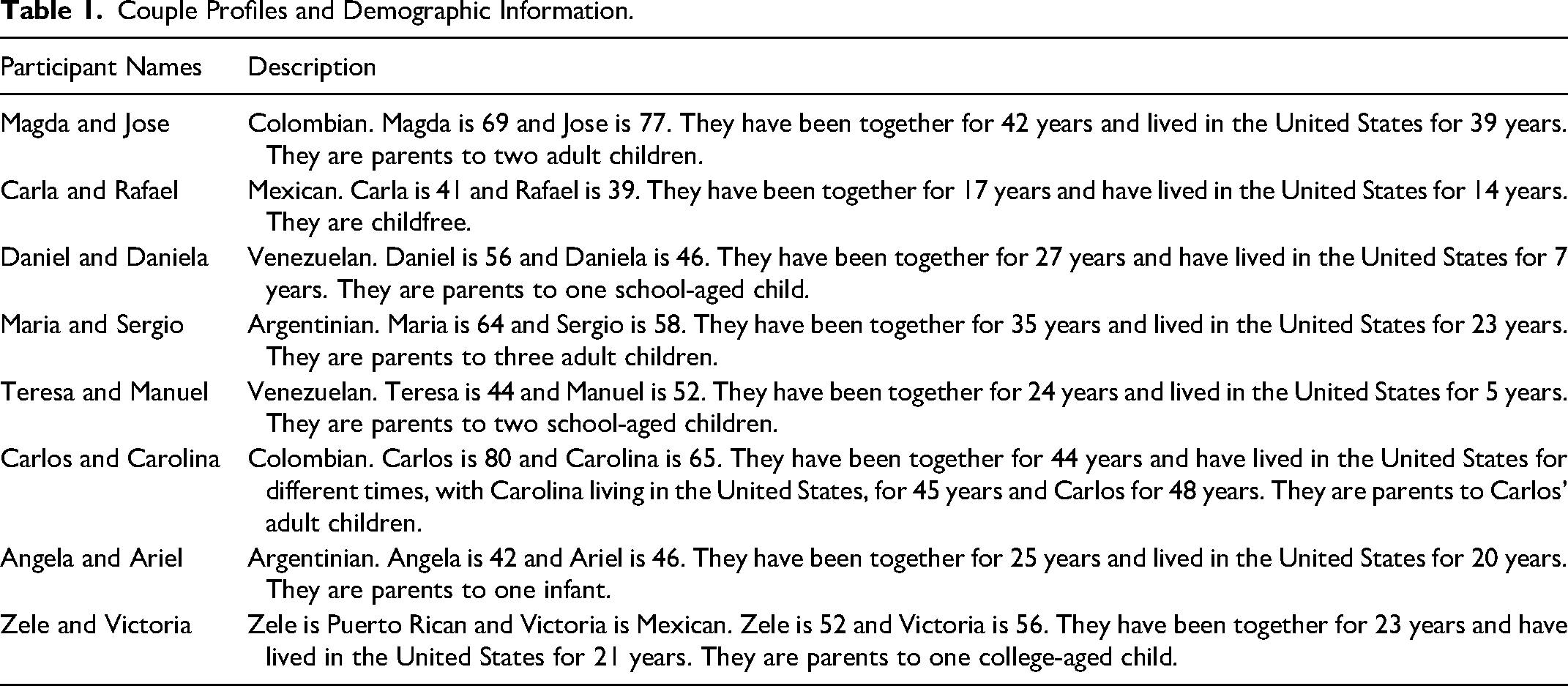
The data for this study were drawn from couples who participated in a broader investigation about the experiences of Latine immigrant couples living in the United States. The findings presented in this manuscript address one of the research questions explored in that study. Participants included eight cisgender, heterosexual couples. This sample size allowed for in-depth data collection and analysis and was sufficient to identify both convergent and divergent themes across cases (Smith et al., 2009). As a result of our inclusion criteria, all participants were Latines who had immigrated to the United States after the age of 18 and who had been in their current relationship for three years or longer. For participant safety reasons, couples who had incidents or risk of IPV in their current relationship were excluded from the study and provided with additional resources. Brief profiles with demographic information about each of the couples can be found in Table 1. All participants have been assigned pseudonyms.
Couple Profiles and Demographic Information.
Procedures
After obtaining Institutional Review Board approval, we initiated participant enrollment by word-of-mouth and social media marketing efforts. Interested individuals were directed to a Qualtrics survey, where they (a) reviewed the informed consent, (b) confirmed study eligibility, (c) completed a brief demographic survey, and (d) completed the HITS (Hurt, Insult, Threaten, Scream; Sherin et al., 1998) questionnaire to assess for IPV. Survey respondents who were ineligible to participate were redirected to the end of the survey and provided with immigration and IPV resources. Eligible respondents were asked to provide their contact information and prompted to encourage their partners to also complete the survey. To ensure all participants met the inclusion criteria, we scheduled data-collection interviews only after both partners individually completed the online survey. Nine couples had both partners complete the Qualtrics survey and meet all the inclusion criteria. After various contact attempts, eight of these couples were successfully enrolled in the study. Participating couples engaged in two audio-recorded, conjoint semistructured interviews (56–112 min in duration) and one audio-recorded, conjoint member-check meeting (28–68 min in duration). Study meetings were hosted online using secure video-conferencing software. All data-collection interviews and member-check meetings took place between October 2022 and February 2023.
We facilitated conjoint meetings due to the relational nature of the phenomena of interest (Mavhandu-Mudzusi, 2018; Wawrziczny et al., 2016). To acquire rich data, we also hosted multiple interviews with each couple, which facilitated rapport building and ample opportunities for each partner to share their experience. Meetings were conducted using a semistructured interview protocol that was refined after being piloted with a Latine immigrant couple (not included in the sample) before study implementation. Some sample interview questions include “Tell me about some things you do well as a couple,” “Tell me about an immigration-related challenge that you have been able to overcome as a couple?” and “What is a time in your immigration process from when you first arrived to today during which you felt very connected as a couple?” Based on participant language preferences, all study meetings were completed in Spanish. Each participant received a $20 gift card for each meeting.
Data Analysis
The data-collection interviews yielded approximately 20.5 hours of recorded data, which were transcribed verbatim. To circumvent potential losses in meaning through translations, we completed the data analysis process in Spanish. Our data analysis followed a modified version of Smith and Nizza's (2022) recommended IPA analytic procedure. Steps included (a) a deep immersion into the data (i.e., reading and re-reading transcripts), (b) writing initial exploratory notes throughout the transcripts (i.e., initial reactions), (c) formulating experiential statements (i.e., a statement about the meaning the participant is attributing to the experience) for each remark made by participants, and finally, (d) clustering experiential statements into themes with supporting participant quotes (Smith & Nizza, 2022). This procedure was followed for each of the cases, resulting in an experiential themes table for each couple. Each couple was considered a single unit of analysis, but divergent themes between partners were noted in the experiential tables. Case-specific experiential themes tables were reviewed by our Spanish-speaking external auditor (second author), who provided feedback on the themes and their representativeness of the participant quotes. Once case analyses were completed, we conducted a cross-analysis to identify convergent and divergent themes across couples. This resulted in a master experiential themes table. After another review from our external auditor, preliminary results were presented to participants during their conjoint member-check meetings. All the couples chose to attend their member-check meeting, and the final study results were adjusted based on their feedback.
Positionality and Trustworthiness
The first author, who led the data collection and analysis process, is a partial insider of the phenomena of interest, as she is a Latina immigrant with 10 years of clinical experience working with the Latine community as a licensed marriage and family therapist. The second author, who acted as the external reviewer, is also a bilingual Latino, with extensive research, clinical, and advocacy experience with the Latine community. Last, the third author, who provided feedback on the study's design and implementation, is a White woman, who also has extensive research and clinical experiences working with underprivileged youth and families. We recognize that our social identities, along with our experiences as clinicians, researchers, and advocates likely impacted the design and implementation of this study. Thus, we relied on several trustworthiness mechanisms. These included (a) cyclical bracketing through journaling completed by the first author throughout the study design and implementation phases, (b) the use of an external auditor, and (c) completion of member-check meetings with all study participants to confirm study findings were adequately representative of their experiences.
Results
A total of five themes emerged from the data in relation to our research question. For dissemination purposes, the participant quotes supporting each theme have been translated into English by the first author, a native Spanish speaker, and reviewed by the second author, also a native Spanish speaker. However, because translations can be subject to loss of meaning, the original Spanish-language quotes have been made available for readers in Appendix A.
Theme 1: Mutual Support to Overcome Challenges and Reach Goals
Participants described a steadfast exchange of support within their relationships and provided various examples in which they both gave and received help from one another. Sometimes this help was manifested in tangible ways, such as Jose and Zele helping their respective partners learn English, or Carlos and Carolina assisting each other with the costs of family funerals in their country of origin, Colombia. Another example of this instrumental support was illustrated by Carla and Rafael, who assumed additional household responsibilities to relieve each other during demanding professional and educational periods. Carla, for instance, noted the importance of Rafael's assistance when she was simultaneously working three jobs: Without it [Rafael's support] I would not have been able to do it. I mean, literally, I would’ve just begun crying on a Sunday and never have gotten up again! But having that was like a bind that would pull me, and it was like “Keep it up, keep it up, keep it up!” It was like… a yoke… with two oxen that kept on pulling, and I would feel that… his support pushed me just like that to keep progressing, to not give up.
Carla, in other words, attributed her success to the concrete assistance she received from Rafael. By offering the oxen metaphor to describe how encouraged she felt, Carla also alluded to the emotional impact of Rafael's support. This aligns with reports from other couples, who noted emotional care and encouragement as common expressions of support. When coping with transnational grief, for instance, Carlos and Carolina described: Carolina: When people have passed away, these have been very hard blows during which we have supported each other a lot… Carlos: My father, my mother, and a sister have passed away, and well, she [Carolina] was always there consoling me.
A few moments later, Carlos added “To tell you the truth, with that support you feel like you lack nothing, that everything is complete,” expressing how essential Carolina's emotional care was during his grieving process. Thus, emotional support appeared to be of special significance during distressing times. Several partners shared that their ability to survive difficult situations and accomplish goals was directly connected to the emotional support in their relationship. A notable example of this was provided by Angela, who struggled with depression and anxiety after moving to the United States, but received significant care from her partner: Immigration was…the biggest challenge I’ve ever faced… I had a lot of moments of sadness…and I wasn’t at my best…but he [Ariel] never criticized me. On contrary, he gave me time so I could have my experience. [Telling me] “That's okay, you will feel better, be at ease, do what you can…” He gives a lot of emotional support.
Angela was certain she would not have successfully remained in the United States without Ariel's help. She also explained that her pursuit of higher education was facilitated because of her relationship. Similarly, other couples described being motivated by their partners to pursue personal goals. This was the case for Daniel, who sought out and obtained more fulfilling employment after active encouragement from Daniela. The same was true for Victoria, who was encouraged by Zele to pursue a higher education degree: “He pushed me to complete a degree here in the U.S., because I was struggling with a lot of imposter syndrome, feeling like I was no one here.” It was, therefore, common for partners to consider their relationships both the birthplace of many of their educational and career successes as immigrants in the United States, and an important source of emotional and material support to manage the many challenges brought on by immigration.
Theme 2: Open Communication Based on Respect
Study participants described healthy communication as an essential component of their relational well-being. Magda, for example, attributed the longevity of her and Jose's marriage to their ability to talk, “What has maintained our relationship now for more than 40 years has truly been dialogue, because like all couples one has difficult and stressful moments.” In her statement, Magda recognizes strife as a normal part of relationships—a sentiment shared by most other participants—and identifies communication as the main tool through which to manage it.
Respeto (i.e., respect), as a foundational quality of their communication patterns, was another convergent theme. For some couples, respeto was manifested by avoiding yelling, name-calling, or cursing during conflict. For others, respeto also included making efforts to understand their partners’ perspectives. Angela and Ariel described it like this: Angela: As a couple something we do well is…communication. … We consider the other person and their point of view, and we have the habit of talking about things, especially things that bother us or if we have a problem… We listen to each other… and we can take on the other person's point of view and adjust our own. Ariel: We have mutual respect Sergio: So, it's also knowing how to communicate, knowing how to listen, not only hear what you want to hear. Knowing how to listen, a listening that is authentic, genuine, generous… So, then you start to hear what's in the other person's heart… Maria: And it's good to tell the other person what you like and dislike, so that they know… I mean communication is very important.
For these couples, understanding is fostered by respectful communication characterized by both empathic listening and transparency. This type of communication also assisted the couples in addressing problems external to the relationship. Daniel reported that late-night conversations with Daniela helped them figure out strategies to address the many problems (e.g., finances, childcare, career) they faced after their arrival to the United States: We spoke a lot… it was in those moments, at night before we went to bed. That's when really all our emotions would awaken and communication truly flowed…there we’d open up and converse… and we’d talk for hours investing in that communication process and formulating the solutions needed in that moment.
Daniel and Daniela's communication allowed them to explore potential solutions to their difficult situations, and to have an avenue for emotional expression. Open, respectful communication seemed to facilitate conflict resolution, transparency, and empathy and provided the couples with opportunities to cope and manage immigration-related stressors. In some ways, this open dialogue was yet another expression of mutual support, as some couples described receiving emotional encouragement and comfort from their partners in these conversations.
Theme 3: Working Together as a Team
Several couples relied on the metaphor of the relationship as a team to describe their collaborative approach to meeting goals and overcoming challenges. Viewing the couple as a team entailed an attitudinal disposition that prioritized the “we” over the “I.” In other words, participants seemed to view themselves as a part of a cohesive unit, which promoted a commitment to work together. Maria and Sergio, for instance, faced a series of immigration-related challenges after their arrival in the United States, including fear of deportation, financial precarity, and missing their country of origin, Argentina. When speaking about how they coped, Maria shared: I always understood, above everything, when we had problems that we are two, that we are both on the same side, that we both want the same things, that we both expect the same things, and that we are a couple. And that if we don’t both advance together, then we would get nowhere.
Viewing herself as part of a team allowed Maria to work in conjunction with Sergio to make progress toward their goals as immigrants, which included financial stability for their family, attaining a documented status, and affording their daughter's educational opportunities—goals they had successfully met by their participation in this study. Maria's words also capture the idea that success could not be achieved unless both partners made strides together. A similar sentiment is reflected in this exchange between Angela and Ariel: Angela: We have our individual project and everything, but it has always been that we do things as a team… Ariel: Yes, exactly. We don’t take on the position of who is going to win or lose. It was never like that…From the beginning, our relationship was never about “I have to win,” it was not a competition. It never was. It was like “How do we solve this?”
The lack of competition in Angela and Ariel's relationship, speaks to a sense of equitability, where one partner's needs or wants didn’t supersede the other's. Manuel and Teresa succinctly summarized a similar idea: Manuel, “We are a team,” Teresa, “Exactly, we don’t feel that one person is more important than the other.” These dispositions toward unity and equitability were expressed by the couples in their collaborative behaviors. Some of these behaviors were demonstrated as the mutual support previously described but also included actively relying on each other's strengths. The couples universally described their partners as possessing complementary qualities or skills that they themselves lacked, but that could be leveraged as resources. This was the case for Zele and Victoria, who shared: Zele: I told her that we make a good team because I am extremely bad at many things… and she has a list of positive qualities that compensate for my bad qualities. Victoria: But he also has a lot of great qualities that I didn’t get from my upbringing. I’ll give you an example: administration of finances.
Victoria and Zele, then, capitalized on their interdependence by relying on and utilizing the skills each partner brought into the relationship. In this sense, it seemed like the couples were able to double the resources available to them. Teamwork within the interviewed couples entailed viewing themselves as a collaborative unit working toward common goals. Viewing the relationship as a team aided the partners in setting aside unhelpful individualistic desires (e.g., the need to win, to be right), leveraging each other's strengths, and creating mutual benefits.
Theme 4: Acceptance and Admiration for Each Other
Across the interviews, there was a theme of accepting your partner as they are, and even beyond that, admiring their qualities and accomplishments. Acceptance was expressed as something that can be given and received. Noting the importance of accepting your partner as they are, Daniela shared: “One cannot expect to change the other person, and even less so after immigration.” Acceptance, however, came up more frequently as a benefit of the relationship, resulting in the ability to be yourself. This is illustrated by Maria: Everything that I feel, think, want, don’t want, I tell him [Sergio]. I open my mind…I’m not like “Oh, I’m not going to say this because maybe he’ll think that I’m a bad person.” No, with him I am myself and I have no secrets…I don’t try to hide or beautify anything. He knows everything about me…
Maria is indicating an assurance that she will not be rejected by Sergio, even as she shares the most vulnerable parts of herself. In a very similar way, Zele noted his gratitude for Victoria's full acceptance of him and her commitment to their relationship: It's not only grinding glass, it's also chewing and swallowing it. And she has done that. One thing is to accept it and another is to remain here…I am fully aware that…she can date anyone! … She is a very interesting woman, a smart woman, a beautiful woman!
Here, we can see that Zele's admiration for Victoria is deepened by her acceptance of him exactly as he is. In general, the couples seemed to easily identify, appreciate, and celebrate their partner's positive qualities. As exemplified by Zele, they took opportunities to complement one another or highlight their partners’ strengths. Ariel and Victoria, for instance, both spoke at length about their admiration for their respective partners’ intelligence and educational achievements. Another example includes Maria's compliments of Sergio's relationship skills, describing him as “a good husband, a good father, a good son, an excellent friend.” Participating couples discussed acceptance as a crucial aspect of their connection with their partner, which in turn engendered genuineness in the relationship. Moreover, they moved beyond acceptance, to express deep admiration for their partner's positive qualities and accomplishments.
Theme 5: Loving and Being Loved as a Resource
Partners made it apparent that their deep couple connection (i.e., the act of loving and being loved) was ladened with benefits. These benefits included the ability to sustain their relationships through time and adversities, having a safe haven in each other, feeling more courageous, and gaining a clearer sense of self. These benefits proved to be particularly helpful as the couples faced the difficult and upending process of immigration. Magda openly described love as a strength she and Jose relied on: “In reality, it is the love and unity between us… that has helped us overcome all these difficult situations.” Likewise, Sergio described the role that his and Maria's love played in their ability to overcome immigration-related stressors: Here, finding ourselves in a different environment, alone, and with ugly, real problems and well, you end up saying “What do we do?” …But above all…it was love that sustained us… What worked was that we embodied love in all its characteristics… You know another thing that is beautiful and important, is that this [relationship with Rafael] lets me know that I exist…it's like that also gives me a lot of…security, peace, confidence, I can be more courageous…because I know that I exist in someone's mind, that they are thinking of me. It's as if you have someone praying for you all the time, that's what it feels like, like I exist and someone is thinking of me.
With her moving words, Carla not only named the bravery that is engendered from the knowledge that she is loved by Rafael, but also added that this love gave her reassurance about her own existence. In doing so, she is remarking on the idea that important relationships, characterized by love, can solidify our sense of self. This same idea is supported by Manuel's words, who at the end of our final interview described the need for his family to make sense of himself: “I can’t locate myself without my wife and my children. It's fundamental, I mean, love, respect, and unity. I can end with that: With the love, respect, and unity that you can have from the beginning.” Like others, Manuel felt that it all boiled down to love.
Because our data-collection interviews were conjoint, we were able to observe the expression of love through the couple's interactions. Sometimes, this care was demonstrated through words; the couples praised one another, expressed appreciation for each other, consoled each other, and joked and laughed together. Other times, love was manifested through physical affection, such as kisses on the cheek, turning to each other to make eye contact, stroking of their partner's hair, resting their head on their partner's shoulders, and hugs. Consequently, the importance of love was communicated through both the content of what was shared in the interviews, but also through various behavioral expressions.
Discussion
In this study, we sought to understand how Latine couples perceive their relationships positively influenced their immigration experience. Due to the preponderance of deficit-based research on Latine immigrants, our investigation was crafted to identify their relational strengths using an RCT framework. Five themes emerged in relation to our research question: (a) mutual support to overcome challenges and reach goals; (b) open communication based on respect; (c) working together as a team; (d) acceptance and admiration; (e) loving and being loved as a resource. Our findings confirm the presence of relationship assets that ameliorated the negative impact of immigration-related stressors and closely align with key RCT theoretical concepts.
Relational Cultural Theory
RCT is a psychological theory that grounds human well-being in the context of interpersonal relationships (Jordan, 2012); As such, RCT outlines the conditions necessary for growth-fostering relationships (i.e., mutual empathy, mutual empowerment, and relational authenticity), as well as the byproducts of being in such a relationship (i.e., the five good things; Jordan, 2012). The themes that emerged in this study's findings echo many of these concepts. For example, conceptual overlaps exist between the couples’ report of mutual support and RCT's concept of mutual empowerment. The couples in this study reported empowering one another by giving and receiving concrete (e.g., financial assistance) and emotional support (e.g., encouragement). RCT theorists highlight the process of empowerment through encouragement as an important component of growth-fostering relationships because it promotes a sense of confidence and hope in the face of difficult challenges (Jordan, 2012). This is resonant of reports by participants, like Carlos, who reported Carolina's support during his transnational grieving process was crucial for him. It is also present in Carla's report of the additional courage she felt from the reassurance that her partner, Rafael, was always thinking of her.
The couples' reports of open communication, acceptance, and admiration for each other also demonstrates RCT's concept of relational authenticity. From an RCT perspective, relational authenticity involves the ability to be honest, which includes the courage to move into conflict, while also holding space for empathy and respecting the needs of the relationship (Jordan, 2013). Many of the couples in this study reported that open communication, including talking about what is not going well, was an important part of their relational success as they faced major immigration-related stressors. The couples described that their communication was characterized by the ability to be honest and respectful, and by active listening. As noted by Angela, actively listening was tied to a desire to understand the other person (i.e., a desire to be empathic, which is another key concept of RCT; Jordan, 2012), and to be open to adjusting your point of view. This openness speaks to mutuality, which in RCT, involves a deep engagement with a vulnerability that allows us to be changed by those whom we are in relation with (Jordan, 2013).
Finally, there are also similarities between the couples’ reports of growth (e.g., feeling courageous, feeling valued, gaining a clearer sense of self, accomplishing career and educational goals with encouragement from their partners) and several of RCT's five good things (e.g., increases in productive energy, clarity, self-worth), which capture the beneficial outcomes of growth-fostering relationships. Victoria and Angela's pursuit and attainment of higher education degrees with the support of their partners, for instance, exemplify the increases in energy and productivity that are said to be the result of growth-fostering relationships (Jordan, 2012). Manuel's statement about finding himself through his family demonstrates RCT's sense of clarity. Similarly, Carla's statement about gaining more confidence and being reassured of her own existence because of her partner's love is congruent with expected increases in self-worth resulting from growth-fostering relationships. The sense of safety, reassurance, and courage described by Carla is also resonant with the concept of “safe haven” in attachment theory (Davila & Kashy, 2009), which is connected to improved individual and relational well-being (Johnson, 2019). RCT theorists have highlighted attachment theory research, noting that it is supportive of RCT concepts (Frey, 2013) as it also centralizes the importance of healthy relationships for individual well-being and growth. In general, the overlaps between the themes that emerged in this study and key RCT concepts, provide preliminary evidence for the usefulness of an RCT lens when exploring and understanding the relational experiences of Latine immigrant couples.
The couples’ reports of relationship resources (e.g., mutual support, communication, “we” over “I” teamwork) to manage external stressors closely align with previous research on dyadic coping (see review by Falconier & Kuhn, 2019). The use of positive dyadic coping strategies has been linked to improved individual (e.g., reduced depression) and relational outcomes (e.g., relationship satisfaction; Falconier et al., 2015; Landolt et al., 2023), thereby acting as a protective factor for couples. This is congruent with the lived experiences of study participants, some of whom reported that the support they received from their partners allowed them to better cope with occupational demands, financial crises, grief and loss, and mental health concerns. This study adds to the body of work on dyadic coping by expanding this concept's applicability to Latine couples managing immigration-related stressors.
Limitations
While this study has several strengths, there are also some limitations that must be taken into account. Firstly, although our inclusion criteria permitted us to obtain a fairly homogenous sample, some variability in the sample remained (e.g., different nationalities). This variability represents some limitations because there were unique components of each couple's experience that we were not able to fully capture in the study findings. Secondly, our sample only included heterosexual and cisgender couples, so it does little to address the gap in the literature about sexual and gender minority relationships. Thirdly, it is important to consider that although conjoint interviews for data collection bring about various benefits, there is the possibility that individual partners refrain from sharing the entirety of their relational immigration experiences. A final study limitation is the translation of study findings from Spanish to English due to the potential loss of meaning and nuance. We hope to reduce the impact of this limitation by providing the original Spanish-language participant quotes in Appendix A.
Implications for Practitioners and Future Research
Findings from this study may be helpful in crafting culturally responsive clinical strategies for helping professionals working with Latine immigrants, couples, and families. The presence of significant relationship strengths, and the important role they played in managing immigration challenges, highlight the need to adequately assess for the presence and state of these qualities in counseling. As such, clinicians may consider crafting intake procedures that formally assess various dimensions of relationship quality. For instance, given the numerous stressors associated with immigration (e.g., acculturative stress [Cao et al., 2023]; discrimination [Cross et al., 2024]; cumulative trauma [Navarro Flores et al., 2023]), assessments such as the Dyadic Coping Inventory (Bodenmann, 2008; Ledermann et al., 2010), which helps clinicians evaluate how well partners are supporting each other to cope with external and internal stressors, may provide useful information on the couples’ relational strengths and areas of growth. In addition, informal assessment strategies, such as asking Latine immigrant couples to describe their strengths, may also prove useful in gathering information about the relationship, and assist in the instillation of hope by highlighting couples’ relationship assets.
Results from our study also suggest that Latine immigrant couples’ strengths may be effectively used to cope with numerous stressors. After identifying relational strengths, helping professionals may consider exploring how these can be leveraged to meet the couples’ treatment goals. A clinician, for example, may initiate a brainstorming session to generate ideas on how a couple's healthy communication patterns about finances can be applied to their challenges with acculturative gaps within the relationship. Similarly, clinicians may inquire about past successes (e.g., ability to endure a stressful move to the United States) and discuss strategies that may be transferable to the couples’ presenting concerns. Deploying strength-based assessment and intervention approaches when working with Latine immigrants emphasizes the resilience present in this community, and thereby promotes a culturally responsive perspective of Latines as multidimensional beings with numerous strengths, who should not be reduced to a series of challenges or deficits (Arredondo et al., 2014; Garcini et al., 2022).
Although additional research is needed, our findings also provide some initial support for RCT as a helpful theoretical lens when working with the growing Latine immigrant population.
However, outcome-based research is needed to test the efficacy of RCT with Latine immigrant individuals, couples, and families. Future researchers may also want to quantitively explore specific relational qualities and strengths (e.g., mutuality) as moderators between immigration stressors and various dimensions of the individual (e.g., mental health outcomes), and couple (e.g., relationship satisfaction) well-being for this population.
Conclusion
This study helps to address the knowledge gap about Latine immigrant couples and their relational strengths. Through the emergence of five experiential themes, study findings confirm the presence of significant relationship assets that support Latine couples’ ability to cope with immigration-related stressors and meet individual, couple, and family goals. This highlights the importance of adopting a strength-based clinical approach when working with this community, as well as the need for additional research to further investigate their relational strengths.
Supplemental Material
sj-docx-1-tfj-10.1177_10664807241276203 - Supplemental material for “Fue el Amor que nos Sostuvo”: The Relational Strengths of Latine Immigrant Couples
Supplemental material, sj-docx-1-tfj-10.1177_10664807241276203 for “Fue el Amor que nos Sostuvo”: The Relational Strengths of Latine Immigrant Couples by Nicole Silverio, Daniel Gutierrez and Kelly L. Wester in The Family Journal
Footnotes
Declaration of conflicting interests
The authors declared no potential conflicts of interest with respect to the research, authorship, and/or publication of this article.
Funding
This study was partially funded by the Southern Association for Counselor Education and Supervision. We have no conflict of interest to disclose.

Supplemental material
Supplemental material for this article is available online.
Notes
Appendix A
Participant Quotes in their Original Spanish Language
Carla: “Pues como sin eso [apoyo de Rafael] no lo habría logrado, o sea literal yo creo que me tiraba llorar un domingo y ya no me levantaba! Pero tener eso era como que como un lazo que me jalaba y me como que ‘si sigue, sigue, sigue!’ Y yo como una yunta…con 2 bueyes y que te siguen jalando y ya así eso sentía…como que su apoyo me empujaba a sí mismo adelante y a no rendirme y a no mandar todo a volar.” Carolina: “Como parte de personas que se han muerto, que han sido golpes muy duros, que nos hemos apoyado bastante…”/Carlos: “A mi se me murio mi papa, mi mama, una hermana, y pues estubo ella consolandome…” Carlos: “Pues pa’ decirle la verdad como si [con] ese apoyo siente que nada le falta y que todo lo tiene completo.” Angela: “La inmigracion para mi fue el desafio mas grande que yo he tenido… Yo tuve mis momentos asi de mucha, de caidez por asi decirlo… no estaba en la mejores de mis condiciones, y el viste el nunca fue de nuevo de criticar ni nada. Al contrario, de darme mi tiempo de tener esa experiencia, [diciendome] “bueno ya te vas a sentir mejor, vos tranquila, vos haces lo que puedas, si no podes, no podes.” El es muy emotional support… Victoria: “El me empujó a que hiciera un degree aquí en Estados Unidos porque tenía el síndrome de impostor bien fuerte de no soy nadie aquí.”
Magda: “Lo que nos ha mantenido a nosotros ya por más de 40 años realmente ha sido el dialogo, porque como toda pareja yo pienso que uno tiene momentos difíciles, estresante.” Angela: “Yo creo que como pareja este algo que hacemos bien es … comunicarnos … Tenemos en cuenta lo que el otro tiene que decir o el punto de vista del otro, y tenemos tambien la costumbre de hablar las cosas, especialmente si es algo que nos molesta, or algun problema… Nos escuchamos… nos podemos poner del punto de vista del otro y bueno y acomodarnos.”/ Ariel: “El respeto mutuo que tenemos.” Sergio: “Entonces es tambien saber comunicarse, saber escucharse, no solo escuchar lo que yo quiero escuchar, no. Saber escucharse, una escucha autentica, genuina, una escucha generosa…Entonces uno empieza a escuchar el corazon del otro”/ María: “Y esta bueno tambien decirle a la otra persona lo que a uno no le gusta, para que la otra persona trate de no hacerlo… O sea que la comunicación es muy importante” Daniel: “Hablamos mucho… el momento era en las noches antes de acostarnos. Ahí realmente se despertaban todas la emociones y la comunicación de verdad que fluia…ahí nos toco destaparnos. Destaparnos y conversar. Y durabamos, cosa que durabamos mucho tiempo, muchas horas, invirtiendo en ese proceso de comunicación, la solucion de ese momento.”
María: “Yo siempre entendí más que todo cuando teníamos problemas que somos dos, que los dos vamos para el mismo lado, que los dos queremos lo mismo, que los dos esperamos lo mismo, y que somos una pareja. Y que, si no vamos los dos juntos para adelante, no vamos a llegar a donde queremos llegar.” Angela: “Tenemos nuestros proyectos individuales y todo, pero siempre a sido asi, cosas asi como que las hacemos en equipo…”/ Ariel: “Exacto, el que no tomamos la postura de haber quien gana y quien pierde. Nunca fue asi…De entrada nuestra relacion nunca fue de bueno ‘yo tengo que ganar,’ la discusion no fue una competencia. Jamas lo fue. Fue bueno y como solucionamos esto? Manuel: “Somos un equipo”/ Teresa: “Exacto, no sentimos que que uno es más que el otro” Zele: “Yo le dije a ella de que nosotros hacíamos un buen equipo, porque yo soy extremadamente malo en en muchísimas cosas… y ella tiene una lista de cosas buenas que compensa mi lista de cosas malas.”/ Victoria: “Pero tiene muchas cosas buenas que yo de crianza no tenía como la, te voy a dar un ejemplo, que siempre tengo a colación: la administración financiera”
Daniela: “Uno no puede pretender cambiar el otro nunca, y menos después de inmigrar, menos que menos.” Maria: “Yo todo lo siento, lo que pienso, lo que quiero, lo que no quiero, yo se cuento a el. Yo habro mi mente… yo no estoy ‘Ay no voy a decir esto porque a lo mejor va a pensar que mala que soy, o porque hablo asi’ no, yo con el soy yo y yo no tengo secretos para el. Yo digo todo lo que siento y como me sale, no trato de ocultar o de maquillar nada con el. El sabe todo de mi..” Zele: “Ella, no es solamente moler vidrio, es cometerlo y tragartelo también y ella ha hecho eso…Uno cosa es aceptarlo y otra cosa es estar dispuesta a quedarse ahí…Yo siempre he sido consciente hasta el sol de hoy con la edad que tenemos los dos, ella se puede con cualquiera! … Es una mujer interesante, es una mujer inteligente, es una mujer muy bella físicamente” María: “Es muy buen esposo, muy buen padre, es muy buen hijo, excelente amigo.”
Magda: “En realidad el amor y la unión que ha habido entre nosotros…[que] nos ha ayudado mucho a superar todas estas situaciones difíciles.” Sergio: “Acá, al estar en otro contexto, solos, y con problemas feos, reales, y entonces bueno, terminas acá de decir ‘Que hacemos?’ …Pero sobre todo, … fue el amor lo que nos sostuvo… Lo que funciono fue que vivimos el amor en toda sus características y cualidades.” Daniela: “mi lugar seguro, mi puerto seguro” Carla: “Sabes otra cosa que es muy bonito e importante, eso me hace saber que si existo… es como que eso también sí me da mucha… seguridad, paz, confianza en mí misma, puedo ser más valiente y todo, porque sé que hay alguien que existo en su mente, que está pensando en mí, que es como si alguien estuviera rezando por ti todo el tiempo, eso es como se siente, como existo y alguien está pensando en mí.” Manuel: “No me hayo sin mi esposa y sin mis hijos. Es fundamental, o sea, el amor, el respeto y la unión. Con eso yo podría terminar: Con el amor, el respeto y la unión que uno puede tener desde un inicio”
References
Supplementary Material
Please find the following supplemental material available below.
For Open Access articles published under a Creative Commons License, all supplemental material carries the same license as the article it is associated with.
For non-Open Access articles published, all supplemental material carries a non-exclusive license, and permission requests for re-use of supplemental material or any part of supplemental material shall be sent directly to the copyright owner as specified in the copyright notice associated with the article.
