



Abstract
The present study addresses the effects of school closures during the second COVID-19 lockdown in January and February 2021 on children's feelings of stress. Numerous quantitative studies have already proven the adverse effects of school closures during the first lockdown on the stress perception of children and adolescents. In contrast, the present study uses a qualitative research format to take a closer look at the personal perspectives of children during the second lockdown. Twelve telephone interviews were conducted between February 4, 2021, and February 22, 2021, to collect data on the organization of distance learning, leisure behavior, stress symptomatology, current concerns, perceptions of school under distance learning, and perceptions of school before the school closures. Data analysis demonstrated a strong influence of loneliness, classroom management, and leisure behavior on children's perceptions of stress. Furthermore, correlations were found between school closures, stress vulnerability, and stress perception.
Stress and loneliness during the pandemic
Pandemic containment measures in the first half of 2021 led to school closures across Germany. From mid-December 2020 to early March 2021, many schoolchildren were left alone in a homeschooling situation. Teachers made the material available and sometimes offered videoconferences. However, restrictions meant that some children had no contact with teachers, classmates, friends, and family for weeks. Even parents who were not working in a systemically relevant profession (health industry, food trade) had to restrict their social life severely. The extensive OECD study “COVID-19 and well-being” concludes: “The pandemic has touched on every aspect of people's well-being.” (OECD, 2021, p.5) More precisely, they disclose that “mental health suffered, and both loneliness and feelings of being left out of society grew as the pandemic progressed.” (OECD, 2021, p.6) Even though governments supported average incomes and stemmed the tide of unemployment, emotions of insecurity were measured high. Some parts of the population have been more psychologically affected by COVID-19 containment measures. Data from 12 OECD countries revealed that young people experienced the highest rates of anxiety and depression during the whole pandemic period. These include school-age children and young people worldwide. The pandemic and the infection protection measures prescribed within its framework fundamentally change people's everyday lives and thus result in various stresses that affect the mental health of many children and adolescents. The influence on their mental development has meanwhile been empirically investigated several times. International studies quickly revealed significantly increased mental illness in this age group (Brooks et al. 2020; Fegert et al. 2020; Hamaideh et al. 2022; Jiao et al. 2020).
The first German nationwide representative study, the COPSY Study, uncovers that some subgroups are affected significantly more than others. These are children with low socioeconomic status, migration background, and limited living space (Ravens-Sieberer et al., 2021). In addition, according to the Federal Institute for Population Research (2021), there were increased rates of depression during the coronavirus pandemic, including among younger people. For example, in 2018/19, only 10.2% of adolescents had clinically relevant symptoms of depression. In the spring of 2020, however, this proportion rose to 25.2%, meaning that one in four Germans between the ages of 16 and 19 had clinically relevant symptoms of depression. Extrapolated, already 477,000 more adolescents between the ages of 16 and 19 with clinically relevant depressive symptoms after the first lockdown appeared in May or June 2020 (Bujard et al., 2021). Various youth studies conducted during the pandemic revealed that loneliness had become one of the most profound social experiences of young people during this social crisis (Andresen et al., 2020, 2021; Entringer and Kröger, 2021; Keller, 2022). Young people need social environments such as school, sports and leisure facilities, informal social contact, and exchange opportunities. During the pandemic, they felt that their needs were ignored by familiar institutions such as schools (Andresen et al., 2020) and political representatives (Andresen & Wilmes, 2022).
Research questions
In order to identify a connection between the effects of the school closure and the emotional experience of the children, the present study would like to answer the following research questions.
H1: Stress and school closures
According to Lazarus & Folkman’ (1984) transactional stress model, stress arises when individuals perceive their coping strategies as uncertain or insufficient. Many families face entirely new and considerably changed living conditions due to the closures of daycare centers and schools during COVID-19 (Cohen et al., 2020). These insights lead to the first Hypothesis:
H1: School closures affect the stress perception of children and adolescents.
H2: Stress and loneliness
Children's everyday lives occur at school. Depending on age and grade, they spend between 24 and 45 h per week on scholastic activities. Nevertheless, school time is not just a place for children to learn. At the same time, an average German class size of 20 primary school students in a social community automatically cultivates social contact with classmates and friends. The closure of schools is an effective method of minimizing personal contact and ensuring social distancing. This measure also limits the possibility of children meeting classmates and friends in their social environment. According to “quality of life”—research, social contacts result from psychological, social, and sociological reasons essential for personal well-being (Glatz & Bodi-Fernandez, 2022). Maslow includes social contacts in his theory of the needs pyramid as one of the five basic human needs (Glatz & Bodi-Fernández, 2022). In addition to physical and psychological factors, social factors can also lead to stress. The lack of daily scholastic social contact leads to the second Hypothesis:
H2: Loneliness influences children's and adolescents’ perception of stress.
H3: Stress and lesson design
According to Hattie (2009), the teacher is the second most significant influencing factor on student learning and performance. Teachers create the school environment. The school environment demands performance from students. The prevailing performance requirements can lead to the perception of psychological stressors, so-called performance stressors. If a pupil suffers from these stressors, it depends on how the teacher makes didactic and methodological decisions. The particular lockdown situation changed the lesson design completely. Instructional design in everyday school life, the provision of materials, task design, school contact with the teacher, and technical resources could influence children's stress perception.
H3: Lesson design influences children's and young people's perception of stress.
H4: Stress and leisure time
Physical activity is an essential factor in the health of children. In 2021, the German Olympic Sports Confederation (2021) counted more than 5.6 million children between the ages of 7 and 18 as members of one sports club nationwide in Germany. Due to the pandemic and related restrictions, millions of young club sports members lost their opportunity to engage in physical activity (Neubert, 2021). Another critical element of a club sport is social communication in the community. The ban on club sports in late 2020 and early 2021 for the 5.6 million children separated them for months from their social sports community. In addition, the meetings of relatives and friends in the private sphere became massively limited. As explained in the loneliness hypothesis (H2), friendships influence family relationships through the sense of social integration and well-being of a human being and satisfy the basic need of belonging to a social community.
H4: Leisure time behavior influences the stress perception of children and young people.
Data and methods
We used a qualitative method to find the answers to these research questions. The present study is part of a survey of 2842 parents. After filling out that questionnaire about their parental stress perception related to the lockdown in 2021, the parents could let their children participate in an interview study. About a hundred parents agreed to participate. Twelve children were chosen to be interviewed.
Participants
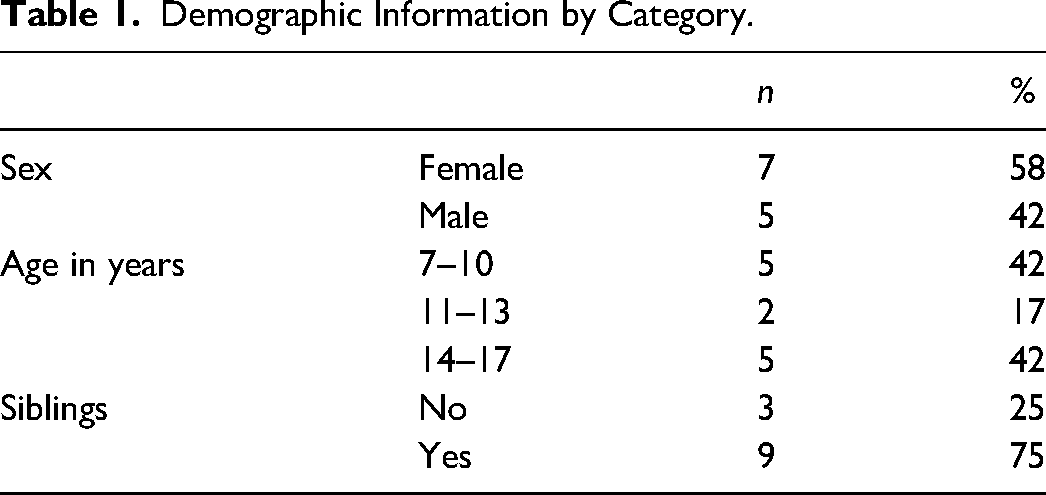
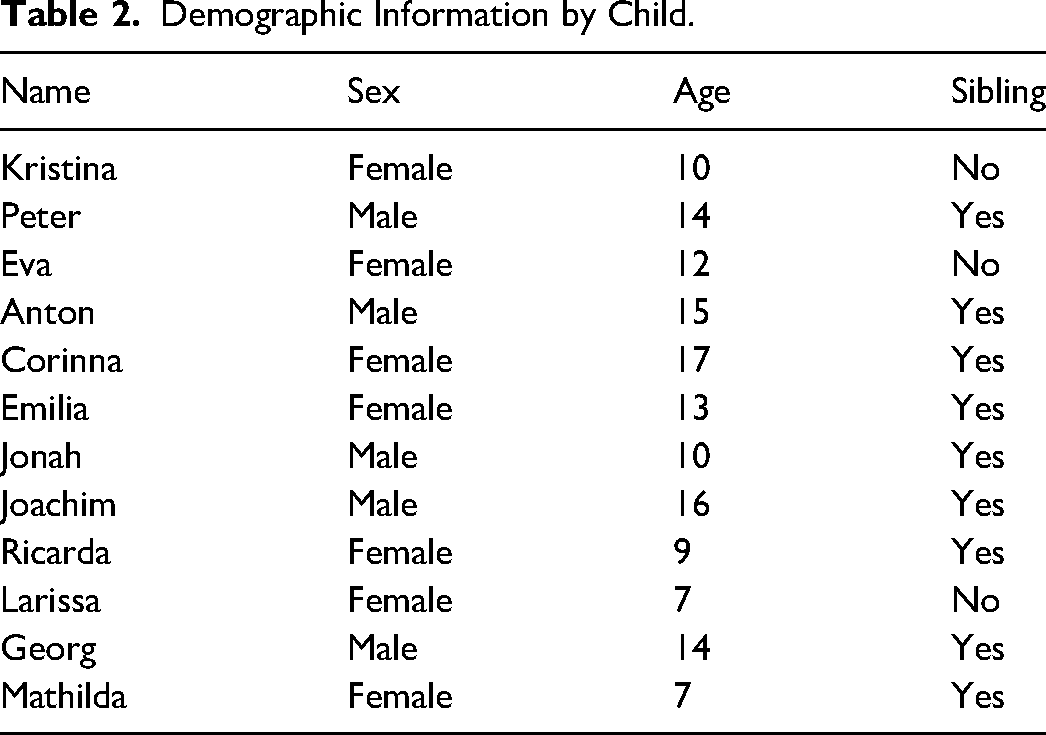
Twelve interviews were conducted from February 4, 2021, to February 22, 2021. Consent of the legal guardians was obtained in all cases. We conducted all interviews in German. Participation was voluntary. The demographic participant information is by category in Table 1 and by child found in Table 2. Names are changed for privacy reasons.
Demographic Information by Category.
Demographic Information by Child.
Interview
We conducted the interviews via phone due to the pandemic. Children could have their parents beside them, which four of them did. The duration of each interview was approximately 20 min. Although the participants could stop anytime, no interview was prematurely truncated. The interviews were tape-recorded and transcribed by the authors. The confidentiality and anonymity of all participants were always maintained. The whole topic guide includes all questions and scales in Appendix 1. For the semistructured interviews, we generated a topic guide based on the “Stress and Coping Questionnaire for Children and Adolescents” (Lohaus et al., 2018) and questions concerning the process of distance learning, leisure behavior, and perception of school before school closure.
We posed open questions about the daily distance learning routine, leisure activities, social contacts, and worries (annex 1). The items about distance learning stress have already been tested on parents in two peer-reviewed published studies and indicate good reliability with a Cronbach alpha of 0.7.
Evaluation of the interview
The closed questions were evaluated through tabular listing and determination of average values. The Stress-Symptom and Well-Being Scales from the Stress and Coping Questionnaire for Children and Adolescents (SSKJ) is a 22-item self-report instrument. Five subscales for Somatic Symptoms, Anger, Sadness, Anxiety, and Well-Being evaluate stress symptomatology and well-being experienced in the last week.
The retest reliability of SSKJ is between .56 and .82, the internal consistency between .67 and .89 consistency between .67 and .89. The validation was carried out with n = 3189 children (Lohaus et al., 2018). The raw values are calculated using the percentile rank values (PR) based on the German version's norm tables.
Part 1 of the SSKJ 3-8 R measures the respondents’ stress vulnerability in 7 four-level items. Stress vulnerability indicates the potential for feeling stress. The focus is placed on everyday tensions and problems. The respondents are everyday situations, particularly from everyday school life, and they are asked to rate them on a 4-point scale from “no stress at all” (1) to “very much stress” (4) the extent of their stress for each situation described. The extent of stress vulnerability in everyday life is shown using a total score with a range of 7–28 possible points. The higher the sum score, the higher the stress vulnerability. The internal reliability of Cronbach's alpha of 0.7 can be rated good (Lohaus et al., 2018).
Part 3 of the SSKJ 3-8 R measures physical and psychological stress symptoms and general well-being in five three-level scales: physical symptoms with six items, psychological, physical symptoms with six items, psychological symptoms with the subscales anger, sadness, and anxiety, each with four items each and general well-being with four positive well-being items. The questions refer to the period of the last week. The response scales are: “never” (1), “once” (2), and “several times” (3). A high sum score indicates increased physical, psychological, and mental stress symptoms. The Cronbach's alpha for the three subscales is medium to good (physical symptoms: 0.67; psychological symptoms: 0.85; well-being: 0.72). For the evaluation, both the total sum score with a range from 22 to 66 as well as the individual categories of physical stress symptoms (extent of somatic stress symptoms), psychological stress symptoms, and well-being can be used (Lohaus et al., 2018).
Another step contributing to the evaluation was creating coding categories that code the qualitative interview material and the basis for a “methodically controlled qualitative analysis” (Kelle & Dahmen, 2020). Subcategories were developed to the categories contained in the category scheme, which served as the framework and basis of the evaluation and served to enrich empirically. This was done by systematically comparing and analyzing text passages of the same coding categories to identify more detailed patterns and structures.
Results
H1: Stress and school closures
The results of the present study indicate that school closures influence the perception of stress in children and young people. Average physical Stress symptoms of 9.8 (SD = 1.98) were measured, which indicates, according to Lohaus, average stress symptoms (PR = 31) (Lohaus et al., 2018). With a value of 11.34 (SD = 1.98) and a PR of 69 in the present study, girls were more affected than boys at 7.56 (SD = 2.04) and a PR of 16. Children with siblings had an average stress symptom score, while only children were slightly more stressed, with a slightly above-average score. The highest average stress symptomatology was a PR of 7 among children between 11 and 13, followed by children aged 7–10 (PR = 31). The lowest average stress symptoms were adolescents aged 14–17 (PR = 50). Regarding the physical stress symptoms mentioned most frequently as headaches, 10 of the 12 participants suffered from them. Younger participants were more likely to give physical stress symptoms, and older people were more mentally ill.
The average stress vulnerability was slightly above average, with a mean raw score of 17 (SD = 3.37), indicating a percentile rank value of 69.
All participants stated they had been happy before the school closures. Joachim describes his experience of distance learning: “Of course […] that is also missing the atmosphere of the school” (2021).
H2: Stress and loneliness
We differentiated between the effects of loneliness on classmates and teacher social contact. There is a difference between socializing with classmates and learning alongside them when it comes to classmates. It favored existing loneliness in all subcategories of stress emergence in children. Eleven of the 12 children miss their classmates.
Before the schools were closed, all participants got along well with their classmates. Five of the 12 participants indicated that exclusively through social aspects, loneliness stresses them. Furthermore, in one of his statements, using the example of chattering, Joachim connects pure social contact with classmates with another aspect, the common one to learn. “[E] there is often simply a lack […] of contact during class, even if you are not normally supposed to chatter, just to clarify a few questions, something like that is already missing” (Joachim, 2021). Georg feels it is “something different when you are sitting alone in front of the computer instead of in the classroom” (2021). Joachim notably lacks interaction among classmates. “Because in the (video) conference, you do not do anything among yourself, i.e., among classmates. You see the teacher and nobody else […]. That is very different from […] in the classroom, where you see everyone […]. Sometimes, there are also discussions within the class when one has a different opinion or something.” (Joachim, 2021).
Eight of the 12 participants missed their teacher. Three participants point out that they particularly lack seeing the teacher instead of just hearing the voice or watching video recordings (Emilia, 2022; Joachim, 2021; Jonah, 2021). Matilda has a particularly close relationship with her teacher. “For me, my teacher [is] the very best in the world” (2021).
H3: Stress and lesson design
We differentiated the results of lesson design into the categories of type of teaching, the structure of everyday school life, task design, school contact with teachers, and technical resources. The structure of everyday school life separated results regarding video calls, weekly schedules, and motivation. Additionally, task design, which refers to the quantity and difficulty of tasks, was measured. The results indicate that the lessons’ design influenced children's stress perception. The form of teaching, the video calls, the motivation, and school contact with teachers has a powerful effect. There was no significant effect found in the task design.
A structuring element of everyday school life is video calls, that is, teaching units, which take place digitally. All but one of the participants had a form of video call. Video calls could take part in each subject, only in some subjects, or as structuring telephone calls independent of subjects. Depending on the subject, participants who made structuring video or telephone calls had an average PR = 16 and PR = 31. The value of video calls in all subjects rose again to PR = 69.
In connection with video calls, it is noticeable that Kristina, the only one with an approval rating of PR = 98, had no video calls. She was also the only one reporting high stress caused by school tasks.
Five children had a fixed weekly schedule. Furthermore, Item 6.7 displayed that children with a fixed weekly schedule with an average of 20% significantly less procrastinated than children without a weekly schedule, of which 57% procrastinated. However, organization support was offered most of the time for participants without a fixed weekly schedule. For example, orientation tasks are often carried out daily or weekly in a task list with an expiration date. Only two participants had significant problems planning their school day.
Children perceive procrastination as the second problematic factor after the two social aspects (6.2 and 6.6). “Sometimes it is stressful to get all things ready. Because […] sometimes I cannot feel that good to do the tasks I have to do at home. And then it is stressful in the end” explains Peter (2021).
All participants could contact their teacher. Eighth, the children mentioned written contact options such as emails or chat functions but no personal verbal communication such as telephone calls. “It took them a few days to read it” says Joachim additionally one (2021).
Joachim also points out that, in his opinion, teachers’ teaching activities and the teaching dynamics. “If the [teachers] explain something, then sometimes you do not understand it directly. And that […] then goes to school already easier” (2021). Furthermore, “if you learn things, you can not necessarily ask directly” (2021).
Corinna said the teacher is missing in her advisory and role model function. Teaching staff “are somehow in a kind of role model and generally easy […] Persons to whom you also look up and [about] whose criticism you are […] happy about” (2021).
Finally, Corinna points out that the teacher depends on the design of the lessons as a whole. “Right now, a lot is dependent on teachers and […] there are teachers who do this at all do not regulate well, but there are also teachers who do it well and always help us encourage us again and talk us well and take great care that we are good and that we are doing well. Furthermore, […] I am grateful for that, and that helps […] a very” (Corinna, 2021).
Distance learning requires specific technical resources. For one of the participating families, it was a problem to have enough end devices to participate in the classroom (Emilia, 2022). Emilia had four siblings, resulting in a total of five end devices. In addition, technical difficulties occurred during distance learning; for one student, these were internet problems and problems with nonfunctioning platforms (Joachim, 2021).
H4: Stress and leisure behavior
We differentiated the results on leisure behavior into the categories of friends, relatives, and hobbies and found that all three subcategories reduce children's perception of stress. Eleven participants were allowed to meet with their friends. One person was not allowed to meet with friends.
The stress symptomatology of the person not allowed to meet friends was significantly high at a percentage rank of 96. However, the children also meet friends, sometimes with massive restrictions. “[T]n times with the mask I met two friends on the playground with Playmobil, and that was so the first friends I met” says Matilda (2021). Eva only meets one of her friends “outside over the fence” (2021).
Meeting friends seems relevant for all children, including Joachim, “because you only see the family all day, and I also like to see someone else” (2021). Kristina also clarifies the current worries that social restrictions are weighing on her. “So, I am very burdened […] that I am not allowed to meet my friends, and I am also an only child” (2021).
Joachim feels the same way. “I just have a girlfriend in Munich, for example, whom I cannot meet right now” (2021).
Five children were allowed to meet relatives, five others were not allowed to do so, and two were allowed to do so only to a limited extent. The average stress symptoms of the participants who were only allowed to see others to a limited extent or not at all were higher than those who were allowed to visit relatives.
In addition, two participants are concerned about their Grandparents’ health. Emilia wonders, “How do the grandparents feel if you do not see them now? Because they are already quite old, something can happen to them more easily” (2022).
Four children and adolescents named hobbies exercised privately, such as reading, unaffected by the pandemic. Eight participants, on the other hand, named an organized exercise hobby. Of these eight persons, only one person could claim to be able to continue practicing the usual hobby, which was tennis (Peter, 2021).
The remaining seven people also experienced limitations regarding their hobbies and missed them. Four people were affected by club sports closures through their hobbies, football, bouldering, and dancing. Georg emphasizes “that you can use them somehow there was a rush to do a little sport, that […] is always missing” (2021).
Elements of everyday life can also be comparable to a hobby for children. For Joachim and Georg, this is the way to school. “I usually go cycling very often. I usually go to school often, then I'm missing a bit now” says Joachim (2021). Georg also mentions the “way to school. […], now you are at home all day. So yes, it is a bit more boring without” (2021).
Concerning the symptoms of stress, children who had limitations in their hobbies, with moderate stress symptomatology, experienced more stress than participants who could continue their hobbies.
Discussion
Children experience stress due to school closures. In the present study, the participants gave an average of medium stress symptoms. These results agree with the findings of the school barometer regarding the first school closures from the end of March 2020, according to which more than half of all pupils felt more likely to feel strong or burdened during this time (Huber et al., 2020).
Children with siblings were slightly less stressed than only children, which coincides with the results of the German Youth Institute (Langmeyer et al., 2021).
Siblings as social contacts, play, and conversation partners remained, while for only children, most of their social contacts were often lost, and they were socially isolated.
It is interesting to note that before the school closures, the participants mostly liked school. These values act as representative baselines for the situation before the school closures. So, it turns out that with the school closures for many children and adolescents, new stressors arose, such as worries about the future, and caused a general burden on the school situation. Altogether, the sudden but profound changes in everyday life for children and adolescents present critical life events that can explain the development of stress (Ravens-Sieberer et al., 2021).
Loneliness is the most significant stress factor and stressor in the present study.
Almost half of all participants even feel loneliness burdens solely. Most of the comments at the end of the interviews referred to social issues, highlighting the extraordinary importance and massive consequences of the situation for the social life of many children.
Social contact and the feeling of social integration are beings basic needs. Many pupils at school take their class community as a social network and their classmates as friends. These interactions apply not only during class but especially during idleness, giving the space for social interaction and including, among other things, chatting, breaks, or running through corridors on the way to another classroom. During distance learning, pupils cannot spend their usual time on social contact.
In school, the social group of the class community fulfills another purpose. Not only do classmates often become friends. They also learn and contact persons with questions or the general coping with everyday school life. In some cases, the mere presence of a friend makes you feel supported. Moreover, the views and ideas of classmates often affect the enriching of your thoughts. In addition, it is much easier in a group to find strength and motivation for processing tasks and to find a concentrated and maintained working atmosphere conducive to learning. Classmates are, thus, for children and young people in many ways, often essential resources that help to meet the requirements of everyday school life and thus the probability of assessment of stimuli as stressors. However, with all its facets of coping alone, the entire school day can quickly create a feeling of being overwhelmed, which causes stress.
Nevertheless, classmates are not the only ones who are part of the social network at school. There also exist social relationships with teachers. Thus, the teacher is not only for school but also for privacy concerns and a vital reference person. Especially for younger children, the teacher plays an important role. They often share personal feelings or experiences with them. Some children maintain an almost parental relationship with their teacher. Our results cover the findings of the Vodafone Foundation Germany, which indicated that teachers define their role beyond the provision of learning opportunities, and more than 85% of teachers find personal contact with their students necessary (Eickelmann & Drossel, 2020). School closures prevent children from meeting classmates and teachers, so they have to cope with significant divisions, considered critical life events that resemble massive social stressors and thus cause stress.
Video calls can give children and young people structure in their everyday school life at home. Moreover, the calls support the planning of everyday school life and motivation and significantly reduce the danger of excessive demands. Without video calls, children had to structure and master everyday school life without guidance, which explains the associated high-stress levels. Optimal is structuring video calls independent of school subjects and subject-specific video calls in some subjects. This combination gives the students orientation and a good mediocrity structure. Overall, structuring video calls is connected with the lowest perception of stress. Stress does not come from the tasks but from poor structure and motivation. However, video calls in all subjects increase the stress level. Not only is the total duration of the time spent in front of the computer significantly higher but phone calls contain many other stimuli and information beyond the desired structure and can cause sensory overload.
After loneliness in the present study, the danger of procrastination was the second biggest problem. It turned out that concerning the structure of everyday school life, the planning itself was problematic. Video calls and weekly schedules or similar formats supported most of the participants. Instead, some children lacked the motivation to plan, whether predetermined through teachers or self-created and complete their tasks as planned. When children are alone, the hurdle of individually starting is significant. Neither the teacher supervises at home whether tasks are done directly nor are they supported by motivated classmates who work beside them in a concentrated way. The ability to motivate oneself to complete tasks is exhausting. If motivation fails, additional stress arises as the expiry dates are approaching, increasing the pressure to perform. After the reopening of schools, from the teachers’ perspective, it would be essential to motivate pupils by increasing personal contact and emotional ties between teachers and students (Eickelmann & Drossel, 2020).
Children and adolescents feel burdened mainly due to the reduced contact with friends (Ravens-Sieberer et al., 2021). Restrictions in leisure behavior concerning meeting friends come as a stress factor to the existing loneliness through the lack of interaction with classmates and favor the emergence of stress. Although children with siblings have slightly reduced stress, social contact with friends cannot be compensated by one's own family.
The situation is particularly drastic when combining several social stressors: school closures and the ban on meeting friends in private. About the meeting of relatives, a similar picture emerged. Relatives are also often close people. Disconnection due to contact restrictions leads to social stress and increases loneliness. However, worrying about family members, such as elderly grandparents, can cause additional stress.
Limitations on hobbies can impact stress in a variety of ways. A hobby is, first and foremost, an essential component of daily life. A hobby frequently serves as a personal resource, too. A lack of this internal resource can make it harder to handle stressful circumstances. Sports-related pastimes and the accompanying exercise also frequently act as energy balancers and, in some cases, even release valves. Lack of exercise, for instance, can make people more irritable, a trait associated with stress. Lastly, a hobby frequently refers to a social group with a shared interest. Closing sports clubs further reinforces the feeling of loneliness.
Limitations
First, only 12 children have taken part in the interviews. Their age was coincidental, so only one person was represented in some age or the case of grades. Results that refer to the age of the participants are, therefore, only valid to a limited extent.
Due to voluntary participation, it can be assumed that the topic for the participants had a particular significance. In addition, the present study refers to German pupils. Due to different school systems and legal regulations during the pandemic, the results are only valid for Germany. The subjectivity of the interviewees must also be taken into account. All statements reflect the subjective truth of the interview participants.
Conclusion
Social restrictions lead to a decline in children's well-being and, in some cases, stress. Our study emphasizes the critical role of peer contact in children's well-being. This should be considered in upcoming political decisions regarding social restrictions for children. The exercise of important leisure activities has a high priority in connection with the stress vulnerability of children, which is why measures should be handled cautiously. The present study indicates that school measures such as the targeted, well-dosed, and structured use of videoconferences represent a preventive measure against the stress caused by school closures. A great strength of the generation examined is undoubtedly the natural use of digital media. Using digital tools will be essential to creating learning environments during school closures. Future studies should examine whether digitally savvy children and young people felt less stress than less digitally connected children during the pandemic or other comparable situations.
Supplemental Material
sj-docx-1-tfj-10.1177_10664807231226235 - Supplemental material for The Impact of School Closures on Childrens Stress Perception During the Covid-19 Lockdown in Germany
Supplemental material, sj-docx-1-tfj-10.1177_10664807231226235 for The Impact of School Closures on Childrens Stress Perception During the Covid-19 Lockdown in Germany by Isabelle May and Lena Hörl in The Family Journal
Footnotes
Declaration of conflicting interests
The author(s) declared no potential conflicts of interest with respect to the research, authorship, and/or publication of this article.
Funding
The author(s) received no financial support for the research, authorship, and/or publication of this article.

Supplemental material
Supplemental material for this article is available online.
References
Supplementary Material
Please find the following supplemental material available below.
For Open Access articles published under a Creative Commons License, all supplemental material carries the same license as the article it is associated with.
For non-Open Access articles published, all supplemental material carries a non-exclusive license, and permission requests for re-use of supplemental material or any part of supplemental material shall be sent directly to the copyright owner as specified in the copyright notice associated with the article.
