




Abstract
Parents of children with autism spectrum disorders (ASD) experience very heightened levels of parenting stress. Symptoms of ASD, attention deficit hyperactivity disorder (ADHD), and oppositional defiant disorder (ODD) vary in children diagnosed with ASD. The current study examined ASD, ADHD, and ODD symptoms in an ASD sample through a hierarchical linear regression to determine which symptoms accounted for the greatest proportion of unshared variance in parenting stress. A total of 84 mothers of sons with ASD participated in an online survey. Findings showed that symptoms associated with ODD accounted for the largest proportion of unshared variance in parenting stress. Symptoms associated with ADHD and ASD did not account for any additional variance in parenting stress above and beyond that explained by ODD symptoms. Interventions for children with ASD should focus on reducing externalizing behaviors to reduce parenting stress.
Keywords
Extensive research has examined the association between parenting stress and childhood disorders. Parenting stress literature consistently shows that parents of children with a psychological disorder experience increased levels of stress when compared to parents of typically developing children (Hayes & Watson, 2013; Hutchison et al., 2016; Kiani et al., 2014; Miranda et al., 2015; Rao & Beidel, 2009; Theule et al., 2012; Van Steijn et al., 2014; Wiener et al., 2016). This is particularly true for parents of children with autism spectrum disorders (ASD), who are faced with a greater risk for increased levels of parenting stress compared to both parents of children with other childhood disorders and the typically developing population (Hayes & Watson, 2013).
In the past decades, it was well accepted that parents of children with ASD experience the highest levels of parenting stress. However, more recent studies have suggested that parents of children with attention deficit hyperactivity disorder (ADHD) and comorbid ASD and ADHD (ASD + ADHD) experience comparable levels of parenting stress to the ASD-only population (Miranda et al., 2015; Van Steijn et al., 2014). Oppositional defiant disorder (ODD) is another disorder related to elevated levels of parenting stress (Ross et al., 1998). ODD is characterized by high levels of externalizing symptoms, which have been shown to be particularly stressful for parents (Hutchison et al., 2016; Ross et al., 1998). It is important to understand which symptoms associated with these common disorders are most strongly related to increased levels of parenting stress in order to provide the most effective supports to families of children with psychological disorders.
Childhood Disorders
ASD is a lifelong neurodevelopmental condition that is characterized by persistent dysfunctions in social interaction and communication, and a consistent display of repetitive patterns of behaviors or interests (American Psychiatric Association [APA], 2013). According to the Public Health Agency of Canada (2018), ASD has an estimated prevalence of 1 in 66 children, and is three to four times more common in boys than girls. ASD symptoms are highly varied and are represented on a spectrum where individuals may present with mild to severe symptomology (APA, 2013).
ADHD is a neurodevelopmental disorder characterized by overactivity, impulsivity, and difficulty maintaining attention (APA, 2013). These traits often result in children presenting with forgetful, easily distractible, unpredictable, and uncooperative behaviors (APA, 2013; Van Steijn et al., 2014). ADHD has a worldwide prevalence of 3.55% and is one of the most commonly diagnosed mental disorders in children (APA, 2013; Banaschewski et al., 2017). ADHD is marked by deficits in social skills and some aspects of executive functioning (Demopoulos et al., 2013). Children with ADHD are susceptible to poorer social, academic, and occupational outcomes (Sullivan et al., 2006).
While ASD and ADHD commonly occur simultaneously, the Diagnostic and Statistical Manual of Mental Disorders, 4th Edition (DSM-IV) included classification restrictions that prevented a comorbid diagnosis of ASD + ADHD (APA, 2000). Therefore, little was known about this combination of disorders until more recently. The DSM-5 contains revised ADHD diagnostic criteria and is the first version to allow co-occurring diagnoses of ADHD and ASD (APA, 2013; Leitner, 2014). According to Davis and Kollins (2012), 30%–50% of individuals with ASD manifest significant symptoms of ADHD.
ODD falls under the umbrella of disruptive and impulse control disorders (APA, 2013). The prevalence of ODD ranges from 1% to 11% with an average of 3.3% of children meeting the criteria for ODD (APA, 2013). Symptoms of ODD include angry mood, argumentative and defiant behavior, rule defiance, and vindictiveness (APA, 2013). Children with ODD are at risk of developing a variety of problems such as peer rejection, school failure, psychopathology, substance abuse, and criminality (Burke et al., 2002). ODD is strongly associated with negative externalizing behaviors which have been linked to elevated levels of parenting stress within the family system (Ross et al., 1998).
Parenting Stress
Abidin (1995) defined parenting stress as the result of a discrepancy between the perceived demands of parenting and the availability of resources required to meet those demands. According to Deater-Deckard (1998), parenting stress consists of four core components: the demands parenthood brings, the child's psychosocial adjustment, the quality of the parent–child relationship, and the parents’ psychological well-being. Heightened levels of parenting stress have also been shown to influence the quality of the parent–child relationship and negatively impact parental functioning (Abidin, 1992; Rodgers, 1998). Further, mothers tend to experience more elevated levels of parenting stress than fathers, which has been suggested to be the result of mothers’ greater involvement in children's day-to-day care (Dabrowska & Pisula, 2010; Hayes & Watson, 2013; Van Steijn et al., 2014).
Parents of children with ASD tend to face greater challenges and demands in child-rearing compared to parents of typically developing children (Karst & Van Hecke, 2012). Several child externalizing behaviors have been associated with increased parenting stress in ASD populations, including deficits in social skills, general behavior problems, and self-injurious behaviors (Davis & Carter, 2008; Konstantareas & Homatidis, 1989). Moreover, a meta-analysis performed by Theule et al. (2012) found that externalizing symptoms in children with ADHD symptoms were linked to higher levels of parenting stress.
Fewer studies have investigated the association between ODD and parenting stress. Of those that have examined this relationship, studies appear in agreement that ODD symptoms are a strong predictor of elevated parenting stress (Liu et al., 2018; Ross et al., 1998). Specifically, Ross et al. (1998) found that parents reported particularly high levels of parenting stress when children exhibited the most common characteristics of ODD including vindictiveness, negative mood, defiant behavior and other hostile externalizing behaviors.
In the ASD literature, it has been well established that caregivers of children with ASD are at a heightened risk for elevated levels of parenting stress relative to parents of children with other neurodevelopmental disorders (Hayes & Watson, 2013). More specifically, studies have reported that parents of children with ASD experience the highest level of parenting stress compared to parents of children with down syndrome, intellectual disabilities, cerebral palsy, fragile X syndrome, cystic fibrosis, fetal alcohol spectrum disorder (FASD), and typically developing children (Hayes & Watson, 2013). Compared to parents of children with ADHD, parents of children with ASD report more stressful financial situations, more serious concern over their child's well-being, and diminished quality of life (Cadman et al., 2012; Lee et al., 2008).
In the ADHD literature, studies have reported mixed findings in regard to parenting stress. A meta-analysis performed by Theule et al. (2012), examining the associations between ADHD and parenting stress, reported that ADHD was most often not associated with greater parenting stress compared to other clinical disorders, indicating that increased parenting stress may result from factors associated with raising a child with a clinical diagnosis in general, rather than ADHD characteristics specifically. In contrast, individual studies have found that ADHD yields higher levels of parenting stress compared to other populations with neurodevelopmental disorders. For instance, a study by Miranda et al. (2015) compared parenting stress in families of children with ASD, ADHD, ASD + ADHD, and typically developing children and found that parents in the ADHD group perceived more parenting stress related to lack of emotional closeness and bonding, as well as a lower capacity to understand the feelings and needs of their children (Miranda et al., 2015). Additionally, some studies have evaluated parenting stress between ASD and ADHD groups (Hutchison et al., 2016) and ASD, ADHD, and ASD + ADHD groups (Miranda et al., 2015; Van Steijn et al., 2014) and found no difference in reported levels of parenting stress. Contrary to expectations, the presence of the comorbid disorder did not have an adverse effect on parenting stress relative to the presence of ASD or ADHD alone (Miranda et al., 2015; Van Steijn et al., 2014). Hutchison et al. (2016) suggest that heightened levels of parenting stress may be the result of children's externalizing behavior problems, which can be common in both ASD and ADHD populations.
Some research has also found that ODD symptoms may impose an additive effect on parenting stress, above and beyond ADHD symptoms. For example, one study comparing parenting stress between parents of children with ADHD, ODD, and ADHD and ODD (ADHD + ODD), concluded that children with ADHD who also displayed aggressive and hostile externalizing behaviors associated with ODD reported higher levels of parenting stress than parents of children exhibiting ADHD symptoms alone (Ross et al., 1998; Wiener et al., 2016). Specifically, mothers of children with a comorbid diagnosis reported greater levels of child-related stress and their children experienced more behavior problems when compared to mothers of both the ADHD and ODD single diagnosis groups (Ross et al., 1998; Wiener et al., 2016). Further, mothers of single diagnosis ADHD and ODD groups reported the same amount of parenting stress (Ross et al., 1998).
In summary, the majority of previous parenting stress literature has found that parents of children with ASD report the highest amounts of parenting stress. However, more recent literature has emerged recognizing elevated levels of parenting stress among parents of children with ADHD, ADHD + ASD, and ODD. To explain these findings, studies have attributed similar levels of parenting stress between childhood disorders to the effects of externalizing behaviors, which are common symptoms of ASD and ADHD, and represent the primary symptoms of ODD (Hutchison et al., 2016; Wiener et al., 2016).
Objectives
Given the elevated risk for parenting stress in mothers of children with ASD, it is important to understand the factors that contribute to parenting stress in this population. More specifically, insight into the role of symptoms of ASD (i.e., social communication difficulties and restricted/repetitive behaviors), ADHD (i.e., overactivity, impulsivity, and lack of attention) and ODD (i.e., angry mood, defiant behavior, and vindictiveness) in predicting parenting stress will be beneficial to further the literature within this area of study. A correlational research design was used to examine the role of disorder symptoms in predicting parenting stress. The research questions in the current study were as follows:
Which disorder symptoms (ODD, ADHD, and ASD) account for the greatest proportion of unshared variance in parenting stress? What proportion of unshared variance of parenting stress is accounted for by symptoms of ODD? What proportion of unshared variance of parenting stress is accounted for by symptoms of ADHD? What proportion of unshared variance of parenting stress is accounted for by symptoms of ASD? ODD will account for the greatest proportion of unshared variance in parenting stress. After ODD, symptoms of ADHD will account for the second greatest proportion of unshared variance. Symptoms of ASD will account for the smallest proportion of unshared variance.
Given previous research suggesting externalizing behaviors to be the strongest predictors of parenting stress (Hutchison et al., 2016; Konstantareas & Homatidis, 1989; Ross et al., 1998; Wiener et al., 2016), and research acknowledging the association between externalizing behaviors and increased levels of parenting stress in parents of children with ASD (Abbeduto et al., 2004; Blacher & McIntyre, 2006), the following was hypothesized:
Method
Research Design
A correlational research design was used in the current study, with predictor variables being disorder symptoms (ODD, ADHD, and ASD), while the outcome variable was the level of parenting stress. Associated levels of parenting stress were examined in an ASD population in relation to the level of symptomology associated with ASD, ADHD, and ODD. A hierarchical linear regression analysis was carried out to determine the degree of unshared variance accounted for by the symptoms of each disorder. Ethics approval was provided by the Psychology/Sociology Research Ethics Board at the [University of Manitoba].
Participants
Eligibility
Mothers of sons with ASD between the ages of 6 and 11 years were recruited to participate in the current study. To reduce variability, only mothers were recruited for the present study given gender-based differences in parenting stress (Dabrowska & Pisula, 2010; Davis & Carter, 2008; Hayes & Watson, 2013; Van Steijn et al., 2014). We included only mothers of boys given that ASD is far more prevalent in boys and that girls may systematically differ from boys (Loomes et al., 2017). To be considered eligible, sons must have been formally diagnosed with ASD by a qualified psychologist or medical doctor. To provide further support for the diagnosis, an ASD screening measure (i.e., The Autism Spectrum Quotient [AQ-Child]) was used to confirm current symptom severity.
Recruitment
Participants were recruited from across Canada and the United States through webpage postings and social media (i.e., Facebook). ASD organizations from the same regions were also contacted and were asked to post a description of our study on their webpage or circulate the survey link to members.
Sample
A sample of 84 mothers of sons previously diagnosed with ASD by a qualified psychologist or medical doctor participated. A majority of the sample were White mothers (n = 68; 81.0%), residing in Canada (n = 71; 84.5%), who were married or living in common-law relationships (n = 65; 77.4%), with 9 identifying as single (10.7%) and another 10 identifying as separated or divorced (11.9%). Among our sample of boys diagnosed with ASD, eight (9.5%) were also diagnosed with ADHD. Sons ranged in age from 6 to 11 years (M = 8.40; SD = 1.62), while mothers ranged in age from 25 to 51 years (M = 39.64; SD = 5.00).
Measures
At the start of the current study, participants were asked to report on several demographic questions to gather relevant information regarding socioeconomic status, ethnic background, and possible co-occurring disorders.
Parenting Stress Index – Short Form
The Parenting Stress Index – Short Form (PSI-4-SF; Abidin, 2012) was administered to determine mothers’ perceived level of parenting stress. The PSI-4-SF consists of 36 self-report items where participants can respond in a range of 0 (strongly disagree) to 5 (strongly agree) that are designed to measure parenting stress across three domains: Difficult Child, Parent–Child Dysfunctional Interaction, and Parental Distress. The PSI-4-SF also yields a total stress score (Abidin, 2012) which was the score that was analyzed in the present study. The PSI-4-SF has outstanding reliability (Cronbach's α = .88–.95) and strong validity (Abidin, 2012).
AQ-Child
The AQ-Child is a parent report questionnaire which was used to measure child symptomology of ASD (Auyeung et al., 2008). This measure utilizes a Likert scale ranging from 0 (definitely agree) to 3 (definitely disagree), where higher scores indicate higher autism severity. The AQ-Child examines different domains of ASD: social skills, imagination, attention switching, ability to attend to detail, and communication. The AQ-Child has strong internal consistency (Cronbach's α = .83–.97) and test–retest reliability (Cronbach's α = .85; Auyeung et al., 2008). This measure was used to both confirm the presence of clinically significant symptoms of ASD for this study (using a cut-off score of 76) and to assess the severity of symptomology continuously.
ADHD Rating Scale-IV
The ADHD Rating Scale-IV (ADHD-RS-IV; DuPaul et al., 1998) is a parent report measure which was used to measure the child's ADHD symptom severity. The ADHD-RS-IV examines four symptom categories of ADHD: ADHD Inattention, ADHD Hyperactivity, ADHD Impulsivity, and Sluggish Cognitive Tempo. For the purpose of this study, the total score was used as a continuous measure of ADHD symptom severity. Using a 4-point Likert scale, items are ranked from 1 (never or rarely) to 4 (very often). The ADHD-RS-IV has been shown to have good internal consistency (Cronbach's α = .86–.96), test–retest reliability (Cronbach's α = .78–.86; Pappas, 2006), and predictive validity.
Parent and Teacher Rating Scale (SNAP-IV)
The SNAP-IV is a commonly used parent report measure, used to screen for ADHD and ODD in children aged 6–18 years of age (Alda & Serrano-Troncoso, 2013; Swanson, 1995). For the purpose of the current study, only items specifically designed to assess ODD symptoms were used. Using a Likert scale, items range from 0 (not at all) to 3 (very much). Item scores were summed and divided by the number of items in the subset. This measure has been shown to have good internal consistency (a = .89) and high predictive validity (Bussing et al., 2008).
Data Collection Procedure
Measures in this study were compiled into the data collection platform, Qualtrics (Qualtrics LCC, 2014), where the online survey was administered. Mothers who opted to participate in the current study were presented with an informed consent form where they then indicated whether or not they consented to participate. Once the survey was completed, all participants were given the opportunity to enter in a draw for the chance to win one of 10 $50 Amazon gift cards.
Statistical Analysis
Prior to running a hierarchical linear regression, a Pearson correlation was conducted to examine correlations between diagnostic symptoms (of ASD, ADHD, and ODD) and parenting stress. Additionally, the following assumptions were tested and met: the assumption of linearity, the assumption of multivariate normality, the assumption of no multicollinearity, and the assumption of homoscedasticity. Once assumptions were met, a hierarchical linear regression was conducted. The criterion variable in the model was parenting stress. Predictor variables (ODD, ADHD, and ASD symptoms, respectively) were entered into the model sequentially to ascertain the proportion of unshared variance in parenting stress that was accounted for by each predictor variable. The Statistical Package for Social Sciences (SPSS) was used to carry out the statistical analysis (IBM, 2017). An alpha level of .05 was selected for each analysis.
Results
Correlation coefficients were computed among the predictor and outcome variables. The results of the correlation analyses show that, as predicted, symptoms associated with ODD were most highly correlated with parenting stress scores compared to symptoms associated with ADHD or ASD. Correlations between symptoms of ASD and parenting stress were not significant (Table 1).
Correlations Among Parenting Stress, ODD, ADHD, and ASD Symptoms (n = 84).
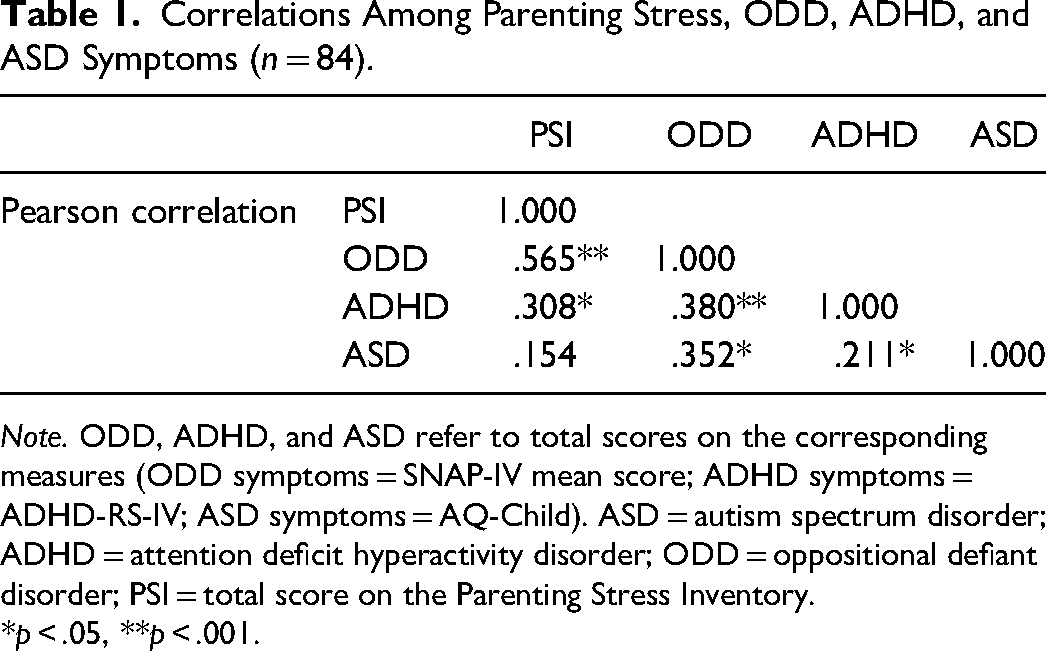
Note. ODD, ADHD, and ASD refer to total scores on the corresponding measures (ODD symptoms = SNAP-IV mean score; ADHD symptoms = ADHD-RS-IV; ASD symptoms = AQ-Child). ASD = autism spectrum disorder; ADHD = attention deficit hyperactivity disorder; ODD = oppositional defiant disorder; PSI = total score on the Parenting Stress Inventory.
*p < .05, **p < .001.
A hierarchical linear regression was used to examine the proportion of unshared variance that symptoms of ODD, ADHD and ASD accounted for in parenting stress. All assumptions were met prior to running the analysis. Predictor variables (symptoms of ODD, ADHD and ASD) were entered into the regression analysis to evaluate the variables as predictors of parenting stress. The hierarchical linear regression showed that R2 was not significantly different between ODD symptoms (Model 1); ODD and ADHD symptoms (Model 2); and ODD, ADHD, and ASD symptoms (Model 3; see Table 2). As predicted in the first hypothesis, symptoms associated with ODD corresponded with the greatest change in R2, meaning that ODD symptoms accounted for the greatest proportion of variance in parenting stress. However, contrary to the second and third hypotheses, ADHD symptoms and ASD symptoms accounted for no additional variance in parenting stress after ODD symptoms were accounted for. See Table 3 for the means and SDs of each of the parenting stress, ODD, ADHD, and ASD measures.
Hierarchical Regression Model Summary of Disorder Symptoms as Predictors of Parenting Stress.
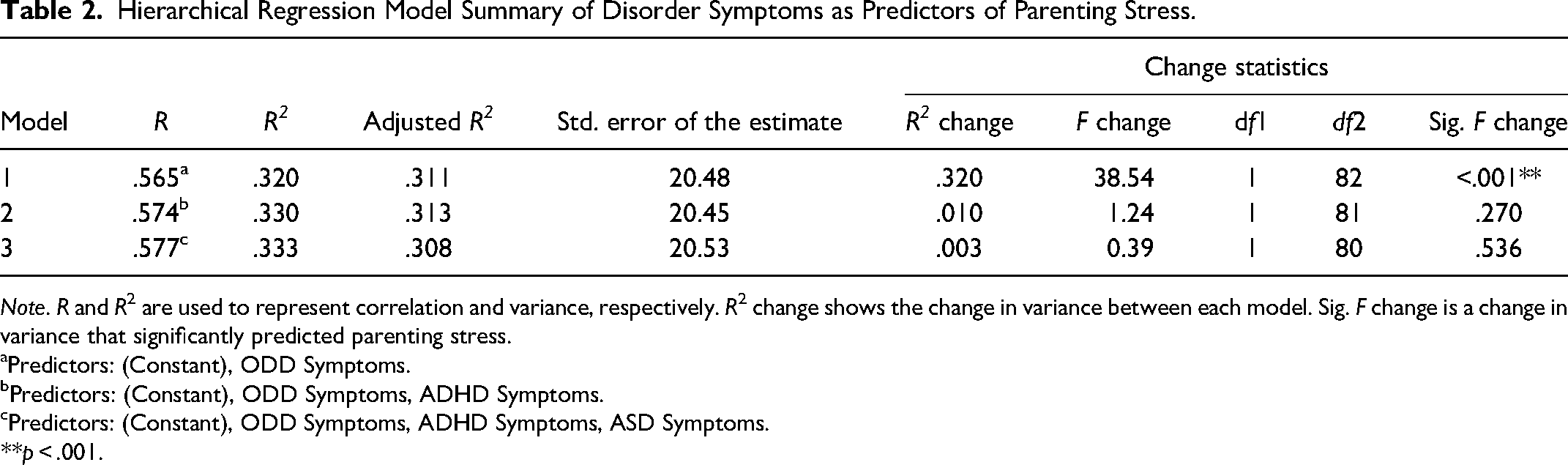
Note. R and R2 are used to represent correlation and variance, respectively. R2 change shows the change in variance between each model. Sig. F change is a change in variance that significantly predicted parenting stress.
Predictors: (Constant), ODD Symptoms.
Predictors: (Constant), ODD Symptoms, ADHD Symptoms.
Predictors: (Constant), ODD Symptoms, ADHD Symptoms, ASD Symptoms.
**p < .001.
Descriptive Statistics of Parenting Stress and Disorder Symptoms (ODD, ADHD, and ASD; n = 84).
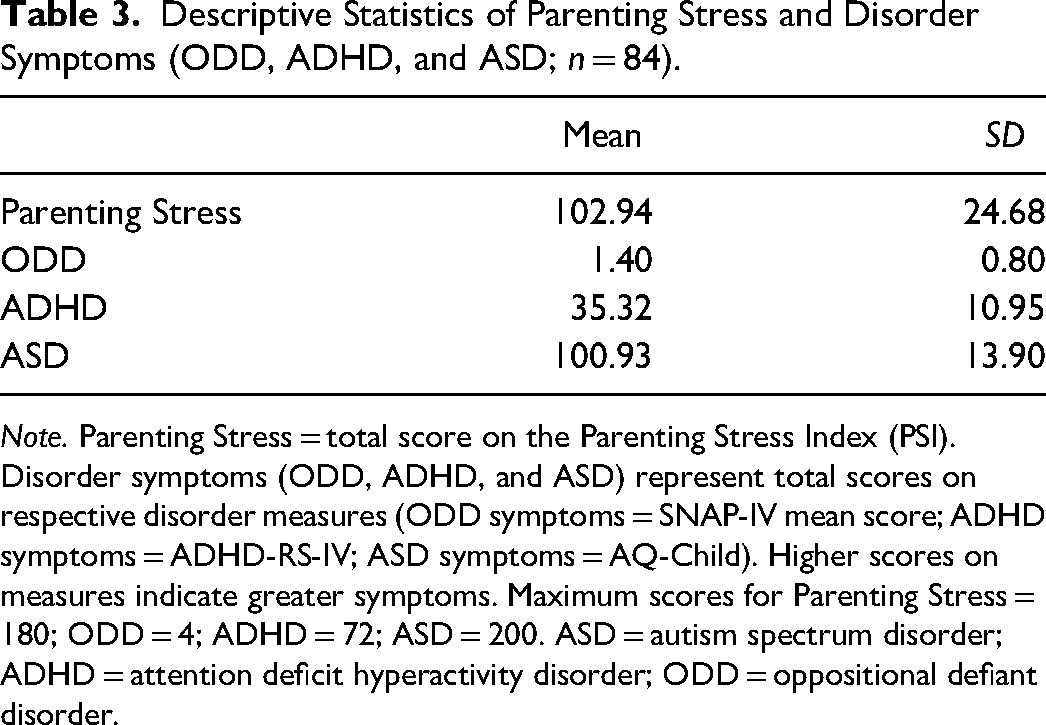
Note. Parenting Stress = total score on the Parenting Stress Index (PSI). Disorder symptoms (ODD, ADHD, and ASD) represent total scores on respective disorder measures (ODD symptoms = SNAP-IV mean score; ADHD symptoms = ADHD-RS-IV; ASD symptoms = AQ-Child). Higher scores on measures indicate greater symptoms. Maximum scores for Parenting Stress = 180; ODD = 4; ADHD = 72; ASD = 200. ASD = autism spectrum disorder; ADHD = attention deficit hyperactivity disorder; ODD = oppositional defiant disorder.
Discussion and Implications
A sample of mothers of sons with ASD was recruited to evaluate symptoms associated with ASD, ADHD, and ODD, and their contribution to elevated levels of parenting stress. As predicted, ODD symptoms were found to contribute the most to mother's reported experiences of parenting stress, whereas ASD symptoms and ADHD symptoms did not contribute above this. This suggests that defiant and disruptive behaviors, which often co-occur with ASD, may be responsible for a large majority of increased parenting stress often observed in this population. Interestingly, ADHD and ASD symptoms did not contribute to mothers’ experiences of parenting stress after ODD symptoms were accounted for. These results were not consistent with initial hypotheses that, after ODD symptoms, ADHD symptoms would account for the second largest proportion of variance in parenting stress, and ASD symptoms would account for the smallest proportion of variance in parenting stress. These findings do support previous research highlighting externalizing behavior problems as strong predictors of parenting stress in ASD, ADHD, and ODD populations (Abbeduto et al., 2004; Blacher & McIntyre, 2006; Davis & Carter, 2008; Hutchison et al., 2016; Ross et al., 1998; Theule et al., 2012; Wiener et al., 2016).
Moreover, in the present study, symptoms of ODD (i.e., angry mood, defiant behavior, and vindictiveness) are most strongly correlated with parenting stress. Symptoms associated with ASD, although not significant, had a stronger relation to parenting stress compared to symptoms associated with ADHD, which is consistent with research suggesting parents of children with ASD experience greater levels of parenting stress compared to parents of children with ADHD (Hayes & Watson, 2013). Although previous research has outlined the role of ODD symptoms in parenting stress, this is the first study to demonstrate that ASD symptoms do not contribute to parenting stress above and beyond the effect of ODD symptoms.
Strengths and Limitations
There are several strengths of the present study. Investigating the contributions of ODD, ADHD, and ASD symptoms in a continuous fashion helps increase understanding of the impacts of these disorder symptoms in a more naturalistic fashion. Homogeneity in other sample demographics—including parent and child gender—allows for clearer generalizability (Jager et al., 2017). This leads to clearer implications for mothers of sons with ASD and ASD + ADHD, which is a population that is vulnerable to significant levels of parenting stress (Dabrowska & Pisula, 2010; Hayes & Watson, 2013; Van Steijn et al., 2014). The current sample also included several comorbid ASD + ADHD cases.
There were limitations associated with the correlational research design used. The current study provides information about the relationship between symptoms associated with ASD, ADHD, ODD, and parenting stress, but it cannot be inferred that these diagnostic symptoms cause elevated levels of parenting stress. Additionally, the variability in ASD symptoms was restricted by limiting our sample to those who had previous diagnoses of an ASD and who continued to experience clinically significant symptoms. This may have reduced our ability to detect a relationship between ASD symptoms and parenting stress. Further, the use of mother-report surveys for child symptoms is a limitation of the present study. Relatedly, the measure used for ODD symptoms was relatively brief. Mothers’ responses may have been biased by a variety of factors (i.e., a felt need to exaggerate, feelings of shame, and difficulty remembering specific details). The social desirability bias should be considered when examining this data, as parents may have felt the need to present themselves in a manner that is more acceptable to society (Rosenman et al., 2011). Despite the potential limitations associated with self-report measures, it is worth noting that parenting stress is a subjective experience. Moreover, in addition to common method variance related to using the same raters for all constructs, the PSI does have some items tapping into behavior problems, which may have inflated some effects.
There are also some limitations associated with the restricted sample used for the current study. The use of a homogeneous sample of mothers and sons with ASD precludes the generalizability of these results to girls with ASD, nor their fathers. Moreover, despite recruiting across North America, the sample consisted of very few mothers residing in the United States, with the majority of mothers residing in Canada. Additionally, a majority of the sample was composed of White mothers. The current study may be used as a starting point to inform future research with broader samples that allow for further generalizability.
Implications
The current study adds to literature by elucidating the differential contributions of ODD, ASD, and ADHD symptoms to elevated levels of parenting stress in mothers of children with ASD. Examining the symptoms of these disorders along a continuum, rather than dichotomously exploring the presence of each disorder, was unique to the current study. This approach is important because—while ASD, ADHD, and ODD are often diagnosed comorbidly in some combination—the symptoms of these disorders can also be present at subclinical levels and understanding the effects of subclinical symptomology is important in supporting families who face varying levels of struggle in managing ODD symptoms.
The current study clarifies the effect of externalizing behaviors on the well-being of parents. Future research should continue examining childhood disorder symptoms continuously in more varied samples to further contribute to understanding the development of parenting stress in families of children with externalizing and/or neurodevelopmental disorders. The present study may inform future interventions for reducing parenting stress by focusing efforts on reducing externalizing behaviors. Future research and clinical work should focus on the experiences of parents with comorbid ASD and ODD symptomology and should investigate the specific impacts of comorbid ASD + ODD in addition to the contributions of ODD symptomology.
Footnotes
Declaration of Conflicting Interests
The author(s) declared no potential conflicts of interest with respect to the research, authorship, and/or publication of this article.
Funding
The author(s) disclosed receipt of the following financial support for the research, authorship, and/or publication of this article: This work was supported by the University of Manitoba (J. G. Fletcher Award).
