



Abstract
Two correlational survey studies were conducted among adult samples (Ns = 205; 697) to test the effects on general life satisfaction of attachment to three close others: mother, father, and romantic partner. Results showed that attachment to mother and father also matter in adulthood, in that they are associated with adult life satisfaction. Secure attachments to mother and father were positively associated with life satisfaction, and anxious and avoidant attachments to mother and father were negatively associated with life satisfaction. Moreover, attachment to the romantic partner was also related to life satisfaction, so that secure attachment was positively related to life satisfaction, and anxious and avoidant attachments were negatively related to the outcome variable. Importantly, attachment to mother and father were still significant predictors of life satisfaction when effects of attachment to the current romantic partner were controlled for. The effects of parental attachments on life satisfaction were not mediated by attachment to the romantic partner. Theoretical and applied implications of the findings are discussed.
Introduction
Across many different life domains, it has been demonstrated that childhood experiences have a long reach, and can affect outcomes well into adulthood. For example, negative experiences during childhood can have long-term effects on the ability to regulate emotions (Rudenstine et al., 2019) and on physical health (Monnat & Chandler, 2015). It has also been proposed that attachments formed with significant others during childhood influence outcomes later on (Bowlby, 1973). This present paper will focus on the concept of attachment, and investigate how emotional attachments to significant others are related to well-being, and particularly general satisfaction with one's life, in adulthood. Specifically, the effects of attachment to the mother and the father, and attachment to a current romantic partner, will be studied. It is predicted that attachment to mother and father will be predictive of life satisfaction even in adulthood alongside attachment to a romantic partner, which is also expected to predict life satisfaction. Crucially, it is expected that attachment to the parental figures will predict life satisfaction even when controlling for attachment to the romantic partner, and that effects of parental attachments will not be due to - i.e., will not be mediated by- attachments to the romantic partner.
Attachment to Mother, Father, and Romantic Partner
Attachment theory proposes that young children develop attachments to their primary caregivers, and that those attachmetns fundamentally shape how children act and what they expect within close relationships (Bowlby, 1969; 1973). While some children will learn to trust that significant others will reliably offer support in the presence of threat and in times of need, others will learn that the primary caregiver cannot be relied upon. The three major attachment styles that might be developed on the basis of early experiences are: secure, anxious-ambivalent, and anxious-avoidant attachment. Secure children seek closeness to the caregiver in times of threat, and trust that the caregiver is reliable. Anxious-ambivalent children do not feel that the caregiver can be relied upon consistently, and they fear abandonment. Anxious-avoidant children have, in some ways, given up on the caregiver; they assume that no support will be offered by the caregiver, and they become compulsively self-reliant as a result. Much research has linked secure attachment to a wide range of positive outcomes (see e.g., Birnbaum et al., 2006), ranging from emotion regulation (Gambin et al., 2021) to peer and academic competence (Diener et al., 2008), to effective caregiving (Feeney, 1996; Feeney & Collins, 2001; see also Simpson & Rholes, 2012).
Most studies on attachment have focussed on attachment to the mother (Diener et al., 2008). Attachment to the fathers has received comparatively little attention (de Minzi, 2010), although there is now an increasing appreciation for the importance of attachments to the paternal figure (Bureau et al., 2017; Cowan et al., 2019; Di Folco et al., 2017; Doyle & Markiewicz, 2009; Duchesne & Ratelle, 2014; Emmanuelle, 2009; Gambin et al., 2021; Gomez & McLaren, 2007; Kobak et al., 2005; Marsa-Sambola et al., 2017; Umemura et al., 2017; Veríssimo et al., 2011).
It has been proposed that attachment styles formed in relation to primary caregivers during infancy and childhood can then be generalized to other close relationships and inform how people relate to others later in life (Bowlby, 1973). So, for example, someone who was insecurely attached to his or her primary caregiver is likely to manifest the same attachment issues in relation to later romantic partners (Hazan & Shaver, 1987). Having said this, some scholars question whether attachment styles remain invariant across the lifespan (see e.g., La Guardia et al., 2000; Spangler, 2016; Waters et al., 2000).
Irrespective of the question of whether attachments to primary caregivers are later reenacted in other close relationships or not, it is clear that the attachment concept can be successfully applied not only to relationships with primary caregivers and parents during childhood, but that it is also explanatory of adult relationship dynamics. Hazan and Shaver (1987) in particular have demonstrated that secure, anxious and avoidant attachment styles can also be identified in the ways adults relate to their romantic partners.
Effects of Attachment on Life Satisfaction
The present paper will study the association between attachments to mother, father, and romantic partner on the one hand and life satisfaction on the other. Life satisfaction is a concept that describes overall satisfaction with life as a whole, measured at a very global level and not focussing on specific life domains or dimensions (Diener, 2000; Pavot & Diener, 1993). General well-being in the form of life satisfaction is an important concept, because it has been shown to be associated with many important outcomes, for example academic achievement (Bücker et al., 2018) and mental health (Sullivan et al., 2020). Understanding what predicts general life satisfaction is therefore of particular pertinent.
There are several theoretical reasons for why one would expect secure rather than insecure attachments with the parents to be related to greater life satisfaction. The need to belong and be positively connected to others is a fundamental human need (Baumeister & Leary, 1995), and a lack of social connection has been linked to adverse psychosocial and physical health outcomes (Hawkley & Cacioppo, 2010). Moreover, parental approval or the lack thereof can have an impact not only during childhood but also during adulthood, as has been demonstrated, for instance, in the domains of drug abuse and gambling (Rahman et al., 2014; Reboussin et al., 2019). Because of the powerful effects experiences during formative years and relationships to primary childhood caregivers have throughout the lifespan (Monnat & Chandler, 2015; Rudenstine et al., 2019), and because many people continue to maintain meaningful close relationships with their parents into adulthood, one can expect that attachment to mother and father might affect life satisfaction also for adults. One would therefore expect that damaged attachments to the mother and father will adversely affect life satisfaction even in adulthood.
Of course, although good relations to one's parents are important to many adults, the relationship of primary importance is, however, often that with the romantic partner. Insecure attachments to the romantic partner can therefore also be expected to be adversely related to life satisfaction. Humans are social beings, and secure connections with significant others will positively affect well-being generally and life satisfaction specifically. This should hold true both for attachments to the romantic partner, but also to attachments to other significant others such as the parents.
Indeed, previous research has found systematic relationships between adult attachment and life satisfaction. Generally, secure attachments have been found to be positively associated with life satisfaction, and insecure attachments negatively (Hinnen et al., 2009; Kirchmann et al., 2013; Laghi et al., 2016; Molero et al., 2017). The same patterns have been found for other indicators of well-being that can be assumed to be related to life satisfaction (see e.g., Karreman & Vingerhoets, 2012; Keizer et al., 2019; Sadava et al., 2009).
Having said this, there are some important questions that the existing literature cannot easily answer. There is considerable variability in the types of attachment that have been measured. Some studies have measured attachments within adult close relationships in general. These relationships need not necessarily be with a romantic partner, but can also be with other close others such as friends (using items such as ‘I find it easy to get engaged in close relationships with other people’ or ‘My desire to be very close sometimes scares people away’; e.g. Galinha et al., 2014; Gnilka et al., 2013; Karreman & Vingerhoets, 2012; Wright et al., 2017; Wright & Perrone, 2010). Some studies have measured attachments not to concrete romantic partners, but to hypothetical romantic partners, or potential romantic partners in general (e.g., ‘I prefer not to show a partner how I feel deep down’; e.g., Lavy and Littman-Ovadia, 2011; ‘I worry that romantic partners won’t care about me as much as I care about them’; Lane et al., 2017).
It transpires, then, that much previous work has not actually measured both life satisfaction and attachment to a concrete romantic partner, as we do here - for a couple of exceptions, see Hinnen et al. (2009) and Molero et al. (2017). Moreover, very few studies have measured attachments to mother and father in relation to life satisfaction, as we do here – for exceptions, see Laghi et al. (2016) and Nickerson and Nagle (2004). Further, the previous studies that have focussed on the specific attachments of interest here have attended to either attachments to parents or attachments to a romantic partner, but not both (for one exception, see Guarnieri et al., 2015). This leaves open the question of how these two types of attachments, to parents and to partner, relate to each other in their predictiveness of adult life satisfaction.
As will have become clear, there is a gap in the research in testing whether both parental and romantic attachments will still be important predictors when controlling for the respective other variable. It is unknown whether attachments to parents might only be important because they affect attachment to romantic partners, and through this life satisfaction, or whether attachments to parents still have powerful predictive effects in their own right, even in adulthood. Scholars who argue that childhood attachments to the parents inform later adult attachments might expect that parental attachments have an indirect effect on life satisfaction via romantic attachments, whereas scholars who argue that childhood attachments do not necessarily predict later adult attachment styles would not expect such mediation.
The present research aimed to address the question of how attachments to mother and father on the one hand and attachments to the romantic partner on the other are related to each other in their predictiveness of general life satisfaction. Because, as seen above, many adults still care deeply about their parents, and because clearly problems or harmony in romantic relationships strongly impacts on people's emotional state, we expected that romantic attachments would impact life satisfaction, but that attachments to mother and father would do too, and that the latter would be significant even when controlling for effects of attachment to the romantic partner.
The Present Research
It was hypothesized that attachment to mother and father predict life satisfaction in adulthood. It was expected that secure attachment to mother and father would be positively associated with life satisfaction, and that anxious and avoidant attachments to mother and father would be negatively associated with life satisfaction (H1). Further, it was predicted that attachment to romantic partners would also be related to life satisfaction in the same way (negative assocaitions for anxious and avoidant attachments, positive association for secure attachment, H2). Last but not least, it was tested whether attachment to mother and father would still be significantly associated with life satisfaction when effects of attachment to the current romantic partner are controlled for, and whether the effects of parental attachments on life satisfaction would stand in their own right and not be channelled through, and mediated by, attachment to the romantic partner (H3). These questions are important, because ultimately insights about correlates of life satisfaction might provide clues on how to enhance human happiness. An important innovation of this contribution was to attempt to consider several potentially important social connections as once, whereas previous work has often focussed on only one type of connection at a time. The hypotheses were tested in two online survey studies.
Study 1
The purpose of study 1 was to provide an initial test of the importance of the effects of parental attachments on life satisfaction among an adult sample. To achieve a sufficiently large sample size, attachment to the romantic partner was not assessed, because we did not want to limit participation only to those who were romantically involved at the time of the study. Nonetheless, an initial test focussing just on the attachments to mother and father can be informative about their unique impact on adult well-being, especially as there still is a paucity of research focussing on attachments to fathers as well as mothers.
Method
Participants
On the basis of previous findings reported in the literature reviewed above, an a priori power analysis was conducted with G*Power for a regression slope of .2, and alpha level of .05, and a requested power of at least .80, to get an indication of a minimum required sample size. This yielded a sample of 150.
Two hundred and five participants completed the study online in 2019. The study was advertised on social media (Facebook, Twitter, Instagram). The study was live and accessible for a period of approximately 4 weeks, and everyone who agreed to participate in that time was included in the sample. No monetary compensation was offered, but as an incentive participants were entered into a raffle for online vouchers. There were 145 female and 60 male participants. The mean age was 24.72 years (SD = 4.60). This cross-sectional correlational study included the following measures:
Measures
Attachment to the mother and father was measured separately for each parent but using identical items, which were based on the items taken from Fraley et al. (2000). While Fraley's original items were about close adult relationships in general, they were adopted here to focus on parental attachment. Items were measured on a 7-point scale (1 = ‘strongly disagree’ to 7 = ‘strongly agree’). Participants were instructed to think about their relationship with their [mother/father]. Four items measured secure attachment: ‘I will turn to my mother/father in times of need’; I usually discuss my problems and concerns with my mother/father; I talk things over with my mother/father’; and ‘I find it easy to depend on my mother/father’, α = .93 for mother and α = .93 for father. Three items measured anxious attachment: ‘I often worry that my mother/father does not really care for me’; ‘I’m afraid that my mother/father may abandon me’, and ‘I worry that my mother/father won’t care about me as much as I care about her’, α = .75 for mother and α = .72 for father. Two items measured avoidant attachment: ‘I don’t feel comfortable opening up to my mother/father’; and ‘I prefer not to show my mother/father how I feel deep down’, α = .78 for mother and α = .85 for father.
General life satisfaction was measured with a 3-item scale based on Diener et al. (1985). Items were measured on a 7-point scale (1 = ‘strongly disagree’ to 7 = ‘strongly agree’). Items were ‘In most ways my life is close to my ideal’; ‘The conditions of my life are excellent’; and ‘I am satisfied with my life’, α = .88.
The questionnaires for both studies also included a number of other questions included to test different hypotheses (e.g., about roles assumed within the family growing up), and these measures will not be discussed further here. None of the other measures were relevant for the present hypotheses, and there were no alternative measures for the concepts studied here that would need to be reported. All aspects of the research for both studies were in line with American Psychological Association (APA) and British Psychological Society (BPS) ethics guidelines. The data for both studies is available here: https://osf.io/6cnpe/?view_only=dd7f988e92964cde8327142ebaabeed8.
Results and Discussion
Descriptives and bivariate correlations for all measures are displayed in Table 1. As can be seen in Table 1 and in line with what would be expected theoretically, secure and insecure attachments to the same parent were, although measurable as separate constructs, quite highly correlated (e.g., secure and avoidant attachments to the father correlated -.66).
Bivariate Correlations for Study 1 (N = 205) Above the Diagonal & Study 2 (N = 697) Below the Diagonal.
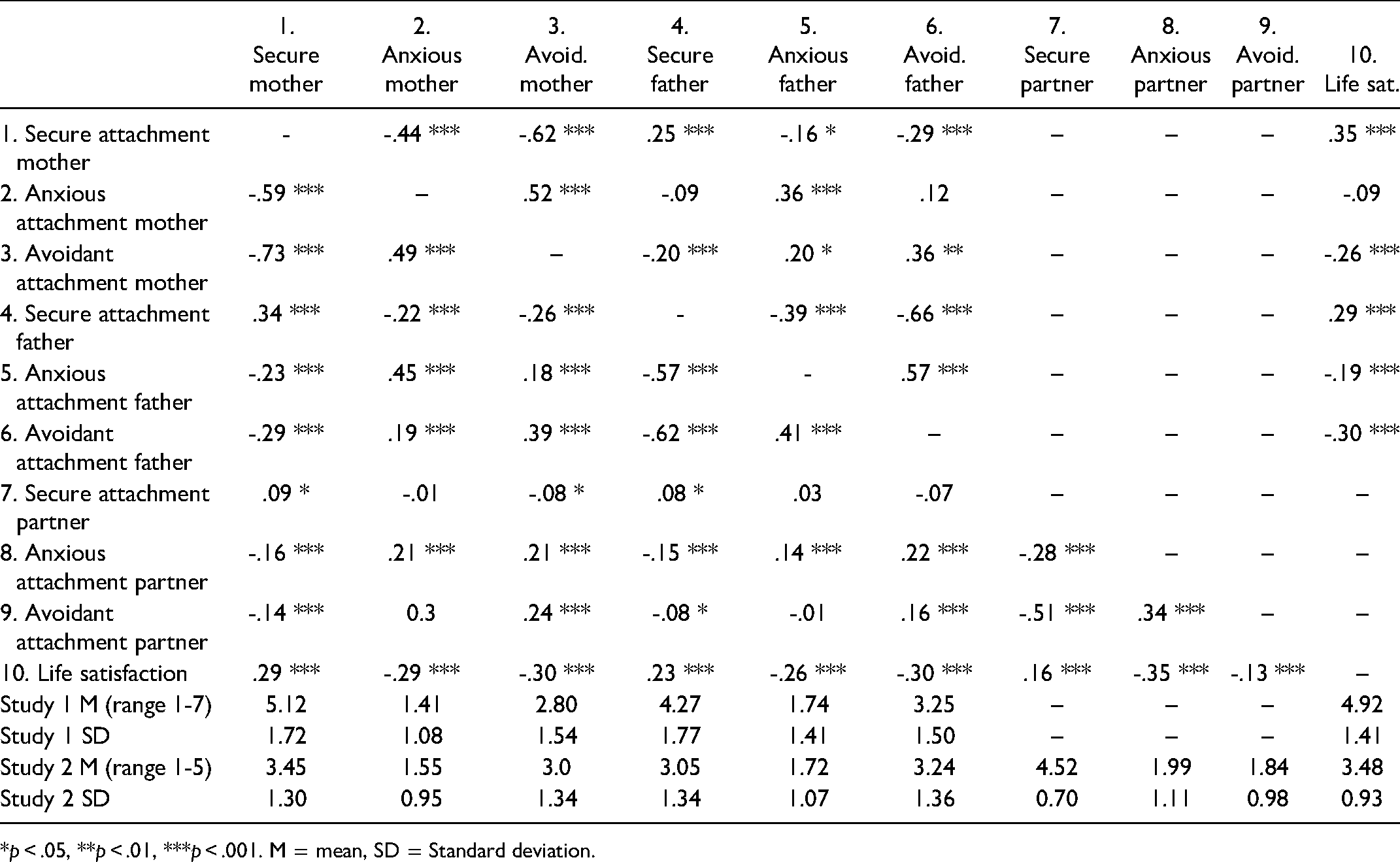
*p < .05, **p < .01, ***p < .001. M = mean, SD = Standard deviation.
Three regression analyses were conducted. The first analysis tested the effects of secure attachment to mother and father as two simultaneous predictors of life satisfaction, the second analysis tested the effects of anxious attachment to both figures, and the third analysis tested the effects of avoidant attachment to both figures. Results are displayed in Table 2.
Regression Results Predicting Life Satisfaction for Study 1 (N = 205) & Study 2 (N = 697).
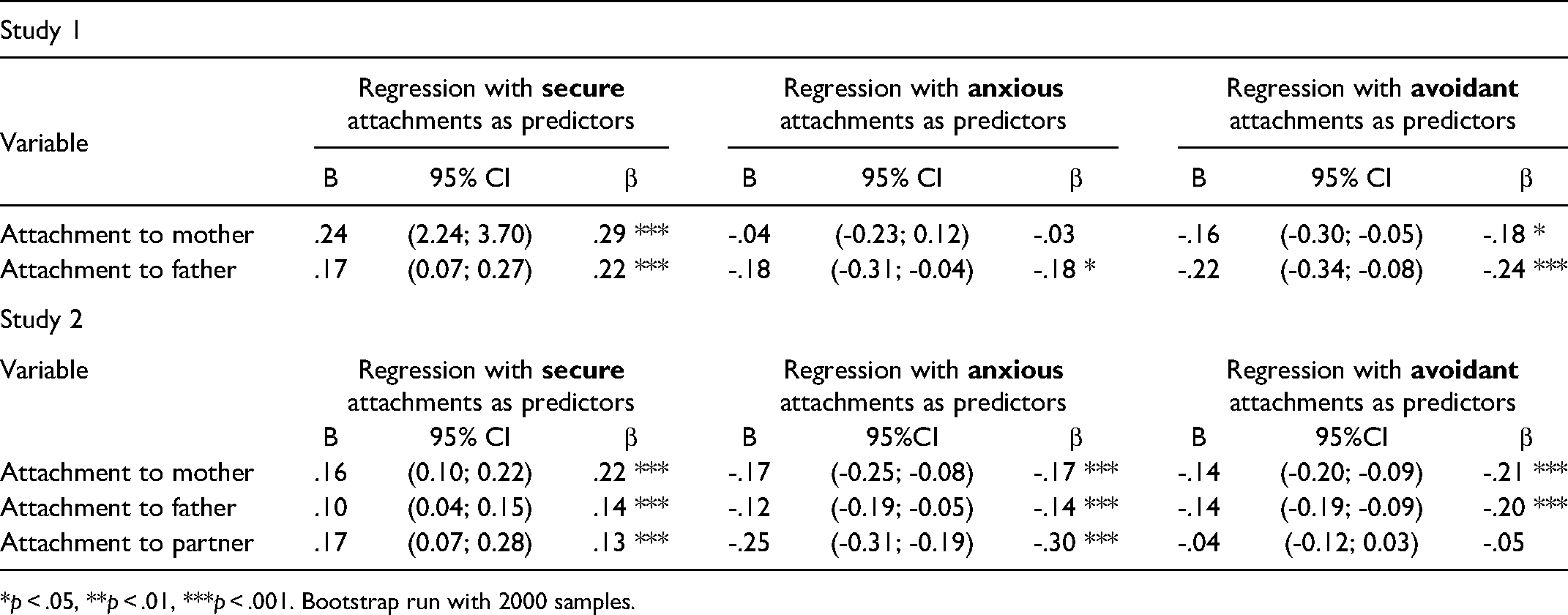
*p < .05, **p < .01, ***p < .001. Bootstrap run with 2000 samples.
The overall regression with secure attachments as predictors of life satisfaction was significant, R2 = .16, F (2, 199) = 19.49, p < .001, as was the overall regression with anxious attachments as predictors, R2 = .04, F (2, 199) = 3.89, p < .05, as was the overall regression with avoidant attachments as predictors, R2 = .12, F (2, 199) = 13.59, p < .001.
As can be seen in the table, results were in line with H1. Secure attachments to both mother and father were positively related to life satisfaction, and both anxious and avoidant attachments to both mother and father were negatively related to life satisfaction. This held true across all three regressions that were run, with the exception of anxious attachment to the mother, which did not reach significance in this study.
These results confirm the long reach of parental attachments into adulthood: attachments to parents are related to well-being, in the form of general life satisfaction, among these adult participants. However, study 1 did not include a measure of attachment to the romantic partner. This was rectified in Study 2, which included only participants that were romantically involved at the time of the study, and hence were able to respond to items about their attachment to their romantic partner. The aims of Study 2 were 1) to replicate the findings of Study 1 with regards to the importance of attachments to mother and father for life satisfaction, to 2) demonstrate in addition the importance of attachment to the romantic partner for predicting the outcome, and last but not least 3) to confirm that attachments to mother and father would still matter, even when controlling for contemporaneous effects of attachments to the romantic partner, and that parental attachments have a direct effect on life satisfaction, rather than an indirect effect via other adult attachments.
Study 2
Method
Participants
Six hundred ninety seven participants completed the study online. As before, the study was advertised on social media, but Study 2 was conducted after a significant time lag (at the start of 2021), and there was no overlap between the participants in the two studies. The sample of Study 2 included participants who indicated that they were currently romantically involved and who were hence able to answer questions about attachment to their current romantic partner. The study was designed in such a way that the first part consisted of questions answerable by anyone, also those who were single (e.g. attachment to parents), and the second part was displayed only for those participants who were romantically involved. Hence, the N = 697 utilized here are the romantically involved sub-sample of a larger sample.
The study was live and accessible for a period of 4 weeks, and everyone who agreed to participate in that time was included in the sample. No monetary compensation was offered, but again participants had the option of being entered into a raffle for online vouchers. There were 501 females, 175 males, and 21 participants who indicated a different gender identity or had missing data on this question. The mean age was 31.07 years (SD = 13.07).
Measures
Attachment to the mother and father was measured with the same items as in Study 1, based on Fraley et al. (2000). However, this time items were measured on a 5-point scale (1 = ‘strongly disagree’ to 5 = ‘strongly agree’). All scales had acceptable reliability: secure attachment: α = .93 for mother and α = .92 for father, anxious attachment: α = .86 for mother and α = .89 for father, and avoidant attachment: α = .86 for mother and α = .86 for father.
Participants were also asked to think about how they feel about their current romantic partner, and the same items as before were used to measure attachment to the partner, e.g. by asking ‘I will turn to my partner in times of need’, secure attachment: α = .89, anxious attachment: α = .85, and avoidant attachment: α = .77.
Life satisfaction was measured with the same items as for Study 1, again based on Diener et al. (1985). Items were measured on a 5-point scale this time (1 = ‘strongly disagree’ to 5 = ‘strongly agree’), α = .85.
Results and Discussion
Descriptives and bivariate correlations for all measures are displayed in Table 1. Again, three separate analyses were conducted, first for the effects of secure attachment to mother, father, and partner as three simultaneous predictors of life satisfaction, second to test the effects of anxious attachment to mother, father, and partner, and third to test the effects of avoidant attachment to all three figures. Results are displayed in Table 2.
The overall regression with secure attachments as predictors of life satisfaction was significant, R2 = .12, F (3, 684) = 29.66, p < .001, as was the overall regression with anxious attachments as predictors, R2 = .19, F (3, 682) = 54.06, p < .001, as was the overall regression with avoidant attachments as predictors, R2 = .13, F (3, 682) = 33.71, p < .001.
As can be seen in the table, results were in line with H1, H2, and H3. Secure attachments to mother, father, and partner were all positively associated with life satisfaction, and anxious attachments to all three figures were negatively related to life satisfaction. Mirroring the results of Study 1, again avoidant attachment to mother and father were negatively related to life satisfaction, but interestingly avoidant attachment to partner was not significant.
These results clearly demonstrate that attachment to parents affects life satisfaction even for adults (H2), and even when attachment to the partner is controlled for (H3). The fact that parental attachments still had a significant effect even when controlling for romantic attachment as a simultaneous predictor also suggests that the effects of parental attachments on life satisfaction are direct, rather than mediated via romantic attachment: in the case of mediation, one might expect the effects of parental attachments to disappear once the mediator is included in the analysis.
Next, structural equation models (SEMs) were estimated, to yield even further evidence that parental attachment is important in its own right, and not only via attachment to romantic partners. Three models were built. In the first model, secure attachment to mother and father (which were also allowed to covary) predicted secure attachment to the romantic partner, which in turn predicted life satisfaction. Direct paths from parental attachments to the outcome variable were not included in the model. If indeed the effects of parental attachment on life satisfaction were to be channeled through attachment to the partner, one would expect this mediation model to fit the data well. However, if effects of parental attachment on life satisfaction is not channeled through attachment to the partner, the model should not fit well. In line with the predictions of H3 that attachment to parents has a unique direct effect on life satisfaction in its own right, and not via romantic attachment, the mediation model did not fit the data well, χ2 (2) = 66.53, p < .001, CFI = .61, RMSEA = .22.
Two further models were calculated, one where anxious attachment to mother and father were mediated via anxious attachment to the partner, and one were avoidant attachment to mother and father were mediated via avoidant attachment to the partner. In line with the predictions of H3, which proposed that the effects of parental attachment would be direct rather than mediated through romantic attachments, neither of these models fittted either, χ2 (2) = 54.59, p < .001, CFI = .83, RMSEA = .19 for the model on anxious attachment, and χ2 (2) = 84.65, p < .001, CFI = .66, RMSEA = .24 for the model at avoidant attachment.
General Discussion
Across two studies, evidence was found that attachment to mother and father are strongly related to life satisfaction, even among adult samples. Moreover, the second study in addition demonstrated that attachments to the romantic partner are also associated with life satisfaction. Last but not least, the second study confirmed that effects of attachments to mother and father are still significant even when controlling for attachment to the current romantic partner, and that the effects of parental attachment on general well-being were not due to an indirect effect via attachment to the romantic partner.
Together, the two studies make several important contributions. First, they emphasise the importance of situating attachment theory into the life course: attachments are important beyond childhood, but the importance of attachments does not simply move from early attachment figures (e.g., the parents) to current attachment figures (e.g., the partner). Instead, the importance of attachments to early important others lives on, long beyond the limits of childhood. Second, much prior research has not particularly considered father-attachments, and the present results clearly demonstrate that this is needs to be rectified, because fathers are clearly important in people's lifes. Third, the present research demonstrates that it is vital to simultaneously consider attachments to differnt significant others (i.e., both parents and current partners), because different attachments can all have unique effects. An important innovation of the present study was that it considered the effects of attachments to both parents and concrete romantic partners simultaneously, thereby making possible to estimate their respective effects whilst controlling for each other, and to also consider (and, in this case, dismiss) the possibility of sequential effects between them. Fourth, the findings speak to the question whether early attachments shape and dictate later attachments, and whether effects of childhood experiences on later life outcomes might be mediated and explained by indirect effects of early styles of relating to important others being transferred onto later important others. The current findings suggest that this is not the case.
These results have several important theoretical implications. First, as indicated above there is disagreement within the attachment literature on whether early attachments formed in relation to primary caregivers determine styles of relating to significant others later on in life. While some scholars propose that those who are securely attached to primary caregivers in childhood will go on to be securely attached in their close adult relationships, other scholars (e.g., La Guardia et al., 2000) have emphasized variability across attachment targets that contradict such a deterministic view. The present findings lend weight to the argument against determinism: correlations between attachments to mother and father on the one hand and attachment to the romantic partner on the other were only modest, and effects of parental attachments on well-being were not due to (mediated by) parental attachments having affected modes of relating to the romantic partner.
Second, the findings speak to the enduring importance of parent-offspring relationships. Much research has been dedicated to the ways in which children are attached to their primary caregivers, especially the parents. Moreover, a substantial amount of research has focussed on attachment within romantic relationships. In contrast, less research has focussed on attachments of adult children to their parents. However, clearly parental influence does not stop magically once children turn 18. Adult children continue to have relationships with their parents, and these relationships might well (as suggested by the present findings) have important effects on their lifes (e.g., Blair and Madigan, 2019). The present findings can hopefully help highlight the importance of studying child-parent attachments beyond childhood and into adulthood. This could be an exciting topic for future research.
Of course, the present research is not without limitations. Most importantly, the correlational nature of the data does not afford certainty over the causal direction of effects. Experimental or – failing that – longitudinal data would be needed to be sure that it is in fact attachments influencing life satisfaction, rather than vice versa.
Another limitation is that, like many previous studies, the present study only does justice to a selection of potential attachments. Clear evidence was generated that attachments to mothers, fathers, and partners matter. At the same time, relationships with friends, children, pets, colleagues and others were omitted. A larger-scale investigation could cast a wider net, and shed light on the potential effects of those other relationships for general life satisfaction, a concept that has been linked to so many important outcomes.
Avenues for further exploration organically emerge from the reflections above. Future work could focus the attention on the importance of child-parent relationships and attachments beyond childhood and into adulthood. Many adults have very meaningful relationships with their parents (be they positive or negative in nature); yet the psychological literature has little to say about this, and this is worth addressing. Moreover, with reference to the important construct of general life satisfaction, although the present research gives an indication of the influence of attachments to mothers, fathers, and partners, many other attachments might play a crucial role, and future research could explore this further.
Also, in the present paper attachments to the parents were assessed with a focus on the present, rather than the past (e.g. ‘I talk things over with my mother’ rather than ‘during childhood, I talked things over with my mother’). However, clearly both dynamics present and past might impact on well-being outcomes (Zagefka et al., 2021). Hence, another interesting question is to which extent present-day and past attachments to parents match, and the potential effects on important outcomes in cases where there is subjectively perceived change in the attachment bond (for the better or the worse). Again, future research could explore this. Finally, some scholars have proposed refinements of the attachment style categories originally identified by Bowlby (1969). For example, Bartholomew and Horowitz (1991) describe four styles: secure, dismissing, preoccupied, and fearful. Others (e.g., Lieberman et al., 1999) have suggested that secure attachment should be split into components of parental availability and child dependency on parents. The questions investigated here could also be investigated within a framework that considers the more nuanced attachment orientions that have been proposed.
There are some clear applied implications of the findings. Being satisfied with life as a whole depends on having healthy, secure attachments to and relationships with others. A lack of meaningful connection will be detrimental to psychological health, which is why initiatives that improve social relationships (e.g., www.campaigntoendloneliness.org) are so important. Crucially, the present results suggest that relationships with parents have an important role to play in the enhancement of well-being, not only for children but also for adults. In sum, the present contribution highlights the important role played by social relationships and social connections – human well-being is relationship dependent. Life satisfaction is contingent on bonds with others, such as romantic partners and parents. No man (or woman) is an island.
Footnotes
Declaration of Conflicting Interests
The authors declared no potential conflicts of interest with respect to the research, authorship, and/or publication of this article.
Funding
The authors received no financial support for the research, authorship and/or publication of this article.
