




Abstract
Are Afrodescendant candidates more likely than white candidates to retire following electoral defeat? Numerous studies examine the emergence and electoral success of racial minority candidates, but we know remarkably little about how they respond to electoral defeat. There is reason to suspect that defeated racial minority candidates are less likely than defeated white candidates to run again because they are treated differently by political elites and members of the public. Using data from Brazilian elections and a regression discontinuity design, however, we present compelling evidence that Afro-Brazilian candidates who barely lose are just as likely as defeated white candidates to compete in subsequent elections. These findings challenge assumptions about racial disparities in political resilience and the prospects for closing Brazil’s racial representation gaps.
Keywords
Introduction
It is common for politicians to run for elected office multiple times before winning. Studies suggest that defeated candidates often perform better in subsequent elections because they learn from defeat—they start fundraising earlier, build stronger support networks, enhance their name recognition, and refine their campaign message to resonate with voters (Anagol and Fujiwara 2016; Campos Fernandez Hott and Menezes-Filho 2024; Haime, Vallejo, and Schwindt-Bayer 2022). Yet not all defeated candidates run again. Oftentimes, they retire from electoral politics.
Why do some defeated candidates run again while others withdraw from politics? Research on political ambition indicates that candidates behave strategically and emerge when the rewards of running and winning exceed the costs (Lazarus 2008; Maisel and Stone 1997; Shames 2017). The costs of running are arguably higher for some than others. Politicians of color are commonly threatened, harassed, and attacked (Erikson, Håkansson, and Josefsson 2023; Gorrell et al. 2019; Guerin and Maharasingam-Shah 2020; Håkansson & Lajevardi, 2025). Some evidence suggests that party leaders and the donor class are also less supportive of aspiring racial minority politicians (Herndon 2018; Janusz 2022; Ocampo and Ray 2020; Sorensen and Chen 2024). Considering how costly it is for politicians of color to run for office, defeated candidates of color may be less inclined than their white counterparts to pursue subsequent bids for office.
In this article, we estimate racial differences in candidate persistence in Brazil, Latin America’s most populous democracy. In recent years, the number of Afrodescendant candidates running for political office has surged. Their electoral participation is particularly notable at the local level. In 2024, more than half of all city council and mayoral candidates identified themselves as Afrodescendant. The growing racial diversity of Brazil’s candidate fields may be regarded as evidence that Brazil is making progress toward racial equality. Nonetheless, the vast majority of Afrodescendant candidates have been defeated. How they respond to defeat has critical implications for political representation and the quality of Brazilian democracy.
We use a regression discontinuity design and data from local elections to estimate the causal effect of losing an election on the likelihood of running again for Afrodescendant and white candidates. We focus on candidates in two different types of elections: city council races and mayoral contests. These elections provide the opportunity to explore how variation in electoral rules shapes patterns of reemergence while holding constant potentially confounding factors. We find that first-time candidates in both types of elections who narrowly lost were less likely to run again than those who narrowly won. In contrast to expectations, though, our analysis indicates that narrowly losing reduced the likelihood of running again to a similar extent for Afrodescendant and white candidates in both types of elections. Our results suggest that Afrodescendant politicians are no more disillusioned by defeat than white candidates and show that party elites are willing to nominate them to run again.
Our study contributes to the literature on electoral politics in three important ways. First, we broaden the study of political ambition by focusing on the decision-making behavior of defeated candidates. While there is considerable research on how officeholders decide whether to seek reelection, higher office, or retire (e.g., Black 1972; Kiewiet and Zeng 1993; Schlesinger 1966), a few studies examine the behavior of losing candidates. Given that most candidates do not win, this constitutes an important gap in the literature. Second, research on persistence to date focuses primarily on whether men and women respond differently to defeat (e.g., Bernhard and de Benedictis-Kessner 2021; Dolan and Shah 2020; Peveri and Sangnier 2023; Vallejo 2024; Wasserman 2023). Our study is the first to assess racial differences in electoral persistence. The results indicate that gender, but not race, conditions candidates’ responses to electoral defeat in Brazil. Finally, we contribute to scholarship on elections by exploring how defeat affects the composition and quality of the candidate pool. Building on the findings of Haime, Vallejo, and Schwindt-Bayer (2022), which show that candidates in Brazil who ran for elected office, but lost, are more likely to win when they run in future elections, our analysis suggests that the representation of marginalized racial groups is likely to increase in the future.
Candidate Supply—Who Runs and Who Runs Again?
In many democracies, racial and ethnic minorities are not represented in proportion to their population size (Clark 2019; Dancygier et al. 2015; Htun 2016; Lajevardi, Mårtensson, and Vernby 2023). A common explanation for these persistent disparities is voter bias. While some studies indicate that voters discriminate against racial minority candidates, evidence suggests it is not the primary source of social bias (Norris and Lovenduski 1995). In many elections, voters cannot discriminate against racial minority candidates because they are not on the ballot (Janusz 2022; Juenke 2014; Norris and Lovenduski 1993; Shah 2014). In short, the underrepresentation of racial minority politicians is attributable to insufficient candidate supply.
Running for office typically requires political ambition—that is, a willingness to consider seeking elected office—so individuals who lack such ambition are unlikely to enter as candidates (Schlesinger, 1966). Research on ambition in Western industrialized democracies reveals that racial minorities are just as politically ambitious as members of dominant groups. Allen and Cutts (2018) find no racial differences in political ambition in Britain, and Tolley (2023) reports that racial minorities are just as ambitious as whites in Canada. In the United States, Black and Latino survey respondents are just as likely as whites to have considered running for office and Black respondents are more likely than others to have “seriously considered” doing so (Lawless 2012). Shah (2014, 2015) corroborates that Black Americans are just as politically ambitious as their white counterparts using data on candidates’ paths to public office. These findings suggest that other factors, such as party recruitment practices and candidate selection processes, explain why racial minorities run for elected office at lower rates than members of dominant groups.
Party elites influence the likelihood that individuals run for office through their recruitment activities (Hazan and Rahat 2010; Norris and Lovenduski 1995; Sanbonmatsu 2010; Tolley 2023). By encouraging latent candidates, party leaders can increase their interest in holding public office and willingness to run (Broockman 2014; Lawless and Fox 2010). Parties can benefit from nominating racial minorities, yet research indicates that party gatekeepers do not always invest in diversifying their candidate slates (Barbour et al. 2013; Dancygier 2018; Hazan and Rahat 2010; Lawless 2012; Moncrief, Squire, and Jewell 2001). Moncrief, Squire, and Jewell (2001) as well as Lawless (2012) find that racial and ethnic minorities in the United States are significantly less likely than white individuals to be encouraged to run for office. One reason party elites may not encourage candidates of color to run for office is that they do not believe they can win. For example, Doherty, Dowling, and Miller (2019) report that party chairs in the United States perceive white candidates as more electable than candidates of color.
Although party gatekeepers influence the candidate pool, prospective politicians ultimately decide whether or not to run for office. Theories of political ambition indicate that politicians weigh the costs and benefits of running as well as their chances of winning before deciding to throw their hat in the ring (Black 1972; Jacobson and Kernell 1983; Maisel and Stone 1997). Research suggests that the racial composition and partisan makeup of the electorate, the history of the seat, and the degree of competition inform candidates’ cost-benefit calculus (Fraga, Gonzalez Juenke, and Shah 2020; Ocampo and Ray 2020; Shah 2014). When the costs of running are high and the prospects for winning are low, aspiring racial minority candidates are expected to wait for a better opportunity. Nevertheless, even when conditions appear favorable and they are on the ballot, victory is not guaranteed. Shah (2015) reports that 66.6 percent of Black candidates in Louisiana between 1990 and 2010 were defeated the first time they ran for office. The political careers of racial minorities therefore often depend on their resilience. Theories of political ambition, however, offer limited insights into how candidates respond to electoral setbacks.
Race, Rejection, and Rerunning
Research suggests that the costs of running for public office are higher for certain kinds of candidates than others (Fox and Lawless 2004; Ocampo and Ray 2020; Stone and Maisel 2003). Unlike first-time candidates, politicians who have run before are acutely aware of the costs associated with standing for office. They know firsthand how expensive modern campaigns are and how challenging it is to finance them. They also understand how difficult it is to cultivate electoral support. Finally, experienced candidates recognize that running for office can have negative consequences on their lives. Campaigning invites public scrutiny, imposes financial burdens, requires prolonged time away from family, and exposes them to hostility and violence. Given their personal knowledge of the costs associated with running for office, there is reason to suspect that the candidates most likely to run again are those for whom these costs are relatively low.
The cost of running again is arguably lowest for political incumbents. They control extensive resources, possess institutional privileges, and benefit from media exposure (Highton 2011; Mondak 1995; Santos and Pegurier 2011; Stone et al. 2010). As a result, many studies on political ambition focus on how incumbents decide whether to run for reelection or seek higher office. When incumbents do retire, it is often because the expected costs of running—due to scandal or shifts in the electorate—have become unusually high (Mayhew 2008; Stone et al. 2010). For candidates who lack incumbency advantages, the costs of running are high even in ordinary circumstances.
Financial considerations are among the factors that influence previously defeated candidates’ electoral decisions (Dolan and Shah 2020; Thomsen 2025). Modern political campaigns are incredibly expensive (Norris and Van Es 2016). Even in local races, candidates routinely spend substantial sums. Access to campaign resources, however, is uneven. Studies show that candidates of color, and women of color in particular, often raise less money than white candidates (Albright 2014; Janusz 2019; Johnson, Oppenheimer, and Selin 2012; Scott 2022; Sorensen and Chen 2022; Vallejo 2024). 1
Electoral defeat may further exacerbate racial disparities in campaign resources. Losing candidates often exhaust their campaign funds and must secure additional support to mount another campaign. Recently defeated candidates, though, may find it difficult to raise additional funds. Donors are likely to perceive defeated candidates as less electorally viable than others. For candidates of color, who already raise fewer resources on average, these post-defeat constraints may diminish their likelihood of running again.
In addition to financial considerations, the personal risks associated with running for office are likely to influence candidate emergence decisions. Running for office is demanding and can be hazardous. Political candidates are verbally abused, threatened, and attacked (Collignon and Rüdig 2020; Tenove and Tworek 2020). In some cases, they are even physically assaulted and killed (Barbosa 2022; Trejo and Ley 2021). Evidence shows that women candidates and racial minorities are disproportionately targeted (Håkans-son, 2021; Krook and Sanín 2020; McMahon and Alcantara 2021; Thakur et al. 2022). Previously defeated racial minority candidates are likely to anticipate that they might be harassed and abused if they choose to run again. As a result, we can expect them to run again at lower rates than other types of candidates.
The costs of running are likely to discourage some racial minorities from wanting to run again. Those who want to run, however, may not always get the chance. Party leaders influence and sometimes even choose party nominees. Electoral rules affect the type of candidates that party elites choose to nominate and renominate. Party elites are incentivized to put forward the candidate they believe has the strongest chance of winning in single-member races. Research shows that party leaders and voters alike perceive candidates of color to be less “viable” than white candidates (Bateson 2020; Doherty, Dowling, and Miller 2019). Therefore, party elites can be expected to renominate defeated white candidates more often than defeated candidates of color.
Although candidates of color who were barely defeated might appear to have a good chance of winning if renominated, there is reason to suspect that party leaders may nevertheless decline to support them for two reasons. First, due to racialized perceptions of viability, party leaders may reason that an otherwise equal white candidate would have won and stands a better chance of winning in the future. Second, single-member races where candidates of color nearly win are likely to attract attention from within the party. Other latent candidates may view a near victory as a signal that a race is competitive and seek the party’s nomination. As the number of candidates seeking a party’s nomination increases, party leaders have more options, and the likelihood that they select the previously defeated candidate should decline.
In contrast to single-member races, party leaders are incentivized to put forward electorally strong as well as diverse candidate slates in multimember races (Bloemraad 2013). By presenting balanced tickets, they can broaden their party’s appeal and attract the support of new voting blocs (Dancygier 2014; Matland 2005). Because parties benefit from nominating multiple candidates who appeal to different constituencies, party leaders may be more willing to renominate previously defeated candidates of color in multimember elections than single-member races.
In sum, we expect defeated candidates of color to run in subsequent contests at lower rates than white candidates. Nonetheless, we posit that the impact of electoral defeat on patterns of rerunning is likely to depend on electoral rules. In particular, the racial gap should be most pronounced in single-member races, where party elites select the party nominee. In multimember races, where party leaders are less likely to engage in gatekeeping, racial differences in rerunning are likely to be less pronounced. Therefore, our hypotheses formalize these expectations about how electoral defeat and electoral rules jointly shape racial differences in rerunning. Hypothesis 1 (H1). The effect of losing an election on rerunning is larger (more negative) for candidates of color than for white candidates. Hypothesis 2 (H2). The racial gap in rerunning between candidates of color and white candidates is larger in winner takes all single-member districts than in multi-member races.
Race and Electoral Persistence in Brazil
Brazil is a valuable case in which to assess racial differences in electoral persistence because of its racial diversity and entrenched inequality. Brazil has five official ethno-racial categories: black (preta), brown (parda), white (branca), Asian (amarela), and Indigenous (indígena). 2 The most pronounced and salient racial division though is between whites and Afrodescendants, an umbrella label under which black and brown Brazilians are typically grouped (Mitchell 2018). 3 Afrodescendants comprise a majority of the Brazilian population, but political power is concentrated in the hands of whites. Afrodescendants have mobilized to redress racial inequality and have attained some success (Hanchard 1998; Htun 2004). Nonetheless, most elected politicians in Brazil are white (Campos and Machado 2022).
A growing number of studies examine why Afrodescendants are underrepresented in public office. Evidence suggests that Afrodescendants are just as interested in holding office as white Brazilians and that party leaders, who can engage in gatekeeping, are willing to nominate them (Bueno and Dunning 2017; Campos and Machado 2022). 4 Parties across the ideological spectrum put forward dozens, and in some cases, hundreds of Afrodescendant candidates in city council elections (Campos and Machado 2022). Parties nominate numerous Afrodescendant candidates in city council elections, in part, because of electoral incentives. In each municipality, which serves as a single at-large district, candidates compete in multimember districts under open-list proportional representation rules (OLPR). These rules encourage parties to nominate as many candidates as legally permitted. 5 Due to large district magnitudes, prospective candidates can virtually self-nominate (Samuels 2008). 6 In single-member mayoral races, where each municipality also serves as a single district, political party elites also nominate Afrodescendant candidates, albeit at lower rates. Janusz (2022) reports that some mayoral contests feature multiple Afrodescendant candidates, others have none at all. In light of evidence that Afrodescendants run for public office, scholars have turned their attention to the viability of their candidacies.
Afrodescendant and white candidates differ from one another in theoretically important ways. On average, Afrodescendant candidates have lower levels of formal education than white candidates, are less likely to hold white-collar occupations, and are less wealthy (Bueno and Dunning 2017; Campos and Machado 2022; Oliveira 1998). Each of these factors affects electoral success and contributes to racial representation gaps. Arguably, the most important difference between Afrodescendant and white candidates, however, lies in campaign resources (Bueno and Dunning 2017). Afrodescendant candidates have less resources at their disposal than their white competitors (Bueno and Dunning 2017; Campos and Machado 2017, 2022). Janusz (2019; 2022; 2025) reports that Afrodescendant candidates donate less money to their own campaigns and receive significantly less campaign support from corporations, members of the public, and the very political parties that nominate them.
Political parties are expected to distribute resources strategically, but evidence shows that Brazilian political parties often favor white nominees over Afrodescendants. Party elites provide white candidates more advantageous ballot numbers than Afrodescendant candidates (Cunha Silva 2023; Janusz and Sells 2022), greater broadcast airtime (Janusz and Campos 2021), and more money (Janusz 2025). 7 This behavior is consequential in open-list proportional representation elections, like city council races, where candidates compete with both copartisans and candidates affiliated with other parties for voter support. Despite the introduction of regulations to promote racially equitable resource distribution, parties do not always comply. Qualitative evidence suggests these practices erode candidates’ trust in political parties and have discouraged some formerly aspiring Afrodescendant politicians from participating in politics (Adorno 2018; Boldrin 2020).
In addition to the financial costs associated with running for office, Afrodescendant candidates’ experiences on the campaign trail differ from their white competitors. Many Afrodescendant candidates report being racially harassed and threatened (Carvalho 2022; Drumond 2020; Magalhaes and Pearson 2021; Malcher 2024). In some cases, they have even been physically attacked and killed (Observatório da Violência Política e Eleitoral 2025; Simões 2024). The assassination of Marielle Franco, an Afrodescendant city councilor in Rio de Janeiro, underscores the risks that political actors take. Afrodescendant candidates who experience threats or violence firsthand may be reluctant to run again and place themselves at risk. Even those who have not been targeted, though, may be impacted. Racism in Brazil is illegal and racialized political violence often receives extensive media coverage. Exposure to such coverage may prompt Afrodescendant candidates who previously ran for elected office to reassess the risks of candidacy and reduce their likelihood of seeking office again.
Defeated Afrodescendant candidates may be less likely than defeated white candidates to run again in races at the local, state, and national levels. Empirically, however, municipal elections offer a useful setting in which to examine post-defeat persistence. Each of Brazil’s more than 5,500 municipalities elects both a city council and a mayor, with elections held concurrently every 4 years but governed by distinct electoral rules. The local level thus provides a unique opportunity to assess whether racial differences in rerunning exist and whether they are conditional on electoral institutions.
Identification
To estimate racial differences in rerunning after losing, we draw on data collected by Brazil’s Superior Electoral Court (TSE). In addition to collecting information on electoral outcomes, the TSE requires political candidates to racially identify themselves when they register to run for office. Candidates can identify as black (preta), brown (parda), white (branca), Asian (amarela), and Indigenous (indígena). Because the division between whites and Afrodescendants is most salient in Brazil, we employ a dichotomous, white/Afrodescendant analytical framework (Telles 2014). Using this data, we conduct a series of close election regression discontinuity (RD) analyses for Brazilian city council and mayoral elections between 2016 and 2024. Our dependent variable is Rerunning at t + 1 for the same office, coded as 100 for candidates who ran for office in 2016 or 2020 and re-ran in the subsequent election (2020 or 2024, respectively), and 0 otherwise.
Our treatment variable is Losing/Winning at t. Naturally, Losing/Winning is not randomly assigned, and factors that determine Losing/Winning, such as candidates’ wealth, networks, influence within the party, and popularity, can also predict Rerunning. Furthermore, a top-voted candidate from a major party in a large district, such as the city of São Paulo, is vastly different from a minimally supported candidate in a small municipality in Brazil’s Northwestern region. To address these issues, we focus only on candidates who barely won or barely lost their seats.
Brazilian city council and mayoral races are governed by different electoral rules. Seats in Brazilian city councils, as well as in all other legislative offices, are allocated using an open-list proportional representation system. In this system, voters cast their votes for a political party or candidate affiliated with a party. 8 All candidates from party j pool their votes together, and seats in a given district are distributed among parties proportionally to the total number of votes their candidates received. Within each party (or federação 9 ), seats are then allocated to the candidates with the most votes. For instance, if party j receives k seats, the top k candidates from j in terms of votes are awarded the seats. Each party that wins at least one seat will have a last winner—the candidate ranked kth who secured the final seat—and a first loser—the candidate ranked k + 1th, who narrowly missed obtaining a seat. Our analysis of city council candidates includes only these last winners and first losers.
In our analysis of mayoral candidates, we do not estimate the intra-party last winner or first loser because there is only one winner per single-member district and parties (or coalitions) are not permitted to nominate multiple candidates. Therefore, in mayoral elections, the terms last winner and first loser simply refer to the winner and the runner-up, respectively. However, for consistency, we will continue to use the terms last winner (winner) and first loser (runner-up) throughout the manuscript. In addition, for both offices, we analyze only newcomers to isolate the effect from any prior exposure to the treatment.
The running variable in our RD design is the intra-party margin of votes (expressed as a percentage) between the last winner and the first loser. For last winners, the margin is positive, indicating how far the candidate was from losing, while for first losers, the margin is negative, reflecting how far they were from winning. 10
We estimate the effect of Losing on the probability of Rerunning separately for city council and mayoral candidates, as shown below.
For city council candidates, we estimate:

For mayoral candidates, the specification is analogous but omits party identifiers since mayoral elections do not involve multiple candidates from the same party competing simultaneously:

Following Calonico, Cattaneo, and Titiunik (2014), we estimate the effect of interest, τ rd , using a non-parametric approach by fitting two separate regressions on either side of the cutoff. A triangular kernel is applied to assign more weight to observations closer to the cutoff. The effect of interest, τ rd , is the difference between the predicted regression values at the cutoff. The term f (margin(j,t)) represents a polynomial function of the running variable, and t(j,t) is the error term. All models are estimated using province-city-party clustered standard errors. Although the running variable, margin, assigns negative values to losing candidates and positive values to winning candidates—thus designating observations above the cutoff as the “winning” treatment—for consistency with our theory and equations 1 and 2, we interpret the results in terms of negative values, reflecting the effect of losing instead.
In Figure 1, we present the percentage of candidates included in the regression discontinuity analyses. The stacked bars show the share of mayoral and city council candidates who fall within each stage of the analytic sample, based on nested subsets: all candidates, newcomers, last winners or first losers (LWFL), and those within the RD estimation band-widths. Bandwidths are calculated using the optimal selection procedure proposed by Calonico, Cattaneo, and Titiunik (2015).11,12 The full bar length represents the 100 percent of the candidates for each office. Among the 35,680 individuals who ran for mayor during the study period, 13,189 (36.96 percent) were newcomers. Of those, 6,735 (18.87 percent of all mayoral candidates) were classified as LWFL, and 3,106 (8.71 percent) fell within the optimal RD bandwidth of 10.75 percentage points. In contrast, the city council candidate pool was substantially larger, with 946,504 candidates. Of those, 625,643 (66.09 percent) were newcomers, 36,903 (3.90 percent) were LWFL, and 28,604 (3.02 percent) were within the RD bandwidth of 1.24% points. Colored bars in the figure distinguish between these groups. Table A1.2 in the Appendix summarizes this information in table form. Share of mayoral and city council candidates included in the RD analysis. The gray segment represents the full bar length and indicates the 100 percent of candidates. Colored segments highlight the newcomers, newcomers last winner/first loser pairs, and candidates used in the analyses.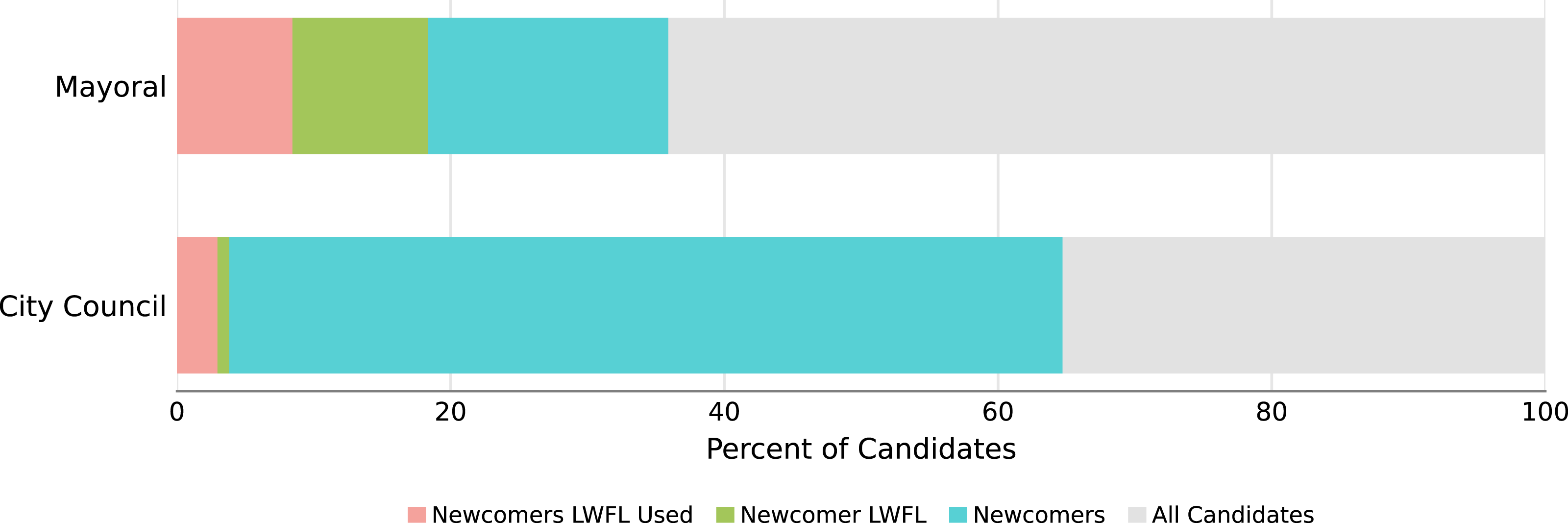
Using this approach, we conduct a series of six RD analyses across the following subsamples: city council and mayoral candidates, each split by race (white and Afrodescendant) and analyzed both separately and in combination. Analyses of the full samples for each office provide a baseline understanding of rerunning patterns and the overall effect of losing, regardless of race. To test Hypotheses 1 and 2, we estimate the effect of losing (versus winning) on rerunning, disaggregating by office and race. In line with Hypothesis 1, we expect the discouraging effect of defeat to be larger for Afrodescendant candidates, regardless of office. To evaluate Hypothesis 2, we examine whether this racial gap in rerunning is larger in mayoral elections than in city council races.
Results
Figure 2 shows a series of fourth-degree polynomial plots, with all observations equally weighted, that include all the last winners and first losers. We estimated two separate regressions for positive and negative values of the margin between the last winner and the first loser, employing robust standard errors clustered by province-city-party. The τˆ values represent the difference at the cutoff between the two polynomials. Mimicking-variance RD plots (Calonico, Cattaneo, and Titiunik 2015) showing the effect of winning versus losing on rerunning among newcomer candidates only for (a) all mayoral candidates, (b) white mayoral candidates, (c) Afro-Brazilian mayoral candidates, (d) all city council candidates, (e) white city council candidates, and (f) Afro-Brazilian city council candidates. The running variable is margin of defeat/victory. Circles report binned averages, with bubble size proportional to the number of observations in each bin. Solid lines represent fourth-order polynomials estimated separately on each side of the cutoff using a uniform kernel, and the shaded gray areas denote 95 percent confidence intervals.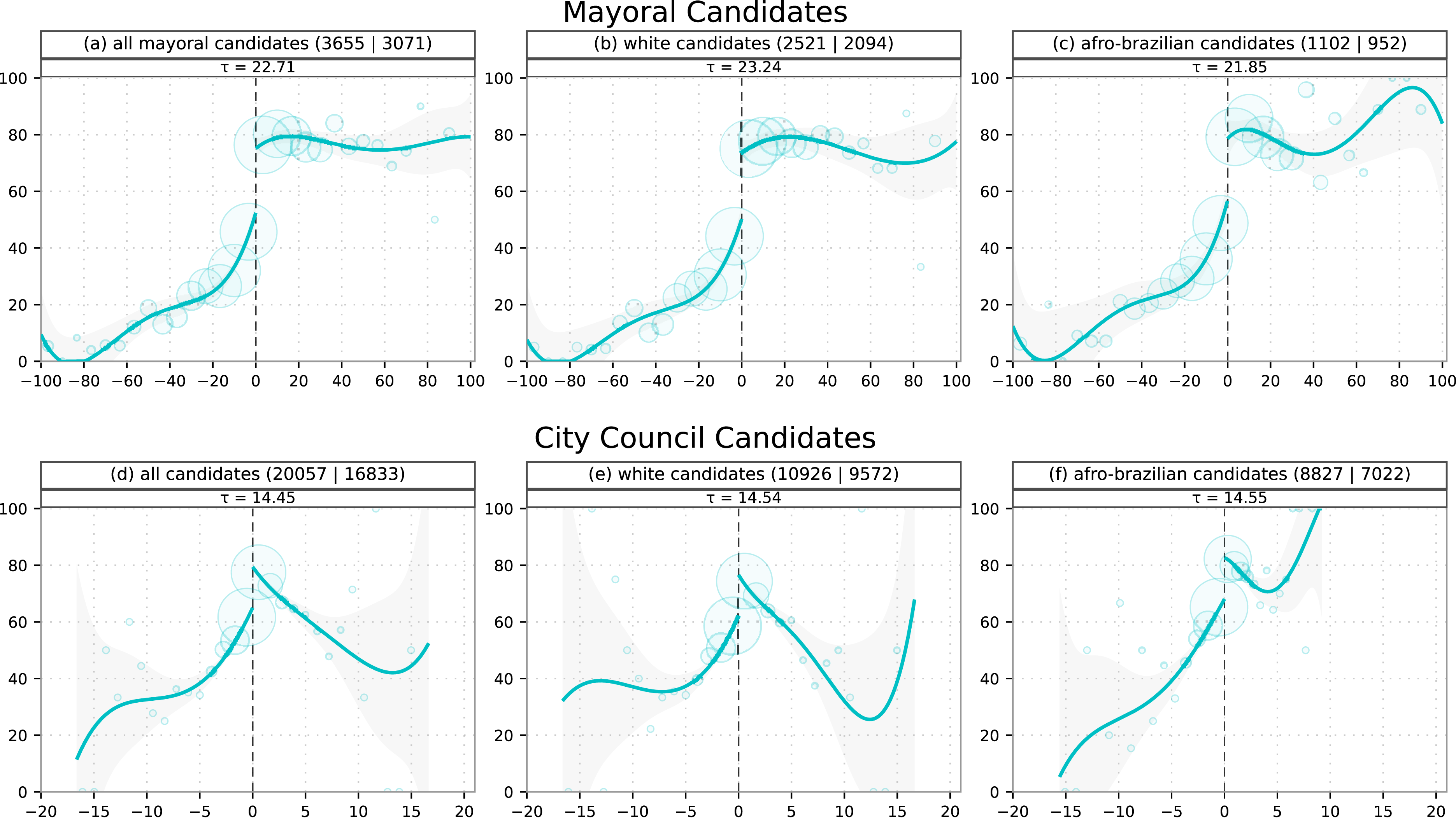
In total, Figure 2 presents six analyses. Panel (a) shows the full sample for mayoral candidates, panel (b) displays the subsample for white mayoral candidates, panel (c) focuses on Afrodescendant mayoral candidates, panel (d) shows the full sample for city council candidates, panel (e) depicts white city council candidates, and panel (f) highlights Afrodescendant city council candidates. In all cases, τˆ is positive, indicating that candidates who lost are less likely to rerun in election t + 1 compared to those who won. We observe that, although the magnitude of τˆ varies by office (and is consistently larger for the mayoral office across all models), there is little difference when comparing races within the same office. For the full sample of mayoral candidates, losing reduces the probability of rerunning by almost 23 percentage points; for white mayoral candidates, this is almost 23 percentage points, while for Afrodescendant mayoral candidates, the effect is 22.5 percentage points. Regarding the city council office, we observe less variation by race. The probability that candidates who lost run again is about 14.5 percentage points lower than winners, regardless of their race. 13 Overall, Figure 2 does not provide evidence supporting either Hypotheses 1 or 2.
Sharp (conventional) RD estimates, with robust confidence intervals (CIs) and p-values based on the MSE-optimal bandwidth proposed by Calonico, Cattaneo, and Titiunik (2014). Models are estimated with a province-city-party cluster
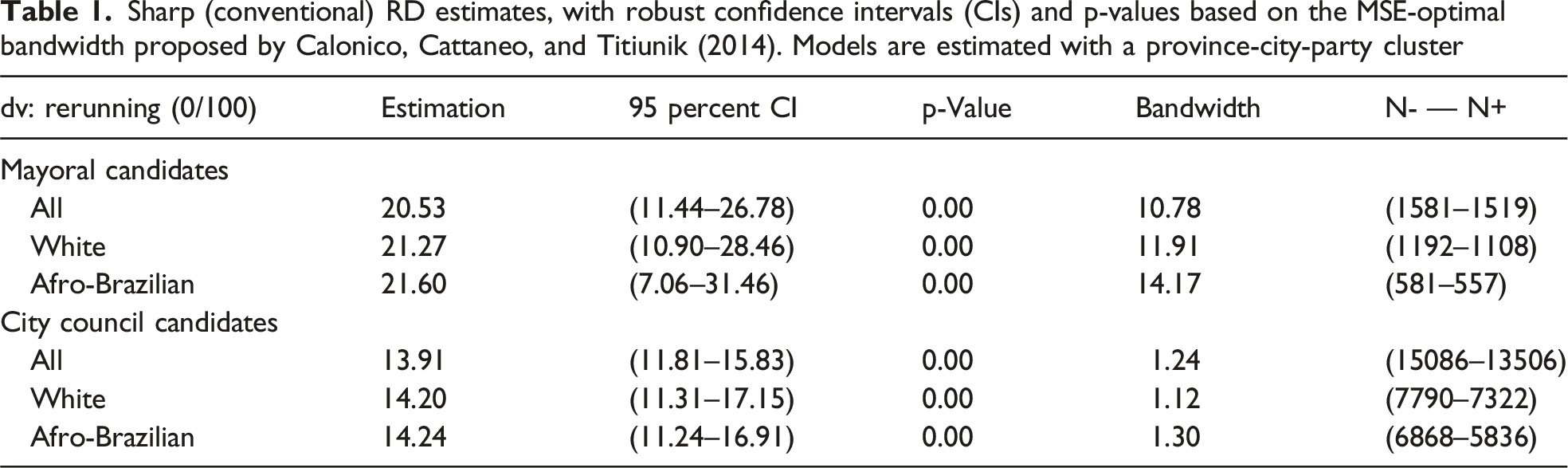
Although the effect of Losing on Rerunning is statistically significant across all models, we find no racial differences in rerunning (H1). Defeated Afrodescendant mayoral candidates are just as likely as defeated white mayoral candidates to run again. Similarly, defeated Afrodescendant city council candidates are just as likely as defeated white city council candidates to run again (H2). As suggested by Williamson et al. (2023), to ensure that this null effect is not merely an artifact of limited statistical power or measurement error, we conducted a series of additional checks using alternative model specifications, discussed below and detailed in the Appendix. Across all specifications, the estimated coefficients for Losing within office remain nearly identical for both racial groups, and their confidence intervals overlap substantially.
Appendix A2.1 reports statistical power analyses based on the observed effect sizes. The design is well powered to detect the estimated effects in most subgroups, with power levels exceeding the conventional 80 percent threshold. Appendix A2.3 presents estimates using second- and third-order polynomials, respectively. Results from these polynomial specifications are consistent with those reported in Table 1 and show no meaningful racial differences in rerunning rates. Appendix A2.4 includes additional control variables—gender, age, marital status, education (college), and, for city council candidates, coalition and district magnitude. The results with controls are similar to the results of our primary analyses and reveal no significant racial differences in rerunning.
While our study includes two electoral cycles—2016–2020 and 2020–2024—we may also want to test whether the observed effects are driven primarily by one of these cycles. In Appendix A2.5, we replicate the main models for the 2016–2020 and the 2020–2024 cycle, separately. Once again, the coefficients are very similar, and the confidence intervals overlap. The only notable exception is that the model for Afrodescendant mayoral candidates in the 2016–2020 cycle loses statistical significance. Nevertheless, the coefficient is nearly identical to that for white candidates, and the confidence intervals still overlap. In Appendix A2.6 we include all last winners and first losers, rather than restricting the sample to newcomers. The results are consistent with our main findings. Despite slight differences in magnitude, we still find no significant racial differences in rerunning. Appendix A2.7 replicates the main analysis using a CER-optimal bandwidth instead of the MSE-optimal bandwidth, again yielding nearly identical results.
Appendix A2.9 disaggregates Afrodescendant candidates into subsamples of preto and pardo candidates. Results for these subgroups remain consistent with our overall findings, although estimates for the preto mayoral candidate subgroup become imprecise due to small sample size. Additionally, Appendix A2.8 explores rerunning behavior specifically within the same party. The effects are smaller for all groups, but the results broadly align with our main findings. Racial differences do not emerge even when restricting rerunning behavior to within-party candidacies. Appendix A2.10 reports RD estimates disaggregated by office, gender, and race. We recover a gender gap in rerunning (women’s estimates exceed men’s), consistent with Vallejo (2024). In contrast, within gender, White–Afrodescendant contrasts are absent; the only apparent difference—among mayoral women (about 7% points)—does not meet the conventional 0.05 threshold (p-value equals 0.08), in line with the main results. We interpret this as suggestive rather than definitive, especially given the comparatively small sample of mayoral women (and the multiple subgroup comparisons).
Appendix A2.11 presents sensitivity analyses for the subsamples analyzed in Table 1, using manually specified bandwidths ranging from 0 to 30 (with intervals of 0.1) for mayoral candidates, and from 0 to 3 (with intervals of 0.01) for city council candidates. Additionally, it includes estimates using the exact, half, and double bandwidths proposed by Calonico, Cattaneo, and Titiunik (2014), as well as the optimal bandwidth suggested by Imbens and Kalyanaraman (2012). Across these robustness checks, estimates remain consistently positive, significant, and stable, and no racial difference was detected. Finally, Appendix A2.12 implements a recent methodological approach for analyzing heterogeneous treatment effects across subgroups (Calonico et al. 2025). Consistent with our previous estimates, differences between White and Afrodescendant candidates are minimal and not statistically significant.
Discussion
The number of candidates of color running for elected office in many democracies is growing. In Brazil, this change has garnered substantial media attention (e.g., Globo 2024; Magalhaes and Pearson 2021). Many Afrodescendant activists regard Brazil’s changing candidate fields as a promising step toward racial equality (Hanchard 1998; Paschel 2016). Nonetheless, most Afrodescendant candidates are defeated at the polls. While some research suggests that electoral losses can serve as valuable learning experiences that improve future performance, others note that defeat can signal to candidates that the political arena is not open to them. Due to the racialized challenges Afrodescendant candidates encounter, it would not be surprising if they stop rerunning for the same office after an initial loss.
Using data from Brazilian local elections and a close election regression discontinuity design, we find that Afrodescendant candidates are just as persistent as their white counterparts. Our results indicate that losing candidates are less likely to rerun in future contests than winners, but the impact of defeat on future participation does not differ by race. This finding suggests that even though previous studies have shown that Afrodescendant candidates often suffer racial abuse on the campaign trail, electoral defeats do not differentially reduce Afrodescendant candidates’ likelihood of rerunning. And, because even losing candidates can acquire experience and skills that may affect later performance, our findings suggest that the recent wave of Afrodescendant candidacies may expand the pool Afrodescendant candidates with previous experience in elections; whether this translates into changes in descriptive representation depends on other constraints, including campaign resources and voter behavior (Bueno and Dunning 2017).
The fact that we do not uncover racial differences in post-defeat rerunning should not be interpreted as evidence that racism—including structural racism and institutional racism—or other racial barriers do not exist in Brazil. Our analysis speaks to just one specific stage of the electoral pipeline—persistence after a narrow loss among electorally competitive newcomers. The fact that we find no racial gap at this stage does not preclude the possibility of significant bottlenecks elsewhere. Identifying where racial bottlenecks exist should be a priority for future scholarship. Whether these findings generalize beyond Brazil is ultimately an empirical question; on this point, Wang (2023) suggests similar patterns in the United States.
Our analysis contributes to the literature on representation gaps and the supply-side factors that can drive them. Elected officials may not descriptively represent the public because of who chooses to run for public office (Junqueira et al. 2025) and the challenges that candidates face when they throw their hats in the ring (Broockman and Soltas 2020). Experience is a key resource that candidates accumulate over time. If candidates of color disproportionately withdraw from politics after a loss, they never build on or benefit from that experience. As a result, the candidate pool remains perpetually composed of inexperienced first-time contenders (Haime, Vallejo, and Schwindt-Bayer 2022; Squire and Smith 1984). Our findings suggest that differential post-defeat persistence and renomination, as measured by rerunning for the same office in the next election among candidates in close races, is unlikely to be a primary driver of Afrodescendant underrepresentation in these contests.
Our findings also offer important insights about political careers, ambition, and representation among historically marginalized groups. Unlike women, who previous research has shown are less likely to rerun after losing local elections in Brazil (Vallejo 2024), we find no such gap for Afrodescendant candidates. This difference raises two key points for future research. First, the mechanisms driving gender and racial representation gaps may differ. Consequently, different theoretical frameworks and policy approaches are needed to understand and effectively address them. Second, our results highlight potential unintended consequences of gender quotas. Specifically, quotas might encourage women who are less politically ambitious—and thus less inclined to persist after electoral defeat—to run for office. Because there are not racial quotas, only highly ambitious Afrodescendants are likely to choose to run. As a result, when they lose, they may be more persistent.
Finally, our conclusions should be interpreted in light of the scope of our design. The regression discontinuity estimates identify the effect of barely losing versus barely winning among first-time candidates in very close municipal elections, and our outcome captures rerunning for the same office in the subsequent election. The results therefore do not speak to other forms of continued political engagement (e.g., running for a different office, waiting more than one cycle, or seeking non-elective political roles), nor to candidates in non-competitive races. Within these scope conditions, however, we find no evidence that Afrodescendant candidates are less likely than white candidates to persist after defeat.
Future work should examine the role of parties in shaping how candidates respond to defeat. Political parties may influence who runs again and the party label under which they compete via the distribution of campaign resources (e.g., money and media time). Party leaders are known to favor incumbents when allocating resources in countries such as Brazil (Janusz, Barreiro, and Cintron 2022), but it remains unclear whether rerunning candidates across racial and gender groups enjoy equal access to the resources that can help them win. In Appendix A2.8, we take an initial step in assessing the role of political parties by estimating effects for rerunning within the same party. Future research should leverage party- and coalition-level heterogeneity and directly measure post-defeat party support. A second promising avenue for research is to examine whether incumbency effects—especially in contexts where incumbency is a disadvantage (Schiumerini 2025)—vary by race and gender. In particular, it would be worth exploring whether any incumbency disadvantages are concentrated among specific groups.
Supplemental Material
Supplemental Material - The Race After the Race: How Candidates of Color Respond to Electoral Defeat
Supplemental Material for The Race After the Race: How Candidates of Color Respond to Electoral Defeat by Andrew Janusz and Agustín Vallejo in Political Research Quarterly.
Footnotes

Funding
The authors disclosed receipt of the following financial support for the research, authorship, and/or publication of this article: University of Houston (000191512).
Declaration of Conflicting Interests
The authors declared no potential conflicts of interest with respect to the research, authorship, and/or publication of this article.
Data Availability Statement
Replication materials will be published with the following DOI identifier: https://doi.org/10.7910/DVN/URUR5S (Andrew and Agustin, 2026).
Supplemental Material
Supplemental material for this article is available online.
Notes
References
Supplementary Material
Please find the following supplemental material available below.
For Open Access articles published under a Creative Commons License, all supplemental material carries the same license as the article it is associated with.
For non-Open Access articles published, all supplemental material carries a non-exclusive license, and permission requests for re-use of supplemental material or any part of supplemental material shall be sent directly to the copyright owner as specified in the copyright notice associated with the article.
