




Abstract
While the contemporary conversation about trust in U.S. elections focuses on mistrust among white conservatives, we ask whether racial and ethnic minority groups also lack confidence in the integrity of the vote count. Is there an enduring gap along ethnoracial lines over trust in elections and, if so, what determines the magnitude of this gap? Grounding our theory in the literature on race and trust in institutions and elections, we outline hypotheses about the mechanisms of mistrust for minority groups. We use an original national survey as well as data from the Survey of the Performance of American Elections from 2012 through 2022. We find that Black and Native Americans have lower levels of trust in elections when compared to white Americans. Asian Americans are not statistically unlike whites in their level of trust, and the trust gap that exists for Latines is partially explainable by demographic characteristics such as education and income. We further demonstrate the profound importance of state voting laws: in states that impose high barriers to accessing the ballot, the gap between white and Black Americans’ trust in elections doubles in size, while in states with the most inclusive voting laws, the racial gap in trust disappears.
Even before a “confidence earthquake” opened up a “historic gap in trust” in American elections between the two parties following the 2020 presidential contest (Clark and Stewart Charles, 2021), there has been much timely and important academic work on trust in elections (see Bergeron-Boutin et al. 2023 for a summary). Current scholarship has focused primarily on conservatives (Barreto Nicolas et al., 2021) and white Americans (Morris 2023), the groups that have seen a recent loss of confidence in election integrity, as well as on the role of Donald Trump (Arceneaux and Truex, 2023; Berlinski et al., 2023; Clayton et al., 2021; Pennycook and Rand, 2021).
But left out of the contemporary conversation on trust in elections are the groups that have historically been excluded from American elections and still today face persistent obstacles to casting ballots as well as the dilution of their voting power: members of racial and ethnic minority groups. The well-documented histories of disfranchisement of Black Americans (Anderson and Bolden 2019; Bunche 1941; Keyssar 2000; Kousser 1974), Latines 1 (Budiman and Igielnik 2020; Fraga 2018; Garcia-García Bedolla 2005), Asian Americans (Lien 2010; Wong et al., 2011), and Native Americans (McCool et al. 2007; Rogers et al. 2023; Schroedel et al. 2022) resonate today. For instance, many groups still face unequal wait times at polling places (Chen et al. 2022; Cottrell et al. 2021; King 2020; Pettigrew 2017). How does this history and currently lived experience shape peoples’ confidence that their own ballot will be counted accurately and that their state’s count will accurately reflect the vote? What are the gaps in trust in elections along racial and ethnic lines in America today, and do they shift over time and across political contexts? Vitally, do a state’s voting rights laws affect trust, either through its historical record of disfranchisement or through contemporary laws governing the inclusiveness of elections?
We answer these questions by fielding an original survey and survey experiment conducted after the 2022 midterm elections and by newly analyzing racial and ethnic patterns in national surveys fielded after elections from 2012 through 2022. The past data come from the Survey of the Performance of American Elections, the authoritative studies of election experiences and trust administered by MIT (Stewart 2023). Although these surveys collect the race and ethnicity of respondents, the links between identity and trust have not been explored (except in the bivariate descriptive statistics for three elections reported by Bergeron-Boutin et al. 2023). We build on that important initial exploration by charting levels of trust by racial and ethnic groups—holding constant their partisan affiliations and other individual characteristics that the literature on trust in elections show us are critical factors to control for—for each election surveyed since 2012. We also present an extensive analysis of trust in elections through the national survey that we conducted after the 2022 midterms. This includes a survey experiment exposing respondents to informational videos explaining protections on the vote counting process, for which we preregistered our exploration of differential effects by race and ethnicity.
First, we identify a significant and enduring gap over trust in elections along racial and ethnic lines. Analyzing our national survey of 3,038 eligible voters after the 2022 midterm elections, we find that this gap is most prominent between Black and Native Americans vis-à-vis white Americans. Trust is lower among these two minority groups that have historically seen their voting rights violated and their political power diluted, with the result standing even in multivariate models that include a full set of demographic controls, systematic factors, and fixed effects that address the unique political context in each state. Trust among Latines is lower on average than among whites, but this gap disappears in multivariate models, indicating that it can be explained by demographic characteristics such as education and income. Finally, our findings note that trust among Asian Americans and Pacific Islanders is not significantly different than among whites. Each of these dynamics parallels expectations that we derive from the broader literature on trust in society and trust in government.
We also reveal new dynamics that are specific to trust in elections when we look at how racial and ethnic gaps over trust vary across time, across states, and in different informational contexts. Looking at how the trust gap varies across states, we demonstrate the profound importance of state voting laws: in states that impose high barriers to accessing the ballot as measured by Grumbach (2022), the gap between white and Black Americans’ trust in elections doubles in size, while in states with inclusive voting laws, the racial gap in trust disappears. Our initial analysis provides no evidence that a state’s history of voting rights litigation predicts the current gap in trust across racial and ethnic lines, though trust is lower among all groups in states that have seen many VRA actions. Drawing on a decade’s worth of data from Surveys on the Performance of American Elections (see Stewart 2023), we see that the magnitude of this gap rises and falls with election outcomes, with the gap being most narrow after Barack Obama’s re-election and widest after Donald Trump’s 2016 victory.
Finally, we explore the results of a survey experiment that randomly assigned some respondents to view a video produced by election officials explaining the protections on the integrity of the vote counting process. Gaudette et al. (2025) show that viewing such videos exerts a powerful effect on trust in elections, increasing trust significantly among Democrats, Republicans, and independents alike. Does this informational treatment also work across racial and ethnic lines? Our analysis of the survey experiment finds that exposure to an informational video strongly increases trust among white Americans and among Asian American and Pacific Islander respondents. By contrast, viewing these videos does not appear to build trust among Black, Latine, or Native Americans (though our test of these differential effects does not yield a statistically significant interaction between the video’s effect and the viewer’s racial or ethnic identity). These suggestive findings indicate that the specific messages tested in these experiments, at least, may not be a promising avenue to reducing the gap in trust. Election officials who seek to increase trust across all racial and ethnic groups may need to produce messages that address the particular concerns that minority groups have about American elections.
In short, our theoretical contribution is that we draw upon historical and contemporary accounts of disfranchisement in American elections to advance a theory of why members of minority groups that have faced such discrimination should be expected to report lower levels of trust in elections. This theory generates empirical hypotheses about the reasons to expect a gap in trust as well as how the magnitude of that gap may vary across states based on their voting rights laws, across elections based on their winner, and according to exposure to videos about election protections. Our empirical contributions are as follows: 1. The identification of a robust and longstanding gap in trust in elections along racial and ethnic lines that is particularly sharp between Black and white Americans; 2. The finding that the size of this gap is significantly smaller in states that currently have more inclusive voting laws; 3. The finding that election-to-election fluctuations in this gap appear to rise and fall with election outcomes; and 4. Experimental evidence that informational videos do not deliver the same boost in trust for minority groups that they bring to respondents overall. We conclude by considering the implications of these findings for the study of trust in American elections and for the efforts of political leaders, elections officials and community organizations to increase it.
Theorizing from the Literatures on Race, Ethnicity, Trust, and Elections
The impact of racial and ethnic identity on trust in elections in America is just beginning to be systematically studied (Bergeron-Boutin et al. 2023; Freeder and Shino 2023). But there is a deep literature on the links between identity and trust in society and social institutions in the fields of sociology, psychology, and public health (Bagasra et al. 2021; Blankenship et al. 2021; Blankenship and Stewart 2019; Smith 2010). There are also essential works on trust in government in political science that focus on the role of race and ethnicity (Abrajano and Alvarez 2010; Koch 2019; Wilkes 2015; Wu et al. 2022). We draw upon and aim to expand upon the existing body of literature concerning race, ethnicity, and trust in society and government in our examination of trust in elections.
Trust fundamentally underpins social cohesion, stability, and effective governance. It forms the bedrock of democratic stability, acting as a linchpin that influences individuals’ adherence to societal rules, in both social and political contexts. Recognizing the critical role of trust in maintaining a robust democratic framework, Wu et al. (2022) adopt a structured approach to understand the interplay between race and political trust, noting that perceptions of justice shape the observed variance in public trust levels among racial and ethnic minorities. They highlight the historical neglect of justice orientations in research, which place restraints on scholarly understanding of institutional trust.
Characterized as the overarching belief that commitments made by others are dependable, generalized trust is integral to political dynamics and societal connections. Smith’s (2010) review of the sociological literature on race, ethnicity, and generalized trust in society highlights gaps in trust and points to the key role that personal and group experiences can play in shaping it: “Ethnoracial differences in generalized trust are attributed to historical and contemporary discrimination, neighborhood context, and ethnoracial socialization” (Smith 2010, 453).
In a parallel fashion, work in political science on trust in government finds that trust is often—though not always—lower among members of racial and ethnic minority groups than among white Americans. A key finding of this literature is that trust in government is driven by different considerations for members of different racial and ethnic groups. For Black and Latine Americans, political trust reflects a deep-seated discontent rooted in decades of political exclusion, violence, discrimination, and a persistent sense of disfranchisement. According to Abrajano and Alvarez (2010), personal experiences of racial discrimination shape trust in government among Latine and Black Americans. They also note, however, that trust among Latines, especially first-generation immigrants, is often higher than among whites. In a similar vein, Wu et al. (2022, 177) find that although trust in government is lower among groups that have faced institutional injustice, “when racial and ethnic minorities perceive there are greater opportunities for racial progress, which signal that widespread harm can be repaired, their political trust tends to increase, sometimes to levels that exceed those for Whites.” Koch (2019) further finds that trust in government is lower among members of racial and ethnic minority groups, including Native Americans, but that this trust gap is inconsistent.
For trust in elections, we take two primary lessons from the literature on trust in society and trust in government. First, trust among racial and ethnic minority groups may be profoundly shaped by historical and contemporary experiences of discrimination. Second, the trust gap may vary—across states and across elections—in a way that responds to variations in political exclusion or inclusion of racial and ethnic minorities and in the electoral fortunes of candidates favored by these groups.
Reasons to Expect a Racial and Ethnic Gap in Trust in Elections
One’s own experiences and hearsay about experiences from those in one’s community shapes their trust in elections (Stewart 2022). Recent work probes how personal experiences with election participation shapes one’s trust in elections. Shineman (2018) examines the causal relationship between participation and trust in elections, using a mobilization field experiment to estimate the direct effects of participation. Participating in an election increases trust in the voting system used, and in the representatives elected, but this work does not examine how past or present experiences differ for communities of color or whether this contributes to gaps in voters’ trust in elections.
Throughout the history of the franchise in the United States, barriers to the ballot box have disproportionately impeded participation among some groups of voters, impacting their experience with electoral institutions. This history should shape patterns in trust. Prior to the Voting Rights Act (VRA) of 1965, state and local governments were left to determine to whom suffrage should be extended, freely implementing electoral regulations that imposed discriminatory tests and devices designed to deny or dilute their voting power (Grofman and Davidson 2011). The treatment of Black Americans by national, state, and local governments is perhaps the most egregious example of this. Following the end of slavery and the passage of the 15th Amendment, a patchwork of voter intimidation, achieved through widespread election-related violence against Black voters and candidates (Keyssar 2000), and discriminatory tests—poll taxes, literacy tests, the White primary, etc.—were implemented in the American South to exclude the newly eligible Black electorate (Foner 1982; Kousser 1974). Aimed primarily at dismantling these discriminatory practices, the Voting Rights Act (VRA) of 1965 expanded access to the ballot box for Black voters. In response, states adopted racial gerrymanders, at-large elections, and other mechanisms that have diluted Black voting power (Davidson and Grofman 2021).
Many other racial or ethnic minority groups were targeted by racially discriminatory election rules all over the country. To impede or suppress Latine American and Native American voters, many jurisdictions used literacy tests and some states even barred language assistance at the polls. In Texas, unless a voter had been a United States citizen for at least 21-year prior, it was made illegal for voters to receive language assistance at the polls (Garcia 2020). This endured until 1975 when the VRA was amended to apply to Asian American, Latine American, and Native American voters. Amendments to the VRA in 1970, 1975, and 1982 not only expanded its reach to apply to other racial or ethnic minority groups, who had long suffered alongside Black voters, but it also extended protections to language minority groups (Grofman and Davidson 2011; O’Rourke 1983; Parker 1983), also impacting Asian American political incorporation that was previously impeded by discriminatory language requirements. Legal challenges brought under the VRA were largely successful in overturning many discriminatory practices (Anderson and Bolden 2019), but recent Supreme Court decisions eroding the potency of key VRA protections have empowered states and local jurisdictions to implement restrictive voting laws that disproportionately impact racial minority voters (Eyer 2019; Tokaji 2005).
Recently, many states have enacted restrictive voting laws, again disproportionately burdening some groups of voters. When voting laws make voting less accessible, it has a disproportionate impact on racial minority groups (Barreto et al. 2009a), who are more sensitive to these changes in voting laws (Grofman and Davidson 2011; Williams 2000). Among racial minority groups, who are less likely to have access to the required forms of identification under the most restrictive voter identification laws, compliance with these laws becomes more burdensome (Barreto et al. 2009a; Barreto and Sanchez 2014; Barreto et al. 2022a; Citrin et al. 2014; Henninger et al. 2021). For many Native American voters who live on reservations without a USPS mailing address, it can even become impossible to comply with voter identification laws’ strict residential proof requirements (Barreto et al. 2022a). Reductions to early voting generally reduces turnout, but some states choose to truncate the days from the early voting period that have been the most desirable for Black, Latine, youth, and first-time voters, negatively impacting turnout for racial and ethnic minority voters (Herron and Smith 2014). Asian Americans have largely evaded the deleterious effects of many of these policies. Whether this can be attributed to the impact that immigration policies favoring high skilled labor have shaped the socioeconomic composition of the Asian American diaspora or the extent to which Asian Americans have been positioned in the racial order as a model minority group, more akin to white Americans but simultaneously too foreign (Kim 1999), Asian American voters are often not targeted as frequently by such policies. Historically, Asian immigrants have long been denied the opportunity to even obtain U.S. citizenship in order to gain the right to vote (OuYang 2020), but communities of naturalized and U.S. born Asian American voters struggle today with accessing election materials in a language other than English (LaVine and Jarboe, 2019; Lee, 2024; Magpantay, 2004) and they face discrimination in redistricting plans that dilute their voting power in jurisdictions where they comprise a large share of the population (Bohra 2021).
Today, voters’ experiences with election participation can be vastly different, in ways that could affect trust in elections. Racial minority and low-income communities are more likely to have lower quality voting precincts (Barreto et al. 2009b). Census tracts with a higher percentage of Black residents and high poverty census tracts tend to have low quality voting facilities—polling place quality, accessibility for persons with disabilities, visibility of disability access signs, number of election judges, line count just before and at closing, and interference with free passage of voters (McClendon et al. 2019). Similarly, differences in the allocation of polling place resources can exacerbate these inequalities in electoral participation experience (Highton 2006). Black voters are more likely to face long wait times at the polls than are members of other racial and ethnic groups (Pettigrew 2017). These wait times are associated with depressed turnout in subsequent elections, which may contribute to the racial turnout gap (Chen et al. 2022; Cottrell et al. 2021; King 2020; Pettigrew 2017). Other voters of color, including Latines, Asian American and Pacific Islanders, and Native Americans, encounter discriminatory election laws such as at-large elections, gerrymandering, polling place location disadvantages, and restrictive vote-by-mail procedures, which have been shown to limit their influence in elections (Fraga 2018; McCool et al. 2007; Rogers et al. 2023; Schroedel et al. 2022).
Finally, differences in voters’ interactions with election officials contribute to worse experiences with election participation that can impact trust in elections. The racially disparate enforcement of voter identification (Ansolabehere 2009; Cobb et al. 2010; Rogowski and Cohen 2015; White et al. 2015) contributes to the negative impact these laws have on racial minority groups (Alvarez et al. 2008; Hajnal et al. 2017; Kuk et al. 2022; Rocha and Matsubayashi 2013, but for contrary evidence see Pryor et al. 2019). Work that examines experiences with election officials reveal that election officials are more likely to display bias in communications against Latines (Hughes et al. 2020). Differences in historical and contemporary experiences of voters from different racial groups
2
should lead to meaningful differences in trust in elections. This leads us to our first hypothesis: Trust in elections should be lower among members of racial and ethnic groups that have experienced political exclusion (members of the Black, Native American, Latine, Asian American and Pacific Islander, and “other race” communities) compared with trust among white respondents.
How the Trust Gap May Vary Across States
Equally important to consider when discussing the impacts that historical disfranchisement has on political trust is the varied experiences of discrimination by state. This can be attributed to the unique experiences of racial minorities across state lines. Article I, Section IV of the United States Constitution grants states great discretion to determine how elections should be conducted; this resulted in significant differentiation in state voting procedures and practices throughout American history (Ewald 2009). While state elections eventually became more uniform, the legacy of states developing their own election practices persisted. One example of this is the treatment of Black Americans in their struggle to obtain suffrage across the nation, as we have discussed above. The ratification of the 15th Amendment in 1870 aimed to allow Black Americans to obtain some level of citizenship following the end of chattel slavery in the United States, but with the abandonment of Reconstruction, states were once again allowed to introduce many new restrictive voting laws such as poll taxes, literacy tests, and grandfather clauses that restricted Black Americans’ ability to vote (Kousser 1974; Samuels 2022). The difficulty in bringing an end to these discriminatory voting laws was found in the fact that seldom were two state’s laws or implementation of such laws alike, this meant that national laws were likely required to combat these laws on a large and multi-state scale (Schuit and Rogowski 2017). Such national level legislation 3 was eventually enacted with the passage of the 24th Amendment (which eliminated poll taxes) in 1964 and the Voting Rights Act (VRA) of 1965. By giving the federal government and plaintiffs representing minority groups that had been disfranchised or seen their vote diluted the power to mount legal challenges, the VRA became a critical tool to identify and redress discriminatory election laws.
The experience of disfranchisement that varies by state is not limited to Black Americans, as many other American racial and ethnic minority groups have their own unique experiences with discrimination. Each of the groups that we study here—Latines, Asian American and Pacific Islanders, and Native Americans, along with Black Americans—has filed legal challenges under the VRA. One common type of voting rights challenge seen post 1965 are failures to comply with the language minority provisions found in Section 4 of the VRA, which states that if there are minority populations that exceed 10,000, or five percent in a political subdivision, that voting material printed in the “applicable language” must be supplied in order to better ensure their collective ability to be active and informed participants in an election. Challenges surrounding this section of the VRA were primarily concentrated in Latine and Native American communities, where insufficient access to voting materials in a particular language greatly affected that population’s ability to vote. Another example of a type of VRA challenge that we see across states is in response to the practice of alleged discriminatory intent or effect of many state redistricting practices (Schuit and Rogowski 2017; Tofighbakhsh 2020).
These examples of VRA challenges help to illustrate the nature and scale of voting rights challenges in the U.S., and how past instances of voter disenfranchisement may impact contemporary relationships between racial minorities and state voting institutions. They suggest a hypothesis that we can test across states. Using the record of VRA cases filed in each state since its passage in 1965, we would expect that the states that have seen the largest number of challenges to election laws, members of racial and ethnic minority groups should exhibit the lowest level of trust in elections, relative to white Americans. Simply put, a state-specific record of numerous voting rights violations should reduce trust among the communities that have historically faced disfranchisment.
Another possibility is that the trust gap varies not with historical records of voter disenfranchisement but with the contemporary level of political inclusion, determined by current voting rights policies and practices. In states that have more inclusive sets of policies, such as Election Day Registration, online or automatic voter registration, flexible mail ballot provisions, or independent redistricting commissions, we would expect that members of racial and ethnic minority groups perceive these as accessible elections that will provide their members strong representation. Either their direct knowledge of these laws or their individual experiences with the voting system should increase their levels of trust, reducing the trust gap. For instance, in a state that allows early voting, voters who participate in a “Souls to the Polls” event can have a direct, positive interaction with a state’s election administration that could strengthen their level of trust in its elections.
Yet in states with more restrictive policies, such as voter identification laws, felon disenfranchisement, restrictions on registration drives, or high levels of gerrymandering, members of these groups may feel excluded from elections and thus less trusting. Again, this mechanism can be either direct or indirect; a restrictive law could block an individual themself from participation, or their knowledge that their state’s laws pose particular obstacles to some members of their community could make elections seem less accessible, reducing their trust. Grumbach’s (2022) “State Democracy Index” provides a composite measure of these state election laws and practices, allowing us to test their impact on trust. In states that score highly on this measure, indicating that elections are strongly inclusive, the gap should shrink, but we predict that it will be larger in states with low scores, indicating the presence even today of laws and practices that pose obstacles toward participation and power for members of racial and ethnic minority groups.
Any gap in trust in elections should be smallest in states that have taken an inclusive approach to voting rights and largest in states that have taken an exclusive approach.
How the Gap May Vary with Election Results
One of the most powerful and widespread dynamics identified in the literature on trust in elections and on trust in government is the “winner effect,” also called the “winner-loser gap.” Simply put, after an election, trust rises among supporters of the side that was victorious and falls among those on the losing side. This effect has been found in the United States (Anderson and LoTempio 2002; Clarke and Acock 1989; Craig et al. 2006) as well as in established and emerging democracies (Anderson et al. 2005; Anderson and Guillory 1997; Nadeau and Blais 1993) around the world. Among the losing side, not only does trust in government decline but trust specifically in elections falls (Bergeron-Boutin et al. 2023; Sances and Stewart 2015; Sinclair et al. 2018). This drop can be driven by cues from elites who claim elections are rigged (Clayton et al. 2021) or by mass mood shifts alone immediately after election results are reported (Reller et al. 2022).
The implication of the winner effect literature for this study is that the size of the racial and ethnic gap over trust in elections should depend upon whether candidates favored by racial or ethnic minority groups win or lose. When their chosen candidate is victorious, members of racial and ethnic minorities should have an increased sense of efficacy and a generalized increase in mood, leading to more trust broadly and in elections specifically. By contrast, a defeat could lead any group to attempt to resolve their cognitive dissonance by explaining away the results as fraud or could result in them hearing allegations of fraud by the losing candidate. Either mechanism will lead to a decline in trust.
In order to see whether descriptive patterns in trust over time are consistent with this hypothesis, we will track trust by ethnic group (within a given party) after each presidential election. The presidential contest, by far the most salient in American politics, should drive trust most powerfully. Recent American history also provides the opportunity to observe variation, as Barack Obama was clearly the candidate preferred by members of each racial and ethnic group that we study (Pew Research Center 2009) and Donald Trump was opposed by strong majorities of the members of these groups (Tyson and Maniam 2016). Just as Wu et al. (2022) found that trust in government rose sharply among Black Americans after Obama’s election victories, we expect that trust in elections will rise among members of minority groups (relative to white Americans) after elections in which Obama or Biden win and will be lower (widening the gap in trust) after Donald Trump’s 2016 victory (consistent with the Minority Party hypothesis from Cain et al. 1991). These results should hold even controlling for partisan affiliation in tests that hold constant this highly correlated factor. Any gap in trust in elections should be smallest after candidates favored by minority groups win elections and largest after candidates opposed by minority groups win elections.
How the Gap May Vary with Exposure to Information on Election Protections
One of the reasons that some Americans lack trust in the accuracy and integrity of elections is that they lack information about the many protections that state and local officials put in place to safeguard the voting process (see Stewart 2023, 30). If this is the case, then informing them of safeguards on elections can increase confidence among groups that lack it. In a series of survey experiments conducted in four states as well as with a national sample after the 2022 midterm elections, Gaudette et al. (2025) explore the impact of viewing real informational videos, produced by election officials, explaining protections on elections. They find that viewing a video exerts a powerful effect on trust in elections, increasing trust significantly among Democrats, Republicans, and independents alike.
Does this informational treatment also work across racial and ethnic lines, increasing trust for members of all groups? That is possible, and if these videos are equally effective, they could be a promising path forward to increasing trust for all those who watch them (even if this parallel movement does not reduce gaps in trust). But it is also possible that such informational treatments work better among members of some groups than others. One potential mechanism is that these messages might be most effective among those who share the racial or ethnic identity of the messenger, similar to the way voter mobilization efforts are often most effective when delivered by co-ethnics or in a preferred language (Abrajano and Panagopoulos 2011; Barreto and Nuño 2011; Binder et al. 2014). Unless trust messaging campaigns are conducted by a variety of messengers who share the identity of different communities, they might be more effective for members of majority groups than minorities. Second, because these messages typically focus on safeguards on the integrity of elections, rather than safeguards on access to elections, they may speak most closely to the concerns of white Americans rather than members of racial and ethnic minority groups. In either case, it is possible that their impact will be weaker on minorities than on white Americans. Informational videos detailing the protections on the integrity of elections should cause a larger increase in trust for white Americans than for members of racial and ethnic minority groups, increasing the size of the trust gap for those who are exposed to these videos.
Data and Research Design
We use three distinct data sources to answer our hypotheses. First, we fielded a national survey from November 17-27th, 2022. The survey consisted of 3,038 respondents, collected through Luc. Id (now Cint) and was nationally representative along race, gender, age cohorts, and education levels. Our survey asked respondents “How much do you trust the accuracy and integrity of elections in your state?” with four answer options ranging from “Distrust a lot” (coded as 1) to “Trust a lot” (coded as 4). The survey captured the respondent’s state of residence as well as demographic information along race, gender, age, income, and education. We capture this dependent variable of trust in a respondent’s state vote since it parallels our primary political variables of interest, which are also captured at the state level. Our total size drops to 2,874 after dropping respondents who selected “I don’t know” to our dependent variable and then to 2,589 for any non-response to general demographic variables.
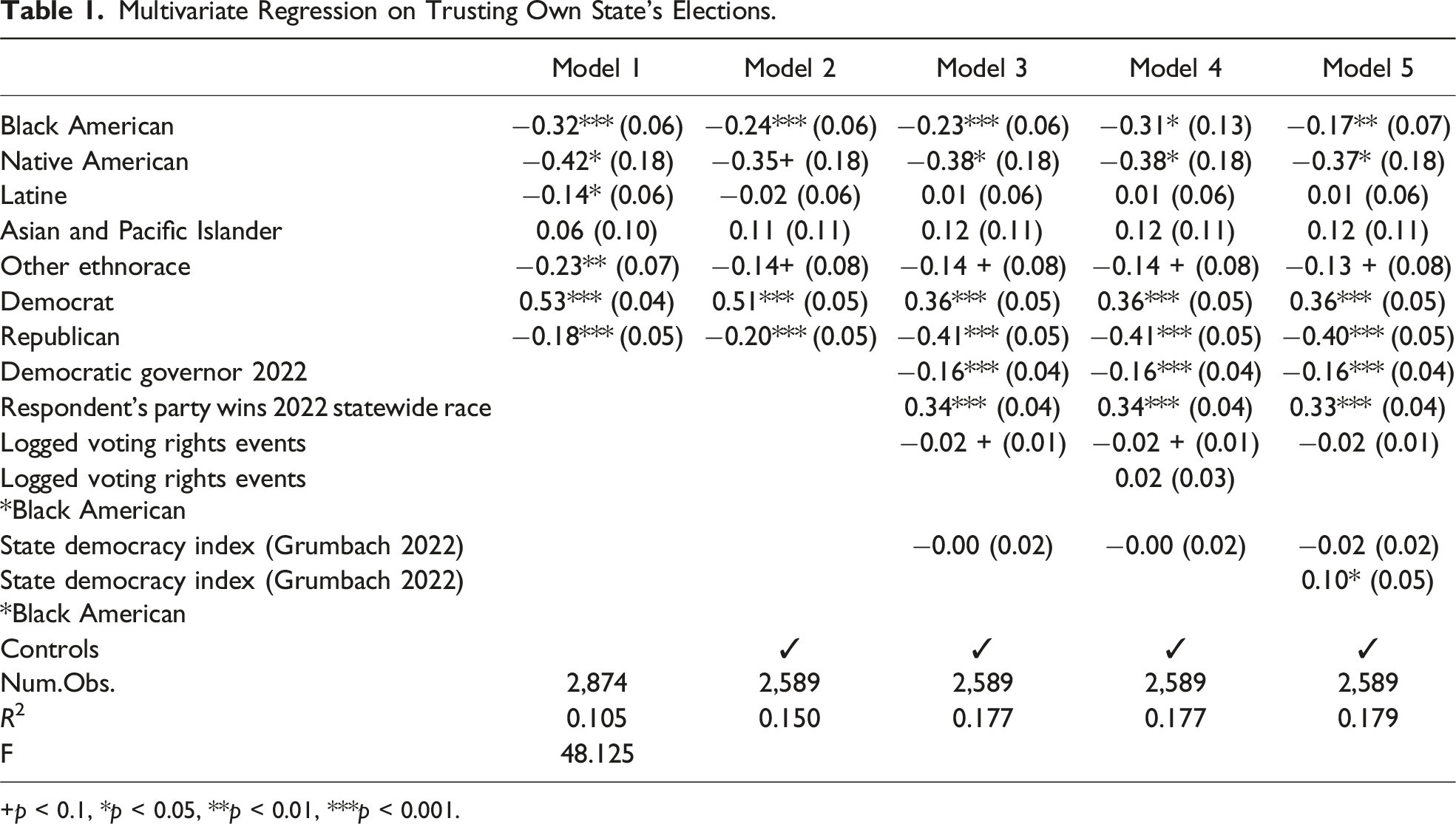
Multivariate Regression on Trusting Own State’s Elections.
+p < 0.1, *p < 0.05, **p < 0.01, ***p < 0.001.
Additionally, we embedded an experimental module into our survey. This was part of a broader study of the impact of communication by election officials (see Gaudette et al. 2025) conducted through a national survey as well as four state- or county-level surveys. The experimental design was straightforward and consistent across each of these surveys: a third of the participants were randomly assigned to view a one-minute video from the state of Virginia showing the officials who safeguard vote counting, a third were assigned to watch a video from Maricopa County detailing the processes that safeguard voting, and one third were assigned to watch a control video unrelated to elections. We implemented this experiment in our national survey and conducted parallel experiment in surveys that we conducted, also beginning November 17, 2022, in Colorado, Georgia, Los Angeles County, and Texas 5 that were each regionally representative along race, gender, age cohorts, and education levels. To maximize the statistical power of the experimental analysis that we conduct in Section V, we combine data from the national experiment with data from the four parallel experiments conducted with state and local samples. In total, our experimental analysis consists of 8,333 respondents, of which 5,521 were in a treatment group and 2,812 were in the control group. We ask respondents pretreatment and post-treatment questions about “How much do you trust the accuracy and integrity of elections in other states?” which we use as our dependent variable to evaluate the impact of viewing either video (because, for nearly all respondents, the Virginia and Maricopa videos focused on other states).
Third, we analyze data over time from the Survey of the Performance of American Elections (SPAE), 6 which is a repeated cross-sectional, national survey that aims to understand the voter experience of the election process. It has been carried out every 2 years between 2012 and 2022, with the exclusion of 2018 which did not have a fielded survey for that year. Additionally, the survey features respondents from all 50 states and includes a stratified sampling technique from the Community Population Survey voter supplement that is stratified on gender, age, race, education, and state. Each survey year has more than 10,000 respondents, with a total over the duration of the study to date being 59,000. We display descriptive data illustrating the shifts in racial gaps in trust over time in Section IV of this paper. We then report full multivariate models estimated at the individual level using this SPAE data, for all available years, demonstrating that the analysis of our original 2022 survey yields findings that are quite consistent with findings from elections held over the past decade.
Was There a Racial/Ethnic Gap in Trust in 2022, all Else Equal?
We define groups who have experienced political exclusion to be respondents who self-identify as Black, Native American, Latine, Asian American, and Pacific Islander. However, we focus our extended analyses most closely on Black Americans, who have faced consistent and targeted exclusion over the course of U.S. history. Many post-Reconstruction state voting laws were enacted with the primary goal of voter suppression of emancipated Black Americans, and many voting laws today have been shown to have disproportionate impacts on members of this community. As such, our models also include interactions of Black Americans with our measures of the inclusiveness of each state’s political system, in order to understand the impact of these historical and contemporary experiences.
We first test our Racial/Ethnic Gap hypothesis (H1), where we expect to see lower levels of trust in elections among members of racial and ethnic groups that have experienced political exclusion compared with trust among white respondents, holding standard demographic variables constant.
Table 1 presents our multivariate regressions. We fit a linear model for our dependent, pretreatment variable of trust in a respondent’s own state’s elections, which ranges from one to four. Model 1 tests the relationship between race/ethnicity, party, and trust in the respondent’s own state.
When looking at just these factors, we observe significant gaps in trust between most minority ethnoracial groups and white voters. For Black Americans, levels of trust are 0.32 points lower than for whites on this four-point scale, controlling for party identification, a finding that surpasses high levels of statistical significance. A similarly high magnitude (0.42 points) gap exists for Native Americans, and this relationship holds statistical significance at the 95 percent confidence level. Latine voters likewise are less trusting of their state’s elections, though the magnitude of this effect is smaller (0.14). Finally, we do not observe a significant gap in trust between Asian American and white respondents. It is also worth noting that this analysis shows partisan patterns that have been familiar since the aftermath of the 2020 election, with Republicans significantly less trusting than independents (the baseline category) and Democrats more trusting. At first glance, this model supports hypothesis
Model 2 adds explanatory demographic characteristics of education level, age, income, and gender, with all of its coefficients plotted in Figure A-1 in the appendix. The gap in trust for Black Americans remains strongly significant in this model. The trust gap for Native Americans is significant only at the 90 percent confidence level in this model, but note that in all subsequent models that include additional controls, it is significant at the 95 percent level and substantively large. The major difference revealed by adding the full set of demographic controls is that the gap in trust for Latines is no longer strong or significant. This parallels work on Latine trust in society more broadly, which finds that bivariate gaps in trust are a function of age and education levels in this community.
Model 3 introduces four variables that encapsulate the political context of elections: whether a state had a Democratic governor in office in 2022, whether the candidate from the respondent’s own party was the winner of the highest-profile statewide race contested in November 2022, the number of successful Voting Rights Act events, and the state’s level of democratic inclusivity through the State Democracy Index. First, we note that adding these state-level contextual variables does not take away the impact of the individual-level variables seen in Models 1 and 2. We still find that the gap in trust between Black and Native Americans, on the one hand, and white voters, on the other, remains substantively large and statistically significant even when adding these contemporary and historical measures of each state’s political context. Similarly, adding these contextual variables does not affect the already strong relationship between partisan identity and trust in elections; Democrats are significantly more trusting of elections than independents, and Republicans are significantly less trust, all else equal.
Second, we find that the broader political context in a state strongly predicts individual-level confidence in its elections. Model 3’s results shows that trust in elections after the 2022 midterms was significantly lower in states with Democratic governors serving in office at that time, likely because post-2020 claims of fraud were primarily made by Republican Party leaders (Arceneaux and Truex 2023; Berlinski et al. 2023; Clayton et al. 2021; Pennycook and Rand 2021). The variable measuring whether a respondent’s co-partisan candidate won the highest-profile statewide election in November 2022—the governor’s race in 26 states, and a US Senate race in the others—is meant as a test of the “winner effect.” Consistent with the literature showing a robust link between trust in election results and a respondent’s preferred candidate winning (Clayton et al. 2021; Reller et al. 2022; Sances and Stewart 2015; Sinclair et al. 2018), we find a winner effect here that is strong in magnitude (0.34 points) and statistical significance. Additionally, we find suggestive evidence that a state’s voting rights history predicts trust levels among all of its residents, no matter their race or ethnicity. In a finding that is significant at the 90 percent confidence level, Model 3 shows that confidence in elections is lower in states where there had been a larger number of successful voting rights cases and other VRA events from 1957 to 1981. Analogous models that measure VRA events through 2020 yielded similar results, as do measures of events per capita reported in Appendix Table A-2. 7 This is an aggregate effect, averaged across all racial and ethnic groups, rather than a direct test of our Hypothesis 2 that voting rights history will predict the gap between groups. Still, it uncovers an important dynamic that deserves further exploration, showing that trust levels across all groups are lower in states with a history of disfranchisement. We do not find an analogous aggregate effect of Grumbach’s (2022) state democracy index.
Models 4 and 5 allow us to directly explore Hypothesis 2 by testing whether gaps in trust in state elections are smallest in states that have taken an inclusive approach to voting rights and largest in states that have taken an exclusive approach, all else equal. Specifically, we expect that both historical (as captured by VRA cases) and contemporary (as measured by the State Democracy Index) approaches to democratic inclusivity should influence respondents’ levels of trust in their state elections. In our efforts to explore each of these, we focus on the unique experiences of Black Americans. 8 To ask how the trust gap varies for this group across different types of states, we interact group membership with the historical and contemporary voting rights records of each state.
We find strong evidence that contemporary democratic practices matter greatly for the trust gap. We do not find evidence that historical patterns of voting right violations affect the trust gap. Model 4 tests Hypothesis 2A, which predicted that the racial gap in trust would be largest in states that had more successful Voting Rights actions brought against them in the past. Our key test of this—the interaction between (logged) VRA events and whether a survey respondent was a Black American—yields a null finding with a coefficient close to zero. We conduct more targeted tests of this hypothesis in which we separate out VRA cases brought by Black, Latino, Native American, and Asian American plaintiffs, interacting each with Black, Latino, Native American, and Asian American survey respondents, and report these tests in Appendix Table A-3. Again, we find null results for each of these interactions. While this null finding is surprising to us, it is important to note, as reported above, that the number of successful VRA actions in a state does predict marginally lower levels of trust across all racial and ethnic groups. Our test of Hypothesis 2A simply shows that it does not widen the Black-white gap in trust. We posit two potential post-hoc explanations of this null finding. Because these VRA events were victories for the plaintiffs, it could be that successes increase trust among minority communities either by changing election laws and practices for the better and thus changing reality for minority voters, or by sending a clear signal of progress that shifts in perceptions, leading to more confidence.
There is a strong and significant interaction, in the direction predicted by Hypothesis 2b, between Grumbach’s State Democracy Index and Black survey respondents, according to Model 6. The evidence presented here shows that the interaction between being Black and the level of the State Democracy Index has a positive and statistically significant effect on trust in elections, effectively closing the gap between Black and white trust as the inclusiveness of elections rises. Figure 1 plots the predicted size of the gap between Black and white trust, for given values of the index, with predictions derived from our full multivariate Model 5. Visualization of the interaction between black identity and the state democracy index.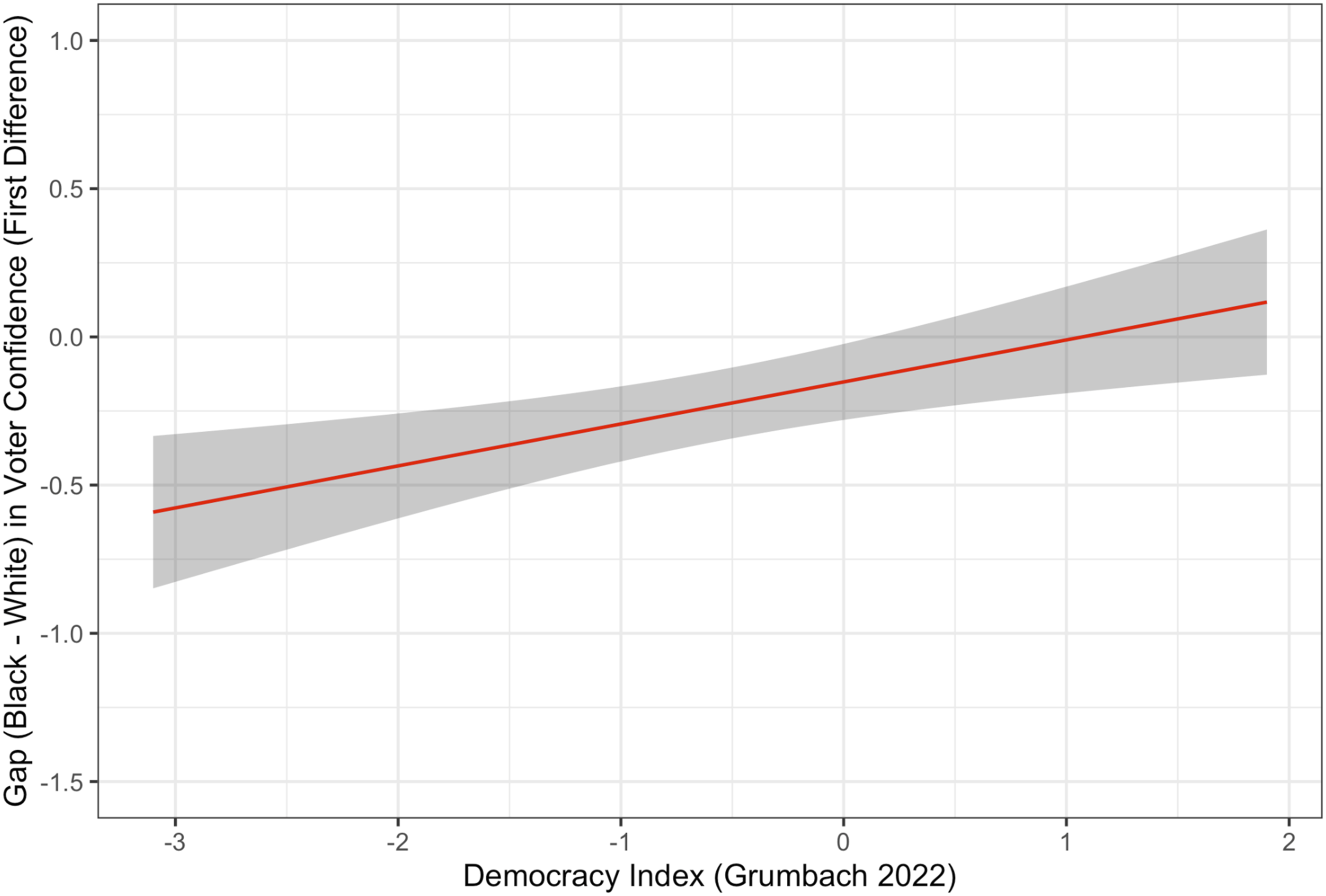
Figure 1 shows that as the inclusiveness of democratic institutions in a state increases, Black Americans tend to have higher levels of trust in the accuracy and integrity of elections in their own state (relative to white Americans). In states with more inclusive approaches to democracy—such as Arizona, Colorado, California, New York, and Oregon—the predicted gap in trust in state elections between Black and white Americans goes away. In states scoring near the midpoint of the index (including Idaho, Kansas, Texas, and Virginia), the predicted gap becomes significant. In states with low scores on Grumbach’s Democracy Index (a group that includes Georgia, Missouri, South Carolina, and Wisconsin), the predicted gap doubles in size.
This is a particularly noteworthy finding because it demonstrates that the racial gap in trust in elections is not a fixed attribute of American politics but that it responds to a state’s democratic performance. Where states promote policies and create institutional channels for encouraging broader participation, Black Americans report feeling more confident and trusting in the electoral process and the racial trust gap disappears. This finding further suggests that efforts to enhance democracy by ensuring equal access to voting rights, eliminating barriers to participation, and reducing bias in redistricting and other practices may not only strengthen democratic governance but also contribute to building trust in electoral institutions.
Does the Racial and Ethnic Gap in Trust Vary by Election?
The existing literature finds that trust in government and elections is highly sensitive in reflecting short-term discontent for individuals no matter their ethnoracial background (Wilkes 2015). In particular, the strong “winner effect” increases trust soon after an election among the party whose candidate prevailed (Anderson et al. 2005; Anderson and Guillory 1997; Anderson and LoTempio 2002; Clarke and Acock 1989; Clayton et al., 2021; Craig et al. 2006; Nadeau and Blais 1993; Reller et al. 2022; Sances and Stewart 2015; Sinclair et al. 2018). To explore whether the party-driven winner effect also shapes trust in elections among racial and ethnic groups, we present data on trust after five US federal elections, broken down by race and trust. We look for evidence consistent with our third hypothesis, seeking to understand whether the gap in trust in elections is smallest after presidential candidates favored by minority groups (Cain et al. 1991)—here, that is, Barack Obama and Joe Biden—win elections and largest after candidates opposed by minority groups—in this analysis, Donald Trump—win elections.
To determine whether this pattern has held in recent American history, we use the Survey of the Performance of American Elections (SPAE), an authoritative source that has asked about levels of trust in surveys conducted after national elections 9 since 2012 (see Stewart 2023 for a description of the most recent SPAE). The four ethnoracial categories we include in this analysis are Black, Hispanic (of any race), Asian, and white; we do not include Native Americans due to this survey not offering this racial category as an option for respondents. After asking the respondent about their confidence in their own vote and in their county’s vote, this question asks: “Now, think about vote counting throughout [the respondent’s state]. 10 How confident are you that votes in [the respondent’s state] were counted as voters intended?” Individuals who answered “Very Confident” were coded as a 4, while those who selected “Not At All Confident” were given a 1, with “I don’t know” excluded from this analysis.
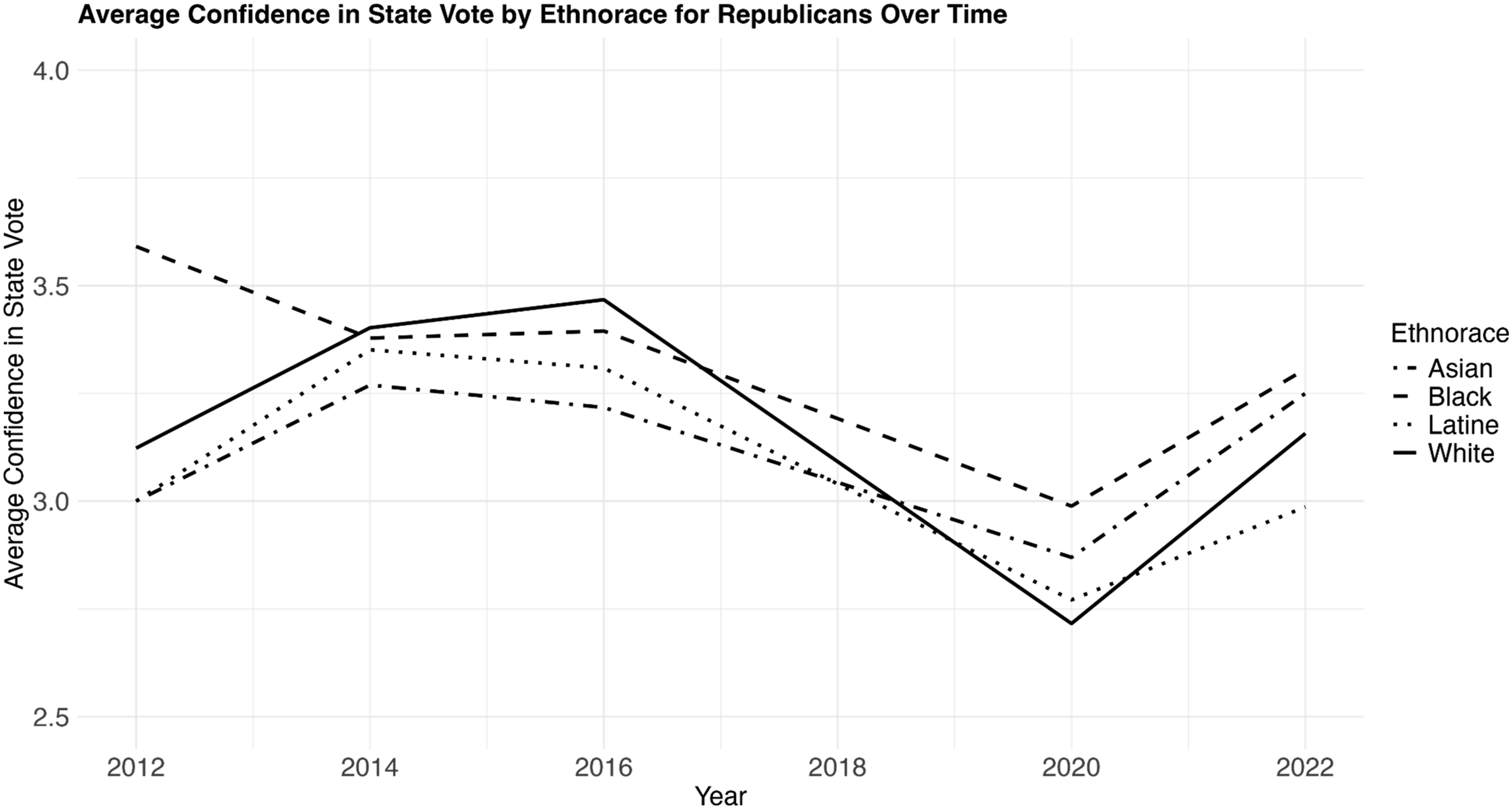
Figures 2 and 3 display trends in respondents’ confidence in their state vote, averaged by ethnorace. Because partisanship is such an important factor in determining trust after an election, and because it is so highly correlated with race, we look at each party separately to hold constant party affiliation. Figure 2, then, depicts the average confidence in knowing that the respondent’s state vote was counted as intended, subset to only Democratic respondents, over time. For almost the entirety of the period, Black Democrats reflected the lowest levels of confidence, with large gaps relative to white and Asian democrats. The exception to this trend comes in 2012, when Black Democratic trust in elections is high, with racial gap almost entirely disappearing, after President Obama’s successful re-election. This is consistent with the findings of Wu et al. (2022) about Black Americans’ trust in government broadly. Black trust in elections exhibited a decline in confidence from 2012 to 2016 (after Donald Trump’s victory) and then rebounded and stabilized in 2020 and 2022. This trend is consistent with the rise and fall in trust depending on whether this group’s preferred candidates won or lost. Average confidence in state vote among democrats by ethnorace over time data from SPAE, 2012–2022. Average confidence in state vote among republicans by ethnorace over time data from SPAE, 2012–2022.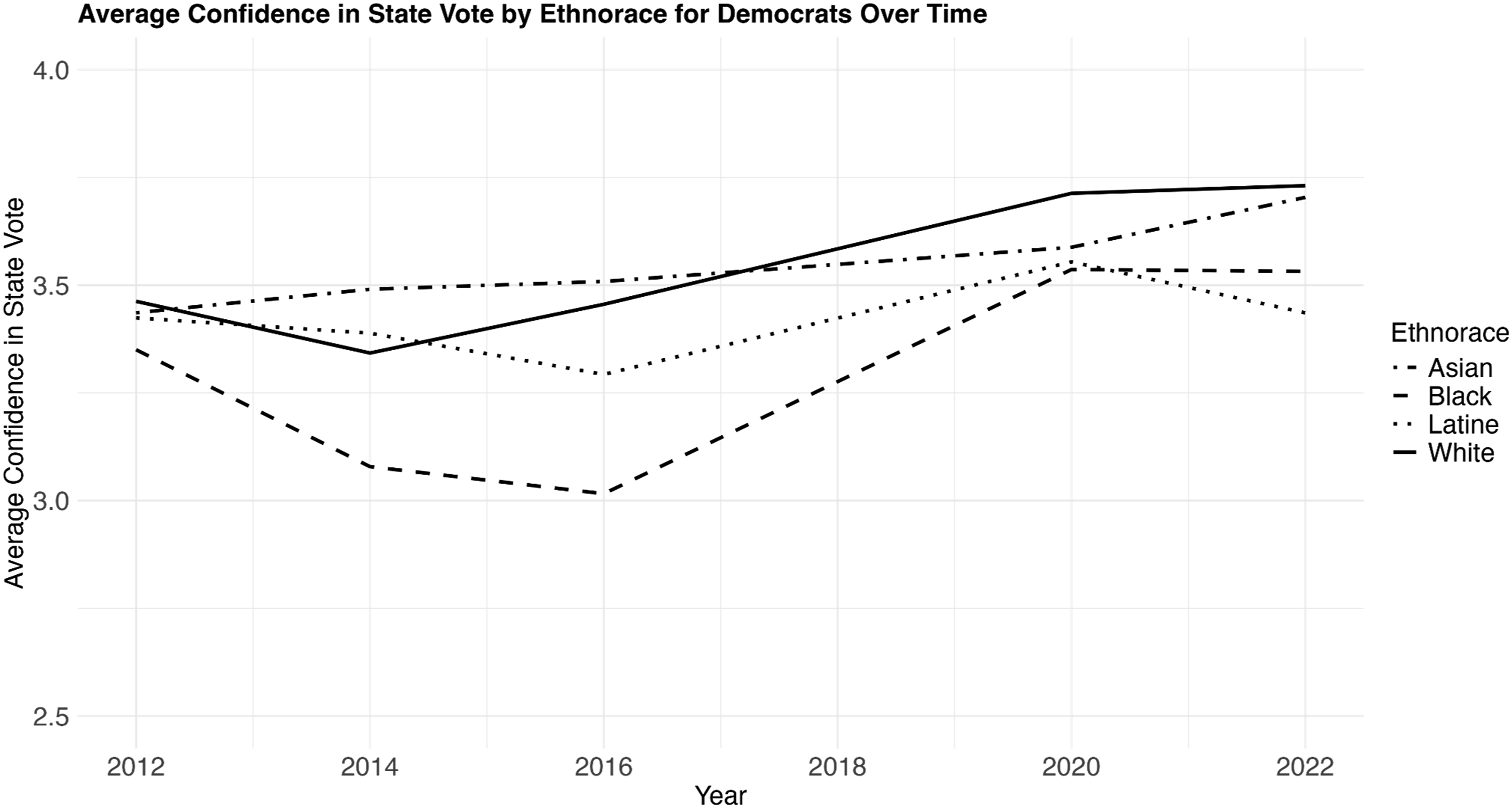
White Democratic respondents, on the other hand, experienced a relatively stable increase in their confidence level from 2014 through 2020, with a less steep but nonetheless still positive trend through 2022. Among Asian American Democratic respondents, there is a consistent upward trajectory in confidence from 2012 to 2022, with confidence levels steadily increasing. Confidence among these Asian American respondents is similar to that expressed by white respondents, and tends to be high; the notable exception is in 2020, where levels of trust among Asian respondents dips, potentially due to a rise in COVID-19 related hate crimes in this time period. Trust among Hispanic Democrats is lower than among their white or Asian American co-partisans from the time of Donald Trump’s victory onward, and after the 2022 contest this group registered the lowest levels of trust in the SPAE.
We report trends for Republican respondents over time in Figure 3. While among Democrats we observe a cohesive uptick in 2020, the reverse relationship is shown here—that is, among all ethnoracial groups, there is a general decline in confidence after the 2020 elections. This is consistent with their candidate’s loss and with claims that Donald Trump made of vote fraud. White Republicans had the lowest levels of trust, in between “Somewhat confident” and “Not too confident.” The most pronounced disparities along racial and ethnic lines appear in 2020, with Asian and Black Republicans trusting the results more than their white co-partisans. Notably, Black Republicans’ trust in elections was the highest of any Republican group after Donald Trump’s loss in 2020 as well as after Barack Obama’s victory in 2012, both consistent with the idea that trust in elections is shaped by group-level responses to election outcomes. And the generally high level of trust in elections among Black Republicans is similar to the finding by Wilkes (2015) that this group reports particularly high levels of trust in government.
An intriguing pattern, which other scholarship has identified, is that the gap in trust between Black and white Democrats is typically larger than the gap in trust between Black and white Republicans. The exception to this is Barack Obama’s re-election in 2012, in which Black Republicans reported much higher levels of trust than white Republicans, while trust among Democrats of all racial groups was high among all racial and ethnic groups. Prior scholarship has found that white liberals and liberals of color react differently to politics based on their perceptions of the salience of race in a given issue, which may be the case witnessed here. For example, White liberals and liberals of color had different reactions to the events of January 6, 2021 based on whether they viewed race as a motivating factor for those who stormed the Capitol Building that day (Gutierrez et al. 2025). Although these groups may share ideological views across a broad spectrum of issues, racial minority groups are more likely to respond to the racial undertones of political events when the identity-to-politics link is made relevant (Lee 2008). For many people from minority racial groups, their evaluations of electoral institutions are heavily influenced by either their own experiences as a person from that racial/ethnic group or by the experiences of others who share their racial/ethnic background.
Further, Black Republicans deviate from Black political behavior norms more broadly and so may be likely to depart from the community’s norms about trust in elections. The divergence of Black Republicans from broader norms of Black political behavior highlights tensions between individual ideology and collective identity. While most Black Americans prioritize policies that advance racial group interests—often aligning with the Democratic Party—Black Republicans often emphasize individual responsibility and personal agency, which aligns with the Republican Party (White and Laird 2020).
Multivariate Regression Using the Survey on the Performance of American Elections, 2012–2016.
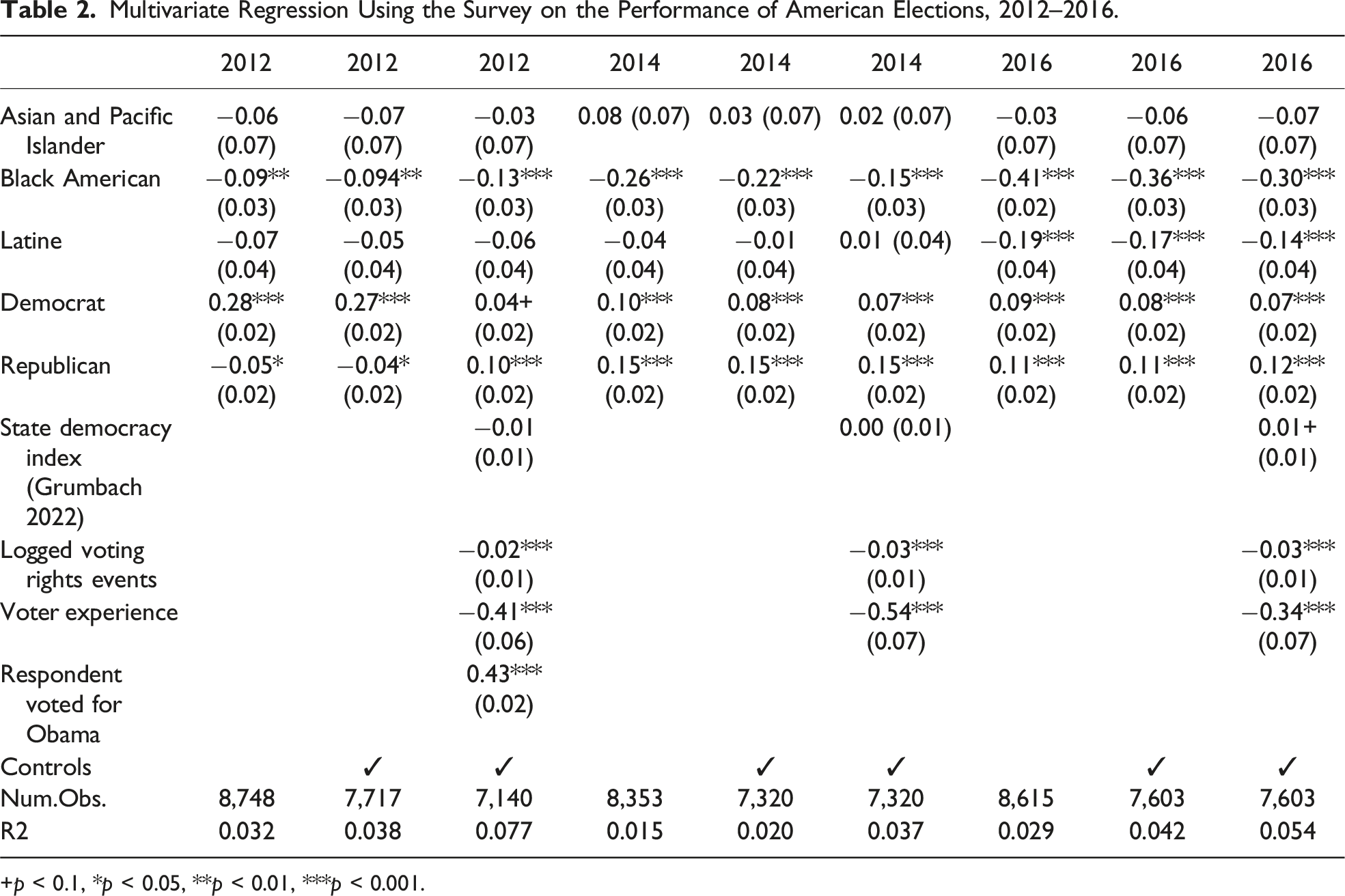
+p < 0.1, *p < 0.05, **p < 0.01, ***p < 0.001.
Multivariate Regression Using the Survey on the Performance of American Elections, 2020, 2022, and Pooled Across 2012–2022.
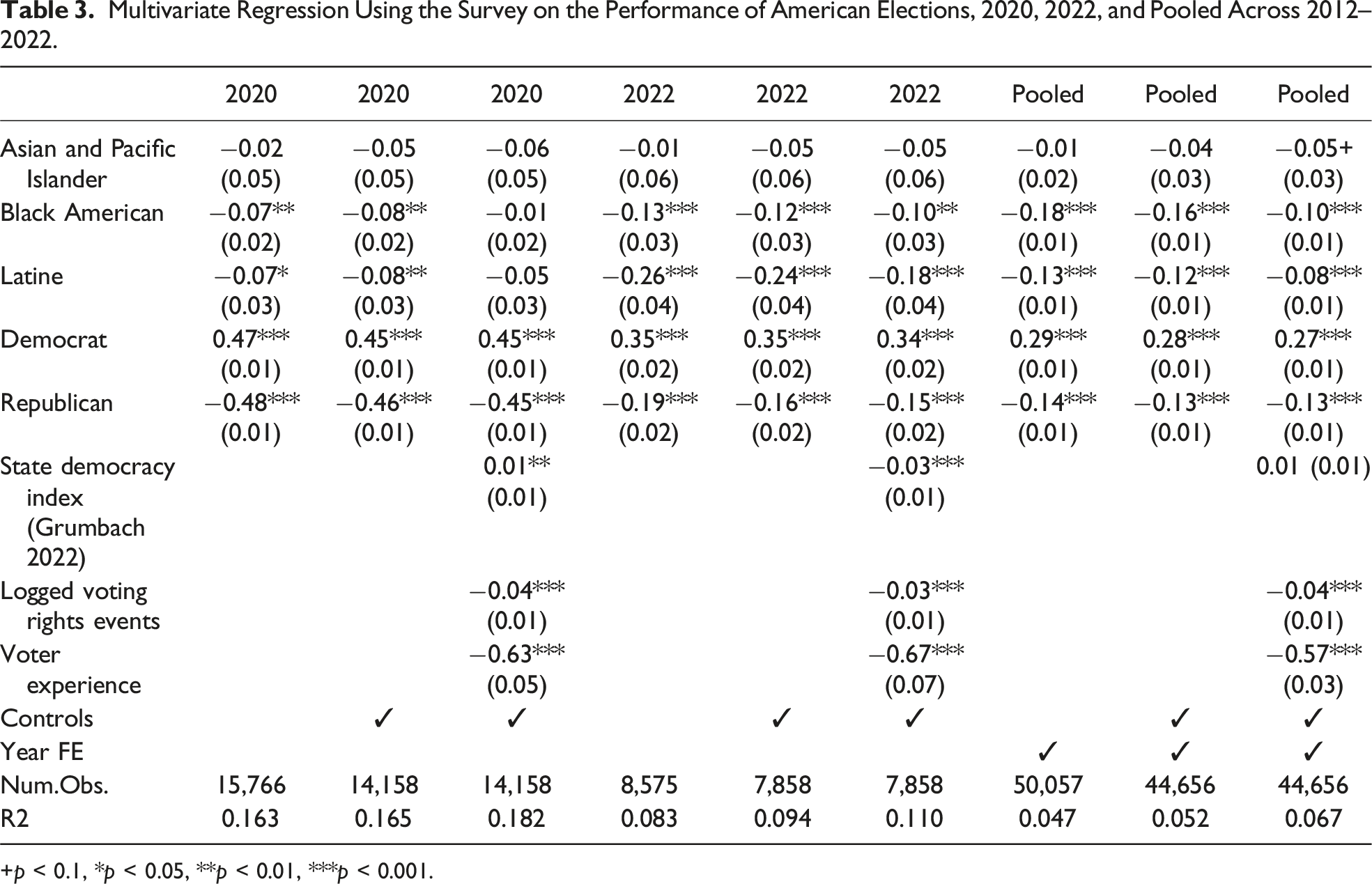
+p < 0.1, *p < 0.05, **p < 0.01, ***p < 0.001.
In sum, we note that a closer look at the patterns of trust over time are best explained when considering both ethnorace and partisanship. Most ethnoracial groups move together within their party, which provides support for the general idea that a partisan “winner effect” impacts trust in elections. But we also find support for our third hypothesis that the same underlying logic shapes trust for individual racial groups. The deviations that we note within each partisan trend—the higher levels of trust that Black Democrats and Black Republicans alike show after Obama’s victory, the declines in trust among Black and Hispanic respondents after Trump’s victory in 2016, and the rebounding trust among all minority groups after 2020—are each consistent with a group-specific winner effect.
Do Informational Treatments Affect the Racial and Ethnic Gap in Trust?
To test our third hypothesis that members of different racial and ethnic groups will respond differentially to information about safeguards on elections, we further analyze a pooled, national, and preregistered 11 survey experiment conducted by Gaudette et al. (2025). For the survey we fielded on a nationally representative sample, respondents were randomly assigned either to view a video produced by the Virginia Department of Elections (“Democracy Defended”), by the Maricopa County (Arizona) Elections (“Phil in the Blanks”), or to a control treatment that viewed a commercial for auto insurance. Descriptions of each video can be found in the appendix. For the samples collected in Colorado, Georgia, LA County, and Texas, respondents were randomly assigned to one of two treatment videos, both about their state (or county)’s elections office, or control of a Cadillac commercial. The survey asked respondents about their levels of trust in other states’ elections both before and after viewing the videos, allowing a within-subjects test of the videos’ impact in a design with strong causal inference. Because the videos had similar effects overall, in the analysis presented below, we pool their effects, reporting the impact of watching either video on trust in elections, compared with the control cases. We preregistered our hypothesis that the treatment effects will vary by racial and ethnic group.
Testing the Impact of Informational Treatment on Trust in Other States’ Elections, by Racial and Ethnic Group.
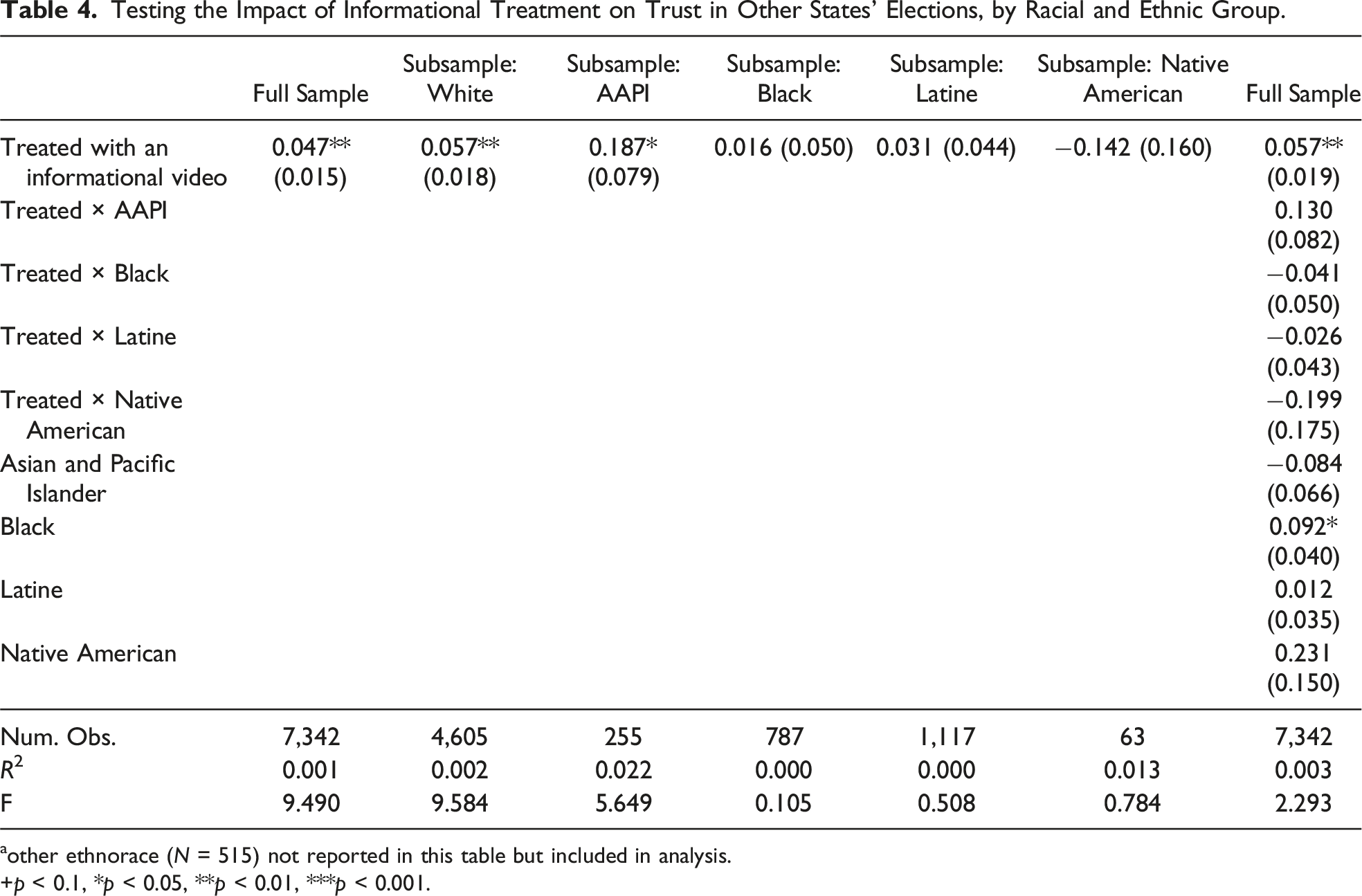
aother ethnorace (N = 515) not reported in this table but included in analysis.
+p < 0.1, *p < 0.05, **p < 0.01, ***p < 0.001.
The largest impact on trust observed in this experiment was among Asian American and Pacific Islander respondents, whose trust rose by 18.7% points after viewing the video. For members of other racial and ethnic groups, the estimated impact of viewing the videos were either smaller (1.6% points for Black Americans and 3.1% points for Latines) or negative (−14.2% points for Native Americans) and in all cases falls far short of statistical significance. This provides suggestive evidence that the two videos that we tested were less effective among members of these groups than among white or AAPI Americans.
However, our formal tests of these differential effects presented in the final column—the interactions between the treatment and membership in each group—also fall short of statistical significance. Additionally, in Appendix Table A.5 we present results that pool across all minority groups, and do not find a statistically significant interaction with the treatment. While this analysis thus does not conclusively demonstrate differential effects across groups, it highlights the concern that trust messaging that works for white and AAPI Americans may not be as effective for members of groups that exhibit lower levels of trust and who may hold different concerns. As election officials do the important work of planning informational campaigns to build trust in elections, they should be cognizant of the need to address diverse sets of audiences through their messaging.
Conclusion
The contemporary discourse on trust in American elections often overlooks historically marginalized groups—particularly racial and ethnic minorities who continue to encounter barriers to voting and experience the dilution of their voting power. Understanding how both this history and ongoing, contemporary challenges shape individuals’ confidence in elections, separate from their trust in society and political institutions more broadly, is critical. Recent research has begun systematically studying the impact of racial and ethnic identity on confidence in the integrity of elections (Bergeron-Boutin et al. 2023; Freeder and Shino 2023). Our work extends this literature by advancing and exploring a theory of how this gap is rooted in voting laws, by comprehensively examining four major racial and ethnic minority groups, and by leveraging three data sources that uncover the dynamics of this gap.
Our first approach analyzes a multivariate regression, finding significant gaps in trust along racial and ethnic lines, with Black and Native Americans exhibiting lower trust compared to white Americans, even after accounting for demographic factors and historical political context. We also find that the gap in trust between Black and white Americans depends on a state’s election laws and practices; the gap disappears in states that score highly on Grumbach’s (2022) State Democracy Index, where the gap is most pronounced in states whose policies are less inclusive towards ethnoracial members. Additionally, trust gaps vary across time, reflective of the context of the electoral victories for candidates most strongly favored by different racial and ethnic groups. Finally, we find that informational videos produced by election officials, which increase trust among the population broadly, may not be as effective for members of some racial and ethnic groups. Our findings underscore the persistent disparities in trust in elections among racial and ethnic groups, highlighting the importance of addressing structural barriers and tailoring interventions to build trust across diverse communities.
In sum, these findings demonstrate that the gap in trust in elections is rooted in the obstacles to accessing democracy that some racial and ethnic groups have faced throughout American history. This gap did not result from an election-specific loss in confidence driven by a favored candidate losing an election or from that candidate making unverified claims of fraud. For Black Americans, the gap has persisted at least since 2012. It remains strong and significant even when we control for the “winner effect” dynamic in models where that data is available in 2012 and 2022. The magnitude of the gap varies with a state’s election laws and practices, as evidenced by the interaction between the State Democracy Index and trust among Black Americans.
This particularly noteworthy finding further emphasizes the importance of legal frameworks in shaping trust in elections. Inclusive access to democracy for all Americans—such as through expanded access to early voting, felon re-enfranchisement, and earlier preregistration to vote, to name a few—is a powerful approach that promotes trust in American elections. When states promote these policies and create institutional channels for broader participation, trust rises among members of the groups that have faced disfranchisement. The racial gap over trust in elections is thus driven by fundamental forces in American democracy rather than by ephemeral shifts after a single election.
Furthermore, different ethnoracial groups have unique determinants of mistrust shaped by distinct historical and social contexts. For example, distrust in elections among Black Americans may stem from historic legacies of slavery, Jim Crow laws, and systemic racism, whereas in Native American communities it may instead stem from sovereignty conflicts or land dispossession. Similarly, Latine populations might experience mistrust from feeling excluded in the electoral context. It is possible that our measure may not fully capture these nuances, which emphasizes the need for additional research to advance this subject to explore these nuanced determinants of mistrust. Further scholarship might go into more specific avenues and intersectional approaches to comprehend how these particular historical, political, and social contexts influence mistrust across various communities.
Of course, this project contains its limitations. For one, having a nationally representative sample reduces the amount of variation we can see within each ethnoracial group. Future scholarship could oversample such respondents in order to better understand within-group heterogeneity towards intersectional nuances. Additionally, our video interventions largely target the source of electoral mistrust among white conservatives, but not among diverse communities. Identifying and addressing these sources of mistrust may prove more effective at closing the ethnoracial gap in such interventions.
Understanding the implications of trust in elections is crucial due to its potential for significant behavioral impacts. Trust in elections is correlated with reported turnout (Gaudette et al. 2022), and Gaudette et al. (2023b) provide initial experimental evidence that changes in trust cause changes in intent to turn out as well as willingness to serve as a poll worker. In this analysis, we find that trust and voter turnout are correlated, with this bivariate correlation particularly pronounced among Native American, Black, and Latine voters (see Appendix Table A-6). We encourage future scholarship to further explore the potential role of trust as a mediator in voter behavior. Moreover, given the context of evolving voting laws, our findings underscore the importance of assessing the inclusiveness of state voting laws. In 2023, as 14 states passed restrictive voting laws while others expanded access to the ballot (Brennan Center for Justice 2024), understanding the impact of these legal changes on trust becomes increasingly vital for ensuring equitable electoral participation and democratic integrity.
Supplemental Material
Supplemental Material - The Racial Gap in Trust in Elections (and How to Close It)
Supplemental Material for The Racial Gap in Trust in Elections (and How to Close It) by Laura Uribe, Kailen Aldridge, Thad Kousser, Kyshan Nichols-Smith, and Tye Rush in Political Research Quarterly.
Footnotes
Declaration of Conflicting Interests
The authors declared the following potential conflicts of interest with respect to the research, authorship, and/or publication of this article: UCSD IRB # 805606.
Funding
The authors disclosed receipt of the following financial support for the research, authorship, and/or publication of this article: The authors are grateful for funding provided by the MIT Election Data and Science Lab “Learning from Elections” program and from the UC San Diego Yankelovich Center.
Data Availability Statement
Data and replication code can be found at: https://doi.org/10.7910/DVN/E9UXOH,  .
.
Supplemental Material
Supplemental material for this article is available online.
Notes
References
Supplementary Material
Please find the following supplemental material available below.
For Open Access articles published under a Creative Commons License, all supplemental material carries the same license as the article it is associated with.
For non-Open Access articles published, all supplemental material carries a non-exclusive license, and permission requests for re-use of supplemental material or any part of supplemental material shall be sent directly to the copyright owner as specified in the copyright notice associated with the article.
