




Abstract
In modern congressional elections, fewer than 10% of candidates who run against sitting members of Congress win and yet they comprise as much as 30% of the House in any given congress. In this paper, we examine the legislative effectiveness of those relatively rare challengers who knock off incumbents. We name them, “Giant Killers,” and find that during the early part of their House careers they are 43% more effective than those who first join the House by winning an open seat. We suspect that the coalition-building skills that a candidate needs to win a difficult race against an incumbent may be similar to and correlated with the coalition-building skills needed to be legislatively successful.
Keywords
In a result that President Obama described as a “shellacking,” the Republicans picked up 63 House seats in the 2010 elections producing the largest ever Republican freshmen class. 1 Two of the 91 first-term Republicans were Richard Hanna (NY-24) and Rick Crawford (AR-1). Though they represented different parts of the country, they shared several characteristics. Neither had ever been elected to political office before. Hanna owned a construction business before his election, and Crawford was a television news anchor. Both succeeded Democrats. By 6 points, Hanna beat Mike Acuri, someone who defeated him by 4 points in the previous election. After 7-term incumbent Marion Berry, a Democrat, decided to retire, Crawford lined up some institutional Republican support and won the primary by more than 40 points before defeating Berry’s chief-of-staff by 8 points in the general election. Upon taking the oath of office, both Hanna and Crawford were appointed to the same committees: (1) Education and Workforce and (2) Transportation and Infrastructure. On paper, they were nearly indistinguishable: two middle aged white men who parlayed their outsider status into winning competitive seats as part of the big Tea Party wave that swept into the House.
Given their similar backgrounds and institutional positions, it is reasonable to expect them to have similar legislative records. Neither had any previous legislative experience. Both were in the majority party, and both served on the same committees. As they began their respective journeys through the marbled halls of the Capitol, their legislative prowess quickly diverged. Hanna proved himself an industrious and effective legislator introducing 14 bills, three of which became law and an additional two passed the House (on average, he gathered 29 cosponsors for each of his bills). Crawford, on the other hand, introduced 9 bills only one of which the House passed (none of the others made it out of committee). He only secured, on average, 9 cosponsors for his bills.
Admittedly, any number of justifications could be offered to explain these outcomes. From differing personal experiences, staff expertise, leadership styles, or sheer luck, certain members of Congress simply succeed while others struggle (Volden and Wiseman 2014). Another explanation for these divergent outcomes might have to go back to election day, though focusing less on Hanna and Crawford and more on their opponents. While Crawford entered Congress the same way most members do, by waiting for the incumbents to retire and running to replace them, Hanna entered Congress by defeating an incumbent. Because of whom he beat, we name victors like Hanna, “Giant Killers.” While admittedly the incumbents they defeat are not all giants, the advantages that members of Congress accrue simply by being in office makes their reelection odds much better than the challengers running against them. Because of the well-known and studied incumbency advantages, it is not surprising that so few incumbents lose (Herrnson 2016; Jacobson and Carson 2020). What is not well known, and should not be surprising, is that the very few challengers that beat incumbents are exceptional, at least in the electoral arena.
In this article, we show that Giant Killers in their first term are 43% more legislatively successful than the members who win open-seat contests, though this bonus recedes with each additional term and completely disappears by the end of their first decade in the House of Representatives. We proffer two hypotheses to explain this bonus. First, their party leadership may favor them legislatively to help them electorally. At least for General Election Giant Killer, which comprise roughly three-fourths of the total, their districts have shown a recent proclivity for voting for candidates from the opposite party. Their leaders may try to make these Giant Killers safer by providing them with legislative accomplishments. Second, the kinds of skills candidates need to win difficult elections might be correlated with the skills members need to succeed legislatively. Discussing policy in a compelling way, putting together a coalition, and developing a game plan may work just as well in the legislative arena as it does in the electoral one. Teasing these arguments out statistically is not particularly straightforward, but we provide more evidence that seems to point to the second explanation.
This article proceeds as follows. First, we precisely delineate who qualifies as “Giant Killers” and then describe across time their numbers in the House of Representatives. Second, we determine the precise bonus Giant Killers have in legislative effectiveness through bivariate and multivariate analyses. Third, we attempt to adjudicate between the two hypotheses for the legislative effectiveness bonus. Finally, in the conclusion, we suggest multiple paths for future research.
Giant Killers
Theriault and Edwards (2020, 98) assert that “perhaps the best truism of congressional politics is that incumbents win.” Indeed, the incumbency reelection rate in the House hovers around 95%. Jacobson and Carson (2020) summarize that the incumbency advantage has multiple sources including the institutional design of Congress (Mayhew 1974), the changes in voting behavior (Ferejohn 1977), the services members provide to their constituents (Fiorina 1977), their greater access to campaign contributions (Jacobson 1980), and then, because of these sources, their ability to scare off challengers (Cox and Katz 1996). Indeed, incumbency is the most important determinant in understanding who wins congressional elections. And yet, each cycle some lose perhaps because they had become weaker candidates (because of scandals, old age, or other personal or political circumstances) or because they had run against a superior candidate.
Measuring the incumbency advantage is complex for a variety of reasons. First, sometimes weak members simply retire (Hibbing 1991; Moore and Hibbing 1992; Theriault 1998); other times, they run for reelection. Challengers who beat weakened incumbents are not nearly as “giant” as those that knock off incumbents who few thought were vulnerable. 2 Second, candidates, especially “quality challengers,” enter contests contingent on political circumstances, incumbent strength, and district characteristics (Jacobson and Kernell 1983; Maisel and Stone 1997, Carson et al., 2011), which help determine how good the challenger needs to be in order to defeat the incumbent. Third, the nationalization of congressional elections (Jacobson and Carson 2020) and party polarization (Abramowitz 2010; Theriault 2008) suggest that the individual movement that any one candidate can make is smaller than it was when split-ticket voting—and split results—were more common. These complexities suggest that not all Giant Killers are the same, just as all the incumbents that they beat are not the same; likewise, of course, with the comparison group of candidates that win in open seats.
Given the difficulty of defeating an incumbent, candidates that try may be revealing their lack of keen political acumen, which would suggest that that they simply wait for the right moment to launch their campaigns. By not waiting for the incumbent to retire, these candidates may be revealing how little they know about politics, which calls in to question either their skill or judgment. Either way, the literature might suggest that Giant Killers should fare worse legislatively for not understanding how the game of politics is played. While the total set of candidates running against incumbents may not be legislative heroes, those that somehow figure out a way to win, may be. We argue that the variation over the 435 races in the 12 cycles we analyze makes the individual perturbations of any single race less meaningful. Systematic testing can reveal if the differences in the groups are the same as the differences between Hanna and Crawford.
Defining Giant Killers
We define any new representative who arrived in the House by beating an incumbent as a “Giant Killer.” This narrow definition introduces a couple of tough cases for which we want to be explicit. First, some members arrived in the House after launching a campaign against an opposite-party incumbent, only to see that incumbent defeated in the primary. Going on to win that election would not classify that member as a Giant Killer, even though the incumbent member was seeking reelection. Second, those members who win their seats over other incumbents (typically when redistricting combines their constituencies) are not classified as Giant Killers because they enjoyed the same incumbency advantages as their opponents. While their opponents may have been a giant, they, too, were giants, suggesting a status-equal election contest not unlike two challengers competing for an open seat. 3
The Frequency of Giant Killers Across Time
We begin our analysis with the 1994 elections leading into the 104th Congress for three reasons. First, up until then, the Democrats dominated the House securing a persistent majority back to the 84th Congress (1955–6). So long as the Democratic Party was a “permanent majority” (Ornstein 1991), the election contests were different than they are when only a couple of seats in an election cycle determines which party is the majority (Theriault and Lewallen 2012). Second, Newt Gingrich and the new Republican majorities so changed the House that we think that lumping the Giant Killers from before 1994 with those afterward is grouping two different sets of politicians (Bonica and Cox 2018; Green and Crouch 2022; Theriault 2013; Theriault and Rohde 2011). Third, the incumbency advantage prior to the 1994 elections was significantly greater than it was after (Jacobson and Carson 2020), so obtaining the status prior to the 104th Congress may have been even more difficult, and because the incumbency reelection rate stays high before and during the time period of our analysis, it suggests that a different dynamic may be playing out in the elections before our article’s time period, perhaps based on the two previous reasons (for more, see Jacobson 1989).
The 104th Congress ushered in 38 Giant Killers comprising 8.7% of the House and 40.4% of the first-term members. In the following election, 30 of the 38 new Giant Killers from the 104th Congress continued to serve; they were joined by 24 new Giant Killers. Each succeeding election brought more Giant Killers to the House up until the 114th Congress, which had five fewer than its predecessor (see Figure 1). Not unsurprisingly, the two largest new classes of Giant Killers entered the House in 1994 and 2010. The steady state of Giant Killers in the House is between 20 and 25%; three-fourths of whom defeat the incumbent in the general election. The number of Giant Killers in the House, 104th to 115th Congresses (1995–2018).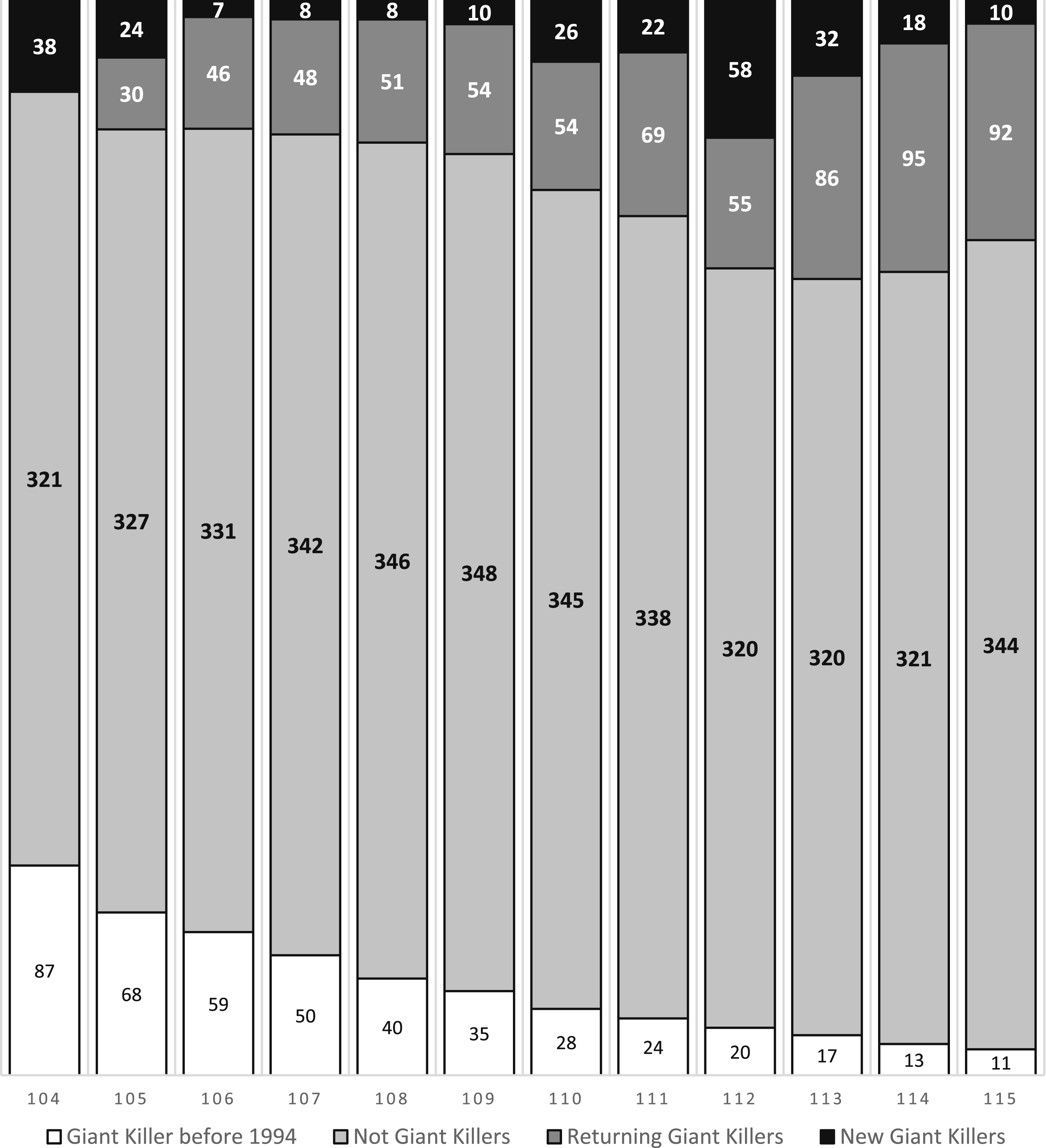
Of the 351 members in the 104th Congress (1995-6) who also served in the 103rd Congress (1993-4), 87 were Giant Killers from previous elections. Our analysis of these members’ legislative effectiveness from the 93rd Congress (1973-4) to the 103rd Congress shows that they are not distinct from the members who won their seats in open-seat contests. The Giant Killers from this earlier period had a mean LES of 0.279, which was only 0.004 higher than the first-term members who won open seats (p-value of 0.449). Furthermore, the data do not show a time trend over these congresses that suggests the Giant Killer bonus is getting bigger across time. The 50 Giant Killers from the 102nd and 103rd Congresses have a 0.282 average LES, which is 0.015 bigger than their 124 open-seat winning colleagues (p-value of 0.407). That the 104th Congress opens a new era for the Giant Killer bonus is clear. The 38 Giant Killers of the 104th Congress have an LES of 0.958, which is 0.632 higher than the new members of the 104th Congress who won their seats in open-seat races (p-value of 0.000). Where appropriate we do test for a pre-104th Congress Giant Killer effect. We never find any evidence that they are any different from the non-Giant Killers in this earlier time period.
The Legislative Effectiveness of Giant Killers
The professional wrestler, Ric Flair, made famous the concept we explore in this article: “To be the man, you have to beat the man.” 4 While the data in the previous section suggests that most members of Congress just wait until the “man” or “woman” retires and then runs for his or her seat that is now vacant, sufficient members do not wait until a retirement for us to examine if they have a fundamentally different experience within Congress than those who gain their seats through open-seat races.
Even though they take the same oath, they get their seats on the same day, and their seniority is determined by lot (Kellermann and Shepsle 2009), we offer two reasons why Giant Killers may be more effective than their non-Giant Killer colleagues. 5 First, Giant Killers might have more legislative success because their party leadership treats them differently when they arrive in the hallowed halls of the U.S. Capitol. In fact, it could be that the promises leadership made to a successful businesswoman or a popular sportscaster compelled them to pause their professional careers to try their hand at politics. Once they take their seats in Congress, leadership may reward them with better committee assignments or may prioritize their legislative goals in hopes of making safer a vulnerable first-term member.
Second, by virtue of beating an incumbent, Giant Killers may simply be exceptionally talented politicians. Just as it is not easy to defeat an incumbent, it is not easy to pass legislation. The skills that helped an individual do the former may prove useful at achieving the latter. While getting the details right in legislative drafting is not the same thing as developing policy papers and while assembling an enacting legislative coalition is not the same thing as getting campaign contributions, the organizational and interpersonal skills on the campaign trail may not be that unrelated to those that are required for building a successful legislative record (Ringe, Victor, and Gross, 2013; Harbridge 2015; Craig 2023). When faced with difficult electoral environments, they worked hard and got the job done. It could be that the same is true with legislating.
In their book that launched the effectiveness research agenda, Volden and Wiseman (2014, 168–192) identified five habits of highly effective lawmakers. While one of those habits (“Be entrepreneurial with positions of institutional power”) requires some level of seniority, the other four are as relevant to first-term members as veterans. The remaining habits could speak to why Giant Killers are not only electorally, but also legislatively, effective. Just as Giant Killers must present themselves as compelling candidates in order to defeat incumbents, so highly effective lawmakers “develop a legislative agenda rooted in personal background, previous experiences, and policy expertise.” Catering to district needs (habit 2) could help not only in defeating incumbents, but also in being an effective lawmaker. Giant Killers have to appeal to voters beyond their traditional base in order to upset incumbents; effective lawmakers have to “be open to compromise, even with those who are not natural allies” (habit 4). The campaign to defeat an incumbent is required to be expansive, just as enacting coalitions of laws must include a “broad set of allies, even beyond the House” (habit 5). Congressional candidates, especially those taking on incumbents, must develop winning electoral campaigns; effective lawmakers need winning legislative campaigns to get their bills across the finish line. This same set of skills—either innate or learned—that led to them becoming Giant Killers could also help them become effective lawmakers.
Although many challengers take on incumbents, only the really good ones become Giant Killers; the rest are electoral losers. As such, only the really good challengers make it to the House. In this sense, being a Giant Killer might not be that different from being a female member of Congress (Anzia and Berry, 2011; Lawless et al., 2018; Volden et al., 2013). Because the political environment is sufficiently stacked against them (either Giant Killers or women), the ones that eventually succeed are the cream of the crop. Not unsurprisingly, they (either Giant Killers or women) overperform those who do not face as insurmountable odds. Giant Killers, perhaps more so than even women, show either a more carefree approach to electoral politics or an utter disregard for the political science literature (how dare they!). Both by anecdote and study (Carson et al. 2011; Jacobson and Kernell 1983; Maisel and Stone 1997), the most strategic politicians are most likely to wait for an open seat to launch their congressional campaigns. While individual personal circumstances (e.g., reaching the end of a term limit for state legislators or a free attempt at Congress while serving in an office with a different reelection date) or strategic calculations (e.g., a vulnerable incumbent either because of malfeasance or incompetence) may compel even risk-averse ambitious politicians to throw their hats in the ring against an incumbent, few challengers are expected to win their races at the time they announce their candidacies. Because the odds are so low, most strategic politicians may opt for the more likely path to Congress—winning an open seat.
Our dependent variable is the members’ legislative effectiveness scores (LES), which are derived from the success and importance of the legislation members sponsor (Volden and Wiseman 2014). The scores have a mean of 1 in every congress. They range from 0 (no introduced bills) to 18.7 in the House (Charlie Rangel in the 110th Congress). In the 112th Congress, Hanna’s LES was 2.77 (the 34th highest score in that congress); Crawford’s score, on the other hand was 0.53 (the 223rd highest score). While these scores may not perfectly reflect effectiveness, enough analysis suggests that they are sufficiently correlated with the predicted factors that they are close approximations for how member (and those studying them) view legislative success (Battaglini, Sciabolazza, and Patacchini, 2020; Berry and Fowler 2018; Crosson et al., 2020; Montgomery and Nyhan 2017).
Bivariate Analysis
At the simplest analytic level, the data show that Giant Killers are significantly more effective than those members elected in open-seat contests. For all congresses and coding a members’ status for the duration of their careers in Congress, Giant Killers have a mean LES of 0.90, whereas their counterparts’ mean is 0.76 (p-value of 0.0000). 6 If we isolate the comparison to members’ first term in Congress, the difference is greater: Giant Killers in their first term have a mean LES of 0.83, while their counterparts’ mean is 0.58 (p-value of 0.0001)—a 43% Giant Killer bonus. With each passing congress, that bonus diminishes. Indeed, after 10 years in the House, Giant Killers have an LES of 0.93, which is statistically indistinguishable from the non-Giant Killers 0.95. The LES gap between Hanna (1.25) and Crawford (1.14) dropped in their second congress (as Crawford introduced almost twice as many bills as Hanna) and by their third congress, which was Hanna’s last, the order between them flipped. Incidentally, Hanna left after his third term, and Crawford eventually became the Chair of the House Intelligence Committee.
Whether leadership favoritism or superior skills are at root of Giant Killer legislative success, it makes sense that over time the distinction between Giant Killers and their compliments dissipates. The electoral contexts for all members change over time, which blurs the differing electoral circumstances safety between the two groups. Additionally, the attributes that make Giant Killers better legislators can be learned as witnessed by Crawford early in his career. Given these results, we must add complexity to Flair’s pithy quote: “To be the man, you have to beat the man or wait until the man is equally safe or watch what that man does and then imitate that behavior.” 7
Our bivariate analysis suggests that the Giant Killer boost is not particularly differentiated by which election the member gains their Giant Killer status. Primary Giant Killers over the course of their careers have an LES of 0.86, which is 0.05 lower than General Election Giant Killers (the difference is not statistically significant). If we restrict the analysis to just their first term, the difference grows to 0.16, though it is still statistically insignificant (in part because so few Giant Killers earn that distinction in primary elections). These results have a consequence both on our argument and how we construct it. Both because of whom they beat and because of the districts they represent, we suspect that party leadership is more inclined to assist General Election Giant Killers more than Primary Giant Killers. If their boost to LES is not differentiated by the election, it suggests that Giant Killers are simply better at their jobs. Because we do not uncover a sufficient difference between these two types of Giant Killers, we construct our multivariate analysis, which we present in the following section, by keeping both types of Giant Killers in the same category.
Multivariate Analysis
To determine if the Giant Killer bonus is robust to a more comprehensive specification, we include its operationalization in the Volden and Wiseman (2014) model. We first test their model using the data from the 104th to the 115th Congresses (1995–2008) with a couple of minor tweaks. We used the incumbents’ two-party vote rather than their percentage of the vote that they received on election day. 8 Also, to include members filling vacancies via special elections, we used an indicator variable for those members that served the full 2-year term (see on-line appendix A for the summary statistics of the variables we include in the model). 9
To operationalize the Giant Killer bonus appropriately, we include several variables beyond the Volden and Wiseman (2014) set-up. We include an indicator variable that takes a value of “1” if the member is a Giant Killer. Second, to account for the diminishing LES boost that Giant Killers have over their careers, we interact our Giant Killer indicator variable with the seniority variable.
The Legislative Success of Giant Killers in the House of Representatives.
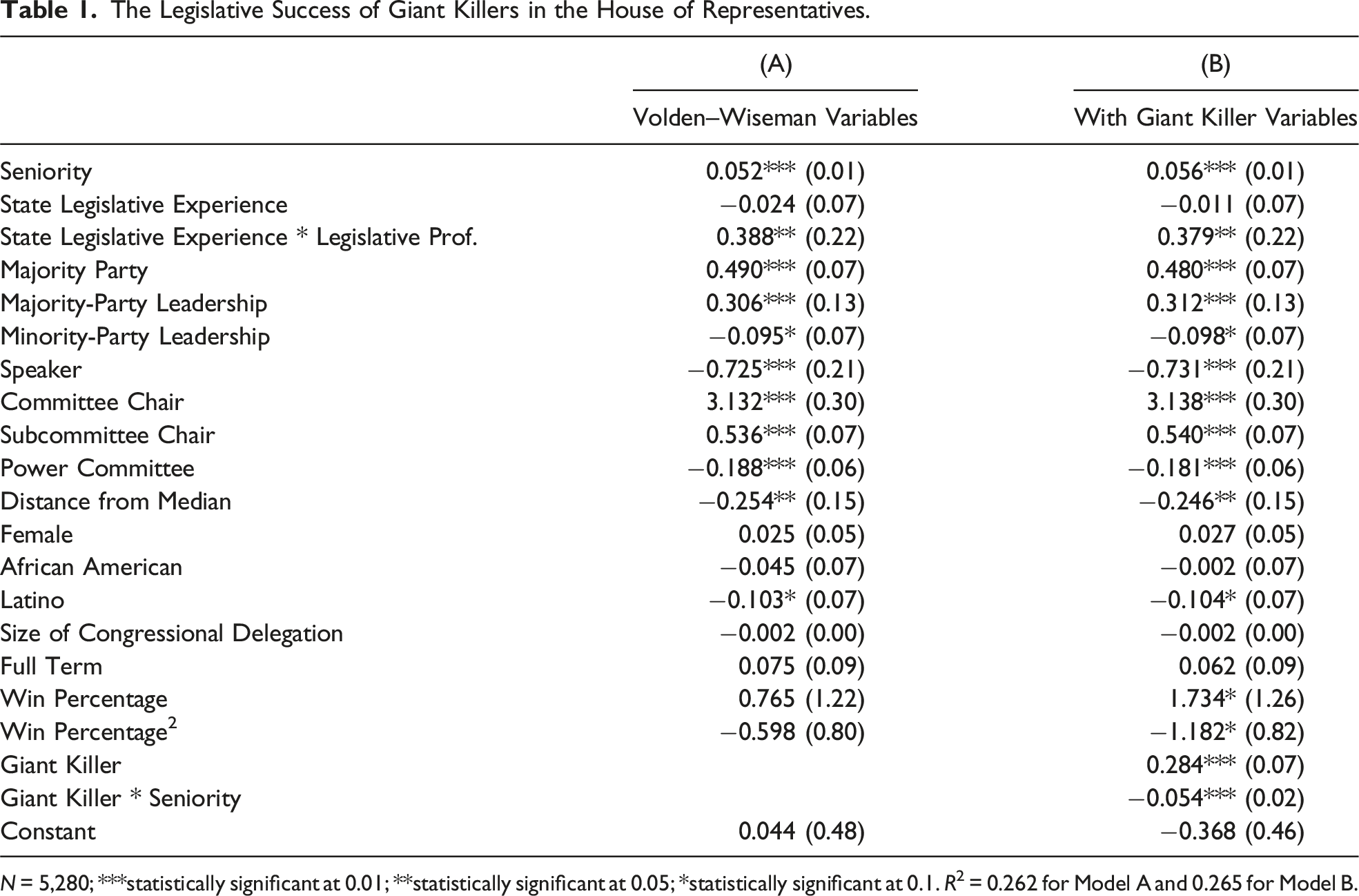
N = 5,280; ***statistically significant at 0.01; **statistically significant at 0.05; *statistically significant at 0.1. R2 = 0.262 for Model A and 0.265 for Model B.
The results show that the importance of the Giant Killer indicator variable persists in the multivariate analysis (column B). The coefficient of 0.284 is on par with the difference of 0.247 that we observed in the bivariate analysis.
10
Furthermore, the results show that for each additional term they serve, the boost to Giant Killers goes down by 0.054. In combination, these results suggest that the Giant Killer boost to LES disappears around their fifth term in the House (see Figure 2).
11
The relationship between legislative success, tenure, and Giant Killer status, 104th to 115th congresses (1995–2018).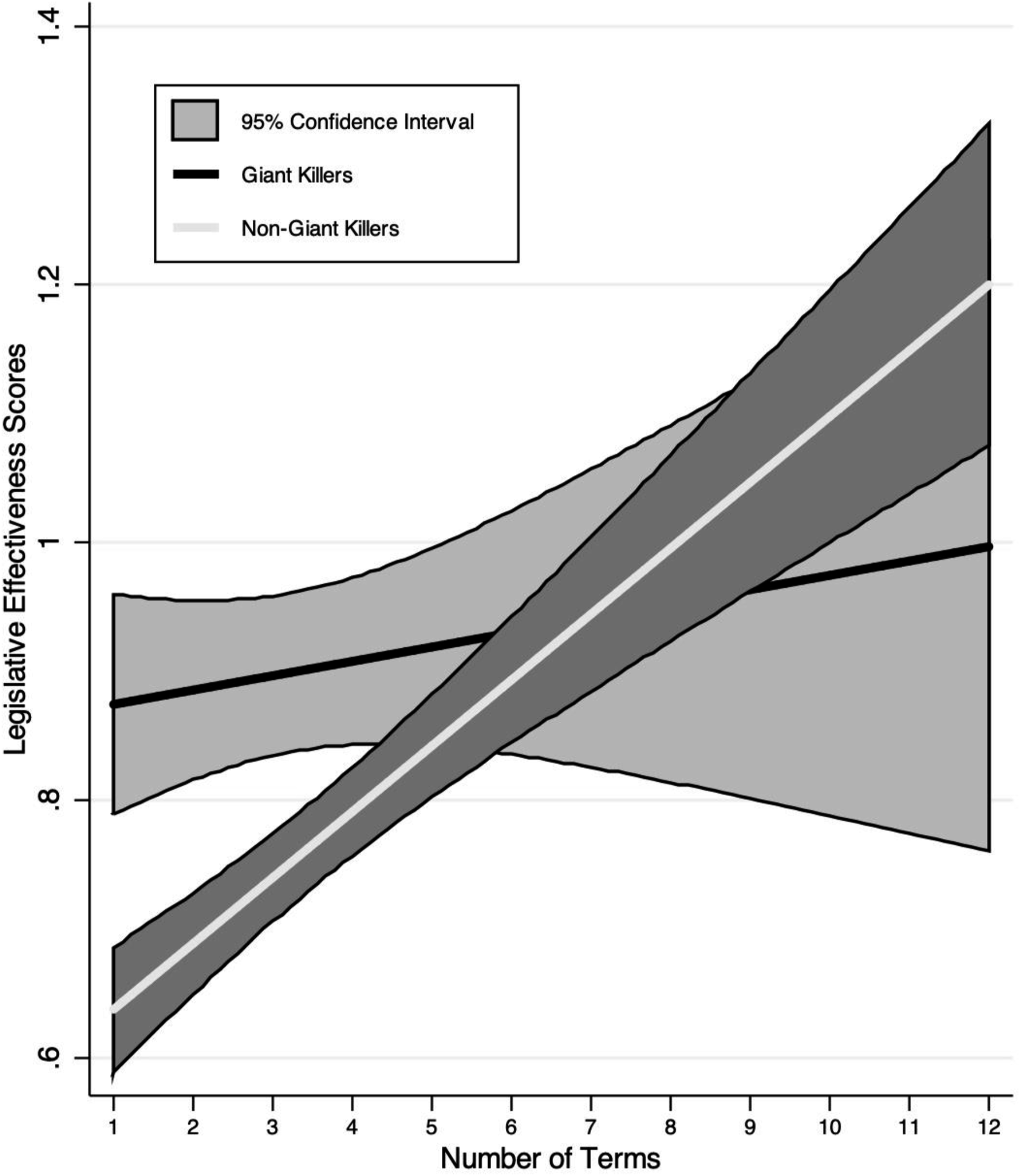
We can put the Giant Killer bonus into a broader context. The regression output suggests that the first congress boost from being a Giant Killer is worth more than 10 years of seniority and more than half as much as being a subcommittee chair. 12 Those challengers who beat incumbents on their way to taking their seats in the House chamber significantly—both substantively and statistically—overperform their counterparts who won in open seats; but the effect gets smaller with each succeeding term, which suggests that it is not some innate quality that cannot be learned, modeled, or imitated. Just as Crawford may have learned from Hanna, so it seems that open-seat winners can copy Giant Killers on their way to becoming legislatively successful.
Why Giant Killers May Have Greater Legislative Success
Distinguishing Primary Giant Killers from General Election Giant Killers helps parse out any legislative bonus that Giant Killers might enjoy. For however hard it is to defeat an incumbent in a general election, it is even harder in a primary, when candidates typically cannot even rely upon their party to assist them, and in some instances have their party vigorously opposing them. As a result of climbing an even steeper mountain, these Primary Giant Killers may be truly exceptional politicians. But, balancing that exceptionalism, once Primary Giant Killers show up in Congress, they may face lingering hard feelings from the party conference or caucus that used to contain their primary opponent, which may cause hard feelings making the passage of their bills even more difficult. Given that General Election Giant Killers enjoy an even bigger boost in legislative effectiveness than Primary Giant Killers, we have some evidence of the validity of this hypothesis, though because it does not reach standard levels of statistical significance, the evidence is rather weak (see on-line appendix B for the full results from this analysis).
To determine the source of the Giant Killer boost to LES, we can more explicitly operationalize each explanation. Given that so few challengers defeat members of Congress, the ones that do must work extra hard. It could be that this work ethic persists after they take their oaths of office. If so, Giant Killers should be more active in the legislative process.
The Legislative Success of Giant Killers and Their Counterparts at Various Legislative Stages.
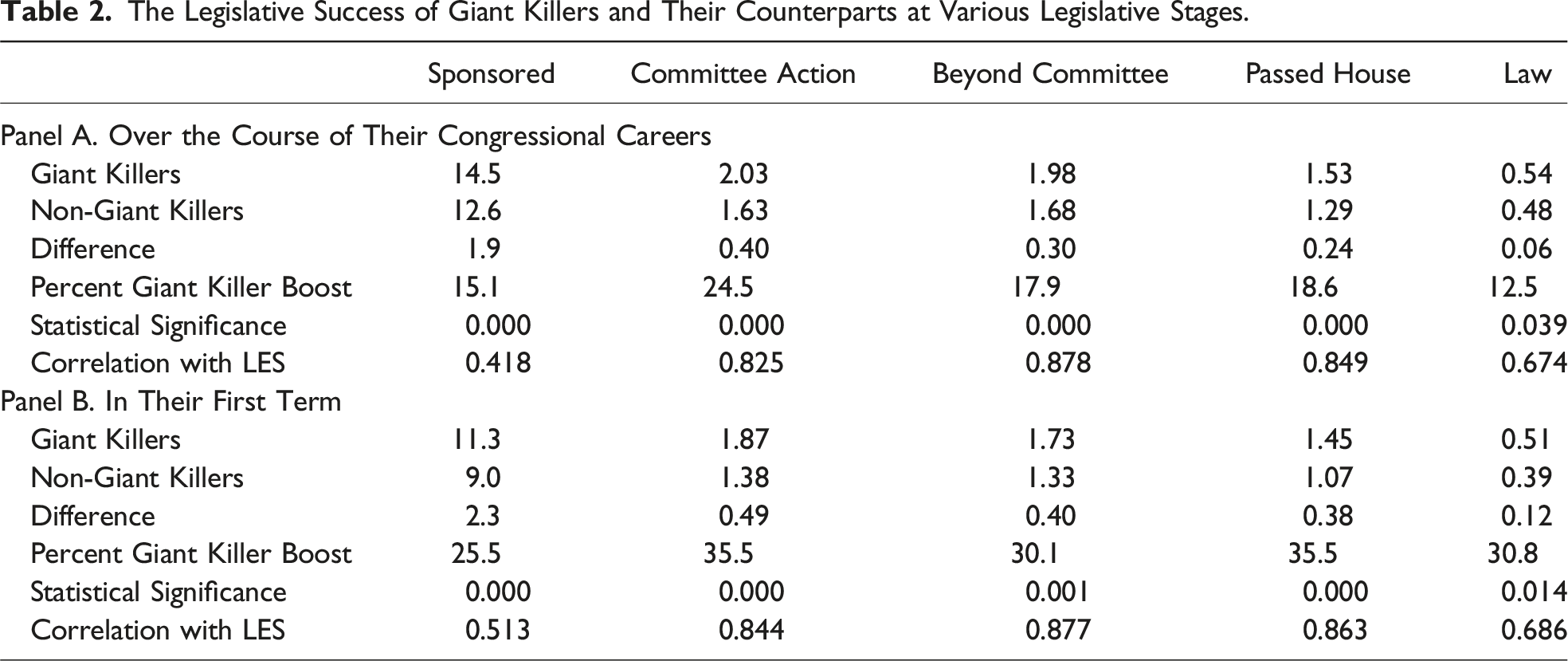
These data suggest that Giant Killers work harder by introducing more bills and pushing them further in the legislative process. It could be that party leadership prioritizes Giant Killers’ bills as a way of either rewarding them for beating an incumbent of the opposite party or to bonus them in their reelection efforts. If this dynamic were consistent with the data, we should see that the Giant Killer advantage increases as their bills progress in the legislative process because leaders have more control at each subsequent stage. That is not what we observe. Instead, what we see is that Giant Killers are more active at every stage, suggesting that it is hard work rather than favoritism that propels their bills in the legislative process. While we see a bit of a jump between the first two stages of the process in their first term, we see that Giant Killers are not disproportionately favored in each of the succeeding stages, in which party leaders play an even greater role.
These results are only suggestive—it could be that Giant Killers are introducing more bills because their party leaders have told them that they will bonus them legislatively to help them electorally, but this explanation seems less plausible to us. We think the narrative we outline above is more straightforward than an explanation of leaders telling Giant Killers to introduce more bills because of potential future favoritism as the bills progress down their legislative paths. Furthermore, once they are in the House, we think that leaders are less attuned to how members first acquired their seats than they are to their overall electoral vulnerability.
We further test this combination of beating an incumbent and subsequent electoral vulnerability. If party leaders do play favorites among the Giant Killers, we should see it clearest among the most electorally vulnerable members. If prioritizing legislation is a zero-sum game for leaders (that is, one member’s advantage is a collective loss to the rest of the members), leaders should help their most endangered members the most in hopes of securing their reelections, which would help in maintaining (or becoming) a majority party. And, indeed, Giant Killers are more vulnerable than their counterparts. Whereas their counterparts get 69.0 percent of the two-party vote in the elections over the course of their careers, Giant Killers only get 63.9 percent of the vote (p-value = .0000). The disparity is even greater in their first elections, when Giant Killers get 56.2 percent of the vote compared to 62.6 percent for non-Giant Killers (p-value = .0000).
If party leaders are most interested in helping their most vulnerable members by favoring their legislation, the most vulnerable members should have higher LES scores than their safer colleagues. We have already presented evidence that suggests this dynamic is not the case across all members in the post-104th Congresses by considering both the winning percentage and the winner percentage squared. In both models of the multivariate analysis, we show that lower winning percentages result in lower LES. Before adding in the variables operationalizing Giant Killer status, the better a member did in the election the higher their effectiveness up until they secured 65% of the two-party vote, then the downside of the curvilinear relationship dominates. In the Giant Killer model, members max out their LES when they achieve 75% of the two-party vote.
When we examine separately Giant Killers and their counterparts, we get the same results. The easier the Giant Killers won their elections, the higher their LES until they get about 70% of the two-party vote. Among their counterparts, the downside of the curvilinear relationship starts around 60% of the two-party vote. The results for the Giant Killers (and their counterparts) in their first term are even worse for the hypothesis. They show that safer members do worse up until they get 55 (60) percent of the two-party vote then they become more effective, maxing out on effectiveness when they face no opposition. The lack of results for favoritism among party leadership toward electorally weaker members is consistent—in multiple contexts with different cohorts and tests—we can uncover no evidence that vulnerable members are more effective. The results suggest, even preliminarily, that vulnerable members experience a trade-off between their reelection-seeking behavior and their legislative success. As Mayhew (1974) warned years ago, reelection must be the proximate goal—the goal that must be achieved first before members consider other goals such as enacting good public policy.
Conclusion
Summary of Our Findings.
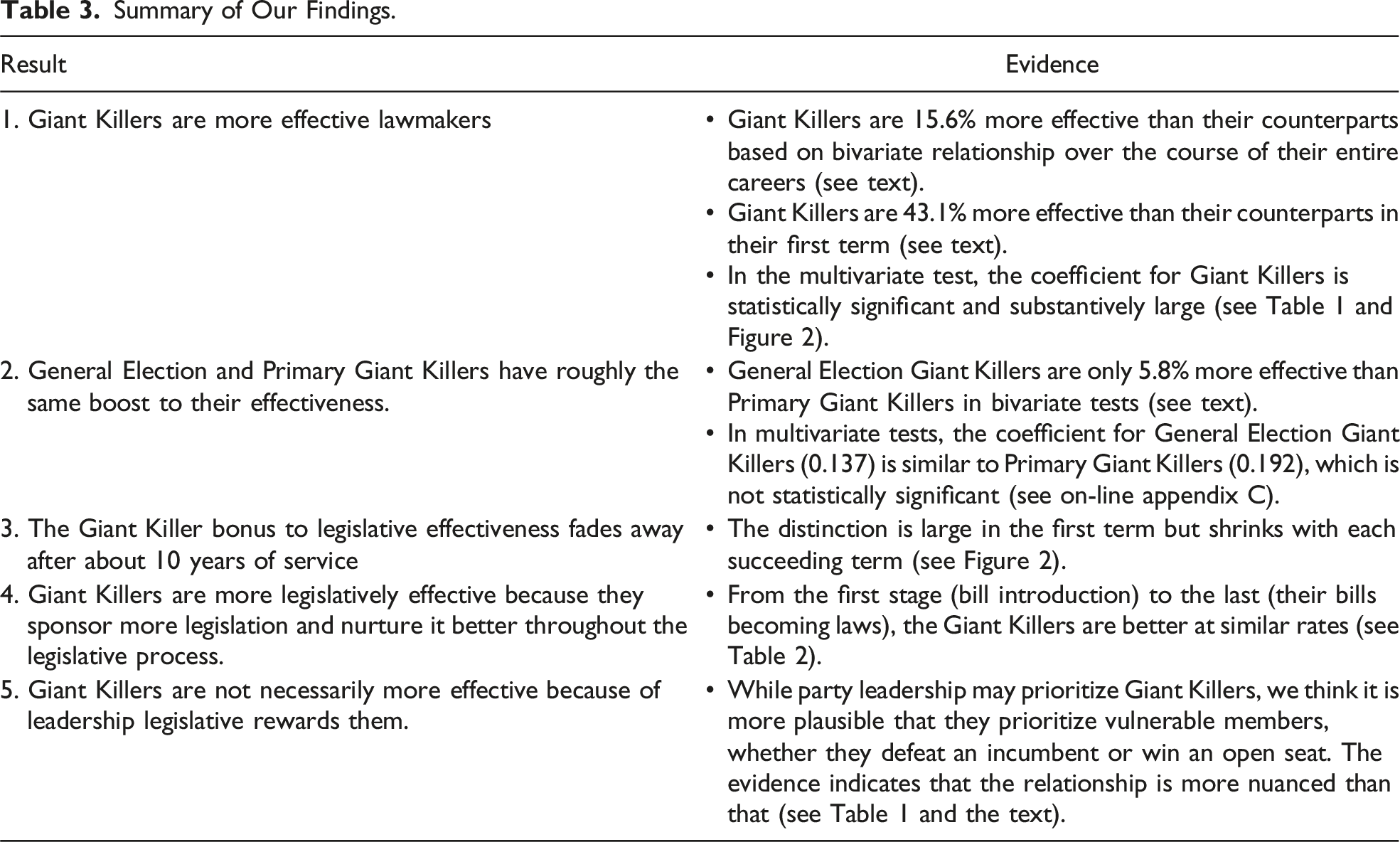
Our preliminary analysis shows that this boost derives from the greater involvement that Giant Killers have at later stages in the legislative process. They introduce more bills and see more action on their legislation. We uncover little evidence that party leaders reward Giant Killers to help secure their reelections in what are more vulnerable districts.
In addition to shedding light on the determinants of legislative success, this article also introduces a new type of member that to our search of the literature is brand new—Giant Killers. We could imagine future research that examines if this class of representatives is different in other ways. We wonder if Giant Killers, by virtue of beating an incumbent, are more impervious to future electoral contests than their open-seat counterparts. Because they didn’t abide by the norm of waiting until the seat is open, are Giant Killers more progressively ambitious? It may very well be that Giant Killers have different electoral as well as legislative experiences than their non-Giant Killer counterparts.
Supplemental Material
Supplemental Material - The Legislative Success of “Giant Killers” in the U.S. House
Supplemental Material for The Legislative Success of “Giant Killers” in the U.S. House by Sean M. Theriault, Jared Hrebenar, and Isabel Reyna in Political Research Quarterly.
Footnotes
Declaration of Conflicting Interests
The author(s) declared no potential conflicts of interest with respect to the research, authorship, and/or publication of this article.
Funding
The author(s) received no financial support for the research, authorship, and/or publication of this article.
Data Availability Statement
The replication data for this article can be accessed at the (Theriault, 2025) at  .
.
Supplemental Material
Supplemental material for this article is available online.
Notes
References
Supplementary Material
Please find the following supplemental material available below.
For Open Access articles published under a Creative Commons License, all supplemental material carries the same license as the article it is associated with.
For non-Open Access articles published, all supplemental material carries a non-exclusive license, and permission requests for re-use of supplemental material or any part of supplemental material shall be sent directly to the copyright owner as specified in the copyright notice associated with the article.
