




Abstract
What determines public support for judicial nominees? We argue that support for nominees is based on policy congruence, and a nominee’s candor at her confirmation hearing can assist citizens as they try to align their support for a nominee with their own policy preferences. When nominees are evasive, other cues, such as past practice experience and interest group statements, can help citizens align their policy preferences with their support for a nominee. Drawing on two nationally representative survey experiments, we demonstrate that, when nominees demur in their answers to abortion questioning, citizens’ policy preferences play only a small role in shaping support for a nominee. But, when a nominee is forthcoming about their views on abortion, citizens’ policy views are a strong predictor of their desire to have the nominee confirmed. In a conjoint experiment, we demonstrate that—particularly in the absence of forthcoming statements from nominees—interest group support can help citizens to calibrate their policy views with their support for a nominee. The results emphasize the importance of confirmation hearings, even when nominees are evasive, for shaping public support.
How do people assess judicial nominees? When voters consider candidates for high-level elected offices, they have a wealth of information—the candidate’s own statements, their website and social media postings, and their competitors’ attacks (Greer 2006)—to help them evaluate the candidate’s positions and decide whether to support their bid for higher office. And, when citizens in the majority of U.S. states go to the polls to elect their judges, they are often assisted by candidates’ statements about policy that can help them understand how their views compare to the judicial candidates’ (e.g., Hall 2015). But federal judicial nominations make the task much harder.
Presidents carefully vet judicial nominees to limit “surprises,” diving into their past writings and actions to discern their stances on the most pressing legal and policy issues that are likely to come before them on the bench. Nominees—themselves experienced and knowledgeable about the law—appear before the Senate Judiciary Committee to explain their qualifications and their views on judicial philosophy. But then, on many of the most important policy concerns facing America (issues on which nominees have surely thought carefully about their own legal views), nominees sidestep Senators’ questions and refuse to explain how they are likely to rule should those issues come before the Court. This makes it difficult for citizens to determine how nominees might shape the law on the country’s most salient issues.
In the face of candidate evasiveness, how do citizens intuit judicial nominees’ views on important legal matters? Some research might suggest that this evasiveness is beside the point (Wedeking and Farganis 2010). Because presidents so carefully vet nominees and make statements promising to only appoint certain types of judges to the bench (Cameron and Kastellec 2023), it could be the case that citizens form their opinions about nominees according to presidential or partisan interests and without regard to their statements to the Senate Judiciary Committee. By this logic, nominees’ responses at confirmation hearings may be dramatic but they do little to affect public attitudes.
We, by contrast, argue that a nominee’s behavior at their confirmation hearing shapes support for their confirmation. While citizens prefer nominees who convey their views on salient issues, they do not automatically assume that a nominee shares a president’s stance on these issues. Instead, citizens take nominees at their word during confirmation hearings: evasive statements are interpreted by the public as genuine statements of ambiguity that dampen the relationship between citizens’ own policy views and their support for the nominee. In the absence of clear statements from nominees about their views, citizens may turn to other cues to evaluate nominees, such as their prior advocacy experience or interest group endorsements. These signals can help them align their personal policy views with their support for the nominee. By this logic, nominees’ behavior at confirmation hearing has an important effect on public attitudes.
We test this theory using two experiments, fielded on a nationally representative sample. Focusing post-Dobbs on abortion policy, we assess how citizens form their judgments about U.S. Court of Appeals nominees as they vary in their forthcomingness and, in a conjoint experiment, how nominee statements are supplemented by interest group endorsements (and opposition) in people’s decision-making. Our results demonstrate that nominee candor shapes the effect of citizens’ policy preferences on their support for a nominee. When nominees demur, citizens’ policy preferences on that issue play only a small role in predicting their support for a nominee. But, when nominees state their preferences openly, support for the nominee and citizens’ policy preferences are tightly aligned. Further, in a conjoint experiment, we demonstrate that interest group support can help citizens calibrate their policy views with their support for a nominee. Notably, the ability of interest group opposition to alter a nominee’s support is more limited.
These results have important implications for understanding modern judicial selection politics. For decades, commentators—including now-Justice Kagan—have suggested that confirmation hearings are more pageant than substance, even as researchers have demonstrated that these hearings play an important role in American democracy Collins et al., 2013; Dancey et al., 2020; Farganis and Wedeking, 2014). Our findings demonstrate another potential benefit of these hearings: they help to shape citizens’ views of judicial nominees. More broadly, our findings that citizens take nominees’ statements in these hearings seriously—and treat evasive responses as genuine uncertainty—helps to explain why, pre-Dobbs, Democratic party messaging regarding Republican nominees’ likelihood of overturning Roe was largely ineffective: many Americans didn’t believe the Republican nominees had stable views on abortion policy.
Moreover, studying public opinion toward judicial nominees is important for a host of reasons. First, and perhaps most obviously, evidence suggests that higher levels of public support for nominees at the constituency level is associated with an increased likelihood that a senator will vote to confirm the nominee (Kastellec et al. 2010). Senators can also be held accountable for these votes in future election cycles: confirmation votes can become a campaign tactic that challengers use against incumbents (Scherer 2005). Second, a burgeoning literature has evaluated the extent to which the behavior and attitudes of individual judges can affect attitudes toward their court more broadly (e.g., Armaly and Lane 2023; Boston et al. 2023; Gibson and Caldeira 2012; Krewson and Owens 2024). Third, and relatedly, research suggests that public attitudes toward judicial nominees specifically—and the confirmation process more generally—can affect attitudes toward courts (e.g., Armaly 2018; Carrington and French 2021; Gibson and Caldeira 2009). Studying how the public forms their attitudes toward nominees—and, by extension, individual judges—is important for understanding the broader dynamics of support for judicial institutions.
Public Opinion Toward Judicial Nominees
Over the past decade, political scientists and legal scholars have devoted a great deal of attention to studying the public’s attitudes toward judicial nominees (e.g., Bartels and Johnston 2012; Kaslovsky et al. 2021; Krewson and Owens 2024; Sen 2017), with this body of literature suggesting three major conclusions. First, citizens’ support for nominees is powerfully shaped by instrumental concerns. Most Americans want judicial nominees to articulate their views on legal issues during confirmation hearings, and nearly 70 percent prefer nominees whose stances on key policy issues—such as abortion—align with their own (Bartels and Johnston 2012). Indeed, the public cites ideological considerations as the most important factor in evaluating nominees (Krewson and Owens 2024).
These policy- and partisan-based considerations can overshadow other considerations, such as a nominee’s legal qualifications and impartiality. Motivated reasoning leads some to justify their support for nominees by aligning their beliefs about a nominee’s qualifications with their ideological preferences (Sen 2017). These considerations also overshadow the importance of a nominee’s judicial philosophy, with Democrats (Republicans) more likely to want living constitutionalists (originalists) compared to originalists (living constitutionalists) (Krewson and Owens 2022).
However, while there is certainly an increasing role for ideology and partisanship in the public’s preferences for confirming judicial nominees, scholars know less about how individuals learn about a nominee’s policy preferences and how they weigh different types of information when evaluating nominees. Most recent studies rely upon experiments that give respondents information about a nominee’s partisanship or ideology rather than examining how realistic statements given by nominees during the confirmation process might help people as they formulate judgments of nominees.
Indeed, little research focuses on how a nominee’s policy positions—publicly displayed during these hearings—affect support from the public. A notable exception is Chen and Bryan (2018), who use an automated media environment to analyze how a nominee’s comments during hearings shape support for the nominee. While their study provides important insights on how nominees’ responses to senators influence public support, it leaves much room for future work. Most notably, this study does not explore how the public weighs different sources of information or how ideological congruence, rather than partisanship, shapes individual level assessments of nominees.
Second, descriptive representation is significant in predicting support for members of traditionally underrepresented and minority groups—even when their political views diverge from those of a nominee. Group dynamics—particularly in-group and out-group bias—influence evaluations of nominees. In the absence of direct ideological cues, some engage in “political searching” to infer a nominee’s political affiliation based on characteristics such as race and gender (Sen 2017). Race is especially salient to Black Americans, who show higher levels of support for co-racial nominees regardless of their ideological orientation (Badas and Stauffer 2018; Kaslovsky et al. 2021). Research by Armaly et al. (2025) also demonstrates that shared race not only affects evaluations of nominees, but also leads to more favorable views of the Court among Black respondents. However, racial diversity can lower support from out-groups, particularly White Republicans (Kaslovsky et al. 2021). Work by Ono and Zilis (2022) helps explain this, showing that individuals evaluate judges from underrepresented groups as less impartial in their decision making when they do not share demographic traits with the judge under consideration. While race is particularly salient, gender is less informative to nominee evaluations. Although the positive effects of gender are mixed, substantive representation is especially important for women: judicial nominees who are expected to substantively represent women increase trust and legitimacy of the Court (Chen and Savage 2024).
Although this research highlights many factors the public utilizes to evaluate judicial nominees, it primarily focuses on the characteristics of a nominee—such as race, gender, partisanship, and ideology. We know less about how a nominee’s own behavior (e.g., their decision to be forthcoming at a confirmation hearing) might shape public support for their confirmation. Given the growing scholarly attention to confirmation hearings in recent years (e.g., Boyd et al. 2023; Dancey et al. 2020; Schoenherr et al. 2020), it is surprising that these two research areas have remained largely independent. This is especially relevant considering how public opinion on nominees influences senators’ voting behavior (Kastellec et al. 2010) and other research demonstrating that the judicial confirmation process—and support for individual nominees—can affect attitudes toward judicial institutions (e.g., Armaly 2018; Carrington and French 2021; Gibson and Caldeira 2009).
Third, a separate line of research highlights the growing role that interest groups play in shaping confirmation dynamics. While the appointment and confirmation of Supreme Court justices has long been viewed as an inherently political process, the increased involvement of issue- and identity-oriented interest groups (Cameron et al. 2020) and televised hearings (Farganis and Wedeking 2014) exacerbates a contested confirmation process. With greater levels of ideological polarization, public interest and identity groups have taken a leading role in shaping lower court confirmations in significant ways (Cameron et al. 2020; Scherer et al. 2009; Steigerwalt 2010).
Studies of public support for judicial nominees often overlook the role that interest groups might play in shaping public attitudes toward nominees. Their mobilization efforts—including mailers, advertisements, and, more recently, social media—influence the information environment of a nominee’s confirmation. By providing important heuristics to attentive segments of the electorate, their efforts are intended to aid citizens in understanding the potential policy implications of a nominee’s confirmation. While research extensively examines their importance in confirmation outcomes, little attention is given to how the public processes the information these groups supply to citizens when forming opinions about judicial nominees, a surprise given that these activities are taken with expressly that aim.
Issue Congruence and Support for Judicial Nominees
Citizens generally understand that judges have ideological commitments—just as they do—and judges decide cases with legal views colored by those values (Gibson and Caldeira 2011). Knowing that judges in America have the final say on many of the most important issues facing the country, a fact made particularly salient on the issue of abortion, citizens are likely to prefer judges who agree with them on important policy issues compared to those who do not (e.g., Krewson and Owens 2024).
The easiest way for a citizen to learn about a nominee’s policy views is for the nominee to testify about them under oath, providing a credible and public statement about their thoughts on these issues. If citizens’ support for nominees is based on the congruence of their views with a nominee’s, there should be a strong relationship between a citizen’s policy views on salient issues and their support for the nominee when that nominee has made an unambiguous statement about their policy position.
Unfortunately, however, it is difficult for citizens to learn about nominees’ policy views since nominees often go to great lengths to obscure them from the public, declining to respond directly to questions about their views on important legal matters when asked during their confirmation hearings (Farganis and Wedeking 2014). Nominees, for example, often invoke the so-called “Ginsburg rule,” declining to share their attitudes toward salient matters that may come before their court. 1
How do evasive answers from nominees shape citizens’ support for their confirmation? Here, we see two possible logics. 2 First, one might argue that citizens will intuit that the nominee shares the president’s position on the issue. By this view—which we term “entrenchment”—judicial nominees, seeking seats to a bench with lifetime tenure, are high-stakes decisions for presidents. Presidents respond by carefully vetting nominees to ensure that their nominees are aligned with the White House on important policy issues. Indeed, as Cameron and Kastellec (2023) document, party platforms often contain promises to only nominate judges who will support the party’s position on salient issues like abortion. Presidential candidates (and administrations) pointedly discuss nominations in terms of entrenchment, promising to put judges on the bench who share their views on important policy issues, particularly abortion (e.g., NBC News 2016; The White House 2021).
By this theory, even if a nominee is evasive in her answers about important policy topics, Senators and citizens alike assume that the nominee shares the president’s (and party’s) views on these salient issues. If she did not, the president would have put forward a different nominee. A quote from a scholar discussing one of Trump’s judicial nominees puts this theory aptly: “I think the best evidence of her position on Roe v. Wade is that President Trump has said he will only appoint justices who are committed to reversing Roe, and there’s no reason not to believe him” (McCammon 2020). This logic would suggest that, in the presence of an evasive statement, citizens’ support for the nominee is based on their alignment with the president’s position on the issue. On the issue of abortion, for example, support for pro-choice policies would positively predict support for Biden nominees given his administration’s stated position on screening nominees on that issue, 3 just as pro-choice opinion would be inversely related to support for a Trump nominee given his administration’s promise to vet judges according to their pro-life views. This perspective suggests that the relationship between policy opinion and nominee support remains constant regardless of the forthcomingness of the nominee: because presidents vet nominees carefully, all citizens need to know is who selected the nominee in order to align their own policy preferences with their support for the nominee.
We think this is unlikely. After all, for all that presidents and parties talk about litmus tests, they backtrack once a particular nominee is put forward. For example, while President Trump had promised to appoint only pro-life nominees, once he put Amy Coney Barrett forward for a Supreme Court position, his Vice President pled ignorance about Barrett’s views on the issue in a debate, saying, “I would never presume how Judge Amy Coney Barrett would rule on the Supreme Court of the United States” (Kelly 2020). Other administrations run the same playbook. When asked about Sonia Sotomayor’s stance on abortion, President Obama said he had not discussed the issue of abortion and did not know her views (Jacobs 2009). When questions were raised about a memo Elena Kagan wrote espousing a pro-choice policy position as part of her work as a Clinton Administration attorney, the Obama White House brushed aside that work as unrepresentative of Kagan’s policy views, saying it was work performed for a client (Baker 2010). The Bush administration did the same when a memo written by John Roberts emerged espousing a pro-life view (Baker 2010). Presidential ambiguity about nominees’ policy views, as disingenuous as they may appear to close observers of the confirmation process, likely provide serious ambiguity to everyday citizens who do not follow the process closely.
We argue that citizens take nominees (and administrations) at their word. Rather than assuming that a nominee shares the president’s views, citizens look at what nominees say at hearings (which, on salient issues, is readily reported in the media) and use those statements to calibrate their support for the nominee vis-a-vis their own policy positions. To this end, we expect that evasive answers effectively sever the link between a citizen’s policy views and their support for a nominee. When a nominee says that they decline to answer a question about an important issue, citizens do not assume that they share the president’s policy views and instead take the nominee’s answer as a genuine statement of uncertainty. This, in turn, negates the ability of citizens’ policy positions to predict their support for a nominee.
In the absence of overt evasion, other issue-relevant information is often raised at confirmation hearings that can help citizens to align their own views with their support for a nominee. For example, even as nominees refuse to answer directly about their support for controversial issues like abortion, senators often ask pointed questions about a nominee’s work in legal practice and the sort of clients that they represented, particularly with regard to impact litigation. Senators—especially those whose partisanship diverges from the nominating president—aim to highlight nominees’ ideological predispositions by discussing the clients they represented and the cases they handled, while nominees strive to counter this perception, distinguishing their roles as advocates from the impartiality expected of them as judges. 4 We expect this sort of information is helpful to citizens who make the assumption that attorneys usually advocate for clients who hold positions with which they agree. While learning that a nominee represented a client in support of or in opposition to a controversial issue is not the strongest evidence that a nominee holds that position (and is therefore less informative than a forthcoming statement by a nominee about their view on that issue), it is a piece of concrete evidence about an action the nominee has taken regarding that issue and is therefore more informative to citizens seeking to align their own policy preferences and their support for the nominee than an evasive answer alone.
Taking this all together, we expect that the ability of citizens to match their own policy preferences with their support for a nominee varies according to the answers a nominee gives at their confirmation hearings: • Hypothesis 1: The relationship between individual level pro-choice attitudes and support for a nominee is highest among forthcoming nominees, weakest among evasive nominees, and in between for those whose forthcomingness falls in the middle of the two extremes.
Of course, confirmation hearings are not the only information available to citizens. Other information sources—particularly interest groups—may also prove useful to citizens deciding whether to support a judicial nominee, especially when that nominee has not provided a forthcoming statement about their policy views. Interest groups flag information about controversial nominees (Steigerwalt 2010) and play a pivotal role in disseminating it to create conflict (Krutz et al. 1998). Richard Viguerie, a conservative fundraiser, highlights how these groups utilize confirmation hearings to mount public campaigns against judicial nominees: “The more material he gives us to work with, the easier the battle will be. The more quickly we can identify that person as an ideological liberal, the easier it is for us to communicate to the American people how radical the president is and the nominee is” (Savage 2010). As Viguerie illustrates, interest groups’ influence extends beyond the lobbying of senators: they attempt to shape public perceptions of nominees and drive public engagement in the confirmation process (Bird et al. 2025).
Today, interest groups leverage the internet, social media, and targeted ads to signal their support or opposition. On X, for example, Alliance for Justice, a liberal mainstay in judicial confirmations, sent a clear message regarding Biden nominee Julie Rikelman to its followers: “1st Circuit nominee Julie Rikelman has defended the rights of those seeking access to reproductive health care, including abortion, and she’s defended access to the ballot box. We need this vital experience on the bench TODAY.” 5 In contrast, Tony Perkins, president of Family Research Council, sent the opposite message: “Oppose the nomination of Julie Rikelman to become a U.S. Circuit Court Judge for the First Circuit. Rikelman’s record of (1) consistently making radical arguments on behalf of the pro-abortion lobby and (2) leading the U.S. litigation team for an organization dedicated to establishing abortion as a fundamental human right (a position rejected by the U.S. Supreme Court in Dobbs, which she argued) shows her incapable of acting as an impartial jurist and, therefore, unfit for a seat on the federal bench. . . .” 6 These examples highlight how interest groups use internet campaigns to mobilize ideologically aligned citizens and, in doing so, may also provide useful information citizens can use to evaluate nominees by advancing policy messaging about the nominee.
We expect that citizens use these interest group statements to align their policy preferences with their support for a nominee. When an interest group endorses a nominee, it provides citizens an external source of information about the nominee’s policy views on the issue on which the interest group is an expert. Citizens can use those endorsements to align their policy preferences with their support for a nominee: when an aligned interest group endorses a nominee, citizens should be more likely to support that nominee; when an aligned interest group opposes a nominee, the reverse should be true. So too can information from ideologically opposed interest groups prove useful: an endorsement by a group that a citizen disagrees with tells them they should oppose that nominee. Thus: • Hypothesis 2a: Among pro-choice respondents, individual support for a nominee will increase when pro-choice interest groups endorse a nominee (or pro-life interest groups oppose a nominee) compared to neutral interest group endorsements. • Hypothesis 2b: Among pro-life respondents, individual support for a nominee will decrease when pro-choice interest groups endorse a nominee (or pro-life interest groups oppose a nominee) compared to neutral interest group endorsements.
Of course, interest group statements are secondhand information. We therefore expect them to be less effective at shaping public opinion than the nominee’s own statements. For example, citizens may not know the group’s policy positions or they may judge interest group statements as hyperbolic. For this reason, we expect interest group statements to be more effective at shaping public support when citizens have less information from the nominee themselves. When the nominee is forthcoming, in other words, the effect of interest group statements should decline. Thus: • Hypothesis 3: Interest group endorsements will be more effective at shaping citizens’ judgments of nominees when the nominee is not forthcoming, compared to conditions where the nominee is forthcoming.
Research Design
We test our hypotheses with a pair of survey experiments fielded to 1500 respondents in a nationally representative YouGov survey in July 2024. The first experiment, which allows a direct test of Hypothesis 1, was a vignette experiment that held the nominee’s appointing president, gender, and qualifications constant and varied the nominee’s level of candor surrounding abortion policy. The strength of this experiment is its simplicity: we are able to tightly identify the effect of candor across nominees who, objectively, are uniformly pro-choice. The drawback of this design is our inability to vary the nominee’s qualifications and other information that citizens would reasonably have when judging a judicial nominee, including interest group statements.
The second experiment is a paired conjoint design, in which respondents were presented with pairs of potential nominees and asked which nominee they would prefer President Biden nominate to the U.S. Courts of Appeals. 7 As we describe below, the conjoint profiles include information about the nominees’ qualifications and the responses of interest groups to their potential nomination. With this design, we can again test Hypotheses 1 but also can test our remaining hypotheses.
Study 1: Vignette Experiment
All respondents begin the experiment by reading the same text about a qualified nominee to the U.S. Court of Appeals who is asked a question in her confirmation hearing about abortion. There are three treatments, which vary the statement a nominee makes in response to a question from a senator about her stance on abortion during her confirmation hearing. Suppose that President Biden has nominated Katherine Adams to serve on the U.S. Court of Appeals, the second-highest court in the United States. Adams is an attorney with twenty-five years of experience in private practice. She graduated from a top-ranked law school and clerked for a U.S. Supreme Court justice after graduation. Last week, the U.S. Senate Judiciary Committee held a hearing on Adams’s nomination where she was asked about her stance on abortion. • Avoid: In response to the question, Adams said, “I have a duty to avoid commenting on disputed legal matters such as whether there is a constitutional right to abortion. As a Court of Appeals judge, my job would be to resolve each case on an individual basis by assessing the parties’ legal arguments based on the law as I understand it.” • Forthcoming: In response to the question, Adams said, “I can’t tell you how I’ll rule in any case, but I value a woman’s freedom to make her own reproductive health care decisions. I want to be very clear about my values because I think Americans deserve to know what a judge’s values are, rather than hiding them.” • Client: In response to the question, Adams said, “As a young lawyer, my law firm represented a group of women challenging an abortion restriction, and my job was to advocate on behalf of a client. As a Court of Appeals judge, my job would be to resolve each case by assessing the parties’ legal arguments.”
These treatments draw directly from real statements made by judicial candidates. The language in the Avoid treatment comes from Justice Jackson’s response to Senator Grassley’s (R-IA) questioning about the death penalty and judicial philosophy: “As a federal judge, I resolve each case on an individual basis by assessing the parties’ legal arguments based on the factual record and applicable law” 8 and “I also have a duty to avoid commenting on, or providing personal views of, disputed legal matters.” 9
The language in the Forthcoming treatment is adapted from Wisconsin Supreme Court now-Justice Janet Protasiewicz’s primary night acceptance speech: “I can’t tell you how I’ll rule in any case, but throughout this race, I’ve been clear about what my values are. That’s because you deserve to know what any candidate seeking this office believes. I value a woman’s freedom to make her own reproductive healthcare decisions with her doctor, family, and faith.” 10 Of course, while we relied on Protasiewicz’s language to formulate our treatment, federal nominees are sometimes similarly forthcoming in their exchanges with the Senate Judiciary Committee. Consider, for example, William H. Pryor, Jr.’s comments on abortion to the Senate Judiciary Committee during his hearing: “I believe that abortion is the taking of innocent human life. I believe that abortion is morally wrong. I’ve never wavered from that” (S. Hrg. 108–264). 11
The language in the Client treatment comes from Justice Jackson’s description of her time representing a group challenging an abortion protest restriction as a young lawyer: “The brief that you’re referring to was a brief that I filed on behalf of clients who were clients of my law firm. This is in, I believe 1999 or 2000s, maybe 2000 or 2001. I was an associate at a law firm and I had appellate experience because I had just finished my Supreme Court law clerk position, and in the context of my law firm I was asked to work on a brief concerning a buffer zone issue.” 12
We use one dependent variable in this experiment: support for the nominee. It is measured on a four-point scale ranging from strongly support to strongly oppose. Among respondents, 75 percent have some type of affirmative response in support of the nominee.
Our hypotheses about the alignment of a respondent’s policy preferences with the nominee’s views require us to have a measure of the respondent’s abortion policy preferences. Our measure of the respondent’s position on abortion is a single item, taken from Pew and measured on a four-point scale ranging from whether the individual feels abortion should be “legal in all cases” to “illegal in all cases.” Of respondents, 59 percent gave a pro-choice response to this question.
Vignette Experiment Results
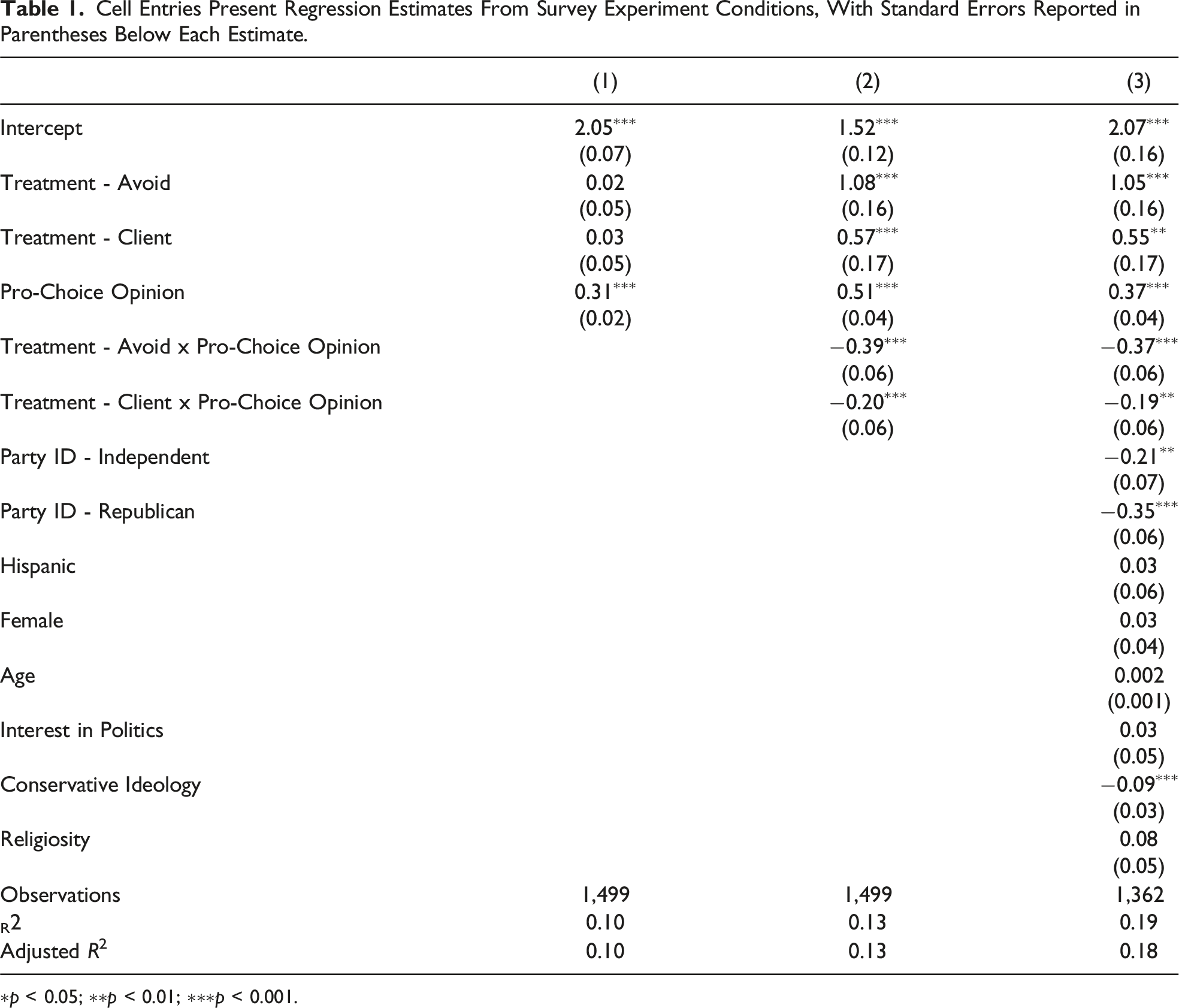
Recall that our first hypothesis suggested that the effect of respondent-level support for abortion should be highest when the nominee gave a forthcoming statement, weakest when the respondent was evasive, and between those extremes for respondents who read about the nominee’s past work for pro-choice clients. Before testing this hypothesis directly, we begin by discussing the direct effects of the experimental conditions on support for the nominee. There is no statistically significant difference in support for the nominee when she is forthcoming about her views of abortion compared to conditions where she does not expressly state her views on the issue. Indeed, there is less than a 0.02-point change in support between the Avoid and Forthcoming treatments and approximately a 0.03-point change in support between the Forthcoming and Client conditions.
Cell Entries Present Regression Estimates From Survey Experiment Conditions, With Standard Errors Reported in Parentheses Below Each Estimate.
∗p < 0.05; ∗∗p < 0.01; ∗∗∗p < 0.001.
However, Hypothesis 1 suggests that judgments of nominees go beyond assuming they share the president’s policy preferences. We argued that respondents’ abortion attitudes are stronger predictors of nominee support when the nominee was forthcoming. The second model in Table 1 contains multiplicative interaction terms between the respondent’s abortion attitudes and the experimental treatments. As predicted, both interaction terms are statistically significant. And, as the third model shows, these results hold when we control for respondents’ demographic characteristics.
To understand these effects, we turn to Figure 1. Starting with the Avoid condition, where the nominee declined to take a stance on a woman’s right to choose, the difference in support for the nominee is fairly constant regardless of a nominee’s abortion views. The difference in support for the nominee from a strongly pro-life respondent to a strongly pro-choice respondent is roughly one-third of a point: when a nominee is not forthcoming in their confirmation hearing, the effect of respondents’ policy attitudes on their support for the nominee is minimal. This figure plots predicted support for nominee’s confirmation among respondents by treatment group and position on a woman’s right to choose. The model relies upon the estimates in Model 2 of Table 1. The shading provides 95 percent confidence intervals.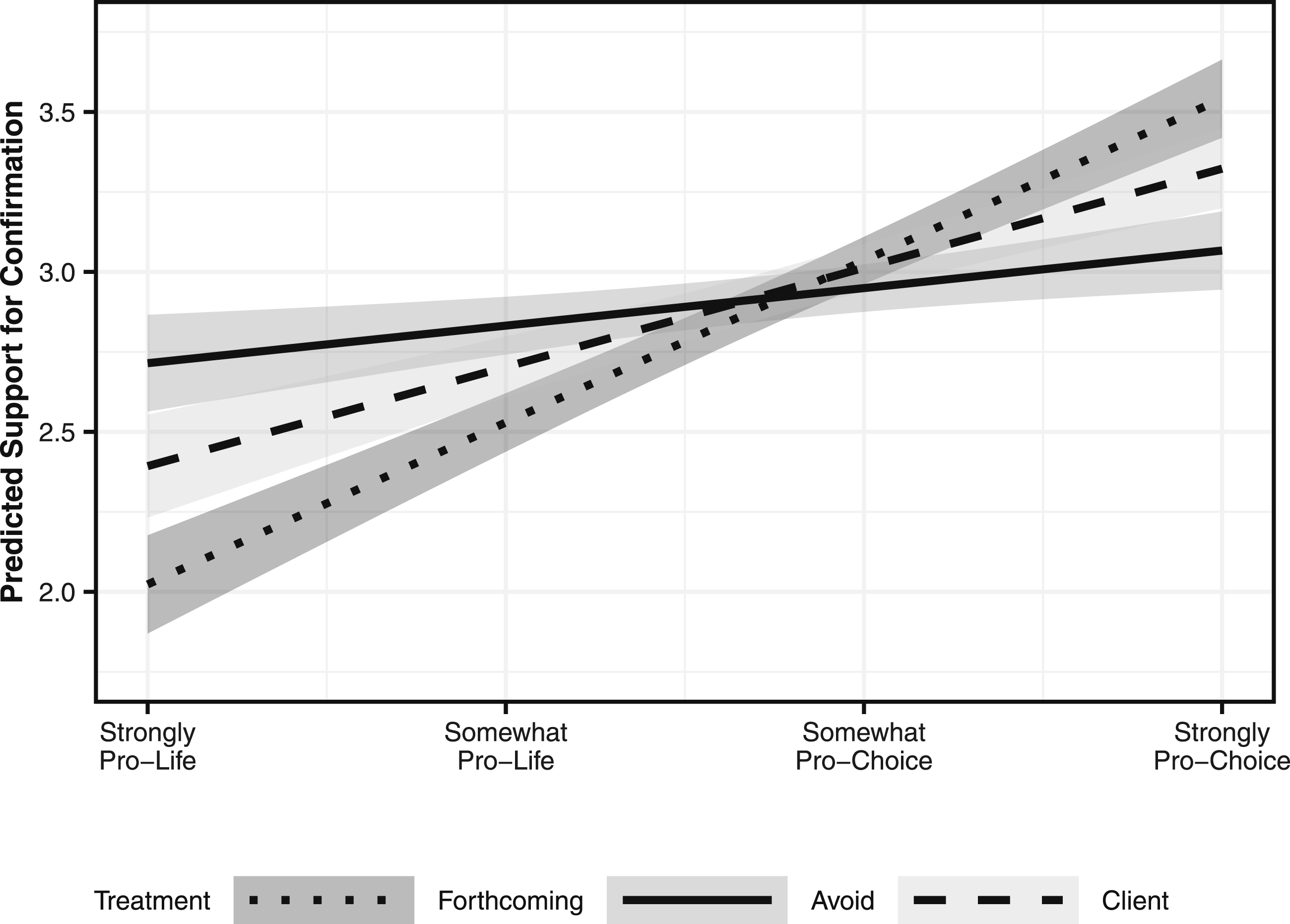
By contrast, we look to the dotted line in Figure 1, which plots the predicted values of support for a nominee among respondents who read about a forthcoming nominee. Here, the effect of abortion attitudes is much stronger. Support for confirming a forthcoming nominee increases by over 1.5 points (on a 4-point scale) when comparing respondents who are strongly pro-life to those who are strongly pro-choice. This increase is over four times greater than the increase observed in the Avoid condition.
Finally, we turn to the Client condition, in which a nominee distinguishes between her prior experience as an advocate and her role as a judge. As predicted by Hypothesis 1, the effect of abortion attitudes in this treatment falls between the Forthcoming and Avoid groups. Support for the nominee varies significantly between respondents in the Client treatment and those in both alternative conditions, with stronger effects among those at the ideological extremes.
Beginning with strongly pro-life respondents, predicted support for confirmation is 2.39 in the Client condition, which is significantly lower compared to the Avoid treatment (2.71; p < .01) but higher than in the Forthcoming treatment (2.02; p < .01). Among strongly pro-choice respondents, this pattern reverses, and the predicted value of support is 3.32 in the Client condition. This is a lower level of support than in the Forthcoming condition (3.54; p < .05), but higher than in the Avoid condition (3.07; p < .01). These results suggest that individuals do draw inferences about a nominee’s policy views from their professional background and align their support for a nominee’s confirmation accordingly.
Together, these results are strongly supportive of our expectations. The effect of abortion attitudes varies decisively according to the nominee’s level of candor during her hearing. Citizens support nominees at higher levels when they agree with them on policy issues, and the policy attitude-support linkage is strongest when nominees are clearest about their own views. By contrast, when nominees are evasive, support for that nominee is only weakly related to a citizen’s policy views.
Study 2: Conjoint Experiment
This Table Shows the List of Conjoint Attributes Included in the Experiment.
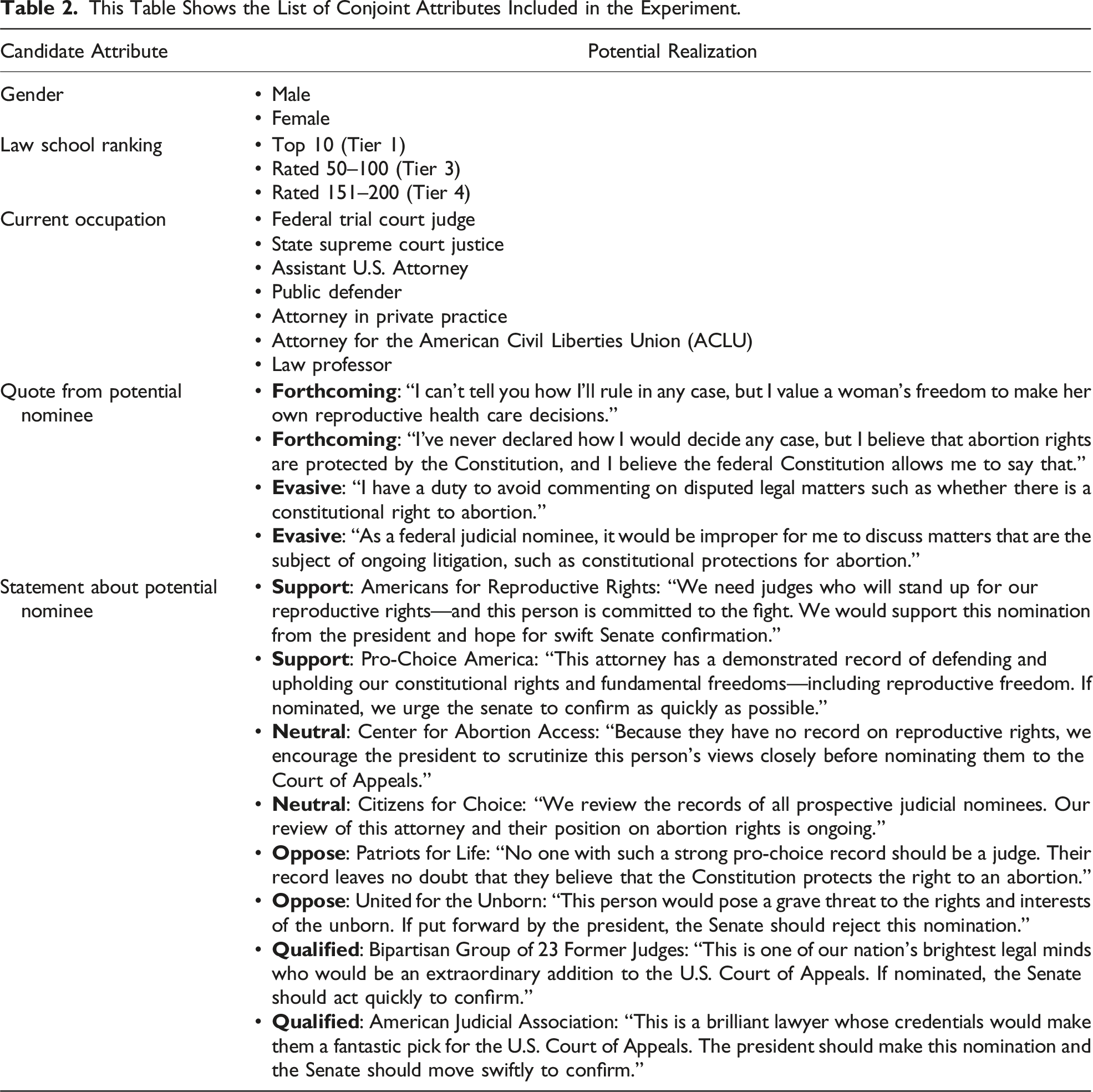
We draw our quotes for potential nominees from real quotes given by judicial nominees and candidates, as with the vignette experiment; our interest group statements were modeled from actual statements put forward by interest groups in support of or opposition to nominees. To mitigate issues with respondent recognition of interest group names, we created fictional (but plausible) sounding interest group names that signaled the group’s policy position on abortion. We have four interest group treatments: Neutral (where the group provides no endorsement or opposition but says Senators should scrutinize the nominee’s record), Support (by a pro-choice group), Oppose (by a pro-life group), and Qualified (where a legal group supports the nominee with no reference to abortion policy).
For both the nominee statements and the interest group support/opposition, we wrote two statements for each condition which we combine for the purpose of analysis. This helps to ensure that no single language choice drives our results and provides more variety to respondents taking the survey by reducing the number of profile pairs respondents see where interest groups give the same statement on each nominee. For example, respondents may have been exposed to either of the following nominee statements—“I have a duty to avoid commenting on disputed legal matters such as whether there is a constitutional right to abortion” or “As a federal judicial nominee, it would be improper for me to discuss matters that are the subject of ongoing litigation, such as constitutional protections for abortion”—and we code either as an Evasive nominee quote.
Our outcome variable is the respondent’s candidate choice, a dichotomous variable indicating whether the candidate was the choice of the respondent among the pair of candidates.
Conjoint Experiment Results
Figure 2 displays the average marginal component effect for the nominee selection outcome. Relative to the baseline attribute, positive estimates indicate a higher likelihood of nominees with the attribute being selected, while negative values denote that the attribute was associated with a lower probability of selection. Average component marginal effects, candidate selection outcome. Positive estimates indicate that a candidate is more likely to be selected, and negative values indicate that the attribute was associated with a lower probability of selection. The lines provide 95 percent confidence intervals.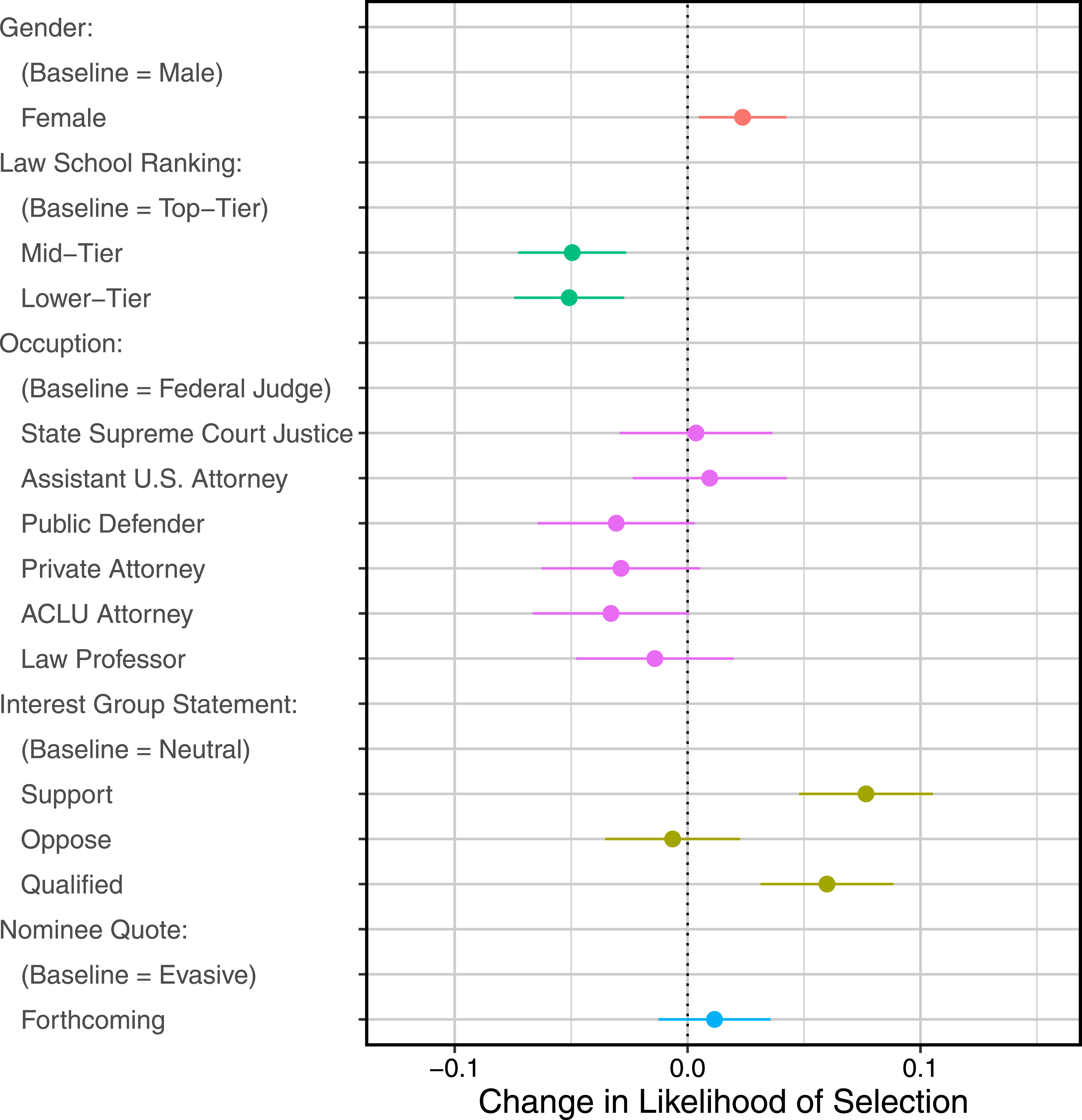
We begin by returning to the effect of nominees’ statements on their overall support among respondents. Just as we saw in the vignette experiment, there is no overall difference in support for a nominee according to whether they are forthcoming or evasive. This result is reflected in the bottom point of Figure 2.
Our hypothesis, by contrast, is that forthcoming statements help citizens to align their own policy views with their support for a nominee. As applied to the conjoint experiment, we expect that the effect of a forthcoming statement (relative to an evasive statement) will be polarized according to a citizen’s policy views. To test this expectation, we divided respondents into those with pro-choice or pro-life attitudes based on their answers on our four-point abortion item and estimated the ACIE for each of the conjoint attributes according to respondents’ abortion views.
Figure 3 displays these estimates. As expected, looking at the bottom point estimate in each panel of the figure, forthcomingness has polarizing effects depending on a respondent’s position on this issue. When a respondent is pro-choice, a forthcoming nominee is 12 percent more likely to be selected nominee compared to an evasive nominee. In contrast, when a respondent is pro-life, the likelihood of selection decreases by 14 percent compared to an evasive nominee. Together, this represents a 26 percent difference in support between respondents with opposing views when a nominee declines to provide their position on this issue. This is strong additional support for Hypothesis 1. Average component interaction effects, nominee selection outcome. Positive estimates indicate that nominees having an attribute are more likely to be selection, and negative estimates indicate that the characteristic is associated with a lower probability of selection. The lines provide 95 percent confidence intervals.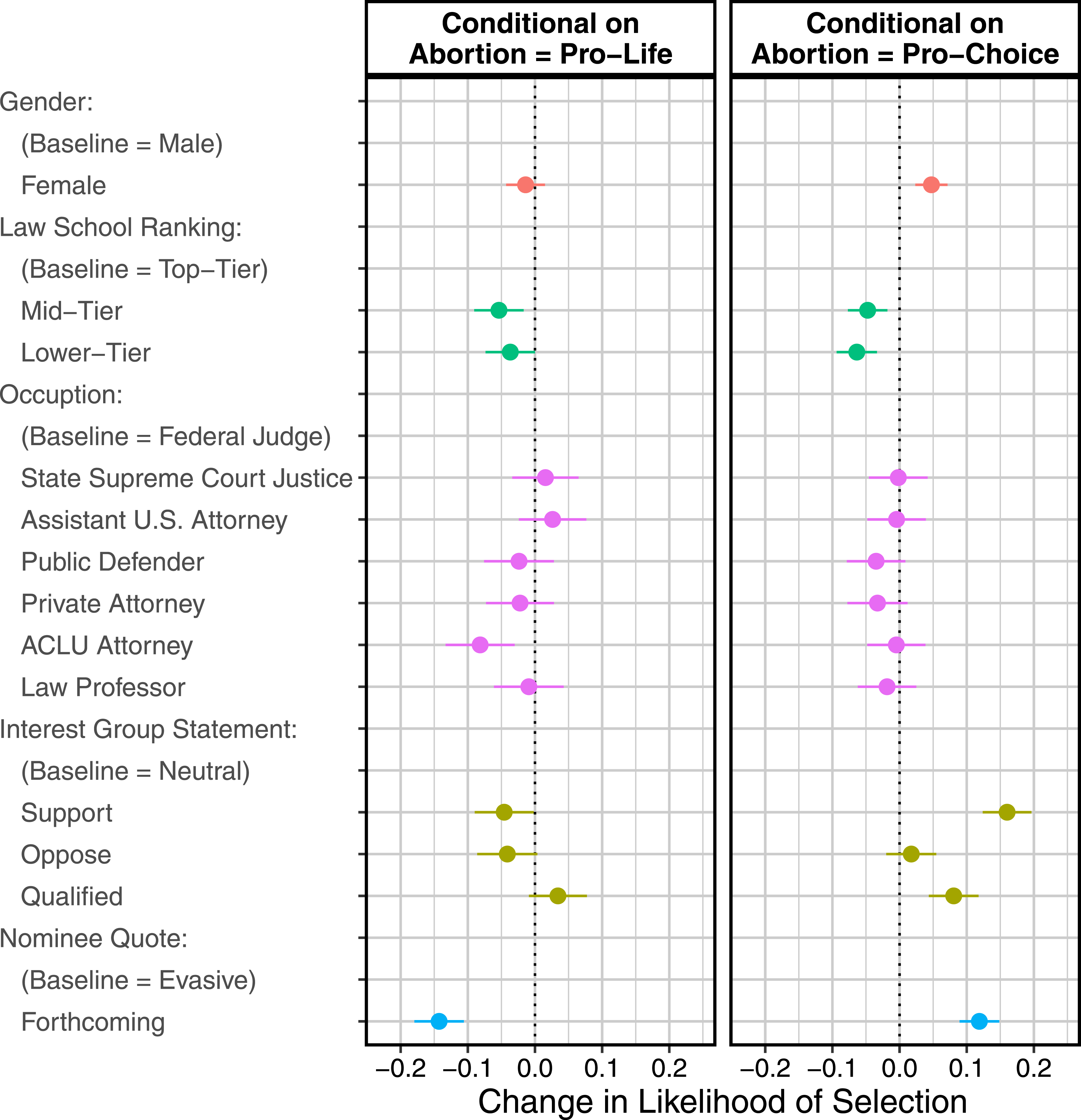
The conjoint experiment enables us to estimate the effects of interest group support and opposition alongside the effects of a nominee’s own statements. Hypotheses 2a and 2b suggest that interest group endorsements have a strong effect on nominee selection when the information they convey aligns with a respondent’s position on a woman’s right to choose. To test this expectation, we turn to the ACIE estimates, displayed in Figure 3.
We observe mixed support for these expectations. Among pro-choice respondents, the likelihood of nominee selection increases by 16 percent when interest groups aligned with the respondent’s position to endorse a nominee, compared to when a group remains neutral. And, looking at the Qualified treatment (in which legal elites endorse the nominee on the basis of qualifications), we see a significant, although less substantial, increase in support for the nominee. Surprisingly, however, opposition from pro-life groups has no discernible effect at shaping the likelihood of nominee selection: pro-choice respondents responded no differently to a statement of interest group opposition compared to a neutral interest group statement.
Among pro-life respondents, we observe a similar pattern for interest group support. Nominees are 5 percent less likely to be selected by pro-life respondents when a pro-choice group endorses a nominee. And, again, interest group opposition is not able to sway the probability the respondent would select a nominee.
Taken together, our results for both pro-choice and pro-life respondents suggest that interest groups are more effective at moving the public's support of a nominee (positively or negatively) through affirmative public support of the nominee than to affect the nominee’s support through public opposition.
Our final hypothesis suggested that interest groups would be more effective when the nominee was evasive than when she was forthcoming. To begin to assess how interest group statements and nominee candor affect support among respondents, Figure 4 presents the predicted levels of support for a nominee’s confirmation among pro-life (left panel) and pro-choice (right panel) respondents. Predicted probability of nominee selection considering elite and nominee statement. Left figure shows these conditions across pro-life respondents and right figure shows pro-choice respondents. Other attributes held at their modes and error bars provides 95 percent confidence intervals.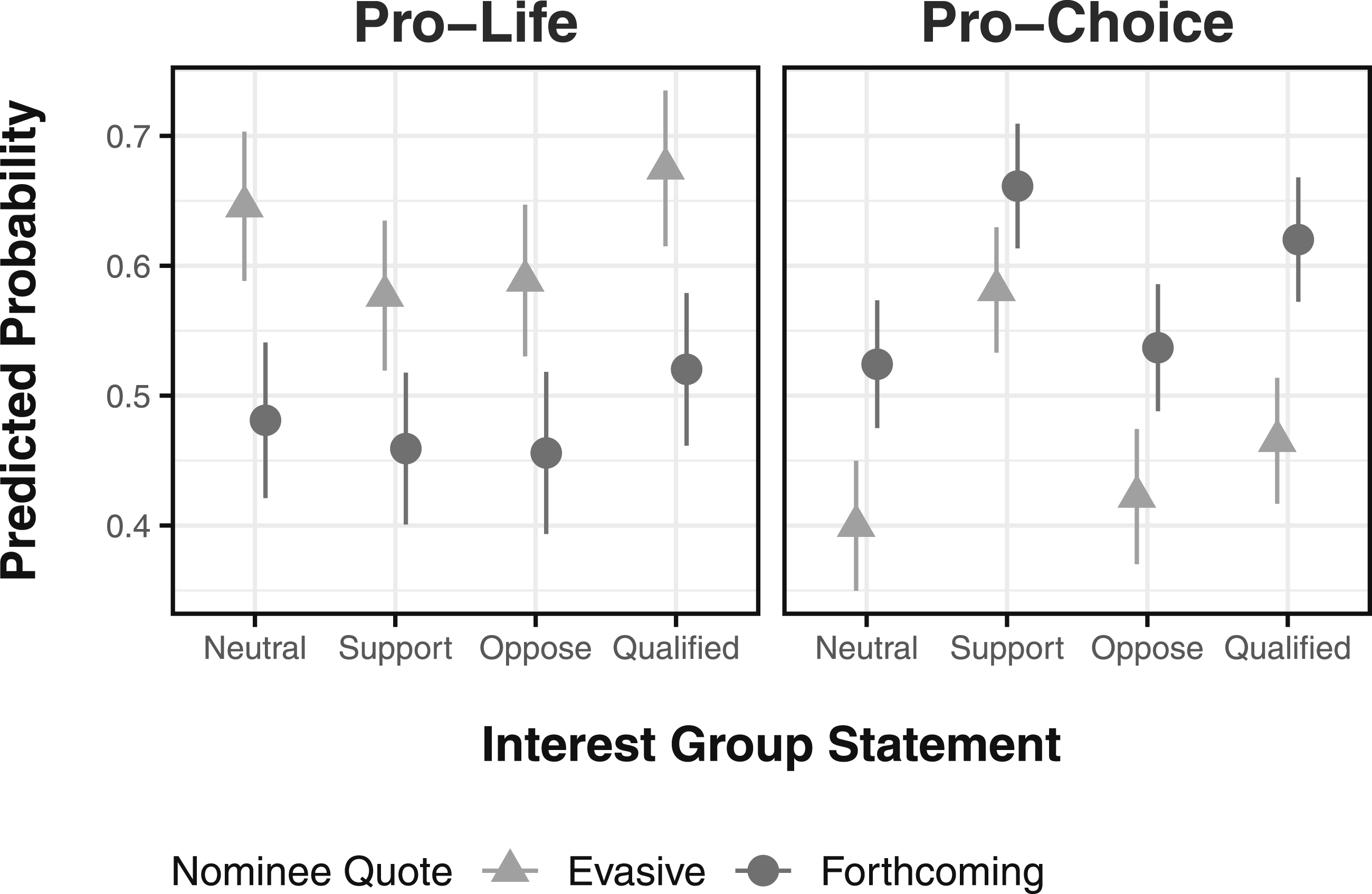
We begin in the right-hand anel with pro-life respondents’ responses to a forthcoming nominee. Here, we see evidence that interest groups can sway judgments of forthcoming nominees. Statements of support significantly increase the probability of selecting forthcoming nominees (p < 0.001) compared to neutral interest group statements, though there is no difference in the probability of selection when a pro-life group puts out a statement in opposition to the nominee (p = 0.62). So too do ostensibly non-ideological endorsements of the nominee’s qualifications increase the likelihood they are supported relative to the neutral pro-choice interest group endorsement (p < 0.001).
Looking to pro-choice respondents’ responses to evasive nominees, we again see a strong increase in the probability of selection when the pro-choice interest group provides a statement of support (compared to a neutral statement). This endorsement accounts for an 18 percent increase in the probability that the nominee will be selected (p < 0.001). This is the strongest increase in respondent support. However, mirroring a result we saw earlier, interest group opposition is less effective at swaying pro-choice respondents: there is no difference that an evasive nominee will be selected when an interest group speaks in opposition to them than when a pro-choice group puts out a neutral statement about that nominee (p = 0.38). Finally, turning to the legal elites, a statement that the nominee is qualified boosts support by about 7 percent, a significant increase (p < 0.05). 13
We now turn to the results for pro-life respondents in the left-hand panel of Figure 4. Beginning with forthcoming nominees, compared to neutral statements, respondents are no less likely to select a nominee when pro-choice groups issue supportive statements, pro-life groups issue oppositional statements, or legal elites say that a nominee is qualified to serve on the court. However, respondents are less likely to select a forthcoming nominee with support from pro-choice groups (p < 0.05) or statements of opposition from pro-life groups (p < 0.05) compared to those who have support from legal elites.
When nominees are evasive, we observe stronger support for our theory among pro-life respondents compared to forthcoming nominees. Most notably, we see that a supportive statement from a pro-choice interest group decreases support for an evasive nominee compared to a neutral statement from a pro-choice interest group. This difference accounts for an approximately 7 percent decline in the probability that the nominee is selected and is statistically significant (p < 0.05). 14 We see a similarly sized effect for evasive nominees when a pro-life interest group speaks out in opposition. Here, the difference in the probability of selection between a neutral statement and a statement of opposition is a decrease of about 6 percent, however, this difference is not statistically different than the neutral interest group statement (p = 0.06). Finally, turning to the statement by legal elites that the nominee was qualified to serve on the court, we see that pro-life respondents were roughly as likely to select a nominee under this condition as they were a nominee who had a neutral interest group endorsement (p = 0.31). But, compared to the interest group statements of support and opposition, a statement that the nominee was qualified boosted their likelihood of selection by 9 percent (p < 0.01) and 10 percent (p < 0.01) respectively.
Taken together, the results from Figure 4 provide mixed support for our final hypothesis. On the one hand, the results for pro-life respondents align with our expectations: when a nominee is forthcoming, interest group statements do little to sway citizens’ judgments. But, when the nominee is evasive, the interest group statements shape their evaluations of the nominee. However, it is notable that all the estimates for forthcoming nominees are lower than the estimates for the corresponding evasive nominees. This shows the limits of interest group influence: they can erode support for non-ideologically aligned evasive nominees somewhat, but not to the negative extent the nominee would experience if she spoke out openly about her policy views.
On the other hand, we find that interest groups are relatively effective at shaping citizens’ judgments among pro-choice respondents regardless of whether the nominee is evasive. For both forthcoming and evasive nominees, a statement of interest group support boosts support for the nominee, and the difference in these increases is not itself statistically significant (p = 0.37). What is most notable about the interest group effects for pro-choice respondents is the limited influence of statements in opposition to the nominee. While opposition statements, like statements of support, were able to blunt support for evasive pro-life nominees, they have no effect on pro-choice respondents (regardless of whether the nominee was evasive). This result fits with our findings from above: interest groups, it seems, can help more than they can hurt a nominee’s odds of confirmation.
Discussion
We argued that citizens generally prefer nominees with whom they agree on important issues and suggested that nominee candor assists citizens as they try to align their support for the nominee with their personal policy preferences. We found support for this contention in both a vignette experiment and a conjoint experiment. Contrary to arguments that citizens judge nominees based on the appointing president such that their statements at confirmation hearings play no meaningful role in shaping support, our results demonstrate that forthcoming statements about nominees’ views increase the effect of citizens’ policy views on their support for nominations.
But what happens when nominees are not forthcoming? How do citizens connect their policy views with their support for a nominee? We suggested that other cues—like questioning about past clients or statements about interest groups—can assist citizens, though the quality of these cues are less than a forthcoming nominee statement. In the vignette experiment, for example, we found that statements about past clients increase the effect of policy views on support for a nomination compared to an evasive statement. But, the effect of citizens’ policy views is stronger when the nominee is forthcoming.
An important implication of this finding is that senators’ questions matter, too. By directing the public’s attention to past work history with a clear ideological valence—as senators from both parties often try to do—the connections legislators draw between these past experiences and nominees’ policy views are a meaningful way to shape public opinion: they are not a distraction.
Interest groups also play an important role in the confirmation process, and we assessed the effects of interest group support and opposition to nominees in our conjoint experiment. We found that—particularly in the absence of forthcoming statements from nominees—interest group support can help citizens calibrate their policy views with their support for a nominee, particularly among respondents who are not ideologically aligned with the president facing an evasive nominee. Importantly, though, interest groups appear to be much better at affecting citizens’ attitudes through their positive support for a nominee than through statements of opposition to the nominee. Perhaps the negative information becomes “noise” to citizens given the negative valence of politics today. These statements may be seen as cheap talk while the positive statements are better able to cut through the noise with a signal of credibility.
Scholars assert that confirmation hearings play a critical role in public’s support for the judiciary and understanding of constitutional law (Collins et al., 2013; Gibson and Caldeira, 2009). Yet, others suggest that hearings are little more than political theater: senators grandstand while judicial nominees dodge one question after another. Indeed, this latter perception is no secret. During Justice John Roberts’s Judiciary Committee hearing, then-Senator Joe Biden spoke of these hearings as a “kabuki dance” in which nominees “tap dance and shuffle,” refusing to tell Americans how they “think about fundamental issues facing them” (S. Hrg. 109–158). Our findings in this paper demonstrate that this evasiveness plays an important role in channeling public opinion by limiting the ability of citizens to align their personal policy commitments with their support for a nominee.
Our findings regarding the effects of interest groups endorsement and opposition challenge previous research, which suggests that ideologically aligned interest groups see little benefit from engaging in costly confirmation battles unless opposition groups actively seek to block a nominee’s confirmation (see, e.g., Steigerwalt 2010). Our findings indicate that nominees, and by extension, interest groups, gain an advantage when those aligned with a nominee endorse them.
Of course, our study focuses exclusively on the issue of abortion, an important but unique issue in the judicial confirmation process. Cues about nominees’ positions on reproductive rights might be particularly powerful ways to align citizens’ own policy views with their support for a nominee. And, not only is the issue salient but it is a clear one to citizens—a rarity in constitutional interpretation. It may be the case that our findings present a best-case scenario for the ability of confirmation hearings to shape public opinion and the effects of nominee statements on other issues are less powerful. That is a ripe topic for future research.
Supplemental Material
Supplemental Material - Judging Judicial Nominees
Supplemental Material for Judging Judicial Nominees by Morrgan T. Herlihy and Michael J. Nelson in Political Research Quarterly
Footnotes
Acknowledgments
We thank Christina Boyd, Amanda Driscoll, Morgan Hazelton, Jay Krehbiel, Andy Stone, and Martín Gandur for helpful feedback on this article.
Declaration of Conflicting Interests
The authors declared no potential conflicts of interest with respect to the research, authorship, and/or publication of this article.
Funding
The authors disclosed receipt of the following financial support for the research, authorship, and/or publication of this article: We thank the McCourtney Institute of Democracy and the College of the Liberal Arts at Penn State for supporting this research.
Ethical Statement

Data Availability Statement
Data and code for replication purposes are available at https://doi.org/10.7910/DVN/WKKIPX (Nelson et al., 2025).
Supplemental Material
Supplemental material for this article is available online.
Notes
References
Supplementary Material
Please find the following supplemental material available below.
For Open Access articles published under a Creative Commons License, all supplemental material carries the same license as the article it is associated with.
For non-Open Access articles published, all supplemental material carries a non-exclusive license, and permission requests for re-use of supplemental material or any part of supplemental material shall be sent directly to the copyright owner as specified in the copyright notice associated with the article.
