




Abstract
Social identity plays a central role in mass politics, shaping the perceptions citizens have of politically relevant phenomena. Does identity bias perceptions of social problems, leading citizens to show preferential concern for problems affecting their ingroup? If so, why? Most experimental research has not found evidence of such ingroup bias, but when it has, it has not distinguished empirically between ingroup favoritism or outgroup hostility, leaving open the question of whether identity biases people for their group or against outgroups. Also unclear is whether symbolic or self-interested motivations drive ingroup bias. Employing a variety of social identities and social problems, three survey experiments show citizens perceive problems affecting outgroup members as less serious and more strongly oppose government aid in those cases. Ingroup favoritism was not found because participants did not perceive ingroup victims as more similar than non-identified victims. Outgroup hostility was driven more by concerns stemming from self-interest than symbolic identity-based motivations.
Keywords
Political actors often aim to broaden the scope of concern about social problems (Schattschneider, 1960). 1 They want to raise the alarm about what is happening so that others will join them in support (Baumgartner and Jones, 2015). What makes citizens notice those alarms instead of ignoring them? As a strong force in political reasoning, social identity is one likely explanation (Huddy, 2013; Mason and Wronski, 2018). When citizens learn that people like them, people who share their social identity, are suffering, they may react with more sympathy (Conover, 1988; Simas et al., 2020). Given that social problems often afflict some groups more severely than others, bias against groups other than one’s own could hamper support for ameliorative government action.
If so, it is important to tease out why citizens seem to care more about ingroup problems. Two potential, though not mutually exclusive, processes may be at work. In one, as Social Identity Theory would predict, citizens may be driven by the desire to maintain a positive view of their group (Tajfel and Turner, 1986). To do so, they may attribute causes of problems that affect their group to forces outside their control, seeing them as victims rather than deviants. Being victims, they are thus more deserving of government aid (Iyengar, 1990; Weiner, 1995). In another process, self-interest may be the driver. Citizens may react more acutely to problems suffered by their ingroup because they fear they might soon face the same fate. A problem affecting similar people may make it loom larger, seem more plausible, or its harm more vivid. Shared group identity may trigger their self-interest more than it does their concern for the group as such (Fiorina, 2018; Weeden and Kurzban, 2017).
In addition to teasing out its mechanisms, it is important to ascertain what type of discrimination underlies ingroup bias in how citizens perceive social problems (e.g., Lelkes and Westwood, 2017). Is it ingroup favoritism (discrimination in favor one’s group), outgroup hostility (discrimination against outgroups), or both? If ingroup favoritism, then citizens prefer government do more to ensure the well-being of their group while leaving the well-being of outgroups untouched. Outgroup hostility, on the other hand, implies citizens are more interested in reducing outgroups’ well-being, perhaps because they see helping the outgroup as taking away resources that might go to their group (Dovidio and Gaertner, 2010). Each type of discrimination has different repercussions for democracy, as well as different implications for how to address it (Brewer, 2016).
I use three novel survey experiments to examine the presence, mechanisms, and type of ingroup bias in perceptions of social problems. Two of the experiments leverage salient politically charged identities (rural identity and partisan identity), while a third elicits what respondents considered their most personally important identity (from a preset list). The experiments exploit three different social problems (internet insecurity, air pollution, and cyber-attacks) on three different types of populations. Subjects exhibited significant ingroup bias—in the form of outgroup hostility—that appeared to be driven by self-interest as opposed to social identity. The absence of ingroup favoritism was caused by the surprising difficulty in using identity to make victims appear more similar. When perceiving social problems, it’s easier to make victims look different than similar.
This paper moves the literature forward in several ways. First, it tests two prominent mechanisms that may drive problem perception bias. It examines whether people care more about ingroup social problems because they are protecting the esteem of their groups, as social identity would expect, or because they are worried about their own well-being, as self-interest would predict. Second, it tests whether bias in the perception of social problems is people caring more about ingroup problems, less about outgroup problems, or both. Third, by placing emphasis on how people perceive problems that affect groups rather than specific individuals, it may help explain the mixed results of previous studies, as the results here are fairly consistent. Fourth, the finding that increasing perceived similarity is difficult to achieve in survey-experimental settings may help explain prior null results and chart a path forward in social identity research in political behavior.
Social Identity and Perceptions of Social Problems
Social problems are harms at scale. They can harm people’s physical, economic, or psychological well-being, and they often harm some people, and thus some groups, more than others. The question this paper asks is, do citizens perceive problems suffered by people with whom they share a social identity to be more serious? And if so, why?
Social identities seem to play an increasingly large role in mass politics in the United States, due in part to more and more people from the same social groups identifying with the same political parties (Levendusky, 2009; Mason, 2018). By bringing their social identities in line with their partisan identities, people have connected their identities with politics and the arena of conflict it evokes (Groenendyk and Krupnikov, 2021; Iyengar et al., 2019). One consequence of this politicization of identities may be a tendency to bring a mindset of conflict—a belief that what others get is necessarily taken from me—to perceptions of the social problems that animate politics. For example, partisans tend to see the same economy as improving or worsening depending on whether their party is in power (Ang et al., 2022; Bartels, 2002), a bias that has only grown in recent years (Brady et al., 2022). A similar pattern may extend to the perceptions citizens form of the many problems that afflict groups across society.
A great deal of work has tested this hypothesis in experiments that hold constant a problem, such as poverty (Feezell et al., 2021; Iyengar, 1990), homelessness (Gross and Wronski, 2021), unemployment (Iyengar and Kinder, 1987), opioid addiction, climate change (Hart and Nisbet, 2012), opioid addiction (de Benedictis-Kessner and Hankinson, 2024), religious extremism (Feezell et al., 2021), fear of deportation (Ostfeld and Mutz, 2014), and diabetes (Gollust and Lynch, 2011), while manipulating the identity of the individual suffering from it. Usually that identity is race, but sometimes it’s nationality, religion, culture, or rurality. In a recent study, de Benedictis-Kessner and Hankinson (2024) found that subjects were more supportive of a more lenient, patient-focused approach to opioid addiction when exposed to a victim who shared their race, though the effect did not extend to sharing their rural identity or gender. Some studies support this finding on race (Brader et al., 2008; Hannah and Cafferty, 2006; Harell et al., 2016) whereas others do not (Fang and Huber, 2020; Gollust and Lynch, 2011; Gross, 2008; Gross and Wronski, 2021). The studies that leveraged culture (Ostfeld and Mutz, 2014) and religion (Feezell et al., 2021) also found no effect, while the one that manipulated nationality did (Hart and Nisbet, 2012).
Given the prominence of social identity in politics and political science, this mixed record calls for further examination of how it may bias perceptions of social problems. Hart and Nisbet (2012) showed that, because Republicans perceived American farmers as more similar than French ones, their support for helping American farmers harmed by climate change was higher. Perceiving them as similar was part of the process of preferring to help the American victims. Though it may be safe to assume that white Americans perceive other whites as more similar than Blacks, none of the studies verify this fact, leaving open the possibility that, at least in some cases, the variable of interest (shared ingroup identity/perceived similarity) was not actually manipulated.
At least one other study, by Ostfeld and Mutz (2014), ensured that participants perceived one set of victims as more similar than the other. Surprisingly, however, it did not find similar-seeming victims were given more policy aid. This could be because the study focused on portrayals of specific individuals. Focusing on individuals rather than large groups may hinder people from considering the problem as large-scale and thus suitable for government policy. As a host of studies have found, support for policy is higher when problems are presented in “thematic” rather than “episodic” terms (Feezell et al., 2021; Iyengar, 1990).
Other studies present social problems thematically, but do so in terms of group, typically race-based, disparities. In these, ingroup biases surface more consistently. For instance, Rigby et al. (2009) found health disparities based on income and education were perceived as bigger problems than disparities based on race. When told COVID-19 disproportionately affected communities of color, Skinner-Dorkenoo et al. (2022) found whites reduced their support for safety precautions. These studies rely on problems described in relative terms, a “substantively important” difference from absolute terms (Gollust and Haselswerdt, 2023, 3). By casting problems as relative to another group, they evoke group conflict, thus changing the nature of the problem. They cannot test whether, had the victimized people been ingroup members, as opposed to outgroup members, would attitudes toward ameliorative policy been more positive? Since most existing evidence speaks to problems described as relative or portrayed through particular individuals, it is valuable to investigate perceptions of social problems described as large-scale phenomena in absolute terms.
In light of extant theory and previous research, I expect ingroup problems to be perceived and treated differently than outgroup problems. First, when a social problem harms people with whom citizens share a politically charged social identity, I expect them to perceive the problem as more serious.
As a result, they should express stronger support for ameliorative public policy.
The Mechanisms of Ingroup Bias
Group Esteem
Why do people show preference for addressing problems that affect their group? It could be in part because they interpret their group members as less culpable for their problems. Social Identity Theory (Tajfel and Turner, 1986), an influential framework in psychology and increasingly so in political science (Huddy, 2001; Mason, 2023), posits that people strive to differentiate their groups from others and keep them in high esteem. This motivation is especially strong when there is competition over resources (whether material or political) (Dovidio and Gaertner, 2010). This may be why partisans tend to credit their party (but not opposing parties) for good societal outcomes and deflect blame for bad outcomes (Bisgaard, 2015; Zell et al., 2022). This tendency, known as intergroup attribution bias (Hewstone, 1990), is particularly likely when the causes of behavior are ambiguous or multi-faceted (Brewer, 2016).
Social problems are prime cases of ambiguous causation. They are large-scale phenomena involving complex interactions of personal choice, environment, and public policy, among others. Knowledge of their scale and impact on individuals is channeled through news reports, conversation, and personal experience. Such complexity leaves plenty of room for arriving at conclusions consistent with one’s ideological orientation or social identities. Indeed, the causal beliefs citizens hold regarding perennial problems such as poverty and unemployment are sharply divided along ideological and party lines, and they explain a lot of the variance in policy preferences (Gollust and Lynch, 2011; Iyengar, 1990). Causal beliefs are central to how people make sense of politics. Telling them that problems they think are caused by personal behavior are actually mostly shaped by environmental factors can even lead to them doubling-down on their prior positions (Gollust et al., 2009).
Moreover, problems that are thought to be caused by factors outside the victims’ control are perceived as more deserving of assistance (Weiner, 1995). Attributing the causes of social problems to external forces, in other words, grants the sufferers the status of being innocent victims worthy of help rather than perpetrators of their own misery (Conover, 1988; Schneider and Ingram, 1993). Citizens may, therefore, be motivated to attribute social problems affecting their ingroup to external forces, thus preserving their group’s good image. At the same token, because they wish to ensure the positive distinctiveness of their group, they may be more likely to attribute outgroups’ social problems to internal causes, such as inherent characteristics and personal choices. This pattern would be consistent with problem perception bias driven by social identity.
Self-Interest
Alternatively, the social groups affected by a problem may signal to citizens how likely of a threat that problem is to them. A problem affecting ingroup members may seem more likely to strike them than one affecting outgroup members.
A vast literature has explored the extent to which citizens view politics through their personal interests as opposed to symbolically, in which “one’s political and personal lives exist largely isolated from one another” (Sears et al., 1980, 671). The lengthy debate has not resulted in a clear consensus, though recent work has begun to uncover a significant role, under certain conditions, for self-interested concern in the public’s political attitudes (Weeden and Kurzban, 2017).
This research has identified two conditions that encourage the role of self-interest. First, citizens must be aware of the stakes involved and the stakes should be fairly high (Chong et al., 2001). The higher the stakes, the more likely citizens are to incorporate what they see as being gained or lost in their decision-making. As Haselswerdt (2020) shows, citizens who were spared the negative consequences of a policy reform were less opposed to it than those who would feel the full brunt of it. Second, self-interest is more likely to impose itself when citizens understand the stakes and worry about being able to cope with the problem. Melcher (2023) demonstrates that people who thought they would soon lose their job did not necessarily have higher support for unemployment benefits. Instead, people who anticipated losing their job and were worried about getting a new one soon enough to make ends meet in the interim that showed higher support for aid to the unemployed. Losing a job is not harmful if you can quickly find a new one or you have a lot in savings.
Additionally, because imagining oneself in situations faced by similar others is cognitively easier, social problems harming similar others may appear to have clearer and higher consequences (Van Boven et al., 2013). The clarity of the consequences and the shorter social distance between oneself and ingroup members may cause the problem to appear likelier to happen to oneself than it would otherwise, thus raising personal concern.
This heightened personal concern suggests that people interpret what happens to ingroup members as a signal of what may happen to them. In this way, it bears some similarity to the linked fate heuristic (McClain et al., 2009). Conceptualized to explain the political behavior of Black Americans (Dawson, 1994), and extended to apply to other racial (Marsh and Ramírez, 2019) and non-racial (Donnelly, 2021) groups, it gauges how much people believe their life consequences are affected by those of the groups to which they belong. As more of a trait-like characteristic, linked fate is not the outcome measure here. Instead, I am testing whether perceptions of personal concern are why ingroup problems can appear more serious.
Ingroup Favoritism vs. Outgroup Hostility
Whatever mechanisms drive ingroup bias, it is an open question whether that bias is better characterized as discrimination in favor of the ingroup (ingroup favoritism) or discrimination against the outgroup (outgroup hostility). Though early research in social psychology posited that the two were reciprocal—with greater ingroup favoritism meaning greater outgroup hostility and vice-versa—the two are empirically distinct (Brewer, 2016). In fact, the bulk of social psychological research suggests that ingroup favoritism underlies most ingroup bias, in part because ingroup love exists before outgroup hate is formed. First you become a member of a group, then you may discover there are other, potentially threatening groups out there. When the outgroup is perceived as a threat, “not only to the self but also to the integrity, interests, or identity of the ingroup as a whole”—as is often the case in politics—people tend to exhibit both forms of discrimination (Brewer, 2016, 92).
Research on partisan animosity is more supportive of ingroup favoritism. Lelkes and Westwood (2017) show that the more affectively polarized partisans are, the more they support actions that would benefit their party, rather than hurt the other (see also Westwood et al., 2019). Similarly, Barber and Davis (2022) find partisans grant the lives of co-partisans more moral value than those of out-partisans. In hypothetical “trolley problem” scenarios, people are far less willing to sacrifice a co-partisan for the sake of a group of out-partisans than they are an out-partisan in the same situation (Barber and Davis, 2022).
The effects of shared identity on perceptions of social problems may follow a similar pattern, but prior research on social problems has not been able to adjudicate between ingroup favoritism and outgroup hostility. This is because the experiments did not incorporate an “identity-free” scenario. Incorporating one provides a useful baseline from which to assess both ingroup and outgroup treatment, which Studies 2 and 3 do, below. 2
Outgroup hostility may be tempered by general group empathy, as people higher in group empathy are more likely to support pro-outgroup policies (Sirin et al., 2021, ch. 8). Racial and ethnic minorities in particular report higher levels of group empathy, and all groups demonstrate that greater empathy with one’s ingroup is associated with more empathy for outgroups (Sirin et al., 2017, 439). On other hand, dispositional empathy can cut the other way, such that those higher in (general) empathic concern take more enjoyment in the injury of an out-partisan (Simas et al., 2020, 265).
Data and Methods
I analyze three survey experiments fielded in the United States, two conducted on nationally representative samples, the other on an online convenience sample. I will describe the experiments in turn and then report the results by hypothesis. For comparability, all dependent variables are scaled to range from 0 to 1.
Study 1: Rural Identity and Internet Insecurity
The first survey experiment was embedded in the 2021 Cooperative Election Study (N = 1,000), a nationally representative online survey conducted by YouGov. Participants were randomly assigned to read one of two characterizations of internet insecurity. In one, the problem was described as predominantly rural; in the other, as urban.
Rural identity is an ideal test case for ingroup bias in problem perception because it is a strongly held, competition-fueled identity (Cramer, 2016) that cuts across party (Munis, 2022). Ingroup bias is more likely to be expressed here, particularly for rural Americans, because what urban Americans get from government seems to come at the expense of their communities (Dovidio and Gaertner, 2010; Jacobs and Munis, 2023). Internet insecurity as a social problem offers an excellent case for study because it is not highly partisan, yet it is a national issue that affects people across the rural-urban divide, so it can plausibly be presented as either rural or urban (White House, 2021).
The experimental manipulation consisted of a question about a recent report. The question read: “According to a report by the OECD, an international think tank, one in five American households lacks access to reliable high-speed broadband internet. The report found the vast majority of people dealing with such ‘internet insecurity’ live in [rural, sparsely populated areas/urban, densely populated areas], where broadband internet can be either unaffordable or not offered by internet service providers.”
Rural respondents were classified as those who said they lived in a rural area (21% of the sample), as opposed to a city, town, or suburb. Rurality is therefore based on self-identification rather than geographic location (Nemerever and Rogers, 2021), as recent work does (Jacobs and Munis, 2019).
Dependent Variables
To measure perceived problem seriousness, respondents were asked: “How harmful do you think not having reliable access to high-speed internet is?” Subjects were asked about “financial or economic harm (such as lost income or job opportunities).” This was measured on a 5-point labeled response scale anchored by “extremely” and “not at all harmful.”
Attributed causal responsibility was measured using an item that asked, after a short preamble, “Who do you think is responsible for people not having high-speed internet in their homes?” Respondents could answer on a 7-point scale from “consumers themselves” to “internet service providers (ISPs)” with a midpoint of “equally consumers and internet providers.” Answers on the “consumers themselves” half of the scale therefore reflect victim-blaming. 3
Support for government policy was measured using a 7-point agree-disagree item that asked, “In general, do you support or oppose the U.S. government increasing regulations and/or spending more, even if it means higher taxes, to help provide people with reliable, affordable high-speed internet access in their homes?”
Personal concern was tapped by asking, “How concerned are you that you may soon not have access to reliable high-speed internet in your home?” Answers ranged from “not at all concerned” to “extremely concerned” on a 5-point scale.
Manipulation Check
To gauge whether respondents perceived the victims of internet insecurity as more similar in the Rural condition, they were asked, “How much do you agree with the following statement? “I identify with people who lack access to high-speed internet.”” They responded on a 7-point agree-disagree scale.
Study 2: Partisan Identity and Air Pollution
The second survey experiment was fielded in July 2022 on a sample of 2,200 Republican and Democratic identifiers on the survey platform Prolific. After giving informed consent, participants were asked a series of demographic questions and then read a two-paragraph news clipping. The clipping described a “harmful air pollutant” that had recently appeared in rural counties in Arizona. Details of the county were manipulated to signal the residents were either predominantly Democratic or Republican. As a 2020 toss-up state with both Republican- and Democratic-voting rural counties (e.g., Mohave and Coconino), Arizona was a plausible (and as the manipulation check shows, believable) choice for the setting.
Participants were randomly assigned to one of three conditions: one Republican, one Democratic, and one without mention of party. Participants whose partisanship matched that of the victims were coded as having receiving the Ingroup treatment; those with opposing partisanship were in the Outgroup condition. The remainder were in the No Party condition.
4
The first paragraph read as follows: “Reports of a harmful air pollutant have been rising in some rural communities in Arizona. Over the past several months, residents have made hundreds of complaints with local county offices. The office of Douglas Johns, a six-term [Republican/Democrat] and the top official in the county, which went decisively for [Donald Trump/Joe Biden] in 2020, has received many alarming calls. “Residents,” he said, “are calling in about an unusual odor and health problems. They’re getting painful headaches, nausea, and weakness that can debilitate them for hours. Sometimes they can’t go to work or their kids can’t go to school.” Longer-term effects of exposure to the pollutant are still unknown, but concerns are mounting about its increasing prevalence.”
Participants were asked, “Have you heard of this developing story?” They proceeded to the items for perceived problem seriousness, policy attitudes, causal attribution, perceived similarity, and personal concern.
Dependent Variables
Perceived problem seriousness was gauged using a 5-item scale with items such as, “How serious of a problem do you think the air pollutant is?” Responses ranged from zero (“not at all”) to 10 (“the most possible”).
Attributed causal responsibility was measured using an item that asked, “How responsible do you think residents of the community are for causing the harmful air pollutant?” Responses were from “not at all” to “entirely” on a 7-point scale.
Support for government policy was measured using the 7-point agree-disagree item that asked, “how much you support or oppose the government providing affected residents with effective air purifiers free of charge for their homes?”
To assess personal concern, respondents were asked, “How concerned are you about this type of harmful air pollution coming to your area?” Answers ranged from “not at all concerned” to “extremely concerned” on a 5-point scale.
Manipulation Check
Perceived similarity was comprised of a 4-item scale (Hart and Nisbet, 2012), using agreement with such items as, “The residents in the news clipping are like me.”
Study 3: “Primary” Identity and Cyber-Attacks
Study 3 centers on cyber-attacks in which small-business owners of a certain social group are targeted and suffer financial damages. The purpose of the study was threefold. First, to maximize the degree of victims’ perceived similarity to respondents, the victims— the small-business owners—were assigned identities that matched respondents’ “primary” identity. Respondents’ “primary” identity was operationalized as the identity to which they allocated the most points from a set of socially relevant categories, including gender, race, religion, rurality, and partisanship (Spry, 2021). For example, if a Black respondent put more points in the race category than any other, the victims would be described as Black.
Second, Study 3 added variety to the range of social problems studied here. In contrast to the previous studies, Study 3 focuses on a problem whose cause was intentional rather than ambiguous. Intentional harm should evoke moral feelings and thus provide a stronger test of ingroup bias (Schein and Gray, 2018). Third, Study 3 revisits party identity, specifically out-party identity, to test the robustness of out-party hostility found in Study 2.
The survey experiment was embedded in the 2023 Cooperative Election Study (N = 1,000). After completing the identity point-allocation task earlier in the survey, respondents read a paragraph about cyber-attacks affecting small businesses. They were randomly assigned to one of three conditions that varied the identities of the small-business owners. In the Primary Identity condition, the victims were given the respondents’ “primary” identity; in the Out-party condition, victims were out-party members; in the third No Identity condition, no social identity was mentioned. The paragraph read: “More and more small businesses are being hit by cyber-attacks. Recent news reports suggest that small businesses owned by [primary identity/out-party] entrepreneurs are being targeted by a group of internet hackers. In many cases, the cyber-attacks have interrupted operations, caused major loss of revenue, and compromised customers’ trust. The identities of the hackers are unknown. Trade associations representing the businesses have called for official investigations, increased spending on cyber-security, and financial support from the government.”
Perceived problem seriousness was measured using an item asking how serious the problem was on an 11-point scale.
Support for government policy was captured by asking a question regarding federal spending on aid for small businesses hit by cyber-attacks. Responses ranged on a 5-point scale from “decrease a lot” to “increase a lot.”
To measure attributed causal responsibility, respondents were asked, “Would you agree or disagree that small businesses are to blame for not preparing enough and leaving themselves vulnerable to cyber-attacks?” They could respond on a 7-point scale from “strongly disagree” to “strongly agree.”
Personal concern was measured the same as in Study 1.
Manipulation Check
To assess perceived similarity, respondents were asked how much they agreed or disagreed on a 7-point scale with the statement: “The small businesspeople in the news report are like me.”
Estimation Strategy
Since citizens are hypothesized to react to social problems differently depending on the relation between their identity and those of the victims of the problem, the quantities of interest are conditional average treatment effects (CATEs). These estimates capture the average effect of the treatments conditional on respondents’ sharing a social identity (an Ingroup condition) or having opposed social identities (an Outgroup condition) to the victims relative to a No Group condition. To increase statistical precision, I estimate linear regression models with pretreatment covariates (Gerber and Green, 2012). To illustrate, the Study 1 models take the form,

Results
Manipulation Checks
In Study 1, rural respondents perceived the rural victims of internet insecurity as 10.5 percentage points more similar than the urban ones (p = 0.031). 5 Non-rural respondents perceived neither as more similar. In Study 2, partisan respondents perceived out-partisans as less similar than non-partisans (3.7% points, p = 0.023), but they did not perceive co-partisans as more similar (p = 0.70). Following the same pattern, respondents in Study 3 perceived out-party victims as less similar compared to the No Identity baseline (p = 0.012), but they did not perceive victims who shared their “primary” identity as more similar (p = 0.676). The surprising failures of both in-party and “primary” identities to make victims appear more similar underscore a potentially under-appreciated difficulty in using social identity to elicit ingroup feeling in political vignettes.
Hypothesis 1: Perceived Problem Seriousness
Rural and non-rural respondents perceived the economic harm of internet insecurity differently depending on who the victims were. Figure 1 shows lines representing the CATEs among rural and non-rural respondents. The green line’s slope, representing the effect for rural respondents, is 8.7 percentage points more positive (SE = 0.044, t = 1.98, p = 0.048) than that for non-rural respondents. This pattern is consistent with ingroup bias in perceived harm, though it is not clear if it is because of ingroup favoritism or outgroup hostility. Rural respondents perceive internet insecurity does more harm to rural victims than urban. Note: Points are estimated values with 95% confidence intervals, based on coefficient estimates in Appendix Table A1, Model 2. Dependent variable is perceived economic harm from not having reliable high-speed internet, scaled 0 to 1. Green line is for rural respondents, gray is for non-rural.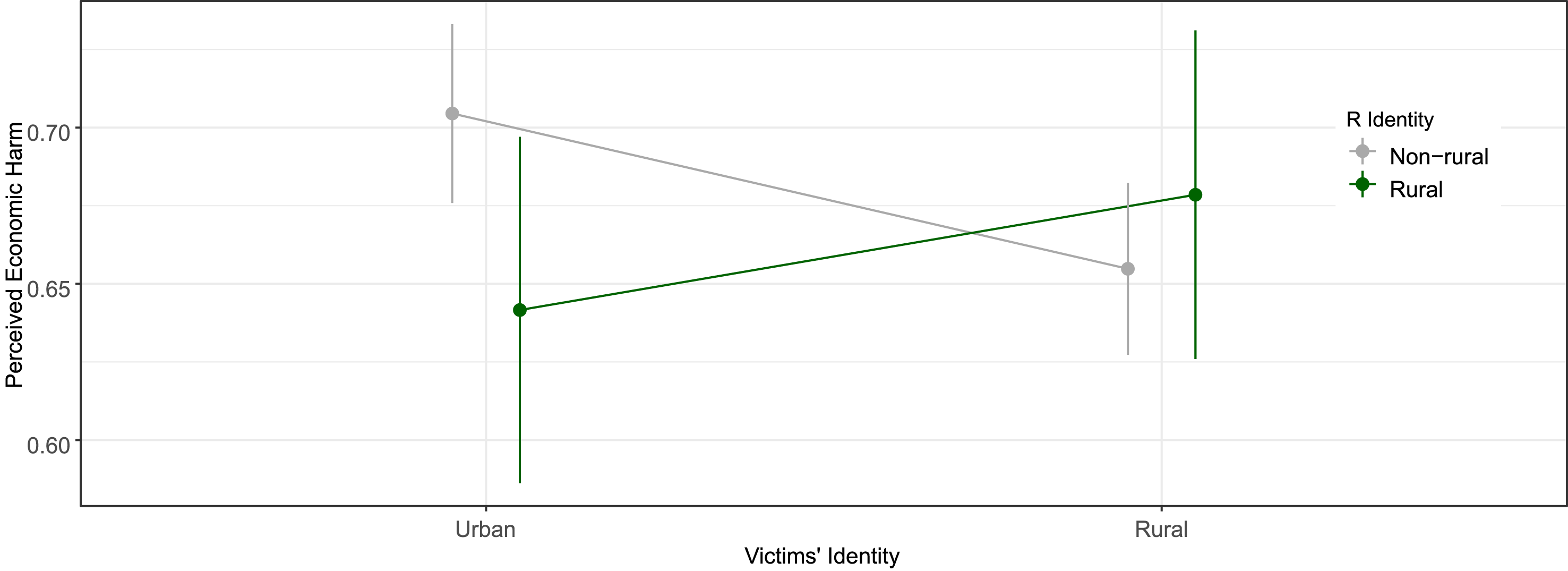
Study 2 sheds some light on this question. To do so, I analyze average treatment effects conditional on party ID. Figure 2 plots estimated values and 95% CIs of perceived problem seriousness by condition separately for Democrats and Republicans. The flat blue line shows Democrats reacted similarly to all three conditions. Republicans perceive air pollution affecting democrats as less serious. Note: Points are estimated values with 95% confidence intervals, based on coefficient estimates in Appendix Table A2, Model 2. The dependent variable is perceived seriousness of the air pollution problem, scaled 0 to 1. Red line is for Republicans, blue is for Democrats.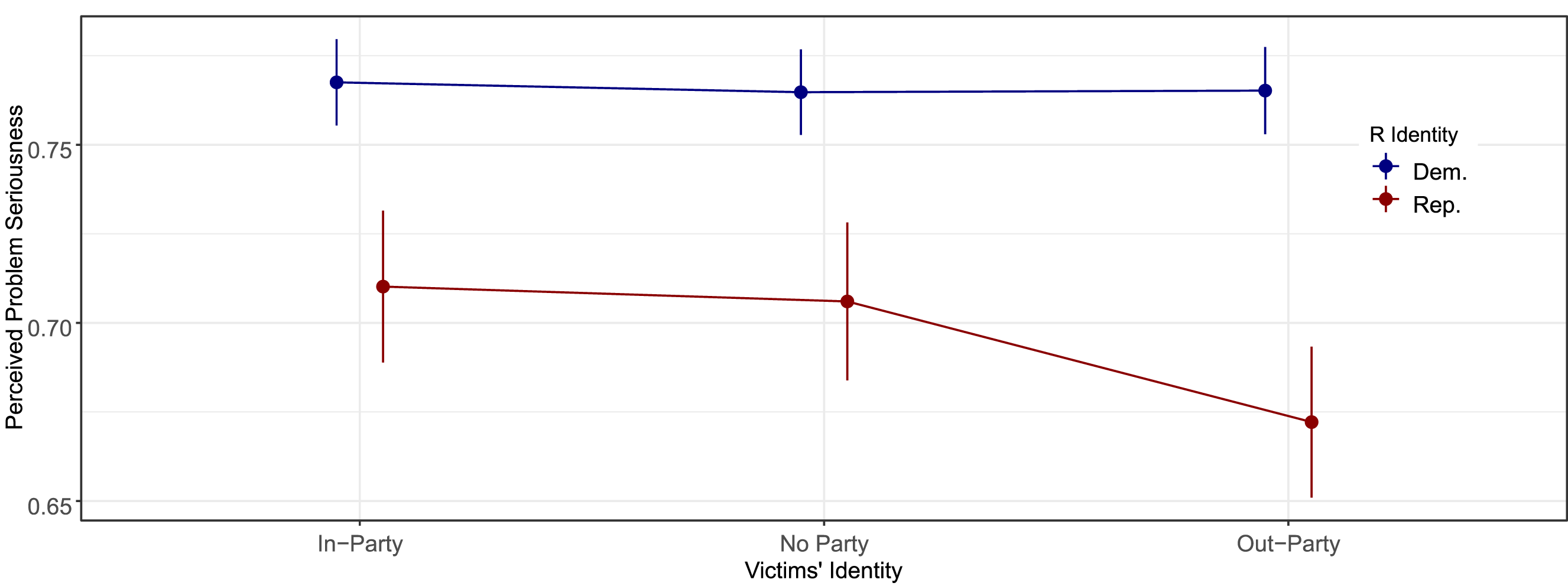
The red line stays flat when going from the In-party to No Party conditions, indicating no bias in favor of co-partisans over non-partisans. Starting from the No Party condition, however, the line slants downward, as Republicans reported significantly lower perceived problem seriousness when the problem affected Democrats. Ingroup bias exerted itself as outgroup hostility rather than ingroup favoritism. The Republicans’ Out-party mean dropped 3.4 percentage points from the No Party mean (SE = 0.017, t = −1.98, p = 0.048). The size of the drop in perceived seriousness is not trivial. It is more than half as large (59%) as the average partisan difference in overall perceived problem seriousness (β = −0.058, p < 0.05).
Study 3 corroborates Study 2’s findings. As presented in Figure 3, respondents reported 4.6 percentage points less perceived problem seriousness in the Out-party condition as compared to the No Identity condition (SE = 0.019, t = −2.48, p = 0.01), an effect equal to 0.20 standard deviations in the dependent variable. Partisans perceive cyber-attacks affecting out-partisans as less serious. Note: Points are estimated values with 95% confidence intervals, based on coefficient estimates in Appendix Table A3, Model 2. Dependent variable is perceived seriousness of the cyber-attack problem, scaled 0 to 1.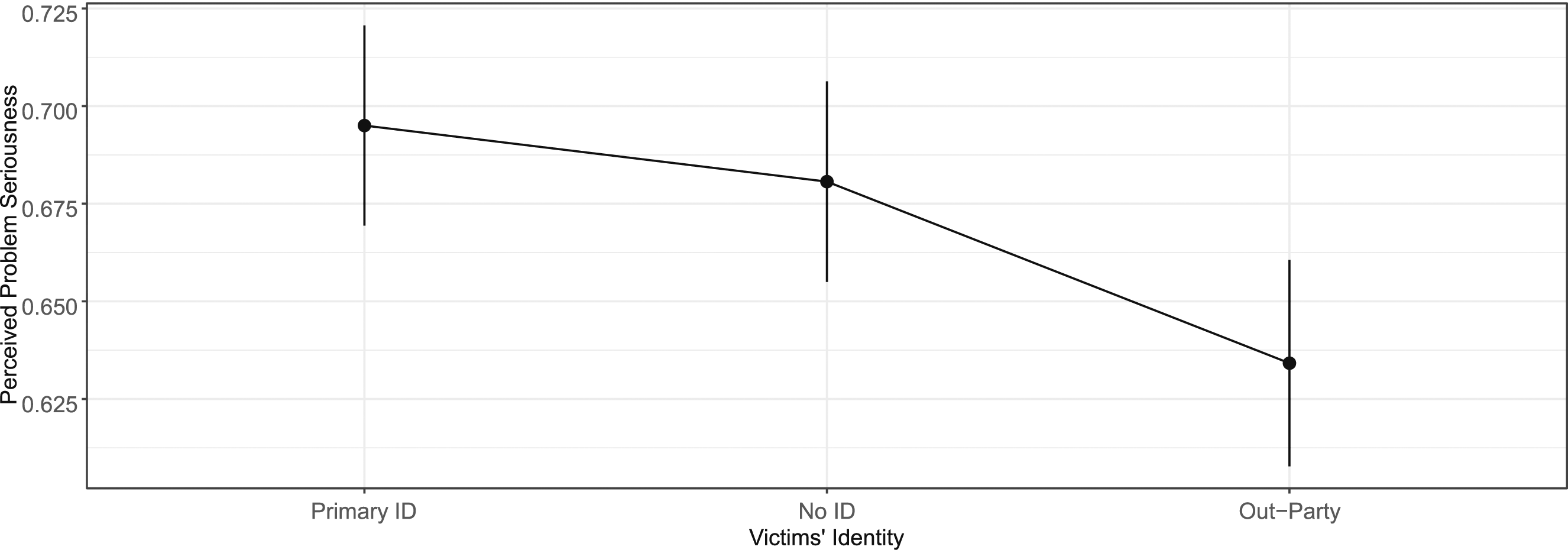
Hypothesis 2: Policy Support
If subjects showed ingroup bias in perceived problem seriousness, we would expect them to exhibit similar bias in their support for government action. Indeed, we see the effects on policy attitudes mirror those on perceived problem seriousness. Looking to Figure 4, presenting the predicted means of support for providing victims with free home air filters, we see another positive slope for rural respondents and a flat one for non-rural ones. The effect is 9.6 percentage points larger for the rural participants (SE = 0.042, t = 2.30, p = 0.022), equivalent to 0.29 standard deviations. Rural respondents support Gov’t helping rural victims more than urban. Note: Points are estimated values with 95% confidence intervals, based on coefficient estimates in Appendix Table A4, Model 2. Dependent variable is support for increasing government spending and/or regulations to help provide more reliable internet, scaled 0 to 1. Green line is for rural respondents, gray is for non-rural.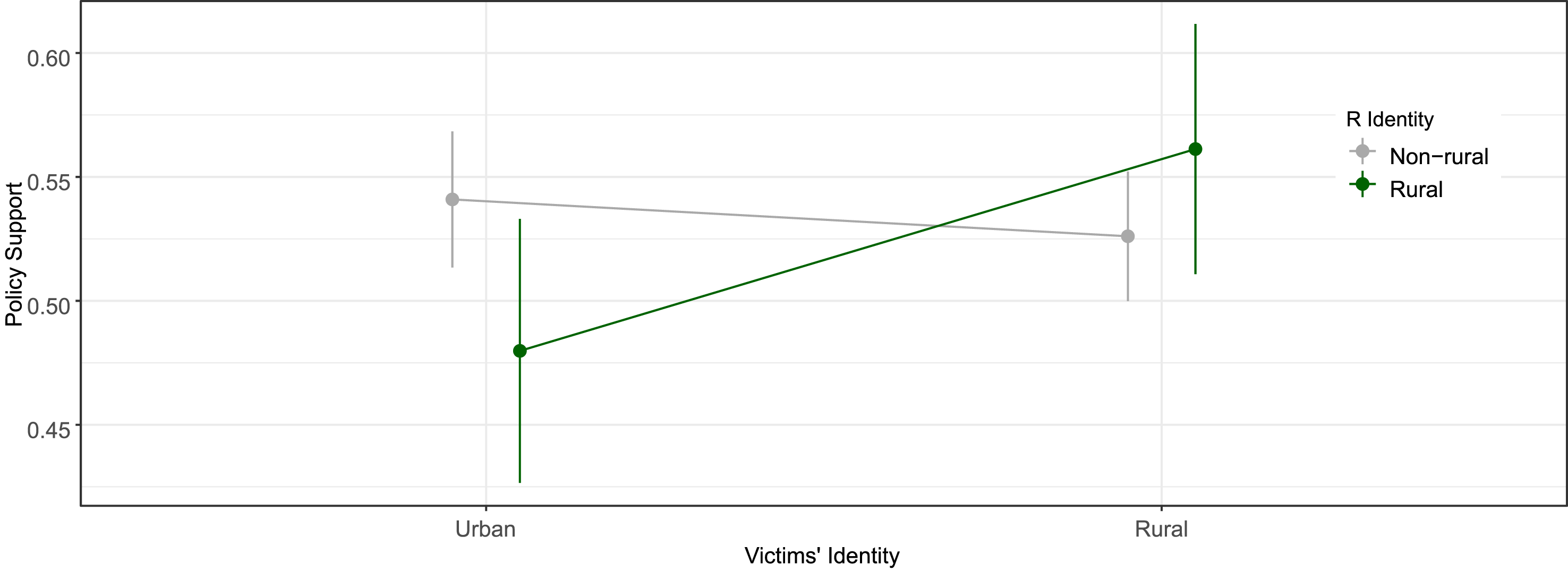
Figure 5 shows again that in-party victims do not receive preferential policy support; instead, outgroup victims receive less policy support among both Republicans and Democrats. The pooled effect is −3.7 percentage points (SE = 0.013, t = −2.93, p = 0.003), a magnitude about half the size of the estimated difference between men and women of −8.7 percentage points and about 0.15 standard deviations in the outcome. Partisans reduce support for Gov’t helping out-partisans, don’t increase support for co-partisans. Note: Points are estimated values with 95% confidence intervals, based on coefficients estimates in Appenix Table A5, Model 2. Dependent variable is support for free air purifiers to victims, scaled 0 to 1. Red line is for Republicans, blue is for Democrats.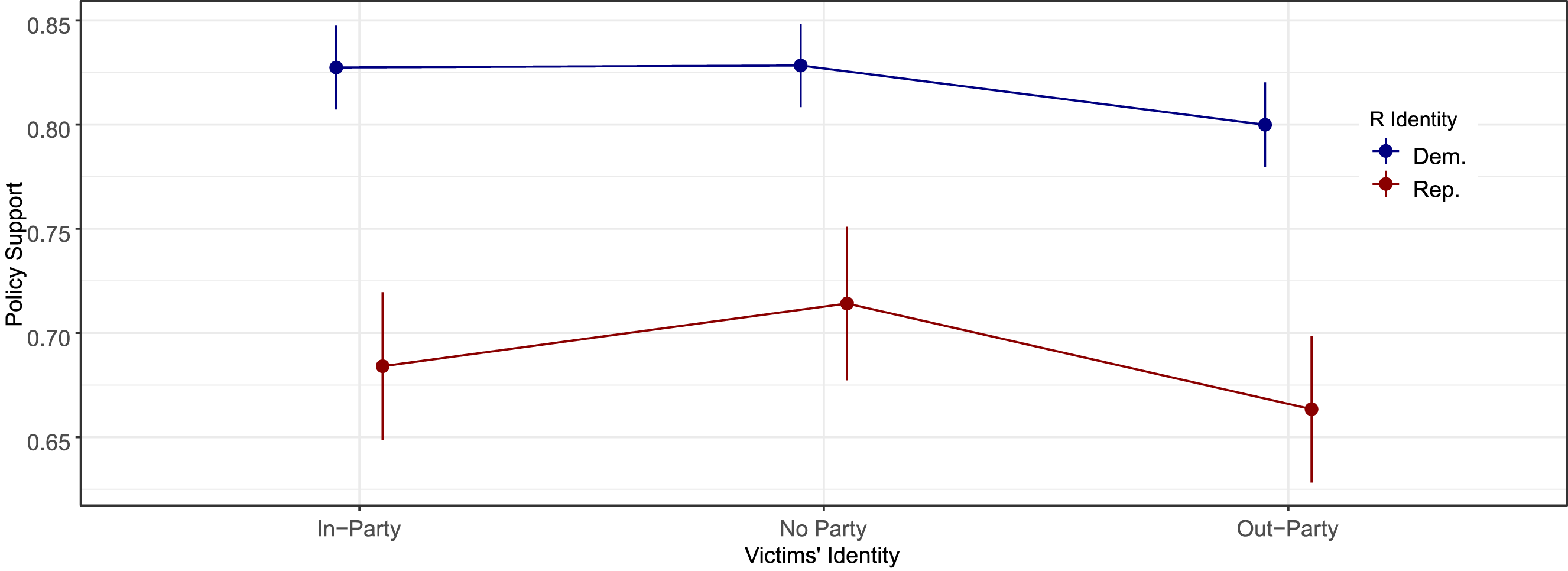
The pattern for Study 3 mirrors that of Study 2 (see Figure 6). Support for policy aid is significantly lower for out-partisans (β = −0.035, SE = 0.018, t = −1.93, p = 0.054) than a general population. Again, support for helping the ingroup is not significantly higher and is in fact close to being significantly lower (p = 0.115). Respondents drop support for Gov’t helping out-partisans, don’t increase support for “primary” ingroup. Note: Points are estimated values with 95% confidence intervals, based on coefficient estimates in Appendix Table A6, Model 2. Dependent variable is support for increasing federal spending on cyber-security for small businesses, scaled 0 to 1. 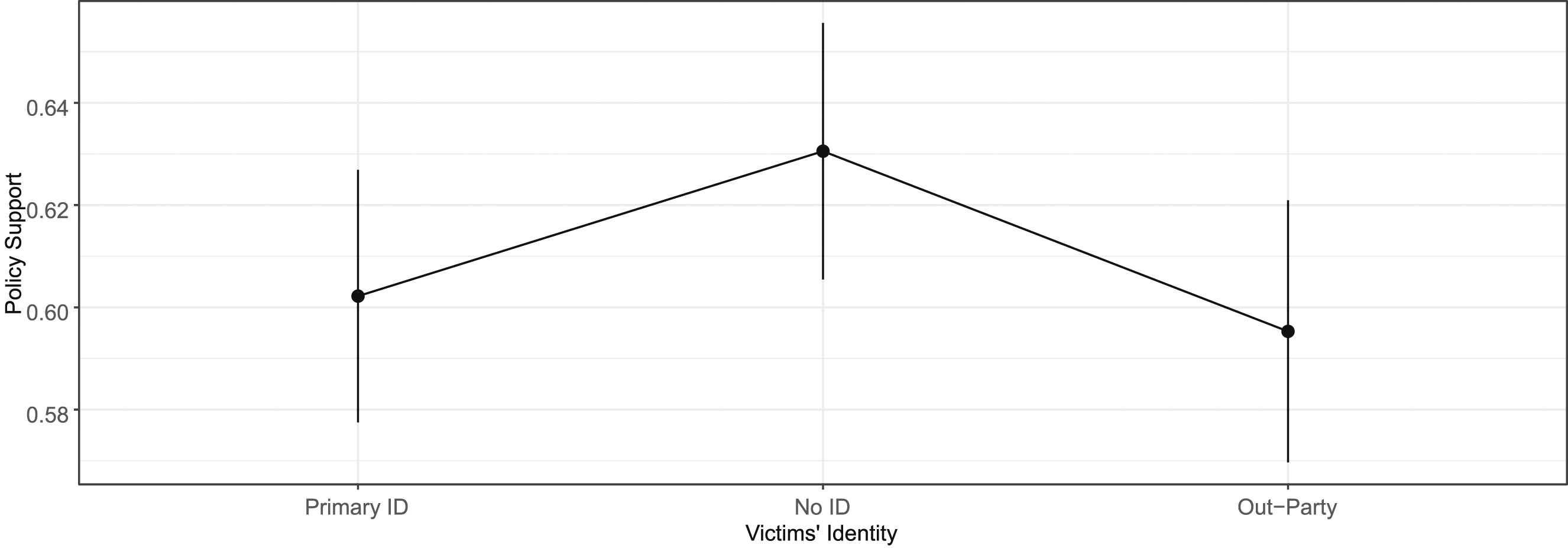
Hypothesis 3: Causal Attribution
If citizens’ problem perceptions are driven by motivations to protect group esteem, we would expect respondents to direct blame away from their ingroup members. I find no evidence of this. In Study 1, rural respondents did not attribute significantly more responsibility to ISPs in the Rural condition (β Rural = 0.062, SE = 0.043, t = 1.42, p = 0.155). Partisans in Study 2 did not attribute significantly less responsibility to the co-partisan victims (β Pooled = 0.009, SE = 0.017, t = 0.535, p = 0.593). The null effect was very similar for both Republicans and Democrats (β Republican = −0.005, SE = 0.040, t = −0.127, p = 0.899). Study 3 respondents did not place significantly less blame on victims in the Primary Identity condition (β = −0.019, SE = 0.018, t = −1.070, p = 0.285) nor did they place significantly more blame in the Out-party condition (β = 0.015, SE = 0.018, t = 0.833, p = 0.405), as compared to the No Identity baseline.
Hypothesis 4: Personal Concern
Instead of group esteem, people may be motivated by concern for their own welfare. I find evidence consistent with this hypothesis. Beginning with Study 1, Figure 7 shows that both rural and non-rural respondents felt similarly concerned in the Urban condition, but then diverged in the Rural condition. Rural respondents became more personally concerned, a full 10.9 percentage points so (SE = 0.051, t = 2.13, p = 0.033), equal to 0.32 standard deviations. Non-rural respondents became marginally less concerned (βNon−rural = −0.037, SE = 0.024, t = −1.58, p = 0.115). Rural respondents feel more personally concerned when problem is rural rather than urban. Note: Points are estimated values with 95% confidence intervals, based on coefficient estimates in Appendix Table A10, Model 2. Dependent variable is personal concern about the problem soon affecting the respondent, scaled 0 to 1. Green line is for rural respondents, gray is non-rural.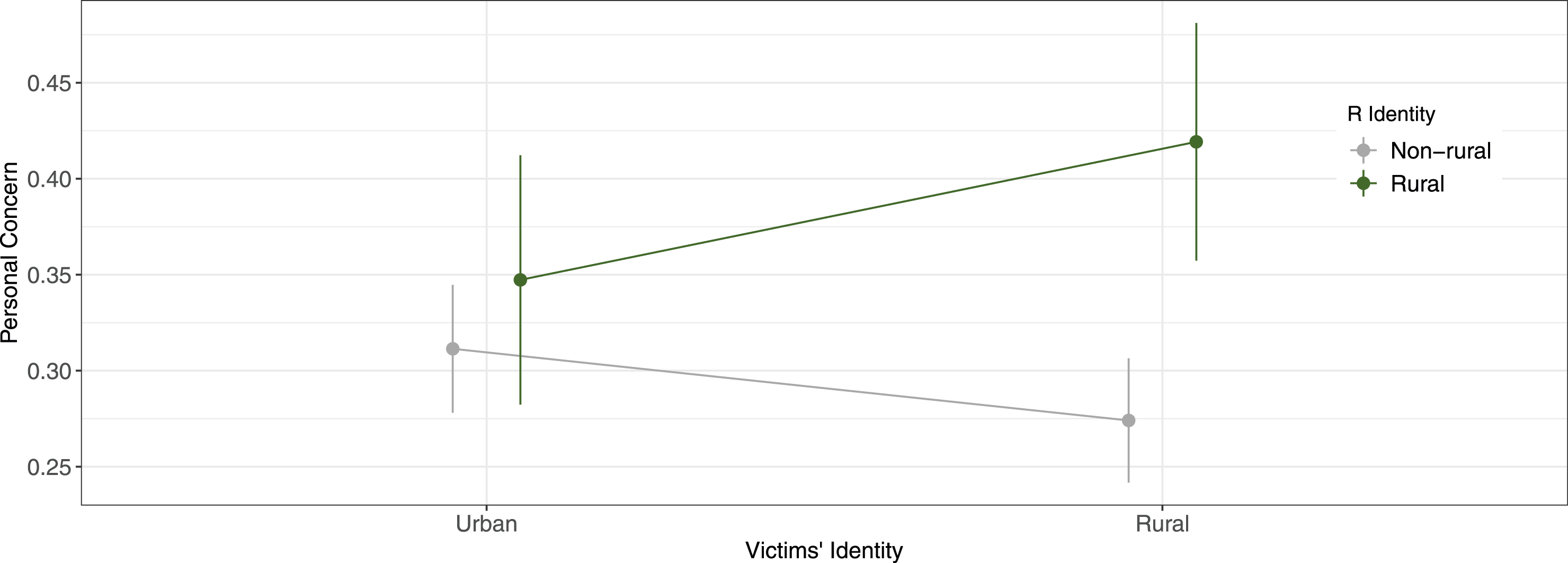
Starting on the lefthand side of Figure 8, we see that the lines representing Republicans and Democrats stays relatively flat between the In-Party and No Party conditions, suggesting no ingroup favoritism. When shifting over to the Out-party condition, however, personal concern among Republicans and Democrats diverges. Consistent with a self-interest explanation for their drops in perceived problem seriousness and support for government aid, Republicans’ personal concern falls 6.1 percentage points (SE = 0.037, t = −1.65, p = 0.098), equal to 0.20 standard deviations in personal concern. Republicans feel less personally concerned when problem affects democrats. Note: Points are estimated values with 95% confidence intervals, based on coefficients estimates in Appendix Table A11, Model 2. Dependent variable is personal concern about the problem soon affecting the respondent, scaled 0 to 1. Red line is for Republicans, blue is for Democrats.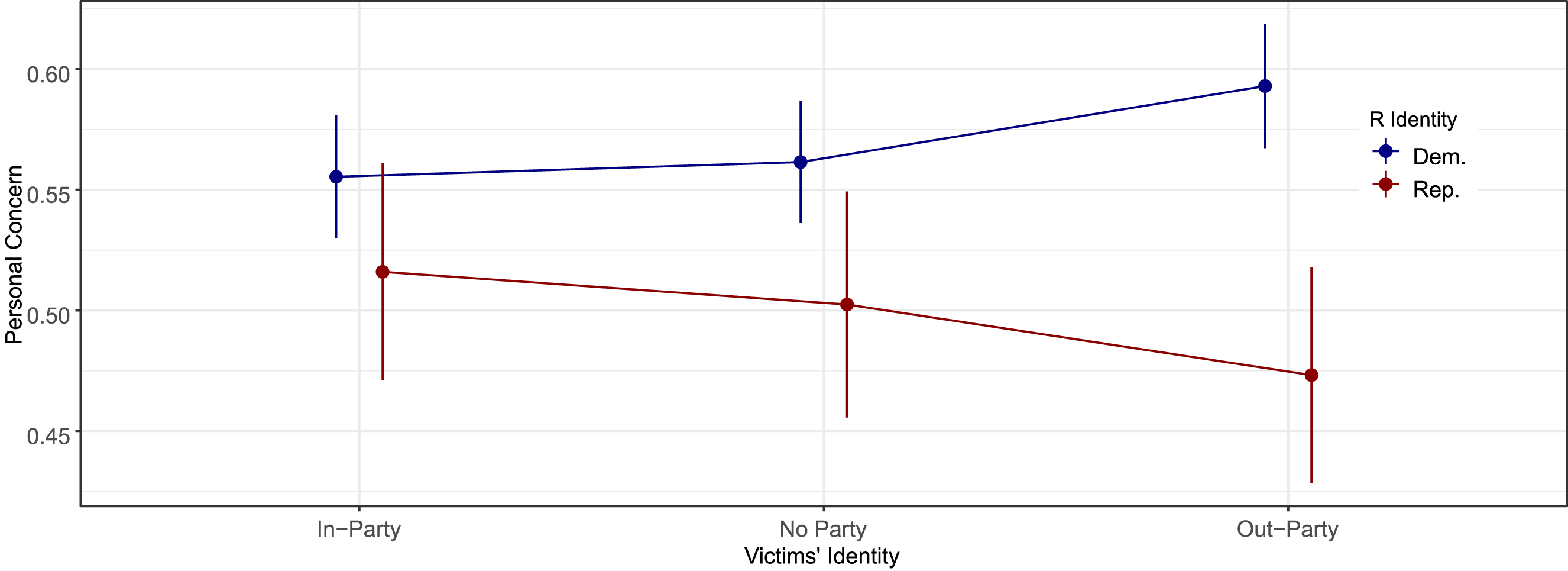
Given that the cyber-attacks were targeted at small-business owners and not ordinary people, it may not be surprising that respondents’ were not less concerned they too would soon be hit by a cyber-attack (β = 0.017, SE = 0.022, t = 0.787, p = 0.431). This null effect shows that personal concern is one, but not the only, potential pathway for antipathy toward outgroup’s social problems.
Discussion and Conclusion
By leveraging politically charged social identities across three distinct social problems, focusing on perceptions of groups rather than individuals, and measuring two potential mechanisms, I present unique evidence of the extent to which, and how, social identity shapes citizens’ perceptions of social problems. When subjects perceived the people suffering as dissimilar to themselves, they judged their harms to be less serious. They then registered weaker support for government intervention to help. Thus, depending on who was suffering, subjects showed bias in what problems they cared about and how much they wanted the government to do. This held for rural respondents thinking about internet insecurity, and partisans learning about out-partisans breathing polluted air or having their businesses hacked by cyber-criminals.
The effect sizes for ingroup bias in perceived problem seriousness and policy attitudes were in the range of 0.15–0.32 standard deviations in the dependent variable. While these sizes are modest, they are indicative of a process that may produce larger effects in the real world. One reason is because of the tameness of the experimental stimuli, which only switched group labels. Real-world depictions of such problems, particularly those on partisan media sources, could more forcefully highlight the “otherness” of the outgroup or similarity of the ingroup (Lelkes et al., 2017). Discussion with likeminded others may also exacerbate the effects of such depictions on citizens’ attitudes (Druckman et al., 2018; Hobolt et al., 2024).
In contrast to the experimental literature on ingroup bias, this paper finds consistently significant effects. The reason for this consistency may be that respondents were shown problems that affected groups rather than specific individuals (Feezell et al., 2021). Study 1, for example, shows rural respondents perceived internet insecurity as more serious when cast as a rural problem. de Benedictis-Kessner and Hankinson (2024) show, in contrast, that rural respondents did not report greater willingness to help a rural victim of opioid addiction. The disparity may be because shared identity matters less when the victims are presented as individuals, as portrayals of specific people may evoke sympathy regardless of their social identity (Slovic, 2007). In emotionally cooler, thematic (group-based) presentations of problems, shared identity may have a larger effect.
The bias exhibited in Studies 2 and 3 is more consistent with outgroup hostility, not ingroup favoritism. Compared to those in the “identity-free” conditions, respondents in the outgroup scenarios were significantly less sympathetic and supportive of helping victims. In contrast, respondents who read about ingroup members were not more sympathetic and supportive of helping them.
While Studies 2 and 3 provide novel evidence of outgroup hostility in how citizens perceive problems and form policy attitudes, they do not disprove the existence of ingroup favoritism. This is because participants perceived neither co-partisans nor victims who shared a “primary” identity as more similar than identity-neutral victims. Thus, the effect found here is one of dissimilarity rather than similarity. Ingroup victims’ failure to elicit higher perceived similarity may have been because participants assumed the victims in the “identity-free” conditions were ingroup members as well. This seems unlikely, however, for two reasons. First, with regard to Study 2, if respondents had assumed the partisanship of the victims, they likely would have assumed they were Republican because they lived in a rural area. Democratic respondents would then likely have perceived the non-party-identified victims as less similar than the Democratic victims. But they did not. Moreover, Republicans and Democrats reacted the same—that is, not at all—to the non-party-identified victims as compared to their co-partisan victims (see Appendix Figure B2). Instead, this result suggests using co-partisanship as a marker of similarity may be more difficult than as a marker of dissimilarity. American partisans tend to assume the worst about opposing partisans (Ahler and Sood, 2018), while probably not making equally extreme glowing assumptions about their fellow partisans.
In Study 3, the failure to make the small businesspeople who shared the respondents’ “primary” identity appear more similar is even more surprising. Even respondents who selected one “dominant” identity, allocating at least half of their identity points to one social category, did not perceive their ingroup victims as more similar (p = 0.95). Ingroup favoritism may exist, but evoking the perceived similarity to observe it was not as easy as expected.
While previous studies have uncovered similar bias in political attitude formation, particularly in the context of race, none has simultaneously tested the contributions of social identity and self-interest. A social identity-driven approach would anticipate a process by which citizens strive to maintain the esteem of themselves and their group (Tajfel and Turner, 1986). When perceiving a social problem involving their group, they would pin the blame outside their group (Bisgaard, 2015; Zell et al., 2022). However, respondents here did not do this, in part because they did not perceive the ingroup as more similar. Instead, seeing the outgroup made them less fearful that the problem would soon be at the their doorstep. It seems outgroup identity de-activated a sense of shared fate. Indeed, the results of Study 2 suggest people may be motivated by unshared fate: when respondents saw that the victims were out-partisans, they felt much less personally concerned. This perception had downstream effects. The problem seemed confined to hurting “them,” not “us,” so it seemed less serious and less worthy of government aid. This finding casts the citizen as someone who asks herself, “how will this affect me?” rather than “how will this make my group look?”
Study 2 suggests the effect of partisan ingroup bias may be stronger for Republicans than for Democrats, but Democrats exhibited it too. Republicans in Study 2 clearly expressed stronger and more consistent ingroup bias—across perceived problem seriousness, policy support, and personal concern—than Democrats did. However, bias was not exclusive to Republicans, as Democrats’ support for policy aid dropped when it came to helping Republican victims. Furthermore, the rural identifiers from Study 1 (a nationally representative sample), are nearly equal parts Democratic and Republican: 36% identify as Democrats and 40% as Republican, suggesting bias by rural identifiers of both parties (Munis, 2022). In Study 3, there were no statistically significant differences between partisans. Thus, while the tendency to meet out-partisans’ problems with disregard seems stronger for Republicans, it is not absent among Democrats. It may be stronger for Republicans because they tend to dislike Democrats more than Democrats dislike them (Iyengar et al., 2012) and because conservatives tend to prioritize harm reduction less than liberals do (Graham et al., 2009). This suggests that moral values of equality and fairness may moderate the extent to which social identity biases problem perceptions.
Self-interest took the stage in Studies 1 and 2; group esteem was not cast a role. Participants did not seek to make their group look better or make the outgroup look worse by attributing responsibility for the problem differently. This is surprising, because maintaining group esteem is a core concern for social identity theory (Tajfel and Turner, 1986). It’s also surprising because causal attributions are central to whether victim populations are considered deserving of help (Conover, 1988; Petersen, 2012). Instead, the reason people granted less seriousness and fewer government resources to outgroups’ problems was because they felt less personally threatened. That process gels with research showing that individuals prioritize concerns of the personal self above those of the social self (for a review, see Sedikides et al., 2013).
The insights provided by this paper are not without their limitations. First, because no group perceived any victims as more similar than the neutral group, tests of ingroup favoritism could not be conducted. Future work should pursue this question. Second, neither the social problems nor the social identities explored here are exhaustive or representative of their variety. While efforts were made to employ social problems with ambiguous and unambiguous causes with physical and economic effects, future studies could leverage other social problems that vary along these dimensions as well as others. Similarly, exploiting rural and partisan identity constitutes only a fraction of the possible identities citizens possess. Efforts were made toward expanding the variety of identities by eliciting respondents’ “primary” identity, but the set of possible identities was limited to gender, race, religion, party, and rurality. Future research should explore other identities, with an eye toward measuring how competitive or otherwise they feel them to be.
Third, all the data were collected in the United States, a nation with relatively strong values for impersonal fairness and relatively weak ingroup biases (Henrich, 2020). Had data been collected from a variety of countries, especially non-Western ones, I would have expected to see stronger effects of ingroup bias. This pattern is suggested by the difference between Democrats and Republicans, as conservatives hold more traditional values of group loyalty and respect for the authority (Waytz et al., 2019), which are more common in non-Western populations. This paper thus shows only a sliver of the variation across nations.
Supplemental Material
Supplemental Material - Not My Problem: How Social Identity Shapes Problem Perceptions and Policy Attitudes
Supplemental Material for Not My Problem: How Social Identity Shapes Problem Perceptions and Policy Attitudes by Philip Moniz in Political Research Quarterly.
Footnotes
Acknowledgments
I would like to thank Amber Boydstun, Jacob Brown, Christopher Bryan, Nicholas Dias, Jamie Druckman, Stephen Jessee, Robert Luskin, Daron Shaw, Bill Swann, and attendees of the 2022 Toronto Political Behavior Workshop for helpful feedback.
Declaration of Conflicting Interests
The author(s) declared no potential conflicts of interest with respect to the research, authorship, and/or publication of this article.
Funding
The author disclosed receipt of the following financial support for the research, authorship, and/or publication of this article: The author received financial support from the Texas Politics Project at the University of Texas at Austin for the research of this article.

Supplemental Material
Supplemental material for this article is available online.
Notes
References
Supplementary Material
Please find the following supplemental material available below.
For Open Access articles published under a Creative Commons License, all supplemental material carries the same license as the article it is associated with.
For non-Open Access articles published, all supplemental material carries a non-exclusive license, and permission requests for re-use of supplemental material or any part of supplemental material shall be sent directly to the copyright owner as specified in the copyright notice associated with the article.
