




Abstract
Despite extensive research on rising populism, we still know little about the relation between populist politics and how ordinary citizens engage with, and act upon, the identities that populism mobilises. To address this blind spot, I develop an inductive approach that moves from a focus on populism to a broader exploration of peoplehood, and from a variable-centred to a person-centred approach employing Latent Class Analysis. The results indicate attitudes towards peoplehood can be grouped into 6 major conceptions across Western Europe, and that support for populism is concentrated among citizens who hold particular conceptions of peoplehood, offering insight into the ideas of the people that underlie support for populism. These findings show peoplehood is a useful theoretical framework for understanding collective belonging, and that it can help to grasp more comprehensively the social grounds of contemporary populism. Finally, using regression analysis, I find the association between conceptions of peoplehood and electoral behaviour is significant in the case of populist right supporters, but not populist left supporters. Overall, I argue these findings offer new hypotheses regarding the meaning and implications of populism, and can also help explain the differing success of right and left populist parties.
Introduction: Rethinking the Way We Study Populism and Identity Politics
Recent decades have faced political scientists with the challenge to make sense of rising populist politics, in the wake of decades of declining political interest and participation since the 1970s (Norris 1999). Yet despite growing interest and research on populism, today we still know little about the relation between rising populist politics and the way ordinary citizens engage with, and act upon, ideas of the people.
To be sure, the need to explain such political shifts has motivated a rapid development of populism studies in the past two decades (Meijers and Zaslove 2021), facilitated by the development of a consensus in scholarship that populism must be understood as a fundamentally discursive phenomenon. The result has been a fruitful programme of comparative research that has provided key insights on the prevalence of populism from the US to Japan. However, existing research relies on a deductive model of public opinion, which restricts research to a specific conception of populism that assumes or brackets, rather than explores the identities behind identity politics. In other words, the development of a discursive paradigm has paradoxically come at the expense of minimising the attention we pay to meaning and discourse.
This research has recurrently established a causal link exists between populist attitudes and support for populism, foregrounding the mobilisational power of the people as a political identity. Yet we cannot grasp the roots or implications of populism without an understanding of what these identities mean, or whether they are different for supporters of populism compared to other citizens. To move beyond this conundrum, I build on recent conceptual and methodological developments in the field of nationalism studies to propose a double shift: first, from a focus on populism to the broader study of peoplehood, understood as a multi-dimensional discursive phenomenon encompassing notions of nationhood, citizenship and sovereignty. Second, from a variable-centred to a person-centred methodology using Latent Class Analysis (LCA), which is a method for grouping individuals according to attitude patterns. The aim is to complement the deductive approach in previous research which has shown the causal relevance of populist attitudes, with an inductive approach that unpacks the concepts of collective belonging that underlie said attitudes. Building on this framework, in this paper I ask: do ordinary citizens in West Europe hold coherent conceptions of peoplehood? And if so, are these conceptions associated to different patterns of electoral behaviour?
The results indicate 6 major conceptions of peoplehood exist among ordinary citizens. These conceptions are consistent and clearly identified across different countries, constituting an important finding that speaks to the relevance of peoplehood as a framework for empirical research. These different conceptions of peoplehood reflect coherent combinations of attitudes that show how the different ways in which we are part of the people (culturally, administratively and politically) are meaningfully interconnected. Moreover, when considered relationally, they shed light on how the elusive idea of the people is engaged with in contemporary democratic societies.
In terms of electoral behaviour, I show the constituencies of different party families present significant variation in conceptions of peoplehood. Specifically, whereas mainstream party supporters hold diverse conceptions of peoplehood that largely reflect the broader society, support for right and left populism is concentrated among citizens holding specific conceptions of peoplehood. Finally, I perform regression analysis to test whether the associations between conceptions of peoplehood and electoral behaviour are independent of other factors, and I find this is the case only for populist right parties. I propose these findings can help to explain the divergent fortunes of different populist parties.
Finally, I speak back to dominant theories of populism, indicating the findings contest common assumptions regarding the meaning and political salience of the people as a collective identity. This research therefore also makes a broader methodological point regarding the need to explore new approaches to the study of identity politics as a way of grasping populism more comprehensively. I also link my findings to broader debates regarding identity and its political import in postmodern times, casting doubt on the common idea that populist success reflects a “return” of the people as a more modern, traditional form of politics.
In this paper I proceed as follows: first, I review the relevant literature and flesh out the limitations of the dominant approach to populism. Second, I outline how an alternative, inductive approach can be developed. Third, I specify this approach detailing my research design, data and methods. Fourth, I design and fit a latent class model for the construct theorised, which is the grounds for identifying and analysing the 6 ideal types. Fifth, I report and analyse the results of my regression models. Finally, I discuss the implications of my findings in relation to previous scholarship.
Populism as a Mass Phenomenon: The Limitations of a Deductive Consensus
The current debate on populism responds to a pressing need to make sense of new forms of radical politics. The exponential development of this literature stems largely from efforts by scholars Cas Mudde and Cristóbal Rovira Kaltwasser to place centre stage the political significance of appeals to the people as a distinct discursive phenomenon, founding what is today known as the ideational school. Following ideational theory, populism is defined as a ‘thin-centred ideology’ that ‘considers society to be ultimately separated into two homogeneous and antagonistic groups, “the pure people” versus “the corrupt elite,” and which argues that politics should be an expression of the volonté générale (general will) of the people’ (Mudde 2007, 23, 544). Transcending a disperse array of ways of defining populism in the past, the ideational school has built a clear consensus that populism is a discursive phenomenon that cuts across different types of ideologies, political styles, or institutional arrangements (Brubaker 2017, 360).
In recent years, ideational scholarship has shifted from a focus on the supply side of elite discourses, policy, etc. to a growing interest in the demand side of citizen attitudes and political behaviour (Van Hauwaert, Schimpf, and Azevedo 2019). Acknowledging the incapacity of previous research to tap into the phenomenon of populism itself as it unfolds in the minds of ordinary people (Hawkins, Rovira Kaltwasser, and Andreadis 2020), original surveys have been fielded where populism is operationalised as a series of populist attitudes that amount to a multi-dimensional construct composed of anti-elitism, people-centrism, and Manicheanism (Castanho Silva et al. 2019, 160-161). This recent strand has shown populist attitudes are widespread across Western societies, and that they are significant in explaining support for populism (e.g., Akkerman, Mudde, and Zaslove 2014; Anduiza, Guinjoan, and Rico 2018; Hawkins, Rovira Kaltwasser, and Andreadis 2020; Loew and Faas 2019; Santana-Pereira and Cancela 2020).
However, the ideational concept of populism is problematic for the amount of substantive assumptions it builds into research. These have been flagged by critical perspectives grounded in alternative schools (chiefly the Essex tradition): 1 that populism is a discourse of a moral register that vindicates the ‘pure’ people (Ostiguy, 2017, 91-92; Stavrakakis and Jäger 2018), that vindications of the people always refer to a homogeneous construction (Katsambekis 2022), or that populism takes shape as an ideology (Freeden 2017). This does not mean we cannot agree on a more minimal, formal definition of what populism is that can consensually group scholars, as indicated by Stavrakakis and De Cleen (2020, 316) in defining populism as a type of discourse ‘characterized by a people/elite distinction and the claim to speak in the name of “the people.”’ But substantive assumptions nevertheless remain essential to ground ideational scholarship, and they are reflected in the way public opinion is studied: in the populist attitudes literature, questions regarding the meaning of the identities that populism mobilises have been sidelined, with research focusing instead on measuring a specific concept of populism that looks fundamentally not at self-definition but antagonism (against politicians, against the government, against people that do not think like oneself), and that assumes no heterogeneity within or across populations.
In other words, research on populist attitudes has opted for a deductive approach ‘whereby the essential features of populism are asserted by fiat, drawn as they are from the prevailing theories of the day’ (Dean and Maiguashca 2020, 16). While this path has made it possible to develop an ambitious comparative literature on populist attitudes, this new research cannot fully meet its objective which was to tap into the phenomenon itself of populism as a ‘discourse’ (Hawkins and Rovira Kaltwasser 2017, 531). In operationalising populism as a set of attitudes that exist as fixed ‘latent’ dispositions available for ‘activation’ by political actors (Hawkins and Rovira Kaltwasser 2017, 531; Mudde and Rovira Kaltwasser 2018, 1671; Verbeek and Zaslove 2019, 5), the possibility of studying the ways in which citizens construct peoplehood, the potential diversity in said constructions, and their agency in engaging with politics through them, is blacked out. Ultimately, the objective of comparative generalisation is met by flattening discourse into psychology. But the question remains as to what these surveys are actually tapping into (Hawkins and Rovira Kaltwasser 2019, 16), or whether populism really amounts to a cross-culturally comparable phenomenon (Castanho Silva et al., 2020). In other words, populist attitudes research has made fundamental inroads to map populism and its political import in society, but a significant portion of the picture remains unexplored: what does the people mean to the people?
To be sure, ideational scholarship has paid attention to nationalism, which is the main identity behind populist politics. But the way this has been done reproduces the broader deductive scheme I have described. Specifically, nativism is the conceptual frame through which nationalism is factored into ideational scholarship. It is defined as ‘an ideology, which holds that states should be inhabited exclusively by members of the native group (“the nation”) and that nonnative elements (persons and ideas) are fundamentally threatening to the homogeneous nation-state’ (Mudde 2007, 19). While nativism has become the standard framework in ideational research, a focus on this particularly strong, ethnicist “flavour” of nationalism fails to account for the role of nationalism comprehensively. On the one hand, it builds into the theoretical frame the assumption that nationhood can only have a negative and exclusionary political meaning, again reducing identity to antagonism (e.g., De Cleen 2017; Mudde 2017; Rooduijn, Bonikowski, and Parlevliet 2021). On the other hand, at an empirical level this is reflected in how attitudes toward immigration are considered enough to account for this dimension of populism (e.g., Gidron and Hall 2020; Norris and Inglehart 2019; Rooduijn et al., 2017).
What ideational scholarship shares is the assumption that the national people is always already assumed to be homogeneous rather than diverse, given rather than dynamic, antagonistic rather than constructive (see Inglehart and Norris 2017), in sharp contrast with research in nationalism studies that has shown the nation to be a dynamic and contested object (Bonikowski 2016; Cohen 1996; Kaufmann 2017, 428), and whose chief social function is not exclusion but self-definition, ontological security, social cohesion (Malešević 2013). As is shown in research not only in nationalism studies but also other related fields such as the study of citizenship or sovereignty (e.g., Bryant and Reeves 2021; Kallio, Wood, and Häkli 2020), the collective identities that populism builds on are anything but static realities that can be operationalised across different contexts as fixed phenomena. Ultimately, working on problematic conceptual assumptions can lead research to misrepresent available data and to reach mistaken conclusions regarding citizens’ opinions (see Küppers, 2024). For instance, how is the increasingly civic frame of far-right nationalism (Halikiopoulou et al., 2013) factored into this framework?
In other words, a study of populism as a mass discourse cannot limit itself to ascertaining the prevalence of populist attitudes. It requires inductive, contextual insight into the dynamic identities underlying said discontent. Rising populist forces problematise the foundations of democracy by appealing to the people and contesting its definition, but how do ordinary people actually engage with these discourses? How is peoplehood understood, if at all, as a coherent construct at a personal level? How does it resonate with populism, for whom, and to what effect?
Some researchers have already flagged the paradox of approaching identity politics while downplaying identities themselves (Filsinger et al., 2021; Lubbers 2019; Lubbers and Coenders 2017; Meuleman and Lubbers 2013). In turn, their work asks what role national identity plays in relation to populist attitudes or electoral support for populism. Their mixed results are interesting and point to interrelations much more complex than would be assumed within the ideational framework: for instance, the link between national identity and migrant antagonism, or between social conservatism and populist attitudes, are unclear.
However, there is strong evidence to suggest national identities are not suited to a straight-forward operationalisation as discrete attitudes of national attachment, national pride, etc. (Bonikowski 2016). Building on recent innovative research (Bonikowski and DiMaggio 2016; Todd 2018), I argue there is a need to transcend a conventional methodology in the study of identity and politics that operationalises identities as “containers”. By a “containers” logic, I mean the norm to analyse the salience of identities in the form of linear relations between distinct variables, and also the assumption that these variables reflect self-contained realities (nationhood, religion, ethnicity, etc.) independent of each other.
So how can we transcend a tendency to reduce identities to psychology and to deductively assume their contents, while at the same time not essentialising said identities as discrete “containers”? While the critical perspectives reflected here build on other major frameworks in the literature on populism, neither of them has proposed an alternative approach to demand-side research, even if some case-study research exists that draws on qualitative fieldwork (Katsambekis et al., 2022; Küppers, 2024). Looking beyond the field for a way forward, in the following section I build on nationalism studies to tackle this conundrum. The objective is to address limitations in the ideational framework, which has offered solid grounds for comparative research in populism, by complementing a deductive approach with an inductive one that factors in the complexity of the identities behind identity politics. We know populist attitudes are widespread and explanatory of populist politics. But what constructions of the people underlie such widespread discontent?
A New Framework: From a Deductive to an Inductive Approach to Mass Politics
The conundrum I have fleshed out reflects a broader problem: the study of cultural phenomena requires a theoretical framework that can be operationalised empirically without reducing the complexity of cultural meanings to distinct sets of attitudes. But this requirement is at odds with the general practice in quantitative research to assume linear relations between independent variables (Goldberg 2011, 1397-98).
Precisely as a response to this type of problem, the use of Finite Mixture Modelling (FMM) has become popular in nationalism studies (Alemán and Woods 2018; Bonikowski 2017; Bonikowski and DiMaggio 2016; Bonikowski, Feinstein, and Bock 2021; Keskintürk and Kuyucu 2024). It has also gained relevance in other areas of political science such as the study of political participation (e.g., Oser 2017) or citizenship norms (e.g., Hooghe, Oser, and Marien 2016). FMM is a powerful statistical tool that allows us to identify groups of observations in a sample that show a similar pattern of values across a specific number of variables. In turn, it is possible to calculate the probability that any observation belongs in the groups identified, according to their values across the given variables. Speaking of survey data, since relations between variables are approached not as linear associations across respondents but as multivariate associations within individuals’ responses, FMM serves to approach data in a holistic manner. Therefore, it can be understood as a ‘person-centred approach’, as opposed to ‘variable-oriented research’ (Ruelens and Nicaise 2020, 1, 4).
Among other FMM methods, LCA has gained greater relevance within political science because of its suitability for modelling categorical survey data (Oser 2017, 244). Conceptually, the logic is similar to a long tradition in political science of defining citizen typologies or voter profiles (e.g., Inglehart 1990; Pratto et al., 1994). Provided a predefined a set of variables, LCA can be used to identify specific patterns of values across said variables that are common to subsamples of respondents. For instance, it has been used to analyse which kinds of political participation are generally combined by the same individuals, as well as to identify who these individuals are demographically (Oser 2017). The logic is similar to that of Exploratory Factor Analysis (EFA), except in this case we synthesise information not by grouping variables but by grouping observations. In turn, just like in EFA, deciding on the number of classes to retain as a final model consists in a trade-off between nuance and parsimony that is guided by a combination of fit criteria, information indices, and interpretability (Masyn 2013).
In the case of this paper, I apply LCA to map views on peoplehood, rather than populism. This is a key conceptual step for researching the identities behind identity politics: in order to understand populism from the bottom up, we must scope out to the broader social reality of that identity that populism revolves around. This argument is inspired in ethnographic research in nationalism studies, that has gradually moved scholarship from a traditional tendency to speak of nationalism or nationhood as clearly bounded phenomena, and towards a broader orientation to study how ordinary people engage with the nation (Skey 2011, 10).
Yet there is an evident fuzziness to the notion of people or peoplehood, which might be the reason why it has scarcely been developed conceptually (see Canovan 2005; Lie 2004; Näsström 2007; Smith 2015). Due to the historical structuration of governance into nation-states, the notion of the people in Europe is amalgamated with notions of culture and collective self-definition, constitutive of a unique type of political system that lies at the core of political modernity (Gramsci 1971, 125–133). Indeed, the national call for self-determination is the historical vehicle for the emergence of popular sovereignty (Malešević 2013, 11). Furthermore, with the increase of fiscal pressure, compulsory duties and social rights, the notion of citizenship as an administrative relation between institutions and individuals has come to develop as a further dimension to this unique social structure (Cohen and Ghosh 2019; Esping-Andersen 1990, ch. 2). This is the empirical historical basis for my argument that we should operationalise peoplehood as a discourse that encompasses three dimensions that are generally studied separately yet are structurally entangled: the people as sovereign, the people as nation, the people as citizenry.
Combining a broader conceptual scope and a person-centred methodology, the resulting approach better aligns the discursive ontology of populism studies with empirical research. Scoping out to a more complex construct, it is possible to tap in detail into the identity discourses that are meaningful to ordinary people (to grasp nationhood rather than nativism, etc.). And to do so while avoiding the “containers” problem: LCA ‘differs considerably from the standard variable-based approach in attitudinal and public opinion research’ to the extent that ‘[t]he assumption here is that cultural representations should be viewed holistically, as the sum of all their constituent parts, rather than as sets of discrete attitudes that can be examined in isolation from one another’ (Bonikowski 2013, 9). Therefore, LCA aligns with the dictum in discourse theory that meanings derive from the interrelationship of elements (ibid., 10). There is no assumption, of course, that behind said groups of attitudes exist actual, conscious arguments or a fundamental “trait” inherent in people, as opposed to how clinicians might use LCA to identify symptomatic patterns of objectively existing pathologies. Rather, the objective is to foreground the interrelations between attitudes, on the account that said attitudes form schemata that tap into a common social phenomenon (see DiMaggio 1997, pp. 268-269), and that therefore they can produce patterns that are meaningful and allow us to grasp said phenomenon within the limitations of existing data.
Second, this research design delivers a more comprehensive, inductive approach that does not predefine the people behind populism, or assume that its meaning should be homogeneous across a population – which is frequently a necessary assumption in quantitative research (Ruelens and Nicaise 2020, 3). Both issues are characteristic of ideational scholarship, yet problematic because they foreclose important questions. In contrast, LCA is not only inductive in that it produces data-driven analyses of the contents of a construct, but also in the way it captures the internal heterogeneity of sampled populations.
Third, as opposed to other FMM methods, this research design contributes a different perspective while being compatible with the questions that occupy prior scholarship. LCA produces variable measures for each observation, which lead to a categorical assignment of respondents to classes (of peoplehood), allowing us to analyse the association between respodents’ attitudes and related variables. This makes LCA suitable to complement the findings of populist attitudes research, getting us one step closer to the original objective of prior scholarship. In providing greater depth through a focus on peoplehood, these analyses can also inform the assumptions in prior findings to inspire improvements in future measurements of populist attitudes.
For the purposes of LCA, we can think of peoplehood as a multi-dimensional yet distinct component of political culture. From this standpoint, I go one step further than previous uses of LCA for the study of national identity by proposing a more encompassing analysis. As I show later, the different typologies of nationhood their previous research has identified (Bonikowski and DiMaggio 2016; Keskintürk and Kuyucu 2024) can actually be mapped onto the more comprehensive set of typologies emerging from my analysis.
Methods
The data used corresponds to the European Values Study (EVS) round 5 (2017). EVS is the only major dataset that includes a selection of items to capture with sufficient granularity the three dimensions of the construct theorised.
Regarding model specification, I made two decisions to further attune my research design to an inductive ethos: first, I decided to fit the model for each country separately, rather than combining respondents into a single model. Country contexts can most directly determine the nature of the phenomenon being studied, which taps into how respondents relate to collectives and institutions that are national in scope. This more cautious approach is common in prior research in nationalism studies using LCA for comparative purposes (Bartasevičius 2022; Bonikowski 2017).
Second, I limited the number of countries included to match the theoretical framework of peoplehood which is cultural, as opposed to the psychological framework of prior research, requiring caution as to the extent to which cross-country comparison is congruent (in turn, this constraint in scope will also make it possible to venture further considerations and hypotheses later). Accordingly, I focus on European countries, since my concept of peoplehood builds fundamentally on a European political framework. I include two further considerations. First, I decided to include only countries that are EU members. The EU is a powerful supranational institution with wide-ranging impacts on national policy, as well as representative legitimacy that adds a further specificity to the framework proposed (i.e., the EU is a European people). For instance, research has shown lay constructions of national peoplehood are significantly shaped by belonging in the EU (Díez Medrano 2003). These are also the countries where we see most populism today, and which have been more extensively researched by ideational scholarship. Second, I excluded countries with a communist past. The USSR and its satellite regimes were characterised by a radically different form of peoplehood, which still constitutes the political socialisation of a large proportion of their population. For example, important East-West differences in ideas on nationhood remain regardless of EU membership, pointing to the prevalent impact of historical differences and a lack of convergence throughout time (Bartasevičius 2022; Hadler and Flesken 2018). Case-study research has also shown that relations between citizens and the State in the post-communist context can remain today heavily shaped by Soviet frames of reference (Ozoliņa-Fitzgerald 2016). These criteria resulted in a West Europe sample of 10 countries (including Germany, which is generally better categorised within West Europe despite its historical particularities).
The point is not to argue research cannot be extended beyond this kind of sample or be informative for research on different cases, but that comparative analysis must align with theoretical assumptions to avoid deriving into a post-comparativist tendency (Peters 2013, 145). Even if populist movements across the globe use similar frames, they build on identities that are grounded in specific cultural and institutional structures. For instance, Osuna, Javier and Rama (2022) find populist attitude indexes perform worse in non-European countries, indicating there is a need to reflect on the situated nature of our concepts.
EVS Round 5 Items Considered for Operationalising Peoplehood.
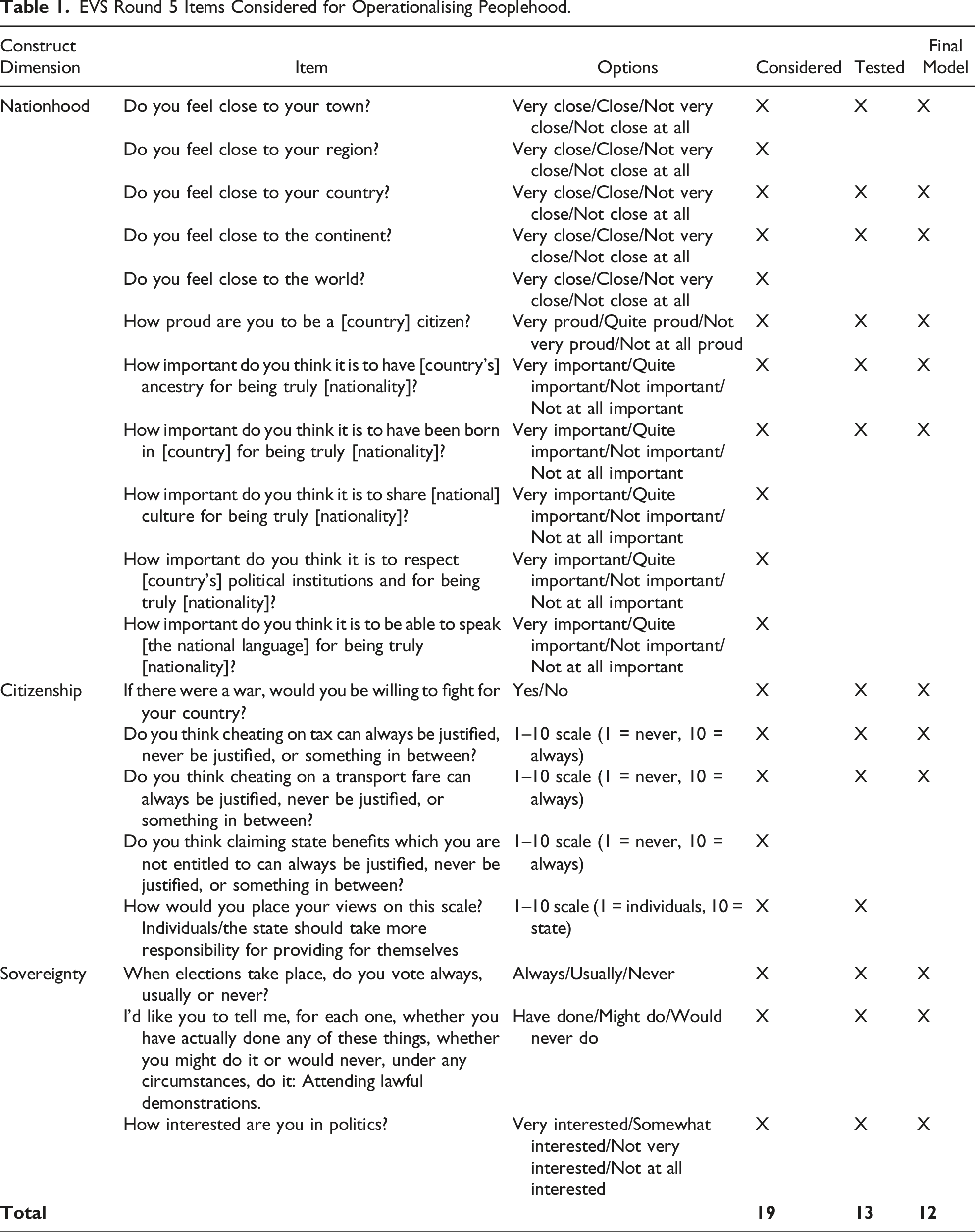
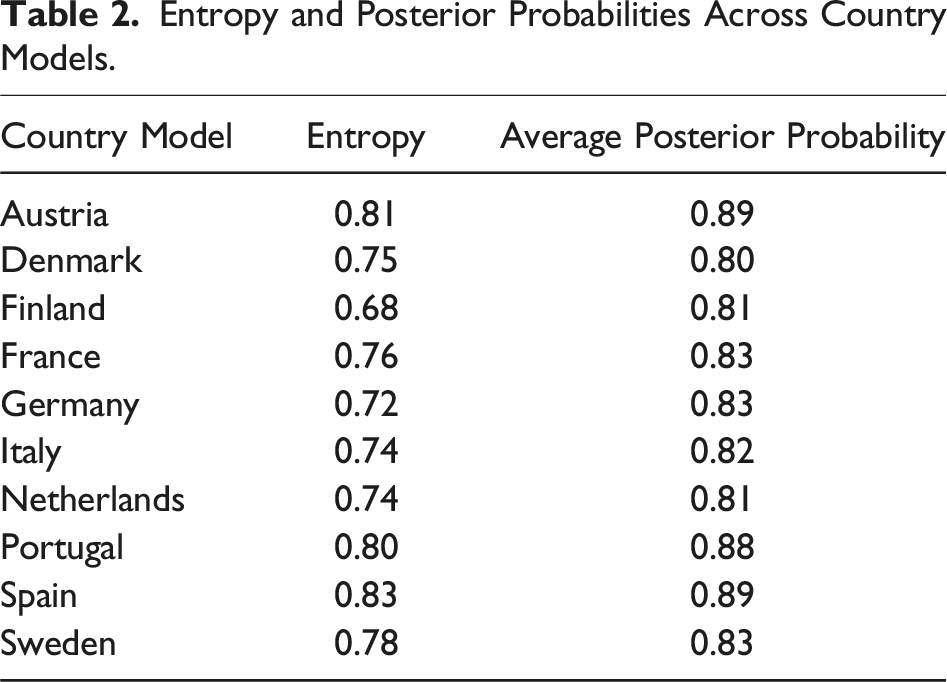
In a third step, I fit models for each country separately with the final set of 12 items. Selecting the final model for each country (i.e., choosing the ideal number of classes to represent the heterogeneity of conceptions of peoplehood within the sample) required balancing interpretability, fit indices and classification diagnostics (Masyn 2013; Petersen, Qualter, and Humphrey 2019; Weller, Bowen, and Faubert 2020, 292-93). Still, I gave prime importance to the Bayesian Information Criterion (BIC) which is widely regarded as the most reliable fit index (Weller, Bowen, and Faubert 2020, 301).
Once a final set of models across the 10 country-cases was established, I traced classes for patterns that could be meaningful in order to give a substantive interpretation to the results. When patterns were recurrent across countries, I grouped them into types. The resulting patterns across countries are aggregated into ideal types discussed later.
In a further analytical step, I perform regression analysis to focus more specifically on how said types are associated to electoral behaviour. I fit regression models aggregating data across the whole sample while including control variables. While this requires I assume the type membership of respondents as a given independent variable, this design allows me to leverage the fact that the types identified in the previous analytic step are consistent across countries to work with a larger sample.
How do Europeans Understand Peoplehood?
Entropy and Posterior Probabilities Across Country Models.
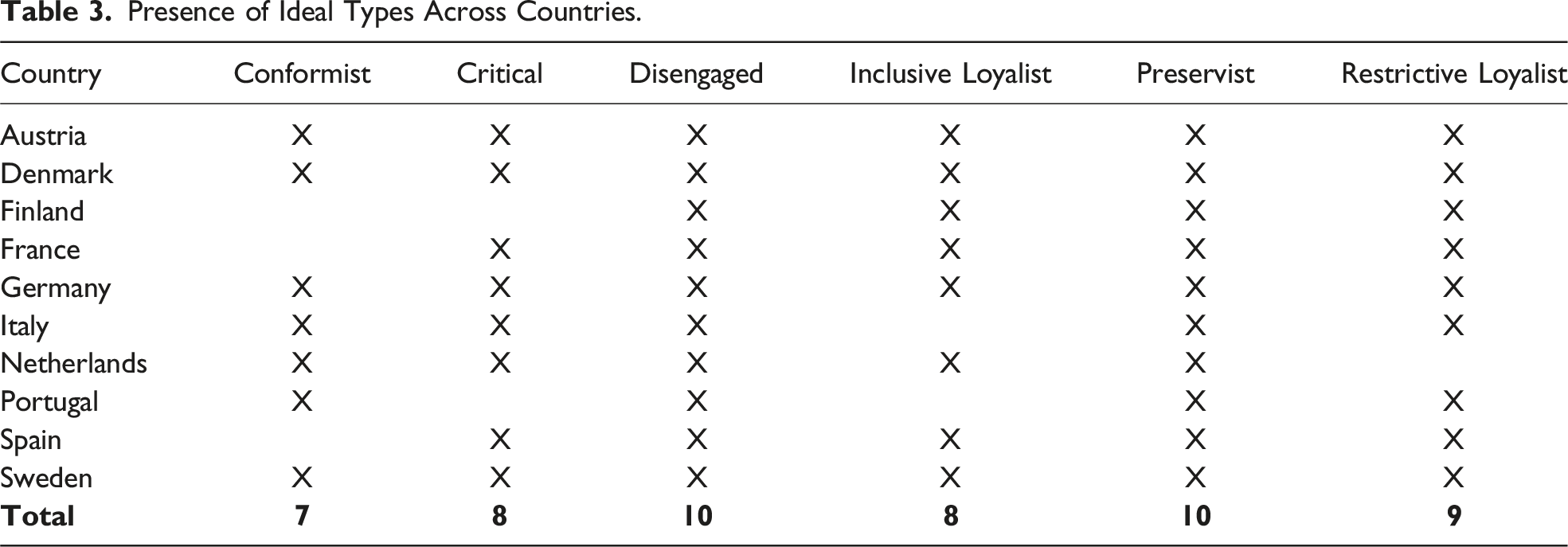
Presence of Ideal Types Across Countries.
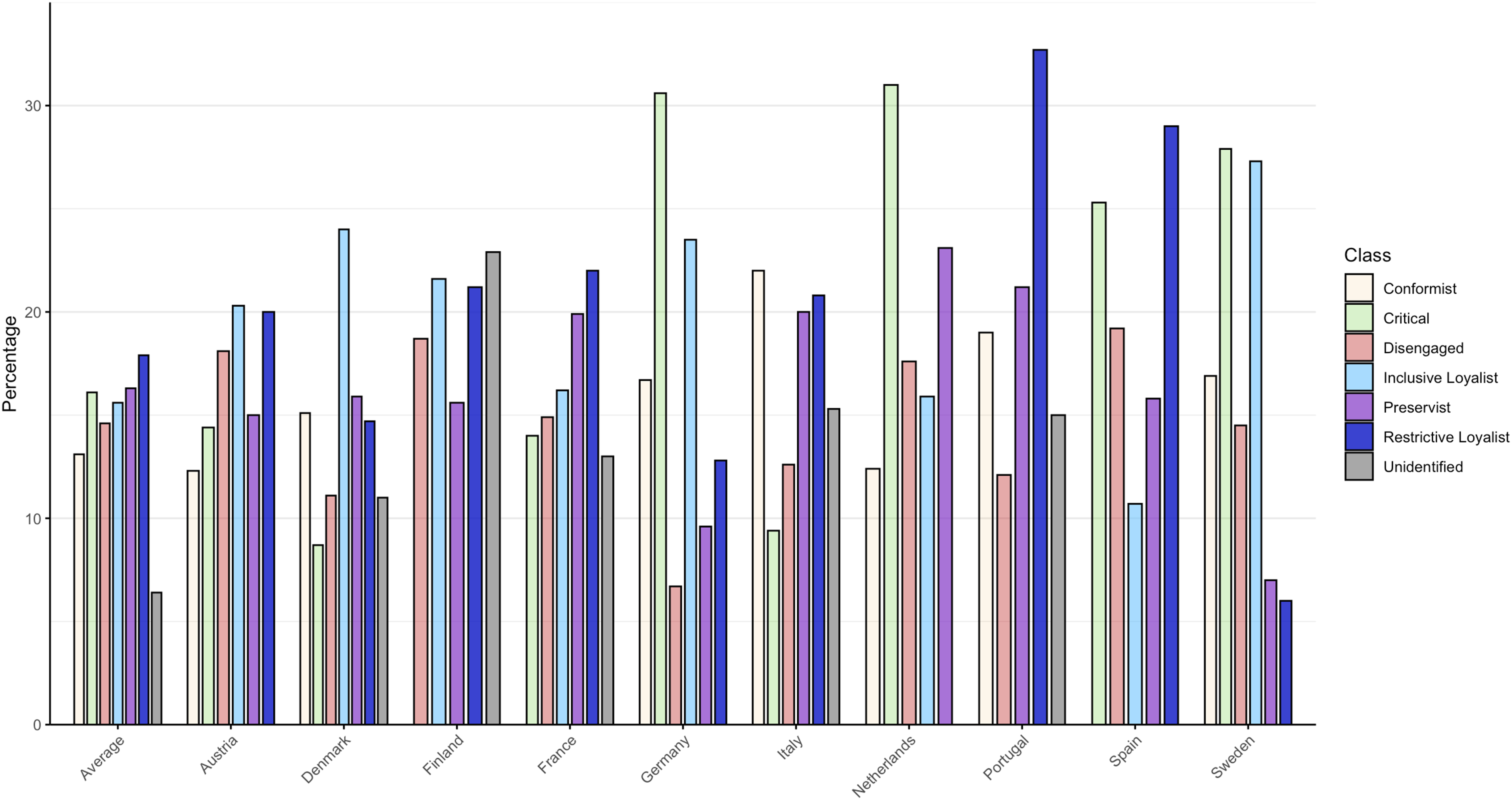
Prevalence of ideal types across countries.
Figure 2 presents the mean probabilities of responding affirmatively to the survey items across all countries for each type identified (note the last option, Attending a demonstration, has three options: Never would, Might do, Have done, ordered from darker to lighter). The item probabilities for each class in each country can be found in the Supplemental Materials. Average item probabilities across the 6 ideal types.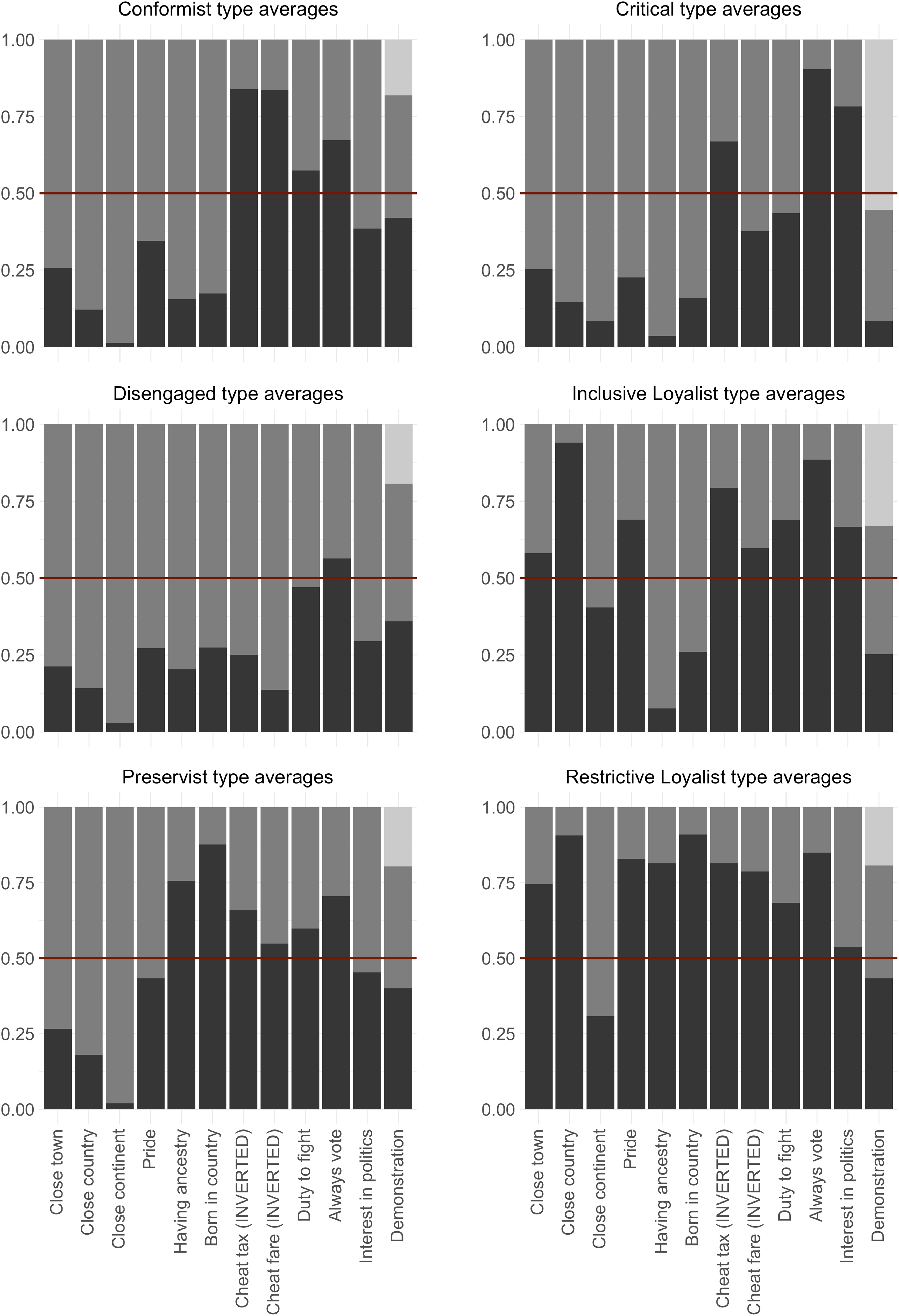
Overall, taking into account the patterns across items, each type can be interpreted as follows: • Restrictive loyalist citizens: individuals belonging in this type score high in all items except for attitudes toward unconventional participation and political interest. I therefore define them as “loyalist” because they present characteristics desirable for institutional stability, social cohesion and public order: they display affect for local and national communities (not for Europe, even if higher than most types), they are proud nationals, they are clearly inclined to answer a call to arms and are inflexible as regards the legitimation of cheating on contributions. Moreover, while they are very likely to declare themselves as regular conventional participants in elections, they are unlikely to engage in non-conventional participation, and show lower-than-average interest in politics. Finally, I qualify them as “restrictive” because they score high on having ancestry and being born in the country as important criteria for being truly national. • Inclusive loyalist citizens: the same central concept is used to define this type which is very similar to the previous one, except for the fact that these citizens are contrary to upholding restrictive criteria of national belonging. In line with this more “inclusive” stance, they are the group most likely to feel close to Europe, even if their score is still negative. They are also frequently more interested in politics, and they are more likely to hold a middle ground as regards unconventional participation. • Preservist citizens: these are citizens that place less relevance on political participation and are uninterested in politics, as well as reflecting lower and largely ambivalent inclinations toward citizenship duties. Interesting patterns are present when it comes to nationhood, combining low attachment and low national pride with a high emphasis on restrictive notions of national belonging. This is why I conceptualise them as “preservist”, since they exhibit a passive engagement with peoplehood that is mostly concerned with maintaining it the preserve of a homogeneous in-group. • Critical citizens: this type is the only one for which acknowledging participation in demonstrations is the most likely outcome, combined with a high commitment to electoral turnout and high political interest. This is paired with low levels of pride and affect for any type of collective as well as a clear rejection of restrictive notions of national belonging. Whereas they generally display inflexibility as regards the possibility of justifying tax cheating, they are likely to understand that cheating on a fare to access a public service might be justified in some cases. They are also contrary to the idea of answering a call to arms. It is because of this combination of detachment from the collective and its norms with a high emphasis on being a part of the sovereign people that I have characterised them as “critical”. • Conformist citizens: respondents in this class are characterised for low indicator probabilities except when it comes to upholding citizenship norms as regards cheating, for which they have the highest values compared to other groups. They are also likely to answer a call to arms even if not as strongly. These traits go hand in hand with low item probabilities in terms of affect, pride or restrictiveness, average levels of commitment to electoral participation and low levels of interest in politics or in unconventional participation. I have conceptualised this type as “conformist” because of how staunch commitment to comply with contributions is combined with a dispassionate stance of detachment from the community as well as lower interest in its governance. • Disengaged citizens: this final type groups citizens characterised for very low item probabilities for the three dimensions of the construct theorised, overall presenting the most “disengaged” character in relation to peoplehood. The only item for which they show a positive probability is voting, even if is still the lowest across types.
Out of 57 classes identified in total, 52 were identified as corresponding to one of the ideal types. 14 classes are exact correspondences to the ideal types. 29 classes are clear correspondences to an ideal type, with some items’ confidence intervals hovering around the 50 percent probability mark. Still, what is important is that differences in probabilities are visible, regardless of them producing clear positive/negative binaries (e.g., Hooghe, Oser, and Marien 2016). In 9 cases I allocated a class to an ideal type even if an item was significantly contrary to its expected value for that type. Where the traits of an ideal type were clearly visible, I considered this option more coherent than marking them as unidentified, paying attention to contextual factors or to the relative values of classes within the country. For instance, conformist citizens in Denmark are still positively interested in politics, yet this level is still the lowest behind disengaged citizens, congruent with the definition of the disengaged type. In Germany, disengaged citizens are unlikely to justify cheating on tax, in line with a strongly abiding pattern across all classes. Conformist citizens in Portugal are still likely to express pride for their country, whose citizens rank high in terms of national pride comparatively (Sobral and Vala 2022). Consistent with contexts that are more culturally conservative or where nationhood is more strongly associated to ethnicity (Bartasevičius 2022), conformist and disengaged citizens are still likely to score positively on one of the two items measuring restrictive notions of nationhood (Austria, Germany, Spain, Italy). Inclusive loyalist citizens in Germany are unlikely to express national pride, which is logical in a country where expressions of national pride are comparatively lower due to the particular historical backdrop of Nazism (Smith and Jarkko 1998). Finally, when the critical type was identified in Northern countries (Denmark and Sweden), respondents were always prone to fight for the country, contrary to theoretical expectations given the general patterns for that same type, but congruent in societies that are characterised by greater compliance with public enforcement (Hough, Jackson, and Bradford 2013; Nair, Selvaraj, and Nambudiri 2022), or even used to military conscription in the case of Sweden.6 Only 5 classes (representing 6.94 percent of respondents in the sample) could not be given a coherent interpretation, thus remaining unidentified. Overall, this shows the virtue of a country-level focus in modelling: even if more time-consuming, it allowed me to accommodate contextual specificities within types of worldviews that are still clearly identifiable, and to be more flexible in understanding the prevalence of ideal types across the whole sample (Bartasevičius 2022).
A common first step after running an LCA model is to check the sociodemographic profiles of the individuals allocated to each type. While this step is not relevant for the purposes of my research questions, the congruence of these sociodemographic patterns is important to lend credibility to the types derived from LCA as socially meaningful groupings (Petersen, Qualter, and Humphrey 2019, 2). The key sociodemographic variables can be checked in the Supplemental Materials, together with some further social and political attitudes that I have included to further illuminate the profile of types. The data shows effectively that clear patterns exist and that they are congruent with the constructions of peoplehood associated to each type, providing an important robustness check.
The most important finding in this study is the existence of the types themselves. The fact that the data fits a series of consistent and meaningful patterns is a significant result that speaks to the validity and interest of the concept of peoplehood. Encompassing a broader concept of collective identity that cuts across disciplinary boundaries, it is possible to tap into patterns of opinions and dispositions that are coherent and carve out an unexplored dimension of political culture (or rather, it taps into previously explored dimensions from a new, more comprehensive perspective). There are evidently some similarities across classes, such as the general positive disposition towards conventional participation and low levels of attachment to Europe. But contrasts are evident and point to very distinct, categorical groups of citizens. It is interesting, in this regard, to note how the four types of nationhood identified by previous scholarship in a variety of countries using LCA (Bonikowski 2017; Bonikowski and DiMaggio 2016; Keskintürk and Kuyucu 2024) can be identified within the types mapped here, serving to validate my framework of peoplehood in relation to other overlapping frameworks. 3
Second, that these types are consistent across countries, given certain regional specificities, is a second relevant finding. Rather than identifying types specific to certain regions, as was my initial expectation, what diverges is the prevalence of classes across regions: for instance, culturally restrictive types (preservist and restrictive loyalist) are more prevalent in Southern European countries, whereas inclusive loyalist views are more prevalent in Northern countries (see Figure 1). Just as with the studies of nationhood cited above, this cross-case pattern suggests further possibilities for insightful comparative research.
Third, in the spirit of Bonikowski and diMaggio’s (2016) original proposal, the results show that innovative frameworks combined with advanced methods can extract significant insights from survey data that tap into meaning-making or discursive processes. Person-centred approaches are promising in their capacity to produce rich yet parsimonious descriptions of a given population. While it is imperative not to push inductive interpretations beyond the data itself, studying variables in interrelation certainly illuminates the meanings their values have (Bonikowski, Feinstein, and Bock 2021). For instance, it is only through such interrelations that one can identify the significant nuance that sets inclusive and restrictive loyalist citizens apart. Similarly, it is only by seeing adamant attitudes against cheating side by side with a lack of attachment or desire to participate that one can grasp the worldview of certain citizens as conformist.
Conceptions of Peoplehood and Electoral Support
Focusing now on the second research question, I plot type membership and party preference focusing on the four major party families, including separately respondents that feel no appeal for any (Figure 3).
4
To aggregate respondents across countries consistently, I have defined party families following European-level party affiliation, as well as a specialised dataset for the classification of populist, far-right and far-left parties (Rooduijn et al., 2019). Composition of party family electorates by types.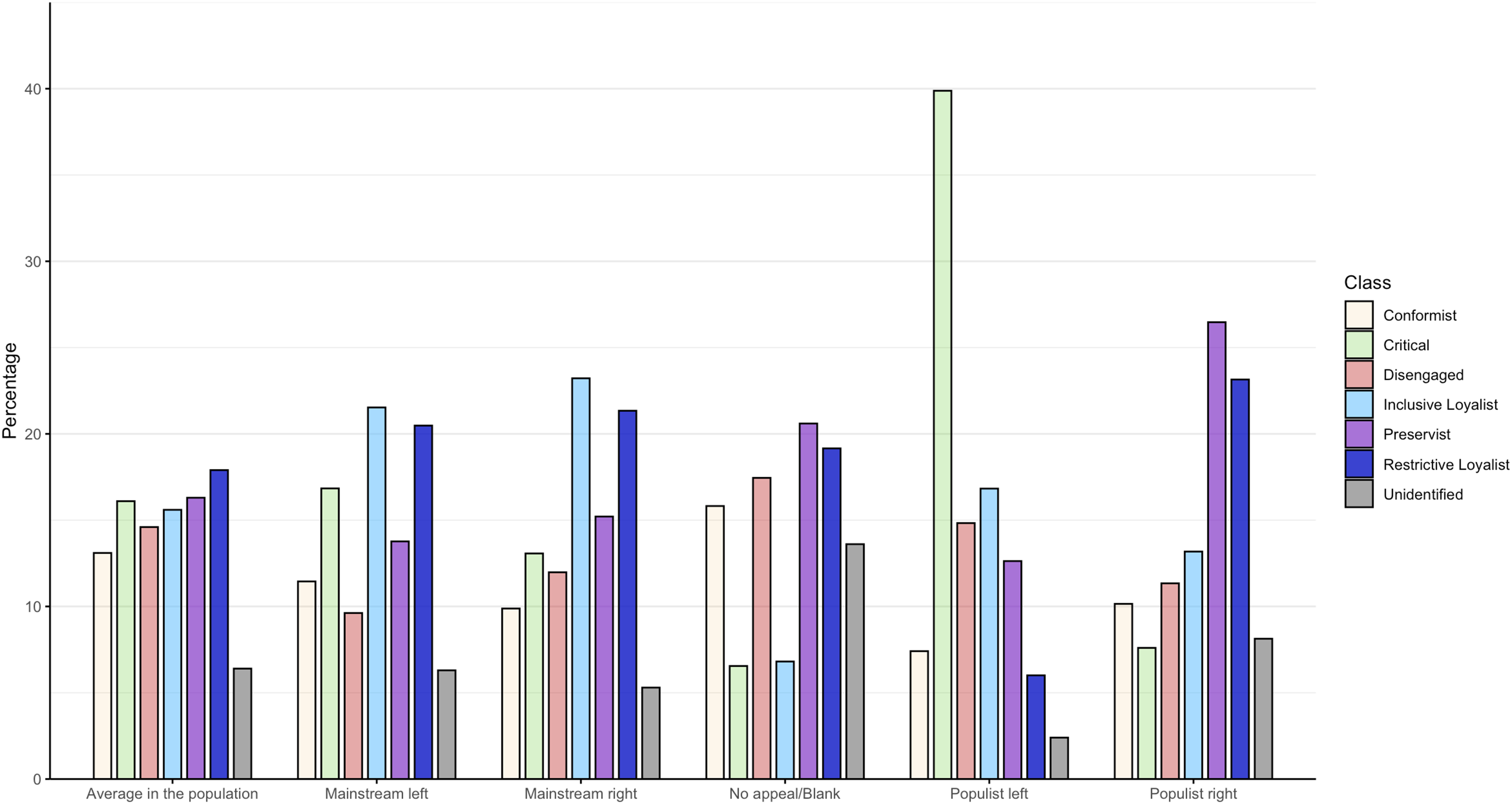
First, both mainstream left and right rely primarily on a coalition of loyalist citizens, which indicates a logical correspondence between normative or deferential conceptions of peoplehood and support for mainstream political actors. However, populist right actors also rely significantly on restrictive loyalist citizens (attracting 14.4 percent of these citizens), forming a coalition with preservist citizens, with which they share restrictive notions of national belonging that are congruent with the stances of populist right parties (a “restrictive coalition” which amounts to 49.7 percent of the electorate of populist right parties). As regards populist left parties, these present the most skewed distribution, relying very heavily on critical citizens (39.9 percent of their electorate), which again is congruent: critical citizens are not nationalist, they are the most staunchly inclusive in terms of national belonging, and they are the most committed to the exercise of sovereignty, matching the emphasis placed by populist left parties on internationalist discourses and the vindication of more inclusive, participatory democracies.
LCA analysis not only serves to show conceptions of peoplehood diverge significantly across constituencies, but crucially to give insight into what the people means for the increasing number of citizens that vote populism. In turn, this analysis can serve to hypothesise how the causal link between populist attitudes and electoral behaviour works (and why it is more successful in some cases as opposed to others).
First, the identification of a “restrictive coalition” backing the populist right provides more granular information on the strength of these parties as a product of the resonance between elite populist discourses and heterogeneous social conceptions of peoplehood. Importantly, it shows right-wing populism is the only party family capable of articulating more traditional, hegemonic worldviews associated to mainstream politics with more detached, “outsider” worldviews associated to abstention or blank voting. In the case of the populist left, reliance on one single type of citizens is evident. Even if inclusive loyalists constitute the second-largest group of voters, the percentage of inclusive loyalists that opt for the populist left is much smaller than the percentage of restrictive loyalists opting for the populist right (7.1 percent as opposed to 15.8 percent, counting only the countries where a populist right party is present). This difference suggests an incapacity on the part of the populist left to tap into the core constituency of the mainstream left as much as the populist right does with the mainstream right.
These correlations can help understand why it is that populist right parties are more successful in West European countries than populist left parties. Moreover, restrictive loyalists and preservists happen to be the two most prevalent groups in West European society (estimated at 34.2 percent of the population), and they also constitute together a large segment of citizens that express no party appeal yet might turn out to vote (estimated at 4.2 percent of the population), all of which further illuminates the potential of the electoral base of the populist right vis-à-vis the populist left.
Finally, the prevalence of the different types within mainstream electorates is diverse and actually comes close to mirroring the average prevalence of said types in the sample. This finding suggests that conceptions of peoplehood are relevant in explaining support for populist but not mainstream parties. The virtue of mainstream politics, therefore, might be not a capacity to connect with certain conceptions of peoplehood such as restrictive or inclusive loyalism, as much as to attract supporters on other grounds. In turn, the success of populist politics seems to depend crucially upon a capacity not only to contest that mainstream parties represent the people (after all, prior research shows populist attitudes are very widespread across Western society), but to make specific ideas of the people salient, problematised, and eventually politically mobilised.
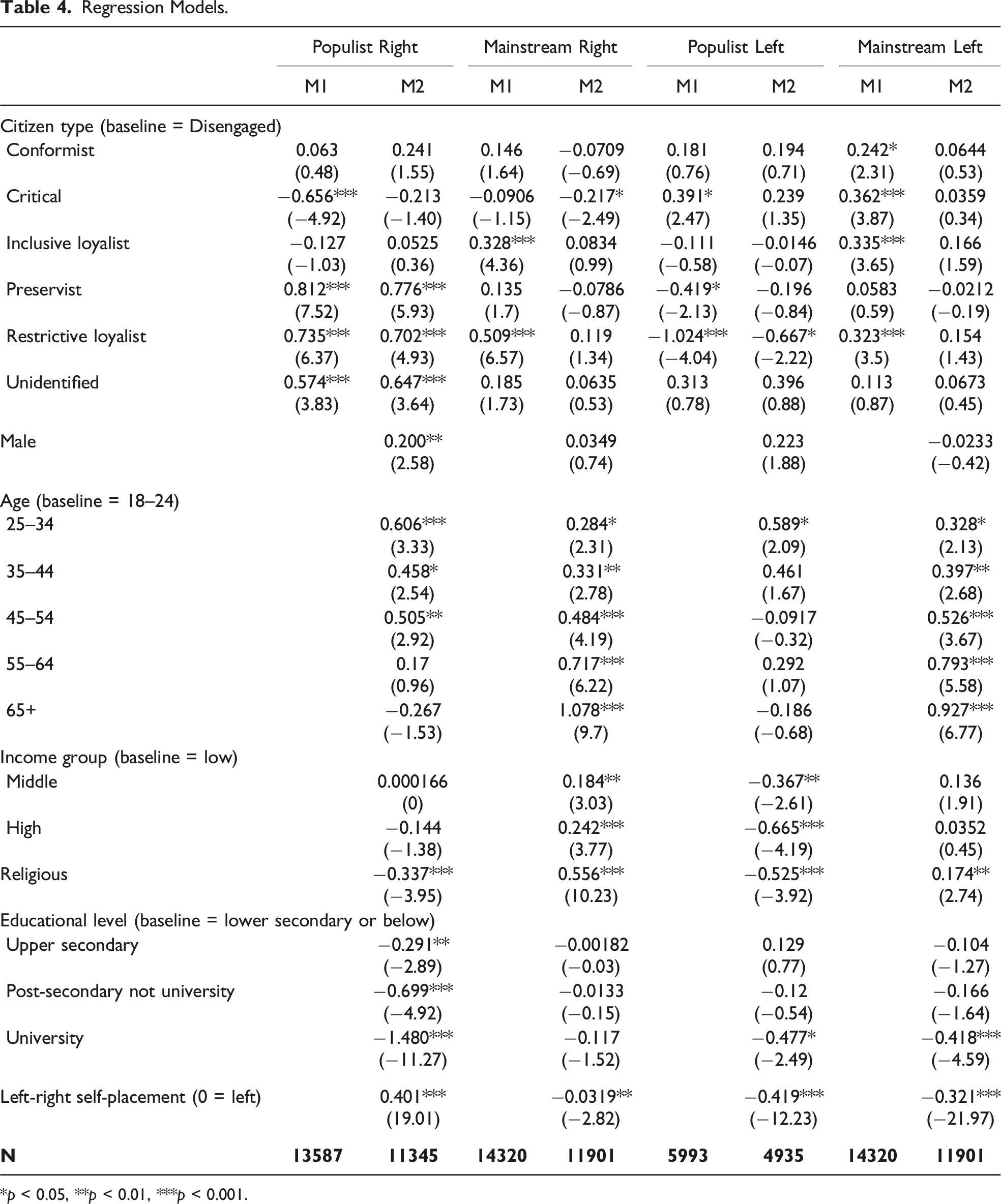
To better understand this association, in a final step I perform regression analysis to test the link between peoplehood types and electoral behaviour while controlling for a series of other predictors. The objective is to find out whether these patterns of attitudes tap into discursive processes that are relevant in their own right, or rather they reflect dispositions dependent upon other sociodemographic or attitudinal factors. There is no assumption as to the actual causal mechanisms mediating meaning and action, or whether the attitudinal patterns identified ”exist” as actual categorical groups, all of which are interpretive questions (see Schwartz-Shea and Yanow 2012, pp. 51–53).
Regression Models.
*p < 0.05, **p < 0.01, ***p < 0.001.
Aggregating respondents and controlling for sociodemographic variables, the regression models make it possible to consider the relation between identity and political participation from a more comprehensive and precise perspective. First, the hypothesis that conceptions of peoplehood are not relevant to explain support for mainstream parties is confirmed: throughout, significant associations in the base model become largely non-significant when accounting for other variables in the expanded model. Where peoplehood type remains statistically significant (critical type in the mainstream right model), the effect is deterrent rather than mobilisational.
Second, the hypothesis that conceptions of peoplehood are relevant to account for populist support is partially confirmed. On the one hand, being a preservist or a restrictive loyalist citizen is substantively and significantly associated to supporting the populist right. This result is congruent with previous research that has looked at the association between types of nationalism and electoral behaviour in the United States (Bonikowski, Feinstein, and Bock 2021). The size of the coefficients is only slightly affected when other variables are accounted for in the expanded model; people’s left-right self-placement and lacking a university education are the only variables whose effect is more substantive. There is also a significant association between belonging in the unidentified classes and supporting the populist right, suggesting that this grey area in the model is not random. On the other hand, associations detected in the constrained model between peoplehood and support for the populist left become non-significant once the relevance of age, religiosity, education and left-right self-placement is accounted for, except for the negative association to restrictive loyalism.
This interesting contrast further illuminates the point made above regarding the powerful restrictive coalition on which the populist right thrives: understandings of peoplehood are consequential to understand support for the populist right among its key constituencies (preservist and restrictive loyalist citizens), but the same is not the case with the key constituencies of the populist left. Accordingly, it is possible to add further nuance to the original hypothesis: populist success seems effectively dependent on mobilising specific understandings of peoplehood, and precisely the varying capacity to create this resonance can help explain the divergent success of populist parties. Whereas the populist right is successful in creating affiliation based on specific conceptions of peoplehood, populist left parties rely on voters associated to a specific idea of the people, yet their support is explained rather by sociodemographic and ideological factors (which might, in turn, explain their lack of national identity and other aspects of their conceptions of peoplehood). Tentatively, proof for this argument can be found by examining the proportion of populist supporters that go against their natural ideological inclination: while the populist right manages to enlist the support of a substantive segment of respondents that place themselves on the left of the left-right scale (25.5 percent of their electoral base is placed between 0 and 4), the populist left largely fails to do the inverse (only 10.8 percent of their supporters position themselves between 5 and 9). Beyond class membership, control variables show expected patterns in explaining support for populism (see Filsinger et al., 2021; Gidron and Hall 2017; Gidron and Hall 2020).
As a robustness check, I run a model on the populist right dummy adding a further variable registering attitudes towards immigration, which is consistently found to be the key predictor of populist right support at the individual level (Berman 2021). Since attitudes towards immigration are linked to conceptions of nationhood (Gagnon 2022), it is possible that this further variable might explain away the association as artificial. This new model is reported in Table 5 in the Supplemental Materials. As expected, the model indicates having a negative opinion of immigration is a significant and substantive predictor for populist right support (1.213, p < 0.001). The coefficients for restrictive loyalist and preservist type membership are moderated (from 0.702 to 0.570 and from 0.776 to 0.615, respectively), yet remain substantive and significant at p < 0.001. Overall, this test lends further support for the thesis advanced in this paper: understanding populism is dependent upon our capacity to grasp this discursive dimension of politics, for which this article offers a first step.
Discussion and Conclusions
In this paper I have presented an empirical application of theoretical and methodological ideas that extend recent innovative research on the relation between identity and politics. This framework was intended to complement the deductive framework of research on populist attitudes with an inductive approach, to wed an objective of cross-country generalisation to a consideration for context and heterogeneity. I have approached this question by moving from a deductive measurement of populism to a broader, inductive exploration of peoplehood; and from a logic of “container” variables to a logic that understands identities as heterogeneous, multi-dimensional phenomena. The main objective here has not been to measure a causal association, but to take a first step towards understanding how the link between discontent and populism depends upon constructions of collective identity.
Overall, the answer to the first research question is affirmative: West Europeans do hold meaningful conceptions of peoplehood, which are moreover comparable across countries. This finding animates further applications of peoplehood as a theoretical framework. Beyond this regional context, future research might find useful the application of this framework, provided adequate alignment between assumptions, scope, and data. For instance, research has adapted quantitative frameworks of nationalism to non-Western regions by reconsidering the measurement of the construct (Keskintürk and Kuyucu 2024, 6-7). Regardless of regional specificities, this finding can motivate further research that looks at political identities that hinge upon common units (the State, the federation, etc.) by foregrounding their interrelations.
The answer to the second research question is also affirmative: conceptions of peoplehood are associated to political behaviour, with populist parties finding support predominantly among citizens that share specific conceptions. The analysis offers rich information on the substantive understandings of the people that underlie the antagonistic dynamics most evident and superficial. It shows that there is complexity and heterogeneity in the social discourses around populism, which is important to better understand political outcomes and their significance. Controlling for potential confounders, this association seems to be determining only in the case of the populist right. These findings lend support to the thesis advanced by the ideational school: it is fundamental to delve into the discursive dimension of politics to fully grasp populism. But, valuable insight is lost when this discursive dimension is reduced to a deductive measurement of populism.
These findings inform critically some widespread ideas in the literature. The populist attitudes literature presupposes the identity discourses of populist politics, and assumes these discourses to be coherently linked to specific types of populism (right, left). Yet this research indicates that both assumptions are wrong: neither common assumptions hold for the underlying meanings of peoplehood, nor are single party families linked to single, homogeneous worldviews in the electorate.
On the one hand, speaking of the populist right, my analysis supports the common finding that populist right voters are characterised for their restrictive nationalism that antagonises immigrants (Mudde 2007). Yet I also show restrictive notions of belonging pin together a variety of stances or values that must be understood holistically, and whose meaning is not quite the same for different types of people. It might be that restrictive loyalist citizens see restriction as a way of safeguarding a national community they feel attached to and value. Yet the same is unlikely for preservist citizens, who express detachment from the national community, which is a surprising finding. This contrasts, for instance, with the assumption that nativism is a product or reflection of a traditional form of strong, national solidarity that is somehow latent in human societies (e.g., Inglehart and Norris 2017, 443). The fault in such a theory is to assume modern notions of collective loyalties hold in a postmodern Western context.
At once, what that preservist impulse means is very much open to debate for further research. It might represent citizens that crave a traditional sort of intra-national solidarities that are perceived to be lost in societies to fragmented, in countries too culturally diverse. It might also mean they care little about national solidarity, and are rather concerned with sustaining a status quo of cultural privilege and/or preferential access to public goods that serves their private interest. This second hypothesis is a priori more congruent with the decline of collective loyalties in postmodern societies (Brown 2015). In this line, prior scholarship has theorised right populism as a continuation, rather than a challenge, to neoliberal logics of exclusion (see Blühdorn and Butzlaff 2019). Prior qualitative research in the European context has supported this idea, for instance, pointing to the little actual relevance that nationalism can have in explaining populist right support as opposed to more material, status-related motivations (Küppers, 2024).
On the other hand, the findings suggest that the link between peoplehood and populism is weak or unimportant in the case of the populist left. Essex school scholars, who have approached populism from a discourse analysis perspective, have placed much emphasis on the construction of the signifier the people and the vindication of its unrealised sovereignty as the key to the success of left populists, both normatively (e.g., Laclau 2007) and empirically (e.g., Stavrakakis and Katsambekis 2014). Yet it seems populist left parties cannot connect with the very inclusive, engaged worldviews of critical citizens (or inclusive loyalist citizens, who are the closest profile) in a way that makes a difference.
Again, the possibility that populist left supporters are left but not populist, in the sense that people’s politics may no longer be motivated by the desire to construct a national, institutional collective identity, reflects insights from contemporary sociology that have not been integrated in populism scholarship. The critical citizens in my analysis fall in line with new forms of ‘engaged’, ‘critical’, or ‘self-actualising’ citizenship (e.g., Bennett 2008; Dalton 2008; Norris 1999) that are understood as a product of postmodern shifts in the relation between citizens and democracies, which push for more horizontal, issue-based, and individualistic forms of political engagement. At once, my model show critical citizens are not merely focusing on unconventional participation but are firmly committed to electoral participation too, contrasting with more extreme diagnoses of a ‘divorce’ between citizens and political institutions (Touraine 1992, 185–192).
These findings raise an interesting question regarding the meaning of electoral participation for critical citizens, and whether the possibility exists to create that populist ”glue” that today seems so much stronger for the populist right. In societies where discursive agency plays an increasing political role due to the dissolution of traditional solidarities and structural cleavages, the vagueness of populism rightly matches the need to manage increasing social diversity (Laclau 2007, Preface). Yet considering the evidence on the increasingly individualised pursuit of self-realisation (e.g., Streeck 2017, Ch. 3), building a meaningful, non-nationalist people is perhaps the most complex task of progressive politics today (see Khiari 2016). On the contrary, a corollary hypothesis is that left populisms have been most prominent in Latin American societies because they were capable of articulating more nationalist or ethnic conceptions of the people that are unappealing to European left constituencies.
Overall, the results cast doubt on the commonplace idea that populism can be seen as a “return” of the people in the wake of decades of depoliticisation, social fragmentation, and neoliberal hegemony (e.g., Mair 2013). There is no evidence that populism is the result of the mobilisation of conceptions of peoplehood that are regressive, traditional or more “modern”, of a backlash against a state of affairs rooted in globalisation and neoliberal deregulation. In fact, the alternative seems more plausible. It is important to underline that the two key populist constituencies (preservist and critical citizens) have in common that they express detachment from the collective that populism is meant to vindicate. This detachment, as I have discussed, is framed in conceptions of peoplehood that can be linked to key postmodern trends of either neoliberal marketisation (in the case of preservist citizens) or reflexive autonomy (in the case of critical citizens). Overall, populism is mobilising constituencies more readily construed as progressive, in the sense of furthering rather than backlashing against postmodern dynamics of identity. A lack of collective attachment on the part of these key populist constituencies raises further questions regarding the kind of people these citizens have in mind and seek to vindicate when they vote populist. Is underlying such detachment a potential for new collective self-definitions, for new ideas of solidarity, that populist supporters desire to build? Or is it merely protest politics that underlies populist momentum?
Finally, there are a number of limitations to this study. First, as I indicated above, the classification of classes into types was frequently complicated by item probabilities whose confidence intervals cross the 50 percent probability mark. Still, the final averages across all allocated classes do reflect clear patterns that build up to identifiable ideal types (see Figure 2). This problem is possibly derived from the multi-dimensionality and novelty of the construct theorised: further research could benefit greatly from datasets that included a larger number of items, items more precisely oriented to map peoplehood in its multi-dimensionality, or larger samples, all of which can contribute to better discriminate among classes in LCA modelling. Overall, the results can be taken as strong evidence that meaningful attitudinal patterns exist in the population and that these are politically consequential, but measurement should be understood as approximate and imperfect. Second, to be able to inform more comprehensively previous research on populist attitudes, an ideal dataset would include both variables tapping into peoplehood and variables measuring populist attitudes.
Supplemental Material
Supplemental Material - The ‘Return’ of the People? Understanding Populism by Exploring Citizens’ Conceptions of Peoplehood in Western Europe
Supplemental Material for The ‘Return’ of the People? Understanding Populism by Exploring Citizens’ Conceptions of Peoplehood in Western Europe by Roni Küppers in Political Research Quarterly.
Footnotes
Acknowledgements
I would like to thank Ellie Knott, Jonathan Hopkin, Paul Kindermann, and Patrick Sturgis for fantastic comments and suggestions throughout the research process. I especially thank Jouni Kuha for his unwavering support, from inception to write-up, of a project he initially inspired through his teaching. I also want to thank the participants in the 2024 Political Studies Association annual meeting where an earlier version of this paper was presented, and the anonymous reviewers for their constructive comments.
Declaration of Conflicting Interests
The author(s) declared no potential conflicts of interest with respect to the research, authorship, and/or publication of this article.
Funding
The author(s) disclosed receipt of the following financial support for the research, authorship, and/or publication of this article: The project that gave rise to these results received the support of a fellowship from ‘la Caixa’ Foundation (ID 100010434, The Fellowship code LCF/BQ/EU21/11890039).

Supplemental Material
Supplemental material for this article is available online.
Notes
References
Supplementary Material
Please find the following supplemental material available below.
For Open Access articles published under a Creative Commons License, all supplemental material carries the same license as the article it is associated with.
For non-Open Access articles published, all supplemental material carries a non-exclusive license, and permission requests for re-use of supplemental material or any part of supplemental material shall be sent directly to the copyright owner as specified in the copyright notice associated with the article.
