




Abstract
Under what conditions do political parties employ junior ministers to keep tabs on their coalition partners in multiparty cabinets in presidential democracies? Existing literature on coalition governance in presidential systems has focused mainly on the role of presidents in monitoring coalition partners. Political parties have yet to be noticed. This paper contributes to the literature by placing parties front and center as strategic actors in presidential coalition governance. Specifically, we look at the conditions in which political parties employ junior ministers to shadow their coalition partners. Using an original data set covering 25 cabinets in seven presidential democracies in Latin America, Africa, and Asia, we find that parties strategically use junior ministers to curb delegation perils and implement their collectively agreed-upon policy preferences. Our findings show that parties shadow nonpartisan ministers more extensively where presidents are strong. Furthermore, we show that democratic experience cements the use of coalition governance tools, suggesting an institutional learning process.
Introduction
Coalitions are the most common cabinet arrangement in presidential democracies (Chaisty et al. 2018; Cheibub et al. 2014; Cheibub et al. 2004; Kellam 2017). Presidents and parties relinquish power by delegating authority over policy formulation, enactment, and implementation to make the cabinet work efficiently. Delegation, however, is not costless. Presidents and parties have different policy preferences, which create agency loss if cabinet members use their informational advantages and authority to advance policy goals not aligned with the coalition’s collective preferences (Kiewiet and McCubbins 1991).
The prevalence of coalitions in presidential systems spawned a vast literature on coalition formation (Altman 2000; Amorim Neto 2006; Borges et al. 2021; Kellam 2017), executive-legislative relations and budget appropriations (Pereira and Mueller 2004; Samuels 2002), the role of presidential agenda-setting powers in multiparty cabinets (Alemán and Tsebelis 2011, 2016), and coalition durability and defection (Altman 2000; Martínez-Gallardo 2012).
In recent years, a growing body of scholarly work has focused on coalition governance in presidential democracies (Lee 2018b; Pereira et al. 2017; Silva and Medina 2023). However, this literature remains in its infancy. First, most works on coalition governance in presidential democracies focus on how presidents monitor parties to prevent policy drifting. 1 The literature looks at coalition governance primarily from the vantage point of the president, overlooking the other coalition members: political parties. Second, because of the prohibitive costs of cross-regional data collection, most contributions are limited to case studies or regional studies. Consequently, unlike parliamentary democracies, whose coalitions have been analyzed from a comparative perspective, comparative lessons about coalition governance in presidential democracies remain limited.
Previous studies have focused on how presidents employ junior ministers to reduce agency loss to partisan ministers (Pereira et al. 2017), in this paper, we contribute to the literature on coalition governance in presidential democracies by taking the perspective of political parties. We argue that political parties—like presidents—are incentivized to keep tabs on ministers from other parties and independent ministers, who are widely seen as president agents (Martínez-Gallardo and Schleiter 2015). The fact that we observe partisan junior ministers serving under independent cabinet ministers attests that parties may also be granted junior minister posts in shadowing positions. While presidents are the constitutional heads of the cabinet and formally appoint ministers as well as junior ministers, to the extent that they choose to govern in multiparty cabinets, they have to make concessions to those parties in terms of office, pork-barrel, and policy benefits (Ames 2001; Amorim Neto 2002; Chaisty et al. 2018; Cheibub 2007; Raile et al. 2011). 2
We argue that presidents have an additional resource to attract and retain the support of the coalition parties: the opportunity for parties to monitor independent ministers and ministers from other parties. Parties in presidential systems are motivated by policy (Magar and Moraes 2012) and can, therefore, be assumed to have an interest in making sure ministers stick to the policy compromise agreed upon by the coalition.
In addition to our focus on the role of political parties in coalition governance in presidential democracies, a second contribution of our paper is that it is the first, to the best of our knowledge, to deal systematically with coalition governance in presidential systems from a cross-regional perspective, including data from Latin America, Africa, and Asia. 3 Admittedly, our contribution is unbalanced, with an overrepresentation of Latin American countries. Nevertheless, our original data set allows us to draw conclusions beyond individual countries and regions and to explore the dynamics of presidentialism in Africa and Asia, which have been overlooked in the comparative literature in favor of Latin America. 4
Against this backdrop, we focus on the following research question: Under what conditions do partisan junior ministers in multiparty presidential cabinets serve under ministers who do not belong to their party? Like their counterparts in parliamentary systems (Greene and Jensen 2016; Lipsmeyer and Pierce 2011; Thies 2001), we argue that political parties use junior ministers to keep tabs on their coalition partners, including presidential agents. Following a similar logic to parliamentary democracies, where parties bargain for coalition governance arrangements during government formation (Martin and Vanberg 2004; Strøm et al. 2010), we assume that presidents and parties negotiate junior ministers posts during the coalition formation stage. For reasons of empirical tractability, in this paper, we focus on explaining coalition governance mechanisms once they are in place—explaining coalition formation is beyond the scope of this article.
Using an original data set covering 25 cabinets in 7 countries in Latin America, Africa, and Asia, we make a comparative contribution to the literature on coalition governance in presidential democracies. First, contrary to our expectations, we find that parties are less likely to keep tabs on a minister if the minister’s party is farther away from the coalition’s ideologically weighted mean position. Second, our evidence shows that political parties use junior ministers more extensively when presidents have strong legislative-making powers to keep tabs on presidential agents in the cabinet. Finally, we show that democratic experience matters for coalition governance. Political actors need to learn how to maximize their benefits against the rules of the game. Our findings suggest that only after years of democratic experience do political parties turn to junior ministers to keep tabs on the agents of powerful presidents.
Coalition Governance in Presidential Systems
Coalition government implies delegation. The compartmentalized nature of the executive into discrete departments creates a division of labor whereby different parties control different portfolios. While the set of parties in the coalition can be seen as a collective principal, each party individually acts as an agent of the coalition within the portfolios it controls (Andeweg 2000). However, delegation implies agency loss. Agents may deviate from the course of action determined by their principals. This is especially the case when agents hide information from their principals. Consider the following example. Party A in portfolio i has access to information on the goings of that portfolio that party B in control of portfolio j does not, and vice versa. Such informational asymmetries allow parties to act on their incentive to pursue policy in line with their ideal point rather than the coalition’s (Laver and Shepsle 1996; Thies 2001).
Presidential systems further complicate delegation in the executive by introducing a directly elected president whose survival is separate from that of the legislature. The president is the constitutional head of the cabinet. However, presidents who govern in multiparty governments do not govern alone. Rather, they coalesce with other parties to govern and share office and policy. Like parliamentary democracies, coalition cabinets are a collective principal in presidential systems. Presidentialism introduces several unique agency loss challenges. First, absent the disciplining instrument of confidence vote (Cox 1987; Huber 1996), presidents have less control over their coalition’s legislative contingent than prime ministers. Second, the distinct election methods of the executive and legislative branches create a separation of purpose within parties. They become separated into a branch that seeks executive office while the other seeks legislative office, each of which appeals to a different electorate using different resources (Samuels and Shugart 2010). Notably, presidents need to appeal to broad electorates by making promises about national policy issues, while legislators need to target funds to geographically or demographically circumscribed bailiwicks from which they obtain their support (Ames 2001; Calvo and Murillo 2004; Shugart 1999). This means that, in addition to inter-party agency loss, presidents face intra-party agency loss (Martínez-Gallardo and Schleiter 2015; Samuels and Shugart 2010). Third, presidents take almost all the credit for good government performance, meaning coalition parties may have fewer incentives to be committed to the government than in parliamentary systems (Altman 2000). 5
In this paper, we seek to examine coalition governance in presidential systems from the perspective of political parties. Parties suffer agency loss to one another as well as to the president. Agency loss to fellow junior partners is magnified by the fact that intra-cabinet relations in presidential systems tend to be more bilateral, between the president and each individual minister, rather than multilateral, as they are in parliamentary systems, which are characterized by collective cabinet responsibility (Laver and Shepsle 1994). Agency loss to the president is more problematic, the most conspicuous example being so-called policy switches by presidents once they are in office (Campello 2014; Lupu 2014, 2016; Samuels and Shugart 2010; Stokes 2001). However, unlike everyday political interactions, policy switches are highly visible instances of agency loss, which makes it efficient for parties to apply sanctions. Less perceptible examples of agency loss are policy drift in favor of the president’s individual ideal point in portfolios headed by nonpartisan ministers (Martínez-Gallardo and Schleiter 2015), as well as through the use of personal advisory networks, inner cabinets controlled by loyal agents and agencies attached to the presidency (Siavelis 2016; Inácio and Llanos 2016; Batista 2013).
There are several mechanisms to contain agency loss: contract design, screening and selection, monitoring and reporting, and institutional checks. Contract design aims to align the interests of principals and agents by establishing a system of incentives and penalties linked to the agent’s conduct. Within coalition governance, the primary form of contract design is typically the coalition agreement, a public document outlining the collective policy commitments agreed upon by the coalition partners (Höhmann and Krauss 2022; Strøm and Müller 2008). Coalition agreements are uncommon in presidential systems (Freudenreich 2016), where pre-electoral coalitions bind presidents and parties to the mast on publicly made policy pledges (Kellam 2017).
Screening and selection involve carefully selecting and vetting potential agents to mitigate the risk of adverse selection (Kiewiet and McCubbins 1991). For instance, parties tend to form coalitions with ideologically aligned partners to minimize conflict and agency loss (Alemán and Tsebelis 2011). Monitoring and reporting mechanisms can vary, with one effective approach being the use of “fire alarms” to allow affected third parties to report undesirable actions to the principal (McCubbins and Schwartz 1984). In coalition governance settings, these fire alarms include junior ministers (Greene and Jensen 2016; Lipsmeyer and Pierce 2011; Pereira et al. 2017; Thies 2001) and committee chairs (Carroll and Cox 2012; Fortunato 2019; Inácio and Rezende 2015; Kim and Loewenberg 2005; Pukelis 2016) from parties not affiliated with the respective minister or coalition legislators filing information requests to ministers from other parties (Silva and Medina 2023). Lastly, institutional checks are present when one agent possesses the authority to hinder the actions of another agent (Kiewiet and McCubbins 1991).
Together, this body of work suggests a vast array of tools for political actors to monitor their coalition partners. Importantly, these different mechanisms coexist in a relationship of complementarity. As Thies (2001) suggests, the relatively low incidence of junior minister shadowing in Germany could be explained by the country’s relatively strong committees, as these would substitute for the shadowing function of junior ministers.
This paper focuses on junior ministers as an institutional solution for reducing agency loss in presidential coalition cabinets. While in parliamentary systems, extensive literature focuses on junior ministers in coalitions (Greene and Jensen 2016; Lipsmeyer and Pierce 2011; Thies 2001), to the best of our knowledge, Pereira et al. (2017) make the only contribution about junior ministers in presidential democracies. However, the authors focus on how presidents rather than parties use junior ministers to keep tabs on their coalition partners in Brazil. In the next section, we discuss why junior ministers are effective as a coalition governance tool in multiparty presidential governments and how they are appointed.
The Mechanics of Junior Minister Shadowing in Presidential Systems
In this paper, our goal is to explain the extent to which political parties use junior ministers for coalition governance purposes. Unlike most existing literature, whose focus is primarily circumscribed to coalition governance from the vantage point of the president, we consider the role of parties. The comparative study of junior ministers is challenging. Although they have different official roles depending on the country, junior ministers share several features that make them functionally equivalent across countries: (1) they are second in line to the department heads; (2) they are constitutionally appointed and dismissed by presidents; (3) they have executive responsibilities within the departments in which they are placed. Appendix B.2 provides a detailed description of the politics of junior ministers in our seven countries.
Importantly, coalition monitoring is not a formal function of junior ministers. The official job description of junior ministers does not entail coalition governance. However, as Thies (2001) extensively describes, their role in the government structure puts them in a privileged position for coalition governance. For one, junior ministers work directly with their minister, assisting the latter with policy formulation and executive. In addition, junior ministers coordinate the activities of governmental agencies falling under the ministry’s authority and stand in for the minister in their absence. Importantly, junior ministers have privileged access to information about the day-to-day running of their ministerial department.
Consequently, parties use junior ministers to help them curb information asymmetries and, importantly, to serve as fire alarms if the minister deviates from the coalition compromise (McCubbins and Schwartz 1984). Furthermore, in line with Thies (2001), junior ministers serve a deterrence function: ministers who know they are being shadowed are less likely to behave opportunistically, not least because they want to minimize the risk of being fired. We note that our assumption about junior ministers hinges on the notion that they cannot stop agency loss themselves. Rather, their job is to minimize information asymmetries and to inform their parties about ministerial activities. Ultimately, parties decide whether or not to act based on the information junior ministers provide.
But how are junior ministers allocated, and by whom? Evidence from parliamentary systems reveals that junior minister positions are allocated as part of the coalition formation negotiations and may be deliberately appointed as “watchdogs” (Andeweg and Irwin 1993; Thies 2001). Likewise, evidence from presidential systems shows that junior ministers may be given explicit instruction to monitor the ministers they serve under (Pereira et al. 2017), and junior ministers may be purposely allocated in such a way that each minister is overseen by a junior minister from another party, a practice known as transversalismo in the presidential literature (Boeninger 1997; Lanzaro 2012).
Ideally, political parties would like to bargain for “watchdog” junior ministers to as many of their partners’ ministries as possible. However, parties face significant constraints that warrant discussion before we move into our hypotheses. First, parties do not have unlimited access to junior ministers positions, a fixed-sum resource subject to bargaining among coalition partners. Second, parties face a trade-off between demanding more junior ministers to monitor coalition partners and using junior ministers to keep their portfolios at arm’s length from other parties. Third, as Martin and Vanberg (2004) remind us, junior ministers face time constraints. Time spent on monitoring activities reduces the time they spend fulfilling other tasks. These three assumptions inform our thinking about how parties use junior ministers strategically in coalitions.
While the strategic placement of partisan junior ministers as watchdogs indicates a monitoring function, we cannot reject that they might also be engaged in other activities, such as securing office spoils for their parties or informing the president. However, we base our theoretical framework on existing literature that hinges on the same monitoring assumptions (Greene and Jensen 2016; Lipsmeyer and Pierce 2011; Thies 2001).
Before we discuss our hypotheses, it is worth clarifying the nature of ministers in presidential democracies and its implications for junior ministers. Extensive literature shows that nonpartisan ministers play an essential role in presidential democracies as agents of the president (Amorim Neto 2006; Lee 2018b; Martínez-Gallardo and Schleiter 2015). Presidents use nonpartisan technocratic ministers to serve as their agents to avoid intra-party agency loss. Consequently, when political parties use junior ministers, we argue that they target nonpartisan ministers to keep tabs on presidential agents and partisan ministers to shadow parties’ agents.
Determinants of Junior Minister Shadowing
Ideological Heterogeneity
Numerous studies on coalition governance in parliamentary democracy highlight the positive correlation between ideological heterogeneity and the likelihood of shadowing (Carroll and Cox 2012; Lipsmeyer and Pierce 2011; Martin and Vanberg 2004). By contrast, existing scholarly work on presidential systems yields mixed evidence. While some studies find that ideological heterogeneity impacts the employment of coalition governance tools (Alemán and Tsebelis 2011; Pereira et al. 2017; Silva and Medina 2023), others find no such relationship (Inácio and Rezende 2015).
We expect political parties to have more incentives to keep tabs on partisan ministers whose parties are more ideologically distant from them. Considering the constraints on the usage of junior ministers discussed above, parties need to be strategic in making decisions about their monitoring efforts. Ergo, party elites should use junior ministers to curb delegation perils from parties whose ideological position makes them more likely to drift from the equilibrium reached during the coalition bargaining process. This discussion brings us to our first hypothesis:
Parties use partisan junior ministers to keep tabs on partisan ministers whose parties are ideologically more distant from the government’s position.
Presidential Powers
In multiparty cabinets in presidential democracies, presidents are more than a primus inter pares. As Sartori (1994) reminds us, presidents are a primus solus. Consequently, political parties have incentives to monitor nonpartisan ministers who serve as agents of the president (Amorim Neto 2006; Martínez-Gallardo and Schleiter 2015). 6 What conditions incentivize parties to invest more resources in monitoring nonpartisan ministers?
According to Shugart (1998, 4), more powerful presidents can unilaterally veto changes to the policy status quo or “establish a new status quo that differs from legislative preferences.” 7 Consequently, we expect political parties to shadow nonpartisan ministers in contexts where presidents are more powerful, not least because the latter can influence policy outcomes independent of the coalition’s collective preferences. Nonpartisan ministers matter because they are indispensable in designing and implementing presidential policies. If political parties do not monitor nonpartisan ministers of influential presidents, the latter could easily become policy dictators (Laver and Shepsle 1990).
Furthermore, powerful presidents can skew other agency-loss-reducing mechanisms in their favor, for instance, the screening and selection of coalition partners or monitoring partners through the institutional presidency (Inácio and Llanos 2016). Importantly, as presidents have more power over legislation, legislature-based methods such as committee shadowing may become less effective. In this context, junior ministers may be relatively more reliable monitors for parties.
Of course, powerful presidents might circumvent ministries in designing their preferred policies. Junior ministers, some might argue, would be rendered useless as a monitoring mechanism. However, even if presidents design their policies using, for example, presidential agencies, they still need ministries to implement them. Even highly powerful presidents need more time and resources to implement and manage their policies daily. Thus, ministers matter as pivotal centers of information and policy implementation. This discussion brings us to our second hypothesis:
Parties are likelier to shadow nonpartisan ministers as presidential powers increase.
Democratic Experience
In our third hypothesis, we examine the effect of democratic experience in using coalition governance mechanisms. We expect parties to be likelier to keep tabs on nonpartisan ministers as democratic experience increases. An extensive body of scholarly work shows that actors learn how to use the rules of the game for their benefit. Importantly, democratic experience makes “actors develop expectations, orientations, and behavior based on the premise that this practice or organization will prevail into the foreseeable future” (Mainwaring and Scully 1995, 4).
There are at least two motivations for shadowing nonpartisan ministers to increase the democratic experience. First, presidents learn the benefits of coalescing and permitting coalition governance arrangements in fragmented institutional contexts. Insofar as shadowing is not only a function of parties’ willingness but also presidential permission, as presidents learn how to navigate the rules of the game, a more consensual governing style is likely to emerge with more democratic experience. There are numerous examples in multiparty presidential systems of presidential policy gridlocks because of failed unilateral governing attempts. For example, the first president of Indonesia’s current democratic period, Abdurrahman Wahid, was impeached in 2001 after 2 years of erratic and unilateral rule (Mietzner 2016). He was succeeded by his vice-president, Megawati Sukarnoputri, who governed in a consensual matter, building a “classic coalitional cabinet.” Sukarnoputri was, after her term finished, succeeded by Susilo Bambang Yudhoyono, who “celebrated [coalitional presidentialism] as a virtue of stable governance” (Mietzner 2016, 213). The same happened in Brazil, where the erratic and unilateral first directly elected president after democratization, Fernando Collor de Mello, was impeached and succeeded by a vice-president, Itamar Franco, and then another directly elected president, Fernando Henrique Cardoso, both of whom were skilled coalition leaders (Amorim Neto 2018). Second, existing literature shows that party elites adapt their behavior to institutional contexts to maximize their payoffs (Benoit 2007). In presidential democracies, parties operating in systems with powerful presidents learn how to use existing institutional channels to counterbalance the president’s influence in multiparty governments over time.
Together, we expect that democratic experience makes powerful presidents relinquish power to allow parties to shadow nonpartisan ministers in exchange for a more stable government. Party elites should learn that junior ministers are helpful in constraining presidents. This discussion brings us to our third hypothesis:
As the democratic experience increases, parties are more likely to shadow nonpartisan ministers of powerful presidents.
Empirical Strategy
To answer our research questions about the extent to which political parties use junior ministers for coalition governance in presidential democracies, we use an original data set on the composition of 25 coalition governments in 7 countries in Latin America, Africa, and Asia. Ideally, we would have liked to include more countries and years to capture greater institutional and behavioral heterogeneity. In most presidential democracies, however, there are few systematic data sources of executive composition, including ministers and junior ministers. Faced with a similar problem, Martínez-Gallardo and Schleiter’s (2015) strategy involved researching ministers and junior ministers individually to retrieve as much information as possible. We follow a similar approach. A constellation of criteria and considerations has guided our data collection efforts. First, in addition to pure presidential systems, we follow Chaisty et al.’s (2018) work, including president-parliamentary regimes, in which the president is the head of the cabinet and has the power to fire ministers unilaterally. 8 Second, our research question requires the inclusion of multiparty cabinets with a substantive partisan component. This condition forces us to exclude several countries. For example, South Korea and Peru—where most ministers are technocrats or nonpartisans—and Costa Rica, Argentina, and Bolivia, where coalitions have been rare in recent decades. It also forces us to exclude countries where presidents tend to be independent, such as Benin, as the position of the president and her agents would be impossible to determine. Third, following (Chaisty et al. 2018), we include countries whose Polity V score is positive to guarantee they are democratic. Fourth, data availability is limited and unequally distributed across countries and regions. We, therefore, decided to focus on ideal-typical cases with long democratic experience and frequent coalition governments while assuring a broad geographical scope with between two and three countries for each macroregion (Africa, Asia, and Latin America) where presidentialism is a common form of government; our case selection has been constrained by data availability. In building our data set, we leveraged several data sources, such as WhoGov (Nyrup and Bramwell 2020), partial secondary data sets, and primary data sources at the country level. Additionally, we retrieved data from official government sources and Wikipedia. 9 The countries included in our data set are Brazil (1995–2019), Chile (1990–2018), Indonesia (2014–2019), Kenya (2013), Malawi (2020), the Philippines (2016), and Uruguay (1990–2020). 10 Our case selection allows us to make a cross-sectional comparison of Latin American, African, and Asian countries, which enriches our contribution because each region is typically analyzed in isolation. Additionally, the dynamics of African and Asian presidentialism are still understudied compared to their Latin American counterparts. This set of countries meets our scope conditions while offering a representative sample of democratic multiparty presidential systems whose executives frequently constitute multiparty cabinets. The final section discusses how much our results travel to different geographies.
For each cabinet, we record cabinet partisanship on “day-one coalitions” (Chaisty et al. 2018), that is, coalitions formed in the first few months after the president’s inauguration. 11 For each cabinet, we record the partisanship of each minister (i.e., heads of whole government departments rather than government agencies or other officials with cabinet rank that do not head a true ministry) and junior minister. Ministers and junior ministers whose partisan affiliation is missing are recorded as nonpartisans. Our countries of interest display a high degree of heterogeneity regarding the number of junior ministers in each portfolio and their roles and positions in the cabinet hierarchy. For example, in Brazil, there is only one junior minister per ministry, whose functions explicitly include monitoring. 12 By contrast, in Kenya, each ministry has multiple junior ministers, each of whom is assigned to head a specific sub-department. Like most works dealing with junior ministers in parliamentary democracies, our intuition is that these positions are functionally equivalent across countries, which makes them comparable. Appendix B.2 offers a detailed discussion of the formal responsibilities of junior ministers for each country in our sample.
Model and Variables
Our modeling strategy defines y i as our dependent variable for each ministerial portfolio i. Specifically, we construct y i to take one of three discrete values based on the shadowing on each ministerial portfolio. When ministers do not have partisan junior ministers keeping tabs on them, or when the junior minister is from the same party as the minister, y i equals 0 (No shadowing ). When parties shadow nonpartisan ministers, y i takes a value of 1 (Nonpartisan shadowing). When parties shadow a partisan minister from another party, y i takes a value of 2 (Partisan shadowing). 13 While we have used the terms “monitoring” and “shadowing” interchangeably, we are going to be more precise and use “shadowing” whenever we are talking about the observed partisan configuration of ministers and junior ministers and “monitoring” whenever we are referring to the active practice of vigilance by junior ministers, which, we must stress, we do not observe directly. Put differently, we are using shadowing as a proxy for monitoring and are open about the caveats this entails.
In light of the bounded nature of our dependent variable, we use a fractional response regression model (Mullahy 2015; Papke and Wooldridge 1996). This modeling strategy allows us to account for the trade-offs between the three alternative outcomes by observing which increases when others decrease. Additionally, we consider
Our vector of independent variables
The vector of controls
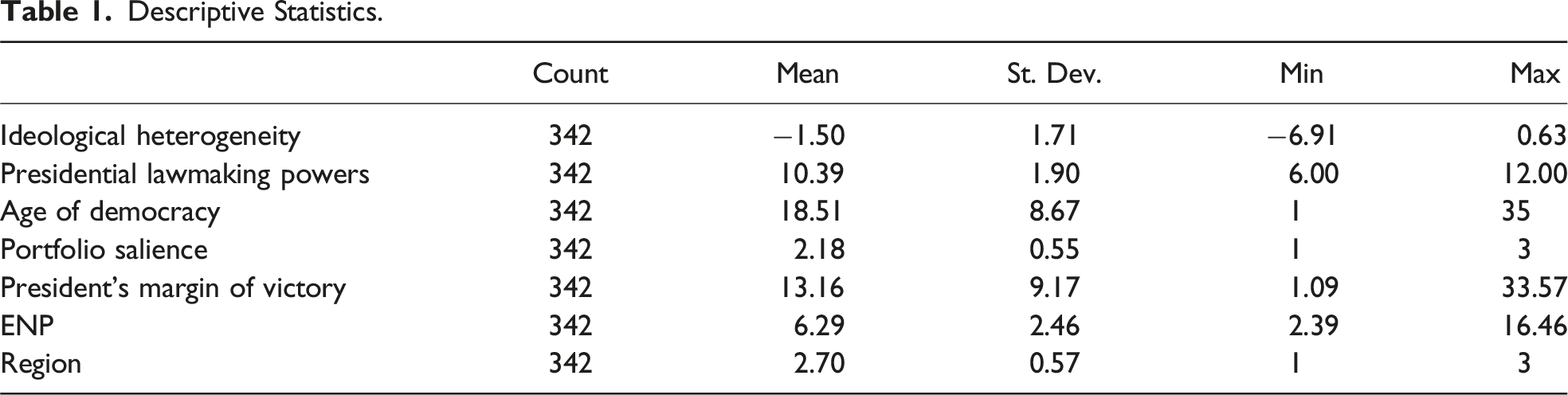
Descriptive Statistics.
Findings
Determinants of Coalition Management in Presidential Democracies.
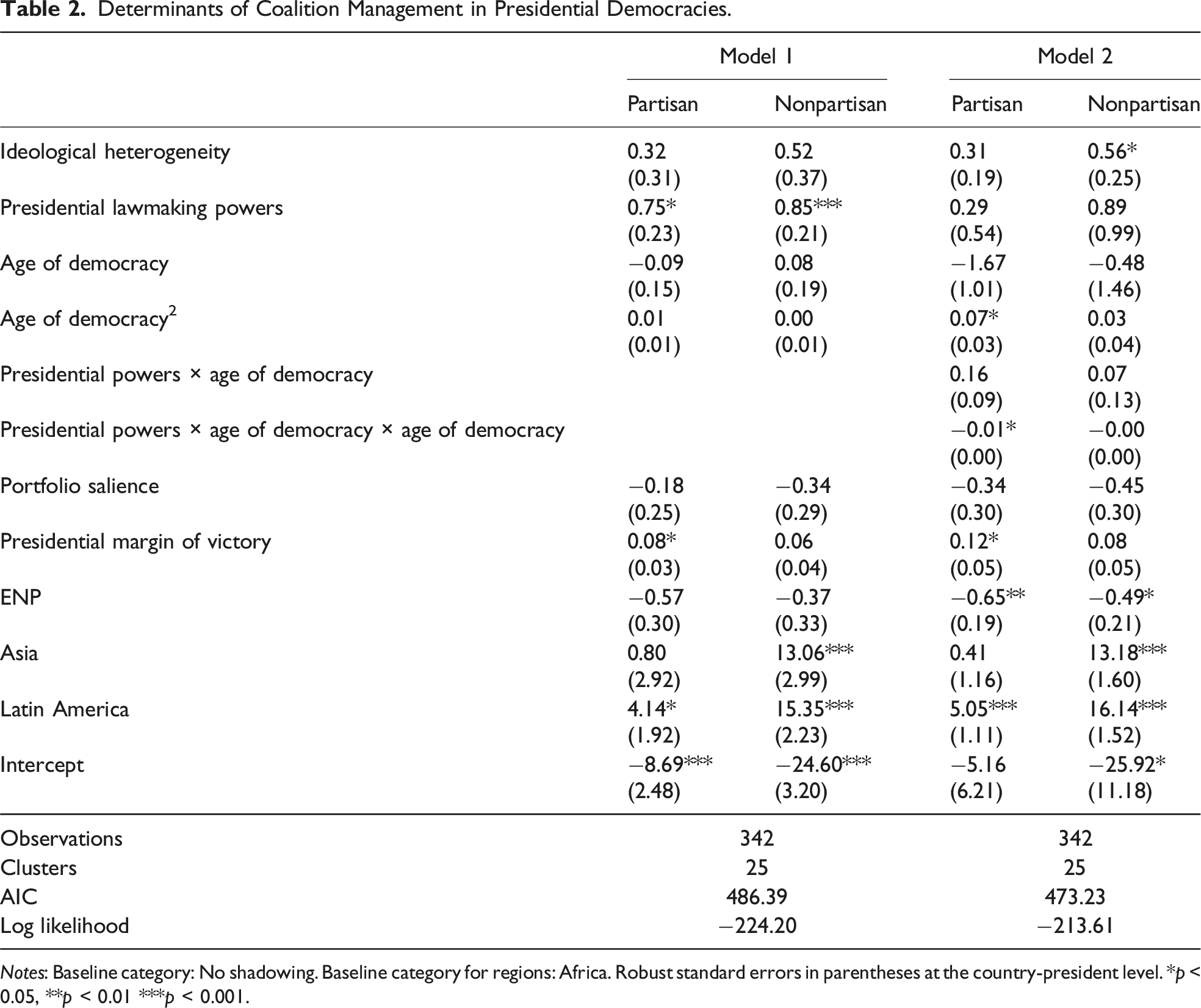
Notes: Baseline category: No shadowing. Baseline category for regions: Africa. Robust standard errors in parentheses at the country-president level. *p < 0.05, **p < 0.01 ***p < 0.001.
We start by examining the results for Hypothesis 1. Recall that we expect parties to be more active in keeping tabs on partisan ministers whose parties are more ideologically distant from the coalition mean. The latter matters because it represents the government formation equilibrium all partners agreed to when they coalesced to govern together. Figure 1 shows the predicted marginal effects of Ideological heterogeneity on shadowing. For clarity, we show the three outcomes: no shadowing, nonpartisan shadowing, and partisan shadowing. In line with our expectations, political parties increase their shadowing of nonpartisan and partisan ministers. However, the only significant effect is no shadowing, which is less likely when heterogeneity is greater. Our intuition is that our observations are insufficient to tease whether an increase in ideological heterogeneity is conducive to nonpartisan or partisan shadowing. We reject Hypothesis 1. Predicted marginal effects of ideological heterogeneity on coalition shadowing.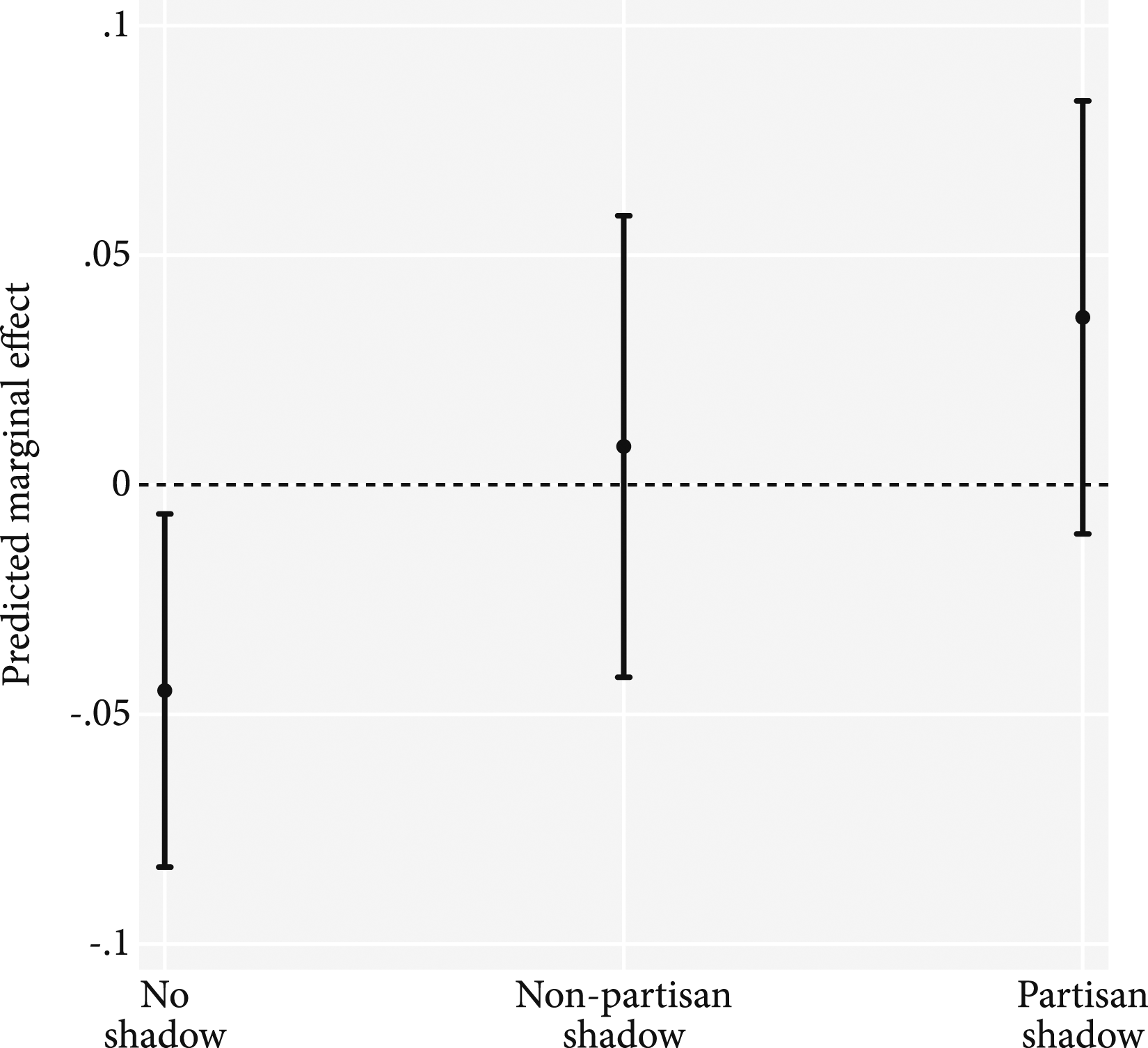
Next, we turn to the impact of Presidential Lawmaking Powers on the likelihood of political parties shadowing nonpartisan ministers. Recall that we expect parties to increase their shadowing of nonpartisan ministers working as agents of powerful presidents. Model (1) in Table 2 shows that presidential legislative-making powers positively affect the likelihood of shadowing. For a better understanding of the effects of the coefficient, Figure 2 shows the marginal effects of presidential lawmaking powers on nonpartisan shadowing. The results show that the relationship between powers and nonpartisan shadowing is almost linear, with a slightly flatter slope around the lower end of the spectrum. The findings confirm Hypothesis 2. Political parties and presidents agree to an equilibrium where the former allows the latter to use partisan junior ministers to keep tabs on nonpartisan ministers. Predicted probability of presidential lawmaking powers on nonpartisan shadowing.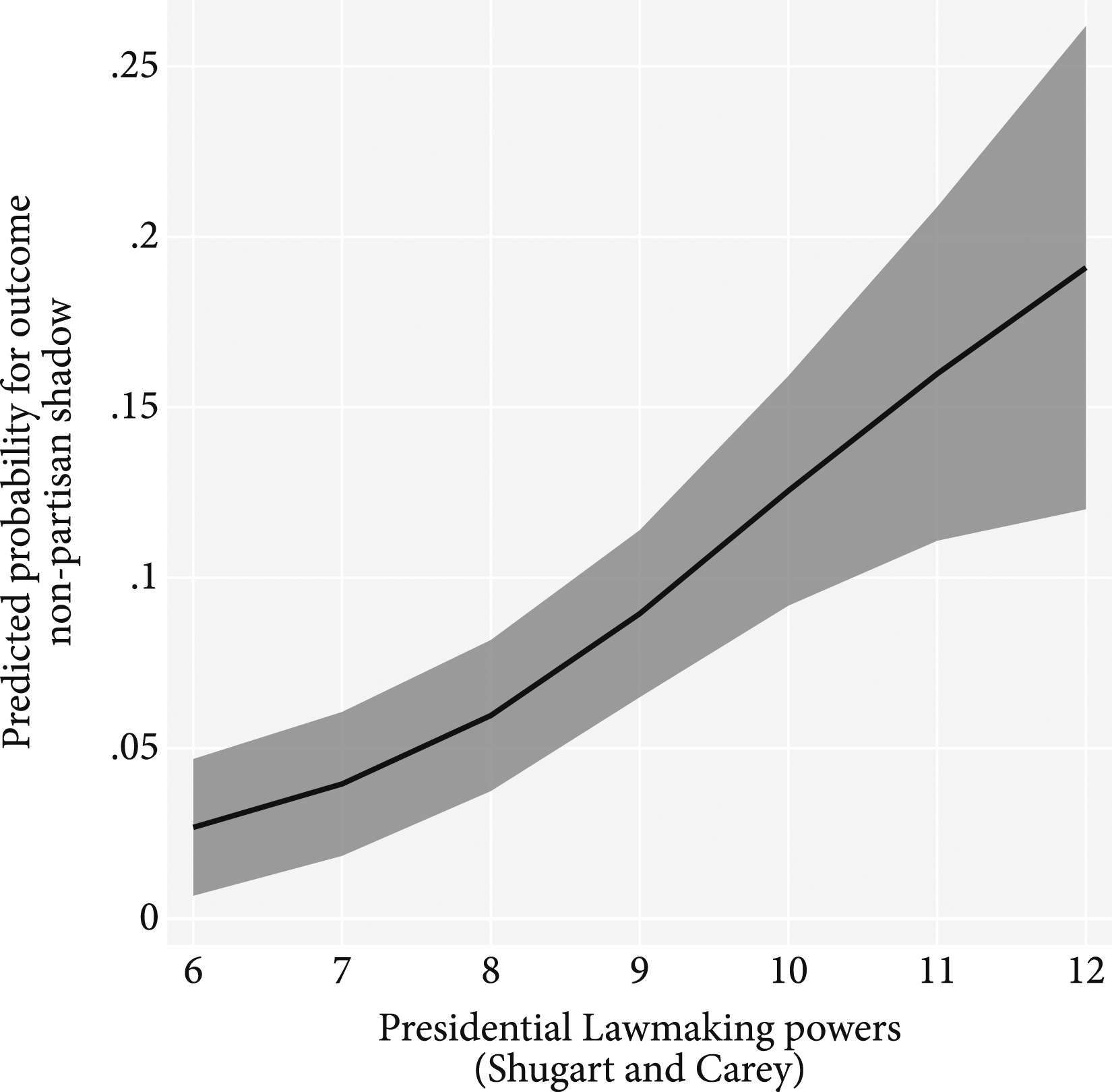
Next, we examine the effects of democratic experience in moderating the effect of presidential power on the likelihood of parties shadowing presidential agents in the cabinet. Model (2) in Table 2 displays the results. Recall that we use a non-linear term of Age of Democracy to account for non-linear effects. Thus, we make a triple interaction to gauge the moderating effect of a non-linear term of Age of Democracy on Presidential Lawmaking Powers. The effect size is small, but the result is significant. To better understand this result, Figure 3 plots the predicted effects of the triple interaction. Findings suggest that, in line with our hypothesis, the increase of presidential powers has different impacts on the likelihood of shadowing nonpartisan ministers depending on the length of democratic experience. This effect is more pronounced at higher levels of democratic experience, suggesting that it takes some time before the effects of institutional learning become noticeable. As political elites become more experienced with the rules of the game and update their expectations and beliefs based on experience, they are more likely to shadow presidential agents. Taken together, our comparative results lend support to Hypothesis 3. Predicted probability of presidential lawmaking powers on nonpartisan shadowing moderated by the age of democracy (years).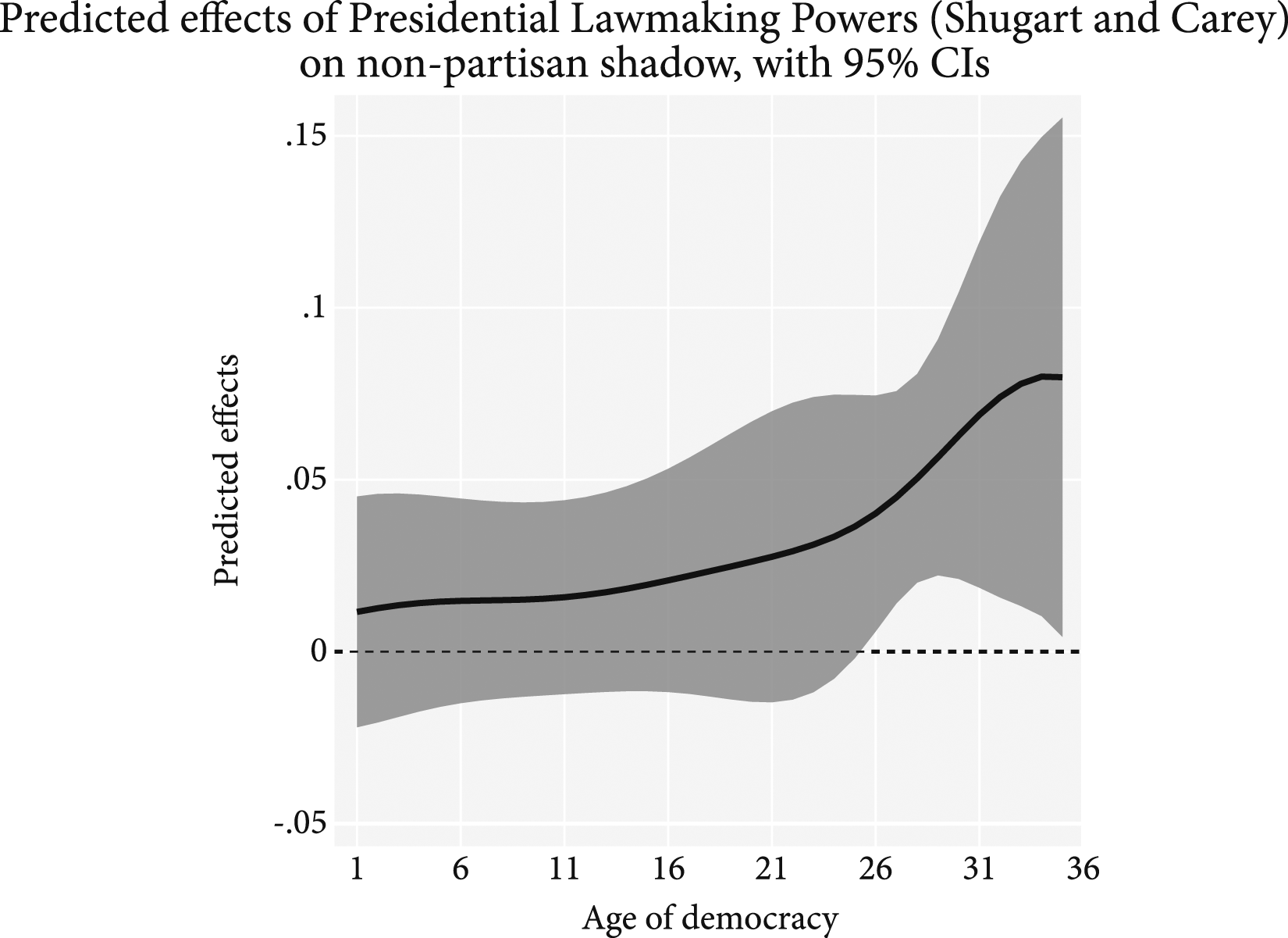
Our results are robust to the inclusion of our vector of controls. First, portfolio salience reduces both nonpartisan and partisan shadowing, which could point to the fact that presidents and parties resist shadowing of salient portfolios. However, it does not reach significance. Second, in line with our expectations, the Presidential margin of victory increases the likelihood of shadowing, but, interestingly enough, only the effect on partisan shadowing reaches significance. Third, against our expectations, party-system fragmentation, as gauged by the effective number of parties (ENP), decreases the incidence of shadowing, and its effect reaches significance in Model 2. The intuition behind this is that parties are confronted with a bewildering variety of coalition partners in fragmented systems, which complicates the strategic calculus of where to focus their shadowing. This may lead to abdication and a more ministerial mode of governance. Finally, our results are robust to including our region dummies, which shows that our findings about parties in multiparty cabinets have implications for all three regions in this study. Findings suggest that Asian and Latin American parties tend to engage more in coalition governance arrangements than their African counterparts.
This figure depicts the predicted marginal effects of ideological heterogeneity on coalition shadowing. Coefficients depict predicted values calculated from Model (1) in Table 2.
This figure depicts the predicted margins of presidential powers on nonpartisan shadowing. Predicted values calculated from Model (2) in Table 2.
This figure depicts the predicted margins of presidential powers moderated by the age of democracy (years) on nonpartisan shadowing. Predicted values calculated from Model (2) in Table 2.
Conclusion
Multiparty cabinets are now the norm in presidential systems. Making executive coalitions to gain legislative support is the institutional solution to overcome gridlock and make democracy work in separation-of-powers systems (Cheibub 2007). Our understanding of agency loss associated with multiparty governments in presidential democracy is gaining traction in the literature (Chaisty et al. 2018; Martínez 2015; Pereira et al. 2017). This body of work is still in its infancy and has yet to take full advantage of received wisdom from studies on coalition governance in parliamentary democracies. Furthermore, comparative work on this matter has been limited because micro-level data are difficult to access and collect.
Our paper provides important insights into our understanding of coalition governance in presidential democracies. First, unlike most literature, which focuses primarily on presidents and their preferences and behavior, our paper focuses on political parties and their role in coalition governance. Ours brings political parties to the fore to understand how they keep tabs on their coalition partners to curb delegation perils. Second, to the best of our knowledge, ours is the first cross-regional comparative work on coalition governance in presidential democracies.
Importantly, we use data from Latin American, African, and Asian countries, which allows us to draw generalizable conclusions about coalition governance under the separation of powers. Finally, our contribution considers the impact of democratic experience, a matter of particular importance when it comes to using coalition governance formal (and informal) institutions (Carroll et al., 2006).
Our work advances scholarly understanding of coalition governance in presidential democracies by making three contributions. First, we find that, in agreement with other authors studying coalition governance (Martin and Vanberg 2004; Alemán and Tsebelis 2011), parties are more likely to keep tabs on partisan ministers as the ideological distance between them increases, while being slightly more likely to shadow nonpartisan ministers. However, this is primarily because no shadowing is especially less likely as ideological heterogeneity increases, rather than one or the other type of shadowing necessarily being more likely. Second, coalition partners tend to keep tabs on nonpartisan ministers when the president is more powerful. Finally, we identify a moderation effect between presidential powers and democratic experience, whereby parties are more likely to focus their shadowing efforts on nonpartisan ministers when presidents are more powerful, especially in combination with a long democratic track record. This points toward an institutional learning process by which parties’ strategic considerations become more pronounced as democracy institutionalizes.
The main implication of these findings for our understanding of how multiparty governments work is that they further support the literature bridging parliamentary and presidential systems (Cheibub 2007). Furthermore, the findings help us better understand political parties’ incentives in presidential democracies. While Samuels and Shugart (2010) suggest that parties primarily focus on vote-seeking strategies in presidential democracies, our findings imply that parties also follow strong policy-seeking strategies in separation-of-powers systems. The fact that the results suggest that party leaders use junior ministers to shadow their coalition partners tells of their policy concerns.
Our study, however, like any other, also suffers from limitations. First, we are cautious about the causal nature of our findings. Our results are primarily descriptive. However, in light of the field’s infancy, we believe ours is an important contribution to moving comparative research forward on coalition governance in presidential democracies. Second, like most studies on junior ministers in coalition governance in parliamentary democracies, our data do not allow us to discern the motivation for appointing junior ministers, given that motivations other than monitoring exist, such as satisfying parties’ need for office spoils (Pukelis 2016). Third, our ideological heterogeneity variable does not account for directionality. It assumes that a party away from the center should ceteris paribus always be more likely to be shadowed, even by partners on the same side of the aisle. Unfortunately, we did not have a better way to measure this, as taking the distance between the minister’s party and the junior minister’s party would amount to using an outcome as an independent variable.
Fourth, our sample suffers from a geographical imbalance due to real-world data collection constraints for regions with shorter democratic experiences and more difficult data access. However, we included a dummy for regions over time to partly compensate for this. Our results are robust to the inclusion of said dummy, which suggests that Latin American countries are not the primary driver of our results. However, further work should use more data as they become available to add more countries to the analysis.
Our foray into coalition governance in presidential democracies raises several vital clues for future research. Rather than focusing on the determinants of intra-coalition shadowing, future research should examine the impact of shadowing patterns on policy outcomes. Fine-grained case studies are also needed to confirm that the observed shadowing patterns are accompanied by monitoring. This requires investigating junior ministers’ day-to-day functioning within the departments where they are positioned to find concrete evidence of monitoring activity.
Supplemental Material
Supplemental Material - Parties and Coalition Governance in Presidential Democracies
Supplemental Material for Parties and Coalition Governance in Presidential Democracies by Joris Thijm, and Jorge M. Fernandes in Political Research Quarterly.
Supplemental Material
Supplemental Material - Parties and Coalition Governance in Presidential Democracies
Supplemental Material for Parties and Coalition Governance in Presidential Democracies by Joris Thijm, and Jorge M. Fernandes in Political Research Quarterly.
Footnotes
Acknowledgments
A previous iteration of this paper was presented at MPSA, Chicago, 2022. We thank three anonymous reviewers and the editors for their excellent comments. The authors would also like to thank Octavio Amorim Neto, Fernando Bizarro, José António Cheibub, David Fortunato, Michael Laver, Sérgio Praça, Mafalda Pratas, Kenneth Shepsle, Matthew Shugart, Pedro Silveira, Daniel M. Smith, and Kaare Strøm for invaluable comments and suggestions. All remaining mistakes and omissions remain our sole responsibility. Jorge M. Fernandes would like to thank EUI’s Robert Schuman Centre for Advanced Studies for hospitality while writing this paper.
Declaration of Conflicting Interests
The author(s) declared no potential conflicts of interest with respect to the research, authorship, and/or publication of this article.
Funding
The author(s) received no financial support for the research, authorship, and/or publication of this article.

Supplemental Material
Supplemental material for this article is available online.
Notes
References
Supplementary Material
Please find the following supplemental material available below.
For Open Access articles published under a Creative Commons License, all supplemental material carries the same license as the article it is associated with.
For non-Open Access articles published, all supplemental material carries a non-exclusive license, and permission requests for re-use of supplemental material or any part of supplemental material shall be sent directly to the copyright owner as specified in the copyright notice associated with the article.
