




Abstract
This paper examines the rise of group consciousness in California during the 1990s. Many scholars have studied the increase in political participation in California and have alluded to an increase in group consciousness, but studies have not captured whether or not this actually exists. In this paper, I use seven surveys conducted between 1989 and 2004 and leverage the timing of these surveys to examine the role of perceived discrimination on Latino group consciousness in California. I hypothesize that the impact of political threat motivated an increase in group consciousness, which is driven by Latinos who perceived the discriminatory nature of California’s proposition politics in the 1990s. I find support for the hypothesis that perceived discrimination is positively associated with group consciousness during this time. However, the relationship between perceived group discrimination and group consciousness weakens after the threatening time period, even though reported levels of group consciousness continued to increase. This finding suggests that group threat may activate group consciousness even after feelings of threat have subsided.
Keywords
The panethnic identity of Latino/Hispanic leads many to wonder about the political implications of Latinidad (Beltrán 2010; Mora 2014; Prewitt 2013; Rumbaut 2009). Developing a sense of Latino group identity is important for increasing Latino group engagement (Barreto 2005; Bedolla 2005; Sanchez 2006b; Stokes 2003). Many studies have looked at the role of a politicized identity in political participation, whether through linked fate, identity centrality, solidaridad, or group consciousness, and have found that not only do many Latinos hold a sense of politicized identity, but also that this identity leads to increased levels of political participation (Barreto 2010; Barreto et al. 2009; Garcia-Rios and Barreto 2016; Gay, Hochschild, and White 2016; Gutierrez et al. 2019; Marsh and Ramírez 2019; Masuoka 2006; Masuoka and Junn 2013; Pérez 2015b; Sanchez 2006a; Sanchez, Masuoka, and Abrams 2019; Sanchez and Vargas 2016; Stokes 2003; Zepeda-Milan 2017). If a politicized identity is an important component of voting behavior, then understanding how identities become politically salient is critical for understanding Latino political engagement.
Studies highlight the importance of individual context and political environment in identity formation. Events at the local, state, and national levels can all play a role in forming and activating identity (Bedolla 2005; Ramirez 2013; Zepeda-Milan 2017; Zepeda-Millán and Wallace 2013). Scholars have examined California’s anti-immigrant movement in the 1990s and explained how this was politically mobilizing for Latinos, but to my knowledge, none have quantitatively examined how a politicized Latino identity became salient during this time. In this paper, I examine the Latino sample from 7 surveys and demonstrate that perceived group discrimination is associated with increased group consciousness. Because of the increase in group consciousness in the California Latino electorate during this time, we can better understand the mechanism behind studies that have found that the Latino electorate in California exhibits higher levels of political participation (Barreto, Ramirez, and Woods 2005; Barreto and Woods 2005; Bowler, Nicholson, and Segura 2006; Pantoja, Ramirez, and Segura 2001; Pantoja and Segura 2003; Valenzuela and Michelson 2016).
Republican Governor Pete Wilson ran for re-election in 1994 on a strongly anti-immigrant campaign that supported voting yes on Proposition 187 (Bergman, Segura, and Barreto 2014; Bowler, Nicholson, and Segura 2006). The goal of Proposition 187 was to make undocumented individuals living in the state ineligible for public benefits such as healthcare and education (Hajnal and Baldassare 2001; E. Lee 2019). In addition, it made public servants responsible for reporting individuals they thought might be undocumented. The campaign in support of Proposition 187 was full of racially coded language and commercials that portrayed Latin American immigrants as criminals coming to the United States to steal jobs and take social welfare away from Americans. 1 In 1996, Proposition 209 was proposed and passed, effectively removing affirmative action in California’s state colleges and universities. Two years later, Proposition 227 was passed, which required that English as a Second Language (ESL) classes be taught in English and limited student access to ESL for a year. A ramification of 227 was that it eliminated bilingual education for limited English proficient students, ending most bilingual education classes in the state. At the time, the Republican Party in California was still a strong player in state politics and had a sizable Latino contingency. However, registration trends turned after 1994 because many Latinos perceived Republicans as hostile to their communities (Barreto, Ramirez, and Woods 2005; Barreto and Woods 2005; Bergman, Segura, and Barreto 2014).
I argue that the group threat imposed by California’s state politics between 1994 and 1998, which were motivated by anti-immigrant attitudes, increased group unity and political mobilization in the Latino electorate (Brader, Valentino, and Suhay 2008). Proposition 187, in particular, led to the mobilization of Latino activists because of the impact such a law would have had on the daily lives and sectors of society that interact with immigrant communities regularly (Zepeda-Milan 2017). However, only looking at Proposition 187 in 1994 does not paint the full picture because it is the climate during this 4-year period that sets Latinos in California apart from other states, and studies looking at the long-term effects of regressive politics have also found that there is a significant temporal component for the long-term effects of political participation (Pantoja, Ramirez, and Segura 2001; Ramirez 2013). States play an essential role in fostering a sense of belonging and political incorporation for minority communities (Jiménez et al. 2021), and while shifts to more welcoming immigrant political policies didn’t occur until the 2010s, 1998 marked the end of an outwardly regressive time in California’s approach to immigration policy and a reduction in the coverage of anti-immigrant sentiment at the state level (Colbern and Ramakrishnan 2020), thus reducing the saliency of anti-immigrant/anti-Latino sentiment in the state (Colbern and Ramakrishnan 2020; Jiménez et al. 2021; Zaller 1992). Furthermore, focusing on this particular timeframe, I can examine the effects of this wave of xenophobia before we begin to see a resurgence of anti-immigrant sentiment at the national level in the mid-2000s.
When immigration and other similarly group-based issues become the political focus, Latinos, whether U.S.-born or immigrant, become the political “others.” During these periods of political group threat, Latino identity, and group consciousness are most likely to be activated. By lumping Latinos and immigrants together and emphasizing their identity in a politically charged climate, the repercussions are necessarily political. Individuals who recognize the negative political messaging and hostility from these campaigns are aimed at Latinos should be more likely to respond politically because of the activation of group consciousness. Additionally, I expect that Latinos will continue to hold high levels of group consciousness even after group threat is no longer salient. One of the key dimensions of group consciousness is that the group recognizes its position in the social hierarchy (Miller et al. 1981), and that can be done without the group actively being discriminated against. Because all that is needed is a recognition of group status, I expect that group consciousness will not fluctuate. The perception of Latino’s lower status is not likely to shift just because the saliency of the threat fades. I expect that their sense of group consciousness will remain because Latinos continue to be in a subordinate position. With a collection of cross-sectional data from 1989 through 2004, I use California’s political climate to test the unifying political power of threat. This may explain what accounts for increased Latino political participation in the state. By examining surveys conducted before, during, and after the proposition period, I can compare how group consciousness shifted during these three timeframes.
These propositions, especially 187 and 227, targeted all immigrants but were strongly connected to Latino immigrants. Research on the connection between Latinos and immigration found that before 1994 and the anti-immigrant campaign in California, Latinos were only slightly more likely to be mentioned in news stories about immigration. After Proposition 187, there was a greater focus on Latin American migration (Valentino, Ted, and Jardina 2013). Tracking articles about the propositions in the LA Times from 1994 to 2000, I find that many of these articles explicitly mention Latinos. 2 There is an inextricable link between Latino identity and immigration debates, and it appears that in California, at least, it can be traced back to this moment (Jones-Correa, Al-Faham, and Cortez 2018).
Scholars have studied the impact of the threatening climate and these propositions on Latinos in the state. Pantoja, Ramirez, and Segura (2001) found that voter turnout increased among Latino immigrants who naturalized and registered to vote during the 1990s compared to those who naturalized prior. Ramirez (2013) finds that Latinos who registered to vote during this time were more likely to be habitual voters, and Asian Americans were also mobilized by the anti-immigrant rhetoric (Ong 2011). There was also an increase in voter registration and turnout in the state due to greater interest in politics among Latinos (Barreto, Ramirez, and Woods 2005).
Furthermore, county and statewide trends indicate that the number of Latino registered Republicans declined (Barreto 2005; Bowler, Nicholson, and Segura 2006; Pantoja and Segura 2003). While these studies find a connection between threat and mobilization, I argue that there is an intermediary step that these studies have not observed that comes before political participation, and that is feeling a sense of politicized identity. Individuals are less likely to be motivated by threat and engage with the political system if they do not identify with the group being threatened, as this is a fundamental step in the identity to politics link (Lee 2008). Understanding the way that threat influences Latino identity has only become more pressing given the rise in anti-immigrant rhetoric and scapegoat politics in other states like Texas and Florida as well as the national level. This paper adds to our understanding of group threat and group identity and how we might expect to see other Latinos respond when faced with similar situations.
Psychological Roots of Identity
Understanding how Latinos feel about their identity is important for determining the role that Latino identity will play in shaping their views on politics and policy. Studies have shown that those who strongly identify as Latino and perceive group discrimination are more likely to identify politically as liberal (Huddy, Mason, and Horwitz 2016), while Garcia-Rios and Barreto (2016) find that Latinos with a strong sense of linked immigrant identity hold higher levels of political engagement and are more likely to engage politically.
Works on mobilization have found that the effectiveness of identity appeals in GOTV phone calls in mobilizing Latino populations depends on the strength of a person’s identity (Valenzuela and Michelson 2016). Ramirez’s work on Latino mobilization (2013) outlines a participation mechanism that hinges on native and foreign-born voters having a politicized identity; however, this connection is implied. We know that the role of identity is important, but studies focusing on mobilization in California during the 1990s have not shown that group consciousness increased. There are many reasons to believe that perceived discrimination is tied to group identity. Studies on the immigrant rights protests in 2006 found that discrimination played a role in perceptions of racialized identity (Jones-Correa, Wallace, and Zepeda-Millán 2016; Zepeda-Millán and Wallace 2013). Meanwhile, linked fate is associated with increased immigrant rights activism (Zepeda-Milan 2017). However, we do not have quantitative evidence to support the idea that this is what occurred in California during the 1990s.
Qualitative studies on Latino social movements have found that politicized identity during periods of threat can lead to more participation if individuals feel positively toward their group (Bedolla 2005; Zepeda-Milan 2017). Attachment and strength of identity are also important to how people respond to threat. Pérez (2015a) finds that when faced with xenophobic rhetoric, strong Latino identifiers will reaffirm their group identity when the group is threatened. However, weak identifiers opt to move further away from the group. This trend was also found in Bedolla’s (2005) work on identity in East Los Angeles and Montebello. Similarly, studies have found that when faced with discrimination, individuals will actively try to maintain feelings of belonging and personal self-esteem by maintaining a stronger Latino identity (Armenta and Hunt 2009; Schildkraut 2005). Thus, perceived group discrimination may lead to an increase in in-group identification and the strengthening of group bonds.
The psychological process is important to understanding how group members react when faced with threats, but questions surrounding the persistence of a group-conscious identity remain. Should we expect to find that group consciousness subsists once the initial threat fades? Or does perceiving group threat and activating a group identity at one point mean that feelings of group consciousness remain even when the group is no longer threatened? I hypothesize that group discrimination will be positively associated with group consciousness and that perceived discrimination will continue to be positively associated with group consciousness. I suspect that once found, group consciousness is likely to remain, and I test this by examining what happened with group consciousness between 1989 and 2004.
What poses a more significant challenge for group consciousness among panethnic groups is that many different identities are nested under a panethnic label. While identity is shared, it is not a given that it will mobilize all members (Lee 2008). But as Junn (2006) noted, consciousness can exist even when it isn’t always quantifiable. There are instances when group consciousness may be activated, like during times of political threat. This is in line with Padilla’s (1985) work on situational group consciousness and Marsh and Ramírez’s (2019) work on discrimination and solidaridad during times of threat. Other works have found that the foundation of group consciousness for Latinos is in shared experiences of group discrimination (Sanchez and Vargas 2016).
Group consciousness is often used to capture a sense of politicized identity because it applies to a broad range of groups (Miller et al. 1981; Stokes 2003). It is a combination of identifying with the group, recognizing the group’s lower position in society, and a commitment to improve their group’s standing (Gurin, Miller, and Gurin 1980). Works on Latino group consciousness find that group consciousness may also shift how policy debates are perceived (Sanchez 2006a) and is positively associated with increased political participation (Sanchez 2006a; Stokes 2003).
While these works tell us that group consciousness is important for political participation, studies examining Latinos in California during the 1990s have not made this intermediary connection between threat and identity. Understanding is important because it tells us who is most likely to become to be mobilized when we have a group threat.
Hypotheses
We have seen many instances of group threat directed toward Latinos, and while many do mobilize, some do not. Understanding the connection to their Latino group identity will help us contextualize these moments of political activation. Furthermore, by looking at group consciousness over time, we can also see if increases in group consciousness during periods of threat are temporary or more durable and elucidate what it means for Latino political participation in California.
To examine Latino identity during this time, I use group consciousness as my outcome of interest. I collected seven surveys with large Latino samples in California from 1989 to 2004 and subset my data to look only at respondents living in California. I start my analysis with the 1989/1990 Latino National Political Survey (LNPS). This allows me to include a baseline for group consciousness before group threat becomes salient. Three surveys capture what happens to identity during the proposition period (1994–1998), and three additional surveys conducted between 1999 and 2004 illustrate what happened to group identity after the proposition period. Below, I outline my hypotheses.
I expect that prior to the threatening propositions of the 90s, group consciousness will generally be lower, and perceived discrimination will be weakly correlated with group consciousness.
From 1994 to 1998, during the propositions, perceived discrimination will be strongly and positively correlated with group consciousness because of the saliency of group threat.
From 1999 to 2004, feelings of group discrimination will continue to be positively associated with group consciousness, and group consciousness will remain at a higher level because people are more aware of the group’s status even if the threat has subsided.
Foreign-born respondents likely will feel a greater sense of threat and discrimination because of these propositions, and feelings of perceived discrimination will likely be associated with higher levels of group consciousness than their U.S.-born counterparts.
I hypothesize that the relationship between perceived discrimination and Latino identity will not be as strong in the survey periods before the propositions (H1) because Latinos in the state have not yet been exposed to political discrimination at the state level in the same way that they were between 1994 and 1998. I argue that the social climate during these propositions is increasing the saliency of the discrimination Latinos as a group face. However, as the 1990s continue and these propositions arise, I expect that perceived discrimination will positively correlate with group consciousness (H2). Recognizing that society perceives Latinos to be different, coupled with being reminded of Latino’s lower status in society, is part of what is pushing respondents to have group consciousness, and this is likely to continue even after the initial threat period (H3).
Finally, I test one additional hypothesis: since propositions 187 and 227 targeted immigrants, I expect perceived discrimination will substantially impact group consciousness among foreign-born respondents more than their U.S.-born counterparts (H4). While some may point to the fact that second- and third-generation Latinos live in immigrant communities and likely know immigrants who would have been impacted, studies examining foreign-born respondents find that the mobilizing effect of these propositions is greater among immigrants in particular, who were turning out to vote at higher rates (Barreto and Woods 2005; Pantoja, Ramirez, and Segura 2001; Ramirez 2013). So, if this group shows higher levels of mobilization, perhaps group threat also impacts their sense of group identity.
Data and Methods
Many have looked at threat in California, but the link between threat and group consciousness has yet to be fully established. A key innovation that this paper brings is the use of multiple surveys to examine temporal patterns and the connection between identity and discrimination at multiple points in time. To explore the connection between perceived discrimination and group consciousness, I collected numerous surveys with large samples of Latinos in California. These surveys are the Latino National Political Survey (LNPS) of 1989/1990, The Los Angeles County Social Survey (LACSS) of 1994, The Multi-City Study of Urban Inequality (1992–1994), The Washington Post Kaiser Foundation Harvard National Survey of Latinos 1999, the Mexican American Study Project II, which was conducted between 1997 and 2000, The Kaiser Pew 2002 National Survey of Latinos, and The Pew Kaiser Latino Survey on Politics 2004. 3 These seven surveys contain a large sample of Latino respondents living in California at the time and a measure of group consciousness and perceived discrimination. By limiting my sample to only the California respondents in these surveys, I can measure the relationship between perceived discrimination and group consciousness in the state. Ideally, I would have liked to have enough respondents in other states to use a difference-in-difference approach as an alternative estimation strategy; however, considering the different geographies and sampling strategies of these surveys, I am unable to do so.
The LNPS was the first nationally conducted survey of Latinos. It has 809 California respondents from Mexican, Cuban, and Puerto Rican ancestry. 4 Because the measurement of group consciousness is varied, I looked for questions that most closely capture the definition of group consciousness as outlined by Miller et al. (1981). Their definition of group consciousness involves feeling like you belong to a group, recognizing that the group is marginalized in society, and wanting to work together with other group members on behalf of their political goals (Miller et al. 1981). With the LNPS, I constructed a political similarity scale using respondents’ answers about political similarity among Latino ethnic groups. Respondents were asked three questions about the similarity of political concerns regarding the three largest Latino ethnic groups. Each survey item has the same possible responses: “very similar,” “somewhat similar,” or “not at all similar.” I combined these three items into a scale such that “0” represents a respondent reporting that all these Latino ethnic groups are not at all similar, and “1” represents respondents reporting that all these Latino ethnic groups are very similar. The internal consistency of this scale was strong (Cronbach’s α .68). To make the different surveys comparable across years, I then collapsed all respondents into a binary measure in which one represents respondents who viewed these three groups as either mostly or somewhat politically similar and the rest as zero. Only the respondents on the highest third of the scale were coded as one.
Additionally, the LNPS asks about discrimination faced by the respondent’s ethnic group. This asked, “How much discrimination or unfair treatment do you think different groups in the U.S. face? A lot of discrimination, some, a little or no discrimination at all.” This was asked of Puerto Ricans, Mexicans, and Cubans. The response given for the respondent’s ethnic group is used as perceived discrimination. Responses are coded 1 for those who said there is a lot or some and 0 for a little or none. In total, the LNPS provides 627 complete observations from California.
The Multi-City Study of Urban Inequality also had a large Latino sample in California. The interviews from California were conducted between 1993 and 1994. The Multi-City Study of Urban Inequality conducted 1,019 Latino interviews in Los Angeles between 1993 and 1994. The perceived discrimination variable in this survey asks how much discrimination respondents think Hispanics face that hurts them economically. Respondents who said “a lot” and “some discrimination” are coded 1, and respondents who stated there was “none” or “a little discrimination” are coded zero. My identity measure in this survey asks, “Do you think what happens generally to Hispanic people in this country will have something to do with what happens in your life?” Responses are coded 1 for those who said yes and 0 for those who said no.
Next, I examine the Los Angeles County Social Survey of 1994. While the sample is limited to Latinos living in the greater Los Angeles area, this survey was conducted during the height of Proposition 187, so I expect a strong and positive relationship between perceived group discrimination and group consciousness. The item used to measure group consciousness in this survey asks, “When thinking about social and political issues, do you think of yourself as a member of a particular racial or ethnic group, or do you think of yourself as mainly American?” Responses are collapsed into a binary variable coded 1 for those who think of themselves as only ethnic, or ethnic, and then American, and zero otherwise. The discrimination variable in this survey is worded “How often do members of your group experience discrimination.” Responses are coded 1 for experiencing discrimination, and 0 represents respondents who report never experiencing discrimination. There are 242 Latino responses in total.
The Mexican American Study Project II was conducted from 1998 to 2000 in the greater Los Angeles and San Antonio areas. It has 791 complete observations of Mexican Americans living in the Los Angeles metropolitan area. While it is limited to only Mexican American respondents, California’s Latino population is predominately Mexican American and should follow larger group trends. Respondents to the MASP survey were asked, “Do you agree that Mexican Americans should work together politically?” Responses were coded 1 for those who stated they should work together for political or social reasons or zero for those who stated otherwise. Perceived discrimination in this survey asks, “How much discrimination do you think there is today against people of Mexican origin?” This variable is coded 1 for those who perceive discrimination and 0 for those who say there is no discrimination.
The Washington Post Kaiser Family Foundation Harvard University National Survey of Latinos was conducted in 1999. This survey has 301 respondents from California. I combined two questions and scaled them into a single additive index variable to capture group consciousness. The questions used to make the scale ask, “Do you agree/disagree with the statement that Latinos in the United States share FEW political goals?” and “Do you think that if various Latino groups worked together politically, Latinos would be better off, worse off, or it wouldn’t make much difference?” These responses were scaled between 0 and 1, in which 0 represents respondents with no group consciousness and 1 represents respondents with the highest level of group consciousness. This scale was then recoded into a binary 0–1 variable. Of the intermediate responses, only those who gave the highest response on one of the questions and a middle response on the other are coded 1. All other values are collapsed into the zero category. While the α for this scale seems low (0.17), these two characteristics of common goals and improving the group’s standing by working together are how group consciousness is conceptualized, and similar scales have been used in the past (Masuoka 2006). Perceived discrimination in this survey is stated, “Is discrimination against Latinos in our society today a problem, or not a problem?” This variable is coded 1 for discrimination is a problem and 0 for discrimination is not a problem.
The Pew Hispanic Center and Kaiser Family Foundation also surveyed Latinos in 2002 and 2004. From the 2002 survey, two measures were combined to measure group consciousness. The first question asks respondents if they think that “Latinos from different counties share one Hispanic/Latino culture or all have separate and distinct cultures.” The second question used to make up the group consciousness measure asks if “Hispanics/Latinos from different countries are working together to achieve common political goals or are not working together politically.” The perceived discrimination measure in this survey asks, “In general, do you think discrimination against Latinos/Hispanics is a major problem, a minor problem, or not a problem in preventing Latinos in general from succeeding in America?” Respondents who said discrimination is not a problem are coded 0, while those indicating it is a major or minor problem are coded 1. In total, this survey provides 611 respondents from California.
The final survey I use is the 2004 Kaiser Family Foundation Pew Hispanic Center Latino Survey on Politics conducted in 2004 with 615 respondents. This survey had fewer questions related to group identity, so group consciousness is measured using a single item, “Which comes closer to your views Hispanics/Latinos from different counties today are working together to achieve common political goals or are not working together politically.” Respondents who say Latinos are working together are coded 1, and those who believe they are not working together are coded 0.
To conduct my analysis, I run a logistic regression on each survey. 5 For each survey, I model group consciousness as my dependent variable and focus on perceived discrimination as my key independent variable. In each survey, the percentage of respondents who perceive group discrimination ranges a high of 86 percent during the proposition period down to 77 percent in the 2000s. 6 In these models, I also control for whether the respondent is foreign-born, partisanship, the language of the interview, gender, age, education, and income. While I expect that identifying as a Democrat is going to be positively associated with higher levels of group consciousness, given the Republican Party’s stance during this time, partisanship is included as a control in the model to better assess the relationship between perceived discrimination and group consciousness by controlling for partisanship. As a robustness check, I ran ordinary least squares regressions on each survey, allowing for the original number of categories in the group consciousness models. The OLS regression results provide findings similar to those of the logistic regression models. The results from this check can be found in the appendix.
After analyzing each survey independently, I pooled the surveys into a single dataset spanning 15 years. For the pooled analysis, I created fixed effects for the time of the interview. Interviews conducted between 1989 and 1993 are in the pre-proposition period, interviews between 1994 and 1998 are in the “during” period, and interviews conducted in or after 1999 are in the “post” period. My model uses interviews in the pre-proposition period as the reference category. Using logistic regression, I ran interactions between the time period and perceived discrimination for the pooled analysis. In both my individual and pooled regression models I expect that prior to 1994, perceived discrimination will be weakly correlated with group consciousness (H1). However, from 1994 to 1998, during the proposition period, I expect perceived discrimination will be strongly and positively correlated with group consciousness (H2). After the proposition period, feelings of group discrimination will continue to be positively associated with group consciousness (H3).
Results
Examining the cross tabs of group consciousness in each survey, we see that the LNPS has the lowest levels of group consciousness, with only 11 percent of the sample having group consciousness. Group consciousness increases in the three surveys conducted during the proposition period (median of 26 percent), supporting hypotheses 1 and 2. Looking at group consciousness levels in the post-proposition period, I find a larger increase in group consciousness (median of 53 percent), countering my expectation in H3.
Turning to the regression results from the individual surveys in Figure 1, I find support for hypotheses 1 and 2. Before the propositions, perceived discrimination is not associated with group consciousness. However, in the three surveys conducted during the proposition period, perceived discrimination is positively associated with group consciousness during times of political threat. However, looking at the results from the three surveys conducted after the proposition period, I find that perceived discrimination is no longer positively associated with group consciousness, indicating that the results do not support H3. I suspect that this is because levels of perceived discrimination are generally fairly high during the proposition period (between 82 percent and 86 percent), and in the post proposition period, there is a slight decline (between 77 percent and 82 percent). The lower levels of discrimination in the post-proposition period may be due to the fact that group threat is not as salient during this time as it had been. Marginal effect of going from 0 to 1 on perceived discrimination. Each survey was modeled using logistic regression.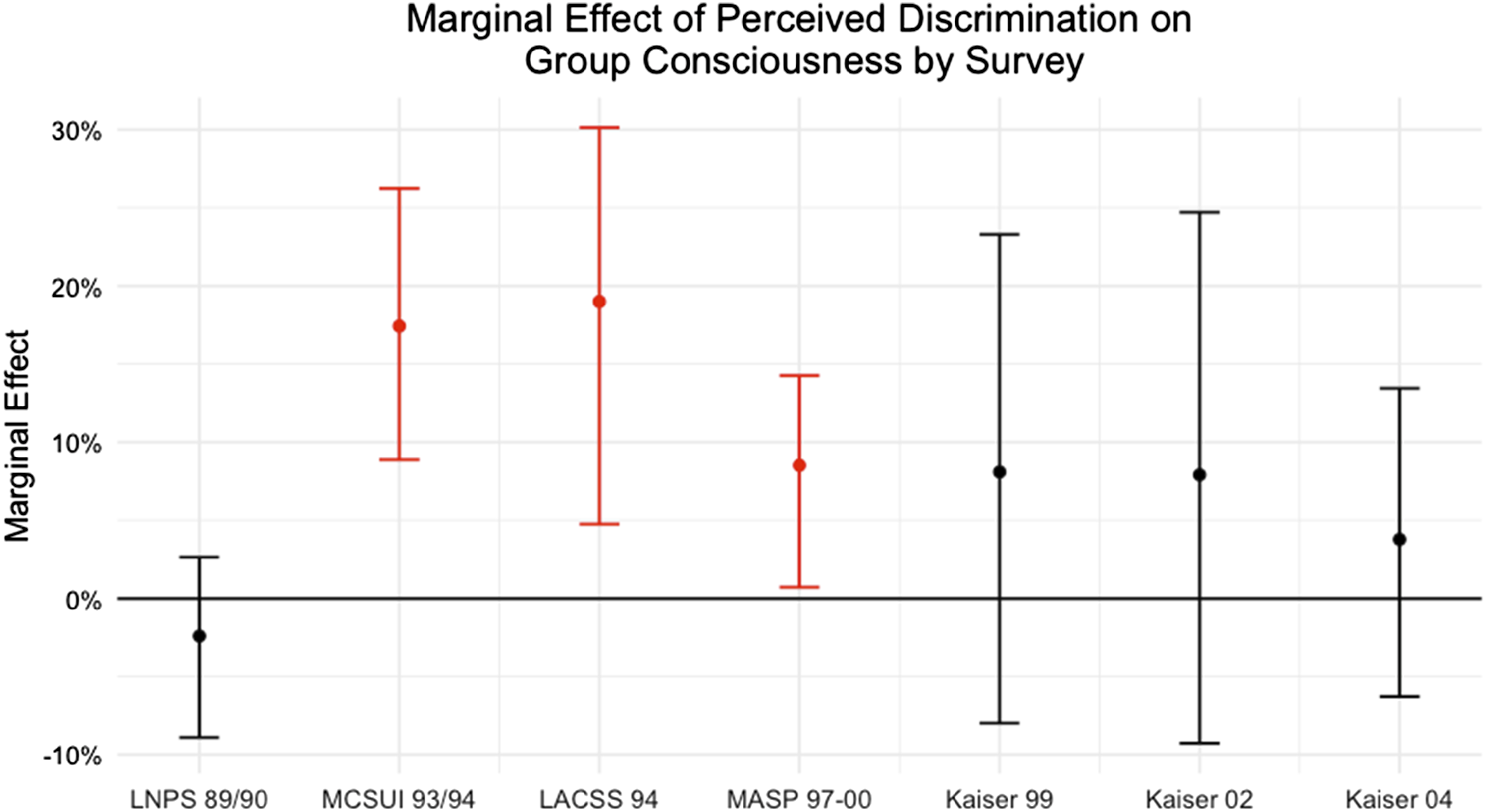
Surveys conducted during the proposition period are marked in red in Figure 1. In the LACSS, respondents who perceive group discrimination are 19 percent more likely to be group consciousness than those who say they do not perceive discrimination. Similarly, the marginal effect for the MCSUI is 17 percent. In the MASP, perceived discrimination is still positively associated with group consciousness, though the effect is smaller. Respondents who report that they perceive discrimination toward Latinos are associated with a 9 percent increase in their predicted probability of reporting group consciousness. The three surveys in the post-proposition period are the Kaiser Washington Post studies. In these surveys, perceived discrimination failed to reach statistical significance. In Figure 1, we see that while the estimate is positive in 99, 02, and 04, the margin of error crosses zero, indicating that perceived discrimination is no longer associated with group consciousness. Additional tests were conducted using different models and variable groupings of group consciousness. When I ran the OLS version of these models, which allowed for a broader range in the dependent variable, I found similar results.
Meta-analysis
To address concerns that the results are because each survey is unique, I also conducted a meta-analysis of the surveys in the proposition (1994–98) and post-proposition (99-04) time frames using the OLS estimates. Meta-analysis is one way that we can summarize across individual findings that take into account differences in sample sizes (Goh, Hall, and Rosenthal 2016). Because my hypotheses rely on the time of the survey as a key component to when we will find an effect of perceived discrimination on group consciousness, I conduct two separate meta-analyses, one for the studies conducted during the proposition period and another for the studies conducted after the proposition period. Since there is only one dataset during the pre-proposition timeframe, meta-analysis is not possible. Still, we can use the LNPS result of no statistically significant association between perceived discrimination and group consciousness as our information for the pre-proposition period. To conduct this meta-analysis, I used the original OLS results that allow each group consciousness variable its full range from 0 to 1.
7
The results can be seen in Figure 2. The pooled effect size of perceived discrimination for the 3 studies conducted during the proposition period is 0.137, with a confidence interval between 0.0127 and 0.2613, indicating that the association with perceived discrimination is positive during the proposition period. The meta-analysis for the three surveys in the post-proposition period indicates that the pooled effect is 0.0364 with a confidence interval between −0.0938 and 0.1667. In the post-proposition period, according to the meta-analysis, the effect of perceived discrimination on group consciousness is not distinct from 0. This aligns with the results from the individual regression findings. Ladder plot of meta-analysis estimates for during and post-proposition periods. Note that the pre-proposition period is the OLS estimate and confidence interval for the LNPS since there is only one survey in the pre-proposition time frame.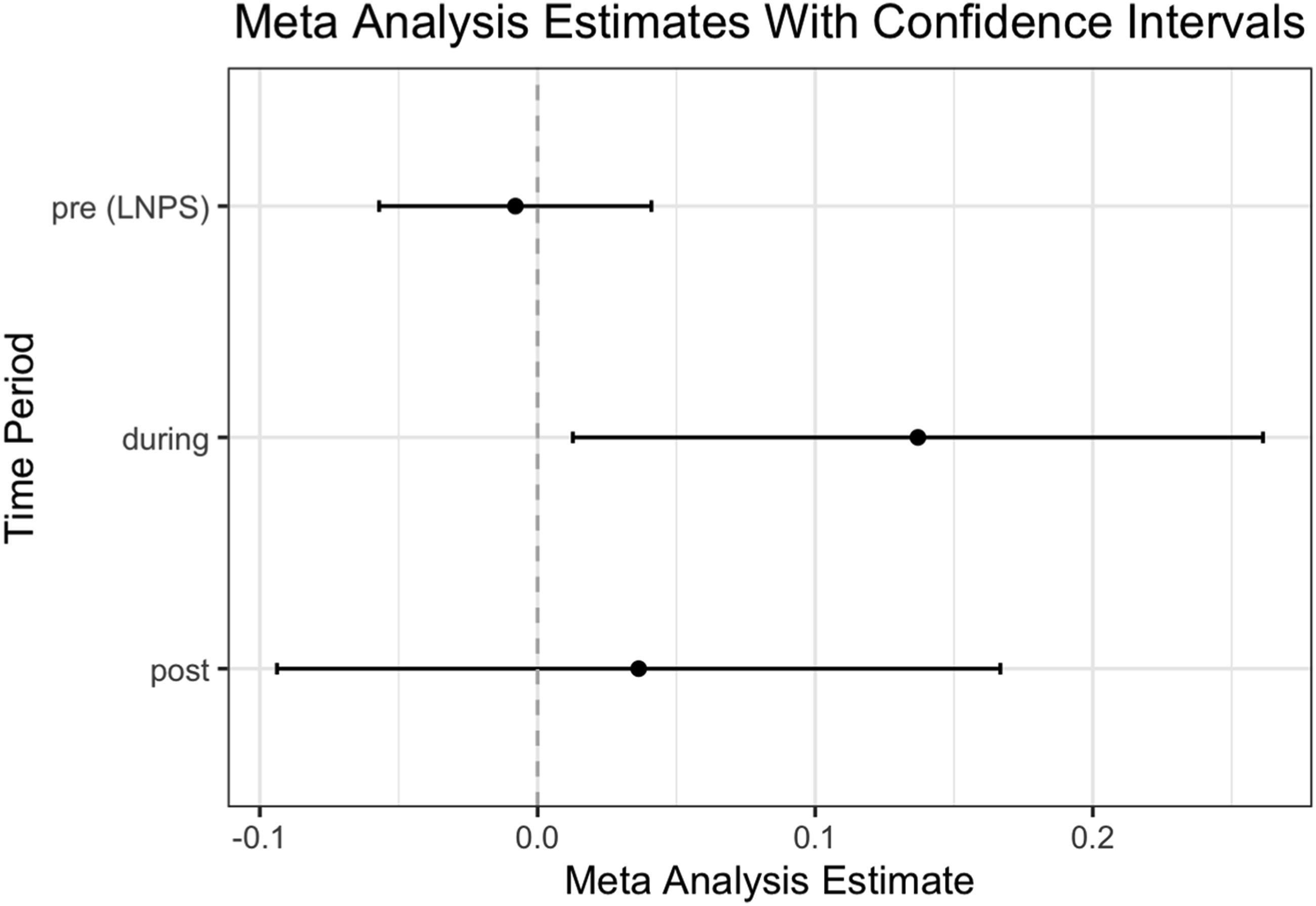
Pooled Models
The pooled analysis helps clarify the relationship between perceived discrimination and group consciousness over time. Instead of grouping respondents by survey, I group respondents by interview period and conduct a logistic regression using time-fixed effects. This allows me to separate respondents from surveys conducted during multiple periods. The period before the propositions includes all respondents who were interviewed between 1989 and 1993, the during period includes respondents from 1994 to 1998, and the post period includes respondents who were interviewed from 1999 to 2004.
Scholars have noted that Los Angeles was a key location for the political action surrounding these propositions (Barreto 2005; Bedolla 2005). Since some of these surveys were limited to the Los Angeles area, some may wonder if the impact of perceived discrimination on group consciousness during this time only occurred in LA County, where people were politically organizing. While I don’t have city information for all of my surveys, I was able to construct a dummy variable for whether or not a respondent was living in LA County at the time of the interview for 85 percent of my survey respondents. Another concern is that since one of my surveys is only of Mexican Americans, and I don’t have national origin information for every survey, the results may be due to differences in national origin. To address these concerns, I subset my data to only respondents I can identify as living in Los Angeles County and of Mexican origin. Table 3 in the appendix provides alternate model specifications, including county and national origin dummy variables. These results are consistent with the pooled subset results described below.
Using the pre-proposition period as my reference category and running interactions with the time period and perceived discrimination, I find that perceived discrimination is positively associated with group consciousness. Looking at the time-fixed effects, respondents surveyed between 1989 and 1993 are associated with lower levels of group consciousness than respondents interviewed during the proposition time period, but the post-proposition variable has no significant difference from the proposition time frame. In the pooled model, the interaction effect between perceived discrimination and group consciousness is negative and statistically significant. This indicates a weaker relationship between perceived discrimination and group consciousness in the post-proposition period. Since the pooled model uses logistic regression, which is not directly interpretable, I use the Zelig package to simulate the effects of going from a 0 to a 1 on perceived discrimination for the three time periods using the logistic regression model specifications. This is represented in Figure 3. Marginal effect of perceived discrimination on group consciousness by time period for Mexican Americans living in Los Angeles County.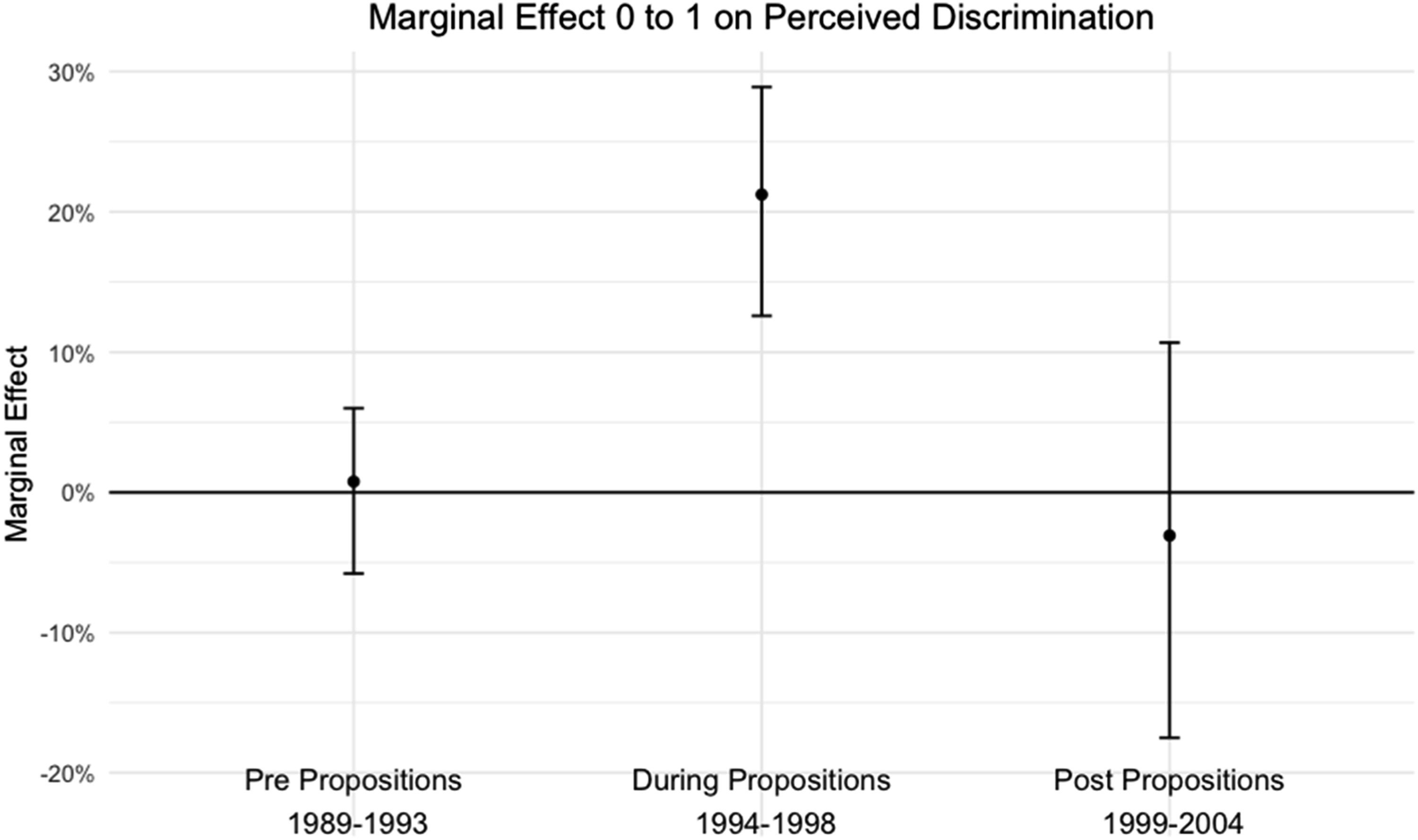
Before Proposition 187, the correlation between perceived group discrimination and group consciousness was 1 percent; though not statistically significant, this aligns with the previous analysis and H1. During the proposition period, perceiving discrimination is associated with a 21 percent increase in the predicted probability of being group conscious, indicating a stronger relationship. After the proposition period, perceived discrimination is negatively correlated with perceived discrimination, though not statistically significant, corroborating the null result for H3 found in the previous analysis. This suggests that there is something unique to the proposition time period that is linking group threat to group consciousness.
My final hypothesis is that foreign-born respondents will likely feel a greater sense of threat and discrimination because of these propositions, and feelings of perceived discrimination will likely be associated with higher levels of group consciousness than their U.S.-born counterparts. This is based on research consistently finding that foreign-born respondents mobilized in response to these propositions (Barreto, Ramirez, and Woods 2005; Pantoja, Ramirez, and Segura 2001; Ramirez 2013). The results from the subsample analysis can be seen in Figure 4. While the effect of perceived discrimination looks similar among both U.S.- and foreign-born respondents for the pre and post periods, Figure 4 indicates that foreign-born respondents primarily drive the correlation between perceived discrimination and group consciousness during the proposition period. For foreign-born respondents, perceiving discrimination is associated with a 30 percent increase in their predicted probability of reporting group consciousness during the proposition period, while the U.S. estimate is 10 percent and fails to reach statistical significance. I conjecture that this is because the proposition period increased their awareness of the out-group status of Latinos in US society. This is less likely to be the case for US respondents who were socialized in the US and are more aware of the racial hierarchy, which may be why perceived discrimination fails to reach a statistically significant effect. Here, once again, we see that the relationship between group consciousness and perceived discrimination does not hold for both U.S.- and foreign-born subsamples. Simulated marginal effect of perceived discrimination on group consciousness by nativity subsamples for Mexican American respondents in Los Angeles County.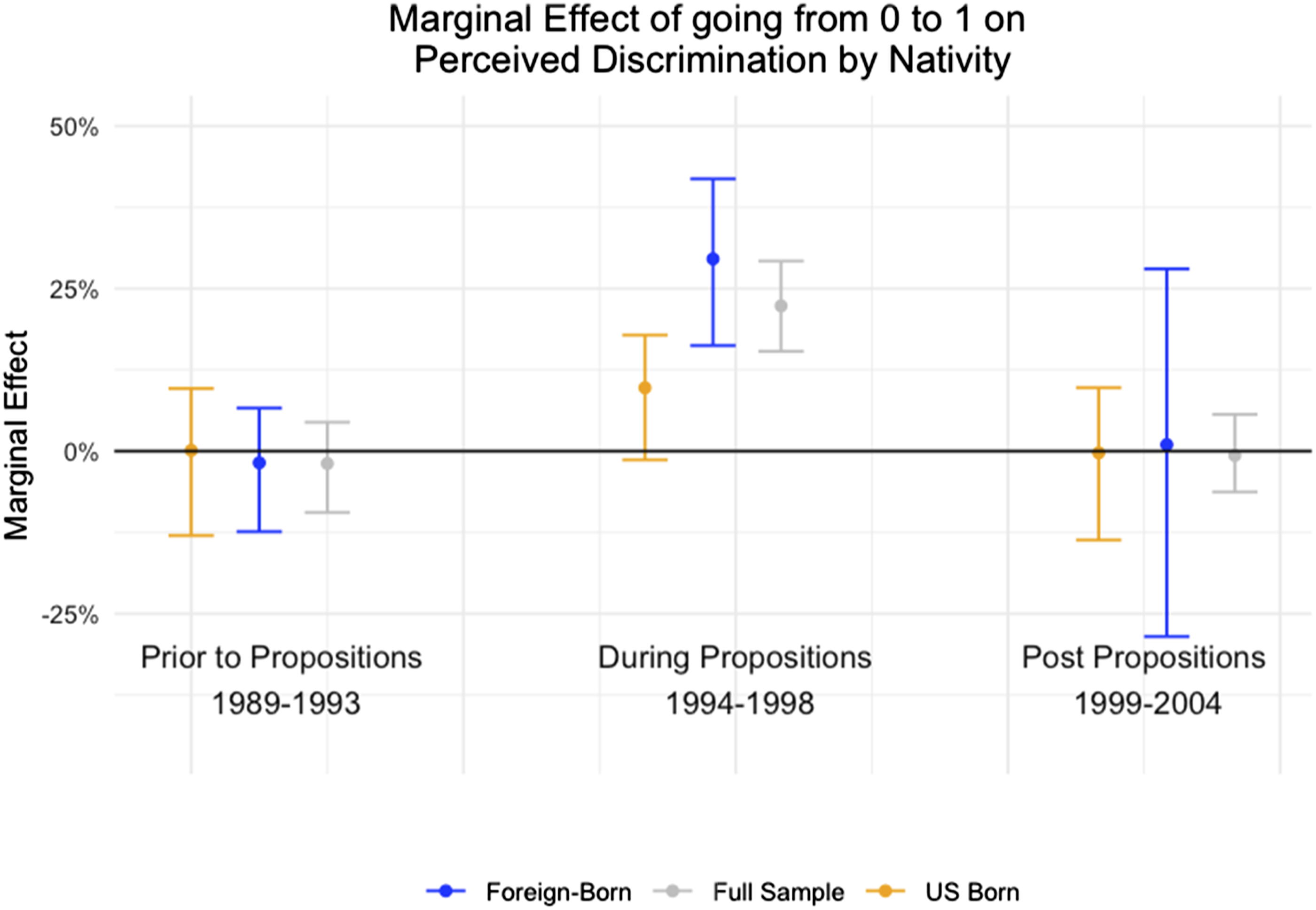
I find support for the following hypotheses: (1) levels of group consciousness are lower during the pre-proposition period and not correlated with perceived discrimination, (2) perceived discrimination is positively associated with group consciousness during periods of threat, and (4) foreign-born respondents are feeling more discrimination and are mainly driving the relationship between perceived discrimination and group consciousness during the proposition period. However, I find null results for hypothesis (3). While levels of group consciousness are higher in the post-proposition period, the relationship between perceived discrimination and group consciousness is no longer statistically significant.
Discussion
These three propositions in California were some of the first xenophobic laws passed during the most recent wave of anti-immigrant sentiment. Proposition 187 wanted to stop undocumented immigrants from receiving state services, Proposition 209 eliminated affirmative action, and Proposition 227 attacked ESL classes and bilingual education. While many have studied these propositions, this paper is the first to examine the temporal effects of group consciousness and its relationship to the larger political context. Before the proposition period, levels of group consciousness were lowest and not correlated with perceived discrimination. Testing the connection between group consciousness and perceived discrimination, I find that perceived discrimination during the proposition period is associated with higher levels of group consciousness. This is consistent with other works that have found that threat can mobilize (Jones-Correa, Wallace, and Zepeda-Millán 2016; Zepeda-Millán and Wallace 2013). These results are distinct from the pre-proposition period in which the effect of perceived discrimination on group consciousness is null. After the proposition period, while perceived discrimination appears to be positively associated with group consciousness, the effect has diminished and is no longer statistically significant. Similarly, other studies found that while people still vote at higher rates after periods of threat, the impact diminishes over time (Ramirez 2013).
This suggests that group threat may serve as a catalyst that raises the saliency about group discrimination and an awareness about the need to work together to raise the group’s standing. While the survey data indicates that perceived discrimination and group consciousness increase during this time, as the saliency of the group threat fades, I find a weakening connection between discrimination and group consciousness. However, this does not result in lower levels of group consciousness. The survey data indicates that group consciousness is higher after the proposition period. One reason may be that group consciousness becomes socialized in the community. This would lead to a community that is more likely to identify with and work on behalf of their group without needing to perceive widespread group discrimination. The threat may have increased the saliency of Latino discrimination, but people may not need group threat to be present to recognize that their group has a lower status in society. The other is that the events of these propositions increased Latino political action. News stories discuss how a new wave of Latino political activists and politicians emerged because of these propositions (Arana 2019). The increase in community organizing and activism that emerged after these propositions certainly helped engender a more politically active Latino community that is likely to be group conscious. If we couple community activism with a growing Latino population, we are more likely to foster a positive disposition toward Latino identity, especially among young adults who are entering the electorate for the first time.
These initial results suggest that perceived discrimination can serve to increase group consciousness during contentious political times, which may lead to a more involved and efficacious Latino population in the state of California. While there are shortcomings in studying identity with cross-sectional data, it is one of the only ways we can quantitatively and retrospectively answer critical questions about identity activation among the largest minority group in the United States. While many studies have looked at threat and political participation and hint at the connection between identity and threat, this study focuses on the impact of threat on identity explains why threat can mobilize via group consciousness. It also tells us why threat might not be mobilizing for some group members.
This study supports what many have suspected but, up to this point, has not been clearly shown via quantitative data. In the 1990s, group threat in California led to an increase in group consciousness and political participation. Group consciousness is an important component to understanding political behaviors. We have seen similar patterns repeated in other racial and ethnic groups. One such example is that of Asian Americans. The COVID-19 pandemic fostered a tremendous amount of xenophobia and discrimination toward Asian Americans (Reny and Barreto 2022). Survey data found that Asian American respondents are more likely to identify with the Asian American community than they were before the rise in discrimination (Dugyala and Jin 2021). Because of the messaging coming from politicians in the Republican Party, Asian Americans are also more likely to identify with the Democratic Party than they were before experiencing group-based discrimination (Chan, Kim, and Leung 2022; Dugyala and Jin 2021). These recent events mirror what was occurring in the Latino community in California during the 1990s and help bolster the claim that identity plays an intermediary role in group threat and political participation.
This research may also serve as a framework to understand what is happening with Latino political participation today. Immigrants and Latinos continue to be used as political scapegoats in state and local politics. We see that immigrants are being targeted in states like Florida and Texas, where Latinos make up a large share of the electorate. This study can help us understand how these instances of group threat may strengthen group identity and political participation for some of those group members. Latinos in the U.S. are much younger than other segments of the population. Recognizing group threats may lead many young Latinos to register to vote and become politically involved. However, if politicians do not deliver on the political promises made to Latinos, then it is likely that many will be disillusioned, thus reducing efficacy among the segment of the population that was initially spurred to action. While threat can activate group consciousness, its political impact depends on the political infrastructure and their ability to harness the political energy into lasting political participation.
Supplemental Material
Supplemental Material - Latino Tú Latino Yo: Group Threat and Group Consciousness in California
Supplemental Material for Latino Tú Latino Yo: Group Threat and Group Consciousness in California by Angela Gutierrez in Political Research Quarterly
Footnotes
Acknowledgments
Thanks to Matt Barreto, Danielle Clealand, David Sears, Efren Pérez, Lorrie Frasure, Angela Ocampo, Marcel Roman, the UCLA Political Psychology Lab, the Race Ethnicity Politics Lab, the UC Berkeley American Politics workshop, the APSA Political Psychology/Elections Public Opinion and Voting Behavior workshop, and the anonymous reviewers for their feedback on earlier versions of this paper.
Declaration of Conflicting Interests
The author(s) declared no potential conflicts of interest with respect to the research, authorship, and/or publication of this article.
Funding
The author(s) received no financial support for the research, authorship, and/or publication of this article.

Data Availability Statement
All datasets used in this article are publicly available and can be found through ICPSR or the Roper Center.
Supplemental Material
Supplemental material for this article is available online.
Notes
References
Supplementary Material
Please find the following supplemental material available below.
For Open Access articles published under a Creative Commons License, all supplemental material carries the same license as the article it is associated with.
For non-Open Access articles published, all supplemental material carries a non-exclusive license, and permission requests for re-use of supplemental material or any part of supplemental material shall be sent directly to the copyright owner as specified in the copyright notice associated with the article.
