




Abstract
In 2020, Alaskans voted to adopt a nonpartisan top-4 primary followed by a ranked-choice general election. Proposals for “final four” and “final five” election systems are being considered in other states, as well as ranked-choice voting. The initial use of Alaska’s procedure in 2022 serves as a test case for examining whether such reforms may help moderate candidates avoid being “primaried.” In 2022, incumbent Alaska Senator Lisa Murkowski held her seat against a Trump-endorsed Republican, Kelly Tshibaka. We use data from the 2022 election in Alaska, along with a mixed-mode survey of Alaskan voters before the general election, to test hypotheses about how voters behave in these kinds of elections, finding: (1) the moderate Republican candidate, Murkowski, likely would have lost a closed partisan primary; (2) some Democrats and independents favored the moderate Republican over the candidate of their own party, and the new rules allowed them to support her at all stages of the election, along with others who voted for her to stop the more conservative Republican candidate; and (3) that Alaskan voters are largely favorable toward the new rules, but that certain kinds of populist voters are likely to both support Trump and oppose the rules.
Over the last decade, political scientists have expressed considerable alarm about the threat polarization and rising populism pose for American political institutions, warning that the fabric of American democracy “can tatter only so long before it rips” (McCarty 2019, 167). Some reform advocates aim to reduce polarization and political dysfunction by modifying election rules and, in particular, by reducing the risk that elected officials are “primaried” as partisan punishment for moderate policy preferences or cross-party compromise. Yet, scholarly research has arrived at mixed conclusions about whether primary election reforms produce the desired results (Barton 2023; Grose 2020; Hirano and Snyder 2019, 296; Masket 2016; McCarty 2019, 118; McGhee et al., 2014; Rackaway and Romance 2022). In 2020, Alaska adopted one of the latest innovations of this kind, Ballot Measure 2, instituting a novel top-4 “pick one” primary followed by a ranked-choice general election (a “top-4/RCV” system). There is little research on voter behavior and election outcomes using this new system. We examine the impact of the top 4/RCV procedures on the outcome of Alaska’s high-profile 2022 U.S. Senate election, voter behavior under this system, and voter support for the new institutions.
The Alaska rule uses the single-vote primary to reduce the field of choices available in the ranked-choice general election. In the primary, voters express only one preference, with all of the alternatives for each office presented as part of a common pool of candidates. The four candidates receiving the most votes advance. In the general election, voters may rank those four candidates. In the ranked-choice portion, votes for each worst-performing candidate are reallocated to the next-ranked among the remaining set of candidates until a candidate earns over half of the vote. In 2022, the top-4/RCV electoral system was used for elections to federal and state offices for the first time. The U.S. Senate election featured multiple candidates on the general election ballot, including two serious contenders from the same party: Lisa Murkowski, the incumbent Republican, and Kelly Tshibaka, a challenger endorsed by former President Donald Trump. This general election was an early test of the expectations motivating many advocates of these types of reforms.
Alaska’s top-4/RCV system is a nonpartisan election reform related to, but more complex than, the top-2 systems in California and Washington. Scholars have studied the top-2, but there has been little systematic analysis of this new Alaska process. Other states, like Nevada (Clyde 2022; Gehl and Porter 2020), are considering adopting similar rules, including a top-5/RCV alternative (“final five”). An early look at the primary stage of the Alaska election has suggested it may help advance moderates (Anderson et al., 2023), but the general election dynamics are important to evaluate as well. It is particularly important to study the general election stage of these top-4/RCV systems because so few serious candidates are eliminated in the primary.
For our study we use official election returns and survey data to study the first use of the top-4/RCV rule in Alaska, particularly emphasizing the statewide general election contests. We use our unique survey data, collected just before the general election, to answer three questions. First, since Murkowski voted against her own party on several important occasions (Arkin 2021), did the top-4/RCV help Murkowski avoid getting “primaried?” Second, did Murkowski benefit from strategic behavior, or was she sincerely the first choice of many Democrats? Third, after participating in the new election system, how did Alaskan voters evaluate the new process?
Key Findings
First, the electoral system is part of the explanation for how Murkowski was able to defeat the Trump-endorsed Republican for U.S. Senate. Given voter preferences, we argue that Murkowski would have struggled to win reelection in a system with traditional partisan primaries. The electoral system is also part of the story for Democrat Mary Peltola’s victory in the state’s U.S. House election.
Second, the top-4/RCV rules provide incentives for strategic behavior, particularly in the general election. Voters may wish to rank their true second-choice preference ahead of their true first-choice preference if they fear (a) their real first-choice may not ultimately prevail against their least-preferred candidate and (b) their real second-choice candidate may be able to win but risks early elimination. Combining Democrats and Independents in our survey data, we find that 21 percent self-reported considering electability while ultimately deciding to place Murkowski first. Nevertheless, the potential for strategic behavior is only part of the story; a large bloc of voters favored both Murkowski and Peltola as their first choices, many of these apparently sincerely, and the new rules allowed such voters to express these preferences as well.
Third, voters' reactions to the new electoral system are partisan, with Democrats and Independents favoring the rules under which their preferred candidates were able to win elections, even though the final-round Senate choice came down to two Republicans, electing a Republican. While more negative in their assessments, Republican attitudes vary as well. Beyond partisanship, reactions to the new rules correspond with the extent and type of voters' populist beliefs. Voters with higher levels of anti-expert or national-identity populist attitudes are more likely to prefer closed partisan primaries over the top-4/RCV, but voters with higher anti-elite populist attitudes are no more likely to do so. These kinds of electoral innovations are more compatible with certain kinds of populist views than others.
What do our findings mean for our understanding of how electoral systems affect voters? One implication is that the top-4/RCV system has the potential to affect individual-level voter outcomes, and will likely affect election results, when there are two serious candidates of the same party competing on the second-round general election ballot. The possibility of same-party candidates contending for position on the general election top-4/RCV ballot is similar to the same-party elections that sometimes occur with top-2 systems. In short, the top-4/RCV made a difference in terms of which candidate won in part because it changed who, how, and when voters could make their choice. Furthermore, preferences in favor of the top-4/RCV system are associated with a voter being in a party that is perceived as benefiting from the new system. Finally, attitudes toward election reform among voters are conditioned by voter partisanship and voter populism.
What are the Theoretical and Empirical Expectations for the Alaska Test Case for Reform?
Ballot Measure 2, which created the top-4/RCV system, passed in 2020 by a narrow margin (50.6–49.4 percent) even though Trump beat Biden in Alaska that year (52.8–42.8 percent). 1 The first election under the top-4/RCV, the 2022 midterm, included Murkowski’s threatened Senate seat. In 2010 she had lost the Republican primary, winning the seat with a rare and difficult write-in campaign (Yardley 2010). 2 Nevertheless, she continued to affiliate with the GOP and won the regular 2016 partisan primary (Everett 2021). In the Trump era, though, she did not always follow the party line: she voted to remove President Trump in his second impeachment, declined to support Brett Kavanaugh’s Supreme Court confirmation, and voted with Democrats to preserve the Affordable Care Act. In response, her party censured her and Trump targeted her for defeat (Arkin 2021; Ruskin 2021). Representative Liz Cheney, who also defied Trump, lost her Wyoming Republican partisan primary on the same day Murkowski—and Murkowski’s main Republican rival—advanced forward in the top-4 Alaska primary (Bohrer 2022). It is hard to “primary” someone if that requires driving their support down below fourth place.
Other states will learn from Alaska’s experience. The U.S. Constitution permits state-level changes in electoral laws, and modern primaries have evolved over time as advocates, party leaders, and officeholders seek to change outcomes or gain advantages (Cain and Gerber 2002; Hirano and Snyder 2019; Rackaway and Romance 2022; Ware 2002). The legal framework is partially state-regulated and partially party-influenced. In fact, Alaska’s path to adopting the top-4/RCV procedure began with changes in other states. For many years, Alaska and Washington used the “blanket primary” which permitted voters to switch between party primaries as they moved down the ballot (Cain and Gerber 2002). California adopted the blanket primary in the 1990s, only to have the Supreme Court strike it down for all three states in California Democratic Party v. Jones. Although each state initially reverted to traditional partisan primaries, the decision suggested nonpartisan elections as an alternative. The “primary” is then the first stage of a two-stage election; even if the ballot lists candidates' party affiliations, the winners are not officially endorsed by the party. By 2012, both California and Washington were using a top-2 election.
Alaska’s top-4 primary, like the top-2, allows voters to choose any candidate regardless of the voters' or candidates' party affiliations. The crucial difference is that Alaska’s rule pairs the nonpartisan primary with a ranked-choice general election. Alaska’s rule differs from elections where RCV is used to choose a party nominee—such as Maine’s electoral system—because the general election in the Alaska top-4/RCV system can feature candidates from the same party. In the general election, if no candidate has over 50 percent of the initial vote, the candidate with the fewest first-place votes is eliminated, and their votes are transferred to their second choice. If that is insufficient, the process is repeated, the weakest candidate eliminated, and their votes shifted to their next choice (either their second or third choice, depending on whether they supported the last-place candidate in the first round). The resulting winner has at least 50 percent of the remaining (non-exhausted) ballots, and the last two candidates can be of the same party.
Research on candidate and voter behavior in non-presidential American primaries has examined left-right ideological positioning of legislators, candidates, and voters. Most scholarship on primaries classifies rules according to ease of voter access, ranging from closed (registered partisans only voting in separate party primaries) to semi-closed (permits independents to vote in a party primary) to open (anyone can vote in one party’s primary on election day though there are separate party primaries). The most common theoretical expectation is that more open primaries will broaden the electorate, and (with some assumptions) open primaries may shift the median primary voter away from the ideological extreme (Gerber and Morton 1998; Kanthak and Morton 2001; Kaufmann, Gimpel, and Hoffman 2003; McGhee et al. 2014).
Much of the scholarship has focused on the hypothesized relationship between primary type and moderation. There is some evidence that open and top-two primary rules are associated with more moderate members of Congress and more moderate voters participating (Grose 2020; Kaufmann, Gimpel, and Hoffman 2003), though other studies have not found any association between open primaries and moderate legislators (McGhee et al., 2014). The relationship can be complicated: nominating perceived extremists can result in moderation, if extremists lose the election to candidates of the opposing party (Hall 2015), and other dynamics may discourage moderates from running at all (Hall 2019). Scholarship on political parties has emphasized the ability of parties to adapt (Cohen et al., 2008; Hassell 2018; Masket 2016; Masket and Shor 2015; McGhee et al., 2014). Team-oriented partisan behavior may also influence the way voters react to these types of rules, as voters may not have the underlying ideological views spatial models presume, or they may be motivated by negative affect toward the other party (Achen and Bartels 2017; Kinder and Kalmoe 2017; Mason 2018; Webster 2020).
California’s and Washington’s experience with the top-2 informs our expectations for Alaska’s top-4/RCV system because the top-2 shares some key institutional attributes. Both change the range of choices available to voters and the structure of candidate competition, modifying both the primary and general election procedures relative to traditional partisan elections. The possibility of having two serious candidates of the same party appearing in the general election can produce different opportunities, risks, and consequences for the participants (Alvarez and Sinclair 2015; J. A. Sinclair 2015; Crosson 2021; Grose 2020; B. Sinclair and Wray 2015; J. A. Sinclair et al., 2018; J. A. Sinclair and O’Grady 2018). The magnitude of the top-2’s impact has been the subject of considerable debate, with some of the desired effects hard to identify or smaller than advocates might have hoped, particularly with regard to strategic voter behavior (Ahler, Citrin, and Lenz 2016; Crosson 2021; Hill and Kousser 2016; Kousser 2015; Kousser, Phillips, and Shor 2018; McGhee and Shor 2017; Nagler 2015). The ranked-choice component of the Alaska general election does provide a different window into the attitudes voters have toward multiple candidates than is available under the top-2. Significantly, the Alaska procedure moves eliminating and reallocating the support from third- and fourth-place candidates from the earlier primary to the November general election. The key point, though, is that these types of rules are not just “more open” than the open primary. 3 With both the top-2 and top-4/RCV, if the final choice is between two or more candidates of the same party in an otherwise lopsided-one-party electorate, the more moderate candidate may be able to build a coalition of opposite-party voters, moderate voters of their own party, and independents.
The top-4/RCV system may mitigate some of the drawbacks of the top-2. One criticism of the top-2 is that “orphaned voters”—those without a candidate of their own party—sometimes skip same-party general elections (Fisk 2020; Patterson 2020), although advocates emphasize that this roll-off is relatively minimal (Munger 2019). Similar roll-off could occur in an RCV general election due to incomplete rankings and ballot exhaustion, a concern that may not be offset by greater voter satisfaction or other benefits (Coll 2021; Nielson 2017). A second major criticism of the top-2 is that a crowded primary field could yield a same-party general election with candidates from the locally weaker party, though such elections are rare (J.A. Sinclair 2022). Shifting to top-4/RCV may mitigate this risk while preserving some of the moderating logic of the top-2 (Gehl and Porter 2020). Additionally, restricting the general election to only four candidates could also limit one of the potential downsides of RCV elections: reducing the complexity of the voter’s task might limit voter confusion (Donovan, Tolbert, and Gracey 2019).
Top-4 and Top-2 Primary Reforms: Voters' Populist Attitudes
A more general criticism of these types of reforms is that they harm political parties. American primaries—of all kinds, including closed primaries—tend to be more open to voter participation and less controlled than the party-related institutions in other democracies (Hazan and Rahaṭ 2010; Sandri, Seddone, and Venturino 2016; J. A. Sinclair 2019). Functioning parties are considered essential for democracy (Schattschneider 2004), and some have argued that reducing party control in the name of reform may be counterproductive (Masket 2016; Rackaway and Romance 2022). Primary reforms which reduce barriers to broad citizen participation are sometimes characterized as populist reforms, standing in opposition to political elite control of nominations (Cain 2015).
Yet, these types of reforms can also be understood as efforts to contain populist leaders and movements. While the term populism has several meanings, Mudde describes populism as “a thin-centered ideology that considers society to be ultimately separated into two homogenous and antagonistic groups, ‘the pure people’ and ‘the corrupt elite’, and which argues that politics should be an expression of the general will of the people,” even if in reality the group perceived as “the pure people” does not form a majority (e.g., Mudde and Rovira Kaltwasser 2012, 8). Work in the U.S. (Hawkins and Littvay 2019) and elsewhere (Hawkins and Rovira Kaltwasser 2018; Norris 2020) has focused on the different kinds of populist attitudes and party positions. Oliver and Rahn (2016) divide the populist attitudes of American voters into three types: a belief about elite control, the mistrust of experts, and national identity; they find that supporters of Trump tended to have higher populism scores across all three types, whereas supporters of candidates like Bernie Sanders tend have only anti-elite attitudes.
While other work has focused more broadly on constructing other types of populism scales (Petersen, Osmundsen, and Arceneaux 2023; Uscinski et al., 2021), Oliver and Rahn’s three dimensions capture the tension about whether these reforms are populist or not. Since these types of election rules can be seen as attempts to frustrate party elites, anti-elite populist voters may approve of the reforms while the other types of populist voters may (correctly) identify themselves as the intended targets and dislike the reforms (B. Sinclair and Sinclair 2021). This latter possibility informs our argument and expectations. In Alaska, candidates who would likely perform worse under the new electoral system are the most populist in ways identified with Donald Trump and his Republican allies, and thus we think these specific populist attitudes will be associated with opposition to the Alaska electoral reform.
Testing the Impact of Top-4/RCV on Voter Behavior With Our 2022 Alaska Voter Survey
Our dependent variables are voter preferences over candidates and election systems, measured multiple ways within a survey conducted in advance of the 2022 Alaska general election. We partnered with DHM Research to conduct a multi-mode survey focused on the U.S. Senate contest. Our timing reflects a deliberate choice to focus on the ranked-choice voting (RCV) general election, since the primary did not eliminate any notable candidates for any statewide contest. The combined sample includes 700 interviews completed between October 24th and November 7th (the day before the election), including landline (201), cellphone (39), and SMS (460) respondents. We pool the respondents from all three contact types together and use the overall sample weights DHM provided in all analyses. Details about the survey methodology, disposition reports, and resulting data are provided in the online appendix. Mass-level surveys of Alaska are rare in political science given the difficulty of conducting survey research with the state’s small population and other unique attributes. This is one of the highest-quality attempts to measure the preferences of Alaska electorate ever produced for scholarly research.
We measure voter preferences regarding the Senate candidates in three ways. First, we asked the respondents to rank the candidates in the Senate race, mirroring the structure of the actual ranked-choice election ballot. Second, we asked a series of pairwise comparisons between Senate candidates, offering respondents an opportunity to signal divergence between their ranked-choice behavior and true candidate preference. Third, we also directly inquired about how voters intended to approach the Senate election. To supplement the Senate data, we asked about preferences in the U.S. House election (also a statewide contest for Alaska’s lone representative using the same top-4/RCV electoral rule). As covariates, we also measured the survey respondents' partisanship, ideology, and political faction.
In addition to the dependent variable of voter preferences over candidates, another type of dependent variable captures voter preferences and attitudes about election systems. To measure these views, we asked about voter experiences with the system in Alaska and broad preferences over types of primary rules. Our survey also asked about populist attitudes of voters, which serves as a key independent variable to test our expectations that individuals' populist attitudes are associated with voter preferences about the top-4/RCV system.
The combination of survey data and election returns allows us to investigate three hypotheses. Our first is derived from a simple question: would Murkowski have lost a closed partisan primary to her Trump-backed opponent, Kelly Tshibaka? Given theoretical expectations around closed primaries, we hypothesize that many Republican voters had a substantial preference for the more-extreme Tshibaka over the moderate Murkowski, and that she would have faced a high probability of losing a primary under alternative institutions.
Our second hypothesis is that Murkowski benefits from strategic voting behavior among Democrats. We know she ultimately won—but how did she do it? Ranked-choice voting elections do not necessarily eliminate incentives for strategic behavior: Democrats may have worried that although Murkowski could beat Tshibaka head-to-head the Democratic candidate, Patricia Chesbro, could not. If Democrats ranked Chesbro ahead of Murkowski, they ran the risk of eliminating Murkowski, sending Chesbro to defeat in the final round against Tshibaka. An alternative explanation is that Democrats could have sincerely preferred Murkowski to Chesbro.
The third hypothesis is that populist voters will have different attitudes toward primary election reform, and rules like Alaska’s, depending on what kind of populist they are. Beyond anticipating that Republicans like these rules less than Democrats, we also expect voters with greater expressions of national identity and anti-expert populism will prefer more closed systems, while anti-elite populists will favor more open and anti-party systems like Alaska’s. Our populism survey questions are modified from Oliver and Rahn (2016); the questions about primary type preference are adapted from Sinclair and Sinclair (2021) to include a top-4/RCV option.
Results From Alaska’s 2022 Election Under Top-4/RCV
Official Election Returns, Alaska Statewide General Elections, 2022. Totals May Not Add to 100 Percent due to Rounding. The Gubernatorial Election Ended With the Initial Vote (Dunleavy: Just Over 50 Percent). “None” Includes Any “None of the Above” Ballot—Spoiled, Blank, and Exhausted.
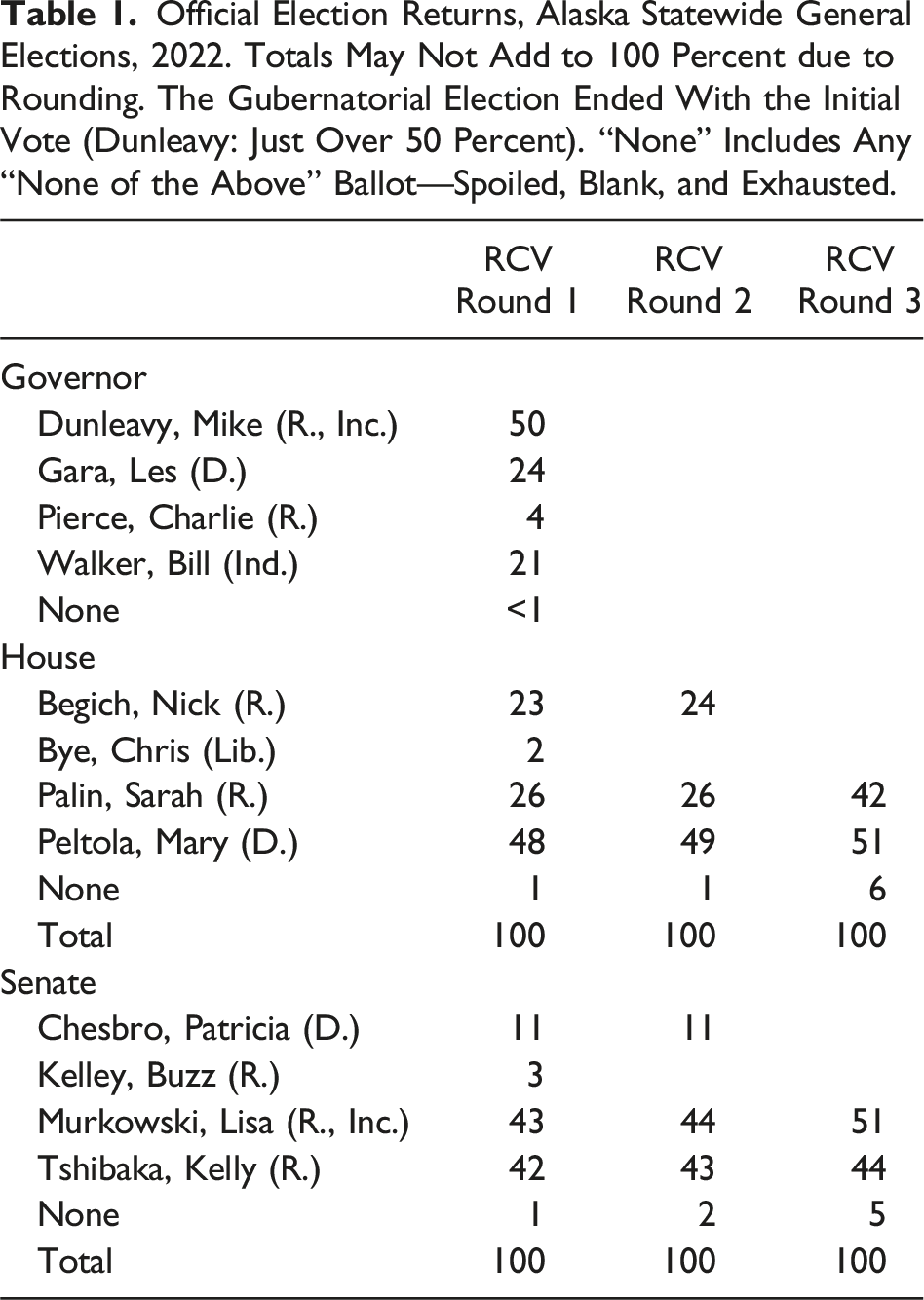
Governor Mike Dunleavy demonstrated that a Republican incumbent, lacking the personalities or controversial positions present in some of the other contests, could win handily. In the primary, Dunleavy finished in first place (with 40 percent of the vote). From a field of ten candidates, the rest of the top-four included the following: a second-place Democrat, Les Gara (23 percent); a third-place independent, former Governor Bill Walker (23 percent); and Charlie Pierce, a distant fourth-place Republican (at 7 percent). The fifth-place candidate, the closest alternative denied an opportunity to move forward, was another Republican (4 percent). Using a top-2 election, only Dunleavy and Gara would have advanced. Even with the top-4 rules, Dunleavy and Gara finished first and second again in the general election (as shown in Table 1). The rankings of the Gara, Walker, and Pierce voters are irrelevant because Dunleavy earned just over 50 percent of the general election vote to win outright. 4 The leading Republican candidates for House and Senate, though, were not as well-positioned as Dunleavy.
Democrat Mary Peltola won a surprising victory in the House race, securing the seat Republican Don Young held for decades. Following his death, Alaska held a special election where the top-4 primary for the regular House election took place at the same time as the RCV general special election, with mostly the same candidates. Both elections had two Republican candidates obtaining meaningful shares of the vote alongside Peltola: Sarah Palin and Nick Begich. Peltola won the special election with 51 percent of the vote after the RCV tabulation, alarming Republicans nationally ahead of the regular election (Shabad 2022). For the full-term primary, Peltola came in first (37 percent) in the large field of candidates; Palin finished second (30 percent) and Begich third (26 percent). The fourth-place candidate earned four percent but withdrew from the race, advancing the fifth-place finisher, Libertarian Chris Bye. As shown in Table 1, Peltola came close to winning the general election on the first ballot (48 percent). 5 Few voters (about 2 percent) selected Bye, so his elimination did little to alter the race. Palin ran just ahead of Begich, so the RCV procedure next eliminated Begich. Had every Begich supporter selected Palin as the next choice, Palin could have narrowly beat Peltola. Yet, Begich voters were split in how they recorded their next preference after Begich. Some Begich voters left incomplete rankings or ranked Peltola second. With only some Begich voters next choosing Palin, Peltola won comfortably 51-42 percent, with 6 percent incomplete or blank. Peltola is a candidate with a unique identity and political orientation, as she focused on local issues rather than national ones, and was the beneficiary of an intra-party Republican feud.
In the Senate contest, the anti-Murkowski Republicans rallied around Kelly Tshibaka. Murkowski finished first (45 percent) and Tshibaka second in the primary (39 percent), with Democrat Patricia Chesbro in third place (7 percent) and Republican Buzz Kelley in fourth (2 percent). Although the Senate contest, like the U.S. House race, had many names on the ballot, both really had only three competitive candidates. While Chesbro faced long odds, she had the benefit of being the only Democrat to advance and was a serious candidate (Lester 2022). In the first round of the general election, Murkowski and Tshibaka were nearly tied (43-42 percent), while Murkowski ran comfortably ahead of Chesbro. Removing fourth-place finisher Kelley, who earned approximately 3 percent of the vote, did not change the totals much, leaving Murkowski ahead of Tshibaka 44-43 percent. Eliminating third-place Chesbro put Murkowski over the top with 51-44 percent in the final contest between the last two—both of whom were Republicans, with 5 percent of the ballots exhausted or empty and not attributed to either candidate. The results suggest that Murkowski obtained Democratic votes, which we confirm with the survey data.
Survey Results: Voter-Level Data on Candidate Support in the Top-4/RCV System
Alaska’s 2022 Senate Election, Survey RCV Procedure. N = 700, Weighted Column Percentages. Following the Same Ranked Choice Voting Rules as in the Election and Including Side-by-side Comparison With the True Percentages by Elimination Round.
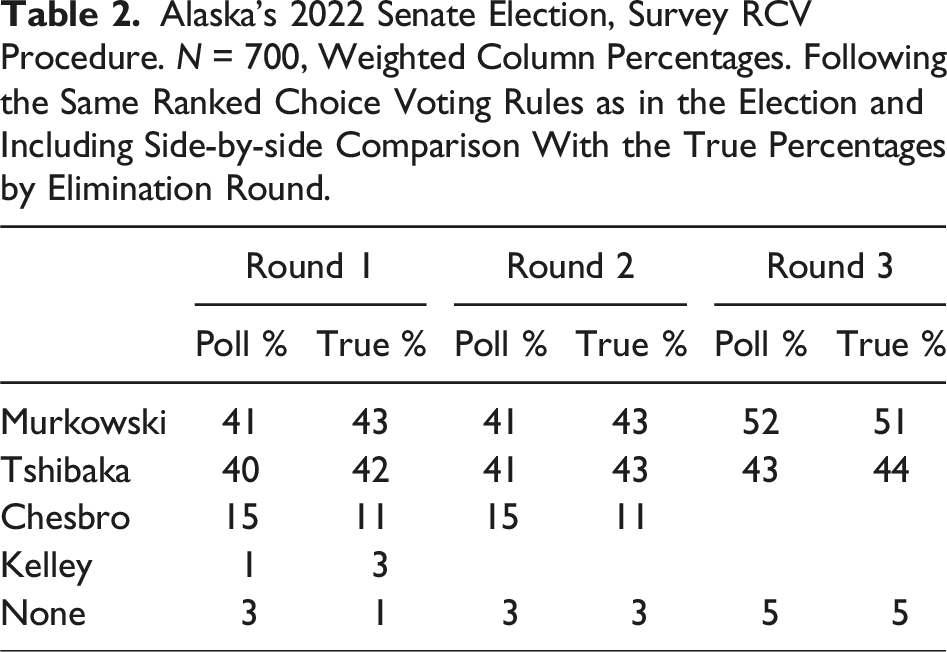
Table 3 displays candidate first-round preferences by the independent variables relevant for our first and second hypotheses, party and group affiliations. First, we have to determine if Murkowski would have been the likely winner under alternative rules and, second, if there is evidence of strategic behavior on the part of some segment of voters. One approach for addressing both issues focuses on the factional identity of voters beyond party identification. To measure this, we asked respondents “from this list, which politician comes closest to representing your views?”
7
Respondents could choose among twelve politicians, grouped after the fact as follows: • Progressives: Bernie Sanders or Alexandria Ocasio-Cortez. These are well-known national progressives. • Regular Democrats: Jim Clyburn, Kamala Harris, Joe Biden, or Joe Manchin. While these are politicians of varying ideological predispositions, they represent “establishment” types. • Anti-Trump Republicans. Mitt Romney, Liz Cheney, or Lisa Murkowski. These were selected because of their support for impeachment. Romney and Cheney together only command 6 percent of the total responses; 18 percent of Alaskans said Murkowski. • DeSantis Republicans. Ron DeSantis and Tim Scott. These were potential alternative 2024 Republican presidential candidates. The category is named for DeSantis since 20 percent selected him and only 1 percent selected Scott (we did not include Nikki Haley on the list at the time). • Trump Republicans. Donald Trump only. This category provides an important comparison between the Trump and DeSantis Republicans. Alaska’s 2022 Senate Election, First Round Vote by Factional Type. Political Faction Determined by Responses to Political Leader Preferences; Standard Five-pt. Ideology Question; When Crossed With Party Affiliation, the Ideology Categories are Collapsed for Convenience. The Final Question Covers the Second Trump Impeachment for all Voters. Displays Weighted Row Percentages and, as a Column, the Percentage of Voters in Each Category. N = 700.
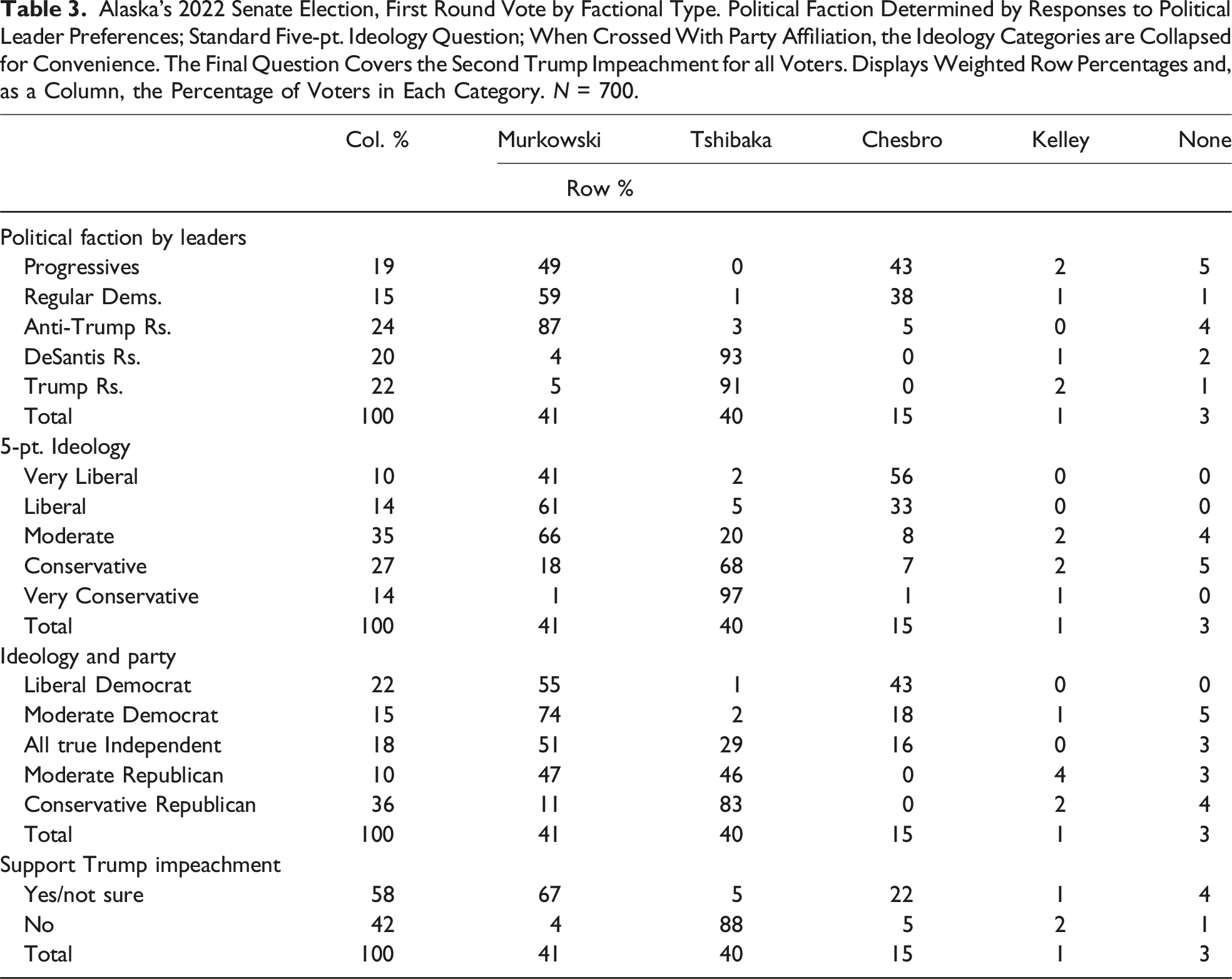
We expect support for Chesbro to be most common among Progressives—and it is, although more still selected Murkowski (49-43 percent). The Murkowski–Chesbro split is slightly more pronounced among the regular Democrats. Unsurprisingly, since she is included, the anti-Trump group overwhelmingly favors Murkowski (87 percent; the group includes 24 percent of the respondents). The most interesting finding is the near-uniform support for Tshibaka among the DeSantis (93 percent) and Trump Republicans (91 percent).
By ideology, the “very liberal” prefer Chesbro, although this is a small group (only 10 percent). Tshibaka earned 97 percent of the support of the most conservative. We also paired ideology with party identification to better understand what the “moderates” may mean. The ideology and party group takes the “very liberal” and “liberal” Democrats and combines them, and then does the same with those respondents who are “moderate” or “conservative” Democrats. This process is mirrored for the Republicans, leaving true independents of every ideology grouped together (nearly all are moderates). This pulls the larger moderate category apart. What we can see from this section of Table 3 is that liberal Democrats support Chesbro more than moderate Democrats, who overwhelmingly prioritized Murkowski. Moderate Republicans are somewhat rare (only 10 percent) and divided. The conservative Republicans go overwhelmingly for Tshibaka (83 percent).
Table 3 illustrates Murkowski’s partisan primary risk. Tshibaka earns the vote of 88 percent of those opposed to Trump’s impeachment, but only 5 percent of those who supported it or were unsure. While there is a broader conversation in political science about the appeal of Trump to Republican voters, once we take those preferences and world-views as given, it is not hard to apply them in institutional contexts like this one. We do not conduct multivariate analysis for this because there is little variation once attitudes toward Trump are taken into account.
The Top-4/RCV Electoral System Helped Lisa Murkowski Win
The information in Table 3 helps to confirm our first hypothesis: Murkowski would likely have lost a partisan Republican primary. She was only the preferred first-round Senate candidate of 19 percent of her own party (independent-leaning Republicans included). Of those opposed to Trump’s impeachment, she was the favorite of only 4 percent. While her weakness in a Republican primary seems clear, the result of having a partisan primary system is less obvious, particularly given her support among Democrats. We’ll return to this point in the conclusion, but part of an assessment of the consequences of the electoral system will depend on an assessment of how she came to have much Democratic support. Did a segment of the Democratic electorate abandon a weaker candidate of their own party in a tough-to-win place to help the most acceptable alternative of the dominant party?
Alaska’s 2022 Senate Election, Survey Pairwise Comparisons. N = 700. Weighted Survey Data Showing Percentages Within Party Groupings Preferring Each Candidate Using Separate Pairwise Comparison Questions. The Survey Did Not Include Pairwise Questions for Kelley.
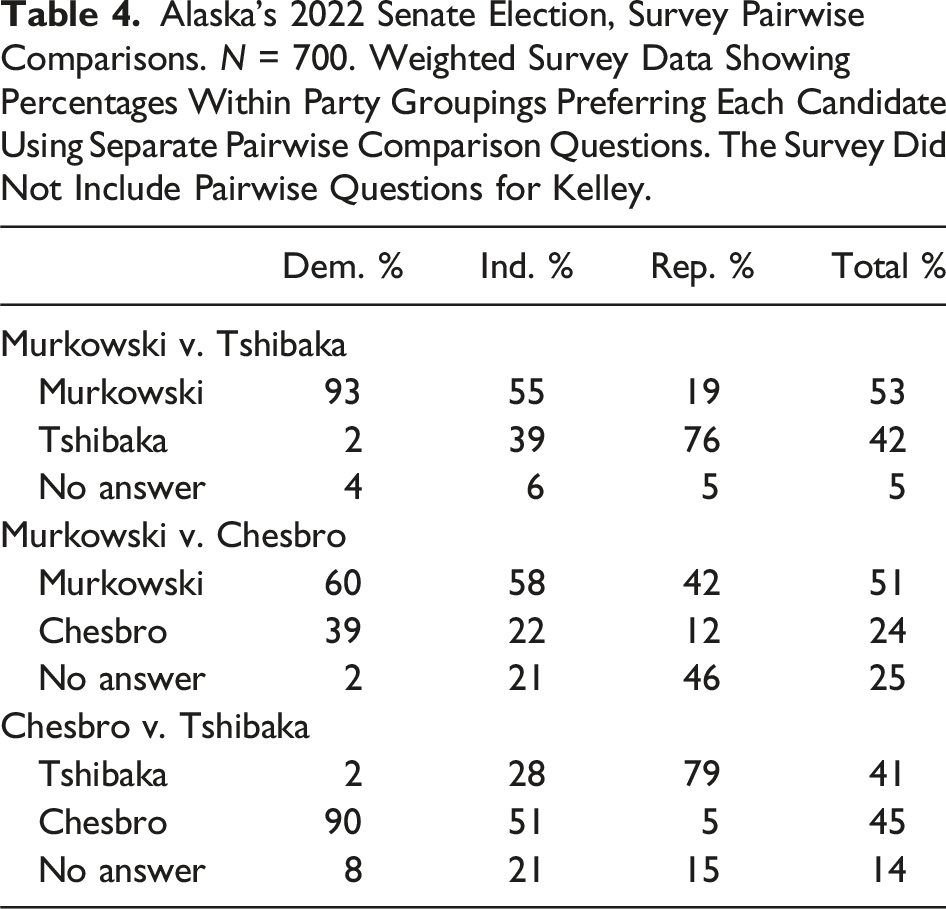
The head-to-head data presents two challenges for the strategic voting story. Unsurprisingly, as we find when applying the RCV procedure to the rankings in the survey, Murkowski beats Tshibaka head-to-head overall, with Democrats overwhelmingly preferring Murkowski (93 percent) and Republicans preferring Tshibaka (76 percent). Unexpected, though, is that Murkowski beats Chesbro head-to-head among Democrats, even when abstracted away from the actual vote choice and ranking system. Murkowski wins convincingly among Democrats, 60-39 percent. Chesbro beats Tshibaka 45-41 percent, though this closer-than-expected finding should be treated with caution, as 14 percent gave no answer for this matchup. Murkowski is a Condorcet winner, beating the other two serious contenders head-to-head. 9 She also beats them in a plurality election, and with the ranked-choice voting procedure used in Alaska. The earlier evidence shows that the top-4/RCV system allowed a popular candidate to avoid a primary loss. Yet the evidence for our second hypothesis about the strategic voting is weaker. The results suggest that Murkowski had a considerable amount of support, even among Democrats.
However, there is some evidence for strategic behavior, or at least strategic thinking. We asked voters how they made their decision. Did they just vote for their favorite candidate, rank candidates and consider electability, or rank candidates simply in order of personal preference? Democrats and Independents faced the most substantial dilemma in this regard. Among that group of party identifiers (N = 356), 21 percent both voted for Murkowski first and self-reported considering electability (amounting to 1-in-3 Democratic/Independent votes for Murkowski). Of the voters ranking Chesbro first, the proportion self-identifying as choosing based on electability was much smaller (about 1-in-7).
Some Democrats signal strategic behavior with the head-to-head questions: 8 percent of Democrats both ranked Murkowski first and favored Chesbro head-to-head. For many, though, the survey does not provide conclusive evidence of casting tactical votes through the explicit acknowledgment of considering electability in the rankings or head-to-head preferences. It still may be strategic behavior, as 38 percent of respondents prefer Peltola on our House question and yet ranked Murkowski first for Senate. That amount of Democratic crossover voting for Republican Murkowski implies that there could have been some sophisticated behavior in this contest. In the context of the heated Trump–Murkowski feud, voters are limited in strategic messages that can be sent via elections (Alvarez and Kiewiet 2009). Apparent tactical behavior is a way of clearly expressing disdain for the strongest opponent: it indicates that defeating the least-favored candidate is the most important consideration. It is possible that Democrats are trying to speak clearly in the same way in this 2022 Alaska election by repeatedly expressing a preference for Murkowski to express disdain for Trump.
Voter Partisanship is Associated With Support for Top-4/RCV
Turning to our third hypothesis, we examine the relationship between partisanship, populist attitudes, and views about electoral systems. Here, the dependent variables are respondent preferences related to the Alaska top-4/RCV electoral rules. Our independent variables include populist attitudes, which cross party lines, and voter partisanship. The measures of the three types of populist attitudes help explain the remaining variation unexplained by partisanship in our analysis focused on support for particular primary rules.
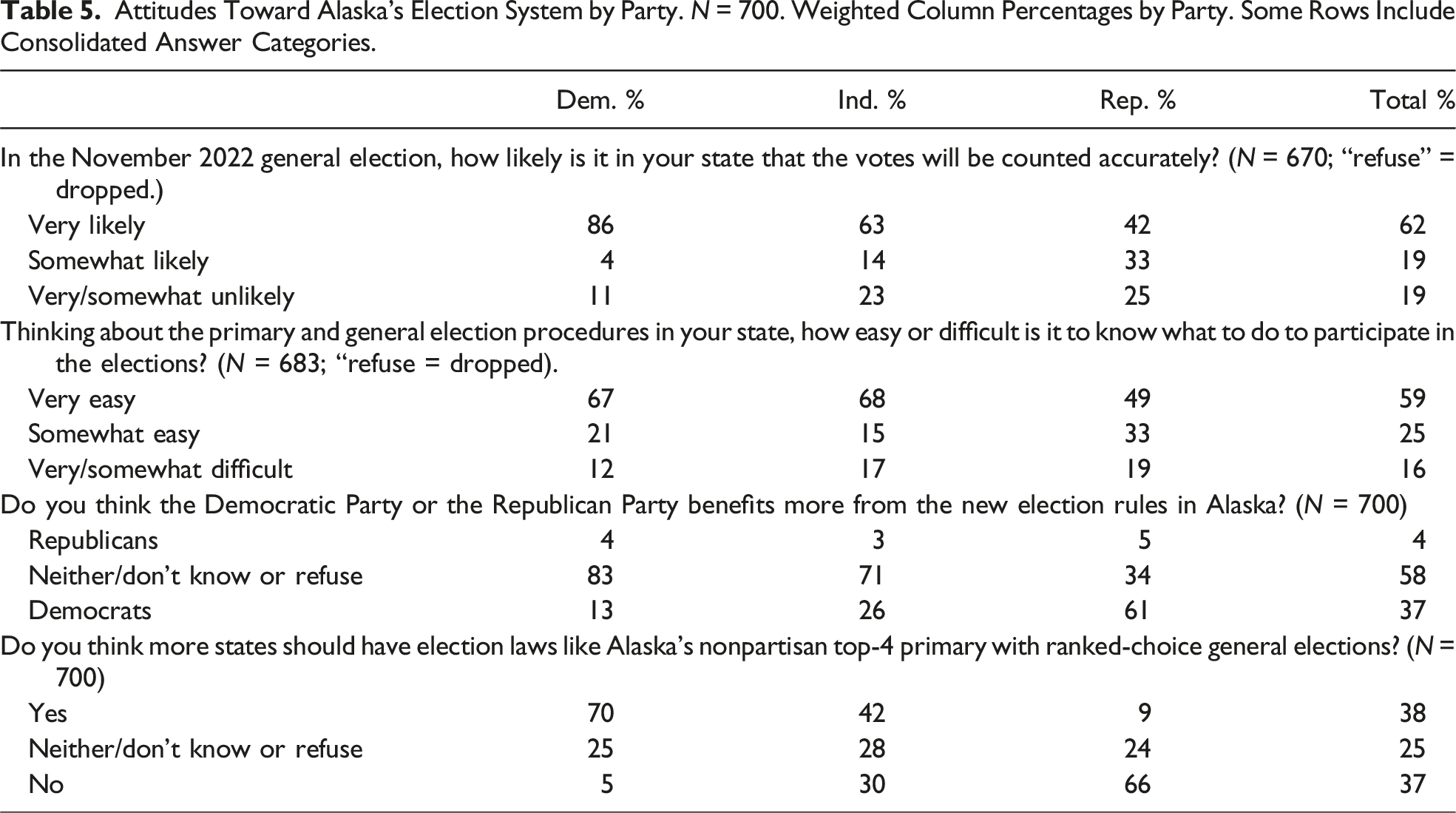
Attitudes Toward Alaska’s Election System by Party. N = 700. Weighted Column Percentages by Party. Some Rows Include Consolidated Answer Categories.
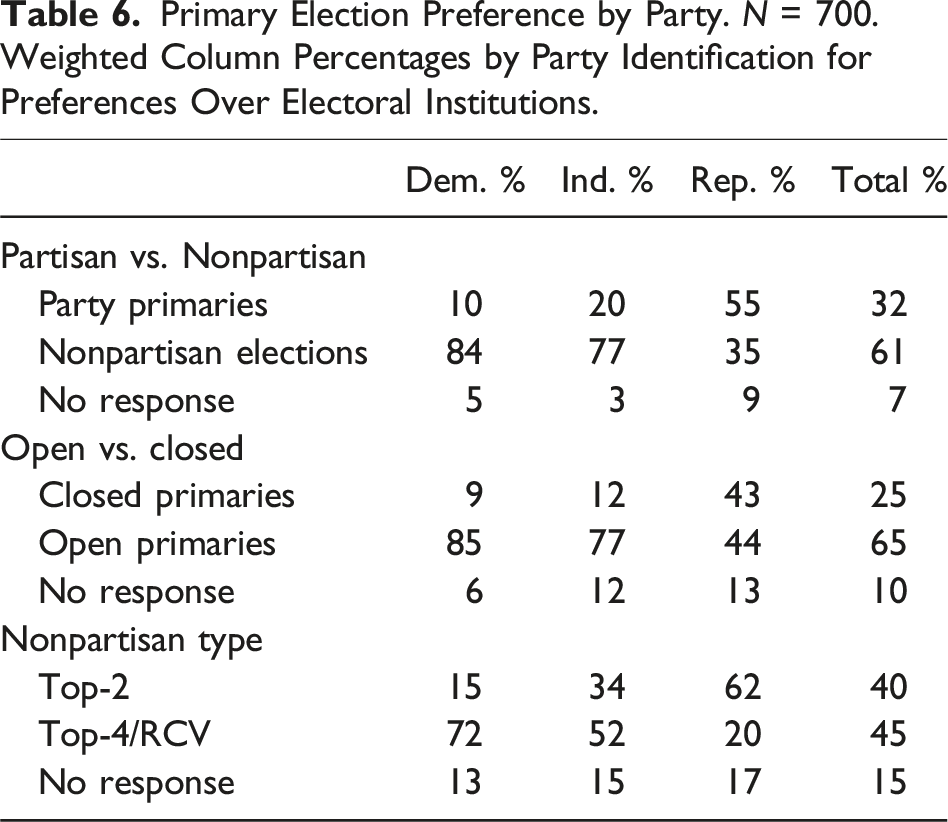
Primary Election Preference by Party. N = 700. Weighted Column Percentages by Party Identification for Preferences Over Electoral Institutions.
Overall, respondents thought the 2022 top-4/RCV system in Alaska was administered well, but there are partisan differences. Given the national context, contrasting partisan messages about election procedures following the 2020 election, and complexity of RCV procedures, it is a positive sign that only 25 percent of Republicans thought the ballots were very or somewhat unlikely to be counted accurately (19 percent for all voters). Similarly, only 19 percent of Republicans thought it was somewhat or very difficult to know what to do to participate in Alaska’s elections (16 percent for all voters). Most respondents (59 percent) thought it was “very easy” to know what to do.
The substantial partisan differences concern who benefits. On balance, and including the independents, the reviews are mildly favorable. The partisan differences can be explained by the election outcomes: Democrats did better than usual in Alaska in 2022. Therefore, it is not very surprising that Democrats favored the rules under which these outcomes occurred, and many Trump-leaning Republicans did not. Among Republicans, 61 percent thought the law benefited Democrats; only 13 percent of Democrats thought the same. Democrats (and Independents) tended to think the rules benefited neither party. Among Republicans, only 9 percent thought other states should use this rule; in contrast, 70 percent of Democrats did. This result suggests that the first post-reform election result hardens attitudes about the electoral system along party lines.
Additional survey questions permit comparing the Alaska laws to alternative systems (full question text is in the appendix). Every respondent got each of the questions in Table 6. Alaska Democrats favor nonpartisan-type elections (like the top-4/RCV and top-2) over having party primaries. They also prefer open partisan primaries over closed partisan primaries and favor the top-4/RCV system over the top-2 primary system. The magnitude of the preference for top-4/RCV over top-2 (72-15 percent) is surprisingly large, though the introduction of top-4/RCV in the state before is concurrent with the survey timing, and is consistent with past research (B. Sinclair and Sinclair 2021). The preferences of true Independents also mirror the Democrats. The key finding is that Republican opposition to nonpartisan elections is not as strong as Democratic support for them: Republicans only favored partisan primaries 55-35 percent. Republicans evenly divide between preferring open and closed partisan primaries. With closed partisan primaries preferred by minorities of Democrats and Independents, and only by about half of the Republicans, only a minority of the respondents wish to have these kinds of partisan electoral institutions. 10 These questions did not force respondents into a branching structure, but there is a branching logic to them. We created a variable for rule preferences that respects the split between partisan and nonpartisan primaries on the first question and then places respondents into the appropriate category in the follow-up question. With this type of branching structure, 38 percent of respondents would prefer the top-4/RCV option, 17 percent the top-2, 12 percent prefer open, and 18 percent prefer closed; 15 percent of the respondents did not give complete answers. 11
Populist Attitudes are Associated With Lower Support for Top-4/RCV
To examine the relationship of populist attitudes and respondents' attitudes about preferred primary type, controlling for partisanship, we use a multinomial logistic regression, implemented using the svy package in Stata 18. There are four values of the outcome variable (top-4/RCV, Nonpartisan, Open, and Closed) and 614 respondents without missing responses for these survey questions. The three populism categories are anti-elite, anti-expert, and national identity sentiments derived from Oliver and Rahn (2016) and measured on a five-point scale from strongly disagree to strongly agree, normalized so that strongly disagree (the least populist answer) equals zero and strongly agree (the most populist answer) equals one. Anti-elite sentiment is measured with two questions and averaged; we used one question each to measure anti-expert and nationalistic populism sentiments. Full question wordings (and a more extensive discussion of these measures) are presented in the appendix.
12
As control variables we include measures of age (above/below 50), gender (male/not), race (white/not), and education (4-year college/not).
13
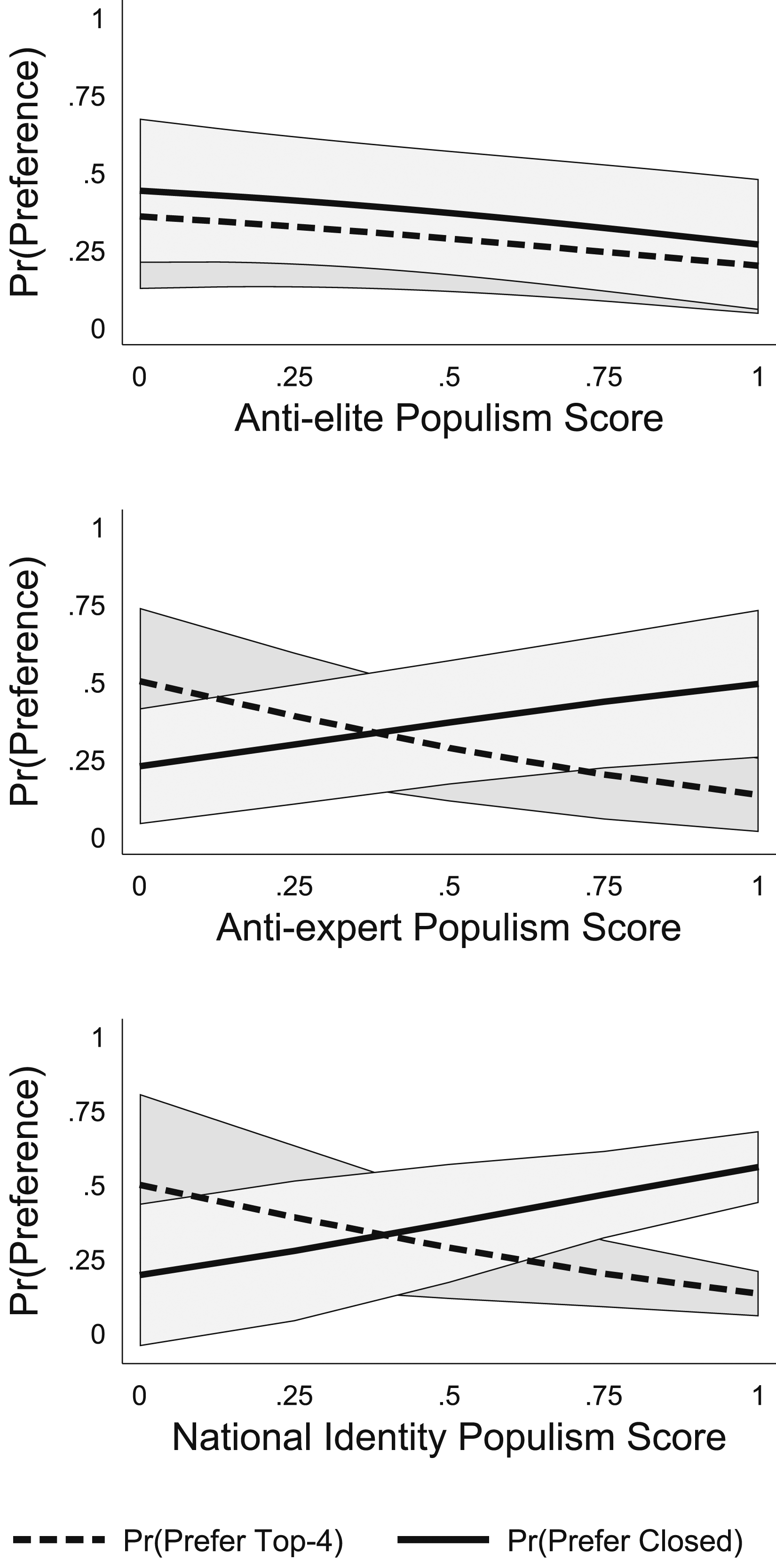
Figure 1 presents estimated coefficients, and Figure 2 shows predicted probabilities for a range of populism values for a Republican voter (the most common partisan category in Alaska). Coefficients from multinomial logistic regression for primary type. N = 614 respondents with a complete rule preference order. Coefficients relative to top-4/RCV as preference, meaning higher values correspond with increased likelihood of preferring each alternative system over the top-4/RCV. Predicted probability of support and 95 percent confidence intervals for nonpartisan top-4 and closed primaries by voters' populism attitudes. Higher values on the y-axis show greater probability of supporting each primary type; and higher values on the x-axis indicate increasing levels of each populist attitude. These figures also assume a Republican voter, over 50, male, white, and college educated. Displaying predicted values only for top-4/RCV and closed primary preferences.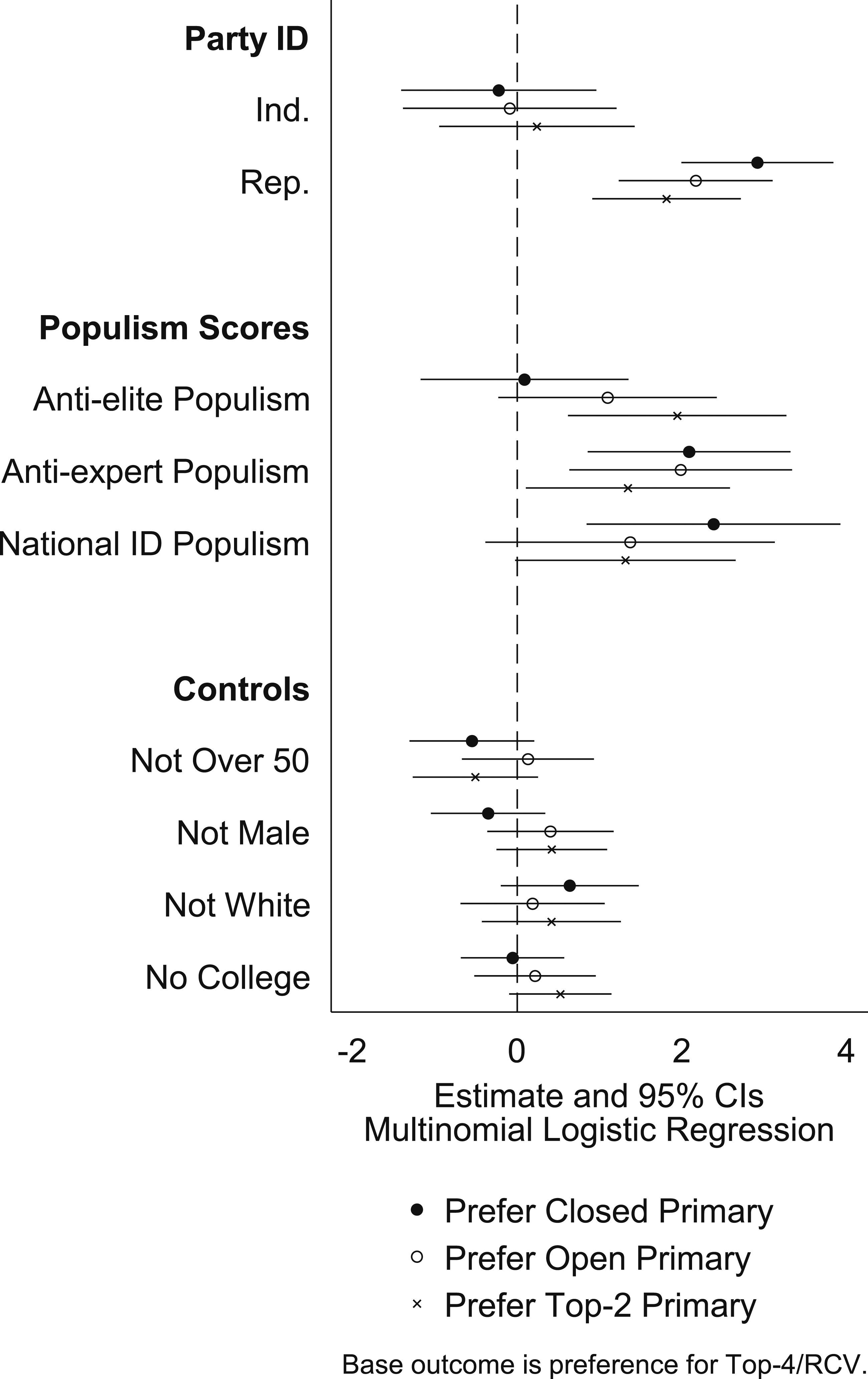
While we find no significant difference between Democrats and Independents, Republicans are more likely to prefer any alternative to the top-4/RCV system. Consistent with Oliver and Rahn (2016), anti-elite populism can be found in both parties. We find no relationship between anti-elite populism and a preference for closed over top-4/RCV primaries. Oliver and Rahn, though, found that Trump’s supporters tended to have high scores in anti-elite, anti-expert, and national identity populism. We find that respondents with high levels of anti-expert and national ID populism are more likely to prefer closed to top-4/RCV elections. Higher anti-expert populism scores are generally associated with a rejection of the top-4/RCV system.
Figure 2 assumes a profile of a Republican respondent, and holding all other levels of populism at their theoretical midpoint (0.50), there is little difference in the probability of selecting top-4/RCV for someone with a higher or lower anti-elite populism score. Those Republicans are about equally likely to pick a closed primary system and top-4/RCV. As anti-expert scores increase, though, such a voter becomes considerably more likely to favor closed primaries, at an approximately 50 percent chance for those strongly agreeing with the “mistrusting experts” statement. Nearly, the same is true for the national identity populism score. Of course, those with both high national identity and anti-expert populism scores, the kinds of Republicans most likely to favor Trump, are quite likely to favor closed primaries.
The main findings from this analysis are that Democrats and Independents liked the new top-4/RCV rules while Republicans did not. Voters with strong anti-expert and nationalistic populist attitudes were opposed to the Alaska electoral reforms, while there was no observable effect for anti-elite attitudes. Even when controlling for partisanship, there is an association between some types of populist attitudes and preferences over reform. The Alaska reform gets some support from Democrats, from low-populism Republicans, and from voters with lower levels of hostility to experts.
Conclusion: Partisanship and Populism Explain Attitudes Toward the Top-4/RCV
Each election cycle provides new opportunities to learn about the broad trends and variation in outcomes from this new class of nonpartisan election rules, adding Alaska’s new variant to the top-2 in California and Washington. In our study, we set out to address three critical questions about how the system worked in Alaska in its first year and to offer an initial look at how this electoral system may unfold in the long run. Overall, we find that the system likely helped Murkowski retain her seat, that the evidence is mixed about how likely such events are to occur with other candidates and circumstances, and that the system has a substantial but not overwhelming amount of support. From these findings, we can tease out some of the implications for potentially adopting this rule for other electoral contexts in the United States.
First, our survey data strongly suggests Murkowski would have been in trouble in a partisan Republican primary. Of course, there are limitations to exploring the counterfactual; if Alaskans had narrowly rejected, instead of narrowly accepting, Measure 2 in 2020, perhaps a great number of other different choices might have followed—Murkowski switching parties, or running as an independent, or casting a different vote for presidential removal, improbably winning as a write-in again, and so on. What is clear from our data, though, is that the majority of Republicans preferred Trump-endorsed Tshibaka at the time of the 2022 election. To the extent that the top-4/RCV helped Murkowski build the coalition she needed to win reelection, this race demonstrates the potential for a more moderate candidate to avoid being “primaried” and to win the general election. For the reform’s advocates, that finding is largely consistent with their claims.
Second, we also find that such a result may not always occur with moderate candidates. Murkowski was an experienced, long-time incumbent, with high name-recognition; she also had some support from Republicans to go along with substantial support from Democrats and Independents. The Democratic first-round vote for Murkowski we observe in this case may not materialize for other centrist Republicans in Alaska or elsewhere, should other states adopt this rule. It will take several election cycles to get a better sense of the strategic voting incentives and behavior in Alaska, to see whether Democrats regularly abandon weaker Democrats for moderate Republicans, as they did with Chesbro for Murkowski, while backing stronger Democrats like Peltola. Too many Democrats and Independents on our survey ranked Murkowski ahead of Chesbro to be confident about the incentives for strategic behavior in these elections in the future.
Third, there is broad, but not universal, support for the new rules. While many Alaskans liked the new rules, some Republicans did not. While it is sensible that voters on the “winning side”—the anti-Trump Republicans and Democrats, strong enough to pass the rules and elect Peltola and Murkowski with them—like the rules, the populism findings add some nuance to a simple dichotomy. After taking partisanship into account, some populism attitudes, those most uniquely associated with former President Trump, correspond with hostility toward the system, and a preference for closed primaries instead. Defenders of this system in Alaska and advocates for it elsewhere may attempt to politically maneuver by using anti-elite populism arguments, which—controlling for partisanship—did not have the same kind of negative relationship with top-4/RCV rule preferences. Since Democratic voter enthusiasm for the top-4/RCV could also be attributed to the U.S. House result, with a Democratic candidate winning, future work will have to continue to evaluate the durability of these attitudes in the face of changing electoral fortunes and expectations over time.
Finally, the advent of the top-4/top-5 alternative is also an opportunity to expand the research agenda on electoral systems in the United States. While top-4 is part of a class of primaries allowing all voters to choose among all candidates, it is a different system than the top-2. Yet, so far, the Alaska results do not suggest large differences in outcomes between the top-2 and the top-4/RCV systems. The Senate primary in Alaska, if conducted with a top-2 rule, would have likely produced a Tshibaka–Murkowski general election, for which the outcome would presumably have been similar. Going forward, this will need to be a major part of the research agenda for these types of electoral institutions: not only distinguishing them from traditional partisan primaries but also trying to understand how they differ from each other. The Murkowski victory has given advocates another selling point, and the observed popularity of these primary types may make them difficult targets for repeal. Yet political scientists' knowledge about these systems, especially top-4/RCV, is nascent. The consequences of these systems have enduring relevance for understanding how electoral systems shape U.S. history.
Supplemental Material
Supplemental Material - Electoral Innovation and the Alaska System: Partisanship and Populism Are Associated With Support for Top-4/Ranked-Choice Voting Rules
Supplemental Material for Electoral Innovation and the Alaska System: Partisanship and Populism Are Associated With Support for Top-4/Ranked-Choice Voting Rules by J. Andrew Sinclair, R. Michael Alvarez, Betsy Sinclair, and Christian R. Grose in Political Research Quarterly.
Footnotes
Declaration of Conflicting Interests
The author(s) declared no potential conflicts of interest with respect to the research, authorship, and/or publication of this article.
Funding
The author(s) disclosed receipt of the following financial support for the research, authorship, and/or publication of this article: The Division of Humanities and Social Sciences at the California Institute of Technology and the Weidenbaum Center at the Washington University in St. Louis provided the funding for the survey.

Data Availability Statement
Supplemental Material
Supplemental material for this article is available online.
Notes
References
Supplementary Material
Please find the following supplemental material available below.
For Open Access articles published under a Creative Commons License, all supplemental material carries the same license as the article it is associated with.
For non-Open Access articles published, all supplemental material carries a non-exclusive license, and permission requests for re-use of supplemental material or any part of supplemental material shall be sent directly to the copyright owner as specified in the copyright notice associated with the article.
