




Abstract
A common explanation for Hillary Clinton’s loss in the 2016 presidential election was that she catered to minorities at the expense of the broader electorate. How does such a loss narrative influence voters' interpretation of subsequent elections? In a conjoint experiment, white and Black Democratic respondents were randomly exposed to a vignette that ascribed Democrats’ 2016 losses to their focus on identity politics. This narrative had an asymmetric effect on attitudes toward the 2020 election based on both race and gender. While it had no impact on white men’s or Black women’s understanding of why the Democrats lost the last presidential election or their candidate preferences for the next, it had a substantial impact on the electoral attitudes of white women and a moderate impact on those of Black men. Specifically, it shifted their support away from candidates committed to gender and racial equity and toward those emphasizing broad economic policies. The identity politics loss narrative thus may have acted as a self-fulfilling prophecy that advantaged white male candidates in the 2020 election.
Introduction
A common explanation for the outcome of the 2016 American presidential election was that Hillary Clinton lost because of her practice of “identity politics.” That is, her outreach and championing of women, people of color, the LGBT community, and other politically marginalized and underrepresented groups ultimately alienated white, male, middle class voters, who in turn voted for Donald Trump. A Democratic nominee promoting a more inclusive and universal message, the argument goes, would have kept those swing voters within the Democratic fold.
In this paper, we are less concerned with evaluating the truth of this argument than examining the consequences of making it. If voters heard this election loss narrative, how did it affect their interpretation of the 2016 election? First, did they accept it as valid? If so, did it influence who they saw as an ideal Democratic presidential nominee for 2020? These are not idle questions. The Democratic presidential field for the 2020 election was the most diverse in the party’s history, and questions of identity were at the fore of consideration by party leaders and voters. If political observers and party elites can use an election loss narrative to influence how voters interpret the role of gender and race in recent elections, and consequently how they evaluate current presidential candidates, they can do much to shape the contours of the next major election.
We examined these questions with a unique conjoint survey experiment in which white and African American Democratic identifiers chose between two Democratic candidates in a series of primary trial heats. We exposed a subset of the respondents to an identity politics narrative about Democratic losses and measured how the narrative influenced the kinds of candidates that Democratic identifiers preferred for the 2020 presidential election. Our findings suggest that potential Democratic voters reacted to this identity politics loss narrative quite differently depending on both their race and gender. While the narrative had little impact on the candidate preferences of white men, it caused white women to shift their candidate preferences away from a woman explicitly looking to address gender and racial inequities, and toward a man emphasizing more general economic issues. African American men reacted similarly to white women, although the effects were smaller. While African American women were unphased by the identity politics loss narrative, the overall effect was nonetheless substantial enough to impact the kinds of Democratic candidates most likely to win in a primary contest. These findings imply that the loss narratives political elites adopt in the wake of an election could have profound consequences for future contests.
Framing an Election Around Identity
Arguing over the interpretation of an election is a longstanding tradition in politics. As Azari (2014) argues, modern presidents often seek to define their victory in a way that adds legitimacy to their presidency, particularly when their election was close or questionable. More broadly, campaigns and political observers seek to define recent elections in ways that advantage certain groups and causes (Azari and Stewart 2015). Mandate frameworks tend to be adopted quickly by news organizations and are highly durable over time (Grossback, Peterson, and Stimson 2006; Mendelsohn 1998).
Perhaps just as important as narratives about victories, although far less studied, are those about losses. Hershey’s (1984, 1992) work examines efforts by observers to understand why Walter Mondale lost to Ronald Reagan in 1984 by such a substantial margin. The interpretation of the 1984 election was part of a decades-long effort by some Democratic leaders to reposition the party toward the center and advantage its white Southern wing. On the flip side, the Republican Party’s 2012 “post-mortem” report (Barbour et al. 2013) was an attempt by more moderate voices within the GOP, including several Republican National Committee leaders, to interpret Mitt Romney’s loss to Barack Obama as a call to create a more inclusive party and resist nativist voices. The effort by former House Speaker Paul Ryan and others to interpret the 2022 midterm elections as the result of a “Trump hangover” was also a campaign to steer the Republican Party away from re-nominating Trump in 2024 (Pesce 2022). These loss interpretations were not simply intellectual exercises to assess an election; they were efforts to guide the party by advantaging some voices and claiming others were the cause of its recent failures.
But to what extent do loss narratives influence ordinary voters? Despite considerable scholarship on how loss narratives shape internal party debates, there has yet to be a systematic analysis of their impact on the electorate. This oversight is particularly conspicuous given how readily the public can be swayed by media coverage and elite messaging on other politically relevant issues (Druckman 2004a; 2004b; 2011; Issenberg 2012; Jacobson 2015; Lenz 2012; Zaller 1992). Political communications can be particularly influential when they come from a trusted partisan source (Slothuus and Vreese 2010). If a partisan source offers a loss narrative that fellow partisan voters find useful, they may employ it in the process of sorting between options in the next election. We home in on the narrative that the Democratic Party is electorally disadvantaged by their focus on minorities—a claim that became particularly dominant among influential Democrats in the wake of the 2016 presidential election—to better understand how electoral loss narratives impact voters’ decision-making.
A common argument to emerge in the days after the 2016 election laid the blame for Clinton’s loss on “identity politics.” We refer to this argument as the identity politics loss narrative. Versions of this argument emerged from many different authors and outlets, but an oft-cited one was humanities professor Mark Lilla’s New York Times op-ed, “The End of Identity Liberalism” (2016), coming just a week after the election Clinton was at her best and most uplifting when she spoke about American interests in world affairs and how they relate to our understanding of democracy. But when it came to life at home, she tended on the campaign trail to lose that large vision and slip into the rhetoric of diversity, calling out explicitly to African-American, Latino, L.G.B.T. and women voters at every stop. This was a strategic mistake. If you are going to mention groups in America, you had better mention all of them. If you don’t, those left out will notice and feel excluded. Which, as the data show, was exactly what happened with the white working class and those with strong religious convictions (Lilla 2016).
Various versions of this argument were made by countless political observers in the weeks following the election. “Democrats must drop identity politics,” said commentator Froma Harrop (2016). Chicago Tribune columnist Clarence Page (2016) urged Democrats to “forget identity politics.” John Judis (2016) claimed Hillary Clinton lost because Democrats “overestimated the strength of a coalition based on identity politics.” The New York Times published 68 references to identity politics in the month following the 2016 election alone. It is reasonable to suggest that this became a leading, if not the consensus, interpretation of the election’s outcome among the United States’ commentariat.
Some variant of the identity politics loss narrative has been posited among Democratic leaders whenever the party lost an election over the past half century or so (Shafer 1983; Klinkner 1994; Frymer 1999). It’s not obvious that the Clinton campaign made more references to particular demographic subgroups than the campaigns of other modern Democratic presidential nominees. Moreover, despite losing the electoral college, the Clinton campaign held enough broad appeal to win the popular vote. Yet this critique has largely stuck.
Just as party actors have used the identity politics loss narrative to call for specific actions or to advantage one faction over another, we argue that different groups of partisan voters may respond to the narrative in varying ways. If the political media settle on a narrative that blames a particular group within a party—liberals, young people, women, African Americans, etc.—for a recent loss, it could affect partisan voters’ interpretations of those groups and the proper role they play in politics. While the identity politics loss narrative largely puts the blame on candidates for emphasizing some groups of voters over others, it also implicitly suggests that those marginalized groups are somehow to blame for prioritizing their grievances. The narrative, that is, blames female candidates and candidates of color as well as those who seek policy changes that promote rights and benefits for underrepresented groups, all of which purportedly have the effect of alienating white, male, moderate voters in swing states. If you hadn’t asked for everything, the narrative insinuates, the party would have won, and you would have gotten something as opposed to nothing. The groups of voters implicated by the identity politics loss narrative must thus decide whether to embrace or reject it as they contemplate the next election.
While the identity politics loss narrative caters to the preferences of white men and is arguably targets them, it likely has a substantial effect on women and minority voters. And any effect on them could change the direction of the party. White women now comprise a plurality of self-identified Democratic voters, while African Americans make up nearly a quarter of Democratic identifiers. They thus represent highly influential voting blocs within the party. Given Democratic Party’s shifting gender demographics and ongoing contention over electability, this study is especially interested in how the identity politics loss narrative interacts with Democratic voters’ race and gender.
The existing literatures in these areas offer conflicting possibilities. On the one hand, it has been well-established that gender and race are critical dividing lines in public opinion (Barnes and Cassese 2017; Burns and Kinder 2011; Huddy, Cassese, and Lizotte 2008). Moreover, African Americans and women receive better substantive representation from members of their own groups (Haynie 2001; Haines, Mendelberg, and Butler 2019; Mansbridge 1999; Preuhs 2006; Shah and Marschall 2012). Thus, from a self-interest perspective, white women and African Americans—who could leverage their plurality within the Democratic Party—should reject the identity politics loss narrative and push for their preferred candidates. On the other hand, political decision-making frequently derives from people’s social identities rather than their tangible self-interests (Achen and Bartels 2016)
Theories of Gender and Race in Electoral Politics
African Americans have been steadfastly Democratic since at least 1968 (White and Laird 2020). The past few decades have also seen the emergence of a substantial gender gap in American politics, with women regularly voting eight to ten percentage points more Democratic than men (Box-Steffensmeier, De Boef, and Tse-Min Lin 2004; Griffin and Wolbrecht 2012; Huddy, Cassese, and Lizotte 2008; Huddy and Willmann 2016). While racial and gender differences are most pronounced between the parties, they also exist within each party. Both Republican and Democratic women are somewhat more liberal than their male counterparts on issues of broad concern to all Americans (Diekman and Schneider 2010; Huddy, Cassese, and Lizotte 2008). Even larger policy preference gaps occur between whites and African Americans (Kinder and Sanders 1996; Kinder and Winter 2001; Schuman et al. 1997; Smith and Seltzer 2000). Women and African Americans are both substantially more liberal on issues that disproportionately affect their groups. For women, these issues include abortion, paid parental leave, and equal pay for equal work (Huddy, Cassese, and Lizotte 2008). For African Americans, important issues include equal opportunity in employment, affirmative action in hiring and college admissions, and justice reform (Kinder and Sanders 1996; Kinder and Winter 2001; Smith and Seltzer 2000). These distinctive preferences influence voting behavior even in primary elections where partisanship is not salient (Dolan 2008; Huddy and Carey 2009; Simien and Hampson 2017).
Although African American voters will rarely cross party lines to vote for a Black candidate, they consistently and strongly favor Black candidates in Democratic primaries
If these pre-existing gender and racial gaps were operative in the 2020 primary election, white Democratic men presumably threw their support behind a moderate male candidate focused on generalist fiscal policies related to taxation and the economy. White Democratic women would have been more likely to favor a liberal candidate focused on social welfare issues, particularly those related to gender equity (attributes more likely in a female candidate). Black Democrats would have likely favored a Black candidate with a liberal stance on social welfare and racial justice issues. Black women may have preferred a candidate who could speak to both racial and gender issues (Gay and Tate 1998; Philpot and Walton 2007). Thus, while the identity politics loss narrative targeted white men, it may have had relatively little impact on their electoral preferences since they were already predisposed to support the kind of candidate the narrative called for.
The stakes were much higher for white women and African Americans because the identity politics narrative repudiated their preferences. Moreover, it put them in a double bind by implying that they were destined to be sub-optimally represented regardless of who they supported. If they embraced the narrative, they had to yield their distinctive preferences as minorities to support their more general interests as Democrats. If they rejected the narrative, they risked the chance that their most preferred candidate might be unable to beat the Republican incumbent. The identity politics loss narrative placed the burden of strategic compromise squarely on minority voters. How white women, Black men, and Black women reacted to the narrative was likely contingent on the extent to which they regarded their minority status as central to their political interests and identity.
To the extent that minority group’s preferences stem from a politicized sense of group solidarity, they should have been disinclined to accept or accommodate the identity politics loss narrative. African Americans, who generally possess a strongly politicized racial identity, might express at least some resistance to the identity politics loss of narrative. Women, however, have tended to either lack the political solidarity exhibited by other historically marginalized groups or have found that solidarity cross-pressured by other social memberships such as race and partisanship. Scholars operating from an intersectional framework note the political implications of race and gender in tandem. For instance, (Junn 2017) argues that white women “have long been a buffer protecting white males at the apex of power in dominant status,” sacrificing their gendered interests to sustain their white privilege. Strolovitch, Wong, and Proctor (2017) similarly argue that white women continue to be invested in the “white heteropatriarchy.” In contrast, intersectional analyses reveal that Black women have been a bulwark for progressivism in the Democratic Party for over four decades, largely due to the compounding disadvantages they face in terms of both race and gender (Gillespie and Brown 2019). For Black women, high levels of racial consciousness go hand-in-hand with high levels of gender consciousness in politics (Harnois 2015; Simien 2005; Simien and Hampson 2017).
These lines of scholarship suggest two alternative hypotheses about how the identity politics loss narrative might affect voter’s electoral preferences. Under the strategic partisan hypothesis, the imperative of ensuring a partisan victory should uniformly trump considerations of race and gender. While certain demographic groups may have to set aside more of their existing preferences than others, the identity politics loss narrative should result in fairly uniform support for an “electable” candidate. Under the identity-based resistance hypothesis, voters should prima facie prefer candidates that uplift and prioritize their group. When the identity politics loss narrative challenges these preferences, voters from groups with a weaker sense of collective identity will be more vulnerable to this messaging. We would thus expect the white men to embrace and act on the identity politics loss narrative since it does not challenge their group identity. Among the groups whose preferences are challenged, the narrative should prompt white women to adjust their preferences the most, since they have only a weak sense of gender identity to insulate them. Black men should be someone less affected due to their strong sense of racial identity. Black women should be the least affected since they possess a sense of both racial and gender identity. Both these explanations stand in clear contrast to the null hypothesis, which (1) holds that the identity politics loss narrative should have little impact on the electoral preferences of any of the groups in question; or that (2) the impact of the narrative should vary unpredictably across groups in a manner inconsistent with either pattern discussed above.
Experimental Design, Data, Measurement, and Analysis
To assess how the identity politics loss narrative might have influenced Democrats’ preferences in the 2020 election, we conducted two rounds of a survey experiment in late 2018 and early 2020 that combined a standard experimental manipulation with a choice-based conjoint analysis. Conjoint analyses ask respondents to choose between a set of alternatives with randomly varied attributes to identify what drives their decision-making. Political studies typically leverage conjoint designs to measure respondents’ baseline preferences for various characteristics in politically relevant persons, such as candidates (Carnes and Lupu 2016; Teele, Kalla, and Rosenbluth 2018) or immigrants (Hainmeuller and Hopkins 2014; Hainmeuller, Hopkins, and Yamamoto 2013). Our experiment extends the use of conjoint analysis to evaluate whether political messaging can influence which characteristics voters’ favor when choosing candidates. In other words, this study is focused less on identifying the candidate characteristics that voters tend to prefer at the outset than whether those preferences can be altered. To evaluate this, we first randomized respondents’ exposure to the identity politics loss narrative. We then put them in the position of 2020 Democratic primary voters and asked them to choose between pairs of Democratic candidates in a series of conjoint trial heats. Finally, we measured differences in the preferred candidate characteristics of those who were exposed to the loss narrative versus those who were not.
In the experimental manipulation, respondents were told that the Democratic Party had begun strategizing for the 2020 election and was interested in their opinions on potential candidates. 1 They were then asked to read a fictitious news clipping from the New York Times to “refresh their memory” about the party’s performance in the 2016 and 2018 elections before giving their opinions. In the control, the clipping simply mentioned Democratic losses: “Hillary Clinton lost the 2016 presidential campaign. Although the Democrats managed to take back the House in the 2018 midterm, they were unable to win the Senate.” In the treatment, the clipping attributed Democratic losses to identity politics: “According to some political experts, Hillary Clinton lost the 2016 election because she focused too much on identity politics. Others note that although the Democrats managed to take back the House in the 2018 midterm, their continued focus on identity politics likely prevented them from winning the Senate. Hillary Clinton and other Democratic candidates appealed directly to African Americans, Latinos, women, and LGBT voters, but failed to paint a broader picture of American life or address basic issues like jobs and health care that are of concern to all Americans.” 2 While we cannot readily assess the impact of the identity politics loss narrative in a real-world context, exposing respondents to it in the context of a survey experiment allows us to isolate its causal impact.
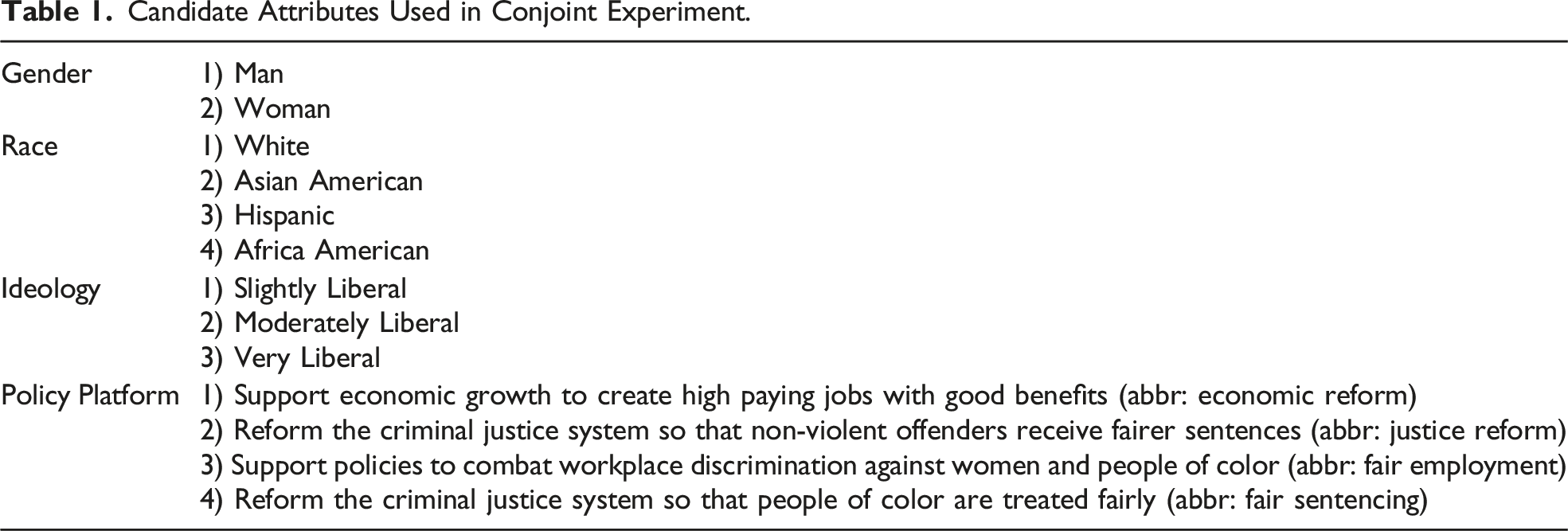
Candidate Attributes Used in Conjoint Experiment.
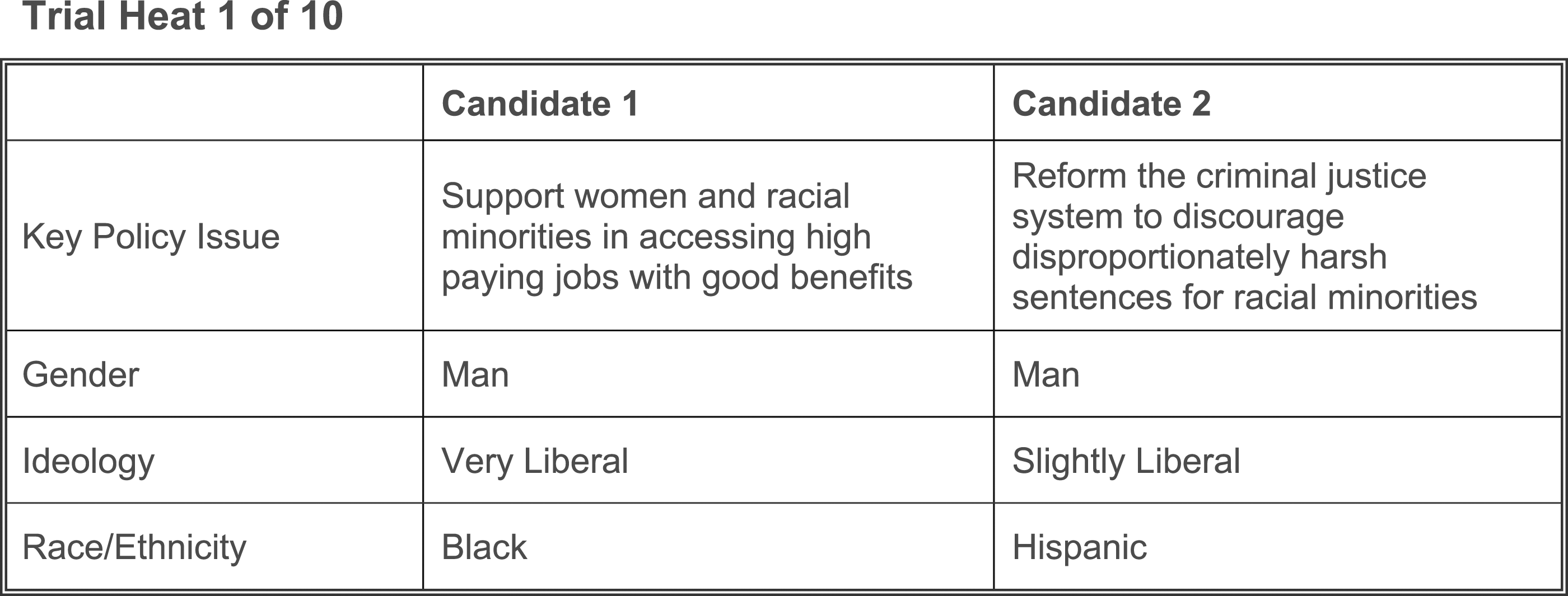
Trial heat in conjoint experiment.
The attributes used in the conjoint design were selected to tap key implications of the identity politics loss narrative. Candidate gender and race clearly speak to issues of descriptive representation for minorities. Candidate ideology is similarly relevant given racial and gender gaps in policy preferences. However, policy stances most directly assess the assertion of the identity politics narrative, since its main claim is that candidates who focus too much on minority groups are disadvantaged. Policy issues were developed to assess support for overt substantive representation of minorities. They take one of four values: “Support economic reform to incentivize high paying jobs with good benefits” (e.g., “good jobs”); “Support women and racial minorities in accessing high paying jobs with good benefits” (e.g., “fair employment”); “Reform the criminal justice system to discourage harsh sentences for minor crimes committed by non-violent offenders” (e.g., “justice reform”); or “Reform the criminal justice system to discourage disproportionately harsh sentences for racial minorities” (e.g., “fair sentencing”). These policies vary along two dimensions: minority orientation and identity politics framing. The economy was chosen as a non-minority, non-identity politics issue because it implicates all voters. Moreover, most iterations of the identity politics loss narrative implore candidates to emphasize economic concerns as a way to mobilize as many constituent groups as possible. Though the economy and employment are not minority oriented, criminal justice policy is highly racialized (Entman and Rojecki 2000; Hutchings and Jardina 2009; Mendelberg 2001). Policies that mention specific minority groups are associated with identity politics framing. Thus, the “good jobs” issue is not oriented toward either minorities or identity politics. “Fair employment” is oriented toward both minorities and identity politics. “Justice reform” and “fair sentencing” are both implicitly oriented toward minorities, but only the latter is framed as identity politics. It is possible that these platforms vary in terms of their baseline effectiveness. Nonetheless, we can assess the impact of the identity politics loss narrative by comparing the extent to which each platform appealed to voters against a baseline control condition.
Sample
Our experiment was conducted in two separate rounds. The experiment was first administered in the days immediately following the November 6, 2018 midterm election to a representative probability sample of 845 white U.S. citizens identifying as a Democrat or a Democratic-leaning independent. The second experiment was administered in January of 2020 to a representative probability sample of 943 African American U.S. citizens identifying as a Democrat or a Democratic-leaning independent. Both rounds of the experiment were administered online through Qualtrics. Our samples mirrored national demographic benchmarks.4, 5 We chose to prioritize a systematic analysis of whites and African Americans (as opposed to other racial categories) because they make up the two largest voting blocs in the Democratic Party. Republicans were excluded from this study because the identity politics loss narrative was largely a Democratic issue in the 2016 and 2018 elections.
Analysis
To evaluate how the identity politics loss narrative influenced male, female, white, and Black Democrats, we compared those who were exposed against those who were not on two outcome measures: (1) loss attribution, specifically the belief that Hillary Clinton lost the 2016 presidential election due to identity politics; and (2) preferred candidate characteristics for upcoming elections, as measured in the conjoint trial heats. We take up loss attribution first. At the end of the survey, respondents were asked to choose up to three options from a list of reasons explaining why Hillary Clinton lost the 2016 presidential election. One option was that “Hillary Clinton was too focused on identity politics, while Donald Trump addressed issues of broad concern to all Americans.” Two-tailed proportion tests that compare the percentage of respondents who chose this option in the treatment versus control serve as a manipulation check. Specifically, they allow us to determine if treated respondents received and accepted the identity politics loss narrative.
The outcome variable of central interest is preferred candidate characteristics. The conjoint design allows for estimation of the effect of each candidate characteristic on vote choice. To evaluate whether the message given in the first experimental manipulation influenced preferred candidate characteristics, we conduct logistic regression analyses that interact a dummy variable for each characteristic with a treatment dummy indicating whether respondents were exposed to the identity politics loss narrative. Since the unit of analysis is vote choice for each observed candidate profile, we have up to 33,128 observations in each model: 845 white respondents and 943 African American respondents voted in ten heats, with two candidates in each heat. To obtain accurate variance estimates, we cluster the standard errors by respondent because observed choice outcomes are not independent within the profiles rated by a single respondent. Postestimation testing is then used to calculate the probability that each theoretical candidate with a unique set of characteristics would receive a vote from a potential supporter. The nature of the conjoint design means that the probability of support for any given candidate profile is independent of other profiles. We assess the probability of support—not vote share—for various candidate profiles to derive two measures of interest.
First, we follow the statistical approach developed by Hainmeuller, Hopkins, and Yamamoto (2013) and estimate average marginal component effects (AMCEs). The AMCE represents the average difference in the probability of being voted for when comparing two different attribute levels—for instance, a candidate who is a woman versus one who is a man—where the average is taken over all possible combinations of other candidate attributes. Thanks to the random assignment of candidate characteristics, profiles with “woman” will have the same distributions for all other attributes compared to profiles with “man,” allowing for straightforward comparisons of means. 6 Second, in online appendices G and H, we offer additional tests of how the identity politics loss narrative could sway an election. 7 We simulate match-ups between every candidate with specific trait or set of traits against every candidate without those traits. Those simulations are then used to calculate the probability that a candidate with a particular trait or traits would win against some otherwise unknown candidate without them. We perform these simulations on each subgroup of voters: white Democratic men, white Democratic women, Black Democratic men, and Black Democratic women. We then compare the results for those who received the identity politics loss narrative against those who did not.
Results for Loss Attribution
For the identity politics loss narrative to influence electoral behavior, Democratic voters must both receive and accept it. Figure 2 displays the percentage of Democratic respondents who indicated that Clinton lost the 2016 presidential election due to her focus on identity politics. The results are broken down by experimental condition, race, and gender, with 95% confidence intervals. It is notable that even in the control condition, respondents exhibit some pre-existing familiarity and agreement with the identity politics loss narrative. However, this varies by race and gender. Nearly 28% of white men in the control group gave identity politics as a reason for Clinton’s loss, compared to only 11% of white women ( Percent attributing Clinton’s loss to “identity politics,” by condition and demographic Category.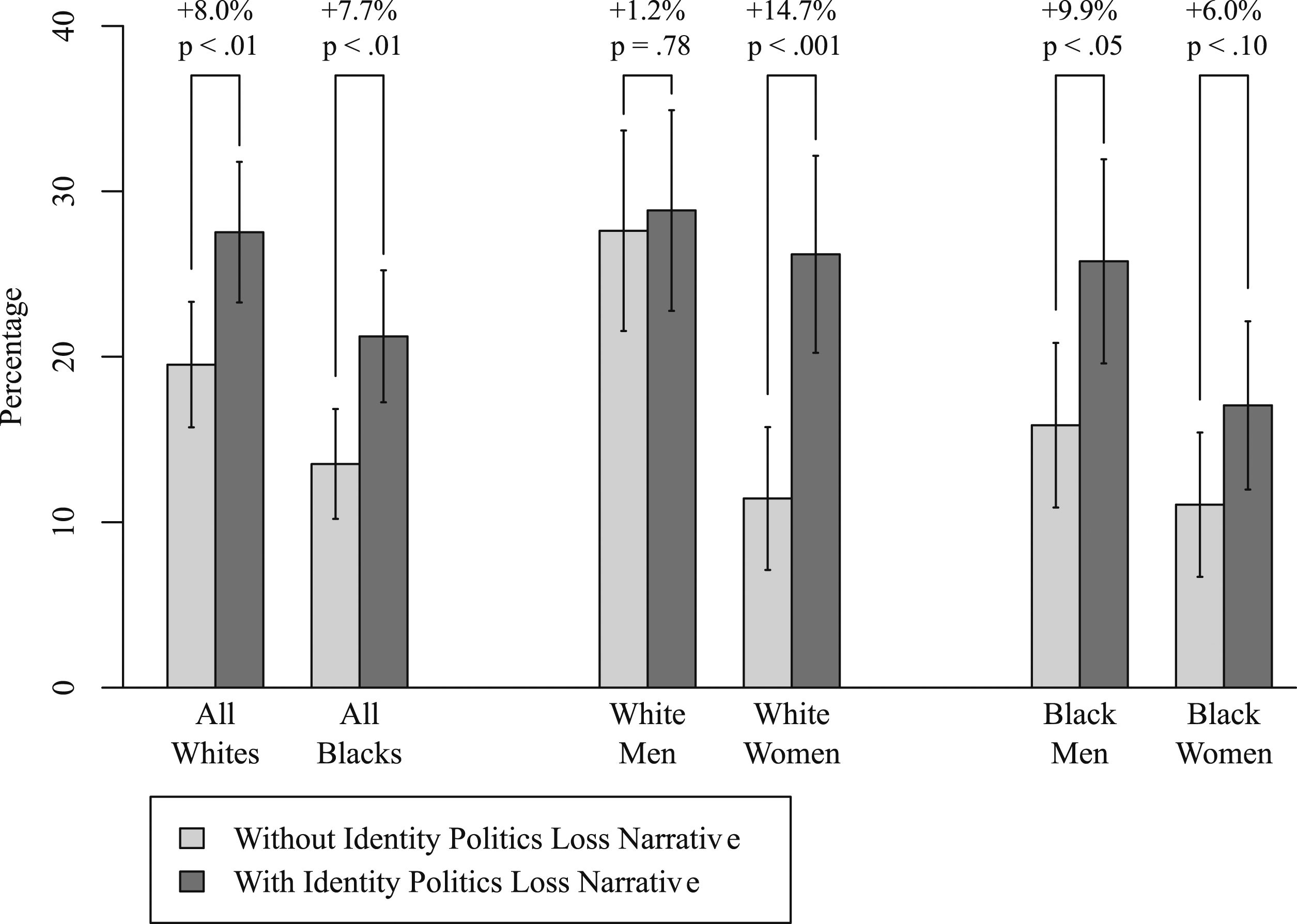
Figure 2 shows that the treatment had almost no effect on white men, increasing the percentage who cited identity politics by only one percent (p = .80). This may be due to a ceiling effect, since white men were already strongly inclined to accept the identity politics loss narrative. Treated white women became significantly more likely to indicate that Clinton lost due to identity politics, with their overall acceptance rate increasing by approximately fifteen percentage points (p < .001). The effect was more moderate among Black men, producing a significant ten percentage-point increase (p < .05). Finally, the effect was smaller among Black women, resulting in a marginally significant increase of just six percentage points (p < .10).
Results for Candidate Preferences
Candidate Characteristics and Loss Narrative as Predictors of Vote Choice.
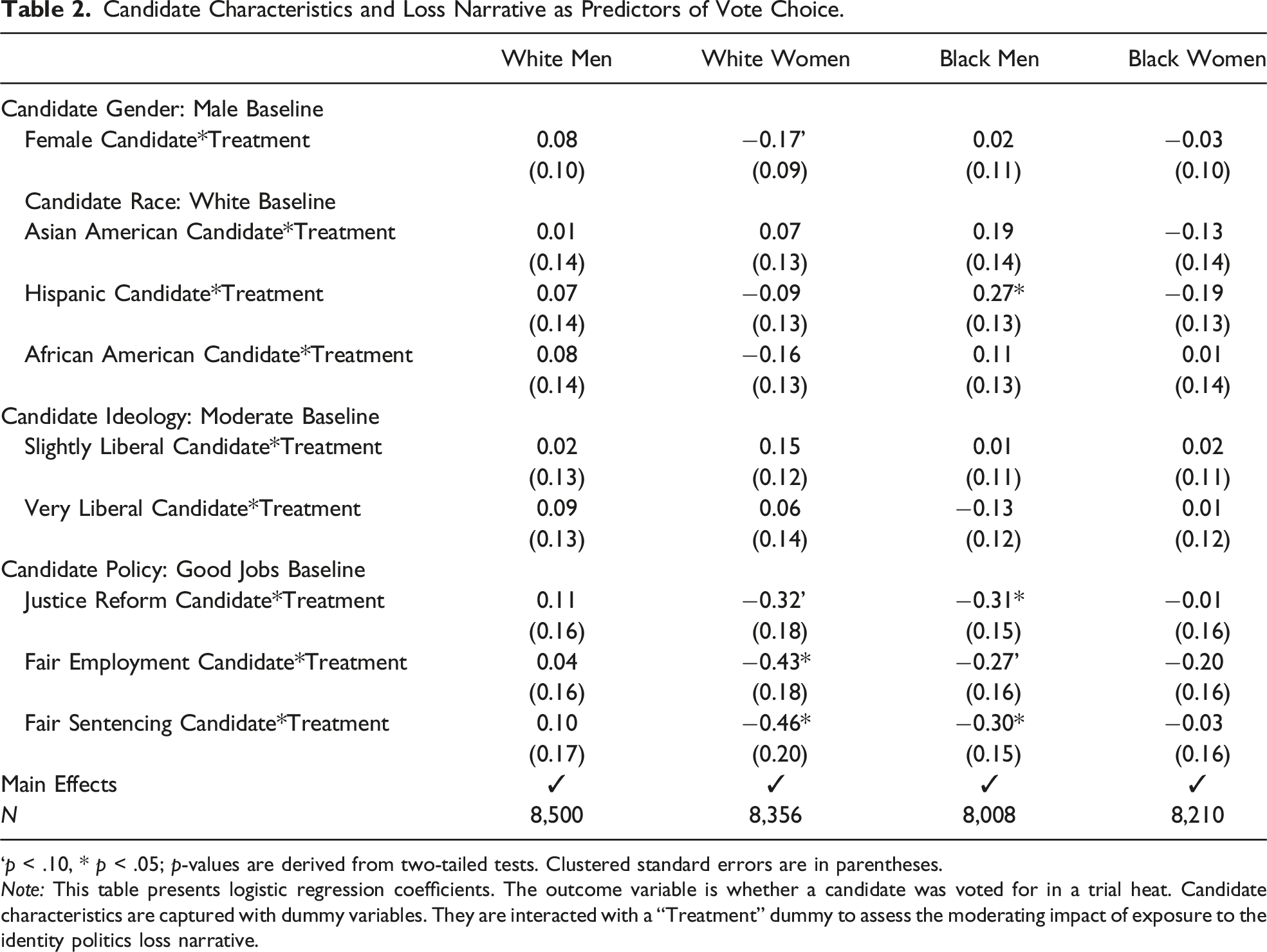
‘p < .10, * p < .05; p-values are derived from two-tailed tests. Clustered standard errors are in parentheses.
Note: This table presents logistic regression coefficients. The outcome variable is whether a candidate was voted for in a trial heat. Candidate characteristics are captured with dummy variables. They are interacted with a “Treatment” dummy to assess the moderating impact of exposure to the identity politics loss narrative.
To make these results more interpretable, Figure 3 visually presents the marginal probability of voting for a candidate with a specific characteristic relative to the baseline in both the control and treatment conditions. Each characteristic’s AMCE is depicted with a 95% confidence interval. For instance, the top point estimate in the leftmost-hand panel indicates that without the identity politics loss narrative, white Democratic men were four percentage points more likely to support a female candidate than a male candidate. The second point estimate in the left-hand panel shows that with the loss narrative, white Democratic men were six percentage points more likely to support a female candidate. The confidence intervals for these estimates overlap almost perfectly, indicating that the identity politics loss narrative had no overall impact on the gender preferences of white Democratic men. Where the identity politics loss narrative had a statistically significant impact, the point estimate is indicated with a star and the difference-in-difference between the control and treatment is noted. Marginal probability of voting for a candidate based on their characteristics.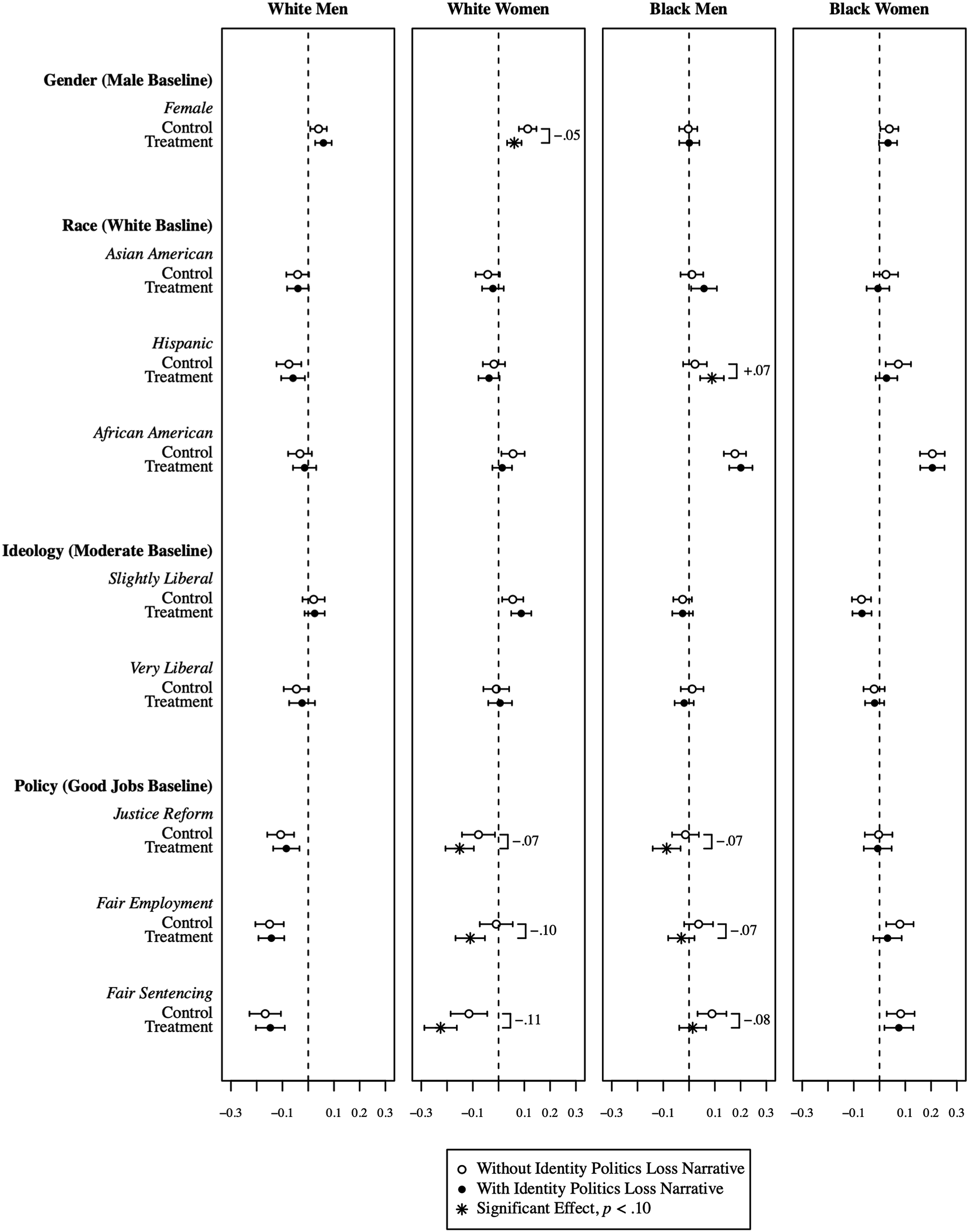
Overall, the results in Figure 3 confirm that the identity politics loss narrative had little to no impact on white Democratic men’s candidate preferences. Even in the control, white men were less somewhat likely to prefer a candidate of color than a white candidate. 14 They were far less likely to prefer a candidate focused on racialized issues like criminal justice reform or gendered issues like fair employment than one focused on job creation. 15 This remained consistent in the treatment condition. In both the treatment and control, white men indicated a preference for female candidates. In both conditions, the most successful candidate among Democratic white men is a slightly liberal, white woman focused on economic reform. This candidate has a 69% chance of winning a white Democratic man’s support in the control and a 68% chance in the treatment. Similarly, white men’s least preferred candidate in both conditions is a very liberal Latino focused on making the criminal justice system fairer for racial minorities. To better assess which hypothesis these results support, it is necessary to review the results for remaining voter groups.
The results in Figure 3 look quite different for white Democratic women. While white women’s racial and ideological candidate preferences are similar in both conditions, there are substantial shifts in preferred candidate gender and policy focus. White women in the control condition are eleven percentage points more likely to vote for a female than a male candidate. This drops to six percentage points when women are exposed to the identity politics loss narrative, a marginally significant drop in support (p < .10). Similarly, white women who are exposed to the loss narrative become seven percentage points less likely to vote for a candidate focused on criminal justice reform (p < .10); ten points less likely to vote for a candidate focused on fair employment for minorities (p < .05); and eleven points less likely to vote for a candidate focused on fair sentencing for racial minorities (p < .05). In both conditions, women’s most preferred candidate is a slightly liberal, African American woman focused on economic reform. However, the identity politics narrative alters why and how much support this candidate receives. While the candidate loses some support due to her gender, she more than regains it due to the increased enthusiasm for her focus on job creation. As such, she has a 69% chance of winning a white woman’s vote in the control versus a 73% chance in the treatment. Not only does the identity politics loss narrative change the kind of candidates white women are most likely to support, it aligns them more closely white men. This could produce a decisive voting bloc that severely reduces the viability of candidates focused on issues of particular concern to women and minorities.
Figure 3 shows that Democratic African American men’s reaction to the identity politics loss narrative is similar to white women’s, albeit somewhat less dramatic. Unlike white women, treated African American men do not become less likely to vote for a female candidate. However, they became seven percentage points less likely to vote for a candidate focused on criminal justice reform (p < .05); seven points less likely to vote for a candidate focused on fair employment for minorities (p < .10); and eight points less likely to vote for a candidate focused on fair sentencing for racial minorities (p < .05). In the control, the candidate with the most support among Democratic African American men is a very liberal, African American man focused on fair sentencing for racial minorities. This candidate has a 69% chance of receiving support from African American men. In the treatment, this candidate is no longer the favorite and the probability of receiving a vote drops to 65%. While their candidate preferences remain distinctive from both white men and white women, the identity politics loss narrative nonetheless minimizes these differences. This is consistent with the identity-based resistance hypotheses.
Figure 3 confirms that the identity politics loss narrative has no detectable impact on the candidate preferences of Black women. In both conditions, their most preferred candidate is a moderately liberal, African American woman focused on fair sentencing for minorities. In the control, this candidate has a 71% chance of receiving winning a Black woman’s vote. In the treatment, she has a 73% chance. African American women remain steadfast in their candidate preferences despite exposure to the identity politics loss narrative. Whether treated or untreated, their candidate preferences differ greatly from those of white men and women. This also fits with the identity-based resistance hypotheses.
These results are further confirmed in online appendix G, with a series of simulations that assess the probability of a candidate with a specific trait winning an election against a candidate without that specific trait. Among white female voters, exposure to the identity politics loss narrative caused the probability of a candidate focused on fair employment practices winning against a candidate focused on some other issue to drop by nine points (0.65 vs. 0.53). Similarly, among Black male voters, the identity politics loss narrative reduced the probability of a candidate focused the racially tinged issue of criminal justice reform winning by eight points (0.40 vs. 0.32). Only among Black female voters were there limited changes in which candidates most likely to win in a match-up.
Online appendix H presents additional simulations that assess the interactive effect of multiple candidate traits on the probability of winning. Specifically, it evaluates the probability of victory for white male candidates, white female candidates, Black male candidates, and Black female candidates when they are focused on different policy platforms. One of the most notable findings is that white female voters who were exposed to the identity politics loss narrative imposed harsher punishments on Black candidates than white candidates for focusing on identity-based policies. A white male candidate focused on fair employment was not penalized, while a white female candidate focused on fair employment became 8-points less likely to win in the treatment compared to the control. A Black male candidate focused on fair employment suffered a 9-point punishment in the treatment compared to the control, while a Black female candidate suffered a 16-point loss. This suggests that candidates of color may have less capacity to successfully advocate for minority interests than their white counterparts, particularly when the identity politics loss narrative is made salient. More generally, these results indicate that the identity politics loss narrative may alter the kind of candidate who wins among white women and Black men—and by extension, the candidate who wins the election as a whole.
Conclusion
The results of our survey experiment show that the identity politics loss narrative may have had an asymmetrical impact on Democratic voters’ preferences heading into 2020 presidential election depending on their race and gender. In our study, White men were unaffected by the loss narrative, whereas white women’s candidate preferences shifted dramatically. Conversely, African American men’s candidate preferences shifted slightly, while African American women’s remained unmoved. The results for white men are not particularly surprising. Although white men were somewhat enthusiastic about the possibility of a female candidate, they strongly rejected candidates focused on minority interests or grievances from the outset. 16 White men in the control did not require the identity politics loss narrative to convince them that they should prefer a white candidate with a generalist policy focus. The differing results for white women, Black men, and Black women are more difficult to account for. One plausible (but by no means definitive) explanation is “identity-based resistance” hypothesis. For white women, gender is not a central political consideration. Thus, abandoning their distinctively gendered preferences may not seem like a particularly onerous sacrifice. For instance, while white women may prefer a female candidate, they do not see it as imperative for the wellbeing of their group. Black men, with their stronger sense of group consciousness, are more hesitant (but not unwilling) to accept and act on the identity politics loss narrative. Black women possess the strongest sense of minority consciousness due to their intersecting racial and gender categories. Given this, embracing the identity politics loss narrative may be tantamount to a betrayal of their core personal and group identity.
While more research is required to understand the psychology behind the identity politics loss narrative, this study nonetheless offers a number of critical findings. First, it demonstrates that post-election loss narratives affect more than pundits and party elites. Even a fairly modest treatment—a few sentences at the beginning of a survey—showed rather dramatic effects on potential voters’ evaluations of the political scene. If we were to extend this finding to the 2020 presidential election cycle, it would suggest that the arguments used in the coverage of the 2016 election affected how Democratic white women and African American men perceive presidential candidates. Consistent with this, a survey conducted in the summer of 2019 found that a plurality of Democrats said they would vote for Senator Elizabeth Warren if she could automatically become president. But when asked who they would pick to run in the general election, they preferred former Vice President Joe Biden as the more “electable” candidate (Mendoza 2019). Biden, a relatively moderate older white man with experience in elected office, was in many ways an archetype for the kind of candidate preferred by white Democratic men. However, their votes alone were not determinant in the presidential nomination contest. His ultimate nomination may have been at least partially informed by minority voters’ internalization of the identity politics loss narrative—particularly white women and Black men. In short, the Democratic Party might well have ended up with a different nominee in 2020 than it would have if Democratic elites and the media had settled on another loss narrative after 2016 (Masket 2020).
Second, the findings show that loss narratives do not exert uniform influence across party subgroups. White men’s unwavering candidate preferences suggest that although they now make up a minority of self-identified Democrats; they continue to have disproportionate influence over its electoral processes. Meanwhile, although white women constitute a plurality of Democrats, they readily compromised their distinctive preferences to keep white men in the fold and ensure a Democratic victory. Similar compromises were made by African American men. While African American women did not bend to the identity politics loss narrative, the narrative’s effects on other subgroups substantially reduced the odds for their more favored candidates. This is consistent with the idea that choosing a particular loss narrative can have a powerful effect on intraparty dynamics, empowering some subgroups while disempowering others.
Third, these results are instructive about the intersection of race and gender in politics. White women’s readiness to yield their descriptive and substantive representation is consistent with the notion that women lack a strong or coherent sense of gender consciousness. Although white women have distinctive preferences (Barnes and Cassese 2017; Burns and Kinder 2011; Diekman and Schneider 2010), they can readily be persuaded to abandon them “for the good of the party.” African American men can be persuaded to make similar compromises. Only African American women, perhaps by virtue of their double minority status, rejected the identity politics loss narrative. Yet the lure of identity politics loss narrative was powerful enough to break down Black women’s gendered alliances with white women as well as their racial alliances with Black women. In short, the narrative exacerbated Black women’s alienation and disempowerment within the Democratic party. Meanwhile, the loss narrative gave white men license to take an assertive position and demand accommodation. The identity politics loss narrative effectively taps into historically established racial hierarches and traditional gender roles to grant white men final say over how much representation of others they are willing to tolerate.
Supplemental Material
Supplemental Material - “You Had Better Mention All of Them:” Race and Gender Effects in Election Loss Narratives
Supplemental Material for “You Had Better Mention All of Them:” Race and Gender Effects in Election Loss Narratives by Pavielle Haines and Seth Masket in Political Research Quarterly.
Footnotes
Acknowledgements
We are grateful to Kristin Kanthak, Corrine McConaughy, Libby Sharrow, Dara Stolovitch, Christina Wolbrecht, Marjorie Hershey, and Rachel Bernhard for their helpful comments and suggestions. We also thank participants at the 2019 annual conference of the Midwest Political Science Association for their generous feedback on an earlier draft of this paper.
Declaration of Conflicting Interests
The author(s) declared no potential conflicts of interest with respect to the research, authorship, and/or publication of this article.
Funding
The author(s) received no financial support for the research, authorship, and/or publication of this article.
Supplemental Material
Supplemental material for this article is available online. The online appendix can be found under ‘Supplementary Material’ on PRQ’s website. Data and replication files can be found on Harvard Dataverse ( ).
).
Notes
References
Supplementary Material
Please find the following supplemental material available below.
For Open Access articles published under a Creative Commons License, all supplemental material carries the same license as the article it is associated with.
For non-Open Access articles published, all supplemental material carries a non-exclusive license, and permission requests for re-use of supplemental material or any part of supplemental material shall be sent directly to the copyright owner as specified in the copyright notice associated with the article.
