




Abstract
Scholarship on women voters using an intersectional lens has shown feminists and women of color within the Democratic Party to be a powerful force in electoral politics—specifically, Black and Latina women—are the most reliable voters. Combined, they represent the majority of women voters in the Democratic Party, and they have shown themselves to be a sizeable voting bloc in the last two American presidential election cycles. Using data from the 2016 American National Election Studies (ANES), we demonstrate important differences in support for the Democratic candidate (Hillary Clinton) between feminists and women of color—Black and Latina—underscoring the need to study gender, race, and ethnicity simultaneously (versus independently) when they are co-constitutive identity categories. By examining women and the groups the Clinton campaign appealed most to—feminists, Black, and Latina women—we add to the scholarship in political science that followed this unique election and demonstrate the importance of feminist identity for vote choice and various modes of political behavior for women voters. Knowing and understanding how women respond through affect and how this affect can result in political behaviors will help determine what it takes for future historic first candidates to emerge successful.
Keywords
Democratic leaders have witnessed considerable growth in their electoral base across various racial, gender, and ethnic groups (Grossman and Hopkins 2016). Although minority voters and women once lagged in turnout, over time both the size of respective demographic populations and their practice of voting increased with the help of mass voter registration drives and other grassroots efforts to get out the vote. Much of the extant literature has established that women and racial minorities are the majority of Democratic identifiers, and women in particular have been responsible for a partisan gender gap in American presidential elections since the 1980s (Bejarano 2014; Carroll 1999; Elder 2021; Junn 2017; Lien 1998; Whitaker 2008).
Political scientists devoted considerable time and attention to the gender gap in 2016, given the historic nature of the campaign. The gender gap for Republican candidate Donald Trump opposite his Democratic opponent Hillary Clinton was 11 percentage points, with 41% of women and 52% of men casting a vote in Trump’s favor (Cassese and Barnes 2019; Frasure-Yokely 2018; Junn 2017; Junn and Masuoka 2020). As in past elections, a majority of women favored the Democratic candidate, and a majority of men supported the Republican candidate. While this data supports the prevailing notion that women constitute the majority of Democratic identifiers, it effectively conceals the fact that, among white women, an estimated 52% voted for Trump compared to the 43% who supported Clinton (Cassese and Barnes 2019; Frasure-Yokely 2018; Junn 2017; Junn and Masuoka 2020).
The popular narrative that women are Democrats is misleading when considering the largest group of women voters—that is, white women have been consistent supporters of Republican Party candidates since the 1950s (Cassese and Barnes 2019; Junn 2017; Junn and Masuoka 2020). In contrast, party preference for women identifying as feminists generally and women of color specifically, reflects a different pattern. Feminists and women of color vote majority Democrat and have done so consistently for years (Bejarano 2014; Conover 1988; Klein 1984; Elder, Greene, and Lizotte 2021; Frasure-Yokely 2018; Gurin 1985; Lien 1998; Simien and Hampson 2017; Smooth 2006). This significant pattern of difference in partisan vote choice for subgroups of women in American presidential elections is often overlooked by political analysts and has been hidden due to the way they tend to interpret the data for women vis-a-vi men. Such a static approach presents women as a monolith.
Understanding candidate affect in addition to the behavior of feminists and women color in the 2016 American presidential election will help determine what it takes for future historic first candidates to emerge successful and thus, warrants empirical investigation (Simien 2022). Using data from the 2016 American National Election Studies (ANES), we demonstrate the importance of feminist identity for vote choice and various modes of political behavior among women voters. We also demonstrate important differences in support for the Democratic candidate between feminists and women of color—Black and Latina—underscoring the need to examine gender, race, and ethnicity simultaneously (versus independently) when they are co-constitutive identity categories.
The Trump Majority and Multiple Axes of Identity
Until recently, scholars had merely speculated about the sources and implications of the partisan gap among women. The Trump majority among white women voters who supported the Republican candidate in 2016 has since catalyzed an onslaught of empirical investigations of this partisan gap (Bracic, Israel-Trummel, and Shortle 2019; Cassese and Barnes 2019; Elder, Greene, and Lizotte 2021; Frasure-Yokely 2018; Junn 2017; Simien and Hampson 2017; Tien 2017). From the positionality of white women and their relationship to the Republican Party (Cassese and Barnes 2019; Junn 2017; Junn and Masuoka 2020) to conventional gender role stereotypes (Bracic, Israel-Trummel, and Shortle 2019; Conroy, Martin, and Nalder 2020) and sexism in its varied forms: modern, traditional, and ambivalent (Frasure-Yokely 2018; Hanley 2021; Knuckey 2019) as well as a possessive investment in white heteropatriarchy (Strolovitch, Wong, and Proctor 2017) or whiteness (Cassese and Barnes 2019; Levine-Rasky 2011), explanations have run the gamut for the outcome of the 2016 American presidential election.
The historic nature of this contest afforded women voters the opportunity to gauge their potential for full inclusion as political actors on the main stage of the Democratic Party apparatus, as did the 2008 election once before (Simien 2015; Simien and Hampson 2017). Such a high-profile race offers a fascinating case for which to investigate the differential impact of Clinton’s candidacy on women voters. As the candidates, campaigns, and media hyped the American presidency, framing it as the “manliest” of all elected offices whereby examples of gender tropes, sexist rhetoric, and misogyny manifested throughout the campaign, many observers predicted that specific subgroups of women would be especially mobilized into mass-level participation (Scherer and Weigel 2018; Rubin 2021). For all these reasons, we take a comparative approach and examine the impact of Clinton’s historic candidacy on women voters across multiple axes of identity—feminist, racial, and ethnic—to determine candidate affect, vote choice, and various modes of political behavior during the 2016 American presidential election.
Intersectionality has been an important analytic for studying multiple axes of identity and the simultaneous effects of such identity categories as race, gender, and ethnicity on vote choice and political behavior for subgroups of women (Brown 2014; Crenshaw 1989; 1991; Cassese, Barnes, and Branton 2015). We start with the premise that gender as a mainstay of identity needs to be complicated, as Crenshaw (1989, 1991) would have it; however, intersectionality as a frame is applied to a new context specific, empirical site and situated within the 2016 American presidential election. Alongside intersectionality theory, research on social identity theory (Tajfel and Turner 1986) has presented important insights that demonstrate that human cognition relies heavily on social categorization, which structure human perception, socialization, and behavior. Scholars have demonstrated that this categorization might have evolutionary benefits such as information reduction (Stewart, McCarty, and Bryson 2020). Importantly, scholarship has built on social identity theory to show that elites employ social groups to build coalitions. Rather than appealing to majority opinion or an entire geographic constituency, subconstituency politics theory has argued that elected officials appeal to small groups of voters, often with direct appeals to social identities (Bishin 2000; 2009; Hayes and Bishin 2012). By seeking out and identifying even latent social groups, many elites work to activate these identities which can lead to political learning and increased political participation even among groups with historically low voting rates (Bishin 2009).
Failure to consider identity categories as both meaningful and consequential for empirical analysis can result in fixed ways of interpretating data that obscure the heterogeneity of the group in question—that being, in this case: women. Scholarship on women voters using an intersectional lens has shown feminists, and women of color within the Democratic Party to be a powerful force in electoral politics—specifically, Black and Latina women—are the most reliable voters (Bejarano 2014; Junn 2017; Junn and Masuoka 2020; Lien 1998; Smooth 2006; Simien and Hampson 2017). Combined, they represent the majority of women voters in the Democratic Party, and they have shown themselves to be a sizeable voting bloc in the last two American presidential election cycles. The mobilizing effect, or more precisely—the lack thereof by Clinton—among a majority of white women for whom she descriptively represents is an intriguing finding and one that creates an interesting paradox we intend to explore (Frasure-Yokely 2018; Junn 2017; Simien 2015; Simien and Hampson 2017; Tien 2017).
Hypotheses
Feminists and non-feminists alike figured prominently in discussions of the 2016 election albeit for slightly different reasons, given the historic nature of the contest and the public release of an audio-visual recording of Trump describing in graphic detail his efforts to seduce married women and sexually assault others (Elder, Greene, and Lizotte 2021; Frasure-Yokely 2018; Junn 2017). Several analysts opined that the 2016 election presented women in general and feminists in particular with an obvious choice on the grounds that sexual harassment is a salient issue of pressing concern to them. While there are theoretical reasons to expect that Clinton could achieve solidarity with women as a group because of her viability and status as the “first-woman” candidate (Herrnson, Lay, and Stokes 2003), there are also theoretical reasons for why we cannot expect women as a group to respond uniformly as a monolith in support of Clinton (Cassese and Barnes 2019; Lawrence and Rose 2010).
Studies find that partisan identifications are identities with strong emotional attachments, ones that individuals come to identify with using other groups they strongly identify with (Green, Palmquist, and Schickler 2004; Hajnal and Lee 2011; White and Laird 2020). Moreover, parents can play a large role in the initial partisan orientation of an individual (e.g., Niemi and Jennings 1991). Additionally, geographic region (Acharya, Blackwell, and Sen 2018), socioeconomic status (Fraga 2018), and religion all play a role in partisan identification (Margolis 2018). Thus, there are many reasons even outside the context of the 2016 campaign that lead us to believe women would not act as a monolith.
Scholarship has demonstrated that both major political parties have been transformed by the women’s right’s movement (e.g., Wolbrecht 2000) and that while once more closely aligned on women’s rights, the parties are increasingly polarized (Wolbrecht 2002; Wolbrecht and Corder 2020). Recent work argues that the Republican Party can best be understood as an ideological movement, while the Democratic Party is more of a coalition of group interests (e.g., Grossmann and Hopkins 2016). However, traditional accounts of Republican Party-political ideology focus on the “three-cornered stool” model of free-market capitalism, aggressive approach to national defense, and moral traditionalism (Grossmann and Hopkins 2016), other accounts have argued that opposition to racial equality (stemming from opposition to the Brown case) should be included as a mainstay of Republican Political Ideology (Terbeek 2021). Additionally, one of the most salient efforts to oppose the 1977 Women’s National Conference and the Equal Rights Amendment was led by Phyllis Schlafly, who many credit with moving the Republican Party to the right and defeating passage of the ERA (Mansbridge 2015). While some ideologically conservative women might argue that conservativism is not at odds with feminism, most women identifying as feminists and especially Black and Latina feminists are likely turned off by the conservative ideology and platform of the Republican Party—specifically, for its push back against the more liberal and progressive policy stances of radical third and fourth wave feminism (Roth 2004).
In the context of the 2016 election, Clinton’s historic candidacy would have a differential impact on women voters—feminists and non-feminists—due to differences in ideological commitments along a conservative-liberal, deeply partisan divide (Cassese and Barnes 2019; Junn 2017; Junn and Masuoka 2020; Tesler and Sears 2008), and highly affective emotional attachments, along the conventional feeling thermometer (Kinder and Dale-Riddle 2012; Simien and Hampson 2017; Yates 2016; Valentino, Wayne, and Oceno 2018). Trump’s performance at rallies on the campaign trail stoked intense emotions, as he waged sexist attacks against his Democratic opponent, Hillary Clinton, and such a common news reporting practice as the “first woman” frame advantaged Trump, given the default identity category for the American president has been a white, heterosexual, male (Dittmar 2017; Katz 2016; Kray, Carroll, and Mendall 2018). Also, the Republican majority among white women voters has been consistent since the 1950s and there is a plethora of evidence that as a subgroup of women generally, they lack gender (or feminist) consciousness (Cassese and Barnes 2019; Frasure-Yokely 2018; Junn 2017; Junn and Masuoka 2020; Strolovitch, Wong, and Proctor 2017). Thus, we expect that feminists will have higher feeling thermometer ratings for Clinton than non-feminists.
Candidate Affect Hypothesis (H1): Feminists will have higher feeling thermometer ratings for Clinton than non-feminists. In the United States, there is a longstanding belief that a female candidate (especially one running against a male opponent) will be more committed to issues of social and economic justice for women’s rights. Additionally, as research finds the major political parties are able to “own” certain issues come election time (e.g., Petrocick 1996) and individual candidates can utilize this to emphasize certain traits (e.g., Hayes 2005) and thus, Clinton could have been perceived as more likely to champion the policy interests of women as a group once elected to office. Many women—feminists and non—had to ask themselves whether voting for Trump constituted a betrayal of their feminist convictions or their interests as women as the campaign got underway (Bracic, Israel-Trummel, and Shortle 2019; Frasure-Yokely 2018; Knuckey 2019). Such vote choice draws critical attention to the complicated way in which certain aspects of identity—specifically, a feminist identity—can be primed, given the circumstances and related policy interests activated by both the electoral context and historic nature of the campaign. Thus, we expect that feminists will be more likely to vote for Clinton than non-feminists.
Vote Choice Hypothesis (H2): Feminists will be more likely to vote for Clinton than non-feminists. In the United States, there is a longstanding belief that the Democratic Party is more racially liberal, and the Republican Party is more racially conservative. While recent studies argue the roots of this post-Civil Rights realignment occurred pre-Civil Rights during the New Deal (e.g., Schickler 2016), many studies find party coalitions to differ substantially (Grossmann and Hopkins 2016) and ideological differences toward racial issues a salient marker of difference among the Republican and Democratic Parties (e.g., Terbeek 2021). Assuming Clinton as the Democratic nominee held views closer to their own and would champion the policy interests of racial and ethnic minorities once elected to office, feminists of color like feminists generally could affirm their politicized group identity by making a vote choice that proved self-affirming and supportive of their intersectionally marginalized group-linked policy preferences. Such a vote choice once again draws critical attention to the complicated way in which certain aspects of identity—racial and ethnic group identity—can be primed, given the hierarchy of interests activated by both the electoral context and historic nature of the campaign. Thus, we expect feminists of color—Black and Latina—will be more likely to vote for Clinton than their non-racialized counterparts (read: white women).
Racialized Feminist Vote Choice Hypothesis (H3): Black and Latina Feminists will be more likely to vote for Clinton than their non-racialized counterparts (white women who do not identify as feminists). Taken together, the significance of feminist identification combined with racial or ethnic group identity in predicting vote choice in 2016 signals the connection made by feminists and feminists of color alike in terms of Clinton’s candidacy and the promise that her candidacy offered to those once denied representation at the presidential level. It could be argued that Clinton’s quest for the U.S. Presidency became synonymous with an end goal of the women’s liberation movement and exceeded a mere exercise of the franchise. Her historic candidacy included a more expansive claim to full citizenship, including a path to the White House, as was the case for the modern civil rights movement and Barack Obama’s historic candidacy in 2008. Thus, we consider how well feminist identity predicts political behavior among women and situate our analysis in the context of future American presidential elections with the hope of better predicting how subgroups of women—namely, feminists and women of color—demonstrate different participatory styles. The effects of feminist identity and multiple subordinate group identities—namely, racial, and ethnic—on political behavior are understudied in political science, even though they constitute fundamental identities that shape American political behavior (Brown and Gershon 2016). We propose that feminists will participate at elevated rates, given a feminist belief system encourages a higher degree of psychological engagement and a closer connection to political networks which translates into a different orientation toward politics (Conover 1988; Elder, Greene, and Lizotte 2021; Fulenwider 1980; Gurin 1985; Rinehart 1992). At the same time and, no less importantly, we do not mean to suggest the effect of feminist identity on political behavior will be uniform among feminists and feminists of color when differences in rates and patterns of political behavior have long been observed and attributed to socioeconomic status, cultural norms and traditions, migration patterns, homeland political history, foreign-born versus native status, English language acquisition, etc. To be sure, group consciousness or linked fate among racial and ethnic minorities is a well-known catalyst for heightened levels of such political activities as talking to someone about voting for a candidate, attending a protest or political event, contributing money to a campaign, signing a petition, and engaging in social media (Chong and Rogers 2005; Dawson 1994; Gershon et al. 2019; Gurin, Hatchett, and Jackson 1989; Montoya, Hardy-Fanta, and Garcia 2000; Wong, Lien, and Conway 2005; Sanchez 2006; Sanchez 2008; Sanchez and Masouka 2010). Taking seriously the assumptions of intersectionality research, we recognize the importance of distinguishing between feminist identity and belonging to multiple subordinate groups to disaggregate the political behavior of women in the United States. Often, the literature has treated women as homogenous in terms of how they either lag behind men or perform uniformly as a monolith within the American political system (Burns, Schlozman, and Verba 2001). Such an essentialist view of women fails to consider other sources of variation like race and ethnicity—for example, Black women who experience structural inequality based on their race and gender tend to vote and participate in a variety of political activities at higher rates than other groups on account of their social capital and civic engagement (Brown and Gershon 2016; Dowe 2023; Farris and Holman 2014; Scott et al. 2021; Simien and Hampson 2020). Thus, we expect that feminist identity in addition to race and ethnicity will work in tandem to influence how women participate in a variety of political activities at different rates.
Political Behavior Hypothesis (H4): Feminists are more likely to engage in additional political behavior—such as proselytizing and attending a political meeting—than non-feminists.
Data and Methods
To examine the differences that might exist between and among women in their attitudes toward presidential candidates, vote choice, and political behavior we employ data from the 2016 American National Election Studies (ANES). The 2016 ANES data are especially useful due to the large national sample of women (N = 2232). Of this total, we can also examine differences among women as 895 (40 %) are self-identified feminists. While the majority of women in the sample are white (N = 1380), the second largest subgroup of women are African American (N = 234). As Frasure-Yokley highlights, the 2016 ANES allows researchers to assess “long-term trends and questions necessary to understand the particular political moment of 2016” (2018, 10–11). In order to examine attitudes and political behavior in the 2016 election among women, we use three different sets of dependent variables. We measure candidate affect (support for the candidate) using a 0–100 feeling thermometer scale. Respondents are separately asked “How would you rate Donald Trump?” as well as “How would you rate Hillary Clinton?” on the 0–100 scale, 0 represents cold or negative affect and 100 represents warm or positive affect. Our second set of dependent variables measures respondent vote choice with Clinton Vote measured dichotomously as 1 for a ballot cast toward Clinton and 0 for any other candidate (including Trump). Similarly, Trump Vote is measured as 1 if a respondent indicated voting for Trump and 0 for any other candidate (including Clinton).
While our analysis examines voting, we also examine a variety of other political behaviors. Brown (2014) suggests, nontraditional forms of participation “work outside the system … these types of activities are most appealing to those whose positions in society are or have been marginalized” (332). Therefore, the third set of dependent variables are a variety of measures in the ANES that ask respondents about political behavior beyond voting, each of which is measured dichotomously (1 if engaged in behavior, 0 otherwise). The ANES includes six different questions that ask about whether a respondent talked about a candidate during the campaign with another person, whether a respondent signed a petition, attended a political meeting, a protest, engaged with social media such as Facebook or Twitter about the campaign or election, and finally whether they donated money to a candidate or party. See Appendix A for a complete list of variables used in each analysis.
Self-categorization taps group identity more directly and lends itself to a parallel analysis for feminist identity and racial identity. The measure for feminist identity adopted here is a direct one and captures the extent to which women consciously identify as feminists. Respondents were asked: “Do you think of yourself as a feminist—most of the time, some of the time, occasionally, or never.” This measure was used by Conover in her seminal work on feminists and the gender gap (1988). Assuming how a woman thinks of herself is as important as her objective status—that is, whether a woman thinks of herself as a feminist is assumed to have an impact on how she views her role as a citizen—the feminist identification measure is thought to be an improvement over closeness items, feeling thermometers, and a homemaker item. The measure for racial identity adopted here is also a direct one and captures women who consciously identify as Black or African American (versus white).
The measures for feminist identity and racial identity are coded dichotomously, so that a “1” on the measure indicates a woman who thinks of herself as a feminist and 0 otherwise. Similarly, for Black women, we coded a respondent as 1 if they identified as black, 0 otherwise. This coding also applies to Latina women (1-Latina, 0-otherwise). We include a number of other independent variables each model. Respondents Party ID is measured as 1 for Republican, 0 for Independent, and −1 for Democrat. Similarly, Ideology is on a 10-point scale, with higher values indicating a respondent is more conservative. We also include standard control variables for Age, Income, Education, whether a respondent is Married, and whether a respondent resides in the South. For the analyses where the dependent variable is the feeling thermometer, we use a standard OLS regression analysis. For all other analyses (which use dichotomous variables), we employ logistic regression.
Results
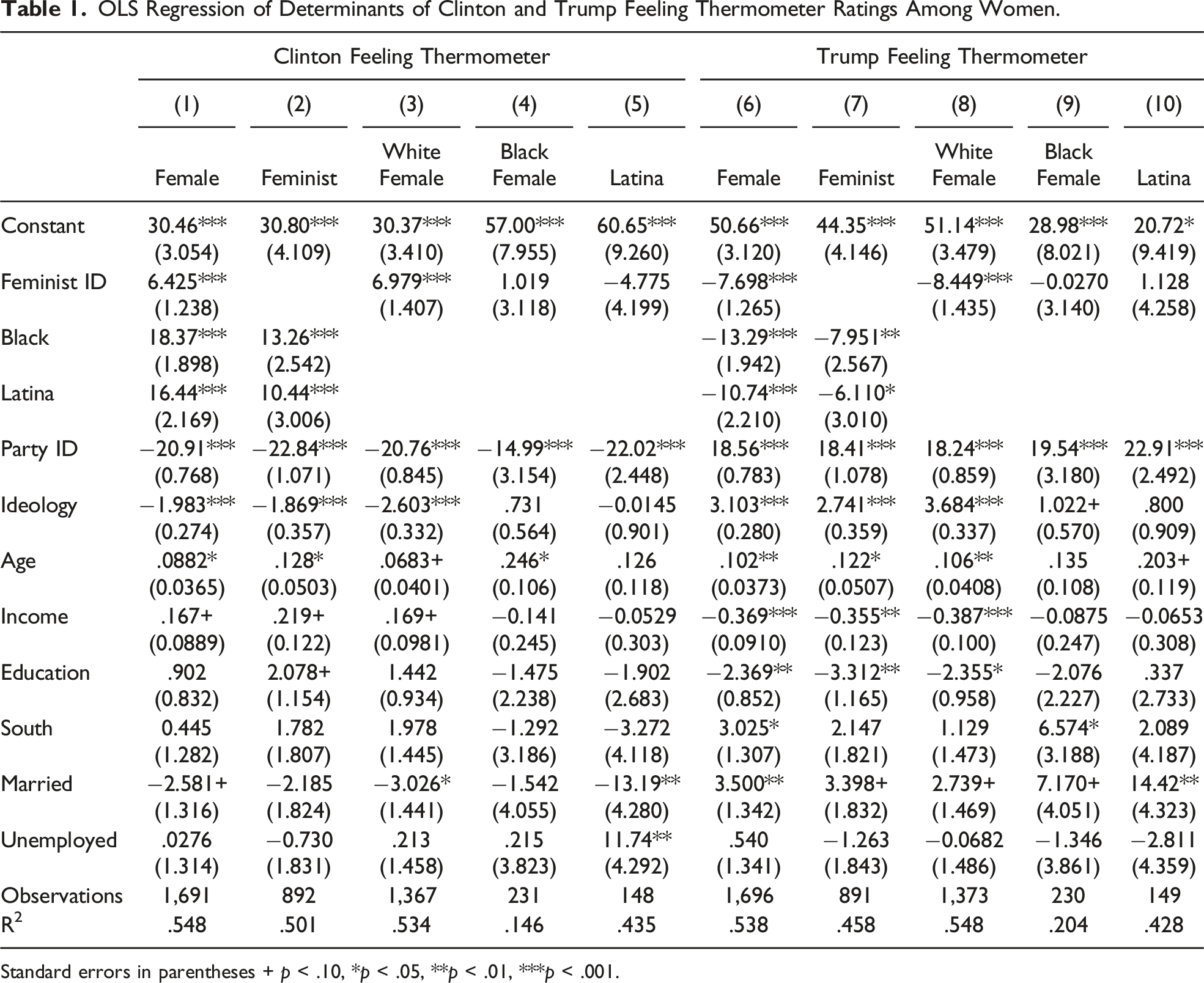
OLS Regression of Determinants of Clinton and Trump Feeling Thermometer Ratings Among Women.
Standard errors in parentheses + p < .10, *p < .05, **p < .01, ***p < .001.
In the second column, we restrict the analysis to women who identify as feminists. Here we see that the results are like the first model as the coefficients measuring Black, Latina, Party ID, and Ideology are all statistically significant indicators of a respondents rating of Clinton. In this model, however, we see that Age is positive and statistically significant indicating that older feminists are more likely to have positive ratings of Clinton. The models in the third, fourth, and fifth columns are limited to White, Black, and Latina Women, respectively. We see that White Feminists (but not Black or Latina Feminists) are significantly more likely to rate Clinton highly on the feeling thermometer rating.
Table 1 includes the same set of models, except using respondent feeling thermometer toward Trump as the dependent variable for the remaining four models. In columns 6–10, as we might expect, we observe opposite results for each variable when the dependent variable is the feeling thermometer of Donald Trump. The coefficient for Feminist ID is negative and statistically significant, as women identifying as a feminist are more likely to hold lower view of Trump on the thermometer scale. Notable differences in statistical significance in this model are for the variables Age, Education, and South as older women are more likely to hold positive views of Trump (among all but Black and Latina women), more highly educated women hold a more negative view of Trump (among all but Black and Latina women), and women residing in the South hold a significantly more positive view of Trump (for all women and for Black women).
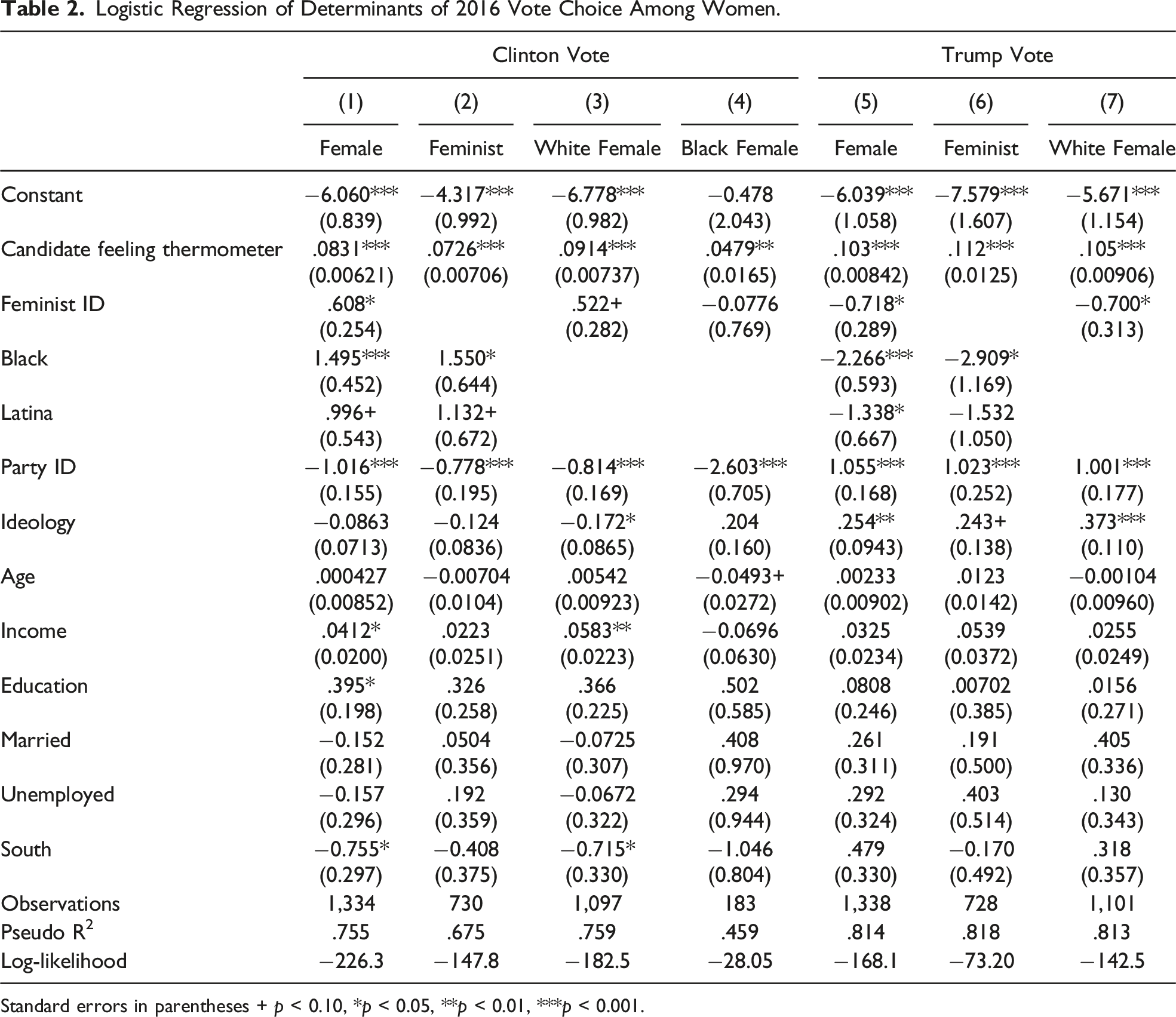
Logistic Regression of Determinants of 2016 Vote Choice Among Women.
Standard errors in parentheses + p < 0.10, *p < 0.05, **p < 0.01, ***p < 0.001.
We observe an opposite set of results when the dependent variable is measured dichotomously as support for Donald Trump (all other candidates measured as 0). As expected, those that rate Trump more positively as measured by the feeling thermometer are also more likely to support him from President. Those identifying as feminists, Black, or Latina were less likely to vote for Trump, as the coefficients are negative and statistically significant in all models. Party ID and Ideology are both positive and statistically significant in each model as Republican and conservative women were more likely to back Trump.
The substantive significance of the results in Tables 1 and 2 can be seen in Figure 1 below. To generate the values shown in the figure, we estimated the predicted margins for the respondent feeling thermometer and vote choice for each subset of women while holding all other variables at their means. The figure shows the predicted margin (probability) displayed as a dot, with the lower and upper bounds of the 95 percent confidence interval depicted as lines above and below each predicted margin. Predicted margins of 2016 feeling thermometer and vote choice among women.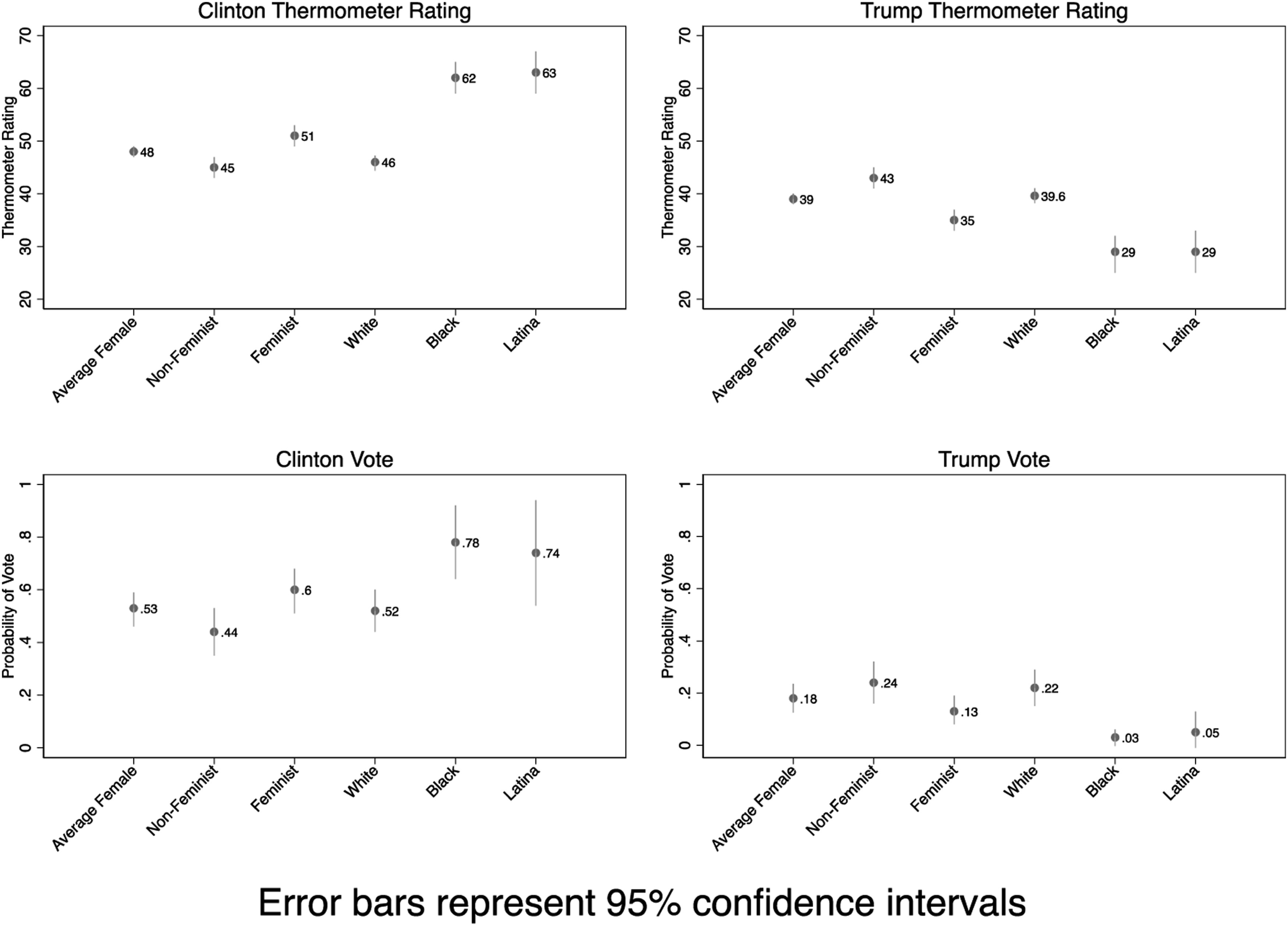
While intersectional research requires more than simply looking at multiple categories in sequence, predicted margins help us visualize and contextualize the regression results by recognizing the site or “intersectional location.” Margin figures offer a space-oriented way of observing a range of differently situated women, with a focus on the interstices. Such an approach must be taken at least provisionally in a comparative way to discover how race-gender similarities and differences in candidate affect, or vote choice are linked to power hierarchies and inequities within social categories. A broad intersectional approach is inclusive of a “both/and strategy” with both additive effects and intersectional effects, demonstrating the importance of building upon “single-axis” approaches and simultaneously examining intersectional locations (Reingold, Haynie, and Widner 2020). Each of these effects are meaningful especially when considering intersectionality seeks to address relational power and privilege, with explanatory power.
The top two panels show that for the feeling thermometer, the average woman rates Clinton at 48 on the 100-point scale, which is higher than the mean of 44 among all respondents (men included). Feminists rate Clinton higher than the average at a predicted value of 51, but this is only 6 points higher than non-Feminists (45), lending some support to the Candidate Affect Hypothesis (H1). Black and Latina women give Clinton the highest predicted rating at 62 and 63, which is 16–17 points higher than White Women (46). While Clinton’s thermometer ratings among women hover just above the median, Trump’s thermometer scores among all groups of women is quite low. The average woman, holding all variables in our model constant, is predicted to give Trump a thermometer rating of 39. This is below the average of among all respondents (men included) who rate Trump at 42 on the 100-point scale. Women who do not identify as Feminists are predicted to rate Trump at 43 while Feminists rate Trump at a predicted value of 35. White women rate Trump 10 points higher than Black and Latina women, who give the lowest predicted rating of 29.
We also observe significant variation among different groups of women when examining respondent vote choice (bottom two panels). The figure shows that the average female respondent has a 0.53 predicted probability of voting for Clinton. There is a large gap in the predicted probability of voting for Clinton (0.16 difference) between those who identify as a feminist (0.6) compared to those women who do not (0.44), thus lending support to the Vote Choice Hypothesis (H2). Similarly, there is a large gap (0.26) between white women (0.52), Latina women (0.74), and Black women (0.78), as Black women have the highest predicted probability of the groups we examine. These results support the Racialized Feminist Voice Choice Hypothesis (H3). As expected, all groups of women have a much lower predicted probability of voting for Trump, with the average female respondent showing a 0.18 predicted probability of support. Women who do not identify as feminists have a 0.24 predicted margin of supporting Trump, while feminists have only a 0.13 predicted chance of supporting Trump. Once again there is a large difference between white and Black women (0.19) as white women are predicted to support Trump at a predicted probability of 0.22, Latina women a predicted probability of 0.05 and Black women have a predicted probability of just 0.03.
Feminist Political Behavior in 2016
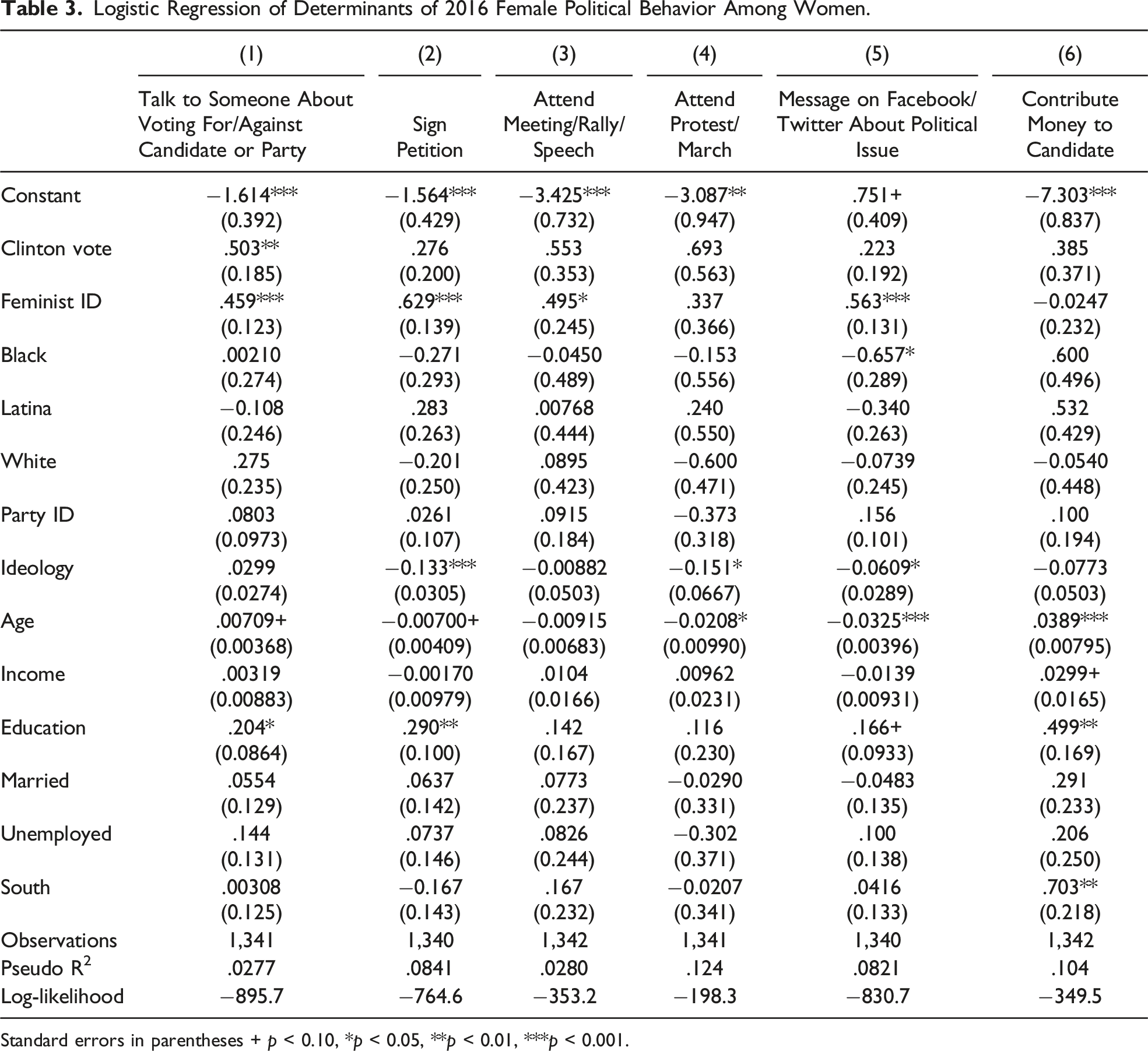
Logistic Regression of Determinants of 2016 Female Political Behavior Among Women.
Standard errors in parentheses + p < 0.10, *p < 0.05, **p < 0.01, ***p < 0.001.
In the second column, where the dependent variable is measuring whether a respondent indicated signing a petition in the past 12 months, we again see that the coefficient for the variable measuring Feminist ID is positive and statistically significant. The coefficient for Ideology is negative and statistically significant, as conservatives were less likely to sign a petition. Older women were less likely to sign a petition, as the coefficient for Age is negative and statistically significant. More educated women were more likely to sign a petition as Education is positive and statistically significant. The only significant predictor for the model where the dependent variable is whether a respondent attended a political meeting, rally, or speech is whether a woman identifies as a Feminist, as this variable is positive and statistically significant. In the next model, the dependent variable measures whether a female respondent indicated joining a protest or a march in the past 12 months. Here, we see that the only significant predictors are Age and Ideology, which are both signed negatively as older and more conservative women were less likely to attend a protest or march during the year leading up to the general election.
Turning to whether a respondent engaged with social media (Twitter or Facebook) to talk about a political issue during the campaign (column 5), we see that once again the coefficient for Feminist ID is positive and statistically significant, indicating women identifying as feminists were more engaged on social media than non-feminists. Black women, conservatives, and older women were less likely to engage via social media as the coefficients for each variable are negative and statistically significant. The coefficient for Education is positive and statistically significant, indicating more highly educated women were more likely to engage with social media during the campaign. In the final model (column 6), we examine whether a respondent contributed money to a candidate during the campaign. We see that the coefficients for Age, Education, Income, and South are all positive and statistically significant as older women, more educated women, wealthier women, and those residing in the South were more likely to donate.
To examine differences among women and to see the substantive significance of these results, we again generate predicted margins for each of the models in Table 3 for each subset of women. The predicted margins (and 95 percent confidence intervals) are shown in Figure 2. To examine and compare the range of effects possible within an intersectional frame fosters a better understanding of the nuanced ways in which social categories are linked to certain political behaviors (or lack thereof) for subgroups of women, especially feminists. Given the tendency to talk about gender inequality as separate from inequality based on race and ethnicity, we often miss how women and especially feminists are subject to all of these, and their political experience is not just the sum of their parts (Block, Golder, and Golder 2023). To self-identify as “feminist” is to perceive a sense of belonging to the group and to recognize the unequal distribution of wealth and power resources in accordance with a complex matrix of oppression (Conover 1988; Cook 1989; Collins 2000; Elder, Greene, and Lizotte 2021; Fulenwider 1980; Gurin 1985; Klein 1984; Wilcox 1990; 1997; Simien 2006). Feminists possess an acute sense of awareness that structural barriers and not personal failings account for the subordinate status of the group and the act of voting and other modes of political behavior are necessary means by which to remedy the problem of inequality for women generally (Cook 1989; Gurin 1985; Miller et al. 1981). Predicted margins of 2016 political behavior among women.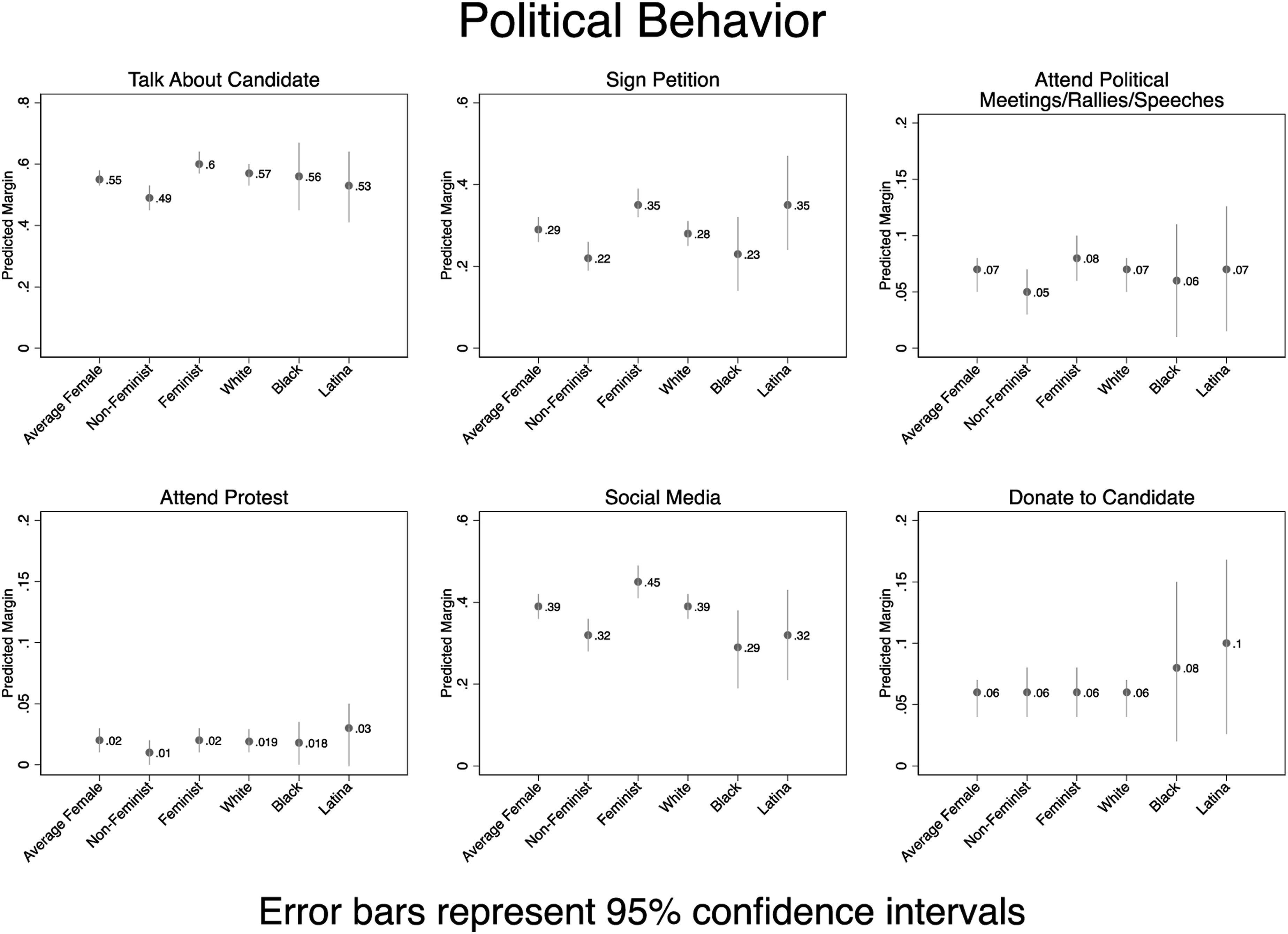
The figure shows wide variation by type of political behavior among women. Most groups talked about the candidate with another person leading up to the election, with feminists having the highest predicted engagement about a candidate and those not identifying as a feminist as having the lowest. While the differences are not always large, feminists were also the most politically engaged as they were the group most likely to sign a petition, attend a political event, to attend a protest, or engage with social media. Black women were the most likely to donate to a candidate or party, though the confidence intervals overlap other groups. Black women were the least likely to engage with social media about the election. Latina women where most likely to sign a petition, attend a protest, or donate to a candidate. Overall, attending a protest, political meeting, or donating were the least engaged in activities among all groups. In sum, there is some support for the Political Behavior Hypothesis (H4). Those identifying as Feminists are slightly more likely to engage in political behaviors such as talking to someone about a candidate, signing a petition, attending a meeting or talk, or being active on social media. While feminist identifiers were no more likely to either attend a protest or donate, only a very small portion of the American public engages in such activities, as reported by the ANES.
Discussion and Conclusion
Our results add to prior studies that examine how American attitudes and political behavior may be differentially politicized across various subgroups especially those who are disadvantaged within marginalized populations using quantitative methods and an intersectional lens (Brown 2014; Simien 2006; Strolovitch 2007; Reingold, Haynie, and Widner 2020). Much of the research investigating women’s political behavior shows that feminists vary considerably from non-feminists in their participatory styles (Conover 1988; Elder, Greene, Lizotte 2021; Fulenwider 1980), which is further complicated by their racial and ethnic identity (Brown 2014; Brown and Gershon 2016; Simien 2006). Here, we advance seminal research on feminist identity (Cook 1989; Conover 1988; Wilcox 1990) and illuminate not only the importance of feminist identity in determining candidate affect and vote choice but also show the utility of feminist identity for predicting political behavior across subgroups of women. The differences in candidate affect and vote choice for Clinton and Trump were stark, resulting in a competitive advantage of special importance for the Democratic nominee (and as such, we believe will benefit future Democratic nominees by virtue of a carry-over effect especially among feminists). Feminist identity is an important indicator of participation in politics, particularly for activities outside of voting among women generally. All things considered, we provide new insights into the ways that feminist identity and other subordinate identities like race and ethnicity intersect to influence candidate affect, vote choice, and political behavior during the 2016 American presidential election.
Women who identified as feminists rated Clinton more favorably than Trump, as did Black and Latina women who gave Trump the lowest rating on the feeling thermometer. Correspondingly, those identifying as feminists, Black, or Latina were less likely to vote for Trump. Feminists were the most politically engaged—that is, they were more likely to sign a petition, attend a political event, to attend a protest, or engage with social media. Black and Latina women were most similar in terms of their feeling thermometer ratings and predicted margins of vote choice for the two candidates. Black women were less likely to engage in social media. Whereas income was a key variable in determining candidate affect and vote choice, education was central to understanding political behavior as it differed among women (Brown 2014; Cassese and Barnes 2019; Hardy-Fanta 1993; Simien and Hampson 2017) and feminists generally (Elder, Greene, and Lizotte 2021). Education was a consistent variable, increasing the likelihood that women would talk to someone about the candidate or party, sign a petition, or engage in social media. The importance of income in determining feminists' attraction to Clinton and education for understanding behavior as it differs among women generally (Brown 2014; Cassese and Barnes 2019; Hardy-Fanta 1993; Simien and Hampson 2017) and feminists specifically (Elder, Greene, and Lizotte 2021) serve as a reminder that civil rights and feminist organizations ought to consider ways that their outreach efforts might address the increasing socioeconomic inequalities that exist within the populations they represent. This study advances our understanding of feminist identity while also recognizing the precarious position of women of color in the racial hierarchy—specifically, women who have become the preferred providers of cheap, repetitive, and poorly paid labor in the United States (Fernandez-Kelly 2000), and who are the least likely to enter and remain active in politics through social media. Even among feminists, race and ethnicity exert important cross pressures on American public opinion and political behavior. Black women especially those without a college education and post-graduate training are motivated to distance themselves from feminists and privilege their fate-linked relationships with Black men by prioritizing their race over gender (Alexander-Floyd and Simien 2006; Collins 1996; Gay and Tate 1998; Mansbridge and Tate 1992; Simien 2006; Simien and Hampson 2017). Latina women also experience cross pressures when immigration becomes salient, as with Trump’s promise to build a wall along the United States border to prevent immigrants from entering the country, and to block access to opportunities—healthcare and education—regardless of documentation status. They too can possess weaker perceptions of gender discrimination and be reluctant to identify with the feminist movement due to limited resources, cultural traditions or Latin machismo, and their gender-stratified occupations in food service, housekeeping, and other domestic care jobs (Berjarano, Manzano, and Montoya 2011).
The 2016 election reflected an important political moment, with the opportunity for a historic first. Previous scholarship has shown the lack of female political participation is often attributed to not being able to identify with the candidate or the candidate struggling to create a platform relatable to women. With the profound turnout from the Black community in the election of Barack Obama, it appeared that appealing to women ensured Clinton would have an immense voting base. The results of the 2016 election demonstrated that the political participation of women is more complex. Our research adds to the political science literature following this unique election, aspiring to determine the relationship between these two diverse candidates and the emotions as well as behaviors of politically active Americans. Specifically examining women and the groups the Clinton campaign appealed most to—feminists, Black, and Latina women—adds to our knowledge and understanding of how women respond through affect and how this affect can result in increased political behavior and lead to potential policy change.
To that point, the above analysis may inform futures studies that examine the ways in which campaigns can appeal to the above social group identities, using the subconstituency politics theory, to court prospective voters (Bishin 2009). Alternatively, researchers may wish to consider how evolutionary game theory might inform this work especially when considering affective polarization defined by growing economic anxieties and social group cleavages in the United States is at the root of this subject (Stewart, McCarty, and Bryson 2020). Still, others might draw upon the work of Hofstede (2001)—specifically, on dimensions of cultural comparisons, with its focus on societal orientations toward masculinity versus femininity, for connecting the feminist versus non-feminist behaviors reported here in the United States to other countries for a cross-country analysis of elections for heads of state. Finally, scholars might consider the role of the unconscious mind in stereotyping and the subliminal aspects of everyday decision-making for group behavior, as in voting (Mlodinow 2013). Herein lies a range of possibilities for innovative research, reminding us that such topics are ripe for incisive treatment and lend themselves to an intersectional framework.
Supplemental Material
Supplemental Material - The Democratic Majority and the 2016 American Presidential Election: Feminist Political Behavior Across Multiple Axes of Identity
Supplemental Material The Democratic Majority and the 2016 American Presidential Election: Feminist Political Behavior Across Multiple Axes of Identity by Evelyn M. Simien, Thomas J. Hayes, and Carolyn Conway in Political Research Quarterly
Footnotes
Declaration of Conflicting Interests
The author(s) declared no potential conflicts of interest with respect to the research, authorship, and/or publication of this article.
Funding
The author(s) received no financial support for the research, authorship, and/or publication of this article.

Supplemental Material
Supplemental material for this article is available online.
Note
References
Supplementary Material
Please find the following supplemental material available below.
For Open Access articles published under a Creative Commons License, all supplemental material carries the same license as the article it is associated with.
For non-Open Access articles published, all supplemental material carries a non-exclusive license, and permission requests for re-use of supplemental material or any part of supplemental material shall be sent directly to the copyright owner as specified in the copyright notice associated with the article.
