




Abstract
Spanish language media is linked to multiple forms of Latino political mobilization, including protest, naturalization, and voting. However, recent research associates geographic access to Spanish language broadcasts with significantly lower rates of Latino voter participation. We engage this controversy by exploring whether relative consumption of Spanish and English language media shapes rates of civic and voter participation among Latinos using data from the 2016 Cooperative Multiracial Postelection Survey and our own 2021 survey. 1 Next, we test the hypothesis that Spanish language media acts through politicized identities to shape Latino civic engagement, as some theorize. We find strong association between Spanish language media consumption and politicized identities among Latinos but no evidence that these identities constitute a conduit through which Spanish language media mobilizes. Instead, our results show that the mobilizing effect of Spanish language media consumption on civic engagement is direct and independent of politicized identity. These findings indicate a need to explore whether Spanish language media consumption influences Latino participation through differences with English language media in terms of content and/or fragmentation that better educate Latinos to participate, reduce political alienation, or accomplish both.
Introduction
Does Spanish language media (SLM) shape Latino political participation? If so, how? Recent research demonstrates that access to SLM, measured in terms of its geographic accessibility, is actually associated with lower rates of voter turnout among Latinos (Velez and Newman 2019). By contrast, many other studies positively link SLM to various forms of mobilization (Barreto et al. 2009; Barreto, Merolla, and Soto 2011; Abrajano and Panagopoulos 2011; Félix, González, and Ramírez 2008; Panagopoulos and Green 2011; Ramírez 2013; Zepeda-Millán 2017). Refining our empirical understanding of this relationship requires disentangling these apparent conflicts.
Scholarly understanding of the relationship between SLM and Latino political participation also suffers from a lack of explicit hypothesis testing to isolate the theoretical mechanism(s) than animate the relationship. For example, Garcia-Rios and Barreto (2016) theorize that SLM may work alongside feelings of immigrant-linked fate to construct politicized identities among Latinos and act through those identities to influence greater campaign-related participation and greater likelihood of voter participation. However, the data examined in that study does not permit an explicit test of the theoretical relationship, forcing the scholars instead to rely upon proxy measures to gauge the impact of SLM. Furthermore, research has generally failed to contextualize the role of SLM as a factor that acts alongside a much larger and potentially more influential English language media (ELM) environment. We move this scholarly conversation forward through analyses that examine whether relative consumption of SLM and ELM shape political behaviors and explicitly test the theory that SLM consumption constructs and works through politicized identities to influence participation.
The contrasting qualities and fragmentation of SLM and ELM are substantial. In terms of content, substantive coverage of political campaigns and issues relevant to Latinos appears more prevalent in SLM than ELM (Moran 2006; Eshbaugh-Soha and Balarezo 2014; Medina Vidal and Subervi-Velez 2018). SLM also contrasts with ELM when it comes to priming and framing by presenting coverage of Latinos that is more positive, affirming, and inclusive, and less likely to portray Latinos as threatening (Casillas 2014; Medina Vidal and Subervi-Velez 2018; Branton and Dunaway 2008; Silber Mohamed and Farris 2020; Farris and Silber Mohamed 2018). In part due to the fact that SLM television media remains less fragmented and more broadcast-oriented than ELM, SLM also appears less likely than ELM to present polarizing and partisan narratives.
We see at least three possible mechanisms deriving from differences in SLM and ELM media environments that might explain why greater relative consumption of SLM should mobilize Latinos. First, SLM’s greater presentation of Latino-oriented and affirming programing may foster an “identity to politics” link by politicizing identities among Latinos and, in turn, encouraging greater participation, as some theorize (Garcia-Rios and Barreto 2016; Pérez 2015). Second, the relative absence of both polarizing partisan narratives and negative portrayals of Latinos and immigrants in SLM compared to ELM may insulate Latino viewers from alienating content that seems likely to demobilize Latino participation. Finally, SLM may have advantages when it comes to educating Latinos to participate both because it features more content that is politically relevant to Latino audiences and because its less fragmented, more broadcast-oriented format is likely to produce greater incidental exposure to political information (Prior 2007).
Our analysis of the relationship between relative reliance upon SLM and ELM and patterns of civic participation and voting employs two distinct sets of data. The 2016 Collaborative Multiracial Post-Election Survey (CMPS) and our own 2021 survey both contain the requisite questions related to linguistic media consumption and one or more indicators of political participation that permit us to examine this relationship. Both also enable us to explicitly explore one of the three theoretical explanations relating SLM consumption to political participation discussed above: specifically, the theory that SLM mobilizes Latino participation by first politicizing Latino identities and then working through those identities to spur engagement. Our results indicate that SLM consumption is, indeed, associated with politicized identities among Latinos. However, we failed to find evidence that its mobilizing effect on patterns of Latino civic engagement is dependent upon or amplified by the presence of politicized identities. Instead, the positive relationship between consumption of SLM and Latino political participation appears to be direct and independent of politicized identity. These findings indicate a need to revisit empirical research that demonstrates a negative relationship between Latino voter participation and access to SLM television (Velez and Newman 2019). They also urge further theoretical exploration of the relationship between SLM consumption and participation. In particular, future research should examine whether educative benefits of incidental exposure to political information, the greater political relevance of SLM content to Latinos, or SLM’s role in balancing or insulating audiences from demobilizing features more prevalent in ELM explain SLM’s positive relationship with Latino participation.
Spanish and English Language Media Environments
Beyond obvious linguistic contrasts, Spanish and English language media differ from one another in a variety of potentially impactful ways. Some of the most obvious contrasts between ELM and SLM relate to political content and framing. Revolutionary changes related to polarization, incivility, and dominant narratives that portray Latinos as a threat to native populations all appear far more characteristic of ELM than SLM (Chavez 2020; Silber Mohamed and Farris 2020; Farris and Silber Mohamed 2018; Gonzalez O’Brien et al. 2019; Cappella and Jamieson 1997; Lawrence 2000; Mutz 2015; Mutz and Reeves 2005). Taken together, these features comprise key components of what Berry and Sobieraj dub the “outrage industry,” an increasingly prevalent media genre characterized by “virulent, distorted, and demeaning political analysis” that has proven “lucrative in a cluttered, competitive, and largely unregulated media space” (2014, 218).
“Latino threat narratives” are of special concern to this study. These narratives tend to selectively focus on “spectacles” that are unrepresentative in their characterization of immigrants as undeserving recipients of public resources, as diluting rights and privileges of “native” populations, as invaders, and as potential separatists (Chavez 2020). These narratives come through not only in verbal content but also in visual imagery, disproportionately portraying immigrants as illegal or undocumented, as unskilled, as male, and as Latin American (Silber Mohamed and Farris 2020; Farris and Silber Mohamed 2018).
The prevalence of “outrage”-related content in ELM contrasts with prominent features of SLM content. First, the overall content of SLM tends to be more Latino-relevant or Latino-oriented than programing in the ELM. Research shows, for example, that SLM covers immigration more reliably and positively than ELM (Branton and Dunaway 2008). More Latino-oriented and affirming broadcasts may help to promote feelings of inclusion or belonging as suggested by research focusing on SLM radio (Casillas 2014).
Second, the content of SLM reporting may be more substantive and useful when it comes to Latino political engagement. For example, one study conducted by examining Univisión and ABC affiliates in San Diego found that the Spanish language affiliate covered substantially more stories about local and national politics, politics relevant to Latinos, border and immigration issues, and included more in-depth reporting as measured by segment length (Moran 2006). In the context of presidential elections, a study comparing coverage by Telemundo and NBC found that candidate visits to border states receive greater coverage from Telemundo and that only Telemundo considered Latino sources in its coverage (Eshbaugh-Soha and Balarezo 2014). Consistent with this observation about content, another study found Spanish stations to be far more focused on Latino interests in the context of election reporting than English ones, perhaps underscoring the importance of voting for Latino audiences (Fowler, Hale, and Olsen 2009). Limited survey evidence confirms that Latinos recognize the superior relevance of SLM when it comes to providing news and information necessary “to engage in our democracy” (Medina Vidal and Subervi-Velez 2018, 397).
A final contrast that sets SLM apart from ELM relates to formatting. Especially when it comes to television, media fragmentation in the ELM is demonstrably more pronounced than media fragmentation in the SLM. This means that the ELM is characterized by many more viewing options and thus more programming tailored to narrower viewing audiences, while the SLM retains characteristics of a broadcast media environment dominated by heavyweights like Univision and Telemundo. By virtue of the broadcasting format—and less media “choice”—SLM audiences consume more common programing than ELM audiences and probably experience greater incidental exposure to political news and information (Prior 2007). SLM audiences also likely consume less “outrage” than ELM audiences because the relative lack of media competition disincentivizes narrowly tailored ideological programming.
The majority of research exploring the implications of SLM suggest that it positively influences multiple forms of Latino mobilization (Barreto et al. 2009; Barreto, Merolla, and Soto 2011; Abrajano and Panagopoulos 2011; Félix, González, and Ramírez 2008; Panagopoulos and Green 2011; Ramírez 2013; Zepeda-Millán 2017). However, in their recent study of the relationship between SLM access and Latino voter participation Velez and Newman (2019) find a negative relationship. The study examines compelling evidence from regional data in North Carolina and Florida, as well as from national surveys, and shows that Latinos in the coverage area of Spanish language television stations were significantly less likely to turn out to vote in 2008 and 2012 compared to those outside the coverage areas in both the North Carolina case and the U.S. more broadly.
Velez and Newman advance a “cocooning” hypothesis as a potential explanation for the negative relationship observed between Spanish language television coverage areas and rates of ethnic civic participation (and political knowledge). This hypothesis suggests that access to Spanish-language television enables and encourages Spanish speakers to consume more non-political entertainment and reduces civic engagement as a result (2019). While findings from the geographically based data are compelling, it is worth noting that the results could reflect responses to other unaccounted for characteristics of geographic or media environments or have been shaped by contextual factors related to the political climate of the era. For example, while the study accounts for variations in geographic access to SLM, it fails to account for geographic variations in qualities of ELM access, and thus the overall mix of available media. Furthermore, the study was conducted during a period in which the ELM was rapidly transforming in terms of the potentially demobilizing factors we identify earlier, and during an era in which many of the dynamics that define our contemporary political environment, including the Trump phenomenon, were nascent. Finally, the cocooning hypothesis carries with it the strong assumption that access to SLM translates into consumption of SLM by Latinos, something that the study does not explicitly demonstrate.
The cocooning hypothesis contrasts starkly with competing explanations of a positive relationship between SLM and Latino political participation. An initial possibility is that, whatever effect SLM may have on Latino behavior, its influence stands alongside characteristics of ELM that are likely to demobilize Latino political participation. The “new videomalaise” thesis suggests that violations of interpersonal and spatial norms through incivility and close-up camera angles lead to negative reactions by audiences that decrease trust and increase cynicism about politics (Mutz 2015; Mutz and Reeves 2005). In an era of partisan and polarized narrow cast programming, such norm violations tend to come with clear in-group/out-group political messaging and frequently appear designed to demoralize the political opposition while mobilizing the in-group through outrage (Berry and Sobieraj 2014).
Whether televised incivility actually demoralizes or demobilizes is a matter of debate. A small body of research has challenged the claims that (1) uncivil television polarizes audiences (Arceneaux and Johnson 2013; Levendusky 2013; Druckman, Levendusky, and McLain 2018) and (2) that partisan polarization harms voter engagement (Simas and Ozer 2021). However, the focus on partisan polarization in the United States as a topic in ELM and the accompanying portrayal of strong partisans may harm political engagement (Levendusky and Malhotra 2016). One notable feature of ELM cable news in the United States is the extent to which it highlights—or perhaps exaggerates—partisan conflict and instances of political incivility (York 2013). Americans with weaker political identities may recognize they are unlike the deeply involved partisan exemplars portrayed in the news, and thus come to believe they do not have what it takes to become politically involved (Krupnikov and Ryan 2022).
The incivility, partisanship, and outrage prevalent in ELM may be particularly corrosive to Latino political engagement. First, partisan identities, and thus the appeal of partisan media, appear weaker among Latinos: about a third of American Hispanics were born outside of the United States (Krogstad and Noe-Bustamante 2020) and among new (first-generation) Latino Americans, a significant proportion lack partisan affiliation (Alvarez and Bedolla 2003; Carlos 2018). Moreover, even among second-generation Latino immigrants, party ties are relatively weak and come about later in life (Carlos 2018). Second, Latinos encounter an increasingly pervasive volume of immigrant portrayals that scholars suggest more generally depict Latinos as a threat (Chavez 2020; Silber Mohamed and Farris 2020; Farris and Silber Mohamed 2018). While the implications of such portrayals for political behavior are not straightforward, there is evidence that groups that feel threatened by media coverage express less trust and are less likely to identify strongly as Americans (Saleem et al. 2019). Diminished confidence in and identification with the American system seem likely to damage political engagement.
In contrast to the host of factors in the ELM environment that appear, on balance, to have potentially negative implications for political engagement, several characteristics of the SLM environment seem likely to encourage political participation either by educating Latino audiences to participate or buffering alienating contents of the ELM. First, coverage that is more relevant and affirming to Latinos should promote feelings of inclusion and belonging that reduce alienation and facilitate engagement (Moran 2006; Branton and Dunaway 2008; Casillas 2014). Second, more substantively useful content related to both politics and electoral participation should perform an educative function that also appears conducive to political engagement (Moran 2006; Fowler, Hale, and Olsen 2009). Furthermore, contrasts in media fragmentation between SLM and ELM may also have educative consequences. ELM fragmentation, first by the advent of diverse cable TV viewing options and then by the proliferation of internet media, permits audiences to self-select entertainment streams that diminish incidental exposure to political news and information, resulting in significant inequalities when it comes to political knowledge and participation (Prior 2007). Simply by virtue of its less fragmented, and more broadcast-oriented environment, SLM should more effectively promote incidental exposure to political news and information. The greater likelihood of incidental exposure to political information among SLM consumers dovetails with aforementioned coverage that is more relevant to Latino political engagement providing a good reason to hypothesize that SLM performs an educative function that enables greater Latino political participation.
The contrasting natures of framing, content, and fragmentation in SLM and ELM, particularly with regard to evidence that SLM provides more information relevant to Latino political participation, yield expectations that contrast starkly with arguments and evidence produced by Velez and Newman (2019) and lead to our initial hypothesis: H1) greater consumption of SLM relative to ELM relates to higher rates of political participation among Latinos.
The theoretical explanations we develop above related to the contrasting educative and alienating potential of SLM and ELM stand alongside previous research that instead suggests the relationship between SLM and civic engagement occurs through SLM’s influence in politicizing Latino identities. Garcia-Rios and Barreto (2016) argue that greater interest in politics and a stronger sense of linked fate positively predict political participation by Latinos, and those factors interact to amplify the positive impact. Furthermore, consumption of TV news by Spanish-dominant Latinos appears to amplify Latino interest in voting, compared with English-speakers, a finding they attribute to Spanish language news (Garcia-Rios and Barreto 2016). Taken together, the coinciding positive impacts of political interest, consumption of political news by Spanish-dominant individuals, and linked fate on election-related activity suggest the possibility that Latino mobilization is related to a politicized Latino identity that SLM may help to construct and maintain (Garcia-Rios and Barreto 2016). A pair of other studies underscore the potential for SLM to play a role in shaping politicized identities and civic engagement. Research by Kerevel (2011) demonstrates a direct relationship between SLM consumption and greater group consciousness among Latinos. Perez argues that elite discourse may act through group identification to shape patterns of political behavior. When such discourse impugns the worth of group identities, “high identifiers” may engage in political efforts to restore group status (Pérez 2015). The “identity-to-politics link” may provide a conduit through which SLM shapes civic engagement (Pérez 2015). Other research demonstrating that the combination of ethnic or pan-ethic identities with personally experienced discrimination increases the likelihood of voting among Latinos further supports the need to examine politicized identity in conjunction with SLM consumption (Schildkraut 2005; Valdez 2011). Taken together, this research implies that the relationship between SLM and political behavior proceeds through politicized identities and thus leads to our second set of hypotheses: H2a) greater SLM consumption relative to ELM consumption relates positively to politicized identities among Latinos, and H2b) greater SLM consumption relative to ELM consumption interacts with politicized identities to positively influence political participation.
Data and Models
We examine two separate sets of data in order to explore the dynamics by which SLM consumption shapes Latino civic engagement: the 2016 Collaborative Multiracial Post-Election Survey (CMPS) and our own survey conducted in 2021 with the survey research firm Lucid. 1 One advantage of these surveys is the temporal contrast they offer with Obama-era data examined in research conducted by Velez and Newman (2019). We suspect that the Trump-era data we examine offers more contemporary insight into the relationship in question. The nascent Tea Party movement evident early in Obama’s presidency presaged but also largely preceded the anti-immigrant and anti-Latino rhetoric which culminated in unprecedented ways during Trump’s candidacies and presidency (Gervais and Morris 2018). Many Latinos (and many Americans) likely experience politics today in ways fundamentally different from experiences of the pre-Trump era. Second, the inclusion of our 2021 data enables us to capture the relationships of interest during the COVID-19 pandemic—a period of relative isolation during which media consumption likely became more essential to understanding political attitudes and behaviors. Political controversy, differing partisan strategies, and widespread misinformation related to alternative voting methods such as absentee balloting, for example, arguably complicated the process of voting and confused many voters. If SLM consumption played an important role in educating Latino voters or insulating them from potentially demobilizing content, we might expect its effect on patterns of participation to have been particularly evident during the Pandemic. The contrasts between 2016 and 2021 in terms of daily life, patterns of media consumption, and potential contrasts with respect to voting information in particular can thus offer insight into whether the relationship between relative SLM and ELM consumption and Latino political participation is consistent or contextualized.
The analyses focus on U.S.-born Latinos. Michelsen (2003) finds a clear distinction in the effect of language assimilation across foreign- and U.S.-born Latinos, with foreign-born Latinos essentially immune to language assimilation effects. Our analysis replicates this finding with regard to voting behavior, showing no relationship between the balance of SLM and ELM consumption and that indicator of participation among foreign-born survey participants. We report those results in the supplemental material. Both surveys contain requisite questions about relative consumption of Spanish and English language media ranging from exclusive consumption of English language media to exclusive consumption of Spanish language media. 2 To explore the relationship between SLM and politicized identities among Latinos and possible interactive effects of SLM consumption and politicized identity on civic engagement, we constructed a variable that interacts group consciousness (whether participants agreed that what happens to Latinos generally has an impact on their lives) and political or campaign interest (ranging on four and five point scales from “not interested at all” to “very interested”). The variable thus differentiates Latinos who express group consciousness from those who do not and distinguishes among those who do according to their expressed level of political interest.
The initial set of models examine politicized identity as a function of SLM consumption. Other variables controlled for in the models include party (Republican and Democrat), conservatism, female gender, age, income, and whether the respondent was from a Mexican or Cuban background. 3 The 2016 CMPS analysis also contains variables indicating Puerto Rican background, Hispanic composition of participants’ neighborhoods, participants’ education levels, and whether the survey was conducted in Spanish.
The second set of models focus on the impacts of both SLM consumption and politicized identity on patterns of Latino civic engagement. Using the 2016 CMPS data, we examine both civic participation and voter participation. The first variable is derived from a question that asks whether respondents “participate in one or more than one social, cultural, civic, political group or union” and takes on values of 0 (none), 1 (one group), or 2 (more than one group). Our voter participation measure is derived from a question that asks “Besides presidential elections, how often do you vote for state or local elections?” with responses measured on a four-point scale: I usually skip state/local elections (1); I occasionally vote in state/local elections (2); I vote in many state/local elections (3); I vote in every single state/local election (4). Analyses of the author’s survey examine only self-reported dichotomous voting behavior in the 2020 election. Each dependent variable is measured using a base model that examines the independent effects of SLM consumption and politicized identity, and a second model that includes an interaction term that multiplies these indicators. 4
Results
Spanish Language News and Politicized Identity Among Latinos, OLS Regression.
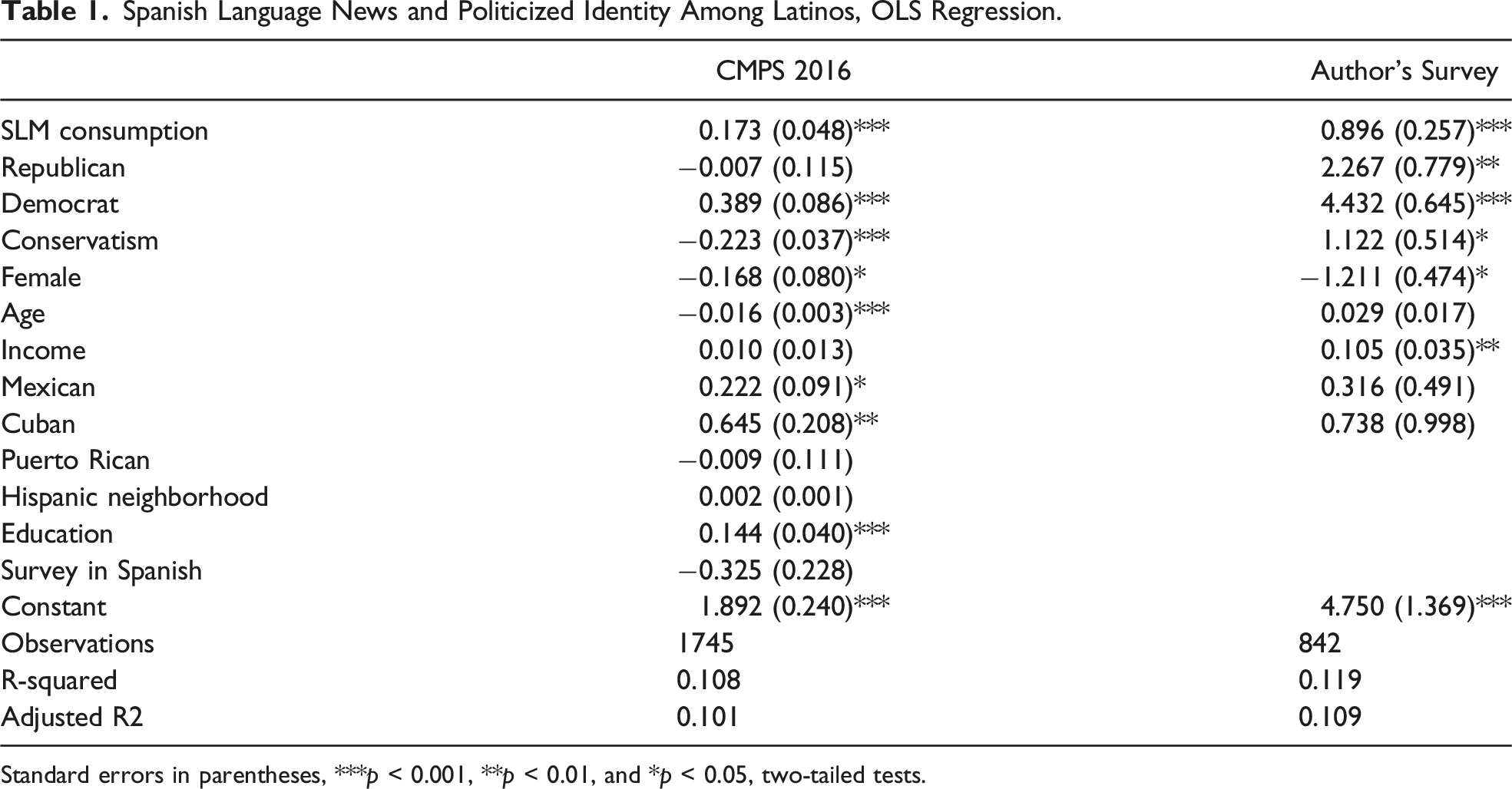
Standard errors in parentheses, ***p < 0.001, **p < 0.01, and *p < 0.05, two-tailed tests.
In addition to the consistent positive relationship SLM consumption shares with the formation of politicized identities, it is worth noting the magnitude of the relationship. In the 2016 survey, a one-unit change, for example, between mostly ELM consumption to equal parts ELM and SLM consumption, had a slightly greater estimated effect than obtaining a college degree or the gender gap between Latinos and Latinas, and nearly half of the substantive impact of being a Democrat vs. identifying as an independent. In the 2021 survey, a one-unit change in SLM consumption produced an effect nearly half as large as being a Republican rather than independent, nearly a quarter as large as the effect of being a Democrat as opposed to an independent and again, similar to the gender gap. Thus, the relative effect of SLM consumption on politicized identities appears to be substantial.
Spanish Language Media, Politicized Identity, and Civic Engagement by Latinos, OLS (CMPS) and Probit (Author’s Survey) Regression Models.
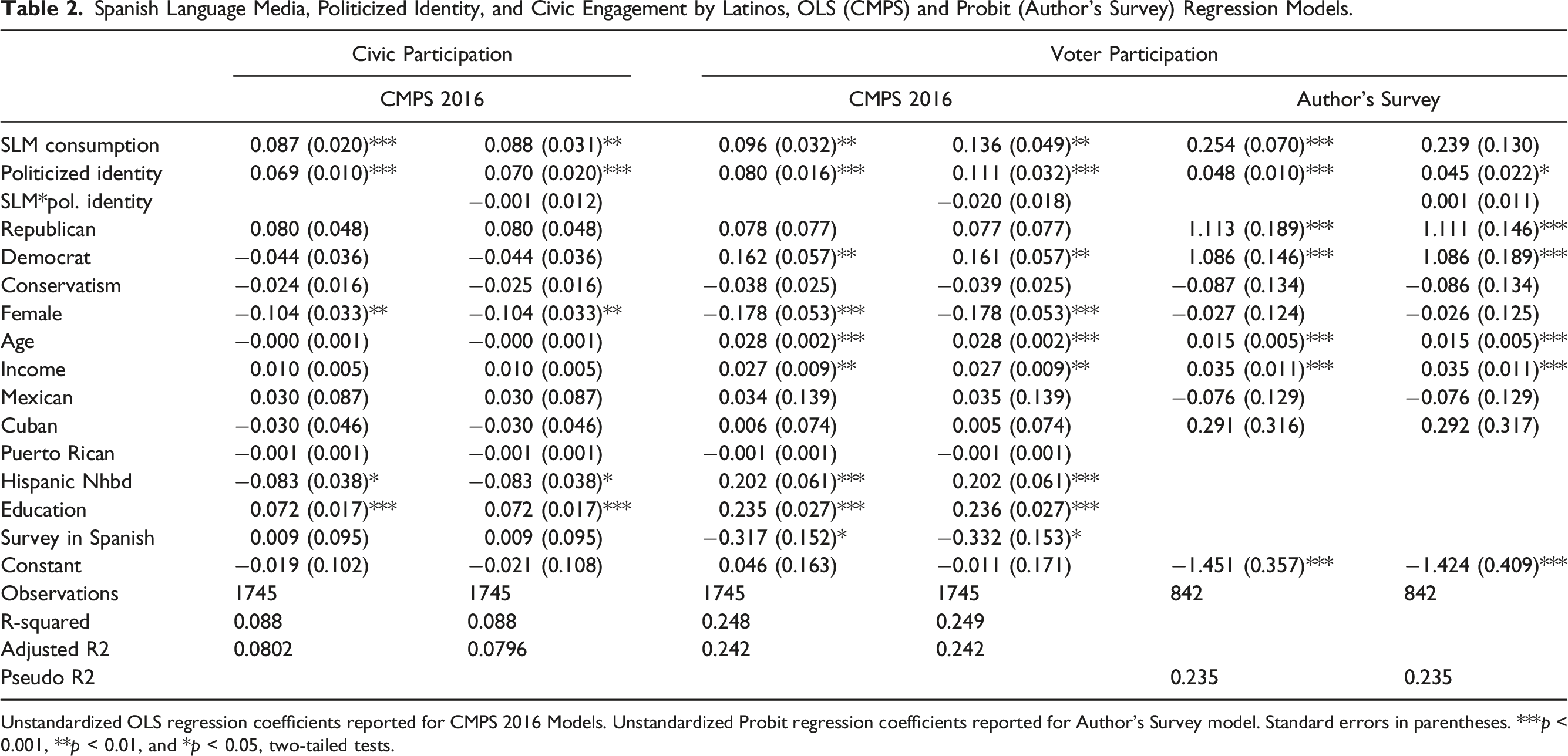
Unstandardized OLS regression coefficients reported for CMPS 2016 Models. Unstandardized Probit regression coefficients reported for Author’s Survey model. Standard errors in parentheses. ***p < 0.001, **p < 0.01, and *p < 0.05, two-tailed tests.
The first pair of columns reveal consistent, positive relationships between both SLM consumption and politicized identity, and our indicator of Latino civic participation. However, the multiplicative effect of SLM consumption and politicized identity fails to produce a significant relationship and does not alter the underlying independent effects of SLM consumption and politicized identity on civic participation. A similar pattern is revealed in analyses of voting behavior in both the 2016 CMPS survey and the 2021 author’s survey. While SLM consumption and politicized identities are positively related to voter participation in each survey, those relationships are not substantially altered by the inclusion of the interactive term. Note, however, that the coefficient for SLM lands just above statistical significance to p < 0.066 in the 2021 author’s survey model, yet its magnitude and direction remain similar and the pseudo-R2 remains the same across both. Moreover, the multiplicative effect of SLM consumption and politicized identity on voter participation is insignificant across all models. These findings provide strong evidence that SLM consumption shapes patterns of civic engagement independent of underlying or SLM-influenced politicized identity. They also strengthen our confidence that the relationship between SLM and Latino participation is not endogenous to a broader identity-based selection effect, and is in fact, causal.
The effects of other variables in the models of civic and voter participation are less consistent. While Democratic party identification positively predicted voter participation in both surveys, and Republican identification positively predicted participation in the 2021 survey, party identification had no effect on civic participation in the 2016 survey. Latinas were less likely to engage in civic participation or to vote in the 2016 survey, but gender had no significant effect in the 2021 survey. Both age and income were positively associated with voting in both surveys but had no impact on civic participation in the 2016 survey. Education had positive impacts on both civic and voter participation in the 2016 survey, but individuals who interviewed in Spanish were less likely to report having voted in 2016. Finally, participants from Mexican backgrounds were less likely to engage in civic participation in 2016 but more likely than counterparts to vote.
As in the previous analysis, the magnitude of the relationship between SLM consumption and civic engagement was substantial. Figures 1 and 2 underscore the results by illustrating the estimated relative marginal impact between mostly ELM consumption and the equal consumption of ELM and SLM compared to common changes in other significant factors in the base models presented in Table 2. Figure 1 reports the effects from the CMPS models for civic and voter participation. Increasing SLM consumption corresponds to a larger change in civic participation than that associated with the gender gap or moving from a high school to college degree, and a slightly smaller effect than a two standard deviation change in politicized identity. Furthermore, a one-unit increase in SLM consumption relative to ELM consumption is associated with a larger increase in voter participation than a $40,000 change in household income, Democratic partisan affiliation relative to Independent affiliation, or the gender gap. Thus, only education and age produce larger marginal effects than SLM consumption in the CMPS model. Estimated marginal effects of common changes in significant factors of voter and civic participation (CMPS 2016 models). Estimated marginal probabilities of common changes in significant factors of voting (authors survey Model).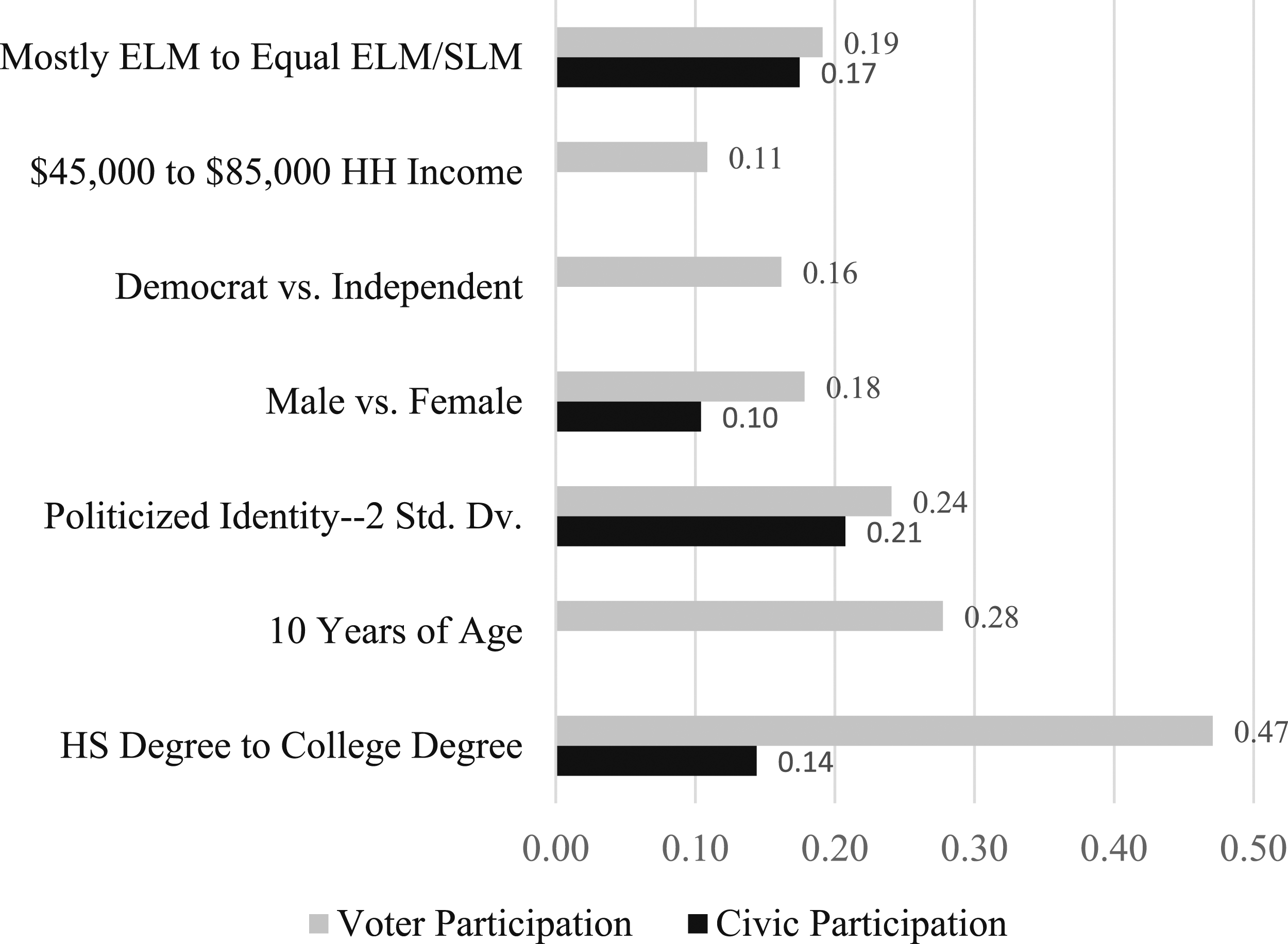
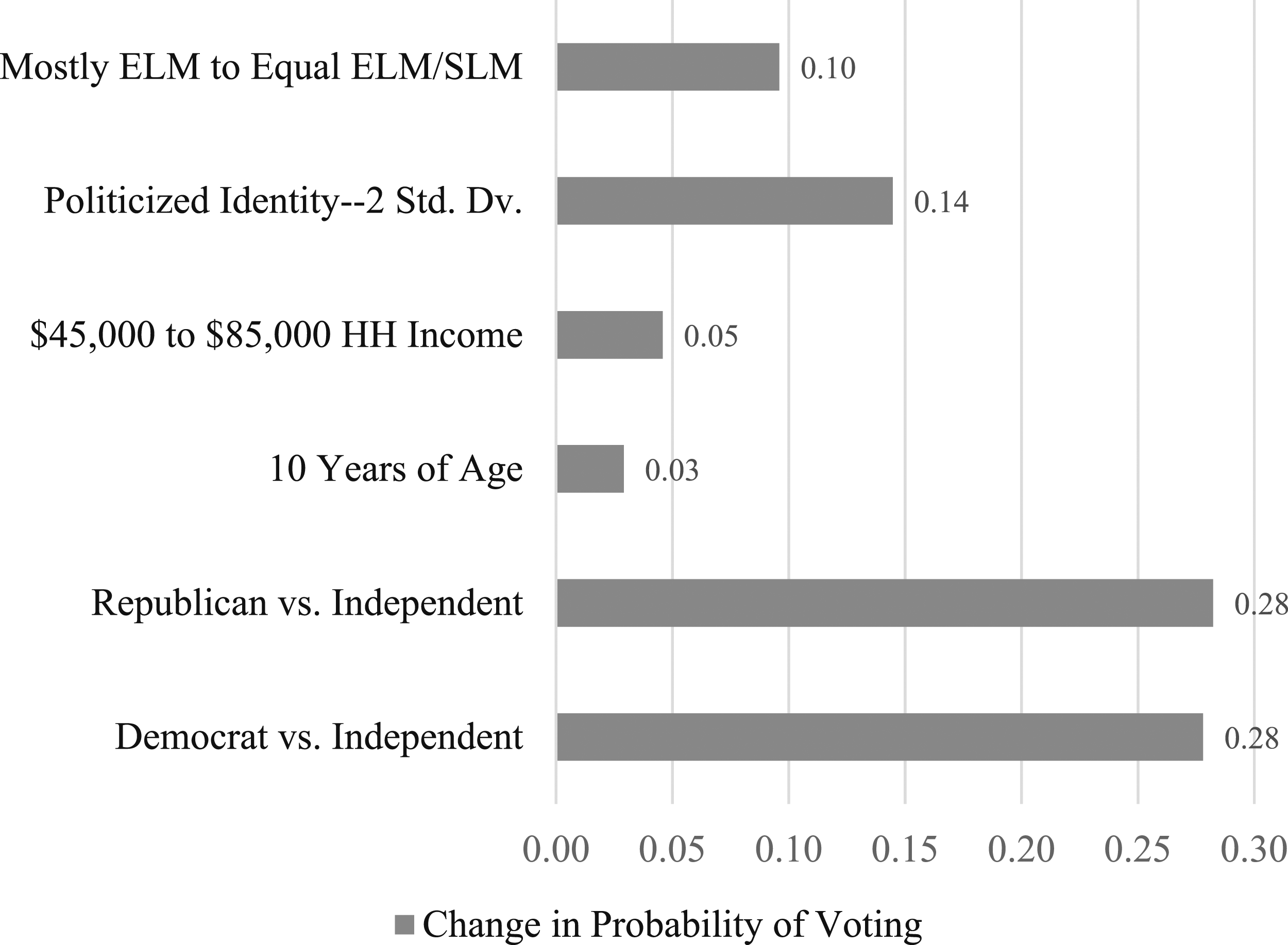
Figure 2 presents the change in probabilities of voting estimated with the Author’s survey data (see Table 2). Here, the same shift from mostly ELM to about equal ELM and SLM consumption equates to about a ten-percentage point increase in the probability of voting. In the 2021 data, the impact of SLM consumption actually outweighs a 10-year age difference and a $40,000 change in income. SLM consumption also produced an effect only four percentage points lower than a unit shift in politicized identity. Finally, a one-unit change in SLM consumption relative to ELM consumption produced about one-third the effect of a shift from being an independent to affiliating with one of the parties. Overall, these impressive relationships provide strong evidence that relative consumption of SLM and ELM is not simply a statistical artifact but comes with major implications for Latino political behavior that are on par with many traditionally accepted factors in civic and voter participation.
Conclusion
This analysis began by asking whether relative consumption of Spanish and English language media shapes patterns of political participation. Previous research had not explicitly examined the relationship between relative SLM and ELM consumption and civic engagement, relying instead either on proxy measures of Spanish dominance or geographic access to SLM (Garcia-Rios and Barreto 2016; Velez and Newman 2019). Our approach ties patterns of linguistic media consumption more explicitly to political behavior, an important empirical contribution in its own right. While Velez and Newman’s research raises questions about the mobilizing potential of SLM, and even demonstrates that access to SLM may have a demobilizing impact of Latino voter participation, perhaps due to entertainment “cocooning” by viewers, we fail to support their results in our analysis, and instead show a robust and consistent positive relationship between SLM consumption and multiple types of civic engagement.
While our findings are inconsistent with those produced by Velez and Newman (2019), we think there are a number of possible explanations for the discrepancy that are worth exploring in future research. The first relates to inconsistencies in variables that measure geographic access vs. self-reported consumption. We acknowledge that the precision of self-reported behavior, particularly media consumption, can be suspect. However, the measures we leverage also have an advantage: measures of geographic access cannot effectively account for the relative reliance of Latino populations on SLM since (1) non-broadcast formats for SLM exist, as the authors acknowledge, and (2) neither consumption of nor geographic access to other media were accounted for in their models. Our measure takes an initial step toward disentangling those issues by providing a measure of relative SLM and ELM consumption and suggests the need to revisit questions about SLM access with attention to, among other possible geographic factors, the fragmentation of media environments that do and do not contain SLM.
A second set of questions worth exploring involve the evolving qualities of SLM and ELM in the past two decades, which have likely responded in important ways to a rapidly changing political environment. Unlike other studies that relied on data from the Obama era or earlier, ours examines survey evidence from the Trump era. The presidency and candidacies of Donald Trump alone likely reoriented important elements of content in both SLM and ELM in ways that may have resulted in dramatically different relationships between relative SLM and ELM consumption and political behavior. Alongside other political developments, technological advances in media, continued media fragmentation, and the maturation of the Latino voting population, it seems plausible that SLM’s role as a mobilizer changed to reflect underlying political dynamics of the political environment we observe here.
That said, the extent to which our results are context-dependent is unclear. Participation during the 2020 election (measured in our 2021 survey) which took place during the peak of the COVID-19 pandemic and amidst an expansion of mail-in and early voting options may prove to be an aberration (although we will note the consistency of our results across the studies). Future research should seek to explore how distinctive political and electoral climates shape the interplay of media consumption and political behavior.
The major theoretical contribution we make is to demonstrate that the positive relationship between SLM consumption and patterns of Latino civic engagement occurs independently from politicized identities. Although we show that SLM consumption shares a positive relationship with the combined expression of group consciousness and heightened political interest, its positive relationships with civic and voter participation are neither dependent upon politicized identity nor amplified by such identities. This, we believe, provides especially strong support to alternative hypotheses that emphasize differences in content between SLM and ELM to explain how SLM consumption shapes Latino civic engagement. The next step for research on the topic is to examine which of the contrasting characteristics that separate SLM and ELM are operative as de/mobilizers of Latino civic engagement and to identify the mechanism(s) through which contrasting content influences behavior. The presence of certain forms of content in SLM, such as Latino-oriented and affirming content, or simply the reduced ability to avoid incidental exposure to political information when consuming SLM may serve an important educative function that enables participation. The relative absence of certain forms of content in SLM, including the “outrage” genre generally, and Latino threat narratives specifically, may also serve to balance or insulate Latinos from alienating political information prevalent in the ELM and reduce resultant demobilization.
A final, practical conclusion that we draw from our research is that SLM appears to constitute an important reservoir for mobilizing the Latino electorate, and thus serves an important political role as the Latino population seeks representation and political incorporation in America. While SLM lags behind ELM with regard to fragmentation, narrowcasting, and “outrage” as a media genre, apparently with positive implications for civic engagement, understanding the specific content differences that appear to give it mobilizing potency is a task of some urgency. Differences between SLM and ELM are diminishing rapidly as SLM becomes increasingly fragmented. This raises important questions about whether SLM will, or can, remain a positive force in shaping Latino political participation.
Supplemental Material
Supplemental Material - Spanish Language Media Consumption and Latino Civic Engagement
Supplemental Material for Spanish Language Media Consumption and Latino Civic Engagement by Walter Clark Wilson, Robert Preuhs, and Bryan T. Gervais in Political Research Quarterly.
Footnotes
Declaration of Conflicting Interests
The author(s) declared no potential conflicts of interest with respect to the research, authorship, and/or publication of this article.
Funding
The author(s) received no financial support for the research, authorship, and/or publication of this article.

Supplemental Material
Supplemental material for this article is available online.
Notes
References
Supplementary Material
Please find the following supplemental material available below.
For Open Access articles published under a Creative Commons License, all supplemental material carries the same license as the article it is associated with.
For non-Open Access articles published, all supplemental material carries a non-exclusive license, and permission requests for re-use of supplemental material or any part of supplemental material shall be sent directly to the copyright owner as specified in the copyright notice associated with the article.
