




Abstract
Since 2010, televised campaign ads have proliferated, raising questions about gender differences in the number of ads outside groups air. Assuming incumbent Democratic women and Democratic women with prior office-holding experience run with support from their party and interest groups, we expect Democratic-leaning groups air more favorable ads supporting Democrats in races that include experienced or incumbent Democratic women than they do in races that include experienced or incumbent Democratic men. Conversely, we assume Republican women receive less support from their party and interest groups. We expect outside groups air more favorable ads supporting Republicans in races featuring experienced or incumbent Republican men than races including experienced or incumbent Republican women. Given the potential for backlash to attack ads, we expect Democratic- and Republican-leaning groups air more ads in races including experienced or incumbent male opponents than in races that include experienced or incumbent female opponents. We test these hypotheses by focusing on 2010–2018 U.S. Senate races and combining original data with data from the Wesleyan Media Project, the U.S. Census, and the Cook Political Report. Democratic- and Republican-leaning groups both sponsor significantly fewer ads in races featuring experienced female Democratic candidates compared to races including experienced male Democratic candidates.
Since EMILY’s List was established in 1985, it has helped Democratic women win elections (Burrell, 2018; Carroll and Sanbonmatsu, 2013; Crespin and Deitz, 2010; Day and Hadley, 2005; Dittmar, 2015; Kitchens and Swers, 2016; Thomsen and Swers, 2017). Today, EMILY’s List (2023) claims their SuperPAC created 49 unique television ads during the 2020 elections, helping them mobilize “millions of voters in 48 states.” More broadly outside interest groups aired 1.5 million ads during the 2020 election (Wesleyan Media Project [WMP] 2021). These data reveal outside groups’ television ads are critical components of American elections raising questions about how outside groups’ decisions about how many television ads to air help or hurt female candidates. We ask: do Democratic- and Republican-leaning outside groups air more ads on behalf of female or male candidates during U.S. Senate races?
Outside groups include four types of campaign finance organizations American interest groups establish to influence elections: traditional political action committees (PACs), SuperPACs, 527s, and 501c “dark money” groups. All four types help groups elect their preferred candidates to office, and most have clear partisan or ideological leanings (Boatright, 2007; CRP, 2023a; Dwyre and Braz, 2014; Herrnson, 2017; Sides et al., 2019). Though the Senate is becoming less male-dominated (Center for American Women and Politics [CAWP] 2023a; 2023b), women continue to face unique opportunities and challenges when they run for the Senate. Incumbent Democratic women and Democratic women with prior office-holding experience often run with the enthusiastic support of their party establishment and allied interest groups. Meanwhile, incumbent Republican women and Republican women with prior experience in elected office run with less support from party elites and allied interest groups. Bringing these insights together, we expect Democratic-leaning groups should run more favorable ads when their preferred Democratic candidate is a female incumbent Senator rather than a male incumbent Senator, or an experienced female challenger (i.e., one who has held prior elected office, but is not a sitting Senator) rather than an experienced male challenger. Conversely, Republican-leaning groups should run more favorable ads when their preferred Republican candidate is a male incumbent Senator rather than a female incumbent Senator, or an experienced male challenger rather than an experienced female challenger. We also expect both Democratic- and Republican-leaning groups should run more attack ads when the opposition party candidate is a male incumbent rather than a female incumbent or an experienced male challenger rather than a female experienced challenger. Finally, we expect there will be few gender differences in the number of ads that both Democratic- and Republican-leaning groups air in races that include inexperienced challengers who do not have prior office-holding experience.
We test these hypotheses using WMP data on 135,115 favorable and attack ads that 304 outside groups aired on television during Senate general elections from 2010 to 2018; an original dataset on U.S. Senate candidates’ gender, incumbency status, prior office-holding experience, and partisanship; state-level Census data; and the 2010–2018 Cook Political Reports. We find
Outside Groups and Senate Campaign Ads
Outside groups change election outcomes by supporting their preferred candidates’ campaigns. The term “outside group” distinguishes campaign finance organizations associated with interest groups from campaign finance organizations associated with the political parties or the candidates themselves. Typically, outside groups establish one (or more) of four types of campaign finance organizations: a traditional PAC, a SuperPAC, a 527, or a 501c. Traditional PACs are “groups that work toward the election of candidates, to pass or defeat legislation, or to advance a political agenda” (Sides et al., 2019). Traditional PACs primarily contribute funds to candidates they endorse. They face the largest number of campaign finance restrictions. Donations to traditional PACs are legally capped; in the 2023–2024 cycle, the maximum donation an individual can make to a PAC is $3,300 (Federal Election Commission [FEC], 2023). Traditional PACs are also required to publicly identify donors who have contributed at least $200 (Sides et al., 2019).
SuperPACs make “independent expenditures” which primarily fund communications, such as television ads, that explicitly advocate “for the election or defeat of a clearly identified candidate” and “that are not made in cooperation with, consultation or concert with, or at the request or suggestion of any candidate” (FEC, 2019). SuperPACs are allowed to “solicit and accept unlimited contributions from individuals, corporations, labor organizations, and other political committees,” which means they can raise and spend far more money airing ads than traditional PACs (FEC, 2019).
527s primarily support candidates by using independent expenditures to fund political communications. They are “organized and operated primarily for the purpose of directly or indirectly accepting contributions or making expenditures or both” for voter mobilization campaigns and issue advocacy (FEC, 2019). Unlike SuperPACs, 527s are not allowed to explicitly advocate for or against specific candidates, but their ads can focus on candidates’ issue positions (Meier, 1999). Consequently, 527s were largely replaced by SuperPACs.
501c “dark money” groups are three types of tax-exempt non-profits: 501c4s, 501c5s, and 501c6s. 501c4s are “social welfare organizations” which “must not be organized for profit and must be operated exclusively to promote social welfare” (IRS, 2019c). 501c5s promote “the betterment of conditions of those engaged in the pursuits of labor, agriculture, or horticulture” (IRS, 2019b; Sides et al., 2019). 501c6s are “business leagues, chambers of commerce, real estate boards, boards of trade, and professional football leagues” which do not provide earnings to shareholders or individuals (IRS, 2019a). 501cs are not allowed to endorse candidates or tell voters which candidates to support and participating in politics cannot be their “primary” purpose (Meier, 1999; Potter and Morgan, 2013). 501c groups are appealing to political donors because three important legal loopholes allow them to air campaign ads. First, the IRS weakly enforces primary purpose requirements, allowing 501cs to air large numbers of ads (Potter and Morgan, 2013; Sides et al., 2019). Second, 501cs are allowed to air issue advocacy ads that support or criticize a candidate’s stance on a given issue relevant to the 501c’s mission as long as they do not use “magic words” that tell voters to specifically vote for or against a candidate (Meier, 1999). Third, 501cs do not have to publicly disclose their donors (Sides et al., 2019), so they allow donors to fund air campaign ads with little public scrutiny.
Given the different opportunities and challenges associated with each type of organization, outside groups often set up multiple campaign finance arms that operate simultaneously. For example, Planned Parenthood (PP) has a traditional PAC, a SuperPAC, and a 501c4 (Center for Responsive Politics [CRP] 2023b). Its traditional PAC endorses candidates and directly contributes to them. However, those campaign contributions are capped and publicly disclosed, so other arms help circumvent those limitations. PP’s SuperPAC spends unlimited funds on ads that explicitly tell voters who to vote for. For donors who do not want their contributions publicly disclosed, PP’s 501c dark money arm spends unlimited funds on issue ads, giving donors an anonymous way to shape elections.
Outside groups air approximately one-third of the ads that appear during competitive Senate races, running more ads than the political parties in recent years (Fowler et al., 2016). The large number of outside group ads aired during Senate races is important for four reasons. First, SuperPACs, 527s, and 501cs cannot legally contribute directly to candidates, and SuperPACs and 527s use independent expenditures to fund political communications. Consequently, airing ads is one of the primary ways those groups influence Senate elections.
Second, though women’s media coverage is becoming more balanced (Banwart et al., 2003; Bystrom et al., 2004), gendered challenges remain. Coverage of female candidates continues to draw disproportionate attention to women’s appearances (Andrich et al., 2023; Bystrom et al., 2004; Carlin and Winfrey, 2023; van der Pas and Aaldering, 2020), their viability or “electability” (Gibbons, 2022; van der Pas and Aaldering, 2020), likability or warmth (Carlin and Winfrey, 2023; Cassese et al., 2021; Godble et al., 2019), the “novelty” of women in office (Bauer, 2020; Bauer and Taylor, 2023; Gibbons, 2022; O’Regan and Stambough, 2011), and/or women’s personal lives (Banwart et al., 2003; Bauer, 2020; Bauer and Taylor, 2023; Gibbons, 2022; van der Pas and Aaldering, 2020). Some trait coverage continues to come at the expense of issues coverage (Dunaway et al., 2013). Women of color receive less coverage overall and more frequent negative coverage than their competitors (Gershon, 2012; Ward, 2016). Therefore, we expect women’s outside groups, particularly Democratic ones, should air large numbers of favorable ads to help female candidates counteract the gendered stereotypes and frames that are prevalent in the media.
Third, because Senate campaigns must turnout voters across entire states, television ads are one of the most important ways voters learn about the candidates and participate in Senate elections (Fowler et al., 2016; Jacobson and Carson, 2020). The more ads groups air (and the more different times, programs, and channels they are on), the more likely outside groups will be able to precisely micro-target specific groups of voters and get their message out to as many voters as possible (Fowler et al., 2016). Advertising expenditures alone cannot account for the number of chances voters have to be exposed to each group’s ads on television.
Fourth, the large number of outside group ads has changed the tone of Senate elections, making them into “no holds barred contests” that feature personal attacks and/or inflammatory language, sometimes without even naming the opposition (Dowling and Miller, 2014; Dowling and Wichowsky, 2015; Herrnson, 2017; Kahn and Kenney, 2004, xi–xii). Thus, by focusing on the number of ads aired, we can analyze the factors associated with outside groups’ decisions about how many favorable and attack ads to air.
Hypotheses
The majority of outside groups focus on winning elections for their partisan or ideological allies, making them well-positioned to influence races in today’s hyper-partisan Senate (Abramowitz, 2012; Boatright, 2007; CRP, 2023a; Dwyre and Braz, 2014; Herrnson, 2017; Lee, 2012; Sides et al., 2019; Sinclair, 2012). Wealthy mega-donors who are narrowly focused on achieving their partisan/ideological goals fund many outside groups (especially SuperPACs; Boatright, 2007; Dwyre and Braz, 2014; Garrett, 2013; Herrnson, 2017). Consequently, we assume outside groups often function as informal extensions of the parties (or ideological factions within the parties) and their decisions about the number of ads to air during Senate elections will be closely related to their desire to help candidates from one party (or one ideological wing of one party) win Senate seats. In addition to considering candidates’ partisanship/ideology, the decisions outside groups make about how many ads to air should also be influenced by the candidates’ gender, incumbency status, and prior office-holding experience.
First, we focus on advertising campaigns focused on
Unlike Republican women, Democratic women also benefit from connections to female mega-donors, such as Karla Jurvetson, who contributed $5.4 billion to EMILY’s List/Women Vote between 2011 and 2018 (FEC, 2020; Herrnson and Heerwig, 2021). Moreover, during our 2010-2018 study period, 22 of the 31 women who served in the Senate were Democrats, and Democratic women secured leadership positions in the Senate, including Assistant Majority Leader and SCCC Chair (Patty Murray, D-WA) and the Appropriations Committee Chair (Barbara Mikulski, D-MD) (CAWP, 2023a; US Senate, 2023). When women secure leadership positions, they have been able to put more pressure on their parties to recruit and support female candidates (Crowder-Meyer, 2013; Elder, 2021; Geras, 2021; Sanbonmatsu, 2006). With all of these structures to support them, it is no surprise Democratic female candidates raise more from individual donations than their male counterparts (Crespin and Deitz, 2010), female Democratic donors give more to female Democratic candidates (Thomsen and Swers, 2017), female Democrats receive more support during primaries their male counterparts do (Hassell and Visalvanich, 2019; Thomsen and Swers, 2017), and female Democratic nominees attract more donors and raise more money from them than male nominees do (Fraga and Hassell, 2021).
Because many outside groups exist to achieve partisan/ideological goals, outside groups should be more likely to support incumbents or experienced challengers whose legislative records align with their preferred party’s “brand.” Democrats should support candidates who align with the party’s “brand” as the women-friendly party and allow the party to take advantage of the gender gap in its favor (Sanbonmatsu, 2004; Swers, 2013). Thus, Democratic leaders seek out female Senators for press conferences and efforts to communicate their work on behalf of women’s issues and social welfare legislation to showcase the party’s reputation on those issues (Swers, 2013). Following their lead, Democratic-leaning outside groups should air more
Republican women’s groups also raise far less money than their Democratic counterparts, as many Republican donors are unaware that Republican women’s groups exist or are unlikely to donate to candidates based on their sex or gender (Crowder-Meyer and Cooperman, 2018; Dittmar, 2015; Thomsen and Swers, 2017). Over the course of 20 years, VIEW PAC (one of the largest Republican women’s groups) raised $6.5 million for candidates, while EMILY’s List raised $100 million in 2018 alone (Elder, 2021, 151). Many Republican women’s groups also go out of business after only a couple of election cycles (Dittmar, 2015; Elder, 2021). With little emphasis on supporting women’s campaigns, Republican women (including incumbents and experienced challengers) raise less money than their male counterparts (Kitchens and Swers, 2016; Thomsen and Swers, 2017). Moderate Republican women, who are often perceived as more liberal than the party as a whole, also struggle to raise funds from “a polarized, congressional donor pool” and to receive funds from the party itself (Crespin and Deitz, 2010, 590; Carroll and Sanbonmatsu, 2013). Even female Republicans prefer to donate to conservative candidates (Thomsen and Swers, 2017). These gendered disadvantages in financing Republican women’s campaigns suggest Republican-leaning groups will also struggle to raise money to support Republican women, and they will have less money available and less donor pressure to air ads on behalf of Republican women. Consequently, we expect Republican-leaning outside groups have few incentives to air ads that support Republican women running as women who legislate on behalf of women.
We also expect Republican-leaning outside groups will be more likely to support Republican male candidates than female candidates for two gatekeeping reasons. First, with only 9 Republican women serving in the Senate between 2010 and 2018, few Republican women serving in leadership positions, and poorly integrated women’s groups there is little pressure from Republican women in office to challenge gendered structures within the party, particularly given the party’s strong emphasis on hierarchy and loyalty (CAWP, 2023a; Elder, 2021; US Senate, 2023). Thus, Republican leaders and party elites may continue to support men who they know from their existing networks of largely male office-holders and/or business contacts (Crowder-Meyer, 2013; Sanbonmatsu, 2006). Second, many mega-donors to Republican-leaning outside groups are male and are primarily focusing on helping Republicans or party extremists win elections (Boatright, 2007; Dwyre and Braz, 2014; Herrnson, 2017; Sides et al., 2019). Conservative female mega-donors, such as Miriam Adelson (wife of Sheldon), also contribute to achieve partisan/ideological goals (Boatright, 2007; Bryner and Weber, 2013). Since those mega-donors play an important agenda-setting role for their groups, they are focused on winning elections for their partisan/ideological teams, and party elites hesitate to support female candidates in competitive elections (Crowder-Meyer, 2013; Niven, 1998; Sanbonmatsu, 2006), we expect Republican-leaning outside groups will be more eager to air ads that support Republican men rather than Republican women. Altogether, these insights lead us to our second hypothesis:
Although airing attack ads is effective, we expect outside groups carefully consider the optics associated with airing ads that attack female candidates. Because the Democratic party includes groups and donors that provide explicit support for increasing women’s descriptive representation and the party’s brand is associated with being “women-friendly” (Crepsin and Deitz, 2010; Crowder-Meyer and Cooperman, 2018; Elder, 2021; Fraga and Hassell, 2021; Sanbonmatsu, 2004; Kitchens and Swers, 2016; Thomsen and Swers, 2017), we expect Democratic-leaning outside groups will be hesitant to air attack ads targeting women. Airing such attack ads could open them to charges that Democrats are actually “anti-woman” or unwilling to support all women. Republican-leaning outside groups that air attack ads against Democratic women risk retrenching arguments that the Republican Party is anti-woman (Elder, 2021; Sanbonmatsu, 2004). Republican groups that air attack ads on behalf of Republican women could also encounter tensions with Republican positions that focus on preserving women’s traditional roles as caregivers or moral protectors (Deckman, 2016; Elder, 2021; Schreiber, 2008; Wineinger, 2022). It could be difficult for Republican-leaning groups (and candidates they support) to claim they are caring or have the moral high ground if they air large numbers ads that attack other female candidates. Hence, our third hypothesis states:
Data and Methods
We utilize three types of data to examine gender differences in the number of television ads that outside groups air. First, we use WMP data on television ads purchased in all 210 American media markets during 2010–2018 Senate elections. Second, we examine data on the gender, partisanship, incumbency status, and prior office-holding experience of each candidate in the 2010–2018 general election races for the U.S. Senate. 1 Third, we control for state-level demographic information with U.S. Census data and use Cook Political Report data to control for the partisan lean and competitiveness of each race.
The WMP data identify the sponsor of each ad, indicating whether the sponsor was the candidate, one of the political parties, or an interest group, and we used those codes to limit the analysis to interest group ads. WMP’s “interest group” category does not distinguish between the different types of outside groups, so it contains ads aired by traditional PACs, SuperPACs, 527s, and 501c dark money groups. Second, the WMP data identify whether each ad
The dependent variables in our analyses are the
Outside Group Ads by Gender, Incumbency Status, and Prior Office-Holding Experience of the Democratic Candidate.
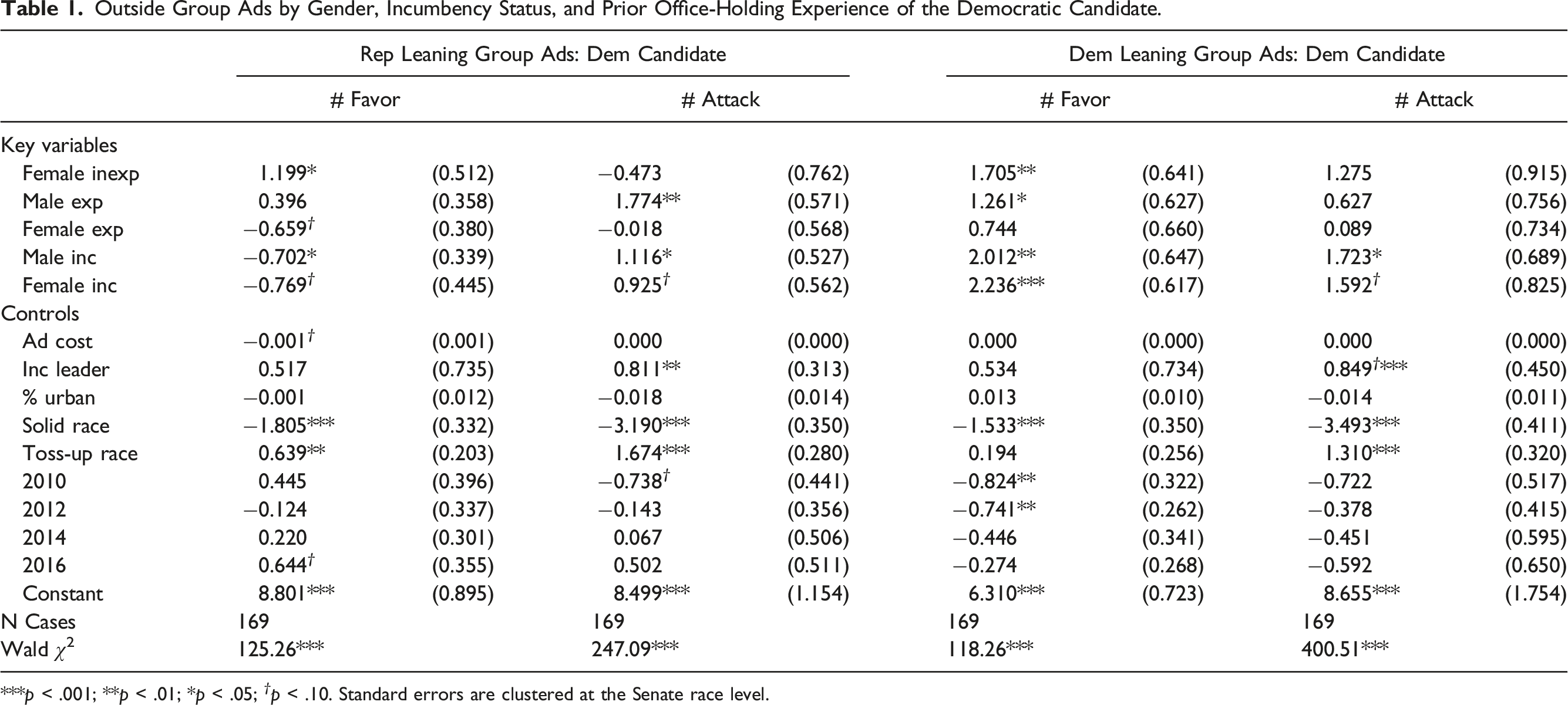
***p < .001; **p < .01; *p < .05; †p < .10. Standard errors are clustered at the Senate race level.
Outside Group Ads by Gender, Incumbency Status, and Prior Office-Holding Experience of the Republican Candidate.
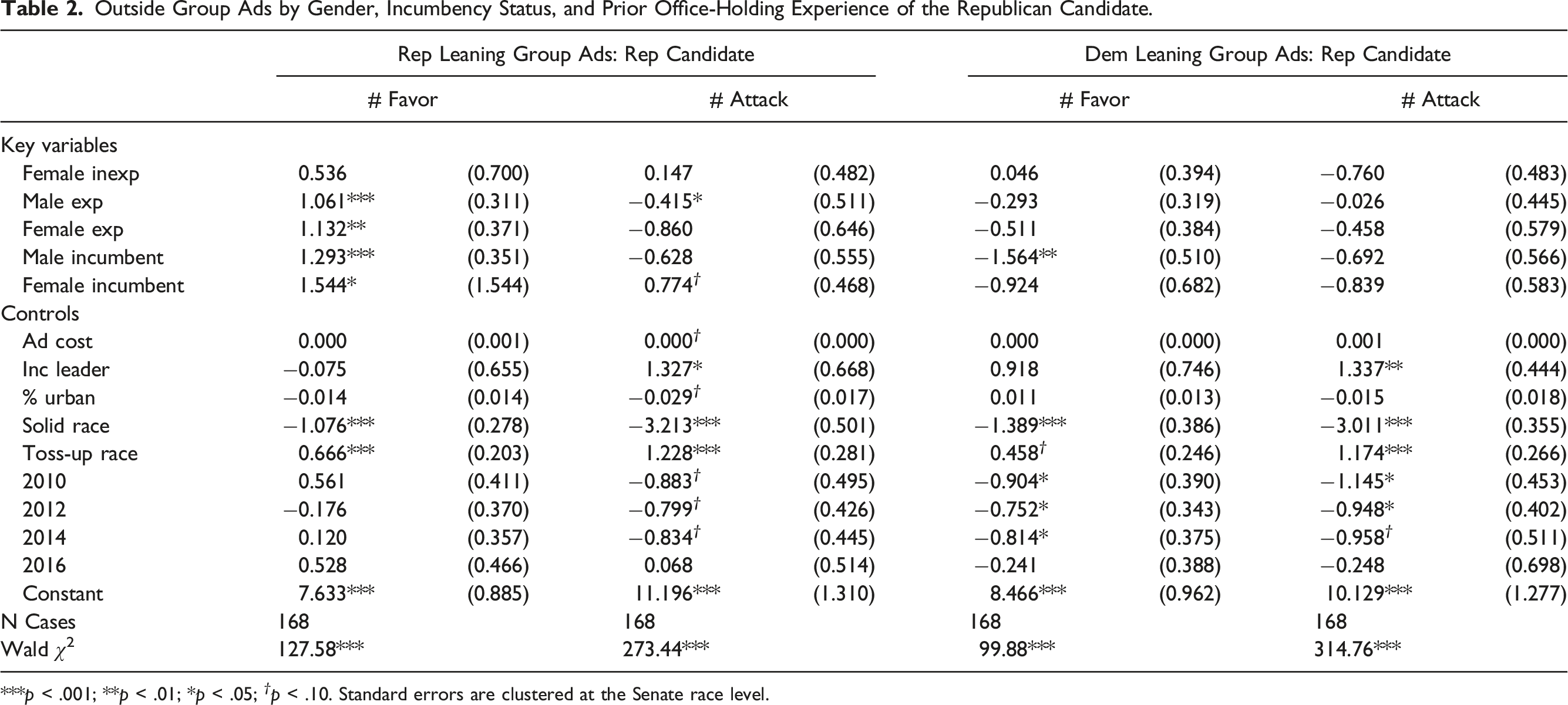
***p < .001; **p < .01; *p < .05; †p < .10. Standard errors are clustered at the Senate race level.
The first five rows of Tables 1 and 2 present the results of our analyses focused on our primary independent variables: the candidate’s gender, incumbency status, and prior office-holding experience. We account for whether a candidate is an incumbent or has held prior elected office because incumbents and experienced candidates are more likely to win (Carson et al., 2007; Cox and Katz, 1996; Jacobson and Carson, 2020; King and Gelman, 1991). Thus, outside groups should be more likely to air ads that support or attack incumbents and experienced challengers than to air ads on behalf of inexperienced newcomers. Our models include the key independent variables for the gender, incumbency status, and prior office-holding experience of the candidate that each ad targeted using the five dummy variables listed at the top of Tables 1 and 2:
The models also include several controls:
Next, we include two dichotomous variables that reflect the level of competition in each race:
The model also includes control variables for whether an
Ads Aired Based on Gender, Incumbency Status, and Experience of the Democratic Candidate
Because the dependent variables are all counts (number of favorable and attack ads), we use negative binomial regression to estimate the models. Table 1 presents the results for
Differences in Outside Group Ad Use: Democratic Candidate.
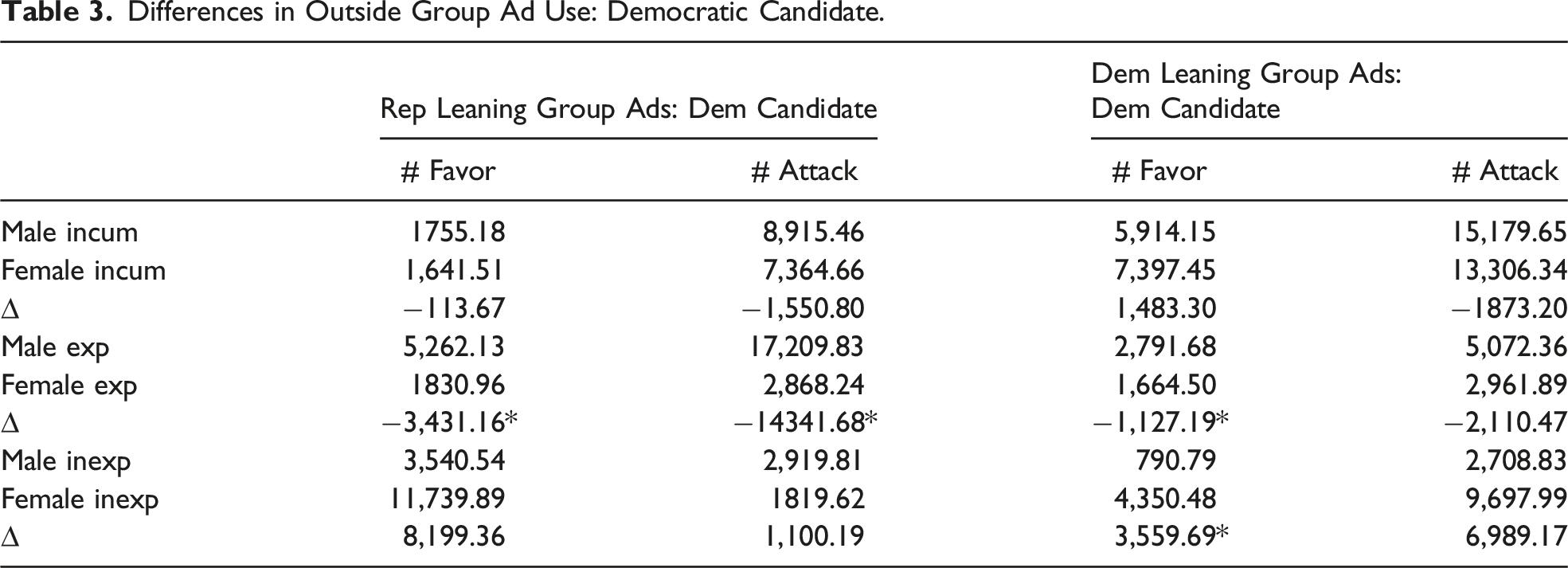
The findings in Table 3 indicate Republican-leaning outside groups aired significantly fewer
Next, Democratic-leaning outside groups air significantly fewer favorable ads (1,127.19 fewer ads) in races that include experienced female Democratic challengers (1,664.50 ads) compared to races that include experienced male Democratic challengers (2,791.68 ads). However, Democratic-leaning outside groups run significantly more favorable ads (3,559.69 more ads) in races that include inexperienced female Democratic challengers (4,350.48 ads) compared to races that include inexperienced male Democratic challengers (790.79 ads).
Together,
Ad Aired Based on Gender, Incumbency Status, and Experience of the Republican Candidate
Differences in Outside Group Ad Use: Republican Candidate.
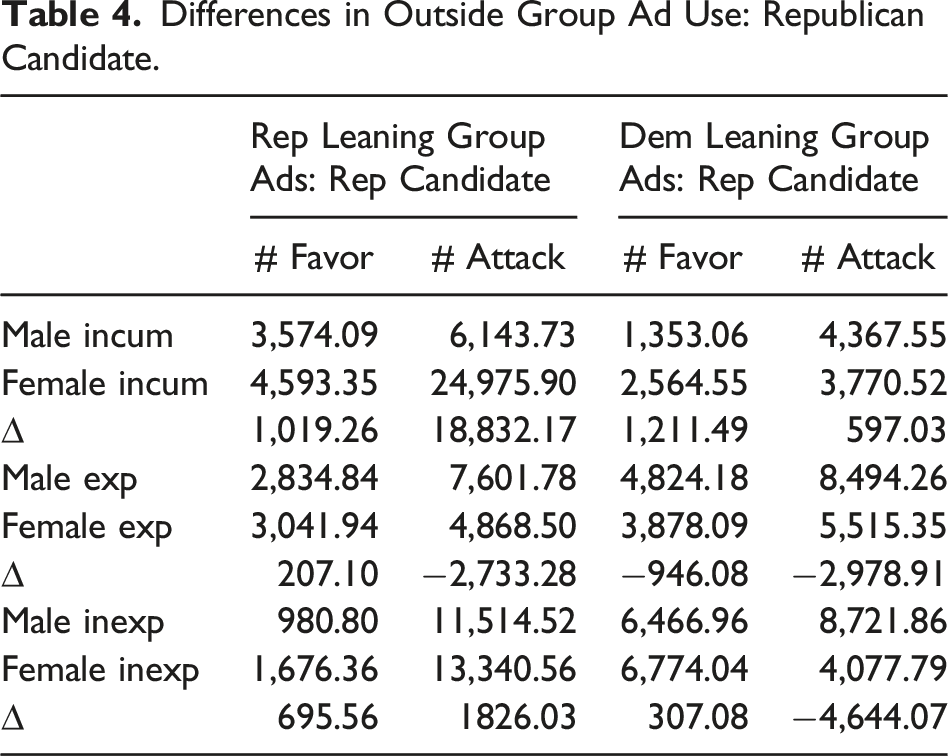
The left panel of Table 4 shows there are no significant differences in the number favorable ads or attack ads Republican-leaning groups aired when comparing races that include male Republican incumbents to races with female Republican incumbent candidates, races that include male experienced Republican challengers to races with female experienced Republican challengers, or races that include male inexperienced Republican challengers to races with female inexperienced Republican challengers. These findings indicate that, contrary to expectations, Republican-leaning groups do not air more favorable ads for their experienced or incumbent preferred-party male Republican candidates than they do for experienced or incumbent female Republicans.
The right panel of Table 4 provides the results for the Democratic-leaning outside groups. We unexpectedly find there is no significant difference in the number favorable or attack ads when comparing races that include male Republican incumbents to races with female Republican incumbents, races that include experienced Republican male challengers to races with experienced female Republican challengers, or races that include inexperienced Republican male challengers to races with inexperienced female Republican challengers. Together, the findings indicate the gender, incumbency status, and prior experience of Republican party candidate is not significantly related to the number of ads Republican- or Democratic-leaning outside group air in Senate races. These results stand in stark contrast to the results focusing on the number of ads outside groups air based on the gender and experience of Democratic candidates.
Discussion
Despite recent increases in the number of women and women of color serving in the Senate (CAWP 2023a; 2023b) and the increasing prominence of women’s issues on the agenda during the 2010s, our analyses suggest the proliferation of outside group ads created some new gendered challenges for experienced female candidates who ran for Senate seats between 2000 and 2018. Though we expected Democratic-leaning groups would air more favorable ads supporting female candidates,
Democratic-leaning groups’ unexpected preference for airing favorable ads in races that include experienced male Democratic challengers is surprising, because Democrats provide more support for female candidates and increasing women’s descriptive representation than their Republican counterparts do (Crowder-Meyer and Cooperman, 2018; Fraga and Hassell, 2021). Why aren’t outside groups producing similar advantages for Democratic women by airing more favorable ads during their races? One possibility is that Democratic women’s groups (e.g., EMILY’s List) prioritize candidate training, technical assistance, sharing information about politics and policy, and/or bundling campaign contributions, over running ads (Crowder-Meyer and Cooperman, 2018; Day and Hadley, 2005; Fraga and Hassell, 2021; Hassell and Vislvanich, 2019; Kitchens and Swers, 2016; Kritzer and Osborn, 2019; Thomsen and Swers, 2017). EMILY’s List/Women Vote prioritizes supporting incumbent women (Malcolm, 2016; Schriock, 2021). Thus, it is possible that EMILY’s List/Women Vote and other women’s groups run more ads in races that include women incumbents than races with experienced challengers because prioritize maintaining continued access to incumbents (Grier and Munger, 1993; Hall and Deardorff, 2006). If that is the case, then the overall number of ads Democratic-leaning groups air for experienced women challengers would drop, potentially giving experienced male Democratic challengers an advantage over experienced female Democratic challengers on the airwaves. Another possibility is that Democratic-leaning groups not explicitly focused on increasing women’s descriptive representation do not run as many ads for Democratic women as the Democratic women’s groups do, because male Democratic donors do give more to male candidates than female candidates (Thomsen and Swers, 2017). Thus, those donors may also push broadly-focused Democratic-leaning groups to use those funds to air more ads for experienced male challengers rather than experienced female challengers. Future research should test these hypotheses.
Though our results suggest experienced Democratic women challengers face some advertising disadvantages, there are some ways in which the increasing number of outside group ads in Senate races is helping, or at least not harming, female candidates. Most notably, our results indicate outside groups are not airing more attack ads against female candidates as compared to their male counterparts. We only found one gender difference associated with the number of attack ads outside groups air, and it poses a challenge for men (not women).
The last notable gender difference we found indicated
In contrast to our findings related to the number of ads outside groups air based on the gender and experience of the Democratic candidate in a given race, there are no significant differences in the number of favorable and attack ads that outside groups run as a function of the gender, incumbency status, and prior experience of the Republican candidate in the race. Republican-leaning groups, surprisingly, do not seem to favor their own preferred-party candidates when they are men. These null findings could be driven by the small number of Republican incumbent women and challengers in our dataset that outside groups could have supported with ads. Our findings should be revisited as the number of Republican female Senators and candidates increases.
As the number of women of color serving in Congress reached record highs in 2018 and 2020 (CAWP, 2018a; 2018b; Dittmar, 2018; 2020), more research should examine how the number of ads that outside groups air is associated with candidates’ race/ethnicity, in addition to their gender, incumbency status, and prior experience. Though women’s groups exist to recruit and support female candidates on both sides of the aisle, only 31 out of nearly 400 groups that support female candidates explicitly focus on women of color (Kritzer and Osborn, 2019). Women of color running in House races also raise only 70 to 80 percent of the amounts raised by other candidates, and Democratic donors and party committees provide more support for white women than they do for women of color (Fraga and Hassell, 2010; Hassell and Visalvanich, 2019; Sorenson and Chen, 2022, 745). In interviews, Democratic leaders, office-holders, and party elites claim the party “could and should” do more to recruit and support women candidates of color (Elder, 2021). Our findings, which show Democratic groups run more favorable ads in races with inexperienced female challengers, suggest these groups may already be trying to support more women candidates of color without prior office experience. However, this was not explicitly tested in this project and should be in future research.
Outside groups that support candidates of color more broadly may also struggle to air large numbers of ads on behalf of candidates who have been marginalized due to their race or ethnicity. Black candidates receive fewer PAC contributions than their white counterparts, and Black House members raise fewer campaign funds than their white counterparts, making it more difficult for them to run for Senate seats (Johnson et al., 2012; Wilhite and Theilman, 1986). Democratic and Republican leaders also believe that Black and Latino/a primary candidates are less likely to win their races, and party leaders provide fewer endorsements for Latino/a candidates, excluding them from important partisan networks (Doherty et al., 2019; Ocampo, 2018; Ocampo and Ray, 2020). In contrast, Fraga and Hassell (2021) unexpectedly found that minority Republican House candidates received more donations from Republican donors than the white candidates that ran in the previous cycle, potentially due to Republicans’ attempts to appeal to more minority voters or win over white moderates.
Additional research on the number of ads outside groups air on behalf of candidates of color might help further untangle these mixed results. Because some SuperPACs exist to pull the parties to their ideological extremes (Dwyre and Braz, 2014), we expect Fraga and Hassell’s (2021) finding that Republicans provide more support to minority candidates than white ones will not generalize to the number of ads that Republican-leaning outside groups air. In other words, we do not expect to find that Republican outside groups try to appeal to moderate (white) voters by airing more ads on behalf of candidates of color. Ultimately, we expect that outside group donors contribute less to groups that air ads on behalf of male and female candidates of color, making those groups less likely to air favorable ads for them. Though outside groups tend to air ads that are more negative and aggressive than those aired by parties or candidates (Dowling and Miller, 2014; Dowling and Wichowsky, 2015; Herrnson, 2017), we also expect that they will air few attack ads against candidates of color to avoid potential charges of racism.
Conclusion
Our results provide an important first step towards understanding gender differences in the number of television ads outside groups air during Senate campaigns. We show Republican- and Democratic-leaning groups approach candidates’ gender, incumbency status, and prior experience similarly when they decide how many ads to air during Senate races, as both types of groups air more
Supplemental Material
Supplemental Material - Outside of the Old Boys Club? Gender Differences in Outside Groups’ Advertising Support for U.S. Senate Candidates
Supplemental Material Outside of the Old Boys Club? Gender Differences in Outside Groups’ Advertising Support for U.S. Senate Candidates by Ashley English, Regina Branton, and Amy Friesenhahn in Political Research Quarterly
Footnotes
Declaration of Conflicting Interests
The author(s) declared no potential conflicts of interest with respect to the research, authorship, and/or publication of this article.
Funding
The author(s) received no financial support for the research, authorship, and/or publication of this article.

Supplemental Material
Supplemental material for this article is available online.
Notes
References
Supplementary Material
Please find the following supplemental material available below.
For Open Access articles published under a Creative Commons License, all supplemental material carries the same license as the article it is associated with.
For non-Open Access articles published, all supplemental material carries a non-exclusive license, and permission requests for re-use of supplemental material or any part of supplemental material shall be sent directly to the copyright owner as specified in the copyright notice associated with the article.
