




Abstract
Super PACs have become a pivotal force in U.S. elections, often working in tandem with political campaigns to create cohesive messages in advertisements that serve as a tool for impression management. In previous research, I outlined a series of performance types, impression management techniques used by candidates and Super PACS in the 2012 Republican Primary. Since then, a second Republican Primary occurred, and a more expansive dataset on 2012 was released. In this paper I replicate my past work with the new dataset and compare performance types in advertisements from the 2012 and 2016 primaries. When comparing datasets, the findings were overwhelmingly consistent. At the same time, there were fundamental changes between 2012 and 2016. Notably, the inclusion of a new performance type, “the warrior,” which promotes an eagerness to use physical violence toward non-Americans. This change further indicates the rightward shift in Republican messaging that leans into fascism.
The newest development in campaign organizing and communication in the United States are Super PACs, political organizations that can take in and spend unlimited amounts of money on elections but cannot donate to or coordinate with candidates. This, however, has not stopped some Super PACs designed to specifically advance a single candidate from coordinating with them (Kang, 2013; Magleby & Goodliffe, 2014). The involvement of Super PACs affiliated with but not visibly identified as being associated with campaigns, in theory, allows for campaigns to build images of candidates without being accountable/associated with the content of advertisements. Previously, I identified a series of impression management techniques used by candidates and their respective Super PACs in the 2012 Republican primary, demonstrating complementary messaging practices (Katz, 2015, 2016). However, since then, a second Republican primary has occurred, and more robust data has been released. In this paper, I return to my previous work to see how those findings differ from those in a larger dataset and how trends in political advertising changed between 2012 and 2016.
Building Candidate Images
The concept of impression management, the practice of working to associate individuals with specific social traits to create an image of oneself for others to interact with is a central symbolic interactionist theory (Goffman, 1959). For politics, impression management becomes the practice of controlling information to influence public perception of a candidate's relatability and electability (Hall, 1972, [1979] 2005). This occurs by categorizing symbols to construct personalities for candidates, allowing them to “own” different political images and issues (Goffman, 1959; Hayes, 2005; Klapp, 1954). Candidates are not the only ones to craft these images. By allowing candidates to “own” specific traits, impression management becomes a strategy for the organization of political information to craft an image that connects to voters (Hayes, 2005; Petrocik et al., 2003). Their opponents do so as well, creating “blemishes” to highlight candidate flaws. As a result, political impression management is the practice of candidates managing how the public views them and their opponents (De Landtsheer et al., 2008; Edelman, 1964; Goffman, 1963; Le Grand, 2019).
The management of information to create public images allows candidates to prioritize some pieces of information over others based on what political actors feel the public wishes to see (Edelman, 2001; Goffman, 1959; Hoffjann, 2021; Winton, 2010). This creates “social types,” categorizations of individuals based on the information they express and what the public expects of them, allowing people to make sense of how to perceive and interact with others relative to how they fit those types (Best, 2018; Klapp, 1965). Political advertisements facilitate these social types by allowing political elites to create and distribute images and messages that link them to the voting public (Katz, 2022a; Nimmo & Savage, 1976). For these reasons, I suggest that as social types take on more media-centric formations with greater attention to dramaturgy, the term performance type becomes more fitting.
Performance types allow for candidates to express how they relate to their political parties, other candidates, and society as a whole. To build these performance types, images, sounds, and texts combine to create a holistic package for messaging that is exaggerated to emphasize specific personal and social qualities (Bergstrand & Jasper, 2018; Kaid & Johnston, 2001). These images are often necessary for candidates, as the cultural contexts of authenticity and effective leadership are constantly changing, meaning candidates must adjust to meet new political demands (De Landtsheer et al., 2008; Seifert, 2012). In many cases, the public awards candidate images more than it does their policy positions (Cronin, 2008), further driving home the importance of political impression management as a necessary tool to win elections (Garzia, 2013). Engagement may also be undercut by enjoyability, that is, people may be less involved and willing to vote for a party if their televised interactions within them are fundamentally unpleasant (Hoffjann, 2021; Scammell & Langer, 2006).
Cooperation Among Political Actors
During elections, candidates work alongside political parties, interest groups, PACs, and, since 2010, Super PACs and understanding how their spending influences public interactions is essential (Katz, 2022a). This includes the behavior of Super PACs. While it is illegal for Super PACs to coordinate with candidates, some have turned into the unofficial wing of campaigns, linking candidates to the public, additional spending money, and a variety of other interest groups (Katz, 2022b). Common legal workarounds include, staffing people who are close to or work for candidates, receiving candidate endorsements, and the sharing of advertising firms (Katz, 2022b; Briffault, 2013; Kang, 2013). These candidate-specific Super PACs allow candidates to indirectly amass more money, allowing for more political advertisements (Magleby et al., 2018). This allows candidates to subsidize their political funds to extend their campaigns and find a way to mitigate some of the risks involved with negative campaigning (Brooks & Murrov, 2012; Hasen, 2016). However, voters who are more knowledgeable about candidates may be less responsive to ads from outside groups (Meirick & Nisbett, 2011).
Coordination between candidates and Super PACs results in shared impression management efforts, wherein they produce political advertisements covering the same issues. To some extent, this is a natural occurrence. More often than not, only a handful of political issues end up dominating the advertisements during any given election (West, 2018). However, the strong ties between organizations, both formal and informal, legal and illegal, mean the messages themselves are not just focused but also complementary efforts by political elites to control information.
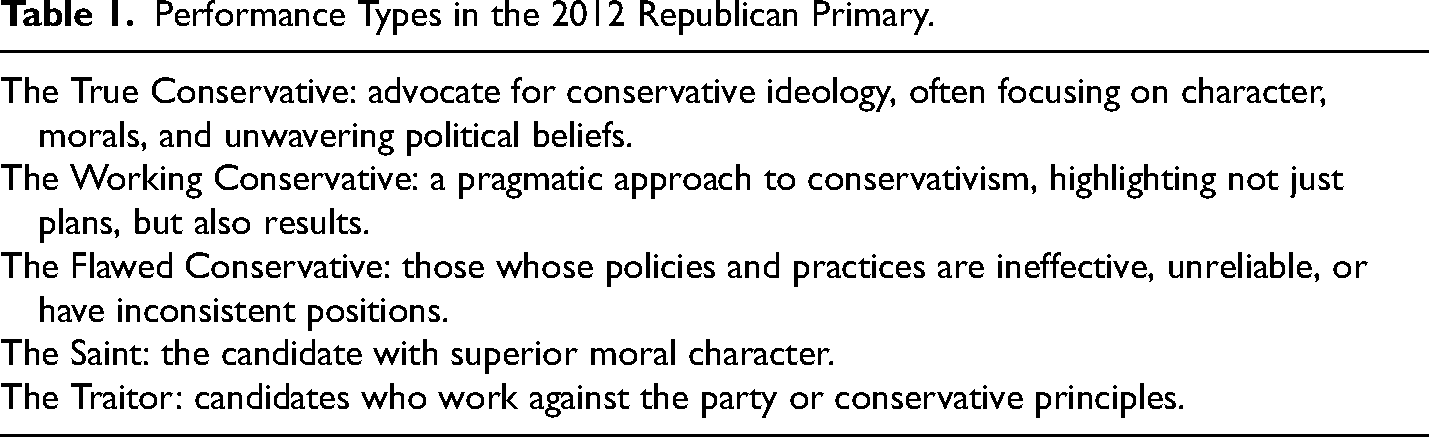
In my research on the 2012 republican primary (Katz, 2015, 2016), I outlined five performance types, impression management techniques used to construct the character of candidates: the true conservative, the working conservative, the flawed conservative (initially titled the sinner), the saint, and the traitor. These performance types mapped out how candidates and Super PACs designed to support them used political advertisements to construct the images of candidates and their opponents. This does not mean that all performance types were equally valued, in fact that is anything but the case. Candidates favored the ideological purity and pragmatism of the true and working conservative, while Super PACs focused on the blemishes and imperfections of “flawed conservatives” as well as the anti-party practices of traitors (Katz, 2016). Table 1 briefly summarizes these performance types.
Performance Types in the 2012 Republican Primary.
There are, however, limitations to these works. Previous works relied on the Stanford Political Communication Lab's dataset. 1 Now, a more expansive dataset, that of the Wesleyan Media Project, is available. With a larger number of advertisements to draw data from, findings may now differ. Second, the sociological contexts that advertisements are created in influences their content. Therefore, with each election the images favored may differ and entirely new performance types can appear. With the Wesleyan Media Project's release of data for both the 2012 and 2016 elections, I ask three questions about the use of impression management to create performance types in Republican primaries:
RQ1: Are there differences in the frequency of performance types used in 2012 when comparing older and newer datasets?
RQ2: How does the frequency of performance types differ between advertisements aired in 2012 and 2016?
RQ3: What changes are there in the construction of performance types between 2012 and 2016?
Methods
Scholarship on political advertising often lacks theory-driven methods (Holtz-Bacha, 2018). Sociological theory can serve a pivotal role in filling this gap by providing deeper analytic frameworks. One approach to sociological theory that can help drive research on political advertising is symbolic interactionism, which focuses on images, symbols, and collective meaning, all of which can be coded and analyzed both qualitatively and quantitatively, allowing for the ability to identify patterns and to draw comparisons (Benzies & Allen, 2001; Ulmer & Wilson, 2003). This aligns well with the study of political ad content, which requires seeking out collective themes within political advertisements, not only tracking their qualitative components but also the frequencies in which components of ads appear (Franz et al., 2009; Jamieson, 1996).
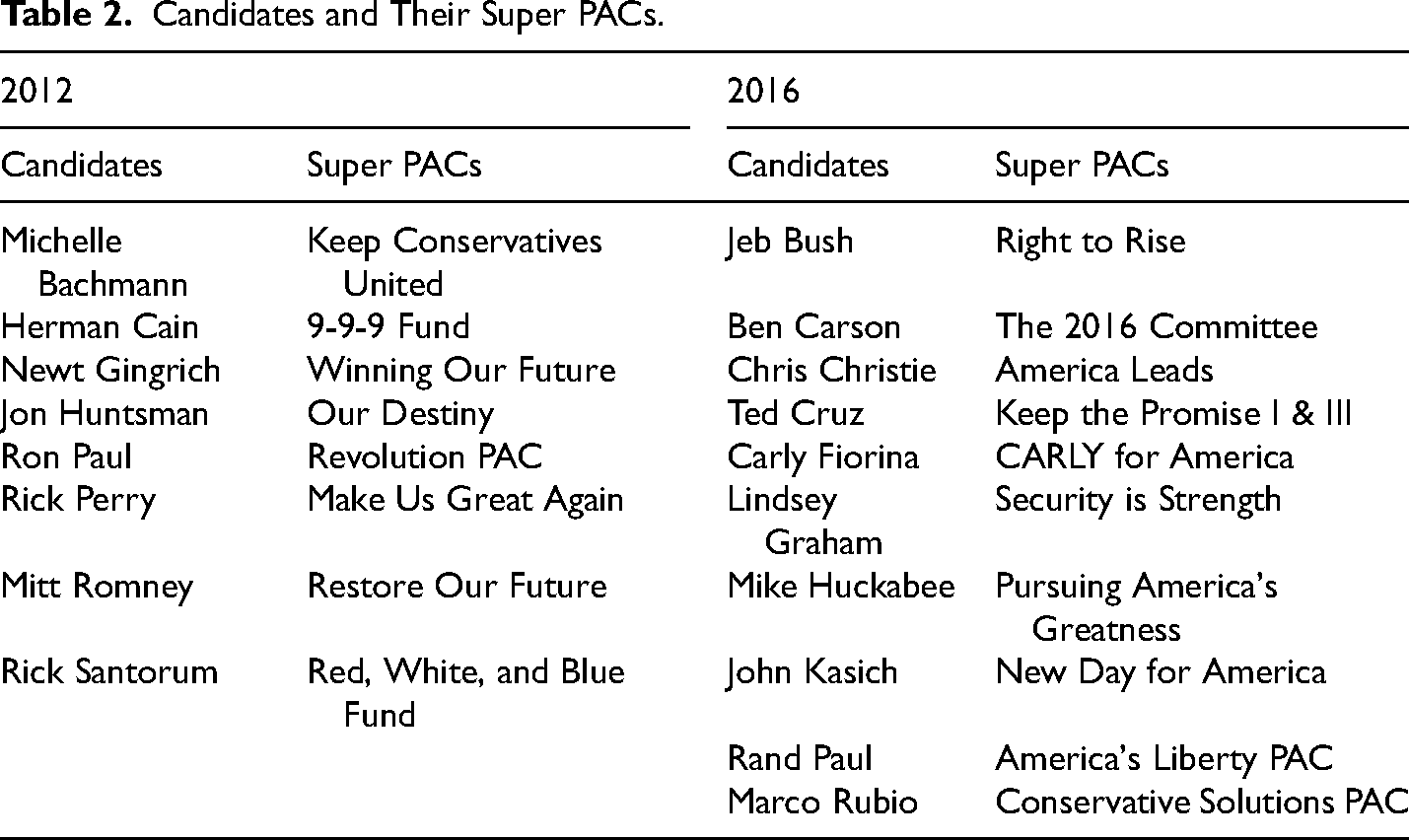
To track and compare the development of performance types, I conducted a qualitative analysis of political advertisements from the 2012 and 2016 Republican primaries. I identified participants in the 2012 election using my previous data (Katz, 2016) and the 2016 election by those identified by Magleby (2019). While the core of the past project was data from the Stanford Political Communications Lab, in this project, I started with the Wesleyan Media Project's datasets for both the 2012 and 2016 elections 2 , 3 (Fowler et al., 2017, 2020). While these datasets are far more comprehensive than the previous ones, they may still miss advertisements. To account for this, I then cross-referenced them with the Stanford Political Communications Lab's data and the lists of advertisements provided by Democracy in Action. Table 2 lists the candidates analyzed within this paper and their affiliated Super PACs.
Candidates and Their Super PACs.
Ads in my sample met various criteria. First, there had to be advertisements focused on running for office from both a candidate and their Super PAC to explore the possibility of a complimentary nature. This explains the absence of advertisements from Donald Trump, as he did not have a Super PAC until the general election. Second, advertisements found on the Democracy in Action website were specified as airing on television during the primary, and those from the Stanford Political Communication Lab had to include a Stand By Your Ad statement (where candidates say “I am _____ and I approve this message” and Super PAC ads say “paid for by ____”) a legal requirement to air advertisements on television. Third, because I am only fluent in English, I excluded all non-English ads. Lastly, I removed all duplicate advertisements or near-duplicate advertisements. For example, Mitt Romney's campaign put out advertisements called “Florida Families” and “Nevada Families,” which were the same advertisement only swapping the state named. Therefore, I only included “Florida Families.” However, I included both “Proven” and “Vetoed” by America Leads, former New Jersey governor Chris Christie's Super PAC, as the differences were in words used to discuss policy and social issues, not simply swapping the names of states. Finally, if multiple versions of an advertisement existed, I chose the longest version. An example of this is the pro-former Speaker of the House Newt Gingrich's Super PAC, Winning Our Future's advertisement “Its time to Choose,” which has a 30 and 60-s version. I included only the 60-s version.
I identified 430 advertisements for data collection and conducted a simple random sample of half of the advertisements among four sponsor categories: 2012 candidates (n = 47), 2012 Super PACs (n = 30), 2016 candidates (n = 72), and 2016 Super PACs (n = 68). I coded all advertisements in two rounds. The first round focused on performance types in 2012 elections, looking for the frequency of the initially identified performances in the new dataset. I compare these findings to the frequency of portrayals between the old and new datasets, answering the first research question. To answer the second and third research questions, I performed a more open-ended analysis of performance types, tracking the old performance types and searching for new ones, identifying where and how changes occurred.
The roots of this performance type analysis are a combination of Videostyle and ethnographic content analysis. Videostyle tracks the patterns of images and messages that candidates use to develop advertisements (Johnston & Kaid, 2002; Kaid & Johnston, 2001). Ethnographic content analysis pays attention to documentary material as records of social processes in which researchers attempt to define a political situation with greater awareness of the reflexive nature of qualitative media analysis (Altheide & Schneider, 2012). I looked for shared narratives, repeated use of stock images and what was associated with them, what specific behaviors of candidates advertisements highlight, and the efforts to frame candidate behavior as positive or negative. By combining Videostyle and ethnographic content analysis in this way, I was able to uncover the cultural contexts and implicit assumptions central to sociological analysis of media (Bergesen, 2016). I did this while relying on the “looping” approach, rewatching all advertisements to account for any concepts or patterns discovered later in the coding to ensure they were included in previously analyzed documents (Altheide & Schneider, 2012). I did this four times: twice for 2012 advertisements to address the first research question, then two analyses of all advertisements to answer research questions two and three. This became the basis for identifying the performance types I categorized. After identifying the performance types, I then reviewed all advertisements using said type to contrast how the types are utilized by candidates and Super PACs, highlighting similarities and differences in each election. This allowed for the ability to understand both the nature and details of the symbolic constructions of performance types, their frequencies, and the ability to compare ads from different elections, which helps to understand the development of social change (Ulmer & Wilson, 2003).
Comparing 2012 Datasets
Table 3 compares the frequency of performance types between past research and the analysis of the new dataset rooted in the Wesleyan Media Project (Fowler et al., 2017). While the complementary nature of the images between candidates and Super PACs remained, there were changes in the frequency of performance types. When ranking favorability of performance types (most to least common), candidate's priorities stayed overwhelmingly the same. However, with the exception of the saint (which saw a 6% decrease), all performance types were more common among candidate advertisements. The true conservative and traitor have the most significant increases in favorability (7% and 6%). One advertisement did not fit any performance types. Conservative pundit and pizza mogul Herman Cain's ad “Walker Civic Center” is a short advertisement about Cain hosting an open forum in Georgia. This advertisement, due to its highly specific purpose, is an outlier.
Comparing Frequency of Performance Types Between Data Sets.
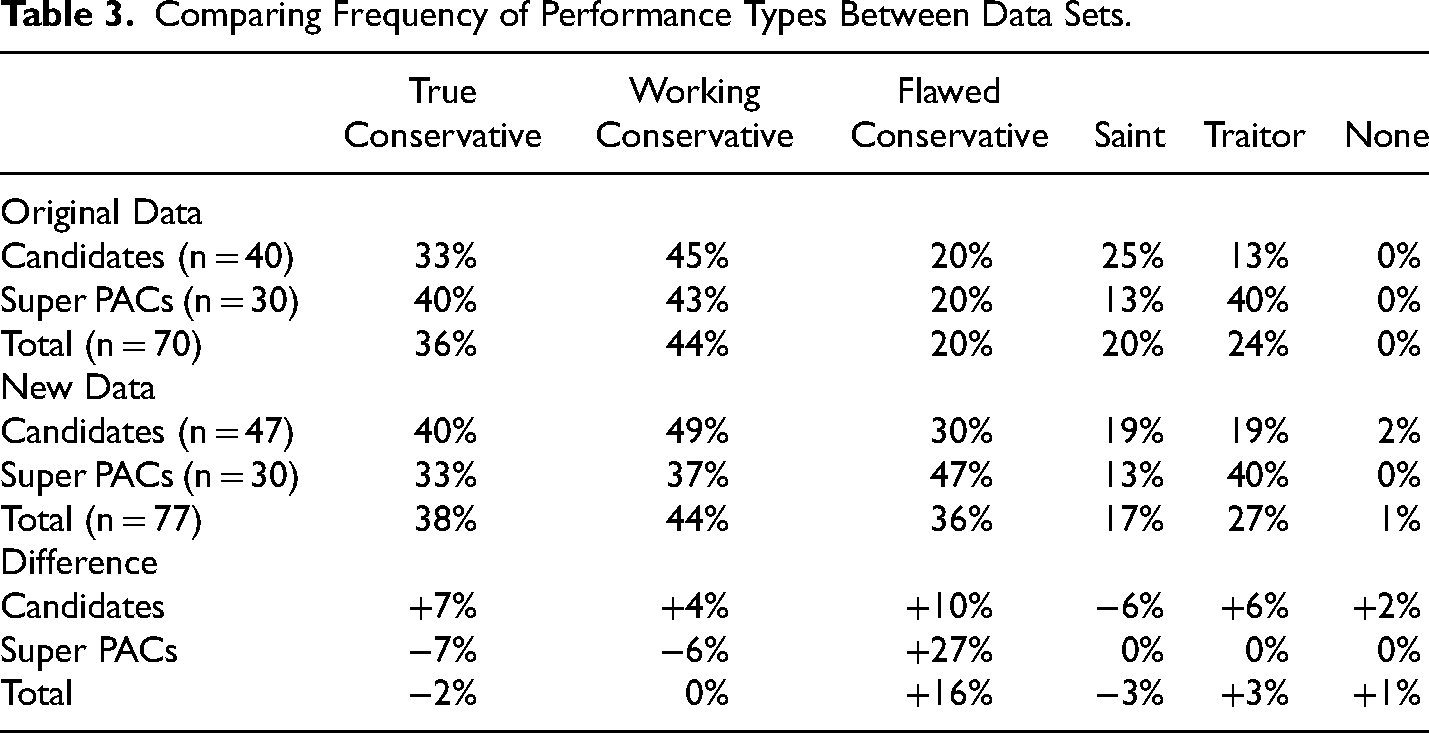
The new dataset shows more drastic changes in the usage of performance types by Super PACs. Like with candidates, Super PACs saw a greater favoring of the flawed conservative in the new dataset. However, it increased 27%, making it the most common performance type produced in Super PAC advertisements. Super PACs also relied less on the more positive frames of the saint, the true conservative, and the working conservative. This aligns with other research on political advertising in the 2012 primaries, suggesting that Super PACs further emphasized negative advertising (Gulati, 2012). In this way, the newer dataset better reflects trends shown in previous findings on Super PAC advertising. So, when addressing the first research question regarding the frequency of performance types, there are differences between the two datasets. The greatest difference is Super PACs favoring the flawed conservative. However, many of the overarching trends: the favorability of positive images by candidates and how both candidates and Super PACs relied on the working conservative to emphasize policy effectiveness more than the true conservative and its push for conservativism on a purely ideological level, remained the same between datasets.
Comparing 2012 and 2016
Table 4 answers the second research question, inquiring about differences in the frequency of performance types between 2012 and 2016. The most noticeable change is the inclusion of a new performance type, the warrior, discussed later in the paper. In addition, changes in the previously existing performance types occurred. Most notably, most forms of performance types saw a drastic decrease in presence in 2016. However, the saint, the performance type morally above their opponents all but disappeared. More surprisingly, there was a drastic decrease in negative imagery as well. The presence of the traitor dropped overall from 27 to 19%, primarily due to Super PACs no longer relying on the performance type. There was also a decrease in the use of the flawed conservative among both Super PACs and Candidates. However, Super PACs were still more likely to rely on negative performance types than candidates. Super PACs were more likely to use most performance types, excluding the now discarded saint and the deemphasized traitor, which roughly tied with candidates.
Comparing Frequency of Performance Types in 2012 and 2016.
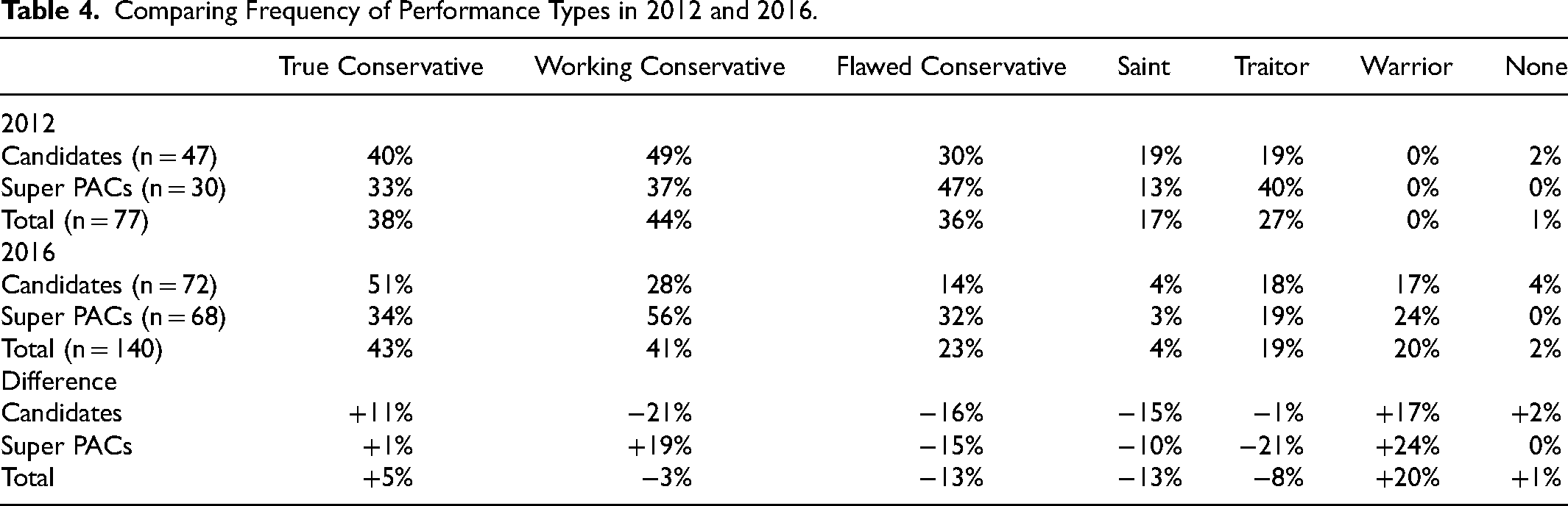
With its message of ideological purity, the true conservative was the only performance type to see an increase in use among both candidates and Super PACs. This makes it the candidate's most relied on performance type and Super PAC's second most relied on performance type in 2016. The rise in the use of the true conservative suggests a desire to express a hard-right purity politics focusing on American supremacy. Super PACs also saw an increase in the use of the working conservative (19%). The increased reliance on the working conservative begins to suggest a shift toward a further embracing of a different form of anti-liberal politics, framed around the importance of a conservative ideology and its results instead of the more preferred framing in 2012, where the traitor and flawed conservative emphasized the absence of this position.
There were, once again, candidate-sponsored advertisements that did not fit within any performance type: Texas Senator Ted Cruz's ad “It Feels Good to be a Clinton,” former brain surgeon Ben Carson's ad “Failure,” and Florida Senator Marco Rubio's ad “Safe.” These advertisements attack then President Barack Obama and the then-presumed nominee of the Democratic party Hillary Clinton with little or no emphasis on what the sponsoring candidates offer beyond a semblance of “real leadership” that their opponents may lack. Despite the slight increase in political advertisements with no performance types, this does not suggest a lack of applicability to the concept. However, it shows that primary ads do, on occasion, deviate from attacking their immediate opponents, focusing on those they may face in the long run or feeding into pre-existing negative sentiments of the opposing party.
In sum, the answer to the second research question is that the fundamental differences between 2012 and 2016 are an overall increase in the use of the true conservative performance type, as candidates also embraced the flawed conservative more and Super PACs embraced the working conservative. All other performance types from the previous election, and the overall use of all performance types excluding the true conservative, saw a decline from 2012.
Evolutions in Performances and Performance Types
The following two sections of this paper answer the third research question because it is answerable in two ways: by looking at the changes in the specific components of the old performance types and examining the construction of the new performance type. It is not just the frequency of performances that changed between election cycles; the content of advertisements changed as well. This is not simply a matter of changes in any given electoral cycle's dominant policy issues, though that most certainly does contribute. There were also changes in the use of video components and rhetorical devices. First, driving home the more complementary nature of advertisements previously outlined (Katz, 2015, 2016) was the use of video footage. As opposed to stock images which were far more common in 2012, Super PAC ads from 2016 have an increased usage of direct footage from candidates, particularly at town halls and debates. In some cases, candidates and Super PACS would even use the same footage.
There were also changes in the expression of performance types. These changes reflect differences in each election cycle's cultural and technological contexts and what candidates and Super PACs saw as perceived public demands. In other words, there are changes in the symbolic components to performance types, but in most cases the overall construction and image of each performance type remained. Again, this shows how political elites attempt to innovate existing symbolic frameworks in a forward-thinking way without totally erasing past cultural knowledge.
The working conservative saw one of the most immediate changes in terms of content. While the working conservative overall focuses on pragmatic conservativism and results, the results highlighted changed. In 2012, there was an emphasis on one-upmanship within working conservative performances (Katz, 2016), which was still present in 2016, but to a lesser degree. While both electoral cycles emphasized job growth, balancing budgets, and a general sense of responsibility, 2016 saw greater attention to polling. Then-governor of Ohio John Kasich's advertisement “One Choice” highlights statistics showing that he, rather than Ted Cruz holds better poll numbers against Hillary Clinton. His Super PAC, New Day For America's advertisements “Suggest” shows pictures of candidates within a bar graph, discussing their likelihood of beating Clinton, stating that Kasich is “ten points more likely than Cruz. Fifteen points more likely than Trump” and therefore “unless you want this
4
president Clinton vote Kasich.” “First,” another advertisement from New Day for America claims: Washington politicians and lobbyists are rushing to crown Marco Rubio but national polls show John Kasich is the one who beats Hillary Clinton by eleven points, not Marco Rubio. And that of all the GOP candidates only John Kasich has the experience to be president.
These advertisements emphasize the pragmatism and the importance of results like the advertisements of the past (Katz, 2016) and the hyper-interest in polling throughout the 2016 primary (Bruni, 2016), building the working conservative as a performance type. Super PAC portrayals of the working conservative in 2016 also included advertisements such as “Reformer” by America Leads had footage of Chris Christie boasting he could “stand up and fight the most powerful special interests” and “Believe in the Future” by Conservative Solutions highlighted that Rubio “took on the Republican establishment and won.” This portrayal of the working conservative has a small presence in 2012, with Winning Our Future's advertisements that claim Gingrich was the opponent of Washington insiders. However, despite these changes in content, the overall message and image of a candidate who can generate results ran through the performances of working conservatives.
The saint, with its little presence in 2016, shows similar changes. The performance type of the saint focuses on the superiority of a candidate's character and how their superiority makes them ideal leaders. The saint relies on imagery and texts that suggest candidates are above the moral fray, maintain exceptional character not just in politics but in social circumstances, and in some cases, candidates were even prophetic (Katz, 2015; Klapp, 1965). While both the image of a candidate of exceptional moral character and outsider status are present in 2016, outsider status is more prominent. While New Day For America's ad “Quiet” has an attendant of a town hall discussing how he has found hope in John Kasich, advertisements using the image of the saint were more likely to be along the lines of Carson's advertisement “Outside the Box” where when discussing his chances Carson says: The political class says “impossible” he's too outside the box. Well they do know impossible. Impossible to balance the budget. Impossible to get border security. Impossible to put aside partisanship. I’m Ben Carson. I’m running for president and I am very much outside of the box.
Or America's Liberty PAC's ad “Leading the Fight,” which describes Kentucky Senator Rand Paul as “the bold leader fighting against the Washington machine” and that voting for Paul is necessary because “it is time for something different.” These advertisements directly contrast Carson and Paul with “the political class,” cementing outsider status that emphasizes the ability of the public to think differently from political elites and reign in their power. Carson and America's Liberty PAC portray these as necessary for a stronger American future. While both parts of the saint were present, 2016 saw a greater interest in the importance of having an outsider status in politics and a rejection of political norms (Magleby, 2019), once again showing how the overarching performance types remain the same while making adjustments for specific elections.
The negative performance types also saw changes in their construction. For instance, the flawed conservative focuses on what Goffman (1963) calls “blemishes,” the practice of highlighting imperfections. In 2012, this regularly took the form of backing unpopular policies such as bailouts, reckless spending, and inconsistencies in political positions. In other words, the flawed conservative is a character who is not necessarily malicious in their intent but is still untrustworthy and ineffective (Katz, 2015, 2016). One particularly popular strategy was to list a long series of failures. For instance, in the eventual 2012 Republican nominee Mitt Romney's advertisement “Never” he points to form Pennsylvania Senator Rick Santorum as flawed as he has “never run a business, never run a state, [and is] a Washington politician who voted for a bridge to nowhere.” In 2016 this technique is found in Cruz's anti-Trump ad “For Our Jobs” which highlights Trump's agenda as “support[ing] and defend[ing] planned parenthood, government-funded healthcare, [and] let[ting] illegal aliens take our jobs.” However, because cultural contexts drive advertisements, political attacks adjust to the stances and records of candidates involved. Unlike in 2012, where eventual frontrunner Mitt Romney was a frequent target of attacks, in 2016 the main candidates portrayed as flawed conservatives were Ted Cruz and Marco Rubio, despite neither being the consistent frontrunner. Cruz was attacked on a variety of fronts, including poor polling (“One Choice”), cowardice when fighting Trump (“Suckup”), and being fiscally irresponsible (“Phony Conservatives”). Rubio's opponents attacked him on far more consistent lines. Former Texas Governor Jeb Bush's Super PAC Right to Rise, Ted Cruz, and Cruz's Super PAC Keep The Promise all attacked Rubio for his lack of accomplishments, overall absence, and support of amnesty programs despite speaking against them initially (“Briefing,” “Freshman,” “Unfair,” “Burned,” “Bridenstine,” “Leadership”). As a result, the flawed conservative shows some of the most coordinated and complementary political attacks within the 2016 primary.
The second negative performance type, the traitor, saw drastic developments in 2016. Candidates initially used the traitor to portray opponents as overwhelmingly anti-party, working with Democrats to fight conservative agendas on climate change, healthcare, engaging in mudslinging, and occasionally political corruption (Katz, 2015, 2016). However, in 2016, the traitor was anti-party and anti-society, engaging in practices that violate political and social norms. Much of this was targeted at Donald Trump and Marco Rubio, with Trump accused of supporting then governor of New York Bill DeBlasio and Hillary Clinton and Rubio being attacked once again on immigration reform (“Great,” “The Shows,” “Burned,” “Path to Citizenship”). These attacks came from both candidates and Super PACs. Donald Trump faced accusations of engaging in deplorable acts and extreme depravity to the point that his character is unpresidential. For instance, Bush's ad “Enough” targeted him for mocking a disabled reporter, and Cruz's ad “Parking Lot” accuses Trump of “bullying people out” of their homes to make room for a parking lot and the victims of his plans claiming he “doesn't have a heart.” So while other performance types adjusted to candidates’ specific policies and positions yet kept much of the same overall tone, the traitor was conceptualized as more extreme and had a more expansive range of topics to incorporate.
The one exception to these fundamental changes is the performance type of the true conservative. Like other performance types, the true conservative slightly changed to match the candidates' experiences. There was also a heavy focus on testimonials in advertisements in 2012, which was not present in 2016. However, the testimonials, speeches, and images emphasized in 2012 were nearly identical in 2016: the importance of religion, maintaining unwavering values, and pushing to reignite a loosely defined “American spirit.”
The Warrior
2016 saw the development of a new performance type: the warrior. Even after multiple loops and recodings, the warrior was not found in the 2012 dataset. The warrior's purpose as a performance type is to show how candidates are willing, if not eager, to use violence to support American supremacy. This differs from the true and working conservative in that it is not about purity, principles, values, or effectiveness but focuses on the violence itself. It also differs from other performance types through its identification of a target. While other performance types attack or praise candidates, the warrior targets an “other,” a figure not running for office that poses a threat that is solvable with violence. In 2016, this “other” primarily took the form of foreign actors constructed to be threats to the United States.
The presence of this violence takes a multitude of forms. For instance, in the Cruz advertisement “American Sovereignty,” a voiceover praises Cruz thusly: “the World Court ordered a stay of execution for an illegal immigrant convicted of murder. Standing in their way was Ted Cruz…. Cruz fought the United Nations and won.” In other words, this advertisement boasts about Ted Cruz's fight against the United Nations for the right to kill a man. While not direct military action, this still shows the importance of violence and the willingness to use it to preserve some form of American idealism.
While the Cruz ad focuses on domestic issues, advertisements with the warrior performance primarily focused on the Middle East and a willingness to embrace violence to dominate, and while there were some ads that supported joint military efforts, generally they expressed a willingness for the U.S. to act independently. For example, in Christie's advertisement “Strong and Clear,” he discusses his goal of sending a message to the Middle East with images of military forces and missiles fired into the air. Other advertisements regularly showed images of the military in action and discussed the use of force and its role in preserving security. The Rubio ad “Disqualified” exemplifies the willingness to use violence with video and audio of Rubio saying: When I am president, we are going to win this war on ISIS. The most powerful military in the world is going to destroy them, and if we capture any of them alive, they are getting a one-way ticket to Guantanamo Bay, Cuba and we are going to find out everything they know.
And his Super PAC, Conservative Solutions' ad “Different,” also features audio and video of Rubio saying: When I am president, we are going to win this war on ISIS. The most powerful intelligence agency is going to tell us where they are. The most powerful military in the world is going to destroy them, and if we capture any of them alive, they are getting a one-way ticket to Guantanamo Bay, Cuba and we are going to find out everything they know.
These advertisements use much of the same images, sounds, and nearly identical wording to express Rubio's willingness to go on the offensive and use a publicly and openly known location for torture. These advertisements establish not just a willingness to use torture, but a variety of forms of force and violence, making a performance type that expresses how candidates will pursue militaristic victories by any means necessary.
What makes the rise of the warrior particularly troubling is that it occurs alongside further emphasizing the true conservative and working conservative. The use of conservative performances in advertisements often focuses on the idea of “taking America back” (Katz, 2015), which candidates and Super PACs have combined with violence. While most advertisements did not engage in both performance types, the further demand for ideological purity, the importance of results, and an “us vs. them” mentality leading to an embrace of violence has long been associated with advocacy for war and the rise of fascism (Bergstrand & Jasper, 2018; Hinton, 2021). The result of this imagery and forms of performance is a change in organizational patterns, which may lead to war and an increase in violence (Bergstrand & Jasper, 2018). Further compounding this problem is the traitor's shift to an anti-society stance, making fellow Republicans a threat to the moral and social fabric as well. In 2016, the public commonly associated this with Donald Trump (Hinton, 2021). Yet even with his absence (due to not having a candidate-specific Super PAC during the primaries), one-fifth of all advertisements maintained some image of the warrior. This demonstrates that the embracing of imagery associated with the rise of fascism came not only from Trump, but other candidates involved in the 2016 primary. One may suspect that candidates and Super PACs were simply playing “follow the leader” in an attempt to match Trump, who most certainly contributed to the advocacy of violence. However, candidates often engage in the performances that they believe voters want to see (Hoffjann, 2021), which demonstrates that the violence has a broader appeal. It is more likely that Trump is a symptom and not the cause of the emerging radicalization on the right, meaning his competitors were responding to other political demands. Either way, their actions directly aid in the development of fascism.
Continuing to answer the third research question, the 2016 primary advertisements differ from those in 2012 because they are significantly more violent. This violence comes from multiple candidates and emerges alongside a trend of the increased presence of ideological purity that lends itself to fascist tendencies. This makes the fact that the eventual winner left the White House after a failed insurrection attempt even less surprising.
Conclusion
Candidates and Super PACs use political images to express how they relate to parties, society, and one another. These images take the form of performance types, the organizing of symbolic information to develop social types in media. Past research has shown how political ads from candidates and organizations supporting them can align on topics covered (Franz et al., 2016), the tone of advertisements (Brooks & Murrov, 2012), influence political knowledge (Meirick & Nisbett, 2011), and can even help extend the lives of campaigns (Christenson & Smidt, 2014). This paper shows that outside political advertisements also support candidates through their development of performance types, meaning it is not just the symbols and topics, but the construction of performances that are aligned. It also has larger implications for the study of impression management, particularly political impression management. Past research on political impression management has often looked at how images and sounds from candidates and parties impact electability (De Landtsheer et al., 2008; Garzia, 2013). However, more than electability, this paper demonstrates how in politics, the impression management process is about more than what candidates and their opponents do, but also how interest groups and other social actors also contribute to candidate impressions. Therefore, political impression management should not be seen solely as a marketing technique but rather as something at the heart of political culture, organization, and interaction that all actors, to some degree, take part in. Instead, it should also be viewed as a window into the developing ideological worldviews of political parties. The rise of a warrior and the violence that comes with it is not simply the product of political calculations. It is something that, to some degree, voters have an interest in seeing to make sure candidates express their views and values. In this case, it highlights how candidates engage in the practice of promoting democratic backsliding for their own personal victories. While this project focuses on political advertising in the United States, there are implications for examining political advertising in other nations. Countries that allow for outside interest groups to produce advertisements should pay attention to the difference and tone and content of advertisements based on sponsors. The development and creation of performance types can contribute to the analysis of advertisements in other nations, particularly those with more candidate-centered advertisements. And while it is very likely that different nations may have their own unique sets of performance types, special attention should be given to the creation of anti-democratic performance types like the warrior.
This project shows that my previous analysis (Katz, 2015, 2016) overwhelmingly remained accurate. The complementary nature and the performance types present within candidate and Super PAC ads remained the same. However, past analysis has an underrepresentation of the working conservative. Thus performances in political advertisements are not static. When we build an understanding of political advertisements based on their specific cultural content, the performance types used by candidates begin to reflect specific political climates. As a result, performance types are an expression of how consultants and politicians think the public wishes to see their current thoughts, hopes, and fears handled. Actors favor different performance types in different elections. When comparing ads from the 2012 and 2016 Republican primaries, there is a shift to favoring the true conservative. The 2016 primaries also show the emergence of the warrior, a new performance type that emphasizes the use of violence and contains fascist undertones. Therefore creation and promotion of the warrior are tied to ongoing trends of democratic erosion. While the warrior focused on foreign threats in 2016, it is entirely plausible that the warrior performance type will find domestic political targets in the future. This will likely include the targeting of transgender individuals as well as groups such as Black Lives Matter, pro-choice initiatives, and other leftist-counter movements.
While this project shows the development of performance types in televised political advertisements, particularly the troubling rise of violence in 2016, limitations still leave room for further growth. Television may still be the primary source of advertising, however online advertising has an ever-increasing presence, and future research should advance the study of performance types to online advertisements. Furthermore, this paper only explores candidates and a select set of candidate-specific Super PACs. Other interest groups involved in electoral politics may have their own performance types used in advertisements. Other avenues of research include applying the concept of performance types to Democratic elections and non-presidential races and the use of political advertisements in other nations, either individually or in the form of a cross-national analysis. The analysis of performance types is also applicable to other areas of research. Klapp (1954, 1965) was not focused on political advertisements as he mapped out social types but on other forms of media. Therefore, sociologists and media scholars can extend the development of performance types and how multiple organizations rely on the same performances to analyze other forms of media.
Candidates and their Super PACs engage in the development of a variety of performance types. These performance types work together to create a series of cohesive messages in their political advertisements. As a result, they create a series of messages to bolster the candidates they wish to support and attack those they do not. In 2016 however, these attacks went beyond candidates running for office, as candidates and Super PACs expressed not simply a willingness, but an eagerness to use violence in the Middle East. This changes how the public engages with candidates and political knowledge and indicates a rise in fascist messaging within political advertisements produced by Republicans.
Footnotes
Declaration of Conflicting Interests
The author(s) declared no potential conflicts of interest with respect to the research, authorship, and/or publication of this article.
Funding
The author(s) received no financial support for the research, authorship, and/or publication of this article.
