




Abstract
As populist parties and politicians have grown in prominence in democracies, scholars have turned their attention to the causes, and consequences, of populist attitudes among citizens. Some preliminary research indicates that individuals with populist attitudes are more likely to express support or tolerance for the use of violence to achieve political objectives. In this study, I examine this relationship further by investigating factors that mediate the effect of populism on endorsement of political violence. Using an original survey of more than 1300 subjects in the United States, I evaluate four elements that theoretically mediate the relationship between populism and support for political violence: economic grievances; distrust of political institutions; perception that social and demographic changes in the United States are threatening; and preferences for politically illiberal or nondemocratic rule. I find that the effect of populism on support for political violence is mediated through fear of social/demographic change and preference for illiberal rule but not through economic grievances or distrust of political institutions. Taken together, over 50% of the effect of populism on support for political violence is mediated through heightened anxiety about social and demographic changes in the U.S. and illiberal attitudes.
Keywords
Are individuals who hold populist political attitudes more likely to endorse or tolerate the use of violence to achieve political goals? If they are, what might explain the connection between populism and support for political violence? These questions are inspired by a handful of recent studies linking populism and populist sentiments to endorsement of political violence. Research by Armaly and Enders (2022) and Krekό (2021) found that individuals with populist attitudes or who support populist political parties are more likely to regard the use of political violence to be acceptable. In a public opinion study by Piazza (2022), supporters of former President Donald Trump—a politician frequently identified as a right-wing populist (see, e.g., Inglehart and Norris 2017)—were found to be more likely to express support for the use of political violence. Some research also suggests that populist individuals, specifically those who espouse nationalist populist sentiments associated with the “America First” ideology, are more likely to have engaged in violent behavior (Levi, Sendroiu, and Hagan 2020). All these studies find a link between populism and political violence. But they do not provide a comprehensive explanation for the relationship between populist attitudes and support for political violence.
In this study, I explore in more depth the relationship between populist political sentiment and support for political violence, defined as endorsement or acceptance of the use of violence to achieve one’s political goals, among Americans. Specifically, I consider four factors that might mediate, and therefore help to explain, this relationship: economic grievances; distrust of mainstream/establishment political institutions; fear of socio-cultural and demographic changes in the United States that are perceived to challenge traditional White male privilege and power; and embrace of illiberal or authoritarian political rule. I make several findings. First, in line with previous research, I find that populist individuals are more likely to express support for the use of political violence. Second, I find that only two factors—fear of social (socio-cultural or demographic) change and political illiberalism—significantly and substantively mediate the impact of populism on political violence. Collectively, around 50% of the effect of populism on political violence is mediated through these two factors. I do not find evidence that populist individuals endorse political violence because they suffer from economic grievances or are because they distrust political institutions.
In the following sections, I provide a short definition of populism and then discuss the potential mediators in more depth to examine how they help to explain the link between populism and attitudes about political violence. I then follow-up with a presentation of my empirical tests and their results and conclude with the scholarly and policy implications of the findings.
What is Populism?
Populism is a commonly used term, both within scholarly and popular discourse. However, it is a contested term that provokes fierce debate (see Roccato, Cavazza, Colloca, and Russo 2020 for a discussion of the various definitions of populism). In this section, I provide what I believe is the most commonly accepted conceptualization of populism as a contemporary political attitude within democratic societies.
Most scholarly definitions of populism identify it using the following features: Populism is an ideological attitude 1 that divides society into two opposing sociopolitical forces: “the people,” who are regarded as patriotic, pure, and good; and “the elites,” who are unpatriotic, corrupt, arrogant, unresponsive to the economic and political concerns of the people, and dismissive of the cultural heritage of the country (Akkerman, Mudde and Zaslove 2014). Frequently, populism defines “the people” in exclusivist racial, ethnic, religious, or cultural terms that exclude minorities, foreign-born citizens, and cosmopolitans (Kriesi 2014). Populists attest that legitimate government is one that is guided by and is attuned to the will of “the people,” however all too often “the elites” work to undermine and manipulate this will (Hawkings, Riding and Mudde 2012).
Populists are often skeptical and suspicious of democratic pluralism and mainstream political institutions, seeing them as fostering corruption and subverting the will of “the people,” and are often attracted to political leaders and movements who oppose the political establishment and pledge to reorient government toward the people (Akkerman et al. 2014; Kriesi 2014; Kriesi and Papas 2015). However, the relationship between populism and political authoritarianism is nuanced and populism should not simply be viewed as an antidemocratic ideological framework. For example, Mudde (2023) explains that while most populist voters are not explicitly critical of the democratic process, populist parties and movements in Europe are in part driven by popular backlash against perceived democratic deficit of hegemonic liberal institutions. Populist movements have exploited popular dissatisfaction with elite liberal institutions but instead of fostering greater democratic pluralism they have often worked to undermine it by assailing the rights of outgroups, weakening rule of law and damaging separation of powers. This reinforces the notion that skepticism of elites and mainstream liberal institutions is a core element of populism while political authoritarianism is a potential byproduct.
Finally, populism is perhaps most commonly associated with the political right in contemporary political discourse, but Rooduijn (2018) explains that there are both right and left-wing variants of populism.
Populist Support Political Violence
In the studies noted above, individuals with populist attitudes were found to be significantly more likely to express support or tolerance for the use of political violence. I seek to reproduce these findings using original public opinion data. I therefore (re)test the following hypothesis:
Individuals who express populist attitudes are more likely to support political violence. However, I also seek to investigate the relationship between populism and political violence further by identifying which attitudinal factors help to explain the link between populist sentiment and endorsement of political violence. In this study, I consider four potential factors that may mediate the relationship between populism and support for political violence. I argue that these factors are mediators rather than core defining elements of populism. All of these are potentially related attitudes that may accompany populist affinities and may bridge populism and support for political violence. I discuss them below:
Economic Grievances
A host of scholars assert that populism is rooted in individual or sociotropic economic grievances (Berman 2021). The typical argument is that profound economic changes, fostered by globalization, deindustrialization, and neoliberal economic reform policies in industrialized countries, have put a lot of pressure on working class people. In this new economy, there are categories of “winners” who have flourished, and “losers” who feel left behind. Moreover, the new economy is one that appears to privilege global investment and production at the expense of national industry and economic heritage. This has produced a politics of popular economic grievance that has been exploited by populist politicians, political parties, and commentators and has culminated into a populist critique that political elites and the mainstream political system is disloyal to the national interest and unresponsive to those who have been left behind economically (see Betz 2001; Castanho Silva 2019; Kriesi, Grande, Lachat, Dolezal, Bornschier, and Frey 2008; Elchardus and Spruyt 2016; Piketty 2017).
These economic grievances have had two significant impacts. First, they have created a political market for populist politicians and parties that have captured the support of substantial proportions of the working class in advanced democracies (Oliver and Rahn 2016). Second, other scholars observe a relationship between populism and economic grievances at the individual level. Individuals who perceive that the national economy is ailing and who express frustration with unresolved economic crises facing advanced democracies are more likely to also express populist attitudes and preferences (Rico and Anduiza 2019; Rico, Guinjoan and Anduiza 2017; Watson, Law and Osberg 2022). More organically, populist attitudes are associated with individual qualities that drive economic grievances, such as lower education and unstable employment status (Macros-Marne, Zuniga and Borah 2022), though other scholars have not consistently found a significant relationship between individual measures of economic grievances and support for populism (see, e.g., Inglehart and Norris 2017; Roccato et al. 2020).
In popular conception, economic grievances may culminate in frustrations, resentments, and feelings of alienation that prompt individuals to reject nonviolent, mainstream political participation and instead voice support for political violence. However, the scholarly literature produces two relevant expectations in this regard: that economically aggrieved individuals are more likely to voice support for political violence; and economically aggrieved individuals are no more or are less likely to endorse political violence. Supporting the first argument, an older literature theorizes that individuals who feel excluded from society’s economic progress or who feel afflicted by economic injustices are more likely to lose faith in status-quo politics and to instead become susceptible to militant, anti-system political actors that call attention to their grievances by offering a disruption of conventional politics (see Paige 1978; Scott 1976). Other researchers argue that the frustrations produced by relative economic deprivation—feelings that oneself or one’s own social group is deprived of economic wellbeing or progress relative to others—prompt individuals to express a desire to engage in violent extremist behavior as protest and retribution. This is particularly the case when individuals believe that their social groups status is losing economic significance relative to other groups (Jasko, Szastok, Gryzmala-Moszczynska, Maj, and Kruglanski 2019; Van den Bos 2020). These arguments are supported by some empirical studies finding that material grievances predict support for political violence (Drystad and Hillesund 2020) or that individuals' socioeconomic statuses are associated with endorsement of violent extremism (Cherney, Belton, Norham and Milts 2022; Sidanius, Kteily, Levin, Pratto and Obaidi 2016).
However, other studies either find no link between sources of economic grievances and support for political violence or find that low socioeconomic status individuals are less likely to support violent extremism. In their studies of U.S. public opinion, Armaly and Enders (2022) and Armaly, Buckley and Enders (2022) do not find poorer, unemployed or less educated subjects—individuals that may exhibit greater economic grievances—to be more likely to endorse political violence. Analysis of original public opinion data collected in Pakistan by Blair, Fair, Malhotra and Shapiro (2013) determines that poorer and less educated individuals are actually less likely to favorably endorse militant extremist groups. The authors argue that this is because low socioeconomic status individuals are more exposed to negative externalities associated with violent extremism and are therefore wary of providing support to actors that might precipitate political violence.
Because of these rival expectations, I test the following hypotheses:
Individuals who express populist attitudes exhibit greater economic grievances and are therefore more likely to support political violence. and
Individuals who express populist attitudes exhibit greater economic grievances and are therefore less likely to support political violence.
Distrust of Political Institutions
As previously noted, a core component of populism is distrust of mainstream political institutions within democracies (Bergh 2004; Kriesi and Pappas 2015; Roccato et al. 2020; Schumacher and Rooduijn 2013), or what Akkerman et al. (2014) refer to as skepticism and hostility toward “mediating institutional bodies” which encompass the political institutions and elite actors that govern contemporary pluralist democratic polities. Populists deride mainstream political institutions as corrupt and allege that they work to subvert the will of “the people” (Hawkins, Riding and Mudde 2012). Consequently, individuals with populist attitudes also exhibit distrust for political institutions. For example, Angelucci and Vittori (2021) and Jiang and Ma (2020) determine that individuals who vote for populist political candidates tend to be more distrustful of the political system and of political elites.
This distrust has potential consequences for attitudes about political violence. Trust and confidence in political institutions, political processes, and the elites who run them is requisite for social peace and nonviolent political stability in democracies. Anderson, Blais, Bowler, Donovan, and Listhaug (2005) argue that public trust in democratic political institutions serves as a crucial but fragile bulwark against political violence. When institutional trust is weakened, the use of political violence becomes normalized and more likely to occur. Current research reinforces this contention. Veri and Sass (2022) find that lack of trust in democratic institutions and governing elites within democracies is a key ingredient that determines whether domestic political opposition movements are likely to engage in violent extremism. Empirical research by Piazza (2022) demonstrates that when individuals lose trust in democratic political institutions—namely, when they become distrustful of the validity of democratic election outcomes in the face of (unsubstantiated) allegations of election fraud by losing political parties—they are more likely to express support for the use of political violence, and instances of domestic terrorism are subsequently more likely to occur.
Because of this literature, I test the following hypothesis:
Individuals who express populist attitudes distrust political institutions and are therefore more likely to support political violence.
Social Change Threat
As previously mentioned, glorification of a pure, good, and homogenous “people” is central to populism, and frequently populists identify “the people” in exclusivist racial, ethnic, or cultural terms (Roccato et al. 2020). This is particularly the case for right-wing populists. Because of this, populism often exhibits a dichotomous, and Manichean, “us versus them” worldview and populist leaders mobilize supporters by emphasizing racial, ethnic, and cultural grievances against nefarious “others” (Berman 2021; Oliver and Rahn 2016). The appeal of this dichotomy is prominent because it exploits populist individuals' fears of social and demographic changes in contemporary Western democracies that have challenged the traditional socio-political, economic, and cultural dominance of majority groups, such as White Christian males. Roccato et al. (2020) identify perceptions of challenges to dominant groups due to increased demographic and cultural pluralism as key contributors to support for populism. More specifically, Akkerman et al. (2014) explain a strong driver of populism is popular opposition to mainstream political actors and pluralist institutions within democracies that safeguard minority group rights. Examining European countries, Kokkonen and Linde (2023) determine that populists motivated by nativist backlash against immigrants frequently express preferences for a type of illiberal, anti-pluralist “democracy” in which minority group rights and the democratic institutions that safeguard them are subordinated to the will of the native (“true”) population as expressed through executive branch power.
A body of empirical research undergirds these arguments. Globally, researchers have found a link between nativist and anti-immigrant attitudes and support for right-wing populist political parties (Cutts, Ford and Goodwin 2011; Semyonov, Raijman and Gorodzeisky 2006; Maier, Welzenbach-Vogel, Christner, Tilman, Zinkernagel, and Schmitt 2022). In the United States, scholars have found that individuals' resentments against racial, ethnic, gender, and religious minorities was a strong predictor of electoral support for Trump, a populist candidate who campaigned on a White backlash platform (Inglehart and Norris 2017; Mason, Wronski, and Kane 2021). Several scholars have also specifically identified fears among Whites that growing diversity and empowerment of minorities within the United States, and corresponding loss of White racial power and privilege, as a factor driving the Trump vote in 2016 (Mutz 2018; Sides and Tessler 2019).
Social change threat is also associated with increased normalization of and support for the use of political violence. As explained by intergroup threat theory, when individuals are faced with broad social changes, pressures and (perceptions of) threats, they are prone to react by enhancing their identification with their social ingroup and by becoming more hostile toward members of social outgroups. Brewer (1999) depicts this phenomenon as “ingroup love and outgroup hate.” Put another way, individuals who feel that their groups' status is being challenged frequently respond by demonizing outgroups, who are viewed as rivals and enemies in the context of social group competition, and by treating them with suspicion, hostility, and denial of basic rights (see Shamir and Sagiv-Schifter 2006). This framework is consistent with empirical research linking ethnic antagonism, sexism, racism, and xenophobia with an increased tolerance of the use of political violence among survey subjects in the United States (see Bartels 2020; Kalmoe and Mason 2022; Piazza 2022). Similar effects are found in non-US contexts as well. In a study of Scandinavian subjects, Obaidi, Kunst, Ozer, and Kimmel (2022) found that individuals exhibiting greater resentments toward immigrants and religious minorities, as well as subjects treated with information suggesting that minorities and immigrants threaten to demographically and culturally replace Whites in the coming years, were more likely to voice support for political violence.
This discussion leads to the following hypothesis:
Individuals who express populist attitudes feel threated by social change and are therefore more likely to support political violence.
Political Illiberalism
Some scholars associate populism with hostility toward democratic pluralist modes of government and affection for illiberal, anti-establishment, “strong man” leaders. As previously noted, this is an important but complex quality of populism. Populists themselves frequently reject accusations of illiberalism and political authoritarianism and instead cast themselves as champions of “true” democracy, one that is rooted in the sovereignty of the “real people” of the country as opposed to the corrupt governing institutions and elites. That said, a host of scholars argues that populism has a significant illiberal ethos (see Canovan 1999; Foa and Mounk 2016; Muller 2017; Pappas 2019). As previously discussed, populism is an anti-system orientation that often is hostile toward pluralist democratic features, institutions, and actors (Kriesi 2014). To respond to the corruption and ossification of pluralist democracy, populists frequently advocate what Akkerman et al. (2014) call “plebiscitary politics and the personalization of power” in the form of an anti-politician leader who embodies the rage of a public that is fed up with politics as usual. The strong man politician can speak directly for the sovereign people and can therefore dispense with constraining democratic rules and institutions (Kriesi and Pappas 2015). Scholars have found empirical support for the relationship between populist and illiberal attitudes (Elchardus and Spruyt 2016; Norris 2005). Populist political figures frequently assail pluralist democratic norms, traditions, and institutions in their political rhetoric (Bowler, Carreras and Merolla 2022; Norris and Inglehart 2019). Populist political parties also tend to receive strongest electoral support from voters that harbor illiberal or antidemocratic attitudes (Donovan 2021; Lewandowsky and Jankowski 2023).
The illiberal and antidemocratic attitudes that accompany populism have implications for individual support for political violence. Bartusevicius, van Leeuwen and Peterson (2020) explain that individuals in advanced democracies like the United States who hold illiberal and antidemocratic attitudes and who generally favor autocratic modes of government also tend to exhibit social dominance orientation (SDO), an individual measurement indicator derived from social dominance theory (see Pratto, Sidanius, Stallworth, and Malle 1994). Individuals exhibiting high levels of SDO have strong preferences for fostering and defending traditional social hierarchies and are prone to advocating for the inegalitarian treatment of outgroups. This makes them more amicable to illiberal/nondemocratic rule (Sidanius and Pratto 2001). Research also links SDO with higher tolerance of the use of political violence (see Lemieux and Asal 2010; Henry, Sidanius, Levin, Pratto 2005; Tomsen, Green and Sidanius 2008). It is therefore not surprising that scholars have found that individuals harboring illiberal or antidemocratic attitudes are more likely to also support political violence. Bartusevicius et al. (2020) find that subjects in multiple countries who hold autocratic political views are more likely to endorse political violence. Finally, Bartels (2020) associates antidemocratic attitudes among U.S. Republican subjects with support for the use of violence to preserve the “traditional way of life.”
Because of these arguments, I test a final hypothesis:
Individuals who express populist attitudes endorse illiberal political rule and are therefore more likely to support political violence.
Research Design
To test the hypotheses of the study, I constructed and fielded an original survey of 1393 subjects living in the United States using the Lucid Theorem online panel. The Lucid panel is broadly representative of the U.S. population (Coppock and McClellan 2019) and has been used in a variety of other studies that examine U.S. public opinion, including studies investigating support for political violence (see Armaly and Enders 2022; Armaly, Buckley, and Enders 2022). All subjects provided consent prior to taking the survey, and subjects who completed the survey were thoroughly debriefed. 2 Those that opted not to consent or terminated the survey before finishing were eliminated from the analysis. Because subject inattentiveness may affect responses to questions about support for political violence, I embedded multiple attention checks in the survey and eliminated subjects who failed these checks (see Westwood, Grimmer, Tyler, and Nall 2022a). Furthermore, subjects who either finished the survey too quickly or who took too long to take the survey were also eliminated from the analysis, following practices by Armaly and Enders (2022); 3 though, robustness models including these subjects reproduce the main findings of the study. 4 I fielded the survey between December 1 and December 11, 2022. The median subject took approximately 14.5 minutes to complete the survey. The completion rate of the survey—including subjects who provided consent, passed attention checks, completed the survey, and did so in a timely manner—was around 60%.
Dependent Variable
The dependent variable of the study measures subject support or approval for the use of violence to achieve political goals. To measure this outcome, I constructed an index 5 using six questions developed by other scholars that capture a variety of conditions and forms of political violence. 6 In two of the questions, I asked subjects whether they regard the use of political violence to be an acceptable means of achieving one’s political goals. 7 I used another two questions to ask subjects whether they regard the use of political violence as an acceptable way of expressing their disagreement with the government 8 or whether violence is justifiable if political opponents use it first. 9 I also asked two 10 questions 11 that measure subject support for the use of attacks for the purposes of threatening or otherwise coercing politicians which fall short of actually perpetrating direct physical harm on a target or victim but can be otherwise depicted as “threat making.” Responses to these questions were combined into an unweighted additive index ranging from 6, indicating no support for political violence, to 24, indicating high support for political violence (α = .8009).
Overall, support for political violence among subjects in the sample was quite low. This is illustrated by Figure 1. Frequency distribution, support for political violence.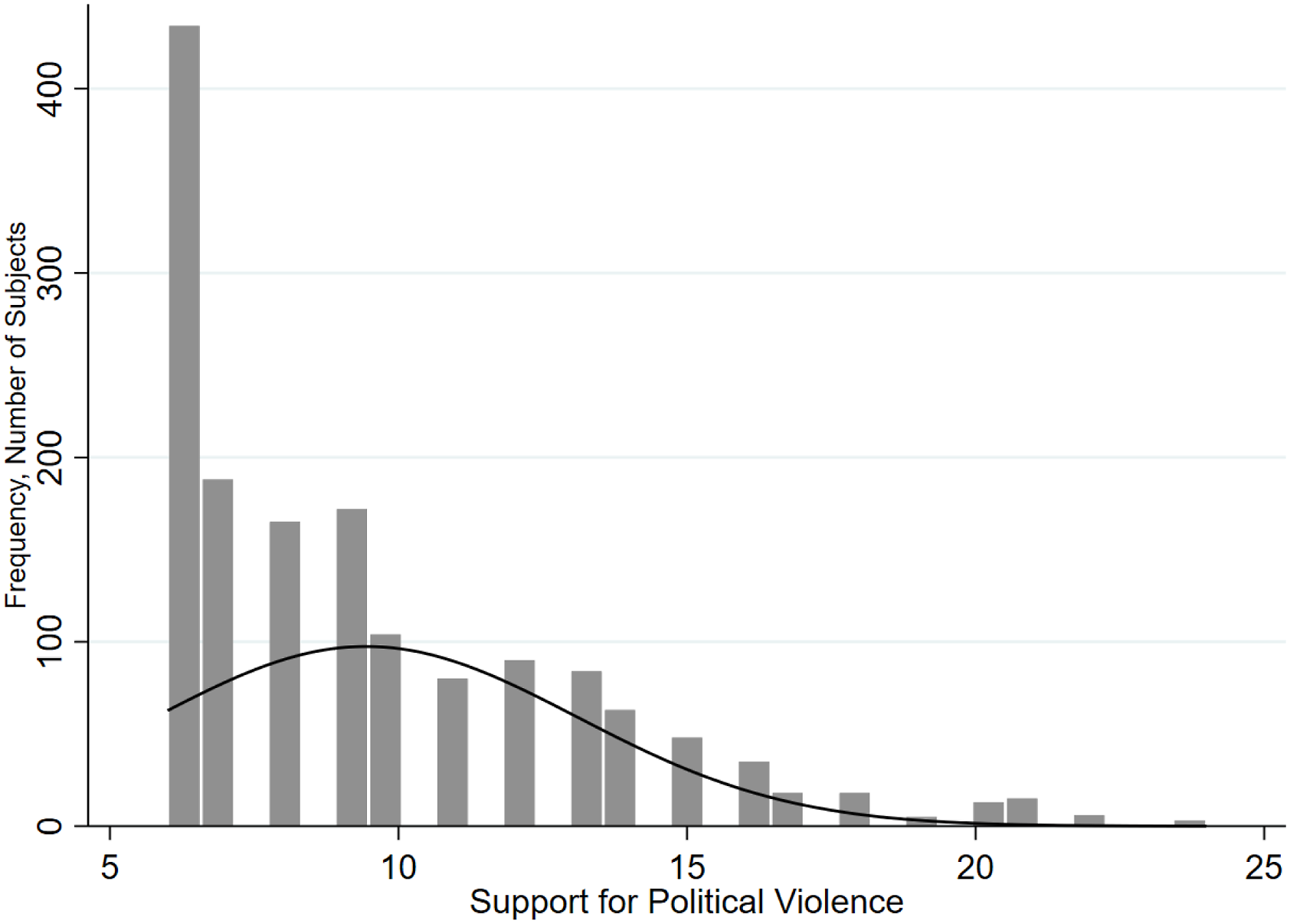
The modal subject, representing 28.4% of all subjects, expressed no support for political violence across all questions. The median subject had a combined score of eight on the 6 to 24 index of support for political violence, suggesting a low level of support for political violence for only some of the questions in the index. 12 Only 10% of all subjects had combined scores of 15 or higher on the index, suggesting that a distinct minority of the sample exhibited a moderate to high level of support for political violence. The political violence scale comports with measures of support for political violence used in other studies, such as Armaly and Enders (2022). 13
Independent Variable
The independent variable of the study is an unweighted additive index measuring populist attitudes among subjects. Because populism is a complex and contested concept, I measure populist attitudes using survey questions developed and vetted in multiple previous studies. Specifically, I use a set of eight questions developed by Oliver and Rahn (2016) for their study of populist sentiment in the contemporary United States. 14 These eight questions provide several advantages.
First, they have been tested previously in several studies, which reinforces their validity. The eight questions were adapted by Oliver and Rahn (2016) from previous investigations of populist attitudes by Akkerman, Mudde, and Zazlove (2014), Elchardus and Spruyt (2016), Hawkins, Riding, and Mudde (2012), Spruyt et al. (2016), and Stanley (2011). Second, the questions capture core elements of populist sentiment, such as anti-elitism, mistrust of expertise, belief in the sovereignty and purity of the “real people,” belief that the mainstream political system and its pluralist institutions have been irredeemably corrupted by elites, and belief that ordinary people have been disempowered or marginalized.
15
For example, some of the questions measure hostility toward elites and valorization of the goodness of “the people,”
16
and depict the political system as corrupted by elite influences and power.
17
Other questions tap populist alienation from mainstream political systems and the belief that “the people” are disenfranchised by establishment political institutions.
18
Finally, one of the questions captures the Manichean nature of populist sentiment.
19
Third, in their study, Oliver and Rahn (2016: 197-198; Figure 2) also examine how populist attitudes, captured by these eight questions, correlate with other attitudinal variables (“secondary variables”) that I investigate in this study as mediators, such as nativism and racism. Finally, the same eight questions have been previously employed by Armaly and Enders (2022) in their study of individual support for political violence. That said, as previously noted, populism is a difficult concept to operationalize and it is likely that the eight questions used in this study do not capture it in full without ambiguity. Frequency distribution, populism.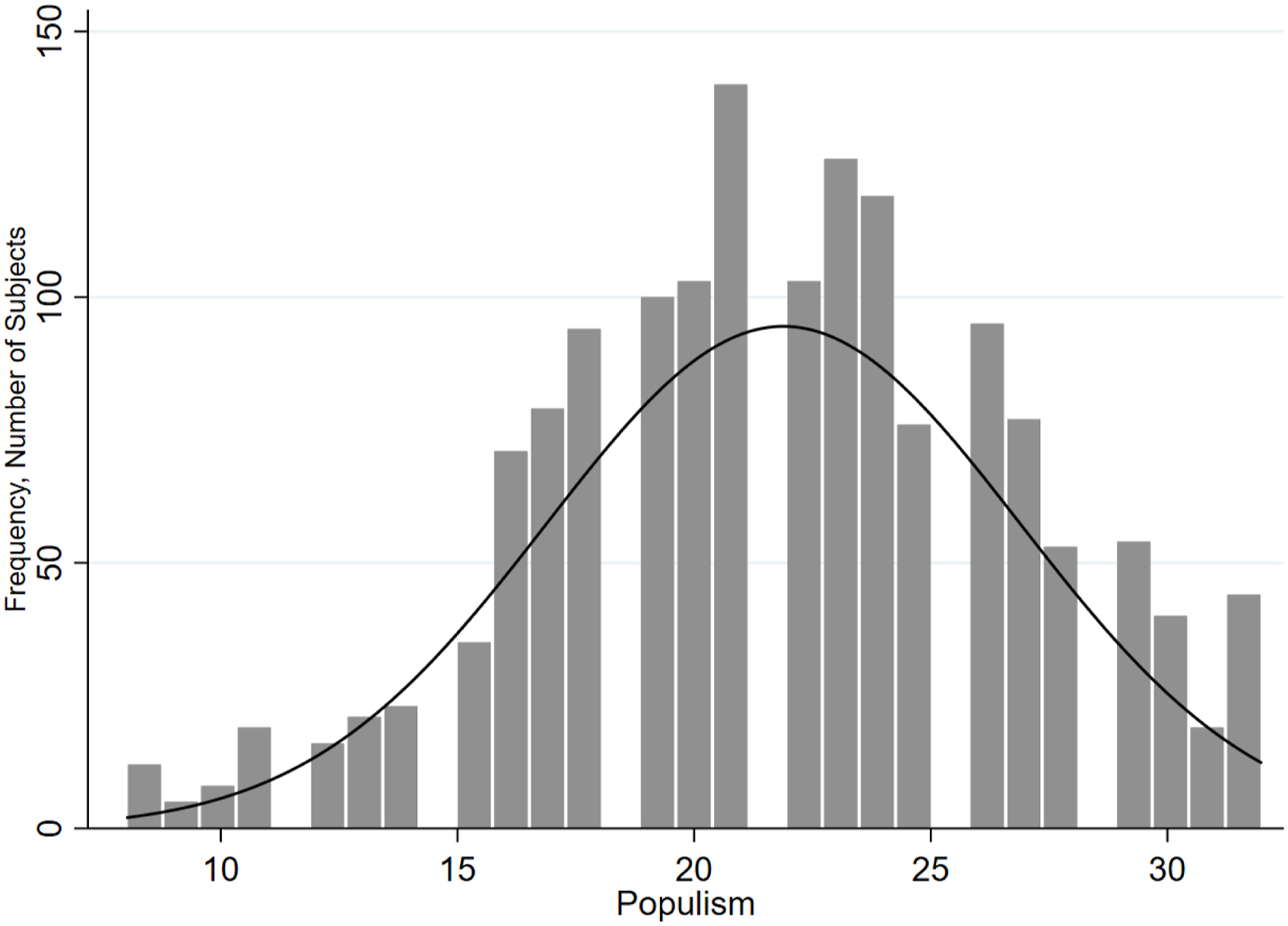
The index ranges between 8, indicating an absence of populist attitudes, and 32, indicating a high level of pro-populist sentiment. 20 The distribution of populist sentiment among the subjects more closely approximates a normal distribution than is the case for support for political violence, as illustrated in Figure 2.
The median score on the populism index for subjects is around 21.5, which is close to the average score of 21.8, suggesting a normal distribution. The distribution skews rightward with 25% of subjects scoring 18 or lower on the populism index and 25% of subjects scoring 25 or higher on the populism index. The mean for the populism scale is similar to that for the measure of populism used by Armaly and Enders (2022). 21
Mediators
The study also employs four mediators to measure economic grievances, distrust of political and government institutions, social change threat and illiberal or antidemocratic political attitudes. To measure economic grievances, I surveyed subjects on their socioeconomic mobility by asking them whether they had a “better off,” “worse off,” or “same” standard of living compared with their parents' standards of living at the same age. This question captures perceptions of current and relative economic wellbeing and is frequently used in World Values Survey questionnaires (see Haerpfer et al. 2022; Gallup 2023). In the sample, around 31.5% of subjects reported being “better off” economically than their parents at the same age. Around 37.3% said they were “about the same.” Around 31.1% said they were “worse off” than their parents. I operationalize the economic grievances model as a dichotomous measure coded 1 for subjects reporting that they were “worse off” than their parents.
To measure distrust of government and political institutions, I asked subjects about their level of distrust for the federal government, media, and election officials and created an additive index of their responses ranging between 3, indicating a high level of trust, and 12, indicating a high level of distrust. 22 Each of these institutions are routinely identified as elite-captured and are vilified by populist politicians and political actors (see Bonikowski 2016; Norris, Garnett and Gromping 2020). Consequently, populist individuals are deeply distrustful of them. 23 Distrust of government and political institutions are normally distributed in the sample. The median subject scored a 7.5 on the 3 to 12 scale of distrust. Approximately 15% of subjects exhibited a moderate to high level of trust of political institutions (3–5 on the index) while around 18% exhibit a moderate to high level of distrust (10–12 on the index).
To measure feelings of threat or anxiety in the face of social and demographic changes in the United States I surveyed subjects on their perceptions that traditional social group hierarchies and the socio-cultural heritage of America are being challenged due to the empowerment of minorities and demographic transformation. I used two questions to capture these sentiments. The first asks subjects if they believe that, “Members of racial, religious and other minority groups in the United States are being too demanding in their push for equal rights” in America. Around 43.2% of respondents either agreed or strongly agreed with this statement, while 59.8% either disagreed or strongly disagreed. For the second question, I presented subjects with a scenario in which, “The U.S. Census Bureau projects that by 2044, non-Whites and foreign-born people in America will outnumber American Whites.” This is intended to expose subjects to a trigger for perception of profound demographic change. I then presented subjects with a second statement: “This is a threat to our democracy and to our political traditions” and asked them whether they agreed or disagreed. Around 39.6% of subjects agreed or strongly agreed that this demographic shift represents a threat to U.S. democracy and political traditions, while around 60.4% disagreed or strongly disagreed. I then constructed an additive index of these two questions, producing an index that ranges between 2, indicating an absence of social change threat, and 8, indicating an acute perception of social change threat. 24
The final mediator measures illiberal or antidemocratic sentiments/preferences. It uses a question that is derived from a similar question featured in World Values Survey questionnaires and in other studies (see Drutman, Diamond and Goldman 2018) to determine respondent political illiberalism: “Having a strong and honest leader who does not have to bother with Congress or elections would be a good way of governing the United States.” Around 40.2% of subjects agreed or strongly agreed with this statement, indicating their comfortability with illiberal or nondemocratic rule by a “strong man” leader, while around 59.8% disagreed or strongly disagreed.
Controls
I include several controls in the analyses. I control for subjects' age, gender, household income, race and ethnicity, religious identification, partisan affiliation, political engagement, news habits, aggressiveness, and region of the U.S. where they reside. Because Kalmoe (2014) found that individuals exhibiting trait aggression—aggressive or hostile personality traits—are more likely to express support for political violence, I also include a measure of train aggression as a control in the analyses. Finally, to account for regional differences among subjects, I control for the region of the country they resided in. I include more information about the controls, along with descriptive statistics, in the appendix.
Analytical Strategies
I employ two sets of analytical techniques to test the hypotheses. These are executed in two steps. In the first step, I test hypothesis 1, the proposition that individuals who hold populist attitudes are more likely to support political violence, using ordinary least squares estimations (OLS). 25 In the next step, I test the remaining hypotheses, all of which propose that the relationship between populism and support for political violence is mediated through other variables, namely economic grievances, distrust of political institutions, social change threat, and political illiberalism. To test the mediators, I utilize a structural equation modeling (SEM) technique and conduct 1000 bootstrapped replications. The SEM models are fully specified, using all controls described above.
Results
The results of the first analysis provide support for hypothesis 1. Individuals who hold populist attitudes are more likely to support or endorse the use of political violence. This finding is consistent with Armaly and Enders (2022) and is illustrated in Figure 3 and is presented in more detail in the full model results summarized in the appendix. Populism and support for political violence, coefficient plot of standardized variable. Obs.: 1396. All variables standardized to 0–1 scale. Non-standardized results presented in Appendix. Different colored/thickness lines indicate different levels of significance for confidence intervals (95%, 99%, 99.9%). See appendix for a summary of full model estimations.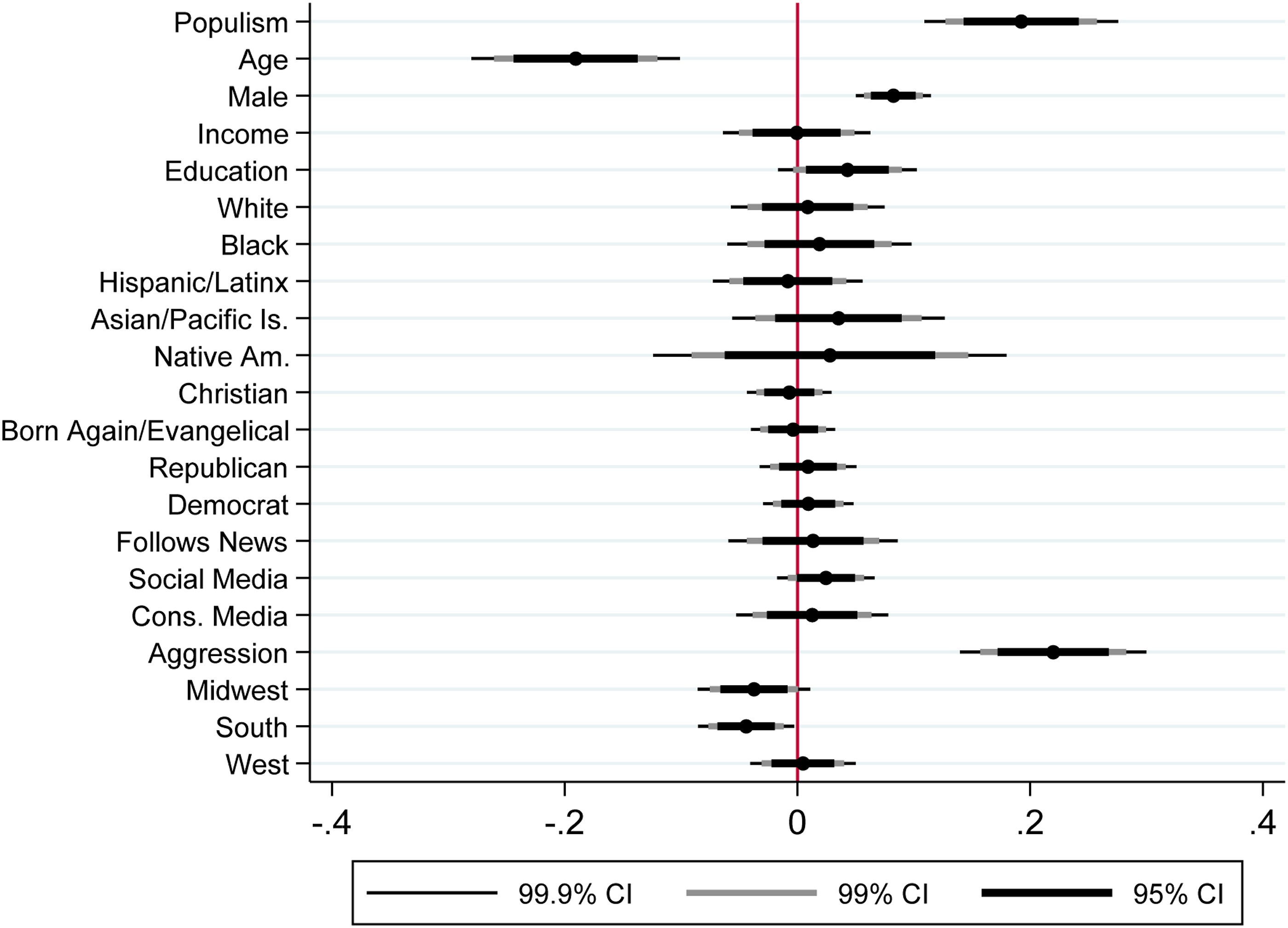
In Figure 3, standardized coefficients for all variables in the model, scaled between zero and one, are plotted to show the relative substantive relationship between populism and support for political violence. Note that non-standardized results are presented in the Appendix and conform to those in Figure 3. In the figure, populism is a significant, positive predictor of support for political violence. Each unit increase in the standardized populism index is associated with a 0.192 increase in the standardized political violence index (β = .192, 95% CI [0.142, 0.241]). This is a highly significant correlation, and its substantive impact is second only to trait aggression (β = .219, 95% CI [0.172, 0.267]. Other substantive predictors of support for political violence include age, gender, and education level. These results are discussed in more detail in the appendix.
In Figure 4, the predicted values of populist sentiment on support for political violence are graphed. Again, standardized coefficients for all variables in the model, scaled between zero and one, are plotted to show the relative substantive relationship between populism and support for political violence. Non-standardized results are presented in the Appendix and they mirror the findings in Figure 4. Populism and support for political violence, predicted values plot of standardized variables. Obs.: 1396. All variables standardized to 0–1 scale. Non-standardized results presented in Appendix. Note, all controls are included and held constant at their mean values: age, gender, household income, education level, race, Christian, born again or evangelical, political party affiliation, political engagement, news frequency, reliance upon social media and conservative media, trait aggression, and region.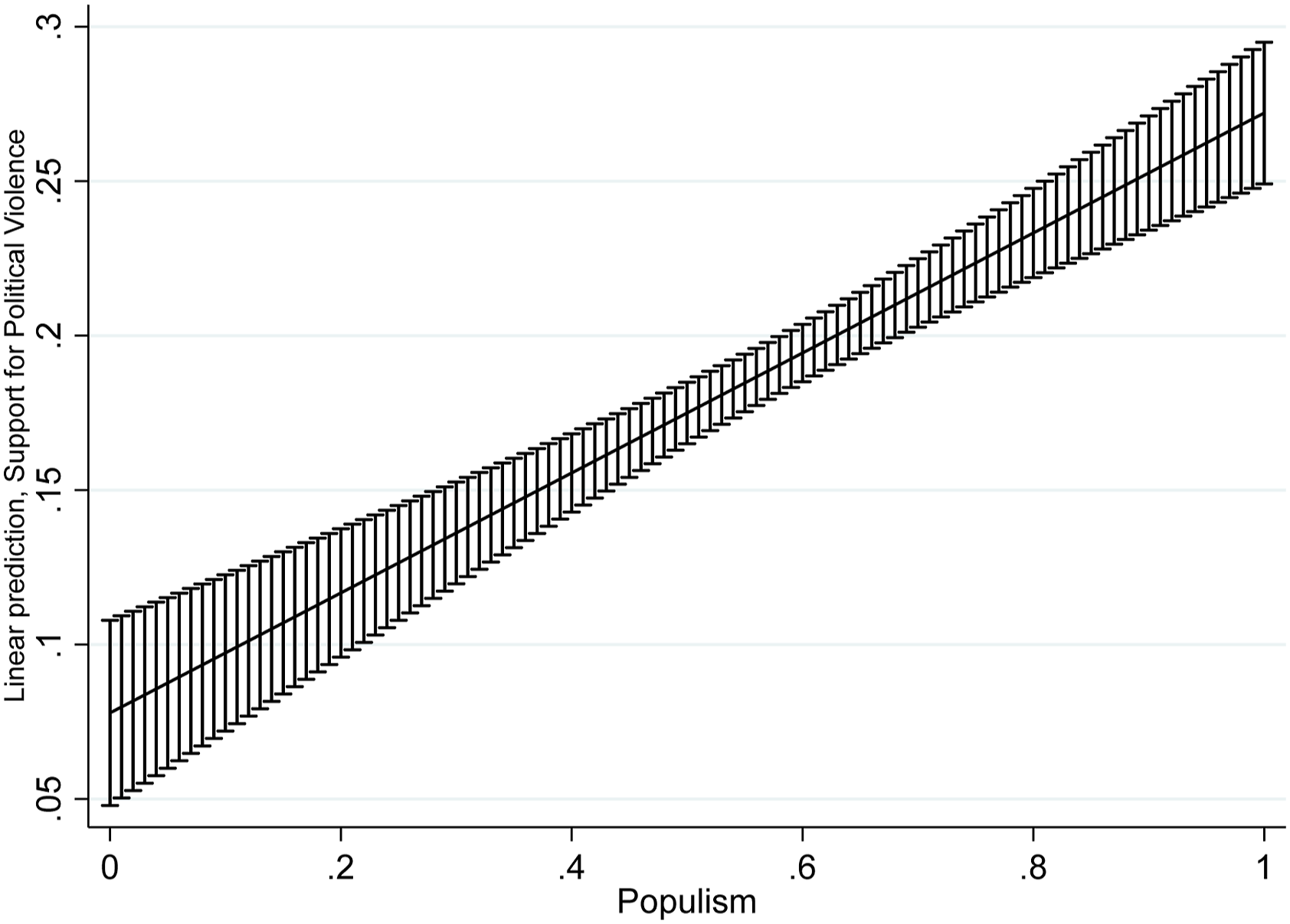
In Figure 4, populism and support for political violence are strongly correlated (β = .192, 95% CI [0.142, 0.241]). Support for political violence increases by around 250% between subjects exhibiting lowest level of populist sentiment (margin of 0.077, 95% CI [0.047, 0.107]) and subjects expressing the highest level of populist sentiment (margin of 0.27, 95% CI [0.249. .294]).
Testing the Mediators
Support is found for some but not all the remaining hypotheses in the mediation tests. The results of these tests are summarized and graphically presented in Figure 5. The full results of the mediation tests are also summarized in the appendix. Populism, Economic Grievances, Distrust of Political Institutions, Social Change Threat, Political Illiberalism and Support for Political Violence, Summary of Mediation Tests. Obs.: 1396 Replications = 1000. ***p ≤ .000 **p ≤ .01 *p ≤ .05. Percentages of the relationship between populism and support for political violence mediated are indicated in parentheses. Black lines indicate significant relationships. Gray lines indicate not significant relationships. Note, all controls are included: age, gender, household income, education level, race, Christian, born again or evangelical, political party affiliation, political engagement, news frequency, reliance upon social media and conservative media, trait aggression and region.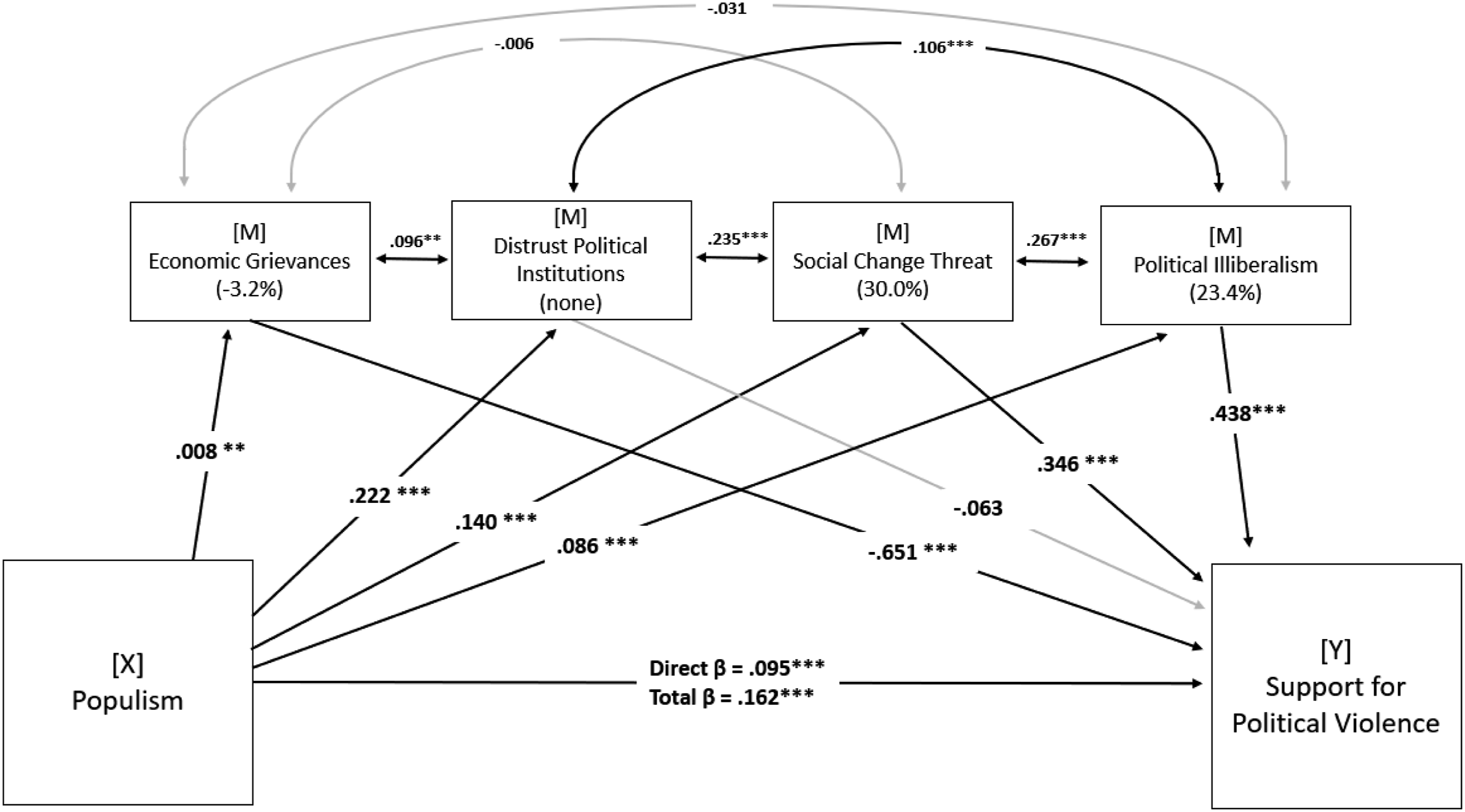
In Figure 5, only some of the mediators are significant in the direction hypothesized. Populism is a significant positive predictor of economic grievances (β = .008, 95% CI [0.003, 0.012]) as hypothesized. However, economic grievances are negatively associated with support for political violence (β = -.651, 95% CI [-1.017, -.284]). Economic grievances mediate a very modest amount—around 3.2%—of the relationship between populism and support for political violence. 26 This finding suggests that populists are more likely to be economically aggrieved, but their grievances are associated with opposition to political violence as a behavior. As previously discussed, some existing literature is consistent with this result (e.g., Blair et al. 2013). Economic grievances, as a mediator, are correlated with only one other mediator: distrust of political institutions.
Though I hypothesized that one reason individuals with populist attitudes are more likely to also support political violence is because they are distrustful of mainstream political institutions, such as the federal government, media, and election officials, I find no empirical support for this. Populism is positively correlated with distrust of political institutions (β = .222, 95% CI [0.003, 0.012]), however distrust of political institutions is not correlated with support for political violence. Populist individuals do exhibit higher levels of distrust of political institutions, but this does not make them more likely to support political violence. More research is required to explain this null finding. However, I have some preliminary thoughts. First, the relationship between distrust of political institutions and support for political violence might be complex and nuanced in that it could be institution, context, or subject specific. For example, a conservative, populist, white, male subject who is distrustful of the national media might have different attitudes toward political violence than a liberal, populist, nonwhite subject who is distrustful of law enforcement. Second, distrust of political institutions might interact with other attitudes, such as conspiratorial thinking, to predict support for political violence. Finally, from a theoretical standpoint, distrust of political institutions might lead not to anger and endorsement of political violence but rather to apathy and resignation. This might be examined by engaging literatures on and empirically investigating trust, apathy, and other forms of political (dis)engagement. Distrust of political institutions, however, is correlated with all other mediators.
I do find support for my remaining two hypotheses. Subjects holding populist attitudes are also more likely to exhibit social change threat as a reaction against the empowerment of minorities and increasing ethnic and racial diversity that may lead to challenges to White dominance and traditional power structures (β = .140, 95% CI [0.123, 0.158]). Subjects exhibiting social change threat are more likely to also support political violence (β = .345, 95% CI [0.228, 0.464]). Around 30% of the correlation between populism and support for political violence is mediated through increased social change threat perception or sentiment in the analysis. 27 Social change threat is correlated with distrust of political institutions and political illiberalism but is not correlated with economic grievances.
Likewise, political illiberalism mediates the relationship between populism and support for political violence. Populist subjects are more likely to exhibit politically illiberal attitudes, in that they are prone to regard as desirable “strong man” leaders that are unchecked by elections and other branches of government. Populism is a significant predictor of political illiberalism (β = .086, 95% CI [0.075, 0.097]) and political illiberalism is a significant predictor of support for political violence (β = .438, 95% CI [0.250, 0.626]). Approximately 23.4% of the relationship between populism and political violence is mediated through increased political illiberalism/antidemocratic preferences. 28 Political illiberalism is correlated with distrust of political institutions and social change threat, but not economic grievances.
Taken together, social change threat and political illiberalism mediate around 53% of the relationship between populism and support for political violence. Social change threat and political illiberalism are also strongly associated. This suggests that rooted within populism are intertwined concerns about social changes that threaten traditional power hierarchies as well as skepticism about liberal democratic political rule among subjects and that these erode norms of peaceful political behavior.
The results of the mediation tests also provide some preliminary information on more complex relationships between populist sentiment, the mediators, and support for political violence. For example, though the impact of populism on support for political violence may not be mediated through distrust of political institutions, subjects who distrust political institutions also seem to fear social change and to exhibit political illiberalism, which are significant mediators. Future research may examine this in more detail.
Conclusion
To conclude, the study offers some alarming and bleak findings. Populism is associated with increased tolerance of the use of political violence, and its effects on political violence are mediated through perception of social change threat and political illiberalism rather than economic grievances or distrust of political institutions. These results might suggest a more complex and conditional effect of different aspects of populism. For example, populist political figures who emphasize economic inequality or unfairness may not inspire violence in their supporters while those that emphasize social change threat or who assail democratic pluralism may increase the chances that their supporters will be prompted toward violence.
These results also underscore the urgent need for a popular recommitment towards a pluralist, multi-ethnic, multi-racial, tolerant democratic system in the United States where social groups share power. If fear of socio-cultural and demographic transformation is abated and popular commitment to democratic values is renewed, the threat populism poses to the United States stands to be reduced. However, the current environment and potential trajectory are not encouraging as populist politicians exploit “White backlash” and pluralist democratic rights, norms, values, and institutions are under siege by populists.
At the same time, the findings do not indicate a salubrious role for more straightforward policy adjustments. For example, economic policies to mitigate inequality and lack of economic opportunities are not likely to blunt the impact of populism on popular support for political violence. Likewise, campaigns to bolster public trust in government and U.S. political institutions—through, for example, public information campaigns, civics education, or responsible media reporting—are not likely to address populism and political violence.
The study is a first cut investigation of how populism might affect support for political violence. As such, it leaves ample room for future research. One potential direction would be to look at specific party or ideological effects. While the study controls for partisan identification, it does not theorize or test partisan effects of populism on political violence. Indeed, populist Democrat and Republican subjects in the data are both more likely to support political violence, at similar levels. 29 However, the theoretical discussion and conceptualization of mediators in the study is mostly oriented toward right-wing populists. Further empirical investigation reveals that Republican party identification is strongly correlated with significant mediators like social change threat—but only weakly with illiberalism. However, Democratic party identification is negatively correlated with all four mediators examined in the study, and is strongly negatively correlated with institutional distrust, social change threat and political illiberalism. 30 Perhaps the impact of populist attitudes on support for political violence is mediated through different factors for Democrats than Republicans. Future research may investigate this in more detail.
Supplemental Material
Supplemental Material - Populism and Support for Political Violence in the United States: Assessing the Role of Grievances, Distrust of Political Institutions, Social Change Threat and Political Illiberalism
Supplemental Material for Populism and Support for Political Violence in the United States: Assessing the Role of Grievances, Distrust of Political Institutions, Social Change Threat and Political Illiberalism by James A. Piazza in Political Research Quarterly
Supplemental Material
Supplemental Material - Populism and Support for Political Violence in the United States: Assessing the Role of Grievances, Distrust of Political Institutions, Social Change Threat and Political Illiberalism
Supplemental Material for Populism and Support for Political Violence in the United States: Assessing the Role of Grievances, Distrust of Political Institutions, Social Change Threat and Political Illiberalism by James A. Piazza in Political Research Quarterly
Footnotes
Declaration of Conflicting Interests
The author(s) declared no potential conflicts of interest with respect to the research, authorship, and/or publication of this article.
Funding
The author(s) received no financial support for the research, authorship, and/or publication of this article.

Notes
References
Supplementary Material
Please find the following supplemental material available below.
For Open Access articles published under a Creative Commons License, all supplemental material carries the same license as the article it is associated with.
For non-Open Access articles published, all supplemental material carries a non-exclusive license, and permission requests for re-use of supplemental material or any part of supplemental material shall be sent directly to the copyright owner as specified in the copyright notice associated with the article.
