




Abstract
Extant research reveals that Americans hold politically consequential beliefs about the demographic composition of political groups and organizations—even when these beliefs are at odds with objective reality. In this article, we investigate the social imagery of the U.S. Supreme Court, with particular attention to beliefs about the Supreme Court Justices’ religious identities. In survey analysis, we find that evangelicals who believe there are more evangelical Christians on the Court grant the Court more legitimacy compared to non-evangelicals. Further, when evangelical Christians believe there are more atheists on the Court, they view the Court less legitimately than non-evangelicals. To rule out the potential of endogeneity, we conduct a conjoint experiment which demonstrates that evangelicals believe evangelical judges will increase the fairness of the Court and are more likely to support evangelical nominees compared to the average nominee. Likewise, they tend to believe out-group judges will harm the fairness of the Court and are less likely to support out-group judges. Our results have implications for diversity on the Court and how non-ideological factors can affect the Court’s legitimacy.
“Religious liberty is under attack in many places because it is dangerous to those who want to hold complete power. It also probably grows out of something dark and deep in the human DNA — the tendency to distrust and dislike people who are not like ourselves.”
–U.S. Supreme Court Justice Samuel Alito (2022), Notre Dame Religious Liberty Summit (Rome, Italy; quoted in Notre Dame Law School 2022).
When Justice Alito addressed the Notre Dame Religious Liberty Summit in July 2022, the U.S. Supreme Court had just concluded its most controversial term in recent memory. In June, the Court had overturned both Roe v. Wade (1973) and Planned Parenthood v. Casey (1992)—declaring that the U.S. Constitution did not protect a woman’s right to abortion. That same month, the Court ruled (in Kennedy v. Bremerton School District 2022) that a public school football coach could not be fired for publicly praying during each game. Both decisions have empowered religious conservatives. Both seem motivated—at least in part—by the Justices’ religious convictions. Clergy at Faith and Liberty, a ministry associated with Liberty Counsel, claim to have prayed with Justices in chambers and to have ministered to the Court’s most conservative Justices (Voght and Dickinson 2022). For better or worse, religion—and the concern for religious liberty that now animates the Christian Right (Lewis 2018)—is central to the Court’s public profile.
Noting this trend, this article explores how evangelical Christians perceive the U.S. Supreme Court. Given the current Court’s concern for accommodating religion in the public sphere, it makes sense that evangelical Christians would perceive the Court to be more legitimate. Yet while some scholars might attribute this to partisanship or ideology, we focus on an under-explored factor: what evangelical Christians believe about Supreme Court Justices’ religious identities. Our rationale is straightforward: if Americans’ political attitudes reflect the social imagery of the political parties (Claassen et al. 2019; Green, Palmquist and Schickler 2002; Ahler and Sood 2018), the social imagery of the U.S. Supreme Court should matter too.
Our analysis proceeds as follows. First, we explain why the Court’s social imagery—that is, the public’s perceptions of the Justices’ social identities—promises to help explain Americans’ beliefs about the Supreme Court. Second, we apply this theory to the attitudes of evangelical Christians, deriving several hypotheses about evangelical Christians’ attitudes toward the Court.
Next, we present the results of two survey analyses. First, we demonstrate a strong association between evangelical Christians’ perceptions of the Court’s legitimacy and their beliefs about the Justices’ religious identities. Second, we confirm that perceptions of Justices’ religious identities drive attitudes toward the Court, rather than vice versa. In November 2020, we asked YouGov respondents to estimate how many of the Supreme Court Justices were evangelical Christians; we asked the same question about the number of atheists on the Court. Results suggested that when evangelical Christians felt better (less) represented on the Court, they perceived the Court to be more (less) legitimate. From there, we conducted a conjoint survey experiment (March 2023) on CloudResearch’s MTurk toolkit platform to clarify the mechanism driving this relationship. After presenting respondents with randomized biographies of potential Supreme Court appointees, we found that evangelical Christians were more likely to support appointees that identified as evangelical or born-again Christians. This pattern was not better explained by the appointees’ age, judicial philosophy, expert evaluated qualifications, partisanship, gender, or educational background.
To conclude, we describe implications and suggestions for future research. In the present analysis, we focused on evangelical Christians: on their beliefs about Supreme Court Justices’ or appointees’ religious identities, and how this affects their support for Supreme Court nominees and their perceptions of the Court’s legitimacy. However, the social imagery of the Court likely matters for other groups too—whether defined by gender, racial or ethnic background, socioeconomic status, or other indicators relevant to the Court’s decisions. These provide only the most obvious opportunities for follow-up work.
The Importance of Social Imagery
In the United States, social group attachments remain pivotal to mass political behavior. In recent years, group models of mass politics have helped explain public reactions to divisive Supreme Court decisions (Zilis 2018; 2021); resentment between Republican and Democratic identifiers (Kane, Mason and Wronski 2021; Mason 2018); misperceptions of the party coalitions (Ahler and Sood 2018; Claassen et al. 2019); the influence of “intense policy demanders” on party platforms (Bawn et al. 2012; Cohen et al. 2009); and the effects of ethnocentrism on public opinion (Kinder and Kam 2009) and voting behavior (Schaffner, MacWilliams and Nteta 2018). Moreover, political theorists (e.g., Pitkin 1967; Mansbridge 1999) have recognized that social group identities—of both elected officials and the voters they represent—help evaluate the quality of political representation. Simply put, group attachments help explain the intensity of contemporary American politics.
This intensity derives not just from individuals’ own group attachments, but their beliefs about whether the political process represents people like them. Perhaps because parties anchor political conflict, group-based perceptions of the party coalitions have received the closest attention. For example, Green, Palmquist and Schickler (2002) attributed the stability of party identification to the parties’ “social group imagery” (140)—the perception that Republicans and Democrats represent fundamentally different social groups. More recently, Kane, Mason and Wronski (2021) found that the perceived social imagery of the parties—conditional on affect toward in-partisan and out-partisan groups—influences Americans’ party identification. Others have found that Americans overestimate the prominence of party-stereotypical groups in the Republican and Democratic coalitions (Ahler and Sood 2018), and that exaggerated perceptions of the parties’ religious differences promote higher rates of Republican partisanship among evangelical Christians (Claassen et al. 2019).
If parties have social imagery, other political institutions should too. For instance, Stauffer (2021) showed that when Americans overestimate the percentage of female legislators in Congress and the state legislatures, they feel better represented in government.
Importantly, these effects were not confined to female respondents—suggesting that when Americans develop group-based perceptions of political institutions, these reflect more than projections based on their own group membership.
Social Imagery and the U.S. Supreme Court
We would be surprised to find that perceptions of the Court were devoid of social imagery. As David Truman (1951) recognized in The Governmental Process, “Though myth and legend may argue to the contrary. . . the judiciary reflects the play of interests, and few organized groups can afford to be indifferent to its activities” (479). Truman’s logic was not lost on the 34 religious groups or individuals that filed amicus curiae briefs in Dobbs v. Jackson Women’s Health (2022) urging the Court to strike down Roe v. Wade (1973)—nor the five secular groups whose amicus briefs urged the opposite. 1
Focusing on the Court’s substantive representation of different groups, Zilis (2018, 2021) documents one way that social imagery might influence attitudes toward the Court—through beliefs about which groups the Court supports. According to Zilis (2021), public attitudes toward the Supreme Court reflect feelings toward groups (e.g., gays and immigrants) that benefit from the Court’s decisions. By cutting through the “myth and legend” that Truman (1951) references, Zilis (2021) marries theories of intergroup conflict with the judicial politics literature. For our purposes, this is an important theoretical advance; Supreme Court politics, like all politics, turns on intergroup conflict. Moreover, research suggests that when Americans harbor negative attitudes toward racial groups, they are more reluctant to believe these groups’ constitutional rights have been violated. Because the Supreme Court issues high profile rulings on civil liberties, Strother and Bennett’s (2023) conclusions further imply that intergroup conflict might influence beliefs about the Court’s legitimacy.
For several reasons, however, the Court’s rulings are unlikely to be the exclusive basis of the Court’s social imagery. First, because Americans pay minimal attention to politics (Delli Carpini and Keeter 1996), they are unlikely to know about enough Supreme Court decisions to objectively evaluate the Court’s ideological position (Gibson, Pereira and Ziegler 2017). While high profile rulings might influence perceptions of the Court’s legitimacy, politically sophisticated voters drive this effect (Johnston, Hillygus and Bartels 2014).
Second, the Court’s public profile likely derives not only from coverage of the Court’s decisions—but from Court appointees’ confirmation hearings before the Senate Judiciary Committee. Of course, confirmation hearings can be opportunities to learn about the Court’s decision-making process or the contents of Court rulings (Collins and Ringhand 2013). Senators often advance hypotheses about how the nominee might rule on a future case. They often ask whether the nominee supports one of the Court’s watershed decisions. But nominees often refrain from indicating how they would rule on future cases, offering only terse deference to the Court’s precedent; as Farganis and Wedeking (2011) show, this strategy rarely harms the nominee’s chances before the Judiciary Committee. Perhaps for this reason, recent work suggests that while liberal-conservative ideology continues to predict whether Americans will support nominees to the Supreme Court, this relationship is attenuated when Americans share a social identity with the nominee (Badas and Stauffer 2018). After all, one thing that the nominee has communicated—simply by appearing before the Judiciary Committee—is their social identity.
Third, the Justices are themselves conscious of the Court’s social imagery. To underscore their potential contributions to the Court, the Justices sometimes highlight their social identities. In meetings with senators before his confirmation hearings, then-judge Samuel Alito discussed how his father had immigrated from Italy and taught his children to respect both the United States and public service (Kirkpatrick 2005). After her confirmation in 2009, Justice Sonia Sotomayor emphasized her desire to be a role model for young Hispanic women (Weiss 2013). Asked during her confirmation hearings where she had been on Christmas Day 2009, Elena Kagan quipped that “Like all Jews, I was probably at a Chinese restaurant” (Richey 2010). When then-judge Brett Kavanaugh responded to allegations of sexual assault that arose during his confirmation hearings, he emphasized his family’s religious faith—describing, for example, his daughter’s suggestion to “pray for the woman” that had accused him (Peters and Chira 2018).
Fourth, senators have encouraged Americans to care about the religious identities of Supreme Court nominees. During then-Judge Ketanji Brown Jackson’s confirmation hearing, Senator Lindsay Graham (R–SC) asked her to estimate her religious faithfulness “on a scale from 0 to 10.” Jackson declined to answer, noting both the personal nature of religious faith and the importance of judicial independence (Smith 2022). During then-judge Amy Coney Barrett’s confirmation hearings, Senate Republicans accused Democrats of anti-Catholic bigotry, inviting Barrett to comment on Democrats’ earlier concerns about her Catholic faith (Ewing 2020). For example, when the Judiciary Committee considered Barrett’s nomination to the Seventh Circuit, Senator Dianne Feinstein (D–CA) told Barrett that “The dogma lives loudly within you”—a reference to Barrett’s affiliation with a conservative Christian church that promotes traditional gender roles (Goodstein 2017).
Finally, dissenting Justices sometimes reference the Court’s social imagery to criticize the majority opinion. Dissenting in Obergefell v. Hodges (2015), Justice Antonin Scalia noted that there were no evangelical Christians on the Court—suggesting that the Court’s decision to legalize same-sex marriage had denied “a group that comprises about one quarter of Americans” (74) the right to weigh in on the definition of marriage. When the Court denied (in Oklahoma v. Castro-Huerta 2021) the Cherokee Nation the right to prosecute non-Indians that committed crimes on Cherokee lands, Justice Neil Gorsuch wrote that “five unelected judges in Washington [had presumed to] make the ‘right’ decision for the Tribe” (61). Simply put, the Justices believe that their social identities—not just their opinions themselves—have implications for the public’s response to Supreme Court decisions. In the dissents quoted above, they worry that the Court’s failure to represent certain groups might jeopardize the Court’s legitimacy.
The Case of Evangelical Christians
Taken together, these insights suggest that the social imagery of the U.S. Supreme Court—not just the Court’s substantive rulings—is likely to influence public perceptions of the Court. Importantly, the social imagery of the Supreme Court does not need to reflect the objective truth about the Justices’ descriptive identities. Just as Americans have inaccurate but politically consequential beliefs about female composition in the U.S. Congress (Stauffer 2021) or the demographic breakdown of party coalitions (Ahler and Sood 2018), they might have similarly distorted beliefs about the nine Justices on the Supreme Court.
In the present analysis, we focus on what Americans believe about the Justices’ religious identities. We look at self-identified evangelical or “born-again” Christians—that is, Americans that believe Jesus Christ, through an act of personal conversion, has saved them from their sins. 2
We focus on evangelical Christians for a simple reason: for evangelicals engaged in interest group politics, efforts to influence the judiciary have been central to political mobilization. The Religious Right has mobilized around Supreme Court decisions unpalatable to evangelical Christians (Wilcox and Larson 2006, 115). Public interest law firms, such as the American Center for Law and Justice (ACLJ) and Liberty Counsel, have used litigation to advocate for culturally conservative positions (Hacker 2005). More broadly, Bennett (2017) documents how evangelical interest groups have sought to transform the legal profession and the prevailing wisdom surrounding issues of religious freedom. Moreover, as the Religious Right became aligned with the Republican Party, the GOP became more vocally committed to the appointment of conservative judges and Supreme Court Justices (Lewis 2019).
Nevertheless, the Religious Right tends to portray evangelicals as an embattled and increasingly despised minority, whose religious freedom must be protected against secularizing forces (Hollis-Brusky and Wilson 2020; Lewis 2018). As Wong (2018) shows, many White evangelicals have adopted this narrative—reporting, for example, that evangelicals face discrimination on par with other historically marginalized groups. At the Supreme Court, this defensive posture has achieved real victories: accommodations for public school teachers’ religious expression (Kennedy v. Bremerton School District 2022), Catholic social service agencies that refuse to recommend same-sex foster parents (Fulton v. City of Philadelphia 2021), and business owners with religious objections to serving same-sex couples (303 Creative LLC v. Elenis 2023).
For evangelicals that believe they belong to a persecuted religious group, the Supreme Court—with three conservative Justices appointed by former President Trump—may well represent the antidote to their oppression. Thus, evangelical Christians have good reasons to overestimate the representation of evangelicals on the Supreme Court. At the same time, because the Religious Right has attacked Supreme Court decisions favored by cultural liberals, evangelicals have equally good reasons to overestimate the number of non-religious Justices on the Court. With this in mind, we would expect evangelicals to disagree about the religious identities of the Justices—and for these perceptions to influence their attitudes about the Court’s legitimacy.
Data and Analysis
Study 1: YouGov Survey, November 2020
To assess our expectations that evangelical Christians will believe the Supreme Court to be more legitimate when they believe evangelicals are a larger share of the Court’s composition—and believe the Court to be less legitimate when they believe atheists are better represented on the Court—we conducted a survey. The survey was fielded by YouGov in November 2020 and included a nationally representative sample of 1000 participants. The survey was fielded and completed prior to the presidential election. 3
To measure our independent variables, we asked participants how many of the nine Justices they believed to be evangelical Christians and how many of the nine Justices they believed to be atheists. This type of question has many advantages (Stauffer 2021). First, individuals may not have accurate beliefs about the actual number of Justices who adhere to certain religious traditions. This means that analyzing opinions towards the Court over time—as the number of Justices who belong to specific religious traditions varies—may lead to inaccurate conclusions about how the religious makeup of the Court influences attitudes towards the Court. Second, when individuals formulate opinions or beliefs about the Court, they are likely using their own perceptions of the number of Justices who belong to certain religious traditions, rather than the correct number. Thus, compared to alternatives, this approach allows us to exploit the heterogeneity in these perceptions.
The distribution of responses to the questions, by evangelicals and non-evangelicals,
4
are displayed in Figure 1 Distribution of beliefs about Justices belonging to each religious tradition.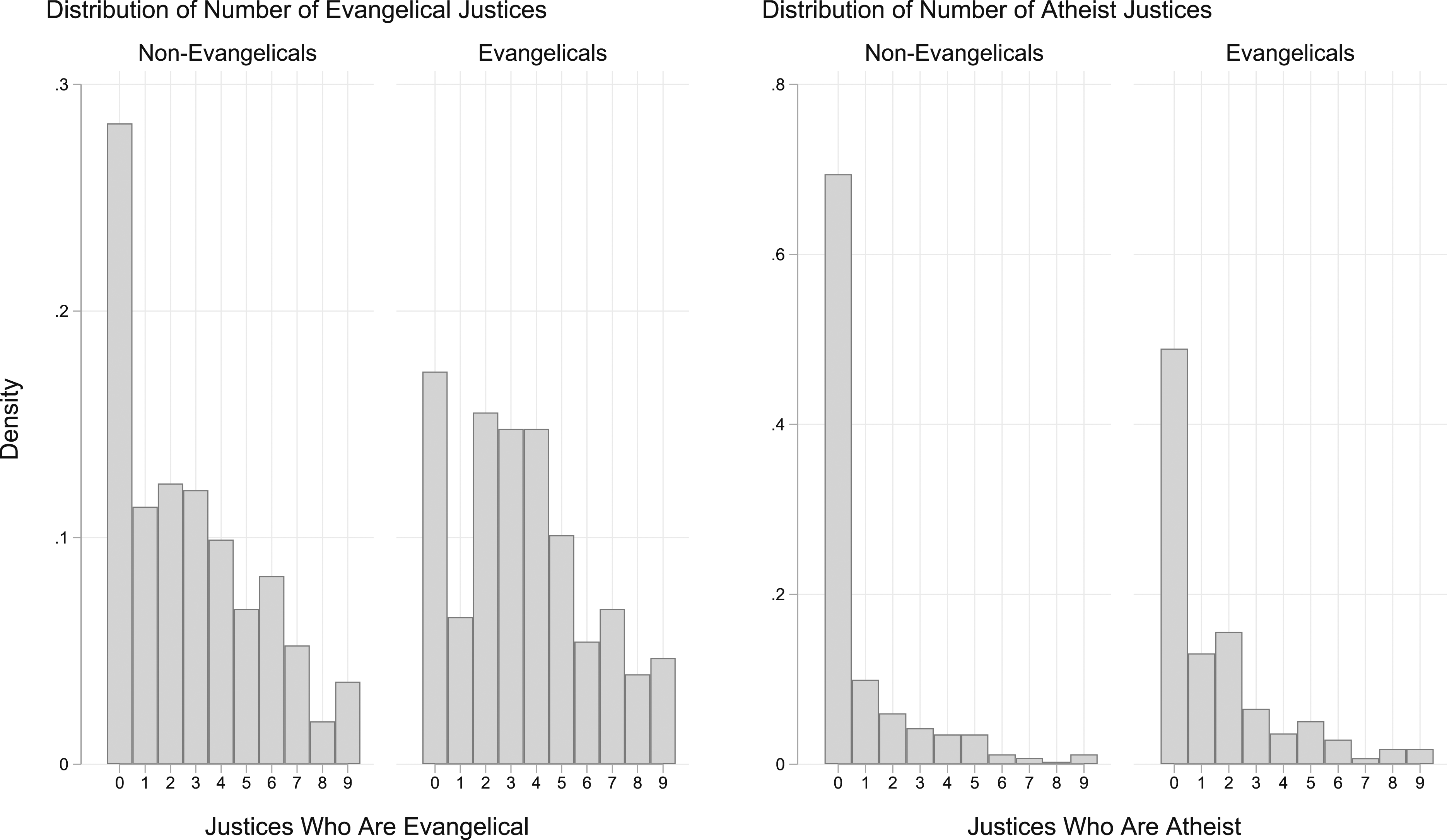
Our dependent variable is the extent to which the respondent believes the Supreme Court is legitimate. We rely on two measures of Supreme Court legitimacy. The first measure of legitimacy we use is the Gibson, Caldeira and Spence (2003) index. The Gibson index creates a summated scale using agreement or disagreement with a set of questions gauging support for the Court. We rely on three of the questions: whether the respondent would do away with the Court if the Court started making decisions most people disagreed with, whether the respondent agreed that the Court gets too mixed up in politics, and whether the Court treats some groups more favorably than others. The three questions load onto a single factor (1.36 eigenvalue) and have high reliability (Cronbach’s α = .702).
The second measure of legitimacy we use is the applied legitimacy index (Badas 2019). The applied legitimacy index creates a scale, using item response theory, based on three questions asking how strongly individuals would support or oppose specific reforms to the Supreme Court’s institutional structure. The questions we rely on asked whether the respondent would support the direct election of the Justices, whether the respondent would support implementing term limits for the Justices, and whether the respondent would support policies that made it easier to remove the Justices from the Court. The three questions load onto a single factor (1.59 eigenvalue) and have high reliability (Cronbach’s α = .803). We rescale each measure of legitimacy to range between 0 and 1 for comparability. Figure 2 summarizes the distribution of each legitimacy measure. Distribution of legitimacy measures.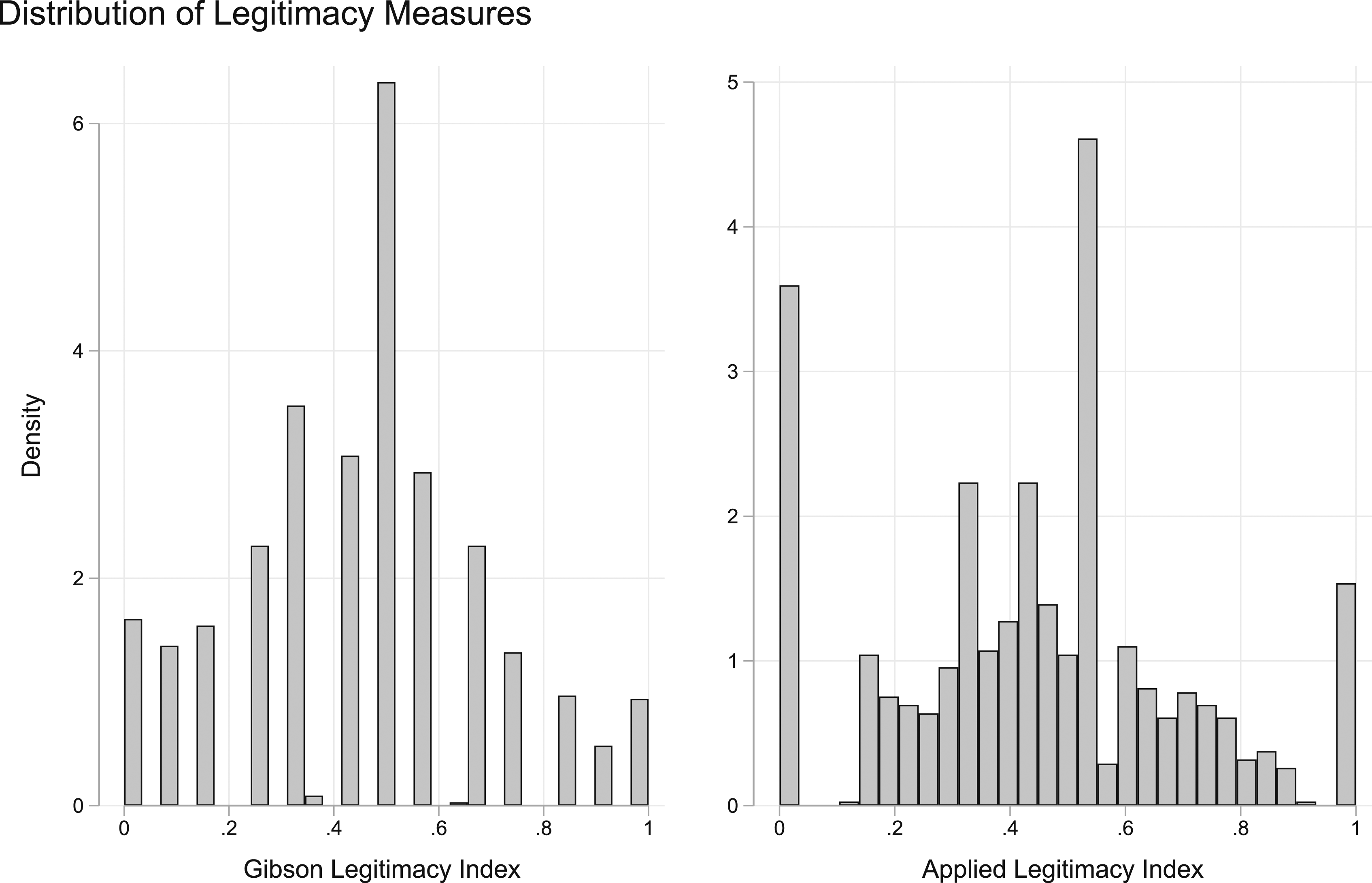
OLS Regression: Legitimacy.
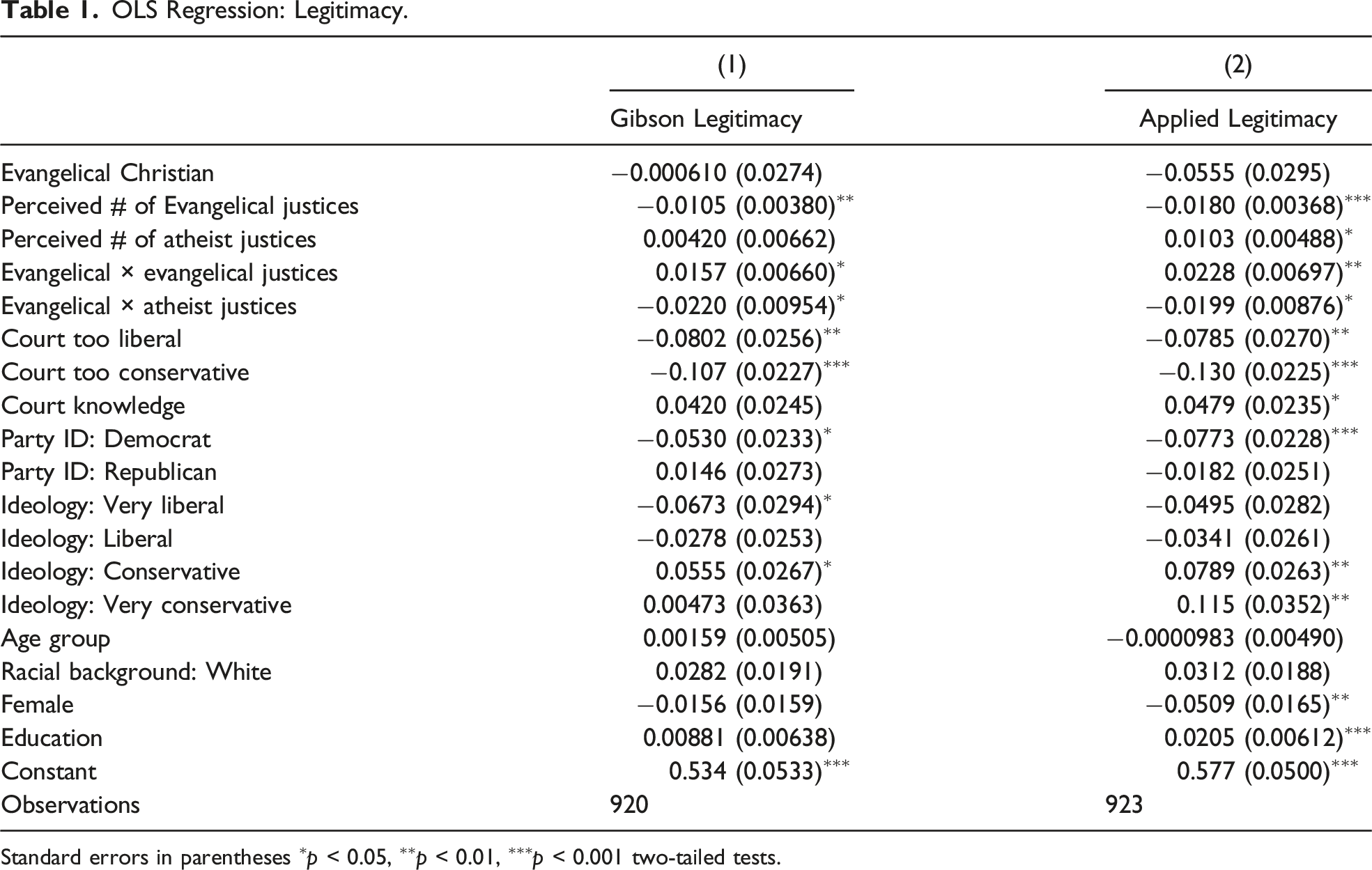
Standard errors in parentheses ∗p < 0.05, ∗∗p < 0.01, ∗∗∗p < 0.001 two-tailed tests.
The results support our expectations that evangelicals will believe the Supreme Court to be more legitimate when they believe their religious in-group is represented on the Court—and less legitimate when they believe a religious out-group is better represented on the Court. We plot the marginal effect on legitimacy ratings of being an evangelical Christian, across the range of individuals’ beliefs about the number of Justices who belong to each religious tradition; see Figures 3 and 4. Results to Table 1, Column 1: Gibson legitimacy index. Results to Table 1, Column 2: Applied legitimacy index.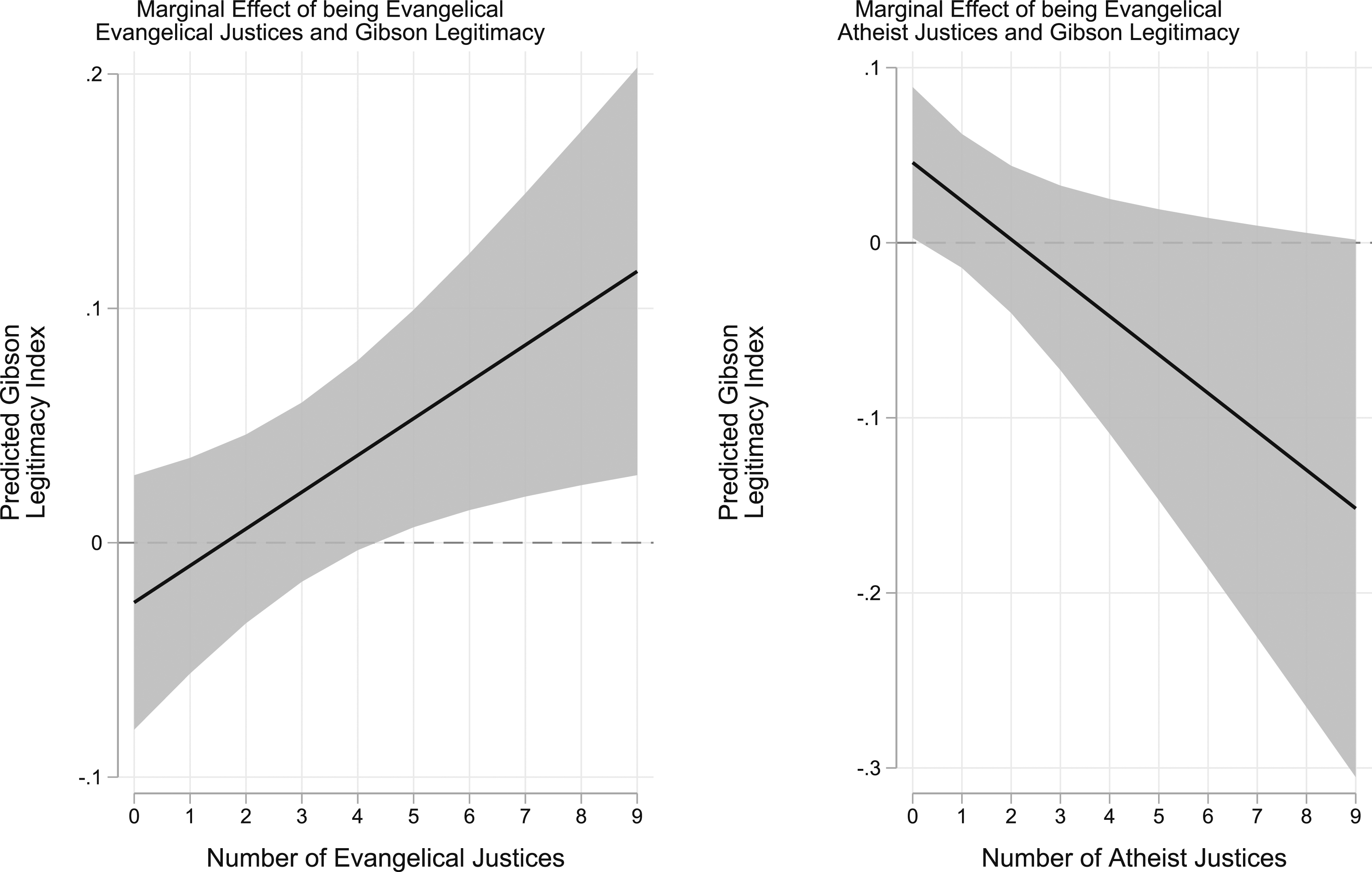
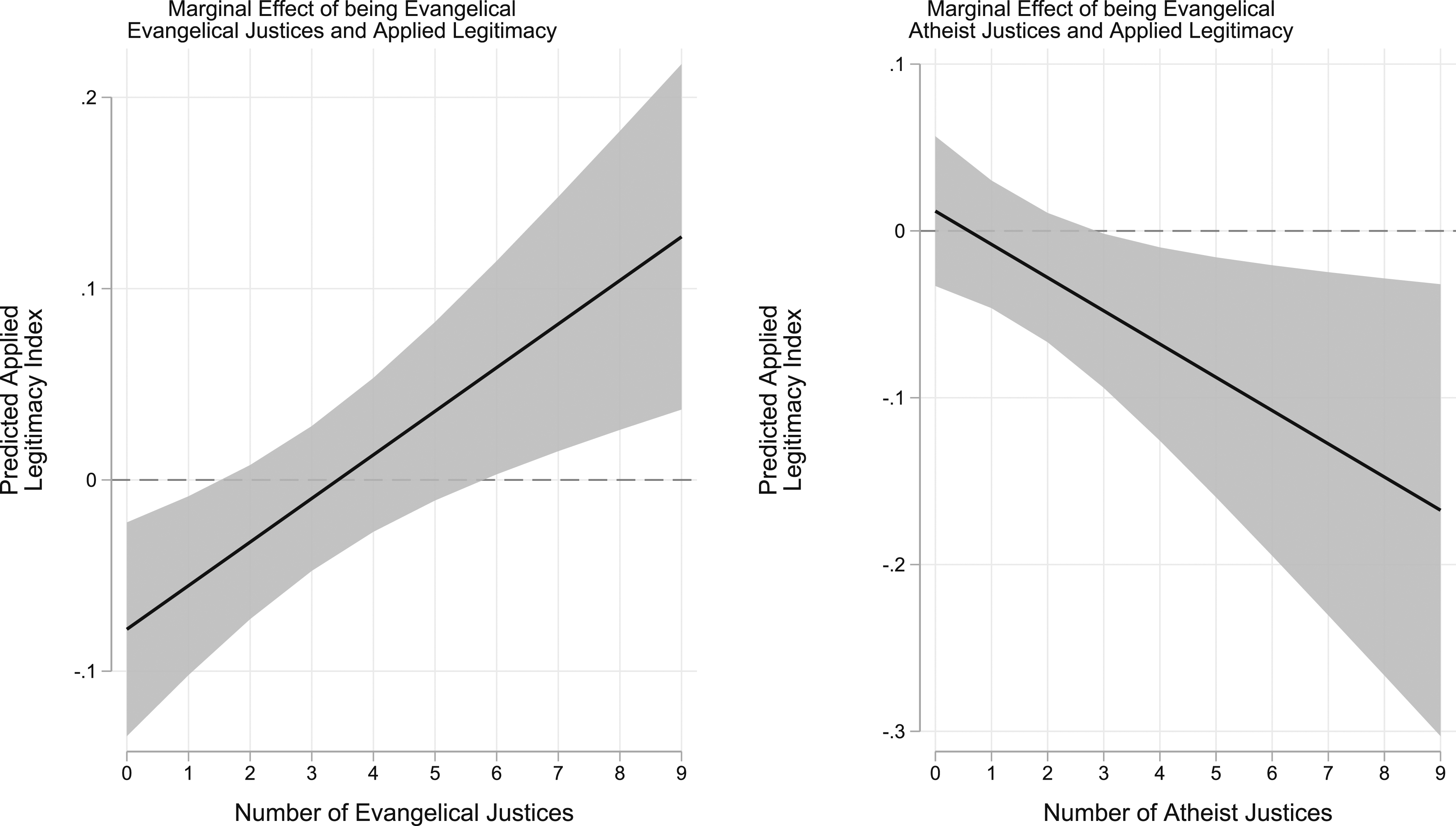
Figure 3 presents the results for the Gibson legitimacy index. From the left panel, we observe that evangelical Christians believe the Court is more legitimate than non-evangelicals when they believe there are more evangelical Justices on the Court. To draw a substantive example, when evangelicals believe there are five evangelical Justices on the Court, they are predicted to have a legitimacy score 0.052 points higher than non-evangelicals. The difference of 0.052 points represents 22% of a standard deviation in the Gibson legitimacy index. From the right panel, we find that evangelicals believe the Court is more legitimate than non-evangelicals when they believe there are fewer atheist Justices on the Court. 7 For example, evangelicals are expected to have a 0.046 point higher legitimacy score than non-evangelicals when they believe there are zero atheists on the Court. Substantively, the 0.046 point difference represents 19% of a standard deviation on the Gibson legitimacy index.
Figure 4 displays the results for the applied legitimacy index. The results largely replicate those found using the Gibson legitimacy index. The left panel highlights again that evangelical Christians believe the Court is more legitimate than non-evangelicals when they believe there are more evangelical Justices on the Court. For example, when evangelicals believe there are six evangelical Justices on the Supreme Court, they are predicted to have a legitimacy score 0.059 points higher than non-evangelicals. The difference of 0.059 represents 23% of a standard deviation on the applied legitimacy index. The right panel demonstrates that evangelicals perceive the Supreme Court as less legitimate when there are more atheists, compared to non-evangelicals. To draw a substantive example, when evangelical Christians believe there are three atheist Justices on the Court, their expected legitimacy score is predicted to be 0.048 points lower than non-evangelicals. The difference represents 18% of a standard deviation on the applied legitimacy index.
Study 2: Conjoint Experiment, March 2023
Using a survey, we have shown that evangelical Christians who believe there are more evangelical Justices on the Supreme Court view the Supreme Court as more legitimate than non-evangelicals. In addition, evangelicals who believe there are more atheists on the Supreme Court view the Court as less legitimate than non-evangelicals. While the survey provides convincing evidence for our argument, there are two primary concerns with survey studies. There may be an unobserved confounder that is causing the relationships we observe. Further, there may be some endogeneity issues if people who view the Court as legitimate mistakenly infer that there are more members of their particular group on the Court.
To rule out these potential problems and demonstrate the causal nature of the relationships we observe, we conduct an experiment. Specifically, we conduct a conjoint experiment. Conjoint experiments are widely used to understand preferences toward judicial institutions (Sen 2016; Badas and Stauffer 2019; Badas 2022; Krewson and Owens 2021; 2022). We follow the standard approach of these studies. Participants viewed one nominee profile at a time and then answered questions about that specific nominee. We provide participants profiles of hypothetical, potential nominees to the Supreme Court. The focal conjoint manipulation is the nominee’s religious belief. The religious belief manipulation can take the following categories: agnostic, atheist, born-again Christian, Buddhist, Catholic, Evangelical Christian, 8 Hindu, Jewish, Mormon, or Muslim. The conjoint also manipulated the potential nominee’s partisanship, judicial philosophy, gender, age, prior experience, and the ranking of their law school. 9
After viewing the nominee’s profile, participants were asked to evaluate the nominee on two dimensions. The first question asked whether the participant believed the nominee’s presence on the Court would make the Court more fair, less fair, or make no difference. This question will further strengthen our evidence that attitudes about the Court’s legitimacy reflect beliefs about in-group composition on the Court. This is because fairness is central to legitimacy evaluations (Lind and Tyler 1988; Tyler 2001). Moreover, by manipulating the nominee’s religious belief using a conjoint experiment, we can determine whether our survey results are causal or spurious—determining whether a nominee with a specific religious profile has the ability to move perceptions of the Court’s legitimacy.
The second question asked how strongly the participant would support or oppose the potential nominee. This question allows us to determine if our argument—that evangelicals will view the Court as more legitimate when more members of their in-group are on the Court and less legitimate when members of their out-group are on the Court—extends to support or opposition to nominees, rather than attitudes toward the institution itself. This is an important question, as nominees’ religious beliefs are often a salient topic during confirmation hearings.
The experiment was fielded to a sample of 1774 on CloudResearch’s MTurk Toolkit platform in March 2023. Religious respondents on MTurk have similar political attitudes to those from nationally representative samples (Lewis et al. 2015). By collecting a larger sample to compensate for MTurk workers’ lower rates of religious adherence, we follow Lewis et al.’s (2015) recommendations for religion and politics research on MTurk. The CloudResearch platform leverages Amazon’s Mechanical Turk platform but takes additional precautions to ensure data quality. For example, CloudResearch is more active in screening out bots and those who are using virtual private networks to misrepresent their location, excluding these individuals from the sampling frame. Research demonstrates that CloudResearch has higher data quality than other forms of convenience samples, including Qualtrics, MTurk, Prolific, and undergraduate samples (Douglas, Ewell and Brauer 2023). To be eligible to participate in the experiment, users had to be located in the United States, be 18 years of age or older, have had 97% of their prior tasks completed on MTurk accepted, and have completed at least 50 prior tasks on MTurk (Thomas and Clifford 2017). The experiment was fielded and completed on March 27, 2023. Participants viewed five profiles in total; our total sample size is 8743. Evangelical Christians composed 20 percent of our sample. 10
Figure 5 displays the estimated marginal means (Leeper, Hobolt and Tilley 2019) for the question asking participants whether they believed the nominee would make the Court more fair, less fair, or make no difference. The response set for this question was on a five-point scale, ranging between much more fair and much less fair. The vertical dashed line represents the average response on the fairness question across the entire sample. The point estimates and 95% confidence intervals display the mean level of support for nominees who had each specific religion displayed on their profile.
11
Marginal means for fairness by potential nominee’s religious belief. Left panel shows non-evangelicals. Right panel shows evangelical Christians. Dashed line represents average fairness across all nominees.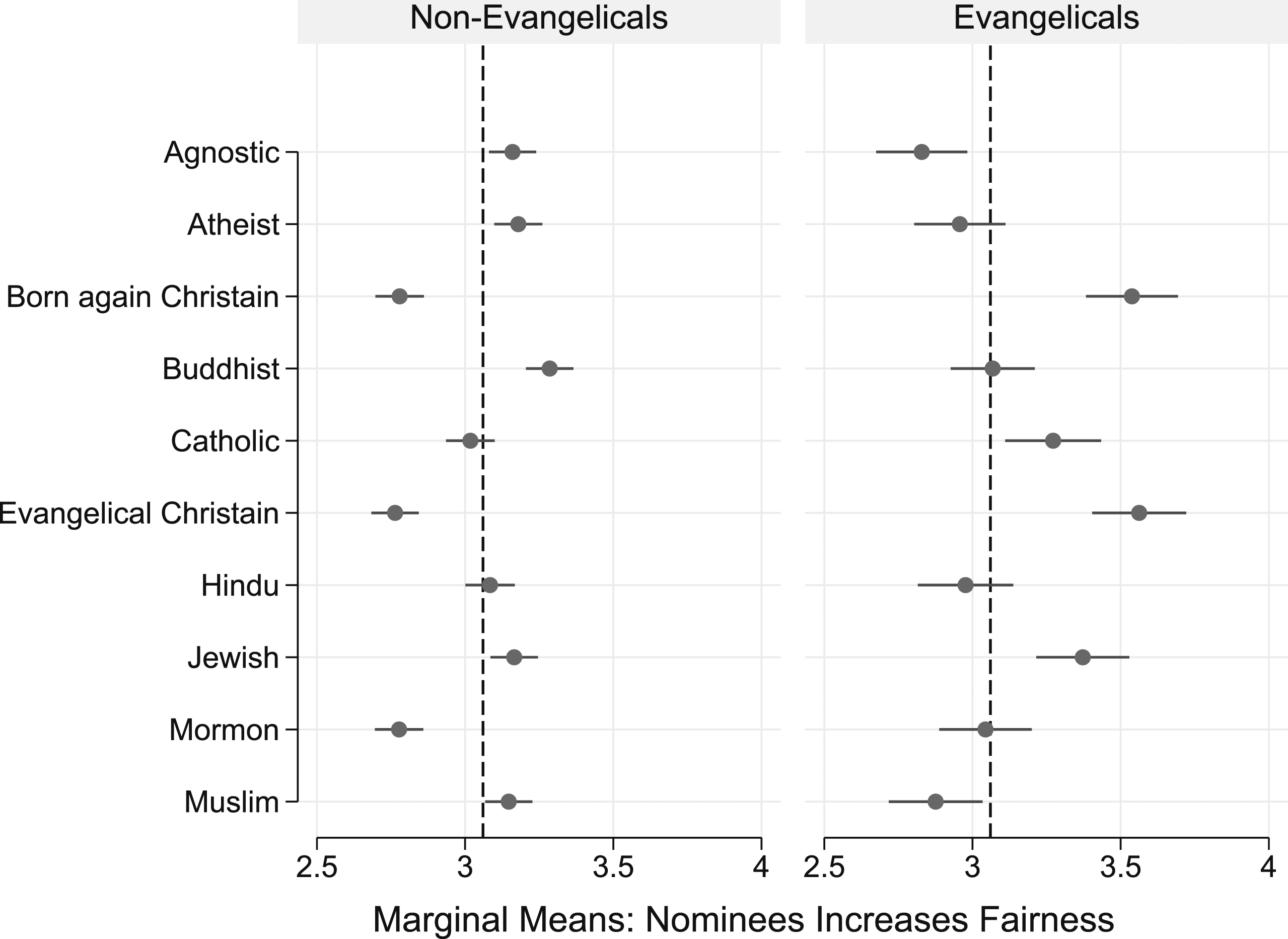
The results of the conjoint experiment confirm the key findings from our survey analysis. When evangelical Christians view nominees who identify as born-again, they believe that these individuals will make the Court more fair. For example, when an evangelical Christian views a nominee whose religion is listed as a born-again Christian, they believe that nominee will increase the fairness of the Court by 0.47 compared to the average nominee. This 0.47 increase represents roughly a 42% standard deviation on the fairness question. Similar results are found when examining evangelical Christian nominees. Fairness increased by 0.5 compared to the average nominee. This is a 45% standard deviation change on the fairness scale.
When turning to the most salient out-group religion traditions, we find somewhat mixed results. Evangelical Christians believe nominees who identify as agnostic will reduce the fairness of the Court by 0.24 points or roughly 21% of a standard deviation. However, when analyzing atheists, the effect is negative (by 0.11 points or 10% of a standard deviation) but not statistically distinguishable from the average nominee’s fairness rating.
The results for individuals who do not identify as evangelical Christians lend support to our observational findings. Individuals who do not identify as evangelical Christians believe nominees who identify with evangelical traditions are likely to make the Court become less fair. When non-evangelicals view a nominee who is a born-again Christian, they view them as 0.29 points less fair than the average nominee, and 0.30 points less fair when the nominee identifies as an evangelical Christian. These effects are roughly 27% of a standard deviation change on the fairness scale.
Non-evangelicals believe atheist and agnostic nominees will increase the fairness of the Court. For both groups, the effect is about 0.10 points, or a 9% standard deviation change in the fairness scale. Overall, the results provide additional confidence in our observational survey data. When viewing nominees, members of various religious traditions believed those nominees would increase the Court’s fairness when they aligned with their religious traditions and believed they would make the Court less fair when they were not aligned with their religious tradition.
Figure 6 presents the estimated marginal means (Leeper, Hobolt and Tilley 2019) for the question asking participants how strongly they would support or oppose the nominee. The question had a four-point response set, ranging from strongly support to strongly oppose. The vertical dashed line represents the average response on the support or oppose question across the entire sample. The point estimates and 95% confidence intervals display the mean level of support for nominees who had the specific religion displayed on their profile. Marginal means for support by potential nominee’s religious belief. Left panel shows non-evangelicals. Right panel shows evangelical Christians. Dashed line represents average support across all nominees.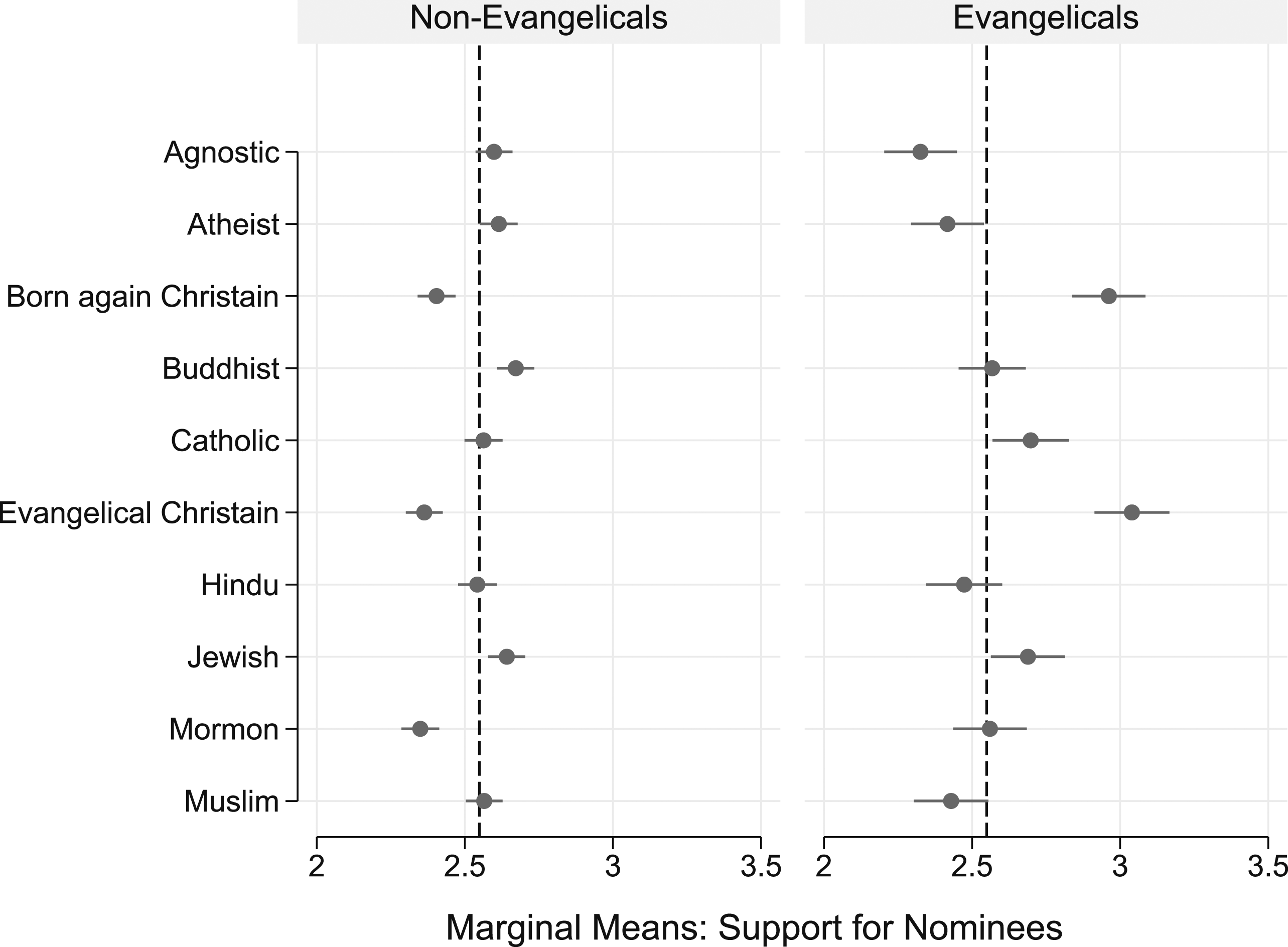
The results to the support question demonstrate that individuals are more likely to support nominees from their religious in-group. This further lends support to our argument that individuals will evaluate the Supreme Court in part by considering their religious beliefs and how those religious beliefs interact with perceptions of the religious beliefs of the individuals who make up the Court.
For example, evangelical Christians are 0.42 points more likely to support a nominee who identifies as a born-again Christian, compared to the average nominee. This is a 48% standard deviation increase in the support question. The results are similar when looking at nominees who are evangelical Christian. Here support increases by 0.49 points or alternatively by 57% of a standard deviation on the support scale.
We also see that evangelical Christians penalize individuals from salient out-group religious traditions, notably agnostics and atheists. Evangelical Christians support agnostic nominees 0.22 points less than the average nominee. This amounts to roughly a 25% standard deviation change in the support scale. Meanwhile, evangelical Christians give atheist nominees 0.13 points less support than the average nominee. 12 This represents roughly a 15% standard deviation change in the support scale.
The results to the nominee support question for individuals who do not identify as evangelical Christians are similar to those for the fairness question. Participants who do not identify as evangelical Christians penalize nominees who do identify as born-again Christians. In the context of a nominee identified as a born-again Christian, this penalty was 0.14 points or 16% of a standard deviation; for nominees who identified as evangelical Christians, the penalty in support was 0.18 points or 21% of a standard deviation.
Individuals who do not identify as evangelical Christians are more likely to support agnostic and atheist nominees. For an agnostic nominee, these individuals increase their support by 0.05 points or a 5% standard deviation increase in the support scale. 13 Among those not identifying as evangelical Christians, support for atheist nominees increased by 0.07 points or 8% of a standard deviation on the support scale.
Conclusion and Implications
We began this paper by explaining why the Supreme Court’s social imagery might condition political attitudes toward the Court. However inaccurate, the public holds politically consequential beliefs about members of Congress’ social identities (Stauffer 2021) and the composition of party coalitions (Ahler and Sood 2018). By examining perceptions of the Supreme Court Justices’ social identities, we explored a novel way to marry judicial politics research with group-based theories of mass politics.
Because the Supreme Court’s decisions have implications for “culture war” politics, we focused on one subset of voters: evangelical Christians. Using data from a nationally representative sample survey, we asked respondents to estimate both the number of evangelical Christians on the Supreme Court and the number of atheists. Compared to non-evangelicals, evangelical Christians perceived the Court to be more legitimate when they believed that evangelical Christians were well-represented on the Court—and less legitimate when they believed that atheists were well-represented. These conclusions held for two different measures of Supreme Court legitimacy, and were robust to different model specifications.
Of course, evangelical Christians might believe that evangelicals are well-represented on the Court because they see the Court as legitimate, rather than vice versa. To clarify that perceptions of the Justices’ religious identities cause evangelical Christians to see the Court as more or less legitimate, we conducted a conjoint experiment on CloudResearch’s MTurk Toolkit. We presented respondents with several profiles of hypothetical religious nominees; the nominee’s religious background was the focal manipulation. Consistent with our theory, evangelical Christians were more likely to say that a nominee would make the Court more fair when the nominee was described as “evangelical” or “born-again.” They were also more likely to support confirming such nominees to the Supreme Court.
Simply put, these results suggest that the Court’s social imagery influences public perceptions of the Court. Evangelical Christians have diverse perceptions of the Justices’ religious identities. These perceptions are politically consequential even when they are not accurate. To our knowledge, there are currently no atheists or evangelical Christians on the Supreme Court. Yet significant numbers of Americans believe that there are. To the extent the Court’s social imagery impacts public opinion, what matters is the perception that evangelicals are well-represented on the Court, or the perception that atheists are well-represented. With group-based models of mass politics as our reference point, these perceptions produce exactly the political judgments we would expect.
Possibilities for future research abound. For the present purposes, we focused on one particular type of social imagery: beliefs about the Justices’ religious identities. To wit, we focused on one particular type of voter: evangelical Christians. Within this context, however, we established that the Supreme Court has a social imagery distinct from its objective composition. This suggests other potential bases for the Court’s social imagery—such as race and ethnicity, gender, socioeconomic status, or sexual orientation. Indeed, we doubt that religion exhausts the list of erroneous beliefs about the Court’s composition. Future research must provide a fuller account of the Court’s social imagery, attendant to the interplay between Americans’ own social identities and their perceptions of the Justices. To be clear, our findings do not suggest that social imagery is the principal catalyst for public attitudes toward the Court. For the time being, we expect partisanship, ideology, and perceived ideological distance from the Court to remain the most pivotal determinants. However, the Justices’ perceived social identities might represent a secondary dimension through which Americans assess the Court’s legitimacy and evaluate potential nominees. Future research can establish the extent and nature of this secondary dimension.
To our knowledge, this article is among the first to demonstrate that an institution of government has a social imagery that affects the public’s faith in that institution. If institutions have social identities that matter for public opinion, this opens up fertile ground for American politics research. As a research paradigm, it connects American politics research with group-based theories of mass politics (see Achen and Bartels 2016). Given that social identity taps deep human emotions (Kinder and Kam 2009), it offers a theoretically satisfying explanation for declining levels of political trust. More broadly, the paradigm complicates the distinction between political institutions and mass political behavior. Of course, by showing that evangelical Christians have diverse perceptions of the Supreme Court Justices’ religious identities—and that these perceptions matter for legitimacy judgments—we have hardly plumbed the depths of this approach. But we have reintroduced the language of social imagery to the study of American institutions.
Finally, our findings have normative implications for the Supreme Court’s role in American politics. With the power to make decisions that cut against popular prejudices, the Court has been likened to a “republican schoolmaster” (Lerner 1967) that helps citizens understand the virtues of republican government. Under this paradigm, the Court’s decisions inform the public of the values that they should hold (Franklin and Kosaki 1989) and individuals update their beliefs to align with the values expressed in the Court’s decisions (Franklin and Kosaki 1989; Hanley, Salamone and Wright 2012; Woodson 2019). However, our results suggest this relationship might be conditional upon citizens’ beliefs about the Supreme Court Justices’ social identities. When individuals believe the Court is composed of individuals from like-minded or favorable social groups, they may be more convinced of the virtues of the Court’s decisions. Oppositely, when they believe the Justices represent unfavorable or disliked social groups, they might be less persuaded by the Court’s reasoning. Future research should investigate whether the social imagery of the Court influences not just the Court’s institutional legitimacy, but the extent to which the public is likely to accept or tolerate individual Court decisions.
Supplemental Material
Supplemental Material - Social Imagery and Judicial Legitimacy: Evidence From Evangelical Christians
Supplemental Material for Social Imagery and Judicial Legitimacy: Evidence From Evangelical Christians by Alex Badas and Eric R. Schmidt in Political Research Quarterly
Supplemental Material
Supplemental Material - Social Imagery and Judicial Legitimacy: Evidence From Evangelical Christians
Supplemental Material for Social Imagery and Judicial Legitimacy: Evidence From Evangelical Christians by Alex Badas and Eric R. Schmidt in Political Research Quarterly
Footnotes
Declaration of Conflicting Interests
The author(s) declared no potential conflicts of interest with respect to the research, authorship, and/or publication of this article.
Funding
The author(s) received no financial support for the research, authorship, and/or publication of this article.

Supplemental Material
Supplemental material for this article is available online.
Notes
References
Supplementary Material
Please find the following supplemental material available below.
For Open Access articles published under a Creative Commons License, all supplemental material carries the same license as the article it is associated with.
For non-Open Access articles published, all supplemental material carries a non-exclusive license, and permission requests for re-use of supplemental material or any part of supplemental material shall be sent directly to the copyright owner as specified in the copyright notice associated with the article.
