




Abstract
Does joining a party faction in Congress enhance or undermine a member’s lawmaking effectiveness? Prior research suggests that factions can help members electorally in signaling their distinct ideological positions to potential political supporters. By contrast, we examine the nine largest ideological caucuses over the past quarter century to test three hypotheses about the conditional lawmaking benefits of faction membership: (1) that benefits from faction membership are limited to those in the minority party; (2) that members of ideologically centrist factions gain the greatest benefits; and (3) that sizable factions exploit their pivotal positions to help their members achieve legislative victories. We find support for only the first of these three conjectures, consistent with the argument that factions offer valuable resources to those in the minority party and that majority-party leaders counter the proposals arising from their own party’s factions. The fact that faction membership offers no significant lawmaking benefit to majority-party legislators challenges conventional wisdom.
For more than 200 years, nearly all elected representatives in the U.S. Congress have affiliated with at least one political party. Yet parties and their brands do not serve all members of Congress equally well. Seeking to differentiate themselves from the party line, or even to shift their party’s positions, some lawmakers have developed or joined organized party factions (i.e., Thomsen 2017). Similar to the parties within which they are housed, these factions (formally referred to as intraparty caucuses) have become a common feature of the contemporary Congress, and their leaders have become increasingly visible and vocal. These factions collectively map onto a sizable share of seats in the U.S. House. In the 115th Congress (2017–18), for example, 81% of the voting Representatives were members of one of nine intraparty factions. The sheer number of Members of Congress who voluntarily choose to associate with these factions suggests that membership must be valuable; but in what ways?
Some have argued that factions primarily provide electoral advantages to their members. Faction-affiliated lawmakers may be able to signal their partisan type, which might be valuable to constituents and donors. When a newly-elected Representative joins the Blue Dog Coalition, for example, she can credibly communicate her views on budgetary politics to potential supporters, even before she cast any votes. Joining a faction can also provide access to tailor-made networks of political donors, connections to influential political activist organizations, and custom-curated advice on how to run reelection campaigns. In other words, Representatives might be drawn to legislative factions because they facilitate access to electorally valuable resources beyond the halls of Congress.
By contrast, factions are often described as being important because of the plausible legislative benefits they can offer to prospective members. At the collective level, factions might serve their members’ needs by helping to set the legislative agenda and/or by ensuring that certain bills pass (or fail to pass) the chamber. At the individual level, faction membership might provide legislators with access to additional legislative staff resources and policy expertise, to help them advance their bills through the lawmaking process. While scholars have explored the evolution of particular party factions (e.g., Bloch Rubin 2017; Green 2019), and party factions more generally (e.g., Koger, Masket, and Noel 2009), to analyze their roles in the legislative process, much of this literature has focused on the scope of the collective organizational benefits and individual electoral benefits that follow from faction affiliation, rather than whether there are any individual-level lawmaking benefits that accompany faction affiliation.
Bluntly stated, it is not clear whether joining an intraparty faction contributes to, or detracts from, the lawmaking success of those members who seek to advance their own (individual) legislative agendas; and (in contrast) there are many reasons to suspect that any individual-level benefits are largely electoral in nature. To understand whether there is, indeed, any lawmaking impact associated with faction membership, we begin by considering the potential for factions—at the aggregate level—to advance or obstruct the progress of bills. This initial approach helps us to motivate three testable hypotheses regarding policy advancement that are rooted in conventional wisdom, journalistic accounts, and academic insights about congressional lawmaking. First, we consider the power and resources of factions relative to the parties in which they are embedded; specifically, we evaluate whether faction members experience legislative advantages only when their party is relegated to minority-party status. Second, we explore whether faction members benefit if their faction is well-positioned ideologically. Third, we raise the possibility that faction influence is conditional on faction size.
For each of these three hypotheses, faction membership offers lawmaking benefits only when certain conditions are met. By examining the members of the nine largest ideological caucuses in the U.S. House of Representatives over 24 years (1995–2018), we are able to isolate each of these conditions, and to determine when caucus members gain greater or lesser lawmaking success through their caucus membership. Our method of analysis employs a fixed effects estimation strategy, and yields support for the first hypothesis. Specifically, we find that affiliation with a minority-party faction tends to increase legislators’ lawmaking effectiveness relative to comparable, unaffiliated legislators; but such a boost does not emerge for majority-party faction members. We find no evidence for our second or third hypotheses, which runs counter to the alternative theoretical arguments suggesting that individual lawmaking benefits of faction membership should be correlated with their ideological positions or their sizes.
Contrary to the extensive media attention given to factions and their proposals, the overall null effect we uncover for faction members (and particularly those in the majority party) is quite surprising and suggests that the electoral role of factions—especially among majority party members—may be more important than prior research suggests. The size and ideological positions of party factions do not matter for their members’ legislative effectiveness, per se. Rather, factions are most likely to be influential in advancing their members’ lawmaking goals when the parties in which they reside are most disadvantaged in the legislative process, due to their minority status. These findings have important implications for our understanding of party organizations in Congress, and they are also of practical value to members of Congress, who might question the value of joining a faction to advance their own lawmaking goals.
Factions in the American Political System
As alluded to above, a small but important literature has emerged that analyzes party sub-groups in Congress. Much of this research has considered how factions have worked to reshape their parties and reform the political institutions in which they operate (e.g., Baer 2017, 2023; Bloch Rubin 2013; DiSalvo 2012); Sin (2015) provides a comprehensive overview of the scope of intra-party divisions across the history of the U.S. Congress; and several scholars (e.g., Jenkins and Monroe 2014; Lucas and Deutchman 2007; Medvic 2007; Seo and Theriault 2012) have studied how ideologically centrist groups of legislators influence policy outcomes. At the individual faction level, the Tea Party Republicans have attracted the greatest scholarly attention (e.g., Bailey, Mummolo, and Noel 2012; Blum 2020; Ragusa and Gaspar 2016; Skocpol and Williamson 2012).
Taken together, this literature has suggested that American party factions closely mirror the structure and practices of conventional political parties in government. Factions are hierarchical organizations, featuring elected leadership positions, whip systems, task forces, and communication directors. Faction leaders direct full-time staffers and coordinate the faction’s procedural and rhetorical strategies. As such, modern ideological factions have evolved to garner influence outside of the constraints imposed by a two-party electoral system.
Indeed, in certain cases, factions appear to actually impose greater constraints on their rank-and-file members than do their parent party organizations. Factions screen candidates on a number of criteria—particularly ideology—before a thorough vetting and sponsorship process can be completed. Some groups employ ostensibly binding rules to improve faction unity; and individuals who frequently defy these supermajoritarian requirements (e.g., the Freedom Caucus’s “80% rule”) may be removed from the faction. 1 Hence, unlike political parties, factions can exert some control over their rosters to maximize their chances of voting cohesively. 2 Interestingly, these institutional features set up an observational equivalence problem; the strong organizational features of a legislative faction may reveal a carefully coordinated effort to shore up the prospects of reelecting members, or they may be legislative instruments intended to influence policy.
There are several reasons to suspect that Representatives may join factions for reelection purposes—even if they care little for legislative accomplishment. First, these groups may serve as mechanisms for representing legislators’ preferences to their constituents (Miler 2011); groups like the House Freedom Caucus signal a more precise (e.g., conservative) ideological type to co-partisans (Gervais and Morris 2012). In addition, legislative factions may be well-equipped to enhance the fundraising capacities of their members (Cox and Rosenbluth 1993; Hendry and Sin 2014); and recent theoretical (Pomirchy 2022), observational (Clarke 2020b), and experimental (Clarke 2023) research further supports the factions-as-brands perspective.
On the other hand, we should not dismiss the potential legislative influence of these groups. Organized party sub-groups diversify the availability of policy information in the House, contrary to the objectives of party leaders, who might seek to centralize information acquisition and distribution (Curry 2015). The internal rules of factions also may reflect a desire to redistribute political power in the House by transforming individually pivotal legislators into a larger, consolidated pivotal bloc (Bloch Rubin 2017) and reforming procedural rules (Baer 2017). 3 Hence, ideological caucuses may play significant roles in the advancement or obstruction of policy proposals.
We engage with these perspectives by considering the nine largest ideological intraparty factions that have existed across recent Congresses. Given that formally recognized “legislative service organizations” were abruptly abolished in 1995 (Clarke 2020a), we begin measuring faction membership in the 104th Congress (1995–96), which provides a clean starting point for all caucus institutions. 4 These factions include two centrist Democratic caucuses (the Blue Dog Coalition and the New Democrat Coalition) as well as two non-centrist Democratic organizations (the Congressional Progressive Caucus and the short-lived Populist Caucus). On the Republican side are one centrist organization (the Republican Main Street Partnership, which includes members of the informal Tuesday Group) and four non-centrist caucuses (the large Republican Study Committee, the Tea Party Caucus, the House Liberty Caucus, and the House Freedom Caucus). 5 All nine groups were officially registered with the House and self-identified in the public domain. Data on faction memberships were drawn from CQ’s Politics in America, the archived websites of lawmakers, journalistic accounts of each group, and many phone calls to congressional offices. 6
Figure 1 illustrates the mean ideological location, as approximated by first-dimension DW-NOMINATE scores (Poole and Rosenthal 1997), of each faction in each Congress covered by our analysis. Hollow circles represent minority-party factions, and each marker is scaled by faction size. Appendix Figure A1 characterizes the new and cumulative sizes of faction membership by Congress. The ideological location, party status, and size of house factions. Notes: Each point indicates the average first-dimension DW-NOMINATE score among faction members in each Congress; the hollow circles represent minority-party factions, while filled circles indicate majority-party factions. All points are scaled by faction roster size.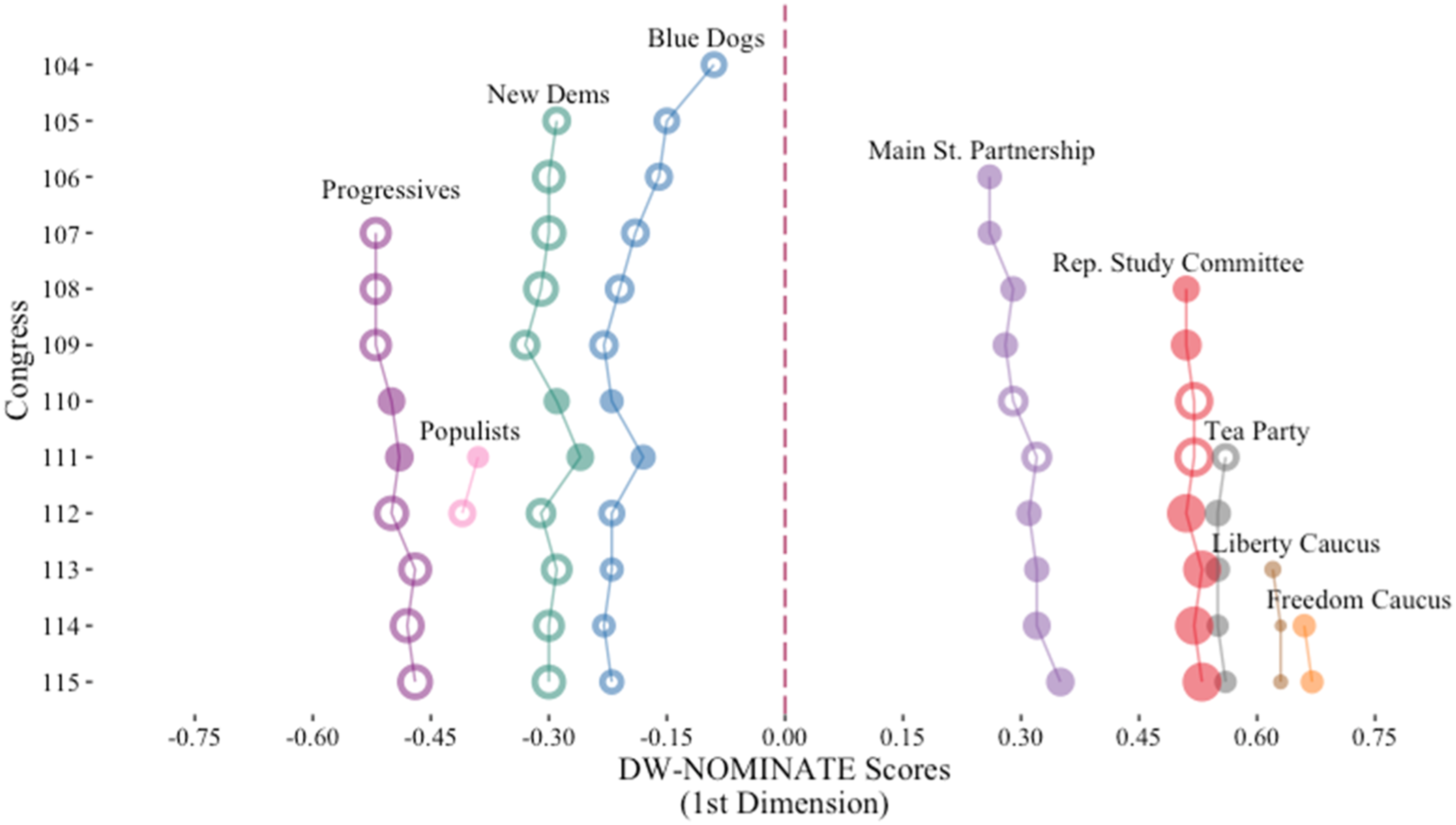
At first glance, faction members do appear to differ from their non-faction counterparts in terms of lawmaking. In generating new laws, faction members introduce fourteen bills on average in each Congress, compared to twelve bills advanced by the average non-faction lawmaker. Yet, their subsequent success is more limited, with a much lower conversion rate for faction members than others in turning their bills into laws, especially among majority-party faction members. 7 Specifically, about 4.5% of faction members’ bills become law, on average, compared to 6.1% for non-faction members. 8 Such findings raise a number of questions. Are legislators who are more interested in policymaking drawn to join factions, or does their faction spur them to be legislatively prolific? Do factions undermine subsequent lawmaking success, or are they simply comprised of legislators who are less senior, and less likely to hold key positions like committee chairs? 9
To help us address this latter question, we turn to the ratings from the Center for Effective Lawmaking, which controls for seniority, committee and subcommittee chair positions, and majority-party status in characterizing each member of the House as “below,” “meeting,” or “above” expectations, regarding her overall legislative effectiveness. As shown in Figure 2, compared to other legislators, faction members are less frequently in the “below expectations” category, while they are more frequently in the “meets expectations” and “exceeds expectations” groups.
10
Faction members appear to be more effective lawmakers. Notes: Data from Center for Effective Lawmaking (www.thelawmakers.org). Benchmarks for each lawmaker are generated by regressing seniority, committee and subcommittee chair positions, and majority-party status on members’ Legislative Effectiveness Scores. Those scoring significantly below or above those benchmarks are placed in the “below expectations” and “above expectations” categories, respectively. The figure shows faction members outperforming their benchmarks at a significantly higher rate than non-faction members.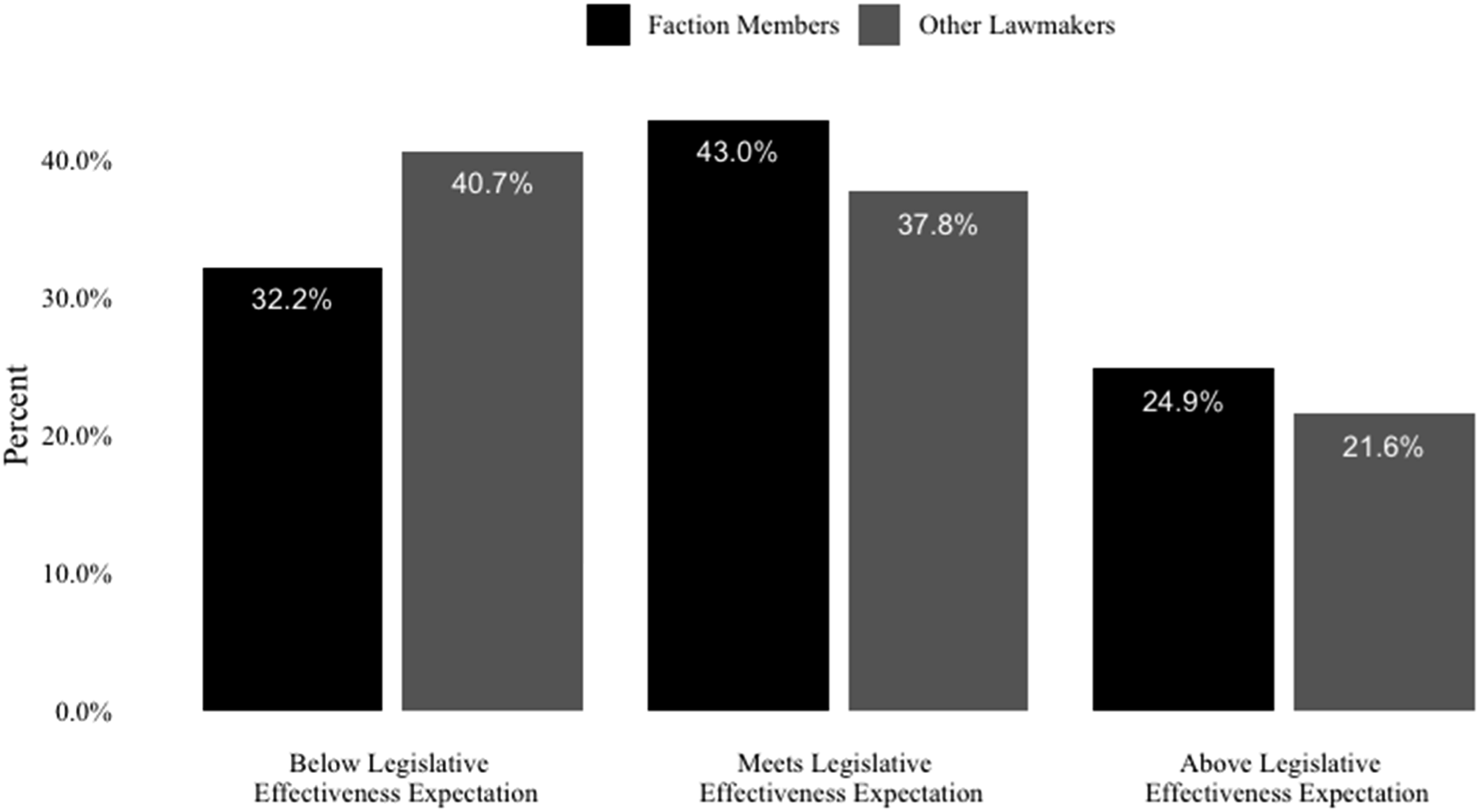
That said, these aggregate patterns mask significant underlying variation. For example, the centrist Republican Main Street Partnership and New Democrat Coalition have a high proportion of their members exceeding expectations, while House Freedom Caucus members perform poorly by this measure. Are ideologically centrist factions especially well-positioned for lawmaking? Alternatively, would highly effective lawmakers achieve similar success had they not joined their caucuses in the first place?
Factions Vote Against their Party at High Rates.
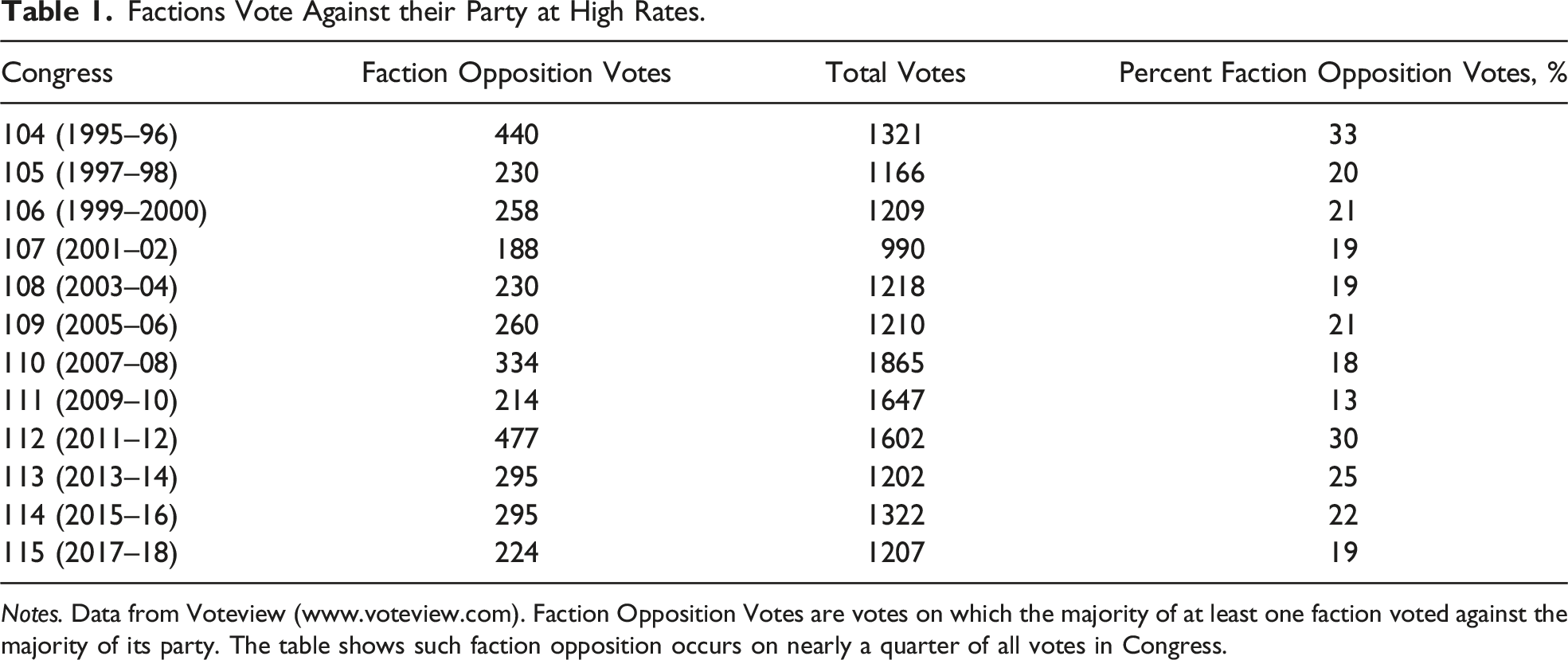
Notes. Data from Voteview (www.voteview.com). Faction Opposition Votes are votes on which the majority of at least one faction voted against the majority of its party. The table shows such faction opposition occurs on nearly a quarter of all votes in Congress.
Once again, such aggregate analyses appear to mask significant and important variation. For example, opposition votes appear to be much more common for centrist factions than for more extreme factions. The centrist Blue Dog Coalition opposed the Democrats on half of all the Faction Opposition Votes identified in Table 1. But perhaps that is due to centrist legislators being naturally more predisposed to join with the opposing party, regardless of whether they were in a faction or not. Second, factions cast opposition votes much more frequently when in the minority party than the majority party. For example, Blue Dogs opposed their party on 2% of all votes when Democrats were the majority party, but once relegated to the minority, their opposition increased to 14%. When in the minority, their defection may be of little consequence to the outcome of the vote, and may not even have been of great concern to their party. Hence, it is difficult to discern when and where faction voting against the party actually obstructed an otherwise successful policy change. Additionally, much faction influence may take place behind the scenes, and therefore may not be observed by this sort of analysis.
On the whole, these aggregate patterns suggest that factions may be influential both in advancing and obstructing policy change. However, they point to significant challenges and potential paths forward for characterizing the lawmaking effects of ideological factions. Specifically, rather than a consistent and sizable effect on lawmaking across all factions, there may be conditions under which factions have more or less influence. These conditions include whether the faction is within the majority or minority party, the ideological position of the faction within its party, and the extent to which the faction may be pivotal in advancing or denying policy change.
Moreover, any explorations of such influence must account for such considerations as the status that factions have within their parties (e.g., whether they are comprised of senior or junior members). Such assessments are likely best achieved by focusing on individual legislators within factions, compared to those not belonging to factions, so that these additional considerations can be controlled for on a case-by-case basis. Finally, the assessment of faction influence on lawmaking may require us to engage with the counter-factual—would a group of lawmakers be equally successful if they were not part of the faction, but simply shared the same interests or ideological positions?
The Conditions for Effective Lawmaking by Faction Members
Drawing on their customized information, dedicated staff resources, and social networks (e.g., Hammond 2001; Ringe and Victor 2013; Victor and Ringe 2009), factions can serve as a natural starting place for their members’ coalition-building activities. Building on this foundation, there are a variety of circumstances under which faction membership might be valuable to legislators in their efforts to advance their bills.
First, it is important to recognize that majority-party leaders have strong incentives to suppress the influence of factions within their party’s ranks, in part because, as Pearson (2015, 171) puts it, “intraparty coalitions have the potential to limit party leaders’ ability to discipline their members by making demands on leaders for resources and opportunities.” In response to these threats, party leaders have historically sought to centralize valuable political information (Curry 2015) and cut off resources that are available to factions within their ranks (Clarke 2020b). These efforts seem particularly important in an era of partisan parity, given that any fleeting hold on power in the modern House may be threatened by failing to rein in majority-party factions (Lee 2016, 209). The competing policy agendas of party and faction leaders can likewise obfuscate the majority party’s core principles and weaken its electoral reputation (Grynaviski 2010; Lupu 2013). The House Freedom Caucus, for example, constantly evaluates policy positions that are staked out by party leaders, with the intention of publicly contradicting the party line if they find the GOP position to be deficient in some way. 12
Given that majority-party leaders, through their agenda setting and committee assignment authority (e.g., Cox and McCubbins 2007), ostensibly possess the means to suppress faction influence, majority-party factions likely struggle in the face of their party’s institutional advantages. As one Freedom Caucus staffer put it, majority-party factions face “unbelievably intense partisan pressure” to get in line during “live-fire exercises” (i.e., when there is a real prospect of changing public law). 13 Even well-organized factions have few prospects for circumventing the agenda-setting capacity of their party leaders. Hence, they will likely have limited success at advancing their initiatives when their party is in the majority, if their agenda runs counter to leader priorities.
In contrast, minority-party leaders lack the means to rein in factions within their own ranks. While several procedural tools (e.g., the motion to recommit) remain squarely in the jurisdiction of the minority party (e.g., Krehbiel and Meirowitz 2002), and while majority-party leaders historically respect committee requests from minority-party leaders (e.g., Krehbiel and Wiseman 2005), the minority party is effectively unable to forestall bill progression in Congress. As a result, minority-party faction members gain the resource benefits of faction affiliation without fearing that their own party’s leaders will undermine their efforts. On this point, Rep. Peter DeFazio (D-OR) explained the Democratic Party’s reaction to the Progressive Caucus’s agenda when their party status changed from majority to minority: We were [previously] abused by our own leadership, to tell the truth .… Those people were holding down Democrats like myself who wanted to change course and wanted to offer a Progressive alternative, and those chains have been loosened. That could be one of the few truly good things to come out of this last [1994] election.
14
In a similar vein, Bloch Rubin (2017, 199) quotes a long-time staffer who states that “being a minority in a minority is difficult on its face … [but] … the Blue Dogs didn’t come to tilt at windmills. They were smart enough to form a group so that they could maximize their individual influence.”
Consistent with this argument, in the 115th Congress (when Democrats were in the minority), the Blue Dog Coalition endorsed numerous pieces of substantive legislation; the Congressional Progressive Caucus, once again, released an annual budget (“The Better Off Budget”); and the New Democrat Coalition published a full-fledged policy agenda (“The American Prosperity Agenda”). While some of these proposals might have been advanced solely for position-taking purposes, 15 many others appeared to be earnest attempts to change public policy. Majority-party leaders, for their part, may allow the progression of legislation that is sponsored by minority-party faction members if they provide an opportunity to deepen schisms in the minority party and do not undermine majority-party goals. Although lawmaking opportunities are more limited for minority-party bill sponsors in recently polarized Congresses, nearly 100 substantive bills sponsored by minority-party members pass the House in each Congress we study, with about a third of them becoming law. 16
In sum, majority-party leaders are likely able to rely upon agenda-setting privileges and other tools to suppress faction influence within their own ranks. Minority-party factions, however, are well-positioned to engage in policymaking activities, relative to their co-partisans; and leaders of the minority party are less able to prevent faction members from advancing proposals that conflict with the broader party coalition.
17
Consideration of these inter- and intraparty dynamics motivates our first testable hypothesis:
Competing with this partisan view is the perspective that ideological positions are more important than partisanship in determining policymaking success in Congress (e.g., Krehbiel 1993). Legislators in centrist factions, for example, have opportunities to build out their supporting coalition in either a liberal or conservative direction; and centrist factions may serve as valuable coalition partners for others because of their ideologically pivotal positions. Coalition leaders might make promises to advance the agendas of more ideologically centrist legislators in exchange for their support on key votes (i.e., Snyder 1991), which would result in members of centrist factions being more effective lawmakers than members of ideologically extreme factions.
Consistent with this argument, political commentators often claim that moderate blocs of lawmakers can extract greater policy concessions from fragile governing coalitions. Along these lines, centrists have been observed to form sub-party, as well as bipartisan, coalitions to try to improve their influence in the House (e.g., Crabtree 2000). 18 Such centrist factions often portray themselves as being influential actors in the legislative process. The Republican Main Street Partnership, for example, advertises its organization as a force that “brings strength and cohesion to the ranks of governing Republicans” by “bringing together some of the most effective members of Congress” and “governing beyond partisan, political rhetoric”. 19
In contrast, non-centrist factions likely have fewer opportunities to build more extensive coalitions, given their far-right or far-left positions; and the legislative goals of the ideologically extreme factions of both parties may differ according to the substance of their policy agendas. As suggested by former Congressman Charlie Dent (R-PA), organizations such as the House Freedom Caucus might be viewed as a “group of rejectionists, who have no interest in governing” (Wallis 2016). Liberal factions, on the other hand, may readily embrace the prospect of advancing a large number of new government-sponsored initiatives, even if they have little chance of success (e.g., “The People’s Budget,” introduced by the Congressional Progressive Caucus in 2019). These theoretical observations and public statements motivate our second testable hypothesis:
In contrast to factions gaining power from being ideologically pivotal, faction strength may arise due to the faction’s size. The House Freedom Caucus, for example, formed with the intention of recruiting at least 29 members—“enough so that if they voted as a bloc, they could defeat the leadership” (Alberta 2019, 221). Factions with expansive rosters have, at least on paper, the capacity to decide which party wins any given legislative skirmish. However, such influence only exists within the majority party. Majority-party leaders can safely ignore members of the minority party—including organized sub-groups—so long as their own party remains largely unified in support of, or opposition to, any policy proposal. By contrast, the Speaker and other key congressional leaders cannot ignore a faction of co-partisans that controls enough votes to hand the minority party a legislative victory. Such a powerful position could be exploited to advance the agenda items of the pivotal faction’s members as part of a larger legislative bargain.
Consistent with this claim, following the 2018 elections, observers were quick to note that the Congressional Progressive Caucus would “have more power than at any time in recent history after adding at least 20 lawmakers,” now comprising the votes of “about 40 percent of House Democrats” in the 116th Congress (Viebeck and Kane 2018). Likewise, in the aftermath of the 2010 midterms, the ranks of the Republican Study Committee grew to 164 members, such that it was larger than a majority of the House majority party. Leading political observers subsequently declared that “no single subgroup drives the legislative agenda like the RSC” (Alberta 2013). Official faction press releases similarly boast of their numbers to emphasize their relative power. Representative Derek Kilmer (D-WA), leader of the New Democrat Coalition, highlighted its “100-strong” roster in the 116th Congress, which would allow the group to “push Congress to look at old problems through a new lens” (Kilmer 2019). These claims suggest that numerically pivotal majority-party factions can wield tremendous influence. These insights motivate our third and final testable research hypothesis:
In sum, members of Congress may have a variety of reasons for joining ideological intraparty factions, including potential lawmaking benefits. Based on claims from these caucuses themselves, on the scholarly literature, and on conventional wisdom, we hypothesize three possible conditions under which faction membership may help legislators achieve their lawmaking goals beyond what they could achieve on their own. Evidence against these hypotheses would be consistent with legislators instead joining caucuses for electoral purposes or benefits other than individual lawmaking.
Data and Research Design
To test these hypotheses, we constructed a dataset covering caucus membership from 1995 to 2018, as well as a pre-caucus lawmaking baseline extending back to 1973. The unit of analysis is a member of the U.S. House of Representatives in a 2-year Congress. We exclude from our data those lawmakers who left the House prior to the 104th Congress. 20 As described above, the party factions in our data include four Democratic and five Republican caucuses.
To test our hypotheses, we first create a Faction Member indicator variable for whether a member of the House belonged to any of these nine ideological caucuses. Next, we create two dichotomous measures to test our Faction Party Status and Legislative Effectiveness Hypothesis. Minority-Party Faction members are coded as “1” if they are both a member of the minority party and a member of any ideological faction. Majority-Party Faction members are similarly coded as “1” if they are members of the majority party as well as being members of any faction, and “0” otherwise.
To test our Faction Ideology and Legislative Effectiveness Hypothesis, we create three variables that indicate membership in a liberal, centrist, or conservative faction. We code any member of the Congressional Progressive Caucus or the Populist Caucus as members of a liberal faction. Members of the New Democrat Coalition, the Blue Dog Coalition, or the Republican Main Street Partnership are coded as centrist faction members. Finally, affiliates of the Republican Study Committee, Tea Party Caucus, the House Liberty Caucus, or House Freedom Caucus are each coded as conservative faction members. 21
To test our Pivotal Factions and Legislative Effectiveness Hypothesis, we construct a Pivotal Faction variable to indicate which lawmakers are affiliated with a majority-party faction that has the capacity to defeat the majority party’s agenda. Specifically, we identify factions as pivotal if they are in the majority party and have rosters that are at least as large as half of the two-party seat margin in the Congress. For example, in the 110th Congress, Democrats held 233 seats, while Republicans held only 202; and the Blue Dogs had 43 members. Consequently, the Blue Dogs were coded as a Pivotal Faction because their roster exceeded the number of votes that was necessary to sink a majority party proposal if the group were to defect as a bloc and vote with the minority party. 22 For robustness we also examine whether the size of a faction matters, beyond this pivotal vs. non-pivotal dichotomy. 23
To measure the lawmaking effectiveness of Representatives in our dataset, we employ Legislative Effectiveness Scores (LES) for every member of the U.S. House of Representatives who served between the 93rd and 115th Congress (1973–2018). As constructed and defined by Volden and Wiseman (2014, 18) the LES measures the “proven ability to advance a member’s agenda items through the legislative process and into law.” More specifically, drawing on information from the Library of Congress website, www.congress.gov, for each Representative, the LES accounts for how many bills she introduced in each Congress, how many of those bills received any sort of action in committee and/or action beyond committee, how many of those bills passed the House, and how many became law. Each bill is likewise coded to account for whether it was primarily commemorative in nature, “substantive,” or “substantive and significant.” These fifteen bill-level indicators (five lawmaking stages × three levels of significance) are then combined as a weighted average to produce a Representative’s Legislative Effectiveness Score, which captures how successful a Representative is at moving her sponsored legislative agenda items through the lawmaking process in a 2-year Congress in comparison to all other Representatives. Scores are normalized to take an average value of “1” within each Congress, facilitating easy comparison across legislators. 24
While Legislative Effectiveness Scores capture an individual lawmaker’s proven ability to advance legislative proposals, two caveats are worth mentioning. First, these scores do not allow us to evaluate the effect of faction affiliation on many other aspects of legislative influence, including the ability to engage in effective obstruction or other forms of negative agenda power. Given the suggestive aggregate results from Table 1 above regarding factions defecting from their parties, future work exploring the conditions under which factions can effectively obstruct would be welcome. Second, we are unable to estimate the impact of faction affiliation on group-level objectives (beyond those explored above), and we cannot speak to a faction’s collective capacity to shape the policy agenda of their respective political party beyond the sum of their individual proposals. Nevertheless, given that our objective here is to identify whether (and how) faction affiliation contributes to Representatives’ lawmaking successes, the use of Legislative Effectiveness Scores serves our purposes well.
That said, exploring the relationship between faction membership and legislative effectiveness raises an important measurement challenge. After all, Representatives voluntarily join each of these groups, which might induce a clear selection effect in terms of which legislators join factions and which do not. Our results might easily be confounded if the reasons that legislators join a faction are correlated with their subsequent lawmaking performance. To address such concerns, we include both Congress and Representative fixed effects in our analyses 25 so that we can interpret our results as the relative change in a Representative’s legislative effectiveness after she joins an ideological faction, while also controlling for other factors.
Put another way, the fixed effects by legislator essentially allow us to compare a legislator to herself, simply under different conditions that change across Congresses, such as when she joins a faction. Thus, for someone who is very interested in lawmaking and who continues that interest upon joining a faction, the coefficient on the faction variables would show the added (or diminished) lawmaking effect from this member being in this faction. Likewise, for individuals and caucuses that are disinterested in lawmaking, we might find no impact from faction participation. The faction effects revealed here are therefore averages, relative to similarly positioned legislators not in the faction.
We also include several Congress- and Representative-varying control variables that are not accounted for by our fixed effects. Here, too, we rely upon data presented by Volden and Wiseman (2014), to include dichotomous indicators for whether a Representative is a committee chair, a subcommittee chair, a member of the majority party, and/or on a “power” committee (i.e., Appropriations, Rules, and Ways and Means). We also account for a Representative’s congressional seniority, a non-linear measure of her electoral security (based on her vote share in the previous election), and her ideological distance from the median member of the House (using DW-NOMINATE scores). 26 Appendix Tables A2–A6 present the results from regression analyses to assess the relationship between these variables and a Representative’s Legislative Effectiveness Score across various model specifications. Summary statistics for each of our variables can be found in Appendix Table A7, and we present the mean value for each of our control variables, by faction affiliation, in Appendix Table A8.
Results
Faction Affiliation and Changes in Legislative Effectiveness.
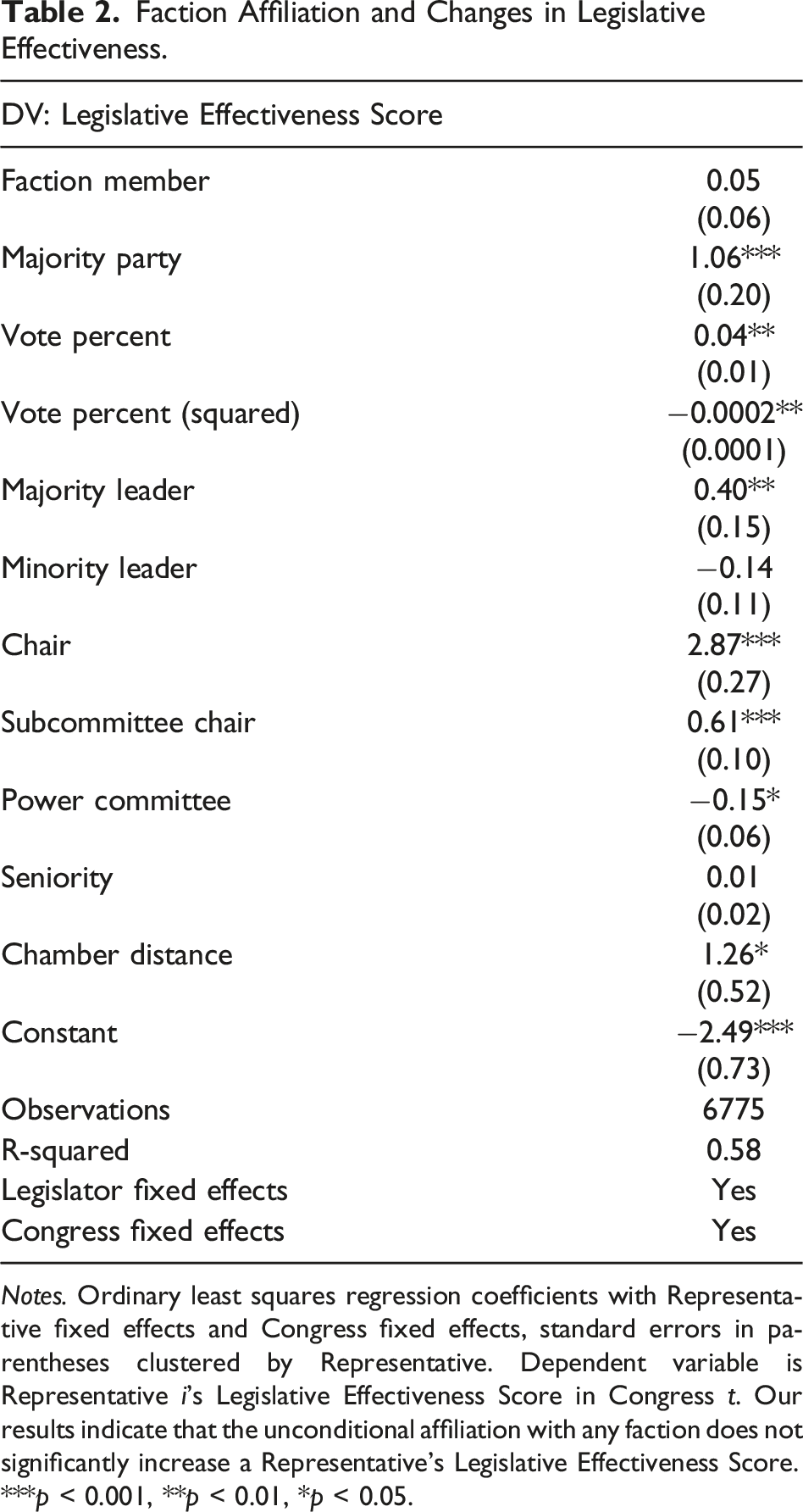
Notes. Ordinary least squares regression coefficients with Representative fixed effects and Congress fixed effects, standard errors in parentheses clustered by Representative. Dependent variable is Representative i’s Legislative Effectiveness Score in Congress t. Our results indicate that the unconditional affiliation with any faction does not significantly increase a Representative’s Legislative Effectiveness Score.
***p < 0.001, **p < 0.01, *p < 0.05.
The results suggest that, with the exception of the Blue Dogs, affiliating with any faction does not generally improve a Representative’s Legislative Effectiveness Score. 28 Given that the Blue Dogs were a minority-party faction in ten of the twelve Congresses, and that they are among the most centrist factions, their enhanced lawmaking effectiveness appears to be consistent with both the Faction Party Status and Legislative Effectiveness Hypothesis and the Faction Ideology and Legislative Effectiveness Hypothesis. To explore these patterns more systematically across all factions, we turn next to a more explicit test of the Faction Party Status and Legislative Effectiveness Hypothesis, which suggests that Representatives who are members of a faction while they are in the minority party will be more effective lawmakers, relative to their non-faction co-partisans.
This hypothesis is explored in Figure 3, which presents the coefficients from a regression where the dependent variable is Representative i’s LES in Congress t, and the key independent variables capture whether a Representative is in a minority-party faction or a majority-party faction. Consistent with the Faction Party Status and Legislative Effectiveness Hypotheses, we see that Representatives who are in factions while in the minority party become notably more effective in lawmaking than their non-faction–affiliated minority-party counterparts. Majority-party faction members, however, become somewhat less effective; but this latter finding does not achieve statistical significance by conventional standards. Because the average LES for all minority-party legislators is 0.42, the coefficient on the minority-party faction variable represents a remarkable 50% increase in relative lawmaking effectiveness for these faction members. Faction affiliation, party status, and changes in legislative effectiveness. Notes: Ordinary least squares regression coefficients and 95% confidence intervals, with Representative and Congress fixed effects and the control variables shown in Table 2. The dependent variable is Representative i’s Legislative Effectiveness Score in Congress t. The results indicate that affiliation with a minority-party faction—but not a majority-party faction—is associated with increases in a Representative’s Legislative Effectiveness Score.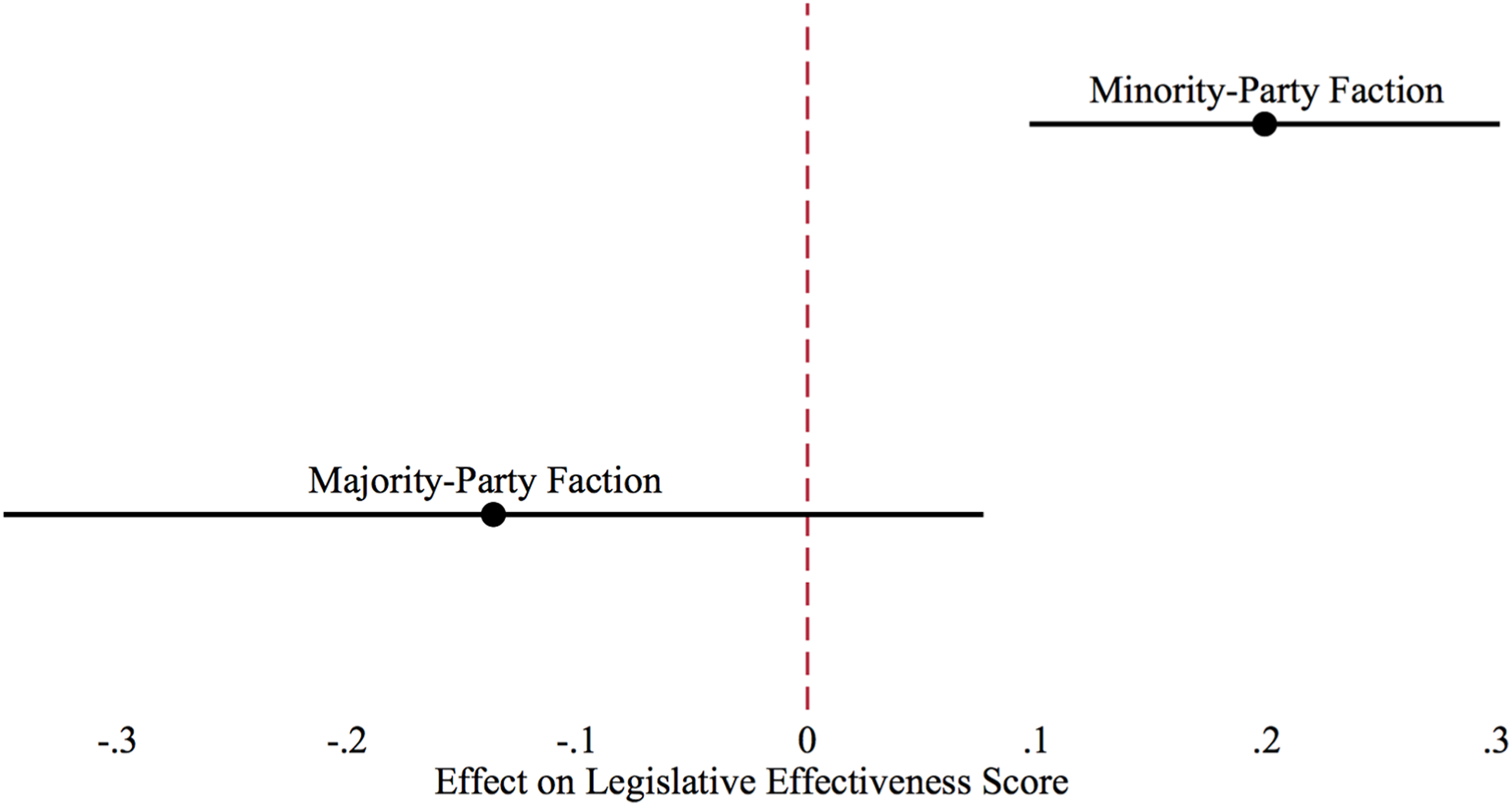
One may wish to dismiss these findings, and suggest that minority-party lawmakers are only successful at advancing modest or commemorative legislative proposals. In Figure 4, however, we focus on the most important “substantive and significant” bills and find that minority-party faction affiliation is positively related to a Representative experiencing greater success in advancing these bills through every stage in the legislative process. In contrast, faction affiliation appears to actually harm majority-party legislators’ attempts to advance substantive and significant legislation. An in-depth consideration of these minority-party faction proposals reveals that they addressed a wide range of topics, including employment discrimination (H.R. 1755, 113th Congress), veterans health care (H.R. 3645, 107th Congress), welfare reform (H.R. 3266, 104th Congress), marijuana policy (H.R. 2652, 113th Congress), network neutrality (H.R. 5273, 109th Congress), and many additional weighty issues in American society. The effect of faction affiliation, by party status, on substantive and significant legislative outcomes. Notes: ordinary least squares regression coefficients and 95% confidence intervals from five distinct models with Representative and Congress fixed effects and all control variables shown in Table 2. The dependent variables in these regressions are: (1) Representative i’s number of substantive and significant legislative proposals (Bills), and the number of those proposals to (2) receive action in a committee (AIC), (3) receive action beyond the committee (ABC), (4) pass the House, or (5) become law in Congress t. The results indicate that affiliation with a minority-party faction increases a Representative’s legislative productivity and success in reaching each stage of the lawmaking process for substantive and significant bills. Conversely, affiliation with a majority-party faction corresponds with a reduction in legislative productivity and success for these bills.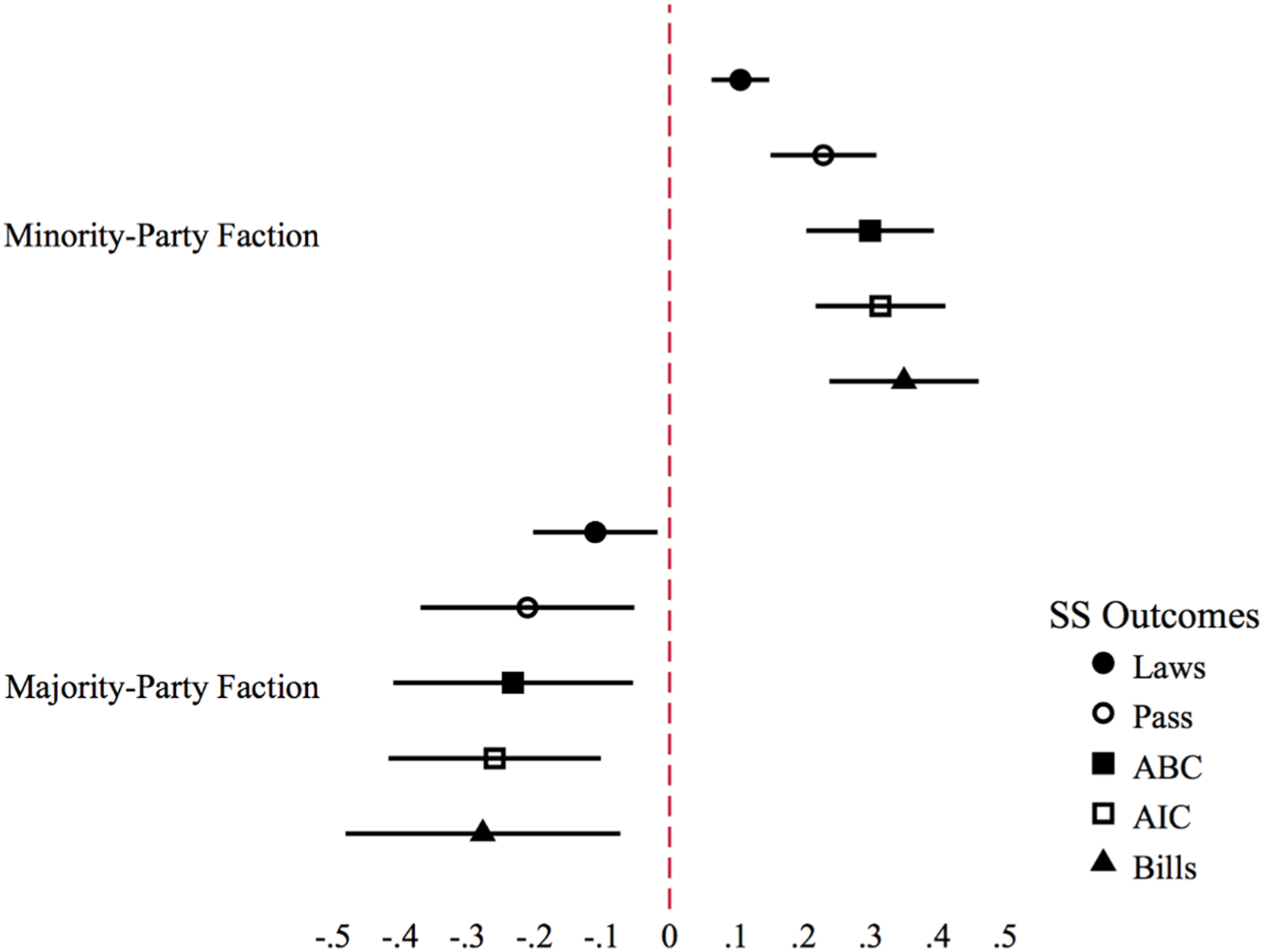
Like the broader population of legislative proposals, the bills advanced by minority-party faction members also varied in their outcomes. Many of these bills lingered and died in committee. In some cases, however, these initiatives led to strange coalitions and swift passage. For example, Rep. Scott Garrett’s (R-NJ) bill to amend the National Flood Insurance Act of 1968 (H.R. 3959, 110th Congress) proposed a hike in flood-insurance premiums as a means of raising millions of dollars in revenue for the National Flood Insurance Program. Garrett, a member of the conservative Republican Study Committee who would later help found the Freedom Caucus, received strong support for his bill from the Progressive Caucus and liberal majority-party member Rep. Barney Frank (D-MA), who stated that the bill “advances the legitimate concerns of both those interested in saving taxpayer money and those interested in environmental protection” (Congressional Record 2008). The bill passed the House by voice vote less than 3 months after Garrett introduced it. Moreover, even for minority-party bills that failed to become law, their advancement through early lawmaking stages (and the surrounding coalition-building efforts) may position them well for subsequent success, including when their sponsors entered the majority party.
More broadly considered, on average, one in three minority-party non-faction lawmakers sees one of the substantive bills she sponsors pass the House. This is true for one in two minority-party faction members, however. In short, the results presented in Figure 3 do not merely capture a talent to name a series of post offices or to commemorate public spaces. Faction affiliation appears to increase a Representative’s relative legislative effectiveness in important ways, but only when those factions are in the minority party. 29 Hence, it appears that factions can meaningfully promote legislators’ agendas, so long as their parties’ leaders are not in a position to counter their legislative progress.
We interpret these results as an institutional resiliency effect of factions. Legislators who choose to affiliate with majority-party factions may be disadvantaged in the lawmaking process, but any such loss is more than fully reversed when in the minority. While losing the majority strips many elected officials of significant power, those who can draw upon the institutional support of ideological factions can continue to legislate with far less interruption. Committee chairs, party leaders, and other loyal members of the party face considerable setbacks after the House is lost to the opposition. Faction members, by contrast, continue to draw upon the same dedicated caucus staff to coordinate legislative action and capture valuable electoral resources. 30
Next, we turn to our consideration of the Faction Ideology and Legislative Effectiveness Hypothesis by presenting the regression coefficients for liberal, centrist, and conservative faction membership.
The results in Figure 5 suggest that membership in an ideologically centrist faction does not significantly contribute to a Representative’s legislative effectiveness. While the Blue Dogs, New Democrats, and Main Street Partnership may appear poised to utilize their ideological position to build broad coalitions to advance their members’ agendas, we find no evidence that membership in these groups leads to greater legislative effectiveness, relative to non-centrist factions, or even relative to those legislators who choose not to affiliate with any ideological faction. Moreover, contrary to the argument that liberal factions are more prone to legislative activism than are conservative factions, Figure 5 hints at the opposite pattern.
31
Faction affiliation, ideology, and changes in legislative effectiveness. Notes: Ordinary least squares regression coefficients and 95% confidence intervals, with Representative and Congress fixed effects and the control variables shown in Table 2. The dependent variable is Representative i’s Legislative Effectiveness Score in Congress t. The results do not support the claim that membership in a centrist faction increases a Representative’s Legislative Effectiveness Score.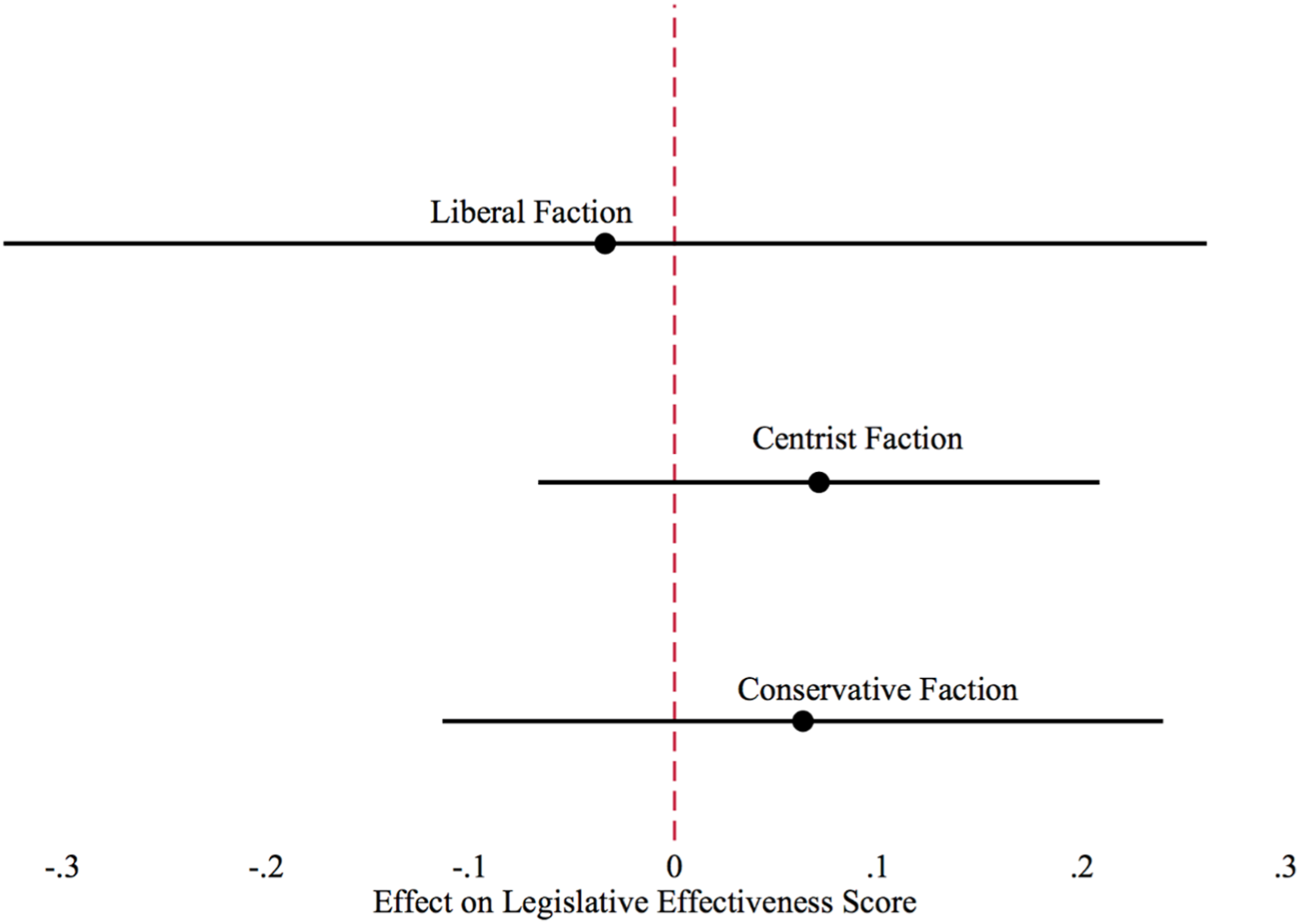
Finally, we turn to our consideration of the Pivotal Factions and Legislative Effectiveness Hypothesis in Figure 6, in which we present the results for pivotal and non-pivotal factions. As with all models presented in this section, these results continue to include the full array of control variables, in addition to Congress and Representative fixed effects. Faction affiliation, faction size, and changes in legislative effectiveness. Notes: Ordinary least squares regression coefficients and 95% confidence intervals for different faction types with Representative and Congress fixed effects and the control variables shown in Table 2. The dependent variable is Representative i’s Legislative Effectiveness Score in Congress t. The results indicate that membership in a majority-party faction—irrespective of pivotality—does not increase a Representative’s Legislative Effectiveness Score, whereas membership in a minority-party faction continues to aid their members’ lawmaking success.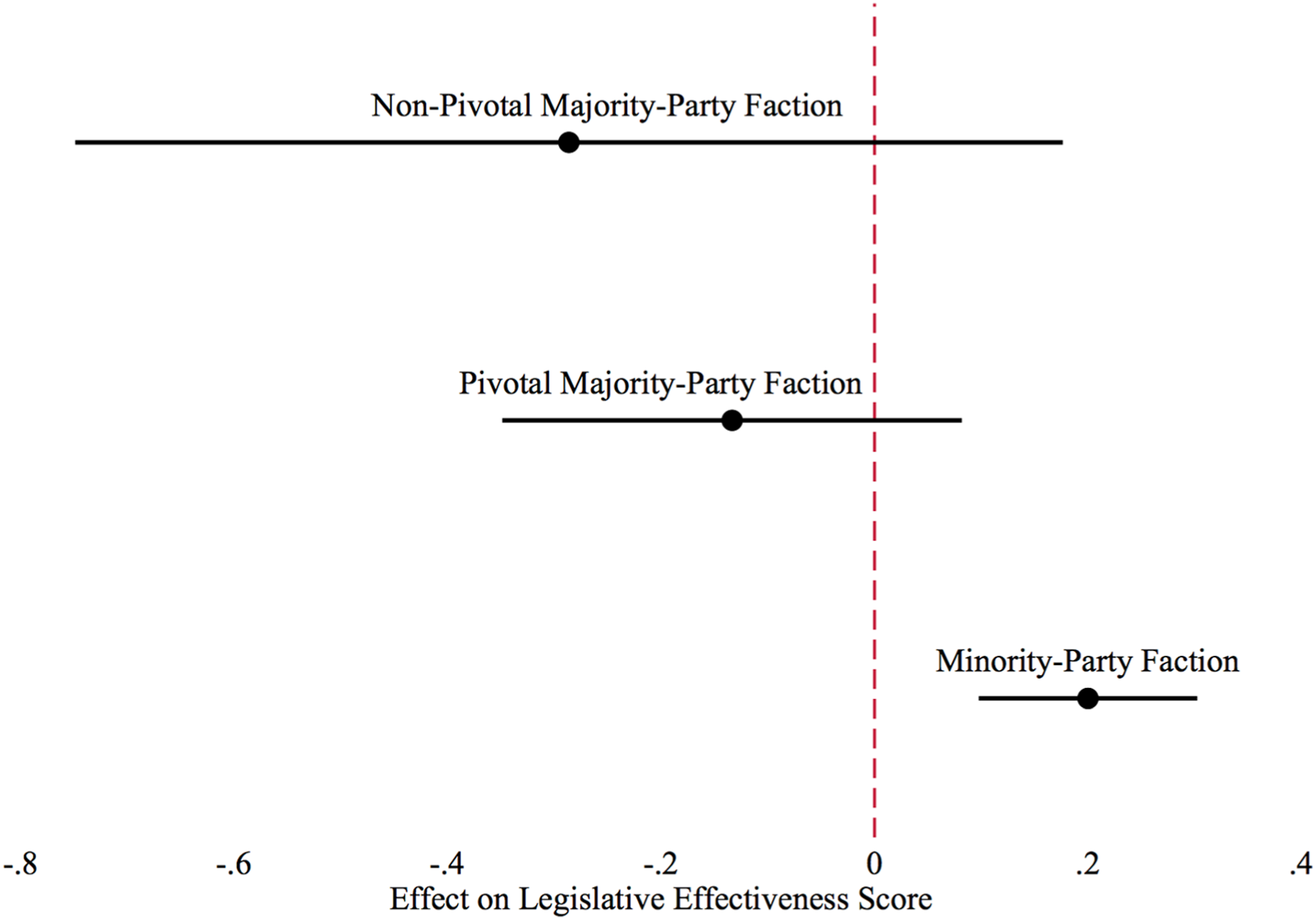
The results provide no evidence that pivotal majority-party factions can leverage their positions to advance their members’ policy proposals. In fact, the coefficients for both pivotal and non-pivotal majority-party factions are negative, although statistically indistinguishable from zero. Being a member of a minority-party faction, however, continues to correspond to a statistically significant increase in a Representative’s Legislative Effectiveness Score. In the Appendix (Figures A8 and A9), we further evaluate subsets of pivotal factions as well as the importance of faction size in both the minority and majority parties. Those results, too, suggest that while minority-party factions of various sizes provide a relative lawmaking advantage to their members, majority-party factions offer no such benefits. 32
In sum, across numerous specifications and tests, we find strong and consistent support for the Faction Party Status and Legislative Effectiveness Hypothesis, but not for faction centrality or size facilitating members’ lawmaking success. This set of results is robust to different time periods—including the full set of legislators or only those who entered Congress after the start of the data in 1995, as well as limiting the analysis to the 108th–115th Congresses, for which we have complete faction membership data. The findings are also robust to different coding schemes for factions—treating the Tea Party Caucus and Taxed Enough Already (TEA) Caucus as the same or separate, coding the Populists as centrists or as liberals, coding the Republican Study Committee as centrists or as conservatives, and coding ideological positions as well as pivotal factions and faction sizes in multiple ways. The results also hold if we include those who belong to multiple factions as members of each, or if we exclude affiliates of multiple factions from the dataset entirely. 33 Finally, the results are also robust to dropping each faction individually from the analyses.
Through all of these examinations, we are highly confident that faction membership does not improve a lawmaker’s effectiveness—with one notable and consistent exception. Faction members in the minority party are about 50% more effective as lawmakers, in comparison to their non-faction counterparts. They are more likely to introduce substantive bills and to see those bills pass the House and become law than are minority party members who do not join factions. This is true upon controlling for numerous characteristics that are important for individual lawmaking success, and upon including the fixed effects that compare these lawmakers to their own performance, when they were not part of the faction.
Conclusion
While journalists and pundits often comment on the positions of faction leaders to evaluate the likely fate of bills in the House, the question remains as to whether factions and faction membership meaningfully contribute to policymaking in the U.S. Congress. We have drawn on new data on the membership of nine ideological caucuses and decades of legislative activity to test three hypotheses regarding the individual-level effect of intraparty faction affiliation on a Representative’s legislative effectiveness. Our results indicate that membership in an ideological faction corresponds with an increase in a Representative’s legislative effectiveness, but this relationship is highly conditional on other factors. We find little support for claims of a critical lawmaking role for members of centrist factions, or of ideologically extreme faction members eschewing lawmaking altogether. Nor do we find evidence that membership in large or otherwise pivotal factions can improve a Representative’s legislative effectiveness within the majority party. While such groups may play an important blocking role, we find no evidence that these groups help advance the proposals of their members.
These findings stand in contrast to much of the rhetoric surrounding ideological factions in the U.S. House. Some argue that “by developing factions within each party, moderates have a golden opportunity to reemerge as a power center in American politics” (Teles and Saldin 2019). Others argue that “ideological caucuses are looking to be a larger source of power in the majority” and, crucially, “numbers will matter for these groups” (McPherson 2018). Many of the null findings in this paper contribute to our understanding of ideological factions through the lack of evidence in support of such claims across numerous model specifications.
By contrast, we find robust evidence that factions in the minority party—and only the minority party—improve their members’ ability to advance their policy proposals. Such effects are large and extend even to the passage of high-profile substantive and significant legislation. These findings are consistent with the argument that factions possess the institutional capacity to support legislative activity for Representatives when they are in the minority party, but that their efforts are blunted (or even undermined) by an empowered set of party leaders when these same Representatives reclaim majority-party status in the House.
Although these findings are instructive, more research is needed to better understand the nature of American party factions in the contemporary Congress. Our initial aggregate explorations are suggestive of conditional effects both for policy advancement and for obstruction. However, given the possibility of other, indirect forms of legislative influence (i.e., Green 2019), systematic quantitative analyses (at either the aggregate or individual levels) may need to give way to fuller qualitative assessments based on examining high-level policy negotiations. Moreover, if it’s the case that faction membership largely serves electoral purposes, then additional research would help to inform us about the conditions under which faction affiliation is deemed valuable by voters.
Our results help answer the question of why so many members of Congress join ideological factions. On the one hand, the highly conditional nature of our findings is consistent with the perspective that factions exist to acquire electoral resources. That said, our findings also point to how faction membership offers continued policymaking support when it is of greatest need—when members are in the minority party. Future work exploring whether such lawmaking benefits extend to non-ideological caucuses may also be fruitful.
Supplemental Material
Supplemental Material - The Conditional Lawmaking Benefits of Party Faction Membership in Congress
Supplemental Material for The Conditional Lawmaking Benefits of Party Faction Membership in Congress by Andrew J. Clarke, Craig Volden, and Alan E. Wiseman in Political Research Quarterly
Supplemental Material
Supplemental Material - The Conditional Lawmaking Benefits of Party Faction Membership in Congress
Supplemental Material for The Conditional Lawmaking Benefits of Party Faction Membership in Congress by Andrew J. Clarke, Craig Volden, and Alan E. Wiseman in Political Research Quarterly
Footnotes
Author’s Note
The authors benefited from comments at seminar presentations at Princeton University, the University of Illinois, and the 2018 Annual Meetings of the American Political Science Association. Volden and Wiseman thank the U.S. Democracy Program of the Hewlett Foundation and the Democracy Fund for continued support of the Center for Effective Lawmaking ( ).
).
Declaration of Conflicting Interests
The author(s) declared no potential conflicts of interest with respect to the research, authorship, and/or publication of this article.
Funding
The author(s) disclosed receipt of the following financial support for the research, authorship, and/or publication of this article: This work was supported by the U.S. Democracy Program of the William and Flora Hewlett Foundation (2020-1727).
Supplemental Material
Supplemental material for this article is available online.
Notes
References
Supplementary Material
Please find the following supplemental material available below.
For Open Access articles published under a Creative Commons License, all supplemental material carries the same license as the article it is associated with.
For non-Open Access articles published, all supplemental material carries a non-exclusive license, and permission requests for re-use of supplemental material or any part of supplemental material shall be sent directly to the copyright owner as specified in the copyright notice associated with the article.
