




Abstract
Why do public works programs in developing democracies often experience implementation failures at the local level? Building on the literature on political business cycles, our study sheds light on a key explanation. We argue that electoral cycles undermine the completion of public works projects because of incumbents’ difficulties in reaping electoral rewards for following through on projects proposed just prior to an election. Analyses based on project-level data from a nation-wide public program in India supports the argument. We find that projects proposed close to an upcoming election are less likely to be eventually completed than projects proposed at other times. We further find that incumbent turnover exacerbates the effect of electoral cycles and that this modifying effect is plausibly causal. The results suggest that new incumbents have reduced incentives to follow through on projects proposed by their predecessors due to the difficulties involved with claiming credit for such projects.
In many parts of the world, governments implement public works programs aimed at providing a range of goods and services to citizens. The local level projects that these programs fund are intended to create tangible amenities—such as roads, school buildings, or improved sanitation facilities—that are tailored to the needs of local citizens. However, the implementation of these programs is typically uneven. In particular, many local projects are started but never completed, leaving in their wake unfinished schools and roads while wasting scarce public resources and bureaucratic effort. As a result of these local failures, public works programs often fail to deliver promised benefits to local communities. Examining when and why local projects fail could thus provide an important explanation for why governments in many developing countries often struggle to provide essential public services.
Our goal in this paper is to take on this task by shedding light on a key—but so far largely overlooked—explanation for when and why public works projects often fail to be implemented successfully. In doing so, our study seeks to contribute to the vast literature on public service provision in the developing world. Much of this existing research focuses on political factors that help explain the level of funding for public service provision
The literature on political business cycles has shown that there are electoral cycles in monetary and fiscal policy (e.g., Franzese 2002), with evidence of increases in overall government spending (e.g., Kwon 2005) and levels of debt (e.g., Shi & Svensson 2006; Brender & Drazen 2005) in periods immediately before elections. Another strand of the literature has focused more closely on how elections can alter the composition of public budgets, leading to increased spending on social welfare (e.g., Akhmedov & Zhuravskaya 2004; Schneider 2009; Chang 2008; Saez 2016), on highly visible spending such as on public investments (e.g., Vergne 2009; Drazen & Eslava 2010; Khemani 2004; Chaudhuri & Dasgupta 2006), and on political patronage (Remmer 2007). Other studies examine how the level of public service provision changes during elections, leading to improvements in the rates of highway construction (Khemani 2004) and electricity provision (Baskaran et al. 2015). Meanwhile, Toral (2021) shows evidence of a decline in health service delivery in the pre-election period owing to bureaucratic shuffling.
The present study extends these findings from the literature on political business cycles to examine whether and why electoral cycles in competitive democratic systems affect the completion of public works projects. Our central argument is simple. We posit that voters’ recency bias when casting their vote creates incentives for incumbents to propose to propose public works projects in the run-up to an election without concern about the projects’ eventual likelihood of completion. As a result, our central hypothesis is that the completion rate of local public works projects is determined by when the project is proposed relative to the next national election.
What conditions exacerbate or mitigate this effect of the electoral cycle on the completion rate of local public works projects? We examine three important —though not exhaustive—potential factors. First, the increased number of politician-proposed projects before elections creates bureaucratic overload, leading to lower completion rates for projects proposed in the pre-election period. Second, upcoming elections create incentives for inefficient project selection. In particular, the anticipation of an election may spur elected officials to submit local projects that are highly visible to voters or that allow incumbents to secure kickbacks to finance their campaigns. These characteristics, however, could increase the projects’ ultimate likelihood of failure. Finally, incumbent turnover could exacerbate the effects of the electoral cycle on project completion by reducing the incentive of newly elected representatives to complete ongoing projects due to their inability to claim credit for completing projects proposed by their predecessors.
We test these arguments in the Indian context using data from over 200,000 individual projects from across the country proposed between 1993 and 2015 under a nation-wide public works program called the Member of Parliament Local Area Development Scheme or MPLADS. Like constituency development fund programs in other countries, including Pakistan, Kenya, and the Philippines, MPLADS grants a fixed annual allotment to Members of Parliament (MPs) to be spent on public works projects. The analyses rely on project-level data derived from the scheme’s online management and monitoring system, which contains detailed information on public works projects from all over India. These data allow us to test our central hypothesis about the effect of election timing on a proposed project’s eventual completion and shed light on the conditions that exacerbate this effect. A key benefit of using these data is that they allow for a focus on public works projects proposed by individual MPs rather than by collective entities, thus allowing for a precise test of the argument concerning the incentives of incumbent politicians. Moreover, the focus on a single program is advantageous since it allows an analysis of the effects of election timing on the outcomes of public works projects while holding constant the formal rules and procedures governing the implementation of these projects.
The results demonstrate robust support for our central hypothesis. In particular, they show that projects proposed by incumbent MPs closer to an upcoming election are less likely to be completed than projects proposed at other times. To allay concerns about endogenous election timing, we show that the results remain robust to considering the timing of project proposals relative to regularly scheduled elections. Thus, the results shed light on an important causal factor driving failures in implementing public works projects that could have relevance in a wide variety of contexts.
Further analyses shed light on which conditions exacerbate these deleterious effects of the electoral cycle. We find no evidence that bureaucratic overload or inefficient project selection account for the observed effects. However, we do find that the impact of the electoral cycle on project completion is greater when the incumbent who proposes the project loses the next election. Additional robustness checks show that the afore-mentioned result continues to hold even when restricting the sample to constituencies experiencing very close elections where it is plausible to assume that incumbent turnover was assigned “as-if-randomly” (Dunning 2012). These results indicate that the finding on the modifying effect of incumbent turnover is unlikely to be the result of reverse causality or omitted variable bias.
Our study contributes to the growing literature explaining variations in the local level execution of public works programs (e.g., Vaishnav & Sircar 2010; Gulzar & Pasquale 2017; Ichino et al. 2018; Thomas 2018; Jensenius & Chhibber 2023; Lehne et al. 2018; Williams 2017) which, in turn, has helped us focus on the micro-level the mechanisms that underpin broader failures in public service provision. While much of this previous work highlights the factors driving the spatial allocation of projects or their associated outcomes, the present research analyzes how intertemporal variations affect project outcomes. Specifically, in seeking to examine when and why development projects are started but never finished, the present study is closely related to Williams (2017), who sheds light on how the credible commitment problem individual legislators face when making collective expenditure decisions leads to failures during project implementation. The present research explains how and why non-completion arises even when individual legislators can make independent decisions on expenditures for public works projects. Moreover, by homing in on the specific factors that exacerbate the effect of election timing on project completion, our study sheds light on important ways to mitigate the negative impacts of electoral cycles on public works provision.
The rest of this paper is organized as follows. The following section presents our main argument and outlines the key hypotheses. We then provide background on the scheme analyzed in this paper, followed by a discussion of the data, variables, and methodology. Next, we present the main results and discuss alternative interpretations and explanations for the findings. The final section concludes with a summary of the findings and their policy implications.
Argument
Why do democratic elections create inefficiencies in the implementation of public works programs? The present argument builds on previous theories that explain electoral cycles in government spending by focusing on voters’ temporary lack of information regarding the competence of incumbents (e.g., Rogoff 1990; Shi & Svensson 2006). In contrast to previous research focusing on fiscal or monetary outcomes (e.g., Franzese 2002), the present study focuses on how election cycles affect the selection and implementation of public works projects.
Our argument builds upon existing theories of how electoral cycles shape voter and incumbent behavior. We start with the premise that voters value incumbents who are responsive to them when implementing public works projects, where responsiveness is a function of an incumbent’s distributive preferences and competence (e.g., Drazen & Eslava 2010). We posit, however, that since voters temporarily lack information on incumbents’ responsiveness, they use observable project outcomes—including project initiation and project completion—as signals of incumbents’ responsiveness and reward them accordingly when voting. Incumbents can thus signal their responsiveness to voters both by completing existing projects and by proposing new projects, often using ground-breaking or ribbon-cutting ceremonies to claim credit for their actions (e.g., Bueno 2021; Cruz & Schneider 2016). However, due to voters’ recency bias (e.g., Huber et al. 2012), citizens overemphasize recent signals of an incumbent’s responsiveness when making voting decisions. We argue that these conditions should lead to incumbents proposing a significant number of projects in the run-up to an election that eventually remain incomplete.
Of course, ideally, incumbents should be able to signal responsiveness simply by allocating their entire budget toward proposing projects early on in their electoral term and then ensuring their completion just before the next election. However, there are two key reasons for why incumbents may wish to save a significant portion of their budget in order to propose new projects toward the end of their term and in the run-up to the next election. First, due to shifts in voter preferences as well as due to changing exogenous circumstances, incumbents may have difficulties in anticipating early on in their term which projects might yield the highest electoral payoff by the time the next election comes around. Thus, incumbents may have a strong incentive to “save” funds for unexpected contingencies that may need to be addressed in the pre-election period. Second, seeing a project all the way through its successful completion over the course of the incumbent’s term typically requires significantly greater effort—and may also be a higher risk strategy—than simply getting a proposal approved. Thus, rather than investing the entire budget upfront on projects that may not yield a high electoral payoff and that may be riskier and require more effort, incumbents who can claim credit for proposing new public works projects (e.g., Bueno 2021) should have a considerable incentive to allocate a significant portion of their budget at the end of their electoral term toward new projects proposed in the run-up to the next election.
At the same time, due to voters’ recency bias, these projects proposed in the run-up to an election should be less likely to be completed than projects proposed earlier on in the electoral term. Specifically, since voters tend to discount signals of an incumbent’s responsiveness earlier on in the electoral term, incumbents have less of an incentive to follow through on pre-election project proposals just after the election is over. Moreover, shifting priorities and circumstances over the course of an electoral term should decrease incumbents’ incentives to follow through on pre-election project proposals during the latter part of the subsequent electoral term. These dynamics should result in a higher likelihood of non-completion for projects proposed in the run-up to an election than for projects proposed at other times.
While the above dynamic may hold universally, several factors may exacerbate its effects. The first reason may be a strain on bureaucratic capacity. A higher number of project proposals in the run-up to an election could result in an increased overall bureaucratic load (e.g., Dasgupta & Kapur 2020) and reduced bureaucratic oversight at the beginning stages of the project. This reduced oversight may increase the chances of the project eventually failing to be completed. Of course, if bureaucrats have substantial autonomy and discretion over approving projects, they should not—in the first place—approve projects that would result in them being overloaded. However, if incumbents exert significant formal or informal influence over the bureaucracy—as they do in many contexts where bureaucracies are politically captured 1 —then bureaucrats may indeed be forced to approve projects that would later result in overload.
A second reason that could exacerbate the main effect of election timing on project completion is that incumbents may have an incentive to propose inefficient projects in the run-up to an election. For example, electoral pressures may incentivize incumbents to submit more visible or salient projects to voters (e.g., Mani & Mukand 2007). These projects may have a higher failure rate due to their scale or complexity. Alternatively, incumbents may propose projects in the run-up to an election to generate kickbacks to finance their campaigns (e.g., Kapur & Vaishnav 2011; Holland & Freeman 2021). In turn, these projects may face a higher failure rate due to the siphoning of funds or due to the hiring of unqualified contractors (e.g., Lehne et al. 2018).
Finally, a third factor could be incumbent turnover produced by an election. For public works projects proposed in the run-up to an election, voters may be unable to discern whether the outcome of a project proposed before the most recent election results from the incumbent's efforts or from those of the newly elected representative. Moreover, if voters observed the incumbent’s role in proposing the project, they are more likely to assign the credit to the incumbent rather than to her successor. Thus, a newly elected MP may be unable to claim credit for completing a project proposed and financed by her predecessor. Consequently, incumbent turnover may result in a newly elected representative who has little incentive to exert the costly effort required to follow through on projects that bolster her predecessor’s reputation and electoral prospects while doing little to help her own. As a result, the risk of non-completion for projects proposed in an election may be greater when the election results in incumbent turnover than when it does not.
Background
The above argument is tested using nation-wide data on the implementation of projects under the MPLAD scheme in India. Previous research on the MPLAD scheme has shown that the scheme’s outcomes are strongly influenced by political considerations (e.g., Keefer & Khemani 2009; Nath 2015; Jensenius & Chhibber 2023; Thomas 2018). The present research seeks to build on these contributions by examining how the timing of elections shapes the implementation of public works projects under the MPLAD scheme.
India is a federal parliamentary democracy that uses a first-past-the-post electoral system. The present study analyzes projects proposed by MPs from the directly elected lower house of parliament—the Lok Sabha—and focuses on those projects that are approved or “sanctioned” by the district bureaucracy. The Lok Sabha has 543 directly elected members and the regular term of the Lok Sabha is 5 years. There are no term limits for members and, aside from special circumstances triggering a by-election, all members stand for election at the same time.
The MPLAD scheme was launched in 1993 and since then has allowed for a fixed annual allocation of funds—currently approximately USD 750,000 in today’s exchange rates—to each single-member parliamentary constituency in India, to be spent on specific local public works projects recommended by the Member of Parliament (MP). MPLADS funds left over from an earlier MP are carried over to the incoming MP’s account. Although the funds are released annually, the bureaucracy is authorized to approve proposals for works up to the MP’s full entitlement without waiting for the release of the funds. Since the scheme’s inception, the majority of sanctioned works have been roads, pathways, and bridges comprising 33%, followed by “other public facilities” which comprise 28%. 2 The other works fall into sectors such as drinking water, education, electrification, and irrigation.
A central government ministry is responsible for releasing MPLADS funds to states and for monitoring the overall implementation of the scheme. A department in each state is then responsible for the supervision, coordination, and monitoring of the MPLADS within the state. 3 Ultimately, states release funds to local District Authorities who are responsible for approving and implementing local projects in the district, mainly using government agencies as contractors.
The process for proposing and completing a particular public works project is as follows. First, the MP recommends a particular project by submitting a proposal to the relevant District Authority or district bureaucracy. The bureaucracy then evaluates the proposal based on administrative and technical guidelines. If the proposal is approved—which guidelines state must occur within 75 days of proposal submission—then the district bureaucracy identifies the “Implementing Agency” through which the particular project is to be executed, and supervises the completion of work and issues payment upon completion. 4 In practice, a nation-wide audit revealed that timely completion of works was aided by execution of works through a tendering process and through regular bureaucrat visits. 5 However, as our findings highlight, several obstacles may arise in practice whereby projects are not successfully executed.
While the scheme accords bureaucrats significant formal control over approving project proposals and ensuring their completion, MPs in practice exert significant influence both over approvals as well as over the process of executing the project. This is due to the significant influence that politicians exert over the bureaucracy in the Indian context (e.g., Iyer and Mani 2012; Gulzar and Pasquale 2017; Thomas 2021).
First, scheme guidelines state that if a proposal is rejected, the district bureaucracy must provide justification to the MP within 45 days of receiving the proposal. This procedure allows the MP to exercise significant influence over the approval process. In practice, it is reported that when MPs encounter restrictions imposed by MPLAD scheme guidelines, the “general trend is to raise objections, question the rationale behind the restriction imposed, challenge the rules and eventually, if all of this does not work, to seek waiver of the rule in respect of a particular proposal.” 6 Moreover, Nath (2015) uses data on the MPLADS scheme to show that bureaucrats are quicker to approve projects under this scheme when the incumbent MP’s likelihood of being in office at the time of the bureaucrat’s promotion is higher, thus revealing the informal influence that MPs exercise over bureaucrats’ decisions to approve projects. Our own interviews revealed that if a proposal is found to violate one or more criterion, that bureaucrats typically work with the MP to get it approved. 7 Thus, in practice, MPs exert significant influence over the approval process and bureaucrats may not have much leeway to deny projects that otherwise meet a set of objective criteria.
Second, MPs also play a significant role in facilitating—or not facilitating, as the case may be—the completion of MPLADS projects. Although MPs do not have formal control over the implementation of public works projects under the MPLAD scheme, they can influence the implementation process by providing information to bureaucrats, who may not have the capacity or incentive to monitor each project. For example, a former MP mentioned that when he would use party workers to monitor the progress of a project on the ground, party workers sometimes directly speed up the progress of project completion by “getting aggressive with the contractors.” 8 He also reported sometimes relying on active and well-informed residents of a community to monitor the progress of a project. District bureaucrats in Rajasthan also noted that MPs frequently monitor the progress of the MPLADS projects they propose. If they find that work on a project is not being promptly done, they “have come to the office, call us on the phone, and write to us.” 9 Meanwhile, consistent with the present argument, these bureaucrats noted that when a new MP is elected, they typically do not monitor projects proposed by the previous MP. 10 Aside from playing these largely primarily informational roles, MPs could also exert control over project implementation due to the informal influence they may have over the careers of bureaucrats (e.g., Nath 2015) or through their influence over the selection of contractors. An evaluation of the MPLADS conducted by the Planning Commission of India found that the majority of district bureaucrats they interviewed reported seeking advice from the MP before selecting the agency to execute a project and that, although it was not permitted, private contractors were used in several instances. 11
How do MPs decide on the public works that they recommend in their constituencies? Media and government reports suggest that members of the public often approach MPs with demands for specific projects, and responding to these requests may be a part of the MP’s constituency service (e.g., Bussell 2019). For example, a government report notes that when MPs tour their constituencies, the “public of that area will approach for creation of community assets based on the locally felt need to be taken up in their area. In such a way, whenever they tour in their Parliamentary Constituency then only they recommend the works...” 12 Reports also suggest that MPs keep upcoming elections in mind when proposing projects under MPLADS. When asked why his MPLAD fund remained so poorly utilized well into his 5-year electoral term, an MP in Maharashtra reportedly stated, “Voters have a short memory span. They don’t remember the work done for [the first] 4 years.” 13 A bureaucrat responsible for administering the MPLADS in Rajasthan also noted that MPs often don’t submit proposals on time since they try to save as much as possible for elections. 14 While the amount allocated under MPLADS is not as large as in some other government programs, the MPLADS is typically very important for an MP since, as one former MP noted, it is “the only scheme that gives you the ability to do something in the [constituency].” 15 Opportunities for MPs to claim credit for their role in providing public works are an intrinsic feature of MPLADS since the guidelines state that public works under the MPLADS must bear a permanently visible plaque stating that they were financed by a given MP’s fund. 16
The analysis includes data from the inception of the MPLADS program in 1993 to 2015 when we collected data for the project. Since the incumbent MPs in charge of making the spending decisions regarding the MPLADS are national politicians, the analyses focus on the timing of national elections. As a result, the analysis period covers the 10th, 11th, 12th, 13th, 14th, and 15th national parliaments, or Lok Sabhas. Elections to these parliaments were held in 1991, 1996, 1998, 1999, 2004, 2009, and 2014. The regular term of the national parliament is 5 years. However, “early” elections were held in 1998 and 1999, in both cases due to the government failing to obtain majority support in the legislature.
A key feature of the MPLADS highlighted by previous research (e.g., Keefer & Khemani 2009) and several press reports is that the funds allocated to MPs under this scheme remain relatively under-utilized. While Keefer & Khemani (2009) examine how constituency characteristics shape legislators’ lack of effort in utilizing funding for MPLADS, the present research shows how this lack of effort—measured here by project non-completion—is also shaped by the electoral cycle. Section B in the Appendix discusses the variation in utilization rates and shows how project non-completion may provide at least part of the explanation for under-utilization.
Hypotheses
In the context of the background provided above, the argument described previously sheds light on how the electoral cycle shapes the prevalence of incomplete public works projects—projects that are proposed and approved but that remain incomplete. Strictly speaking, since a project could always be completed at some time in the future, the true final outcome for an incomplete project is censored and never observed. Thus, the best information we have regarding the “final” outcome of a given project is its status at the time of data collection. Consequently, a project is coded as incomplete if it is recorded as not complete at data collection. With this definition in mind, the central hypothesis concerns the effect of the electoral cycle on project completion—namely, that projects proposed closer to (farther away from) an upcoming national election have a lower (higher) likelihood of completion than projects proposed farther away from (closer to) a forthcoming federal election (H1). The analyses control for the lag time since the project was first submitted and approved to ensure that the results are not driven by more recent projects with a lower chance of eventual completion.
What conditions may exacerbate this effect of electoral cycles on project completion? Our argument highlights three possible factors: bureaucratic overload, inefficient project selection, and incumbent turnover. Since both the total number and sum cost of project proposals contribute to bureaucratic overload, two key observable implications of this explanation are that the effect of the proximity of the project proposal to the upcoming election on the likelihood of project completion is magnified when the total number of projects proposed in the given constituency and month is higher (H2.1a) and when the total cost of projects proposed in the given constituency and month is higher (H2.2a).
The second factor—inefficient project selection—may stem from incumbents’ propensity to propose more visible projects in the run-up to an election (e.g., Mani and Mukand 2007) that have a higher risk of eventual failure. Since more visible projects tend to involve construction on a larger scale, such projects are typically costlier. Consequently, this explanation suggests that the effect of the proximity of the project proposal to the upcoming election on the likelihood of project completion is magnified when the approved cost of the project is higher (H3a). In addition, we might also expect that the opportunities for kickbacks should be the highest for relatively large projects that involve potentially lucrative deals for contractors (Lehne et al. 2018; Wade 1982). More expensive projects could also help concentrate funds in the hands of a few contractors with whom the incumbent may have a personal relationship (Lehne et al., 2018). Thus, H3a may also be consistent with incumbents proposing projects to generate kickbacks in the run-up to an election. 17
The above explanations suggest that the electoral cycle should exacerbate bureaucratic strain and heighten incumbents’ propensity to propose costlier projects. Thus, if the bureaucratic overload explanation holds, we should expect that proximity to an election should increase the total number of projects (H2.1b) and increase the total cost of projects proposed (H2.2b). If the pressure for visible projects or desires to generate campaign finance were an exacerbating factor, we should expect that proximity to an election should increase the average approved cost of projects proposed (H3b).
Finally, a fourth factor that could heighten the main effect of election timing on project completion may be incumbent turnover. This explanation suggests that the impact of election timing on project completion should be more substantial when the election results in a change in the incumbent representing the constituency. If this explanation holds, we should expect that the proximity of the project proposal to the upcoming election on the likelihood of project completion is magnified when the upcoming election results in a change in the identity of the incumbent representing the constituency (H4).
Data, Variables, and Methodology
The data used in the analyses were scraped from the publicly available online works monitoring system for MPLADS which contains details on individual projects approved under the scheme by each MP. These details are uploaded by the district authorities responsible for approving and then carrying out the public works projects at the district level. The above-mentioned system contains details on the date a project was proposed by a given MP, the constituency of the MP, the date on which the bureaucracy approved the project, the name and location of the project, the cost approved for the project, and the completion status of the project. Although exact completion dates are not available in the system, the data contains the completion status of the projects as of the data collection date in November 2015. The completion status of the project is categorized as one of the following: “Completed,” “Discontinued,” “Not Yet Started,” “On Going,” and “Status Not Reported.” The primary dependent variable used in the analyses is Completed which is a binary variable coded as 1 if the project is eventually characterized as “complete” according to the system. Note that the central government’s reports on the MPLADS scheme use the same indicator on completion status provided on the online system at an aggregate level to measure the scheme’s success in a given area. 18 Our research is based on data from over 200,000 individual projects proposed under MPLADS between 1993 and 2015, for which details on cost and date of the proposal were available. 19 Section A.1 of the Appendix provides further information on data collection, and Section A.2 provides variable descriptions and descriptive statistics.
Since the key hypotheses concern the eventual completion of a project, the unit of analysis is the project proposal. We use the information on the timing of the project proposal and the constituency in which the project is located to match each project with the electoral characteristics of that constituency. For ease of interpretation, the main specifications are estimated using a linear probability model (e.g., Wooldridge 2010). However, we also show that our main results are robust to using a probit model. 20 The analyses are presented using clustered heteroskedastic-consistent standard errors to account for the inter-dependence of observations within a constituency.
Given the hypotheses, the key independent variables capture the timing of the project proposal relative to the next upcoming election. Accordingly, the first of these variables is Months to Election, which captures the number of months between the date the district authority received the project proposal and the date of the next election. However, an endogeneity problem could arise with the use of this variable owing to underlying factors that could cause political elites to hold elections as well as that could independently cause political incumbents to change the way they influence the implementation of public works programs. Following Khemani (2004), we deal with this potential endogeneity problem by examining the timing of project proposals relative to regularly scheduled elections, whose timing cannot be manipulated by political elites. Accordingly, our second independent variable, Months to Scheduled Election, captures the number of months between the date the district authority received the proposed project and the next regularly scheduled election date. Thus, the variable treats the next election as being anticipated 5 years after the most recent past election.
Since projects proposed more recently have, all else equal, a lower likelihood of being completed at the time of data collection, a key control variable included in all specifications is Months Since Proposal, which measures the number of months elapsed since the project was proposed until the time of data collection. Other control variables included are factors relating to the political environment in the constituency, including Turnout which captures the proportion of electors who cast their vote in the previous election—that is, the election in which the incumbent MP who proposed the given project was elected—and Vote Margin which captures the vote margin of the current incumbent in the previous election. Each of these variables could independently affect the incentives of incumbents to propose successful projects.
Since reports of the MPLAD scheme reveal that bureaucrats find it easier to approve project proposals submitted in the first quarter of the fiscal year, the analyses also include the variable Start of Fiscal Year which is a dummy indicating whether the projects were proposed in the first 3 months of the fiscal year. To control for the socio-economic characteristics of constituencies, the analyses include a measure Percent Literate which reflects the percent of the population that is literate from the Census of India. In addition to the above-mentioned variables, each specification includes constituency fixed effects and project-year fixed effects which are dummy variables indicating, respectively, the constituency and the calendar year in which the project was proposed. Including constituency fixed effects helps control for unobserved fixed characteristics of constituencies that could confound the results such as the constituencies’ population size or geographic area. Meanwhile, the inclusion of project-year fixed effects helps control for nation-wide annual shocks.
To investigate our additional hypotheses about the conditions that exacerbate the main effect of the electoral cycle on project completion, we focus on exogenously timed elections. To examine H2.1 and H2.2, respectively, we interact the variable Months to Scheduled Election with two variables capturing the conditions implied by each of these hypotheses: a variable capturing the total number of projects approved in the constituency in the given month (Total Number of Projects) and a variable capturing the total cost of projects approved in the constituency in the given month (Total Amount Approved). To examine H3a, we interact the variable Months to Scheduled Election with a variable Project Cost which captures the cost of the given project proposal as approved by the district bureaucracy. In each of the above cases, the dependent variable is the dummy variable Completed defined above.
We also examine the implications of our arguments concerning how the electoral cycle affects bureaucratic strain and incumbents’ propensity to propose costlier projects in the run-up to an election. To examine these hypotheses, we aggregate our project-level dataset to the constituency-month level and estimate linear regressions examining the effect of the variable Months to Scheduled Election on the dependent variables implied by the above explanations. Specifically, to examine H2.1b and H2.2b, we use the total number of projects in a constituency—month and the total approved cost of projects in a constituency-month, respectively, as dependent variables. We examine H3b using the average cost of a project proposed in a given constituency-month as the dependent variable.
Finally, to test H4, we interact the variable Months to Scheduled Election with the dummy variable Incumbent Turnover which is coded 1 if the incumbent in the constituency at the time when the project was proposed is not re-elected to the same constituency in the next election and 0 otherwise. Further details on how the above variables are coded are available in Appendix Section A.2.
Results
To shed preliminary descriptive light on the hypothesis that projects proposed in the run-up to elections are less likely to be eventually completed than projects proposed further away from an election, Figure 1 uses a locally weighted regression to examine how the proportion of completed projects in a given month varies based on the number of months between the date on which the project was proposed and the date of the next regularly scheduled election. The figure clearly shows that project proposals close to an upcoming scheduled election have a lower average completion rate than those further away from a scheduled election. The relationship between election timing and the completion of public works project.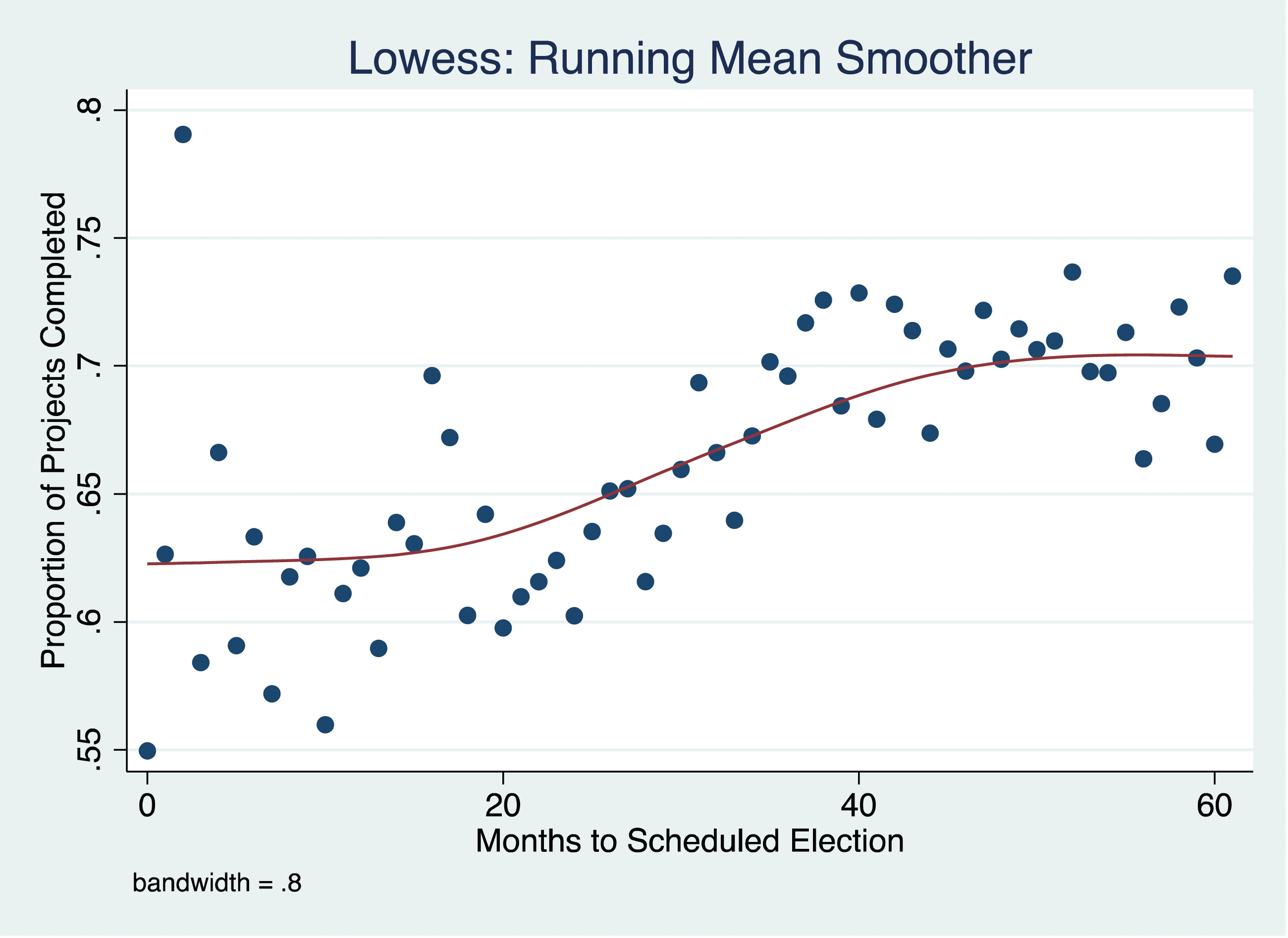
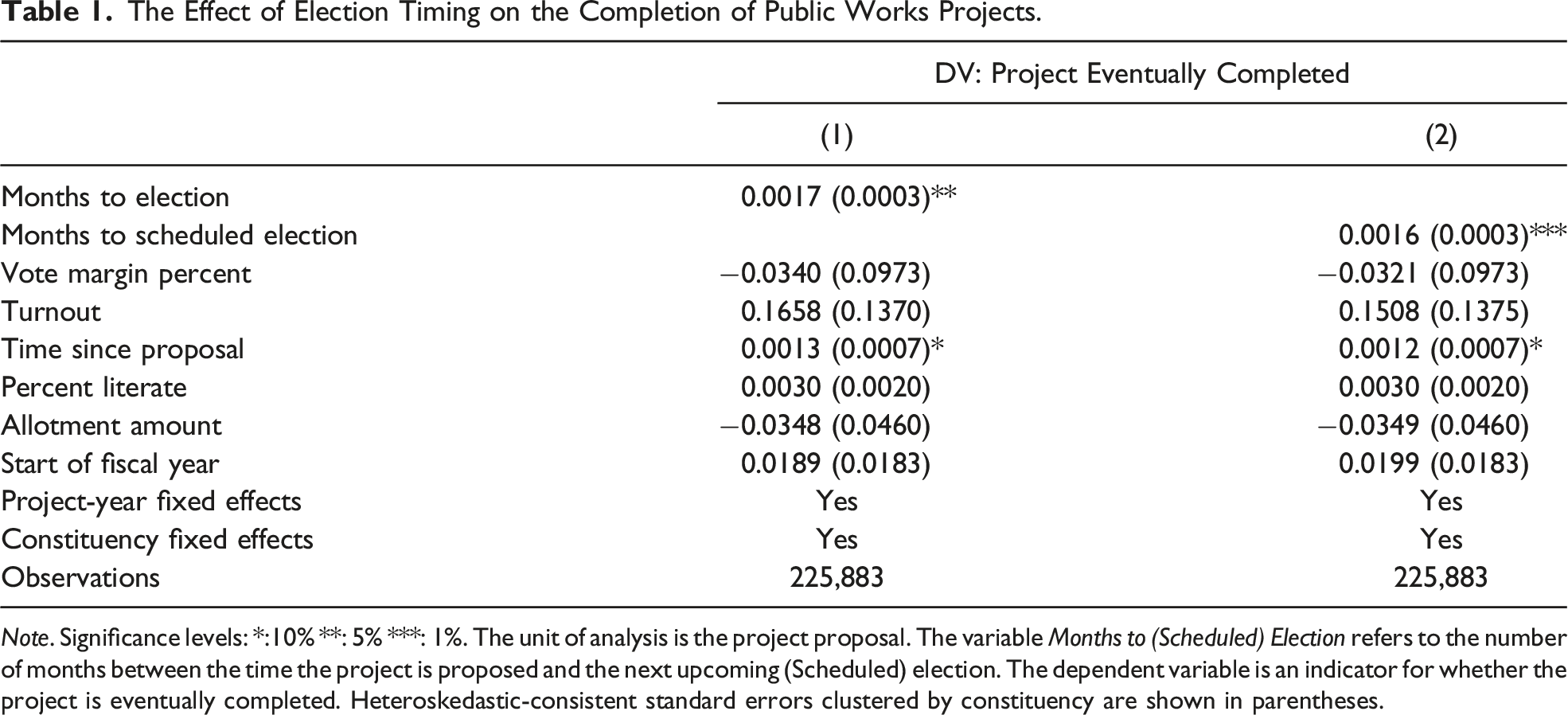
The Effect of Election Timing on the Completion of Public Works Projects.
Note. Significance levels: *:10% **: 5% ***: 1%. The unit of analysis is the project proposal. The variable Months to (Scheduled) Election refers to the number of months between the time the project is proposed and the next upcoming (Scheduled) election. The dependent variable is an indicator for whether the project is eventually completed. Heteroskedastic-consistent standard errors clustered by constituency are shown in parentheses.
Across both columns, we observe a positive and strongly statistically significant relationship between the time between the project proposal and the upcoming election and the likelihood that the project is completed. The results in Column 2 focusing on regularly scheduled elections indicate that this effect is causal and that it cannot be explained by endogenous election timing. The magnitude of the effect suggests that this consequence of electoral cycles has a meaningful negative impact on the government budget. Specifically, based on the results in Column 2, a change in the project proposal date from the start of an electoral term to 6 months before an election decreases the average likelihood of project completion by 8.5 percentage points. Given that an average of 3889 projects are proposed per month nationwide under the MPLADS and the average cost of each project is Rs. 237,000 (approximately USD 33,180 in today’s exchange rates), this suggests that project non-completion related to elections has an opportunity cost of roughly 131 million USD per year which amounts to around 38% of the nation-wide annual allotment under the MPLADS. In turn, if India’s numerous other public infrastructure schemes suffer from similar proportions of wasted resources, the opportunity cost involved would represent a significant portion of the country’s overall budget.
Table A3, Column 1 in the Appendix investigates the robustness of the results to the use of a probit model that accounts for the binary nature of the dependent variable. The probit model continues to show a positive and statistically significant effect of election timing on the likelihood of completion. As discussed in Section D of the Appendix, the marginal effect of a unit change in the number of months to an upcoming election on the probability of completion is about 1.5 times the effect as estimated by a linear model. Thus, the linear model represents a more conservative estimate of the effect of electoral cycles on project completion. Table A3, Column 2 in the Appendix investigates the possibility that the results in Table 1 mask a non-linear effect that may be inconsistent with the main hypothesis. Although the results do show evidence of a non-linear effect, the patterns—as discussed in Section D of the Appendix—remain broadly consistent with H1 other than during the first year of the electoral term. To allow for easy interpretation therefore, subsequent analyses capture the effect of the time to election using a linear model.
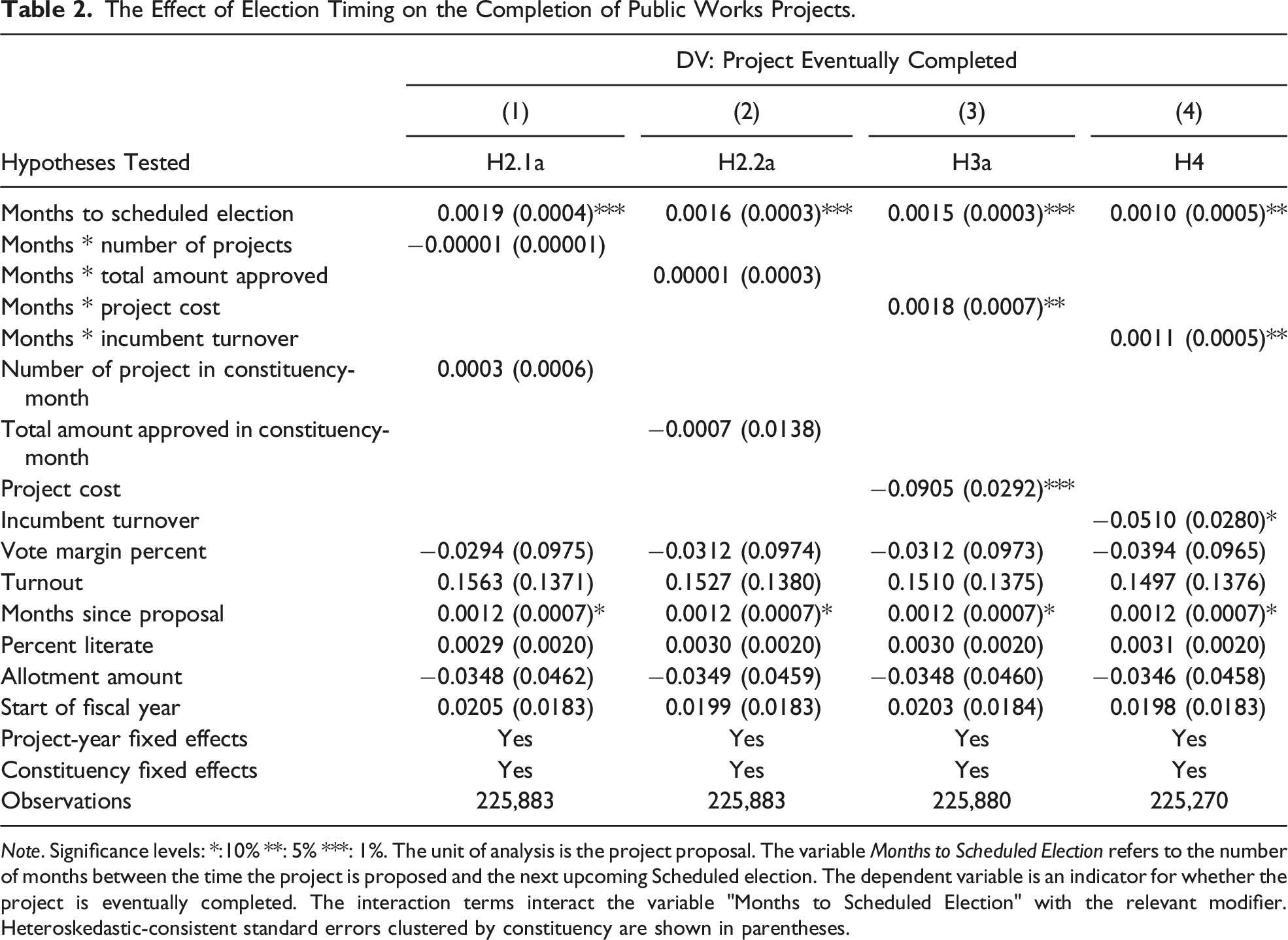
The Effect of Election Timing on the Completion of Public Works Projects.
Note. Significance levels: *:10% **: 5% ***: 1%. The unit of analysis is the project proposal. The variable Months to Scheduled Election refers to the number of months between the time the project is proposed and the next upcoming Scheduled election. The dependent variable is an indicator for whether the project is eventually completed. The interaction terms interact the variable "Months to Scheduled Election" with the relevant modifier. Heteroskedastic-consistent standard errors clustered by constituency are shown in parentheses.
Column 3 of Table 2 examines H3 by interacting Months to Scheduled Election with the cost of the given project proposal. The results show that the project cost exerts a significant and positive modifying effect on the effect of the proximity to an election on project completion. These results support H3a in showing that the effect of election timing on eventual project completion is exacerbated when the projects proposed in the pre-election period are costlier. However, Table A5 in the Appendix shows that the average cost of individual projects is significantly lower in the pre-election period. Thus, the results do not support the notion that incumbents propose costlier projects in the run-up to an election. Instead, the results in Table A5 support the notion that incumbents in the run-up to an election propose numerous relatively small projects—presumably to facilitate spreading their largesse widely to appeal to a larger number of voters in the pre-election period. If the potential for kickbacks is greater for larger projects, then the above-mentioned results also do not support the notion that the adverse effect of the electoral cycle on eventual project completion is driven by incumbents’ desire to propose projects that generate opportunities for them to finance their campaigns through kickbacks. 21 Thus, while incentives to propose projects for the purpose of generating kickbacks may be an important motivation for incumbents, we find no evidence that such reasons may drive the effect of election proximity on the likelihood of eventual project completion.
Finally, Column 4 of Table 2 examines H4 by interacting Months to Scheduled Election with a dummy variable indicating whether the upcoming election resulted in incumbent turnover. The results show that incumbent turnover exerts a positive and statistically significant modifying effect on the relationship between election timing and the likelihood of project completion. While the effect of a change in a project’s proposal date from the start of an electoral term to 6 months before an election lowers the average completion rate by just over 5 percentage points in cases where the upcoming election did not result in incumbent turnover, the same change lowers the average completion rate by 11 percentage points in cases where the election produced incumbent turnover. Thus, although the effect of election timing on project completion is statistically significant even when there is no incumbent turnover, the change of an incumbent due to an election more than doubles the size of the effect. The results thus support H4 indicating that the negative impact of election timing on project completion is exacerbated in situations of incumbent turnover.
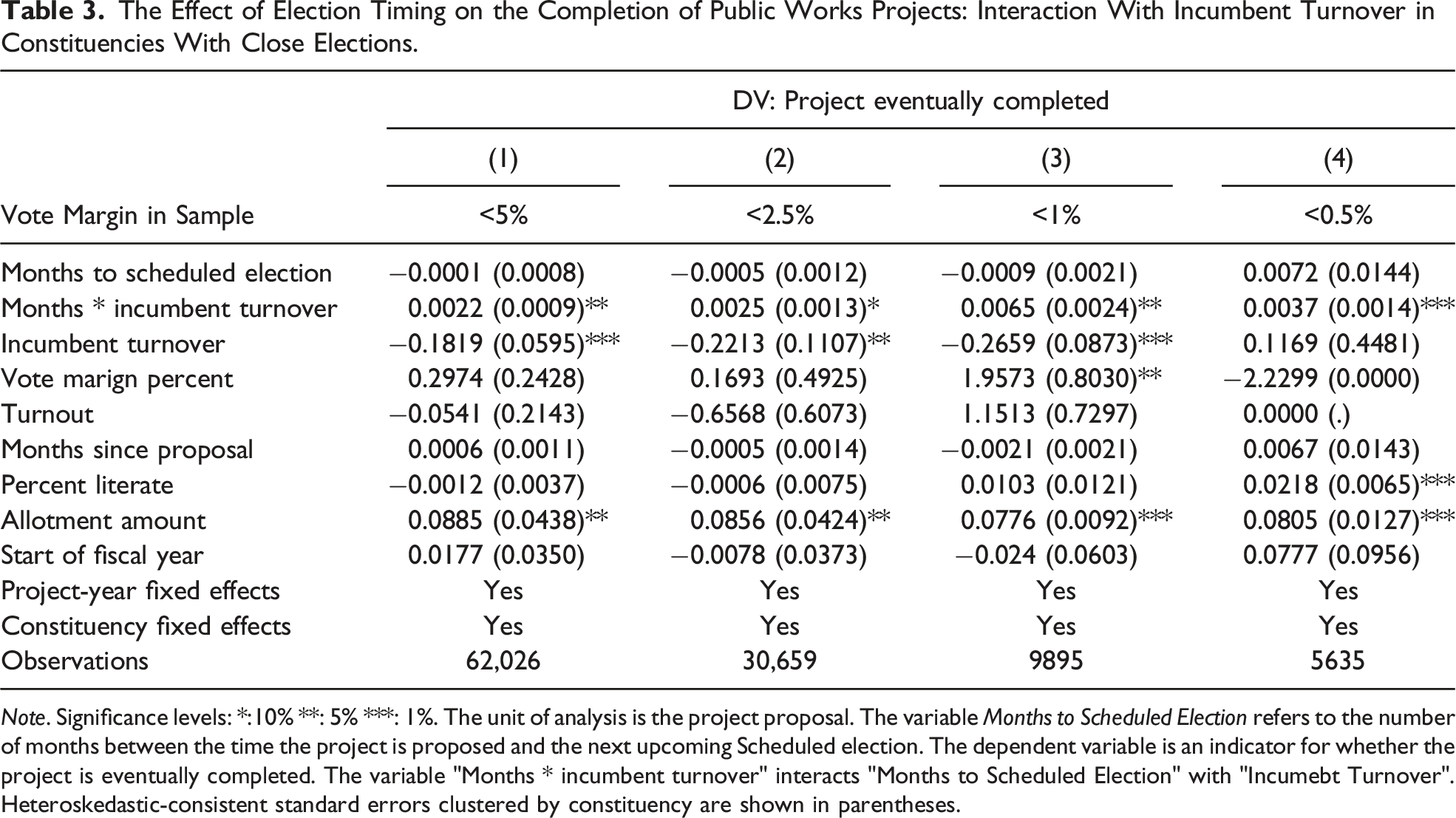
One concern with the above results, however, is that they could be a product of reverse causality or omitted variable bias. Incumbents who anticipate they are likely to lose an upcoming election may seek to propose a large number of projects in the run-up to the election to ensure that their newly elected successors cannot take advantage of funds unused in the prior term. In addition, incumbents may be voted out of office precisely because they have difficulties with ensuring the completion of projects. An incumbent who is incompetent or who is engaging in malfeasance or one who experiences an adverse shock like a natural disaster may be more likely to lose office and may also be more likely to fail to implement projects.
The Effect of Election Timing on the Completion of Public Works Projects: Interaction With Incumbent Turnover in Constituencies With Close Elections.
Note. Significance levels: *:10% **: 5% ***: 1%. The unit of analysis is the project proposal. The variable Months to Scheduled Election refers to the number of months between the time the project is proposed and the next upcoming Scheduled election. The dependent variable is an indicator for whether the project is eventually completed. The variable "Months * incumbent turnover" interacts "Months to Scheduled Election" with "Incumebt Turnover". Heteroskedastic-consistent standard errors clustered by constituency are shown in parentheses.
Discussion
The above results indicate that projects proposed in the run-up to an election are less likely to be eventually completed when the election produces a change in the identity of the incumbent. We argue that this results from the newly elected official’s difficulty claiming credit for a project proposed by her predecessor, which reduces the new official’s incentive to see these projects through to completion. However, there may be three main alternative explanations for this result. One possibility is that the result is driven by the fact that a new incumbent may have a different support base and therefore may prefer delivering projects in a different geographic area or with different characteristics, thus reducing the newly elected incumbent’s propensity to ensure the completion of projects proposed by the previous incumbent. If this explanation holds, and if incumbents belonging to different parties are more likely to have different support bases—we should expect that the effect of election proximity on a project proposal’s eventual completion is heightened when the election resulted in a change in the partisan affiliation of the incumbent in the constituency. Table A7, Column 1 in Section G of the Appendix examines this possibility and shows, however, that party turnover does not produce a modifying impact on the relationship between election timing and project completion. These results suggest that the finding pertaining to incumbent turnover presented in Table 3 seems to be driven by a change in the identity of the incumbent rather than by a change in the partisan affiliation of the incumbent. Therefore, Table A7, Column 1 casts doubt on the support base explanation.
A second possibility is that the results are driven by bureaucratic turnover, which may coincide with incumbent turnover in a constituency (e.g., Toral 2021). However, in the Indian context, the key mechanism by which politicians exert control over the district-level bureaucrats responsible for implementing MPLADS is through the state chief minister’s authority to transfer bureaucrats (e.g., Iyer & Mani 2012). Thus, incumbent MPs’ influence over bureaucrats’ careers is likely to be indirect and to occur mainly through MPs’ partisan connections with the state chief minister. 22 Thus, we would expect bureaucratic turnover to be much more likely to occur when there is a change in the partisan affiliation of the incumbent MP. Consequently, if bureaucratic turnover were driving the results, we would expect to see a significant modifying effect of party turnover on the relationship between election proximity and project completion. Yet, as discussed above, we find no such effect.
A third possibility is that the results are driven by bureaucratic under-performance in the pre-election period (e.g., Nath 2015; Toral 2021). Specifically, bureaucrats may be disinclined to exert effort on behalf of an MP whose party is unlikely to be in office after the election and who therefore is unlikely to influence bureaucrats’ future promotion prospects (e.g., Nath (2015). We assess this possibility by following Nath (2015) and using the time taken by the bureaucracy to approve MPLADS projects as an indicator of bureaucratic performance in the pre-election period. If the bureaucratic under-performance explanation holds and if bureaucrats can reasonably predict when incumbent turnover will occur, we should expect that bureaucrats should be more likely to under-perform in the run-up to an election when the election results in incumbent turnover. Our results presented in Table A7, Column 2 in Section F of the Appendix show that although projects proposed close to an election experience significantly shorter bureaucratic approval times, incumbent turnover does not significantly modify this effect of election proximity on approval times. Thus, there is no evidence to support the notion that the results in Column 4 of Table 2 are driven by bureaucrats’ under-performance in the pre-election period in anticipation of incumbent turnover. Taken together, these results rule out the main plausible alternative explanations for why incumbent turnover exacerbates the effect of election timing on project completion. Thus, we interpret the observed effects as most supportive of the credit claiming explanation.
Conclusion
What factors contribute to the under-provision of public services in developing democracies? This paper addresses the question by using fine-grained data from India to highlight the role that electoral cycles play in undermining the completion of public works projects. This phenomenon leads not only to citizens being deprived of potentially beneficial amenities but also to significant opportunity costs in terms of government budgets and bureaucratic effort. While our results show that electoral cycles produce these disruptive effects regardless of the final electoral outcome, they point especially to the causal effect of incumbent turnover in exacerbating these patterns. Further analyses show that this modifying effect is unlikely to be explained by the differences in the support bases of the previous and new incumbent, by bureaucratic under-performance in the pre-election period, or by bureaucratic turnover. Instead, we interpret the finding that incumbent turnover exacerbates the likelihood of failure of projects proposed in the pre-election period as most likely driven by the difficulties faced by new incumbents in claiming credit for projects proposed by their predecessors resulting in reduced effort on the part of new incumbents in following through on these projects.
While these findings are based on data from a single public infrastructure program in India, the argument should hold in other contexts where elected politicians have discretion in proposing public works projects and exert some influence over the bureaucracy responsible for implementing these projects. Thus, the argument could help explain challenges in implementing public works programs observed in India as well as in other contexts such as Ghana 23 or the Philippines. 24 Our research suggests practical avenues through which the adverse effects of electoral cycles on the implementation of public works programs could be mitigated in such contexts. In particular, they suggest that providing information to voters on incumbents’ actions to support specific public works projects could create incentives for new incumbents to follow through on the proposals made by their predecessors. Moreover, policies that encourage competent incumbents to stand for election again in the same constituency could also create benefits. More broadly, our research highlights that public work programs would experience less wastage and fewer inefficiencies if these programs placed restrictions on project proposals in the run-up to elections, such as by prohibiting such proposals altogether or by requiring safeguards to ensure that projects that are proposed get implemented.
In addition to providing some answers, this research also raises questions for future research. What are the characteristics of incumbents who tend to bring public works projects to fruition? How do the relationships between elected politicians and bureaucrats shape the effect of the electoral cycle on project completion? Do these effects of the electoral process on project completion hold even when project proposals are made by a legislative body rather than by individual incumbents? Addressing these questions would further improve our collective understanding of how public works provision in developing democracies can improve even in democratic elections and the cycles they generate.
Supplemental Material
Supplemental Material - How Electoral Cycles Shape the Implementation of Public Works Programs: Evidence From India
Supplemental Material for How Electoral Cycles Shape the Implementation of Public Works Programs: Evidence From India by Anjali Thomas and Jonathan Darsey in Political Research Quarterly.
Supplemental Material
Supplemental Material - How Electoral Cycles Shape the Implementation of Public Works Programs: Evidence From India
Supplemental Material for How Electoral Cycles Shape the Implementation of Public Works Programs: Evidence From India by Anjali Thomas and Jonathan Darsey in Political Research Quarterly.
Footnotes
Acknowledgements
We are thankful to Emily Beaulieu, Mariel Borowitz, Scott Brown, Charles Hankla, Jeff Lazarus, Dalton Lin, Neha Kumar, Miguel Rueda, Rachel Whitlark, Steven Wilkinson as well as participants at the Comparative Politics Colloquium at Georgia State University, the 2018 Annual Meeting of the Midwest Political Science Association, the 2018 Annual Meeting of the American Political Science Association and the Atlanta Comparative Political Economy workshop for very helpful comments and suggestions. We also thank Geoffrey Brown and Aditya Rajawat for their assistance in conducting interviews in Rajasthan. All remaining errors are our own.
Declaration of Conflicting Interests
The author(s) declared no potential conflicts of interest with respect to the research, authorship, and/or publication of this article.
Funding
The author(s) received no financial support for the research, authorship, and/or publication of this article.

Supplemental Material
Supplemental material for this article is available online.
Notes
References
Supplementary Material
Please find the following supplemental material available below.
For Open Access articles published under a Creative Commons License, all supplemental material carries the same license as the article it is associated with.
For non-Open Access articles published, all supplemental material carries a non-exclusive license, and permission requests for re-use of supplemental material or any part of supplemental material shall be sent directly to the copyright owner as specified in the copyright notice associated with the article.
