




Abstract
Peacekeepers play a vital role in enforcing agreements and promoting stability after a civil war, but participation is costly. While troop-contributing countries may appreciate the material and diplomatic benefits that come with performing this task, they also want to minimize the associated costs and potential downsides of the mission. We examine troop contributions in post-civil war peacekeeping missions, determining which countries are most prone to withdrawal and when. Drawing from a domestic audience cost perspective, we argue that those countries that are most exposed to political risk from scandals or fiascoes are most apt to flee, viewing post-war elections as identifiable exit points. Using data on more than 50 peacekeeping operations between 1996 and 2017, we analyze troop contribution dynamics for over 155 different countries to determine whether and when post-war elections prompt peacekeepers to exit. We find evidence that democratic states are more likely either to withdraw completely from UN missions or to reduce their contributions by removing peacekeepers from the front lines in the wake of host country elections.
In September 1993, a year and a half after its initiation and with the endorsement of great power participants like the United States, the United Nations (UN) officially brought to a close its first post-Cold War peacebuilding effort: the United Nations Transitional Authority in Cambodia (UNTAC). The mission was deemed a success, as it had resulted in democratic elections 4 months earlier, and troop-contributing countries (TCCs) quickly departed. Yet, in spite of the mostly-successful elections, problems remained within the country. Neither of the major warring parties—the Khmer Rouge and the Cambodian People’s Party (CPP)—expressed a willingness to disarm fully, and “[t]he original conditions . . . necessary for free and fair elections to take place were not met” (Martin 1997, p. 1). Indeed, within 4 years, Cambodia would once again be plunged into chaos, with CPP co-premier Hun Sen ousting his co-leader in a bloody coup. Given the instability within the country, the withdrawal could not have been in the best interest of Cambodia. So why were the countries contributing to the peacekeeping mission willing to pull out so soon?
Due to the timing and high-profile nature of the mission, UNTAC initially received significant buy in from major democratic countries, including the United States. However, by early 1993, the success of UNTAC had become contentious and leaders fretted about the danger of failure, “[b]elieving that UNTAC would break up by the end of 1993” (Fleitz and Fleitz Jr 2002, p. 127). This was particularly problematic as the UN had no clear exit strategy for Cambodia. To remedy this situation, UN officials and the newly-inaugurated Clinton Administration—which was eager to avoid any foreign policy fiascoes in its first year—put together a plan to use early elections as an excuse to withdraw before failure could occur. The elections provided cover to members of the Security Council, and gave “the UN and the United States the opportunity to declare victory before chaos returned” (p. 129).
Although the United Nations’ “No exit without strategy” report of 2001 has altered the standards for current UN missions—they now can terminate only after the completion of the mandate—we argue that the problems that plagued UNTAC are not those of a bygone era. Current peacekeeping operations are more complex and take more time to terminate. As Howard (2019, p. 5) notes: Peacekeepers are [now] charged not only with observing ceasefires and troop demobilization but also with human rights monitoring, protecting and delivering humanitarian aid, retraining troops, reforming military and police forces, protecting civilians, reforming legal systems, assisting in economic reconstruction, and sometimes administering the entire state until a new government can take over.
The fact that post-war elections no longer allow troop-providers collectively to declare victory and go home at the earliest convenience, however, does not mean that these elections do not serve a purpose for particular troop-contributing countries. Germany’s recent decision to withdraw from the UN Multidimensional Integrated Stabilization Mission in Mali (MINUSMA) is an example of this. Due to obstacles such as increasing peacekeeper fatalities and lack of freedom of movement, Germany announced its intent in late 2022 to withdraw from MINUSMA. 1 Despite the timing of the announcement, the country will not act upon it until after Mali’s planned election in February 2024. The German government explicitly stated that it wanted a “structured end” to the mission, which is why Mali’s election next year is seen as a perfect opportunity for withdrawal. Inspired by the end to UNTAC and Germany’s decision to withdraw from MINUSMA, we develop the theoretical expectation that TCCs that are prone to domestic audience costs see post-conflict elections as an identifiable exit points and take the chance to minimize the intensity of their commitment to the peacebuilding process. 2 This gives them the ability to escape from any potential fiascoes.
In the case of the UN, this fixation upon elections in post-civil war countries is a well-known problem. While some view early elections as a means of consolidating a new democracy, others (e.g., Autesserre 2019) argue that early elections are not organized to fix the root causes of war, but to declare victory. We demonstrate that post-civil war elections hold different meanings to different troop-providers. Specifically, we show that leaders in advanced democratic countries can easily minimize their military risk by using these elections as an opportunity to leave without the threat of audience costs. The policy implications associated with these findings should not be neglected. Post-conflict countries are inherently dangerous and unstable. Conflict can easily recur following an election when warring groups are not satisfied with the election results. The tendency of certain TCCs to reduce their presence might therefore undermine the accomplishments that the UN has achieved, leaving the post-war country in a vulnerable situation.
We build upon recent work that has begun to explore the connection between domestic politics in the contributing country and that country’s initial supply of peacekeepers (Duursma and Gledhill 2019). Our contribution is to show that domestic costs influence decisions about staying committed throughout the mission, and that domestic audience costs can continue to pose a threat to leaders throughout peacekeeping operations. Specifically, we demonstrate that states with greater audience costs will be most likely to terminate or minimize their troop contributions in the aftermath of the first post-war election. We test our argument using data on the number of peacekeepers from each TCC, dates of post-war elections, and proxies for domestic audience costs within the relevant countries. Our findings suggest that democratic countries (i.e., those that face greater domestic audience costs) are, in fact, less likely to stay the course following post-conflict elections, relative to non-democratic states. More interestingly, even when advanced democracies cannot completely withdraw from UN missions in an election’s aftermath, they still use these elections to minimize peacekeepers on the ground.
Given that peacekeeper composition directly influences peacekeeping effectiveness (Bove and Ruggeri 2016; Meiske and Ruggeri 2017), we argue that more attention should be paid to how TCCs react to post-conflict elections in host countries. The remainder of this article is organized as follows. First, we review the literature on the peacekeeping contributions. Next, we present our argument as to why post-war elections are associated with reduced military contributions by advanced democratic troop-providers. We then empirically examine this theoretical expectation with an original dataset. Finally, we conclude with a discussion of the results.
Contributions to Peacekeeping Missions
Most of the extant peacekeeping scholarship has focused on the decision to engage in missions, rather than on the decision to withdraw. However, the motivation behind troop withdrawal is inextricably related to the motivation to contribute in the first place. The factors that drive a state to join a mission should also lead it to remain involved. Supporting this expectation, Oestman (2021) finds that particular incentives might condition the countries’ willingness to stay the course even after experiencing fatalities. Understanding why states contribute, then, is important in determining when they will stop contributing. Given that post-conflict countries are inherently dangerous and unstable, the decision to send troops as part of a peacekeeping force is fraught with risk and potential costs. So, why do states choose to take part in these operations? Previous work on the deployment of peacekeepers suggests three general sets of explanations for states’ decisions to involve themselves in multinational missions: normative or moral interests, security interests, and material interests.
As the United Nations is the driving force behind peacekeeping in the modern world, it should not be surprising that TCCs tend to be those whose foreign policies are most closely aligned with the organization’s institutional norms (Andersson 2002). In particular, democratic states, which advocate policies of stability, global peace, and human rights, are generally most likely to join in peacekeeping missions (Perkins and Neumayer 2008), especially when other states that hold such preferences also participate in the operation (Ward and Dorussen 2016). The goals in UN peacekeeping missions are directed at eliminating the root causes of conflict, rebuilding infrastructure, assisting with constitutional design, helping to bring forth electoral reforms, and holding and monitoring free and fair elections (Barnett et al. 2007). These tasks all align with the normative aspirations of developed, democratic countries, and motivate them to participate. In addition to such normative aspirations, contributing countries with deep linkages in neoliberal international institutions make use of these institutions to reveal their preferences and needs more clearly to one another. At the UN, this has the effect of increasing troop contributions (Joshi 2020).
UN peacekeeping can also be a private good for contributing governments, allowing them to pursue security and foreign policy preferences (Meiske and Ruggeri 2017). Ongoing violence in conflict countries may also pose security problems to neighboring states (Murdoch and Sandler 2002). Therefore, troop-providers in the region may see deploying peacekeepers as one important tool to prevent conflict contagion and instability at home (Kathman 2010). A civil war in an adjacent country can be destabilizing at home (Maves and Braithwaite 2013), can release refugees that alter the domestic political situation (Salehyan and Gleditsch 2006), and can eventually evolve into an international conflict (Gleditsch, Salehyan and Schultz 2008). All of these effects have the potential to weaken nearby states, providing their leaders with incentives to work for peace when civil conflict erupts in close geographic proximity (Perkins and Neumayer 2008), in a rival state (Kathman and Melin 2016), or in a state that is likely to generate significant refugee inflows (Bove and Elia 2011; Uzonyi 2015).
Finally, the decision to contribute to a peacekeeping mission may have implications for economic well-being. Most directly, “the UN remunerates countries for sending peacekeepers, thereby giving poor countries with inexpensive peacekeepers a means to earn income” (Gaibulloev et al. 2015, p. 728). These funds are an important driver of troop contributions for developing states (Lundgren 2018), particularly in the case of UN missions (as other peacekeeping organizations typically do not reimburse contributors) (Gaibulloev et al. 2015). Developing countries can benefit materially from participation either by deploying old and inexpensive (but functional) equipment (Coleman and Nyblade 2018) or by purchasing newer equipment with UN allowances and keeping it at the end of the mission (Morrison, Kiras and Blair 1996). In the latter case, peacekeeping operations constitute a unique opportunity for certain countries to upgrade their military capabilities. On top of the direct benefits from the UN, poorer TCCs also frequently demand foreign aid from major powers in return for their continued contribution (Boutton and D’Orazio 2020). However, economic incentives exist even for wealthier, developed countries. Empirical research has demonstrated that both explicit trade ties (Stojek and Tir 2015) and former colonial status (which is strongly connected to trade and other economic interests) are related to peacekeeping activity (Perkins and Neumayer 2008).
Once the decision to participate has been made, peacekeepers are deployed on a voluntary basis, and TCCs may withdraw their personnel at any time. While there are several theoretically-sound and empirically-robust explanations for troop contributions, scholars have spent less time considering the decision to withdraw. While the various factors affecting the pre-mission calculus of TCCs can help us to understand decisions about withdrawal, there remain many important examples that they cannot adequately address. Belgium’s withdrawal from the UN mission in Rwanda (UNAMIR) in April 1994, for instance, is a well-known example of exit by a prominent TCC (Clayton et al. 2017). Although Belgium’s advocacy for peace and stability, along with its colonial ties with Rwanda, once made the country an important player in UNAMIR, the kidnap and execution of 10 Belgian peacekeepers by Hutu forces in 1994 resulted in an immediate withdrawal of the remaining 413 Belgian peacekeepers from the country. This decision set off a chain of events that led to the withdrawal of other TCCs as well. However, this sensitivity to casualties is not necessarily general. Indeed, on the day of the kidnapping, the Belgians were accompanied by five Ghanaian peacekeepers, who were also taken, and later set free. Surprisingly, following this abduction, Ghana decided to increase its involvement in UNAMIR. The contrast in behavior between the two states suggests that the domestic political institutions of TCCs may play an important role in decisions about whether to continue the mission. 3 We employ this divergence in audience costs across different countries to explain why certain countries are more apt to withdraw following post-war elections, which are seen as identifiable exit points.
Domestic Audience Costs and the Decision to Stay the Course
Participation in UN missions can be rewarding when the operation successfully staves off conflict between warring parties and lays the foundations for peaceful resolution of disputes. However, it also carries risks in the form of casualties and missions failures or fiascoes. Public sensitivity to casualties—particularly among democratic states—has been well documented in contexts of war and peacekeeping (Smith 2005; Gelpi, Reifler and Feaver 2007; Gelpi, Feaver and Reifler 2009; Boucher 2010). The expenditure of blood and treasure, especially in furtherance of a failed or scandal-laden mission, can lead to public opposition to continuing the action. Moreover, democratic states face greater risks due to the presence of a free press, which can relay information to leaders’ constituents (Slantchev 2006; Crisman-Cox and Gibilisco 2018). In cases in which the public is both informed and able to exert influence on policy, setbacks will have negative consequences for leaders (Fang and Sun 2019). For example, during the Bosnian War, more than 8000 Bosniaks were massacred in Srebrenica, a town ostensibly under guard by nearly 400 Dutch soldiers, as part of the UN’s UNPROFOR (United Nations Protection Force) mission. Their unwillingness to protect the town or intervene to stop the mass killings led to a public backlash against the government and an investigation of its actions. Eight years later, the Netherlands Institute for War Documentation published a report holding the Dutch government responsible for the massacre, leading to the resignation of Prime Minister Wim Kok (who was the head of government in 1995) and his fifteen-member cabinet (Ashraf 2002, p. 1409). Following a major setback or fiasco, a leader may expect voters to react negatively, withdrawing support, as in the Dutch case, or switching to an opponent.
These political concerns have not been lost on scholars writing about contribution calculations. Drawing on concerns about the potential negative consequences of participation, Young (2019) finds that risk aversion significantly affects Canadian leaders’ decisions about troop commitments in peacekeeping operations. He demonstrates that when prime ministers are concerned about Canadian casualties in a particular mission, the country may send only a token force, even when the mission is important and peacekeepers play a valuable role. In a broader study, Duursma and Gledhill (2019) look at constituents’ approval for participating in UN missions across a variety of countries. They find that advanced democracies are less likely to contribute to peacekeeping missions during election years, suggesting an element of risk aversion.
While external calculations play an important role in determining a state’s initial contribution, domestic calculations become increasingly influential on the decision to stay the course. This is especially true for democratic leaders, who risk their political survival at the expense of extremely dangerous peacekeeping operations. For this reason, once involved, democratic leaders will be on the lookout for an opportunity to exit the mission gracefully. This allows them to minimize risk while appearing to have fulfilled obligations. This is particularly important to those for whom the material and security benefits of ongoing involvement are less crucial. Reilly’s (2008) “exit strategy” argument suggests that elections may play this role by offering “organizations involved in international peace missions” a justification for leaving (p. 25). Indeed, because “elections provide a clear signal that legitimate domestic authority has been returned and hence maybe the role of international community may be coming to an end” (Reilly 2002, p. 118), democratic contributors can claim to their constituencies that their mission has been accomplished, and leave without fearing a voter backlash for fleeing or reneging on commitments. In fact, powerful countries are often reluctant to commit peacekeepers or provide funding without the promise of possible early elections (Reilly 2008, p. 160).
Of course, democratic states are not the only states that must be concerned with audience costs (Weeks 2008). Democracies’ and non-democracies’ reactions to risks in the form of casualties or missions failures are different. Democratic leaders are held accountable via public opinion and elections (Bueno de Mesquita et al. 2005), and should pursue domestic and foreign policies consistent with public sentiment, especially when issues are primed by the media and become salient. Within autocratic societies, the source of power does not come directly from the public, but from political elites (Weeks 2014). Therefore, an autocratic leader’s job security is dependent on a much smaller constituency, the satisfaction of which is more tractable through personal benefits than that of a democratic electorate. Because advanced democratic TCCs will be the most exposed to political risk from scandals and casualties in peacekeeping missions, they will be most likely to take the opportunity provided by post-war elections to withdraw troops, minimizing their political risk.
The number of democratic countries contributing peacekeepers to a UN mission will decrease significantly following the first post-conflict election.
Yet, complete withdrawal carries risks of its own, many of which are peculiar to democratic states. The push for a liberal international order has been at the forefront of the Responsibility to Protect (R2P) movement advocated by the United Nations since the end of the Cold War (Chandler 2004). For this reason, there is an international expectation that advanced democracies will use their power to further the cause of liberalism, and to prevent abuses of human rights. An example comes from the United States’ involvement in the war in Bosnia. Sciolino (1996) argues that President Clinton was initially concerned with both the “U.S. position of strength in the world” and the possibility that—especially during an election year—an ongoing Bosnian crisis might be perceived as a failure or abdication of American leadership. Opting not to participate can damage a democracy’s reputation. However, in addition to the reputational costs that may follow from withdrawal, states must consider the potential costs of re-engagement. Transitions are often rocky, and post-conflict countries have a substantial rate of relapse following the first election (Collier, Hoeffler and Söderbom 2008). A TCC that completely eliminates its presence on a mission will find that it needs to rebuild both physical and immaterial infrastructure in order to return effectively. In addition to affecting the decision of withdrawal, domestic audience costs may also force democratic leaders to stay committed throughout the mission. On the one hand, leaders might be penalized for risking the lives of their troops; therefore, they might be reluctant to deploy troops to hard cases. On the other hand, once they have pledged to deploy forces, they must stay the course until the mission ends because “constituents disapprove of leaders who make international threats and then renege” (Tomz 2007, p. 822). Although the levels of violence, human rights violations, and even peacekeeping targeting can spiral out of control in civil wars, tempting leaders to withdraw from missions early, a complete withdrawal may not be the best course of action for the democratic leaders. Citizens are always concerned with whether or not their government has been successful at foreign policy (Fearon 1994). Leaving a mission in progress can potentially spell political disaster for a leader. Consequently, democratic TCCs may instead choose to remain as part of the mission, but to draw down troop strength in order to reduce risk exposure.
The average number of peacekeepers contributed by democratic countries to UN missions will decrease significantly following the first post-conflict election.
Data and Methods
Testing our hypotheses requires three key pieces of information about peacekeeping operations: peacekeeper commitments, election dates, and TCC regime types. We gather data on peacekeeping operations and country-level contributions from the UN Peacekeeping Personnel Data Project (Kathman 2013). This dataset provides figures on contributions by TCCs for each UN peacekeeping mission between 1990 and 2019. Data are assembled monthly, including number of peacekeepers committed by each country. We operationalize our test of Hypothesis 1 at the mission-month level, using three different dependent variables: count of democratic TCCs per mission-month, count of all TCCs per mission-month, and proportion of TCCs that are democratic per mission-month. We operationalize our tests of Hypothesis 2 at the contributor-mission-month level, using counts of contributed personnel. In order to account for the possibility that troop-providers might rotate their own personnel in and out of the host country, we also look at the rolling average of the count of contributed personnel over 3 months. This ensures that our results are not driven by short-term fluctuations. In all tests, we consider a state to be a TCC for a given mission if it contributes at least one peacekeeper to the effort. 4
Our key independent variable for both units of analysis is mission phase. We code an observation as being post-election if it occurs after the first post-conflict election. 5 We draw election dates from the Database of Political Institutions (DPI), created by Scartascini, Cruz and Keefer (2018). Their data cover 180 countries from 1975 to 2017, and include election dates for both executive and legislative elections. For each observation, we narrow our focus to those elections that are arranged within the scope of peacekeeping missions, and we focus specifically upon the initial election held during the mission. Our theory suggests that democratic states’ willingness to commit troops to a peacekeeping mission should change significantly following the first election in a peacekeeping operation, while non-democratic states should remain unaffected. In other words, host country elections can be seen as a treatment that is effective for democracies, but not non-democracies. 6 Following the election, we should see different effects for the two groups. We operationalize regime type using the Polity scale (Marshall, Gurr and Jaggers 2019). Specifically, we classify a state with a Polity2 score greater than six as a democracy, and a state with a score of six or lower as a non-democracy. We are particularly interested in the interaction between democracy and post-election.
While we treat time period relative to election as a key variable, we do not do the same for security risk. 7 Conventional wisdom holds that, given the priority that TCCs place upon the security of their personnel relative to civilians in a conflict country, withdrawals should be most likely when violence becomes intractable. Further given the risk-averse nature of democracies, they should withdraw most quickly. However, recent work by Melin and Kathman (N.d.) shows that democratic TCCs tend to be more recalcitrant in the face of instability and violence, compared to their non-democratic counterparts. This is due largely to the political cover provided by the UN helmet, and to democratic TCCs’ strong interest in democratic institution-building. For this reason, we do not assume that an active conflict environment is a primary factor behind the withdrawal of democratic TCCs. While risk undoubtedly matters, other considerations are important as well. The 2018 announcement of the Dutch Ministry of Defense on Dutch forces’ withdrawal from the United Nations Multidimensional Integrated Stabilization Mission in Mali (MINUSMA) exemplifies how the withdrawal mechanism works for democratic TCCs. On June 15 of that year, the ministry stated the Netherlands’ intent to end its contribution to MINUSMA by the end of 2018, with a complete withdrawal potentially postponed through May 2019 to give other governments time to take over Dutch forces’ duties. At the time, the Dutch had lost a total of six peacekeepers in Mali since joining the mission. 8 Importantly, the decision to withdraw did not come immediately after these casualties, suggesting that the intensity of violence was not the main cause of the decision to leave the mission.
Our dependent variables lend themselves to different forms of data analysis. Our mission-level data, used to test Hypothesis 1, are insufficient to observe differences in treatments. Therefore, we simply assess how the mission composition changes following the first election. We test this using straightforward regression models (discussed below) to examine changes in the type and proportion of democratic states involved in the mission. Our contributor-level data, used to test Hypothesis 2, however, allow us to look at differences in treatment application. We expect only democracies to be affected by elections, and are able to use a linear difference-in-differences estimator of the following form:

For contributor i, Y
i
t
indicates the total number of peacekeepers contributed to the mission in month t. D
i
t
indicates whether country i was a democracy during month t, and E
t
is our post-election dummy variable for that month.
Estimating a valid difference-in-differences model requires that our data satisfy the parallel trends assumption (Abadie 2005). In other words, we must verify that our two sets of TCCs were following similar paths prior to elections. The simplest way to do this is to inspect the data visually, to determine whether the subgroups were trending in the same way during the year prior to the election. This also allows us a first glimpse at their movement following the intervention.
Figure 1 depicts the relevant data for Hypothesis 2, which concerns average TCC peace-keeper levels following an election. The points in the panel indicate the mean contribution size for each contributor to each mission in the 12 months preceding and following the first post-conflict election.
9
We then plot a linear regression through the point clouds, with a spline at t = 0 (i.e., the election month). This facilitates visual interpretation of the data. While the plot cannot account for spuriousness, and therefore is unable to isolate a causal effect, it is a good first indicator of what the relationships in the data may be. It also allows us to examine visually the viability of the parallel trends assumption. Profiles of troop-contributing countries relative to election timing.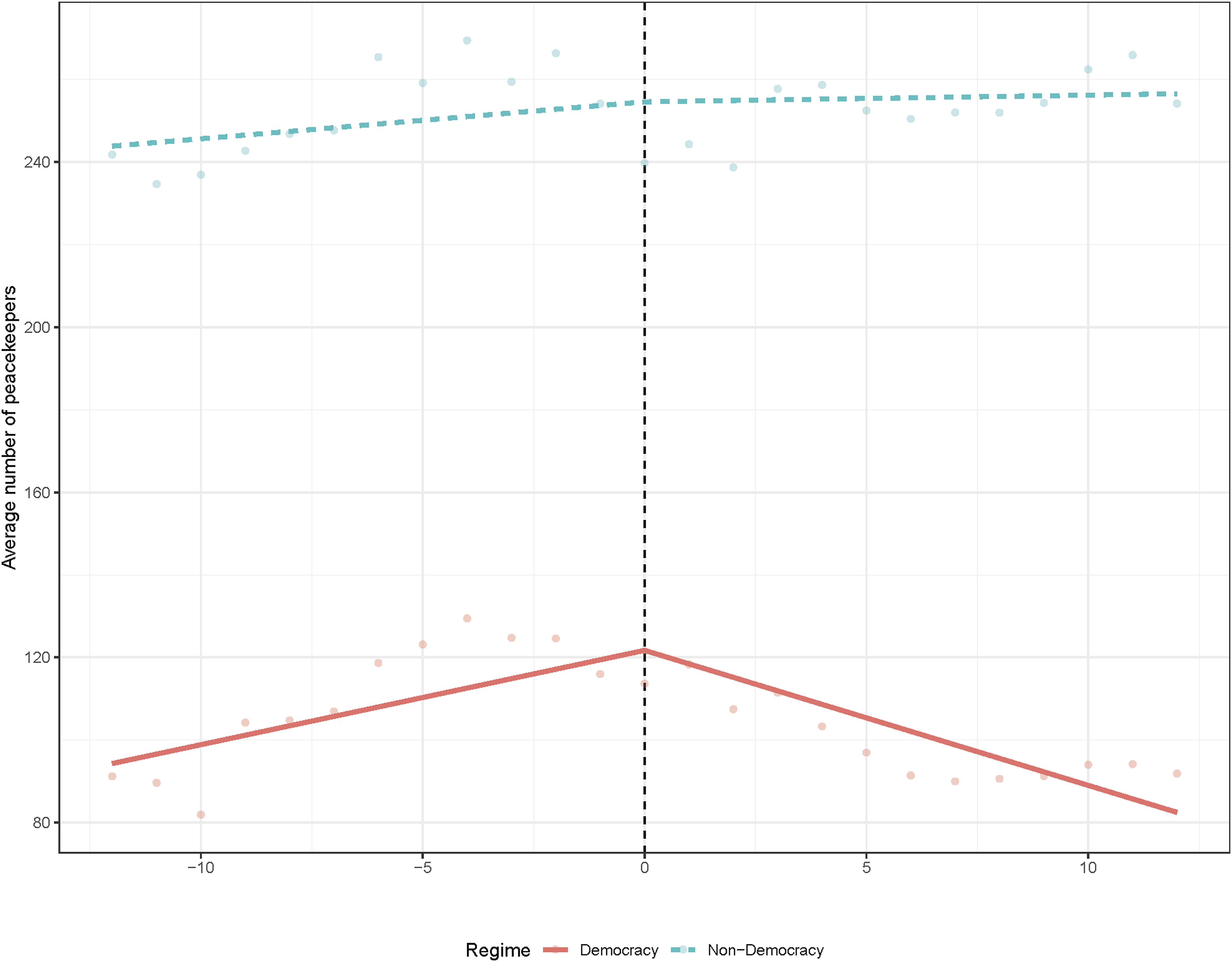
In the plot, we see the trends prior to the election are nearly identical, sloping slightly upward. 10 In the post-election period, we see a noticeable drop among democratic contributors, while the slope for non-democracies remains positive (though less steep). This is consistent with our expectations, and is encouraging. This preliminary look at the data suggests that democracies do seem to reduce peacekeeper contributions, while non-democracies do the opposite.
However, other factors may be relevant to states’ commitment and withdrawal decisions, and there exists a possibility that the relationship between contributions and timing is spurious. Therefore, we estimate the effect of election timing on participation in peacekeeping mission while controlling for a number of potentially confounding variables that might affect both election timing and troop contributions. Five of these—population growth, military expenditures, government effectiveness, political stability, and violence—are measured at the host country level. These factors should all affect the capacity of the country in which peacekeepers are deployed, increasing stability and creating the necessary conditions for elections to be held. The first two come from the Open Data project, 11 the third and fourth are drawn from the Worldwide Governance Indicators, 12 and the last comes from version 19.1 of the UCDP Georeferenced Event Dataset (Sundberg and Melander 2013; Högbladh 2019). Population growth is coded as annual percent change, 13 while military expenditures are calculated as a proportion of GDP. Host effectiveness and host stability are continuous variables, which range from −2.5, indicating the least effective or least stable government, to 2.5, which represents the strongest or most stable government. The total violence variable indicates the log of the total number of deaths (inclusive of both sides and civilians) in a given host country-month. The distance variable, which measures the capital-to-capital distance (in logged kilometers) between the TCC and the host country, is measured at the contributor level, and is drawn from the IPI Peacekeeping Database. Our refugees variable comes from the World Bank, and measures the (logged) number of refugees coming out of the host country in a given year. One variable, the number of new missions, is measured globally at the month level, and simply reflects the number of UN peacekeeping missions initiated anywhere in the world during that month. Finally, we have two variables measured at the mission level. We control for mission costs by including the number of casualties in a given month for both the overall mission (Hypothesis 1) and the relevant TCC (Hypothesis 2). These data come from the Peacekeeping Fatalities Open Data. 14 We also include a dummy variable, civilian protection, which is coded one if the mission’s mandate includes protection of civilians, and zero if it does not. The variable comes from Third-Party Peacekeeping Missions Dataset, created by Mullenbach (2017). We lag time-varying covariates by the appropriate unit in order to mitigate concerns about the direction of causality.
Our dataset initially comprises 4,138 observations at the mission-month level and 131,070 at the contributor-mission-month level. After accounting for missing data, we are left with 2,383 and 94,124 observations, respectively. Relevant information about the distribution of each of these variables can be found in the online appendix. Those measured at the mission-month level are used to evaluate Hypothesis 1, while those at the contributor-mission-month level are included in our assessment of Hypothesis 2.
We analyze the former set of hypotheses by looking at both the number and proportion of democratic (and non-democratic) contributor countries in a given mission-month. As the raw number is a count of contributors and the proportion is a continuous variable, we estimate a series of count and ordinary least squares (OLS) models, respectively. 15 To assess Hypothesis 2, we use the equation given above to obtain OLS estimates of the number of peacekeepers contributed by a TCC in a given month. In all models, we include individual (contributor-mission) fixed effects to account for unobservable phenomena that might affect contributions.
Analysis
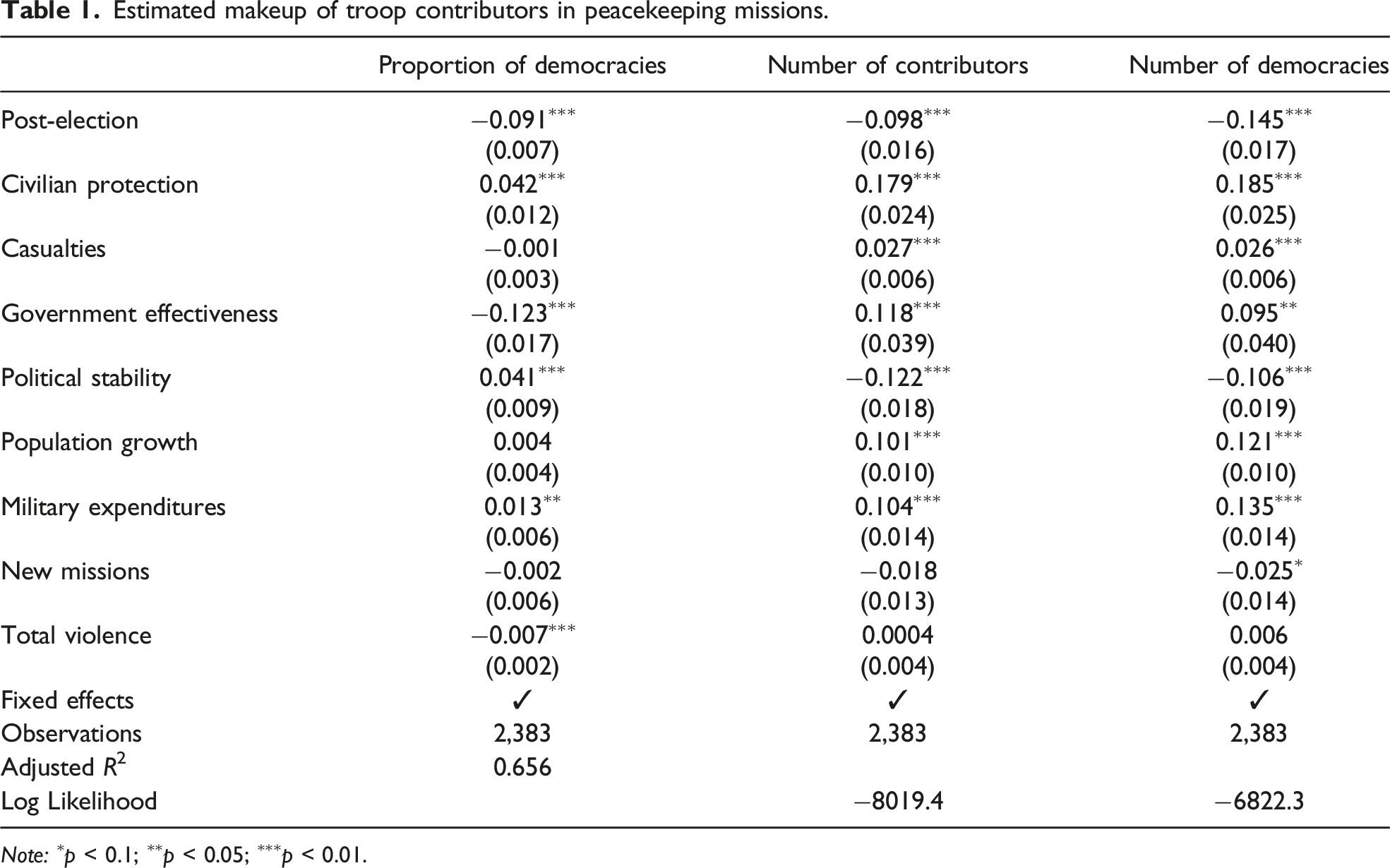
We begin by evaluating our first hypothesis, which posits that host country elections should reduce the number (and proportion) of democratic states involved in a mission. We look at all missions taking place between 1996 and 2017, and count the total number of countries that contributed any personnel in a given mission-month.
Estimated makeup of troop contributors in peacekeeping missions.
Note: ∗p < 0.1; ∗∗p < 0.05; ∗∗∗p < 0.01.
However, some TCCs may opt to reduce the forces that they contribute to the mission, rather than withdraw altogether. In some cases, the reduction may even be substantial enough to approximate a withdrawal, even if a token presence remains. This is the argument put forth in Hypothesis 2. We test this hypothesis below.
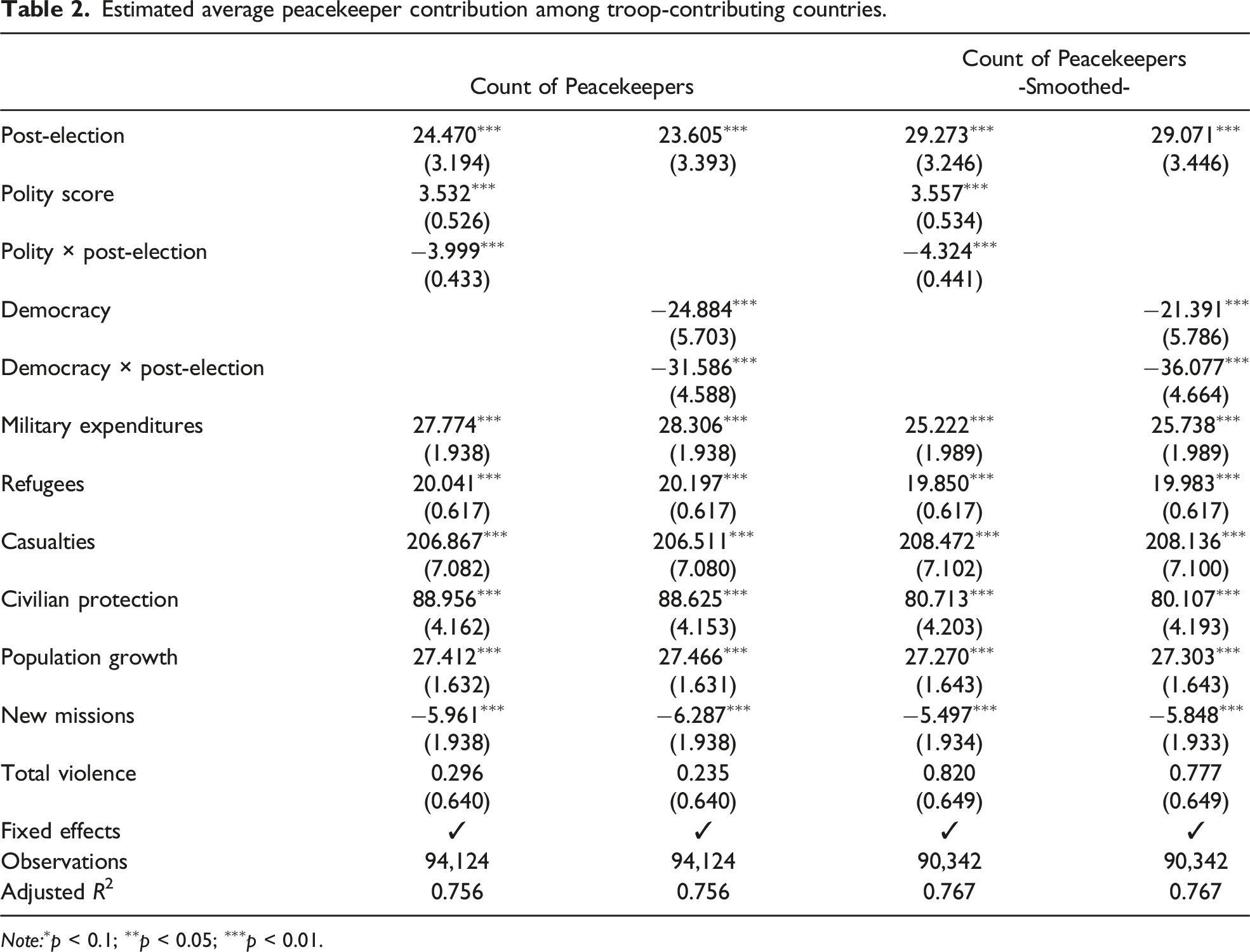
Estimated average peacekeeper contribution among troop-contributing countries.
Note:∗p < 0.1; ∗∗p < 0.05; ∗∗∗p < 0.01.
Our results suggest that while the post-election period is generally associated with more peacekeepers on the ground, democratic TCCs are more likely to decrease their contribution in this phase. Indeed, each additional point on the Polity scale in the post-election period reduces the expected number of troops contributed, relative to the contribution of a comparable country with a lower democracy score. Our findings here are mostly in line with Hypothesis 2 from a statistical standpoint. However, interaction effects can be difficult to interpret. Therefore, it is useful to consider the substantive effect directly.
Figure 2 presents the estimated effect of the election in graphical format. Here, we plot the marginal effect and 95% confidence interval (see Brambor, Clark and Golder 2006) associated with the post-election period across regime types.
16
The mean contribution in a given mission-month is approximately 149 peacekeepers. Our estimates suggest that for a strong autocracy (Polity score of −10), the size of the contribution will increase by between 59 and 86 individuals (an increase of between 39% and 58%, relative to the mean), while a strong democracy (Polity score of 10) will reduce its contribution by between 7 and 21 troops (a decrease of between 4% and 15%, relative to the mean). When comparing democracies and non-democracies as a binary measure, our findings show that non-democracies will increase their contribution levels by somewhere between 22 and 36 troops (a shift of between 14% and 25%, relative to the mean), while the reduction for democracies will be between 0 and 14 (0–10%). Substantive effect of elections on peacekeepers contributed by TCCs.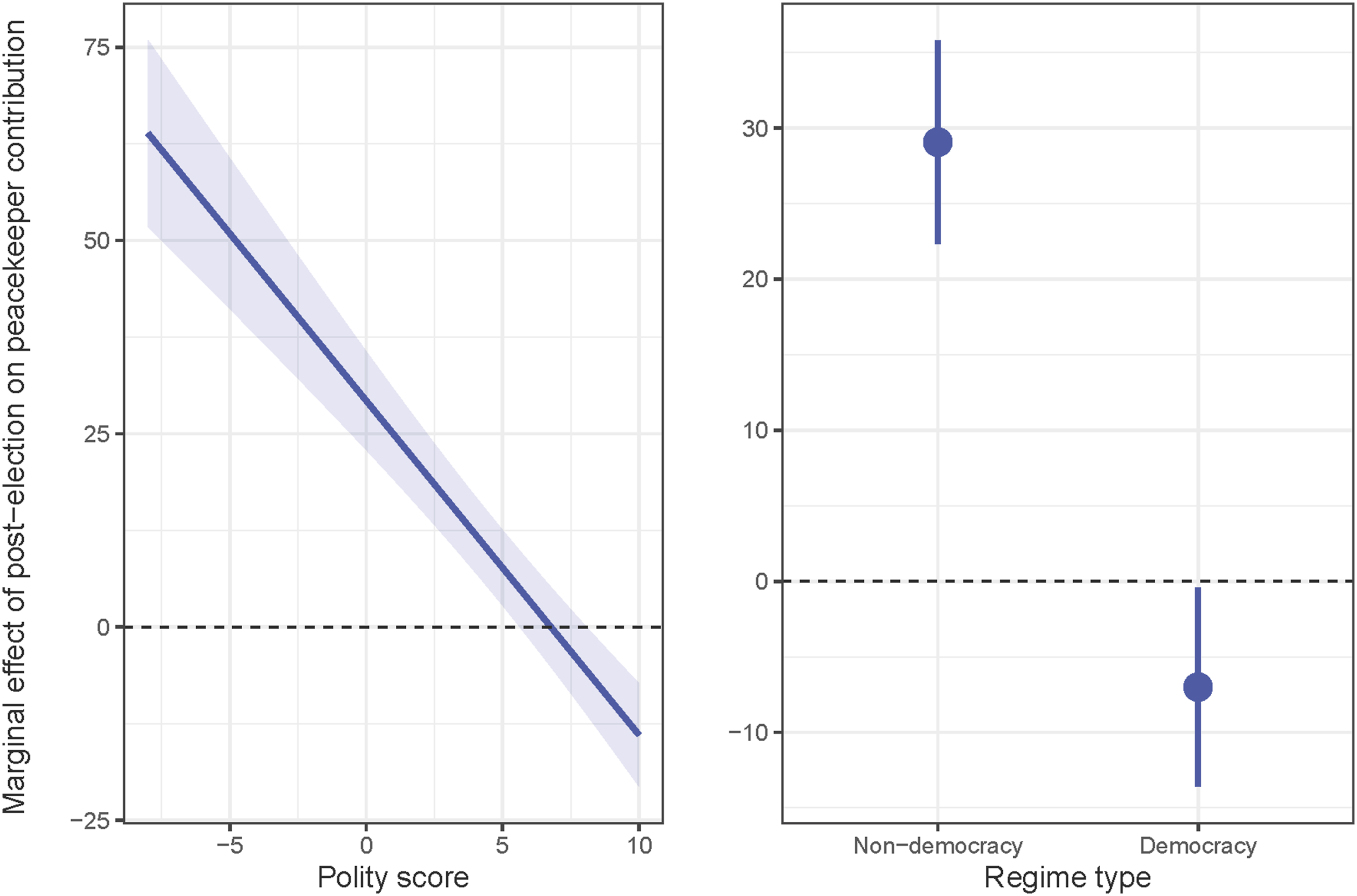
Robustness Checks
Our online appendix contains descriptive statistics for all variables included in our regressions, along with a series of robustness checks. We first re-run the models excluding control variables in order to ensure that our findings are not driven by missing data. We find similar results to those reported in Table 2. We then check whether our results are driven by a particular type of peacekeepers. To that end, we re-analyze peacekeeper contribution disaggregating peacekeeper types into troops, police, and observers. We find that democratic TCCs reduce all three types of peacekeepers following an election in the host country.
We also include two models with additional control variables. Duursma and Gledhill (2019), for example, look at TCC contribution while accounting for constituents’ approval for participating in peacekeeping missions. Their article shows that advanced democratic TCCs are more likely to withdraw from missions during election years. We therefore use their main independent variables—dummies for time periods within 6 months or 1 year from the election date in the relevant contributing country—as additional control variables. Our results remain robust to this inclusion. Levin (2019), meanwhile, finds that peacekeeper fatalities reduce TCC engagement in peace missions, particularly for wealthier troop providers. Indeed, he finds that wealth is a stronger predictor of contribution than democracy. Therefore, we run additional models that control for the real GDP and cost of soldiers of troop providers and find similar results.
Next, we entertain the potential alternative explanation that casualties at the peacekeeper level might affect the engagement of democratic TCCs. In other words, our results may be driven by security threats, rather than political calculations. To that end, we take the lag of contributor-mission-month level peacekeeper casualties and interact it with regime type variables. The results show that advanced democracies are generally not deterred by violence targeting their own military personnel. In the models, we find a statistically significant negative result for both interaction terms. However, the overall marginal effect remains positive. In other words, both democracies and non-democracies increase their contributions in response to casualties, but democratic states do so to a lesser degree. Overall, these results suggest that our findings are not driven by peacekeeper responses to casualties.
We then address the concern that our results are driven by the behavior of a few countries making only token contributions to peacekeeping missions. To ensure that this is not the case, we use Coleman’s (2013) threshold of 40 peacekeepers to identify and exclude token contributions. We then re-estimate our models, using only those TCCs that contributed at least 41 individuals in a given mission-month. Our results remain substantively similar to those presented in Table 2, suggesting that they are not driven by token contributors.
Finally, we acknowledge that personnel contributions are not solely determined by TCCs’ decisions, but can also vary due to the UN Security Council’s (UNSC) operational choices. The UNSC has the authority to determine the maximum number of peacekeepers stationed in target countries. This decision may vary depending on the host country’s background and on budget constraints. In this respect, in order to alleviate concerns that our results might be driven by UNSC decisions, rather than those of troop-providers, we further control for the number of authorized personnel by the UNSC. We acquire the data on formally-authorized personnel from Passmore, Shannon and Hart (2018). After controlling for personnel authorized by the Security Council, we uncover results that are substantively identical to our earlier findings. In short, our results are robust to various alternative specifications reported in the online appendix, and continue to show that democratic states are significantly more likely to reduce their contributions in the wake of the first post-conflict election in the host country.
Conclusion
Extant work on peacekeeping has focused primarily on initial engagement in peacekeeping missions. Scholars have concentrated on the varied motivations of contributor states that cause them to be selective in the countries to which they send soldiers. While exploration of motivation is useful, an equally important phenomenon—the behavior of TCCs once the mission has begun—has received far less attention. In particular, previous research has left open the question of why contributors would withdraw from ongoing missions, even after pledging to contribute to peace. This article has contributed to our understanding of peacekeeping missions by considering such behavior in the context of the domestic political structure of participating countries. While we are not able to test each mechanism within our theory directly, we do provide evidence that is consistent with our conjectures. Our results show that the behavior of democratic and non-democratic TCCs differ markedly. While the post-election period is generally associated with more peacekeeping personnel on average, democracies are significantly more likely to reduce commitments at this particular phase, viewing such events as opportunities to exit, or at least to withdraw certain components of their contributions. Future research should attempt to get at the precise mechanisms that underlie the differences we see here, by seeking large-scale evidence of domestic costs for peacekeeping failures and analyzing TCC behavior with respect to the timing and organization of host country elections. The policy implications that this work offers to the UN should not be overlooked. The literature on post-conflict peacebuilding informs us that the risk of conflict recurrence persists even after post-war elections are held. Disengagement by advanced democracies (those with more professional troops) from UN missions, therefore, is not in the best interest of the civilians in the host countries. In some cases, the withdrawal of advanced democracies from the mission and the change in the composition of peacekeepers might signal to the warring parties that the UN is not as committed to peace as it used to be. This explains why advanced democracies might still play an integral role in the peacebuilding phase as well.
With respect to the academic understanding of peacekeeping, this work marks an important step forward within the literature on the supply-side of UN peacekeeping missions. At the same time, it opens up a number of interesting questions. Perhaps most importantly, our research hints at a phenomenon that we do not assess empirically. If democratic states see elections as exit opportunities, then post-conflict elections may (at least in some cases) be strategic in nature. Therefore, when democratic states—which often play pivotal roles within peacekeeping missions—foresee a difficult and calamitous road ahead, they have an incentive to push for premature elections in order to bring about a chance to declare victory and withdraw before disaster sets in. In fact, this is likely what occurred in Cambodia, where UNTAC contributors were unable to resolve lingering commitment problems. Future research into this and related questions pertaining to contributor behavior after a mission has begun is necessary to deepen our understanding of how and when peacekeeping missions are most likely to succeed.
Supplemental Material
Supplemental Material - Election Accomplished: Democracies and the Timing of Peacekeeper Drawdowns
Supplemental Material for Election Accomplished: Democracies and the Timing of Peacekeeper Drawdowns by Burak Giray and John T. Chatagnier in Political Research Quarterly
Supplemental Material
Supplemental Material - Election Accomplished: Democracies and the Timing of Peacekeeper Drawdowns
Supplemental Material for Election Accomplished: Democracies and the Timing of Peacekeeper Drawdowns by Burak Giray and John T. Chatagnier in Political Research Quarterly
Footnotes
Acknowledgments
The authors thank Songying Fang, Connor Huff, Ulkar Imamverdiyeva, Kerim Can Kavaklı, Nikolay Marinov, Jared Oestman, Pablo Pinto, and Patrick Shea for comments on previous drafts.
Declaration of Conflicting Interests
The author(s) declared no potential conflicts of interest with respect to the research, authorship, and/or publication of this article.
Funding
The author(s) received no financial support for the research, authorship, and/or publication of this article.

Supplemental Material
Supplemental material for this article is available online.
Notes
References
Supplementary Material
Please find the following supplemental material available below.
For Open Access articles published under a Creative Commons License, all supplemental material carries the same license as the article it is associated with.
For non-Open Access articles published, all supplemental material carries a non-exclusive license, and permission requests for re-use of supplemental material or any part of supplemental material shall be sent directly to the copyright owner as specified in the copyright notice associated with the article.
