




Abstract
A growing literature finds that social identity attachments to ideological and partisan groups often generate mistrust, hostility, and prejudice toward opposition groups. Yet, there are no studies of whether attachments to ideological groups (i.e., left, right, liberal, and conservative) contribute to political intolerance—defined as an unwillingness to extend basic liberties to groups one opposes—a widely studied and politically consequential form of outgroup hostility. Using both observational and experimental data, we examine how social identity attachments to left–right groups in Israel influence Jewish Israelis’ political intolerance of disliked domestic groups, that is, least-liked groups and Arab citizens. In contrast to other studies—mostly in the US—that find roughly parallel levels of political and social prejudice toward opposition groups, we theorize and find that more strongly attached rightists and leftists in Israel become more polarized in their levels of political tolerance toward disliked groups. Among rightists, stronger identities decrease tolerance, whereas among leftists, political tolerance increases. Thus, outside the US, identity strength can actually be a protector of democratic values, leading some groups (i.e., Jewish leftists) to become more tolerant.
Introduction
A growing literature, mostly in the US, finds that social identity attachments to ideological and partisan groups often generate mistrust, hostility, and prejudice toward opposition groups (e.g., Mason 2018b; West and Iyengar 2022). Yet, there are no studies of whether such attachments to political groups also contribute to political intolerance—defined as an unwillingness to extend basic liberties to groups one opposes—a widely studied and politically consequential form of outgroup hostility. Based on both observational and experimental evidence, we examine how social identity attachments with the political Left or Right among Jews in Israel, the dominant ethnic group 1 , influence their willingness to deprive their “domestic enemies” (Gibson 2006) of basic civil liberties.
In a two-wave panel survey of Jewish citizens of Israel conducted in 2018, we assess left-right identity strength with a brief index of items similar to those used to measure ideological and partisan social identities in the US and other countries (e.g., Huddy, Mason, and Aarøe 2015; Mason 2018a; Bankert et al. 2017). Such measures focus on the strength of social attachments to the political ingroup—in this case, leftists and rightists. Given that political tolerance involves extending political rights and freedoms to disliked groups, we broaden the usual targets of left–right social identity from rival opposition groups to least-liked groups and Arab citizens. In the first wave of the survey, we rely on cross-sectional survey data to show that stronger social identity attachments polarize levels of political tolerance toward both target groups across the Right and Left. Among right-wingers, stronger social attachments increase political intolerance toward disliked groups, while among the Left stronger attachments are associated with greater forbearance. In the second wave of the survey, we use a novel experiment to determine whether social identity attachments influence rightists’ (leftists’) support for (opposition to) harsh counter-terrorism policies toward Arab citizens when terrorist threat is elevated in a vignette. Under higher threat, strongly attached leftists and rightists polarize in their tolerance levels, while their weakly attached counterparts fail to diverge in reaction to threat.
Our focus on Israel is important for both theoretical and substantive reasons. Most notably, we investigate why, in Israel, stronger social attachments among rightists and leftists tend to polarize levels of political tolerance. This pattern stands in contrast to studies in the US that find stronger social attachments produce parallel incivilities and prejudices among rival partisan and ideological groups (e.g., Mason 2018b, Miller and Conover 2015). Importantly, we show that the polarization of intolerance in Israel is due as much to the different meanings of social identities on the Left and Right as their intensity. Thus, among Jewish leftists, identity strength can actually be a protector of democratic values, leading leftists to be more tolerant.
In addition, in contrast to the usual tendency of social identity studies to focus on group members with the strongest social identity attachments, since they tend to be prototypical group leaders who define group norms (e.g., Ellemers and Jetten 2013), our survey experiment also focuses on the reactions of weakly attached leftists to elevated terrorist threat. We show that they are much more likely to abandon their commitment to uphold the civil liberties of Arab citizens in the face of threat, thus providing important insight into the cross-pressures and defections experienced by leftists in Israel.
We also argue that the forces that work to polarize political tolerance across left-right social identities are not unique to Israel. Rather, they tend to be shared by younger democracies like Israel (e.g., India, Poland, and Turkey) that are beset by severe political polarization on identity issues and a history of high levels of security threats, either real or perceived, a topic we take up in the conclusion.
Left-Right Social Identities and Political Tolerance
In contrast to the traditional conceptualization of “issue-based ideology,” where divisions between ideological groups are viewed as being based on issue positions, an “identity-based ideology” (what we term, left–right social identity) is rooted in social identity and reflects a person’s psychological attachment to an ideological group and its members (e.g., Ellis and Stimson 2012; Mason 2018a). The theoretical argument for left–right social identity stems from social identity research in psychology and its assumption that people identify with social groups. As noted by Brewer (2001), social identities (and political identities) fill two basic psychological needs—one of inclusion (being part of the group) and one of exclusion (distinguishing oneself from others). As Tajfel and Turner (1979) theorize, people automatically categorize the social world into ingroups and outgroups, or “we” versus “they,” where the ingroup is implicitly judged to be superior to the outgroup. In the political world, ideological and partisan labels such as “left” and “right,” “Democrat” and “Republican,” indicate who is “us” and who is “them.”
The empirical case for left–right social identity is made by studies using established social identity measures to capture the intensity of a person’s psychological attachment to a political group. In a series of survey experiments in the US and West European countries, for example, Huddy and her coauthors (2015, 2018) show how partisan social identities, in the face of challenging information, motivate a defense of the in-party, producing the vilification of threatening out-parties, and generating action-oriented emotions that increase political activity, even after controlling for instrumental or issue-based concerns (see also Mason 2018a). And in a recent study, Oshri, Yair, and Huddy (2022) employ a similar measure of left-right social identity to predict the political activism of leftists and rightists in Israel’s multi-party system.
Especially relevant for our purposes, measures of partisan and left–right social identities have been shown to explain the rising level of hostility and incivility toward political opposition groups. Although social identity theorists are quick to point out that there is no necessary connection between “ingroup love” (ingroup identities) and “outgroup hate” (Brewer 2001), when intergroup conflict and threat become salient, intense ingroup identities often lead to outgroup hostility (e.g., Gibson and Gouws 2003; Miller and Conover 2015). Given the increased polarization of elites (e.g., McCoy, Rahman, and Somer 2018) and the information environment in the US and elsewhere (Levendusky 2013, Lelkes 2016), the convergence of political and social identities has amplified hostility toward political outgroups (e.g., Mason 2018b).
While there are no studies of whether left-right social identities impact political tolerance, Gibson and Gouws’ (2003) classic study examined how the social identities of racial groups (e.g., whites and Africans) shaped political intolerance in South Africa. The authors concluded that “stronger and more developed group identities are associated with greater intergroup antipathy, threat and intolerance” (93) 2 . In addition, recent research in the US finds identity-based partisans endorse various forms of partisan hostility and even violence toward the political opposition. Using a version of the partisan social identity index developed by Huddy et al. (2015), for example, Kalmoe and Mason (2022) found socially attached partisans in 2020 were more likely to hold views that rationalize physically harming partisan opponents (called “moral disengagement”) and endorse various forms of partisan violence (e.g., sending threatening and harmful messages to members or leaders of the opposition party). While harming one’s political opponents is not the same as depriving them of their civil liberties, if identity-based partisanship (or ideology) is powerful enough to motivate violence, it should motivate intolerance.
For our purposes, a critical remaining question is whether strongly attached rightists and leftists will express similar levels of political intolerance toward groups they oppose. On one hand, as noted, US studies regularly find left–right social identity (or partisanship) produces parallel incivilities and prejudices among rival ideological and partisan groups. Republicans (conservatives) are no more likely than Democrats (liberals) to display various forms of political prejudice or hostility, a pattern replicated by Kalmoe and Mason (2022) in their study of partisan violence. More to the point, US studies of political tolerance toward least-liked groups find tolerance is not significantly associated with ideological self-placement or partisanship (Gibson 2013, Sullivan et al. 1982). 3
On the other hand, studies in Israel question whether such Left–Right parity is universal, at least when it comes to political tolerance. Tolerance toward least-liked groups, for example, has consistently been found to be lower among Jewish Israelis on the right than among their leftist counterparts (e.g., Shamir and Sullivan 1983; Shamir and Sagiv-Schifter 2006). Across a tumultuous 30-year period, from 1980 to 2011, and during the two intifadas when threat from terrorism was at its highest, Jewish leftists in Israel were consistently more politically tolerant of their least-liked group than Jewish rightists (e.g., Peffley, Hutchison, and Shamir 2015, 2022 1 ). 4
Left–Right Social Identity and Political Intolerance in Israel
Why do we expect strongly attached Jewish leftists and rightists to diverge in their level of political intolerance toward disliked groups? And why are left–right social identities likely to be such strong predictors of political responses in Israel? One reason is that Israel has a multi-party system, with dozens of parties, many of which come and go from one election to the next, making identification with a Left or Right bloc much more important for most voters than partisan identities (e.g., Ventura 2001; Oshri, Yair, and Huddy 2022). In addition, Israel has lived under the threat of constant attack for much of its history, being involved in several armed conflicts and suffering from organized and deadly terror campaigns. Studies show that existential threats from war and terrorism can both magnify identity conflicts, as intergroup hostilities become more visceral and tribal (Stephan, Ybarra, and Morrison 2016), and “increase intolerance, prejudice, ethnocentrism, and xenophobia” toward outgroups (Huddy et al. 2005, 594).
Moreover, Israel is highly polarized, both politically and socially, in ways that contribute to animosities and political prejudices between identity groups on the Left and Right. In contrast to the US and other democratic countries, where issue positions tend to cluster along economic, social and foreign policy dimensions (e.g., Goren 2013; Federico and Malka 2018), Left–Right polarization in Israel, as reflected in voting behavior and placement on the left-right scale, has been largely defined by a single overriding issue—the Israeli–Palestinian conflict. This conflict became the dominant cleavage dimension structuring Israeli politics after the occupation of territories seized in the 1967 Six Day War (Shamir and Arian 1999). Equally important, while identity convergence and “mega-identities” have been increasing in the US (Mason 2018b), Left–Right identities have been socially sorted along religious and ethnic lines in Israel for decades. Secular Jews, for example, are far more aligned with the Left, while more Orthodox Jews are aligned with the Right (Shamir and Arian 1999; Oshri et al. 2022).
A more fundamental characteristic of the Left–Right cleavage in Israel is that it is based on polarized conceptions of Israel’s national identity in terms of Israel’s posture toward its Arab neighbors and the state’s inclusion of Arab citizens—roughly 20% of Israel’s population (Shamir and Arian 1999). The Right has consistently adopted an exclusionary posture toward both Palestinians in the occupied territories and Israeli Arab citizens 5 , both of whom they view as a threat to the country’s security and national identity. By contrast, Israeli Jews on the Left tend to favor the inclusion of Israeli Arabs and negotiations with the Palestinians over the occupied territories.
These competing understandings of nationhood held by rightists and leftists in Israel constitute ethnocultural versus civic national identities, respectively. The former defines prototypical or “true” nationals in narrow, ethnic terms (e.g., Jewish in Israel and Christian or White in the US), drawing an exclusionary boundary between “us,” the ethnic ingroup, and “them,” ethnic and religious minorities not considered true nationals (e.g., Arab citizens in Israel and Muslim Americans or Blacks in the US) (e.g., Citrin and Wright 2009; Pehrson, Vignoles, and Brown 2009). In many countries, an exclusionary view of national identity is associated with the far Right, while the Left adopts a more inclusive, and “civic” conception of national identity defined by respect for institutions and treating people (i.e., ethnic and religious minorities) equally (e.g., Bonikowski 2017). In Israel, however, it is the defining element of Left-Right conflict.
Studies in Israel clearly show that rightists adopt a distinctly “ethnocultural” identity, placing a much higher value on the “Jewish” identity of the state, thereby implicitly or explicitly excluding Arabs as equal citizens (Shamir and Arian 1999). Jews on the Left, by contrast, tend to adopt a more “civic” national identity by placing a higher priority on an inclusive “Israeli” identity of the state that supports universal democratic freedoms and the incorporation of Arab citizens. Seen through the lens of social identity theory, one way that socially identified rightists and leftists create what Tajfel and Turner (1979) called a “positive distinctiveness” between their ingroup and the outgroup, is by rightists being less tolerant toward groups that “threaten the nation” and leftists being more tolerant toward groups like Israeli Arabs who are routinely and falsely accused by the Right of being a “fifth column.”
Considering our focus on political tolerance in Israel, we adapt the study of left-right social identity in two important respects. First, given that political tolerance involves extending political rights and freedoms to disliked groups, we broaden the usual targets of left-right social identity from rival opposition groups (i.e., leftists versus rightists) to least-liked groups and Arab citizens (see below). Second, because political tolerance is unlike voting behavior, a central focus of studies of expressive ideology and partisanship (e.g., Oshri et al. 2022; Huddy et al. 2015), rather than including issue preferences as controls, we include controls found to be major determinants of political tolerance in the literature—that is, perceived threat, support for democratic values and authoritarianism.
Hypotheses
Given prior research and conditions in Israel (i.e., high external threat and divided identities), we predict the political tolerance of leftists and rightists should become more polarized as left–right identity strength increases, even after controlling for other predictors of tolerance (H1). More specifically, we propose H1a, that more intense social identities on the Right should decrease tolerance toward disliked groups, whereas H1b predicts that intense social identification among Jewish leftists should increase tolerance, given their greater support for universal democratic freedoms. Thus, as social identities become more intense, political tolerance should polarize across the Left–Right divide.
Tolerance Toward Least-Liked Groups
A strong test of the polarization hypothesis is provided by using the least-liked method of measuring tolerance (Sullivan et al. 1982), which allows respondents to pick the domestic political group they like the least from a list, followed by political tolerance questions that are tailored to the group. Because this method puts leftists and rightists on a roughly even playing field, if in fact both groups become more intolerant as their identities intensify, the least-liked method should reveal such a pattern. After Gibson (2013, 60) found that partisanship and ideology are not associated with political tolerance toward least-liked groups in the US, he concluded, “to the extent that a measure of tolerance is sought that is equally challenging for liberals and conservatives, Democrats and Republicans, the disliked-group measure seems preferable to the other possibilities” (i.e., fixed group and civil liberties policies).
Tolerance Toward Arab Citizens
In the case of Israel, given the contested understandings of nationhood on the Left and the Right, in addition to high external threat, another important test of the polarization hypothesis (H1) is provided by examining fixed-group tolerance toward Israeli Arab citizens. As noted, Arab citizens comprise one-fifth of the populous in Israel and are a frequent target of derogation, mostly from right-wing groups and leaders. In fact, leaders of the right-wing bloc often vilify the Jewish Left in Israel by accusing it of threatening the Jewish state by empowering Arab political groups. To be sure, we do not expect political tolerance toward Israeli Arabs to be parallel across the Left and Right, although it is worth noting that a substantial portion of Jewish leftists in our study selected Arab groups as least-liked. Rather, tolerance toward Arab citizens is an essential focus for at least two reasons. First, Arab citizens are as important for assessing political tolerance in Israel as American Communists were during the United States’ McCarthy Red Scare era. Second, as we hypothesize below, studying tolerance toward Arab citizens allows us to examine how increasing threat from terrorism creates very different pressures for rightists and leftists in Israel, depending on the strength of their social identity attachments.
Terrorism Threat Hypothesis
In the second half of our study, we use the results of a survey experiment manipulating threat from terrorism to address two important unanswered questions. First, focusing on strongly identified leftists and rightists, we test the hypothesis that raising the salience of threat creates greater polarization in tolerance between the two groups (H2a). Second, security threats from terrorism should produce different reactions among marginal and core members of a political identity group. Although social identity research focuses on gradations in the strength of such identities, it is also true that weakly attached or marginal group members have traditionally attracted much less attention in social identity research (e.g., Ellemers and Jetten 2013). However, recent research clearly shows that the less central a group is to a person’s sense of self (i.e., the weaker their social attachments to the group), the more we should expect a person to abandon the group’s norms when placed under stress (e.g., Pérez and Kuo 2021). While terrorism is an existential threat for all Israelis, it poses a special political problem for the Left in Israel among its Jewish citizens, who have become less likely to identify as leftists after intense terror campaigns (Peffley et al. 2018).
Our next hypothesis, therefore, has a good deal of practical and political import in Israel. Even among Jews who identify with the Left, when threat from terrorism is elevated, weakly attached leftists may side with the Right in expressing more support for depriving Arab citizens of their civil liberties, compared to strongly identified leftists (H2b). After all, most terror attacks are perpetrated from Palestinian groups in the occupied territories, and there is a strong tendency, especially among rightists, to associate threats from Palestinians with Arab citizens (e.g., Peffley, Hutchison, and Shamir 2022).
To test hypotheses H2a and H2b, we embedded a survey experiment in the second wave of the panel that manipulates threat from terrorism to examine whether increased threat polarizes political intolerance toward Israeli Arabs among strongly identified leftists and rightists, and whether more weakly identified leftists and rightists fail to diverge in their level of tolerance when faced with higher threat.
Political Engagement
We must also consider a competing explanation for H2. Because respondents with stronger left–right social identities may also be more politically engaged, they may be more aware of elite cues among rightist and leftist groups. More strongly attached leftists, for example, might initially feel threatened in the face of a terror attack. But after a “sober second thought” about the importance of civil liberties learned from elite cues and arguments on the Left, they may then move toward forbearance. This competing explanation is consistent with Malka et al.’s (2014) analysis using the 2009 World Values Survey. The authors found the less engaged are more reactive to economic threats by supporting liberal (protective) economic policies, while the more engaged tend to support conservative economic policies because they override their initial instincts to follow elite cues about what is ideologically appropriate. Accordingly, H3 predicts that, as political engagement rises among leftists, their political tolerance toward Arab citizens will increase when terrorism threat is elevated.
Data, Method, Measures
To test our hypotheses, we rely on a two-wave Israeli online panel survey of Jewish citizens, with the first wave conducted in June of 2018 and the second wave in July. iPanel, one of Israel’s largest online survey firms, fielded the survey, which was stratified by demographic characteristics (age, gender, religiosity, education, and country of origin) using a quota sampling design. More details about the survey are in Online Appendix, Section A.
We use both observational and experimental data to provide a robust test of our hypotheses. The observational study is drawn exclusively from the first wave of the panel, while the survey experiment is included in the second wave. For the experiment, we use predictors measured in the first wave to provide additional separation between the independent and dependent variables.
Observational Study
Political tolerance, the primary dependent variable in the observational study, was measured, as noted, using both least-liked and fixed-group approaches in the first wave of the survey. For the least-liked measure, respondents were first asked to pick the group they liked the least from a list of 14 groups (see the groups and their selection in Appendix Table A3). Political tolerance was then assessed by agreement with two statements about whether the group they selected “should be allowed to hold demonstrations” and “to speak on TV” on 5-point scales ranging from “strongly disagree” (coded 0) to “strongly agree” (4). Least-Liked Political Tolerance is an additive scale (r = 0.68) initially ranging from 0 (strong disagreement on both items) to 8 (strong agreement on both items), with higher values denoting greater tolerance. A similar fixed-group measure of Arab Political Tolerance was created by adding responses to analogous questions about allowing demonstrations and speech in reference to “Israel’s Arab citizens” (r = 0.67). All variables were recoded to a 0 to 1 scale.
Given that the civil liberties of Arab citizens are contested in Israel, we also assess what we call Arab Civil Liberties by gauging the degree to which Jews disagree with three statements suggesting Arab citizens do not deserve the same rights as Jewish citizens (Alpha = 0.67). 6 As might be expected comparing the average level of support for the three measures, tolerance for least-liked groups (0.41) is lower than extending the same freedoms to Arab citizens (0.60), with support for Arab Civil Liberties falling somewhere between (0.49) (see, e.g., Shamir and Sagiv-Schifter 2006).
To measure Left-Right Political Identity, respondents were asked a standard question appearing in Israeli National Election Studies surveys since 1969, “With what political tendency do you identify?” The original 5-point scale, translating from Hebrew—Right (0), Moderate Right (1), Center (2) Moderate Left (3), and Left (4), was recoded to a binary variable: Right (0) and Left (1). Because the meaning of the Center often changes in Israeli politics, offering no clear or consistent object of identification, and since the center bloc is less established in Israeli politics, we follow other studies that focus only on Left–Right ideological groups in our analysis (e.g., Ventura 2001; Oshri et al. 2022; see Mason, 2018a for a similar approach in the US context).
Left-Right Identity Strength, defined as the degree to which individuals feel socially and emotionally attached to either a Left or Right political group, was measured with four questions often found in indices of social identification of ideological (and partisan) groups in the US and other countries (Mason 2018b; Huddy et al. 2015; Bankert et al. 2017). Immediately after indicating a Right or Left Political Identity, respondents were asked, “How important is being [rightist/leftist] to you?” on a 4-point scale ranging from “not at all important” (0) to “extremely important” (3). Next, they were asked whether they agreed with two statements: “When I meet someone who supports the political [Right/Left] I feel connected,” and “When people criticize the [Right/Left], it feels like a personal insult,” ranging from “strongly disagree” (0) to “strongly agree” (3). The fourth indicator of Left-Right Identity Strength is a binary measure of the intensity of Left–right Political ID, with “Moderate” Right/Left coded as 0 and the two end-points of the original scale, Right and Left, coded as 1 7 .
Before adding the four indicators to create the Left-Right Identity Strength index, the first three items were coded to a 0 to 1 scale to avoid artificially weighting them more than the fourth binary indicator. The additive index was rescaled to a 0 to 1 scale, with higher values indicating more intense identities (Αlpha = 0.65). The mean of the scale for the full sample is 0.42, with a standard deviation of 0.22 (for rightists the mean is 0.44 [sd = 0.23] and for leftists it is 0.36 [sd = 0.18]). For our purposes, we are primarily interested in the interaction between Left-Right Political ID (coded 0 for Right, 1 for Left), and Left-Right Identity Strength, which taps the intensity of social group attachments associated with the Right or Left. Left–Right Political Identity in our sample of Jewish respondents is strongly skewed to the Right (75%) versus Left (25%) 8 .
Controls
We also include as controls several predictors of tolerance found to be important in prior research (e.g., Sullivan et al. 1982; Gibson 2006), such as support for democratic values, authoritarianism and perceived threat from the target group (least-liked groups and Arab citizens), as well as demographic characteristics (i.e., religiosity, age, female, education, and income), described below and in Appendix, Section A. Omitting these variables could end up overstating the effects of any new predictors, such as Left–Right Social Identity.
Support for Democratic Values is an additive index of agreement with three statements expressing support for free speech, equal protections and minority rights, initially coded from 0 to 12, with higher values indicating greater support (Alpha = 0.67). Perceptions of Least-Liked Threat (r = 0.61) and Israeli Arab Threat (r = 0.69) are additive scales assessing threat to “democracy in Israel” and the “Jewish identity of the state” ranging from “not threatening at all” (0) to “very threatening” (5). Authoritarianism, also described as a “fixed” versus an “open” worldview, is a robust predictor of both social and political intolerance in the US and other countries (e.g., Feldman and Stenner 1997; Hetherington and Weiler 2018). Like other studies, our measure is an additive scale (Alpha = 0.53) based on the number of times people select a more authoritarian value (e.g., “obedience”) when asked to choose from “pair[s] of desirable qualities, which one you think is more important for a child to have.” Respondents identifying as Left, compared with Right, are less authoritarian (r = −0.26), more supportive of democratic values (0.26) and perceive less threat from their least-liked group (−0.11) and from Arab citizens (−0.39).
In the analysis that follows, we first examine the antecedents or covariates of Left–Right Identity Strength to gain a more detailed portraiture of how more strongly attached rightists and leftists differ from one another. Next, we estimate parallel models predicting our three measures of political tolerance based on observational data from Wave 1 to test H1. We then examine the results of the terrorist threat survey experiment in Wave 2 to test H2 and H3. Prior to estimation, all variables were recoded to a 0 to 1 scale to make the coefficients easier to interpret.
Results
Predicting Political Tolerance in Israel
Before turning to the observational analysis, we briefly summarize the results of Appendix Section B, where we examine the covariates of our Left-Right Identity Strength measure. Because we hypothesize different effects of social identity for leftists and rightists, it is important to see how the meaning of social identities differs for more strongly attached members on the Left and Right. We answer this question by examining how leftists’ and rightists’ social identities covary with key political orientations—that is, democratic values, views of nationhood, and authoritarianism, as well as various demographic factors, such as education and religiosity. The OLS coefficient plot in Section B shows that leftists and rightists diverge most sharply in terms of their support for democratic values. More strongly attached leftists express greater support for free speech and minority rights (b = 0.42), while more strongly attached rightists express weaker support for democratic values (b = −0.14). In addition, consistent with earlier research (Shamir and Arian 1999), strongly attached rightists place a higher value on a “Jewish” versus “Israeli” identity of the state, while their leftist counterparts identify more as Israelis, consistent with ethnocultural versus civic views of national identity, respectively. Aside from these orientations, only higher authoritarianism significantly predicts stronger attachments, and it only matter for rightists, not leftists. Overall, the distinct profiles of rightists and leftists that emerge serve to reinforce our expectation that, in Israel, strongly attached Jewish leftists and rightists will polarize in their judgments of political tolerance.
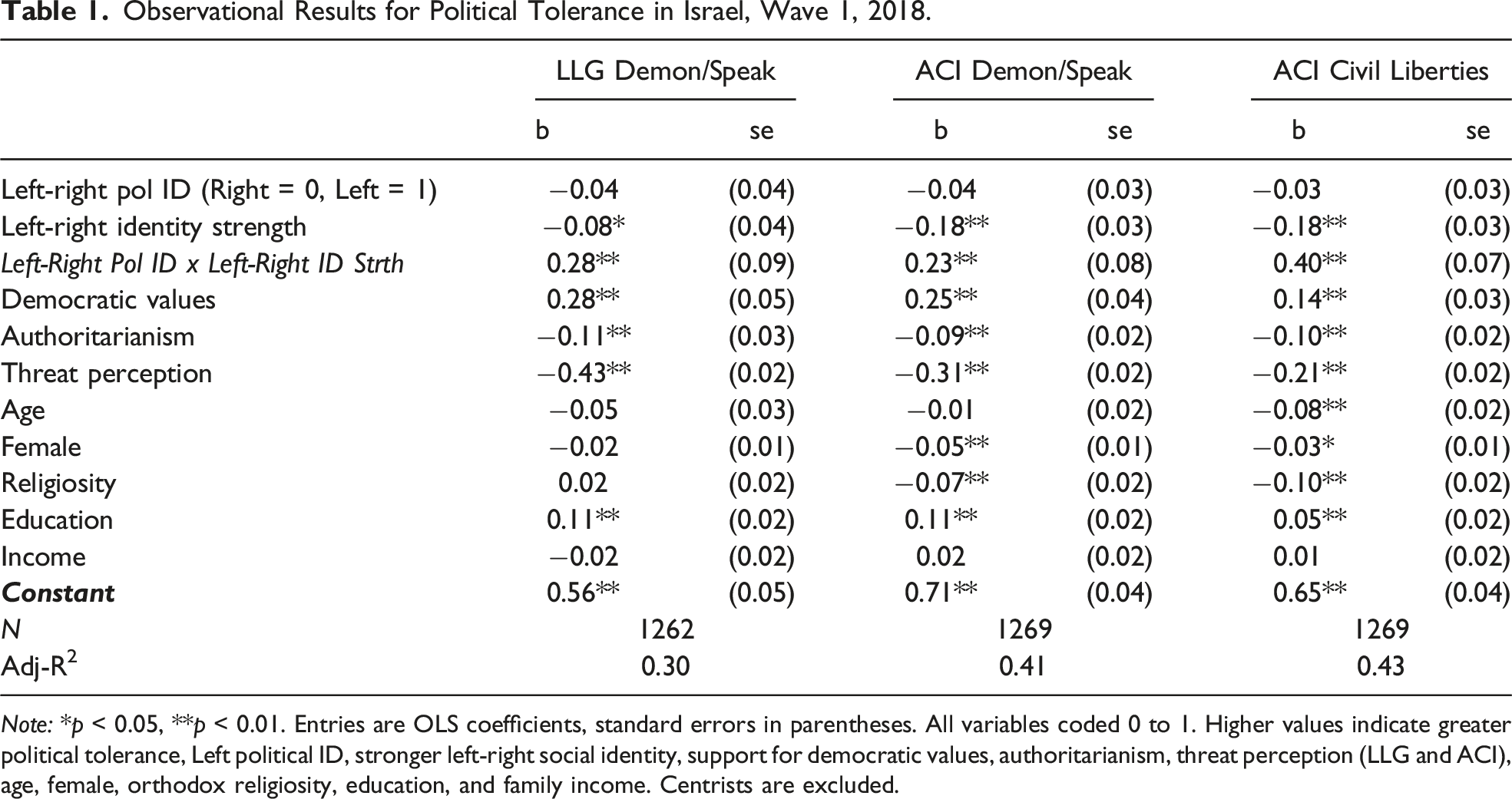
We turn now to our observational analysis of the consequences of Left–Right Identity Strength for political tolerance in Israel. To test the polarization hypothesis (H1), we estimate similar equations for all three measures of political tolerance by including the control variables and the multiplicative term, Left-Right Political ID x Left-Right Identity Strength, along with first-order terms. As the strength of social identification with Left and Right groups increases, so should the gap in estimated levels of tolerance across rightists and leftists. Again, all variables were recoded to a 0 to 1 scale.
Observational Results for Political Tolerance in Israel, Wave 1, 2018.
Note: *p < 0.05, **p < 0.01. Entries are OLS coefficients, standard errors in parentheses. All variables coded 0 to 1. Higher values indicate greater political tolerance, Left political ID, stronger left-right social identity, support for democratic values, authoritarianism, threat perception (LLG and ACI), age, female, orthodox religiosity, education, and family income. Centrists are excluded.
As expected, because rightists are more suspicious of Arab Citizens of Israel (ACI), the strength of their social identity attachments, in the middle and right-most columns of coefficients in Table 1, are twice as powerful in predicting tolerance toward Arab citizens (both b’s = −0.18) as least-liked groups (b = −0.08), consistent with H1a. While not the focus of our analysis, we also note that several of the control variables exert their usual potent impact on political tolerance. Although the coefficients for Democratic Values and Threat Perceptions are greater than the (conditional) coefficient for Left-Right Social Identity, the fact that social identity strength registers such a robust impact in the face of powerful controls is impressive.
To gain a better sense of support for the polarization hypothesis among both rightists and leftists (i.e., H1a and H1b), we graph in Figure 1 the predicted values of political tolerance for all three measures among the Left and Right across Left-Right Social Identity, based on the estimates from Table 1. As noted, for rightists, stronger social identification leads to a precipitous decline in tolerance toward least-liked groups and both measures for Arab Citizens. By contrast, among the Left, stronger social identification leads to a significant increase in forbearance for two of the three measures: least-liked groups (b = 0.20, p = 0.02) and Arab Civil Liberties (b = 0.22, p = 0.00). The weak coefficient for Arab Demonstrations and Speech is clearly not significant (b = 0.05, p = 0.49). One key difference between the middle and right-most panels of Figure 1 is that weaker leftists are clearly less supportive of the civil liberties of Arab citizens when it comes to trading off the rights of Jews versus Arabs in the Jewish state. In the analysis that follows, we explore another type of trade-off between Arabs’ civil liberties versus security, where we find major differences in the way weakly and strongly attached Jewish leftists respond to increased threat from terrorism. Predicted values of tolerance of least-liked groups and Arab citizens, 2018.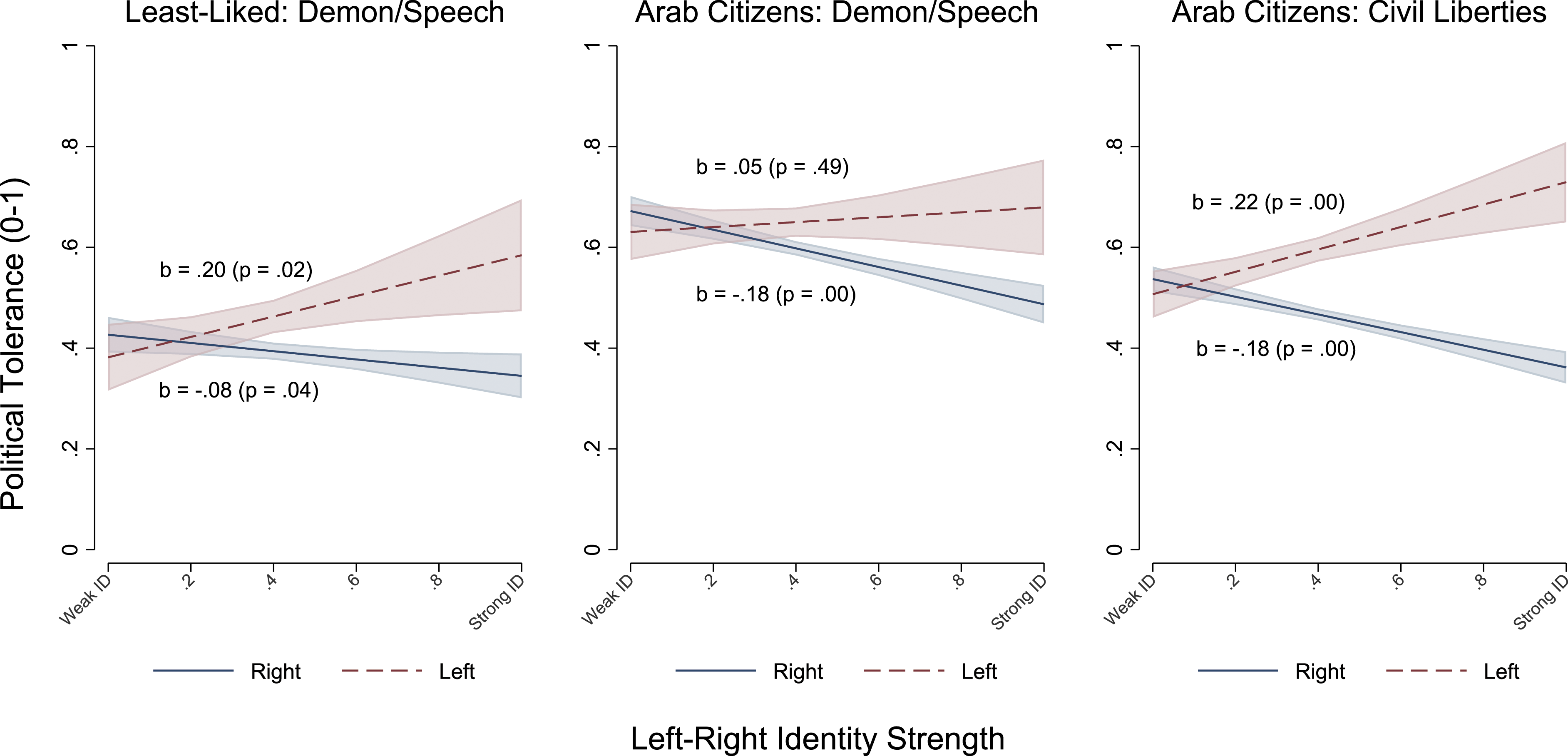
Thus, the results for the observational data are broadly consistent with the polarization hypothesis (H1). Across different targets and freedoms, more strongly identified rightists and leftists diverge sharply in their judgments of political tolerance.
The Terrorist Threat Survey Experiment
Respondents were randomly assigned to one of the three conditions described below that increase the level of threat from terrorism before asking whether they support the policy of depriving Arab citizens of basic civil liberties “to prevent terrorist attacks in the future.” In the Baseline (No Attacks) condition, no attacks or attackers are mentioned; respondents are simply asked two 7-point questions, with an identical stem, “To prevent terrorist attacks in the future, to what extent do you support or oppose the government…,” 1) “prohibiting Arab citizens of Israel from demonstrating?” and 2) “arresting Arab citizens of Israel and holding them in administrative detention without trial?” (r = 0.67 between the two items). Compared with the two Wave 1 measures of Arab Tolerance, the dependent measure in the experiment, Opposition to Arab Repression, is focused on harsh policies for preventing terrorist attacks by depriving Arab citizens of their civil liberties—that is, banning demonstrations and arresting and detaining Arab citizens. Even in the baseline condition, therefore, the Wave 2 tolerance measure differs substantially from both Wave 1 measures of Arab tolerance.
In the second condition, a hypothetical series of terrorist attacks are described but the attackers are not identified. Before answering the same two policy questions, respondents read, “Suppose a series of terrorist attacks [take place] in Israel, in which dozens of people are killed and many others are wounded. After a few days, the authorities have yet to confirm the identity of the attackers.” As we explain in Appendix Section G, we restricted our analysis of respondents in this condition to the large portion (79%) of individuals who guessed that “Palestinians from the Occupied Territories,” carried out the hypothetical attacks. 10 We therefore label this condition the Suspected Palestinian Attackers treatment. In the third, Arab Attackers condition, respondents again read a hypothetical scenario describing a lethal terrorist attack, but the attackers are identified as a “small group” of Arab citizens: “Suppose there is a series of terrorist attacks in Israel, in which dozens of people are killed and many others are wounded. A few days later, the authorities confirm that the attacks were carried out by a small group of Arab citizens of Israel from Umm al-Fahm.” 11 While the elevation of terrorist threat in the second and third conditions is hypothetical, it is considerable—pushing respondents to consider how a series of lethal terrorist attacks might influence their support for repressing Arab citizens to prevent further attacks. By randomly assigning respondents to the three conditions, the experiment allows us to test whether more strongly attached rightists (leftists) increase their support for (opposition to) repressive policies against Arab citizens (H2a), and whether weakly identified leftists, in particular, abandon their support for Arabs’ civil liberties (H2b).
Predicting Responses to the Terrorist Threat Experiment, Israel, 2018.
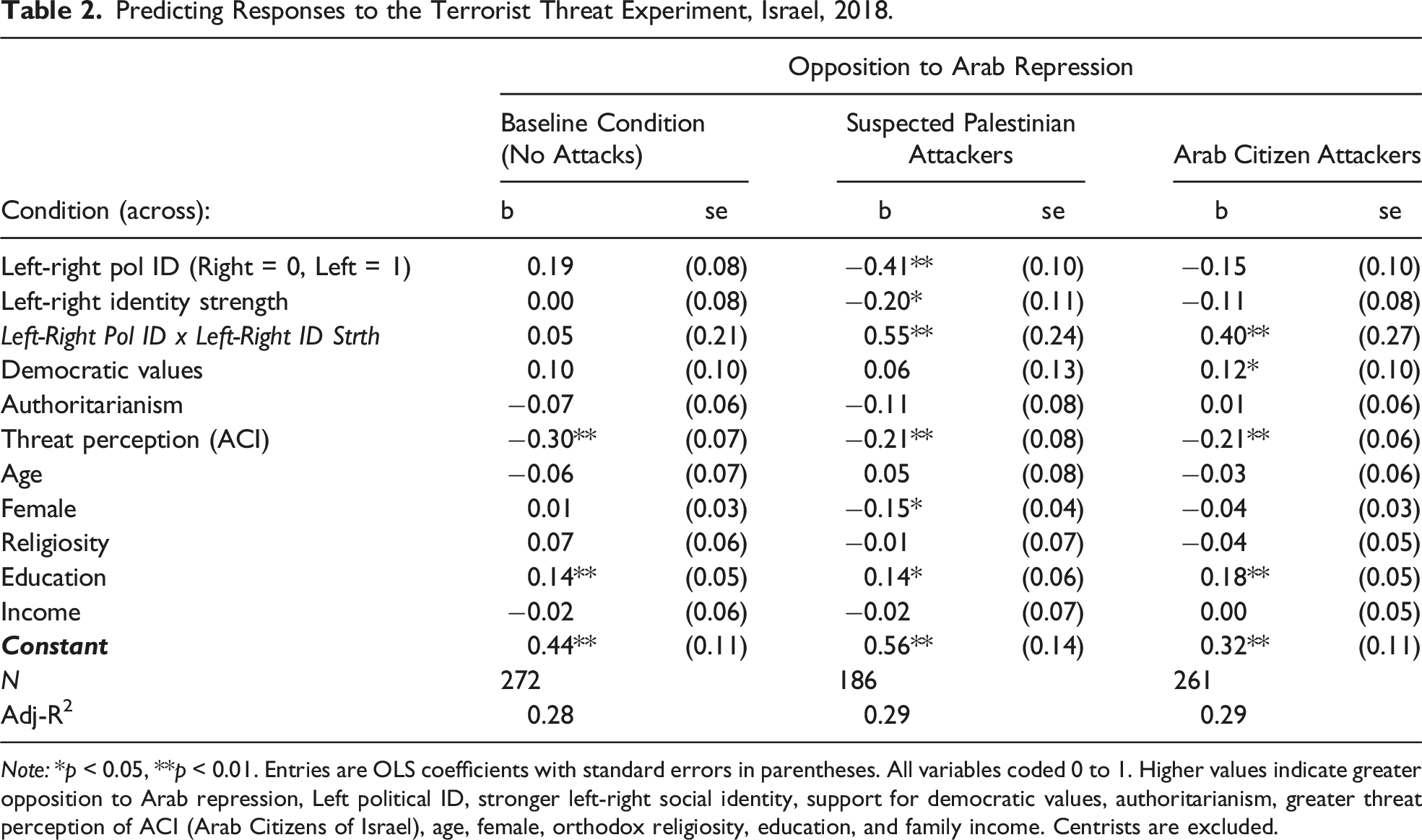
Note: *p < 0.05, **p < 0.01. Entries are OLS coefficients with standard errors in parentheses. All variables coded 0 to 1. Higher values indicate greater opposition to Arab repression, Left political ID, stronger left-right social identity, support for democratic values, authoritarianism, greater threat perception of ACI (Arab Citizens of Israel), age, female, orthodox religiosity, education, and family income. Centrists are excluded.
To aid in the interpretation of the results, we turn to the graphs in Figure 2 displaying the slopes for Social Identity (with 95% confidence intervals) for rightists and leftists in the baseline (no attacks) and two treatment (terrorist attacks) conditions. The left-hand graph makes clear that when people are asked about depriving Arabs’ civil liberties to prevent terrorism in the baseline (no terrorist attack) condition, social identity attachments have no real impact on political tolerance for either the Right or the Left. Although there are substantial differences in tolerance across leftist and rightist groups in the middle of the identity scale, the strength of social attachments does not play a significant role in explaining those differences. Neither slope for leftists nor rightists is statistically significant. It might be that asking respondents whether they supported repressing Arabs “to prevent future terrorist attacks” was too hypothetical to engage their social identities. Left–right identity strength and tolerance of Arab citizens, terrorist threat experiment.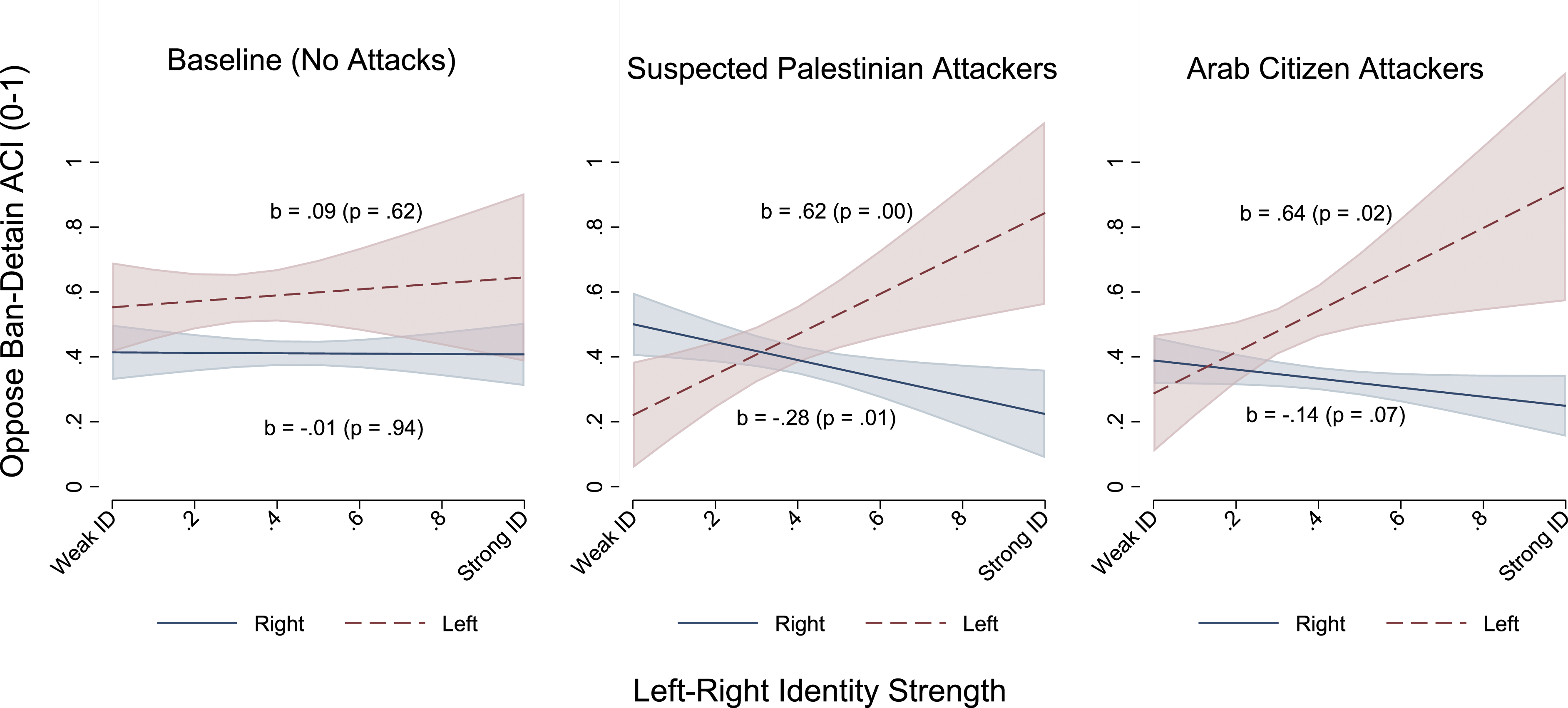
As the middle graph in the Suspected Palestinian Attackers condition demonstrates, however, when terrorist threat is elevated by asking people to imagine a scenario where a series of lethal attacks have occurred, more intense social identities push rightists to increase their support for repressing Arab citizens (i.e., the social identity slope of −0.28 indicates rightists’ opposition to repressing Arabs decreases). Remarkably, this occurs even when the identity of the attackers remains officially unknown. Because respondents in this condition guessed that the attackers were Palestinians in the Occupied Territories, support for repressing Arab citizens, who right-wingers associate with Palestinians in Gaza and the West Bank, increases significantly.
The reaction among leftists in the Suspected Palestinian Attackers condition is more complex. The social identity slope is positive (b = 0.62); stronger leftists are more opposed to repressing Arab citizens than their weakly identified counterparts. Yet, the largest change across the No Attacks and Suspected Palestinian Attackers conditions occurs among leftists with weak social identity attachments, who are significantly more likely to support repressing Arab citizens. Among strongly attached leftists, however, the same context produces no increase in their support for repressing Arab citizens. Despite an increase in terrorist threat, strongly attached leftists hold firm in their opposition to repressive policies. In sum, an increase in terrorist threat magnifies polarized responses in political tolerance among strong social identifiers, but also increases convergence among weak rightists and leftists, mainly owing to the change in response among weak leftists.
In the third Arab Citizen Attackers condition, when terrorist attacks are linked directly to a small group of Arab Israeli citizens, the pattern of responses is similar to the Suspected Palestinian Attackers condition. Once again, more strongly attached rightists and leftists diverge sharply in their opposition to repressing Israeli Arab citizens. Strongly attached leftists increase their opposition even when informed that Arab citizens carried out the attacks. Perhaps leftists are responding to a recurring “script” of right-wing forces calling for broad repressive actions against Arab citizens derogated as a “fifth column” supporting terrorism. For weakly attached leftists, on the other hand, we see another instance of their greater willingness to abandon civil liberties protections for Arab citizens when confronted with a potential threat. When notified that a small group of Israeli Arabs was responsible for the attacks, their support to arresting and detaining Arabs increased 0.15 points on the 0 to 1 scale, about half of a standard deviation.
In Appendix Figure A6, we graph the predicted mean difference (i.e., contrast effects) in tolerance for leftists and rightists along the Left–Right Identity Strength scale for the baseline (No Attacks) versus each of the two treatment conditions that elevate terrorist threat (Suspected Palestinian Attackers and Arab Citizen Attackers). The Figure clearly shows that rightists with stronger social identities become significantly more supportive of repressing Arab citizens in both treatment conditions (consistent with H2a), while among leftists, it is weaker identifiers who significantly reduce their tolerance toward Arab citizens when threat is elevated (consistent with H2b).
As a final test, we investigate whether the effects of left–right identity strength in the experiment are due, at least in part, to political engagement, as outlined in H3. Because respondents with stronger left-right social identities may be more politically engaged, their responses may be shaped by greater awareness of elite cues. Strongly attached leftists might initially feel threatened in the face of a terror attack. But after a “sober second thought” about the importance of civil liberties learned from elite cues and arguments on the Left, they may move toward forbearance.
Results for the Experiment After Adding Controls for Political Engagement.
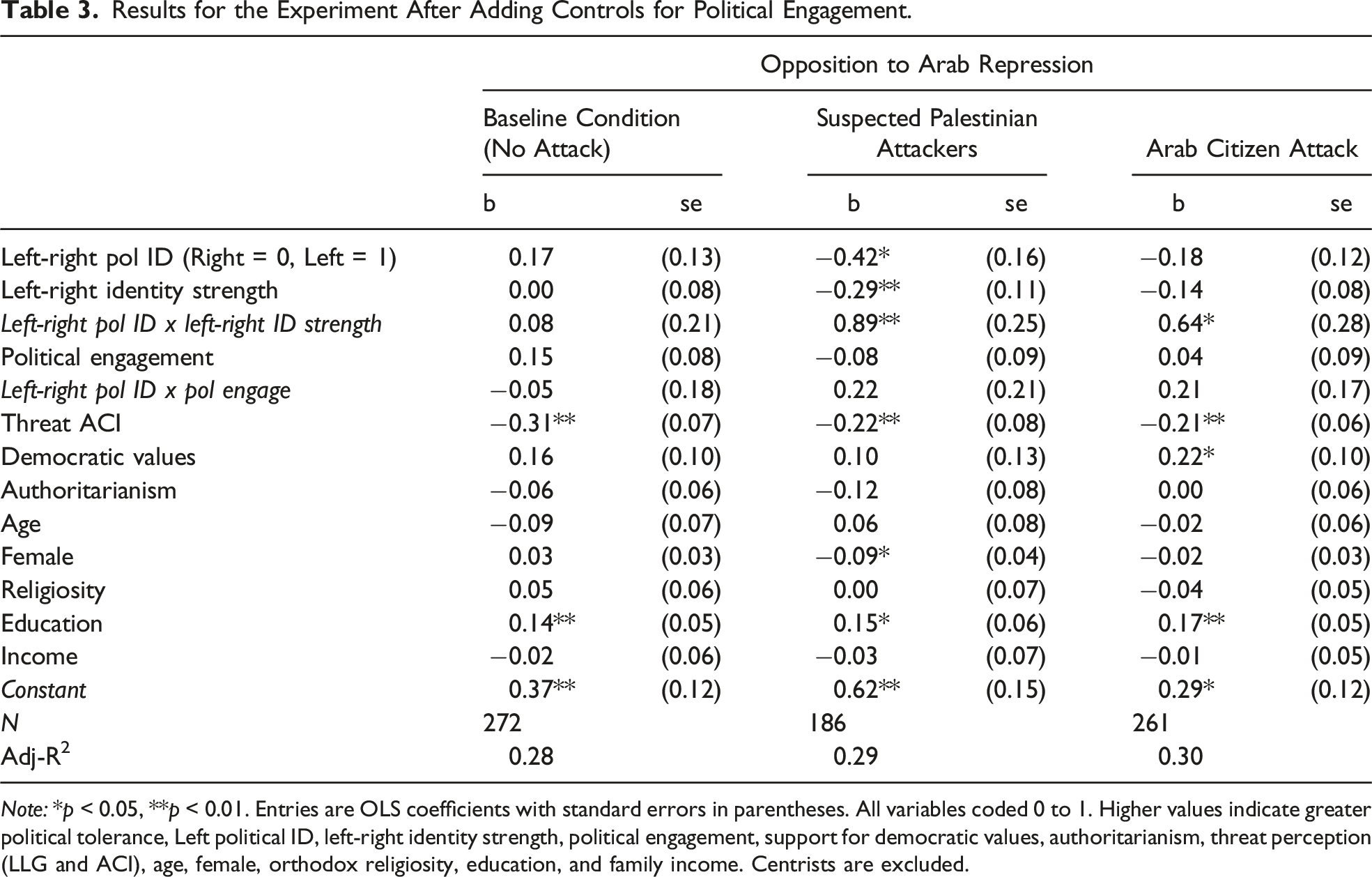
Note: *p < 0.05, **p < 0.01. Entries are OLS coefficients with standard errors in parentheses. All variables coded 0 to 1. Higher values indicate greater political tolerance, Left political ID, left-right identity strength, political engagement, support for democratic values, authoritarianism, threat perception (LLG and ACI), age, female, orthodox religiosity, education, and family income. Centrists are excluded.
As can be seen, the effects of Left–Right Identity Strength remain largely unchanged, while those of political engagement are not statistically significant. One possible explanation for the non-finding is that leftists in Israel respond to terrorism more like a social issue than an economic one. Malka et al. (2014) found engagement was only important for explaining the way people responded to economic issues in their study, not social issues. One might also argue that a more definitive test of H3 requires a much larger sample of leftists to test a three-way interaction to tease apart the effects of engagement versus social identity among Jewish leftists. Thus, a more definitive test of the role of engagement for issues like terrorism must await future research.
Robustness Checks
Prior to discussing the broader implications of our findings in the Conclusions, we briefly describe a series of robustness checks in the Appendix that provide confidence in our results. First, as we show in Appendix Section C, Left-Right polarization in tolerating least-liked groups cannot be explained by the fact that rightists and leftists are reacting differently to least-liked Arab groups. When Arab groups are excluded from the analysis, the estimated Social Identity coefficients for rightists as well as leftists are nearly identical to those estimated in Table 1 and Figure 1. In Appendix Section D, we rule out the possibility that the effects of Left-Right Identity Strength on political tolerance are due, in part, to the tendency for leftists and rightists to differ with respect to the three control variables. After adding interactions between Left–Right Political ID and democratic values, authoritarianism and perceived threat, the effects for Left–Right Identity Strength in Table 1 remain unchanged.
In Appendix Section E, we show that our results are robust to substituting a different measure of Left–Right Identity Strength consisting of only the first three Likert items, thus dropping the fourth binary indicator. In Section F, we use Hainmueller et al.’s (2019) interflex program to verify the interactions in the terrorism threat experiment are linear and the coefficients do not suffer from excessive extrapolation. In Section G, we provide a more detailed justification for using only the large portion of respondents (79%) who guessed “Palestinians in the occupied territories” carried out the terrorist attacks in the terrorist threat experiment. Finally, in Section I, we demonstrate that when rightists and leftists were asked specifically about political tolerance toward the opposition group (i.e., “leftists” and “rightists”), once again, the polarization hypothesis is confirmed: strongly attached leftists are more tolerant of rightists, whereas stronger rightists are less tolerant of leftists.
Conclusions
Our study contributes to an important and growing literature documenting the consequences of ideological and partisan identities that are polarized along unresolved identity issues. Past research ties intense political identities to a host of ill-effects, including social discrimination, public derision, assorted prejudices, and a willingness to harm rival opposition groups. Our study is the first to demonstrate that more intense Left–Right social identities also influence political tolerance, a bedrock value for liberal democracies. Although most research on the impact of political identities takes place in the US, we chose Israel precisely because it is a country where polarized left–right divisions among Jewish citizens are longstanding, socially sorted, and extend to competing visions of nationhood.
Our results diverge from US research where virtually all studies find identity-based ideology and partisanship produce roughly equal levels of activism, bias, and hostility on both sides of the political divide. By contrast, more intense social identities make rightists and leftists in Israel more polarized in their levels of tolerance toward disliked groups. What makes leftists distinct in Israel is their increased level of forbearance toward both least-liked groups and Arab citizens. Importantly, the effects of social identities on tolerance were significant even after controlling for factors traditionally found to drive tolerance judgments—that is, democratic values, perceived threat from the target, and authoritarianism.
We complemented our observational findings with a survey experiment in the second wave of a panel survey to show how increasing external threat from terrorism polarizes political tolerance toward Israeli Arabs across strongly attached leftists and rightists. Most notably, the significant changes in support for repressing Arab citizens across the baseline and treatment conditions occurred among two identity groups—strongly attached rightists and weakly attached leftists.
The tendency for weakly attached leftists to join rightists in supporting repressive policies in the two treatment conditions is reminiscent of the response of low authoritarians in Hetherington and Suhay’s (2011) study of Americans’ support for the war on terror. The authors found that even people who score low on authoritarianism—that is, “many average Americans, become susceptible to ‘authoritarian thinking’ when they perceive a grave threat to their safety (p. 546)” by supporting punitive counter-terrorism policies (e.g., torture and warrantless wiretapping). While similar, our findings call for greater concern for at least two reasons. First, Hetherington and Suhay found that high authoritarians did not express greater support for punitive counter-terrorism policies; yet rightists in our study clearly increased their support for harsh policies targeting Arab citizens, including arrest and detention without trial. Second, given the majority status of rightists in Israel and the historical absence of Arab parties in the government, if weakly identified leftists side with rightists to support repressing Arab citizens, any outcries against repression become extremely muted.
Our results also contribute to refinements in the application of social identity theory. As noted by others, social identity groups are traditionally viewed through the lens of its most strongly attached members. This makes sense because they tend to be more prototypical group leaders who define group norms and elicit attitude change in others (e.g., Ellemers and Jetten 2013; Pérez and Kuo 2021). However, ignoring members who identify with, but for various reasons, do not resemble prototypical members, leads to a poor understanding of potential defections by weakly attached ingroup members, who can be pivotal in the formation of opinion groups and political coalitions. Especially in a multi-party system like Israel’s, weakly attached “leftists” may be more tempted to abandon a political identity group than is possible in a two-party system like the US. In fact, leftists have long suffered from such defections in response to terrorism and waning public support for a two-state solution to the Israeli-Palestinian conflict.
Even more important, our study sheds new light on various gaps in the burgeoning research applying social identity theory to political behavior. As others have demonstrated, stronger ingroup identities do not universally lead to increased hostility toward domestic outgroups (e.g., Sirin, Valentino, and Villalobos 2021; Pérez 2021). In fact, stronger identities can lead to more –or less– hostility and political intolerance, depending on the ingroup and the outgroups being considered. The broader implication is that measures of social identities tend to capture the “essence” or meaning of how ingroup members view themselves and what is important to the group. Outside the US, identity strength can actually be a protector of democratic values, leading some groups (i.e., Jewish leftists) to become more tolerant.
A remaining question is whether our findings can be generalized from Israel to other democratic countries. A definitive answer must await the replication of our design in other nations and contexts. For now, a more specific question to consider is whether intense social identity attachments by leftists and rightists in other countries can be expected to produce the kind of polarized levels of political tolerance we found in Israel. Focusing first on socially attached leftists in Israel, their commitment to, and application of democratic values is distinctive, at least when compared to, say, liberal Democrats in the US, who, as pointed out earlier, are no more politically tolerant than conservative Republicans (Gibson 2013; Chong, et al. 2022). Certainly, given that Israeli rightists greatly outnumber leftists, rightists constitute a greater political threat to Jewish leftists in Israel than conservative Republicans present to liberal Democrats in the US. Future research should investigate whether defections among weakly attached Jewish leftists have made it possible for a shrinking group of core leftists to maintain a strong commitment to democratic values and civil liberties.
Shifting our focus to socially attached rightists in Israel, their low level of political tolerance toward a variety of groups on the left is more often the rule than an exception in many democracies, especially those facing extreme polarization (McCoy and Somer 2019) and high levels of security threat (e.g., Peffley, Hutchison, and Shamir 2015). Rightists are far more likely to adopt an ethnonationalist view of the ingroup that amplifies perceptions of existential threat from their domestic enemies. Rightists in Israel bear a striking resemblance to Malka et al.’s (2020, 809-10) description of “cultural conservatives [of Western democracies] who conceive of the nation in racially, linguistically, or religiously exclusive terms (i.e., nativists) [who] naturally find threatening aspects of democracy that permit all individuals to try to gain access to power.” Such cultural conservatives have provided critical electoral support to leaders who are responsible for democratic backsliding—that is, the “erosion of institutions, rules, and norms that results from the actions of duly elected governments” (e.g., Haggard and Kaufman 2021a, 27; see also McCoy and Somer 2019; Carothers and O’Donohue 2019).
Indeed, Israel’s current far-right government, elected in November of 2022, is, at the time of this writing, threatening to pass legislation that most observers agree, will push Israel into the ranks of several high-profile democracies that have suffered from serious democratic backsliding, including India, Poland, Hungary, and Turkey, a country that is no longer considered a democracy (e.g., see Haggard and Kaufman 2021b). The fundamental changes proposed by the most right-wing government in Israel’s history, will have the effect of destroying the independence of Israel’s Supreme Court, long considered a protector of liberal democracy. On the security front, the post of minister of national security, along with control of the country’s police, was given to far-right coalition partners, like Itamar Ben-Gvir, who themselves have a long history of supporting right-wing terrorist groups and inciting racism against the Arab public (Friedman 2022). Despite massive public protests and opposition to these and other anti-democratic proposals by the government, because Israel has no codified constitution, the changes could soon become the law of the land. Some commentators have even suggested that Israel could be on the verge of a civil war and another Arab uprising (Pfeffer 2023). Issues of political tolerance, terrorism and democratic backsliding were never hypothetical in Israel, but now more than ever, they could inflict lasting damage.
Supplemental Material
Supplemental Material - Left-Right Social Identity and the Polarization of Political Tolerance
Supplemental Material for Left-Right Social Identity and the Polarization of Political Tolerance by Mark Peffley, Omer Yair, and Marc L Hutchison in Political Research Quarterly
Footnotes
Acknowledgments
The authors gratefully acknowledge helpful advice from Profs. Michal Shamir, Robert Rohrschneider and the anonymous reviewers.
Declaration of Conflicting Interests
The author(s) declared no potential conflicts of interest with respect to the research, authorship, and/or publication of this article.
Funding
The author(s) disclosed receipt of the following financial support for the research, authorship, and/or publication of this article: The survey was funded by a grant from the Israel Institute.

Data Availability Statement
Supplemental Material
Supplemental material for this article is available online.
Notes
References
Supplementary Material
Please find the following supplemental material available below.
For Open Access articles published under a Creative Commons License, all supplemental material carries the same license as the article it is associated with.
For non-Open Access articles published, all supplemental material carries a non-exclusive license, and permission requests for re-use of supplemental material or any part of supplemental material shall be sent directly to the copyright owner as specified in the copyright notice associated with the article.
