




Abstract
The year 2018 has been dubbed the Year of the Woman because of the increased number of women who ran for office. What helps explain the dramatic increase in the number of women running for office? This paper examines how the political environment shapes white women’s emotional reactions to politics and in turn their political ambition. We focus on major aspects of the 2016 election: Trump’s treatment of women, Clinton’s historic run for office, the Women’s March, and the #MeToo movement. We argue that each of these factors leads to distinct emotional reactions, and that some of these reactions can increase political ambition. We explore support for these arguments with an experiment conducted with a sample of highly educated white women, an experiment fielded on the 2019 CCES, and with in-depth interviews conducted with first-time women candidates in 2018. We find that Trump’s treatment of women and Clinton’s historic run for office inspired political ambition, but through different emotional pathways. Trump’s treatment of women increased anger and in turn political ambition, while Clinton’s historic run increased ambition through enthusiasm. We find more muted effects for the Women’s Marches and the #MeToo movement.
2018 has been dubbed the Year of the Woman because of the dramatic increase in the number of women who ran for office. 1 For the first time in U.S. history, over 100 women were elected to the U.S. House of Representatives, and the freshmen class was among the most diverse in U.S. history. While national level elections have received the lion’s share of attention in the media, similar trends happened at the state and local level. 2 In this paper, we ask how features of the political environment from the 2016 election and its aftermath influence women’s political ambition, and through which mechanisms. We tackle this question for one group of women, white women, for both theoretical and practical reasons. Existing research shows that underrepresented individuals react to politics in distinct ways (Phillips and Lee 2018; Phoenix and Arora 2018), and the drivers of political ambition are different for women of color and white women (Brown and Lemi 2020; Junn 2017; Phillips 2021). While it is important to explore the broader question for both groups, we begin by theorizing about white women, for whom we have more representative data.
We argue that features of the political environment linked to gender and emotional reactions to that environment played a role in spurring more white women to consider running for political office in 2018, especially Democratic women. One factor, mentioned by pundits and practitioners, 3 was the election of Donald Trump, whose misogyny was on full display throughout the campaign. We theorize that Trump’s treatment of women increased anger, and in turn increased political ambition among white women (Lawless and Fox 2018). Another salient feature of the political environment was the historic candidacy of Hillary Clinton. We hypothesize that seeing an experienced woman run for the highest office of the land should also increase political ambition, but through a different emotional pathway: increased enthusiasm (Bonneau and Kanthak 2020). Finally, we contend that movements on the ground in the aftermath of the election, such as the Women’s Marches, and movements online, such as the #MeToo movement should also increase enthusiasm and in turn encourage more white women to consider running for political office. 4
We test our arguments using three sources of data. First, to examine the role of the political environment as a causal factor, we turn to a survey experiment conducted with a sample of highly educated white women. This experiment randomly assigned respondents to read vignettes that highlighted either Trump’s treatment of women, Clinton’s historic run, the Women’s Marches, or the #MeToo movement. Here, we examine how these factors influenced emotional reactions and in turn political ambition. That is, we examine how emotions mediate the relationship between these features of the political environment and political ambition. Second, we ran an experiment in which we directly manipulate anger, one of our mediators, in response to Trump’s treatment of women and examine effects on political ambition. Finally, to contextualize some of the experimental findings and illustrate the causal mechanisms, we draw from in-depth interviews of women who ran for office, almost all for the first time, in local level elections.
Each of these methodological approaches develop and layer on nuance to our overall investigation. The first survey experiment enables us to test all of our hypotheses, while the second experiment focuses more specifically on one mechanism. In both cases, we are looking at expressed political ambition. The experiments also provide a causal test of our arguments. The interviews help us unpack the causal mechanisms detected experimentally and provide some illustration of how multiple features of the political environment impacted women who actually ran for political office. The findings across all three sets of data suggest that gendered features of the political environment led to distinct emotional reactions, which in turn increase the motivation of white women to consider running for political office, particularly Democrats.
Our study makes several important contributions. First, we focus on how gendered features of the political environment shape political ambition, an area that has received much less attention in the existing literature on political ambition, compared to more structural and stable factors which are less likely to explain dramatic shifts in the number of women seeking office (but see Fox and Lawless 2010; Broockman 2014; Bernick and Heidbreder 2018; Bauer 2020; Dittmar 2020). Second, while some work has considered the role of Trump in impacting women’s political ambition (Dittmar 2020; Lawless and Fox 2018) and others have considered Clinton’s candidacy (Bonneau and Kanthak 2020), few have put these in conversation with each other, and most do not also consider social movements in the aftermath of the election. Third, very few studies have considered emotions as a mechanism through which the political environment might influence women’s political ambition (Brooks and Hayes 2019; Campbell and Wolbrecht 2020; Cassese and Holman 2016; Dittmar 2020). Some work has considered how anger among individuals with sexist views led to greater political engagement in support of Trump (Valentino, Wayne, and Oceno 2018), but our work flips this on its head by looking at how anger at Trump’s treatment of women leads to greater political ambition among white women, especially Democrats.
Existing Understandings of the Forces that Shape Women’s Presence in Elections
Since the 1970s, a robust line of scholarship has examined the factors that help explain the under-representation of women in political office. Given the focus of our inquiry, we narrow our discussion to political ambition but also briefly discuss recruitment and voter biases. Repeated studies by Richard Fox and Jennifer Lawless have demonstrated a long lasting and significant difference between men and women when it comes to political ambition, or the desire to seek elected office (2010, 2011). Women are less likely to say that they want to run for office some day and qualified women are less likely to run than their male counterparts.
There are many forces that contribute to lower levels of political ambition. One set of explanations focuses on socialization: girls are less likely to be encouraged to run for office by their teachers, parents, and other socializing agents (Fox and Lawless 2014). Studies have also shown that children in the United States are socialized into the political environment as a gendered and masculine construct (Bos et al. 2022), which dampens political ambition among girls.
Women’s status in society also deters some from running for office (Bernhard, Shames, and Teele 2021). Women are less likely to run when they have young children (Deason, Greenlee, and Langner 2015; Fulton et al. 2006), given that they tend to shoulder the demands of caregiving. Women’s decisions are also linked to those of their partners. For example, Bernhard, Shames, and Teele (2021) find that the ability of women to rely on the support of a partner’s second income is paramount in their decision to run, while Carroll and Sanbonmatsu (2013) argue that women base these decisions on the reactions of the people whose lives will be impacted by their decision like their children, partners, and parents among others with whom they have close relationships. Finally, women make up a smaller proportion of those in the feeder professions for political office, in lower-level office, and they are less likely to receive coverage in the media about being potential candidates (Thomsen and King 2020).
The context of how campaigns operate also plays a role in shaping women’s political ambition. The expensive and conflict-based nature of campaigns (Lakoff 2016) is less appealing to women, who demonstrate election aversion and conflict avoidance (Kanthak and Woon 2015; Pate and Fox 2018; Wolak 2020). However, when elections are portrayed as a communal and community building endeavor, the ambition gap between women and men is reduced (Preece and Stoddard 2015; Schneider et al. 2016).
Individuals are also more likely to have political ambition when they are recruited to run for office (Fox and Lawless 2010), but women are less likely to be recruited to run by party leaders (Fox and Lawless 2010; Sanbonmatsu 2002). Even when they are recruited, they are more likely to be skeptical that the party will devote sufficient social and political capital to support their campaigns (Butler and Preece 2016). The recruitment factor is also one of the explanations for partisan disparity in the number of women running for office due to the importance of party fit in candidate selection (Thomsen 2015, 2017) and the greater demand for women’s representation among Democratic elites (Crowder-Meyer and Cooperman 2018).
Women may also have lower political ambition if they are concerned about biases among voters. While the academic literature is mixed and nuanced on the question of whether gender stereotypes harm particular women running for office (e.g., Bos, Schneider, and Utz 2018; Hayes and Lawless 2015; Holman, Merolla, and Zechmeister 2011; Bauer 2015; Dolan 2014); even a perception that voters are less likely to support a woman for office may dampen the political ambition of women. Women are often acutely aware that they face a qualification gap, whereby they need to be even more qualified than men to overcome voter biases (Bauer 2020; Fulton and Dhima 2021). Thus, only the most highly qualified women tend to have higher political ambition and decide to run for office (Fulton 2012; Lawless 2015; Sanbonmatsu 2002). It is also important to consider how the forces that shape political ambition may be different for elites and the general public. Crowder-Meyer (2020) argues that studies of elites show the same factors typically predict men and women’s levels of political ambition (Lawless and Fox 2010), but the opposite is true among the general population—women are impacted by social support whereas for men, ambition is typically driven by education and marriage, but not encouragement from others.
Existing scholarship goes a long way in describing the gradual increase in the number of women running for office over time (Lawless 2015; Thomsen 2015), and the forces that shape political ambition. However, to understand why the number of white women running for office jumps in 2018, it is important to consider the concurrent political environment and how it may impact women’s political ambition. More specifically, levels of political ambition are unlikely to dramatically increase without some external shock. Much less work on political ambition has considered how the political environment may impact political ambition among women. Much like the first Year of the Woman in 1992, we argue that the political environment may have served as the type of shock needed to motivate women to consider running for political office. In 1992, the confirmation hearing of Clarence Thomas and the treatment of Anita Hill by an all-male senate judiciary committee made evident the need for more women in political office, and scholars found that many responded by running for office, highlighting their status as women (Dolan 1998; Vavrus 1998; Wilcox 2019). Fast forward to 2016 and its aftermath, many features of the political environment had the potential to increase women’s electoral aspirations (Dittmar 2020; Thomas and Wineinger 2020). But, through what mechanisms did the environment impact women’s political ambition, and among which women? In the next section, we theorize about how different features of the political environment from the 2016 election and its aftermath may have impacted emotional reactions and in turn led to increased political ambition, particularly among white Democratic women.
How the Political Environment Matters for Women’s Political Ambition
Several different features of the political environment related to gender from the 2016 election and its aftermath may have served as the type of environmental shock needed to increase women’s political ambition: Trump’s treatment of women, Clinton’s historic run for office, the Women’s Marches, and the #MeToo Movement. Arguably there has not been another electoral context in recent memory in which gender has been so salient, and in so many different ways. Any one of these forces could have acted as a shock to the political system and encouraged more women to consider running for political office, albeit through different pathways. It is difficult to parse out these effects given that many of the events were happening simultaneously (Campbell and Wolbrecht 2020). Alone, or in concert, they could have had a direct effect in spurring more women to consider political office. However, we argue that one important mechanism through which these various features of the political environment influence political ambition is through emotional reactions.
As noted in the introduction, our theory focuses on white women. Women of color experienced emotions distinct from those of white women when it came to the events and rhetoric of 2016 (Dittmar 2020), and existing work shows that women of color react differently to frames around women’s under-representation (Holman and Schneider 2018). In addition, the translation of emotions to political participation may work differently for some marginalized groups, particularly those that need to contend with stigmas associated with group anger (Banks, White, and McKenzie 2019; Phoenix 2019; Phoenix and Arora 2018). Finally, the path toward political ambition is distinct for women of color (Brown and Lemi 2020; Dowe 2020; Phillips 2021). We will now elaborate on our theory of how gendered features of the political environment may have shaped emotional reactions among white women, which white women may have been most impacted, and how this in turn may have influenced political ambition.
The first environmental factor we consider is Donald Trump’s treatment of women. According to Wolbrecht (2018), Donald Trump acted as a shock in the political environment due to his strong embrace of political positions that overtly adhere to ascriptive gender hierarchy (2018), given his behavior toward women. He frequently engaged in offensive language against female journalists and his female opponents on the campaign trail (Evans and Clark 2016), and in October, the Access Hollywood tape from 2005 was released, in which he was caught on a hot mic saying that attractive women let him do whatever he wants and that he can “Grab ‘em by the pussy.” This type of rhetoric and behavior was connected to voting decisions, with individuals high in sexism being more likely to vote for Trump (Cassese and Barnes 2019; Valentino, Wayne, and Oceno 2018), and with hostile sexists reacting against Clinton’s rhetoric of playing the women card in reaction to Trump’s gendered attacks (Cassese and Holman 2019). This combination of actions may have signaled to women in the electorate that Trump was a threat to them and their interests, and with Trump at the helm, the political system would not be responsive to their needs (Campbell and Wolbrecht 2020).
The first component of our argument is that the political environment plays an important role in shaping emotional reactions. Our focus is on state-based emotions, which relate to a temporary condition individuals experience in reaction to the broader environment. That is, there needs to be some stimulus from the environment to experience state-based emotions. 5 But, what type of emotional reactions should we observe from Trump’s treatment of women? Under conditions of threat, individuals tend to experience a host of negative emotions, such as anxiety and anger. Whether someone reacts with greater anxiety or anger to an unpleasant context depends on how they appraise the context (Harmon-Jones and Peterson 2009; Lazarus 1991; Lerner and Keltner 2000). Individuals are more likely to experience anxiety when an unpleasant context is higher in uncertainty, where they feel little control, and where they are not necessarily sure where to place blame for the situation. Individuals are more likely to experience anger when their sense of an unpleasant environment is associated with less uncertainty, a sense that someone or something is to blame for the unpleasant situation, and where they feel like they have greater control (e.g., Harmon-Jones and Peterson 2009; Lazarus 1991; Lerner and Keltner 2000; Lerner and Tiedens 2006). In the case of Trump, we theorize that exposure to this charged type of stimuli should lead to higher levels of anger: It is unpleasant to read about, in some cases it is certain that Trump is the culprit, and it is clear who to blame. It is also possible that white women may experience some anxiety if they worry about the status of women during Trump’s presidency; however, anger should be the more dominant emotional reaction.
Which white women might be most likely to experience anger in reaction to this information? We expect that these reactions should be stronger among Democrats than Republicans. In today’s polarized partisan environment, individuals are likely to engage in partisan motivated reasoning (Druckman, Peterson, and Slothuus 2013; Lavine, Johnston, and Steenbergen 2012; Nicholson 2012), accepting information that is consistent with their partisan dispositions and rejecting inconsistent information. Republican women are likely to discount being reminded about Trump’s mistreatment of women, so they may be less inclined to react with anger, while Democratic women will be inclined to process the information and have the predicted emotional reaction. We therefore hypothesize that making salient Trump’s treatment of women increases feelings of anger, and to a lesser extent increases feelings of fear, more so among Democratic women.
How might these emotional reactions matter for political ambition? The second component to our argument is that elevated anger from the political environment will increase political ambition. What we know about anger is that it is a behavior-oriented emotion. That is, when people experience anger, they want to take action. Existing scholarship has shown that when individuals are induced to experience anger, they are more likely to engage in the political system, especially with respect to activities that are more costly (Valentino et al. 2011). However, the literature on emotions and political engagement has not considered political ambition as a potential outcome. We conceptualize political ambition to be an even more costly intention to engage in politics, which is likely to be impacted by higher levels of anger. We therefore hypothesize that Trump’s treatment of women should lead to higher levels of political ambition by increasing levels of anger. That is, we expect anger to mediate the relationship between Trump’s treatment of women and political ambition.
There is some existing literature that suggests support for this hypothesis. In a survey of highly educated women, Lawless and Fox (2018) found that Democratic women were more likely to report negative reactions to Trump’s victory in 2016, and those with these feelings were more politically engaged (though they did not look at ambition). Dittmar (2020) looked at public statements in both primary and general elections by Democratic non-incumbent women candidates and found that almost half stated that anger, urgency, or threat were significant contributors to their motivation to run for office. While these studies are in line with our expectations, not all focus on political ambition and they all use observational data, so it is unclear if Trump’s treatment of women is driving the observed relationships through anger. It is not a foregone conclusion that Trump’s treatment of women should increase political ambition. An alternative hypothesis is that increasing the salience of Trump’s treatment of women might lead to lower levels of political ambition, especially if it signals that political leadership is “a man’s world” (Bos et al. 2022).
While Trump’s election may have motivated more women to consider running for office, particularly through feelings of anger, Hillary Clinton’s campaign as the first female presidential candidate to represent a major political party may be an additional environmental factor. Novel women candidates increase interest and engagement among adolescent girls (Wolbrecht and Campbell 2017). Women may be more encouraged to run when they see more women in governing institutions (Atkeson 2003; Campbell and Wolbrecht 2006). This may particularly be the case in seeing a woman capture a major party nomination and running for the highest office in the land. There is some empirical evidence to back up this claim. Bonneau and Kanthak (2020) found that female supporters of Hillary Clinton saw increases in political ambition after watching Clinton campaign ads. Scott and Collins (2020) found that Black women were more likely to express a desire to run if they had favorable feelings toward Clinton. It is likely that the increases were limited to Clinton supporters since relatability is a necessity for role models to have an ambition amplifying effect (Sweet-Cushman 2019). Further, a candidate like Hillary Clinton may be perceived as insufficiently feminine to more conservative respondents (Cassese and Holman 2019), especially given online negative campaigning among Republican women (Wagner, Gainous, and Holman 2017).
However, it is not entirely clear from existing scholarship what mechanism may underlie this effect. Again, our focus is on emotions as a mechanism linking features of the political environment to political ambition. An electoral context with a historic first is likely to generate positive emotions of enthusiasm. Enthusiasm is different from both anxiety and anger in that it is more likely to result from a situation where the initial expectancy is favorable (Carver and Scheier 1990), and individuals are receiving positive feedback from the environment. The historic nature of Clinton’s run should signal more positive feedback from the environment and thus generate enthusiasm. These feelings will be more likely to occur among co-partisans given the dynamics noted earlier (relatability and co-partisanship). We therefore hypothesize that increasing the salience of Clinton’s historic run for office should increase enthusiasm, particularly among white Democratic women.
How might enthusiasm from Clinton’s historic run affect political ambition? Like anger, enthusiasm is an action-oriented emotion (Fredrickson 2001; Groenendyk and Banks 2014). As a positive emotion, enthusiasm can lead to participation in activities merely for the pleasure of the act regardless of the likelihood that participation will result in the achievement of a particular goal (Fredrickson 2001; Groenendyk and Banks 2014). Several studies have documented higher political engagement among individuals experiencing positive emotions such as enthusiasm and hope about political figures and campaigns (Brader 2006; Marcus, Neuman, and MacKuen 2000; Valentino et al. 2011), particularly among strong partisans (Groenendyk and Banks 2014) and people of color (Nichols and Valdéz 2020; Phoenix 2019). We hypothesize that elevated levels of enthusiasm in reaction to Clinton’s historic run for office should also increase political ambition. That is, we expect enthusiasm to mediate the relationship between Clinton’s run and political ambition.
The final feature of the political environment that we consider is social movements, namely, the Women’s Marches and #MeToo movement of 2017–2018. In the aftermath of 2016, there was an increase in the number of political activist groups founded by women and increased participation by women in existing activist circles (Wolbrecht 2018). The Women’s Marches included the largest march in U.S. history (at the time), as well as hundreds of similar events across the nation (and globe). Similarly, the #MeToo movement, while not manifested in the dramatic march of women, has significantly shifted public discourse surrounding women and sexual assault. This movement saw women come forward with allegations of sexual assault against prominent men, revealing past misdeeds by major politicians, actors, and other media figures. 6
How might exposure to these movements influence emotional reactions? We theorize that it may lead to an increase in enthusiasm, since both highlight a network of diverse women coming together to fight inequality and harassment. White Democratic women in particular may be more inclined to experience such reactions given that the plight of these movements overlaps with their ideological and gender orientations (Campbell and Wolbrecht 2020; Wolbrecht 2018). We therefore hypothesize that increasing the salience of the Women’s March or the #MeToo movement will increase levels of enthusiasm, particularly among white Democratic women. This elevated enthusiasm in reaction to these movements should in turn increase political ambition, for the same reasons articulated in the prior section.
While our focus has been on emotional reactions to the political environment as a mechanism leading to increased political ambition among white women, we recognize that alternative mechanisms may also be at play. For example, it could be that any of these features of the political environment increase a sense of gender group consciousness or feminist identity, which in turn might increase political ambition (Holman and Schneider 2018). We consider some of these alternative mechanisms in our analyses. To help tease apart how these varied features of the political environment impact emotional reactions and in turn political ambition among white women, we turn to an experimental design, where we can randomize which aspects of the political environment are made salient.
Experiment on the Effects of the Political Environment on Ambition
Our first study was conducted online with NORC panelists in the summer of 2019 and was about 8 min in length. 7 The sample is unique in that it includes only white women with higher levels of education (at least a college degree; n = 1030; S.I. Table A1). It was part of a larger study on educated white women and we had the opportunity to place a module on that study.
Work on women and political ambition often uses surveys of individuals who are highly educated (those in college or with a BA or higher) or in feeder professions, since they are more likely to consider running for political office in the future (Greenlee, Holman, and VanSickle-Ward 2014; Holman and Schneider 2018; Lawless and Fox 2005, 2010; Schneider et al. 2016). Since we are looking at a broader target population, not only those in feeder professions, it provides a more conservative test of our study treatments. That is, it may be harder to move political ambition for highly educated women compared to a subset of highly educated women in feeder professions.
We already discussed the important theoretical reasons for narrowing our focus to white women. This choice also makes sense from a design perspective. Since we are interested in how partisanship moderates the effect of the political environment, white women provide more variation in party identification than women of color (Barnes and Cassese 2017; Gillespie and Brown 2019; Junn 2017). For these reasons, we expect that the findings produced with our sample of highly educated white women may not be generalizable to women of color.
To test our full theoretical framework, we need to vary the type of environment respondents are exposed to and then measure (a) emotional reactions and (b) political ambition. To that end, respondents were randomly assigned to one of five conditions: Trump, Clinton, #MeToo, the Women’s Marches, or the control condition. After reading one of the vignettes, they filled out a post-treatment survey that tapped into our main dependent variables on emotional reactions and political ambition. Finally, the participants read a debriefing statement and were redirected back to NORC for compensation. 8
Each of the treatment vignettes were drawn from news articles, edited together by the investigators, and maintained a similar style. They introduced the main theme, highlighted quotes from the political figure or movement, referenced reactions by citizens, and closed with a statement about the implications for gender equality, and this formula can be seen in the section-by-section descriptions in the following paragraphs (see S.I. for full treatment text). None of the information in the treatments was likely new to respondents since the events had already occurred during and after the 2016 election. The main goal was to make salient one feature of the political environment to better tease out the distinct emotional pathways through which that feature may impact women’s political ambition. Since respondents in the control group were also familiar with these events, there is likely a fair amount of pre-treatment. If anything, this means it should be more difficult to observe treatment effects (Druckman and Leeper 2012).
Our study was also in the field after the 2018 election, so we are not able to examine the effect of the political environment on ambition before or during that election. It could be that baseline levels of ambition among women may have been higher than usual after seeing a record number of women win. If anything, this should also pose a more difficult test of the treatment effects. Furthermore, because the 2016 events happened 3 years before we fielded the survey in 2019, emotional reactions may not be as strong as they were during 2016, which should again make it more challenging to detect effects. Finally, because Trump was still president when this survey was created, the effects we observe for him may be stronger than those for Clinton.
Respondents assigned to the control read a review of Amazon’s Echo, which serves as a non-political baseline. The Trump condition was designed to highlight Trump’s mistreatment of women. It highlights that Trump was the first presidential candidate to be accused of sexual harassment by at least 10 women. For the quote, it includes a partial transcript of the Access Hollywood tape, in which Trump was caught using sexist and predatory language about women. A citizen reacts by being deeply troubled by Trump’s treatment of women, and the treatment closes by indicating Trump’s election represents a setback for women’s equality. As discussed earlier, we expect that this treatment will increase anger, and possibly fear, and these effects will be more pronounced among Democratic women. Furthermore, we expect elevated anger in turn to lead to greater political ambition. That is, we expect anger to mediate the relationship between the Trump treatment and political ambition.
The Clinton condition highlights that Hillary Clinton was the first woman to secure a presidential nomination from a major political party, as well as her prolific list of accomplishments as a civil servant. The treatment includes a quote from one of her speeches about a daughter being able to be anything they want to be, “Even President of the United States.” A citizen reacts by being inspired by Clinton’s historic run for office, and the treatment closes by indicating progress for women’s equality. Here, we expect the condition will lead to higher levels of enthusiasm, especially among Democrats, and enthusiasm will mediate the relationship between the condition and political ambition. While many women likely associate Clinton’s loss with more negative emotions, this vignette focuses only on the hopeful associations with her campaign.
Both the Women’s March and the #MeToo conditions highlight activism rather than specific political figures and the shared gender struggles characteristic of the movements. The Women’s March condition reminds readers that the march was the largest single-day protest event in U.S. history and discusses the mission of the Women’s Marches. The vignette includes a quote from a speech to rally awaiting marchers, “One of us can be dismissed. Two of us can be ignored. But together we are a movement and we are unstoppable.” Lastly, in the #MeToo treatment, we introduce the mission of the movement, the number of women who reported sexual assaults since 1998, and what the movement is about. We include a quote from one of the founders to highlight the importance of fighting to make sure “nobody ever has to say, ‘me too’ ever again.” We expect both conditions to increase enthusiasm relative to the control group, and we again expect these effects to be more pronounced among Democratic women. Elevated enthusiasm in reaction to these movements should in turn increase political ambition.
The first step in our analysis is to look at the effect of the treatments relative to the control group on emotional reactions. Following the vignette, respondents were asked if they were feeling anxious, afraid, contempt, resentful, hopeful, or enthusiastic right now (a “none” option was also provided). This was presented as a multiple-choice question where respondents could select all emotions that apply. From these, we create additive scales for fear (alpha = 0.52), anger (alpha = 0.54), and enthusiasm (alpha = 0.39) which are re-scaled to run from 0 to 1. 9
The next step to test our theoretical framework is to examine how emotional reactions mediate the relationship between each vignette and political ambition. To measure political ambition, respondents were asked, “Even if you have never thought of it, could you see yourself running for office one day?” They could respond with no (0), maybe (0.5), or yes (1). In general, respondents had low levels of political ambition with a mean of 0.131.
The Effects of the Political Environment on Anger
We begin our analysis with an examination of the effects of each treatment on feelings of anger (Figure 1). As expected, only respondents in the Trump condition (mean = 0.38, p = 0.00 one-tailed) have significantly higher levels of anger than those in the control group (Clinton mean = 0.022; p = 0.97; Marches mean = 0.033; p = 0.39 and #MeToo mean = 0.019; p = 0.79; all two-tailed), and by over 1/3 of the scale.
10
It is clear from these findings that exposure to the Trump treatment increases feelings of anger as hypothesized, but does the treatment affect partisans differently? Mean level of anger by experimental condition in NORC sample.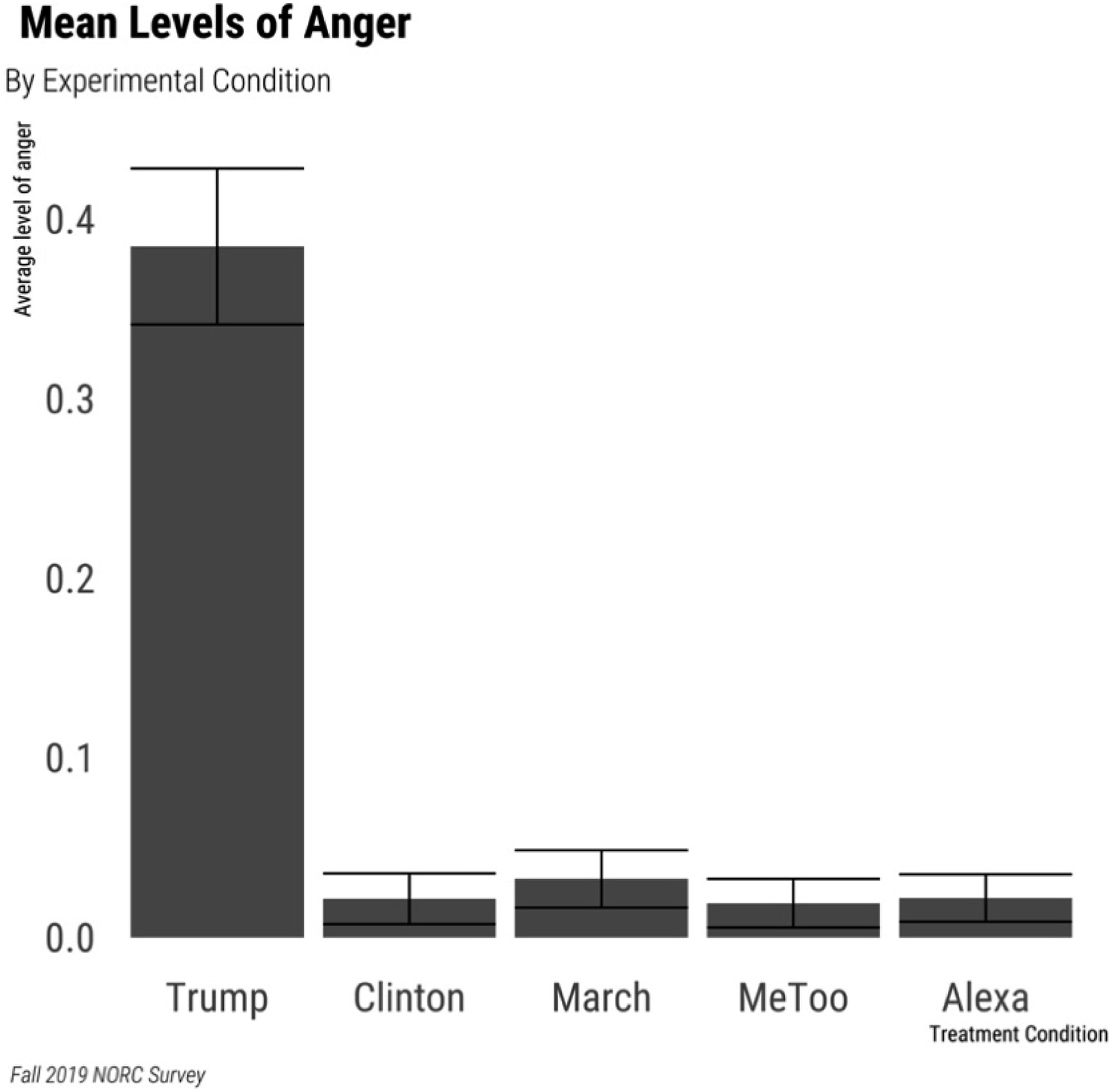
To explore if partisanship moderates the effect of the treatment, we ran a regression analysis with dummy variables for each treatment interacted with partisanship.
11
Since interaction terms are not directly interpretable, we illustrate the marginal effects of the treatment by partisanship in Figure 2 (for full results see S.I. Table A2). While both Democratic and Republican women experience an increase in levels of anger given exposure to the Trump treatment, as hypothesized, the effect is far more pronounced among Democratic women (b = 0.524, p = 0.00, one-tailed) than among Republican women (b = 0.102, p = 0.00, one-tailed). Change in anger moving from the control to treatment conditions by party.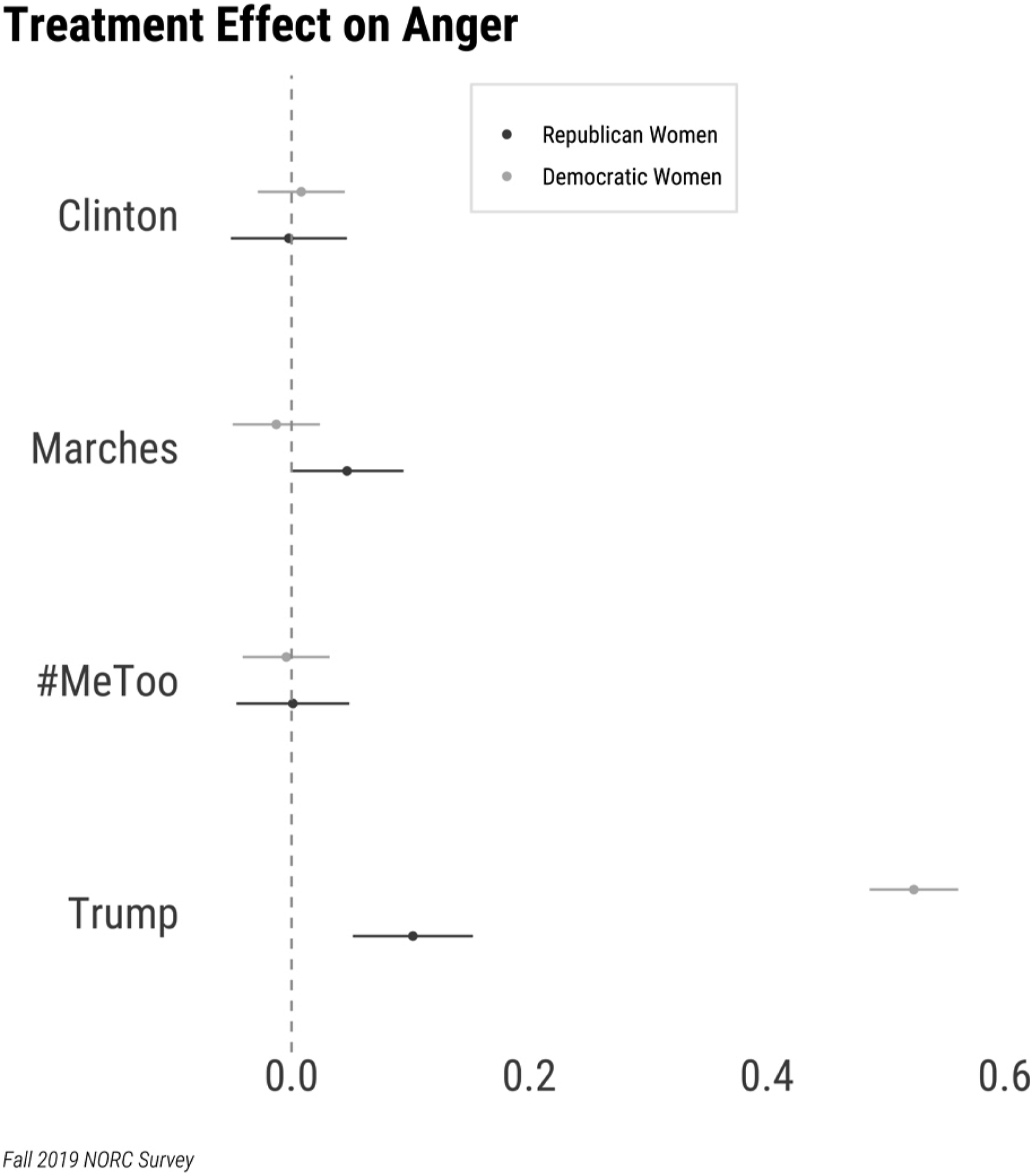
Being exposed to Donald Trump’s misogynistic rhetoric has substantial effects on feelings of anger, particularly among Democratic women, but it remains to be seen whether this leads to an increase in political ambition. To explore if this is the case, we use a structural equation model (SEM) to show the effect of the treatments on emotions and in turn political ambition. This model allows us to test whether anger mediates the relationship between the Trump treatment and political ambition, as hypothesized. The top left of Figure 3 demonstrates that the Trump treatment increases anger, and elevated anger in turn increases political ambition (Indirect Effect = 0.025, p = 0.04, one-tailed), as expected.
12
Path diagram of mediation analysis, NORC.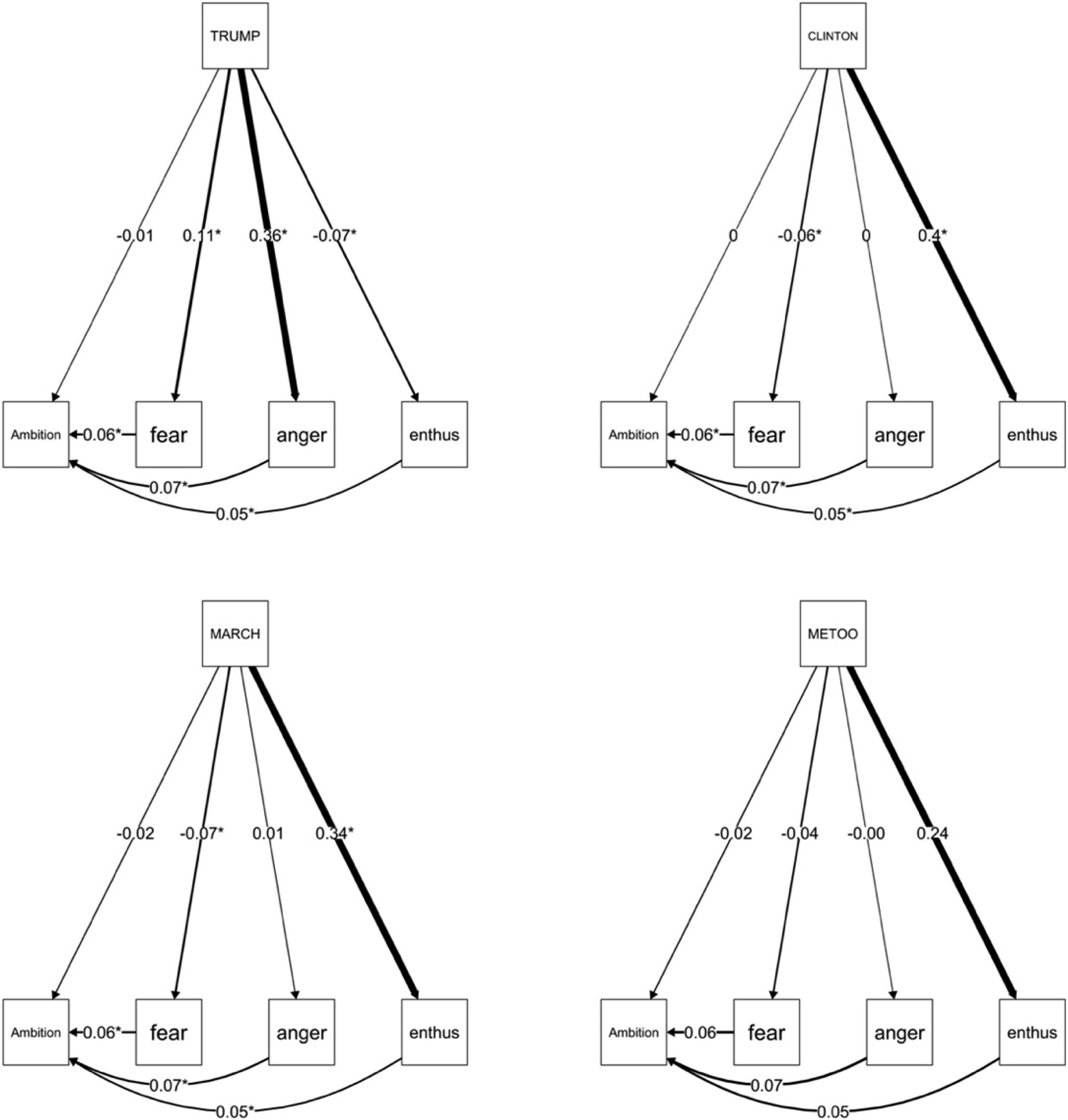
The Effects of the Political Environment on Enthusiasm and Political Ambition
We now turn to our analysis of feelings of enthusiasm. Individuals in the Trump treatment have significantly lower levels of enthusiasm compared to those in the control group (mean = 0.010, p = 0.00), while those in the Clinton (mean = 0.48; p = 0.00), Marches (mean = 0.42, p = 0.00), and #MeToo conditions (mean = 0.32, p = 0.00) have significantly higher levels of enthusiasm than those in the control group (Figure 4), in line with expectations.
13
Mean enthusiasm by experimental condition.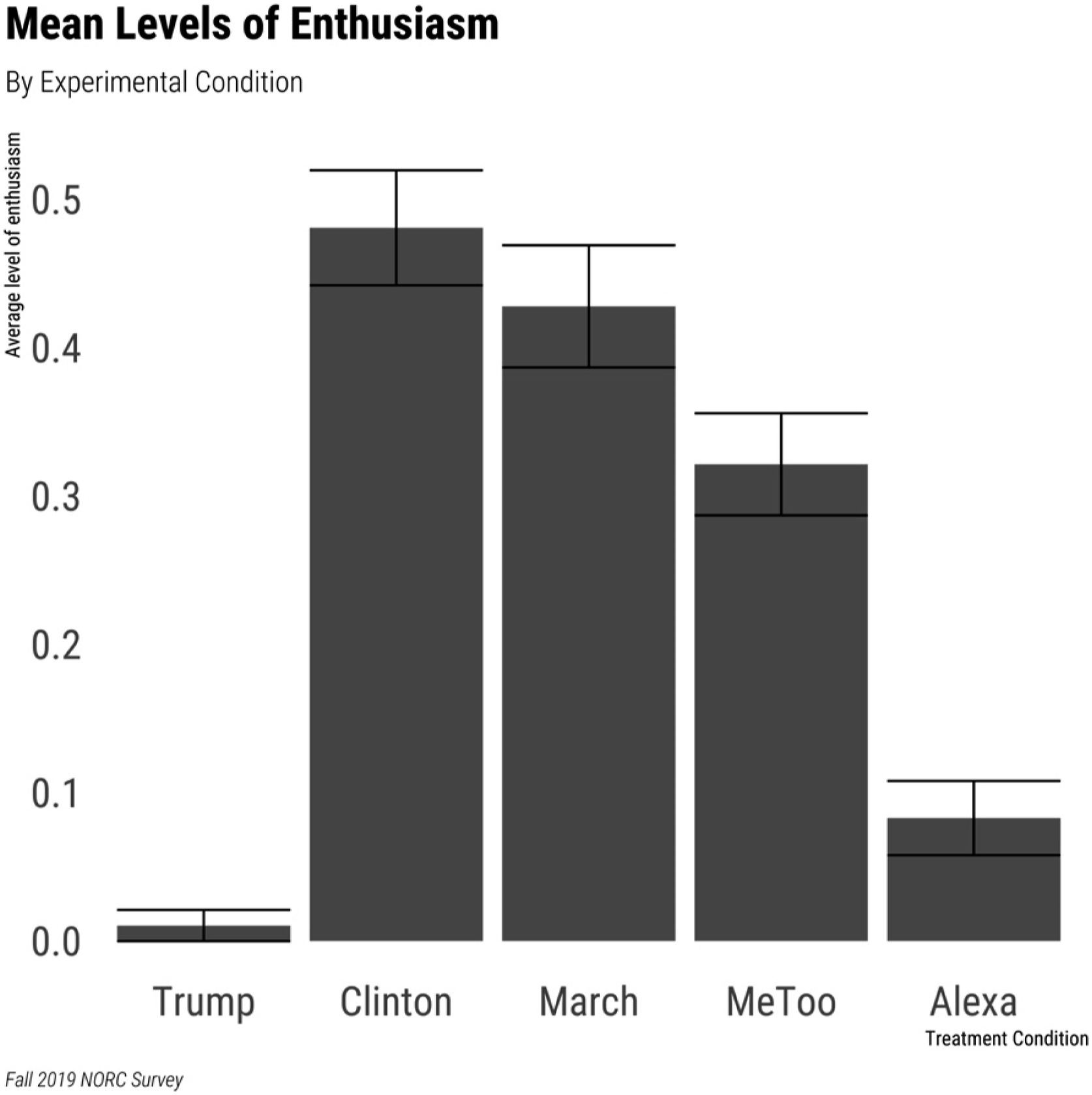
Next, we examine whether the treatment effects are moderated by party (S.I. Table A4). As before, we regress enthusiasm on measures for each treatment condition, party, and the interaction of each. We illustrate the marginal effects in Figure 5 and observe that the Clinton condition, Marches condition, and #MeToo condition all push Republicans and Democrats in the same direction, but the increase in enthusiasm is significantly higher among Democrats, as expected. Both groups experience a similar decline in enthusiasm given exposure to the Trump treatment. Change in enthusiasm moving from the control to treatment conditions by party.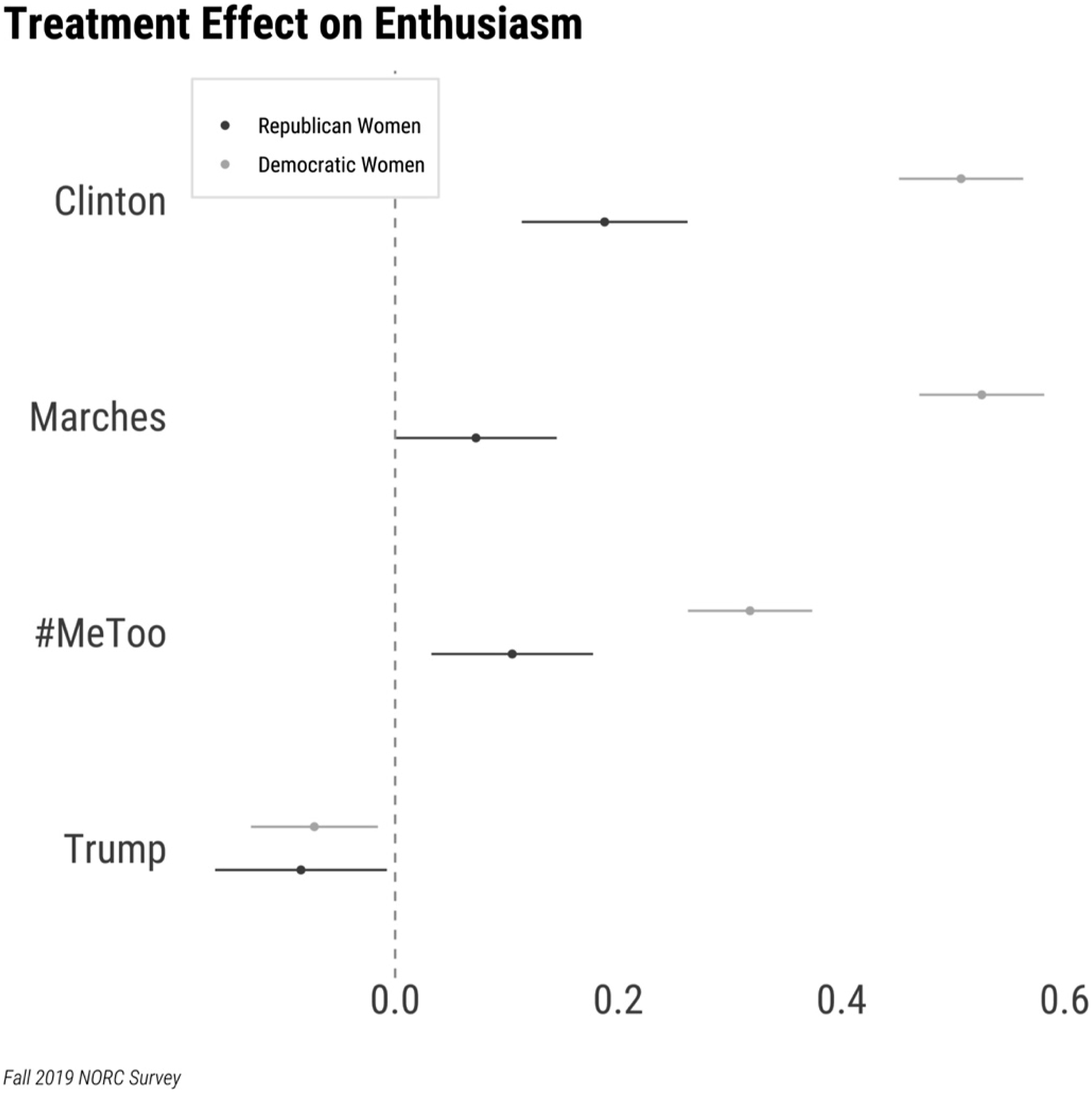
How do these feelings of enthusiasm in turn affect political ambition? We again turn to SEM to explore the effect of each treatment through enthusiasm on political ambition (see Figure 3; S.I. Table A3). In the top left of the figure, we observe that exposure to the Trump treatment reduces enthusiasm and in turn political ambition (indirect effect = −0.004; p = 0.06, one-tailed). However, as expected, we find a positive indirect effect of enthusiasm in reaction to the Clinton condition (indirect effect = 0.021, p = 0.02, one-tailed), the Marches condition (indirect effect = 0.018, p = 0.02. one-tailed), and the #MeToo condition (indirect effect = 0.013, p = 0.02, one-tailed). 14 The path diagram shows the strongest paths between our treatments and ambition through emotional reactions using bolder lines. The strongest path for the Trump treatment is through anger, whereas for all other treatments we see the strongest effect through enthusiasm.
Should any elevated emotions lead to greater engagement? Our theory suggests that we should not observe the same type of indirect effect on political ambition for fear. We only found a higher level of fear relative to the control group for the Trump treatment, and when we run the mediation analysis, we observe a marginal mediating effect of fear on political ambition (indirect effect = 0.007, p = 0.107, two-tailed).
In sum, our analysis of data from a pool of potential future candidates shows that different gendered features of the political environment led to distinct emotional reactions, particularly among white Democratic women. These women reacted with greater anger and less enthusiasm when exposed to a vignette highlighting Trump’s treatment of women, and with greater enthusiasm when instead reading a vignette about Clinton’s historic run for office, the Women’s Marches, or the #MeToo movement. These elevated emotions, in particular anger and enthusiasm, indirectly increased political ambition. These findings are robust to the inclusion of controls (age, income, and partisanship; see S.I. Table A5 and A6) and as noted in footnotes alternative approaches to mediation analysis.
It is possible that these features of the political environment affected political ambition through additional mechanisms. For example, the treatments may have also increased a sense of gender linked fate and in turn political ambition. Our survey included a question on gender linked fate post-treatment. We only find evidence of a mediating effect of the treatment on political ambition through gender linked fate for the Marches condition (see S.I. Table A7). This suggests another important pathway to political ambition, which hopefully paves the way for future work on the relationship between certain elements of the political environment and linked fate.
The main goal of our study design was to explore how women react emotionally to distinct gendered features of the environment, and how this varies by partisanship. Given some of the concerns around mediation analysis (Bullock and Ha 2011), we ran a follow-up study on the 2020 CCES with the goal of directly manipulating feelings of anger toward Trump’s treatment of women. That is, we look at the direct effect of the mediator, anger, on political ambition, as other work has done when exploring the effect of manipulating emotions on other types of political activity (e.g., Valentino et al. 2011). By 2020, our other conditions were less salient. Respondents were randomly assigned to conditions in which they were asked to describe what they find relaxing (control condition); what makes them angry about Trump; what makes them angry about Trump’s treatment of women; or, what makes them angry about Trump’s treatment of minorities.
If we look at the effect of the treatment asking respondents to list what makes them angry about Trump’s treatment of women on political ambition (relative to the control condition) using two-stage least squares to account for non-compliance, 15 we find that the treatment increases political ambition (p < 0.05 one-tailed; see S.I. Table A12). These findings therefore show that experimentally manipulating anger in reaction to Trump’s treatment of women leads to greater political ambition, which gives us more confidence in the findings for the Trump treatment from our first study.
Digging Deeper Into Motivations to Run for Office
The experimental results help demonstrate the causal effects of the political environment on political ambition through anger and enthusiasm. However, they are limited in their ability to unpack how women experienced these emotions simultaneously in reaction to the political environment. Furthermore, our experimental samples likely do not include women who actually decided to run for office, and our data has been de-identified leaving us no way to tell. To probe more deeply how different dimensions of the political environment influence women’s decisions to run for office, we conducted in-depth interviews with women in which we asked candidates why they ran, and most importantly, to explore if they discuss the hypothesized emotional mechanisms when talking about Trump’s treatment of women, Clinton as a candidate, the Women’s March or the #MeToo movement. We find gendered features of the political environment are recurrent themes for our participants, and for many, emotional reactions to the environment operated as expected.
We drew a sample of the entire population of female candidates running for local level office (from county registrar offices) after the 2016 election and before the 2020 election in the following counties: Los Angeles, San Diego, Imperial, Orange County, Riverside, and San Bernardino. This sample was selected due to geographic constraints, and we focused on local level offices to get a sample of consistently new candidates. Participants were recruited via email; and a maximum of two recruitment emails were sent. The sample includes 16 interviews with women who ran for different types of local offices in the 2018 election, with one who was running in 2019. Most women we interviewed were running for office for the first time and were white (two women in the sample were women of color). Five of the 16 women in our sample identified as LGBTQ. The interviews were conducted in person or by phone.
We asked for basic information about the candidates, broad questions about their motivations for running, and specific targeted questions regarding our hypotheses of how gendered features of the political environment may have influenced their decision to run: Trump’s candidacy, Hillary’s candidacy, and recent women’s movements. We did not directly ask about emotional reactions but examine whether they reference emotional reactions as they discuss these environmental factors (for the full question list, see S.I.).
Trump
We hypothesized that women might feel angered by Trump’s treatment of women and that this would motivate some women to consider running for office. We found support for this hypothesis in our experiment. Do we also see support for this in interviews with first-time women candidates? In the interview, we first asked a generic question about what influenced the candidate’s motivation to run to see if Trump came up as a topic. Later in the interview, we asked a more direct question of whether Trump had any effect on their motivation to run.
Out of our 16 respondents, six discussed Trump being a motivating factor in reaction to the first prompt, while an additional two said Trump played a role in reaction to the second prompt. Therefore, half of our respondents pointed to this as a motivating factor. Did the open-ended responses show any evidence that anger toward Trump’s treatment of women was a mechanism leading to this motivation? This was the case for many of our respondents. For example, one Councilwoman noted, “I mean it’s still deeply infuriating to me that he is the president, someone who is so blatantly sexist and misogynistic and a harasser and someone who is, unqualified frankly for the role.” Another interviewee discussed how Trump’s elevation to office was a wake-up call about the status of women in U.S. society, a theme we highlighted in the Trump vignette. This wake-up call motivated many to run, as expressed by one Councilwoman: “Basically when Trump was selected, I was part of that first 13,000 women who declared and started running right away like the world changed for me. I thought that we lived in a world where women could be president. And then I learned that we couldn’t and maybe we would never reach gender equality in politics...” Another common theme expressed was a motivation to run because of the frustration of seeing an inexperienced candidate win against a highly qualified woman.
Clinton’s Historic Candidacy
We also hypothesized that Hillary Clinton’s historic run for the presidency might be a factor influencing candidates to run for office. In our experiment, we found that reading about Clinton’s historic run increased enthusiasm, particularly among Democratic women, and in turn increased political ambition. This relationship was further probed through our interviews. In response to the first question about motivations to run for office, five mentioned Clinton, and when directly prompted about Clinton, an additional three said she was a motivating factor.
Many of these respondents discussed her using positive emotive terms. For example, one councilmember recounted being inspired by Clinton ever since she was a young girl. She volunteered for Clinton’s campaign in 2016 and was devastated by her loss but was moved by Clinton’s call for action in her concession speech: “Hillary is saying women need to run for office. This is obviously my call to action to run for office...” Others interviewed cited enthusiasm for Hillary and characterized her as an inspiration and listed her as a role model in the way she handled being a woman in the political arena. For instance, a board member discussed how Clinton’s presence in the political landscape gave women “clues” about how to handle misperceptions of the role of gender in politics. Another woman said that Hillary Clinton was “very inspirational, very relatable, [and] completely trustworthy”.
#MeToo and Women’s Marches
Finally, we turn to what effect, if any, the #MeToo movement and Women’s Marches had on women’s decisions to run for office, and the extent to which enthusiasm undergirds those reactions. The findings from the experiments indicated that these movements played a role through increasing enthusiasm. The data from our interviews suggest these movements were inspiring to many women we interviewed, but they played a supporting role in their decisions to run for office.
To our first unprompted question of motivations to run for office, none of our participants mentioned #MeToo or the Women’s Marches. We later asked more directly what role, if any, each movement had on women’s decisions to run for office. The #MeToo movement seemed to play a minor role for many of the interviewees but might have had a more latent effect in boosting positive emotions of empowerment and pride. For example, a board member told us that she was very “energized by #MeToo, the Women’s Marches,” adding, “I am so excited about it! … I am feeling in general, this, optimism and determination, and uplift... I feel like we’re on a huge cusp of change.” In total, 8 of the 16 women interviewed saw the #MeToo movement as having some impact on their decision to run, although it was not the main factor. This can be summed up by one councilmember: “The #MeToo movement has certainly helped me decide more so to run but I don’t think it was instrumental in my decision to run”.
Half of the candidates participated in or spoke at the various Women’s marches. When prompted about whether the Women’s Marches played any direct role in the decision to run for office, similar to the #MeToo movement, for about half of the sample the marches played more of a supporting role. For example, one councilwoman did not cite the Women’s Marches as a main motivator for running for office, but saw the Women’s Marches as a political expression and reaction to the 2016 election: “And so I saw the Women’s March is directly tied to Hillary losing and Donald Trump winning. And there’s need for women to rise up and be more active in politics. And for me that meant thinking about running for office. In that moment. Yes”.
Discussions around both movements also suggest additional mechanisms through which the movements may have impacted women’s decisions to run for office. Some discussed the movements as activating a sense of group identity. For example, some of these candidates spoke in language suggesting a sense of duty toward women as an entire group as represented in the Marches and #MeToo. A councilmember mentioned a sense of guilt in being complacent despite previous political engagement and campaigning for other candidates when realizing women were not represented on that city council and had not been in some time. Others echoed the notion of women as a gendered collective. We were able to explore the effect of these movements on political ambition in our experiment and found a significant and positive effect through gender linked fate for the Marches condition, but the indirect effect of #MeToo was not statistically significant.
Conclusions
All of our analyses, including survey experiments and in-depth interviews, show how gendered features of the political environment surrounding the 2016 presidential election led to particular emotional reactions, which in turn increased women’s political ambition. Our first survey experiment showed that exposure to Trump’s negative treatment of women increased feelings of anger among respondents and exposure to the Clinton, Women’s Marches, and #MeToo conditions all increased feelings of enthusiasm. In all of these cases, these reactions were felt more strongly among Democratic women. Though our sample of highly educated white women had low levels of political ambition on average, these distinct emotional reactions led to small increases in political ambition. Our second experiment served as a robustness test of the Trump treatment and showed that directly manipulating anger around his treatment of women led to higher levels of political ambition. Finally, our findings from the in-depth interviews corroborated emotions as one important mechanism through which people experience the political environment, and how this may motivate decisions to run for office.
Across both the experimental studies and the in-depth interviews with candidates, we see the impact the political environment has on women’s political ambition. The advantage to pairing these different approaches is that we were not only able to isolate certain environmental factors in the experiment but also dig deeper into the complexities and interrelatedness of the emotions felt by women in reaction to the political environment in the in-depth interviews. For example, it was rare for interview participants to talk about Trump without also reflecting on Clinton. It was clear from our experiment that Clinton’s historic candidacy sparked enthusiasm (and not anger), while Trump’s treatment of women led to greater anger (and lower enthusiasm), and both of these emotions in turn increased political ambition. It could be that the combination of higher enthusiasm on the one hand, and higher anger, was particularly effective as a mechanism in increasing women’s ambition. It is also worth noting that in both the interviews and in the experimental studies, the Women’s Marches and the #MeToo movement did not serve as primary drivers of women’s political ambition.
For both theoretical and empirical reasons, the focus of our analysis was on white women, but it is important for future work to examine the effects of the political environment on women of color. Our sample for the experiment only consisted of white women, which enabled us to look at the intersection of party with our treatment conditions. However, we could not look at variation by race/ethnicity within party with that sample. And, while our in-depth interviews included some women of color, the sample size was too small to draw meaningful inferences about the conditioning role of race and ethnicity. As noted in our discussion earlier, while our study can help us understand how gendered features of the political environment may have affected white women (who made up about 61% of the pool of female candidates in 2018), 16 women of color (who made up about 34%; for 5% of the pool race was not clear) may have reacted differently than white women to Trump, Clinton’s run for office, and social movements.
Supplemental Material
Supplemental Material - The Effect of the Political Environment on White Women’s Political Ambition
Supplemental Material for The Effect of the Political Environment on White Women’s Political Ambition by Stephanie L. DeMora, Christian Lindke, Sean Long, Jennifer L. Merolla, and Maricruz A. Osorio in Political Research Quarterly
Footnotes
Declaration of Conflicting Interests
The author(s) declared no potential conflicts of interest with respect to the research, authorship, and/or publication of this article.
Funding
The author(s) received no financial support for the research, authorship, and/or publication of this article.
Data Availability Statement
All data and code used for analysis are publicly available on the Harvard Dataverse  or upon request from the authors.
Supplemental Material
Supplemental material for this article is available online.
Notes
References
Supplementary Material
Please find the following supplemental material available below.
For Open Access articles published under a Creative Commons License, all supplemental material carries the same license as the article it is associated with.
For non-Open Access articles published, all supplemental material carries a non-exclusive license, and permission requests for re-use of supplemental material or any part of supplemental material shall be sent directly to the copyright owner as specified in the copyright notice associated with the article.
