




Abstract
Interest groups seek to influence parliamentarians’ actions by establishing exchange relationships. We scrutinize the role of exchange by investigating how interest groups impact parliamentarians’ use of individual parliamentary instruments such as questions, motions, and bills. We utilize a new longitudinal dataset (2000–2015) with 524 Swiss parliamentarians, their 6342 formal ties to interest groups (i.e., board seats), and a variety of 23,750 parliamentary instruments across 15 policy areas. This enables us to show that interest groups systematically relate to parliamentarians’ use of parliamentary instruments in the respective policy areas in which they operate—even when parliamentarians’ time-invariant (fixed effects) and time-variant personal affinities (occupation, committee membership) to the policy area are accounted for. Personal affinities heavily moderate interest groups’ impact on their board members’ parliamentary activities. Moreover, once formal ties end, the impact of interest groups also wanes. These findings have implications for our understanding of how interest groups foster representation in legislatures.
In Western democracies, privileged access to members of parliament (MPs) is heavily sought after by interest groups. By means of financial contributions, information provision, electoral support, and other resources, interest groups establish relationships with the goal of influencing MPs to act in their interest. A large and influential theoretical strand considers exchange as the foundation of these relationships (Berkhout 2013; Bouwen 2004; Hall and Deardorff 2006; Hopkins, Klüver, and Pickup 2019). It builds on the notion that collaboration between MPs and interest groups is mutually beneficial, and accordingly sustained if both actors (perceive to) profit. Yet the exchange mechanism is generally rather assumed than tested. In this article, we therefore scrutinize the role of exchange on MPs’ behavior by addressing three of its key aspects: the impact of on-going exchange relationships, MPs’ susceptibility to exchange, and the reciprocity of exchange. More specifically, we address these aspects by studying how MPs’ seats on the boards of interest groups, that is, formal ties affect MPs’ focus on specific policy areas when using parliamentary instruments at their individual disposal in the Swiss case.
This focus on parliamentary instruments entails several advantages when studying exchange. Parliamentary instruments such as parliamentary questions, interpellations, postulates, motions, or bills constitute an important signaling tool towards a variety of political actors. Members of parliaments use them constantly. They reveal the position and intensity—effort and time investment—that MPs exhibit in specific policy areas (Hall 1996). Members of parliaments’ available attention is scarce so they can only focus on a limited number of issues at a time (see Jones and Baumgartner 2005). When forming relationships with MPs, interest groups may influence legislators’ focus of attention.
Whether this occurs, and if so, to what extent remains empirically unclear. There are several reasons for this. Damgaard (1980, 223) already argued that legislators’ areas of interest and expertise are most strongly indicated by their occupations. Indeed, occupational background drives MPs’ political behavior in several fields, including self-selection into committees (Hamm, Hedlund, and Post 2011; McElroy 2006; Shepsle 1978, 79; Yordanova 2009), bill introduction, and the focus of their legislative agendas (Burden 2007). At the same time, committee membership relates to MPs’ legislative agenda (Schiller 1995). Given these two known empirical patterns, it constitutes a key challenge to the understanding of the role of exchange to empirically disentangle the effect of interest group influence from these personal causes for policy area focus. For example, a legislator with medical training or a seat on the health committee is more likely to submit bills on health policy. Simultaneously, she is arguably also more likely to work with health lobby organizations. When measured cross-sectionally, we thus observe a spurious correlation between the policy area of the representative’s interest group ties and other sources of her policy focus in parliament. The observed statistical correlation between these could be due to the representative’s occupational background or committee membership, and hence affinity to the policy area rather than actual influence on the part of her interest groups.
We propose an original approach to overcome this confounding effect of personal affinity, and make use of the unique part-time nature of the Swiss national parliament. It is the only national parliament where—similar to some U.S. state legislatures—parliamentarians retain their regular occupations while serving part time in the legislature (Bütikofer 2013). We leverage this context as an opportunity to provide a test for interest group influence by not only using time-invariant MP fixed effects but additionally the policy area of MPs’ occupation and committee membership as time-variant control variables. Our choice of a longitudinal design with separate analyses for 15 policy areas arguably constitutes a fitting scenario of statistical control in a real-life observational context. As it would be difficult to devise an experimental design to scrutinize this dynamic, we consider the presented setup to be as close as reasonably possible for empirically establishing whether interest groups and parliamentarians—implicitly—exchange benefits for influence. 1
The presented design offers two additional empirical contributions. First, our choice of adopting a per-policy area approach enables us to put the effect size of interest group influence into perspective by comparing it to current occupation and committee membership as alternative key drivers of MPs’ focus on a certain policy area, and inspect their moderating effect on legislative subsidies and other benefits provided by interest groups. At the same time, focusing on individual policy areas allows us to control for MPs’ traditional principals, voters and the party (Carey 2007; Hix 2002), by using constituency and party fixed effects per policy area.
Second, the longitudinal nature of our design accounts for changes in relations between MPs and interest groups over time. Our key independent variable is MPs’ memberships on interest group boards. We focus on these strong ties because, in comparison to measures such as campaign contributions, such formal ties are institutionalized relationships between parliamentarians and interest groups. This has not only theoretical merit, but also analytical advantages: board memberships come with start and end dates, and therefore clearly delimit the period during which benefits can be given in return for favors. The number of formal ties MPs have at any given time serves as a proxy for interest groups’ supply of benefits.
Empirically, this approach is made possible by data from the Swiss context. Board seats allow us to measure the role of interest groups at concrete moments in time. Swiss parliamentarians are required to provide yearly overviews of their board positions in interest groups. We estimate the effects of formal ties separately across 15 policy areas, for example, whether a farmer with many formal ties to agricultural interest groups still submits more instruments than a farmer with fewer or no ties. We then synthesize these policy area-specific results into an overall image of how MPs’ interest group board positions affect the policy focus of the parliamentary instruments they submit.
To anticipate, the results show that more formal ties to interest groups lead to more activity of parliamentarians in the respective policy areas. Evidence for the existence of a strategic exchange relationship between MPs and interest groups where board positions are “traded” for influence can be found even when MPs’ personal affinity (fixed effect, occupation and committee membership), their political parties, and their voters are all explicitly accounted for. Nonetheless, the effect of a single interest group is smaller than that of their personal interests (occupation, committee membership). In fact, interest groups’ impact is cut almost by half when personal interests in a policy area exist, thus highlighting that not all legislators are equally susceptible to exchange benefits. The exchange conceptualization is further corroborated by results indicating that with said controls it is current rather than former formal ties that affect MPs’ use of parliamentary instruments: we find support for the reciprocity of formal ties by showing that the effect of ties dissipates over time once MPs and interest groups end them. Our findings are robust when using alternative model estimation approaches and not driven by the distinct purposes of specific parliamentary instruments (i.e., gathering information/government oversight, or introducing new policy).
The Impact of Interest Groups on Parliamentary Instruments
Traditionally, the impact of interest groups has been conceptualized as particular policy outcomes that come about or are prevented as reactions to interest group activities (see Leech 2010), with voting behavior being one of the primary examples (e.g., Fellowes and Wolf 2004; Baumgartner et al. 2009). While such key decisions are undeniably important, interest groups arguably also target an entirely different layer of parliamentary behavior, namely, parliamentary instruments. It matters to interest groups how engaged MPs are in policy issues important to their organizations. Parliamentarians need to decide on a continuous basis what kind of policy areas to focus on and specialize in. Parliamentary instruments reflect this and are used to signal concerns and take positions in policy areas (Martin 2011); traditionally towards voters (Bräuninger, Brunner, and Däubler 2012; Highton and Rocca 2005). Parliamentary instruments are particularly suited for this purpose because they are closed instruments—policy statements that entail detailed policy questions, requests, and drafts that require specific action from a certain addressee (see Keh 2015, 1088). They also allow legislators to signal positions that are not related to the current legislative agenda. Interest groups have been shown to reward position taking and signaling behavior—bill sponsorship is a case in point—with campaign contributions (Rocca and Gordon 2010). In this article, we argue there is an additional aspect to this relationship: interest groups not only reward this behavior post hoc but also induce it.
Existing research on how interest groups affect parliamentary instruments is scarce. Evidence so far has been limited to the study of a few select interest groups on the aggregate legislature level (Hertel-Fernandez 2019). At the individual level, interest groups’ influence on the use of parliamentary instruments has been addressed (Martin 2011; Pedersen 2013), but could—with the notable exception of the effect of campaign contributions on committee amendments (McKay 2020)—not be systematically corroborated. There are two possible reasons for this. On the one hand, the absence of effects may arguably relate to the difficulties that interest groups face when attempting to gain the attention of legislators in the first place (see Fraussen, Graham, and Halpin 2018; Jones and Baumgartner 2005). On the other hand, the apparent absence of impact might also be the consequence of a relatively rough cross-sectional measurement that includes observations in which interest groups struggle to assert influence, thus increasing the chance of finding contradictory patterns of interest group influence (Leech 2010). Hence, we adopt a fine-grained longitudinal approach where we focus on long-term MP-interest group relationships as a strategy to identify sizeable shifts in legislators’ focus towards interest groups’ areas of concern.
The Exchange Relationship Between Interest Groups and Parliamentarians
One of the key theoretical ideas in the literature for understanding interest groups’ influence on parliamentarians is to conceptualize it as an on-going exchange relationship. To exert influence on MPs and their behavior, interest groups seek to establish connections with them (Fellowes and Wolf 2004; Grossman and Helpman 1996; Roscoe and Jenkins 2005; Stratmann 1998). Interest groups use their current access to parliamentarians to gather information on political processes, to foster the representation of their interests in committees and on the legislative floor, and to hold the government accountable (Fouirnaies and Hall 2018; Kalla and Broockman 2016; Varone, Bundi, and Gava 2020). In exchange, interest groups compensate parliamentarians with political benefits like information, electoral support, personal gifts, and additional—often financial—favors during this collaboration period (Berkhout 2013; Bouwen 2004; Eichenberger and Mach 2017; Hall and Wayman 1990; Lutz, Mach, and Primavesi 2018).
Until recently, it was generally assumed that interest groups tend to be interested in establishing informal links to parliamentarians (e.g., Marshall 2015; Wonka and Haunss 2019). However, as a result of the increasing demand for transparency in ever more countries, 2 both in terms of connections to organized interests and financial disclosure, light has been shed on the frequent occurrence of long-term collaboration between MPs and interest groups. Interest groups initiate formal exchange agreements by actively recruiting MPs for board positions in their organization (Huwyler 2021). Such formal ties between interest groups and parliamentarians constitute an official statement that these two actors cooperate. They entail both tangible effects—Eichenberger and Mach (2017, 2) talk of “policy-seeking interest group “tying the knot” with vote-seeking MPs”—and less direct ones such as the mutual enhancement of prestige (Gaugler 2009), for example, formal ties as a signal to interest groups’ supporters.
For interest groups, such relationships to MPs entail a long time period of institutionalized access to a political arena to which they usually lack direct access. As long as they support their MPs, they can ask them to use the parliamentary instruments at their disposal to their benefit, for example, to propose draft laws, suggest new measures or legislative regulations, and demand information or reports. Patterns in MPs’ submissions of parliamentary instruments should reflect on-going interest group affiliations accordingly.
A formal tie to an interest group offers several valuable benefits to MPs. First, it provides non-financial compensation such as specialized knowledge and information that benefits parliamentarians’ work, as they deal with issues in a wide array of policy areas (Bouwen 2004; Hall and Deardorff 2006; Klüver 2013). Specialized knowledge and information function as a legislative subsidy, which offers MPs the possibility to appear competent in often complex policy areas (Hall and Deardorff 2006). In consequence, parliamentarians are in a position to display more activity in policy areas to which these resources pertain. Second, interest groups also offer financial benefits, such as resources for election campaigns (Fellowes and Wolf 2004; Lutz, Mach, and Primavesi 2018). They may also incentivize parliamentary activities by providing side payments such as gifts or continuous financial support in the form of paid board positions, if the legal framework 3 allows this (Djankov et al. 2010). Third, interest groups can offer opportunities for post-parliamentary employment (Claessen, Bailer, and Turner-Zwinkels 2021; Lazarus, McKay, and Herbel 2016).
While sitting on the boards of interest groups, MPs therefore want to demonstrate their worth, make use of additional information and resources in order to raise specific issues in parliament, and demand laws benefitting their interest groups. Accordingly, we expect parliamentarians to show an increased level of individual activity in certain policy areas as a result of on-going formal interest group ties in those areas.
Parliamentary activities are also affected by MPs’ personal interests, values, and expertise in specific policy areas (Burden 2007, 15). Prior familiarity with a policy area reduces MPs’ costs of being active in said area. It has been contended that those interests and expertise are best indicated by legislators’ occupations (Damgaard 1980, 223) and by membership in the respective parliamentary committees. In the latter case, activity is not only affected by expertise but also the institutional advantages that committees offer (Hamm, Hedlund, and Post 2011; McElroy 2006; Shepsle 1978, 79; Yordanova 2009). As a consequence, benefits provided by interest groups will exert a weaker effect on those parliamentarians. On the one hand, MPs with expertise in a given policy area depend less on knowledge and information provided by interest groups to work effectively. On the other hand, specialized MPs’ attention to the policy area is less shaped by their interest groups, given that they also derive cues for their parliamentary activities from their occupational and committee-related expertise and experiences.
The conceptualization of the relationship between MPs and interest groups as an exchange implies that the influence of interest groups on parliamentarians depends on on-going formal ties. Parliamentarians should thus remain responsive to interest groups only as long as they obtain benefits. Accordingly, we should observe that parliamentarians’ current instrument use depends primarily on their current number of formal ties. An (implicit) exchange contract implies that once one side stops offering benefits, the other side will return in kind. In consequence, if exchange is reciprocal, parliamentarians should become less responsive to interest groups once their formal relationships have ended. Importantly, we expect the effect of previous formal ties to wane gradually. While sitting on interest group boards, parliamentarians will have deepened their knowledge, made relevant contacts, and possibly increased their personal interest in the specific policy area. In this way, resources and past experiences may induce MPs to be active in certain policy areas for some time even after the end of formal collaboration with interest groups. As these effects are not permanent though, we should no longer observe any effect of former interest group ties after some time.
Case Selection
We use the Swiss case for a test of the exchange mechanism because it allows us to control for time-variant personal policy area focus not only with committee membership but also with occupation. There are 72 democracies globally, including Switzerland, where national MPs can occupy at least some form of paid and unpaid job while in office (Djankov et al. 2010). However, in contrast to other national parliaments, and similar to some U.S. state legislatures, 4 Swiss MPs are part-time legislators who retain their normal occupations. Their parliament is in session 12 weeks per year while committees also operate between sessions. As occupations may exert both a direct influence on MPs’ parliamentary instrument use, and a direct effect on their collaboration with interest groups, not accounting for personal motivation would otherwise bias the results towards an overestimation of the formal tie effect.
Apart from MPs retaining their occupations, the Swiss system is similar to other Western democracies in many aspects: its legislature shares several characteristics with the U.S. Congress. The Swiss Federal Assembly is a bicameral legislature that consists of two equally powerful chambers. In the 200-seat Lower House, seats are allocated to cantons (states) based on resident population. In the 46-seat Upper House, each canton is represented by two seats. 5 Parties are traditionally relatively weak similar to parties in the U.S.
Data
The data in this study are drawn from two sources: Curia Vista, the Swiss Parliament’s database of parliamentary proceedings, and the Parliaments Day-By-Day (PDBD) database (Turner-Zwinkels et al. 2021). Based on these two sources, we generate a data frame with 58,455 observations using parliamentarian-years (i.e., repeated measures of parliamentarians across time with one observation for every year they have a seat in the Swiss Parliament) as the unit of analysis. This represents the idea that in principle, in every year, formal ties between parliamentarians and interest groups can form and end. The sample contains 524 unique politicians, nested in 24 political parties across five legislative periods. These data bring together four types of information: parliamentary instrument use, interest group affiliations, annual self-reported occupations, and additional biographical information, including committee membership.
Information on parliamentary instrument use is taken from Curia Vista. Swiss parliamentarians can use an extensive range of parliamentary instruments (see Online Appendix B). There are neither limits to the number of submitted instruments, nor approval requirements by parliamentary party groups or co-sponsorship quora. All instruments available to MPs individually are also available to party groups and committees collectively. For every instrument, Curia Vista contains a unique database entry with meta-information, including the parliament’s own policy area classification. We focus our analysis to the 23,750 instruments submitted by individual MPs from 2000 to 2015.
For MPs’ interest group affiliations, the parliament’s official Register of Interest Ties served as the original source of the PDBD data collection. At the beginning of every calendar year, legislators have to report their interest group activities. This includes their seats in domestic and foreign leadership bodies, supervisory bodies, and advisory bodies of all organizations, institutions and foundations under private and public law to the Parliamentary Services. These lists have been published annually since 1985 and are available online. 6 The published formal ties are self-reported. Failure to report is not sanctioned. We thus will somewhat underestimate the extent of MPs’ extra-parliamentary work for interest groups.
The Register of Interest Ties also lists self-reported occupations of parliamentarians on an annual basis. Due to the part-time nature of the Swiss parliament, legislators typically hold regular jobs that may change over time next to their parliamentary mandate.
Fifteen Separate Policy Areas
To establish the hypothesized match between MPs’ formal interest group ties and their use of parliamentary instruments, we classified both into 15 distinct policy areas. Assignment to more than one policy area was possible. We used the policy area boundaries developed by the Comparative Agendas Project (CAP) whenever possible. In 12 policy areas, we rely directly on the CAP’s main categories. For three of the areas in our analysis (Economic and Financial Affairs, Social Affairs, Environment), we combine either two or three CAP categories (see Online Appendix C). 7 This was necessary since we rely on pre-coded data from the Swiss Parliament.
Of key theoretical interest is the occurrence of policy area matches across a variety of variables. A policy area match occurs when the values of different variables refer to the same policy area. Consider, for example, formal interest group ties in the area of transportation policy. For every MP, we count both (1) how many ties to transportation interest groups they have, and (2) how many parliamentary instruments on transportation policy they submitted each year.
8
We consider a match to have occurred if formal interest group ties have the same policy area as the submitted parliamentary instruments. This operationalization strategy builds on the assumption that MPs will use parliamentary instruments in line with the preferences of interest groups on whose boards they sit. Figure 1 shows our approach graphically. Of key interest are the hypothesized positive correlations (H1) on the diagonal from top-left to bottom-right of the correlogram. Parliamentary instrument use and formal interest group ties in 15 policy areas. Notes: Bars denote the average number of instruments used and formal interest group ties maintained respectively per MP in 15 policy areas. The correlogram shows the strength of the correlation between the two sets of variables (also see Online Appendix D). Hatched areas denote negative correlations. N=3897. The positive correlations on the diagonal can be seen as prima facie support for H1. AGRI = Agriculture; CRIM = Law, Crime, and Family Issues; CULT = Culture; DEFE = Defense; ECON = Economic and Financial Affairs; EDUC = Education; ENER = Energy; ENVI = Environment; GOVE = Government Operations and Multilevel Governance; HEAL = Health; HOUS = Community Development and Housing Issues; INTA = International Affairs; MEDI = Media and Research; SOCA = Social Affairs; TRAN = Transportation.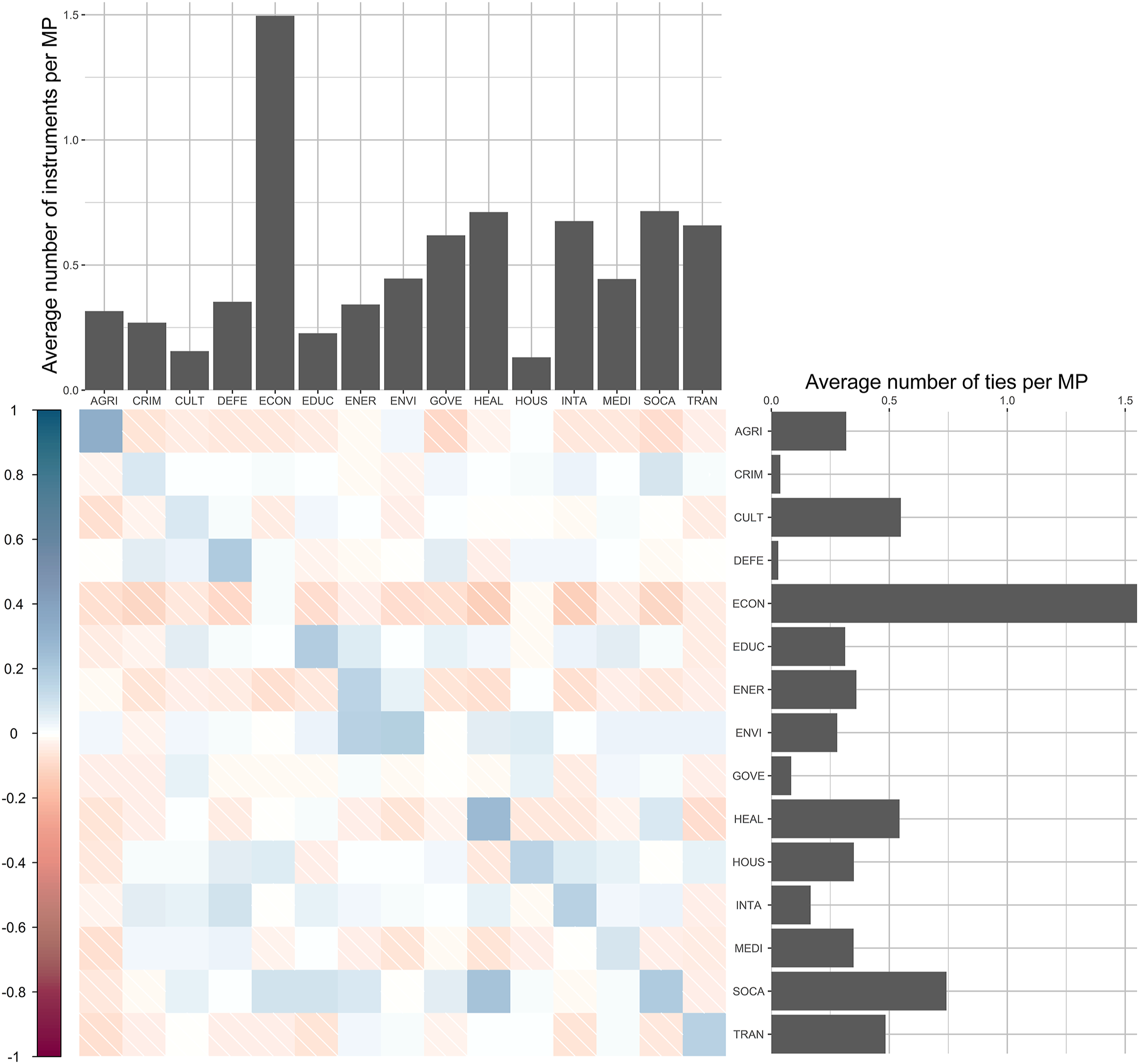
Key Measures Building on Policy Area Match
The measures that follow all rely on the idea of policy area matching. This means that each occurs 15 times in our data, once per policy area.
Number of parliamentary instruments
The dependent variable in all of our analyses is the number of all 9 instruments submitted by an MP in a certain policy area in a given year. Instruments include questions (38.6%), interpellations (26.9%), postulates (9.8%), motions (20.3%), and bills (4.4%) (see Online Appendix B). Based on the policy area codes preassigned by the Parliamentary Services, instruments were mostly 10 automatically attributed to the 15 policy areas. When the Parliamentary Services indicated multiple policy areas for a parliamentary instrument, the instrument was counted in all applicable policy areas. This served to create 15 distinct instrument counts per parliamentarian per year. Of the average 6.27 instruments that Swiss MPs submitted annually, the most, 1.5 on average, pertain to economic and financial policy (Figure 1).
Number of formal interest group ties
The main independent variable in our analysis is the number of interest group ties of any given parliamentarian in a certain policy area in a given year. All entries from the Register of Interest Ties 11 were coded by the authors according to their policy areas. Members of parliaments sit on average on 6.15 interest group boards, resulting in 0.41 formal ties per policy area.
Number of formal ties ended at t minus x years
This relative measure indicates how many more ties MPs had in the past in a certain policy area. Its use in regression analysis is preferred over the absolute measure number of ties at t minus x because that would strongly correlate with the current number of ties, and hence cause multicollinearity issues. We first calculate decreases in the number of ties between two subsequent years by policy area. Decreases are positive integers; increases are coded as decreases of zero. We then apply lags of varying durations to this measure. This allows us to measure how many formal interest group ties ended a certain number of years ago. Hence, the variable captures the effect of former ties for example, two ties that ended in 2009, in subsequent years, for example, in 2010 (t-1), in 2011 (t-2), etc.
Occupation (0/1)
Swiss parliamentarians typically hold day jobs. When occupations and policy areas match, parliamentarians should be more active in the policy area concerned. We expect, for example, that all else equal, elected medical professionals will be more active in health policy than other MPs. We measure dichotomously whether MPs’ occupation in a given year falls into a certain policy area (1) or not (0).
Committee membership (0/1)
Committee membership in the policy area (0 = no, 1 = yes) in which the instruments are submitted constitutes the second way in which we control for MPs’ personal interests and expertise. Committee membership is assumed to relate to personal interests and expertise, and therefore also a higher propensity to use parliamentary instruments in the committee’s policy area. At the same time, working in a committee also makes it more attractive to use instruments from that area as it gives MPs more control over the fate of their submissions.
Moreover, two control variables also follow the idea of policy area matching. We control for money at stake in the policy area and the salience of the policy area. Beyond policy area-specific measures, we add controls for leadership positions, the total number of parliamentary instruments, tenure, election year, and parliamentary chamber. Finally, we add fixed effects for constituency and party affiliation to remove any variance on these levels, 12 (for a detailed description of all variables, see Online Appendix E).
Analytical Strategy
The key relationship under scrutiny is that between formal interest group ties and the use of parliamentary instruments. We use negative binomial models instead of Poisson regression because our dependent variable, the number of parliamentary instruments used per policy area, is an over-dispersed count variable. Likelihood ratio tests on the residuals confirm this decision. 13 Since parliamentarian-specific and year-specific effects need to be accounted for, a non-nested model for each policy area is estimated for the random part of the model. This partial-pooling is appropriate for the time-series cross-sectional data at hand (Gelman and Hill 2006, 289). We estimate 15 different models, one for every policy area. These 15 models can be found in Online Appendix G.
However, to test our hypotheses, we need to calculate the average overall statistical relationship between formal ties (i.e., interest group board seats) in a specific policy area on the use of parliamentary instruments in this policy area. To obtain this overall general effect, we conduct a meta-analysis to synthesize the regression slopes across models using a univariate weighted least squares approach (Becker and Wu 2007, 7). This is possible because all our predictors are measured on the same scale and available across all 15 models. This setup allows us to test our hypotheses only once instead of separately for each of the 15 policy areas.
To illustrate the robustness of our key findings, we provide extensive additional tests that we report in Online Appendix I to K. We show that our results are not driven by the specific functions that parliamentary instruments serve, that is, gathering information/government oversight, 14 or introducing new policy. We estimate our models separately, using either only the number of oversight/information gathering instruments or the number of policy instruments as dependent variables, respectively. To ensure that our results hold when estimating a model that controls for MPs ever having formal ties in a certain policy area, a non-synthesized model in which the function of the aforementioned meta-analysis is fulfilled by simply stacking the 15 different policy area models together into one model, and a regular linear regression model. 15 Furthermore, we replicate the results of the effect of former formal ties (Figure 3) with models using parliamentarian fixed effects. The findings presented are robust to these alternative specifications.
As a final remark on causality in our design, it is important to point out that the measure of our independent variable, formal ties, precedes (January) that of the instruments (rest of the calendar year). This strengthens a semi-causal interpretation of the key effects of interest. The inclusion of occupation, committee membership, and MP fixed effects as control variables deals with policy area affinity of MPs as far as possible.
Results
The General Effect of Formal Ties
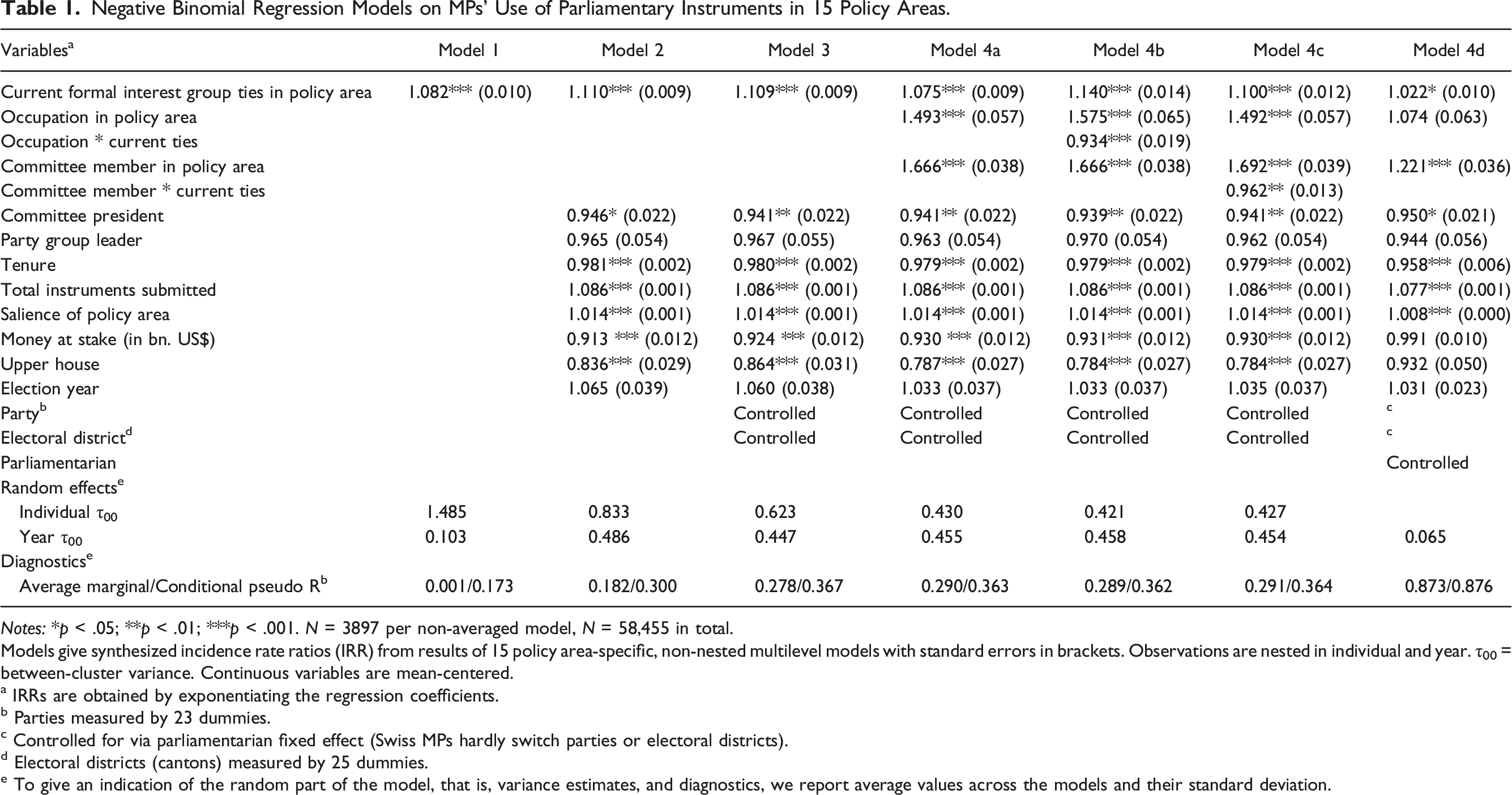
Negative Binomial Regression Models on MPs’ Use of Parliamentary Instruments in 15 Policy Areas.
Notes: *p < .05; **p < .01; ***p < .001. N = 3897 per non-averaged model, N = 58,455 in total.
Models give synthesized incidence rate ratios (IRR) from results of 15 policy area-specific, non-nested multilevel models with standard errors in brackets. Observations are nested in individual and year. τ00 = between-cluster variance. Continuous variables are mean-centered.
a IRRs are obtained by exponentiating the regression coefficients.
b Parties measured by 23 dummies.
c Controlled for via parliamentarian fixed effect (Swiss MPs hardly switch parties or electoral districts).
d Electoral districts (cantons) measured by 25 dummies.
e To give an indication of the random part of the model, that is, variance estimates, and diagnostics, we report average values across the models and their standard deviation.
Our regression analysis progresses in several steps through subsequent models with increasingly far-reaching statistical controls. Model 1 tests the non-controlled relationship. In Model 2, we add MP-level controls (e.g., tenure) and policy area-level controls (e.g., salience). In Model 3, the party and constituency fixed effects are introduced to control for their influence on MPs’ parliamentary instrument use. In Model 4a, we inspect the effect of formal ties in the context of dynamic personal interests: occupation in policy area and committee membership in policy area.
16
In Models 4b and 4c, we inspect the moderation effect of occupation and committee membership on formal interest group ties. Finally, in Model 4d, parliamentarian fixed effects are added as a strong time-invariant control for MPs’ affinity towards a policy area.
17
Finally, for those who prefer such a presentation, the key results are also displayed graphically in Figure 2. There we show average marginal effects to compare interest groups’ impact on legislators with occupations or committee seats in the relevant policy area to those without policy area affinity. Average marginal effects for formal interest group ties. Notes: Average marginal effects are based on the underlying models 4b (left) and 4c (right). 95% confidence intervals calculated using Satterthwaite’s approximation.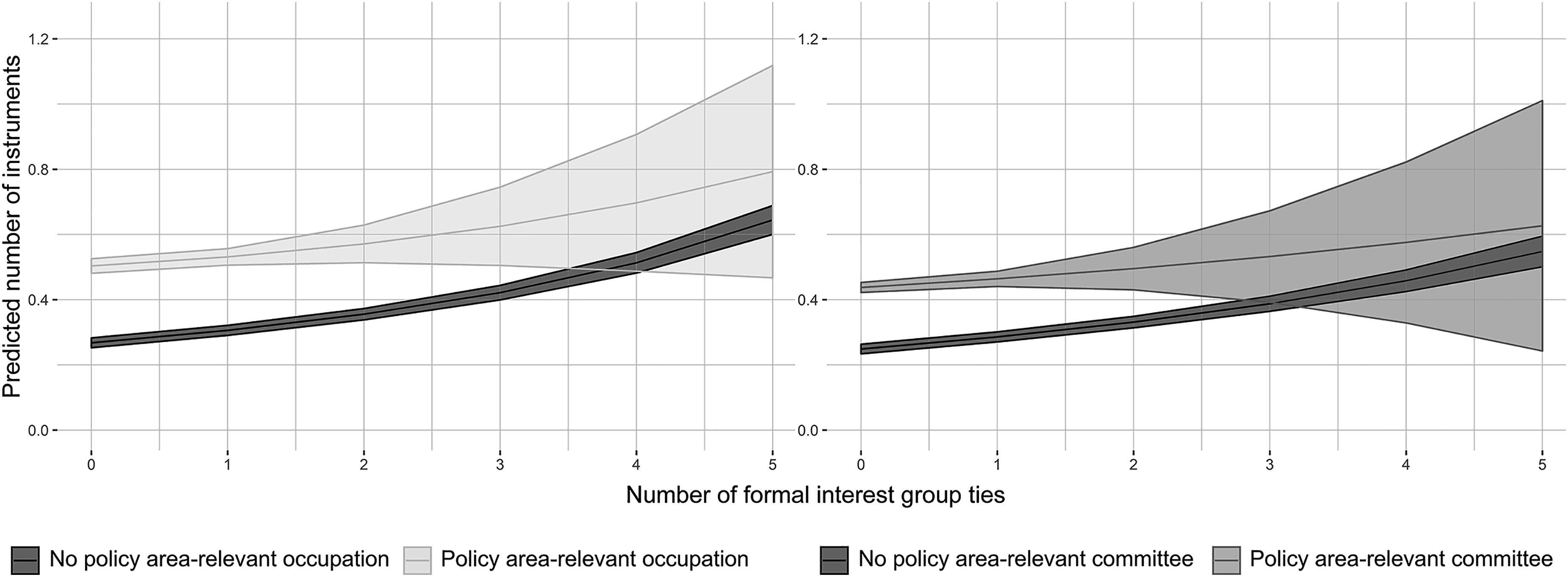
In line with H1, the results of the combined models provide corroborating evidence for a positive relationship between the number of formal interest group ties within a specific policy area and the number of parliamentary instruments that a parliamentarian uses within this policy area. The synthesized estimates in Table 1 reveal that this effect is significant across all models, including Model 4d with MP fixed effects.
In terms of substance, even the most conservative estimates in Model 4d of Table 1 teach us that for every additional formal interest group tie that MPs have, there is still an increase in the rate of submitted parliamentary instruments in that policy area by a factor 1.022 [1.002, 1.042], all else equal.
When comparing Models 2 and 3, we furthermore learn that controlling for MPs’ traditional principals—voters and parties—does not strongly decrease the magnitude of the interest group effect. Only once we account for personal interests and expertise does the effect of interest groups decrease—from a factor 1.109 [1.092, 1.127] in Model 3, to 1.075 [1.058, 1.092] in Model 4a when current occupation and committee membership are added, and to a factor 1.022 [1.002, 1.042] in Model 4d when MP fixed effects are included. This corroborates that without accounting for MPs’ personal affinity, one would overestimate the impact of formal ties on MPs’ parliamentary instrument use by up to a factor of 5. These results show for the first time that interest groups have an impact on MPs’ use of parliamentary instruments across policy areas, even when personal affinity towards the policy area is explicitly accounted for.
To better understand the substance of the interest group effect, it is valuable to compare it to that of occupation and committee membership. The latter two are stronger than a single formal interest group tie. Model 4a 18 estimates the effect of occupation at a factor 1.493 [1.380, 1.606]. This effect is 6.5 times larger than that of a single formal interest group tie (1.075 [1.058, 1.092]) 19 . The effect of a committee seat is estimated at a factor of 1.666 [1.591, 1.741], which is about 9 times larger. By establishing a formal tie, interest groups can thus impact the policy area focus of an MP, but to a limited extent only. However, from the parliamentarian’s perspective, the collective impact of interest groups is far from negligible. Parliamentarians hold on average 6.15 interest group board seats across all policy areas. This means that taken together, a parliamentarian’s formal interest group ties will affect her pattern of parliamentary instrument use about as strongly as her occupation.
Importantly, though, interest groups’ influence depends on MPs’ specialization in a given policy area (H2). Parliamentarians with personal affinity towards a policy area are significantly less impacted by interest group ties than their colleagues without personal interest in the area. As we learn from Model 4b, parliamentarians whose occupational background matches interest groups’ policy area increase their rate of submitted parliamentary instruments in said area by only a factor of 1.064, all else equal, while those without relevant experience from their occupation increase their rate of parliamentary instrument use by a factor of 1.140. Similarly, Model 4c indicates that MPs without policy area-relevant committee seats have their rate of instrument submission increased by a factor of 1.100, those sitting on a relevant committee only by a factor of 1.059. This suggests that MPs who lack relevant expertise from their occupation or committee membership have their parliamentary activities almost twice as strongly affected by interest group board seats than those who do not. Figure 2 further emphasizes these group effects by displaying average marginal effects. The charts show that the difference in the impact of interest groups on MPs with and without relevant expertise is particularly pronounced for MPs with few formal ties in a policy area. In other words, MPs with and without personal interests and expertise in a policy area act more similarly the more formal ties they have.
Do Former Ties Have an Effect?
When hypothesizing about the impact of interest group ties, we argued their impact would wane once they had ended (H3). Figure 3, a coefficient plot with adjusted pooled standard errors, inspects this hypothesized waning effect of former ties. The figure plots the estimated effect of the number of formal ties ended at t minus x years. Coefficient plot of former formal interest group ties after a certain number of years. Notes: All coefficients are based on synthesized estimates from 15 separate models (reported in Online Appendix H). With the exception of current ties, coefficients in black and the respective gray area show the overall time trend based on 2-years syntheses. 95% confidence intervals based on pooled standard errors.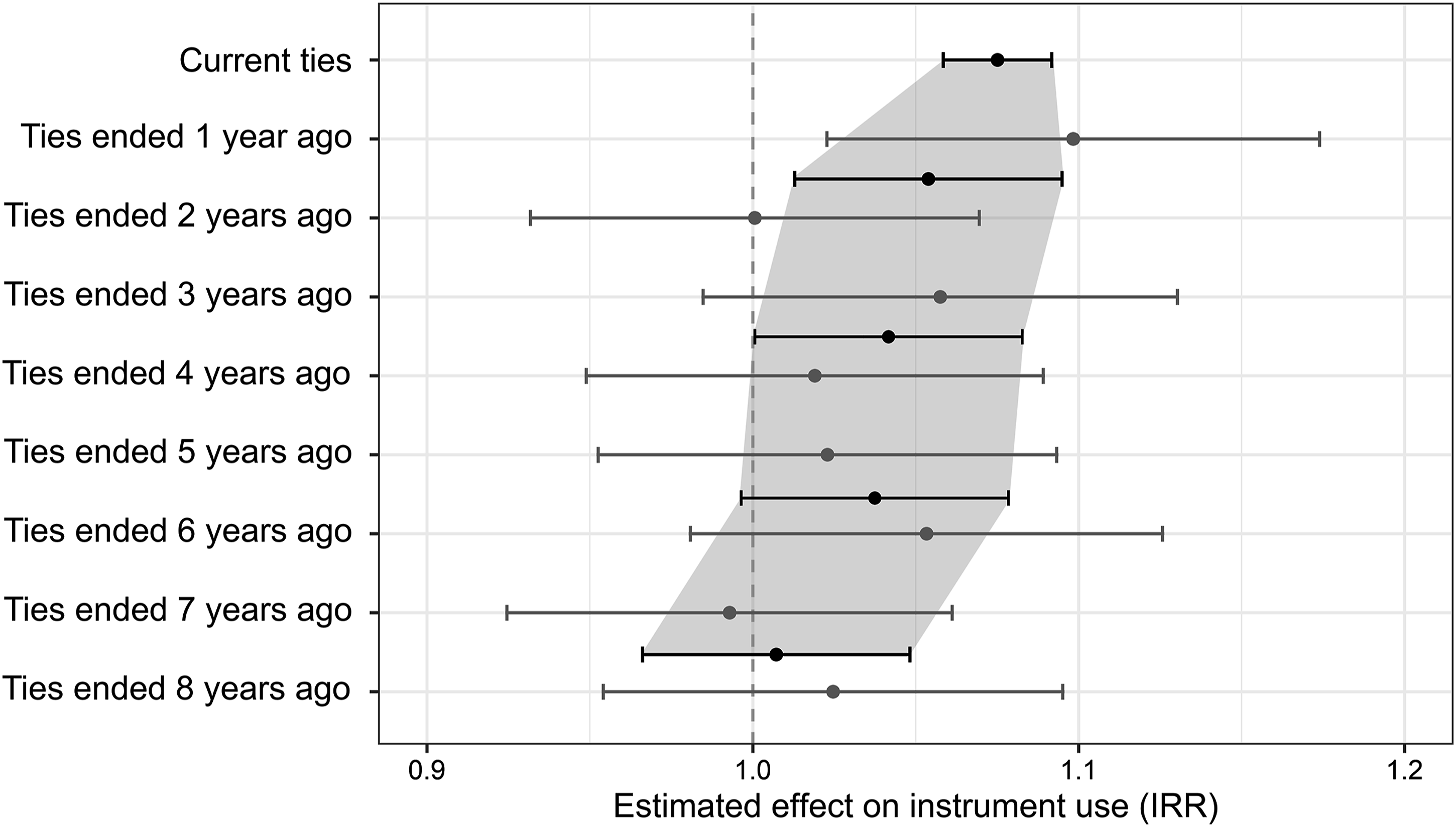
The analytical strategy for significance testing requires some adjustments, as H3 states a null effect. This entails the risk to bias the analysis towards finding support for H3 because as time progresses, our sample size decreases. This renders not finding a significant difference easier and easier. We avoid such bias in two ways. First, to not “overask” the relatively small year-specific subsamples, we test H3 not on single-year estimates (e.g., current versus 1 year ago versus 2 years ago, etc.), but estimate the 2-year synthesized effect of former ties (current versus 1–2 years ago, versus 3–4 years ago, etc.). The second adjustment is to pool the standard errors: instead of using our regression models to estimate the standard errors for each year separately, we additionally assume that the variance in the subsamples for each year is equal. This allows us to estimate one, importantly not year-dependent, standard error and confidence interval around the biennially estimated means. Without this, the drops in sample size and the associated increases in the width of the confidence intervals would render biased support for H3. Together, these two adjustments result in a fair test of H3.
Following this procedure, the overall time trend in Figure 3 generally seems to support this idea of a decreasing impact of former exchange relationships. At the latest 2 years after MPs’ interest group board membership ended, the former formal tie no longer exerts a significant effect on their parliamentary behavior. We also see an indication that with every step into the future, the estimated effect of former formal ties is smaller than in the previous step. This suggests that MPs might still make use of interest groups’ non-financial resources, or that informal MP-interest group contacts are still quite strong right after ties ended. The way the effect dissipates after formal ties end quite strongly supports the proposed exchange conceptualization of parliamentarian-interest group collaborations: we can see here that when benefits stops, representation of interest groups’ interests begins to wane.
Conclusion
The goal of our study was to examine the exchange mechanism by gauging interest groups’ impact on parliamentarians’ focus on specific policy areas. To operationalize the relationship between these two sets of actors, we relied on parliamentarians’ board seats in interest groups as a measure of formal relationships. The results of our longitudinal analysis provided strong evidence for a significant and substantive effect of formal interest group ties on MPs’ use of parliamentary instruments in the respective policy areas. They suggest that exchange plays a defining role. Importantly, the behavior of MPs with prior expertise (and thus lower demand) in interest groups’ policy area is less strongly impacted. Moreover, at the latest 2 years after a formal tie ended, its effect disappears. In line with the reciprocal nature of exchange, MPs’ behavior is primarily affected by the current number of formal ties, not past relationships to interest groups.
Our choice of the Swiss case allowed us to conduct a test with key confounding sources for MPs’ attention to specific policy areas. We were able to show—to our knowledge for the first time—that even when controlling for time-variant sources of personal interests and expertise (occupation and committee membership), and when incorporating MP, constituency and party fixed effects, having more formal ties with interest groups at the start of a year leads to higher levels of legislative activity in the respective policy area of the interest groups throughout the rest of that year. This provides first evidence that interest groups are able to shift legislators’ attention towards the policy areas that serve their interests and are not just subsidizing activities in areas where MPs would have been active in regardless.
The analysis revealed that the effect of interest groups on parliamentary instruments exists across a broad set of policy areas. Arguably, this is because MPs’ use of parliamentary instruments is not conflictual among their principals. A parliamentarian’s choice of how she casts a floor vote may favor some interest groups at the expense of her voters (Giger and Klüver 2016). With parliamentary instruments, however, she can submit multiple ones to meet the expectations of several actors. Increased activity in certain policy areas is unlikely to be perceived as threats to the party or voters. This has important implications for our understanding of interest group influence. Interest groups’ effect on parliamentary instruments can arguably be observed clearly because parties and voters either tolerate legislators’ use of parliamentary instruments for interest groups, or because they are unaware of the systematic nature of the phenomenon.
Our findings also point to a dilemma for interest groups: legislators’ previous affinity with policy areas decreases their need for exchange, which in turn reduces interest group influence on parliamentary instrument use. However, previous research shows that this type of legislator, that is, the one with an occupation and committee assignment in interest groups’ policy area is more likely to sit on the boards of the respective interest groups (Gava et al. 2016; Huwyler 2021). Taken together, this suggests that legislators whom interest groups covet the most for their boards are not necessarily the ones most receptive to their requests.
This study provides a first step towards more rigorous tests of the exchange relationship. Further research might benefit from disaggregating the frequency variables—the number of formal ties and parliamentary instruments—by adopting MP-interest group dyads or even MP-interest group-instrument triads as the unit of analysis. Ideally, such an approach entails studying the impact of interest groups on policy issues, not only areas, to gain a more detailed (context-dependent) picture of the workings of exchange. However, any such approach requires additional and more fine-grained data. For example, the absence of lobbying disclosure requirements beyond formal ties limited our capacity to address variation in MPs’ behavior when collaborating with different interest groups. We know neither the extent nor the combination of the benefits that specific interest groups provide to MPs. It remains subject to future research how variation in interest group benefits—pay, information, campaign support, gifts—trigger different reactions in MPs’ behavior.
At the same time, the generalizability of our findings could be further reinforced with alternative operationalizations of ties. It is conceivable that formal ties, while fueled by exchange, may also induce other, concomitant mechanisms that hinge on on-going exchange. On the one hand, board membership may lead MPs to also act out of loyalty and responsibility for the interest group (see Buchanan 1974, 533). On the other hand, board membership creates procedures and routines for frequent, close personal contact between MPs and interest groups, which is known to impact legislators’ parliamentary behavior most strongly (Huwyler and Martin 2021).
Moreover, we need to study interest groups’ reliance on different parliamentary instruments in more detail. There is, on the one hand, the question of what instruments these organizations request under given circumstances, and on the other, how consequential the impact of interest group-induced parliamentary instruments is. Submitting them is only the first step, and there is variation in their success rate (see Sciarini et al. 2021).
The findings of this article could furthermore be confronted with the conditions of other polities. Switzerland has a relatively non-professionalized parliament comparable to some state legislatures in the U.S. Previous evidence suggests that interest group influence on parliamentary instruments relates to the professionalization of legislatures (Hertel-Fernandez 2019). In a similar vein, in other contexts, more professionalized parties may play a more pronounced role in MPs’ use of parliamentary instruments. The extent to which our findings translate to more professionalized settings should be explored in order to bolster external validity. This would provide an even more nuanced understanding of the impact of interest groups compared to personal interests and other principals.
In multiple ways, the findings of our study supported the conceptualization of the relationship between parliamentarians and interest groups as one of (implicit) quid pro quo. The idea that parliamentarians primarily do interest groups’ bidding when they are compensated for their efforts is provocative. It means that both parties will stay in the relationship as long as they derive sufficient benefits from these long-term issue area-based alliances. The suggestion that former ties are largely without an effect on MPs’ current parliamentary behavior highlights that relationships do probably not transform MPs’ personal interests. As our study suggests, MPs’ investment in their alliances will be relative to the resources they obtain. Parliamentarians who sit on more boards arguably obtain more resources, and therefore submit more parliamentary instruments. This has important implications for parliaments’ collective attention to policy issues. In light of the widespread presence of interest groups in legislatures (Kriesi, Tresch, and Jochum 2007), interest groups as a collective arguably drive a substantive part of parliamentarians’ attention, reaching an influence level similar to that of the occupational background of MPs. This renders the questions about the kind of interest groups that manage to obtain access to parliamentarians (e.g., Fellowes and Wolf 2004; Grossman and Helpman 1996; Roscoe and Jenkins 2005; Stratmann 1998) very relevant; particularly in light of the finding that collectively, interest group ties affect MPs’ use of parliamentary instruments about as strongly as their professions.
Supplemental Material
Supplemental Material - No Representation without Compensation: The Effect of Interest Groups on Legislators’ Policy Area Focus
Supplemental Material for No Representation without Compensation: The Effect of Interest Groups on Legislators’ Policy Area Focus by Oliver Huwyler, Tomas Turner-Zwinkels and Stefanie Bailer in Political Research Quarterly
Supplemental Material
Supplemental Material - No Representation without Compensation: The Effect of Interest Groups on Legislators’ Policy Area Focus
Supplemental Material for No Representation without Compensation: The Effect of Interest Groups on Legislators’ Policy Area Focus by Oliver Huwyler, Tomas Turner-Zwinkels and Stefanie Bailer in Political Research Quarterly
Footnotes
Acknowledgments
We thank Frank R. Baumgartner, Iskander De Bruycker, Justin Grimmer, Tobias König, Amie Kreppel, Lawrence Rothenberg, Åsa von Schoultz, and Florian Weiler for their helpful comments and suggestions on earlier versions of this article. Moreover, we are grateful for the feedback provided by participants of the 2018 ECPR Joint Session Workshop “Legislators as Linkages” at the University of Nicosia, the 2018 ECPR Summer School on Interest Groups at the University of Exeter, and the Hot Off the Press seminar series of the Department of Political Science at the University of Basel. Our thanks also go to the two anonymous reviewers and the journal editors for their concrete suggestions for improvements. Lastly, we owe gratitude to Tobias Gysin and Adrian Sutter for excellent research assistance.
Declaration of Conflicting Interests
The author(s) declared no potential conflicts of interest with respect to the research, authorship, and/or publication of this article.
Funding
The author(s) disclosed receipt of the following financial support for the research, authorship, and/or publication of this article: This work was supported by the Swiss National Science Foundation [grant numbers 162427, 188235, 195721].

Supplemental Material
Supplemental material for this article is available online. Please find the following supplemental material visualized and available to download via Figshare in the display box below. Where there are more than one item, you can scroll through each tab to see each separate item.
Notes
References
Supplementary Material
Please find the following supplemental material available below.
For Open Access articles published under a Creative Commons License, all supplemental material carries the same license as the article it is associated with.
For non-Open Access articles published, all supplemental material carries a non-exclusive license, and permission requests for re-use of supplemental material or any part of supplemental material shall be sent directly to the copyright owner as specified in the copyright notice associated with the article.
