




Abstract
Under semi-presidential regimes, directly elected presidents often play a central role in foreign policy, but their responsibility for the economy is limited. I propose an office-centred explanation of voter behaviour in semi-presidential elections based on the foreign policy preferences of the electorate. In order to explore the empirical applicability of this addition to the theory, I explore the Lithuanian case: a semi-presidential country where the president has substantial powers in foreign and defence policy and the presidents are usually non-partisan. I employ a dataset from the Lithuanian 2019 post-election survey that offers a battery of items measuring the positions of voters on foreign policy issues. When controlling for alternative explanations, I find that foreign policy preferences (measured as an index of voter attitudes towards Russia and defence) are a strong and stable determinant of vote choice, in both the first and second rounds of presidential elections.
Introduction
Due mostly to the increasing popularity of semi-presidential systems (Elgie 1999), especially in Europe (Neto and Strøm 2006), direct presidential elections now account for one third of all the democratic elections in the world (Borman and Golder 2013). However, until now electoral research has focussed either on the party choice in parliamentary elections in Europe (Hutter and Kriesi, 2009; Kitschelt et al. 1999; Knutsen 2004; Lipset and Rokkan,1967), or voting for the presidential candidates and their parties under the presidential systems in the USA (Achen and Bartels 2016; Campbell et al. 1960; Lewis-Beck et al. 2008) and Latin America (Carlin et al. 2015; Layton et al. 2021; Samuels and Zucco 2018). A notable exception is research on France (Lewis-Beck et al. 2004; Mayer 2013). However, France is not a typical case of semi-presidentalism (Elgie 2009): while semi-presidential countries vary greatly according to presidential powers (Siaroff 2003), the French presidency is relatively powerful. Most notably, the president in France (except for periods of cohabitation) has a central role in government formation and dominates the executive over the prime minister (unlike most European semi-presidential republics). This state of the art leaves out countries where voters directly elect presidents with some substantial powers, even though they do not head the executive, thus raising an important question for research: how does voter logic when choosing such presidents differ from voting in a system with a dominant president?
With the exception of research that finds the election of presidents with ‘few useable powers’ (van der Brug et al. 2000, 632) to be popularity contests between candidates (O'Malley 2012), the explanations for voter behaviour in presidential elections overlap with theories of party choice in legislative elections. First, there is the representational approach emphasising party attachments and socio-demographic cleavages. This approach is mostly applied to political systems where the presidents dominate the executive (presidential and legislative elections are also concomitant) such as the US (Achen and Bartels 2016; Campbell et al. 1960), Latin American countries (Layton et al. 2021; Samuels and Zucco 2018) and France (Cautrès 2004; Mayer 2013). However, several studies show that partisan cues and socio-demographic factors are also correlated to voter behaviour in systems with directly elected presidents not dominating the executive but having other substantial powers (e.g. a veto) such as Poland (Cześnik 2014) and Portugal (Magalhães 2007). The second approach to voter behaviour in presidential elections emphasises the accountability mechanism and government performance: voting according to the retrospective (or prospective) evaluation of the economy. Choice in presidential elections is influenced by economic voting both under presidential systems and semi-presidential regimes where the president dominates the executive (Duch and Stevenson 2008; Lewis-Beck and Nadeau 2004). However, research on Portugal finds a much more limited influence of government performance (Magalhães 2007). If the prime minister commands the government and is thus held accountable for governmental policies, voters do not expect the president to influence the economy.
However, the economy is not the sole area of public policy under which directly elected presidents may be judged: they have powers in other areas. Accordingly, if voters are familiar with the intra-executive configuration of powers, they may vote according to performance or issue positions in specific areas falling within presidential competence. In particular, as a directly elected president is usually commander-in-chief and head of state, voters may hold him accountable for foreign policy. The majority of presidents under semi-presidential systems have a central role in foreign policy (Siaroff 2003). Therefore, although half of the presidents in semi-presidential republics – and a majority of such presidents in Europe (Elgie 2009; Siaroff 2003) – do not play a central role in government formation, they still may shape foreign policy through formal and informal activism (Janeliūnas 2020; Raunio and Sedelius 2019, 2020). Some studies find that under presidential (USA) and semi-presidential systems with executive-dominant presidents (Taiwan), voters consider both the economy and foreign policy when evaluating presidents (Nickelsbur and Norpoth 2000; Wang and Cheng 2015). In about half of the semi-presidential systems (and a majority in Europe), there are fewer grounds to hold the president accountable for the economy: however, foreign policy remains. In the absence of economy-based considerations, foreign policy preferences may be very important for the vote choice.
Lithuania is an appropriate case for testing these theoretical considerations. Although, due to the great variation in presidential powers, there is no such thing as a typical semi-presidential system (Elgie 2009; Siaroff 2003), Lithuania is very close to the European average. In Shugart and Carey’s index of presidential powers updated by Elgie (2009), the average is 5.7 and Lithuania’s score is 6. Similarly, in Siaroff’s (2003) index, the average of presidential power in European semi-presidential republics is 4.1 and Lithuania’s score is 4. Although the Lithuanian presidency does not play a central role in government formation, the Constitution of the Republic of Lithuania 1 specifies that the president shall decide on the basic questions of foreign policy and conduct foreign policy together with the government. In political practice, Lithuanian presidents have been central to the country’s foreign representation and their power in foreign and defence policy has grown over recent decades (Janeliūnas 2020; Šlekys 2018). Presidents in Lithuania are non-partisan, both formally and in practice. Article 83 of the Constitution specifies that elected presidents have to suspend any activity in political parties. However, this is usually not necessary, as Lithuanian voters tend to elect presidents without any party affiliation: only two Lithuanian presidents have had clear party attachments: Algirdas M. Brazauskas (1993–1998) and Rolandas Paksas (2003–2004). This may weaken any expectation that voters will hold presidents accountable for the economy (the domain of the partisan government) or that they will relate candidates to economic policy. Of course, this may vary according to the candidate. Even though party candidates struggle to win presidential elections, parties put forward candidates who are clearly partisan and who do attract a significant portion of votes: as exemplified by the 2019 Lithuanian presidential election that is analysed further.
By focussing on the case of Lithuania, this article seeks to address a gap in the literature regarding semi-presidential elections. Neither theoretical argument is sufficient to explain vote choice in these elections. The representational approach equates presidential elections with legislative contests and thus underemphasises their specificity. The popularity-contest argument acknowledges candidate-based competition but underestimates the powers of the presidential office, while retrospective voting overestimates the accountability for the economy of some presidents who do not command the government. This article has two aims. The first is theoretical: to present an explanation of voter behaviour that is related to a very common power of semi-presidential presidents, their role in foreign policy. The second is to apply this approach empirically and to test whether foreign-policy preferences explain vote choice in semi-presidential elections.
The article is organised as follows. First, the literature regarding vote choice in presidential elections is discussed and the main theoretical argument regarding foreign policy preferences is presented. Second, the Lithuanian case is discussed and hypotheses are presented. Third, I present data and explore how foreign policy preferences and other factors affected the vote choice among the three major candidates in the 2019 Lithuanian presidential election. I finish with a conclusion and discussion on how these results contribute to the research on semi-presidential elections.
Presidential Elections and Voter Behaviour
Theoretical approaches to presidential elections relate to the electoral system, the system of government and the powers of the president. Naturally, since researchers of parliamentary systems with indirect presidential elections focus on party competition and strategies (Clementi 2014; Köker 2019), theories explaining voter behaviour are more central to studies on political systems with direct presidential elections. Again, these explanations vary depending on the role of the president in a particular political system.
One particular strand of research covers those semi-presidential systems where voters directly select a president with ceremonial or weak (constitutional and/or de facto) powers (presidents who do not affect government formation or policies). The theory of second-order election (Reif and Schmitt 1980) predicts that in elections with no direct consequences for the national executive power (and in the absence of other information), factors that drive the national-level party preferences (such as partisan cues and retrospective logic) would prevail. However, research on presidential elections in Ireland did not find support for this theory (van der Brug et al. 2000). Alternatively, the perspective of a popularity contest was introduced: in a presidential election that determines zero-to-none executive power, most of the candidates are either non-partisan or downplay ties with parties. In these elections, voter choices are mostly idiosyncratic and related to the personal characteristics of the candidates (O'Malley 2012; van der Brug et al. 2000). This explanation is supported by research finding an inverse relationship between the strength of a presidency and the number of candidates: if the powers of the president are weak, major parties will have little incentive to waste resources on presenting candidates (Elgie et al. 2014; Hicken and Stoll 2008, 2013), and reduced competition from political parties encourages non-partisans to participate, thus diluting the influence of representational factors or government performance.
The popularity contest approach is problematic in those semi-presidential political systems where the president possesses considerable powers, even without dominating the executive (Magalhães 2007). Although, in a number of European premier-presidential countries (Shugart and Carey 1992) such as Portugal, Romania or Lithuania, presidents usually cannot dismiss the government and do not command parliamentary majorities, they still possess some substantial powers that parties have to reckon with. First, through the combination of formal and informal powers, they can affect policies by affecting the ministerial selection (Pukelis and Jastramskis 2021), making public statements of no-confidence in the prime ministers (Raunio and Sedelius 2020) or dissolving the parliament (Feijó 2020; Neto and Lobo 2009). Second, even though their powers regarding the control of the executive are limited, presidents can still influence national politics: in more than half of the semi-presidential regimes, presidents have some discretionary appointment powers and play a central role in foreign policy (Siaroff 2003). Accordingly, national parties may take the presidency seriously and present candidates. In European semi-presidential regimes such as Finland, Portugal, Romania and Poland, directly elected presidents usually have party affiliations. Even in countries where non-partisans often win, the majority of the candidates still come from parties (Jastramskis 2021). Furthermore, research shows that (semi)presidential elections attract a similar number (Feijó 2020) or even more voters than the parliamentary elections (Gherghina and Tap 2021), and are consequently neither simple contests of popularity nor second-order elections.
On the other side of the spectrum of presidential powers, we find electoral research on presidential and also semi-presidential countries where, either due to formal rules (presidential-parliamentary regimes, where the president can dismiss the prime minister) or informal practice (through control of the parliamentary majority party, as in France) presidents dominate the executive. To simplify, in this type of research, there is little theoretical differentiation between party preferences in legislative elections and the choice of a presidential candidate. The standard set of theories that we would also expect in the case of parliamentary elections can be seen: in particular, socio-demographic cleavages, party attachments (partisan cues) and retrospective (economic) voting.
These explanations can be divided into two groups, the first being representational and covering party attachments and social cleavages. Social and political identities have always been important in explaining the presidential choice in the USA (Abramowitz and Webster 2016; Achen and Bartels 2016; Campbell et al. 1960; Lewis-Beck et al. 2008). Demographic cleavages have been somewhat less important in the presidential elections of Latin America (Carlin et al. 2015). However, recent research on Brazil shows the rising influence of factors such as race, gender and religion (Layton et al. 2021). Research on the French presidential elections also employed theories of socio-demographic representation: divisions in the French presidential choice tended to overlap with legislative preferences, mostly class and religion (Cautrès 2004), but also gender and education (Mayer 2013). Simultaneous elections usually mean that the legislative and presidential electorates are similar (Evans and Ivaldi 2018). Demographic cleavages also explain voter behaviour in post-communist countries with dominant presidents such as Ukraine, where ethno-linguistic divisions (Chaisty and Whitefield 2018) are important both in the parliamentary and presidential elections, The representational approach received some support in those rare studies of voter behaviour focusing on semi-presidential presidents who do not dominate the executive, but have other substantial powers. Religion is associated with vote choice in Poland (Cześnik 2014) and partisan attachments are important in the presidential elections in Portugal (Magalhães 2007). However, the presence of non-partisan presidential candidates or those who distance themselves from their parties should theoretically dilute the influence of representational factors. Representation may still explain voter choice for some candidates – especially for those with ties to the major parties. But there are fewer theoretical reasons to expect that the demographic factors will strongly influence voting for candidates with no prior political experience or major party backing.
Another approach to presidential elections emphasises voter evaluation of government performance. Although there are other issues that the government could be held accountable for, such as corruption (Ecker et al. 2016), the major body of research focuses on economic voting: the relationship between the evaluation of the economy and the choice of a candidate in presidential elections. The theory of economic voting has been important for explaining voter behaviour in the USA presidential elections (Achen and Bartels 2016; Fiorina 1981; Lewis-Beck and Stegmaier 2000) and has found support in other systems with an executive-dominant president, such as France (Lewis-Beck 1986; Lewis-Beck and Nadeau 2004), Latin American countries (Lewis-Beck and Ratto 2013), Ukraine (Bloom and Shulman 2011) and Taiwan (Wang and Cheng 2015). There are two caveats to this relationship: cohabitation periods and the electoral participation of the incumbent president. The first caveat comes from electoral research on France. During cohabitation periods, when the president and government (parliamentary majority) are from different parties, responsibility shifts from the president to the prime minister and voters punish the incumbent president less for bad economic performance (Lewis-Beck and Nadeau 2000; Lewis-Beck and Nadeau 2004). Although cohabitation periods do not exert the same influence in the USA, another caveat can be found: retrospective economic voting weakens in those presidential elections where the incumbent is not standing for reelection (Nadeau and Lewis-Beck 2001).
Economic voting theory is particularly applicable to systems where the president is the head of the government constitutionally (or in political practice) and thus at the helm of public policy formulation. However, the caveats discussed tell us that, even in these systems, economic voting weakens when accountability is blurred: when there is a prime minister from another party or the incumbent president does not stand for re-election. Accordingly, it is not surprising that in semi-presidential systems with a weaker president, where the sharing of executive power at worst (for the president) leaves out the president and at best is blurred and nuanced (if the president and prime minister are both from the same party), theories related to government performance fare less well. Research on Portugal does not find that the economy has a strong influence, even when the president standing for re-election is supported by the incumbent government (Magalhães 2007). Of course, theoretically there could be instances where retrospective blame is attributed to some candidates: the best example would be the candidacy of an incumbent prime minister. However, since the presidential position does not come with the control of the executive, economic voting should not exert much influence on the other candidates.
It should be noted that most of the research on voter behaviour in presidential elections refers either to presidential (particularly the USA) or semi-presidential (France) regimes with strong presidents dominating the executive. However, many semi-presidential regimes fall between the extremes of being as powerful as France (rated 7 out of 9 on Siarrof’s scale of nine indicators of presidential powers) and mere figureheads with no power except for direct presidential elections (Iceland, 1 out of 9). Semi-presidentialism is now the most prevalent regime in Europe (Neto and Strøm 2006). However, presidential elections in the European regimes with fairly average-powered presidencies such as Poland (3 on Siaroff’s scale), Romania (5) or Lithuania (4) are seldom studied; and when they are, researchers focus on rather niche questions, such as first-time voter behaviour (Gherghina and Tap 2021) or the influence of short-term factors such as the Smolensk tragedy (Cześnik 2014). Accordingly, there is no explicit theory to calibrate such semi-presidential systems.
There is another reason (besides the rarity of studies) to further develop the theory of voting in semi-presidential elections. Although the popularity contest, representation and government performance approaches all partially explain elections in semi-presidential systems, all these explanations are fairly candidate-dependent. As discussed previously, some presidential candidates under a semi-presidential regime may be judged solely on their personal qualities, especially when previously unknown or non-partisan (van der Brug et al. 2000). Voting for others may be associated with demographics and partisan cues, especially if the candidate has ties with some political camp (Magalhães 2007). Lastly, following the logic of second-order election (Reif and Schmitt 1980), there is a theoretical reason to expect that a representative of the incumbent government (especially the prime minister) standing in a presidential election could be punished (or rewarded) for the state of the economy. However, these explanations are all candidate-dependent in semi-presidential elections because they circumvent the specifics of the office. Under the presidential system, presidents are held responsible for the economy because their office has the power to implement public policies affecting it. However, in most European semi-presidential systems the president does not command the government (although some of them have other powers). Moreover, unlike parliament, the head of state is not usually an institution representing particular interests: quite to the contrary, in a semi-presidential country it may act more like a moderating power (Feijó 2020). The popularity contest is arguably the most accurate approach under a system where the presidential election involves hardly any power; but it would not be very institutionally appropriate in those contexts where the president enjoys competencies that have to be reckoned with.
I believe that issue voting in the area of foreign policy is a promising theoretical approach for explaining voter behaviour in semi-presidential elections. Research on presidential elections in France found issue voting (Gougou and Persico 2017; Mayer and Tiberj 2004) to be an important factor. It is quite a flexible approach as it allows the theoretical framework of issues to be calibrated for the specific competencies of an institution. Regarding the presidency in semi-presidential countries, foreign policy is arguably the foremost approach worth considering: according to data by Siaroff (2003), the majority of presidents in semi-presidential regimes have a central role in foreign policy. Even without playing that central role, a directly elected president who is commander-in-chief and head of state may still be held accountable for state foreign and defence policies. Foreign policy considerations are important factors for approval in countries with powerful presidencies such as the USA (Nickelsburg and Norpoth 2000) and Taiwan (Wang and Cheng 2015). They could play a crucial role in semi-presidential republics: with lower expectations for the president as regards the economy and no responsibility for other policies (such as healthcare), voters may focus on the one area that is clearly attributable to presidential competence.
What type of foreign policy? In the context of emerging worldwide division between the supporters and opponents of globalisation and its close relation to the Brexit vote (Hobolt 2016), EU-related issues (such as further integration) appear as an obvious object for analysis in European semi-presidential politics. Even though for EU Member States EU-related matters do not particularly involve foreign-policy, they still cover political arrangements concerning other countries: especially if considerations about the further transfer of national sovereignty to the supra-national institution are involved. The worldwide third wave of autocratisation (Lührman and Lindberg 2019) has made relations between the democratic and non-democratic states another salient dimension of foreign politics. These questions may overlap with defence policy, particularly in post-communist European countries where security issues related to Russia and NATO are historically important.
The Lithuanian Case and the 2019 Elections
In the empirical analysis, this article focuses on the 2019 Lithuanian presidential election. The Lithuanian presidency has an interesting mix of medium powers and constitutional ambiguity. Various measures of presidential power place it in the average category for both Central and Eastern Europe (Sedelius 2006; Elgie et al. 2014; Raunio and Sedelius 2019) and also European (Elgie 2009; Siaroff 2003) semi-presidential republics. There are several particular reasons for selecting this case.
First, the Lithuanian Constitution gives the president substantial competencies in foreign and defence policy (typical for semi-presidential republics). It specifies that the president shall decide the basic questions of foreign policy and conduct foreign policy together with the government. The president is commander-in-chief of the Lithuanian Armed Forces and chairs the State Defence Council. Research confirms that Lithuanian presidents influence foreign policy in political practice (Raunio and Sedelius 2020). Moreover, during the decade preceding the 2019 election (the two terms of Dalia Grybauskaitė) the presidency became the dominant institution shaping Lithuania’s foreign policy (Janeliūnas 2020). According to an informal practice (not stipulated in the Constitution), the president represents Lithuania in the European Council. Influence over defence policy is exemplified by successful presidential initiatives resulting in an increase in defence spending (Šlekys 2018).
The Lithuanian Constitution gives the Lithuanian president power to defend the rule of law and possibly to fight against corruption: the president independently appoints judges, nominates and appoints (with the assent of parliament) several key figures in the justice system (such as Supreme Court judges and three judges of the Constitutional Court) and also has veto power over parliamentary laws (overridden with 71 votes out of the 141 seats in parliament). Unlike the case of more powerful semi-presidential countries such as France, the president has no central role in government formation and does not chair the government. However, some presidents used their authority to affect the composition of the government and intra-executive coordination (Raunio and Sedelius 2019; Raunio and Sedelius 2020).
Second, another quality of the Lithuanian presidency is that elected presidents tend to be relatively independent politically. The constitutional requirement for the president-elect to quit any political organisation, in combination with societal distrust in parties and non-concurrent elections, removes the presidential elections from strong party control. This allows us to analyse a semi-presidential regime that is devoid both of pure cohabitation and also periods of the same presidential-parliamentary majorities.
Third, although the 2019 Lithuanian presidential election did not feature an incumbent president (Dalia Grybauskaitė could not participate due to the limit of two-consecutive terms), they provided grounds for analysing the competition among three strong candidates, each representing a different political profile. Although the absence of a presidential incumbent restricts the possibility of studying the attribution of responsibility for the economy, this is not a major issue as the president in Lithuania is not head of the executive and does not enjoy constitutional prerogatives in the development of economic policy. The 2019 presidential election offers the possibility of evaluating the influence of foreign-policy preferences on voter behaviour exactly at the point when the Lithuanian presidency was very powerful in the shaping of foreign and defence policy. Nine candidates participated in the election, but the three frontrunners combined received 81.83% of votes (no another candidate received more than 5%). The main opposition party, the centre-right Homeland Union-Lithuanian Christian Democrats (TS-LKD) endorsed Ingrida Šimonytė. Even though she was not a party member, her ties with the TS-LKD were quite apparent as she had previously served as finance minister (2009–2012) and was twice elected to parliament under the TS-LKD banner. Šimonytė narrowly won the first round with 31.3% of votes. The major governing party, the centre-left Lithuanian Farmers and Greens Union (LVŽS) endorsed the candidacy of their prime minister Saulius Skvernelis, another non-partisan (officially). Skvernelis came third with 19.6% of votes. Lastly, the eventual winner Nausėda was the only de facto independent among the front-runners, with no political experience prior to the election and having served as chief economist of a major bank. Nausėda resembled a pure catch-all and non-partisan candidate, with no ties to political parties and no clear right or left leanings. He came a close second in the first round with 30.9% of votes, but won in a landslide against Šimonytė in the second round, receiving 65.7% of votes. The non-partisan nature of the presidential post and clear partisan profile of two out of three major candidates presents an interesting tension that is worth exploring in the empirical analysis.
The fourth reason for selecting the Lithuanian case is the availability of data. Post-electoral surveys of presidential elections are quite scarce, not to mention individual-level data on foreign policy issues. The representative post-electoral survey conducted after the 2019 presidential election under the Lithuanian National Election Study provides a comprehensive analysis of voter preferences in a semi-presidential election. Most importantly, this survey has a relatively large number of questions regarding foreign policy issues and voter positions, which are presented in the next section.
A brief background on elections in Lithuania and some explicit hypotheses should be provided before continuing to the empirical analysis. Although scholars emphasise the personalised nature of Lithuanian politics (Raunio and Sedelius 2020), research on Lithuanian electoral behaviour in parliamentary elections (Jastramskis et al. 2018; Ramonaitė et al. 2014) found some support for the representational approach. Party identities in Lithuania are weak and tend to change with election results. However, there is one important exception: the major centre-right party TS-LKD commands a minority of loyal partisans. The main political cleavage (Ramonaitė et al. 2014; Ramonaitė 2020), is structured around the evaluation of the Soviet period: Lithuanians with negative attitudes towards the Soviet period tend to vote for the right, whereas voters with neutral or positive evaluations lean to the centre-left.
Regarding the role of foreign-policy preferences in (electoral) politics, Lithuania has similarities to Taiwan (Wang and Cheng 2015), as in both countries the central question regarding foreign policy relates to a historical and antagonistic relationship with a large, neighbouring authoritarian country (China in the case of Taiwan and Russia for Lithuania). Research on Lithuanian voters (Ramonaitė 2020) shows that, although the general ideological structuring of party electorates (regarding sociocultural and socioeconomic left and right) is rather loose, attitudes concerning Russia settle into one coherent dimension. Analogously to the cleavage of the Soviet past, right-wing voters more often see Russia as a threat and favour strengthening national defence while the left-leaning voters tend to downplay the Russian threat. However, the research does not show any substantial influence of EU-related views on electoral behaviour. Debates about the EU are rare in Lithuanian politics due to a generally positive consensus on membership in the alliance.
Research on Lithuanian presidential elections is scarce, mostly due to lack of data. Although Lithuanian semi-presidentialism is personalised (Raunio and Sedelius 2020), it has also been observed that the evaluations of parliamentary parties correlate with the probability of voting for major presidential candidates (Jastramskis 2021). There is also some contextual evidence that foreign policy positions were previously important in Lithuanian presidential elections. The first election pitted the eventual winner from the left Algirdas M. Brazauskas and non-partisan Stasys Lozoraitis: it is notable that the party of Brazauskas was reluctant to pursue NATO membership at first, while the right wing supported Lozoraitis and called for immediate integration into the Western alliances. The winner of the 1998 election, Valdas Adamkus, was widely seen as a Western oriented president and strong supporter of membership in EU and NATO. District level results of the 2002 and 2004 presidential elections (Ramonaitė 2007) correlated with ethnic composition: regions with a higher percentage of Russian-speaking population favoured the opponents of Adamkus (he lost the 2002 election, but was re-elected in 2004 after the impeachment of Rolandas Paksas). The same pattern re-emerged in 2009 and 2014, where the winner, Dalia Grybauskaitė (non-partisan, but supported by the right and a strong advocate for a tough stance towards Russia and an increase in defence spending) fared worse in districts with a lower percentage of Lithuanian voters. Of course, ethnicity is at best a loose proxy for geopolitical orientation. However, this contextual information also suggests that foreign policy preferences could be important in Lithuanian presidential elections.
More specifically, issues regarding Russia, defence policy and NATO should be most important. The different profiles of the major candidates in the 2019 election possibly attracted voters with different views on these issues. Šimonytė was supported by the TS-LKD, the major right-wing party well known in Lithuania for having a tough stance on Russia, placing emphasis on national security issues and holding a pro-American orientation. Although the Skvernelis cabinet made no concessions on these issues in practice, the LVŽS had an antagonistic relationship with the oppositional TS-LKD: Skvernelis could have attracted voters with more lenient positions towards Russia. The non-partisan Nausėda occupied a centrist position between the other two candidates. This leads to hypothesis H1.
H1. Tougher views towards Russia and strengthening defence should positively correlate with the probability of voting for centre and centre-right presidential candidates as compared to a centre-left candidate.
On the other hand, in the second round, the non-partisan and centrist profile of Nausėda possibly attracted voters from the centre to the left (in terms of foreign policy) and thus differentiated him from Šimonytė.
H2. Tougher views towards Russia and strengthening defence should negatively correlate with the probability of voting for a centrist presidential candidate as compared to a centre-right candidate.
Data and Results
The empirical evidence in this article comes from the 2019 Lithuanian post-election survey of presidential elections that was conducted under the Lithuanian National Election Study (LNES, 2019). The face-to-face method was used in the survey to ensure the representativity of the sample with 1015 respondents. As one of the main aims of this study was to collect data on voter behaviour in the Lithuanian presidential elections, a number of questions were included related to the theories discussed above. Most importantly, data from the 2019 post-election survey involves a battery of seven questions to measure voter positions on a relatively broad range of foreign and defence policy issues.
In order to construct the main independent variable(s), I first conducted a principal components analysis (PCA) to identify the underlying structure of voters’ positions on foreign and defence policy issues. All seven original questions were measured with a five-point Likert scale, where 1 means ‘completely disagree’ and 5 – ‘completely agree’. The PCA resulted in two dimensions with eigenvalues greater than 1. The first dimension taps into the four items (substantial loadings greater than 0.5) that measure voter position on: 1) sanctions against Russia; 2) the strictness of Lithuanian government rhetoric related to Russia; 3) the possible deployment of a USA missile defence system; 4) an increase in Lithuanian defence spending. This dimension demonstrates empirically that issues regarding Russia and defence are closely interrelated. The second dimension comprises only two questions but is also meaningful and cohesive, as these questions have relatively large loadings and cover EU integration: voter agreement with 1) EU federalisation and 2) an EU common foreign policy. Since the last item (agreement with the statement that membership in the EU is a negative thing) does not have substantial loadings in any of the extracted factors, it was dropped from the subsequent analysis. In order to reduce the number of independent variables, I ran two additional PCA analyses and saved the factor scores as two separate indices: they correspond to the previously discussed two dimensions. The detailed results of the PCA (factor loadings) together with the full formulation of the original survey questions are presented in Appendix 1.
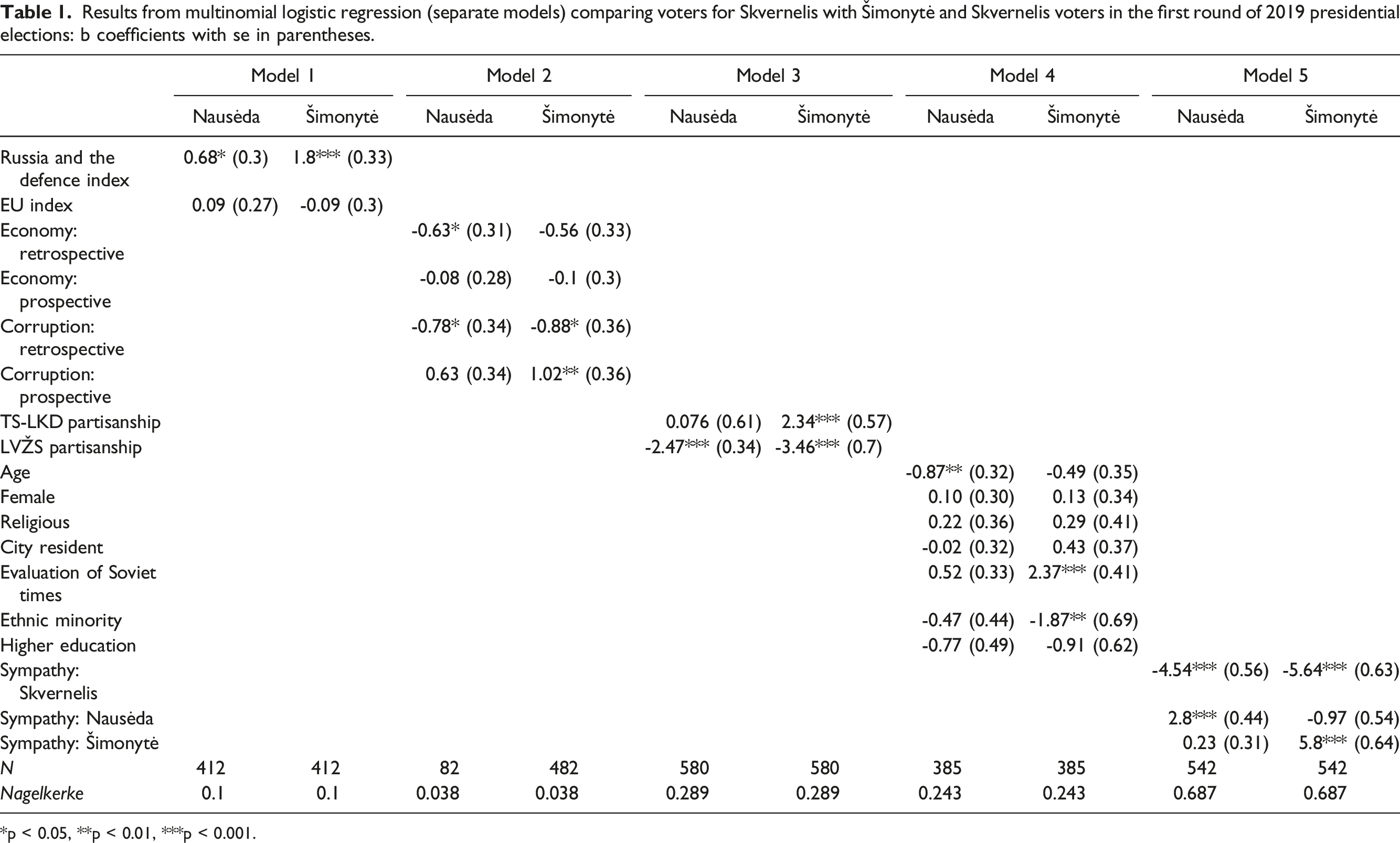
Results from multinomial logistic regression (separate models) comparing voters for Skvernelis with Šimonytė and Skvernelis voters in the first round of 2019 presidential elections: b coefficients with se in parentheses.
*p < 0.05, **p < 0.01, ***p < 0.001.
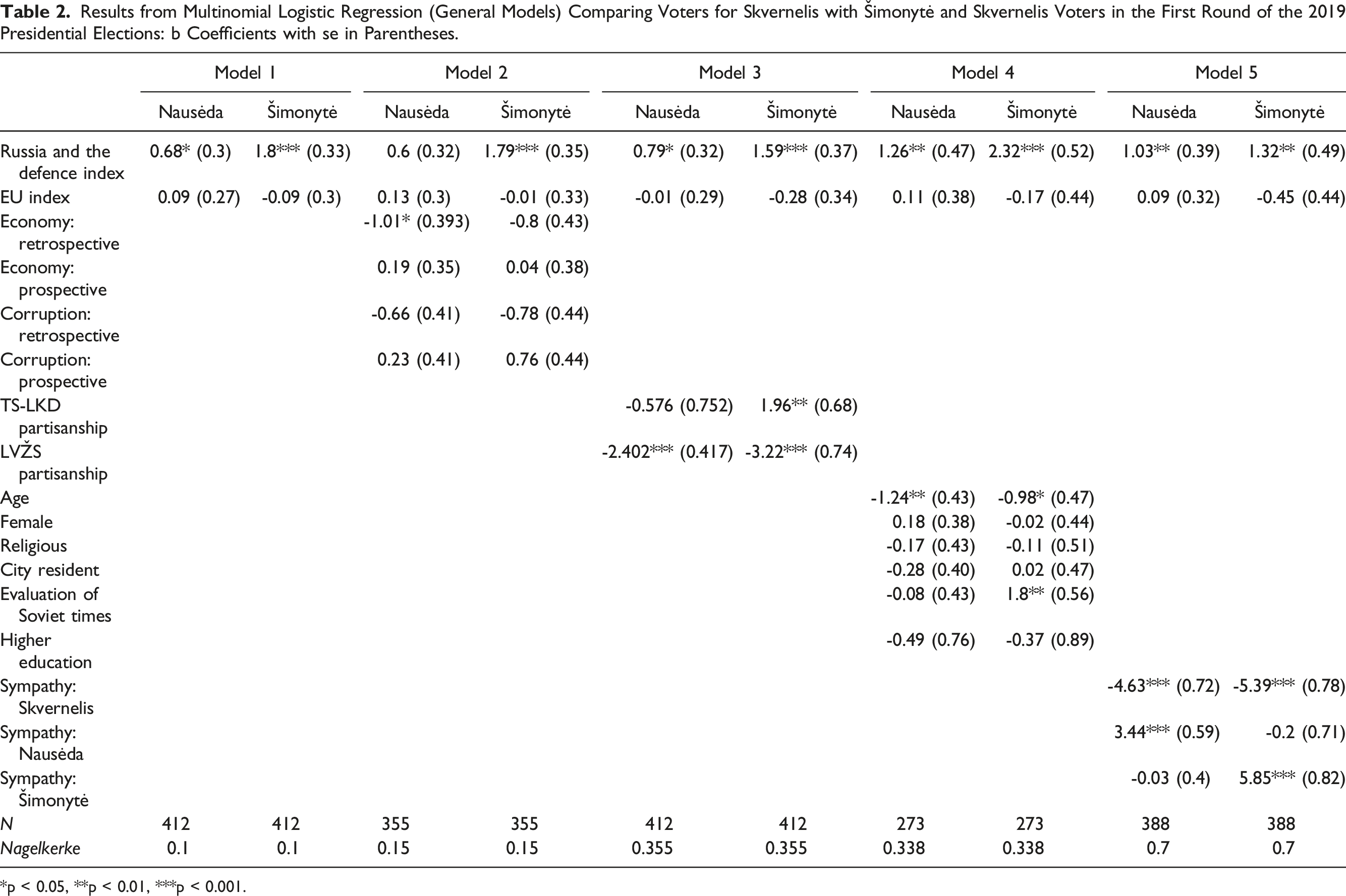
Results from Multinomial Logistic Regression (General Models) Comparing Voters for Skvernelis with Šimonytė and Skvernelis Voters in the First Round of the 2019 Presidential Elections: b Coefficients with se in Parentheses.
*p < 0.05, **p < 0.01, ***p < 0.001.
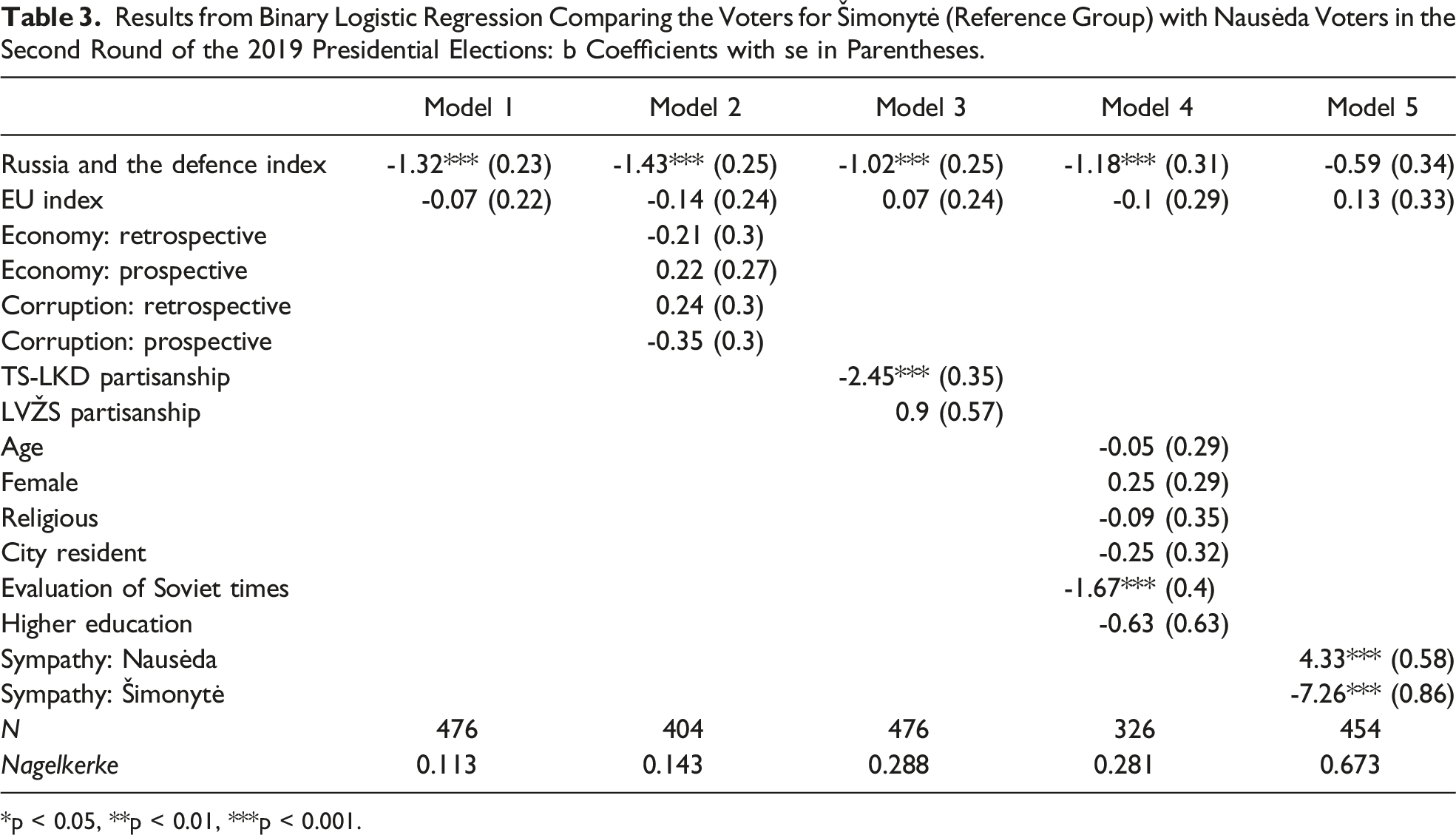
Results from Binary Logistic Regression Comparing the Voters for Šimonytė (Reference Group) with Nausėda Voters in the Second Round of the 2019 Presidential Elections: b Coefficients with se in Parentheses.
*p < 0.05, **p < 0.01, ***p < 0.001.
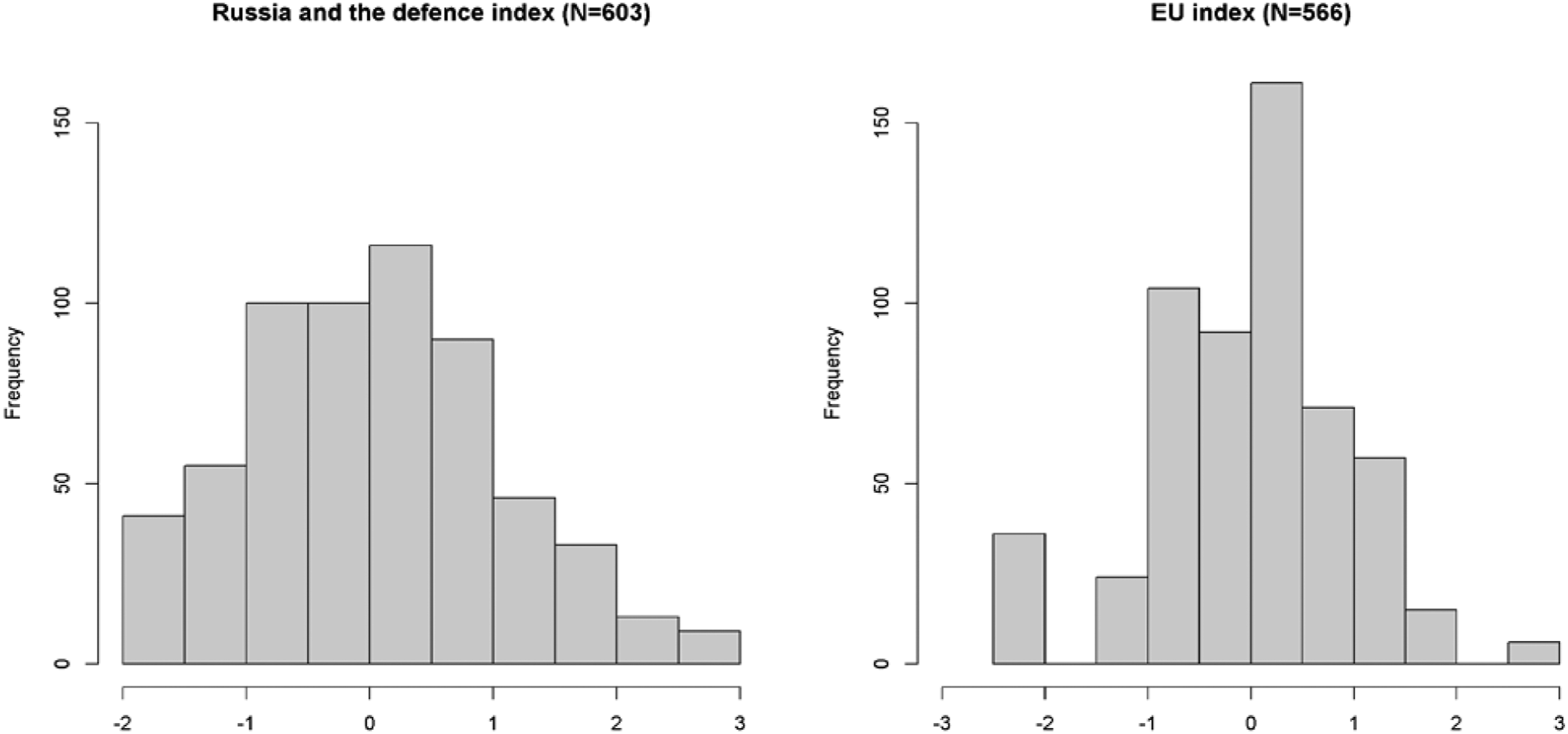
Frequencies of foreign policy preferences (factor scores) among voters in the 2019 Lithuanian presidential elections.
Variables for other theoretical considerations and controls were measured as follows. Partisanship (party identity) in the 2019 post-election survey was originally measured with a question ‘Which party do you feel closest to?’. Two dummy variables were created to separate the voters feeling close to the centre-right TS-LKD (supporting the candidacy of Šimonytė) and the centre-left LVŽS (supporting the candidacy of Skvernelis) from the others (1 – feel close to TS-LKD/LVŽS, 0 – others). To test for economic and corruption-based voting, evaluations were measured by questions that were both retrospective (1 – the economy/corruption has got worse in the last 12 months, 5 – the economy/corruption has improved) and prospective (1 – the economy/corruption will get worse in the next 12 months, 5 – the economy/corruption will get better). In order to account for socio-demographic factors, I use the variables of gender (1 – female, 0 – male), age, education (1 – higher education, 0 – other), ethnicity (1 – ethnic minority, 0 – Lithuanian), religiosity (1 – frequent attendance at religious establishments, 0 – rare attendance or never) and place of residence (1 – cities with at least 100 000 residents, 0 – other). In order to control for the main cleavage in Lithuania, I add a variable that measures attitudes towards the Soviet era (1 – life in Soviet times was better, 5 – it was not better). This is a strong control for foreign-policy considerations, as previous research found that the Soviet cleavage is associated with attitudes towards Russia (Ramonaitė 2020). Lastly, to account for the popularity contest argument, I use three variables measuring sympathy towards the candidates: to what extent respondents like or dislike them (scale from 0, ‘strongly dislike’, to 10, ‘strongly like’).
The dependent variable (vote choice) is restricted in the first-round of the 2019 presidential election to the three main candidates: Šimonytė (oppositional centre-right), Skvernelis (oppositional centre-left) and Nausėda (catch-all, non-partisan). In the analysis of the second round, the dependent variable is naturally limited to two candidates (Šimonytė and Nausėda). Models of multinomial logistic (first round) and binomial logistic regression (second round) are used, as in the analysis of the first round, the dependent variable is categorical with multiple (three) choices, and in the second round it is binary. Furthermore, for better comparison of regression coefficients, I follow Gelman (2008) and standardise the independent continuous (indices of foreign policy, age) and ordinal variables (retrospective and prospective evaluations, question about the Soviet period) dividing them by two standard deviations.
Table 1 presents the results of the multinomial logistic regression comparing voters for the incumbent prime minister Skvernelis (reference group) to the other two presidential candidates. I present the coefficients with standard errors in parentheses. In each model, the first column compares the Skvernelis voters with those of Nausėda and the second column compares the Skvernelis and Šimonytė voters. I first evaluate five separate models corresponding to different theoretical approaches: foreign policy (Model 1), government performance (Model 2), partisanship (model 3), socio-demographic (model 4) and sympathy (Model 4). A comparison of Nagelkerge pseudo R-squareds reveals that foreign policy preferences (R squared 0.103) outperform the government performance model (R squared 0.038). Although the EU index does not exert any influence, the coefficients for Russia and the defence index are positive and statistically significant when comparing Skvernelis voters to those of both Nausėda and Šimonytė: less lenient positions regarding Russia and defence give higher odds on voting for the latter two candidates. This supports H1. Model 2 shows that retrospective voting exerts some influence on vote choice: when comparing Skvernelis to Nausėda, better retrospective evaluations of the economy and corruption lead to lower odds on voting for Nausėda. The comparison of Skvernelis with Šimonytė shows that corruption variables (both retrospective and prospective) are significant: voters thinking either that corruption increased (evaluation of the Skvernelis government) or will improve (hopes for Šimonytė) had higher odds on voting for the opposition candidate. However, as the explanatory power of Model 2 is quite low, these relationships should not be overestimated.
As might be expected, due to the clear partisan profile of two out of the three candidates, the partisanship model (Model 3) provides a fairly good explanation for voting in the first round (pseudo R-squared 0.289). Close identification with the LVŽS party decreases the odds of voting for Nausėda or Šimonytė (compared to Skvernelis), whereas TS-LKD partisanship increases the odds on voting for Šimonytė. In terms of pseudo R-squared (0.243), the socio-demographic Model 4 also works rather well. However, as there are only a few statistically significant coefficients, the explanatory power most probably arises due to the number of independent variables (seven). When comparing Nausėda with Skvernelis, only age is a significant factor: older voters less frequently voted for Nausėda. On the other hand, the comparison of Skvernelis with Šimonytė reveals the influence of ethnicity and the evaluation of the Soviet period. Non-Lithuanians and those who had a more positive evaluation of the Soviet regime were more likely to vote for Skvernelis than for Šimonytė. This is line with previous research that finds TS-LKD voters to be predominantly Lithuanians with strong anti-Soviet attitudes (Ramonaitė et al. 2014). Lastly, as could well be expected, sympathy variables correlated quite strongly with vote choice (pseudo R-squared is 0.687).
Does the influence of Russia and the defence index remain when controlling for alternative explanations? Table 2 presents the results of a multinomial logistic regression comparing Skvernelis voters with those of Šimonytė and Nausėda, while adding controls to the first foreign policy preferences model (controls are based on the models of Table 1 with the exception of the ethnicity variable, which is dropped in order to avoid quasi-complete separation in the data). The coefficient of Russia and the defence index remains statistically significant (the direction of the relationship is unchanged) in seven out of eight columns with controls (from Model 2 to Model 5). This further supports H1 and strongly indicates that foreign policy considerations are an important explanation of vote choice when electing a president with average powers and a central role in foreign policy. The only column where foreign policy considerations cease to be significant is in the model with retrospective and prospective evaluations. Higher levels of economic dissatisfaction seemed to drive voters to choose the non-partisan Nausėda over the incumbent prime minister Skvernelis. However, when Skvernelis is compared to Šimonytė, foreign policy preferences trump the considerations of government performance (only Russia and the defence index is significant in the second column of Model 2). Considerations regarding Russia and defence remain significant when socio-demographic controls are added in Model 4: foreign policy has an independent effect alongside the cleavage of pro-Soviet and anti-Soviet attitudes (and also age). Furthermore, the coefficient of Russia and the defence index is significant even when controlling for partisanship (Model 3) and voters’ sympathies (Model 5). No matter how much respondents liked or disliked particular candidates and which party they felt close to, foreign policy exerted an autonomous influence over vote choice in the first round. Models 2, 4 and 5 were also run with additional controls for partisanship variables (see Appendix 2). Although some coefficients in the model of government performance lose significance, the influence of Russia and defence remains robust.
Skvernelis took third place in the first round and did not advance to the second round, where Nausėda defeated Šimonytė in a landslide. As almost all the former Skvernelis voters flocked to Nausėda, the second round was a contest between the more numerous electoral coalition of centre and centre-left (Nausėda) against a minority of voters supporting the candidate of the centre-right (Šimonytė). Table 3 presents the results from a binary logistic regression comparing Šimonytė voters (reference group) with Nausėda voters in the second round of the 2019 Lithuanian presidential election. Model 1 is the base model of foreign-policy considerations and Models 2 to 5 add controls for respective alternative explanations.
Again, foreign policy considerations provide a relatively good explanation for the vote choice in the second round. Russia and the defence index are statistically significant in the base model with retrospective/prospective evaluations (Model 2), the partisanship model (Model 3) and the socio-demographic controls model (Model 4). Nausėda voters were less supportive of tough policies towards Russia and strengthening the country’s defence. This supports H2. In Model 2, since only Russia and the defence index are significant, foreign policy preferences trump the retrospective and prospective evaluations. This is in line with previous considerations that accountability for the economy should be influential in semi-presidential elections only if a government representative participates. When Skvernelis dropped out of the race, these considerations ceased to be important. This also supports the claim that economic voting in a semi-presidential system is a fairly candidate-dependent explanation. Accordingly, the consistent effect of foreign policy considerations suggests that it more closely resembles an office-centred explanation, in line with the powers of a president who has little influence on the economy but rather plays a central role in foreign policy. This explanation proved to be significant both in the first round (with the incumbent prime minister) and the second round (a non-partisan against a parliamentary opposition candidate). The role of foreign policy preferences remains robust if partisanship controls are added to Models 2 and 4 (Appendix 2). Russia and the defence index are one of two key variables (besides sympathies) that significantly predict vote choice in the second round: the other being the evaluation of the Soviet regime (the main Lithuanian cleavage). Figure 2 plots the predicted probabilities (extracted from Models 1 to 4 from Table 3) of voting for Nausėda according to the values of Russia and the defence index (divided by two standard deviations). The effects of the independent variable are quite stable across the four models: the probability of voting for Nausėda changes from 26 to 41% at the highest values of the index (the toughest positions on Russia and defence) to 90–94% at the lowest values of the index (most lenient positions on Russia and defence). Predicted probability of voting for Nausėda in the second round according to the values of Russia and the defence index (models based on Table 3).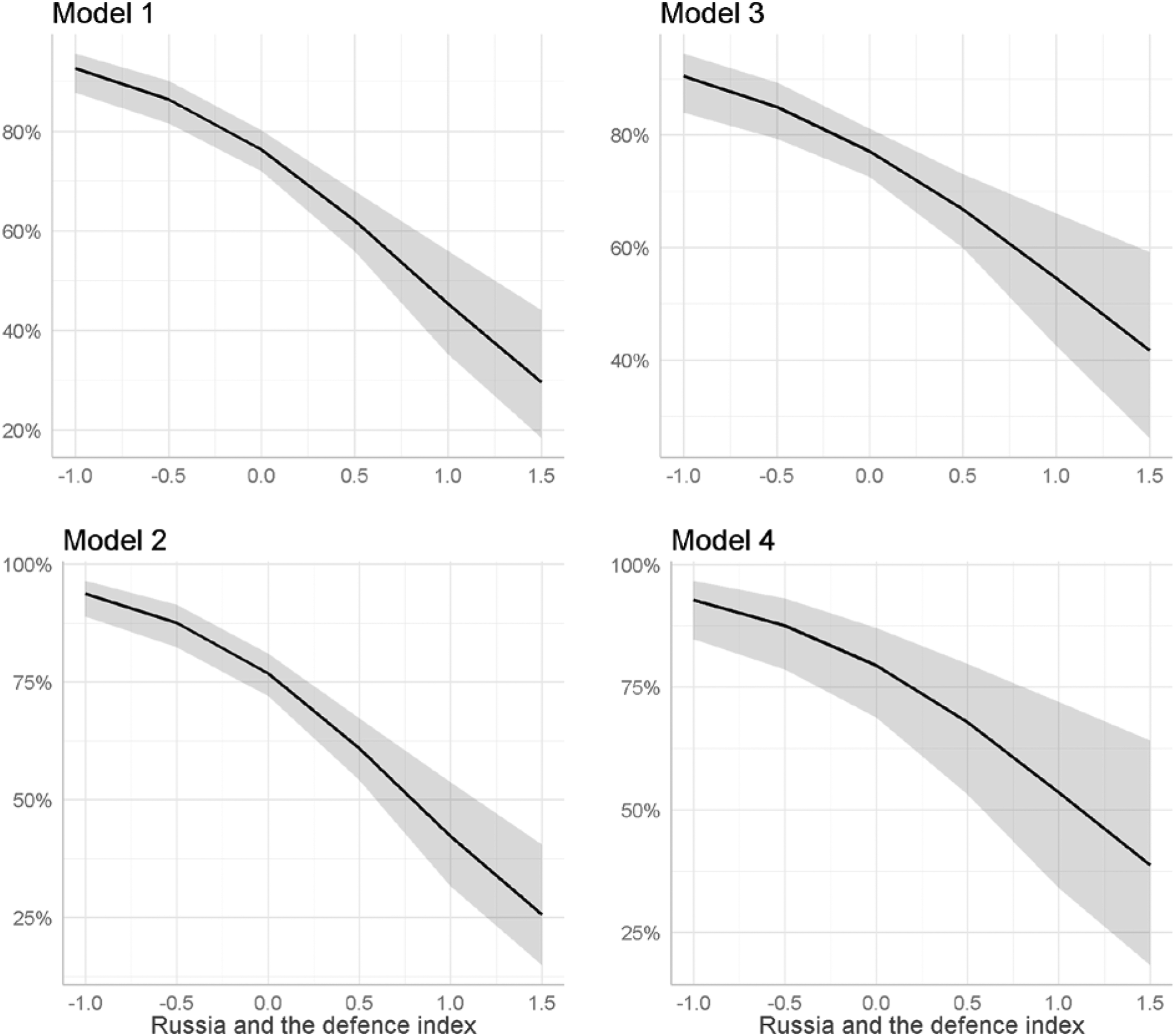
It is only in Model 5, with variables measuring sympathy towards Nausėda or Šimonytė, that foreign policy considerations cease to be significant. However, it is notable that the p-value is quite small (p = .089). Political sympathies possibly mediate the effect of foreign policy considerations. In order to test this argument, I conducted additional generalised structural equation modelling with sympathies as two mediating variables and Russia and the defence index as an exogenous variable (Appendix 3). Results show statistically significant indirect effects. First, voters with more lenient positions have higher sympathy for Nausėda and more often voted for him. Second, tougher positions positively affect sympathy for Šimonytė; and higher sympathy for Šimonytė negatively affects the probability of voting for Nausėda. I also ran GSEM models with partisanship and prospective evaluations of corruption (Appendix 3). They also point to mediating effects from sympathy variables, although a statistically significant indirect effect is observed only in the case of Šimonytė. These additional calculations help to dispel the notion that semi-presidential elections are merely a popularity contest.
Conclusion
This article builds on the existing literature concerning vote choice in presidential elections. I argue that major theoretical approaches are not sufficient to explain elections in semi-presidential republics where presidents do not dominate the executive but have other substantial powers. Since presidents under semi-presidential regimes usually have a central role in foreign policy (with limited responsibility for the economy) I propose an office-centred explanation of voter behaviour (i.e. focusing on the specific powers of the presidential institution) that is based on the foreign policy preferences of the electorate. In order to explore the empirical applicability of this addition to the theory, I employ a dataset from the Lithuanian 2019 national post-election survey that offers a battery of issues measuring the foreign policy positions of voters in presidential elections.
In my analysis, I control for the other important explanations of vote choice in presidential elections: the socio-demographic cleavages, partisanship and government performance. Results indicate that these explanations mostly appear as candidate-centred in semi-presidential elections, as they were significant only in the case of particular candidates. For example, the Soviet period (the main cleavage in Lithuania) and ethnicity exerted influence when choosing between Skvernelis (centre-left candidate) and Šimonytė (centre-right). However, socio-demographic factors were weaker in explaining the vote for Nausėda, a catch-all candidate with no prior political experience and no attachment to political parties. Retrospective voting is important when explaining the vote for prime minister Skvernelis; the partisanship of the LVŽS (the party putting forward Skvernelis’ candidacy) also affected the vote for him. However, the effects of these variables disappear in the second round when Skvernelis had dropped out. Contrary to those explanations, foreign policy considerations (the office-centred explanation) proved to be a stable and statistically significant factor in almost all the models (controlling for other explanations), independently of the candidate and the round in the presidential elections. To be more specific, the choice of a presidential candidate by Lithuanian voters is quite well-explained by their attitude (degree of leniency) towards Russia and defence.
The analysis also strongly suggests that the nature of foreign policy issues in semi-presidential elections is context dependent. Lithuanians clearly give more attention to the issues of national security, defence and relations to the eastern authoritarian countries (foremost, Russia). These issues are constantly covered in the Lithuanian media and have been especially salient since the annexation of Crimea in 2014 and Russia’s war on Ukraine in 2022. On the other hand, as discussions about EU integration never achieved a high level of saliency in the Lithuanian public sphere, EU-related considerations do not affect vote choice in the presidential elections. These context-dependencies of foreign policy possibly constitute a challenge for further research. The research presented here is a country-case study and is thus best defined as an exploratory attempt to analyse a previously under-researched question. In order to test the validity of these claims, further studies are needed in the future with a larger data sample to enable comparisons between different semi-presidential countries (and time periods). However, unlike retrospective evaluations where the economy is ubiquitous, and some major socio-demographic divisions (such as education, religiosity and ethnicity), foreign policy issues are very context-specific: for example, in Taiwan, relations with China are salient (Wang and Cheng 2015). In some European countries, issues around EU integration or the general position towards the EU may exert more influence when electing presidents. A major challenge for future research on vote choice in (semi) presidential elections lies in the creation of measurements that could enable different contexts to be compared.
Supplemental Material
Supplemental Material - Foreign Policy Preferences and Vote Choice Under Semi-Presidentialism
Supplemental Material for Foreign Policy Preferences and Vote Choice Under Semi-Presidentialism by Mažvydas Jastramskis in Political Research Quarterly
Footnotes
Declaration of Conflicting Interests
The author(s) declared no potential conflicts of interest with respect to the research, authorship, and/or publication of this article.
Funding
The author(s) disclosed receipt of the following financial support for the research, authorship, and/or publication of this article: This work was supported by the Lithuanian Research Council (Grant no. S-LIP-19-67).

Note
Supplemental Material
Supplemental material for this article is available online.
References
Supplementary Material
Please find the following supplemental material available below.
For Open Access articles published under a Creative Commons License, all supplemental material carries the same license as the article it is associated with.
For non-Open Access articles published, all supplemental material carries a non-exclusive license, and permission requests for re-use of supplemental material or any part of supplemental material shall be sent directly to the copyright owner as specified in the copyright notice associated with the article.
