




Abstract
Extensive scholarly work engages with the growing number of women in legislatures around the world and highlights their role as advocates of women’s interests during parliamentary decision-making processes. This article sheds light on the reactions of men MPs (members of parliament) to this trend by uncovering how women's numerical strength in party parliamentary groups shapes the issues that their men colleagues emphasize when speaking about women during plenary debates. I argue that, the higher the share of women in a party parliamentary group, the more will men representatives emphasize women’s interests in the context of issues they can easily relate to—either because the issues lie in men’s area of responsibility according to ideas about traditional role distributions in the society, for example, the financing of gender equality projects, or because they are part of broader patterns of societal inequality, such as poverty or health. I provide empirical evidence for this argument based on original time-series cross-sectional data from plenary debates in six German states between 2005 and 2021 using a structural topic model. These findings shed light on men’s role as critical actors and have implications for gender equality and the functioning of representative democracy more broadly.
Introduction
Women’s presence in parliaments around the world has been increasing over the last decades and reached a worldwide average of 26.4% in lower chambers in 2022 (Inter-Parliamentary Union, 2022). A comprehensive set of research engages with the differences these women make for the policy-making process. This work shows that women MPs (members of parliament) prioritize issues differently than men and act as advocates for women's interests (see, e.g., Allen and Childs, 2019, Bäck and Debus, 2019, Lowande et al., 2019). However, to what extend the presence of these women in parliaments also translates into changes in party positions and policy outcomes continues to be a controversial question (see, e.g., Reher, 2018, Dingler et al., 2019, Greene and O'Brien, 2016, Tusalem, 2022, Kittilson, 2011). To get policies enacted, women have to gain the support of the majority of party members and representatives – a group that continues to include predominantly men. In consequence, men are critical actors, who may initiate and drive women’s substantive representation (Childs and Krook, 2009). Ideally, women’s presence among their ranks changes the way men think about politics, leads them to revise the issues they prioritize and the policies they support. Men’s reactions to women’s increasing presence in parliaments is hence decisive for the way the outcomes of the legislative process can incorporate women's interests. This article contributes to a better understanding of this process by answering the following question: How does the share of women in party parliamentary groups shape the issues that men MPs emphasize when speaking about women during plenary debates?
I argue that, as women increasingly enter their ranks, men representatives put more emphasis on women’s interests in the context of issues they can easily relate to—either because the issues lie in men’s area of responsibility according to ideas about traditional role distributions in the society, for example, the financing of gender equality projects, or because they are part of broader patterns of societal inequality, for example, poverty or health. Women bring new information to plenary debates and cause a feminization of parliamentary debates (Dahlerup, 1988, Broughton and Palmieri, 1999, Childs and Krook, 2006a, Thomas and Welch, 2001). Over time, men legislators learn about women’s policy preferences and develop a higher level of awareness for women's concerns (Bratton, 2005, Flammang, 1985, Childs and Krook, 2006a). However, in parallel, a new logic of appropriateness emerges, according to which men should not speak for women, because women may speak for themselves in parliament (Höhmann 2020). In consequence, men face a situation of cognitive dissonance, in which two pieces of information that are linked to each other do not correspond (Festinger, 1957). My proposition is that, to reduce the resulting discomfort, men MPs will develop new strategies to engage with women’s issues that they perceive as appropriate.
This study investigates this proposition using original data from plenary debates in six German state parliaments between 2005 and 2021. In plenum, MPs communicate with the electorate to justify their party’s position or to indicate deviating individual positions (Steffani, 1979). Plenary debates are therefore an essential component of responsive policy-making and a central stage for the representation of women (see, e.g., Chaney, 2006, Clayton et al., 2017), even if policy decisions and revisions of proposals occur predominantly in parliamentary committees or by the government outside parliament. To identify how men engage with women’s issues in plenary debates, I investigate the context of all speeches in which MPs explicitly mention women. This approach avoids essentializing assumptions about all women holding progressive and feminist policy preferences, as it identifies cases in which speakers claim to promote the interests of women or a group of women (Celis and Childs, 2012). Using a structural topic model, I inductively identify the topics that MPs emphasize when speaking about women and investigate how the prevalences of these topics change from 1 year to the next.
The present research design makes two methodological advances to the literature engaging with the role of women’s interests in parliaments—so-called substantive representation of women (Pitkin, 1967). First, this analysis constitutes the first time-series cross-sectional study that engages with the promotion of women’s interests by men MPs. In contrast to previous scholarly work in the field that studied single legislatures over time (Höhmann, 2020, Höhmann and Nugent, 2021), the comparative design allows this study to disentangle the effects of broader societal trends towards gender equality (Inglehart and Norris, 2003) and women’s presence in parliament on the behavior of men MPs. Second, in this article, I apply a multi-dimensional, comprehensive understanding of substantive representation. Women’s interests include a broad set of political issues from equal pay, child care, or health care provisions over poverty among seniors or the financing of women’s shelters to sustainable development or migration. While studies interested in the way women’s presence shapes party positions and policy outcomes addresses this diversity of issues (see, e.g., Reher, 2018, Dingler et al., 2019, Greene and O'Brien, 2016, Ferland, 2020), research interested in the degree to which women’s interested are brought forth in parliament is usually limited to a small set of these issues (see, e.g., Ramstetter and Habersack, 2020, Höhmann, 2019, Celis, 2006). By taking the multi-dimensionality of substantive representation into account, this study contributes to a more comprehensive understanding of the way men MPs adapt their policy-making activities as a consequence of women’s presence in their party parliamentary group.
The findings presented in this study contribute to a clearer understanding as to how men can become “critical actors” (Childs and Krook, 2009) promoting women’s interests. The present study reveals that men increasingly emphasize women’s issues when interacting with many women, albeit only in a selective set of policy areas. Women’s numerical strength hence constitutes the foundation from which men can emerge as critical actors. At the same time, this study also clarifies that men MPs do not become more open to promote family politics and violence against women (Celis, 2008). Men’s reluctancy to engage with these issues can have consequence for policy-making in the interest of women in these crucial areas of women's substantive representation. Related legislative initiatives supported by many women might not reach the necessary support in parties and parliament or respective legislation opposed by many women might pass legislatures, as several case studies indicate (Thomson, 2018, Chaney, 2006).
Women and Men as Proponents of Women’s Interests
Substantive representation entails that representatives act “on behalf of, in the interest of, as the agent of” (Pitkin 1967: 113) women. During such action, MPs might emphasize or indicate support for four broad types of issues: (1) Topics, which are linked to women’s area of responsibility according to traditional ideas about the distribution of responsibilities between men and women (e.g., child care), (2) the promotion of equal opportunities for men and women, particularly in the professional world (e.g., income inequality), (3) policies, that are for biological reasons exclusively or more relevant for women than men (e.g., mother's post natal care), and (4) crosscutting topics, on which women tend to hold different policy positions than men, probably as a consequence of socialization (e.g., environmental policy, or war) (Reingold, 2000, Thomas, 1994, Swers, 2002a).
While both, men and women, can engage in women’s substantive representation, previous scholarly work emphasizes the role of women MPs as advocates of women’s interests. According to the “politics of presence” argument (Phillips, 1998), women politicians are more likely than men to understand the needs of women in the electorate and promote women’s interests fiercely. This pattern is a consequence of different life experiences of men and women which shape their preferences at the mass level and their political behavior at the elite level (Mansbridge, 1999). A comprehensive set of empirical research substantiates this claim: Women MPs join and share committees more frequently than men that deal with portfolios that are closely linked to women’s area of responsibility according to traditional role models (see, e.g., Donovan, 2012, Heath et al., 2005, Fortin-Rittberger and Dingler, 2021). Women also talk more about policies commonly assumed to be in the interest of women during plenary debates (see, e.g., Clayton et al., 2017, Celis, 2006) and ask more written questions to the government on related topics (see, e.g., Lowande et al., 2019, Bird, 2005). The voting behavior of women representatives moreover indicates that they are more likely to sponsor and support respective bills than their men colleagues (see, e.g., Swers, 2002b, Hogan, 2008, Bulut, 2021).
To what extent women act as promoters of women’s interests, however, depends on their numerical strength in parliaments—so-called descriptive representation. Critical mass theory (Dahlerup, 1988) proposes that, as long as only few women are present in parliament, they lack the experience and networks to work efficiently. Additionally, these women are under pressure to adapt to the behavioral norms of the majority, that is, men (Flammang, 1985, Kanter, 1977). Through increasing numerical strength, women are able to overcome these barriers and unfold their potential as advocates for women (Celis, 2006, Franceschet and Piscopo, 2008, Grey, 2002, Mendelberg et al., 2014). However, the relationship between descriptive and substantive representation should dissolve as women’s presence in parliaments increases over time. Women, who are elected into a parliament with a considerable number of women, would engage with other than women’s issues, because they either have diverse priorities or believe that others sufficiently engage with women’s substantive representation (Frederick, 2009, Childs and Krook, 2006a). Moreover, the entrance of conservative women into parliament might lead to polarization and hence complicates collaboration of women across ideological groups (Frederick, 2009, Kanthak and Krause, 2010, Kanthak and Krause, 2012).
Beyond women representing women, men might function as “critical actors” (Childs and Krook, 2009) advocating women’s interests. Critical actors initiate and drive women’s substantive representation, either individually or in groups. To fully understand women’s substantive representation, scholarly work therefore needs to identify the conditions enhancing men’s responsiveness to women’s interests. In this context, previous research shows that the political and institutional context can set incentives for men to promote women’s interests (Erzeel and Celis, 2016, Espírito-Santo et al., 2018, Höhmann and Nugent, 2021).
Women’s numerical strength in parliaments might constitutes another key moderator of men’s efforts to advocate for women’ interests, but how this effect might unfold is not yet clear. On the one hand, men might become more receptive to women’s political interests as more women enter their ranks. Women representatives bring new information to parliamentary debates by emphasizing the interests and needs of women in the population. They build strategic coalitions to promote women’s substantive representation (Childs and Krook, 2006a, Thomas and Welch, 2001, Allen and Childs, 2019) and a feminization of parliamentary debates begins (Dahlerup, 1988, Broughton and Palmieri, 1999), which men can hardly ignore. Over time, men legislators should in consequence learn about women’s policy preferences and develop a higher level of awareness for women's interests (Bratton, 2005, Childs and Krook, 2006b, Childs and Krook, 2009). In support of this rational, research on the United States found that a higher share of women in a state legislature coincedes with more support by men legislators for bills sponsored by their women colleagues (Thomas, 1994). The likelihood that men sponsor bills themselves that engage with women’s issues also increases (Bratton, 2005, Vega and Firestone, 1995).
On the other hand, previous scholarly work argued that men MPs engage less in women’s substantive representation as more women enter the political stage. In the parliamentary arena, like in any institution, gendered norms define what actors perceive to be appropriate behavior (Chappell and Waylen, 2013, Krook and Mackay, 2010). To create legitimate, responsive political decisions, members of disadvantaged groups need to recognize any MP as representative of their interests (Dovi, 2002). However, the historical subordination of women could have created mistrust between men and women and could complicate the communication of political interests between groups (Mansbridge, 1999). Women are therefore likely to challenge men MPs speaking for women in plenum and men MPs, anticipating this reaction, might refrain from such action. Appropriate behavior is thus redefined through women’s presence in parliaments (Chappell and Waylen, 2013, Krook and Mackay, 2010). If a sufficient number of women are present, and the appropriate role for this group is to speak for women, women and men might perceive it as inappropriate for men to engage in women’s substantive representation (Höhmann, 2020). Looking at the case of the German Bundestag, Höhmann (2020) finds that as the share of women in a party parliamentary group increased over time, men asked less questions to the government addressing issues that appear to be more relevant for women than men. Disentangling attitudes and action, Kokkonen and Wängnerud (2017) show that Swedish local MPs indicate a lower willingness to support gender equality measures if more women are present in a municipal council, but support for the ideal of gender equality remains stable. 1
In this article, I argue that the two seemingly ambiguous ways men MPs might react to women’s presence are not mutually exclusive, but rather parallel processes: Men learn about women’s interests so that they increasingly feel the urge to speak for women, but they perceive such action as inappropriate. In the field of social psychology, cognitive dissonance theory (Festinger, 1957) engages with this type of situation. Actors have difficulties ignoring if two elements of knowledge that are relevant to each other lead to opposing conclusions, that is, dissonance, because such a situation creates a feeling of discomfort. Rather than focusing solely on one piece of information and promoting women’s issues or not, men MPs are likely to search for ways to reduce this dissonance.
Actors apply a variety of strategies to dissolve or reduce dissonance, such as removing and adding information, or increasing the importance of certain aspects of their knowledge (Harmon-Jones and Mills, 2019). An important new piece of information on which men MPs can rely is that the substantive representation of women is not a unidimensional concept, but describes a broad variety of policies. Women’s issues include family and child care, violence against women, anti-discrimination and gender equality, but also the financing of such measures, or women’s situation when facing challenges such as poverty or sickness (Reingold, 2000, Thomas, 1994, Swers, 2002a, Clayton et al., 2017). By leveraging the multi-dimensionality of women’s substantive representation, men MPs can engage with some components of substantive representation while disengage with others, and thereby reduce cognitive dissonance emerging from women’s increased presence in politics.
Two considerations of men MPs are likely to guide their choices to engage and disengage with certain dimensions of women’s issues: Consistency with traditional gender roles and ability to link issues to own life experiences. First, politicians and citizens associate certain policy areas with women and others with men. This association follows from traditional ideas about the distribution of labor between men and women, with feminine policy areas including, for example, child care, elderly care, or education, and masculine policy areas including, for example, budget, internal and external security, or economy (Escobar-Lemmon and Taylor-Robinson, 2009, Krook and O’Brien, 2012). Even nowadays, women are more likely to be interested and to be perceived as competent actors in “feminine” policy areas (see, e.g., Goddard, 2019, Espírito-Santo and Sanches, 2019, Goodwin et al., 2021). To the extent that women’s substantive representation entails engaging with issues clearly in their gender’s traditional area of responsibility (e.g., family), men might perceive it as inappropriate to speak for women if large numbers of women are present. However, by identifying women’s interests within “masculine” portfolios, men create a legitimate ground to speak for women. For instance, men might emphasize budgetary aspects of financing policies promoting gender equality. By linking women’s representation to men’s traditional area or responsibility, men might perceive their role as proponents of women’s interests as appropriate or believe that the public perceives these efforts as appropriate.
Second, some women’s issues are closely entwined with women’s different life experiences, while others link to societal patterns of inequality and discrimination that are only partially gendered. Many political interests of women follow immediately from the specific experiences that they make during their life or that they fear to make, for example, anti-discrimination policies and policies fighting violence against women. Other women’s issues are the consequence of factors that cause inequality more broadly and affect also men, such as poverty, immigrant origin, or sickness. Even though women tend to perceive these issues as more important than men (albeit with some variation in degree within the group of women), this kind of “compassion” issues go beyond traditional women’s issues (Yildirim, 2022). While men MPs might believe that it is inappropriate to discuss the former, raising concerns about gender inequality in the context of the latter might appear more legitimate.
The party parliamentary group rather than parliament as a whole is likely to be the first place in which the cognitive dissonance, experienced by men MPs manifests itself. Members of the same party parliamentary groups share similar core values and ideas and are the main place for the exchange of ideas and collaboration. Men’s perception of important issues is more likely to change as a consequence of women’s presence, if they collaborate closely and share similar ideological and policy positions. Possibly, women belonging to other parties might also shape how men think about politics, but these effects are likely to be weaker and unfold after a longer time lag. This rationale leads me to focus on the effect of women’s numerical strength in party parliamentary groups.
Following these considerations, I expect that: H
1a
The more women belong to a party parliamentary group, the less will men MPs speak about women in the context of issues linked to women’s traditional role in the society and women’s unique life experiences from 1 year to the other. H
1b
The more women belong to a party parliamentary group, the more will men MPs speak about women in the context of issues linked to men’s traditional role in the society and life experiences of a variety of disadvantaged groups from 1 year to the other.
Research Design: Case Selection, Operationalization, and Data
To test these propositions, I study legislative behavior in six German state parliaments over three consecutive terms between 2005 and 2021 (Baden-Wuerttemberg, Brandenburg, Bremen, Hamburg, Rhineland-Palatinate, and Saarland). 2 Addressing the research question in the context of German states ensures high comparability of the cases and high generalizability of the results. Within Germany, parliamentary procedures display less diversity than for instance within Europe or industrial democracies, so that behavioral patterns are equivalent across cases. State parliaments also have equal areas of responsibilities for legislating that matter for women. Within the German multi-level system, the regional level is in charge of many policy-making competencies that are closely linked to women’s issues (e.g., child care or education). Despite these commonalities, the political contexts in the states differ substantially. 3 Most notably, there is considerable variation in women’s inclusion into politics, with the share of women in parliament ranging from very low (e.g., 18% in Baden-Wuerttemberg, 15) over medium (e.g., 33% in Saarland, 13) to rather high values (e.g., 42% in Bremen, 18). Overall, this variation in descriptive representation nearly captures the range of values observable in Europe, where Hungary displayed the lowest share of women with 14.1% and Iceland the highest share of women with 48% in 2022 (Inter-Parliamentary Union, 2022). Some of the states under study never had a woman leading the state government (Baden-Wuerttemberg, Brandenburg, Bremen), while others had (Rhineland-Palatinate, Saarland, Hamburg). Moreover, the electoral systems work differently, with states applying either mixed-member proportional systems or open-list proportional representation. The governing parties also vary considerably, with SPD-led governments in different coalitions, in particular in Brandenburg, Bremen and Rhineland-Palatinate, CDU-led governments in Saarland, and even green-led cabinets in Baden-Wuerttemberg. The sample also comprises a state which formerly belonged to the German Democratic Republic (Brandenburg). The population size, economic structure, and level of urbanization vary as well. Overall, the sample is representative for the diversity in the political landscape within the German states, but also within Europe, so that the way women’s presence shapes the speech-making activity of men MPs in the data can likely be generalized for European democracies.
The data set contains aggregated information for men and women in a party parliamentary group per year (N = 674). It covers all major parties that are politically relevant across states (CDU, SPD, AfD, FDP, Greens, Left). 4 The data set contains aggregate information for men and women in the parliamentary party group. Key variables are hence the legislative behavior of an average man or woman belonging to a party, the sex group, and the share of women in the party parliamentary group. Aggregating across all men and women has two advantages for the present study: First, since the research question requires the analysis of change over rather short time windows, information on individual legislators’ activities is scarce and would lead to many missing observations of the dependent variables. By grouping all men and women MPs, the data provides complete information about the way average men and women belonging to a party behaved during a specific year. Second, aggregating information across parties allows to neglect a set of individual-level confounding variables that exist in all parties. These include, for example, membership in committees linked to women’s issues or positions as party speakers.
Dependent Variables: Topics When Speaking About Women in Plenary Debates
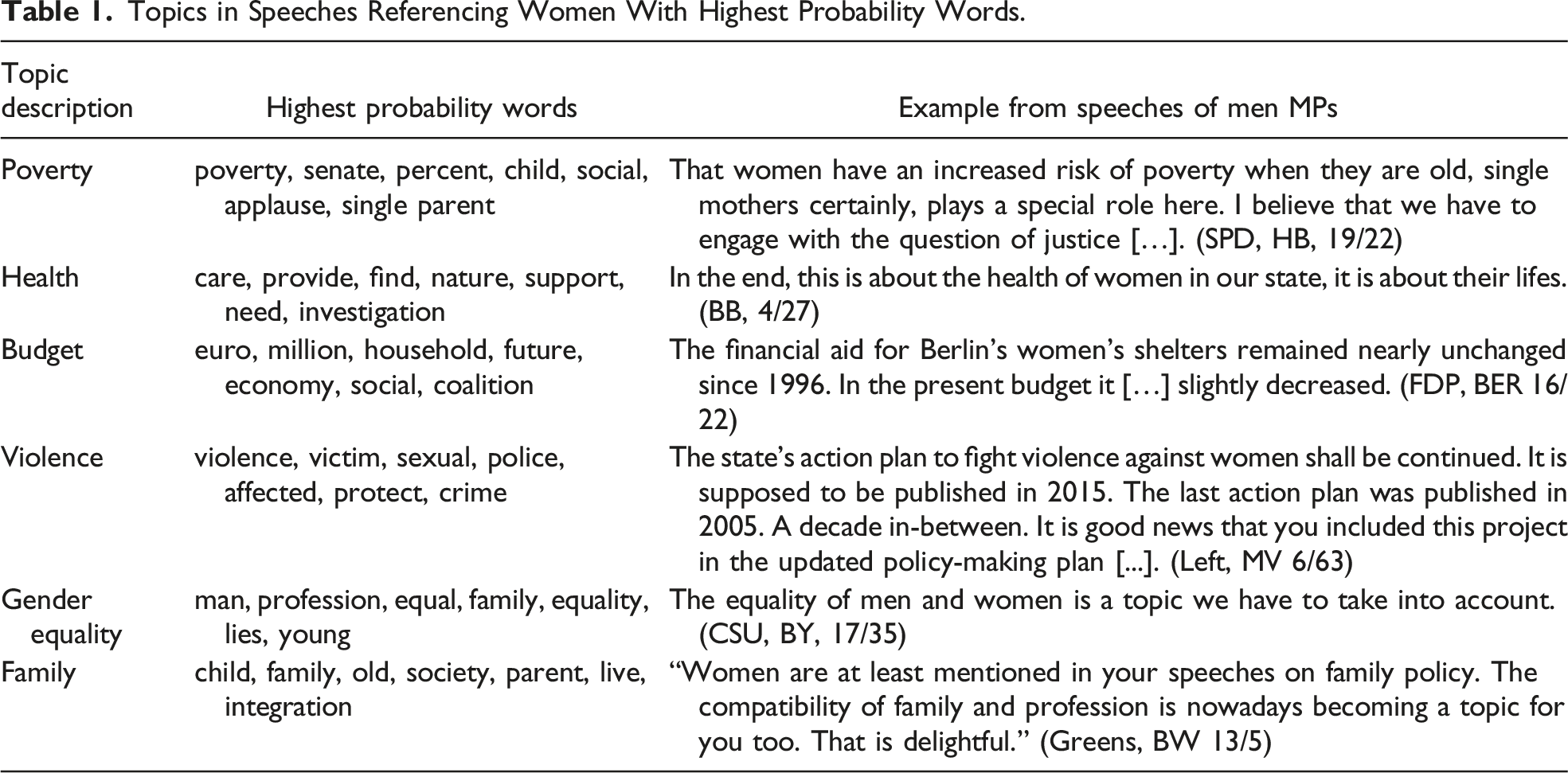
I use the prevalence of six different topics in speeches referencing women as indicator for substantive representation (poverty, health, budget, violence, gender equality, family). The indicators are based on an original text corpus containing the full plenary minutes for the six states. I retrieved all minutes from the webpages of parliamentary archives and read information on the speaker as well as the speeches into R using the “pdftools” package (Ooms, 2021). From all minutes, I excluded components that are likely to be procedural rather than substantial, including all contributions by the speaker of the house and her alternates, speeches with less than 250 words, and the first 10 words of each speech as they usually contain greetings.
I limit the investigation to all speeches that make use of the word “Frauen” (women in German) as a standalone (not a compound) word, meaning I identify those speeches in which representatives explicitly speak about women in the highly symbolic setting in plenum. Of all speeches delivered in the six states over three electoral periods, 7.19% mention the word women at least once. Through this approach, I aim to avoid the pitfalls of essentializing women as a group of actors with a single interest. I do not have to pre-define a fixed set of policy positions that are supposed to be in the interest of all women (for a critique see Mansbridge, 1999, Mansbridge, 2005), but instead understand substantive representation as actors attempt to speak for women or a subset of women in a highly visible context that enhances responsiveness (Piscopo, 2011).
I coded a random sample of 1015 notions using qualitative content analysis to test whether notions of women really indicate efforts to advocate for them. The results indicate that 87.7% of all notions meet this criterion. The claims can be categorized along six types of statements: (1) Demanding concrete political actions said to be in the interest of women or sub-groups. (2) Showing support for political action that has been taken and is said to be in the interests of women or sub-groups. (3) Pointing towards inequality and discrimination linked to gender and the life experiences of men and women. (4) Speaking as a woman for women (also by describing own life experiences). (5) Presenting or asking for support for organizations, programs, initiatives, or events that engage with issues linked to gender, are organized by women or target women. (6) Criticizing the positions and values of other political actors concerning gender equality.
Speeches referencing women that do not contain any of these kinds of claims to speak for women mostly refer to the ministry that entails the women’s portfolio by using its full name, but actually engage with an issue linked to another of its portfolios (i.e., someone speaking about the elderly and addressing the ministry of women, youth, and the elderly). In the remaining cases that did not entail a claim, speakers thank women (and men) for their appearance in parliament or for volunteering, make general statements about societal values that include, but are not explicitly limited to gender equality (e.g., listing several values that characterize the European Union), or address all citizens by mentioning men and women. Only in one statement did I observe that the speaker highlights drawbacks of a policy implemented for gender equality purposes for the broader society. Overall, the analysis of this qualitative sample lends support to the proposition that, when MPs use the word women, they usually claim to speak for women.
To identify the topics in these speeches mentioning women, I apply a structural topic model using the “stm” package in R (Roberts et al., 2019). The algorithm discovers sets of words that tend to appear together, clusters them into non-exclusive categories, and provides information on the proportion of words in the text that belong to the topic. When identifying the prevalence in the speeches, the structural topic model further makes use of additional information closely linked to the content including party, sex group, state, and year.
To estimate the structural topic models, additional data preparation was necessary. I conducted the common steps to prepare a text for automated text analysis including (1) transforming all text to lower cases, (2) removing stop words (in German), (3) removing punctuation and numbers, (4) removing short words with less than four characters, and (5) reducing all words to their stem. I furthermore excluded words that are extremely common and do not distinguish single observations or topics (if a word was used in more than half of all speech sets) as well as all words that are used scarcely and hence contain little information about topics (used on average less than one time by every party in the six state parliaments).
Topics in Speeches Referencing Women With Highest Probability Words.
Descriptive Statistics of Dependent Variables.
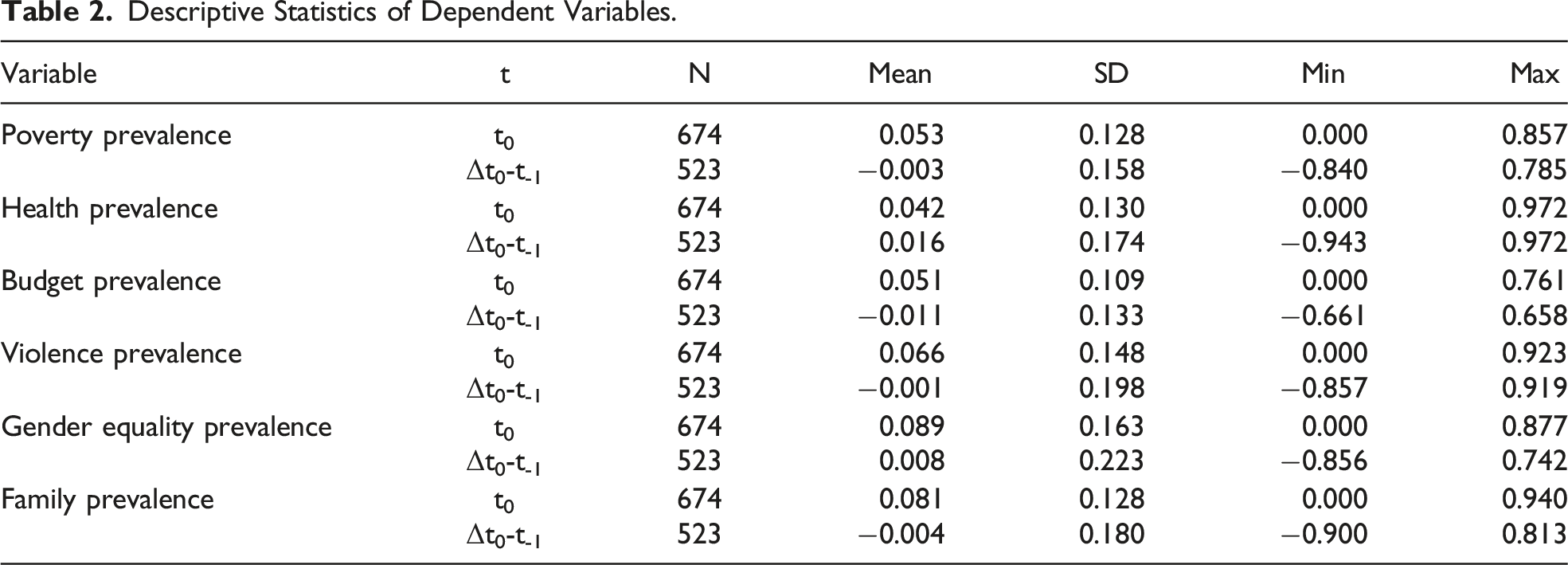
Since the hypotheses address the way MPs change their behavior, I use first differences from 1 year to the next as dependent variables. The mean values for change from 1 year to the next are mostly smaller than 0.01, indicating the absence of a time trend. However, the prevalence of health appears to increase (0.016) and of budget appears to decrease (−0.011) over time.
Independent Variables: MPs’ Sex and the Share of Women in their Fraction
They key research interest of this study is the interaction of MPs’ sex and the share of women in their party parliamentary group.
A binary variable identifies the group of men and women MPs in the data, taking the value “1” for men and “2” for women. I identified the sex of MPs based on information provided by electoral commissions, parliamentary documentation, and parliamentary yearbooks.
A second variable measures the share of women in a party parliamentary group at the beginning of the legislative term in percent. The number was calculated based on the aggregate information about the sex of MPs. Figure 1 reveals how women's presence in parties varies over time and states. The observed values range between 8.3% and 62.5%.
7
Variation between the states is pronounced, with most parties in Bremen displaying rather high proportions of women, while those in Baden-Wuerttemberg have rather low shares. The variation within parties across elections and states is also considerable. Values range for instance between 13.33 and 47.37% for the CDU, 11.11 and 46.15% for the SPD, or 30.56 and 60.00% for the Greens. The analyses include the squared term of this variable as independent variable to capture that increases in the share of women might unfold different effects if few women or many women are present. Share of women in party parliamentary groups in six German states over time.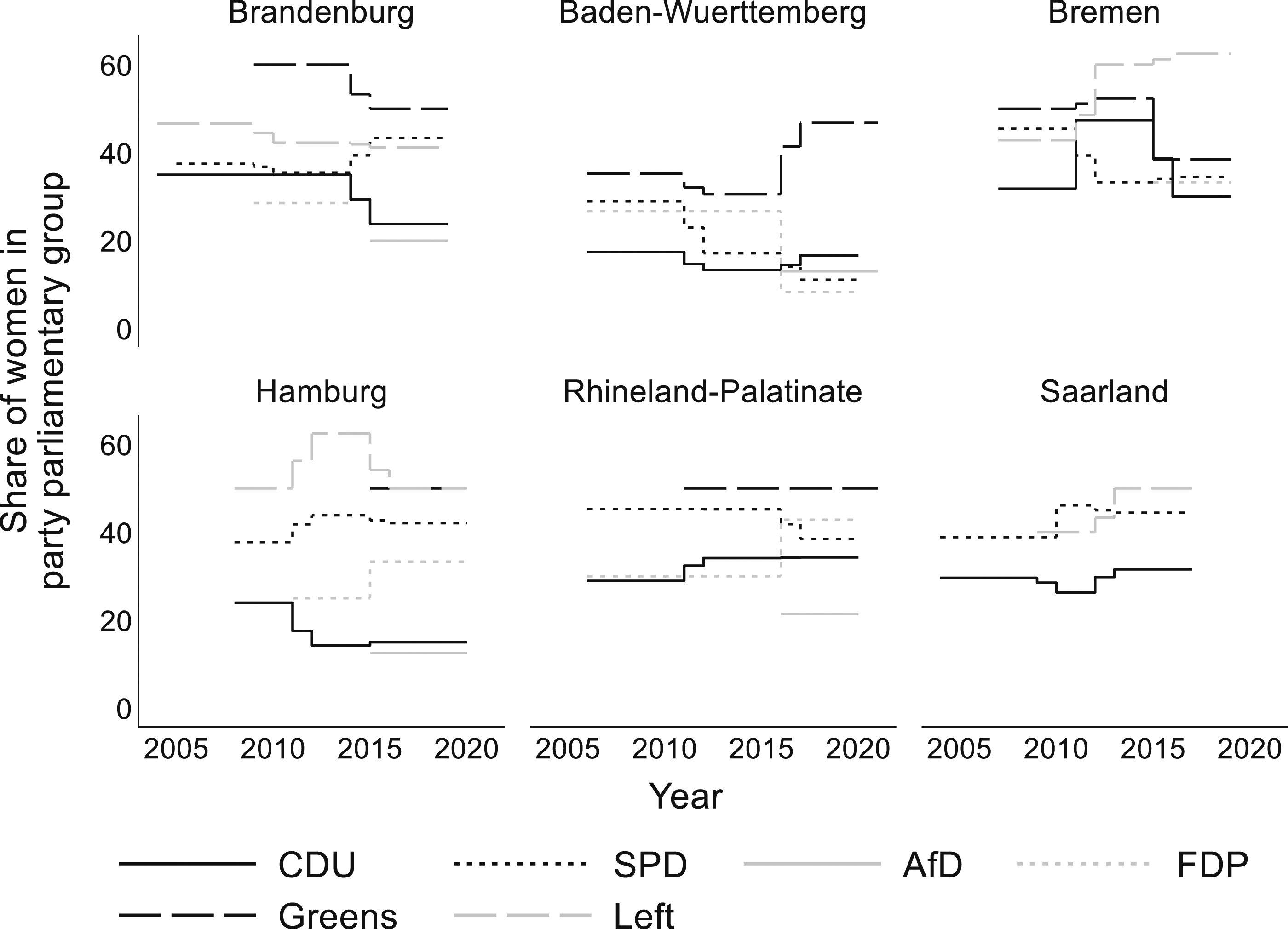
Change in When Men Speak About Women in Plenary Debates—Evidence from German States
To test my main propositions, I regress the first differences of the prevalence of the six topics on sex group and the share of women MPs belonging to a party parliamentary group. The models predict the average change in legislative behavior of all men or respectively all women belonging to a party parliamentary group from 1 year to the next within a legislative term. All models are linear regression models for panel data with robust standard errors. They include fixed effects for the electoral period of a state to identify dynamics specific to the term and state under study and a lagged dependent variable to account for possible autocorrelation. Since the dependent variables are first differences, the main models do not consider confounders that remain constant over the whole legislative term and only impact the overall level of MPs’ engagement into women’s issues, but do not modify it over time. While Figure 2 visualizes the main effects using predicted margins, full models are displayed in the Table OA6 and marginal effects are shown in Figure OA8 in the Online Appendix. Predicted change for the six indicators for substantive representation (t-1-t0) based on the share of women in the party parliamentary group for men and women MPs (with 95-percent confidence intervals). Annotations: Based on Models in Table OA6 in the Online Appendix.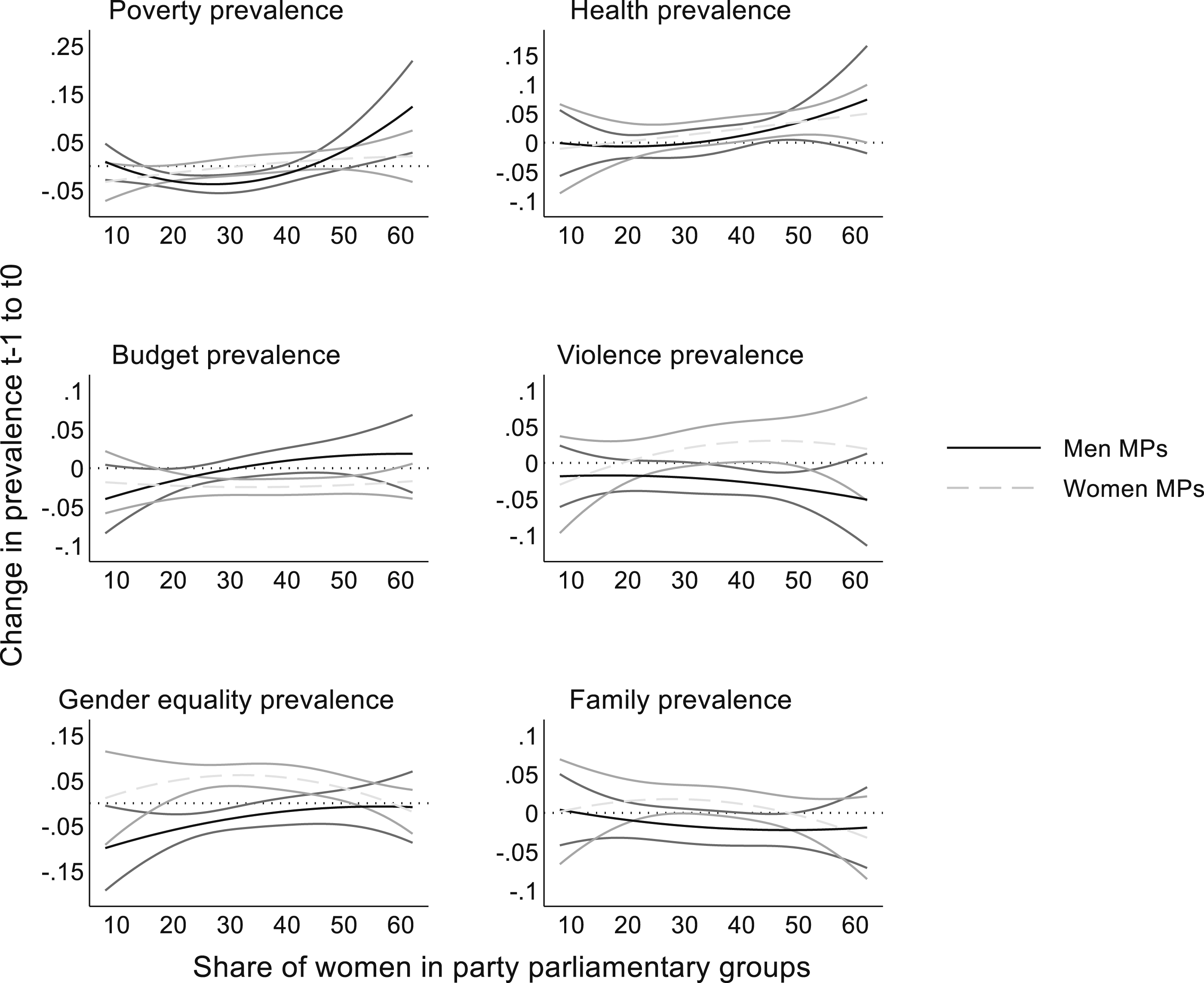
The figure reveals that changes in the prevalence of the poverty, health, budget, and gender equality topics from 1 year to the next in the speeches of men MPs referencing women is positively correlated with the share of women present in the party parliamentary group. The prevalence of poverty shows the most robust and substantial change as women’s presence increases. While men MPs belonging to a party with 27% women in their rows tend to decrease the salience of poverty by 0.04 points, those belonging to a party with over 60% women increase the salience of the topic by 0.11. If a party parliamentary group has 50% women, an additional percent of women increases the salience of poverty in the speeches referencing women delivered by men MPs by 0.006 points per year. This effect can accumulate to 0.03 over a 5-year term, which equals nearly one fourth of a standard variation of poverty prevalence at t0.
Similar, albeit weaker, patterns occur for the health and budget topic. For the health topic, change in the prevalence is close to zero for men MPs belonging to parties with few women. However, as of 32% women MPs, the predicted change slightly increases and turns statistically significantly different from zero as women’s numerical strengths reaches 44%. The predicted change in the prevalence of budget is negative for men MPs belonging to parties with few women MPs, but increases consistently as the share of women MPs grows, so that it turns positive as a party reaches 31% women. While the degree to which men MPs change their emphasis on budgetary questions when speaking about women in plenum differs in a statistically significant manner for men in parties with few and many women, the predicted positive effect for men MPs belonging to parties with a large proportion of women is not statistically significantly different from zero in the main model. However, in an additional test, I included the third order polynomial of the share of women in a party parliamentary group, building on the assumption that a second turning point between the behavior of men MPs and women’s presence might exists (see Figure OA9-OA10 and Table OA7 in the Online Appendix). The results reveal that the prevalence of budget increases for men MPs belonging to parties with 35–58% women, but the effect vanishes again for parties with larger proportions of women.
The prevalence of gender equality in the speeches of men MPs referencing women decreases less for men MPs belonging to parties with many women compared to few. The figure reveals that men surrounded by few women tend to speak less about this issue from 1 year to the next. The negative effect is statistically significantly different from zero at the 5 percent level and its size equals up to half a standard deviation of change in this variable. As the share of women increases, this effect slowly approaches zero and turns statistically insignificant as soon as 34% women are present in a party parliamentary group.
Turning to the remaining topics, Figure 2 reveals that men MPs tend to steadily disengage from 1 year to the next with family and violence when speaking about women—independent of the share of women present in their ranks. For the family topic, predicted change in the prevalence of the topic over time is consistently negative, with the exception of parties with very few women (12% or less), for which the model predicts no change in prevalence over time. For the violence topic, the predicted change in the prevalence is also consistently negative. However, the predicted value only becomes statistically significantly different from zero at the 5 percent level as the share of women in a party parliamentary group overcomes 33%. The marginal effects of an additional percentage women in a party parliamentary group are extremely small for family and violence prevalence and do not reach the 5 percent significance level.
Overall, this evidence hence lends broad support for Hypothesis 1b: The more women belong to a party parliamentary group, the more will men MPs speak about women in the context of issues linked to men’s traditional role in the society (i.e., budget) and inequality more broadly (i.e., poverty, health) from 1 year to the other. By contrast, I find no empirical evidence supporting Hypothesis 1a that men MPs will speak less about women in the context of issues linked to women’s traditional role in the society (i.e., family) and women’s life experiences (i.e., gender equality or violence) from 1 year to the next.
How can we account for the unanticipated yearly decreases in the prevalence of family and violence in the speeches of men MPs referencing women that occurs independent of the share of women in the party parliamentary group? Possibly, this pattern might indicate that the logic of appropriateness shaping men’s behavior (Höhmann, 2020) emerges independent of the share of women present in a specific party parliamentary group. Instead, the definition of appropriate behavior within institutions appears to change as a consequence of a broader societal value change. Such value change might be the consequence of generational shifts in emancipative values (Inglehart and Norris, 2003). Or, changes in societal value could also follow from the political action of strong women leaders. This latter explanations might be of particular relevance for the present study, as the time horizon studied here includes the Merkel era—the first period in which Germany was governed by a woman prime minister, who certainly left a transformative mark on German politics (Ahrens et al., 2022).
These effects are stable to a series of additional modifications in the main models. First, I included party fixed effects to capture the specific dynamics at the party-level beyond the variables introduces in the previous models (Table OA8 in the Online Appendix). Second, I clustered standard errors at the state-level to consider that variation within parties might follow similar patterns within the homogenous setting of a state (Table OA9 in the Online Appendix). Third, I estimated two additional sets of models that use 2-year and 3-year change in prevalence as dependent variables to see whether effects might take longer to unfold (Tables OA10-11 and Figures OA11-14 in the Online Appendix). Forth, I added a series of additional confounders to the models that might moderate the way women’s presence in- or decreases the prevalence of different topics when men MPs speak about women (Table OA12 and Figures OA15-16 in the Online Appendix). The list of variables includes factors at the party-level (e.g., party position on the sociocultural dimension of political conflict), at the parliamentary-level (e.g., whether the CDU fraction was in government at that time), and the state-level (e.g., share of Catholics in the population). 8 Fifth, I added a robustness test using a categorical variable identifying whether a party has less than 15%, 15 to 33%, or more than 33% women MPs (Table OA13 and Figure OA17). This test engages with the logic behind critical mass theory, which proposes that, as women’s presence increase, changes in environments occur not gradually but at certain thresholds (Kanter, 1977, Dahlerup, 1988). The uncertainty of the resulting estimates from this test is rather high, while the patterns in general still mirror the results of the original models using a continuous measure. This insight leads me to conclude that the effects of women’s presence unfold gradually rather than forcefully at certain cut-off points.
Moreover, I investigated whether the results are driven by a certain subset of parties or states. To test whether men MPs belonging to parties on one side of the ideological continuum only change their behavior as described, a sixth test introduced a multi-way interaction between the sex group, the share of women in the party parliamentary group, and the party’s general ideological orientation (see Table OA14 and Figure OA18). A dummy variable identifies left-wing parties with the value “1” (i.e., SPD, Greens, and Left) and right-wing parties with the value “0” (i.e., CDU, FDP, and AfD). Many of the main effects described above persist within the two ideological groups, albeit some of them with a lower level of statistical significance (see, e.g., for poverty, health, and family prevalence). However, the effects that the share of women in a party parliamentary group unfold on the frequency with which men emphasize budget and gender equality in their speeches when talking about women in plenum appear to be limited to left-wing parties only. Moreover, I divided the sample of six states along a series of key characteristics to investigate whether the findings are driven by certain state-level contextual factors. I compare the results for states with and without a CDU-led government in the time under study, with and without a woman state prime minister, and with rather high (34-65%) and rather low (3-13%) shares of catholic population (Tables OA15-20, Figures OA19-21). With very few exceptions, the main findings persist in the split samples. Notably, if they are placed in states that have not yet had a woman state leader or states with rather numerous Catholic populations, men MPs tend to react to increasing numbers of women in their ranks by talking less about women in the context of family affairs in plenum. While the moderating factors at the party- and state-level deserve further attention in future research, the overall consistency of the findings leads me to conclude that the described patterns are not driven by specific circumstances alone.
Conclusion
Making use of original time-series cross-sectional data from German state parliaments, this study showed that men MPs change the issues they emphasize when speaking about women in their plenary contributions as the share of women in their party ranks grows. Men belonging to parliamentary party groups with larger proportions of women increase the salience of poverty and health as well as budget when speaking about women. I argued that this pattern is the result of an effort to dissolve cognitive dissonance: Men who frequently experience women as political actors want to emphasize women’s issues, but worry about the degree to which this action might be perceived as appropriate by the broader public. In consequence, they link women’s substantive representation to “masculine” policy areas as well as inequality more broadly. By applying a multi-dimensional understanding of substantive representation, this study was able to reveal that the behavior of men MPs changes more as women’s presence in parliament increases than previous scholarly work suggested (Höhmann, 2020, Kokkonen and Wängnerud, 2017).
However, the results presented here also confirm the finding of these previous contributions that men are unlikely to promote women’s interests in a narrow sense, even if large numbers of women are present in their party parliamentary group. Men MPs speak less and less about women in the context of family and violence. According to the results presented in this study, this effect occurs independent of the share of women in their ranks. This finding has several implications for the political sphere. First, the lacking engagement of the men majority in these issue areas might lower success rates of related legislation to pass parliament successfully. Second, men miss the chance to make highly symbolic statements about one of women’s main issues in parliament. Third, the resulting division of labor forces women to continue emphasizing family and violence policy, even though engagement in the least prestigious policy area often leads to deadlocks in political careers (Goddard, 2019; Kroeber and Hüffelmann, 2021).
Overall, the evidence presented here adds to an emerging set of scholarly work suggesting that men's engagement for women’s substantive representation mainly depends on women’s descriptive representation (Höhmann and Nugent, 2021, Höhmann, 2020). Women MPs function as information source for men MPs in some policy areas, and are the only speakers for women’s interests in others. Ensuring gender parity in all political parties hence continues to be the main condition for the equal inclusion of women’s interests in the political decision-making process.
A promising avenue for future research would be to test whether the findings presented here hold in national legislatures and, in particular, to investigate whether men MPs also speak more about women when it comes to foreign affairs and defense (arguably two highly important, masculine policy areas). The present empirical analysis builds on data from the German states, which have extensive policy-making competences on policy areas that affect women’s life within Germany. While substantial contextual variation between the states ensures that the findings travel beyond the specific case, revealing whether and to what extent similar patterns occur for foreign relations at the national level would help clarifying the limitations and generalizability of the argument. Additionally, it remains to be tested to what degree the findings hold if key features, that all German states share, vary. Most notably, the German parliaments are working parliaments, within which MPs tend to have a high level of specialization. Usually, only experts for a given policy area speak in plenum. In parliaments in which MPs tend to speak on a broader diversity of issues, women’s presence in party parliamentary groups might be more likely to shape the action of their men colleagues.
Supplemental Material
Supplemental Material - When Do Men MPs Claim to Represent Women in Plenary Debates—Time-Series Cross-Sectional Evidence from the German States
Supplemental Material for When Do Men MPs Claim to Represent Women in Plenary Debates—Time-Series Cross-Sectional Evidence from the German States by Corinna Kroeber in Political Research Quarterly
Footnotes
Acknowledgements
I highly appreciate the research assistance of Jonas Dietrich, Dzaneta Kaunaite, Cord Masche, and Hannes Siebert. I also thank three anonymous reviewers, Paula Reppmann, Sarah C. Dingler, Stephen Holden Bates, as well as my fellow Political Scientists at the University of Greifswald for their valuable input on this research.
Declaration of Conflicting Interests
The author(s) declared no potential conflicts of interest with respect to the research, authorship, and/or publication of this article.
Funding
The author(s) disclosed receipt of the following financial support for the research, authorship, and/or publication of this article: This research is funded by the Deutsche Forschungsgemeinschaft (DFG) – 442430596.

Supplementary Material
Supplementary material for this article is available online.
Notes
References
Supplementary Material
Please find the following supplemental material available below.
For Open Access articles published under a Creative Commons License, all supplemental material carries the same license as the article it is associated with.
For non-Open Access articles published, all supplemental material carries a non-exclusive license, and permission requests for re-use of supplemental material or any part of supplemental material shall be sent directly to the copyright owner as specified in the copyright notice associated with the article.
