



Abstract
Do United States Supreme Court decisions on LGBT rights shape attitudes towards LGBT individuals among the mass public? In this paper, I conduct an empirical test of the effect of quasi-random exposure to the announcement of Bostock v. Clayton County—a landmark case which held that an employer who fires their employee because of their sexual orientation or gender identity violates Section VII of the 1964 Civil Rights Act—on favorability towards LGBT individuals. Relying on data from Phase 2 of the Democracy Fund/UCLA Nationscape survey, I find that quasi-random exposure to the announcement of Bostock engendered increases in favorability towards LGBT individuals among the wider American public. Subgroup analyses also indicate that the largest increases in favorability were among Democratic partisans and the religiously unaffiliated, while minimal changes in favorability were detected among those who are among the most likely to oppose LGBT rights, including Republicans and Evangelical Protestants. The findings speak to the validity of the legitimacy model and highlight the limitations of the backlash model in the post-Obergefell era of public opinion towards LGBT rights.
Introduction
On June 15, 2020, the Supreme Court held in a landmark civil rights case—Bostock v.Clayton County 1 —that an employer who fires their employee because of their sexual orientation or gender identity violates Section VII of the 1964 Civil Rights Act. Following cases such as Lawrence v. Texas (2003), and Obergefell v. Hodges (2015), Bostock was widely seen as another watershed moment in further enshrining LGBT rights (Liptak, 2020, Millhiser, 2020). In addition to understanding how policy development leads to greater social benefits for LGBT individuals (Flores et al. 2020), scholars have analyzed how Supreme Court decisions on LGBT rights shape attitudes towards LGBT individuals among the mass public (Aksoy, Carpenter, Haas & Tran, 2020, Stoutenborough, Haider-Markel & Allen, 2006). Despite these studies, scholars interested in the effects of policy development on mass attitudes have not yet examined whether policy gains on protections from discrimination in employment may lead to more favorable estimations of LGBT individuals among the wider public. Public policy is often used as a strategic tool to change mass opinion (Soss & Schram, 2007), and the public’s response to the introduction of policy is known as policy feedback (Kreitzer, Hamilton, and Tolbert, 2014). To what extent then do competing models of mass opinion change explain public attitudes towards LGBT individuals after the announcement of Bostock? This paper tests the possibility that Bostock shaped public attitudes towards LGBT individuals with a novel research design and the use of timely data.
Demand-side models of public policy have longed examined how mass opinion shapes policy development (Baumgartner and Jones, 2010). These traditional models hold that policy development is responsive to public attitudes towards a given issue (Page and Shapiro, 1983). In recent decades, however, increasing scholarly attention has been paid to how mass opinion is shaped by policy development (Soss and Schram, 2007). Alongside institutional actors including the President and Congress, scholars have examined how the Supreme Court shapes mass opinion via policy development (Hoekstra, 2003). Building on such works, a flurry of Supreme Court decisions in the area of LGBT rights has given rise to a burgeoning scholarship interested in how mass attitudes towards LGBT individuals are shaped by judicial action (Aksoy, Carpenter, Haas & Tran, 2020; Flores & Barclay, 2016; Kazyak & Stange, 2018; Keck, 2009; Tankard & Paluck, 2017).
When it comes to theorizing how policy development via the Supreme Court affects public opinion towards LGBT rights, the literature suggests a number of potential effects, including positive effects, negative effects, positive and negative effects, or no effect at all. These effects are associated with four respective models of attitude change in response to policy development. On the one hand, positive effects are associated with the legitimacy model, which posits that judicial actions enshrine pro-LGBT policies with greater social legitimacy via the mass public’s respect for the rule of law (Flores & Barclay, 2016, Kazyak & Stange, 2018, Tankard & Paluck, 2017). Conversely, negative effects are associated with the backlash model, where any policies that are sufficiently salient and challenging to existing social norms may engender an opinion backlash among those with particularly entrenched views (Klarman, 2012). Elsewhere, the introduction of new policy via the courts may polarize the mass public on issues such as LGBT rights, thus, strengthening and widening the differences between supports and opponents (Stoutenborough, Haider-Markel & Allen, 2006). Lastly, Supreme Court decisions on LGBT rights may also reflect a growing consensus of social change, meaning that such cases impart no feedback effects among the mass public.
To test the empirical validity of these various models, I present quasi-experimental evidence from the Phase 2 of the 2019–2020 Democracy Fund/UCLA Nationscape survey. Exploiting as good as random exposure to the widely reported news stories regarding the announcement of Bostock, I rely on the “unexpected event during survey fieldwork” framework (Munoz et al., 2020) to provide evidence that quasi-random exposure to the announcement led to substantive changes in public favorability towards LGBT individuals.
Overall, I find that quasi-random exposure to the announcement of Bostock led to increased favorable estimations towards LGBT individuals, thus, lending weight to the theoretical expectations of the legitimacy model. I also find limited evidence of a backlash effect (i.e., that SCOTUS decisions engendering greater homonegative attitudes) on mass opinion towards LGBT individuals in the wake of the announcement.
This paper contributes to the extant scholarship in three important ways. First, it provides additional evidence that mass attitudes towards LGBT individuals move in the direction of increasing favorability after exposure to Supreme Court decisions on LGBT rights. Second, while the scholarship has largely focussed on the impact of same-sex marriage reform on favorability towards LGBT individuals, the findings demonstrate that these effects are not limited to exposure to the announcement of Obergefell. This finding is important because it increases the generalizability of the legitimacy model as a means for understanding the impact of policy implementation on mass opinion towards LGBT rights (Flores & Barclay, 2016). Third, it continues to highlight the limitations of the backlash model in the area of LGBT rights, suggesting that institutional actors should not have to fear an intense opinion backlash in response to implementing policies that increase societal inclusion for LGBT individuals.
The structure of the paper proceeds as follows. Drawing on the extant scholarship on Supreme Court decisions and their effects on mass opinion, I outline three testable hypotheses concerning the effects of quasi-random exposure to the announcement of Bostock on mass attitudes towards LGBT individuals. 2 After delineating my hypotheses, I turn to data and methods, outlining my quasi-experimental research design consistent with the “unexpected event during survey fieldwork” framework outlined by (Munoz et al., 2020). I then present results and conclude by reflecting on the significance of the findings, including their implications for understanding which models of public opinion are the most relevant for gauging the impact of Supreme Court decisions on public opinion towards LGBT individuals in the post-Obergefell era.
Supreme Court Decisions and Their Effects on Mass Opinion
A plethora of evidence suggests that policy implementation can trigger a policy feedback mechanism which, in turn, facilitates a change in mass opinion towards a given issue (Campbell, 2012, Eisner, Turner-Zwinkels & Spini, 2021, Jacobs & Metler, 2018, Kreitzer, Hamilton & Tolbert, 2014, Soss & Schram, 2007). Alongside the President and Congress, much attention has been paid to how the Supreme Court shapes public opinion via policy implementation (Franklin & Kosaki, 1989, Hoekstra, 2003). 3 Models examining the effects of Supreme Court decisions on mass opinion towards LGBT individuals point to a number of possible effects, including backlash, legitimacy, polarization, and consensus (Barclay and Flores, 2014; Flores & Barclay, 2016). In this section, I appraise the relevance of each model for understanding how Bostock engendered attitude change towards LGBT individuals.
I first turn to discuss the relevance of the legitimacy and consensus models. The legitimacy model posits that policy implementation from government actors imbues a new policy with increased legitimacy through citizens’ respect for the rule of law (Scheingold, 2004). Evidence suggests that the direction which the Supreme Court rules on a case is likely to give legitimacy to one side of the policy debate. Consistent with this reasoning, multiple studies point to more positive estimations towards LGBT individuals, as well increased support for same-sex marriage, in the wake of cases such as Obergefell v. Hodges (Flores & Barclay, 2016, Kazyak & Stange, 2018, Tankard & Paluck, 2017). Given that mass attitudes towards LGBT individuals trended in the direction of increasing favorability after Obergefell, there is reason to expect that Bostock likewise engendered to more favorable estimations of LGBT individuals among the wider public. Alternatively, if the expectations of the legitimacy model do not hold constant, then we would expect mass opinion towards LGBT individuals to be unmoved by exposure to news about the announcement of Bostock. This outcome would be consistent with the expectations of the consensus model, which posits that institutions such as the Supreme Court are constrained in their ability to lead social change (Casillas et al. 2011). In this respect, the consensus model acts as a null model of public opinion change. These developments lead me to state my first hypothesis as:
Policy proponents often fear opinion backlash from the mass public. Opinion backlash is characterized by a large, negative, and enduring shift in mass attitudes that occurs in response to a policy that threatens to upend the status quo (Bishin, 2016). Certainly, any policy that is sufficiently salient and challenges existing norms may trigger a backlash. Nevertheless, attempting to engender policy change on a particularly contentious issue is especially likely to trigger a backlash, since it will antagonize those with deeply entrenched views on one side on the debate. The intensity of opinion backlash is likely to be conditional upon which actor or political institution engenders policy change. Since direct democratic institutions (i.e., Congress and the President) are inherently responsible for implementing the majority will, policy implementation via the courts may trigger an especially intense opinion backlash (Price & Keck, 2015).
Prior to Obergefell, studies found support for the backlash model as model for understanding the impact of Supreme Court decisions on public attitudes towards LGBT rights (Klarman, 2012). In such studies, the strongest backlash effects were often found among the religiously devout (Stoutenborough, Haider-Markel & Allen, 2006). This finding is not surprising, given that much of the historical and contemporary opposition against LGBT rights—whether it be the right for transgender individuals to use the bathroom that corresponds to their gender identity, access to health benefits, or the right to adoption—is concentrated among the religious (Burack, 2008). 4
While these streams of literature provide some reason to expect an opinion backlash in the aftermath of Bostock, post-Obergefell studies nonetheless find weak evidence in support of the backlash model when analyzing individual-level public opinion data (Flores & Barclay, 2016, Kazyak & Stange, 2018, Tankard & Paluck, 2017).
5
In addition to these works, recent public opinion data indicates that attitudes towards LGBT individuals among religious Americans are becoming increasingly liberal,
6
giving further reason to doubt whether judicial action on LGBT rights would engender a discernible opinion backlash even among those who, traditionally, have opposed LGBT rights. These developments lead me to state my second hypothesis as:
Lastly, contemporary debates in the political science scholarship point to an ongoing partisan and ideological sort among the American public (Levendusky, 2009, Mason, 2015). Consequently, socio-political attitudes such as partisan identity and ideology are likely to shape how individuals react to contentious policy decisions. LGBT rights are a salient example of an issue where individuals are highly polarized by factors such as partisanship, with Republicans generally exhibiting less favorable estimations of LGBT individuals and being more likely to organize in opposition to LGBT rights, and Democrats exhibiting more favorable estimations and being more likely to organize in support of LGBT rights (Castle, 2019, Castle & Stepp, 2021, Lewis, Flores, Haider-Markel, Milller, Tadlock & Taylor, 2017). Given the nature of socio-political sorting and its impact on public attitudes towards a variety of issues, there is a possibility for asymmetric reactions to the announcement of Bostock when individuals are contrasted on their partisan identities. These developments lead me to state my final hypothesis as
Data and Methods
Data
To assess whether Bostock led to attitude change towards LGBT individuals, I utilize data from the 2019–2020 Democracy Fund/UCLA Nationscape survey. Nationscape is a nationally representative online-based 16-month election survey conducted by researchers at UCLA. The initial fieldwork for the Democracy Fund/Nationscape Survey was conducted in 2 phases. Phase 1 of the survey was conducted between July 2019 and December 2019, while Phase 2 was conducted between January 2020 and July 2020. During these first two phases, Nationscape interviewed a total of N = 318,000 US adults.
Research Design
My strategy for identifying local causal effects is derived from the event study framework (Munoz et al., 2020). Bostock was announced on June 15, 2020, thus, taking place during fieldwork for Phase 2 of the Nationscape survey. The quasi-random nature of event exposure provides a setting in which I can identify the impact of the decision on public favorability towards gays and lesbians after it occurred (Munoz et al., 2020).
To estimate local causal effects, I constrain the temporal horizon to a bandwidth of ±15 days relative to treatment. 7 Doing so aids in my ability to isolate the local causal effect of quasi-random exposure to the announcement of Bostock on my key outcome of interest. In additional analyses, I demonstrate that alternative bandwidths to not substantively affect the direction and significance of the results presented here. Results of my models using alternative bandwidth are presented in section A1 of the Supplemental Appendix.
An important impediment to local causal identification outlined by Munoz et al. (2020) is violation of the ignorability assumption. To address concerns related ignorability, I utilize an entropy balancing estimator to maximize covariate balance across treatment andcontrol groups. 8 Entropy balancing is a multivariate reweighting method that reweigh the Nationscape dataset such that covariate distributions in the reweighted data satisfy a set of specified moment conditions. The estimator is thus useful in creating balanced samples in studies such as mine with a dichotomous treatment, where the control group data are ideally balanced to match the covariate moments in the treatment group. 9
Assessing violation of the ignorability assumption also requires that I test whether myestimates are biased by asymmetric attrition (Munoz et al., 2020). A particular concern is that quasi-random exposure to the announcement of Bostock itself may increase the willingness of certain individuals to respond. For instance, any backlash against the ruling may engender a sense of anger or moral outrage among strong Republican partisan identifiers and Evangelical Christians, thus, making them more likely to respond. In my tests for asymmetric attrition, I demonstrate that treatment assignment does not condition a Nationscape respondents’ willingness to provide a response to the dependent measure (see section A4 of the SI file).
Lastly, another important assumption that underpins the “unexpected event” framework is that the event itself is salient and one that survey respondents quasi-randomly assigned to the treatment group were likely to have been aware of Munoz et al. (2020). To gauge the level of popular interest in the Bostock decision and LGBT rights, I turn to Google Trends data for the US. Figure 1 graphs the relative level of interest in the terms“Supreme Court,”“Bostock v. Clayton County,” and “LGBT.” As indicated by Figure 1, all of these terms saw a significant spike in interest after Bostock was announced. These trends thus point to the Bostock decision being an event of interest within the US and signals the relative salience of LGBT issues around the time of its announcement (Mellon, 2014). Popular Interest in “Supreme Court,” “Bostock v. Clayton County,” and“LGBT.” Notes: Lines represent the level of interest in “Supreme Court,” “Bostock v. ClaytonCounty,” and “LGBT,” as search terms on Google between May 30 and July 1, 2020. Day of the announcement of Bostock, (June 15) indicated by the vertical black line. Limited to searches made in the US.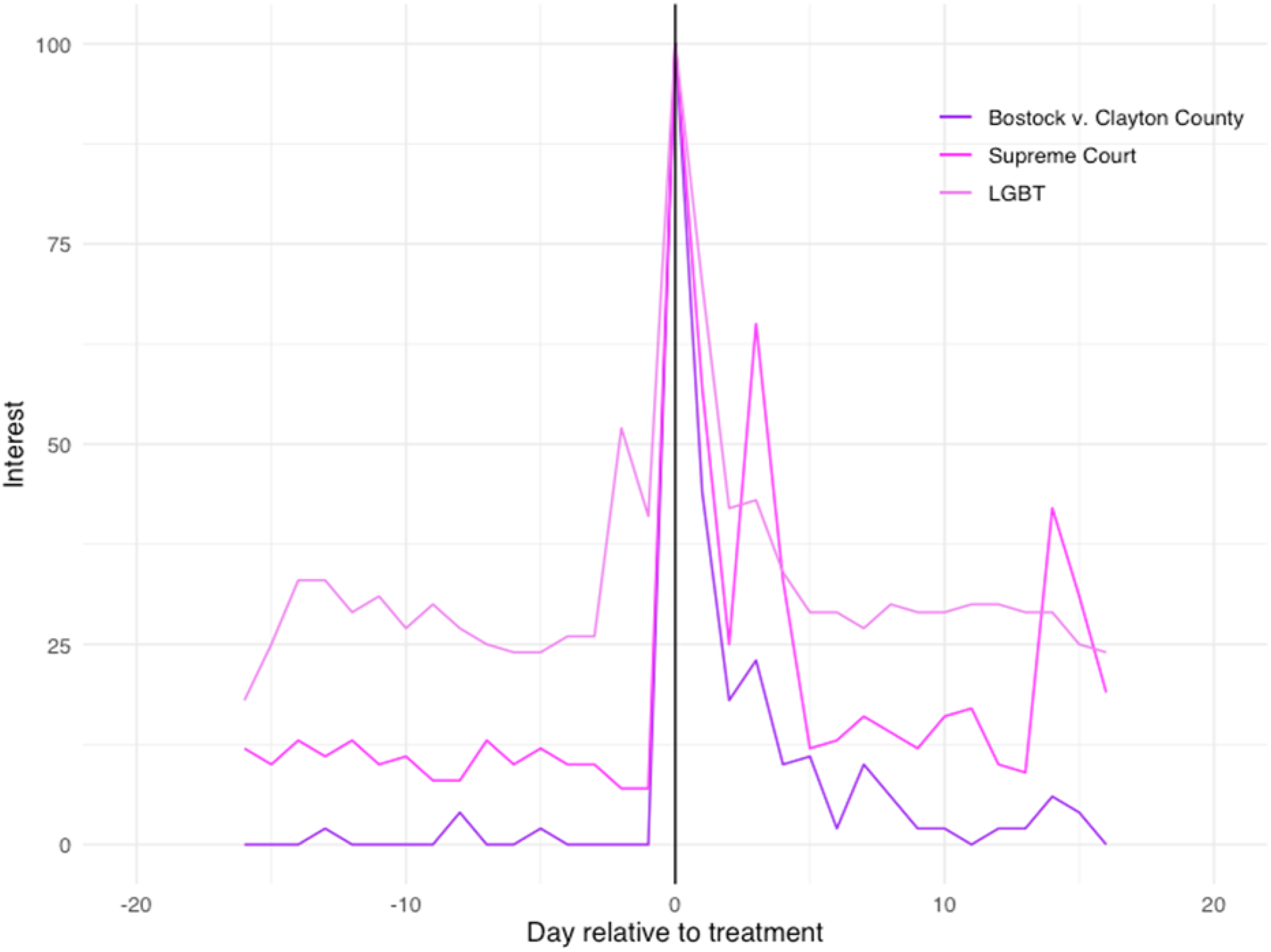
Dependent Measure
The dependent measure is a 5-point ordinal item that asks respondents how favorable they feel towards gays and lesbians, with possible responses ranging from 1 = “very favorable,” to 5 = “very unfavorable.” For ease of interpretation, I dichotomize respondents to those who are favorable towards gays and lesbians (1) and those who are unfavorable/have not heard enough (0).10,11
Quasi-Experimental Instrument
Treatment assignment is operationalized with a dichotomous measure that codes respondents surveyed between May 31 and June 14 as 0 (the control group) and those surveyed between June 15 and June 30 as 1 (the treatment group).
Controls
The effect of the treatment on favorability towards gays and lesbians is adjusted by controlling for political interest (4-point ordinal item ranging from 1 = “hardly at all,” to 4 = “most of the time”), partisanship (7-point ordinal item ranging from 1 = “strong Democrat,” to 7 = “strong Republican”), ideology (5-point ordinal item ranging from 1 = “very liberal,” to 5 = “very conservative”), age (in years), gender (dichotomous measure where 1 = “male,” 0 = “female”), education (11-point ordinal item ranging between 1 = “3rd grade or less,” to 11 = “doctoral degree”), religion (dichotomous measures for Evangelical Protestant, Catholic, other Christian, non-Christian, and the religiously unaffiliated, with mainline Protestants serving as the base category), and region (dichotomous measure where 1 = “South,” 0 = “non-South”). 12
Model
My key term of interest is the intent to treat (ITT) effect of the quasi-random assignment to the treatment condition. The model specification is summarized in the basic model in which β1 is the covariate adjusted intent to treat effect, y (Xi) is a vector of individual covariates (political interest, party ID, ideology, age, gender, education, religion, and region), and

Given that my outcome measure of interest is dichotomous, models are estimated using probit. In my test of
Results
I first present the results of my models examining the effect of quasi-random exposure to the announcement of Bostock on favorable estimations of gays and lesbians among the wider public. Should the theoretical expectations of the legitimacy model hold constant, we should expect the treatment to exert a positive and significant effect on the dependent measure in the direction of greater favorability towards gays and lesbians ( Modelling Favorability Towards Gays and Lesbians. Notes: Points represent the size of each probit coefficient. The lines are 95% confidence intervals. Data are entropy weighted. Full model output presented in section C1 of the SI file.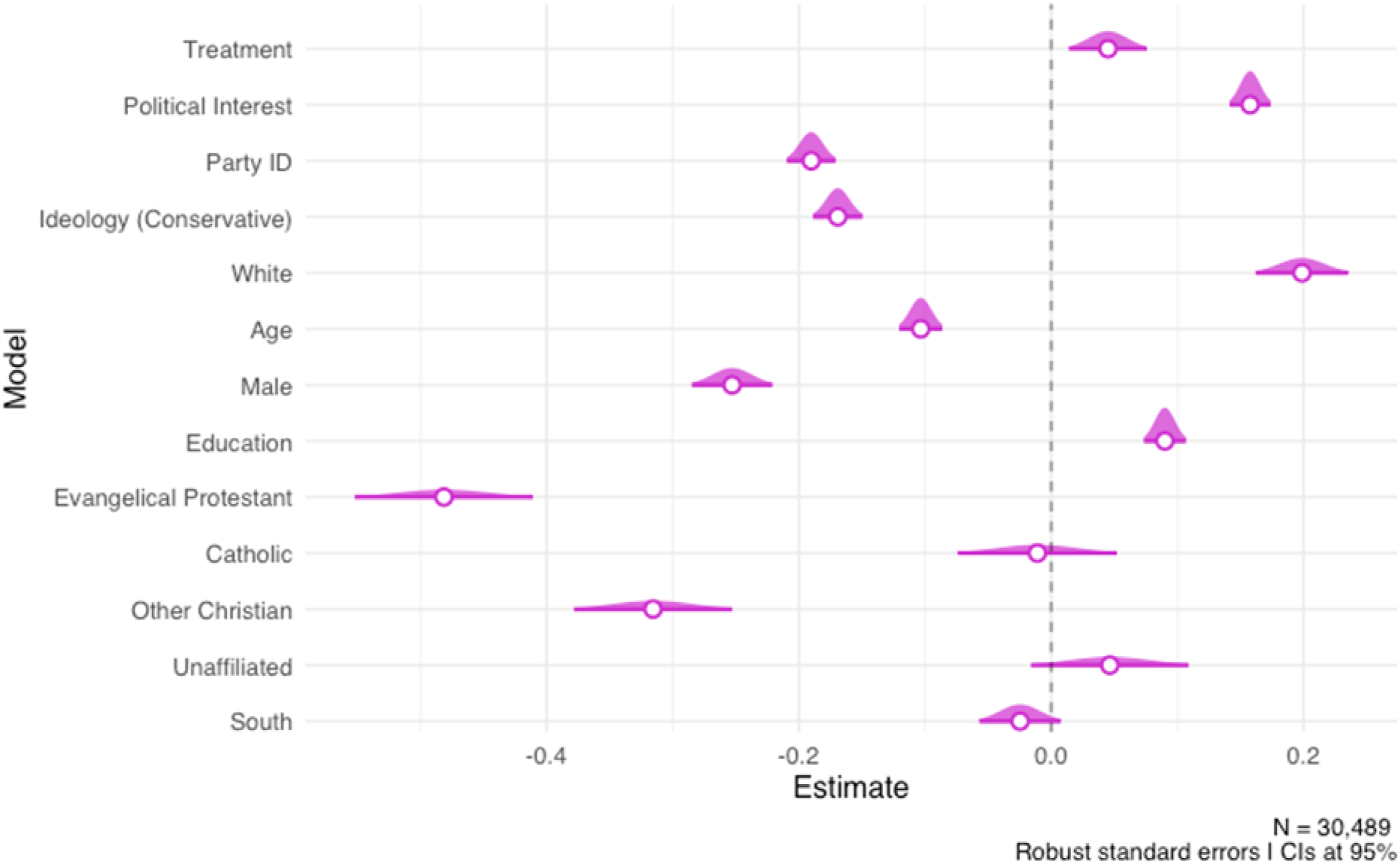
To get a more substantive approximation of the effects of the treatment on the dependent measure, I use postestimation to generate the pre-and post-treatment probabilities that a Nationscape respondent will exhibit favorable estimations of gays and lesbians. The difference in pre-and post-treatment probabilities is expressed as the average local treatment effect (LATE) of the effect of quasi-random exposure to the announcement of Bostock. Adjusting on my set of covariates, I find that 64.2% of Nationscape respondents exhibited favorable estimations of gays and lesbians before the announcement of Bostock, and 65.9% exhibited favorable estimations afterward - a statistically significant increase of 1.7% (LATE = 0.017, p < 0.001).
Subgroup Analyses: Religion and Party ID
Asymmetric Local Average Treatment Effects, by Religion. Notes: Points represent the pre-and post-treatment predicted probabilities for eachreligious subsample. The capped lines are 95% confidence intervals. Full model output presented in section C2 of the SI file.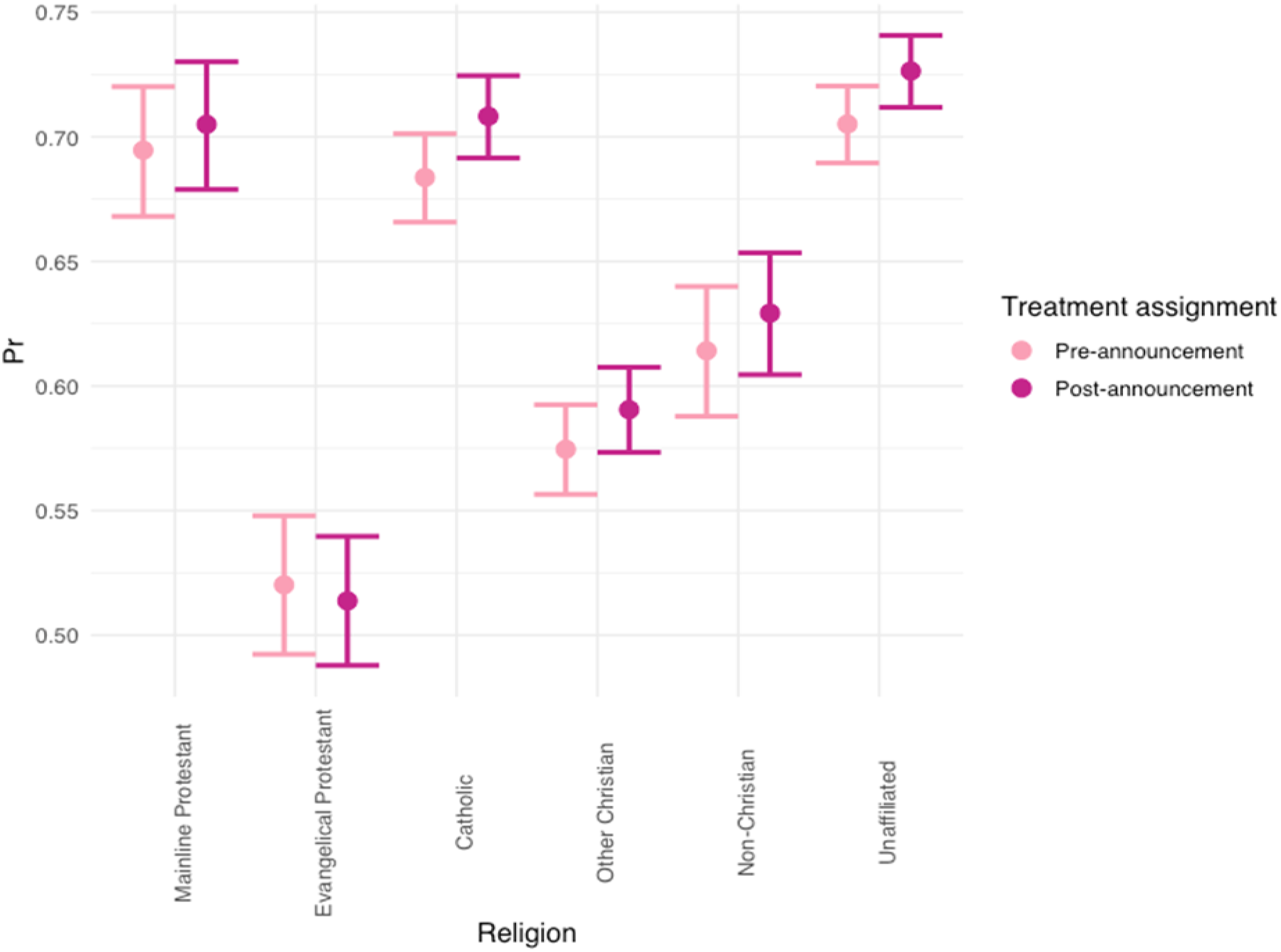
Comparing levels of favorability towards LGBT individuals across the religious subsamples, it is important to note that there are no significant changes among the religious subsamples. In the case of the religiously unaffiliated, however, there is a small-but identifiable effect. Pre-announcement, 70.5% of the religiously unaffiliated exhibited favorable estimations towards LGBT individuals, while post-announcement, 72.6% exhibited favorable estimations, a statistically significant increase of 2.1% (LATE = 0.021, p <0.001). In sum, we find strong evidence in support of
Lastly, Asymmetric Local Average Treatment Effects, by Party ID. Notes: Points represent the pre-and post-treatment predicted probabilities for eachpartisan subsample. The capped lines are 95% confidence intervals. Full model output presented in section C3 of the SI file.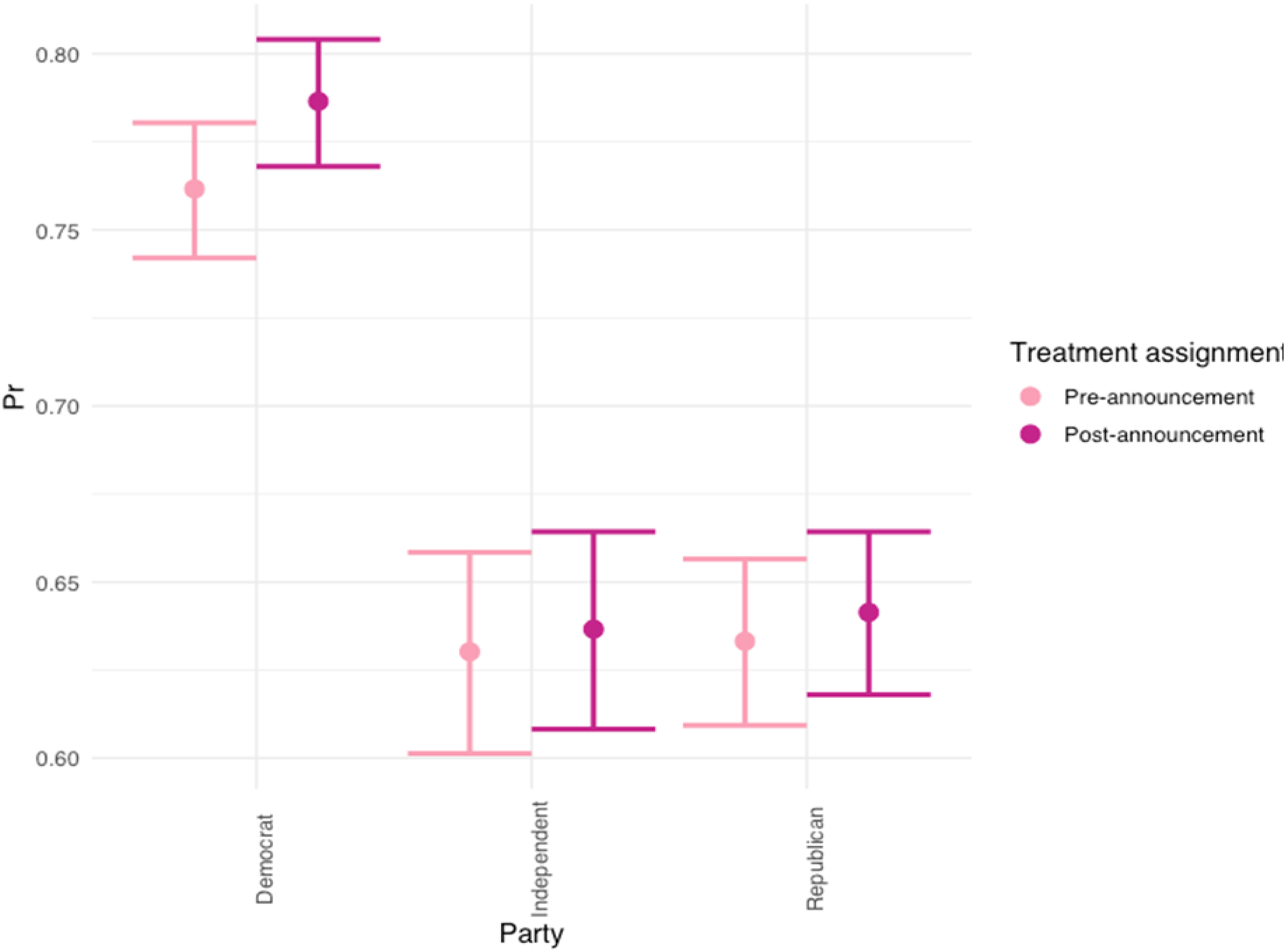
As evidenced by Figure 4, 71.7% of Democratic partisans exhibited favorable estimations of LGBT individuals before the announcement of Bostock compared to 74.4% post-announcement, a statistically significant increase in favorability of 2.7% (LATE = 0.027, p < 0.001). Pre-announcement, 57.7% of Independents and 58.0% of Republicans exhibitedfavorable estimations of LGBT individuals, respectively. Post-announcement; however, 58.3% of Independents and 58.8% of Republicans exhibited favorable estimations. Thoughthe announcement of the decision saw increases in favorability towards LGBT individuals among Independents (0.7%) and Republicans (0.8%), it is important to qualify that themagnitude of these changes are not statistically distinguishable from zero. Given that increases in favorability towards gays and lesbians among Democratic partisans did not coincide with decreases in favorability among Republican partisans, we find mixed results in support of
Robustness Tests
To provide further evidence of a local causal effect on favorability towards gays and lesbians through the treatment, I now present a series of robustness tests. First, the exclusionrestriction requires that the timing of survey fieldwork for Nationscape only affects my outcome of interest through exposure to the announcement of Bostock (Munoz et al., 2020).The most relevant threats underpinning this assumption being that the results are simply the result of chance or are a function of pre-existing time trends. To satisfy the exclusion restriction, I conduct a falsification test that tests for the presence of a significant effect where one ought not to exist. As recommended by Munoz et al. (2020), I use the median interview date of the control group sample as the placebo cut-off date (December 22, 2019). Section D1 of the SI file contains an addition model where favorability towards gays and lesbians is modeled as a function of the placebo cut-off. As indicated here, using the empirical median of the control group subsample as the cut-off date does not produce significant results.
In my next robustness test, I demonstrate that the effect of quasi-random exposureto the announcement of Bostock on mass opinion towards gays and lesbians has an insignificant effect on a variety of measures that ought to have a tenuous connection to the case. Section D2 of the SI file presents the results of a series of placebo models estimating the effect of the treatment on public favorability towards Whites, White men, Blacks, Latinos, Asians, Jews, Evangelical Christians, socialists, labor unions, Democrats, and Republicans. Should quasi-random exposure to the announcement of Bostock affect attitudes towards LGBT individuals, de minimis, then we should expect to observe an insignificantpattern of results across the placebo models. The results of these models indeed indicate that the treatment imparts no significant effect on any of the placebo dependent measures. Therefore, we can be reasonably confident that the treatment is shaping public attitudes towards gays and lesbians in particular and no other groups in US society
In my next test, I demonstrate that the significant effects on the dependent measurethrough quasi-random exposure to the announcement of Bostock is not primarily driven by increases in ing roup favoritism among Nationscape respondents who identify as sexual minorities. Section D3 of the SI file presents the results of an additional model where I limit my sample to respondents who identify as heterosexual/straight. As indicated here, the treatment remains a statistically significant predictor of favorability towards LGBT individuals (β= 0.0 34, p < 0.05).
In my final test, I assess the extent to which respondents in the treatment group have actually been exposed to news about the announcement of Bostock. Nationscape respondents interviewed after the announcement of Bostock are likely to have been exposed to the decision. However, due to the random timing of the announcement, the survey does not contain an item gauging respondents’ awareness of the decision. To assess whether respondents in the treatment group actually received the treatment, I conduct a pseudo manipulation check by interacting the treatment measure with the four-point ordinal item for political interest. 15 If Nationscape respondents interviewed post-Bostock were aware of the decision, then we should expect the effects of the treatment to be the stronger for those with higher levels of political interest. Section D4 of the SI file presents the results of an additional model testing this possibility. As indicated here, the effects of the treatment on favorability towards gays and lesbians are indeed stronger for those with higher levels of political interest.
Discussion
Models gauging the effects of Supreme Court decisions on mass opinion towards LGBT individuals point to a number of possible effects, including legitimacy (increased favorability towards LGBT individuals), consensus (no discernible increase or decrease in favorable estimations), backlash (decreased favorability), and polarization (asymmetric effects) (Flores and Barclay, 2016). Previous studies examining the impact of cases such as Obergefell v. Hodges on mass opinion towards LGBT individuals found strong support for the legitimacy model (Flores & Barclay, 2016, Kazyak & Stange, 2018, Tankard & Paluck, 2017). Despite the clear contribution of these papers in furthering our scholarly under-standing of how Supreme Court decisions increase public support for LGBT individuals and rights in the case of same-sex marriage; however, it was not altogether clear whether we might have observed similar effects when it came to a case on LGBT employment rights. As I have argued throughout this paper, testing for this possibility is critically important, as it would lend further weight to the theoretical expectations of the legitimacy model, and would also increase its generalizability by demonstrating that favorable estimations of LGBT individuals increase in the wake of Supreme Court opinions on LGBT rights beyond those concerning the legalization of same-sex marriage.
The present study represents an important step in addressing this critical lacuna. In this paper, I have explored whether favorable estimations of LGBT individuals among the wider public increased as a result of quasi-random exposure to the announcement of Bostock (legitimacy model). To lend further weight to the expectations of the legitimacy model, I have also tested the robustness of the backlash and polarization models in sub-group analyses. Given the increased mobilization and organization of the religious right in opposition to LGBT rights in the post-Obergefell era (Ayoub & Page, 2020), I have tested for the possibility that favorable estimations of LGBT individuals among religious adherents decreased after quasi-random exposure to the announcement of Bostock (backlash model). Finally, given the extent of socio-political polarization and sorting among the American public (Levendusky, 2009), I also tested for the possibility that there were asymmetric reactions through to quasi-random exposure to the announcement of Bostock when individuals are contrasted on their partisan identities (polarization model)
Second, while the extant scholarship has focused on the impact of Supreme Courtdecisions concerning same-sex marriage (Flores & Barclay, 2016, Kazyak & Stange, 2018, Tankard & Paluck, 2017), this paper quantifies that SCOTUS opinions beyond same-sex marriage legalization are able to impart significant changes in mass opinion towards LGBT individuals in the direction of increasing favorability. This finding is significant because it extends the generalizability of the legitimacy model to include cases on anti-LGBT discrimination in areas such as employment. It is also significant because it confirms that Obergefell did not produce a ceiling effect on mass opinion towards LGBT individuals. There was some reason to expect that this might have been the case, given Stoddard (1997) hypothesis that same-sex marriage legalization would “lead to a world free from discrimination against lesbians and gay men.” Though Obergefell was a significant step forward in the fight for extending rights for LGBT individuals, ongoing cases concerning the ability of employers to discriminate against their employees on the basis of sexual and gender identity provided robust evidence that there was still room for mass opinion towards LGBT individuals increase if a similar outcome was reached in Bostock. In this respect, the findings suggest that, provided that inequality towards LGBT individuals still exists, and a large enough percentage of the American public remain ambivalent, support for LGBT individuals may keep increasing if they see institutions such as the Supreme Court continue to perform their role of norm-legitimizing via ruling in the liberal direction on LGBT rights.
Finally, the results cast further doubt on the robustness of the backlash model as ameans of understanding mass opinion towards LGBT individuals post-Obergefell. Theinsignificant pattern of results for the effects of quasi-random exposure to the announcement of Bostock on favorability towards LGBT individuals among the Evangelical Protestant subsample are consistent with the findings of Bishin et al. (2016), who similarly detect changes in attitudes towards the group that are statistically indistinguishable from zero. The observation of significant effects through the treatment for the religiously unaffiliated suggests that any potential inability to detect opinion changes among the Evangelical Protestant subsample is not simply a function of a failure to treat that group. While there was clear evidence of a backlash in the aftermath of Bostock among publicly visible religious leaders (Bailey, 2020)—an observation that is consistent with elite-led mobilization in opposition to LGBT rights (Bishin, Hayes, Incantalupo, and Smith, 2020)—the null results in my subgroup analysis point to an interesting disconnect between their public moral outrage and the apparent indifference towards the announcement of Bostock among of many Americans who remain religiously affiliated These findings are important because they provide further evidence in favor of the argument that elected representatives and jurists alike should not fear opinion backlash among the religiously affiliated in response to policy implementation on particularly contentious social issues.
Notwithstanding this possibility, it is important to note that favorable estimations towards LGBT individuals have been increasing among all sections of the wider public, including the religiously affiliated. Though it is reasonable to expect that factors such as moral traditionalism means that favorability towards LGBT individuals among religious affiliates has not increased as sharply as it has among the religiously unaffiliated over time (Brewer 2003, Cao & Gurcay, 2021), it is important to note that Evangelical Protestants still exhibited net-favorable estimations of LGBT individuals post-Bostock (see Figure 4). As such, even if quasi-random exposure to the announcement of Bostock engendered a statistically significant decline in favorability, it is important to qualify that this decline might not have been sufficiently large to reduce net-estimations to a state of unfavorability.
Limitations and Future Directions
It is also important to highlight the limitations of the current study, as well as to point to potential avenues for future research. One limitation of the current study is the absence of survey items gauging public support for pro-LGBT policies in the Nationscape dataset. A particular strength of prior studies is that they have contained a battery of items gauging attitudes towards LGBT individuals in addition to support for policies such as same-sex marriage (Flores & Barclay, 2016). In doing so, they have been able to quantify the effects of exposure to Supreme Court decisions such as Obergefell on multipleoutcomes (e.g., group affect and support for specific policies), thus, increasing the applicability of their findings. Another limitation of the current study is that the announcement of Bostock occurred close to the end of the survey fieldwork for Phase 2 of Nationscape, thus, limiting my temporal bandwidth to ±15 days relative to treatment. While a 15-day measurement of exposure is able to capture any effects on public favorability towards LGBT individuals far longer than exposure to a given experimental condition in a survey experiment, it is important to quantify that similar studies have measured attitudes towards LGBT individuals over a period of one year or greater (Flores & Barclay, 2016). Consequently, there are able to better gauge the long-lasting effects of exposure to Supreme Court decisions on LGBT rights on mass attitudes towards LGBT individuals.
Future studies may seek to quantify the impact of exposure to Supreme Court decisions on LGBT protections in employment from discrimination by including a wider range of outcome measures, including those that are theoretically relevant to treatment—for instance, support for laws that would prevent employers from discriminating against individuals based on their sexual or gender identity.
Supplemental Material
sj-pdf-1-prq-10.1177_10659129211068052 – Supplemental Material for Attitudes Towards LGBT Individuals After bostock v. Clayton County: Evidence From a Quasi Experiment
Supplemental Material, sj-pdf-1-prq-10.1177_10659129211068052 for Attitudes Towards LGBT Individuals After bostock v. Clayton County: Evidence From a Quasi Experiment by Jack Thompson in Political Research Quarterly
Footnotes
Declaration of conflicting interests
The author(s) declared no potential conflicts of interest with respect to the research, authorship, and/or publication of this article.
Funding
The author(s) received no financial support for the research, authorship, and/or publication of this article.
Supplemental Material
Supplemental material for this article is available online.
Notes
Author Biography
References
Supplementary Material
Please find the following supplemental material available below.
For Open Access articles published under a Creative Commons License, all supplemental material carries the same license as the article it is associated with.
For non-Open Access articles published, all supplemental material carries a non-exclusive license, and permission requests for re-use of supplemental material or any part of supplemental material shall be sent directly to the copyright owner as specified in the copyright notice associated with the article.
