




Abstract
Do legislators and lobbyists trade favors? This study uses uncommon data sources and plagiarism software to detect a rarely observed relationship between interest group lobbyists and sitting Members of Congress. Comparison of letters to a Senate committee written by lobby groups to legislative amendments introduced by committee members reveals similar and even identical language, providing compelling evidence that groups persuaded legislators to introduce amendments valued by the group. Moreover, the analysis suggests that these language matches are more likely when the requesting lobby group hosts a fundraising event for the senator. The results hold while controlling for ideological agreement between the senator and the group, the group’s campaign contributions to the senator, and the group’s lobbying expenditures, annual revenue, and home-state connections.
More than a hundred campaign fundraisers occur in an average week in Washington. 1 Political fundraising in Washington is a thriving industry, with many firms dedicated to hosting fundraisers, inviting people to attend, and soliciting contributions. Journalistic accounts describe professional fundraisers and fundraising firms that collect and exploit lists of willing donors, leadership political action committees (PACs) 2 that allow double contributions to Members of Congress, and privileges (such as listening in on a conference call of high-ranking Members) that are exchanged for large contributions (in this example, $250,000 to the party) (Birnbaum 2000). The concerned citizen asks, “Who is providing all of this fundraising assistance, and what are they getting in return?”
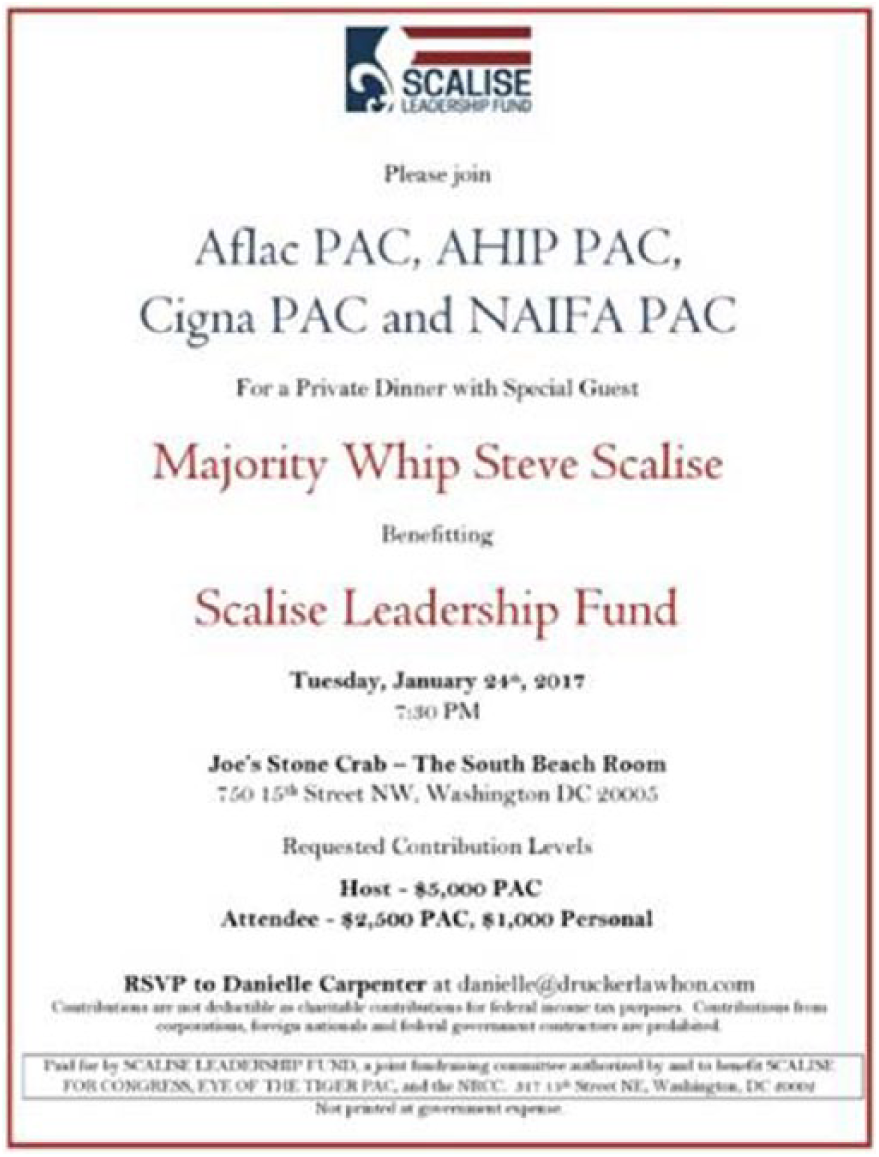
Example of a fundraiser invitation.
Good governance groups and the government itself express concern about fundraising practices and the lobbyists who provide them. Yet fundraising events, unlike lobbying activities and contributions, are not publicly reported. As a result, previous scholars have not had access to data that allow examination of whether fundraising events—and the lobbyists who typically host them—have any effect on the benefitting legislators. This study uses for the first time data containing instances of fundraising by specific interest group lobbyists on behalf of specific incumbent Members of Congress. It then links these fundraising events to activities by senators in pursuit of the interest group’s legislative requests on a bill of major public importance. I show that senators are more likely to perform legislative favors for lobbyists who fundraise for them than for lobbyists and groups that do not. While no study of money in politics can prove a causal link, in a literature replete with null findings (Lowery 2013), the observed relationship between hosting fundraisers and securing desired policy provisions is provocative and robust.
Previous Literature on Political Fundraising
Several decades of studies have investigated campaign contributions as both explanatory and dependent variables. Fundraising, meanwhile, is treated in the literature as little more than the amassing of campaign contributions. Existing studies examine fundraising only indirectly as it relates to candidates and elections (e.g., Heberlig 2003; Herrnson 1992; Smidt and Christenson 2012). Little attention has been given to the relationship between the politician and the person or group that facilitates this necessary activity. Furthermore, within the literature on the effects of campaign contributions on legislative policymaking, firm consensus is lacking. Theories focus on three kinds of influence—votes, access, and effort.
Votes
Some scholars offer evidence that campaign donations have a demonstrable influence on legislators’ votes (e.g., Roscoe and Jenkins 2005; Stratmann 1998; Wawro 2001), while more have argued that campaign money has little influence over votes (e.g., Baumgartner et al. 2009; Wright 1990; for reviews of this literature, see Baumgartner and Leech 1998; Burstein and Linton 2002; de Figueiredo and Richter 2014; Smith 1995; Stratmann 2005). Others have argued that campaign contributions matter subject to certain conditions, such as low issue or vote salience (Morton and Cameron 1992; Sorauf 1992), whether the issue is ideological (Witko 2006), or the subject of the vote. Fellowes and Wolf (2004), for example, find contributions from business to be a factor in Members’ votes on regulatory and tax matters but not on direct government spending.
Access
Various scholars have studied how campaign contributions influence the level of access that donors have to Members of Congress, and some have provided indicative evidence that donors do get greater access to legislators (Kalla and Broockman 2016; Langbein 1986; but see Chin, Bond, and Geva 2000).
Effort
A third category of theories makes the case that campaign contributions buy legislators’ effort on behalf of contributing interest groups (e.g., Evans 1996; Witko 2006). Building on the argument of Denzau and Munger (1986) that legislators pursue policy goals when the supply price of doing so is low, Hall and Wayman (1990) find that campaign contributions marginally increase Member effort in pursuing the goals of the contributing organization. The authors conclude that an exchange is taking place between Members’ effort on behalf of lobbyists and lobby groups’ campaign contributions to the member. In later work, Hall and Deardorff (2006) formally argue that lobbyists provide a legislative subsidy to Members of Congress in the forms of labor, policy information, and political intelligence, and these subsidies enable Members to focus resources on the issues of greatest interest to them. Fundraising might be provided in exchange for a legislative benefit, or serve as a legislative subsidy, or both.
Theory and Hypothesis
Congressional votes are publicly visible and easily counted. Interest groups and Members, therefore, have an incentive to minimize the appearance of vote-buying. Access, meanwhile, is less easily observed and counted than votes. But the effort of Members of Congress is the most difficult form of influence to measure. Doing so has required delving deeply into what is happening behind the scenes, as Hall and Wayman (1990) did. Their index of legislative effort reflects how much time and energy Members spent on behalf of the contributing PACs—attending hearings and votes, speaking at hearings, voting in favor in their interest, behind-the-scenes negotiating and persuasion, and, importantly for our purposes, offering amendments to the committee bill. The present study follows in this vein, using as evidence the text of 564 amendments offered by members of the U.S. Senators Committee on Finance to the legislation that became the Affordable Care Act.
Studies of the influence of political money on policy outcomes suggest that influence is more likely to occur (or to be observed) when the issue or vote is of low salience (Fellowes and Wolf 2004; Godwin, Lopez, and Seldon 2008; Gordon 2001; McFarland 1991; Witko 2006) or when the influence is more difficult to witness (Evans 2004; Hall and Wayman 1990). Thus, trading legislative favors for campaign fundraising seems more likely when visibility is low. The observability of committee amendments and fundraising events both is minimal. Fundraising events are not publicly reported and do not even appear in Members’ daily schedules. 3 Congressional committees very rarely make public the full set of amendments offered to a bill draft, and only a fraction of these are ever discussed on the record, let alone included in the bill. We can infer that Members and staff habitually wrote amendments for an audience of Members, staff, and attentive interest groups—but not the general public.
Citizens at large are not very interested in amendments at the committee, because amendments typically benefit a narrow group of people and because amendments are unlikely to become part of the bill. The amendments in these data would advance the goals of rural ambulance providers, pediatric clinics, respiratory therapists, vaccine manufacturers, and other specific interests. Yet while the benefits amendments provide may be narrowly targeted, they can be of considerable worth to certain groups. We know empirically that lobby groups place great value on private benefits (Drope and Hansen 2004; Godwin, Ainsworth, and Godwin 2012; Richter, Samphantharak, and Timmons 2009), and studies have shown that money spent by business groups on lobbying and campaign contributions can yield impressive returns on investment (Alexander, Mazza, and Scholz 2009; Claessens, Feijen, and Laeven 2008; de Figueiredo and Silverman 2006; Huber and Kirchler 2011; Kang 2016). These varied accounts all find political spending to be a productive activity for profit-seeking interest groups.
From the Member’s point of view, fundraising assistance is an important service provided by individuals and groups. Members must constantly fundraise to keep their jobs, and the greater dollar amounts produced by fundraising events makes these more valuable than individual contributions. In 2010 (the election relevant to the present study), senators running for reelection made campaign expenditures totaling $8.4 million on average. 4 As such, contributions limited to $2,400 for individuals or $5,000 for PACs did not go very far toward meeting candidates’ fundraising targets. Moreover, while all federal contributions over $200 must be reported, the law’s efforts to require “bundled” contributions to be disclosed still leaves most fundraising activity opaque. 5
The unrelenting pressure on congressional candidates to fundraise, combined with the significant benefits that successful legislative requests provide to lobbyists, create incentives for the two sides to trade favors. Since both fundraising assistance and interest-group-requested amendments are virtually invisible to the general public, the exchange can take place without scrutiny. The analysis that follows, therefore, tests the hypothesis that when a lobbyist hosts a fundraiser for a senator, the senator is more likely to advocate for one of the lobby group’s preferences as an amendment to legislation, relative to other senator-lobby group pairs.
This study’s use of fundraising as the key explanatory variable is a departure from the existing literature, as is its dependent variable—committee amendments, in contrast to previous studies that predict votes. The results make a new contribution to a literature in which the influence of political money is notoriously difficult to detect.
Data and Variables
The creation and negotiation of American health reform legislation in 2009 under President Obama offers an ideal opportunity to detect the influence of interest groups’ money and efforts in a way that most research designs cannot. In particular, the case provides us with three sources of data that have not been used in this way before.
First, the committee solicited public comments about health reform legislation, which it provided to me. Most of these were never published (a handful of groups put their letters online). Interest group scholars rarely have access to substantive details about exactly what groups want (de Figueiredo and Richter 2014, 170; but see Nelson and Yackee 2012; Yackee and Yackee 2006)—which is key to determining whether they are successful.
Second, the Senate Finance Committee released on its website all of the 564 amendments to the legislation submitted by committee members, an act of transparency that the committee had never done before. 6 Comparing the text of interest group preferences to the language of legislative proposals is a more direct means of matching advocacy to policy outcomes than is typical in the literature (Burstein 2014, chap. 6). As such, it reveals similarities that are difficult to dismiss as mere coincidence. For example, a letter from a company that makes the first two-hour blood test for Methicillin-resistant Staphylococcus aureus (MRSA) and a device that can simultaneously test multiple specimens for multiple infections requested a change that was inserted into the bill after committee markup had ended. Both the letter and the amendment contain the phrase “healthcare-associated infection[s, as measured by the] preventions metrics and targets [as] established in the Department of Health and Human Services’ HHS Action Plan to Prevent Healthcare-Associated Infections or any successor plan.” This language—which has now become law—incentivizes hospitals to test every Medicare patient for an array of infections before discharging them, and thus encourages hospitals to buy the products sold by the company doing the lobbying—a company headquartered in the state represented by the senator that introduced it.
Third, data about fundraising have not been used in previous research, since there is no obligation to report details about fundraisers. Even with the Sunlight Foundation’s database of fundraiser invitations (described in the following), it took careful, specialized matching techniques to link fundraiser hosts to specific lobbyists and interest groups.
Dependent Variable: Amendment Offering
If a legislator offers an amendment in committee that is requested by an interest group, this is an indicator that the senator is making an effort on the group’s behalf. No previous study has focused exclusively on legislators’ decisions to offer amendments in committee, though it is one of numerous actions Hall and Wayman (1990) and Evans (1996) examine. To capture such instances of legislative effort, I compare language in the amendments to language in public comments submitted to the committee by health care lobbying groups.
Interest groups submitted comments in response to a series of three sets of “Options for Health Reform” released by the committee in the spring of 2009. In these letters, groups stated their support of or opposition to an array of provisions in the Options. Groups did not explicitly request amendments, because the draft that would be marked up by those amendments had not yet been released. Many letters writers did, however, request additional provisions not found in the Options or asked for alterations to provisions that were in the Options. These are the kinds of requests that appear in senators’ amendments. Thus, while not every group submitted additional requests (i.e., requests not in the Options), every group had an opportunity to do so. Furthermore, it seems likely that groups that fundraise might be more likely to make additional requests than groups not involved in fundraising. To avoid selecting on the dependent variable in this way, the universe is all groups that submitted letters to the committee at the email address it created for this purpose after the release of the Options for Health Reform (not just those groups that made additional requests).
Because of the high probability that amendment writers varied—probably intentionally—the language of the amendment somewhat from the language used in the letters, I made multiple attempts to identify matches. I first performed a broad sweep to capture as many matches as I could reasonably make, resulting in some three hundred potential matches. A second, narrow sweep winnowed down that list to just those that were almost certainly describing the same proposal, resulting in about a hundred matches (these sweeps are described in the following). When an amendment was consistent with a letter’s request but the two were not clearly asking for the same legislative act, I did not count this as a match, nor were amendments that did not go as far as the requester would have liked. 7 These decisions required my firm understanding of the legislation, and as such, I did not employ anyone else to make coding decisions. (For example, it required knowing the difference between Medicare Advantage Part D and ordinary Medicare Part D.) In robustness checks, I adjusted the threshold for definite match to be more or less generous; these alternatives still produced a significant relationship between amendment-offering by the senator in the dyad and fundraising events hosted for the senator by the group in the dyad or its lobbyists.
To perform the broad sweep, as has also been done by a number of scholars recently (Corley 2008; Kroeger 2016; Wilkerson, Smith, and Stramp 2015), I used plagiarism-detection software, in this case WcopyFind, to identify instances of word matches between the amendments and the comments. I started by setting the program to identify in the amendments and in the full set of letters any common phrases of six words, allowing up to four imperfections, and ignoring punctuation and letter case. I then read through the matches to determine whether the amendment and the letter might be describing the same policy change. I varied the phrase length and number of imperfections to capture all meaningful matches. Second, I identified in the letters specific requests that were not provisions suggested by the committee in its draft Options for Health Care Reform. I then chose key words from each request and searched all the amendments for those key words, and determined whether these matches were substantive or coincidental (e.g., references to the Department of Health and Human Services). Third, I created key words from each amendment, and again used WCopyFind to identify these key words in any request, and then manually distinguished true matches from mere similar language.
To conduct the narrow sweep, I compared the letter and the amendment it was matched with directly. If it existed, I extracted the language that indicates that the amendment is based on, at least in part, the request made in the letter. The dependent variable is coded as 1 when there is a substantive match between a request made by an interest group and an amendment offered by a senator and 0 otherwise. Each organization that submits comments, and each organization listed on the letterhead of a coalition, is included in the sample, for a total of 864 organizations.
Key Explanatory Variable: Fundraiser Hosting
Information about fundraising events comes from the Sunlight Foundation, a government watchdog group that has for years solicited from the public the invitations to political fundraisers that lobbyists and previous congressional donors routinely receive. To date, it has collected invitations to more than twenty-two thousand distinct congressional fundraising events over the last ten years. The Foundation records the information from these invitations in a database available to the public at http://politicalpartytime.org. Given that these data are “crowd-sourced,” we cannot be sure what portion of the population of fundraisers it captures. Therefore, it underreports (but does not overreport) the incidence of lobbying events. 8 Still, these are the best data available on fundraising events. 9
I identified in the database those fundraisers that list as “beneficiaries” or “honorees” any of the members of the Senate finance committee as it wrote health reform legislation in 2009. I define the health reform period as starting with President Obama’s election in November of 2008 and ending when he signed the Affordable Care Act in March of 2010. The time period over which fundraiser data are collected extends from the beginning of 2008 to the end of 2010: this allows for the possibility that a health lobbyist hosts a fundraiser for a senator after the bill is passed, or that a senator remembers a fundraiser held before consideration of the legislation began. (Whether the fundraiser or the amendment occurs first makes no difference to my argument. Especially when both sides endeavor to conceal any quid pro quo relationship, it seems just as likely that a senator would offer an amendment in anticipation of a future fundraiser as that the senator would offer an amendment in response to a fundraiser that has already occurred.)
A lobbyist is linked to a fundraiser if, for the lobby group that writes the letter, any of the following is true: (1) the group is listed as hosting a fundraiser benefitting a senator, (2) an in-house lobbyist for the group hosts a fundraiser for a senator, or (3) a contract lobbyist whose client is the group hosts a fundraiser for a senator. The decision to treat all fundraiser hosts equivalently biases somewhat toward a null finding, since contract lobbyists have many clients, and any legislative benefit a contract lobbyist gets from fundraising may go to another of the lobbyist’s clients that does not submit a letter to the committee.
Using the methods just described, of the 864 groups that submit comments to the committee, I identified fifty-nine groups whose requests appear in any of the 564 amendments offered by a Finance committee member during the committee’s consideration of the America’s Healthy Future Act. A total of forty-two amendments were linked to specific interest group requests. Since amendments were often sponsored jointly by more than one senator, and some dyads contained more than one amendment, in all there were ninety-eight dyads in which the senator offered an amendment requested by the group.
Control Variables
Member-group agreement
To determine whether a senator’s decision to offer an amendment requested by a group is related to the willingness of the group or its lobbyists to host a fundraiser for the senator, we must address the possibility that the senator is inclined to do what the group requests in the absence of any fundraising assistance. While we have no measure of a senator’s predisposition to offer a particular amendment, researchers have established methods for estimating general ideological agreement between Members and groups. In particular, McKay (2008) and Bonica (2013) scale interest groups using as their basis Poole and Rosenthal’s (2007) ideal point estimates for Members of Congress. Only a minority of the groups in these data give any contributions to federal candidates (required for Bonica’s method), and even fewer generate score cards for Members (necessary for McKay’s method). But for those 132 groups in the data that do make political contributions, we can use Bonica’s (2016) Campaign Finance (CF) scores, which are inferred from the ideologies of the federal candidates to whom groups donate. 10 To simplify the results and to mitigate any problems of inference associated with applying CF scores to these data, I create a dichotomous variable of whether or not the group’s CF score and the senator’s DW-NOMINATE (Poole and Rosenthal 2007) score have the same sign (i.e., both liberal or both conservative). 11 This method produces a measure of member-group agreement that can heuristically be thought of as an indicator of whether the group and senator are of the same party (acknowledging that federal lobby groups are independent of political parties).
Member-group agreement interacted with hosting fundraisers
The incentives to fundraise and to secure amendments encourage both senator and group to trade favors. As such, it might be the case that fundraising activity is more important in a senator-group relationship when the group and the senator’s ideologies do not coincide. When a senator favors a free-market approach to governance, he or she may already be inclined to fulfill a trade association’s deregulatory amendment request. But when the senator prefers to minimize government expenditures while the group wants to increase Medicare reimbursements, hosting a fundraiser may tip the balance in the lobbyist’s favor. This senator may be persuaded to offer an amendment regarding the issue the group cares about even if it is not an issue the senator cares about. This possibility makes it important to include this interaction term where possible (i.e., for groups that make campaign contributions).
Contributions
Legislators may be incentivized by campaign contributions to offer amendments groups want. The theory suggests that hosting a fundraiser may offer legislators a greater benefit—literally, more money—toward their perpetual reelection goals than campaign contributions provide. I, therefore, expect contributions to be significantly related to amendment success but not to be as important as fundraising. To capture contributions, for each dyad, I combine the amounts of money that the lobby group gave to the senator’s campaign or leadership PAC, any personal contributions from an in-house lobbyist to the senator, and any contributions made from employees of the group to the senator’s campaign. These data come from the Federal Elections Commission, the Senate Office of Public Records, and the Center for Responsive Politics (CRP), respectively.
Lobbying expenditures
Controlling for lobbying expenditures helps us identify whether it is the lobby group’s fundraising activity, rather than its lobbying activities alone, that influences groups’ success in getting a desired amendment offered. It also helps us evaluate the lobbying subsidy argument (Hall and Deardorff 2006), which suggests that greater lobbying effort by interest groups should produce greater amendment success for the group. Lobbying expenditures are summed across the four quarters of 2009 (coinciding with the start of the 111th congress in January to the final Senate vote in late December) and come from the Senate Office of Public Records.
Home state
Given the importance in the literature of Members’ ties to constituents and their employers (e.g., Arnold 1990; Hall and Wayman 1990; Schiller 1995), I consider whether the interest group is headquartered in the senator’s state. 12 Importantly, this variable also serves as an indication that the group likely supports the amendment.
Revenue
Some groups represent more individuals or a broader segment of the economy, and therefore, these groups may be more likely to have their requests entertained by senators. To estimate group size or importance, I use the natural log of the organization’s most recently available (at the time the information was collected) annual revenue amount. In most cases, these data come from manual look-up of organizations’ tax returns or Securities and Exchange Commission reports. Unavailable revenue numbers (e.g., for private companies or unofficial organizations) were imputed using regression of collinear variables (about 9%). 13
Number of requests
Finally, I include a variable that counts the number of distinct requests made by the group, plus the number of requests made by any of its coalition partners (for those groups that sent in their own letters and also signed a coalition-written letter). This variable is included following the logic that the more a group asks for, the greater the chances that at least one of its requests will be granted. 14
Method
From the fundraising data, I extracted the names of each host and beneficiary so that individual and group fundraisers were linked to all of the senators who benefitted from a given fundraising event. To match fundraisers to lobbyists, I used data from the lobbying disclosure database, maintained by the Senate Office of Public Records, which links individual lobbyists to their registered lobbying organizations and/or their individual lobbying clients each quarter. Using regular expressions in Stata, I matched lobbyist to group using simplified versions of each group or individual’s name, then re-matched the leftovers by nicknames and alternate spellings. The CRP subsequently released cleaned data derived from the Lobbying Disclosure Act database, which I used to verify and supplement my own work. In particular, data from CRP (available at www.opensecrets.org) allowed me to disambiguate lobbyists with similar or common names.
To analyze the relationship between hosting a fundraising event and the benefitting senator as the senator considers a bill on which the interest group is currently working, each interest group was paired with each senator on the Finance committee to create a dyadic data set. I use the 864 groups that submitted comments to the committee, multiplied by the twenty-two senators who offered amendments in committee, to create 19,008 possible lobby group-senator dyads.
As the universe contains only one committee, the variation among senators is too small to be explained by senator-specific traits such as party, ideology, reelection, or membership on other committees. So instead of controlling explicitly for these variables, I employ a conditional logit model with fixed effects for senators. 15 Fixed-effects models allow us to analyze differences over time or across dyad partners within a unit—in this case the senator. In addition, I cluster errors on the individual group, to more accurately provide the significance of group-specific variables (i.e., lobbying expenditures, annual revenue, and the number of requests made in the group’s letter). Descriptive statistics appear as supplemental materials (Table S1).
Analysis and Inference
When a lobby group in a dyad fundraises for the Senate Finance committee member in the dyad, the odds that the senator offers an amendment requested by the group are nearly 3.5 times (3.465) the odds if no fundraiser occurs in the dyad, as shown in the first (main) model of Table 1. This estimation controls for other variables that may also matter, including campaign contributions in the dyad, lobbying expenditures by the group, and whether the senator is predisposed to advocate for the group (as proxied by sharing a state). The predicted probability that the dyad contains an amendment changes from .005 to .017 if the dyad contains a fundraiser. While amendment-offering on behalf of identifiable interest groups may be rare, it is significantly more likely for those groups that host fundraisers. Of the groups in the data that we know hosted fundraisers for senators, 17 percent could be linked to an amendment, and of the groups that got amendments, 36 percent could be linked to a known fundraising event.
Predicting the Probability That a Lobby Group Will Have One of Its Policy Requests Introduced as an Amendment to the Health Reform Bill by a Senator on the Finance Committee.
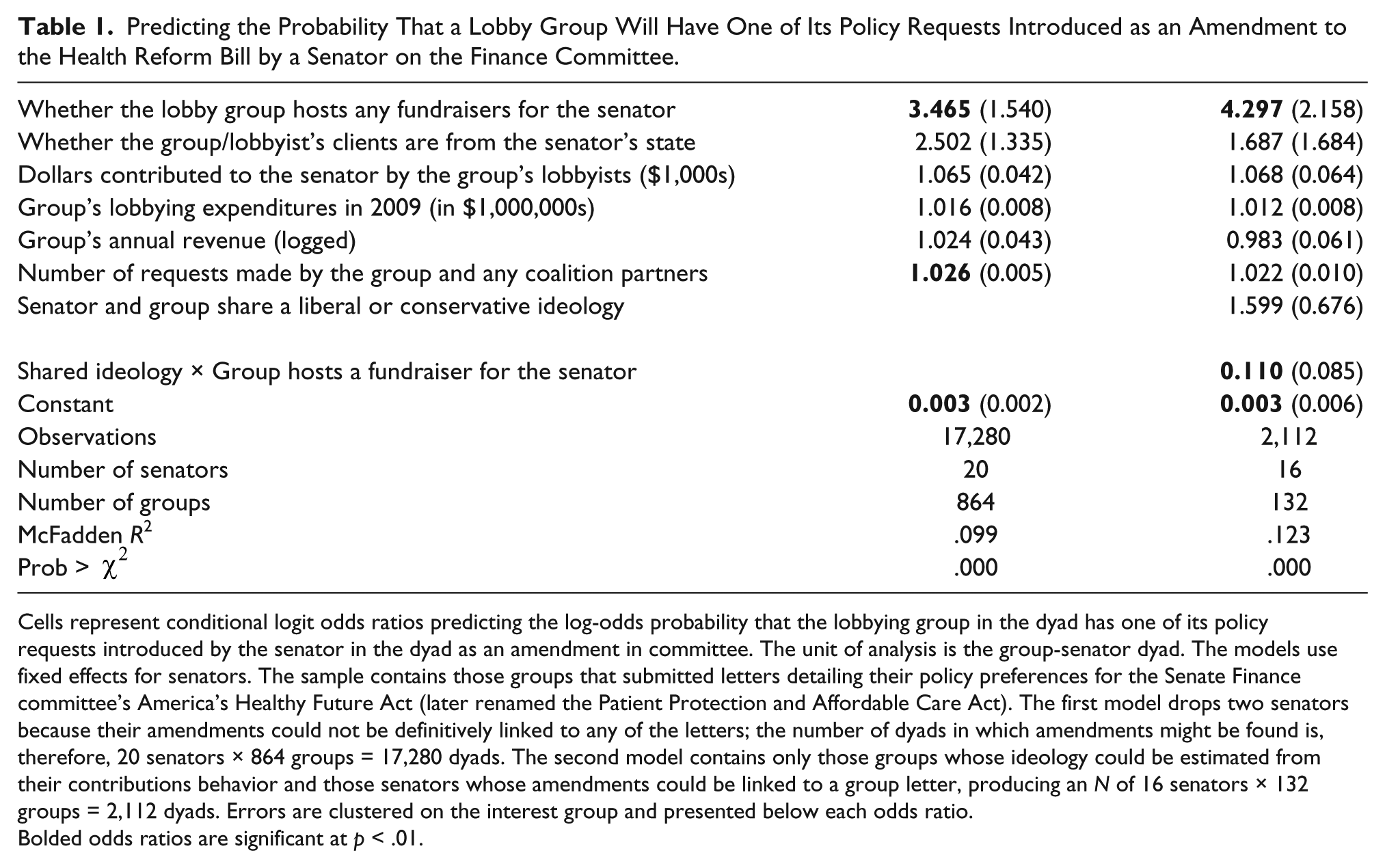
Cells represent conditional logit odds ratios predicting the log-odds probability that the lobbying group in the dyad has one of its policy requests introduced by the senator in the dyad as an amendment in committee. The unit of analysis is the group-senator dyad. The models use fixed effects for senators. The sample contains those groups that submitted letters detailing their policy preferences for the Senate Finance committee’s America’s Healthy Future Act (later renamed the Patient Protection and Affordable Care Act). The first model drops two senators because their amendments could not be definitively linked to any of the letters; the number of dyads in which amendments might be found is, therefore, 20 senators × 864 groups = 17,280 dyads. The second model contains only those groups whose ideology could be estimated from their contributions behavior and those senators whose amendments could be linked to a group letter, producing an N of 16 senators × 132 groups = 2,112 dyads. Errors are clustered on the interest group and presented below each odds ratio.
Bolded odds ratios are significant at p < .01.
Among those interest groups that make any federal campaign contributions, we can further evaluate whether fundraising matters when the group and the senator generally agree or disagree ideologically. As seen in the second model, among groups that have PACs, and controlling for all the other variables in the model, when the group in the dyad hosts a fundraiser for the senator in the dyad, the odds that the senator offers an amendment requested by the group are more than four times the odds when no fundraiser occurs in the dyad. Meanwhile, ideological agreement is not a significant predictor of the dependent variable. The second model shows a significant relationship between the dependent variable and the interaction of hosting fundraisers and ideological agreement, but analysis of margins indicates that ideological agreement is not statistically different from ideological disagreement—whether the group fundraises for the senator or not—in predicting whether the senator provides an amendment to the group.
Regarding home-state advantages, the model indicates that the odds that a group gets an amendment from the senator are about 2.5 times greater in the main model, and about 1.7 times greater in the second model, when the group is from the senator’s state while also controlling for the other variables in each model—but this variable is not significant. This result suggests that fundraising assistance may be more valuable to the senator than constituent interests are.
In both models, the relationship between fundraising and the dependent variable is also stronger than the relationship between contributions and the dependent variable. This finding provides compelling evidence that fundraisers may be more valued by senators than contribution dollars, at least to the extent that either are traded for requested legislation. People who fundraise tend also to make contributions, so fundraisers are correlated with the total dollars contributed (
In Table 1, when controlling for fundraising in a dyad, higher lobbying expenditures by the group in 2009 are not significant (even at p < .05) predictors that the senator offers an amendment requested by the group. If we substitute for the amount spent on lobbying either its natural log or an indicator that the group spent any money on lobbying (Table S2, models 3 and 4), lobbying expenditures is a significant predictor of the group’s amendment success—but fundraising remains significant.
A group’s annual revenue has no apparent association with whether the senator in a dyad offers an amendment requested by the group in the dyad. This null relationship indicates that amendments are not more likely to be offered to organizations that represent a greater number of people (though revenue may not be a perfect indicator of group size). In robustness checks, a model that substitutes for revenue an indicator for business interests, as well as interacting the two variables, also does not reveal a significant coefficient for business or for the interaction term.
Finally, as one would expect, the greater the number of requests made by the group or its coalition partners, 16 the greater its chances of amendment success, at least in the main model. Among groups that make political contributions, the second model shows that the number of requests made is not a significant predictor of the dependent variable.
The main model explains about 10 percent of the variance, the second model explains about 12 percent of the variance, and F tests indicate that both models are significantly different from zero. While there is no clear consensus on how to model dyadic data (Aronow, Samii, and Assenova 2015; Kenny, Kashy, and Cook 2006), the significance of fundraising is robust to alternative specifications as shown in Table S2, including random effects for the group instead of errors clustered on the group (Kenny, Kashy, and Cook 2006; see Table S2, model 6), two-way clustered errors (Cameron, Gelbach, and Miller 2011; Petersen 2009; Thompson 2011; Table S2, model 7), and fixed effects for groups as well as fixed effects for senators (Cameron and Miller 2015). 17
Discussion and Conclusion
It is almost common sense that politicians reward those who help them get into office and keep them there. Yet the nature of these rewards, as well as the cost, have been particularly difficult to identify. Low contribution limits mean that any real or imagined quid pro quo exchanges may be present but statistical needles in a haystack of small contributions. But by focusing on two little-studied, unregulated, and low-salience phenomena—lobbyist fundraising for senators and committee amendment-offering—this study identifies significant relationships between lobbyist fundraising and politicians’ efforts on behalf of the lobbyists who fundraise for them on an issue of lasting public importance.
The analysis suggests that when an interest group hosts one or more fundraisers for a senator on the Finance committee, the odds that that very senator introduces one of the group’s written requests as an amendment to the health care bill are nearly 3.5 times the odds when the lobby group does no fundraising for the senator. The odds are even greater when we control for whether the group and the senator are predisposed to agree ideologically. From this, we can infer that members of Congress may be more inclined to do favors for groups that fundraise for them than for groups with whom they share a political ideology. And while senators might have offered their amendments in the absence of the fundraising event, the use of similar and often identical language between the request and the amendment suggests that, at a minimum, the senator’s amendment was influenced by the lobbying effort, even if it was not wholly caused by the money that went along with it.
The demonstrated link between lobbyist-hosted fundraisers and senators’ amendment-offering has important public policy implications. The models suggest that groups whose lobbyists can raise meaningful campaign contributions for Members of Congress are more legislatively successful than other groups that lobby the same people at the same time on the same bill but do not fundraise for them. And fundraising lobbyists, in addition to being more successful in getting amendments offered, are more successful than other lobbyists in shaping the final law: the amendments that can be directly linked to requests by interest groups using the method described here are twice as likely as other amendments to be included in the committee version of the bill—which itself very closely resembles the signed and adopted Affordable Care Act. From this, we can conclude that interest-group-requested amendments have a real effect on policy outcomes in the form of seemingly minor details in Public Law 111–148.
The models indicate that fundraising has a more powerful relationship with a senator’s decision to offer an amendment than other relevant factors. We see that being from the senator’s home state is not as helpful in getting a senator to offer a requested amendment as hosting a fundraiser for the senator is. By controlling for groups’ lobbying expenditures and the number of requests groups made, the models show that it is not merely the intensity of lobbying activity that motivates senators to offer requested amendments. For groups that make political contributions, by controlling for member-group ideological agreement, we see that the relationship between fundraising and amendment-offering persists when a senator’s predisposition is taken into account. And by controlling for campaign contributions to the senator from the group (and its in-house lobbyists), the models suggest that hosting fundraising events may be more valued by legislators than campaign dollars alone. Interestingly, these results suggest that federal contribution limits may be largely effective in preventing legislators from unduly favoring high donors, but that both lobbyists and legislators may use fundraising events as more valuable currency than campaign contributions.
The broad-impact and controversial “Obamacare” health reform bill was and remains highly salient, as suggested by the abundance of political science studies of the subject (Dinan 2011; Joondeph 2011; Skocpol and Jacobs 2010; Wilkerson, Smith, and Stramp 2015). Its high visibility provides a strong test of the theory that legislative favors are being exchanged for fundraising assistance. On lower-salience issues, the literature suggests that groups and legislators are more willing to trade favors (Fellowes and Wolf 2004; Morton and Cameron 1992; Sorauf 1992; Wawro 2001), while for a high-salience issue, public opinion and visibility tend to play a much larger role in legislative decision making. Future researchers should go beyond this atypical bill and examine a broader array of policy proposals that vary in salience, so that we may evaluate the role of public visibility in explaining lobbyists’ capacity to secure policy favors and legislators’ willingness to provide them. The literature’s infrequent examples of specific lobbying influence of the sort seen in this study suggest that legislators and lobbyists may be more likely to “cover their tracks” when journalists and the public are paying closer attention.
Additional research should continue to explore ways to examine text as a means of assessing interest group influence. Designs like this one that allow for direct comparison of groups’ attempts to influence and evidence of that influence are likely to uncover relationships that other studies cannot detect (Burstein 2014). While hand-coding written comments can be tedious (as done by Yackee and Yackee 2006 and others), automated text coding has been used as a promising and time-saving alternative (e.g., Klüver 2009, 2013). In any case, the written comments of interest groups provide the researcher with a necessary counterfactual to assess the influence of lobbying (Lowery 2013, 5).
There are other plausible explanations of fundraising behavior that do not imply a suspect link to legislative effort. Hosting fundraisers may help interest groups achieve solidary goals of group maintenance (Gray and Lowery 2000; Olson 1965; Salisbury 1969). Fundraisers also give attending lobbyists opportunities to keep abreast of what other lobbyists are doing and working on, as well as to get face time with the politician and the politician’s staff—a benefit that may increase the lobbyist’s subsequent access to legislative offices. For these reasons and others, I stop short of arguing that fundraising lobbyists are buying legislation. Still, the analysis suggests that fundraising activity by lobbyists does seem to encourage legislators to perform narrow legislative favors for the lobbyists that are helpful to them.
Supplemental Material
McKay_Replication_Data – Supplemental material for Fundraising for Favors? Linking Lobbyist-Hosted Fundraisers to Legislative Benefits
Supplemental material, McKay_Replication_Data for Fundraising for Favors? Linking Lobbyist-Hosted Fundraisers to Legislative Benefits by Amy Melissa McKay in Political Research Quarterly
Supplemental Material
Supplemental_materials_for_fundraising_paper_in_PRQ_online_supp – Supplemental material for Fundraising for Favors? Linking Lobbyist-Hosted Fundraisers to Legislative Benefits
Supplemental material, Supplemental_materials_for_fundraising_paper_in_PRQ_online_supp for Fundraising for Favors? Linking Lobbyist-Hosted Fundraisers to Legislative Benefits by Amy Melissa McKay in Political Research Quarterly
Footnotes
Declaration of Conflicting Interests
The author(s) declared no potential conflicts of interest with respect to the research, authorship, and/or publication of this article.
Funding
The author(s) received no financial support for the research, authorship, and/or publication of this article.
Supplemental Materials
Supplemental materials for this article are available with the manuscript on the Political Research Quarterly (PRQ) website.
Notes

References
Supplementary Material
Please find the following supplemental material available below.
For Open Access articles published under a Creative Commons License, all supplemental material carries the same license as the article it is associated with.
For non-Open Access articles published, all supplemental material carries a non-exclusive license, and permission requests for re-use of supplemental material or any part of supplemental material shall be sent directly to the copyright owner as specified in the copyright notice associated with the article.
