



Abstract
This paper describes a skill decay prediction model that was applied to a safety critical task conducted by rail workers. The tool is easy to use and promotes skill maintenance for operators in environments that have an increased risk of skill decay. A skill decay analysis tool called the User Decision Aid was adapted for use in a large, transportation organisation. The tool is an easy-to-use method that has proven useful in guiding training to prevent the degradation of skill and knowledge in various tasks. It produces skill decay curves, addressing questions such as how frequently should an operator receive training or undertake practice in an activity, to remain skilled and competent in that activity? The skill decay tool provides useful benefits to organisations as it allows the judicious allocation of training resourcing, and can guide the design of tasks.
Keywords
In recent years, skill decay has been the focus of an increasing body of research, much of which has focused on tasks and operators within safety critical or high-reliability industries such as transportation, defence and healthcare (Cant et al., 2021; Kenny & Li, 2022; Maddocks, 2020; Park et al., 2022; Nofi et al., 2023; Volz & Dorneich, 2020; Woodman et al., 2021). In part, this attention has stemmed from the 2020 COVID-19 pandemic which caused rapid changes to the nature of work and in some cases, resulted in occupational disruption (Kioulepoglou & Blundell, 2022). Beyond pandemic conditions however, the last few decades has seen dramatic changes in the nature of work due to factors such as technological advancement, digitisation, alternative work patterns and a decline of lifetime employment (Barley et al., 2017; Cascio & Montealegre, 2016; Collin & Young, 2000; Kalleberg, 2000). Generally, jobs have become more knowledge-oriented with a need for adaptability (Hilton, 2008; Kochan et al., 2002). Such trends have led to an increased risk of skill decay for operators, particularly in activities that are performed infrequently or sporadically.
SKILL DECAY
Skill decay, which is also referred to as skill fade or skill degradation, is the inability to retrieve formerly trained and acquired knowledge and skills after periods of non-use, resulting in decreased performance (Arthur, Bennett, Stanush, & McNelly, 1998; Klostermann et al., 2022). For example, consider a medic who is trained to perform cardiopulmonary resuscitation or treat fractures in the field, or a fire warden who must enact evacuation procedures in the event of building emergencies, or consider a railway safety worker who performs lookout working procedures to protect maintenance teams from approaching rail traffic. Such tasks involve the infrequent application of safety critical skills in non-routine or dynamic settings. To prevent or minimise degraded performance due to skill decay, operators will typically undertake activities such as refresher training to maintain their competence during periods of non-use (Vlasblom et al., 2020).
The skill decay literature points to four main factors that predict skill decay (Arthur et al., 1998, 2007; Klostermann et al., 2022; Linde et al., 2018; Wang et al., 2013; Weaver et al., 2012). These include (1) the frequency of practice and length of non-use intervals; (2) task characteristics such as task complexity and mental workload; (3) training factors such as the training design or learning environment; and (4) person factors such as abilities, attitudes and work experience of operators. Empirical research including meta analyses however, suggests that the two best predictors of skill decay include duration of non-use and task characteristics (Arthur et al., 2007; Kim et al., 2007; Park et al., 2022; Wang, 2010; Wang et al., 2013). Complex tasks which involve cognitive judgements and ambiguity or have time pressures and involve a greater number of steps will be lost more readily without practice, than simple tasks that involve a procedure with a few action steps.
NEED FOR A PREDICTIVE SKILL DECAY MODEL
Errors that occur due to operator skill decay can be especially costly in safety critical settings and because operator task performance can degrade through the non-use of underpinning skills and knowledge, a practical question concerns the length of non-use intervals. How long is too long? Or more specifically, how frequently should an operator receive training or undertake practice in a task or activity, to remain skilled and competent in that task? This question has important implications for organisations in areas of public and employee safety, risk management, operational readiness, workforce planning and areas of training and delivery. At present, the body of literature on skill decay has yet to assist practitioners with a current and evidence-based skill decay model that can answer such questions.
THE ‘USER DECISION AID’ APPROACH
In 1984, Rose and colleagues (Rose, Czarnolewski, et al., 1985; Rose et al., 1984; Rose, Radtke, Harris, Shettel, & Hagman, 1985) developed a skill decay prediction model called the ‘User Decision Aid’ (UDA). The UDA was developed to provide United States’ military trainers with an evidence-based approach to guide refresher training scheduling and to answer questions including: • Which tasks are most likely to be retained or lost due to skill decay? • What percentage of operators will be able to perform a task correctly after x months without practice? • When and how often should sustainment training be conducted?
(Rose, Radtke, et al., 1985, p. 6).
Since its creation, the UDA method has been applied to a number of procedural tasks, including those performed by vehicle mechanics (Macpherson et al., 1989), as well as radio operators (Sabol et al., 1990), quartermasters, combat engineers, field medics, and air defence missile crews (Sabol, 1998). The original model has also been used in tasks involved in peace support operations (Wisher et al., 1996). More recently, it has been used to predict decay for teachers in a virtual learning environment (Cahillane et al., 2019). The UDA has been reported as having adequate to high validity and reliability in various dimensions including inter-rater scores and correlations of predicted and actual performance (MacPherson et al., 1989; Rose et al., 1984; Rose Czarnolewski, et al., 1985). It is noteworthy that the approach itself aligns with task characteristics models (Fried & Ferris, 1987; Hart & Staveland, 1988; Veltman & Gaillard, 1998), human information processing models (Baddeley, 1992; Wickens, 2002) and evidence on forgetting curves (e.g. Ebbinghaus’ forgetting curve; Murre & Dros, 2015). While it is not without its limitations, a review of military skill decay models by Bryant and Angel (2000) notes that the User Decision Aid is one of the few approaches for which empirical research exists regarding both its applicability and practicality (p. 47).
The UDA Method
The UDA method has a user manual and a definitions table which was published by the authors (Rose, Radtke, et al., 1985). To apply the method, a task characteristics questionnaire (10-item) is completed for each step in the task of interest. At least three subject matter experts are required to complete this questionnaire and each response option is associated with a weighting (a number). Following the prescribed procedure, these weighted scores are eventually summed, matched to a regression table that is provided in the user manual and from this table, a skill decay graph can be generated. The skill decay graph consists of curves (or lines), each of which represents one activity (or step) in the task. On the Y axis are the percentage of error-free operators (100%–0%) and time is on the x axis (0–52 weeks). Time refers to the number of weeks since operators experienced their last training or practice episode in the activity (0–52 weeks). The curves or lines themselves show the predicted rate of decay (operator error rates in activity) over 1 year of no-practice. According to the model’s predictions, at week zero (immediately following training or practice), 100% of operators are error-free. Over weeks without practice however, and depending on the task’s characteristics, there will be varying percentages of increased operator error.
SKILL DECAY ANALYSIS IN RAIL SAFETY
We recently adapted the UDA method for use in a large, transportation organisation in Australia. The next portions of this paper will explain how it was adapted and applied with rail safety workers. In adapting the UDA model to a method that could be applied to safety critical rail workers in 2022–2023, the following was undertaken: • Some wording in the UDA 10-item questionnaire was made clearer. For example, the question: ‘How difficult are the mental processing requirements of this task’ (Response options: Almost none, Simple, Complex, Very complex), was changed to: ‘What are the judgement and decision-making requirements of this task’. This change reflects a more accurate alignment with the purpose and meaning of this questionnaire item (as per the UDA manual). • An internal, user-friendly guide was produced for transport practitioners who wish to use the skill decay approach. • A spreadsheet with macros was produced, that generates graphs upon appropriate and sufficient data entry. • We refer to the approach as the ‘Skill Decay Analysis’ (instead of the UDA). • Instead of displaying our prediction curves on a 1-year time axis, we used a 6-month axis, as most of the validation work on the original approach, supports the early months of decay. To be clear, this did not change any predictions or formulae.
In summary, the core features of the model (i.e. regression-based modelling and the mathematical weighting aspects of the 10-item task characteristics questionnaire) have been retained while also making minor usability improvements to the original model. A user guide for practitioners who wish to use the skill decay approach (condensed version) is available for interested readers in Appendix C. The full user guide is available by contacting the authors.
Lookout Working
Lookout working is a protection duty performed by qualified officers, to ensure the safety of rail staff while carrying out track inspections, repairs and maintenance in the rail corridor. The Skill Decay Analysis was applied to Lookout Workers in a large Australian transport organisation to: (a) ascertain the minimum frequency that they should carry out their protection duties or receive training, and (b) to identify which specific Lookout Working activities are most prone to decay. Presently there were over 1000 individuals who perform this task for the organisation.
Applying Skill Decay Analysis to Lookout Working
The (UDA-based) Skill Decay Analysis was applied to Lookout Working to produce skill decay curves. This included the following:
A Task Analysis
Task Analysis.
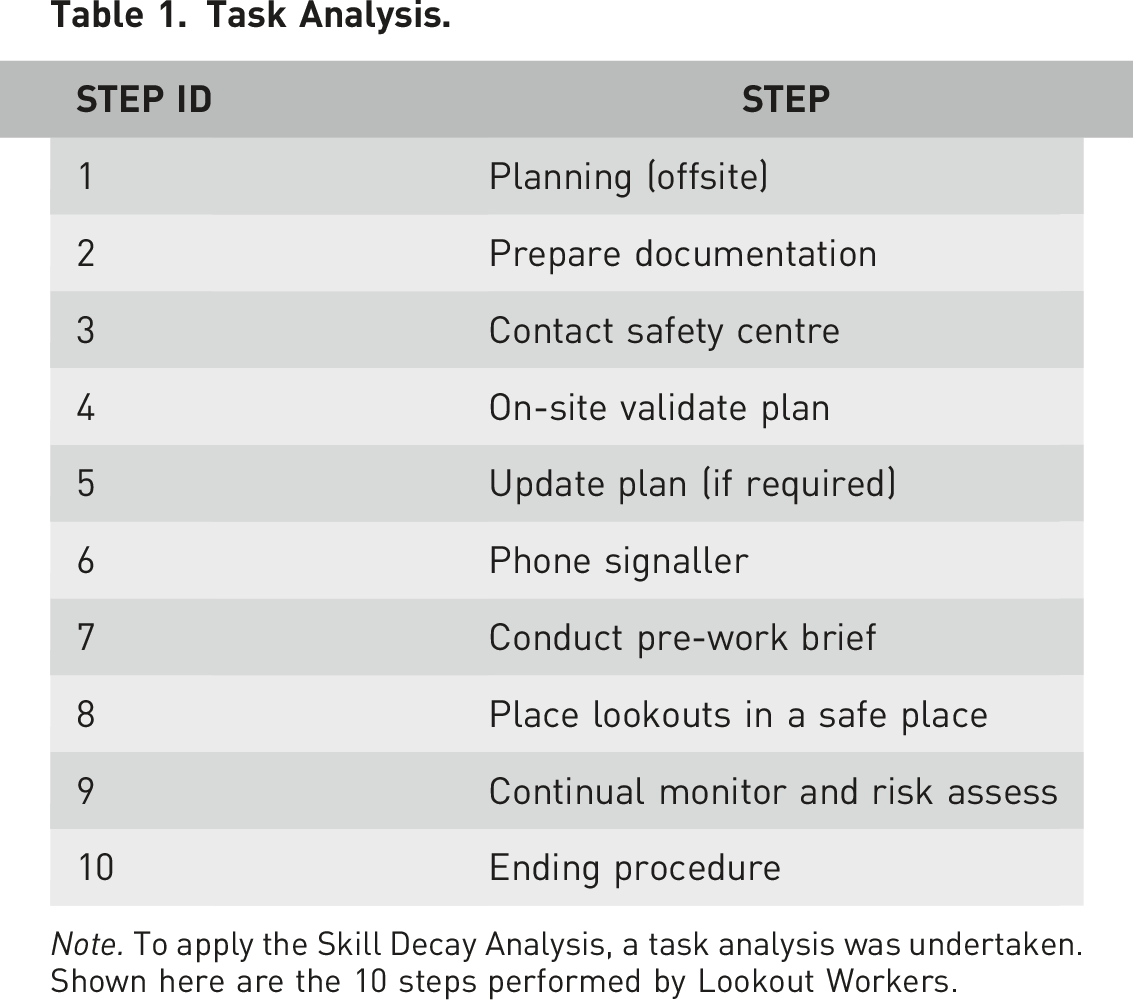
Note. To apply the Skill Decay Analysis, a task analysis was undertaken. Shown here are the 10 steps performed by Lookout Workers.
Task-Characteristics’ Questionnaire and Scoring
Three subject matter experts (SMEs) who were Protection Officer trainers independently rated each Lookout Working step according to the skill decay 10-item questionnaire (see Appendix B). Following completion of the questionnaire by the SMEs, a final response sheet was arrived at, using a majority agreement process (as per the UDA manual).
Skill Decay Prediction Graphs for Lookout Working
Following the UDA procedure, the value column from the questionnaire scores (see Appendix B) was matched to the activity scores in the model’s prediction table (see Appendix A) to generate the Skill Decay prediction graph for Lookout Working. This graph is shown in Figure 1. Skill Decay prediction graph for Lookout Working.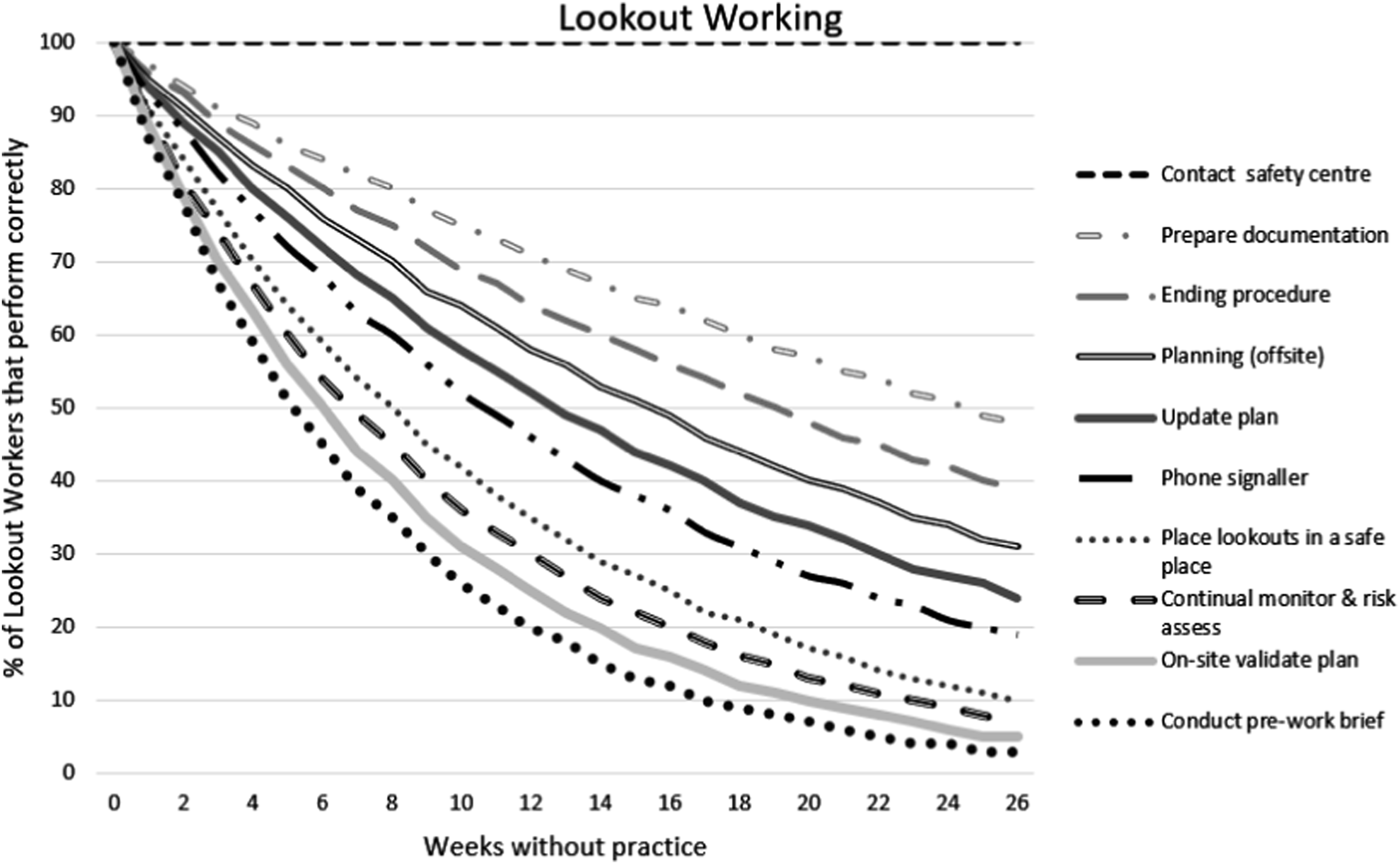
The steps shown are in the same order as the decay curves. The uppermost step, ‘contact safety centre’ has the slowest rate of decay (none in fact), while ‘conduct pre-work brief’ has the most rapid skill decay.
Interpreting the Skill Decay Graph
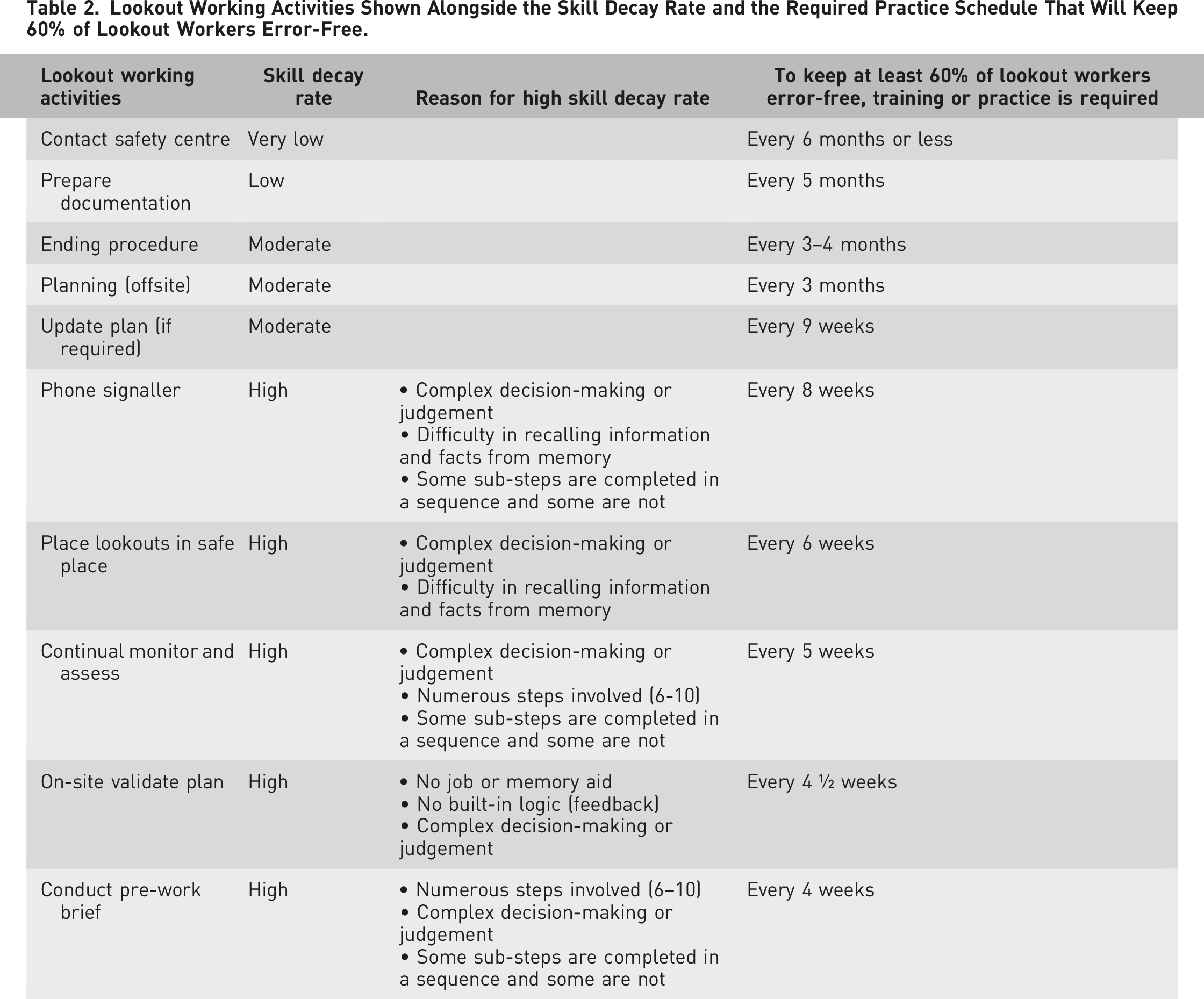
Lookout Working Activities Shown Alongside the Skill Decay Rate and the Required Practice Schedule That Will Keep 60% of Lookout Workers Error-Free.
A PRACTITIONER VIEW: THE PROS AND CONS OF APPLYING THE SKILL DECAY ANALYSIS TOOL
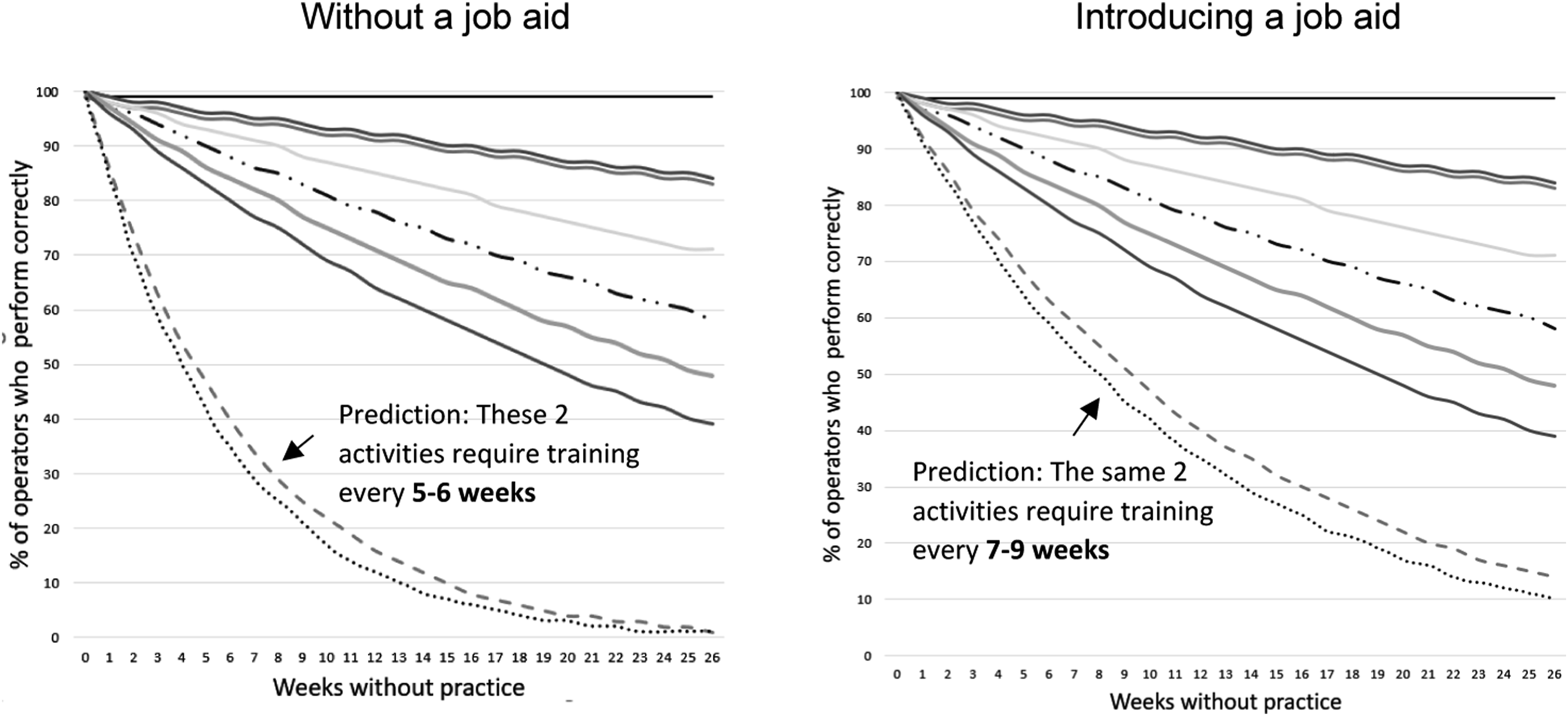
A range of tangible, useful benefits were identified from the skill decay analysis and these are summarised below: 1. Because the model provides a week-by-week prediction of skill decay over periods of non-use, and does this for each activity in a task, we used the results to guide refresher training scheduling for Lookout Workers. This enabled a more judicious use of organisational training resources. Also, coaching conversations or simulation-based experiences were considered in instances where practice opportunities or formal training solutions were limited. 2. By running ‘what if’ scenarios through the model, we found it useful to see how task variables change the predicted skill decay trajectories. For example, see Figure 2. We were able to see how a job aid being introduced for particular activities would impact the need for refresher training. In the example shown in Figure 2, the model predicted that for two activities that did not have a job aid (a quick reference or ‘cheat sheet’), refresher training would be required every 5–6 weeks. With a job aid however, the same two activities would require refresher training every 7–9 weeks. 3. The model can be used to understand how various task design considerations can reduce the potential for decay skill decay in a task. For example, by reducing the number of steps performed or providing a higher quality job aid (i.e., a cheat sheet that has all the information operators need to complete an activity), by reducing the complexity in decision-making, or allowing more time to perform an activity, the skill decay prediction curves are ‘flattened’. 4. Lookout working as well as other transport tasks that have utilised the skill decay approach by us have indicated high face validity. The workers, managers and personnel involved in the task, relayed that the decay prediction graphs accurately reflect task areas known to become ‘rusty’ if not practiced. The skill decay model showing the impact of ‘having a job aid’ versus not having a job aid, for two activities. According to predictions, introducing a job aid changes the need for refresher training from every 5–6 weeks, to every 7–9 weeks.
Some cons or limitations of the approach: 1. The UDA approach does not take into account all possible variables that impact skill decay. It primarily focuses on 2. The UDA skill decay analysis is also a rather specific tool for a specific purpose. It is not an error analysis or a training needs analysis, but rather, is focused on answering the question of how frequently a task should be performed to prevent operator error. The approach defines error rather broadly, and sees an ‘error-free performance’ as one where operators do not skip steps, add steps, perform steps incorrectly or exceed time limits in a task. In organisational contexts where error itself is an issue or if there is a need to map competencies and tasks to training priorities (rather than answering training frequency questions), other tools such as the Risk-Based Training Needs Analysis (RBTNA) or error analyses would be appropriate. In our experience, we have found it useful to undertake a skill decay analysis on tasks that have already been part of an RBTNA and have emerged as being important and infrequently performed.
SUMMARY
As discussed at the beginning of this paper, the workplace is rapidly changing. Highly automated and unmanned systems are becoming more prevalent in many industries. Often the role of the human in these systems is to monitor and either manually intervene when the system fails, or temporarily support the system in tasks that would normally be automated. The challenge is that these tasks may not have been practiced for some time by operators. In safety domains, such situations of manual intervention are by definition ‘infrequent application of safety critical skills in non-routine or dynamic settings’. Understanding the skills that people will need in these degraded situations and how they can retain those skills over long periods of non-use is pertinent.
While any activity that is repeated frequently enough over a sufficient number of years can become relatively robust against skill degradation, this is less likely to occur for tasks that are infrequently required to be performed in organisations. In complex operational environments today, safety critical roles, for example, often require operators to perform in non-routine and dynamic settings, which means individuals must maintain their competence during periods of non-use, to avoid costly errors. A question that faces organisations is how frequently should an operator receive training or undertake practice in an activity, to remain skilled and competent in that task?
In this paper, we describe a skill decay prediction model (the UDA) that we adapted and applied to Lookout Working tasks. We have also applied the model to a range of other safety activities performed within our organisation. The tool has enabled us to understand which steps or activities within particular tasks are more prone to decay and which may require more frequent practice opportunities or refresher training. The approach was also useful in identifying which characteristics of these tasks were driving the decay risk, allowing us to consider job design factors in our interventions.
KEY POINTS
• We wrote this paper having applied the skill decay model in Transport with the purpose of sharing lessons learned with practitioners in other industries. • Addressing skill decay has important implications for many organisations in areas that include public and employee safety, managing human error and risk, workforce planning, job design, training and competency frameworks. • While the Skill Decay Model that we applied is not without its limitations, we found it an easy-to-use tool that may prove useful to other practitioners and operators across a range of industries and tasks.
Supplemental Material
Supplemental Material - Predicting Skill Decay: A Practical Application of the Skill Decay Analysis Tool
Supplemental Material for Predicting Skill Decay: A Practical Application of the Skill Decay Analysis Tool by Sue Brouwers, and Wendy Joung in Ergonomics in Design.
Footnotes
Declaration of Conflicting Interests
The author(s) declared no potential conflicts of interest with respect to the research, authorship, and/or publication of this article.
Funding
The author(s) received no financial support for the research, authorship, and/or publication of this article.
Supplemental Material
Supplemental material for this article is available online.

References
Supplementary Material
Please find the following supplemental material available below.
For Open Access articles published under a Creative Commons License, all supplemental material carries the same license as the article it is associated with.
For non-Open Access articles published, all supplemental material carries a non-exclusive license, and permission requests for re-use of supplemental material or any part of supplemental material shall be sent directly to the copyright owner as specified in the copyright notice associated with the article.
